REPRODUCTION
Reading edition
Age Classes
Each prairie vole was assigned to one of three age classes (juvenile, subadult, or adult) principally on the basis of weight, but partly on the quality and color of the pelage. The three age classes are characterized in table 8.
Table 8. Characters of Juvenile, Subadult, and Adult Prairie Voles
JuvenileSubadultAdult
Less than 21 grams21-38 grams38 grams or more
Weight usually less than 20 gramsAverage weight 30-32 gramsAverage weight 40-45 grams
Entire pelage dullPelage of rump dull; rest of pelage glossyPelage usually entirely glossy (rump sometimes dull)
Dorsal color blackDorsal color grizzled except on rumpEntire dorsal color grizzled except sometimes on rump
Fecundity
Hamilton (1941:4) found for Microtus pennsylvanicus that macroscopic tubules of the cauda epididymis were an indication of fecundity. By noting the size of the tubules (whether macroscopic or not) and by making smears from them in approximately every 25th male caught, I found that the presence of sperm was positively correlated with large-sized tubules of the cauda epididymis in Microtus ochrogaster. Inferentially, males with sperm were fecund.
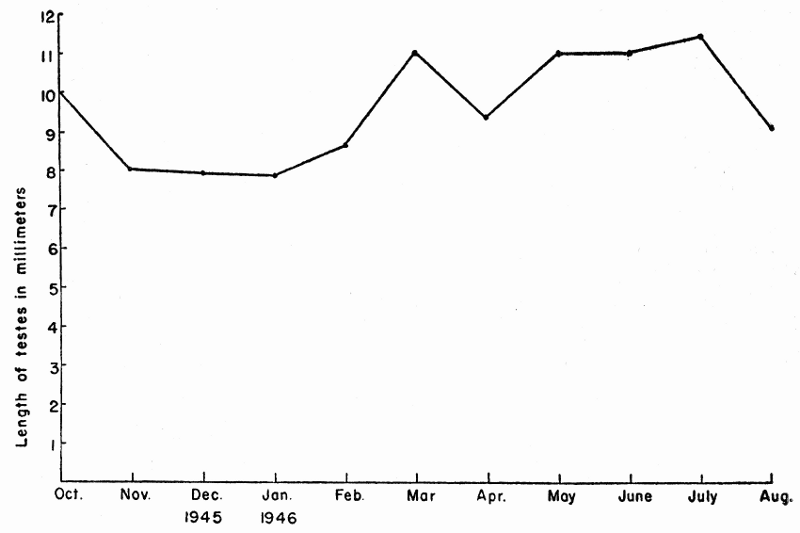
There is a relationship almost positive between the size of the tubules of the cauda epididymis and the length of the testes. Testes longer than 7 mm. have macroscopic tubules in the cauda, and in testes shorter than 7 mm. these tubules cannot be seen with the naked eye, Hamilton (1937b) found that in M. pennsylvanicus testes smaller than 8 × 4 mm. did not contain sperm. The testes of the prairie vole descend into the scrotum in the breeding season. In the two winter months, when the voles did not bring forth young, the testes decreased in size (see figure 3) and were withdrawn into the body cavity. The presence of the testes in the body cavity does not mean that a vole is not in breeding condition, for many specimens with abdominal testes were fecund.
The females were considered to be fecund if they were gravid, or if there were placental scars in the horns of the uteri.
Figure 2. Fecundity of Prairie Voles by Months. Adults and Subadults are Considered Together.
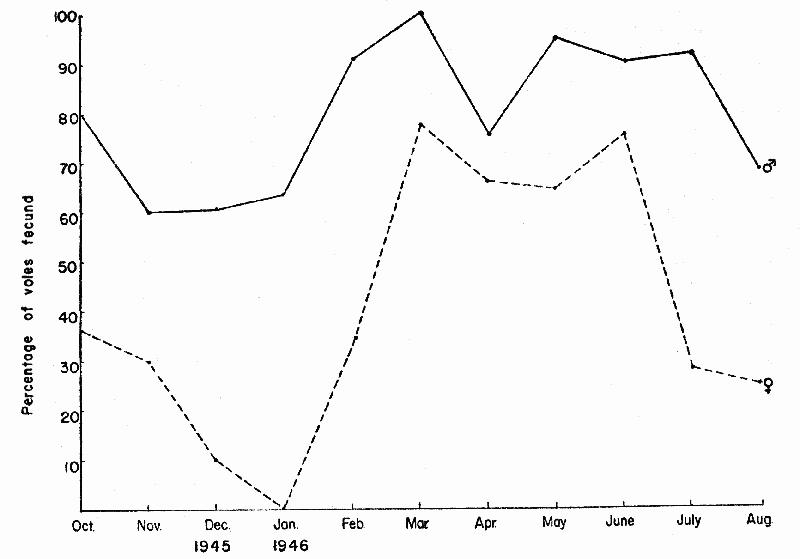
Figure 3. Seasonal Changes in the Length of Testes.
Size of Litters
The number of mammae characteristic of a species of vole may be a rough guide to the average size of a litter for that species. The prairie vole has fewer mammae (three pairs) than some other voles in North America, and might, therefore, be expected to have smaller litters. Fifty-eight gravid females of Microtus ochrogaster examined by me had an average of 3.4 embryos each; the number of embryos ranged from one to seven. Hamilton (1936a) gave 5.07 as the average number of young per litter in M. pennsylvanicus. Hatfield (1935) stated that M. californicus has an average of 5.7 young in a litter. Both pennsylvanicus and californicus normally have four pairs of mammae. The expectation as to the size of the litter seems to be realized. In the prairie vole one pair of mammae is pectoral and two pairs are abdominal. Usually a lactating vole showed evidence of only the abdominal mammae having been in use.
The size of litters was found to vary with the season of the year (see table 9). Gravid females were collected in every breeding month except September.
Table 9. Average Size of Litters of Microtus ochrogaster by Months[G]
Jan.Feb.Mar.Apr.MayJuneJulyAug.Sept.Oct.Nov.Dec.
02.83.93.23.43.12.83.0..3.22.60
..(4)(10)(6)(8)(9)(5)(2)..(5)(5)..
Table 9 shows that the prairie vole produced the largest litters in March. A comparison of table 9 with figure 2 shows that the largest litters were produced at the height of the breeding season. Baker and Ransom (1933), studying Microtus agrestis, also found that larger litters were characteristic of the height of the breeding season; and that at the beginning and at the end of the breeding season the litters averaged smaller.
The size of litters varied also with the age of the female. To place a gravid female in its proper age class, the weight of the embryos was subtracted from the total weight, and the remaining weight was used as the body weight. The average size of the litters of 14 subadults was 2.9, and in 35 adults it was 3.4. Hatfield (op. cit.) found that the younger females of M. californicus gave birth to smaller litters than did the adults.
Not included in either of the above analyses are nine gravid females collected in November in a pasture watered by an artesian spring in Atchison County, Kansas. In this pasture there was a high concentration of prairie voles, and the percentage of fecundity was much higher than in Douglas County at the same time. In November only 29 per cent of the female prairie voles in Douglas County were fecund, as against 59 per cent in Atchison County. The average number of embryos of these nine voles was 4.1. Data from Atchison County are not included in table 9.
The Breeding Season
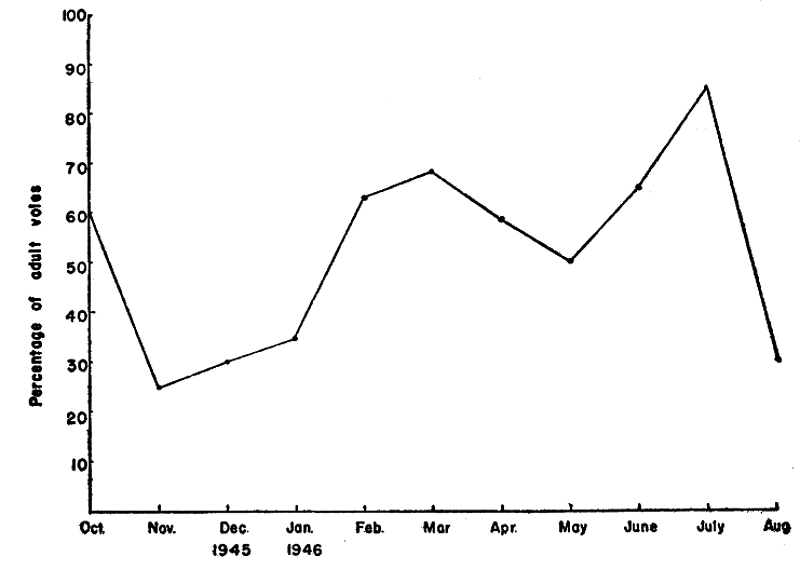
In October, 1945, when this study was begun, the prairie vole was bringing forth young. In the winter of 1945-'46 at Lawrence, Kansas, there was a cessation of reproduction. The reproductive activity was measured in terms of the fecundity of the subadults and the adults of both sexes. Figure 2 suggests that the decline was most marked in December and January; no gravid females were collected in these two months, although two females trapped in the first week of December were lactating. In October, November, and December, 85 per cent of the breeding females were adults. In October, 85 per cent of the adult females were fecund, and in November, this figure was 80 per cent. Reproduction at this season, in the females, it appears, was largely a function of the adults. The proportion of adults to the rest of the population was calculated for each month; and the monthly changes in relative numbers of adults is shown in figure 4. In November, December, and January there was a scarcity of adult voles in the population. The autumnal decline in reproduction occurred simultaneously with the disappearance of these adults, and is thought to have been largely a result of it.
Reproductive activity began in February; and in this month one-third of the females contained embryos, and 90 per cent of the males were fecund. Reproduction reached its height in March when fecundity for the females and males was 77 per cent and 100 per cent respectively. In April both sexes showed signs of being less productive, and still later in the spring the percentage of fecundity remained at slightly over 65 for both sexes, this figure being higher for the males than for the females for any one month. From January to February there was a 30 per cent increase in the percentage of adults in the population; and for this period, there was a 33 per cent increase in the fecundity of both males and females. In February, 80 per cent of the fecund females were adults. The breeding in the late winter, as in the fall, is thought to depend upon the percentage of adults in the population. Hamilton (1937b) noted a similar correlation between winter breeding and dominance of adults in Microtus pennsylvanicus in New York. Fisher (1945) found that the prairie vole continued to breed throughout the winter of 1943-'44 in Missouri; in such a case, one would expect to find a large proportion of adults in the population.
Figure 4. Seasonal Changes in the Numbers of Adults in Relation to the Total Population of Prairie Voles.
Throughout the winter of 1945-'46, at Lawrence, the majority of males were fecund; but fecundity in the females was much less, and in January, no females showed signs of reproductive activity. From this it appears that the females, not the males, limit the breeding season of this species.