Front matter (continued 4)
Reading edition
Fig. 5. T. o. ornata in attitude of alertness after detecting intruder (× 3∕8).
Fig. 6. Tracks of T. o. ornata in muddy ravine (× 1∕8) (June 5, 1956).
PLATE 29
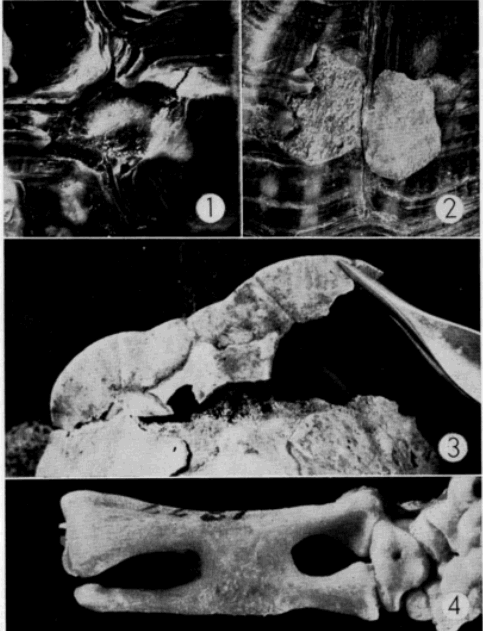
Fig. 1. A small, nearly-healed, injury on the carapace of an adult T. o. ornata (× 2). Note regenerated epidermis at bottom of depression and two pieces of dead bone ("splinter scars") at upper right margin of depression.
Fig. 2. Injured area on the carapace of a juvenal T. o. ornata (× 3) with dead bone removed and laid to the right, exposing regenerating epidermis in its early stages.
Fig. 3. Anterior edge of carapace (held away with forceps) of specimen of T. carolina (KU 51461, Gulf Co., Florida) that had been badly burned (× 8∕9). Nearly all the scutes of the shell had fallen off and large pieces of dead bone could be pulled away, exposing a gnarled mass of regenerating bone and epidermis.
Fig. 4. A fracture that has healed and joined the tibia (upper bone) to the fibula in a specimen of T. o. ornata (KU 1877, × 3½).
PLATE 30
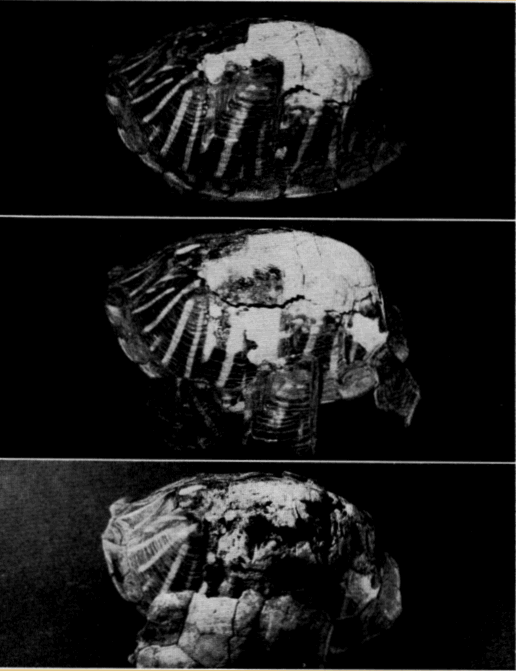
Top: A shell of T. o. ornata (× ½) as it was found at the Damm Farm June 1, 1956. A serious injury (probably resulting from burns) had exposed a large area of dead bone on the carapace.
Center: Same shell with some of scutes removed.
Bottom: Same shell with dead bone removed to expose regenerating epidermis and bone. Note that the injury involved several of the neural bones; the turtle probably died as a result of this injury but not before regeneration was approximately one-half completed.
Terrapene ornata seems to concentrate its breeding season (laying, incubation, and hatching of eggs) more nearly in the middle of the warm season than does T. c. carolina. This concentration probably is an adaptation for breeding in open habitats where, under environmental temperatures less equable than in forest, eggs would develop more rapidly and hatch sooner but would be less able to survive winter temperatures.
Males of T. o. ornata become sexually mature when younger and smaller than females and rarely grow as large as females. Nichols (1939a:20) indicated the reverse to be true of T. c. carolina; Nichols further indicated that growth continued some six to eight years after puberty. Most individuals of T. o. ornata attain maximum size within two to three years after puberty.
Although it is difficult to be certain about the adaptive value of color and pattern, it seems that in box turtles, as in many other kinds of animals, patterns and colors most nearly blending with those of the habitat have some selective value in providing concealment from enemies. The pattern of linear radiations in T. o. ornata closely resembles the patterns formed by light passing through grasses and associated vegetation and camouflages the turtle. In a similar manner, partial or complete loss of radial markings in T. o. luteola seems to provide concealment in habitats where vegetation is sparse and where blending with the substrate is of survival value. The patterns of blotches and broken radiations in most of the subspecies of T. carolina likewise provide camouflage by tending to match patterns formed by the light passing through a leafy canopy.
Although ornate box turtles are omnivorous, they probably depend on insects as a dietary staple. In years when preferred kinds of insects were unusually abundant, the turtles grew more than in other years. A large proportion of the insects eaten is obtained by foraging in or near dung. Alteration of the dung community—at least in a physical sense, but presumably also by influencing the successional stages of the dung biota—is one of the few evident effects of box turtles on the environment. Although certain kinosternids (Carr, 1952:93), emyids (Deraniyagala, 1939:257; Loveridge and Williams, 1957:198), and testudinids (Loveridge and Williams, op. cit.:247) eat mammalian feces, T. ornata is seemingly the only chelonian that habitually seeks its staple diet in dung. The habit seems to be yet another specialization for terrestrial existence. The carnivorous habits of T. ornata reverse the general trend toward omnivorous and herbivorous habits in other turtles that have become partly (emyids) or wholly (testudinids) terrestrial.
It seems remarkable that none of the species of true tortoises occurring in the grasslands of the world has developed insectivorous habits or utilized the unique food niche (in regard to dung-foraging) filled by ornate box turtles in the Great Plains; tortoises are, as far as is known, strictly herbivorous. The ranges of Gopherus and Terrapene are now almost mutually exclusive and the two kinds do not compete with each other for food in the few places where they occur together. It is known, however, that box turtles (T. longinsulae, ornata-like, earliest known box turtle) and true tortoises (genera Testudo and Gopherus, see Williams, 1950:25-26, Fig. 2) occurred together in what is now the Great Plains in early Pliocene times and probably for some time before and after this. Assuming that food habits of fossil representatives of these genera were somewhat like the habits of recent representatives, ornate box turtles may have developed insectivorous habits at a time when other food niches were filled by herbivorous tortoises. Box turtles possibly survived subsequent changes in habitat that made it impossible for populations of large tortoises to exist in the Great Plains.
SUMMARY
Box turtles of the genus Terrapene are emyid turtles that are specialized for terrestrial existence. Two of the seven species now recognized—T. ornata and T. carolina—occur in the United States. Terrapene carolina inhabits forested areas in the east whereas T. ornata is characteristic of open grassy areas in the west; the ranges of the two species overlap in the broad belt of prairie-forest ecotone in the central United States. Terrapene ornata is considered to be the most specialized of living box turtles.
The natural history of T. o. ornata Agassiz was studied in the period, 1953 to 1957. Intensive field studies were made in Douglas County, northeastern Kansas, on a small area of prairie and on the University of Kansas Natural History Reservation. Field observations were made also in a number of other places in eastern Kansas. Laboratory studies supplemented field studies.
Habitats occupied are chiefly open areas; they vary in regard to food supply, temperature, moisture, and kind of soil. The grassy prairies of Nebraska, Kansas, Oklahoma, and northern Texas seem to provide optimum habitat for ornate box turtles; in these areas box turtles are active on a majority of days from April to October. The subspecies luteola is adapted to the more rigorous and arid environment of the southwestern United States, where activity may be possible for only a few weeks in the year. The remainder of the year is spent in a state of quiescence. Factors limiting the distribution of T. ornata are: 1) the presence of a substrate too hard to permit digging of nests and forms (altitudinal distribution in southwestern United States and distribution at western edge of the range); 2) temperatures causing the ground to freeze deep enough (approximately 30 inches) to kill turtles in hibernacula (northern edge of range); and, 3) the lack of one or more relatively wet periods in the course of the warm season, preventing at least temporary emergence from quiescence (southwestern part of range). The activities of man probably have affected population density in local areas but limit the geographic range only in the north (Blanchard, 1923:19-20, 24) where intensive cultivation probably has excluded the species.
Preferred habitat in northeastern Kansas is open rolling grassland grazed by cattle; populations are most dense near natural breaks in the grassy vegetation such as fences, scattered rocks on hillsides, ravines, and stream-beds.
Mating occurs most commonly in spring and autumn; courtship behavior includes pushing and biting on the part of the male. In coitus the hind legs of the male are held tightly by the female; the male falls backward after coitus, still clasped by the female. A few sperm are stored in the oviducts; fertilization without reinsemination can occur. The spermatogenic cycle begins in May and reaches its peak in September, when large numbers of sperm and spermatids are present in the testes; the cycle is completed in October, when sperm pass into the epididymides. The testes are smallest in spring and largest in September. Females are inseminated with sperm produced in the preceding year. The ovarian cycle begins in midsummer, soon after ovulation, and continues up to the time of the next ovulation. Follicular growth is rapid in the period from spring emergence to ovulation. Large follicles remaining after ovulation represent, in many instances, eggs that will be laid later in the same season. Follicular atresia is never great enough to account for the destruction of all large follicles remaining after ovulation. All mature females lay at least one clutch of eggs per year. It is estimated that one-third of the females produces two clutches of eggs in a single season. Second clutches contain fewer eggs than first clutches. An alternation of ovarian activity occurs, whereby one ovary is more active than its partner in one season and less active in the next season. Alternating activity of ovaries accounts in part for the reduced number of eggs in young females, breeding for the first time, and in older, nearly senile females. Extrauterine migration of ova results usually in a more even distribution of eggs in the oviducts. Corpora lutea constitute an accurate record of the number of eggs produced by the ovary as well as the number of eggs laid.
Nesting occurs from May through July but is most common in mid-June; some of the females nesting early in the season lay a second clutch of eggs in July. Nests are dug in the earth by the female using her hind legs. Preferred nesting sites are open, well-drained places with a soft substrate. The nesting site is selected after a period of wandering, in which the female tests the substrate at a number of places; some females search for a nest site for more than a week. Nest digging begins in the evening and is usually completed after dark. Captive females dug a preliminary cavity in which the body rested during the digging of the main nest cavity. The entire clutch of eggs is laid in one nest. The average number of eggs in 23 clutches was 4.7 (range, 2 to 8). The average size of eggs tends to be inversely proportional to the number of eggs in a clutch. Eggs increase in bulk by absorption of water in the course of incubation. Immersion in water for short periods does not harm eggs. The incubation period under favorable environmental conditions is approximately 65 days; cool, damp conditions prolong the incubation period and probably constitute an important factor of prenatal mortality in certain years. Eggs that do not hatch before winter probably do not survive. Emergence of hatchlings from the nest may, however, be delayed until spring if the soil is dry in autumn. Hatchlings can probably escape freezing by burrowing into the walls of the nest. Infertility and prenatal mortality account for at least 40 per cent of the eggs laid, according to laboratory findings. Progeny of a single adult female (considering factors of mortality, multiple layings, and average age of puberty) would number approximately 300 after 20 years. Reproductive processes probably continue throughout life, although possibly at a somewhat reduced rate in later life.
Young box turtles are active soon after hatching but become quiescent if allowed to burrow in soil or if they are covered with damp cotton. Some captive hatchlings take live food in the first days of life but others do not eat until the following spring; initiation of growth is coincident with initiation of regular feeding. The yolk sac retracts mainly during hatching; it sometimes ruptures after hatching. The caruncle remains on the beak for a variable length of time, but never is present in the spring following hatching.
Major growth-rings on the epidermal laminae are formed regularly, one after each season of growth, in the first 10 to 14 years of life. Minor growth-rings occur between major rings and are shallower. Growth of epidermal laminae results from the formation, in spring, of a new layer of epidermis beneath the existing scute. The peripheral projection of the new layer is distinct in texture and color from the older part of the scute and is separated from it by a major growth-ring. Minor growth-rings form when growth slows or temporarily stops during periods of quiescence; no new layer of epidermis is formed. Growth-rings constitute an accurate record of growth that can be studied at any time in the life of the turtle; they are accurate indicators of age only as long as regular annual growth persists.
Growth in the season of hatching depends on early hatching and early emergence from the nest. Turtles that remain in the nest until spring probably do not grow. Slightly less than half of the free-living individuals studied grew in the season of hatching. Precociousness in early life often results in the attainment of sexual maturity at an earlier than average age.
Growth is rapid at first (increments in plastral length average 68, 29, and 18 per cent, respectively, in the first three years) and then slows gradually until puberty. Attainment of sexual maturity is more closely correlated with size than with age. Males mature when smaller (76 per cent were mature when plastron 100 to 109 mm. long) and younger (average age, eight to nine years) than females (66 per cent were mature when plastron 110 to 119 mm. long, average age at maturity, ten to eleven years) but females grow larger than males. A few individuals of each sex reach puberty three to four years sooner than average.
The average number of growing days per season is approximately 160. Amount of growth in any season depends on climatic factors that influence food supply and foraging conditions. Growth rate is directly correlated with precipitation, being highest when large populations of grasshoppers and long periods of favorable weather occur in the same year. Zones of epidermis formed in years when growth was especially slow or especially fast constituted landmarks that were helpful in interpreting growth-histories. Growth stops two to three years after puberty. The total growing period is estimated to be not more than 15 to 20 years. Longevity is estimated to be approximately 50 years.
A number of changes in structure and appearance occur in the period from hatching to puberty. Fontanelles of the bony shell close at or before puberty. Movable parts of the plastron are not functional until the fourth year. Markings on the carapace change from a series of dots to distinct, straight-sided radiations, and a similar pattern develops on the plastron. Markings on the heads of females resemble those of juveniles but males have greenish heads. Males further differ from females in having a red iris, more brightly colored antebrachial scales, and a turned in first toe.
Analysis of some 500 body temperatures (Centigrade) obtained under natural conditions revealed the following: the optimum temperature for activity is near 30 degrees; box turtles emerge from cover usually when body temperature is 24 degrees or higher, and almost never when the body temperature is below 15 degrees; body temperature is raised to optimum by basking in open areas although activity begins at suboptimum temperatures if basking is impossible; cover of dens, burrows, or forms is sought when the body temperature rises above 30 degrees; and, maximum and minimum body temperatures that would be lethal to box turtles (for prolonged periods) are approximately 40 and zero degrees, respectively. Laboratory experiments showed speed of response to environmental temperature to be inversely proportional to bulk; hatchlings could be chilled or warmed more than twice as fast as adults and were active within a narrower range of temperature. Ornate box turtles in general are subject to a narrower range of thermal activity than are aquatic turtles that occur in the same areas.
Box turtles are dormant approximately five and one-half months of the year—from late October to mid-April. Warm weather in November and late March sometimes stimulates temporary activity but dormancy is uninterrupted from mid-November to early March. Forms, dens, and burrows are used as hibernacula. Depth of hibernacula is dependent on severity of temperatures and amount of vegetational cover; hibernacula in open grassland were seven to 18 inches deep whereas those in wooded areas were six inches or shallower. Box turtles are ordinarily solitary when hibernating. Injuries and deaths due to freezing probably occur in the coldest part of the winter. The lowest body temperature of a turtle that survived a winter was 2.7 degrees; an individual, the temperature of which was nearly zero for several days, subsequently died. Turtles burrow upward at the end of hibernation and remain just below the surface for a week or two before emerging. The primary stimulus for emergence seems to be a period of warm moist weather.
Populations of T. ornata observed under natural conditions were chiefly carnivorous, although captives ate a variety of animal and vegetable matter. Insects, consisting chiefly of beetles, caterpillars, and one species of grasshopper, comprised approximately 89 per cent (by volume) of the food present in stomachs. Beetles (chiefly scarabaeids and carabids) are obtained in or near dung and seem to constitute the most important staple element of the diet. Piles of dung, disturbed by turtles in the course of their foragings, were characteristic "sign" of T. ornata in the areas studied.
Insects form the bulk of the diet for most of the year, although certain other foods, when especially abundant for short periods (mulberries for example), are eaten in large quantity or eaten to the exclusion of all other foods. Ornate box turtles occasionally eat the eggs and young of ground-nesting birds and slightly damage vegetables, but in no instance do these feeding habits significantly affect the economy of man. Box turtles probably benefit man by destroying large numbers of crop-damaging insects (locustids and noctuid caterpillars).
Box turtles were more numerous than most kinds of reptiles at the Damm Farm and were the most conspicuous of any kind of reptile. One hundred and ninety-four turtles were marked; one-fourth of these were recaptured at least twice. Population density in certain areas of favorable habitat ranged from 2.6 to 6.3 turtles per acre. The total number of individuals on the study area was estimated to be 286. The marked population consisted of 53 per cent adult or subadult females, 31 per cent adult males, and 16 per cent juveniles of undetermined sex. Only six individuals had plastra shorter than 60 millimeters. Small box turtles are not so rare as these samples indicate; they are infrequently obtained because their smallness and ability to blend with the substrate make them difficult to see. More females than males were found in all months of the season of activity, excepting April and August when more males were found; the preponderance of females was greatest in the nesting season (June and July).
Ornate box turtles walk with the shell held off the substrate. They are able to climb steep embankments or low barriers with some facility. Swimming ability is sufficient to permit survival in water and traversal of water-barriers but ornate box turtles almost never swim voluntarily.
Daily activity consists of periods of basking, foraging, and rest, the durations of which are influenced by temperature and humidity. There is no activity after dark except that of nesting females. After several days of activity there is a period of rest; rest periods seemed not to be correlated with climatic conditions. The average distance traveled per day in summer is 200 to 300 feet. Movements of gravid females are more extensive (average, 363 feet per day) than those of other members of the population; one individual traveled approximately one-fourth of a mile in a single day. Turtles removed from their normal home ranges traveled farther per day than any other group. Movements in autumn are less extensive (average, 152 feet per day) than at other times in the season of activity.
Individual box turtles tended to remain in small areas for long periods; these areas were interpreted as home ranges. The estimated average radius of 44 home ranges was 278 feet (average area, 5.6 acres). The average area of eight home ranges that were actually measured was five acres. General suitability of habitat and certain physical features of terrain (rock fences, ravines, barren fields) that acted as barriers were thought to be the most important factors governing size of home range. Of two turtles removed more than one-fourth of a mile from their home ranges, one homed and one did not. Home ranges of turtles of all ages and sexes overlap broadly. There was no indication that territoriality or social hierarchy existed in the population studied.
Box turtles are subject to injury from natural causes that include fire, cold, molestation by predators, and trampling by cattle. Automobiles and farm machinery now constitute major causes of mortality and serious injury. Capacity to recover after serious injury is great but there is increased chance for secondary injury, infection, and predation in the period of recovery. Pits on the shell from unknown causes ("shell pitting") are less common in ornate box turtles than in other kinds of turtles.
Ectoparasites infesting T. ornata are larvae of chigger mites (genus Trombicula) and larvae of bot flies (Sarcophaga cistudinis). Ectoparasites usually have little adverse effect on the turtles, although heavy infestations cause occasional injury or death.
Few natural enemies other than man are known; however most wild carnivores as well as opossums, large birds, and domestic dogs and cats are suspect as predators. The incidence of predation on eggs and small juveniles is far greater than on older juveniles and adults. Adults of T. ornata occasionally attack smaller individuals.
Ornate box turtles are able to detect the presence of intruders, by sight, from a distance of several hundred feet in open country; apparently, intruders are not detected until seen. Defensive behavior is passive; the shell is closed tightly in response to painful stimuli and, in some instances, at the sight of an intruder. Juveniles usually void odoriferous fluid from the musk glands when handled but adults do so only in response to pain or injury. The function of the musk glands is unknown; possibly the odor of musk is a means of sexual identification or stimulation. Although the musk is probably distasteful to predators, repellent odor alone seems to be of doubtful value as a defense mechanism.
LITERATURE CITED
Agassiz, L.
1857. Embryology of the turtle. Contributions to the natural history of the United States, 2(3):451-643, 27 pls., 12 wood-cuts in text, tables. Little, Brown and Co., Boston.
Allard, H. A.
1935. The natural history of the box turtle. Sci. Monthly, 41:325-338.
1939. Mating of the box-turtle ending in death of the male. Copeia, 1939(2):109.
Altland, P. D.
1951. Observations on the structure of the reproductive organs of the box turtle. Journ. Morph., 89:599-621, 16 figs.
Auffenberg, W.
1958. Fossil turtles of the genus Terrapene in Florida. Bull. Florida State Mus., Biol. Sci., 3(2):53-92, 15 figs., 5 tables.
Bailey, R. M.
1948. Winter mortality in the snake Storeria dekayi. Copeia, 1948 (3):215.
Belding, D. L.
1952. Textbook of clinical parasitology. Appleton-Century-Crofts, Inc., New York, viii + 1139 pp., 283 figs.
Blanchard, F. N.
1923. The amphibians and reptiles of Dickinson County, Iowa. Univ. Iowa, Studies Nat. Hist., 10:19-26.
Bogert, C. M.
1937. Note on the growth rate of the desert tortoise, Gopherus agassizi. Copeia, 1937(3):191-192.
Booth, K.
1958. Development of eggs and young of desert tortoise. Herpetologica, 13(4):261-263.
Breder, R. B.
1927. Turtle trailing: a new technique for studying the life habits of certain Testudinata. Zoologica, 9(4):231-243.
Brennan, L. A.
1937. A study of the habitat of the reptiles and amphibians of Ellis County, Kansas. Trans. Kansas Acad. Sci., 40:341-347, 1 table.
Brumwell, M. J.
1940. Notes on the courtship of the turtle, Terrapene ornata. Trans. Kansas Acad. Sci., 43:391-392.
Cagle, F. R.
1939. A system of marking turtles for future identification. Copeia, 1939(3):170-173, 5 figs.
1944. Home range, homing behavior, and migration in turtles. Misc. Publ., Mus. Zool., Univ. Michigan, No. 61, 34 pp., 2 pls., 4 figs., 5 tables.
1945. Recovery from serious injury in the painted turtle. Copeia, 1945(1):45.
1946. The growth of the slider turtle, Pseudemys scripta elegans. Amer. Midl. Nat., 36(3):685-729, 8 figs., 3 pls., 13 tables.
1948. The growth of turtles in Lake Glendale, Illinois. Copeia, 1948(3):197-203.
1950. The life history of the slider turtle, Pseudemys scripta troostii (Holbrook). Ecol. Monogr., 20(l):31-54, 18 figs., 4 tables.
1954. Observations on the life cycles of painted turtles (genus Chrysemys). Amer. Midl. Nat., 52(l):225-235, 2 figs., 1 table.
Cagle, F. R.
, and
Tihen, J
.
1948. Retention of eggs by the turtle Deirochelys reticularia. Copeia, 1948(1):66.
Cahn, A. R.
1937. The turtles of Illinois. Illinois Biol. Monogr., 16(1-2):1-218, 31 pls., 15 figs., 20 maps, 20 tables.
Cahn, A. R.
, and
Conder, E
.
1932. Mating of the box turtles. Copeia, 1932(2):86-88, 2 figs.
Carpenter, C. C.
1956. Carapace pits in the three-toed box turtle, Terrapene carolina triunguis (Chelonia-Emydidae). Southwestern Naturalist, 1(2):83-86, 1 fig., 1 table.
Carpenter, J. R.
1940. The grassland biome. Ecol. Monogr., 10(4):617-684, 7 figs., 7 tables.
Carr, A.
1952. Handbook of-turtles: the turtles of the United States, Canada, and Baja California. Cornell Univ. Press, xv + 542 pp., 37 figs., 82 pis., 15 tables, 23 maps.
Clarke, R. F.
1950. Notes on the ornate box turtle. Herpetologica, 6(2):54.
1958. An ecological study of reptiles and amphibians in Osage County, Kansas. Emporia St. Res. Stud., 7(1):52 pp., 15 figs., 4 tables.
Cowles, R. B.
, and
Bogert, C. M.
1944. A preliminary study of the thermal requirements of desert reptiles. Bull. Amer. Mus. Nat. Hist., 83(5):261-296, figs. 1-3, pls. 19-29, 1 table.
Cunningham, B.
1939. Effect of temperature upon the developmental rate of the embryo of the diamond back terrapin (Malaclemys centrata Lat). Amer. Nat., 73:381-384.
Danini, E. S.
1946. Histological processes as observed in the regeneration of the carapace of the tortoise Emys orbicularis L. Bull. Acad. Sci. U. S. S. R., Biol., 5:581-594.
Deraniyagala, P. E. P.
1939. The tetrapod reptiles of Ceylon. Vol. 1, Testudinates and Crocodilians. Columbo, ix-xxii + 412 pp., 137 figs., 24 pls., 62 tables.
Ditmars, R. L.
1934. A review of the box turtles. Zoologica, 17(1):1-44, 41 figs.
Driver, E. C.
1946. Delayed hatching in the box turtle. Copeia, 1946(3):173-174.
Evans, L. T.
1952. Endocrine relationships in turtles III. Some effects of male hormone in turtles. Herpetologica, 8(2):11-14.
1953. The courtship pattern of the box turtle, Terrapene c. carolina. Herpetologica, 9(4):189-192, 6 figs.
1954. Courtship and territorial behavior of lower vertebrates (A review). Mimeographed, 50 pp.
Ewing, H. E.
1939. Growth in the eastern box-turtle with special reference to the dermal shields of the carapace. Copeia, 1939(2):87-92, 3 figs.
1943. Continued fertility in female box turtles following mating. Copeia, 1943(2):112-114.
Finneran, L. C.
1948. Reptiles at Branford, Connecticut. Herpetologica, 4(4):123-126.
Fitch, H. S.
1952. The University of Kansas Natural History Reservation. Univ. Kansas Mus. Nat. Hist., Misc. Publ., No. 4, 38 pp., 4 pls., 3 figs.
1954. Life history and ecology of the five-lined skink, Eumeces fasciatus. Univ. Kansas Publ., Mus. Nat. Hist., 8(1):1-156, 2 pls., 26 figs, in text, 17 tables.
1955. Habits and adaptations of the Great Plains skink (Eumeces obsoletus). Ecol. Monogr., 25:59-83, 11 figs., 10 tables.
1956a. An ecological study of the collared lizard (Crotaphytus collaris). Univ. Kansas Publ., Mus. Nat. Hist., 8(3):213-274, pls. 3-6, figs. 1-10, 9 tables.
1956b. Temperature responses in free-living amphibians and reptiles of northeastern Kansas. Univ. Kansas Publ., Mus. Nat. Hist., 8(7):417-476, 10 figs. in text, 6 tables.
1958. Home ranges, territories, and seasonal movements of vertebrates of the University of Kansas Natural History Reservation. Univ. Kansas Publ., Mus. Nat. Hist., 11(3):63-326, 6 pls., 24 figs., 3 tables.
Forbes, T. R.
1940. A note on reptilian sex ratios. Copeia, 1940(2):132.
Fox, W.
1952. Seasonal variation in the male reproductive systems of Pacific Coast garter snakes. Journ. Morph., 90(3):481-553, 5 pls., 13 figs., 3 tables.
1956. Seminal receptacles of snakes. Anat. Rec., 124(3):519-540, 3 pls., 1 table.
Gehlbach, F. R.
1956. Annotated records of southwestern amphibians and reptiles. Trans. Kansas Acad. Sci., 59(3):364-372.
Gould, E.
1957. Orientation in box turtles, Terrapene c. carolina (Linnaeus). Biol. Bull., 112(3):336-348, 5 figs.
Grant, C.
1936. The southwestern desert tortoise Gopherus agassizii. Zoologica, 21:225-229.
Hay, O. P.
1908a. Description of five species of North American fossil turtles, four of which are new. Proc. U. S. Nat. Mus., 35(1640):161-169, pls. 26-27, 3 figs.
1908b. The fossil turtles of North America. Carnegie Inst. Washington, Publ. no. 75, iii-iv + 568 pp., 113 pls., 704 figs.
Hildebrand, S. F.
, and
Prytherch, H. F.
1947. Diamond-back terrapin culture. U. S. Dept. Int., Fishery leaflet no. 216, 3 pp., mimeographed.
Hoffmann, C. K.
1890. Klassen und Ordnungen des Thier-Reichs. Bd. 6, Ab. 3, Reptilien. I. Schildkröten. Winter, Leipzig, 442 pp., 48 pls., 1 woodcut.
Hunt, T. J.
1957. Notes on diseases and mortality in Testudines. Herpetologica, 13(1):19-23, 1 table.
Latham, R.
1917. Studying the box turtle. Copeia, 1917(39):15-16.
Legler, J. M.
1954. Nesting habits of the western painted turtle, Chrysemys picta bellii (Gray). Herpetologica, 10(3):137-144.
1956. A simple and practical method of artificially incubating reptile eggs. Herpetologica, 12(4):290.
1958. Extra-uterine migration of ova in turtles. Herpetologica, 14(1):49-52, 1 fig.
Legler, J. M.
, and
Fitch, H. S.
1957. Observations on hibernation and nests of the collared lizard, Crotaphytus collaris. Copeia, 1957(4):305-307, 1 pl.
Lewis, T. H.
1950. The herpetofauna of the Tularosa Basin and Organ Mountains of New Mexico with notes on some ecological features of the Chihuahuan desert. Herpetologica, 6(1):1-10, 8 figs.
Lincoln, F. C.
1930. Calculating waterfowl abundance on the basis of banding returns. U. S. Dept. Agri., Circ. 118, 4 pp., 1 fig., 2 tables.
Loomis, R. B.
1956. The chigger mites of Kansas (Acarina, Trombiculidae). Univ. Kansas Sci. Bull., 37, pt. II, no. 19:1195-1443, 49 figs., 29 maps, 3 tables.
Loveridge, A.
, and
Williams, E.
1957. Revision of the African tortoises and turtles of the suborder Cryptodira. Bull. Mus. Comp. Zool., 115(6):165-557, 18 pls., 62 figs., 10 tables.
Lynn, W. G.
, and
Ullrich, M. C.
1950. Experimental production of shell abnormalities in turtles. Copeia, 1950(4):253-262, 2 pls., 2 figs.
Marr, J. C.
1944. Notes on amphibians and reptiles from the central United States. Amer. Midl. Nat., 32(2):478-490, 1 table.
Mattox, N. T.
1936. Annular rings in the long bones of turtles and their correlation with size. Trans. Illinois State Acad. Sci., 28:225-226.
Medsger, O. P.
1919. Notes on the first turtle I ever saw. (Abstract of a paper presented Nov. 15, 1918) Copeia, 1919(69):29.
McMullen, D. B.
1940. Cutaneous myiasis in a box turtle. Proc. Oklahoma Acad. Sci., 20:23-25, 2 figs.
Miller, L.
1955. Further observations on the desert tortoise, Gopherus agassizi, of California. Copeia, 1955(2):113-118, 1 pl., 2 figs., 2 tables.
Miller, M. R.
1948. The seasonal histological changes occurring in the ovary, corpus luteum, and testis of the viviparous lizard, Xantusia vigilis. Univ. California Publ. Zool., 47:197-224.
Mitsukuri, K.
1895. How many times does the snapping turtle lay eggs in one season? Zool. Mag. Tokyo, 7 (85):143-147.
Neill, W. T.
1948a. Hibernation habits of amphibians and reptiles in Richmond County, Georgia. Herpetologica, 4(3):107-114.
1948b. Odor of young box turtles. Copeia, 1948(2):130.
Nichols, J. T.
1939a. Data on size, growth and age in the box turtle, Terrapene carolina. Copeia, 1939(1):14-20, 2 figs., 2 tables.
1939b. Range and homing of individual box turtles. Copeia, 1939(3):125-127.
Norris, K. S.
, and
Zweifel, R. G.
1950. Observations on the habits of the ornate box turtle, Terrapene ornata (Agassiz). Nat. Hist. Misc., no. 58, 4 pp.
Odum, E. P.
, and
Kuenzler, E. J.
1955. Measurement of territory and home range size in birds. Auk, 72(2):128-137, 3 figs., 2 tables.
Oliver, J. A.
1955. The natural history of North American amphibians and reptiles. Van Nostrand, xi + 359 pp., 74 figs., 14 tables.
Ortenburger, A. I.
, and
Freeman, B.
1930. Notes on some reptiles and amphibians from western Oklahoma. Publ. Univ. Oklahoma Biol. Surv., 2(4):175-188, 2 maps.
Packard, R. L.
1956. The tree squirrels of Kansas. Univ. Kansas Mus. Nat. Hist., Misc. Publ., no. 11, 67 pp., 2 pls., 10 figs.
Penn, G. H., Jr.
, and
Pottharst, K. E.
1940. The reproduction and dormancy of Terrapene major in New Orleans. Herpetologica, 2(2):25-29.
Peters, J. A.
1948. The box turtle as a host for dipterous parasites. Amer. Midl. Nat., 40(2):472-474.
Rainey, D. G.
1953. Death of an ornate box turtle parasitized by dipterous larvae. Herpetologica, 9(2):109.
Risley, P. L.
1933. Observations on the natural history of the common musk turtle, Sternotherus odoratus (Latreille). Pap. Michigan Acad. Sci., Arts and Letters, 17:685-711, figs. 78-79, 1 table.
1938. Seasonal changes in the testis of the musk turtle, Sternotherus odoratus L. Journ. Morph., 63(2):301-317, 2 pls., 1 fig.
Rodeck, H. G.
1949. Notes on box turtles in Colorado. Copeia, 1949(1):32-34.
Rokosky, E. J.
1948. A bot-fly parasitic in box turtles. Nat. Hist. Misc., no. 32, 2 pp.
Schneck, J.
1886. Longevity of turtles. Amer. Nat., 20(9):897.
Sergeev, A.
1937. Some materials to the problem of the reptilian post-embryonic growth. Zool. Journ. Moscow, 16:723-735.
1939. The body temperature of reptiles in natural surroundings. Comptes Rendus (Doklady) de l'Acad. des Sci. de l'USSR, 22:49-52.
Smith, H. M.
, and
James, L. F.
1958. The taxonomic significance of cloacal bursae in turtles. Trans. Kansas Acad. Sci., 61(1):86-96.
Smith, H. M.
, and
Ramsey, L. W.
1952. A new turtle from Texas. Wasmann Journ. Biol., 10(1):45-54, 1 pl., 1 table.
Smith, R. C.
1954. An analysis of 100 years of grasshopper populations in Kansas (1854-1954). Trans. Kansas Acad. Sci., 57(4):397-433, 1 pl., 5 figs.
Stickel, L. F.
1950. Populations and home range relationships of the box turtle, Terrapene c. carolina. Ecol. Monogr., 20:351-378, 15 figs., 5 tables.
Stock, C.
, and
Bode, F. D.
1936. The occurrence of flints and extinct animals in pluvial deposits near Clovis, New Mexico. Part III,—Geology and vertebrate paleontology of the late Quaternary near Clovis, New Mexico. Acad. Nat. Sci. Philadelphia, 88:219-241, pls. 5-10, 6 figs. in text.
Strecker, J. K., Jr.
1908. The reptiles and batrachians of McLennan County, Texas. Proc. Biol. Soc. Washington, 21:69-84.
Surface, H. A.
1908. First report on the economic features of turtles of Pennsylvania. Zool. Bull., Pennsylvania Dept. Agr., 6(4-5):105-195, pls. 4-12, 16 figs., tables.
Taylor, W. E.
1895. The box tortoises of North America. Proc. U. S. Nat. Mus., 17 (1019):573-588, 7 figs.
Wever, E. G.
, and
Vernon, J. A.
1956. Auditory responses in the common box turtle. Proc. Nat. Acad. Sci., 42(12):962-965.
Williams, E.
1950. Testudo cubensis and the evolution of western hemisphere tortoises. Bull. Amer. Mus. Nat. Hist., 95(1):1-36, pls. 1-8, 2 figs.
Woodbury, A. M.
, and
Hardy, R.
1948. Studies of the desert tortoise Gopherus agassizii. Ecol. Monogr., 18:145-200, 25 figs., 4 tables.
Transmitted August 27, 1959.
PRINTED IN THE STATE PRINTING PLANT TOPEKA, KANSAS 1960

28-773
UNIVERSITY OF KANSAS PUBLICATIONS MUSEUM OF NATURAL HISTORY
Institutional libraries interested in publications exchange may obtain this series by addressing the Exchange Librarian, University of Kansas Library, Lawrence, Kansas. Copies for individuals, persons working in a particular field of study, may be obtained by addressing instead the Museum or Natural History, University of Kansas, Lawrence, Kansas. There is no provision for sale of this series by the University Library, which meets institutional requests, or by the Museum of Natural History, which meets the requests of individuals. When individuals request copies from the Museum, 25 cents should be included, for each separate number that is 100 pages or more in length, for the purpose of defraying the costs of wrapping and mailing.
* An asterisk designates those numbers of which the Museum's supply (not the Library's supply) is exhausted. Numbers published to date, in this series, are as follows:
Vol. 1. Nos. 1-26 and index. Pp. 1-638, 1946-1950.
*Vol. 2. (Complete) Mammals of Washington. By Walter W. Dalquest Pp. 1-444, 140 figures in text. April 9, 1948.
Vol. 3. *1. The avifauna of Micronesia, its origin, evolution, and distribution. By Rollin H. Baker. Pp. 1-359, 16 figures in text. June 12, 1951.
*2. A quantitative study of the nocturnal migration of birds. By George H. Lowery, Jr. Pp. 361-472, 47 figures in text. June 29, 1951.
3. Phylogeny of the waxwings and allied birds. By M. Dale Arvey. Pp. 473-530, 49 figures in text, 13 tables. October 10, 1951.
4. Birds from the state of Veracruz, Mexico. By George H. Lowery, Jr., and Walter W. Dalquest. Pp. 531-649, 7 figures in text, 2 tables. October 10, 1951.
Index. Pp. 651-681.
*Vol. 4. (Complete) American weasels. By E. Raymond Hall. Pp. 1-466, 41 plates, 31 figures in text. December 27, 1951.
Vol. 5. Nos. 1-37 and index. Pp. 1-676, 1951-1953.
*Vol. 6. (Complete) Mammals of Utah, taxonomy and distribution. By Stephen D. Durrant. Pp. 1-549, 91 figures in text, 30 tables. August 10, 1952.
Vol. 7. *1. Mammals of Kansas. By E. Lendell Cockrum. Pp. 1-303, 73 figures in text, 37 tables. August 25, 1952.
2. Ecology of the opossum on a natural area in northeastern Kansas. By Henry S. Fitch and Lewis L. Sandidge. Pp. 305-338, 5 figures in text. August 24, 1953.
3. The silky pocket mice (Perognathus flavus) of Mexico. By Rollin H. Baker. Pp. 339-347, 1 figure in text. February 15, 1954.
4. North American jumping mice (Genus Zapus). By Philip H. Krutzsch. Pp. 349-472, 47 figures in text, 4 tables. April 21, 1954.
5. Mammals from Southeastern Alaska. By Rollin H. Baker and James S. Findley. Pp. 473-477. April 21, 1954.
6. Distribution of Some Nebraskan Mammals. By J. Knox Jones, Jr. Pp. 479-487. April 21, 1954.
7. Subspeciation in the montane meadow mouse, Microtus montanus, in Wyoming and Colorado. By Sydney Anderson. Pp. 489-506, 2 figures in text. July 23, 1954.
8. A new subspecies of bat (Myotis velifer) from southeastern California and Arizona. By Terry A. Vaughan. Pp. 507-512. July 23, 1954.
9. Mammals of the San Gabriel mountains of California. By Terry A. Vaughan. Pp. 513-582, 1 figure in text, 12 tables. November 15, 1954.
10. A new bat (Genus Pipistrellus) from northeastern Mexico. By Rollin H. Baker. Pp. 583-586. November 15, 1954.
11. A new subspecies of pocket mouse from Kansas. By E. Raymond Hall. Pp. 587-590. November 15, 1954.
12. Geographic variation in the pocket gopher, Cratogeomys castanops, in Coahuila, Mexico. By Robert J. Russell and Rollin H. Baker. Pp. 591-608. March 15, 1955.
13. A new cottontail (Sylvilagus floridanus) from northeastern Mexico. By Rollin H. Baker. Pp. 609-812. April 8, 1955.
14. Taxonomy and distribution of some American shrews. By James S. Findley. Pp. 613-618. June 10, 1958.
15. The pigmy woodrat, Neotoma goldmani, its distribution and systematic position. By Dennis G. Rainey and Rollin H. Baker. Pp. 619-624, 2 figures in text. June 10, 1955.
Index. Pp. 625-651.
Vol. 8. 1 Life history and ecology of the five-lined skink, Eumeces fasciatus. By Henry S. Fitch. Pp. 1-156, 26 figures in text. September 1, 1954.
2 Myology and serology of the Avian Family Fringillidae, a taxonomic study. By William B. Stallcup. Pp. 157-211, 23 figures in text, 4 tables. November 15, 1954.
3 An ecological study of the collared lizard (Crotaphytus collaris). By Henry S. Fitch. Pp. 213-274, 10 figures in text. February 10, 1956.
4 A field study of the Kansas ant-eating frog, Gastrophryne olivacea. By Henry S. Fitch. Pp. 275-306, 9 figures in text. February 10, 1956.
5 Check-list of the birds of Kansas. By Harrison B. Tordoff. Pp. 307-359, 1 figure in text. March 10, 1956.
6 A population study of the prairie vole (Microtus ochrogaster) in northeastern Kansas. By Edwin P. Martin. Pp. 361-416, 19 figures in text. April 2, 1956.
7 Temperature responses in free-living amphibians and reptiles of northeastern Kansas. By Henry S. Fitch. Pp. 417-476, 10 figures in text, 6 tables. June 1, 1956.
8 Food of the crow, Corvus brachyrhynchos Brehm, in south-central Kansas. By Dwight Platt. Pp. 477-498, 4 tables. June 8, 1956.
9 Ecological observations on the woodrat, Neotoma floridana. By Henry S. Fitch and Dennis G. Rainey. Pp. 499-533, 3 figures in text. June 12, 1956.
10 Eastern woodrat, Neotoma floridana: Life history and ecology. By Dennis G. Rainey. Pp. 535-646, 12 plates, 13 figures in text. August 15, 1956.
Index. Pp. 647-675.
Vol. 9. 1 Speciation of the wandering shrew. By James S. Findley. Pp. 1-68, 18 figures in text. December 10, 1955.
2 Additional records and extensions of ranges of mammals from Utah. By Stephen D. Durrant, M. Raymond Lee, and Richard M. Hansen. Pp. 69-80. December 10, 1955.
3 A new long-eared myotis (Myotis evotis) from northeastern Mexico. By Rollin H. Baker and Howard J. Stains. Pp. 81-84. December 10, 1955.
4 Subspeciation in the meadow mouse, Microtus pennsylvanicus, in Wyoming. By Sydney Anderson. Pp. 85-104, 2 figures in text. May 10, 1956.
5 The condylarth genus Ellipsodon. By Robert W. Wilson. Pp. 105-116, 6 figures in text. May 19, 1956.
6 Additional remains of the multituberculate genus Eucosmodon. By Robert W. Wilson. Pp. 117-123, 10 figures in text. May 19, 1956.
7 Mammals of Coáhuila, Mexico. By Rollin H. Baker. Pp. 125-335, 75 figures in text. June 15, 1956.
8 Comments on the taxonomic status of Apodemus peninsulae, with description of a new subspecies from North China. By J. Knox Jones, Jr. Pp. 337-346, 1 figure in text, 1 table. August 15, 1956.
9 Extensions of known ranges of Mexican bats. By Sydney Anderson. Pp. 347-351. August 15, 1956.
10 A new bat (Genus Leptonycteris) from Coahuila. By Howard J. Stains. Pp. 353-356. January 21, 1957.
11 A new species of pocket gopher (Genus Pappogeomys) from Jalisco, Mexico. By Robert J. Russell. Pp. 357-361. January 21, 1957.
12 Geographic variation in the pocket gopher, Thomomys bottae, in Colorado. By Phillip M. Youngman. Pp. 363-387, 7 figures in text. February 21, 1958.
13 New bog lemming (genus Synaptomys) from Nebraska. By J. Knox Jones, Jr. Pp. 385-388. May 12, 1958.
14 Pleistocene bats from San Josecito Cave, Nuevo Leon, Mexico. By J. Knox Jones, Jr. Pp. 389-396. December 19, 1958.
15 New Subspecies of the rodent Baiomys from Central America. By Robert L. Packard. Pp. 397-404. December 19, 1958.
16 Mammals of the Grand Mesa, Colorado. By Sydney Anderson. Pp. 405-414, 1 figure in text. May 20, 1959.
17 Distribution, variation, and relationships of the montane vole, Microtus montanus. By Sydney Anderson. Pp. 415-511. 12 figures in text, 2 tables. August 1, 1959.
18 Conspecificity of two pocket mice, Perognathus goldmani and P. artus. By E. Raymond Hall and Marilyn Bailey Ogilvie. Pp. 513-518, 1 map. January 14, 1960.
19 Records of harvest mice, Reithrodontomys, from Central America, with description of a new subspecies from Nicaragua. By Sydney Anderson and J. Knox Jones, Jr. Pp. 519-529. January 14, 1960.
20 Small carnivores from San Josecito Cave (Pleistocene), Nuevo León, México. By E. Raymond Hall. Pp. 531-538, 1 figure in text. January 14, 1960.
21 Pleistocene pocket gophers from San Josecito Cave, Nuevo León, México. By Robert J. Russell. Pp. 539-548, 1 figure in text. January 14, 1960.,
22 Review of the insectivores of Korea. By J. Knox Jones, Jr., and David H. Johnson. Pp. 549-578. February 23, 1960.
More numbers will appear in volume 9.
Vol. 10 1 Studies of birds killed in nocturnal migration. By Harrison B. Tordoff and Robert M. Mengel, Pp. 1-44, 6 figures in text, 2 tables. September 12, 1956.
2 Comparative breeding behavior of Ammospiza caudacuta and A. maritima. By Glen E. Woolfenden. Pp. 45-75, 6 plates, 1 figure. December 20, 1956.
3 The forest habitat of the University of Kansas Natural History Reservation. By Henry S. Fitch and Ronald R. McGregor. Pp. 77-127, 2 plates, 7 figures in text, 4 tables. December 31, 1956.
4 Aspects of reproduction and development in the prairie vole (Miorotus ochrogaster). By Henry S. Fitch. Pp. 129-161, 8 figures in text, 4 tables. December 19, 1957.
5 Birds found on the Arctic slope of northern Alaska. By James W. Bee. Pp. 163-211, pls. 9-10, 1 figure in text. March 12, 1958.
6 The wood rats of Colorado: distribution and ecology. By Robert B. Finley, Jr. Pp. 213-552, 34 plates, 8 figures in text, 35 tables. November 7, 1958.
7 Home ranges and movements of the eastern cottontail in Kansas. By Donald W. Janes. Pp. 553-572, 4 plates, 3 figures in text. May 4, 1959.
8 Natural history of the salamander, Aneides hardyi. By Richard F. Johnston and Schad Gerhard. Pp. 573-585. October 8, 1959.
More numbers will appear in volume 10.
Vol. 11. 1 The systematic status of the colubrid snake, Leptodeira discolor Günther. By William E. Duellman. Pp. 1-9, 4 figs. July 14, 1958.
2 Natural history of the six-lined racerunner, Cnemidophorus sexlineatus. By Henry S. Fitch. Pp. 11-62, 9 figs., 9 tables. September 19, 1958.
3 Home ranges, territories, and seasonal movements of vertebrates of the Natural History Reservation. By Henry S. Fitch. Pp. 63-326, 6 plates, 24 figures in text, 3 tables. December 12, 1958.
4 A new snake of the genus Geophis from Chihuahua, Mexico. By John M. Legler. Pp. 327-334, 2 figures in text. January 28, 1959.
5 A new tortoise, genus Gopherus, from north-central Mexico. By John M. Legler. Pp. 335-343. April 24, 1959.
6 Fishes of Chautauqua, Cowley and Elk counties, Kansas. By Artie L. Metcalf. Pp. 345-400, 2 plates, 2 figures in text, 10 tables. May 6, 1959.
7 Fishes of the Big Blue River Basin, Kansas. By W. L. Minakley. Pp. 401-442, 2 plates, 4 figures in text, 5 tables. May 8, 1959.
8 Birds from Coahuila, Mexico. By Emil K. Urban. Pp. 443-516. August 1, 1959.
9 Description of a new softshell turtle from the southeastern United States. By Robert G. Webb. Pp. 517-525, 2 pls., 1 figure in text. August 14, 1959.
10 Natural history of the ornate box turtle, Terrapene ornata ornata Agassiz. By John M. Legler. Pp. 527-669, 16 pls., 29 figures in text. March 7, 1960.
Index will follow.
Vol. 12. 1 Functional morphology of three bats: Eumops, Myotis, Macrotus. By Terry A. Vaughan. Pp. 1-153, 4 plates, 24 figures in text. July 8, 1959.
2 The ancestry of modern Amphibia: a review of the evidence. By Theodore H. Eaton, Jr. Pp. 155-180, 10 figures in text. July 10, 1959.
3 The baculum in microtine rodents. By Sydney Anderson. Pp. 181-216, 49 figures in text. February 19, 1960.
More numbers will appear in volume 12.
Transcriber's Notes
The "UNIVERSITY OF KANSAS PUBLICATIONS - MUSEUM OF NATURAL HISTORY" listing was moved to the end of the document. In the original version, this listing was printed in the inside front and rear cover as well as the back. An enhanced version of the original cover (which just repeats the first page of the article) has been created using the illustrations contained within.
Except for the typographical corrections listed below, the following changes were made: The italics on the section label Color and Markings (Pg. 593) was removed as those were used to delimit the subsections. Based on the formatting used for other text in this publication, other minor typographica changes may also have been made where periods, commas, etc. were left out or inserted erroneously.
Typographical Corrections
Page Correction
542 Plate 1 → Plate 15
568 hiberation → hibernation
580 expresssed → expressed
582 rail → rain
590 spical → apical
597 Pl. 11 → Pl. 19
601 mullberry → mulberry
603 an → and
604 monentarily → momentarily
614 detph → depth
640 presssure → pressure
667 retpiles → reptiles