EGGLAYING AND INCUBATION
Reading edition
Egglaying
Egglaying begins the first or second day after completion of the nest. The female sits in the nest occasionally for periods of five to twenty-five minutes on the day the nest is completed. This is interrupted by periods of nest-adornment and foraging; such activities sometimes keep the female off the nest for several hours. Prior to the laying of the first egg, only the female is seen on the nest, although the male is often seen sitting quietly within the nest tree a few feet from the female. The infrequency of the "congested" song and the alarm (eh-eH-EH) after the inception of "broodiness" indicates the waning of courtship behavior. As later in incubation only the "normal" song and the scold are heard.
Eggs are laid early in the morning prior to 5:30 a. m. according to Nolan (1960:232). The nest is usually left unoccupied for considerable periods after the first egg is laid, but, on the first day of laying, both sexes have been observed sitting for brief periods averaging ten minutes in length. Eggs are laid at one-day intervals until completion of the clutch. I found incubation to begin with the second egg.
Clutch-size
The average clutch-size of the Bell Vireo in Kansas, based on thirty-three records, is 3.39 eggs (Table 8). Seasonally, the largest average clutches are produced in the middle of the breeding season, that is, in June. Lack (1947:308-309) indicates that in European passerines the highest seasonal average clutch-sizes likewise occur in June. The largest average clutch-size in the Bell Vireo is presumably related to some aspect of the availability of food.
Table 8. Average Numbers of Eggs per Nest (Number of Records in Parentheses)[F].
Year May June July Mean annual clutch-size
1959 1960 3.0 (7) 3.3 (6) 3.2 (12) 3.83 (5) 3.0 (1) 4.0 (2) 3.06 3.72
1959-1960 3.17 3.52 3.5 3.39
Caution is necessary in determining mean clutch-size in the Bell Vireo. Eggs occasionally disappear from the nest prior to or during incubation, without subsequent addition of cowbird eggs. Unfamiliarity with the history of such a nest on the part of the observer would lead to an inaccurate determination of clutch-size.
Complete clutches are not replaced with the same regularity as are nests. I have recorded intervals of six to thirty days between successive clutches. Successful replacement of clutches is determined by a number of factors: nest-site, completion of a nest, weather, predation, and parasitism by the cowbird. The difference between the number of renesting attempts and the successful replacement of clutches seems to indicate that different physiological processes are responsible for these two phenomena and that there is lack of synchrony between them. The development of the ovarian follicle requires a specific number of days that is not always coincident with the building of replacement nests. If, in the Bell Vireo, replacing a nest were solely a responsibility of the female, instead of involving the male to a considerable extent, it would seem likely that replacement of nests and the replacement of clutches would be more closely coordinated.
Incubation
Nice (1954:173) considers the incubation period to be the elapsed time between the laying of the last egg in a clutch and the hatching of that egg, when all eggs hatch. My data indicate that, normally, intensive incubation begins when the second egg is laid and lasts fourteen days in the Bell Vireo. Nice (1929:99) also considered the incubation period in this species to be fourteen days but believed it to commence when the third egg was laid. Pitelka and Koestner (1942:99) noted that the first and second eggs hatched fourteen days after laying of the second egg. However, they thought incubation began with the first egg. This would mean a fifteen-day period for this egg. All the eggs that Nolan (1960:234) marked hatched in approximately fourteen days. Eight eggs artificially incubated by Graber (1955:103) required an average of 15.01 days to hatch. As Van Tyne and Berger (1959:293) indicate, periods of sitting on the nest, even all night, do not necessarily mean that incubation has begun, for it has been demonstrated in several species that birds may sit on an egg without actually applying heat. My own observations demonstrate that the first egg may be left unattended for several hours at a time on the day that it is laid.
The Roles of the Sexes in Incubation
Both the male and female sit on the eggs in the daytime. My study of histological sections of ventral epidermis indicates that the male does not possess a brood patch; the increased vascularization typical of the brood patch in females is not evident in males. But, the male loses most of the down feathers of the ventral apterium. Also, according to Bailey (1952:128), the male Warbling Vireo that sits on the eggs lacks a brood patch.
Bailey (1952:128) suggests that male passerines lacking brood patches that habitually sit on eggs do not heat the eggs. Thus it cannot be considered true incubation since no increase of temperature in the eggs is effected by such means. He further notes that it is at night when eggs are likely to experience a drop in temperature that embryonic development will be impaired. I have no data directly pertaining to which sex sits at night, but it is presumably the female, because she is always seen on the nest early in the morning and late in the evening.
Fig. 4. Comparison of periods of incubation by both sexes in cold (54° F.) rainy weather (A) and in warm (82° F.) sunny weather (B).
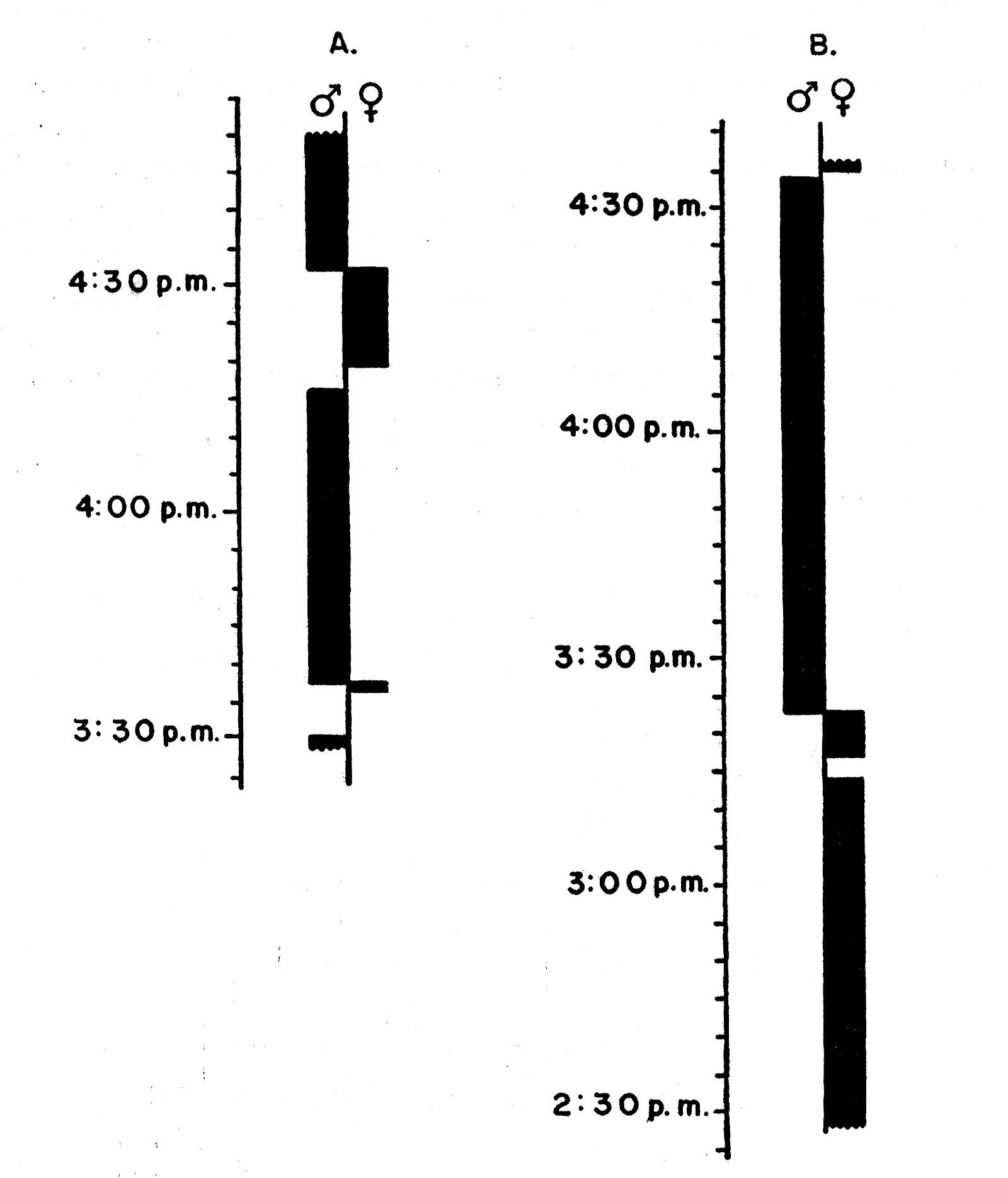
If a highly-vascularized brood patch is essential for true incubation, then it is surprising that males take regular turns on the nest in cold, rainy weather. On May 20, 1960, male 3 (1960) sat on the eggs longer than did the female (fig. 4). The temperature during this hour and a half of incubation was 54° F. One solution to this problem is supplied by Skutch (1957:74). He indicates that, "the type of the incubation is determined largely by innate factors, so that it persists through fairly wide fluctuations in weather, although it may break down in extreme conditions." Obviously then, in the example described above, the weather conditions do not qualify as "extreme." Sitting by the male is certainly functional to some extent for it relieves the female to forage; furthermore, the eggs are sheltered from inclement weather and protected from predators. Nolan (1960:232) suggests similar reasons for incubating by the male and adds the "conservation of heat supplied to the eggs by the female."
Fig. 5. Daily participation in incubation as indicated by the sex of the adult on the nest upon approach of the observer.
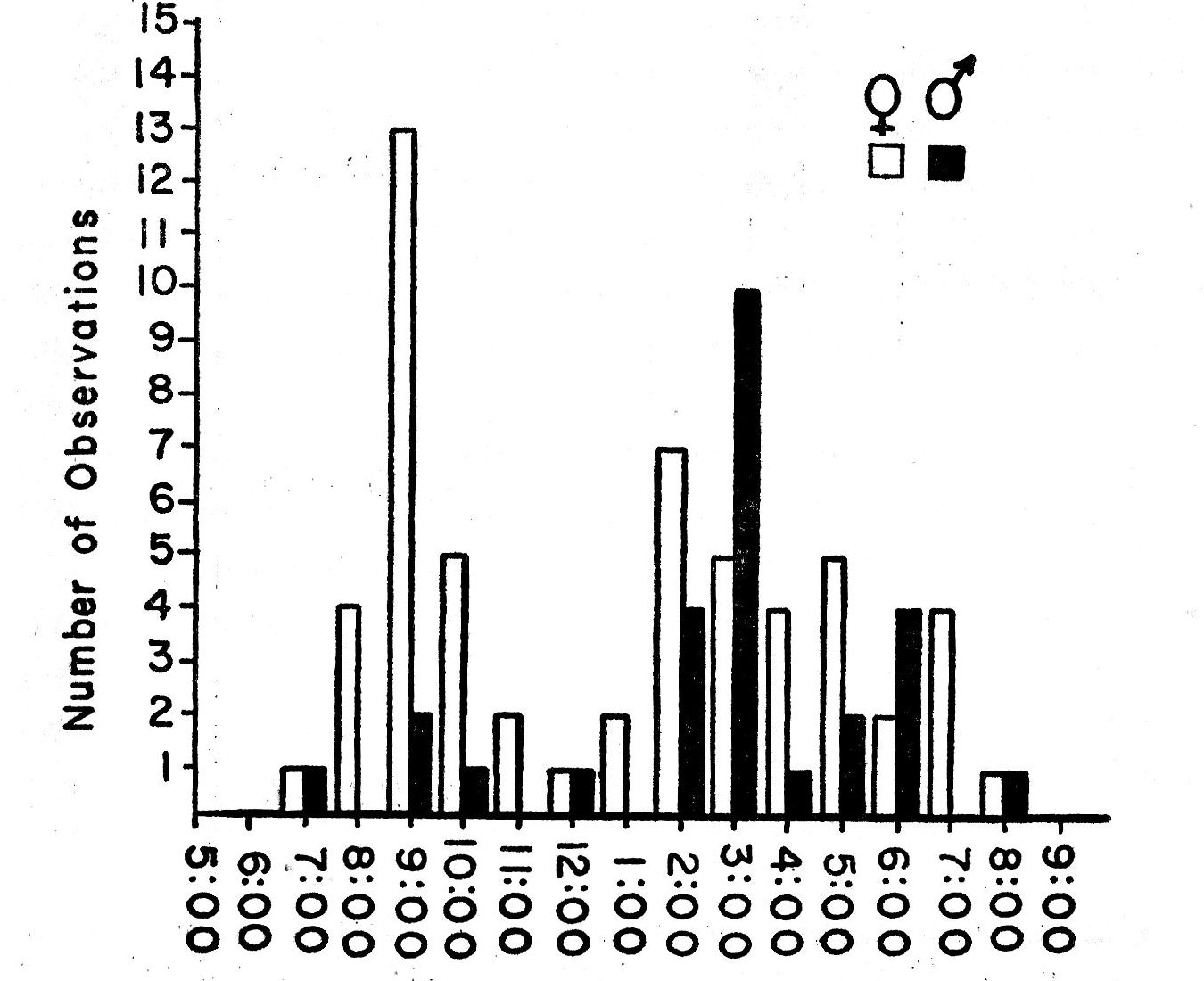
My data, based on incubation beginning with the second egg, indicate that the female incubates more often daily than the male (fig. 5). The male sits on the eggs only occasionally in the morning, but almost as often as the female in the afternoon. Nolan (1960:233) found that 95.5 per cent of the male's time on the nest and only 40 per cent of the female's time were attributable to the early hours of the day. Although I lack data on the critical hours of 5:00 a.m. to 6:59 a.m., I have enough observations (20) from 7:00 a.m. to 9:00 a.m. to indicate that the males sit on the eggs infrequently (3 of 20 instances) in those hours. The discrepancy in the two sets of data, which may be merely an artifact of sampling techniques, does suggest two possible alternatives: (1) the male sits on the eggs in the morning and gives the female, who sits on the eggs throughout the night, an extended rest and an opportunity to forage; (2) the female continues to sit throughout the morning, especially during the early hours of daylight, a time of day when the temperature may still be low enough to impair development of the embryo.
Relief of Partners in Incubation
Relief of partners involves some ceremony. When the female is incubating, the male sings several times as he approaches the nest tree; the female responds with several chees, but otherwise remains immobile. The male sings several more times upon alighting in the nest tree whereupon the female chees again and flies directly from the nest. A few seconds later the male appears at the edge of the nest and, after inspecting the eggs, hops in and settles upon them. When the male is sitting he is notably anxious prior to an exchange with the female, often arising and craning his neck as he surveys the surrounding vegetation, seemingly searching for his mate. The singing of the male and the calling of the female serve as signals, coordinating the exchange.