Chapter V
Reading edition
Forms reptilian and piscine—The basilisk—Shakespeare and Spenser thereupon—King of serpents—The dragon—Aldrovandus thereon—The dragon-stone—The griffin—The scorpion—The “Newe Jewell of Healthe”—Toads—Antipathy between toad and spider—The toad-stone—How to procure it—The weeping crocodile—Cockeram’s Dictionary—The treacherous seal—The salamander—Its potent venom—Its home in fire—Prester John and his kingdom—Pyragones—The chamæleon—Its changing colour—Serpents from air—The gift of invisibility—The serpent-stone—Theriaca—Viper-broth—Antidotal herbs—The soil of Malta—The deaf adder—The two-headed Amphisbæna—Aldrovandus on serpents—Hairy serpents—The deadly asp—Monstrous snails—Snail and spider remedies—Bees—Virgil on their production—Glowworm ink—Marine forms the counterparts of those on land—The sea-monk—The sea-bishop—The sus marinus—The brewers of the storm—The hog-fish—The sea-elephant—The sea-horse—The sea-unicorn—The remora—The dolphin, its special fondness for man—Its love of music—Its changeful colouring—The acipenser—The loving ray—The sargon—The friendship between the oyster and the prawn—The voracious swam-fish—Leviathan—Cause of the crooked mouth of the flounder—The healing tench—Fish medicaments—The vain cuttle-fish—The fish that came to be eaten—Conclusion.
We turn in conclusion to forms reptilian and piscine, and to “such small deer” as may call for a parting word or two in drawing our labours to a close; and here we find no great amount of material to deal with, for though our section includes such fabulous monsters as the basilisk and the dragon, the general knowledge of reptiles and fish was naturally by no means so extensive as that of the more readily visible beasts and birds.
The basilisk, a wingless dragon, according to some authorities—a serpent, if we may credit others—was a peculiarly objectionable creation, not of nature, but of man. Like all such creatures, it is extremely difficult to get a very definite idea of it, since imagination has run rampant in dealing with it. It was but twelve fingers’ breadth long, according to some writers; this we may take to mean some eight or nine inches long,[102] but, unfortunately, its powers of mischief were out of all proportion to its size. It wore a diadem upon its head, as a sign of its kingship over all other serpents, and its poison was death without remedy. Pliny, however, shall be allowed to describe the venomous little monster in his own way, as he does so with a vivid force that it is impossible to surpass:—“With his hies he driveth away other serpents; he moveth his body forward not by multiplied windings like other serpents, but he goeth with half his body upright and aloft from the ground; he killeth all shrubs not only that he toucheth, but that he breatheth upon; he burns up herbs and breaketh the stones, so great is his power for mischief. It is received of a truth that one of them being killed with a lance by a man on horseback, the poison was so strong that it passed along the staff and destroyed both horse and man.” Its touch caused the flesh to fall from the bones of the animal with which it came in contact, and even the glance of its eye was death upon whomsoever it fell. It will be remembered that Shakespeare refers to this belief in the utterance of the Lady Ann in response to Richard’s observation on her eyes—
“Would that they were basilisk’s to strike thee dead.”
In 2 Henry VI. (act iii. sc. 6) the king exclaims,
“Come, basilisk, and kill the innocent gazer with thy sight,”
—while in Henry V. (act iii. sc. 2) Queen Isabel says—
“Your eyes, which hitherto have borne in them Against the French, that met them in their bent The fatal balls of murthering basilisks.”
Suffolk in cursing his enemies invokes against them the deadly basilisk, while Gloster boasts that he will “slay more gazers than the basilisk.” Spenser in like manner mentions one who—
“Secretly his enemies did slay Like as the Basilisk, of serpent’s seede From powerful eyes close venim did convey Into the looker’s hart, and killed farre away.”
The writer of the “Speculum Mundi” hath it that “the Basilisk is the King of Serpents, not for his magnitude nor greatnesse, but for his stately pace and magnanimous minde.” Of this magnanimity, however, he gives no illustration or proof, but simply goes on to give the creature as black a character as all other writers do. “His eyes are red in a kinde of cloudy thicknesse, as if fire were mixt with smoke. His poyson is a very hot and venimous poyson, drying up and scorching the grasse as if it were burned, infecting the aire round about him, so as no other creature can live near him. His hissing, likewise, is said to be as bad, in regard that it blasteth trees, killeth birds, &c., by poysoning of the aire, and if anything be slaine by it the same also proueth venimous to such as touch it,”—an altogether unloving and unlovely brute. It must be borne in mind that whilst we in this nineteenth century simply regard such a creature as a weird fancy, countless generations of mankind have accepted the basilisk as a very grim reality indeed, that might in all its fearful power some day cross their paths.
Even Sir Thomas Browne, who demolished in his book so many common beliefs, is prepared to accept the Basilisk, for while he declares that “many opinions are passant concerning the basilisk, or little King of Serpents, some affirming, others denying, most doubting the relations made thereof,” he, himself, adds “that such an animal there is, if we evade not the testimony of Scripture and humane writers, we cannot safely deny.” For his Scriptural proofs he quotes Psalm xci.: “Super aspidem et Basilicum ambulabis,” and Jeremiah viii., ver. 17: “For behold I will send serpents, cockatrices among you, which will not be charmed, and they shall bite you.” Many of the old writers we may mention in passing, consider the basilisk and the cockatrice the same creature. That by death-dealing glance a basilisk may empoison is not to Browne a thing impossible, “for eies receive offensive impressions from their objects, and may have influences destructive to each other. For the visible species of things strike not our senses immaterially, but streaming in corporall raies doe carry with them the qualities of the object from whence they flow. Thus it is not impossible what is affirmed of this animall; the visible raies of their eies carrying forth the subtilest portion of their poison, which, received by the eie of man or beast, infecteth first the brain, and is thence communicated to the heart.” Again he says, “that deleterious it may be at some distance, and destructive without corporall contaction, there is no high improbability,” and he proceeds, not by any means without thought or shrewdness, to give reasons for his belief in the possibility of such a thing. “For,” says he, “if plagues or pestilentiall Atomes have been conveyed in the air from different Regions, if men at a distance have infected each other, if the shaddowes of some trees be noxious, if Torpedoes deliver their opinion at a distance and stupifie beyond themselves, we cannot reasonably deny that (besides our grosse and restrained poisons requiring contiguity unto their actions) there may proceed from subtiller seeds more agile emanations, which contemn those laws, and invade at distance unexpected.”
The belief in the dragon was one of the articles of faith of our ancestors. In another of our books, “Symbolism in Christian Art,” we have dwelt at considerable length upon the various legends in which the dragon figures, and the symbolic use made of the monster as representative of the evil principle that all are called upon to combat, but our forefathers had a very real belief in the veritable existence of the dragon, not by any means regarding it as a symbol merely, a figure of speech or apt allegory, but as one of the quite definite perils that the adventurous traveller in distant lands might be called upon to face,[103] while preparations of the dragon were a recognized feature in the pharmacopœia. “Scale of dragon, tooth of wolf,” and many other horrible ingredients are found in the witches’ cauldron in Macbeth.
In a mediæval work we are told that “the turning joint in the chine of a dragon doth promise an easy and favourable access into the presence of great lords.” One can only wonder why this should be, all clue and thread of connection between the two things being now so hopelessly lost. We must not, however, forget that, smile now as we may at this, there was a time when our ancestors accepted the statement with the fullest faith, and many a man who would fain have pleaded his cause before king or noble, bewailed with hearty regret his want of draconic chine, the “turning-point” of the dragon and of his own fortunes. Another valuable recipe runs as follows: “Take the taile and head of a dragon, the haire growing upon the forehead of a lion, with a little of his marrow also, the froth, moreover, that a horse fomethe at the mouth who hath woon the victorie in running a race, and the nailes besides of a dog’s feete; bind all these together with a piece of leather made of red deer’s skin, with the sinewes partly, of a stag, partly of a fallowe deere, one with another; carry this about with you, and it will work wonders.”[104] It seems almost a pity that the actual benefits to be derived from the possession of this compound are not more clearly defined, as there is no doubt that a considerable amount of trouble would be involved in getting the various materials together, and the zeal and ardour of the seeker after this wonder-working composition would be somewhat damped by doubt as to its actual utility. Mediæval medicine-men surely must have been somewhat chary of adopting the now familiar legend of “prescriptions accurately dispensed” when the onus of making up such a mixture could be laid upon them.
In spite of the familiarity with the appearance of the creature that the obtaining of its head and tail would suggest, the various authorities differ very widely in describing it. Some writers say that dragons are of “a yellow fierie colour, having sharp backs like saws,” and some tell us that “their scales shine like silver.” Some dragons are said to have wings and no feet, some again have both feet and wings, others have neither one nor the other, and are only distinguished from the common sort of serpents by the combs growing upon their heads. Father Pigafetta in his book declares that “Mont Atlas hath plentie of dragons, grosse of body, slow of motion, and in by ting or touching incurably venomous. In Congo is a kind of dragons like in bygnesse unto rammes with wings, having long tayles and divers jawes of teeth of blue and greene, painted like scales, with two feete, and feede on rawe fleshe.” John Leo, in his “History of Africa,” says that the dragon is the progeny of the eagle and wolf. Others affirm that it is generated by the great heat of India, or springs from the volcanoes of Ethiopia.
After reading about almost every possible variation of structure that is open to a dragon, winged, serpentine, two-legged, four-legged, and the like, it is rather quaint to find that Pliny feels that there is a point after all where one must draw the line. He says that “in Ethiopia there are produced as great dragons as in India, being twenty cubits long. But I chiefly wonder at one thing: why Juba should think they were crested.” This suggestion of the crass ignorance of Juba was certainly a little hard on him, as when so very much was believed a crest was a very little extra item to credit, besides as a matter of fact dragons as such, Ethiopian or otherwise, were often described by ancient authorities as having this feature. It really seems like accepting the sheeted spectre of the country churchyard, and then growing sceptical because its hollowed turnip head was still crowned with a little of the foliage that rustic haste or indifference to the verities had failed to cut away.
Aldrovandus, in his “History of Serpents and Dragons,” published in 1640, goes very thoroughly indeed into the subject.[105] The work is in folio size, and the portion devoted to the dragon extends from pages 312 to 360. It must be duly noted that Aldrovandus entirely accepts the dragon as a reality; that this is so is obvious from his dealing with it in this volume instead of placing it in his “Historia Monstrorum.” The book is written in Latin, and amongst the various sections concerning the dragon we find Differentiæ, Forma et Descriptio, Mores, Locus, Antipathia (unlike most other creatures treated by the old author, his vindictive savagely forbids the usual chapter on Sympathia), and Usus in Medicina. Fig. 19 is one of the draconic forms illustrated in the book; the varieties given are very numerous, and of widely differing nature.
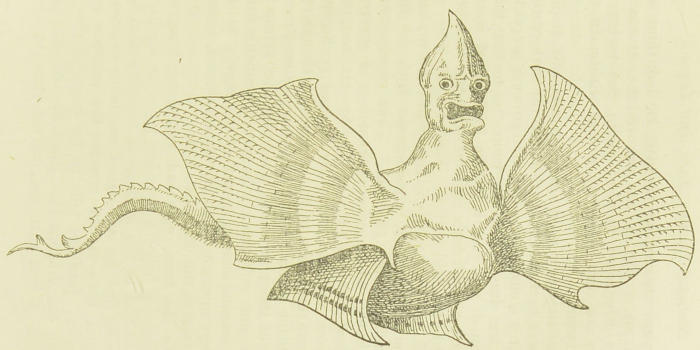
FIG. 19.
Our ancestors used always to prescribe divers kinds of herb-teas to be drunk in the Spring-time, and it is a curious example of instinct in a reptile that the dragon likewise, whom he feels at this season of the year a certain loathing of meat, physics himself into rude health again with the juice of the wild lettuce. Many animals have, or at all events had, if we may credit the wisdom of our forefathers, considerable faith in the medicinal value of herbs. Thus pigeons and blackbirds when suffering from loss of appetite eat bay leaves as a tonic. The bay leaf, too, was a most valuable thing for internal application against the poison of the chameleon, though the elephant when he had inadvertently swallowed one of these creatures, a mistake that seems to have not unfrequently happened, probably from the resemblance in colour of the reptile to the foliage amongst which he was ensconced, pinned his faith in the wild olive leaf.
As the toad, ugly and venomous, bore yet in popular belief a precious jewel in its head, so we find in the writings of various authorities a belief that the still uglier and more venomous dragon bore in like manner the lustrous carbuncle. Jordanus tells us, for example, that in India the dragons that there abound are thus gifted, a fact that the natives turn to their advantage. “These dragons,” he declares, “grow exceeding big, and cast forth from the mouth a most infectious breath, like the thickest smoke rising from fire. These animals come together at the destined time, develop wings, and begin to raise themselves in the air, and then, by the judgment of God, being too heavy, they drop into a certain river which issues from Paradise, and perish there. But all the regions round about watch for the time of the dragons, and when they see that one has fallen they wait for seventy days, and then go down and find the bare bones of the dragon, and take the carbuncle which is rooted in the top of his head.”
Even the dragon, however, may not be quite so black as he is painted, for we read in one old author of a child in Arcadia that had a dragon for its playmate. There was much affection between them, but presently a considerable dread of the dragon’s powers gained possession of the boy, and he compassed the brilliant idea of beguiling his companion well out into the desert and then slipping away. In the very consummation of this plan a new danger arose, as the stripling found himself in an ambush of robbers, whereupon he was only too thankful to call out to his discarded playmate, who immediately came to the rescue and very effectually scattered his despoilers. At this point the history unfortunately stops, but we may perhaps conclude that it follows on the lines of most stories of the affections, and that “they lived happy ever after.” However this may be, it is a charming narrative, and opens out quite a new trait of dragon disposition.
Amongst the many strange creatures that were held to inhabit Ethiopia, the griffins were perhaps the most conspicuous amidst the weird fauna of that marvellous land. “Some men seyn,” and Maundevile in his quaint book of travels fully endorses the idea, “that Griffounes han the Body upward as an Egle and benethe as a Lyoun and treuly thei ben of that schapp. But a Griffoun hathe the body more gret and is more strong thanne eight Lyouns and more gret and stronger than an hundred Egles such as we han amonge us. For a Griffoun ther wil bere, fleynge to his Nest, a gret Hors or two Oxen yoked togidere as thei gon at the Plowghe.”
Chaucer, in the “Canterbury Tales,” says of one of his characters:—
“Blake was his berd, and manly was his face, The cercles of his eyen in his hed They gloweden betwixten yelwe and red, And like a griffon loked he about.”
Ctesias describes the griffin in all sober earnestness as a bird with four feet of the size of a wolf, and having the legs and claws of a lion, their feathers being red upon the breast and black on the rest of the body. Glanvil says of it: “the claws of a griffin are so large and ample that he can seize an armed man as easily by the body as a hawk a little bird.” The griffin is often met with in heraldry past and present, either as a crest, charge, or supporter of the arms. A very familiar example of its employment in the latter service may be seen in the arms of the City of London, or exalted on lofty pedestal, where, in lieu of Temple Bar, it marks the westward civic boundary. Shakespeare, Milton, and others of our poets and writers, refer to the griffin.
Anyone reading the herbals of Gerard, Parkinson, and others, or the various medical books of the Middle Ages, will scarcely have failed to notice how frequently reference is made to the scorpion. In these later days a man might well journey from John o’ Groats to the Land’s End, and run no peril of an encounter, but in the earlier times we have referred to, the sting of the scorpion was a very present dread, and numerous remedies for it were devised. The beautiful blue forget-me-not of our streams is in all herbals and floras till the beginning of this century called the scorpion-grass,[106] from its supposed virtue as a cure, a remedy that was supposed to be sufficiently indicated from its head of flowers and buds being rolled round into some more or less satisfactory resemblance to a scorpion’s tail. Cogan, in his “Haven of Health,” tells how “a certaine Italian, by often smelling the Basill, had a scorpion bred in his braine, and after vehement and long paines he died therof.”
In the “Newe Iewell of Health, gathered out of the best and most approved Authors by that excellent Doctor Gesnerus,”[107] we find some extraordinary preparations. Most of these are of a botanical nature, but we also have “Oyle holy[108] prepared out of dead men’s bones, Oyle or distilled lycour gotten out of the Gray, Oyle marveylous gotten out of the Beuer, Oyle of frogges ryght profitable to such as are payned of ye gout, Oyle of antes egges,” and many other strange remedies for the ills that the flesh is heir to. Among them, a forerunner of the ideas of Hahnemann, and the notion of like curing like, we find “Oyle of Scorpion’s distilled against Poysons.” Apropos of the oil from dead men’s bones, we may point out the special charm that our ancestors seemed to find in anything associated with the charnel house—thus one favourite remedy was the moss that grew on a dead man’s skull, another was a pill compounded from the brains of a man that had been hanged; powder of mummy in like manner was in high repute, and to those who found pill or powder too nauseous a draught of spring water from the skull of a murdered man was at once refreshing and health-giving. The following recipe[109] for the cure of a wound seems to show that our forefathers had no great fear of blood poisoning: “Take of the moss of the skull of a strangled man two ounces, of the mumia of man’s blood one ounce and a halfe, of earth wormes washed in water or wine and dryed, one ounce and a halfe, of the fatte of a Boare two drams, of oyle of Turpintine two drams: pound them and keepe them in a longe narrow pott, and dippe into the oyntment the yron or wood, or some sallowe sticke made wet with blood in opening the wound.” The medicine and surgery of the Middle Ages must have been a powerful influence in checking redundance of population.
Toads were in great repute in sickness. “In time of common contagion,” writes Sir Kenelm Digby in 1660, “men use to carry about with them the powder of a toad, and sometimes a living toad or spider[110] shut up in a box, which draws the contagious air, which otherwise would infect the party,” and many other illustrations of their employment as preventives or remedies might be given. The spider and the toad seem to have been each regarded as most venomous creatures, and in many of the old remedies one or other of them at will are recommended, either alternative being regarded as equally efficacious; thus for whooping cough, if one cannot find a toad to thrust up the chimney, two spiders in a walnut shell will serve equally well.
There was held to be mortal antipathy between the toad and the spider, and the result of a meeting between them was a conflict fatal to one or both of the antagonists. The Aster Tripolium, a well-known English wild plant, was originally called the toad-wort. “When a spider stings a toad, and the toad is becoming vanquished, and the spider stings it thickly and frequently, and the toad cannot avenge itself, it bursts assunder,” at least, the author of the “Ortus Sanitatis” says it does, but whether this arises from venom or from vexation he does not explain. “If such a burst toad be near the toad-wort, it chews it and becomes sound again; but if it happens that the wounded toad cannot get to the plant, another toad fetches it and gives it to the wounded one.” Topsell, in his “Natural History,” vouches for this having been actually witnessed.
That the skin of the toad gives forth an acrid secretion which serves the creature as a defence is established beyond doubt, but its hurtful properties have been greatly exaggerated. Dryden refers to the lady “who squeezed a toad into her husband’s wine,” the inference being she was in heart murderous. Spenser makes Envy ride upon a wolf and chew “between his cankred teeth a venomous tode,” while Diodorus declares that toads were generated by the heat of the sun from the dead bodies of ducks putrefying in mud.[111]
Lily, in his “Euphues,” declares that “the foule toade hath a faire stone in his head,” an idea that Shakespeare has immortalized in the beautiful lines that remind us how:—
“Sweet are the uses of adversity, Which, like the toad, ugly and venomous, Yet wears a precious jewel in its head.”
The crapaudine, or toad-stone, is of a dull brown colour. It was believed to possess sovereign virtue against poison from its changing colour when in the presence of any noxious thing: hence it was often worn as a protection in finger rings. Figs. 20 and 21 are good examples of this use. They are both from rings in the Londesborough collection. The belief in the virtues of the toad-stone was not only popular in England, but was one of the fallacies accepted throughout Europe. Though the stone is well-known to geologists as a variety of trap-rock, the accepted belief was that it was found only in the head of the toad. Fenton, writing in 1569, affirms that “there is found in the heads of old and great toads a stone which they call borax or stelon,” and Lupton, some fifty years afterwards, writes: “the crepaudia or toad-stone is very valuable, touching any part envenomed by the bite of a rat, wasp, spider, or other poisonous beast it ceases the pain and swelling thereof.” Ben Jonson also refers to it in his play of “The Fox.” Albertus Magnus, writing about 1275, adds the great wonder that this stone when taken out of the creature’s head has the figure of a toad upon it, while others declare that the stone itself is of the form of a toad. It is a treasure not easily to be procured, for the toad “envieth much that man should haue that stone,” declares Lupton, the author of “A Thousand Notable Things,” hence it was very necessary to beware of useless counterfeits, and this old writer gives us a ready means of detecting them. “To know,” says he, “whether the toad-stone called crepaudia be the righte and perfect stone or not, holde the stone before a toad so that he may see it, and if it be a right and true stone the toad will leap towards it, and make as though he would snatch it from you,” a proceeding that must have required a considerable amount of nerve on the part of anyone duly impressed with the fear of the deadly venom of the creature.
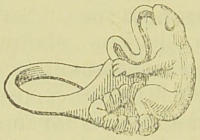
FIG. 20.
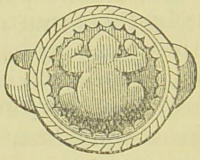
FIG. 21.
The same ancient authority on the subject very obligingly gives “a rare good way to get the stone out of the toad.” It suffices to “put a great or overgrown toad, first bruised in divers places, into an earthen pot: put the same into an ant’s hillocke, and cover the same with earth, which toad at length the ants will eat, so that the bones of the toad and stone will be left in the pot.” This certainly seems simplicity itself, but, unfortunately, most authorities agree in saying that the stone, to have any real virtue, should be obtained while the creature is yet alive. Porta has his doubts on the whole matter, nevertheless he gives some hints that might be of value to those of greater faith. “There is a stone,” he says, “called Chelonites—the French name it Crapodina, which they report to be found in the head of a great old Toad; and if it can be gotten from him while he is alive, it is soveraign against poyson. They say it is taken from living toads in a red cloth, in which colour they are much delighted; for while they sport themselves upon the scarlet the stone droppeth out of their head and falleth through a hole made in the middle into a box set under for the purpose, else they will suck it up again. But I never met with a faithfull person who said that he had found it: nor could I ever find one, though I have cut up many. Nevertheless, I will affirm this for truth that those stones which are pretended to be taken out of Toads are minerals. But the value is certain: if any swallow it down with poyson it will preserve him from the malignity of it, for it runneth about with the poyson and asswageth the power of it that it becometh vain and of no force.” Boethius tells us how he watched throughout a whole night an old toad that he had placed on a piece of scarlet cloth, but is obliged to confess that nothing occurred to “gratify the great pangs of his whole night’s restlessness,” as the toad entirely declined to be lured into any frivolities that might cause him the loss of his precious jewel.
Browne, in his exposure of the various popular errors current in his time, presently arrives at this belief, but finds himself unable to express any very definite opinion, and takes refuge in compromise. “As for the stone,” quoth he, “commonly called a Toad-stone, which is presumed to be found in the head of that animall, we first conceive it not a thing impossible, nor is there any substantiall reason why in a Toad there may not be found such hard and lapideous concretions; for the like we daily observe in the heads of Fishes, as Codds, Carps, and Pearches. Though it be not impossible, yet it is surely very rare, as we are induced to believe from inquiry of our own; from the triall of many who have been deceived and the frustrated search of Porta, who, upon the explorement of many, could scarce finde one.[112] Nor is it only of rarity, but may be doubted whether it be of existency, or really any such stone in the head of a Toad at all. For though Lapidaries and questonary enquires affirm it, yet the writers of Mineralls and natural speculators are of another belief, conceiving the stones which bear this name to be a Minerall concretion, not to be found in animalls but in fields. What therefore best reconcileth these divided determinations may be a middle opinion; that of these stones some are minerall and to be found in the earth; some animall, to be met with in Toads, at least by the induration of their cranies. The first are many and manifold, to be found in Germany[113] and other parts, the last are fewer in number, and in substance not unlike the stones in Carps’ heads. This is agreeable unto the determination of Aldrovandus, and is also the judgment of the learned Spigelius in his Epistle unto Pignorius.” If only a toad with an indurated cranium could be discovered, everything would fall into its right place!
Through the Middle Ages men believed that the toad exercised the power of fascination not only upon its insect prey, but upon all other creatures, including man himself, and even so far back as the days of the classical writers it was a fully accepted belief that whosoever had the misfortune to be looked squarely in the eyes by a toad would find that, basilisk-like, the gaze to him meant death.
The belief that the crocodile shed tears over his prey is a very ancient one; various motives have been assigned for this grief, but the generally accepted belief is that the whole proceeding is a fraud, perpetrated with the idea of attracting sympathetic passers-by within reach of his formidable jaws; hence he has been accepted as a symbol of dissimulation. We get an excellent illustration of this in Shakespeare’s King Henry VIII., where Henry is said by Queen Margaret to be—
“Too full of foolish pity; and Gloster’s show Beguiles him, as the mournful crocodile With sorrow snares relenting passengers.”[114]
Spenser, in the Faerie Queene,[115] deals equally clearly and explicitly with the same fancy in the lines—
“As when a wearie traveiler, that strayes By muddy shore of broad seven-mouthed Nile, Unweeting of the perillous wandring wayes, Doth meete a cruell craftie Crocodile, Which in false grefe hyding his harmefull guile, Doth weepe full sore, and sheddeth tender teares; The foolish man, that pities all this while His mournful plight, is swallowed up unawares, Forgetfull of his owne that mindes an other’s cares.”
“Thereupon,” ungallantly adds an old writer, “came this proverb that is applied unto women when they weep. Lachrymæ Crocodili, the meaning whereof is, that as the Crocodile when he crieth goeth about most to deceive, so doth a woman most commonly when she weepeth.” Thus Othello misanthropically exclaims—
“If that the earth could teem with woman’s tears, Each drop she falls would prove a crocodile.”
In the same spirit Barnfield, in his “Cassandra,” written in the year 1595, has the following passage:—
“He, noble lord, fearlesse of hidden treason, Sweetely salutes this weeping Crocodile; Excusing every cause with instant reason They kept him from her sight so long a while; She faintly pardons him; smiling by art, For life was in her lookes, death in her hart.”
The author of the “Speculum Mundi,” who is ever seeking a moral[116] or an opportunity of improving the occasion, declares that “the crocodile when he hath devoured a man and eaten all up but the head, will sit and weep over it[117] as if he expressed a great portion of sorrow for his cruel feast, but it is nothing so, for when he weeps it is because his hungrie paunch wants such another prey. And from hence the proverb took beginning, viz. Crocodiles’ tears; which is then verified when one weeps cunningly without sorrow, dissembling heaviness out of craftinesse; like unto many rich men’s heirs who mourn in their gowns when they laugh in their sleeves; or like to other dissemblers of the like nature who have sorrow in their eyes, but joy and craftiness in their hearts.” However this may be, the supposititious tears of the crocodile have been turned to abundant literary and moral account. The tears of the crocodile were supposed, according to some who were great authorities in their day and generation, to crystallize into gems, but as supposititious tears could only produce supposititious gems the actual value would be but small.
In an early Bestiary it states that “if a crocodile comes across a man it kills him, but it remains inconsolable the rest of its life;” but why it suffers this life-long remorse we are not told. This old writer also tells us of the hydra, “a very wise animal who understands well how to injure the crocodile.” The modus operandi is very simple, and the injury inflicted seems beyond question:—“When the hydra sees the crocodile go to sleep it covers itself over with slimy mud, and wriggles itself into the crocodile’s mouth, penetrates into its stomach, and then tears it assunder.” The dolphin appears to be another foe to be by no means despised. Pliny tells us that when these desire to pass up the Nile the crocodiles, who regard the river as their peculiar preserve, greatly resent their presence, and endeavour to drive them back. As the dolphins fully realize that they are no match for their foes in fair fight, they take refuge in their superior activity and craft, and having a dorsal fin as sharp edged as a knife, they swim swiftly beneath the crocodiles, and as the under portion of these creatures is unprotected by the armour that is so conspicuous on the upper parts of their bodies, with one sharp gash they rip the crocodile completely open.
It was a Greek superstition that beneath the visible exterior of the seal was concealed a woman, and that when a swimmer ventured too far he ran great risk of being seized by a seal and strangled. The creature then carried the lifeless body to some desert shore and wept over it, from which arose the popular saying that when a woman shed false tears she cried like a seal. As the desert shore implies absence of spectators, it seems difficult to tell what authority there is for the statement as to what went on there, and even when this initial difficulty is overcome it seems equally impossible to suggest any satisfactory reason for the gruesome proceedings of this weird woman-seal or seal-woman, either in the preliminary murderous attack or the subsequent lamentation. Whatever strange idea may have originally started the story, it is a curious parallel to that of the weeping crocodile.
The salamander received its full mythical development in mediæval days, though the older writers refer to it occasionally, and we note in the writings of such men as Pliny the first steps taken towards the erection of that fabric of fancy and superstition that later on became so conspicuous. The ancients asserted that the salamander was never seen in bright weather, but only made its appearance during heavy rain, and that it was of so frigid a nature that if it did but touch fire it quenched it as completely as if ice were piled thereon. It was, moreover, declared to be so venomous that the mere climbing of a tree by the animal is amply sufficient to poison all the fruit, so that those who afterwards eat thereof perished without remedy, and that if it entered a river the stream was so effectually poisoned that all who drank thereof must die. Glanvil, an English writer in the thirteenth century, roundly declares as historic fact that four thousand men and two thousand horses of the army of Alexander the Great were killed by drinking from a stream that had been thus infected.
It was in the Middle Ages an article of faith that the salamander was bred and nourished in fire,[118] hence when the creature is represented it is always placed in the midst of flames. Our illustration, fig. 22, from Porta, is a fair typical example. How the creature should be nourished in the flames, while its mere contact with them suffices to extinguish them, seems a practical difficulty, but the contradiction of ideas does not seem to have troubled our forefathers, and the two mutually destructive statements rest side by side equally unquestioned in the writings of all the authorities. Pliny, having his doubts, thrust a salamander into the fire, and the unfortunate victim of science was quickly shrivelled up and consumed.[119] One would have thought that this crucial test of actual experiment would have settled the whole matter, and reduced the fire-extinguishing theory to oblivion, but it takes much more than that to kill an old and well-established belief, as we may see even in our own day where many superstitions still flourish in spite of common sense, education, and experience arrayed against them.
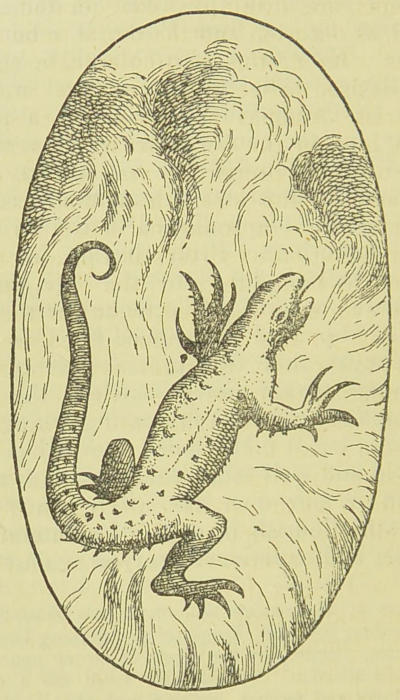
FIG. 22.
De Thaun in his “Bestiary” declares that “the Salamander is of such a nature that if it come by chance where there shall be burning fire it shall at once extinguish it. The beast is so cold and of such a quality that fire will not be able to burn where it shall enter, nor will trouble happen where it shall be.” This latter statement is entirely at variance with the general belief in its deadliness, but all these statements are dwelt on, exaggerated, or suppressed, as occasion and the moral to be deduced requires. As in this particular case the pious writer desired to see in the creature an emblem of Azarias, Ananias and Misael praising God without hurt in the fiery furnace, any reference to its noxious properties was clearly out of place, and on the strength of this association it even receives a somewhat negative form of commendation on its virtues as a peace-producer. This we are bound to say is the only good word we have ever seen ascribed by any of the writers of the past to this unfortunate creature, and it beyond doubt only receives even this solitary commendation because the exigencies of what the old writers thought the greater truth appeared to call for it.
Asbestos was, from its incombustible property, long held to be the wool of the salamander. In the Middle Ages popular imagination was greatly exercised over a mysterious Ruler in the East known as Prester John. He was held to be a Christian, and to bear sway in Asia over a widely-extended empire, but the stories of returning travellers showed that the idea had no foundation in fact, and the scene of the monarchy was then shifted to Abyssinia. The first reference to this sovereign would appear to be in the Chronicle of one Otto of Freisingin, who wrote about the middle of the twelfth century, and afterwards allusions to this mysterious monarch frequently recur. In the Chronicle of Albericus, about a hundred years later than that of Otto, we read that “Presbyter Joannes sent his wonderful letter to various Christian princes, and especially to Manuel of Constantinople, and Frederic, the Roman Emperor.” In this letter, a very lengthy one, he claims to be Lord of Lords, and to receive the tribute and homage of seventy-two kings. “In the three Indies,” saith he, “our Magnificence rules, and our land extends beyond India: it reaches toward the sunrise over the wastes, and it trends towards deserted Babylon, near the Tower of Babel.” Whatever of credence, much or little, we may give to this letter, it is at least interesting to us as showing the set of opinion on, amongst other matters, things zoological, and therefore comes within the scope of our book. He gives many details as to the plants, the gold, and precious stones, and so forth, and also states that “our land is the home of elephants, dromedaries, camels, crocodiles, metacollinarum, cammetennus, tensevetes, white and red lions, white bears, crickets, griffins, lamias, wild horses, wild men, men with horns, one-eyed, men with eyes before and behind, centaurs, fauns, satyrs, and pygmies; it is the home, too, of the phœnix, and of nearly all living animals. In one of our lands, hight Zone, are worms called in our tongue salamanders. These worms can only live in fire, and they build cocoons like silkworms, which are unwound by the ladies of our palace and spun into cloth and dresses, which are worn by our Exaltedness. These dresses, when we would wash them and clean, are cast into flames.” Browne, in his exposure of vulgar errors, gravely denies the existence of wool on a salamander at all, truly pointing out that “it is a kinde of Lizard, a quadruped corticated and depilous, that is, without woolle, furre, or haire,” an altogether hopeless animal to shear.
Porta mentions that some peculiar creatures called “Pyragones be generated in the fire: certain little flying beasts so called because they live and are nourished in the fire, and yet they fly up and down in the air. This is strange; but that is more strange, that as soon as ever they come out of the fire into any cold air presently they die.” Porta of course uses the word presently in the older sense of at this present moment, so that it really is, as he says, a wonder that these creatures are able to fly about in the air, when its effect upon them is immediate death. We have ourselves been gravely told that if the fires at the great iron-works in the Midland Counties were not occasionally extinguished an uncertain but fearful something would be generated in them, and it seems only natural that after the imagination has peopled earth and sea with strange monsters, and placed in the upper regions of the air the paradise-birds and other creatures that derived all needful sustenance from that element alone, that the remaining element, fire, should also have its peculiar inhabitants and monsters.
The chamæleon was for centuries supposed to live only on air, while its property of changing colour under the influence of its surroundings was greatly exaggerated.
Shakespeare, the great storehouse of mediæval folk-lore, makes Speed, in the Two Gentlemen of Verona, exclaim:—
“Tho’ the chamæleon Love can live on the air, I’m one that am nourish’d by my victuals,”
while Gloster, in King Henry VI., boasts that he could “add colours to the chamæleon.”
Gower, in like manner, asserts that vainglory is
“Lich unto the Camelion Whiche upon every sondry hewe That he beholt he mote newe His colour.”
Hence, again, other moralists declare that men and women inconstant and fickle are like unto chamæleons.
It has been asserted by Avicenna that a decoction of chamæleon put into a bath will make him green-coloured that stayeth long therein, but that by degrees this verdant hue will pass away, and the man recover his natural colour, while Porta declares that “with the Gall of a Chamæleon cut into water Wheezles will be called together.” Why anyone should want to call a wheezle together he does not explain, so that the receipt, simple as it is, seems to be of no great practical value.
It has been rather a disgusting belief that if a man will lick a lizard all over he will not only be safe from the personal inconvenience of having a lizard go down his throat some day when he might be sleeping in the fields, but that he will have the power henceforward of healing any sore to which he applies his tongue.
Our ancestors held many strange beliefs respecting serpents and snakes—one of these was they were created from hair, “women’s hairs especially”—as one old writer is careful to emphasize—“because they are naturally longer than men’s.” One old authority, our oft-quoted Porta, hesitates not to say that “we have experienced also that the hairs of a horse’s mane laid in the waters become serpents, and our friends have tried the same,” and he goes on to mention as a truism to be almost apologized for from its self-evident character, that “no man denies but that serpents are easily gendred of man’s flesh, specially of his marrow.” Ælianus in like manner declares that a dead man’s marrow, being putrified, becomes a serpent. Florentinus affirms that basil chewed and laid in the sun will engender serpents.[120]
Another strange idea was that serpents conferred the power of invisibility. Thus John Aubrey, an antiquary and author, and one of the earliest Fellows of the Royal Society, gives in full faith the following recipe: “Take on Midsummer night at xii, when all the planets are above the earth, a serpent, and kill him, and skinne him, and dry him in the shade, and bring it to a powder. Hold it in your hand, and you will be invisible.” His book entitled “Remaines of Gentilisme and Judaisme” is a perfect storehouse of old-world superstitions, an inexhaustible mine of quaint imaginings.
The “pretious stone” theory that we have already encountered in one or two other cases, the toad being the most notable, is in full force again amongst the various strange notions concerning serpents. The recipe for its possession, given by Jacobus Hollerius, is simplicity itself, as it is merely necessary that the “snake be tyed by the tayle with a corde, and hanged up, and a vessell full of water set below; after a certayne time he will avoyde out of his mouth a stone.” The stone is of great medicinal value; for instance, “it fullye and wholelye helpes the partye that hath the dropsye,” by merely being attached to the body of the sufferer, and in divers other ways that we need not stay to particularize, proves itself a stone of price. Jordanus, amongst his other Indian experiences, came across serpents with horns, evidently the cerastes or horned viper, and others with precious stones. Tennant tells us that the Cingalese believe that the stomach of the cobra contains a stone of inestimable value, and this belief, absurd as we deem it, is really hardly more far-fetched than such a story as pearls being found in oyster-shells would appear to a man who heard it for the first time.
Snakes and serpents, like most other repulsive things, have found their way into the pharmacopœia and the menu. Galen tells us that the Egyptians used to eat vipers as other people did eels, and it is a very old-world superstition that viper’s flesh is an antidote to the viper’s poison. In classic and mediæval days a famous remedy, originally known as mithridate or theriaca, and later on as Venice treacle, was held to owe much of its virtue as a vermifuge and antidote to all kinds of poison to the vipers that formed one of its ingredients. It was retained in the London Pharmacopœia until about a hundred years ago. Its constituent parts changed somewhat from time to time; at one period we see it contained seventy-three ingredients. The vipers were added to the horrible mess by Andromachus, the physician to the Emperor Nero,[121] and became a leading element in the prescription. The name treacle was at one time applied to any confection or syrup, and it is only in these latter days that the name has become associated exclusively with the syrup of molasses: it is derived from the Greek Therion, a name given to the viper, so that the schoolboys’ lunch of bread and treacle is the direct etymological outcome of the abominable adder’s broth of the Roman emperor.[122]
One often sees in these ancient remedies a foreshadowing of the homœopathic notion of like to like; thus Porta prescribes “a present remedy” for the poison of the viper, declaring that “the viper itself, if you slay her, and strip off her skin, cut off her head and tail, cast away all her entrails, boil her like an Eele, and give her to one that she hath bitten, it will cure him,” but in another place he says “for serpent’s bites I have found nothing more excellent than the earth which is brought from the isle of Malta, for the least dust of it put into their mouths kills them presently.” There is evidently here some sort of connection endeavoured to be established between the escape of St. Paul while in Malta from the evil effects of the poison of a viper and this present prescription, and it no doubt arose from the old legend that, like St. Patrick in Ireland, St. Paul, after his experience of them, banished all snakes from the island. Once granted that a serpent cannot live on the soil of Malta, it follows almost as a matter of course that a little of this same soil administered to it anywhere the wide world over will prove fatal to it. The recipe is, nevertheless, a little vague, as it deals exclusively with the destruction of the serpent, which is not at all the same thing as the restoration to health of the sufferer from its poison fangs.
Prevention being better than cure, the hint that Cogan gives in his “Haven of Health” should prove of value. “The setting of Lauender within the house in floure pots must needes be very wholesome, for it driueth away venemous wormes, both by strawing and by the sauour of it,” and he adds that “being drunke in wine it is a remedie against poyson.” Tusser, in his book on Husbandry, gives a long list of “strowing herbes,” their fragrance and remedial value being held in high esteem by our forefathers:—
“No daintie flowre or herbe that growes on grownd, No arborett with painted blossoms drest, And smelling sweete, but there it might be fownd To bud out faire, and throwe her sweet smels al around.”[123]
The bunches of flowers that are still presented to the Judges on the opening of the Law Courts are the graceful and now happily needless developments of the bunches of herbs that were once placed on their desks to avert the dangers of the gaol fever, that with its noxious breath slew not the hapless prisoners alone, but the judges on the bench, and administered wild justice on all alike for the contempt of sanitary laws, and for the brutality that was rampant and supreme.[124]
Fennel was, according to our forefathers, held in esteem by the serpents themselves, and one scarcely wonders that this should be so, if it be true that “so soone as they taste of it they become young again, and with the juice thereof repair their sight.” How this juice is applied externally by the serpent is not explained, but it very naturally suggested the idea to the medical men of the Middle Ages that what was so good for serpents might prove equally valuable to suffering humanity, hence “to repair a man’s sight that is dim” nothing better than fennel could be found, though they hesitated to promise also to the human subject rejuvenescence.
The Syrians, according to one venerable authority, had a most singular defence for their country, the land being full of snakes that would do no harm to the natives even if they trod upon them, but which eagerly assailed the people of any other nation and destroyed them. Naturally therefore the Syrians cherished such a valuable protection, though such a state of things would hardly accord with modern notions of free trade and the intercourse of nations. The discovery of one wonder frequently leads to knowledge of others, and Aristotle has a companion story in his “History of Animals,” of scorpions that in Caria sting to death the natives of the country, but do no harm to strangers. In like manner, according to Maundevile, in the island called Silha, wherever that may be, “the men of that yle seen comonely that the Serpentes and the wilde Bestes of that Countree nee will not don non harm, ne touchen with evylle, no strange man that entreth into that Contree, but only to men that ben born of the same Countree.” This differential treatment seems distinctly hard on the aborigines.[125]
“It is observable,” quoth the author of the “Miracles of Art and Nature,” that “in Crete there is bred no Serpents or Venomous Beasts or Worms, Ravenous or hurtful Creatures, so their Sheep graze very securely without any Shepheard; yet if a Woman happen to bite a Man anything hard he will hardly be cured of it,” a statement which brings forth the very natural conclusion that “if this be true, then the last part of the Priviledge foregoing (of breeding no hurtful Creature) must needs be false.”
Amongst various familiar country beliefs lasting even to the present day is the one summed up in the well-known expression, “deaf as an adder.” It has for centuries been an accepted belief that the adder lays one ear upon the ground, and closes the other with its tail, and it doubtless has its origin in that passage in the psalms of David where it states that “the deaf adder stoppeth her ears, and will not heed the voice of the charmer, charm he never so wisely,” and we meet with this idea over and over again in our own literature. Thus Shakespeare writes in King Henry VI.—
“What! art thou, like the adder, waxen deaf? Be poisonous too.”
And, again, in his Troilus and Cressida we find the passage—
“Pleasure and revenge have ears more deaf than adders.”
In Orlando Furioso, too, we find an interesting reference to the old fancy:—
“He flies me now, nor more attends my pain Than the deaf adder heeds the charmer’s strain.”
Many varieties of serpents were known to the ancients, and some of them, as the Cerastes, are quite recognizable from the descriptions given, but of others we have no means of identification. The two-headed Amphisbæna, for example, that was credited with such venomous malignity that nothing but twice the normal power of offence sufficed for its deadly attack. The Amphisbæna was an article of faith with Nicander, who was the first to introduce it to the scientific world of his name, and it is referred to by Galen, Pliny, Ælian, and many other ancient writers, who gravely describe this especially objectionable reptile, “a small kind of serpent which moveth backward and forward, and hath two heads, one at either extreme.” The creature is now entirely lost to science.
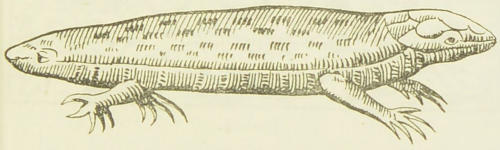
FIG. 23.
Aldrovandus, in his history of serpents, gives an illustration of the basilisk, a serpentine form, but having eight legs, and on its head a crown. Another of his figures shows us a serpentine form again, this time with two legs, the moderation in this direction being fully compensated by the gift of seven heads of human form, while another has the serpent-like body, but to this are added two legs and feet like those of a cock, and the creature has six cocks’ heads. All these creatures are put forth and described in all seriousness, so it is evident that the author must either himself have been excessively credulous, or that he must have expected to find his readers so. It is manifest that such inventions are of the lamest possible type. Nothing could be easier or more fatuous than to fill a folio volume with serpents having three cats’ heads, five lions’ heads, seven bisons’ heads, or twenty rats’ heads, and distribute legs in the same liberal and senseless manner. His drawing, fig. 23, of a two-headed lizard is the nearest approach we can give our readers to the Amphisbæna.
Burton tells us that in Samogitia, a small province in Poland, the people nourish amongst them “a kind of four-footed serpents, above three handfuls in length, which they worship as their household gods, and if mischance do happen to any of their family, it is imputed presently to some want of due observations of these ugly creatures.” Some old writers tell us of hairy serpents, and depict a thing something like the well-known larva of the tiger-moth, the caterpillar popularly known as the “woolly bear,” and familiar enough to all dwellers in the country, the only difference, though that a very serious one, being that the woolly bear is barely three inches long, while the hairy serpents are stretched to any number of feet that the credulity of the narrator will permit.
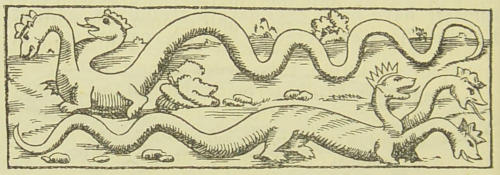
FIG. 24.
Fig. 24 is a facsimile from one of the illustrations in Munster’s “de Africæ regionibus,” and represents the sort of thing that he would have us believe was to be found in his days in Africa, that great home of the weird and mysterious. The perspective effect of the coils of the upper creature, as they recede in the distance towards the horizon, suggests a terrific length, something far exceeding any of the possibilities of the present day, but this may be only a slip of draughtmanship, or a polite desire on the part of the two-headed reptile not to crowd up its three-headed companion.
The asp, from being freely found in Egypt and other parts of North Africa, was well known to the naturalists of Greece and Rome, and its deadly nature fully understood, though the facts are perhaps rather against them when they assert that they are such affectionate creatures that they are always found in pairs and cannot live without their mates. We are told that should one of the pair be killed, this sweet connubial bliss is exchanged for deadly ferocity and instant revenge. The unhappy man is closely pursued and relentlessly tracked, and finds no safety amongst his fellows, as the avenger knows him from all others, and will not be turned aside. Distance is no object, and difficulties no hindrance, and all that the luckless individual can do is to take to his heels with all celerity, and at the earliest opportunity embark in a boat or swim a river, and thus shake off his relentless pursuer.
Democritus tells us that if we mingle the blood of certain birds together a serpent will be engendered. Whoso eateth of this serpent shall know the language of birds, and be able to join in the conversation of any or all of the great feathered host, singing with the lark, cawing with the rook, hooting with the owl, and being thoroughly conversant with all that passes between them.
Maundevile tells us, in his wonderful “Voiage and Travaile,” of an island where one finds “a kynde of Snayles that ben so grete that many persones may loggen hem in hur Schelles, as men woulde done in a litylle Hous”—a sufficiently striking feature in the landscape of that now unknown land.
Snails entered largely into the rustic Materia Medica, and not only indeed into rural practice but into the most courtly and exclusive circles, for we find Sir John Floyer, the physician to Charles II., prescribing thus for dulness of hearing: “Take a grey snaile, pricke him, and putt ye water which comes from him into ye eare and stop it with black woole, and it will cure.” He left behind him a folio volume of such-like valuable recipes, and the manuscript may yet be seen in the Cathedral Library at Lichfield. He was a native of that city.
Spiders were also deemed of great remedial value. When a child has whooping cough, one of the parents should catch a spider and hold it over the head of the patient, repeating three times, “Spider, as you waste away, whooping cough no longer stay.” The spider must then be hung up in a bag over the mantel-piece, and when it has dried up the cough will have disappeared.[126]
Burton, the author of the “Anatomy of Melancholy,” writes: “Being in the country in the vacation time, not many years ago, at Lindley in Leicestershire, my father’s house, I first observed this amulet of a spider in a nutshell wrapped in silk, so applied for an ague by my mother. This methought was most absurd and ridiculous. I could see no warrant for it, till at length, rambling amongst authors, as I often do, I found this very medicine in Dioscorides, approved by Matthiolus, and I began to have a better opinion of it, and to give more credit to amulets when I saw it in some parties answer to experience.” Gerarde, in his “Historie of Plants,” found that such a remedy, however good in theory, however supported by ancient authority, would not bear the strain of actual use. He shall however speak for himself in his own refreshingly quaint way. “It is needlesse,” he writes, “here to alledge those things that are added touching the little wormes or magots, found in the heades of the Teasell,[127] which are to be hanged about the necke, for they are nothing else but most vaine and trifling toies, as my selfe haue proved a little before, hauing a most grieuous ague, and of long continuance: notwithstanding physicke charmes, these wormes hanged about my necke, spiders put into a nutshell and divers such foolish toies that I was constrained to take by phantasticke people’s procurement: notwithstanding, I say, my helpe came from God himselfe, for these medicines, and all other such things, did me no good at all.” It is passing strange that such so-called remedies, so easily proved valueless, should have held their ground for centuries, and are doubtless even now in the byways of our land as firmly believed in as they were nigh two thousand years ago. When one of our own family was ailing, a woman in the little Wiltshire village where we were then staying strongly advised us to drop some peas down the well as an infallible means of restoration to health!
Bees were held to be bred out of putrefying carcases, an idea that doubtless arose in very early times, as we find it referred to by Virgil and other ancient authors, and the Biblical story of the swarm of bees found by Sampson in the carcase of the lion that he slew would be held as confirmation, though anyone reading the story[128] carefully would see that no such inference could be drawn from it. Many weeks had elapsed between the slaying of the lion and the discovery of the honey, ample time for the birds and beasts of prey to have cleared away the flesh, and for the heat of the sun to have dried up all putrefaction and rendered the skeleton a sufficiently cleanly and suitable place for the wild bees to form their combs within. Herodotus tells us that when the Amathusians revenged themselves on Onesilus, by whom they had been besieged, by cutting off his head and hanging it over one of their city gates, the skull presently alone remained, and in this hollow chamber a swarm of bees settled and filled it with honeycomb.
The fourth Georgic of Virgil, which is devoted to the subject of bees, gives account of a simple method whereby the race of bees, if diminished or lost, might be replenished. He speaks of it as an art practised in Egypt, and it is easy to see that it originated in accounts of bees swarming in the dead bodies of animals. The process was to kill a young bullock by stopping up his nostrils, so that the skin should be unbroken by any wound, and then leaving it for nine days in a position where it would be undisturbed, when:—
“Behold a prodigy, for from within The broken bowels and the bloated skin, A buzzing sound of bees the ear alarms: Straight issuing through the sides assembling swarms. Dark as a cloud they make a wheeling flight, Then on a neighbouring tree descending, light. Like a large cluster of black grapes they show, And make a large dependence from the bough.”[129]
In this account we see clearly enough that the belief in the generation of the bees from the putrefying body is frankly accepted. The author of the “Speculum Mundi,” hundreds of years after the Georgics were written, declares that a dead horse breeds wasps, that from the body of an ass proceed humble bees, while a mule produces hornets. Those who would have bees must seek them in a dead calf, though he adds the curious limitation, “if the west winde blow.” He goes on to say “whether the bees in Samson’s dead lion were bred anywhere else no man knoweth.” As an Englishman, more familiar with the possibilities of a dead calf than with those of a dead lion, he declines to commit himself to an opinion as to what is or is not possible in far distant lands over sea.[130]
The strange association of ideas that we have seen in many other instances may be well seen again in the notion that if one pounds up those luminous creatures of the night, glowworms, the result will be an ink that will render any writing performed by its aid visible in the dark. Winstanley, in his “Pathway to Knowledge,” gives a simple receipt for the manufacture of this useful ink, and other writers are content to copy him, or each other, in the laudable desire to spread abroad the knowledge of this luminous fluid. One can easily realize that such a preparation might at times be really very useful.
Turning, in conclusion, our attention to the creatures of sea and stream, we at once encounter the favourite mediæval theory that all creatures of the land had their marine counterparts. “There is nothing,” says the comparatively modern writer, Camden, “bred in any part of Nature, but the same is in the sea;” while Olaus Magnus affirms that “there be fishes like to dogs, cows, calves, horses, eagles, dragons, and what not.” These mysterious denizens of the deep were an unfailing resource in the romances and poems of the Middle Ages, and an article of faith with the writers on natural history. On the Assyrian slabs we see the monster “upward man and downward fish,” while the mermaid we all recognize as a most familiar instance of the presence of creatures at least semi-human in the broad and mysterious expanse of ocean. Bœwulf, the Saxon poet, writes of “the sea-wolf of the abyss, the mighty sea-woman.” The quotation is not altogether complimentary in its sentiment: no lady of one’s acquaintance would feel flattered on being addressed as a sea-wolf. But while a certain halo of romance has in these later days gathered round the idea of the mermaid, those who really believed in her gave her credit for deeds considerably more heinous than combing her flowing hair in the sunlight, since her beauty was a snare and destruction to all who came within its fatal influence.
Sir Thomas Browne, in his merciless dissection of the vulgar beliefs of his day, writes, with his accustomed quaintness and equally accustomed sound common sense, “that all Animals of the Land are in their kinde in the Sea, although received as a Principle, is a tenet very questionable and that will admit of restraint. For some in the Sea are not to be matcht by any enquiry at Land and hold those shapes which terrestrious formes approach not, as may be observed in the Moonfish and the severall sorts of Raias, Torpedos, Oysters, and many more, and some there are in the Land which were never mentioned to be in Sea, as Panthers, Hyænas, Cammells, Molls, and others, which carry no name in Ichthology, nor are to be found in the exact descriptions of Rondoletius, Gesner, and Aldrovandus. Again, though many there be which make out their nominations, as the Sea-serpents and others, yet there are also very many that bear the names of Animalls at Land, which hold no resemblance in corporall configuration, wherein while some are called the Fox, the Dog, or Frog-fish, and are known by common names with those at Land, as their describers attest, they receive not these appellations from a totall similitude in figure, but any concurrence in common accidents, in colour, condition, or single conformation. As for Sea-Horses, which much confirm this assertion in their common descriptions, they are but Grotesco delineations which fill up empty spaces in Maps, and meer pictoriall inventions, not any Physicall shapes. That which the Ancients named Hippocampus is a little animall about six inches long, and not preferred beyond the classis of Insects. That they termed Hippopotamus, an amphibious animall about the River Nile, so little resembleth an horse that, except the feet, it better makes out a swine. Although it be not denied that some in the water doe carry a justifiable resemblance to some at Land, yet are the major part which bear their names unlike, nor doe they otherwise resemble the creatures on earth than they on earth the constellations which passe under Animall names in heaven: nor the Dogfish at Sea much more make out the Dog of the Land than that his cognominall or namesake in the heavens.” He then goes on to show that this belief restrains Omnipotence and abridges the variety of creation, making the creatures of one element but a counterpart of the other.
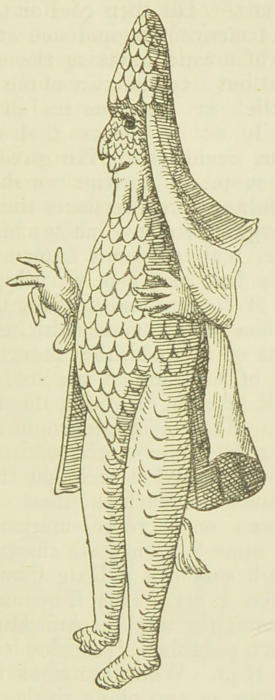
FIG. 25.
This belief in sea-monsters of all kinds was naturally not a chance that a man like Aldrovandus could miss. He gives his imagination full scope, or perhaps we should rather say his credulity, as he introduces these creatures to us as things as real as a rabbit; his sea-monk, for instance, with tonsured human head, arms replaced by fins, and legs by fishy tail, being as matter of fact as one’s vicar. Fig. 25 is given by him in all good faith as the true presentment of a sea-bishop, though not at all our notion of a bishop in his see. The right hand, it will be seen, is giving the benediction. The dragon of the deep, shown in fig. 26, aims at being terrible, but merely succeeds in being feeble. We cannot but feel that the draughtsman here failed to reach our ideal; for one has certainly seen, many representations of land-dragons far more fear-inspiring than this bloated monster with ears like a King Charles spaniel, and tail like a rat. This illustration is from another source, the work of Ambrosinus on the same subject, published “permissu superiorum” in the year 1642. While the book is as quaint and grotesque as any of its rivals, the skill of the artist has in divers cases not paralleled the gifts of description of the author.
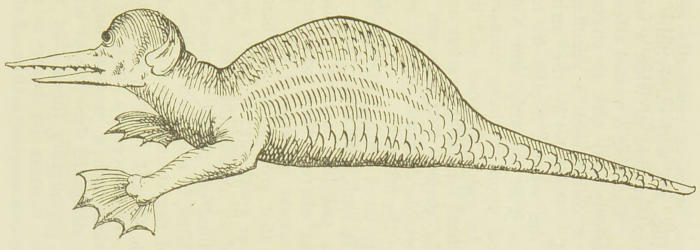
FIG. 26.
The “monstrosus sus marinus,” or terrible sow of the sea, or more especially perhaps of Aldrovandus (fig. 27), will surely fully come up to everyone’s expectation of what a marine pig should be like. Catching a weasel asleep should be a comparatively easy task to circumventing sus marinus; it seems such a peculiarly wide-awake animal. Possibly in the struggle for existence in the watery depths its toothsome flesh may place it in jeopardy, and Nature may have bestowed upon it these numerous eyes to enable it to evade dragons and other foes having a penchant for pork; a rather unexpected addition to the various better-known examples of that comfortable doctrine for the well-to-do, the survival of the fittest.
Purchas tells us of a fish called the Angulo or Hog-fish. “It hath,” he says, “as it were two hands, and a tail like a target, which eateth like pork, and whereof they make lard, and it hath not the savour or taste of fish. It feedeth on the grasse that groweth on the banks of the river and never goeth out; it hath a mouthe like the mozell of an ox, and there be of them that weigh five hundred pound a piece.” This is found, he tells us, in the River Congo.
Another of the strange creatures of ocean is shown in fig. 28. It is somewhat startling to reflect that our ancestors had at least the expectation that such a monster might at any moment rise alongside their vessel and address them in the peremptory tones that the figure suggests: and it must be borne in mind that these illustrations are not a tithe of the strange imaginings that even this one old book sets forth, though it is needless to multiply examples from it. We have carefully drawn our figures in facsimile from the originals, and have naught extenuated, nor set down aught in malice. They are fairly typical examples of the sort of thing that is encountered on page after page.[131]
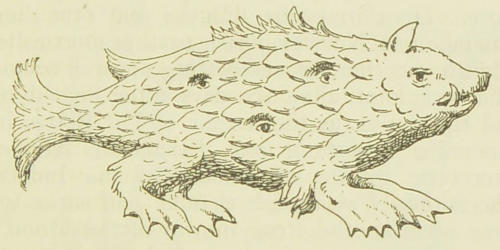
FIG. 27.
In the excellent book of Rondeletius (doctoris medici et medicinæ in schola monspeliensi professoris regii), published in the year 1554, on the subject of marine fishes, the illustrations are full of spirit and life. Amongst these fish of the ocean we find the sea-bishop, sea-monk, &c., all over again, and such creatures as the sea-lion, fig. 29; this latter, except for his scaly hide, has nothing very suggestively aquatic about him. The book, in addition to such impossibilities, contains very good and life-like representations of the sun-fish, sturgeon, hammer-headed shark, ray, and many others.
The author of the “Speculum Mundi” confirms all these wonders, and adds his quota to the general store. He affirms that, “In the year 1526 there was taken in Norway, neare to a seaport called Elpoch, a certain fish resembling a mitred bishop, who was kept alive six days after his taking, and there was, as the author of Du Bartas his summarie reporteth, one Ferdinand Alvares, Secretarie to the storehouse of the Indians, who faithfully witnesseth that he had seene not farre off from the Promontorie of the Moon, a young Sea-man coming out of the Waters, who stole fishes from the fishermen and ate them raw. Neither is Olaus Magnus silent on these things, for he also saith there be monsters in the sea, as it were imitating the shape of a man, having a dolefull kinde of sounde or singing. There be also sea-men of an absolute proportion in their whole body; these are sometimes seene to climbe up the ships in the night times, and suddenly to depresse that part upon which they sit; and if they abide long the whole ship sinketh. Yea (saithe he), this I adde from the faithfull assertions of the Norway fishers, that when such are taken, if they be not presently let go again, there ariseth such a fierce tempest, with an horrid noise of those kinde of creatures and other sea-monsters there assembled, that a man would think the verie heaven were falling, and the vaulted roofe of the world running to ruine, insomuch that the fishermen have much ado to escape with their lives; whereupon they confirmed it as a law amongst them that if any chanced to hang such a fish upon his hook he should suddenly cut the line and let him go on. But these sudden tempests are very strange, and how they arise with such violent speed exceeds the bounds of ordinary admiration. Whereupon it is again supposed that these monsters are verie devils, and by their power such strange storms are raised. Howbeit for my part I think otherwise, and do much rather affirm that these storms, in my judgment, are thus raised, namely, by the thickening and breaking of the aire; which the snortling, rushing, and howling of these beasts, assembled in an innumerable companie, causeth. For it is certain that sounds will break and alter the aire (as I have heard it of a citie freed from the plague by the thundering noise of cannons), and also I suppose that the violent rushing of these beasts causeth much water to flie up and thicken the aire, and by their howling and snortling under the waters they do blow up, and as it were attenuate the waves, and make them arise in a thinner substance than at other times; so that Nature, having all these helps, in an instant worketh to the amazement of the mariners, and often to the danger of their lives. Besides, shall we think that spirits use to feed, and will be so foolish as to go and hang themselves on an hook for a bait? They may have occult properties (as the loadstone hath) to work strange feats, and yet be neither spirits nor devils; for experience likewise teacheth that they die sooner or later after their taking, neither can a spirit have flesh and bones as they have.”
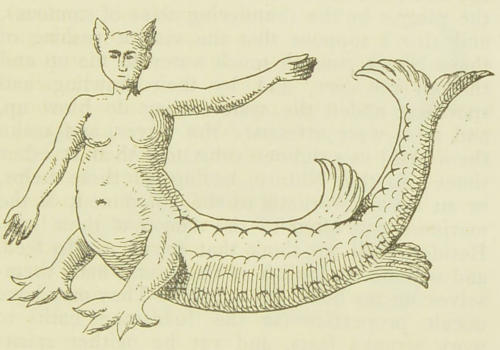
FIG. 28.
The monsters of the deep are best seen at the times of the equinox, “for then,” says Pliny, “by the whirlwinds, rains and tempests which rush with violence from the rugged mountains, the seas are turned up from the very bottom, and thus the billows roll and raise these beasts out of the deep parts of the ocean.” It certainly seems a much more reasonable theory that the storms produce the beasts than that the beasts produce the storms.
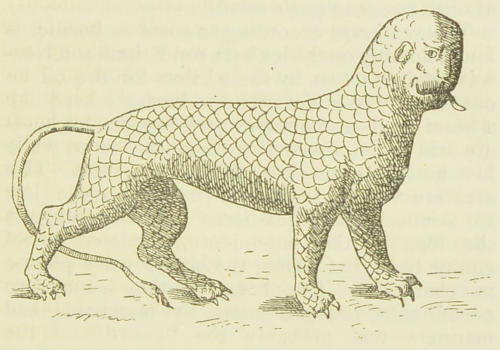
FIG. 29.
On an antique seal we remember to have seen a sea-elephant, a creature having the forelegs, tusks, trunk, and great flapping ears of the African elephant, yet terminating in the body of a fish, and duly furnished with piscine tail and fins. This outrageous combination would seem to indicate the limit possible to absurdity in this direction. When the ancient writers would desire to people the vast unknown of air and sea, their thoughts naturally turned to those creatures of the land with which they were more familiar. Hence, the denizens of the air or ocean are not really creations at all, but adaptations, wings or fins being added to horses, lions and the like, according to the new element in which they were to figure. Of these the sea-horses that drew the chariot of Neptune through the waves, or the winged steed Pegasus, are examples that at once occur to one’s mind.
The sea-horse according to some authorities is found floating on the ice between Britain and Norway, and is taken by the whalers for the oil he contains. He is described as having a head like a horse, and as sometimes neighing, but his hoofs are said to be cloven like those of a cow, while his hinder parts are those of a fish. This creature would appear to be now quite lost to science. The sea-horse naturally suggests the idea of the sea-unicorn, depicted as of equine form, but having the hinder parts piscine in character. The horn of the sea-unicorn occasionally brought home by merchants and mariners was probably the “sword” of the swordfish or the tusk of the narwhal, as it is often mentioned that it was able to penetrate the ribs of ships, and later experience has proved that an encounter between swordfish or narwhal and ships has occasionally taken place. The tusk of the narwhal is a spiral tapering rod of ivory, sometimes attaining to the length of eight or ten feet. Purchas mentions a horn of a sea-unicorn that was presented by Frobisher to his sovereign, and preserved at Windsor, and the name of this great arctic voyager naturally suggests that this horn was the tusk of a narwhal, a creature of the northern seas. One old writer speaks of the horn as a “wreathy spire,” a description which admirably accords with the narwhal tusk. The fact once established that there were creatures in the sea with horns like unicorns, it was at once assumed that they had the horse-like form assigned to the land-unicorn, and in some of the old authors the sea-unicorn is represented as of purely equine form, plus the horn.[132]
In a book published in 1639, entitled “A Helpe to Memorie and Discourse,” we find this question asked, “Whether doth a dead body in a shippe cause the shippe to sail slower, and if it doe, what is thought to be the reason thereof?” The answer to the query is that “the shippe is as insensible of the living as the dead, and as the living make it goe the faster, so the dead make it not goe the slower; for the dead are no Rhemoras to alter the course of her passage, though some there be that thinke so, and that by a kind of mournful sympathy.”[133] The potent influence of the remora or sucking-fish to arrest the progress of a ship by merely adhering to its keel is a curious fancy that has been handed on for centuries. Pliny and many other ancient writers had full belief in this foe to the mariner, and references to it in much more recent authors are by no means uncommon. Thus Ben Jonson alludes to it in the lines—
“I say a remora, For it will stay a ship that’s under sail.”
While Spenser in his “Visions of the World’s Vanity,” writes—
“Looking far forth into the ocean wide, A goodly ship, with banners bravely dight, And flag in her top-gallant I espied, Through the main sea making her merry flight: Fair blew the wind into her bosom right, And th’ Heavens looked lovely all the while That she did seem to dance, as in delight, And at her own felicity did smile: All suddenly there clove unto her keel A little fish that we call remora, Which stopt her course, and held her by the heel, That wind nor tide could move her thence away.”
We may indeed be thankful that this mysterious power, worse even than the more prosaic barnacles and other sea impedimenta that plague the modern shipowner by fouling the bottom of his good ship, and so retarding her course, seems to be no longer exercised. The merchantman speeding home with perishable cargo, the yachtsman burning to carry off the challenge cup, the great record-breaking Atlantic liner, carrying under heavy penalty for delay Her Majesty’s mails, would all be terribly hampered in their several ambitions in presence of so potent yet so apparently insignificant a foe. Well might Spenser add—
“Strange thing meseemeth that so small a thing Should able be so great an one to wring.”
One old writer feeling the impossibility of giving a satisfactory explanation of the marvel is content to say “of which there can be no more reason given than of the loadstone drawing iron; neither is it possible to shew the cause of all secrets in Nature,” a statement as true to-day as the day it was written, though this particular secret of Nature has in the interval been disestablished.
That the dolphin was the swiftest of all living creatures, more rapid than a bird, swifter than an arrow shot from a bow, will probably be an entirely new idea to most of our readers, yet such was the ancient belief. The dolphin occurs very freely in blazonry, on ancient coinage, and in classic and renaissance decoration, and it is almost always represented either as “embowed,” that is to say, bent round like a bow, such being the significance of the heraldic term, or else it is introduced with its lithe body coiled gracefully round an anchor or trident. In either case the representation suggests an easy-going and leisurely state of affairs that is very different to the picture conjured up by the arrowy rush of the creature through the waves, as Pliny paints it for us.[134]
It is a very old belief that the dolphin has an especial fondness for man. “Of a man he is nothing afraid, neither avoideth from him as a stranger: but of himselfe meeteth their ships, plaieth and disporteth himselfe, and fetcheth a thousand friskes, and gambols before them. He will swimme along by the mariners, as it were for a wager, who should make way most speedily, and alwaies outgoeth them, saile they with never so good a forewind.” The representation of the dolphin with the anchor is not simply a type of maritime supremacy, but is a distinct illustration of this belief in the dolphin’s kindly regard for man. Thus Camerarius asserts that “when tempests arise, and sea-men cast their anchor, the dolphin, from its love to man, twines itself round it, and directs it, so that it may more safely lay hold of the ground.”
The works of the ancient writers abound with illustrations of the friendly regard of the dolphin for mankind. Thus in one wonderful story we have a schoolboy, the son of a poor man, who had to travel each day from Baianum to Puteoli, who used at the water’s edge to call a dolphin to his aid. The dolphin would at once respond to the call, and the boy used to mount upon his back and be taken across the sea, and be brought back again at night. This went on for some years, and at last, when the boy fell sick and died, his constitution probably not being able to stand the constant wetting and exposure, the dolphin was inconsolable, and promptly died of a broken heart. In another story, equally veracious, the rider was so unfortunate as to pierce himself with one of the sharp spines of the dorsal fin, and an artery being severed, he bled to death. The dolphin, seeing the water stained with blood, and finding that his rider did not sit on his back in the light and active way that had been his wont, concluded that some catastrophe had happened, and when he realized the full truth, resolved not to outlive him whom he had affectionately loved, and therefore ran himself with all his might upon the shore, and so perished. Pliny, Mecænas, Fabianus, Flavius Alfius, Ælian, Aulus Gellius, Apion, Egesidemus, Theophrastus, and many other old writers, all give equally surprising illustrations of this wonderful love of the dolphin for mankind.
The dolphin is also a great lover of music, and equally wonderful stories are told in illustration of this taste also. Another well-known belief in connection with it is the imaginary brilliancy of its changeful colours when dying. The idea has been a favourite one with poets in all ages: an example from Byron’s “Childe Harold’s Pilgrimage” will suffice as an illustration:—
“Parting day Dies like the dolphin, whom each pang imbues With a new colour as it gasps away; The last still loveliest, till ’tis gone, and all is gray.”
Another strange fish believed in by our forefathers was the Acipenser, “a fish of an unnatural making and quality,” as an old writer terms him; and indeed he may very well do so, as we are told that “his scales are all turned towards his head.” We are not therefore much surprised to learn that “he ever swimmeth against the stream,” though we might well be more astonished if we ever found him swimming at all.
The amiable dolphin stands not alone in its friendship with man. The ray too, if we may believe a mediæval authority, is “a loving fish to man: for swimming in the waters, and being greedily pursued by the devouring Sea-dogs, the Ray defends him, and will not leave him untill he be out of danger.” Sometimes the friendship is with some other creature; thus Porta gives an unfailing recipe for catching a sargon, whatever that may be, by taking advantage of this kindly trait in its character. “The Sargi,” he declares, “love Goats unmeasurably: and they are so mad after them that when so much as the shadow of a Goat that feeds neer the shore shall appear neer unto them they presently leap for joy and swim to it in haste, and they imitate the goats, though they are not fit to leap, and thus they delight to come unto them. They are, therefore, catcht by those things that they so much desire. Whereupon the Fisher, putting on a Goat’s skin with the horns, lies in wait for them, having the Sunne behind his back and paste made wet with the decoction of Goat’s flesh: this he casts into the Sea where the Sargi are to come: and they, as if they were charmed, run to it, and are much delighted with the sight of the Goat’s skin and feed on the paste. Thus the Fishermen catcheth abundance of them.” Porta gives no suggestion that this affection is reciprocal.
Another mediæval writer has a still more extraordinary story of the kind, and in this case it is pleasant to know that the loving feeling is mutual. “Amongst the severall sort of shell fishes,” saith he, “the glistering Pearl-fish deserves remembrance, not only in respect of herself but also in regard of the Prawn, another fish and her companion: for between these two there is a most firm league of friendship, much kindnesse, and such familiaritie as cannot but breed admiration in the reader. They have a subtill kinde of hunting, which being ended, they divide their prey in loving manner: for seeing they one help the other in the getting of it, they likewise joyn in the equall sharing. And, in few words, thus it is—when the Pearl-fish gapeth wide, she hath a curious glistering within her shell, by which she allureth her small fry to come swimming unto her: which when her companion the Prawn perceiveth, he gives her a secret touch with one of his prickles, wherupon she shuts her gaping shell, and so incloseth her wished prey: then (as I said) they equally share them out and feed themselves. And thus, day by day, they get their livings, like a combined knot of cheaters, who have no other trade than the cunning deceit of quaint consenage: hooking in the simpler sort with such subtill tricks, that be their purses stuft with either more or less, they know a way to sound the bottome and send them lighter home: lighter in purse, though heavier in heart.” The moral seems perhaps needlessly severe, and we trust that henceforth our readers, after reading this romance of the deep, will have a kindlier feeling for these faithful friends, the artful oyster and the watchful prawn. The only drawback to the sentiment of the thing seems to be that this loving alliance has a somewhat low motive as its basis. One at least of the partners is capable of a more tender passion, as we have the authority of Sheridan for saying that an oyster may be crossed in love.
Olaus Magnus gives an awful example of voracity in the swam-fish, one of the most greedy cravens of the denizens of the sea, and cites many stories of it that amply justify the bad character bestowed on it. Another old writer affirms that when danger threatens “he will so winde up himselfe and cover his head with the skinne and substance of his own body that he is then bent like unto a piece of dead fish, and nothing like himself.” The plan however appears to have its drawbacks, as the venerable and veracious author goes on to say that this feat “he seldome doth without hurt or damage, for still fearing that there be those about him who will prey upon him and devoure him, he is compelled for lack of meat to feed upon the substance of his own body, choosing rather to be devoured in part than to be consumed by other more strong and powerful fishes”—at best a most painful alternative.
In the account of the Creation the forming of the whale is specially dwelt upon: “And God created great whales and every living creature that moveth, which the waters brought forth abundantly after their kind.” Luther, commenting on this, says that the creation of whales is specified by name, lest affrighted with their greatness we should believe them to be only visions or fancies. Though later commentators have decided that the leviathan of the Bible is the crocodile, it was long held to be the whale. Milton, in the first book of the “Paradise Lost,” writes of that sea beast—
“Leviathan, which God of all his works Created hugest that swim the ocean stream,”
and the Jews had a legend that the first whales were so immense in bulk, so formidable in attack, so voracious, that there was considerable risk of their overtoppling the rest of creation; so while as yet there were but two of them in existence, one was destroyed in order that the race might not be continued and the general balance of Nature upset.
Our ancestors found apt moral against the scornful in the reason assigned for the mouth of the flounder being on one side. It appears that at one time the flounder’s mouth was as fair to see as any other, but that it lost all its beauty through contemptuous flouting of the herring, and it has borne this evil mark of its jealousy ever since, and will probably so bear it to the end of time. At the vague date known as once upon a time we are told that all the fishes of the sea assembled to choose a king, and that the herring was elected to this dignified position. The flounder, on account of his red spots and other features that were evidently more appreciated by himself than by the main body of electors, had strong hope that he should himself be chosen, and the unlovely grimace with which he saluted his sovereign was, as a judgment upon him, made a fixture for all time as a punishment to himself and a warning to others.
The tench was commonly called the physician, for it was believed by our forefathers that when the other fish were in any way hurt and required the aid of surgeon or physician, they healed themselves by rubbing against the tench, finding the slime of his body to be a “soveraigne salve” for their needs. For the sufferings of humanity the beasts, birds, and plants appear to have supplied a sufficient materia medica, and the less accessible creatures of the waters were but rarely pressed into the mediæval pharmacopœia. The blood of the eel was rubbed upon unwelcome warts, and a cruel remedy for bad eyes, the cruelty being, as we have seen over and over again in those old remedies, by no means an exceptional feature, was to capture a crab alive, cut out its eyes and then let it go.[135] The eyes were then bound upon the neck of the man, woman, or child, and a satisfactory result was speedily anticipated, though very possibly not so speedily forthcoming.
The Cuttle fish is scarcely one’s ideal of beauty, yet it is by its vanity and belief in its personal attractions that it is most readily captured. Porta tells us that pieces of looking glass are let down by the fishermen into the waters, and that the Cuttle seeing his image reflected, clasps the glass around, and while he is still enamoured with the reflection of his charms is drawn to the surface by the wily fishermen. In the “Pathway to Knowledge,” published in the year 1685, we are told that if we take the juice of Nettles and Houseleek, and anoint our hands therewith, the fish will gather round and “you may take them out at your pleasure.” This seems almost as simple a method as the catching of birds by placing a pinch of salt on their tails.