"Nat the Naturalist" (continued 4)
Reading edition
“Yes,” continued my uncle, patting Ebo’s black shoulder, “you are a treasure, Ebo, and I see we shall be greatly in your debt. Now, Nat, we must not have a feather of that bird spoiled. I feel ready to go back on purpose to prepare it.”
It was indeed a lovely creature; but as I gazed upon its delicately beautiful tints I felt puzzled. It was of rich purple on the back, with azure-blue shoulders dashed and speckled with a lighter blue, while all the under parts were of a pure white, which seemed to throw out the rich colours of the back. But the great beauty of the specimen was its tail, which was long and had the two centre feathers continued almost without any plumes till the end, where they spread out like a couple of racket bats, making the little bird in all about a foot and a half long.
I felt as if I should never tire of gazing at the beautiful specimen, and quite understood my uncle’s feeling about wishing to make sure of it by preserving it at once.
Just then, though, a large bird flew across, at which I fired, but it was too far distant, and the shots did no more than rattle about its feathers.
“Did you see its great beak, uncle?” I said.
“Yes, Nat, a hornbill. I daresay we shall find plenty of them here. They take the places in the East of the toucans of the West. But now, Nat, there is an easy shot for you—look! Ebo is pointing to it. There, seated on that twig. Now see he darts off after a fly and is back again. No, he is off once more. We have scared him.”
But by this time I had seen the bird, and taking quick aim as it hovered and snatched at a fly of some kind, I fired and brought it down, to find that I too had got a prize in the shape of a lovely little bee-eater, with plumage rich in green and blue, brown and black, while its tail was also rendered more beautiful by the extension of its central feathers in two long thin points.
My uncle’s gun spoke out again the next moment, the second barrel following quickly, and Ebo ran and picked up another of the lovely kingfishers, and one of a different kind with a rich coral-red beak, short tail, and its back beautifully barred with blue and black like the ornamental feathers in the wings of a jay.
“That is a bee-eater you have shot, Nat, and a lovely thing too. Mine are all kingfishers.”
“There must be a little stream down in that hollow between those rocks, uncle,” I replied.
“No, Nat, I don’t suppose there is,” he said, smiling. “But why do you say that?”
“Because of those kingfishers, uncle. There must be a stream or pool somewhere near.”
“I daresay there is, Nat; but not on account of these birds, my lad. They are dry kingfishers, Nat. They do not live upon fish, but upon beetles, butterflies, and moths, darting down and picking them off the ground without wetting a feather.”
“Why, how curious!” I said. “They have beaks just like the kingfishers at home.”
“Very much like them, Nat,” he said; “but they catch no fish. But come, we must get back to the hut, or we shall never get our birds turned into skins before dark. Look out!”
We fired so closely together that it sounded like one shot, and three more of the great pigeons fell heavily to the ground—part of a little flock that was passing over our head.
Ebo seized them with a grin of delight, for he knew that these meant larder, and then hastening back we had just time to strip and prepare our skins before night fell, when, work being ended, the fire was relit, the kettle boiled, and a sort of tea-supper by moonlight, with the dark forest behind and the silvery sea before us, ended a very busy day.
Chapter Twenty Eight.
A bit of a Scare.
That night as I lay in the dark, with the beach outside lit-up by the moon, and listened to the strange noises of the forest behind the hut, I felt over and over again ready to awaken my uncle or Ebo, so sure was I that I could hear wild beasts on the move.
Should there be tigers, or leopards, or even wild boars, what chance should we have if they attacked? Or it might be that one of the huge serpents of which I had read so much might creep in at the open door.
I wanted to be brave, but somehow that night I felt horribly afraid, even the humming buzz of some night-flying beetle making me start. Perhaps I was over-excited, or perhaps, as my uncle would have said, I had eaten too much. At all events, be it what it may, I could not go to sleep, but lay there turning hot and cold and wishing it was morning. The silence seemed so dreadful, and the idea of this being an uninhabited island, instead of being delightful as it had felt in the bright sunshine, now appeared horrible, and I lay thinking of our being far from all human help, and that if our boat happened to drift away we should be left to starve.
Of course this was all nonsense, for with such a clever savage as Ebo and our own ingenuity and tools we could have built another boat—not such a good one as we had arrived in, but quite strong enough to bear us over a calm sea to one or the other of the islands where trading vessels came.
Then I grew hot and seemed to be dripping with perspiration, and my horror increased. What would become of us when our food and powder and shot were gone? We should starve to death. And I began to tremble and wish I had not come, feeling as if I would give anything to be back at home in my old bedroom, with the gas outside in the road and the policeman’s heavy foot to be heard now and then as he went along his beat on the look-out for burglars. I should have been ready to meet Aunt Sophia the next morning and receive the severest scolding I had ever had—anything to be away from where I was.
Then I tried to reason with myself and to think that even if our powder and shot were gone we could make bows and arrows, and set traps, and as food ran short we could always make fishing-lines and catch the scaly creatures that swarmed amongst the rocks all round the shore. Besides which there were cocoa-nuts in plenty, with abundance of other fruit.
I thought too of how when I was at home I should have revelled in the idea of being in such a place, to have an uninhabited island, and such a glorious one, far more beautiful and productive than that of Robinson Crusoe, than whom I should be far better off, for in addition to a man Friday I had my clever uncle for companion, guide, and protector.
At the thought of the last word I stretched out my hand to awaken him and tell him of my horrible feeling of dread; but I drew it back for very shame, for what was there to be afraid of?
I grew a little calmer then and lay gazing out of the open door at the brilliant moonlight, which made some leaves glisten as if they were of silver, and all beneath and amidst the thickets look dark and black and soft as velvet.
Then came a strange sighing noise from the forest behind us, which made my flesh creep as I wondered what it could be. Then there was a wild, strange cry, and soon after a heavy crash as of something falling.
After that, as I lay bathed in perspiration and oppressed by the terrible feeling of loneliness that seemed to increase, I fancied I heard the pat, pat, pat, pat of some animal running along the ground, followed by a hard breathing.
“That must be a wild beast,” I said to myself; and I rose up on one elbow to listen, meaning to get hold of my gun and load it if the sound came nearer.
Then in a confused and troubled way I began to ask myself whether I ought to awaken Uncle Dick and at the same time kick Ebo to make him seize his spear and help in our defence.
But there are no big wild beasts in these islands, my uncle had said to me several times, even expressing his doubt as to there being anything very large in New Guinea.
“But there are great apes,” I said to myself. “I know there are in Borneo, so why should there not be others in an island like this?” and in imagination I began to picture a hideous, great orang-outang cautiously advancing towards our cabin.
I knew they could be very fierce and that they were tremendously strong. Then, too, some travellers had described them as being quite giants of six, seven, and eight feet high, and supposing that there really were no other wild beasts in this island, undoubtedly there were these wild men of the woods, as the Malays called them, and it was one of these that was coming about the hut.
Of course; I knew now as well as if I had seen it. That crash I had heard was made by one of these monsters, and that was its hard breathing that I could hear now.
It was of no use that I tried to make myself believe that I was only listening to Ebo breathing, and every now and then indulging in a regular snore. No, I would not believe it, and lay with my feeling of horror increasing each moment till I lay so helpless now, that if I had wanted to get my gun I could not, I dared not move.
Then there was another horror in the shape of a curious lapping noise from the sea, with a splashing and wallowing as of some great beast; and I did know this, that horrible crocodiles came up the rivers and lived about their mouths, going out to sea and back, and though we had seen no river yet in this island, it was evident that this was one of the monsters crawling about on the shore, and I seemed to see it in the moonlight with its great coarse, scaly back, crooked legs, long stiff tail, and hideous head with sly cruel-looking eyes, and wide, long, teeth-armed jaws.
After a while I knew as well as could be that with its strange instinct it would scent us out and come nearer and nearer, crawling along over the soft sand and leaving a track that could easily be seen the next day. I even seemed to see its footprints with the wide-spread toes, and the long, wavy furrow ploughed by its tail.
It was all one terrible nightmare, growing worse and worse; the noise on the shore increased, the rustling and crashing in the woods; there was a strange humming and buzzing all around, and the breathing sounded closer and deeper.
At last when I felt as if I could bear it no longer, and that if I did not rouse my uncle and Ebo we should be destroyed, I tried to call out, but my voice sounded weak and faint; there was a terrible sense of oppression about me, and the humming and singing noise increased.
I contrived, however, to touch Ebo, and he muttered angrily and changed his position, the noise he made in doing so waking my uncle, who started up on one elbow as if to listen.
“He hears it all, then,” I said to myself, and with a wonderful sense of relief I knew that we should be saved.
Why did I not spring up to help him? you will say.
Ah! that I could not do, for I lay there perfectly paralysed with fright and quite speechless, till to my horror I saw in the dim light of the reflected moonbeams my uncle lie down again, when I made a tremendous effort and gasped forth something or another, I cannot say what.
“Hallo!” he exclaimed. “Anything the matter, Nat?” and getting up quickly he struck a match and lit a little wax taper that he always carried in the brass match-box, part of which formed a stick.
He was kneeling by my side directly and had hold of my hand, when at his touch my senses seemed to come back to me.
“Quick!—the guns!” I panted; “wild beasts!—a crocodile, an ape, uncle. I have been hearing them come.”
“Nonsense! my boy,” he said, smiling.
“No, no; it is no nonsense, uncle. Quick!—the guns!”
“No, my dear boy, it is nonsense. There are no noxious or dangerous beasts here. You are quite safe from them. You have been dreaming, Nat.”
“I’ve not been asleep,” I said piteously.
“Haven’t you, my lad?” he said, with one hand on my brow and the other on my wrist; “then you have been fancying all these troubles. Nat, my boy, you have got a touch of fever. I’m very glad you woke me when you did.”
“Fever, uncle?” I gasped, as the horror of my situation increased, and like a flash came the idea of being ill out in that wilderness, away from all human help and comfort; and, ludicrous is it may sound, I forgot all about Uncle Dick, and began to think of Dr Portly, who had a big brass plate upon his door in the Clapham Road.
“Yes, my boy, a touch of fever, but we’ll soon talk to him, Nat; we’ll nip him in the bud. A stitch in time saves nine. Now you shall see what’s in that little flat tin box I brought. I saw you stare at it when I packed up.”
“I thought it was preserving things, uncle,” I said.
“So it is, my boy, full of preserving things, one of which you shall soon have for a dose. I hope you like bitters, Nat?”
He laughed so pleasantly that he seemed to give me courage, but I glanced in a frightened way at the opening as I said that I did not much mind.
He saw my glance, and went outside with a cup in his hand, to come back in a few minutes with it full of water from a pool close by.
“No wild beasts about, Nat, my boy,” he said merrily. “They were only fever phantoms.”
“But I have not been to sleep, uncle,” I protested.
“Sign that you are ill, Nat, because generally you drop off in an instant and sleep soundly for hours. There are no wild beasts, my boy, in these islands.”
“But I’m sure I heard a great ape breathing hard, and it broke off a great branch in the forest.”
“And I’m sure, Nat, that you heard Ebo snoring; and as to the branch breaking, you heard, I dare say, a dead one fall. They are always falling in these old forests. We don’t notice the noise in the day, when the birds are singing, but in the night everything sounds wonderfully clear.”
“But I’m certain I heard a crocodile crawling up out of the sea, and creeping towards the hut.”
“And I’m certain you did not, my dear boy. We have no muddy tidal river here for them to frequent. It was all fever-born, Nat, my boy; believe me.”
All the while he was talking I saw that he was busy getting something ready. First he put a little white powder in a glass, then he poured a few drops of something over it, and filled it up with water, stirring it with a little bit of glass rod before kneeling down by me.
“There, Nat,” he said kindly, “drink that off.”
“What is it, uncle?” I said, taking the glass with hot and trembling hand.
“A preserving thing, my boy. One of the greatest blessings ever discovered for a traveller. It is quinine, Nat, fever’s deadliest enemy. Down with it at once.”
The stuff was intensely bitter, but my mouth was so hot and parched, and the water with it so cool and pleasant, that I quite enjoyed it, and drew a deep breath.
“There, now, lie down again, my boy, and be off to sleep. Don’t fill your head full of foolish imaginings, Nat. There is nothing to fear from wild beasts here.”
“But am I going to be very ill, uncle?”
“No, certainly not. You will sleep after that till three or four hours past sunrise, and then you will waken, feeling a little weak, perhaps, but in other respects all right. Perhaps it will come back again, and if it does we will rout it out once more with some quinine. Why, Nat, I’ve had dozens of such attacks.”
I lay back, feeling more at rest, and satisfied that uncle was right about the beasts, for there was no sound now to trouble me; only the lapping of the water, which seemed to be only the waves now beating softly upon the sand, while the heavy breathing was certainly Ebo’s, that gentleman never having moved since I touched him.
Then I saw my uncle shut up his little tin case and replace it in the chest, put out the wax taper, and lie down upon his couch of dry grass, yawning slightly, and then lying gazing out of the open door, for I could see his eyes shine.
But by degrees the faintly lit-up hut, with its bamboos and roof, its chests, guns, and Ebo’s spear, all seemed to grow indistinct, and then all was restful peace.
Chapter Twenty Nine.
A strange Cry in the Woods.
When I opened my eyes again the sea was dancing and sparkling, and the leaves waving gently in the soft warm breeze. I could see from where I lay that the water was rippling gently upon the sand, and not far from the hut door my uncle was busy skinning some bright-plumaged bird, while Ebo was cooking a couple of pigeons, and watching a little kettle stuck amongst the glowing ashes.
I was very comfortable, and did not feel disposed to move, for all seemed so calm and pleasant; and when I thought a little about my previous night’s fancies I was ready to smile at them as being perfectly absurd.
I did not speak, but lay quite still, gazing at the lovely picture framed by the open door, and thinking how beautiful it all was, and how foolish I had been to go on fancying such dangers as I had in the night.
Then it was very pleasant, too, to watch Uncle Dick, and how very much quicker and cleverer he was at making a skin than I was. Still, I hoped by practice to get to be as quick.
He went on till he had dressed the interior of the skin with the soap preparation, and after filling certain parts with cotton-wool, and tying the wing-bones together, he turned it back, smoothed the plumage, and I saw that it was another of the short blue-barred kingfishers similar to that we had obtained before.
I could not help noticing as I lay there so quietly what great care and attention he gave to his task, seeming as if he thoroughly enjoyed his work, and felt it to be a duty to do it well.
At last, though, it was put away to dry, and after carefully washing his hands he came to the hut door very gently to see if I was awake.
“Ah, Nat,” he said smiling, “how are you after your long sleep?”
“Long sleep, uncle!” I cried. “Is it very late?”
“Nearly noon, my boy. Well, how are you?”
“I—I think I’m quite well, thank you, uncle,” I said, springing up, and feeling ashamed to be lying there, but turning so giddy that I should have fallen had Uncle Dick not caught my arm.
“Sit down,” he said quietly. “There, that is better.”
“Yes; I feel better now,” I said.
“To be sure you do. Well, Nat, I think we have beaten the fever. You will feel weak for a day or two, but you will soon be all right.”
And so it proved. For after two or three days of weakness, and a strange weary feeling that was quite new to me, I rapidly got better and felt no more dread of being alone at night; in fact I slept soundly as could be, and got up ready and fresh for any new work.
Uncle Dick was very kind, for until I was stronger he contented himself with shooting just about the hut, finding plenty of beautiful birds; but as soon as I was strong enough we prepared some cold provisions and started off for a longer exploration.
Ebo was delighted, and capered about in the excess of his joy, chattering in his own tongue and introducing every English word he had picked up, and these began now to be a good many; but he had very little idea of putting them to a proper use, muddling them up terribly, but keeping in the most perfect humour no matter how we laughed at him.
“It is my belief, Nat,” said Uncle Dick, “that we shall find something better worthy of our notice yet if we make a good long expedition into the more wooded parts of the island.”
“I thought we could not be better off, uncle,” I said, “for we are getting some lovely birds.”
“So we are, Nat; but one is never satisfied, and always wants more. I expect we shall find some birds of paradise, for it strikes me that the cry I have heard several times at daybreak comes from one of them.”
“Birds of paradise! Here, uncle?” I cried.
“Why not, my boy? It is as likely a place as it is possible to imagine: an island near the equator, deeply wooded, and hardly ever visited by man. I should say that we must find some here.”
“Oh, uncle!” I cried as my eyes glistened, and I felt my cheeks flush at the anticipation of seeing one of these noble birds before the muzzle of my gun.
“I shall be greatly disappointed if we do not find some, and I should have been in search of them before now, only I thought you would like to go, and there was plenty of work close home.”
I did not say much, but I felt very grateful at his thoughtfulness, and the very next morning we were off before it was day, tramping through the thick herbage and mounting the rising ground towards the south.
“I purpose trying to get right across the island to-day, Nat,” he said, “and if we are too tired to get back all the way we must contrive enough shelter and camp out for one night in the woods.”
“I shall not mind, uncle,” I said, and on we went.
This time we had provided ourselves with light small baskets, such as we could swing from a cord that passed over our right shoulders, and long and deep enough to hold a good many specimens. We all three bore these, Ebo’s being double the size of ours, as he had no gun to use, but trotted easily by our side with his spear over his shoulder.
Before we had gone two miles several lovely birds had fallen to our guns, principally of the thrush family, for our way was amongst bushes on the rising ground.
It is impossible to describe properly the beauty of these lovely softly-feathered objects. Fancy a bird of the size of our thrush but with a shorter tail, and instead of being olive-green and speckled with brown, think of it as having a jetty head striped with blue and brown, and its body a blending of buff, pale greyish blue, crimson, and black.
We kept on, taking our prizes from the baskets, where they lay in cotton-wool, to examine and admire them again and again.
No sooner had we feasted our eyes upon these birds than something as bright of colour fell to our guns. Now it would be a golden oriole or some glittering sun-bird. Then a beautiful cuckoo with crimson breast and cinnamon-brown back. Then some beautifully painted paroquet with a delicate long taper tail; and we were in the act of examining one of these birds, when, as we paused on the edge of a forest of great trees by which we had been skirting, my uncle grasped my arm, for, sounding hollow, echoing, and strange, there rang out a loud harsh cry: “Quauk-quauk-quauk! Qwok-qwok-qwok!”
This was answered from a distance here and there, as if there were several of the birds, if they were birds, scattered about the forest.
“There, Nat,” said my uncle; “do you hear that?”
“Yes,” I said, laughing. “I could hear it plainly enough, uncle. What was it made by—some kind of crow?”
“Yes, Nat, some kind of crow.”
“Are they worth trying to shoot, uncle?” I asked.
“Yes,” he said with a peculiar smile; and then, as the cry rang out again, apparently nearer, he signified to Ebo that he should try and guide us in the direction of the sounds.
The black understood him well enough, and taking the lead he went on swiftly through the twilight of the forest, for it was easy walking here beneath the vast trees, where nothing grew but fungi and a few pallid-looking little plants.
And so we went on and on, with the trees seeming to get taller and taller, and of mightier girth. Now and then we caught a glimpse of the blue sky, but only seldom, the dense foliage forming a complete screen.
Every now and then we could hear the hoarse harsh cry; but though we went on and on for a tremendous distance, we seemed to get no nearer, till all at once Ebo stopped short, there was the hoarse cry just overhead, and I saw something sweep through the great branches a hundred and fifty feet away.
I had not time to fire, for my uncle’s gun made the forest echo, though nothing fell.
“I missed it, Nat,” he said, “for the branches were in my way; but I thought I would not let the slightest chance go by.”
“What was it, uncle?” I said.
“One of your crows,” he replied, laughing; and Ebo went on again.
Just then my uncle glanced at his compass, and saw that we were travelling in the right direction—due south—so it did not matter how far we went; but though we kept hearing the cries of the crow-birds, as I eventually called them, we saw no more, and felt disappointed for a time, but not for long; there were too many fresh objects for our notice.
At last daylight appeared ahead, and we came out from amongst the trunks, which had risen up on every side of us like pillars, into a beautiful open valley dotted with trees, some of which were green with luxuriant branches right to the ground.
We did not spend many moments gazing at the beautiful landscape, so lovely that I half expected to see houses there, and that it was the result of clever gardening; but it was nature’s own work, and in every tree there were so many birds, and of such lovely kinds, that we seemed to have come to the very place of all in the world to make our collection.
“There, Nat, look!” said my uncle, pointing to where, in the full sunshine, a great bird with a train of soft amber plumage flew across the opening, to disappear amongst the trees; “there goes one of your crows.”
“That lovely buff bird, uncle?” I said; “why, it looked like what I should think a bird of paradise would be.”
“And that’s what it was, undoubtedly, Nat,” he said, “though I never before saw one on the wing.”
“But you said crow, uncle,” I said. “Oh! of course, you said the birds of paradise belonged to the crow family. I wish you could have shot it.”
“It would have required a rifle to hit it at that distance, Nat; but wait a bit. We have learned one thing, and that is the fact that we have birds of paradise here, and that satisfies me that we cannot do better than keep to our present quarters. This place exceeds my highest hopes for a collecting ground. There, look at that bird by the great hollow-looking tree.”
“I was looking at it, uncle. It is one of those great birds with the big bill and a thing upon it like a deck-house.”
“Yes,” said my uncle, “and there is something more. Look, Ebo has gone on. He seems to understand by our looks when he cannot make out our words.”
For Ebo had trotted forward towards the tree that had taken our attention, where the great hornbill had flown to a dead trunk some ten-feet from the ground, and then flapped away.
Chapter Thirty.
A Curious Married Couple.
As Ebo reached the tree he turned back to us laughing and pointing with his spear, and then signed to us to come, though even when we were close up to him I could see nothing but a tiny hole in the trunk of the great tree.
“It can’t be a nest, uncle,” I said, “because it is not big enough. Perhaps it is a wild bees’ hive.”
“I don’t know yet,” said my uncle. “I’m like you, Nat, a little bit puzzled. If it were not so small I should say it was a nest from the way that great hornbill keeps flapping about and screeching.”
“Shall I shoot it, uncle?” I said eagerly.
“Well, no, Nat, I hardly like to do that. If it is as I think, it would be too cruel, for we should be starving the young, and it will be easy to get a specimen of a hornbill if we want one, though really it is such a common bird that it is hardly worth carriage as a skin.”
Just then, to show us, Ebo began to poke at the hole with the point of his spear, and we saw the point of a bill suddenly pop out and dart in again, while the great hornbill shrieked and shouted, for I can call it nothing else, so queerly sounded its voice.
“Why, it can’t be the hornbill’s nest, uncle!” I said. “Look how small it is.”
“Yes, it is small, but it is the hornbill’s nest after all,” said my uncle, as Ebo kept on poking at the hole and bringing down pieces of what seemed to be clay. Then, seeing how interested we were, he took off his basket, lay down his spear, and taking a hatchet from his waistband cut a few nicks for his toes, and began to climb up, the big hornbill screeching horribly the while, till Ebo was level with the hole, from out of which the end of a bill kept on peeping.
Then the hornbill flew off and Ebo began to chop away a large quantity of dry clay till quite a large hole was opened, showing the original way into the hollow tree; and now, after a great deal of hoarse shrieking the black got hold of the great bird that was inside, having quite a fight before he could drag it out by the legs, and then dropping with it, flapping its great wings, to the ground.
“Undoubtedly the female hornbill,” said my uncle. “How singular! The male bird must have plastered her up there and fed her while she has been sitting. That was what we saw, Nat.”
“Then there must be eggs, uncle,” I cried, with my old bird-nesting propensities coming to the front.
But Ebo was already up the tree again as soon as he had rid himself of the great screaming bird, and in place of bringing down any eggs he leaped back to the earth with a young hornbill, as curious a creature as it is possible to imagine.
It was like a clear leather bag or bladder full of something warm and soft, and with the most comical head, legs, and wings, a good-sized soft beak, a few blue stumps of feathers to represent the tail, and nothing else. It was, so to speak, a horribly naked skin of soft jelly with staring eyes, and it kept on gaping helplessly for more food, when it was evidently now as full as could be.
“Are there more birds?” said Uncle Dick pointing to the hole; but Ebo shook his head, running up, thrusting in his hand, and coming down again.
“Very curious, Nat,” said my uncle. “The male bird evidently shuts his wife up after she has laid an egg, to protect her from other birds and perhaps monkeys till she has hatched, and then he goes on feeding her and her young one.”
“And well too, uncle; he is as fat as butter.”
“Feeding both well till the young one is fit to fly.”
“Which won’t be yet, uncle, for he hasn’t a feather.”
“No, my boy. Well, what shall we do with them?” said my uncle, still holding the screeching mother, while I nursed the soft warm bird baby, her daughter or son.
“Let’s put the little—no, I mean the big one back, uncle,” I said, laughing.
“Just what I was thinking. Climb up and do it.”
I easily climbed to the nest and was glad to get the young bird in again without cracking its skin, which seemed so tender; and no sooner had I rolled it softly in and climbed down than my uncle let the mother go, and so strong was her love of her young that she immediately flew to the hole and crept in, croaking and screaming in an uneasy, angry way, as if she was scolding us for interfering with her little one, while from a distance amongst the trees the cock bird kept on answering her with the noisiest and most discordant cries.
Every now and then it came into sight, flying heavily across the openings between the trees, its great cream-coloured, clumsy-looking bill shining and looking bright in the sun, while the cries it uttered tempted one to put one’s fingers into one’s ears.
And all the time the hen bird inside the tree kept answering it peevishly, as much as to say, Look here: what a shame it is! Why don’t you come and drive these people away?
“This is one of the most singular facts in natural history that I have met with,” said Uncle Dick, who was still gazing curiously up at the tree and watching the female hornbill’s head as she kept shuffling herself about uneasily, and seemed to object to so much light.
“I think I know what it is, uncle,” I said, laughing.
“Do you, Nat,” he replied. “Well, you are cleverer than I am if you do know. Well, why is it?”
“The hen hornbill must be like Uncle Joe’s little bantam, who never would sit till she was shut up in the dark, and that’s why Mr Hornbill fastened up his wife.”
My uncle laughed, and then, to Ebo’s great delight, for he had been fidgeting about and wondering why it was that we stopped so long, we continued our journey in search of the birds of paradise, whose cries could be heard at a distance every now and then.
But though we kept on following the sounds we seemed to get no nearer, and to make matters worse, so as not to scare them uncle said it would be better not to fire, with the consequence that we missed shooting some very beautiful birds that flitted from tree to tree.
“We must give up the birds of paradise to-day, Nat,” said my uncle at last. “I see it is of no use to follow them; they are too shy.”
“Then how are we to get any?” I said in a disappointed tone; for we had been walking for some hours now and I was tired.
“Lie in wait for them, Nat,” he replied smiling. “But come, we’ll try and shoot a few birds for food now and have a good dinner. You will feel all the more ready then for a fresh walk.”
By means of a little pantomime we made Ebo understand what we wanted, and in a very little while he had taken us to where the great pigeons thronged the trees, many being below feeding on a kind of nut which had fallen in great profusion from a lofty kind of palm.
If we had wanted a hundred times as many of the big pigeons we could easily have shot them, they were so little used to attack; but we only brought down a sufficiency for our present wants, and as soon as Ebo understood that these birds were not to be skinned but plucked for eating, he quickly had a good fire blazing and worked away stripping the feathers off so that they dropped on the fire and were consumed.
The plumage was so beautiful that it seemed to be like so much wanton destruction to throw it away, and I could not help thinking what delight it would have given me before I had seen Uncle Dick’s collection, to have been the possessor of one of these noble birds. But as my uncle very reasonably said, we should have required a little army of porters to carry our chests, and then a whole vessel to take them home, if we were to preserve every specimen we shot. We could only save the finest specimens; the rest must go for food; and of course we would only, after we had obtained a sufficiency of a particular kind, shoot those that we required for the table.
Ebo was invaluable in preparing fires and food for cooking, and upon this occasion, as he placed the birds on sticks close to the hot blaze, I watched him with no little interest, longing as I did to begin the feast.
But birds take time to cook, and instead of watching impatiently for them to be ready, I saw that Uncle Dick had taken his gun down a narrow little glade between two rows of trees growing so regularly that they seemed to have been planted by a gardener.
But no gardener had ever worked here, and as I overtook my uncle he began to talk of how singular it was that so beautiful a place should be without inhabitants.
“The soil must be rich, Nat, to produce such glorious trees and shrubs. Look at the beauty of what flowers there are, and the herbage, Nat. The place is a perfect paradise.”
“And do you feel sure, uncle, that there are no savages here?”
“None but ourselves, Nat,” said my uncle, laughing.
“Well, but we are not savages, uncle,” I said.
“That is a matter of opinion, my boy. I’m afraid the birds here, if they can think about such things, would be very much disposed to look upon us as savages for intruding upon their beautiful domain to shoot one here and one there for our own selfish purposes.”
“Oh! but birds can’t think, uncle,” I said.
“How do you know?”
Well, of course I did not know, and could produce no argument in support of my case. So I looked up at him at last in a puzzled way and saw that he was smiling.
“You can’t answer that question, Nat,” he said. “It is one of the matters that science sees no way of compassing. Still, I feel certain that birds have a good deal of sense.”
“But you don’t think they can talk to one another, do you, uncle?”
“No, it cannot be called talking; but they have certain ways of communicating one with the other, as anyone who has taken notice of domestic fowls can see. What is more familiar than the old hen’s cry to her chickens when she has found something eatable? and then there is the curious call uttered by all fowls when any large bird that they think is a bird of prey flies over them.”
“Oh! yes, I’ve heard that, uncle,” I said.
“I remember an old hen uttering that peculiar warning note one day in a field, Nat, and immediately every chicken feeding near hurried off under the hedges and trees, or thrust their heads into tufts of grass to hide themselves from the hawk.”
“That seems to show, uncle, that they do understand.”
“Yes, they certainly comprehend a certain number of cries, and it is a sort of natural language that they have learned for their preservation.”
“I know too about the chickens, uncle,” I said. “Sometimes they go about uttering a little soft twittering noise as if they were happy and contented; but if they lose sight of their mother they pipe and cry and stand on their toes, staring about them as if they were in the greatest of trouble.”
“I think I can tell you another curious little thing about fowls too, and their way of communicating one with the other. Many years ago, Nat, I had a fancy for keeping some very large fine Dorking fowls, and very interesting I found it letting the hens sit and then taking care of their chickens.”
“But how is it, uncle,” I said, interrupting him, “that a tiny, tender chicken can so easily chip a hole in an egg-shell, as they do when they are nearly ready to come out?”
“Because, for one reason, the egg-shell has become very brittle, and all the glutinous, adhesive matter has dried away from the lime; the other reason is, that the pressure of the bird’s beak alone is sufficient to do it, because the pressure comes from within. There is a wonderful strength in an egg, Nat, if the pressure is from without; it will bear enormous weight from without, for one particle supports another, and in reason the pressure adds to the strength. The slightest touch, however, is sufficient to break a way out from within. I’ll be bound to say you have often hammered an egg with a spoon and been surprised to find how hard it is.”
“Yes, uncle, often,” I said.
“Well, but to go on with my story, Nat. One day a favourite hen had eleven beautiful little yellow downy chickens, and for the fun of the thing I took one soft little thing out of the nest and carried it into the yard, where the great cock was strutting about with his sickle-feathered green tail glistening in the sun, and, putting down the tiny yellow ball of down, I drew back, calling the old cock the while.
“He ran up, thinking it was something to eat; but as soon as he reached the helpless little chick he stopped short, bent his head down, looked at it first with one eye, then with the other, and seemed lost in meditation.
“‘Come, papa,’ I said, ‘what do you think of your little one?’
“Still he kept on staring intently at the little thing till it began to cry ‘Peek, peek, peek’ in a most dismal tone, for it was very cold, and then the old cock, who had been looking very important and big, suddenly began to cry ‘Took, took, took’, just like a hen, and softly crouched down, spreading his wings a little for the chick to creep under him and get warm, and no doubt he would have taken care of that chicken and brought it up if I had not taken it back to the hen.
“But look! we are talking about barn-door fowls and losing chances to get lovely specimens of foreign birds and—what’s that?”
For just then a shrill wild call rang down the lovely glade, and I thought that Uncle Dick was wrong, and savages were near.
Chapter Thirty One.
Lost in the Forest.
There was no occasion for alarm, the cry only coming from Ebo, who, as soon as he saw us, began making frantic signs to us to come.
“That means the pigeons are cooked, Nat,” said my uncle, laughing; and this was the case, for, as soon as he saw us, the black came running up gesticulating and pointing behind him in the direction of the fire, where the delicious birds were waiting for us to eat.
Those were delightful meals that we had out in the shade of some grand wide-spreading tree, in whose branches every now and then a parrot would come shrieking, to be followed by others; and as we ate our dinner so would they busily find and eat theirs, hanging by their legs, perhaps head downwards, or perching on one leg and using the other with its soft clasping yoke toes like a hand to convey the food towards its beak.
I never felt tired of watching the parrots and paroquets, for besides their beauty of plumage of all kinds of soft tints of green, brightened with orange and scarlet and blue, they always looked such plump and delicately feathered birds. I have seen hundreds of them stuffed, and have admired the bird-mounters’ skill, but they never get anywhere near nature and the soft and downy beauty of a bird in its native state.
The wonder to me was that they could keep themselves so prim, and with every feather in such perfect order. The paroquets, for instance, had the central feathers of their tail so long and thin and delicate, that it seemed that, flitting and climbing about the trees so much, they must get them broken, but they apparently never did, except when they were damaged by our shot.
It was the same with the lovely racket-tailed kingfishers and the fly-catchers, some of which had tails double the length of their own bodies, and of a delicacy that was beautiful in the extreme.
But I must go back to the rest of our adventures that day, for as soon as we had dined and had a rest, Uncle Dick signed to Ebo that he should make a rough hut beneath this tree, ready for our sleeping that night, and leaving him industriously at work, we started off together to try and explore a little more of the island.
Going as straight as we could, we were not very long before, from a bit of a hill, we could see the blue waters of the ocean spreading far and wide, and soon after we made out the great rollers falling over upon the sands, which spread right and left, of a dazzling whiteness, being composed entirely of powdered-up coral and madrepore.
There was no need, my uncle said, to go farther that day, for we had found out that it was no great distance across the island; the thing now was to discover its length.
“It seems a foolish thing to do, perhaps, Nat,” said my uncle, “but I should very much like to try a little more exploration to-day. I don’t think we will shoot any more birds, but examine the land instead, so as to be a little at home with its shape, ready for making a trip here and there in the future. We shall be able to mark down good spots, too, for finding specimens in the future.”
“But shall you stay here long, uncle?” I asked.
“That I cannot answer, Nat,” he replied, as we shouldered our guns and trudged on. “It all depends upon the number of specimens we find, and so far it seems to me that we might travel far before we hit again upon such a wild paradise.”
“I wonder how Uncle Joe would like to live here!” I said laughing. “What a garden he might have, and how things would grow! Oh, how I should like to help him build the house and get the garden in order!”
“Your Uncle Joe would be happy anywhere, Nat,” said my uncle. “He is one of those contented amiable men who are always at rest; but I’m afraid your Aunt Sophia would soon find it dull, and be grumbling because there was no gas, no pavement, no waterworks, no omnibuses, no cabs, no railroads. No, Nat, my boy, your Aunt Sophia would be miserable here.”
“And yet it is such a lovely place,” I cried enthusiastically. “Everything is so beautiful. Oh! uncle, I could stay here forever.”
“No, Nat, you could not,” he replied laughing; “but it is very beautiful all the same. I have travelled a great deal, and have seen some wonderful scenery, but I have never met with so much beauty condensed in so small a space.”
We kept on walking, but it was only to stop every now and then before some fresh find—sometimes it would be a curiously-shaped orchid, or a pitcher-plant half full of dead insects. Then some great forest tree full of sweet-scented blossoms, and alive with birds and insects, would arrest our attention; or down in some moist hollow, where a tiny stream trickled from the rocks, there would be enormous tree-ferns springing up twelve or fifteen feet above us, and spreading their beautiful fronds like so much glorious green lace against the sky. A fern is always a beautiful object, but these tree-ferns were more than beautiful—they were grand.
The farther we went the more beauties we found, and we kept on noting down places to visit again where there were palm and other trees full of fruit, which evidently formed the larder of various kinds of beautiful birds. We could have shot enough in that walk to have kept us busy making skins for days, but we kept to the determination my uncle had made, not to shoot any more that day, except once, when the curious hoarse cry of some bird of paradise, answered by others at a distance, tempted us away.
“Birds of paradise are exceptions, Nat,” said my uncle, smiling. “We must get them when we can.”
I immediately seemed to see the beautiful bird flying amongst the trees, with its lovely buff plumes trailing behind like so much live sunshine, and glancing once at my gun to see that the cartridges were in all right, I crept cautiously on amongst the trees on one side as Uncle Dick made a bit of a curve round in another, so that we had a good many great forest trees between us, whose foliage we carefully watched as we went cautiously on.
Every now and then, after a silence that made us think that our labour was all in vain, and we were about to give up, the loud harsh cry would come echoing from amongst the trees, and always seeming so near that I thought I must get a shot at the bird in a moment or two, and I bent down and crept on as quietly as I could, till the tree from which the sound seemed to come was reached.
Then I would stand ready to fire, watching carefully for a shot, peering amongst the boughs, and fancying a dozen times over that I could catch glimpses of the bird amongst the leaves, when, as if laughing at me for my pains, the cry would come again from a couple of hundred yards away, and the chase went on.
I did not shout to Uncle Dick, for by stopping to listen now and then I could hear the rustling of the leaves and twigs as he went on, besides every now and then catching through the dim light a glimpse of his face.
Once or twice, when a beautiful bird sprang up between us, my heart began to beat more quickly, for I thought that if uncle was tempted to shoot at it he might hit me; but by degrees I grew more confident and walked boldly on, feeling that I had nothing to fear.
That bird must have led us for miles. Every time we were ready to give up, the hoarse cry rang out again, and we followed once more, feeling sure that sooner or later we must get a shot at it, or at one of the others which kept answering from a distance; but at last I heard a peculiar whistle from where my uncle would be, and I forced my way through the undergrowth and joined him.
“Nat,” he said, wiping the perspiration from his face, “that must have been a wild-goose instead of a bird of paradise. Have you heard it lately?”
“No, uncle; not for quite a quarter of an hour. I think it must have taken a longer flight this time.”
“Yawk, yawk—wok, wok, wok, wok, wok,” rang out close behind us, and we both fired simultaneously at a faint gleam of what seemed to be yellow light as it flitted through the glade, running forward to get beyond the smoke in the hope that we might have hit it.
But even if we had we should not have been able to find it, for in the eagerness of our pursuit we had come now into one of the densest parts of the forest that we had found, and after wandering on through a faint warm glow caused by the setting sun shining through the tree trunks, a sudden dull greyness had come upon us, followed almost at once by darkness, and we knew that we were lost.
“I ought to have known better, Nat,” said my uncle, with an exclamation of impatience. “I have not the most remote idea where our camp is, and Ebo will be expecting us back.”
“Oh! never mind, uncle,” I said; “let’s have a try. I dare say we can find the way back.”
“My dear boy, it would be sheer folly,” he replied. “How is it possible? We are tired out now, and it would be only exhausting ourselves for nothing, and getting a touch of fever, to go striving on through the night.”
“What are we to do then, uncle?”
“Do, my boy? Do as Adam did, make ourselves as comfortable as we can beneath a tree. We can do better, for we can cut some wood and leaves to make ourselves a shelter.”
“What, build a hut, uncle?” I said in dismay; for I was now beginning to find out how tired I really was.
“No; we won’t take all that trouble; but what we do we must do quickly. Come along.”
I followed him up a slope to where the ground seemed to be a trifle more open and the trees larger, and as we forced our way on my uncle drew his great hunting-knife and chopped down a straight young sapling, which, upon being topped and trimmed, made a ten-feet pole about as thick as my arm was then.
This he fixed by resting one end in the fork of a tree and tying the other to a branch about five feet from the ground.
“Now then, Nat,” he cried, “get your big sheath-knife to work and clear the ground here. Does it seem dry?”
“Yes, uncle, quite,” I said.
“Well, then, you chop off plenty of soft twigs and leaves and lay them thickly for a bed, while I make a roof over it.”
We worked with a will, I for my part finding plenty of tree-ferns, whose fronds did capitally, and Uncle Dick soon had laid sloping against the pole a sufficiency of leafy branches to form an ample shelter against the wind and rain should either come.
“So far, so good, Nat,” he said; “now are you very hungry?”
“I’m more tired than hungry, uncle,” I said.
“Then I think we will light a fire and then have as good a night’s rest as we can.”
There was no difficulty in getting plenty of dried wood together, and after a few failures this began to blaze merrily, lighting up the leaves of the trees with a rich red glow; and when it was at its height setting a good many birds flitting about in the strange glow, so that we could have procured more specimens here. But after sitting talking by the fire for some time we crept in under our leafy shed, and it seemed to me that no sooner had I stretched myself out than I fell fast asleep.
Chapter Thirty Two.
Another Night Horror.
I had no idea how long I had been asleep when all at once I started into wakefulness, feeling that we were in danger.
I did not know what the danger might be, but that there was something about to happen I was sure.
It was very dark in our narrow shed, and nearly dark out beyond our feet, only that a faint glow from our fire made one or two tree trunks stand out like dark sentinels just on the other side.
My uncle was so near that I could have wakened him by just moving one hand, but remembering that other night I shrank from wakening him without cause.
“I’ve got another fever fit coming on,” I said to myself; but all the same I did not feel so, only startled and timid, and to encourage myself I thought that I must have had a bad dream.
But no; I could remember no dream. It seemed as if I had sunk at once into a profound sleep from which I had just wakened fancying that we were in danger.
Then I lay quite still listening to my uncle’s breathing, and thinking how helpless and unprotected we were out in that wild place, not even having Ebo with us now.
But what was there to fear, I asked myself as I recalled my uncle’s words, that he was certain there were no wild beasts in such an island as this, and there were no other inhabitants than ourselves.
Yes, I could think of all this, and it ought to have made me more comfortable; but no, there was still that curious feeling of being in danger, and I felt as certain as if I could see it, that something was coming to attack us.
Then as I could neither see nor hear anything I began once more to conclude that I must be suffering from another attack of fever, and I lifted my hand to awaken my uncle, so that he might give me some quinine again.
Then I recollected that the medicine was in one of our boxes right away from where we were, for we were lost in the forest, and it would be impossible to move until the sun was up once more. So there I lay till another change came over me, and I once more felt sure that it was not fever again. I knew it was not, and this time there was no mistake—something was coming through the forest, though what it was I could not tell.
Should I waken my uncle?
I raised my hand again and again, but always lowered it once more, so fearful was I of being ridiculed; and then I lay thinking that although uncle had said with such certainty that there were neither inhabitants nor wild beasts, there was plenty of room for either to hide away in these forests; and besides, should there be no regular inhabitants, some might have come by canoe from one or other of the islands. And, yes, I was sure of it, they must have seen our fire, and were creeping up to kill us where we lay.
This was a very pretty theory; but would not they make some noise as they came, and if so, where was that noise?
I lay perfectly still with the perspiration oozing out of me and my horror increasing, but still there was no noise.
Yes, there was—a low rustling sound as of some one creeping through the bushes towards us. There could be no mistaking that sound, it was just the same as I had been hearing all the afternoon as we crept cautiously on in search of the birds of paradise.
I listened and tried to pierce the darkness with my eyes, but only just about the embers of the fire was anything visible, where the tree trunks stood all like sentries.
Then the noise ceased and I was ready to believe that I had made a mistake. No, there it was again, and certainly much nearer.
Should I wake Uncle Dick, or should I try to be brave enough to deal with the danger myself?
I was horribly frightened and sadly wanted him to give me his help and counsel; but as I was not sure, in spite of my feelings, that there really was danger, I fought hard with my cowardice and determined to act as seemed best.
Cautiously reaching out my hand I took hold of my gun, and by pressing my finger on each trigger in turn, I cocked it silently, and raising myself on one elbow waited for the danger to come.
The sounds stopped several times, but were always resumed, and the more I listened the more certain I felt that some big animal was creeping up with great caution towards the fire, though I felt that that animal might be a man.
I would have given anything to have been able to sit up in an easier position; but I could only have done so by making a noise and perhaps waking Uncle Dick for nothing. So I remained as I was, watching with eyes and ears upon the strain, the barrel of my gun towards the opening in our leafy shed and well covering the fire; and so minute after minute went by, with the sensation more and more strongly upon me of the near presence of some creature, one which I each moment expected to see cross the faint glow of the fire.
Then all was still, and though I listened so intently I could hear nothing but my uncle’s breathing. So still did everything become that I began to feel less oppression at my chest, and ready to believe that it was all fancy, when suddenly the embers of the fire seemed to have fallen a little together, for the glow grew stronger and there was a faint flicker which made my heart give one great bound.
For there, between me and the fire, was what appeared to be the monstrous figure of an orang-outang, which had crawled close up to the fire and was looking at it.
The creature was on all-fours and had its back to me, while the darkness of the night prevented me from making it out properly; but it looked to me very large and dark coloured, and I had read that the strength of these creatures was enormous.
It crouched there about five yards from where I lay, and as I wondered whether I had better shoot, I suddenly recollected that both barrels of my gun were loaded with small shot, and that at such a distance, though the shot would well hang together, they were not certain to make a mortal wound; while the result would be that the monster would be more fierce and terrible than it was before.
I don’t think I was afraid to fire, but I hesitated, and as I waited I felt that there was a possibility of the animal not being aware of our presence, for it was evidently the fire that had attracted it.
But these hopes came to an end directly, and I raised my gun softly to my shoulder, for the creature seemed about to crawl towards me. This was only for a moment or two though, and then there was a peculiar scratching noise as if the monster was tearing at the bushes, and I could dimly see its great back waving to and fro. Then all at once the scratching ceased, and it seemed to have thrown some twigs and leaves upon the fire, which blazed up, and my gun nearly fell from my hand.
“Ebo!” I shouted; and as my uncle sprang up and we crept out into the ruddy light spread by the burning wood, there was my monster in the shape of our trusty follower, dancing about like mad, and chattering away as he pointed to the fire, then to himself, then to a distance, and seemed to be trying to make us understand that he had seen the fire and tracked us by its light to where we were.
His delight seemed to know no bounds, for whenever he came to a pause in his performance and stood grinning at us, he broke out again, leaping about, running away, coming back, and shouting and laughing as he slapped himself loudly with his hands. I can compare his conduct to nothing but that of a dog who has just found his master.
The question now arose what was to be done, and by a good deal of sign—making we asked Ebo to lead us back to the camp; but he shook his head and stamped and frowned, and to cut the matter short threw some more wood on the fire, pushed us both into our leaf tent, lay down across the front, and went to sleep.
Chapter Thirty Three.
My Earthquake.
I said very little to my uncle about my alarm, feeling sure that he would laugh very heartily at my mistake, but I lay awake for some little while thinking that it was time I grew to be more manly and brave, and not so ready to be frightened at everything I could not directly understand. It seemed so shocking, too, for I might in my cowardly fear have shot poor Ebo, who was one of the best and truest of fellows, and seemed never so happy as when able to do something for me.
My last thoughts before I went to sleep were that I hoped I might grow into a brave and true man, and I determined to try hard not to be such a weak coward.
I have often thought since, though, that if any ordinary man had been placed in the same situation he would have been as nervous as I; for to awake out of a deep sleep in a dark forest in a wild land, where dangerous beasts might be lurking, to hear a peculiar rustling noise, and through the faint light to make out the figure of the black, looking big and indistinct as he crept on all-fours, was, to put it as you may, very startling.
I was ready enough to laugh at all the dread when I awoke in the morning to find the sun just up, and sending his rays through the long vistas of trees, where the birds were whistling, twittering, and screaming loudly, while every now and then from a distance came the hoarse cry of the birds of paradise.
“It is terribly tempting, Nat,” said my uncle, “but I think we had better make straight for camp and get a good breakfast before we do anything else. Hallo! what is Ebo doing?”
“Making up the fire,” I said; and directly the black had thrown on a great armful of dead wood he came to us laughing and rubbing the front of his person, squeezing himself in to show how empty he was, after which he picked up a stick, took aim at a bird, said “Bop!” and ran to pick it up; coming back laughing for us to applaud his performance.
“Well, Nat, that’s a piece of dumb-show that says very plainly we are to shoot some birds for breakfast before we do anything else, and it would perhaps be wise, so come along; there are some of our old friends in that great palm-tree.”
I followed my uncle closely, and we had no difficulty in shooting three of the great pigeons, which Ebo pounced upon and carried off in triumph, and in a few minutes they were roasting upon sticks, while our black cook busied himself in climbing a cocoa-tree, from which he detached half a dozen nuts, each of which came down with a tremendous thud.
I was terribly hungry, but Uncle Dick said we should be worse if we stopped there smelling the roasting pigeons. So we took our guns and went across an opening to where there was tree after tree, rising some thirty or forty feet high, all covered with beautiful white sweet-scented starry flowers, each with a tube running up from it like that of a jasmine.
All about this beautiful little birds were flitting, and as we watched them for some time I could see their feathers flash and glitter in the sunshine, as if some wore tiny helmets of burnished gold and breastplates of purple glittering scales. No colours could paint the beauty of these lovely little creatures, which seemed to be of several different kinds, for some had patches of scarlet, of orange, blue, and white to add to the brilliancy of their feathering; and so little used were they to the sight of man that they seemed to pay no attention to us, but allowed us to go very close, so that we could see them flit and hover and balance themselves before the sweet-scented starry bell-flowers, into whose depths they thrust their long thin beaks after the honey and insects that made them their home.
I soon learned from my uncle that they were the sun-birds, the tiny little fellows that were in the Old World what the humming-birds were in the New, for there are no humming-birds in the East.
Following Uncle Dick’s example, I took the shot out of my gun, for he said that the concussion and the wad would be sufficient to bring them down. But, somehow, we were so interested in what we saw that neither of us thought of firing, and there we stood watching the glittering feathers, the graceful motions, and the rapidity with which these tiny birds seemed to flash from blossom to blossom, till a loud yell from Ebo summoned us to breakfast.
“Yes, Nat,” said my uncle, who seemed to read my thoughts, “that is the way to see the beauty of the sun-birds. No stuffed specimens of ours will ever reproduce a hundredth part of their beauty; but people cannot always come from England to see these things. Take care! What’s that?”
We were going through rather a dense patch of undergrowth, where the ground beneath was very soft and full of water, evidently from some boggy springs. There was a great deal of cane and tall grass, with water weeds of a most luxuriant growth, and the place felt hot and steamy as we forced our way through, till, as I was going first and parting the waving canes right and left with my gun barrel, I stepped upon what seemed to be a big branch of a rotten tree that had fallen there, when suddenly I felt myself lifted up a few inches and jerked back, while at the same moment the canes and grass crashed and swayed, and something seemed to be in violent motion.
“Is it an earthquake, uncle?” I said, looking aghast at the spot from whence had been jerked.
“Yes, Nat, and there it goes. Fire, boy, fire!”
He took rapid aim a little to the left, where the canes and broad-leaved plants were swaying to and fro in a curious way, just as if, it seemed then, a little pig was rushing through, and following his example I fired in the same direction.
But our shots seemed to have no effect, and whatever it was dashed off into a thicker part, where it was too swampy to follow even if we had been so disposed.
“Your earthquake has got away for the present, Nat,” said my uncle. “Did you see it?”
“No, uncle,” I said.
“But you must have trodden upon it, and it threw you back.”
“No, uncle; I trod upon the trunk of a small tree, that was all.”
“You trod upon a large serpent, Nat, my boy,” he exclaimed.
“Ugh!” I ejaculated; and I made a jump back on to more solid ground.
“The danger has passed now, Nat,” he said, smiling at my dread; “but really I could not have believed such a creature existed in so small an island.”
“Oh, uncle!” I cried, “I shall never like to go about again for fear of treading upon another.”
“You will soon get over that, Nat, and perhaps we may have the luck to shoot the brute. I don’t think we did it much mischief this time, though I got a good sight of it as it glided amongst the canes.”
“Why, we had no shot in our guns, uncle,” I cried; “we took them out so as not to knock the sun-birds about too much.”
“Of course!” cried my uncle. “How foolish of me not to remember this!”
We had both reloaded now, and then, without heeding a shout from Ebo, we stood looking in the direction taken by the reptile, though now all the luxuriant canes and grasses were quite still.
“What do you say, Nat?” said my uncle. “Shall we follow the monster and try and shoot it?”
“It must be forty or fifty feet long, uncle,” I said, feeling a curious creeping sensation run through me.
“Forty or fifty nonsenses, my boy!” he said, laughing. “Such serpents as that only exist in books. They rarely exceed twenty feet where they are largest. That fellow would not be fifteen. What do you say—will you come?”
“Ye–es, uncle,” I said hesitatingly, feeling hot and cold by turns.
“Why, Nat,” he said quietly, “you are afraid!” I did not speak for a moment or two, but felt the hot blood flush into my face as I stood there looking him full in the eyes, and unable to withdraw my gaze.
“Yes, uncle,” I said at last. “I did not want to be, but a serpent is such a horrible thing, and I am afraid.”
“Yes, it is a horrible monster, Nat,” he said quietly. “I don’t like them myself, but if we could kill it—”
“I can’t help feeling afraid, uncle,” I said, “but I’m ready to go on now.”
“What! to attack it, Nat?”
“Yes, uncle.”
“It will be rather dangerous, my boy.”
“Yes, uncle,” I said. “I suppose so; but I want to get over being so afraid of things. I’m quite ready now.”
I looked to him to come on at once, but he did not move, and stood looking at me for some minutes without speaking.
“Then we will go and attack the brute, Nat,” he said; “but it will not go away from that bit of a swamp, so we will try and put a little more nerve into our hearts with a good breakfast, and then have Ebo to help us, unless he proves to be a worse coward than you.”
“He could not be, uncle,” I said pitifully; and I felt very, very miserable.
“Oh! yes, he could be, Nat, my boy,” said my uncle, smiling, and grasping me affectionately by the arm. “You are a coward, Nat, but you fought with your natural dread, mastered it, and are ready to go and attack that beast. Master Ebo may be a coward and not fight with and master his dread. So you see the difference, my boy.”
Another shout from the black made us hasten our steps to where he was dancing about and pointing to the crisp brown pigeons, big as chickens, with great green leaves for plates, and the new ripe cocoa-nuts divested of their husks; but for a few moments I could not eat for thinking of the serpent. My fresh young appetite asserted itself though soon after, and, forgetting the danger to come, I made one of the most delicious of meals.
Chapter Thirty Four.
Many Feet of Unpleasantry.
It was only while I was scraping out the last of the delicate cream from the inside of a huge cocoa-nut that I recalled the task we had to come, and a curious shiver ran through me as I glanced in the direction of the swamp where, nearly a mile away, the reptile lay.
Ebo knew nothing about it as yet, and I hardly conceived how he would be made to understand what we had seen.
“Do you think he will be ready to help kill the serpent, uncle?” I said, after waiting for some time to see if he would say anything about the attack.
“I hardly know, Nat,” he replied cheerily; “but we’ll soon try him. By the way, use the cartridges with the largest kind of shot, for we must make up for this morning’s mistakes. Here, Ebo, we’ve seen a snake,” he said.
“Ung-kul, Nat-mi-boi. Hal-lo, hal-lo hal-lo!” replied Ebo, laughing merrily, and showing his white teeth.
“We shall not get at his understanding like that,” said my uncle quietly; and he sat thinking for a moment.
“Shall I try and draw a snake, uncle?” I said.
“To be sure, Nat,” he replied, laughing; “but where are paper, pencil, or chalk? Stop a minute—I have it.”
We generally carried a stout piece of cord with us, ready for any emergency, and this cord, about ten yards long and a little thicker than clothes-line, my uncle now untwisted from his waist, where he had worn it like a belt, and calling Ebo’s attention to it he laid it out upon the ground. Then holding one end he made it wave about and crawl and curve and twine, ending by knotting it up in a heap and laying the end carefully down as if it were a serpent asleep.
Ebo watched the process attentively, at first seriously and then as if delighted, clapping his hands, dancing, and chattering away as if telling my uncle how clever he was.
“But that does not show him what we want, uncle,” I said.
“Well, then, you try.”
I took up the rope, made it undulate a little, and then as Ebo looked on I gave it a quick twist and wound it round him, pretending to make the end bite.
He took to it directly, pretending that the reptile was crushing him, fighting his way free of the folds, picking up his club and attacking it in turn, beating the make-believe head with his club, and finally indulging in a war-dance as he jumped round, dragging the imaginary serpent after him, pretending all the while that it was very heavy, before stooping down to smell it, making a grimace, and then throwing down the rope, which he pretended to bury in the sand.
“It’s all right, Nat. He understands, and has evidently encountered big snakes. Now, then, to show him our enemy, for he will fight.”
My uncle was right, for it was evident that Ebo quite understood us and meant fighting, for, sticking his spear in the ground, he made signs to me that I should lend him my hunting-knife, which I at once did, and laughing and chattering away he looked about him a little, and then proceeded to cut down a sapling tree about as thick as his arm, from whose trunk he selected a piece a couple of feet in length and carefully trimmed it into a formidable club with a smooth, small handle, while he left the thick end jagged with the ugly places from which he had cut the branches.
He was not long in getting it into shape, and no sooner had he satisfied himself with his work than he returned my hunting-knife, making believe that he was horribly afraid lest it should cut off his head, and then proceeded to attack an imaginary serpent that was trying to escape through the bushes. Now he was trying to strike it, now retreating, now making blows at it upon the ground, now in the air, ending by dropping his club and seizing the neck of the creature, which he pretended had coiled round him; now he was down upon one knee, now overthrown and rolling over and over in a fierce struggle; but at last his acting came to a conclusion by his striking the reptile’s head against a tree, kicking off an imaginary coil from his leg, and strutting about proudly to show how he had conquered.
The most surprising part of the affair was that he did not seem to be in the slightest degree exhausted by his efforts, but picked up his club and began chattering to us, and pointing to the marsh as if asking us to come on.
“Well, Nat,” said my uncle, “if he will only fight half as well as that when we encounter the serpent, there ought to be nothing to fear. We ought to master the brute easily.”
“Would such a serpent be very strong, uncle?” I asked.
“Wonderfully strong,” he replied. “Their muscles are tremendously powerful. See what strength anything of similar form possesses; an eel, for instance.”
“Yes, uncle,” I said thoughtfully, as I recalled how difficult I had once found it to hold a large one that I had caught. “Eels are very strong.”
“Look here, Nat,” said my uncle kindly, “I don’t think we should run any risks in following up this serpent, for one good shot would disable it; but still it may be a little perilous, and it is not just to expect a boy of your age to face such a danger. You stop back at a distance, and I will send Ebo into the marsh to drive it out, while I try to get a shot at it.”
“Oh, no, uncle!” I said quickly.
“Come now, my boy,” he cried, clapping me on the shoulder. “You are going because you think I shall consider you cowardly if you stay behind. I tell you truly, Nat, I shall not.”
“I did feel something of that kind, uncle,” I said warmly; “but that is not all. I want to try and be brave and to master all my cowardly feelings, and this seems such a chance.”
He stood looking at me for a few minutes, and then said quietly:
“Very well then, Nat, you shall come. But be careful with your gun, and do not fire unless you have a clear shot. Don’t hurry, and mind that Ebo is not near. As to the danger,” he said, “there is very little. The worst thing that could happen would be that the serpent might seize you.”
I could not help a shudder.
“Coil round you.”
The shudder felt now was the serpent wrapping me round.
“And giving you a severe squeeze,” continued my uncle. “It is a hundred to one against its teeth catching you in the face, and it is doubtful whether they would penetrate your clothes, and even if they did you would suffer no worse than from a few thorns, for these constricting reptiles are not poisonous.”
“It don’t sound very nice, uncle,” I said, feeling as if my face was showing white through the brown of the sunburns.
“No, Nat, it does not,” he said; “but now I have told you the worst I may as well say something on the other side. Now the chances are that the brute will try its best to escape, and be shot in the act; and even supposing that it did seize you, which is no more likely than that it should seize Ebo or me, we should immediately get hold of it by the neck and have its head off before it knew where it was.”
“Yes, uncle, I know you would,” I said with more confidence and a strange thrill of excitement running through me. “Let me come, please.”
“You shall, Nat,” he replied; “and now I’ll confess to you, my boy, that I should have felt disappointed if you had held back. Come along, my lad, and I think we shall soon slay this modern dragon.”
All this time Ebo had been looking at us wonderingly; but no sooner did we examine our guns and start forward, than he shouldered his club and went before us towards the piece of marshy ground.
I walked on by uncle’s side with my gun ready, and all the time I kept on wondering what he would have said to me if he had known how nervous I felt.
The thoughts of what we were approaching seemed to take all the brightness and beauty out of the scene, which was as lovely as could be. Strange birds flew by us, glorious trees were on every side, some of them covered with flowers, while the brilliant greens of various shades made up for the want of colour in others. Where we were the land seemed to slope down into a little valley, while farther back there was a ridge clothed to its summit with beautiful vegetation.
But just then, as the poetical writer said, the trail of the serpent was over it all, and I kept on seeing imaginary reptiles’ heads reared above the beautiful waving canes and grasses, and fancied I detected the rustling noise made by the creature’s scales as they glided through the dry stems.
“Now,” said my uncle, as we stood at last on the edge of the moist depression, “we must contrive some plan of attack, Nat. We must not let the enemy escape, or he will be scaring us all the time we stay.”
I thought it very kind of him to say us when I know he meant you, but I did not say anything, only eagerly searched the thickly-spread canes and broad-leaved plants as far as I could see with my eyes, and then I could not help thinking what a beautiful spot that marsh was in spite of the serpent, as two or three of the lovely pitta thrushes flitted amidst the bamboos, and half a dozen sun-birds darted about a convolvulus-like plant, and kept flashing in the sunshine, which every now and then seemed to make their feathers blaze.
“Now, Nat,” said my uncle, “I think this will be a good place for you, by this trickling rill; you see the place is roughly in the shape of a ham, so you shall have the place of honour, my boy, by the knuckle-bone, while I and Ebo go round the fat sides and see if we can find the enemy there.”
“Do you think it will come this way, uncle?” I said.
“Yes, Nat, just below you there, so be cool, and give it both your barrels as it goes by. You may depend upon one thing, and that is that the reptile, if it comes down here, will be trying hard to escape. It will not attack you.”
I hoped Uncle Dick was right, but could not feel sure, as I remained on the side of the steep slope, at the bottom of which a tiny stream trickled amongst a long patch of luxuriant canes through which I expected the serpent would try to escape to another part of the island.
The next minute I was quite alone, for in obedience to my uncle’s signs, and eagerly falling into his plans, Ebo ran off to get to the back of the little marsh, my uncle also disappearing quietly on my own side, but of course higher up.
“Perhaps the serpent won’t be here after all,” I thought to myself as I stood there in the midst of the profound silence; and I could not keep back the hope within me that this might be the case.
Everything was now very still, only that once from a distance came the hoarse cry of a bird of paradise and the scream of a parrot, but directly after I seemed to detect the peculiar noise made by a hornbill, one of which birds flapped across the little valley towards a clump of trees.
Not a sound came from beyond the cane swamp, and the slightest grasses hardly moved, but stood there with their feathery plumes bathed in sunshine, while with strained eyes I counted the knots on every light-brown and cream-coloured cane.
I was watching for a wavy, undulating movement, which I felt sure must follow if the serpent was there and creeping about; but all was perfectly still.
“It must be farther up to the top of the marsh than he thinks,” I said to myself; and then I heard a cry which made my blood bound through my veins. But there was nothing the matter; it was only Ebo on the move, and I heard my uncle answer him. Then there was a beating noise as if the black was thrashing the canes with his club.
Then my heart seemed to leap to my mouth, for there was a rustling in the tall grasses, something seemed to be forcing its way through, and with my gun at my shoulder I was ready to fire at the first glimpse of the scaly skin, but feathers appeared instead, and a couple of large wading-birds flew out.
The beating went on, and bird after bird took flight from its lurking-place, some being very beautiful; but no serpent appeared, and I began to feel more bold.
Still the beating went on, with Ebo shouting from time to time and my uncle answering, till they could not have been more than fifty yards above me, when suddenly the black seemed to change his tone, shouting excitedly to my uncle.
“They’ve found it,” I said to myself; and in my excitement I forgot all about my fears, and stood there with my eyes sweeping the cane growth and my ears strained to their utmost.
All at once, and so close that the noise made me jump, I heard a shot, followed by a shout from Ebo, and a loud crashing noise, as if the canes were being thrashed together with a big stick.
Bang once more, and then perfect silence, but directly after the thrashing, beating noise began once more, and as I gazed excitedly in that direction I heard my uncle’s voice.
“Look out, Nat,” he cried. “It’s coming your way.”
“Yolly-to, yolly-to!” cried Ebo; but I hardly heard him, for, rushing down amongst the reeds and canes, writhing and bounding in the most extraordinary way, beating, whipping the tall leaves, tying itself up in knots and then throwing itself out nearly straight, came what to me seemed to be a most monstrous serpent.
I ought to have fired, but as the reptile came towards me I felt as if I must run, and I turned and fled for a dozen yards before shame stopped me, and I faced about.
The creature was close at hand, writhing horribly, and leaving behind it a beaten track, as in a fit of desperation I raised my gun, took quick aim, and fired, leaped aside to get away from the smoke, and fired again at something close to me.
The next moment I was knocked down, my gun flying out of my hand, and when I struggled up the serpent was gone.
“Hurt, Nat?” cried my uncle, who came running up with Ebo, who began to feel me all over.
“I don’t think I am, uncle,” I said angrily; “but the thing gave me a horrible bang.”
“Pick up your gun then and come along, lad. You hit the brute with both barrels, and I know I did once. Come along; load as you run.”
Ebo had already gone on in the serpent’s track, for after I had been sent over by a blow as the reptile writhed so fiercely, it had straightened itself out, and gone straight down the little valley towards more open ground.
“Obe-ally-yolly!” shouted Ebo, and running after him I found that the serpent was gliding about in a rapid way amongst some tall trees, with the black darting at it and hitting it with his club from time to time, but apparently without making any impression.
“Stand back, Ebo,” cried my uncle, waving the black away, and then, as Ebo leaped back, preparing to fire. But he lowered his gun as I came up. “No,” he said, “you shall give him the coup de grace, Nat;” and feeling no fear now I finished the loading of my gun and went in among the trees.
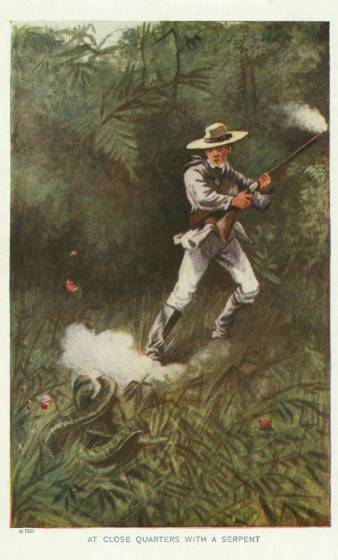
“Fire at its head, Nat,” cried my uncle; but it was not easy to see it, for the creature kept on twining about in a wonderfully rapid way; but at last I caught it as the head came from behind a tree trunk, fired, and the monster leaped from the ground and fell back in a long straight line, perfectly motionless, till Ebo darted in to give it a final thump with his club, when, to my astonishment, the blow seemed to electrify the creature, which drew itself up into a series of waves, and kept on throbbing as it were from end to end.
“Shall I fire again, uncle?” I said excitedly.
“No, Nat,” he replied; “it would only be slaying the slain. Bravo, my boy! you did capitally.”
“But I ran away at first, uncle,” I said sorrowfully. “I did not stop when the serpent first came out.”
“It was enough to make a Saint George run away from such a dragon, Nat,” he said laughing. “I could not have believed such a serpent existed in these isles. Let’s see how long he is.”
“Thirty feet, uncle,” I cried excitedly.
“Your eyes magnify this morning, Nat,” he said merrily. “No, my boy,” he continued, after pacing along by the writhing creature’s side; “that serpent is barely fourteen feet long, but it is wonderfully thick for its size, and it proves that there must be animals here such as would form its prey.”
“Shall you have it skinned, uncle?” I asked.
“Yes,” he replied, handing his knife to Ebo, who readily understood what was wanted, and leaving him to his very nasty job, my uncle and I went in search of birds of paradise.
Chapter Thirty Five.
Another Fishing Trip.
We had a long tramp after the birds of paradise that day, but did not get one. We shot some lovely sun-birds though, and a couple of thrushes such as we had not seen before. Our walk took us well in sight of the sea once more, and we began to have a pretty good idea of the form of the island. But the more we went about the more my uncle was satisfied that it was only a matter of time to make here a glorious collection of the birds of the eastern islands. We saw four different kinds of birds of paradise in our walk, though we did not get one on account of their shyness, but we did not despair of getting over that; and at last, well tired out, we returned to Ebo, who had hung up the serpent’s skin to dry, and following his guidance till nightfall we got back to our hut by the sea-shore, where the boat lay perfectly safe, and being too tired to make a fire and cook, we lay down and fell asleep at once.