Volume 1 — CHAPTER 1.8.
Reading edition
Rescue a white Woman from Captivity among the Natives. Her History. Bramble and boats complete the Survey of Torres Strait. Wini and the Mulgrave Islanders. Intercourse with the Cape York Natives. Nearly quarrel with them at a night dance. Witness a Native fight. Discover some fine country. Incidents of our stay. Many new Birds found. Remarks on the Climate, etc. of Cape York.
On the day after our arrival at Cape York the vessel from Sydney with our supplies anchored beside us, and besides provisions and stores, we had the additional pleasure of receiving five months' news from home.
HISTORY OF A WHITE WOMAN TAKEN BY THE BLACKS.
On October 16th, a startling incident occurred to break the monotony of our stay. In the afternoon some of our people on shore were surprised to see a young white woman come up to claim their protection from a party of natives from whom she had recently made her escape, and who, she thought, would otherwise bring her back. Of course she received every attention, and was taken on board the ship by the first boat, when she told her story, which is briefly as follows. Her name is Barbara Thomson: she was born at Aberdeen in Scotland, and along with her parents, emigrated to New South Wales. About four years and a half ago she left Moreton Bay with her husband in a small cutter (called the America) of which he was owner, for the purpose of picking up some of the oil from the wreck of a whaler, lost on the Bampton Shoal, to which place one of her late crew undertook to guide them; their ultimate intention was to go on to Port Essington. The man who acted as pilot was unable to find the wreck, and after much quarrelling on board in consequence, and the loss of two men by drowning, and of another who was left upon a small uninhabited island, they made their way up to Torres Strait, where, during a gale of wind, their vessel struck upon a reef on the Eastern Prince of Wales Island. The two remaining men were lost in attempting to swim on shore through the surf, but the woman was afterwards rescued by a party of natives on a turtling excursion, who, when the gale subsided, swam on board, and supported her on shore between two of their number. One of these blacks, Boroto by name, took possession of the woman as his share of the plunder; she was compelled to live with him, but was well treated by all the men, although many of the women, jealous of the attention shown her, for a long time evinced anything but kindness. A curious circumstance secured for her the protection of one of the principal men of the tribe a party from which had been the fortunate means of rescuing her, and which she afterwards found to be the Kowrarega, chiefly inhabiting Muralug, or the Western Prince of Wales Island. This person, named Piaquai, acting upon the belief (universal throughout Australia and the Islands of Torres Strait so far as hitherto known) that white people are the ghosts of the aborigines, fancied that in the stranger he recognised a long-lost daughter of the name of Giaom, and at once admitted her to the relationship which he thought had formerly subsisted between them; she was immediately acknowledged by the whole tribe as one of themselves, thus ensuring an extensive connection in relatives of all denominations. From the headquarters of the tribe with which Giaom thus became associated being upon an island which all vessels passing through Torres Strait from the eastward must approach within two or three miles, she had the mortification of seeing from twenty to thirty or more ships go through every summer without anchoring in the neighbourhood, so as to afford the slightest opportunity of making her escape. Last year she heard of our two vessels (described as two war canoes, a big and a little one) being at Cape York--only twenty miles distant--from some of the tribe who had communicated with us and been well treated, but they would not take her over, and even watched her more narrowly than before.
RESCUED FROM CAPTIVITY.
On our second and present visit, however, which the Cape York people immediately announced by smoke signals to their friends in Muralug, she was successful in persuading some of her more immediate friends to bring her across to the mainland within a short distance of where the vessels lay. The blacks were credulous enough to believe that as she had been so long with them, and had been so well treated, she did not intend to leave them--only she felt a strong desire to see the white people once more and shake hands with them; adding, that she would be certain to procure some axes, knives, tobacco, and other much prized articles. This appeal to their cupidity decided the question at once. After landing at the sandy bay on the western side of Cape York, she hurried across to Evans Bay, as quickly as her lameness would allow, fearful that the blacks might change their mind; and well it was that she did so, as a small party of men followed to detain her, but arrived too late. Three of these people were brought on board at her own request, and as they had been instrumental in saving her from the wreck, they were presented with an axe apiece, and other presents.
Upon being asked by Captain Stanley whether she really preferred remaining with us to accompanying the natives back to their island, as she would be allowed her free choice in the matter, she was so much agitated as to find difficulty in expressing her thankfulness, making use of scraps of English alternately with the Kowrarega language, and then, suddenly awaking to the recollection that she was not understood, the poor creature blushed all over, and with downcast eyes, beat her forehead with her hand, as if to assist in collecting her scattered thoughts.
HER HISTORY.
At length, after a pause, she found words to say: "Sir, I am a Christian, and would rather go back to my own friends." At the same time, it was remarked by everyone that she had not lost the feelings of womanly modesty--even after having lived so long among naked blacks; she seemed acutely to feel the singularity of her position--dressed only in a couple of shirts, in the midst of a crowd of her own countrymen.
When first seen on shore our new shipmate presented so dirty and wretched an appearance that some people who were out shooting at first mistook her for a gin, and were passing by without taking further notice, when she called out to them in English: "I am a white woman, why do you leave me?" With the exception of a narrow fringe of leaves in front, she wore no clothing, and her skin was tanned and blistered with the sun, and showed the marks of several large burns which had been received from sleeping too near the fire on cold nights; besides, she was suffering from ophthalmia, which had previously deprived her of the sight of one eye. But good living, and every comfort (for Captain Stanley kindly provided her with a cabin and a seat at his table) combined with medical attention, very soon restored her health, and she was eventually handed over to her parents in Sydney in excellent condition.
Although perfectly illiterate, Mrs. Thomson had made good use of her powers of observation, and evinced much shrewdness in her remarks upon various subjects connected with her residence among the blacks, joined to great willingness to communicate any information which she possessed. Much of this will be found in another part of this volume, incorporated with the result of my own observations. Several hundred words of the Kowrarega language, and a portion of its grammar, were also obtained from time to time, and most of these were subsequently verified. And, although she did not understand the language spoken at Cape York, yet, as some of the Gudang people there knew the Kowrarega, through its medium I was usually able to make myself tolerably well understood, and thus obtain an explanation of some matters which had formerly puzzled me, and correct various errors into which I had fallen. It was well, too, that I took an early opportunity of procuring these words, for my informant afterwards forgot much of her lately-acquired language, and her value as an authority on that subject gradually diminished.
PROCEEDINGS WHILE ON BOARD.
Giaom was evidently a great favourite with the blacks, and hardly a day passed on which she was not obliged to hold a levee in her cabin for the reception of friends from the shore, while other visitors, less favoured, were content to talk to her through the port. They occasionally brought presents of fish and turtle, but always expected an equivalent of some kind. Her friend, Boroto, the nature of the intimacy with whom was not at first understood, after in vain attempting by smooth words and fair promises to induce her to go back to live with him, left the ship in a rage, and we were not sorry to get rid of so impudent and troublesome a visitor as he had become. Previous to leaving, he had threatened that, should he or any of his friends ever catch his faithless spouse on shore, they would take off her head to carry back with them to Muralug; and so likely to be fulfilled did she consider this threat, being in perfect accordance with their customs, that she never afterwards ventured on shore at Cape York.
SURVEY OF TORRES STRAIT COMPLETED.
During the period of our stay at Cape York, the Bramble, Asp, and Rattlesnake's pinnace were sent away to the western entrance of Torres Strait to finish the survey, and returned after a month's absence.
WINI AND THE MULGRAVE ISLANDERS.
The boats had held no intercourse with any of the natives, except a small party of Kowraregas, the inhabitants of Mulgrave and Banks Islands having carefully avoided them. Hopes had been entertained prior to starting of seeing something of a white man of the name of Wini, who had lived with the Badus for many years. Giaom had seen and conversed with him during a visit to Muralug which he had made in hopes of inducing her to share his fortunes. She supposed him to be a foreigner, from his not appearing to understand the English she used when asked by him to speak in her native tongue. He had reached Mulgrave Island in a boat after having, by his own account, killed his companions, some three or four in number. In course of time he became the most important person in the tribe, having gained an ascendancy by procuring the death of his principal enemies and intimidating others, which led to the establishment of his fame as a warrior, and he became in consequence the possessor of several wives, a canoe, and some property in land, the cultivation of which last he pays great attention to. Wini's character appears from the accounts I have heard--for others corroborated part of Giaom's statement--to be a compound of villainy and cunning, in addition to the ferocity and headstrong passions of a thorough savage--it strikes me that he must have been a runaway convict, probably from Norfolk Island. It is fortunate that his sphere of mischief is so limited, for a more dangerous ruffian could not easily be found. As matters stand at present, it is probable that not only during his life, but for years afterwards, every European who falls into the hands of the Badu people will meet with certain death.*
(*Footnote. In further illustration of this assertion I give the following note with which I have lately been furnished by Mr. J. Sweatman, R.N., who served in the Bramble at the time of the occurrence of the murder to which it alludes. In June 1846 the supercargo and a boat's crew of a small vessel from Sydney procuring trepang and tortoise-shell in Torres Strait, landed upon Mulgrave Island (the vessel being about seven miles off) in order to barter for tortoise-shell. The natives appeared at first to be friendly enough, but, towards evening some circumstances occurred which induced the boat's crew to re-embark, and they then went to a small sandbank about a mile off to pass the night there. The supercargo and three men landed, leaving two men in the boat at anchor; about midnight the latter were alarmed at hearing shouts and yells on shore, and, landing in haste, found that the natives had attacked their comrades, whose muskets being damp, were quite useless. The supercargo and two men were killed--a shot from the boat however dispersed the natives sufficiently for the two men to drag their surviving comrade into the boat, but he had an arrow through the body, and his hands were partially severed, and he soon died. The bodies of the three people on the sandbank could not be recovered, the natives returning to the attack with showers of arrows, nor could the small force on board the schooner attempt to punish the perpetrators of this unprovoked murder.)
The inhabitants of the neighbouring Banks Island are described by Giaom as evincing the same hostility towards Europeans. Only a few years ago the Italegas, one of the two tribes inhabiting that island, murdered two white men and a boy, who had reached their inhospitable shores in a small boat, probably from a wreck. Such savage outrages committed by the inhabitants of the north-western islands would probably be completely prevented were they oftener visited by Europeans; such was the case with the people of Darnley Island, once dangerous savages, now safely to be dealt with by taking the usual precautions, and where, as at the Murray Islands, I believe strangers in distress, without valuable property, would now be kindly treated.
INTERCOURSE WITH CAPE YORK NATIVES.
We remained nine weeks at our anchorage in Evans Bay. The natives, of whom there were usually a number encamped in the neighbourhood, attracted by the presence of the ship, as vultures by a carcass, continued on perfectly friendly terms, assisted the wooding and watering parties, brought off fish and portions of turtle to the ship, and accompanied us on our walks on shore. The usual remuneration for their services was biscuit, and, next to that, tobacco, besides which axes and knives were highly prized and occasionally given them. Immediately on landing for the purpose of an excursion, each of us looked out for his kotaiga* from among a crowd of applicants surrounding the boat, the haversack was thrown across his shoulders, and away we started for the bush. It was often difficult for the possessor of a good stock of biscuit to shake off other useless volunteers; these hangers-on, with few exceptions, were more remarkable for their capacity for food than for their powers of endurance, showing a deeply rooted antipathy to any exertion not actually necessary, and for every trifling additional service asking for bisiker muro, choka muro, neipa, or some such thing. Still a few of these same blacks make a very agreeable addition to a shooting party, as besides their services as guides, and in pointing out game, they formed amusing companions and enlivened many a noonday bivouac or dull thirsty march in the hot sun with their songs, jokes, and mimicry.
(*Footnote. Derived from the Kowrarega word Kutaig (younger brother); here in the jargon used between us it signified friend, associate, companion, etc.)
INDUCE THEM TO GET UP A NIGHT DANCE.
One evening I was asked to join a party made up for the purpose of witnessing a native dance. Many strange blacks were then encamped on the margin of the beach, and altogether about 150 people belonging to four or five tribes had collected. Not being apprised of our coming they showed much surprise and suspicion at our landing after dark, but, with some trouble, a number were induced by the promise of a quantity of biscuit to get up a dance round a large fire on the sand to the music of a drum which we had taken with us to announce our approach. The dance after all was a very poor affair--none of the performers were painted and decorated, there was little scenic effect, and they seemed glad when it was over. The bag containing the promised biscuit was most injudiciously handed over to an old woman named Baki, or queena woman Baki, as someone had taught her to call herself, for distribution among the party. She doled out a few handfuls to some women and children who had not been at all concerned in the matter, and would have marched off with the remainder had she not been prevented. The appointment of a woman to this office gave great offence to the men who had been dancing--while not one among them would have scrupled forcibly to deprive her of the whole on the very first opportunity, yet every man there scorned the idea of having to ASK a woman for anything--the consequence was that the performers were not rewarded, and naturally imagined that we had broken faith with them. The discontent increased, some of the men left in a state of great excitement, and went for their spears and throwing sticks. One or two rockets were sent up soon after to amuse them, on which the few remaining women and children hurried to their sheds of bark and hid their faces in terror. When a blue light was burned, and lit up the gloomy shadows of the neighbouring bush, it disclosed the spectral figures of many armed men among the trees, singly and in groups, intently watching our motions. Paida, who with other native allies of ours still remained with us, was very urgent for us to be off, telling me that spears would be thrown immediately (kaibu kalaka muro); being a kotaig of mine, he considered himself bound to attend to my safety, so conducted me to the boat which he assisted in shoving off, nor did he retire from the beach until we had got into deep water.
NEARLY QUARREL WITH THEM.
I have alluded to this occurrence, trivial as it may appear, not without an object. It serves as an illustration of the policy of respecting the known customs of the Australian race, even in apparently trifling matters, at least during the early period of intercourse with a tribe, and shows how a little want of judgment in the director of our party caused the most friendly intentions to be misconstrued, and might have led to fatal results.
OBSERVATIONS ON CAUSE OF OFFENCE.
I must confess that I should have considered any injury sustained on our side to have been most richly merited; moreover, I am convinced that some at least of the collisions which have taken place in Australia, between the first European visitors and the natives of any given district, have originated in causes of offence brought on by the indiscretion of one or more of the party, and revenged on others who were innocent. As a memorable instance I may give that which happened during Leichhardt's overland journey to Port Essington, when his camp was attacked one evening, and Mr. Gilbert lost his life. Long afterwards the undoubted cause of this apparently unaccountable attack transpired in the acknowledgment, while intoxicated, by one of the persons concerned, that a gross outrage had been committed upon an aboriginal woman a day or two previously, by the two blacks belonging to the expedition.
One day I witnessed a native fight, which may be described here, as such occurrences, although frequent enough in Australia, have by Europeans been witnessed only in the settled districts. It was one of those smaller fights, or usual modes of settling a quarrel when more than two people are concerned, and assumed quite the character of a duel upon a large scale. At daybreak, I landed in company with six or seven people who were going out on different shooting parties. The natives came down to the boat as usual, but all carried throwing-sticks--contrary to their usual practice of late; and at the place where they had slept, numbers of spears were stuck up on end in the sand. These preparations surprised me, but Paida would not explain the cause and seemed anxious to get me away. The shooters marched off--each with his black--but I loitered behind, walking slowly along the beach.
WITNESS A NATIVE FIGHT.
About 200 yards from the first camping-place, two groups of strange natives, chiefly men, were assembled with throwing-sticks in their hands and bundles of spears. While passing them they moved along in twos and threes towards the Evans Bay party, the men of which advanced to meet them. The women and children began to make off, but a few remained as spectators on the sands, it being then low water. A great deal of violent gesticulation and shouting took place, the parties became more and more excited, and took up their position in two scattered lines facing each other, extending from the margin of the beach to a little way in the bush, and about twenty-five yards apart. Paida, too, partook of the excitement and could refrain no longer from joining in the fight; he dropped my haversack and bounded away at full speed to his camping-place, where he received his spears from little Purom his son, and quickly made his appearance upon the scene of action.
The two parties were pretty equally matched--about fifteen men in each. The noise now became deafening; shouts of defiance, insulting expressions, and every kind of abusive epithet were bandied about, and the women and children in the bush kept up a wailing cry all the while rising and falling in cadence. The pantomimic movements were of various descriptions; besides the singular quivering motion given to the thighs placed wide apart (common to all the Australian dances) they frequently invited each other to throw at them, turning the body half round and exposing the breech, or dropping on one knee or hand as if to offer a fair mark. At length a spear was thrown and returned, followed by many others, and the fighting became general, with an occasional pause.
DEXTERITY IN THROWING THE SPEAR.
The precision with which the spears were thrown was not less remarkable than the dexterity which with they were avoided. In nearly every case the person thrown at would, apparently, have been struck had he stood still, but, his keenness of sight enabled him to escape by springing aside as required, variously inclining the body, or sometimes merely lifting up a leg to allow the spear to pass by, and had two been thrown at one person at the same moment he could scarcely have escaped, but this I observed was never attempted, as it would have been in war, here each individual appeared to have a particular opponent. I had a capital view of the whole of the proceedings, being seated about fifty yards behind and slightly on the flank of one of the two contending parties. One spear thrown higher than usual passed within five yards of me, but this I was satisfied was the result of accident, as I had seen it come from Paida's party. Soon afterwards I observed a man at the right extreme of the line next me, who had been dodging round a large scaevola bush for some time back, make a sudden dart at one of the opposite party and chop him down the shoulder with an iron tomahawk. The wounded man fell, and instantly a yell of triumph denoted that the whole matter was at an end.
Paida rejoined me five minutes afterwards, apparently much refreshed by this little excitement, and accompanied me on my walk, still he would not explain the cause of the fight. The wounded man had his arm tied up by one of our people who landed soon afterwards, and, although the cut was both large and deep, he soon recovered.
DISCOVERY OF MEW RIVER.
The frequent excursions of our shooting parties being more extended than during our last visit became the means of adding considerably to our knowledge of the surrounding country. One of the immediate consequences was the discovery of several small streams of fresh water. The principal of these, which we named Mew River (after its first finder, the sergeant of marines on board) has its mouth in a small mangrove creek three quarters of a mile to the eastward of Evans Bay. About five miles further up its source was found to be a spring among rocks in a dense calamus scrub. It waters a fine valley running nearly east and west behind the range of hills to the southward of Evans Bay, and its line is marked by a belt of tangled brush exceeding in luxuriance anything of the same description which I had seen elsewhere. The variety of trees in this dense brush is very great, and many were quite new to me. The Seaforthia palm attained the height of 60 to 80 feet, and the rattan was very abundant, and from the recurved prickles catching and tearing the clothes, it was often no easy matter to penetrate the thickets. Among the plants along the river the most interesting is an indigenous species of banana or plantain, probably the same as that found at Endeavour River during Cook's first voyage. The fruit is of small size with numerous hard seeds and a small quantity of delicious pulp; cultivation would, doubtless, wonderfully improve it. Another remarkable plant found on the grassy borders of the jungle and characteristic of rich damp soil is a beautiful species of Roscoea (?) (one of the Scitamineae or ginger family) about a foot high, with a solitary leaf and large bracteae, the lower green and the upper ones pink, partially concealing handsome yellow flowers. From its succulent nature I failed in preparing specimens for the herbarium, but some roots were preserved and given to the Botanical Garden at Sydney.
THE VALLEY OF THE MEW.
The lower part of the valley is open forest land, or nearly level and thinly wooded country covered with tall coarse grass. Further up it becomes more beautiful. From the belt of wood, concealing the windings of the river, grassy sloping meadows extend upwards on each side to the flanking ridges which are covered with dense scrub occasionally extending in straggling patches down to the water, and forming a kind of imperfect natural fence. The soil of these meadows is rich sandy loam, affording great apparent facilities for cultivation from their proximity to what is probably a never-failing supply of fresh water. Here, at the end of the dry season, and before the periodical rains had fairly set in, we found the stream at halfway up to be about six feet in average breadth, slowly running over a shallow, gravelly, or earthy bed, with occasional pools from two to four feet in depth.
PROPOSED SETTLEMENT AT CAPE YORK.
I have alluded to this subject at greater length than under ordinary circumstances I would have done, in the belief that, should a settlement ever be established at Cape York, the strip of good land that runs along the upper part of Mew River may hereafter be turned to good account. Several other valleys watered by small and apparently permanent streams were discovered by our shooting parties, chiefly by Wilcox and the sergeant of marines; these were afterwards visited by me, and my opinion of the productiveness of the country about Cape York almost daily became more and more favourable the further I extended my excursions.
I need scarcely repeat the arguments which have been adduced in favour of the expediency, I may almost say necessity, of establishing a military post, or small settlement of some kind, in the vicinity of Cape York, simply because, while perfectly agreeing with Mr. Jukes* and several other persons who have drawn the public attention to the subject, I have little in addition to offer. Still a few words on the question may not be out of place.
(*Footnote. Voyage of the Fly volume 1 page 302.)
ITS ADVANTAGES.
The beneficial results to be looked for were such a settlement to be formed would be:
1. A port of refuge would be afforded to the crews of vessels wrecked in Torres Strait, and its approaches, who otherwise must make for Booby Island, and there await the uncertainty of being picked up by some passing vessel, or even attempt in the boats to reach Coupang in Timor, a distance of 1100 miles further. And now that the settlement at Port Essington has been abandoned the necessity for such a place of refuge is still greater.
2. Passing vessels might be supplied with water and other refreshments, also stores, such as anchors, etc., which last are frequently lost during the passage of the Strait.
3. The knowledge of the existence of such a post would speedily exercise a beneficial influence over our intercourse with the natives of Torres Strait, and induce them to refrain from a repetition of the outrages which they have frequently committed upon Europeans; the little trade in tortoiseshell which might be pushed in the Strait (as has frequently been done before by small vessels from Sydney and even from Hong Kong) would no longer be a dangerous one--and protection would be afforded to the coaling depot for steamers at Port Albany.*
(*Footnote. I adduce this last advantage on the presumption, which now assumes a greater degree of probability than before--that the steam communication before alluded to will be established, and that the Torres Strait route, the one which is almost generally advocated, will be the one adopted.)
4. In a military point of view the importance of such a post has been urged upon the ground, that in the event of war, a single enemy's ship stationed in the neighbourhood, if previously unoccupied, could completely command the whole of our commerce passing through the Strait.
5. From what more central point could operations be conducted with the view of extending our knowledge of the interior of New Guinea by ascending some of the large rivers of that country, disemboguing on the shores of the Great Bight?
6 and last. But on this point I would advance my opinion with much diffidence--I believe that were a settlement to be established at Cape York, missionary enterprise, JUDICIOUSLY CONDUCTED, might find a useful field for its labours in Torres Strait, beginning with the Murray and Darnley Islanders, people of a much higher intellectual standard than the Australians, and consequently more likely to appreciate any humanising influence which might be exercised for their benefit.
KANGAROOS AND NEW BIRDS.
Several kangaroos or wallabies, the largest of which weighed forty pounds, were killed during our stay at Cape York. A kangaroo dog belonging to Captain Stanley made several fine runs, all of them unsuccessful however, as the chase was seldom upon open ground, and there was little chance of overtaking the kangaroo before it got into some neighbouring thicket where the dog could not follow it. This wallaby proved to be the Halmaturus agilis, first found at Port Essington, and afterwards by Leichhardt in Carpentaria. A singular bat of a reddish-brown colour was shot one day while asleep suspended from a branch of a tree; it belonged to the genus Harpyia, and was therefore a contribution to the Australian fauna.
Among many additions to the ornithological collections of the voyage were eight or nine new species of birds, and about seven others previously known only as inhabitants of New Guinea and the neighbouring islands.* The first of these which came under my notice was an enormous black parrot (Microglossus aterrimus) with crimson cheeks; at Cape York it feeds upon the cabbage of various palms, stripping down the sheath at the base of the leaves with its powerful, acutely-hooked upper mandible. The next in order of occurrence was a third species of the genus Tanysiptera (T. sylvia) a gorgeous kingfisher with two long, white, central tail-feathers, inhabiting the brushes, where the glancing of its bright colours as it darts past in rapid flight arrests the attention for a moment ere it is lost among the dense foliage.
(*Footnote. Many of these have since been figured and described, with accompanying notes on their habits, etc., in the recently published Supplement to Mr. Gould's Birds of Australia.)
I may next allude to Aplonis metallica--a bird somewhat resembling a starling, of a dark glossy green and purple hue, with metallic reflections--in connection with its singular nest. One day I was taken by a native to the centre of a brush, where a gigantic cotton-tree standing alone was hung with about fifty of the large pensile nests of this species.
NATIVE BIRD-NESTING.
After I had made several unsuccessful attempts to shoot down one of the nests by firing with ball at the supporting branch, the black volunteered to climb the tree, provided I would give him a knife. I was puzzled to know how he proposed to act, the trunk being upwards of four feet in diameter at the base, and the nearest branch being about sixty feet from the ground. He procured a tough and pliant shoot of a kind of vine (Cissus) of sufficient length to pass nearly round the tree, and holding one end of this in each hand and pressing his legs and feet against the tree, he ascended by a series of jerks, resting occasionally, holding on for half a minute at a time with one end of the vine in his mouth. At length he reached the branches and threw me down as many nests as I required. He afterwards filled the bag which he carried round his neck with the unfledged young birds, which on our return to the native camp on the beach were thrown alive upon the fire, in spite of my remonstrances, and when warmed through were devoured with great apparent relish by himself and his friends.
A NEW BOWERBIRD.
Two days before we left Cape York I was told that some bowerbirds had been seen in a thicket, or patch of low scrub, half a mile from the beach, and after a long search I found a recently constructed bower, four feet long and eighteen inches high, with some fresh berries lying upon it. The bower was situated near the border of the thicket, the bushes composing which were seldom more than ten feet high, growing in smooth sandy soil without grass.
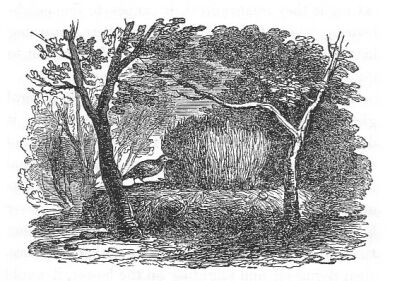
PLAYHOUSE OF BOWER BIRD OF CAPE YORK.
Next morning I was landed before daylight, and proceeded to the place in company with Paida, taking with us a large board on which to carry off the bower as a specimen. I had great difficulty in inducing my friend to accompany me, as he was afraid of a war party of Gomokudins, which tribe had lately given notice that they were coming to fight the Evans Bay people. However I promised to protect him, and loaded one barrel with ball, which gave him increased confidence, still he insisted upon carrying a large bundle of spears and a throwing-stick. Of late Paida's tribe have taken steps to prevent being surprised by their enemies. At night they remove in their canoes to the neighbouring island Robumo, and sleep there, returning in the morning to the shore, and take care not to go away to a distance singly or unarmed.
While watching in the scrub I caught several glimpses of the tewinya (the native name) as it darted through the bushes in the neighbourhood of the bower, announcing its presence by an occasional loud churrrr, and imitating the notes of various other birds, especially the leatherhead. I never before met with a more wary bird, and for a long time it enticed me to follow it to a short distance, then flying off and alighting on the bower, it would deposit a berry or two, run through, and be off again (as the black told me) before I could reach the spot. All this time it was impossible to get a shot. At length, just as my patience was becoming exhausted, I saw the bird enter the bower and disappear, when I fired at random through the twigs, fortunately with effect. So closely had we concealed ourselves latterly, and so silent had we been, that a kangaroo while feeding actually hopped up within fifteen yards, unconscious of our presence until fired at. My bowerbird proved to be a new species, since described by Mr. Gould as Chlamydera cerviniventris, and the bower is exhibited in the British Museum.
Among the gamebirds of Cape York, the emu is entitled to the first rank. Only two or three, however, were seen, and we were not fortunate enough to procure one. One day an emu allowed me to approach within fifty yards by stalking it cautiously, holding up a large green bough before me, when, becoming alarmed, it darted in its fright into a thicket and was lost to view.
BRUSH TURKEY.
Many brush turkeys (Talegalla lathami) were shot by our sportsmen, and scarcely a day passed on which the natives did not procure for us some of their eggs. The mode in which these and other eggs are cooked by the blacks is to roll them up in two or three large leaves, and roast them in the ashes; the eggs burst, of course, but the leaves prevent the contents from escaping. Both bird and eggs are excellent eating; the latter, averaging three and a half inches in length, of a pure white colour, are deposited in low mounds of earth and leaves in the dense brushes in a similar manner to those of the megapodius, and are easily dug out with the hand. I have seen three or four taken out of one mound where they were arranged in a large circle, a foot and a half from the surface. The laying bird carefully effaces any mark she may have made in scooping out a place for the eggs, but the keen eye of a native quickly detects the slightest sign of recent disturbance of the mound, and he seldom fails to hit upon the eggs.
SEASONS.
As at Port Essington, the year at Cape York is divided into two seasons,* the dry and the rainy. From personal observation and other sources of information, it would appear that the limits and duration of these admit of so much variation that it is impossible to determine with certainty, even within a month, when one ceases and the other begins. It would appear however that the dry season, characterised by the prevalence of the south-east trade, usually terminates in November, the change having for some time previous been indicated by calms, light winds, sometimes from the westward, a gloomy unsettled appearance in the weather, and occasional showers--violent squalls of wind and rain are frequent about this time until the westerly breezes set in, when the weather becomes moderate with frequent rain, occasionally very heavy, and intervals, often of many days duration, of dry weather. In the month of March the south-east trade usually resumes its former influence, the change being often attended with the same thick squally weather, and perhaps a gale from the north-west, which ushered in the westerly monsoon.
(*Footnote. The natives of the neighbouring Prince of Wales Island distinguish the dry season (aibu or the fine weather) the wet (kuki or the North-West wind which then prevails) and the period of change (malgui) equivalent to our Spring and Autumn.)
WINDS.
Our own experience of the winds during our last stay at Cape York, at the period when the change of the monsoon was to be expected, may be summed up as follows. During the month of October the trade-wind prevailed, keeping pretty steady at East-South-East, and generally blowing rather strongly, with hazy weather and an occasional shower. For three days in the middle of the month we experienced light north-westerly winds dying away again in the evening, and on the 25th a violent squall from the same quarter accompanied by very heavy rain rendered it expedient that the ship should next day be moved a cable's length further offshore. During the four last days in the month we had calms and light winds from the northward of east, as if the trade were about to cease, but it commenced afresh and continued until the 26th of November, generally very moderate, with fine weather. During the last six days of our stay we had light airs from about North-West, succeeded in the evening by a slight puff of south-easterly wind followed by a calm lasting all night. Last year, during the month of October, we experienced no northerly or westerly winds, but a moderate trade prevailed throughout, pretty steady at East-South-East, but varying much in strength.
TEMPERATURE.
In a place situated like Cape York, only about 640 miles distant from the equator, the atmospheric temperature may be expected to be very high; still the heat, although occasionally very oppressive for a time, caused very different sensations from those experienced during the almost stifling calms of Port Essington. At Cape York, however, calms seldom lasted above a few hours, as from its peninsular position the land receives the full influence of nearly every breeze. An abstract of the thermometrical observations made on board the Rattlesnake shows the following results:
COLUMN 1: DATE. COLUMN 2: AVERAGE TEMPERATURE IN DEGREES AND MINUTES. COLUMN 3: AVERAGE MAXIMUM TEMPERATURE IN DEGREES AND MINUTES. COLUMN 4: AVERAGE MINIMUM TEMPERATURE IN DEGREES AND MINUTES.
October 1848 : 81 : 85 : 77 5. October 1849 : 81 : 83 8 : 78 7. November 1849 : 81 9 : 84 8 : 79.
During the above period, the highest and lowest temperatures recorded by the self-registering maximum and minimum thermometer are, for October 1848, 88 and 73 degrees; for October 1849, 83.8 .and 77 degrees; and for November 1849, 88 and 76 degrees.
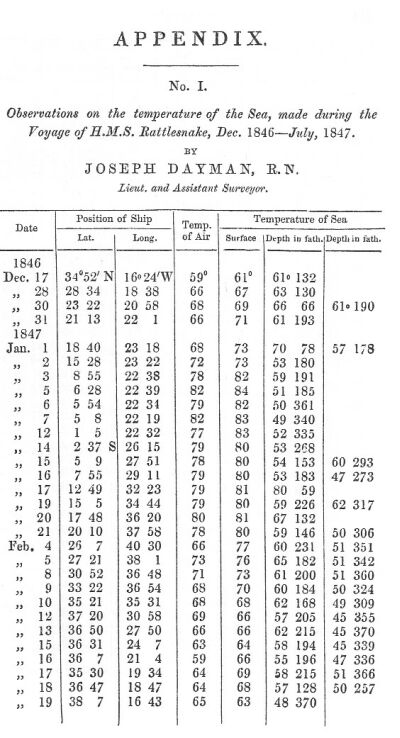
APPENDIX 1.
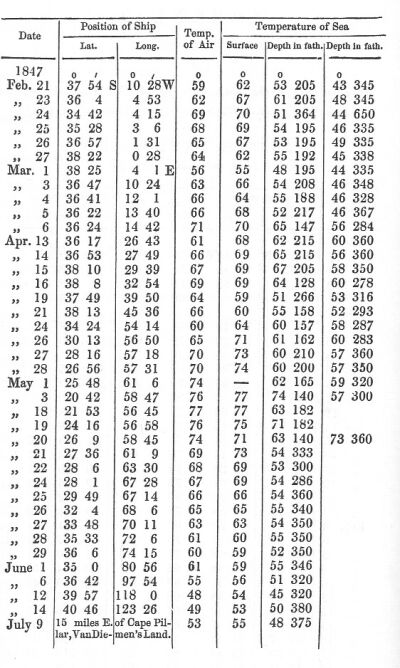
APPENDIX 2.
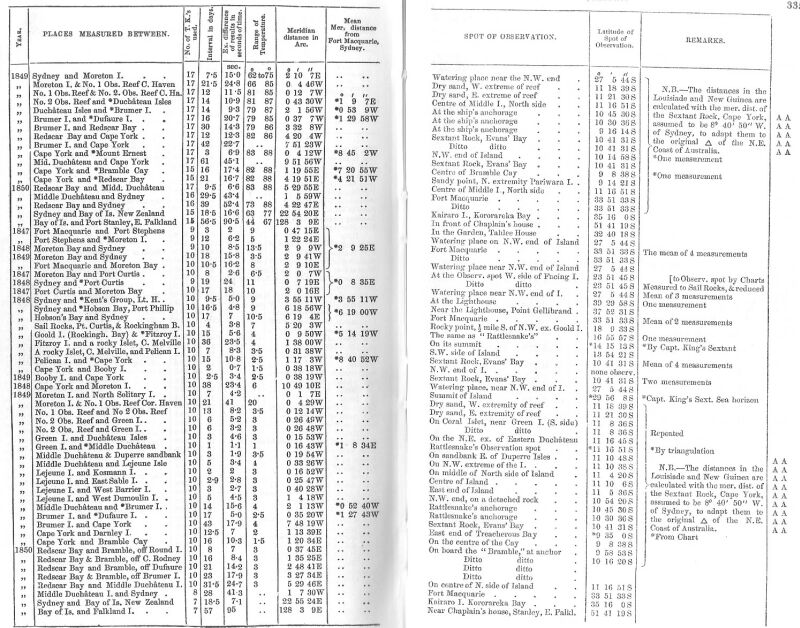
ABSTRACTS OF MERIDIAN DISTANCES MEASURED DURING THE VOYAGE OF H.M.S. RATTLESNAKE, 1847 TO 1850, BY CAPTAIN OWEN STANLEY, R.N., F.R.S., AND LIEUTENANT C.B. YULE, R.N.
The following pages contain abstracts of the meridian distances measured in H.M. Surveying Ship Rattlesnake and her tender the Bramble, in the survey of the Inner Route through Torres Strait, the Louisiade Archipelago, and the South-east Coast of New Guinea, during the years 1847, 1848, 1849 and 1850, under the command of the late Captain Owen Stanley, R.N. F.R.S.
The first three columns require no explanation.
The fourth (interval of days) is the elapsed time between the last day at the first station and first day at the second.
The seventh (meridian distance in arc) is the result of the particular measurement specified between the two places named.
The eighth (mean meridian distance from Sydney) is that deduced by a mean value of two or more distances by the same T.K.'s, and in some instances of ONE ONLY, in some of the principal stations connected with the survey.
The times throughout these abstracts have been determined by equal altitudes of the sun, excepting in those instances where the contrary is specified by A.A. The interpolations in the Rattlesnake's distances have been calculated by Owen's method: those of the Bramble by a method of Lieutenant Yule's.
In the Rattlesnake's distances interpolation has been employed throughout; in the Bramble's only where an intermediate distance is measured between two rates.
The asterisks point out the place to which the mean meridian from Sydney refers.
ABSTRACTS OF MERIDIAN DISTANCES MEASURED IN H.M. SURVEYING SHIP RATTLESNAKE, BY CAPTAIN OWEN STANLEY, R.N., F.R.S.
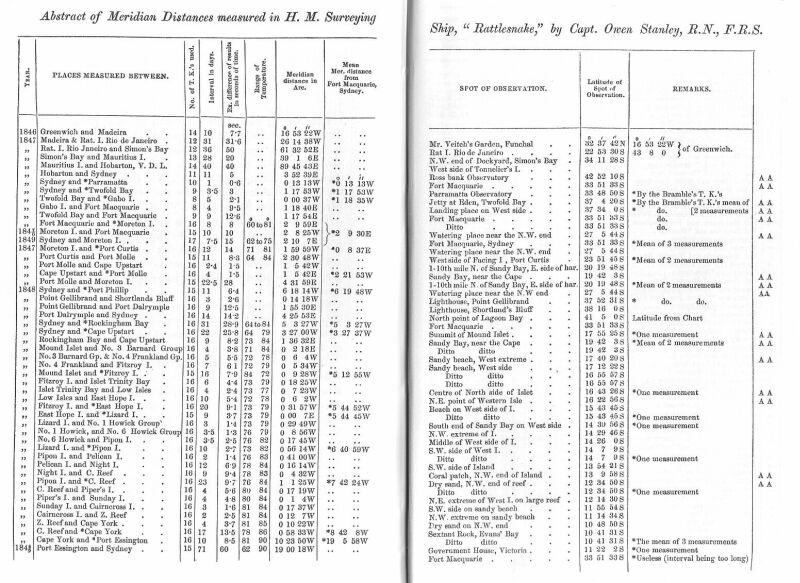
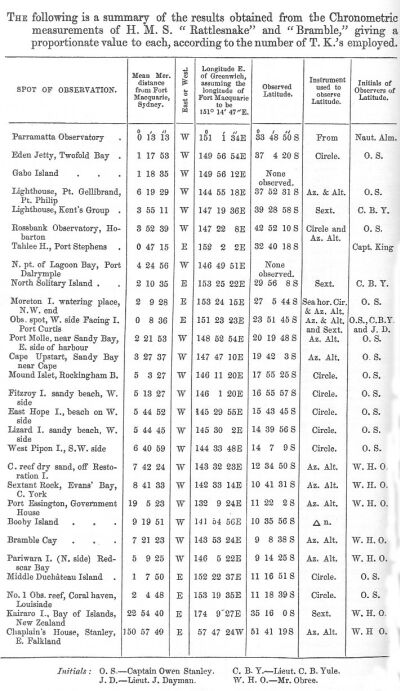
The following is a summary of the results obtained from the Chronometric measurements of H.M.S. Rattlesnake and Bramble, giving a proportionate value to each, according to the number of T.K.'S employed.
APPENDIX 3.
OBSERVATIONS OF THE MEAN MAGNETIC INCLINATION, MADE ON SHORE IN THE VOYAGE OF H.M.S. RATTLESNAKE, BY LIEUTENANT J. DAYMAN, R.N.
INSTRUMENTS EMPLOYED: ROBINSON'S 6-INCH INCLINOMETER; FOX'S DIPPING APPARATUS.
The following tables contain the absolute determinations of the magnetic inclination and declination made in the Voyage of H.M.S. Rattlesnake on shore. A very large series made almost daily at sea with Fox's instrument and the Azimuth Compass require several corrections before they are fit for publication.
In degrees, minutes and seconds.
MADEIRA.
In Mr. Veitch's verandah, Funchal, by Robinson's Needle, A: 59 41 7 N. In Mr. Veitch's verandah, Funchal, by Fox's Needle, A: 60 40 2 N. On the summit of the Pico dos Bodes, by Fox's Needle, A: 64 10 5 N. Ther. 64. on the summit of the Pico dos Bodes, angle of deflection, 2 grains by Fox's Needle, A: 33 13 6. Ther. 59. Funchal angle of deflection, 2 grains by Fox's Needle, A: 38 8 8.
RAT ISLAND, RIO DE JANEIRO.
By Robinson's Needle, A1: 12 15 1 S. By Robinson's Needle, A2: 12 19 1 S. Mean: 12 17 1 S.
SIMON'S BAY, CAPE OF GOOD HOPE.
In the dockyard near the Observation spot of Erebus and Terror, by Fox's Needle A, with index error applied : 53 40 0 S.
TONNELIER'S ISLAND, PORT LOUIS, MAURITIUS.
By Robinson's Needle, A1: 53 48 9 S. By Robinson's Needle, A2: 53 48 8 S. Mean: 53 48 8 S.
HOBART, VAN DIEMEN'S LAND.
At the Magnetic Observatory, Ross bank, by Robinson's Needle, A1: 70 36 0 S. At the Magnetic Observatory, Ross bank, by Robinson's Needle, A2: 70 41 5 S. Mean: 70 38 7 S.
PORT JACKSON.
On Garden Island, by Robinson's Needle, A1: 62 45 3 S. On Garden Island, by Robinson's Needle, A2: 62 47 7 S. Mean: 62 46 5 S.
PORT CURTIS, NORTH-EAST COAST OF AUSTRALIA.
On Facing Island, by Robinson's Needle, A1: 51 28 9 S. On Facing Island, by Robinson's Needle, A2: 51 30 9 S. Mean: 51 29 9 S.
NUMBER 1 PERCY ISLAND.
In a sandy Bay, on North side of Island, by Robinson's Needle, A1: 49 3 5 S. In a sandy Bay, on North side of Island, by Robinson's Needle, A2: 49 0 2 S. Mean: 49 1 8 S.
KEPPEL ISLAND.
In a small Bay, on North side, by Robinson's Needle, A1: 50 46 6 S. In a small Bay, on North side, by Robinson's Needle, A1: 50 49 6 S. Mean: 50 48 0 S.
MORETON BAY.
Near the North-west end of Moreton Island, by Robinson's Needle, A1: 55 20 1 S. Near the North-west end of Moreton Island, by Robinson's Needle, A2: 55 13 5 S. Mean: 55 16 8 S.
PORT PHILLIP.
Near Captain Bunbury's House, Williamstown, by Robinson's Needle, A1: 67 12 7 S. Near Captain Bunbury's House, Williamstown, by Robinson's Needle, A2: 67 16 7 S. Mean: 67 14 7 S.
PORT DALRYMPLE.
In Lagoon Bay, by Robinson's Needle, A1: 69 29 0 S. In Lagoon Bay, by Robinson's Needle, A2: 69 19 5 S. Mean: 69 24 2 S.
SWAN ISLAND, BANKS STRAIT.
Near the Lighthouse, by Fox's Needle B, with index error applied: 68 56 1 S.
PORT JACKSON.
On Garden Island, by Robinson's Needle, A1: 62 48 9 S. On Garden Island, by Robinson's Needle, A2: 62 39 1 S. April 1848 Mean: 62 44 0 S.
ROCKINGHAM BAY, NORTH-EAST COAST OF AUSTRALIA.
On Mound Islet, by Robinson's Needle, A1: 44 15 5 S. On Mound Islet, by Robinson's Needle, A2: 44 10 6 S. Mean: 44 13 0 S.
NUMBER 2 BARNARD ISLAND.
On the West Point of the Island, with Fox's Needle C, with index error applied: 44 8 8 S.
LOW ISLES, TRINITY BAY.
On the North Point of North Low Islet, with Fox's Needle C, with index error applied: 42 22 4 S.
LIZARD ISLAND.
On the West side of the Island, by Robinson's Needle, A1: 39 32 9 S. On the West side of the Island, by Robinson's Needle, A2: 39 31 8 S. Mean: 39 32 3 S.
NUMBER 5, CLAREMONT ISLE.
On the North side of the Island, by Robinson's Needle, A1: 38 11 9 S.
CAPE YORK.
In Evans Bay, by Robinson's Needle, A1: 33 10 2 S. In Evans Bay, with Fox's Needle C, with index error applied: 33 8 4 S. Mean: 33 9 3 S.
PORT ESSINGTON.
In Proa Bay, 1 mile west of Settlement, with Fox's Needle C, with index error applied: 35 14 6 S. On board the ship, at anchor at Port Essington, same needle corrected for local attraction and index error: 33 48 0 S.
Note: The observations on board the ship at this station are the nearest to the truth, there being much ironstone strewed over the country about the observation spot onshore.
PORT JACKSON.
Garden Island, by Robinson's Needle, A1, March 1849: 62 44 2 S.
MORETON BAY.
On the North-west side of Moreton Island, by Robinson's Needle, A1: 55 21 3 S.
CORAL HAVEN, LOUISIADE ARCHIPELAGO.
On a patch of Coral near Pig Island, by Robinson's Needle, A1: 32 35 2 S. On a patch of Coral near Pig Island, by Fox's Needle, with index error applied: 32 33 0 S. Mean: 32 34 1 S.
DUCHATEAU ISLANDS, LOUISIADE ARCHIPELAGO.
On the Middle Island, by Robinson's Needle, A1: 32 48 6 S. On the Middle Island, by Fox's Needle B, with index error applied: 32 56 4 S. Mean: 32 52 5 S.
CAPE YORK.
In Evans Bay, by Robinson's Needle, A1: 33 22 4 S.
BRAMBLE CAY, SOUTH COAST OF NEW GUINEA.
By Fox's Needle B, with index error applied: 31 49 2 S.
GARDEN ISLAND, PORT JACKSON.
By Fox's Needle A, corrected for index error etc.: 62 44 9 S. By Fox's Needle B, corrected for index error etc.: 62 44 9 S. By Fox's Needle C, corrected for index error etc.: 62 44 9 S.
BAY OF ISLANDS, NEW ZEALAND.
Near Kororareka Bay, by Fox's Needle A, corrected for index error: 59 37 6 S. Near Kororareka Bay, by Fox's Needle B, corrected for index error: 59 44 2 S. Near Kororareka Bay, by Fox's Needle C, corrected for index error: 59 28 1 S. Mean: 59 36 6 S.
EAST FALKLAND ISLAND.
Near the Chaplain's House at Stanley, by Fox's Needle A, corrected for index error: 52 19 6 S. Near the Chaplain's House at Stanley, by Fox's Needle B, corrected for index error: 51 43 3 S. Near the Chaplain's House at Stanley, by Fox's Needle C, corrected for index error: 50 58 8 S. Mean: 51 40 6 S.
At the Observation spot of the Erebus and Terror near the old settlement, Berkeley Sound, by Fox's Needle B, corrected for index error: 51 25 6 S.
FAYAL, AZORES.
In the Consul's garden, Horta, by Fox's Needle B, corrected for index error: 66 58 4 N. In the Consul's garden, Horta, by Fox's Needle A, corrected for index error: 67 26 9 N. Mean: 67 12 6 N.
The following absolute determinations of the magnetic disinclination were made with a declinometer, and A.M. and P.M. azimuths of the sun:
William Town, Port Phillip: 9 10 52 E.
Lagoon Bay, Port Dalrymple, Van Diemen's Land: 10 29 16 E.
Garden Island, Port Jackson, March and April 1848: 9 6 43 E.
Mound Islet, Rockingham Bay, North-east Coast of Australia: 6 19 43 E.
Lizard Island, North-east Coast of Australia: 5 46 7 E.
Evans Bay, Cape York, North coast of Australia: 4 42 31 E.
Garden Island, Port Jackson,March and April 1849: 10 9 10 E.
Moreton Island, East coast of Australia: 9 21 14 E.
Coral Haven, Louisiade Archipelago: 7 44 17 E.
Duchateau Isles, Louisiade Archipelago: 7 44 17 E.
Bramble Cay, South-east Coast of New Guinea: 4 22 37 E.
Kororareka Bay, Bay of Islands, New Zealand: 13 27 20 E.
Stanley, East Falkland Island, July 1850: 16 54 46 E.
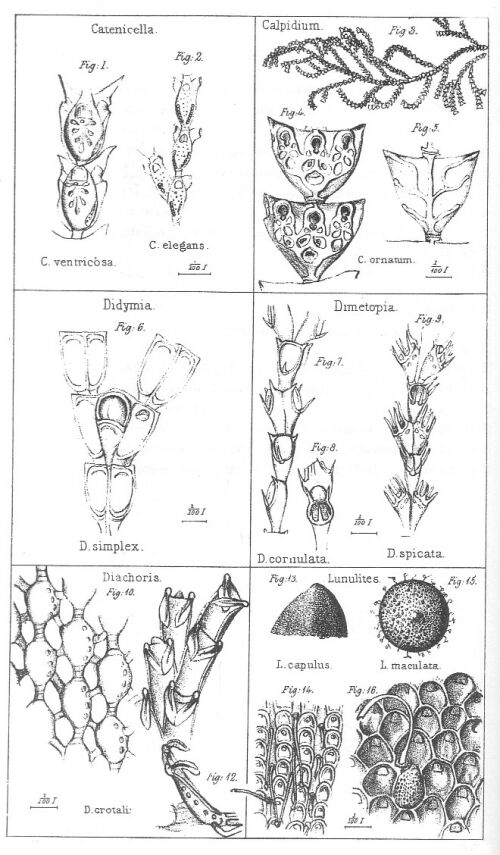
NEW ZOOPHYTES. C. Busk, delt. W. Wing, lith. T. & W. Boone, Publishers, London. 1852. Hullmandel & Walton, Lithographers.
APPENDIX 4.
ACCOUNT OF THE POLYZOA AND SERTULARIAN ZOOPHYTES, COLLECTED IN THE VOYAGE OF H.M.S. RATTLESNAKE, ON THE COASTS OF AUSTRALIA AND THE LOUISIADE ARCHIPELAGO, ETC. BY GEORGE BUSK, ESQUIRE F.R.S.
This collection includes about eighty-five species, distributed in twenty-nine genera, and may perhaps be regarded as the largest and most interesting of the kind ever brought to this country.
When it is stated that seventy-eight of the species are new or undescribed, the number will appear extraordinarily great, but when the comparatively neglected state of exotic Zoophytology is considered the wonder will be much diminished, and still further, as it may safely be assumed, that many of the species here given as new have been previously noticed, though so insufficiently described, as in the absence of figures not to admit of correct identification.
Making, however, a considerable deduction on this account, the remainder will still stamp the present collection with extreme value. As an instance, may be cited the genus Catenicella, of which this collection affords about fifteen species, and of which certainly not more than three have been previously noticed in any way, and of these no sufficient descriptions or figures are extant by which even that small number could be identified. The explanation of this is perhaps to be sought in the circumstance that the species of Catenicella are deepsea forms, and only to be obtained by dredging in deep water--very few being apparently found on the shores.
Though the number of new or supposed new species is so great, the number of new genera is comparatively small, not amounting to more than four. It has, however, been found necessary considerably to modify the characters of several other established genera, so as to include new species.
With respect to the geographical distribution of the species, my means of comparison have been pretty extensive. They have been derived from the examination of Mr. Darwin's and Dr. Hooker's collections, placed at my disposal by the kind liberality of Mr. Darwin--a considerable collection of South African species mainly procured from Mr. Bowerbank--and from the Collection of British and exotic Zoophytes in the British Museum, for the freest opportunities of examining which I have to thank Mr. Gray. From these various sources, and others of less account, I have been able to examine species from a very considerable extent of the earth's surface--more especially in the Southern hemisphere, and to arrive perhaps at as fair a view of the geographical distribution of species as the present imperfect state of Zoophytology will allow.
POLYZOA.
The number of species of Polyzoa is about fifty-four--belonging to twenty-four genera. Of these genera it is believed that four will be found to be new, or hitherto undescribed, and it has been deemed requisite to modify the characters of several others upon the more extended survey of species afforded mainly by the present collection. The new genera here instituted are:
Calpidium. Diachoris. Didymia. Dimetopia.
And the genera whose characters it has been found requisite to modify are:
Catenicella. Salicornaria. Cellularia. Scrupocellaria. Bicellaria. Canda. Emma. Acamarchis. Caberea.
Of the twenty-four genera, three, or perhaps four, appear to be peculiar to the Australian seas. These are:
Calpidium. Canda ? Didymia. Dimetopia.
All the rest, excepting two, Emma and Diachoris, appear to be distributed over the globe in both hemispheres. The above two are perhaps limited to the southern.
Of the fifty-three species, about thirty-three seem to be new, or to have been so imperfectly described as not to admit of precise identification, and five others have synonyms more or less doubtful applied to them.
Six species only are common to the seas of Europe, namely:
Tubulipora phalangea ? Crisia denticulata. Eucratea chelata. Anguinaria spatulata. Acamarchis neritina. Retepora cellulosa.
Sixteen others are met with in other parts of the Southern hemisphere, namely:
Catenicella elegans ? Catenicella ventricosa. Eschara lichenoides, occurring in Algoa Bay. Caberea zelanica. Acamarchis tridentata, in Algoa Bay and New Zealand. Caberea lata. Catenicella hastata. Catenicella cribraria. Catenicella cornuta. Cellularia monotrypa. Bicellaria tuba, in New Zealand and Emma crystallina. Emma tricellata, in New Zealand and Campbell's Island.
Thus of the fifty-four species, about thirty-four would seem to be peculiar to the Australian seas. Ten of these belong to the genus Catenicella, and one to the closely-allied Calpidium, three to Didymia and Dimetopia, and one to Diachoris, of which genus two other species are found in the Straits of Magellan.
The method according to which the Polyzoa are arranged, is, in the primary divisions at least, pretty nearly identical with that indicated in the Synopsis of the Families and Genera of Polyzoa Infundibulata, given in Dr. Johnston's British Zoophytes.*
(*Footnote. Volume 1 page 263 2nd Edition.)
A few words, however, will be necessary to explain more particularly the subsequent subdivisions here adopted.
The order, Polyzoa infundibulata, is divided into three suborders, coinciding very nearly with the Tubuliporina, Celleporina, and Vesicularina of the work above referred to, but as the characters of these suborders are derived from the conformation of the opening of the cell, I have thought it more convenient to name them accordingly. The first suborder, having a round, simple opening to the cell, is here termed the Cyclostomata; the second, with the opening of the cell filled up by a usually thin, membranous or calcareous velum, and with a crescentic mouth provided with a movable lip, the Cheilostomata; and the third suborder, which might perhaps include the Halcyonellea of Ehrenberg, as well as the Vesiculariadae, distinguished by the existence of a more or less well-marked fringe of setae (sometimes only rudimentary) around the opening of the cell when the animal is protruded, the Ctenostomata.
The following synoptical arrangement--which it must be remarked, includes only the genera occurring in the Rattlesnake collection--will serve to indicate the subsequent divisions.
SYNOPTICAL ARRANGEMENT OF THE POLYZOA INCLUDED IN THE RATTLESNAKE COLLECTION.
Suborder 1. CYCLOSTOMATA (Tubuliporina).
Fam. 1. TUBULIPORIDAE. Gen. 1. Tubulipora. Sp. 1. T. phalangea ? 2. Pustulipora. 2. P. australis, n. sp. 3. Idmonea. 3. I. radians.
Fam. 2. CRISIADAE. 4. Crisia. 4. C. denticulata. 5. C. acropora, n. sp.
Suborder 2. CHEILOSTOMATA (Celleporina).
§. 1. UNISERIALARIA.
Fam. 1. CATENICELLIDAE. 5. Catenicella. a. fenestratae. 6. C. hastata, n. sp. ? 7. C. amphora, n. sp. 8. C. margaritacea, n. sp. 9. C. ventricosa, n. sp. 10. C. plagiostoma, n. sp. 11. C. lorica, n. sp. 12. C. cribaria, n. sp. b. vittatae. 13. C. formosa, n. sp. 14. C. gibbosa, n. sp. 15. C. elegans, n. sp. 16. C. cornuta, n. sp. 17. C. umbonata, n. sp. c. inermes. 18. C. carinata, n. sp. 6. Calpidium, n. g. 19. C. ornatum, n. sp.
Fam. 2. EUCRATIADAE. 7. Eucratea. 20. E. chelata. 8. Anguinaria. 21. A. spatulata.
§ 2. MULTISERIALARIA. 1. Articulata. a. internodes elongated, multicellular.
Fam. 1. SALICORNARIADAE. 9. Salicornaria. 22. S. punctata, n. sp. ? 23. S. bicornis, n. sp. 24. S. dichotoma, n. sp. 25. S. marginata, n. sp.
Fam. 2. CELLULARIADAE. 10. Cellularia. 26. C. monotrypa, n. sp. 11. Scrupocellaria. 27. S. cervicornis, n. sp. 28. S. diadema, n. sp. 29. S. cyclostoma, n. sp. 30. S. ferox, n. sp. 12. Canda. 31. C. arachnoides. b. internodes short, 2-4 celled. 13. Emma. 32. E. crystallina. 33. E. tricellata, n. sp.
2. Inarticulata.
Fam. 3. BICELLARIADAE. 14. Bicellaria. 1 34. B. tuba, n. sp. 35. B. gracilis, n. sp. 36. B. grandis, n. sp. 37. B. flexilis, n. sp. 15. Acamarchis. 38. A. neritina. 39. A. tridentata.
Fam. 4. CABEREADAE. 16. Caberea. 40. C. rudis, n. sp. 41. C. zelanica. 42. C. lata, n. sp. ?
Fam. 5. FLUSTRADAE. 17. Flustra. 43. F. pyriformis ? 44. F. denticulata, n. sp. 18. Retepora. 45. R. cornea, n. sp. ? 46. R. cellulosa. 47. R. ctenostoma, n. sp. 19. Eschara. 48. E. lichenoides. 20. Diachoris, n. g. 49. D. crotali, n. sp.
Fam. 6. CELLEPORIDAE. 21. Cellepora. 50. C. bilabiata, n. sp. ?
Fam. 7. GEMELLARIADAE. 22. Didymia, n. g. 51. D. simplex, n. sp. 23. Dimetopia, n. g. 52. D. spicata, n. sp. 53. D. cornuta, n. sp.
Suborder 3. CTENOSTOMATA. (Vesicularina, etc.)
Fam. 1. VESICULARIADAE. 24. Amathia. 54. A. biseriata.
Suborder 1. CYCLOSTOMATA.
Fam. 1. TUBULIPORIDAE.
1. TUBULIPORA, Lamarck.
1. T. phalangea, Couch. Habitat: Bass Strait, 45 fathoms.
A small, imperfect specimen, which may be referred to the variety noticed in British Zoophytes, and figured Plate 46, figures 3, 4.
2. PUSTULIPORA, Blainville.
1. P. australis, n. sp. P. deflexa ? Couch.
Branched dichotomously; branches short, incrassated, truncate. Cells wholly immersed, or about half free, numerous; surface minutely papillose, summits of papillae of a dark brown or black colour.
Habitat: Bass Strait, 45 fathoms; and elsewhere in the Australian seas.
About half an inch high. The stem becomes thicker as it ascends, and divides into two equal short branches, each of which again subdivides into two short truncate branches, in a plane at right angles to the primary division. The cells in the upper part of the stem appear free for nearly half their length, and are gently curved outwards. The surface is covered with pretty regularly and quincuncially arranged minute papillae, the apex of each of which is flattened or rounded, and of a dark brown or black colour. The mode of subdivision of the polyzoary, and the truncated ends of the branches, and the more numerous cells, suffice to distinguish this species from P. proboscidea. The cells in the figure of P. deflexa appear to be much more slender in proportion, and the branches in that species are not truncated, but attenuated at the extremity.
3. IDMONEA, Lamouroux.
1. I. radians, M. Edwards. Ann. de Sc. N. tome 9 page 25 plate 12 figure 4. Retepora radians, Lamarck. Habitat: Bass Strait, 45 fathoms.
One minute specimen, but very perfect, has been examined; but it is undoubtedly the one described and figured by M. Edwards, and noticed by Lamarck as inhabiting the seas of New Holland. M. Edwards' doubt therefore as to this locality is now removed.
Fam. 2. CRISIADAE.
4. CRISIA, Lamouroux.
1. C. denticulata, Fleming. Habitat: Bass Strait, 45 fathoms.
Parasitic upon a species of Salicornaria. The only difference, if there be any, between this form and the British, consists in the rather greater projection or freedom of the extremities of the cells, which are curved towards the front.
2. C. acropora, n. sp.
Cells 9 to 13 in each internode; lateral branches given off between the first and second, or between the second and third cells above a joint. A small conical tooth, sometimes bifid, above and behind the mouth.
Habitat: Bass Strait, 45 fathoms.
A small parasitic species, distinguished from C. denticulata, which it much resembles, by the less average number of cells in each internode, and the less number intervening between the origin of a branch and the joint below it, and by the small conical tooth or tubercle above and behind, or to the outer side of the mouth.
Suborder 2. CHEILOSTOMATA.
§ 1. Uniserialaria. Cells disposed in a simple series.
Fam. 1. CATENICELLIDAE. Cells connected by flexible joints.
5. CATENICELLA, M. Edwards (Lamarck An. s. Vert. tome 2 page 181.)
Cells arising one from the upper and back part of another by a short corneous tube, and disposed in a linear series, all facing the same way, and forming dichotomously divided branches of a phytoid polyzoary; cells geminate at the bifurcation of the branches; each cell furnished with two lateral processes usually supporting an avicularium. Ovicells either subglobose and terminal, or galeriform and placed below the mouth of a cell in front.
This interesting and important genus may be regarded as characteristic, not only of the present collection, but perhaps also of the Australian seas, as far as the Polyzoa are concerned. Thirteen species are here described, and as it has been found extremely difficult in most cases to identify any of them with the very few hitherto noticed forms, the synonyms given must be regarded as at least extremely doubtful.
Each cell arises from the upper and back part of another, with the intervention of a short corneous tube which is prolonged from the interior of one cell to that of the one above. The cell is furnished on each side at the top with a usually well-developed avicularium, in some species of huge size, and in some very minute, or entirely aborted. This avicularian process in most cases supports above a hollow process, which is sometimes closed and more or less elongated, constituting a conical or acerose spine, sometimes open above and assuming the form of a shallow cup or receptacle. In some species both modifications of this portion of the lateral process are met with in the same specimen. This form of spine or cup--as the case may be, is always distinctly separated by a septum from the cavity of the avicularium itself. Below the avicularium there is also in many cases a third distinct cavity which is usually widely open, the opening being covered in very frequently by a convex transparent membrane, and its bottom apparently perforated by several minute foramina--from this part of the lateral process there is in many species a prominent ala or keel prolonged to the bottom of the cell--which ala not unfrequently divides into two branches, which, again coalescing at the bottom of the cell, circumscribe a more or less oval space, the bottom of which is also perforated by minute foramina or apparent foramina, and which is often covered over by a transparent convex membrane. This membrane, however, as well as that which covers in the subavicularian space, is more usually broken off and wanting.
The inferior oval space above described is here termed the lateral area, and it is employed in the specific characters. It would thus be correct to say--that each cell is furnished with two lateral processes, each of which in the fully developed state consists of three distinct compartments--one superior, a cup or spine: a middle one, which is the avicularium: and an inferior; and it would appear that one or more of these elementary compartments of the lateral process may be more developed than the next, or sometimes entirely aborted. The mouth of the cell is situated at the upper part in front, and is of the same conformation as in the rest of the Cheilostomatous suborder. An important generic character consists in the gemination of the cell at each bifurcation.*
(*Footnote. Table 1 figures 1 and 2.)
These characters are common to all the species included in the genus, which furthermore admits of being subdivided into two extremely natural sections or subgenera (or perhaps into three). These subdivisions are named respectively the fenestratae, and the vittatae.
In the fenestrate division, in the whole of which the cells are of larger size and stronger than in the other, the wall of the cell appears to be constituted of at least two distinct laminae. The external lamina, on the front of the cell, is perforated by a certain number of holes, is wanting rather in a certain number of spaces, for which spaces the term fenestrae is employed. These apparent openings do not, therefore, penetrate into the cavity of the cell. But besides the fenestrae, there is, in some cases, a small central opening which does penetrate through the wall. In most cases the fenestrae are arranged in a crescentic, or rather horseshoe-shaped line, indicative, as it were, of the limits of a regular oval space, in the front wall of the cell, the upper part of which oval would be formed by the mouth, and the remainder filled up by the deposition of calcareous matter, as happens for instance in the older cells towards the bottom of the polyzoary in certain Cellulariae, etc.
A further characteristic of the fenestrate Catenicellae is the terminal position of the ovicells. These organs are clearly transformed cells, or cells dilated to considerably more than their natural bulk, and assuming a subglobose form. And what is worthy of remark, these terminal ovicells always have a sessile avicularium on the summit.
In the Vittatae the cell is smaller, and usually more delicate and transparent. They probably want the outer lamina, or have it very thin, and consequently present no fenestrate spaces, and the front of the cell is beset (sometimes very sparingly) with more or less prominent, minute, acuminate papillae. On each side, sometimes on the anterior aspect, sometimes quite laterally, is a narrow elongated band or vitta, as it is here designated, from which the distinctive sectional appellation is derived. This band or stripe varies in width and proportionate length and position in different species; it is slightly elevated, and marked with larger, or small circular discoid, or acuminated eminences. This subdivision is further distinguished by the situation of the ovicells, which are not terminal, but occur at irregular intervals on cells in the course of the series. They are of the same galeate form as in many others of the Escharinae, but are not as in them placed above the mouth of the cell, but below it in front: and in all cases the shape of the ovicell-bearing cell is much altered from the rest, and in all the vittate species the cell upon which the ovicell is produced arises from its predecessor, not with the intervention of a short tube, but is immediately sessile upon it, by a broad base.
a. Fenestratae.
Cells large, fenestrate in front; ovicells terminal.
1. C. hastata, n. sp. ?
C. bicuspis ? Gray. Dieffenbach's New Zealand, Volume 2 page 293.
Fenestrae, 7 to 9, disposed in a crescent, and with elongated fissures radiating towards them from the median line. Avicularia supporting a large pyramidal pointed hollow process, compressed, and perforated before and behind by five or six small circular pores.
Habitat: Bass Strait, 45 fathoms, dead shells.
Of a yellowish white colour, sometimes reddish. Forms fine bushy tufts, with long wavy branches, arising from a short common stem, and it attains a height of five or six inches. It appears sometimes to be parasitic upon other polyzoa, and is then much smaller. Its peculiar characteristics are the perforated and striated scutiform area on the front of the cell and the perforated, or apparently perforated pyramidal lateral processes above each avicularium; these processes are much developed, and give the cell the form of a broad inverted shear-head. It seems to be an abundant species in Bass Strait, and it occurs also in New Zealand. (Dr. Hooker's Collection.)
2. C. amphora, n. sp.
Cellaria catenulata ? var. B. Lamarck. Anim. sans Vert. Volume 2 page 180 2nd edition.
Cells oval, sides rendered straight upwards by the broad avicularia which are prolonged upwards into an acute spinous angle, and support a shallow cup. Front of cell with nine pyriform fenestrae, with fissures proceeding from their pointed ends towards an oval central perforation. An elevated band, extending from the sides of the mouth to the upper angular processes of the avicularia. An elevated flattened band along the middle of the back, which at the top sends off a narrower lateral band to each avicularian spine.
Habitat: Bass Strait, 45 fathoms.
A fine species of a bright reddish brown, and in the younger cells very transparent. Forms small, irregularly branched bushes, four to six inches high and wide. It is peculiar by its extremely regular vase-like form of cell, which is given by the continuation upwards of the broad avicularia in nearly a straight line, and their prolongation into a sharp angular spine, on the inner side of which is a shallow cup-like cavity, whose sides are usually more horny than calcareous. The number of fenestrae appears to be very constant.
The length of the branches before their dividing, and their straightness, together with the colour of this species, render it not improbable that it is the form intended by Lamarck (l.c.).
3. C. margaritacea, n. sp.
Cellaria vesiculosa ? Lamarck.
Cells oval or sub-globular, much compressed; avicularia short and broad, supporting a deep cup-like cavity. Fenestrae 5, large. Lower margin of mouth notched in the middle; back of cell minutely sulcated; sulci short, interrupted, and irregular. A small lateral area.
Habitat: Swan Island, Banks Strait.
A very beautiful species, the branches resembling strings of minute pearls. The pearly lustre (in the dry state) owing without doubt to the minute sulci on the backs of the cells. These sulci are not, however, consequent upon the drying, because they are equally apparent and constant when the specimen has been immersed in fluid. The species may almost at once be distinguished by the notch in the lower margin of the mouth, which notch represents the central suboral opening present in some other species.
4. C. ventricosa, n. sp. Table 1 figure 1.
Cells oval, compressed, rather wide below; avicularia wide, supporting sometimes a cup-like cavity, sometimes a closed broad conical spine. The prehensile part of the avicularium itself small, seated in a deep notch below the acuminate summit; lateral area large and well defined. Fenestrae 7, with fissures radiating to a rounded central opening. Anterior surface of cell studded with minute acuminate papillae; posterior surface smooth, sometimes spotted.
Habitat: Bass Strait, 45 fathoms.
Colour dirty white or brown. Habit stiff, stem strong, straight, branches short and crowded--probably attains a height of four or five inches. The only other species with which it can be confounded is C. amphora, from which it differs in the greater size and more irregular form of the lateral processes, in the presence of the minute papillae on the surface, and in the absence of the narrow longitudinal band on the back; instead of which the older cells in C. ventricosa exhibit a sort of broad scutum, almost covering the back of the cell and sending off two lateral bands on the sides of the cell, one passing below the avicularium and above the lateral area, and the other towards the acuminated apex of the avicularium. It also wants the raised bands which in C. amphora pass from the sides of the mouth to the apex of the avicularium in front. One large specimen presents a variety worthy of note--in this the backs of all the cells, except one here and there, exhibit (internally ?) numerous irregular-sized leopard-like spots.
5. C. plagiostoma, n. sp.
Cells short-ovoid; avicularia very large and long, ascending from near the bottom of the cell into an acute spinous point, and supporting a deep cupped cavity; mouth placed obliquely; front of cell divided into five large subtriangular fenestrae by four broad bands. Back of cell with a broad central band and two narrower bands branching from it on each side; surface of spaces left uncovered by the bands on the back beset with scattered, long setose spines.
Habitat: Bass Strait, 45 fathoms.
Colour brownish white; habit stiff, branches short. This species is at once recognisable by the peculiar oblique position of the mouth--the enormously developed avicularium usually only on one side of the cell, and by the sculpture of the cell--which appears as if it were swathed with broad tapes or bands. The wide spaces left between the bands in front clearly represent the true nature of the fenestrae of other species. It is the only species furnished with elongated setose spines.
6. C. lorica, n. sp.
Cellaria catenulata ? Lamarck.
Cells elongated rhomboidal, truncated at each end. Fenestrae three, large, the lowest the largest, arranged in a triangle. Mouth very large; avicularia wide and strong; two lateral areae on each side, well developed; surface in front with a few indistinct circular spots around the fenestrae, and behind marked with faint longitudinal striae.
Habitat: Bass Strait, 45 fathoms.
Colour white, transparent. A fine widely branching species, in which the catenulate aspect is more evident to the eye than in almost any other. It is at once recognisable by the rhomboidal scutate form of the cell viewed anteriorly, and, when the back is also viewed, the resemblance of the two aspects to the back, and breastplates of a coat of mail, is very striking. The structure of the lateral processes is more distinctly to be made out in this species than in any other. Each lateral process consists, first, of a deep cup-like cavity above; second, a middle compartment, the avicularium; and third, a third loculament below the avicularium, the wide opening of which is covered in by a convex transparent membrane. The bottom of this loculament appears to be perforated, and it is to be noticed also that there is a small central perforation in the septum separating it from the cavity of the avicularium. Towards the bottom of the cell, on each side, is a well developed lateral area of exactly the same conformation as the sub-avicularian loculament, and like it covered in by a convex transparent membrane. It might be supposed that these cavities were for the purpose of containing air, in order to render the otherwise heavy branches of the polyzoary buoyant. They, at all events, appear to be perfectly empty.
7. C. cribaria, n. sp.
Cells sub-globular, compressed, more or less alate. Avicularia large, without any superior appendage, and prolonged downwards into elevated lateral alae. Anterior surface with numerous small round fenestrae, placed at equal distances apart, and evenly distributed over the surface, the circumferential fenestrae being larger than the rest. A minute central perforation of a crescentic form, the lower lip projecting, and the upper lip, lingulate in the middle, falling behind the lower.
Habitat: Bass Strait? This species also occurs in New Zealand.
Colour brown, loosely branched and several inches high. Distinguished readily by the cribriform aspect of the front of the cell, and by the curiously formed central orifice, and by the absence of any superior appendage to the avicularium.
b. Vittatae.
Cells furnished with a narrow elongated band or vitta on each side, without fenestrae. Ovicells not terminal, galeriform.
8. C. formosa, n. sp.
Cells oval; avicularia large, flat, or cupped above. Vittae elliptical, rather anterior.
Habitat: Swan Island, Banks Strait.
Colour light plumbeous. Parasitic upon C. margaritacea. The cells are the largest of any in the Vittate division, and very regular and uniform in size and outline. The more distinctive characters are taken from the comparatively broad vittae, and the flat or cupped upper surface of the avicularia, which are usually continued downwards into a prominent ridge or ala.
9. C. gibbosa, n. sp.
Cells pyriform, ventricose posteriorly, much attenuated at bottom. Avicularia small, placed in front close to the sides of the mouth, at the base of strong conical pointed processes which project in front, and are connected across the top of the cell by a prominent toothed ridge. Vittae long linear, entirely lateral.
Habitat: Prince of Wales Channel, Torres Strait, 9 fathoms, mud.
Of a dark lead colour, when dry. Forms an elegantly branched bush about two inches high. The gibbous form of the cells, and the peculiar anterior position of the avicularia, at the base of the projecting lateral processes, at once distinguish it from all the other vittate species. The toothed (sometimes entire) ridge extending between the two lateral processes across the top of the cell and overlapping the mouth like a penthouse is also a very peculiar feature.
10. C. elegans, n. sp. Table 1 figure 2.
Cells elongated ovoid; avicularia large and projecting, without any superior appendage; vittae narrow, rather anterior.
Habitat: Bass Strait, 48 fathoms. Port Dalrymple, on stones at low water.
A delicate and beautiful parasitic species; the branches slender and spreading; colour white and very transparent. Cells regular and uniform in size and shape. A very similar if not identical species occurs in Algoa Bay, South Africa, the only difference between them being that the latter is rather larger and has the vittae much longer; in the Australian forms these bands do not reach above the middle of the cell, whilst in the South African they extend as high as the mouth.
11. C. cornuta, n. sp.
Cells oval; avicularia in many cells wholly transformed into long pointed retrocedent spines, on one or both sides, in others into shorter spines or unaltered. Vittae linear, extremely narrow, entirely lateral, and extending the whole length of the cell from the base of the avicularium.
Habitat: Bass Strait, 45 fathoms.
Colour yellowish white, growth small; parasitic upon C. amphora. As some difficulty might be experienced in the discrimination of this species from C. elegans, and another South African species (not the variety of C. elegans above noticed) it is requisite to remark that the long retrocedent spines when present are not placed upon or superadded to the avicularia, but that they seem to represent an aborted or transformed state of those organs. They vary much in length and size in different cells, and even in those of the same branch; as it frequently happens that there is a spine, usually of diminutive size, on one side and a very large avicularium on the other, and sometimes (but rarely) an avicularium of more moderate size on both sides. But the character of the species by which it is more particularly distinguished consists in the presence on a great many cells, in one part or other of the polyzoary, of the two large and strong spines projecting BACKWARDS. This retrocession of the spines is alone a sufficient character to distinguish the present species from the South African form above alluded to (C. taurina, B.) And the length and lateral position of the vittae would distinguish the unarmed cells from those of C. elegans.
12. C. umbonata, n. sp.
Cells more or less pyriform, alate, narrow below, bulging or ventricose upwards. Avicularia large and strong. Vittae strap-shaped, anterior, extending from the level of the mouth to the bottom of the cell, with elevated acuminate papillae or short spines. A broad compressed projecting process on the middle of the back.
Habitat: Bass Strait, 45 fathoms.
The cells in this species are small, inflated or ventricose, and as it were sub-globular above, becoming much attenuated below--but the cavity of the cell does not appear to extend into this contracted portion, in which is contained the connecting tube strengthened by calcareous matter--the inferior continuation of the lateral alae, which descend from the base of the avicularium. Owing to the large size of the avicularia, the upper part of the cell is much widened, and the whole acquires somewhat of a triangular form, and has a peculiar rugose aspect, derived, in part also, from the large size and elevation of the acuminated papillae, not only of the vittae but on the surface of the cell itself. The central umbo or crest posteriorly is a marked feature.
c. Without vittae or fenestrae.
13. C. carinata, n. sp.
Cells oval, narrowed at both ends; lateral processes (without avicularia ?) projecting horizontally upwards from the sides of the mouth about the middle of the cell. Mouth nearly central, with a small tooth on each side, and below it a triangular space with three strong conical eminences. The cell which bears the ovicell geminate.
Habitat: Bass Strait, 45 fathoms.
This remarkable form differs so widely in many respects from any of its congeners, as almost to deserve to be considered as the type of a distinct sub-genus. The lateral processes, which may be taken to represent the perfect avicularia of the other species, are, as far as can be ascertained from specimens that have been dried, without a movable mandible, and are probably really so, because there is no corresponding beak. These processes are channelled in front, nearly from the base to the extremity; they arise by a broad base on each side of the mouth, and on the front of the cell, and from the conjoined bases is continued upwards and downwards, or to the top and bottom of the cell, a prominent flattened band. The expanded bases circumscribe an oval space, nearly in the centre of the front of the cell, the upper two-thirds of which space are occupied by the circular mouth, on each side of which is a small calcareous tooth, to which apparently are articulated the horns of the semilunar lateral cartilage. The lower third is filled up by a yellow, horny (?) membrane, upon which are placed three conical eminences, disposed in a triangular manner. The back of the cell is very convex, and has running along the middle of it an elevated crest or keel, which is acuminate in the middle. The ovicell is situated in front of the cell below the mouth, and below it are three considerable-sized areolated spots, disposed, like the three conical spines, in a triangle. The cells upon which the ovicells are placed are always geminate, that is to say, have a smaller cell growing out from one side.
6. Calpidium, n. gen. Table 1 figures 3 to 5.
Character: Cells with an avicularium on each side; with two or three distinct mouths, arising one from the upper part of another, in a linear series, all facing the same way, and forming dichotomously-divided branches; cells at the bifurcation single; ovicells ---- ?
This very peculiar genus, remarkable as it is, seems hitherto to have escaped notice. It is distinguishable from Catenicella, in the first place, by the anomalous circumstance that each cell is furnished with two or more, usually three, distinct keyhole-shaped mouths, and is doubtless inhabited by three distinct individuals. Whether these are separated from each other by internal partitions is unknown, but the closest examination of cells rendered transparent by means of acid fails to discover such. In cells thus prepared, there are apparent, however, three distinct masses, reaching from the bottom of the cell to each orifice, and which are probably the remains either of the body or of the retractor muscles of the animals. Another point of difference from Catenicella is the non-gemination of the cell at the dichotomy of a branch. The avicularia, moreover, do not form lateral projections, but are sessile, or imbedded, as it were, in the sides of the cell immediately below the upper angles.
1. C. ornatum, n. sp. Table 1 figures 3 to 5.
Cells triangular-urn shaped, very broad above, with a straight border, much compressed; mouths, 2 to 3, keyhole-shaped. Five fenestrae below each mouth; numerous branching bands on the back of the cell.
Habitat: Bass Strait, 45 fathoms.
This curious species is the only one belonging to the genus. The cells are very large, regular, and uniform, resembling very closely an antique sculptured urn. Colour dark brown, and the walls so thick as to be nearly opaque. The polyzoary, which appears to attain a height of four or five inches, is bipinnate (with all the branches on one plane) the branches alternate, and given off with extreme regularity. The ultimate ramules are incurved. The whole forms a very elegant object. The central stem, or series of cells, differs in no respect as regards the size or disposition of the cells composing it, from the branches.
Fam. 2. EUCRATIADAE.
7. EUCRATEA, Lamouroux.
1. Eucratea chelata, Lamouroux.
Habitat: Bass Strait, 45 fathoms.
In all respects identical with the British form. It also occurs at Port Adelaide.
8. ANGUINARIA, Lamarck.
1. A. spatulata, Lamarck.
Aetea anguina, Lamouroux.
Habitat: Bass Strait, and other localities.
This species (which appears to be pretty generally distributed over the globe) is identical with the European form. It is to be remarked, however, that a second species (A. dilatata, Busk. Annals of Natural History second series volume 7 page 81 plate 9 figure 14) is found in Torres Strait, but which does not occur in the Rattlesnake collection.
§ 2. MULTISERIALARIA. Cells disposed alternately in a double or multiple series.
1. Articulata.
Polyzoary divided into distinct internodes by flexible articulations.
a. Internodes elongated, or composed of numerous cells.
Fam. 1. SALICORNARIADAE. Cells disposed around an ideal axis.
9. SALICORNARIA, Cuvier.
a. Surface divided into more or less regular hexagonal spaces by elevated ridges.
1. S. punctata, n. sp.
Cellaria salicornioides ? Audoin. Savigny, Egypt. Plate 6 figure 7.
Hexagonal areas with an acute angle above and below; bottom of area pyriform, surface covered with minute transparent granulations. Mouth of cell in the upper third, with a minute tooth on each side.
Habitat: Bass Strait, 45 fathoms. Off Cumberland Islands, 27 fathoms, fine grey mud.
Parasitic upon Sertularians and Polyzoa; branches straggling of irregular lengths.
2. S. bicornis, n. sp.
Areas with an obtuse angle above and below, sometimes rounded above; a minute projection on each side near the top. Bottom of area long-oval, smooth, sometimes with a perforation above the mouth. Mouth with a minute tooth on each side.
Habitat: Bass Strait, 45 fathoms.
Parasitic. Branches shorter and thicker than in the preceding species. In the shape of the area they are very much alike, but in S. bicornis, in some cells, and occasionally throughout the greater part of the internode, the area differs widely from the more usual form. It is much expanded, and presents a wide arch above. In this case there is usually a considerable-sized perforation above the mouth of the cell, as occurs not infrequently also in S. farciminoides in the younger cells, and which opening is probably normal, until it becomes filled up by the gradual disposition of calcareous matter. What more especially distinguishes the present from the preceding species are the minute projections on either side at the two upper lateral angles of the hexagonal area, and the smoothness of the surface of the cell. They are both perfectly distinct from S. farciminoides.
b. Surface not divided into distinct areas by raised ridges.
3. S. furcata, n. sp.
Mouth of cell elliptical, occupying two-thirds of its length. Two small perforations on each side immediately above the mouth, protected by a convex transparent hood, which has a rounded opening on its under surface.
Habitat: Prince of Wales Channel, Torres Strait, nine fathoms.
Forms small crowded tufts from one to two or three inches high; branches very regularly dichotomous.
4. S. torresiana, n. sp.
Cell circumscribed by an acute raised border; opening oval, rather more than half the length of the cell. Cell attenuated below the opening.
Habitat: Prince of Wales Channel, Torres Strait, nine fathoms.
A small broken fragment only preserved; parasitic upon Sertularia mutulata, so that its habit cannot be satisfactorily determined. It is of a greenish colour, but this may be adventitious, although general and uniform throughout the specimen. This species differs from the above in being much larger, and in wanting the two perforations on each side above the mouth--in the less comparative size of the opening of the cell, and in the remarkable elevation of the sharp margin surrounding the upper half of the cell. In the looser aggregation, and in the form of the cells, it shows the transition from Salicornaria to Cellularia.
Fam. 2. CELLULARIADAE. Cells disposed in the same plane.
10. CELLULARIA, Pallas.
Character: (B.) Cells bi-triserial, oblong* or rhomboidal, contiguous. Opening of cell occupying at least half of the front. Margin thickened, sometimes spinous above. A short spine or a sessile avicularium on the upper and outer angle.
(*Footnote. This shape of the cells is given from the back view of them.)
A. inarmatae--without avicularium.
1. C. monotrypa, n. sp.
Cells oblong, narrowed below, with a single perforation, in the upper and outer part behind. Opening oval, margin smooth; a short spinous process at the upper and outer angle; a sharp short spine in the middle of the upper border of the middle cell, at a bifurcation. Ovicell ? in form of a very shallow excavation in the upper part of the cell in front.
Habitat: Bass Strait, 45 fathoms.
The only species with which this can be confounded, is C. peachii (Busk. Annals of Natural History volume 7 second series page 82 plate 8 figure 1.)
The latter, however, is very much smaller, the cells narrower in proportion to their length, and the margin of the opening minutely verrucose. The cell has more than one posterior perforation; and the central cell at a bifurcation is rounded above and without a spinous process; lastly, the ovicell is much loftier and tesselated on the surface.
11. SCRUPOCELLARIA, Van Beneden.
Character (modified). Cells rhomboidal, with a sinuous depression on the outer and posterior aspect. Each furnished with a sessile avicularium at the upper and outer angle in front, and with a vibraculum placed in the sinus on the outer and lower part of the cell behind. Opening oval, or subrotund, spinous above. Ovicells galeriform.
This natural genus is characterised more particularly by the presence upon EACH cell of a sessile avicularium seated on, or in fact forming the upper and outer angle, and of a vibraculum placed on the back of the cell. The cells in some species are provided with a pedunculate operculum, by which it is intended to designate a process, which arising by a short tube from the anterior wall of the cell, immediately beyond the inner margin of the opening, projects forwards and bends over the front of the cell, expanding into a variously-formed limb, and serving as protection to the mouth of the cell in front. The cavity of the tube by which the process arises, becomes, in the expanded portion, continuous with variously disposed grooves or channels, which terminate at the edges of the operculum. This organ affords excellent specific characters (not in this genus alone). Besides the sessile avicularia above noticed, many species of this genus also possess avicularia of another kind, and which are placed on the front of the cell below the opening and towards the inner side, or in other words, towards the middle line of the branch. In this genus, in all those species in which the second avicularium occurs, each individual cell is provided with one. This additional avicularium appears to be composed of a flexible material, and it is very easily broken off, so that in many instances, perhaps throughout an entire specimen the organ itself may be wanting, although its position is clearly evidenced by the existence of a rounded opening in the usual situation of the organ. It is necessary to distinguish this form of flexible (if such it be) avicularium from the truly articulated and movable avicularia, in the form of birds' heads, and which form does not occur in the genus Scrupocellaria.
a. OPERCULATAE. Cells furnished with a pedunculate operculum.
1. S. cervicornis, n. sp.
Veins or channels in the oral operculum, branching so as to resemble the antlers of a stag. The marginal spine next above the pedunculated operculum, bifurcate.
Habitat: Off Cumberland Islands, 25 fathoms, fine grey mud.
A small, delicate, parasitic species, very transparent. The very peculiar markings on the operculum at once distinguish it. The upper margin of the mouth is furnished with five elongated spines, the innermost of which is forked at the extremity.
2. S. diadema, n. sp.
Cells elongate, external side nearly straight, vibraculum sublateral, very prominent. Limit of operculum entire, or obscurely bi-trilobed. A flexible avicularium in front. Ovicell usually with a single row of four or five openings immediately above its mouth.
Habitat: Moreton Bay.
b. INOPERCULATAE. Cells without a pedunculate operculum.
3. S. cyclostoma, n. sp.
Opening of cell nearly or quite circular, margin much thickened, with three or four short indistinct spines above. Vibraculum sublateral. A flexible avicularium in front. Ovicells --- ?
Habitat: Bass Strait, 45 fathoms.
4. S. ferox, n. sp.
Opening of cell broad oval, pointed below; three short indistinct spines above; vibraculum large, sinus deep. An enormous anterior avicularium, as wide as the cell. Ovicell lofty, with numerous punctures over the surface.
Habitat: Louisiade Archipelago. Bass Strait.
Distinguished from the former species by the enormous anterior avicularium, and the form of the opening. Another peculiarity of this species is the curious serrated appearance of the radical tubes.