IN NOMINE DN̄I, AMEN. (continued 2)
Henry Edward John Stanley Stanley translation
Since no one sits in the churches, at their doors outside of them, and within the circuit, there are always a great quantity of staves with cross pieces like a ...[288] or cripple’s crutch, and each one takes his staff and leans upon it as long as he is at the offices of the church. In the churches there are many effigies painted on the walls. Effigies of our Lord and our Lady, and of the apostles and patriarchs, and prophets and angels, and in all the churches St. George. They have not got solid images. There are many books in the churches all written on parchment, because there is no paper there, and the writing and language is Tigray,[289] which is that of the first country in which Christianity began.
In this country they are not accustomed to write to one another, neither do the officers of justice write anything. All the justice that is done, and what is ordered, is by messengers and speech. I say only that I saw the property of Prester John written down on being delivered up and received.
There would be much fruit and much more tillage in the country, if the great men did not ill treat the people, for they take what they have, and they do not choose to provide more than what they require and is necessary for them.
In no part that he went about in were there butchers’ shops, except at the Court, and no person of the common people may kill a cow (even though it is his own) without leave from the lord of the country.
The people speak the truth little, even when they make oath, unless they swear by the head of the King. They much fear excommunication, and if they are ordered to do something, and that it be to their prejudice, they do it from fear of excommunication.
The oath is administered in this manner. They go to the door of the church with two priests, and they have there incense and embers, and he who has to swear puts his hands upon the church door, and one the priests tells him of the oath to speak the truth, and that if he speaks falsely, that as the lion swallows his prey in the woods, so may his soul be swallowed by the devil; and as the wheat is broken between the stones, so may his bones be ground by the devils; and he who swears, at each thing answers Amen; and as the fire burns wood, so may your soul be burned in the fire of hell and made dust. He says Amen. And this if you do not speak truth; he says Amen. And if you speak truth, may your life be prolonged with honour, and your soul in paradise with the blest. He says Amen. And this ended, he gives his testimony.
He says that the movable feasts, Easter, Ascension, Pentecost, are celebrated on the same days and seasons that we celebrate them. The birth of Christ, Circumcision, Epiphany, and other feasts of saints also agree with us, and others not. The year and months begin on the 29th day of August, on which was the beheading of St. John, and the year is of twelve months, and the month of thirty days. When the year is ended, there are five days over, which they call pagomen, which means fulfilment of the year, and in the bissextile year there are six days over; so they keep with us.
He says that during all Passion week they are dressed in black or blue, and do not speak to one another for grief, saying that Judas by a kiss of peace betrayed his Lord.
Although there are in the churches effigies painted on all the walls, and also crosses, nevertheless on no cross is a crucifix painted, neither have they any of solid carving; because they say they are not deserving to see Christ crucified. All the priests, friars, and gentlemen carry crosses in their hands, both on foot and on horseback; and the laymen of the people and lower people carry crosses round their necks. Every priest and friar carries a little horn of copper with holy water, and the hosts where they arrive beg of them water and a blessing, and they give it. Before they eat they throw drops of water on the food, and also in the drinking vases.
Their arms are assagays, few swords, a few shirts of mail, long and narrow; our Portuguese say that they are not of good mail.
There are many bows and arrows, they have no feathers like ours; there are very few helmets and casques. Those that there are have come since they have had intercourse with the Portuguese. There are plenty of strong bucklers; there are no cannon, except two swivel guns which we brought them. At our departure there were fourteen muskets at Court, which they bought from the Turks who come there to trade. The Prester ordered whatever they asked to be given for them, and ordered men to be taught to shoot.
There are trumpets, but not good ones; there are many drums of copper which come from Cairo, and others of wood which have leather on both sides; there are tambourines like ours, and large cymbals which they sound. There are flutes and some instruments with chords, square like harps, which they call David moçanquo, which means the harp of David. They play these to the Prester, and not well.
In this country there are in some parts very flat lands, and in others mountainous; and altogether they are fruitful lands. There are no snowy ranges, but withal severe frosts, especially in the flat lands. In all the lands there is great breeding of cattle.
He says that he did not see the river Nile, and he reached to two days’ journey from it, and the days’ journey which they went were small ones, namely, four or five leagues, a little more or less. But some of those in his company reached its source, and they say that it rises in the Kingdom of Gojame, and its source is in great lakes, and where it rises there are islands, and thence it commences its course and goes to Egypt.
The time when the Nile rises in Egypt is (as they say) from the 15th day of September and later, and in all October; and the reason of this is, because the winter of Ethiopia begins from the middle of June to the middle of September, and on account of the great rains which take place in it without this winter ever changing, the Nile overflows in Egypt at that time.
It is the general custom of Prester John and all the people for no man on horseback to pass a church, but before they reach it they dismount, and so pass it, and lead their beasts by the bridles, and after passing they mount.
When Prester John and all his people travel, the altar and the altar stone on which mass is said, all goes on the shoulders of the priests as on a litter, and there go eight priests with each altar by turns, that is, four and four: and a priest goes in front of them with a thurible, and further in front a zagonay ringing a bell, and all the people go away from the road, and those that are on horses dismount, and show reverence to the altar stone or altar.
There is no grape wine there, more than in two houses, where it is made publicly, namely, in the house of Prester John and the house of the Patriarch Abima Marcos; and if any other is made, it is secretly. The wine with which mass is said in all the churches and monasteries is made in this manner. They take raisins which they have stored in the sacristies and they put them to soak in water for ten days, and they swell, and they let them dry, and they crush them and press them in a cloth, and with that wine which comes out they say mass.[290]
The horses, natives of the country of Prester John, are many and not good, for they are like Gallician beasts; those which come from Arabia are very good, like Moorish horses; those from Egypt are much better, very tall and big and handsome. Many lords breed horses from the mares they get from Egypt in their stables. In this manner, namely, when they are born, they do not suck the mother more than three days, and they at once put the mares to the horses[291]; and they tie up the little colts somewhat apart from the mothers, and they keep for them many milch cows, and give them their milk to drink.
DEO GRATIAS.
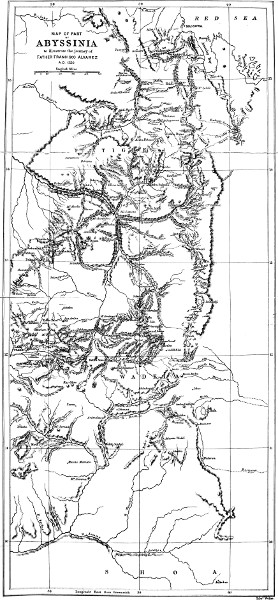
MAP OF PART OF ABYSSINIA
to illustrate the journey of FATHER FRANCISCO ALVAREZ A.D. 1520