CHAP. XXIV.
Reading edition
Two Volunteer Companies raised of free Mulattoes and Negroes—Description of the Arrowouka Indian Nation—Colonel Fourgeoud’s Regiment receives orders to sail for Europe—Countermanded—Re-enter the Woods—Trade of the Colony—Description of a Cacao Estate—Sample of Sable Heroism.
To what good star I was obliged, in the midst of all our confusion and distress, I know not, but certain it is, that Colonel Seyburg having sent for me on the first day of the new year, not only solicited my future friendship, but declared he was sorry for all the ill-treatment he had ever occasioned me, for which he principally blamed Mr. Gibhart, his adjutant and spy; then taking me by the hand, as a proof of his real regard, permitted me from that moment to go to Paramaribo, or wherever I pleased, to refresh and refit until further orders; which had such an effect on me, that having instantly converted every drop of my rum into grog, we sat down, together with two other officers, and drowned all former animosity in oblivion, till we could hardly see each other. In this condition I took my leave that very evening of my new friend and the camp at Java Creek, and rowed down in the best spirits for Paramaribo.
On the 3d I arrived at the fortress Amsterdam, where I was entertained with an excellent fish dinner, and where I must again intreat the reader’s patience, while I attempt to describe the different species, viz. the passessy, prare-prare, provost, and curema. The passary is above two feet long, and weighs sometimes twenty pounds: the head is broad and flat; it has two long barbs, and no scales, and is very delicate eating. The prare-prare is about the same size, and equally good. The provost is large, often five feet, and of a yellowish colour; the flesh of this is less agreeable, but the oil it produces comes to good account. As for the curema, this is a species of mullet, sometimes above two feet in length, with large silvery eyes, and the under jaw longer than the upper. Near this place are also found a kind of sea-snails, of which Madam Merian makes mention; and the fore-part of which exactly resembles those of a shrimp.
In the evening at six o’clock I arrived once more at Paramaribo, and found Joanna with her little boy perfectly well, after having both been blind for above three weeks; with whom being now invited to lodge, at the house of my friend Mr. De Graaf, I was completely happy.
The Colonel, in a word, was now quite the reverse of what he had been before, and upon the whole so very agreeable in his manners, that I would never wish to spend my time in better company; but how I should become at once the favourite of both these rival commanders, was a secret I could never yet discover, unless it might proceed from a desire of gaining me from each other, as they still continued mutual enemies: be that as it may, I resolved to preserve the most inflexible neutrality, as I also did between them and the governor, where I was invited next day, and dined not on salt-beef, but found as usual a truly magnificent entertainment.
Thus I continued daily visiting my friends, viz. Mrs. Godefroy, the Demellys, the Gordons, the Mac Neyls, &c. I also spent a very agreeable day with the black Mrs. Sampson, or Zubly, who was now a widow.
I was present too at a mulatto ball, composed however not of slaves, but of free independant settlers. Here the music, the lights, the country dances, the supper, and, above all, the dresses were so superb, and their behaviour so decent and genteel, that the whole might serve as a model for decorum and etiquette to some of the fairer and more polished inhabitants.
On the 20th, observing a number of Indians and black people of both sexes swimming at the back of Fort Zelandia, young Donald Mac Neyl and myself compleated the groupe, by stripping and getting in among them; and I must confess I never beheld more surprising feats of activity in the water, than were performed by the negroes, who fought a sham battle, by plunging or rather tumbling like porpoises, when they struck each other with their legs, as they never used their hands; while the Indians, who were of the Arrowouka nation, swam and dived like amphibious animals.
“——Such as Arcadian song
Transmits from ancient uncorrupted Time;
When tyrant Custom had not shackled Man,
But free to follow Nature was the mode.”
In her features was displayed that beautiful simplicity, that native unsuspecting innocence, which cannot be put on where there is the slightest consciousness of guilt. Nor is the olive-colour incompatible with beauty, it is certainly the standard complexion of the human race, while the black and white are supposed to be only gradations, produced probably by the extremes of heat and cold. As this Indian girl was perfectly handsome, so she seemed to be perfectly happy.—“Happiness,” as the Abbe Reynal wisely observes, “is more frequently found in a pure state of nature, than in that of the most refined civilization.” To be sure an European woman would blush to her fingers ends at the very idea of appearing publicly stark naked; but education and prejudice are every thing, since it is an axiom, that where there is no feeling of self-reproach, there can assuredly be no shame.
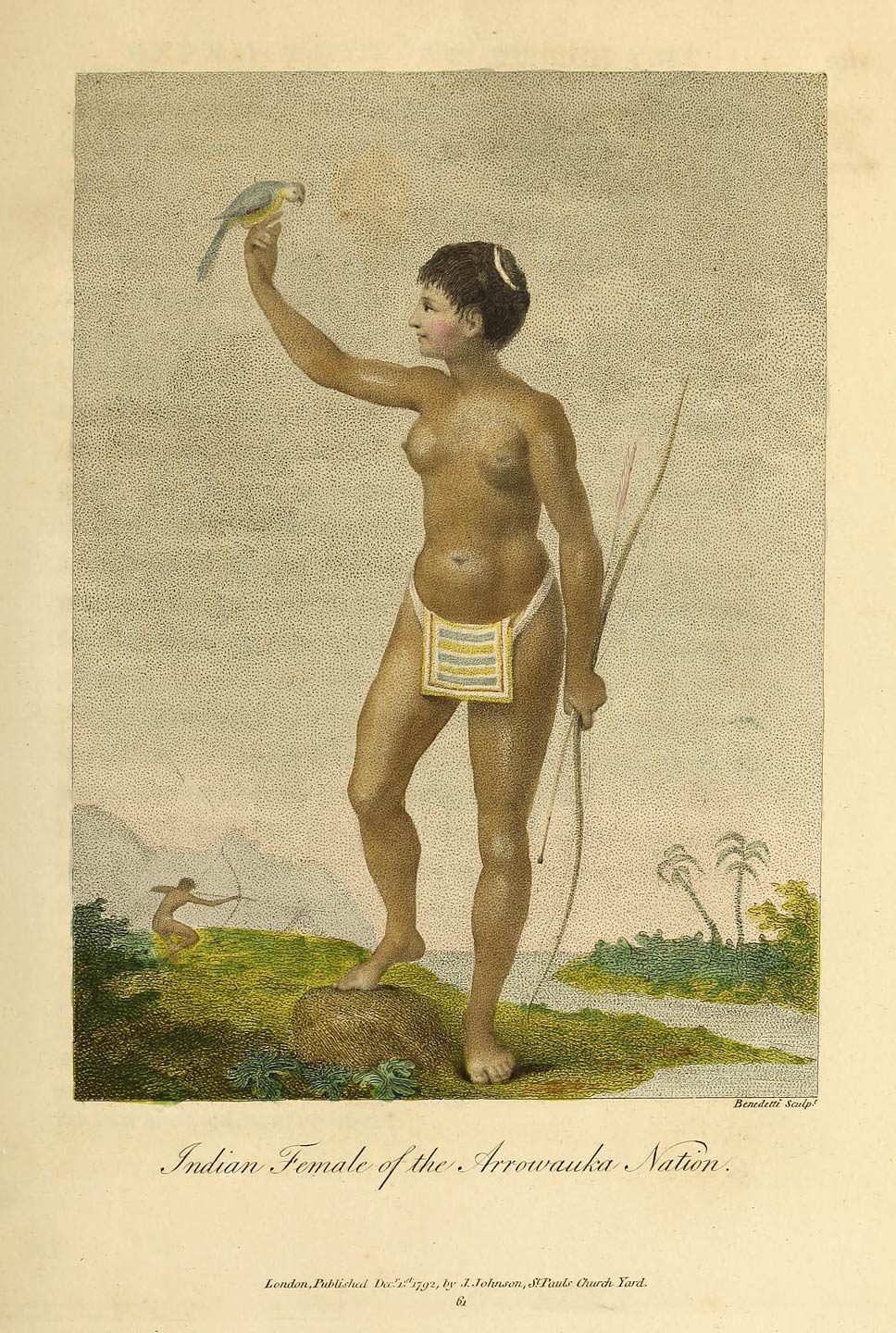
Benedetti Sculpt.
Indian Female of the Arrowauka Nation.
London, Published Decr. 1st, 1792, by J. Johnson, St. Paul’s Church Yard.
I cannot conclude these remarks without adding a few words concerning the unspotted moral character of these people, who not only live in peace with most of the other Indian nations, but are peculiarly attached to the Europeans, while these in return profess for them the strongest esteem.
The education these people receive in their infancy being according to the dictates only of simple nature, their minds or their bodies are very seldom deformed, while a too nice attention to either is possibly as detrimental as a total neglect. The ingenious Dr. Bancroft is of the same opinion, which he supports (I think needlessly) by a quotation from Quintilian.
On the 25th I was seized with a fever, and blooded in the foot, in which the orifice being struck too deep, for struck it was as they bleed the horses, I again became lame; during which time Colonel Seyburg arrived from the Java Creek to recover, he being at last also taken very ill.
In the mean time Colonel Fourgeoud, while he was just ready to renew his operations, having already sent a small detachment to the Jew Savannah for intelligence, received letters from the Hague, with express orders to abandon the expedition immediately, and with his few remaining troops to sail for Holland without delay.
In consequence of these commands on the 27th, the transport ships were put in commission, and all the officers and privates received their clearance, which made them very happy; and indeed all at Paramaribo were alive with joy, except some of the inhabitants and myself.
On the 14th of February, ill as I was with a bad foot, a sore arm, the prickly heat, and all my teeth loose with the scurvy, I found means to scramble out on crutches, with a thousand florins in my pocket, which having divided between Fourgeoud and Mrs. Godefroy for the redemption of the black boy Quaco, and my mulatto, I returned home without a shilling in my purse; yet for this small sum of 500 florins, so inadequate to 1800 which I owed that lady, she was induced generously to renew her persuasions of carrying Joanna and the boy with me to Holland. This, however, Joanna as nobly as firmly refused, declaring, “that, independant of all other considerations, she could never think of sacrificing one benefactor to the interest of another; and that her own happiness or even mine, which was dearer to her than life, should never have any weight, till the debt of her liberty was paid by me, or by her own industry, to the utmost fraction, and which she did not despair to see one day compleated.” She added, “our separation should only be for a time, and that the greatest proof I could ever shew her of my real esteem, was now to undergo this little trial of fortune like a man, without so much as heaving a sigh in her presence;” which last she spoke with a smile, next embraced her infant, then turned suddenly round, and wept most bitterly.—At this moment I was called to Mr. de la Mare’s, who was just dead, where my melancholy having surpassed all description, I at last determined to weather one or two painful years in her absence; and in the afternoon went to dissipate my mind at a Mr. Roux’s cabinet of Indian curiosities; where, as my eye chanced to fall on a rattle-snake, I will before I leave the colony describe this dangerous reptile.
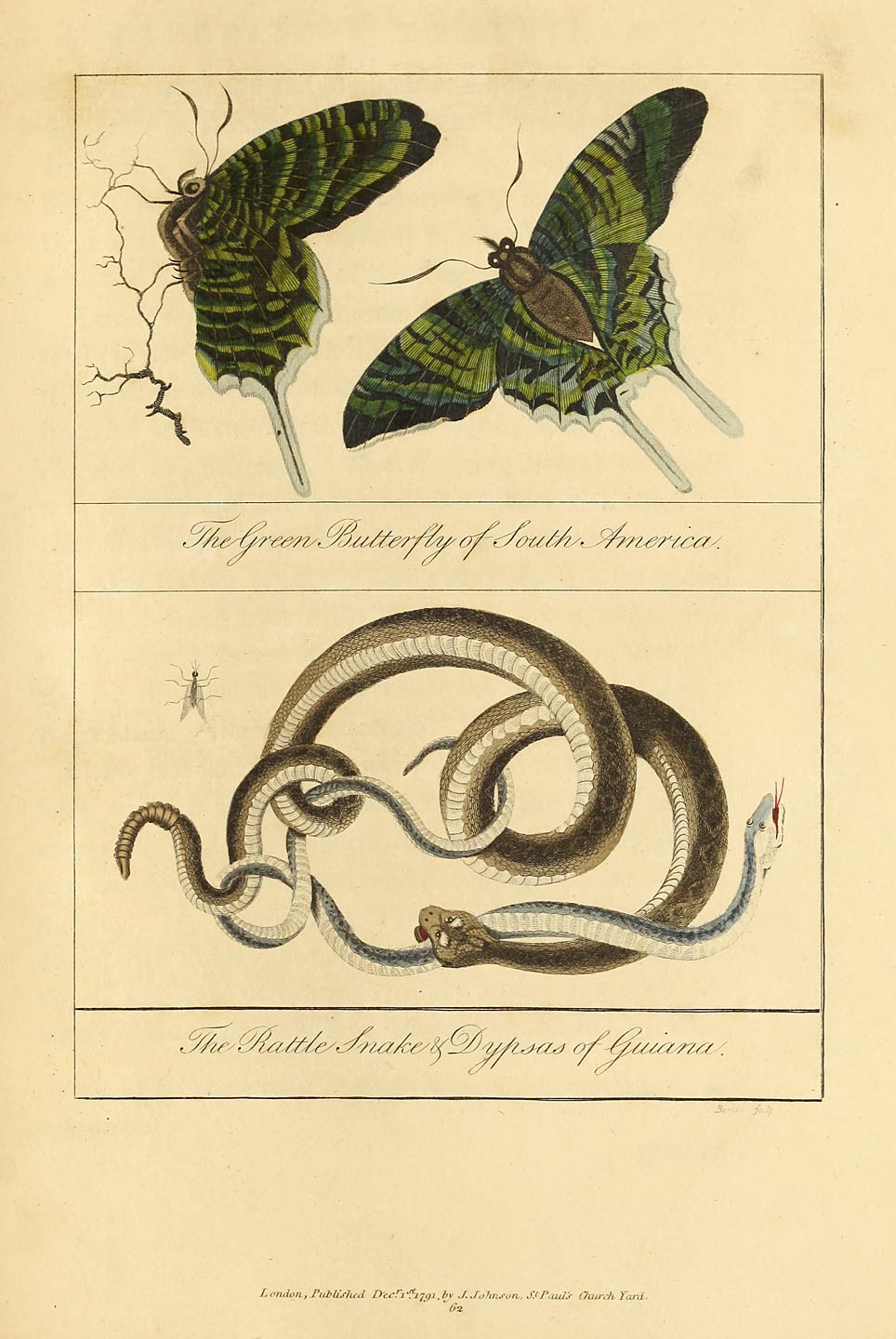
The Green Butterfly of South America.
The Rattle Snake & Dypsas of Guiana.
London, Published Decr. 1st, 1791, by J. Johnson, St. Paul’s Church Yard.
Amongst Mr. Roux’s numerous collection of fine butterflies, one of a middle size I thought peculiarly beautiful; all its wings, both above and below, being elegantly streaked with transverse bars of velvet, black, and a variegated bright green. The amazing height to which they ascend, and the great velocity with which these insects fly, make them so rare, being, for these reasons, but very seldom caught. The caterpillar is a sea-green, and all covered over with hard feelers, not unlike feathers.—For a better idea of the above snakes, and this fly, see the plate annexed, where the last was improved from Madam Merian’s collection.
In short, on the 18th of February, the poor dispirited men were again sent up to Magdenburg, a large party still remaining at the Java Creek; whilst the temper of the officers was now so ruffled, that a Mr. Fisher of our corps fought no less than two duels in two succeeding days, dangerously wounding both his antagonists, who were both officers of the Society regiment.
As I was not yet recovered, I staid some time longer at Paramaribo, where at the house of a Mr. Reynsdorp, I saw a Portuguese Jew teaching his children the Christian religion, while the pious mother of the charity-house kept flogging the poor slaves daily, because they were, as she said, unbelievers. To one black woman, in particular, she wantonly gave four hundred lashes, who bore them without a complaint.
But to change the disagreeable subject;—while I have the leisure and the opportunity, I feel the inclination to state to the public a short account of the trade and intrinsic value of this blood-spilling colony; which still might be richer, did they not follow the example of the woman in the fable with her golden eggs.
In the first place, in Surinam are computed to be about six or eight hundred plantations, producing sugar, coffee, cacao, and cotton, besides some indigo, and valuable timbers, &c.—The exportation of which four first articles only, and their value, may be seen at one view in the following table for four successive years.
The Years. Barrels of SUGAR. lbs. of COFFEE. lbs. of CACAO. lbs. of COTTON.
1771 19,494 11,135,132 416,821 203,945
1772 19,260 12,267,134 354,935 90,035
1773 15,741 15,427,298 332,229 135,047
1774 15,111 11,016,518 506,610 105,126
Total 69,606 49,846,082 1,610,595 534,153
69,606 barrels of sugar, at 60 florins per barrel, make ƒ. 4,176,360 — —
49,846,082 lbs. of coffee, at 8½d. per lb. make 21,184,584 17 —
1,610,595 lbs. of cacao, at 6½d. per lb. make 523,443 7 8
534,153 lbs. of cotton, at 8d. per lb. make 212,661 4 —
Sum total ƒ. 26,097,049 8 8
Which makes in one year exactly ƒ. 6,524,262 7 2
But this average produce was shipped off for the town of Amsterdam only.
If I now add what goes to Rotterdam and to Zealand, besides the home consumption, and the return of the rum and molasses, the indigo at 4 ƒ. per lb. and the timber from 5 d. to five florins per cubic foot, it will amount to as much more 6,524,262 7 2
Thus altogether ƒ. 13,048,524 14 4
Which, supposing it was but 11,000,000 ƒ. makes a yearly income of one million neat in sterling money.
How the above sum is divided between the republic of Holland and this colony, shall be my business to state in the second place.
In the third place, I shall now show in what manner the internal expence of the society of Surinam is defrayed by taxes; which amount to no trifle, as shall be seen.
Having already mentioned, when speaking of the government, that the public revenue officers were five in number, I will now point out how they collect the cash respectively each, for the support of the above expences.
The first of these is that of Importation and Exportation Duties.
To this is paid, viz.
By all Dutch vessels, 3 ƒ. per ton thus for tonnage, ƒ. 90,000

By Americans, &c. 6 ƒ. per ton
By Americans, &c. for all imports and exports, 5 per cent. 60,000
Sugar pays 1 ƒ. per thousand or barrel in 1771 paid 260,000

Coffee 15d. per 100 lb. weight
Cacao 1 ƒ. 15d. per 100 lb. Do
Cotton
———— ƒ. 410,000 — —
Thus receives yearly about the sum of ƒ. 410,000 — —
The second is the office of excise and small duties.
To this is paid, viz.
For a barrel of beer ƒ. 3 — —
A Do of claret 12 — —
A pipe of madeira 23 10 —
All wines, per quart bottle — — 1
The tax on publicans, is 600 — —
Do on small retailers 300 — —
And which amounts to a yearly produce of at least 100,000 — —
Then follows thirdly the office for taxation on heads; which receives for all inhabitants, black and white, without exception, viz.
For or men and women ƒ. 2 10 this produces yearly 150,000 — —

For boys and girls under 12, ƒ. 1 5
Next comes the office for sales and slaves, which gets, viz.
For selling dead stock, including estates, &c. 5 per cent. thus, 130,000 — —
For selling newly-arrived or imported negro slaves, 2½ per cent.
And finally, the office for re-taking negro deserters, which was then erected, the other taxes not being sufficient; which produces yearly, viz.
By an additional tax on heads, black and white, at 1 ƒ. is 80,000
By 4 per cent. of every profit got during the year upon oath, is 400,000
Which makes exactly 480,000 — —
Still let me not forget what is yearly paid for what is called the support of the common or grass fields, viz.
For a house, according to its size.
For a coach 20 — —
For a whiskey 10 — —
For a saddle-horse 10 — —
Which add to the above impositions again 12,000 — —
And these, if summed together, make a yearly revenue of no less than ƒ. 1,282,000 — —
Having thus shewn, according to the best information I was able to acquire, in what the commerce and intrinsic wealth of this fine colony consist; I will now take my leave of the subject, and continue my narrative.
On the 21st of February, Mr. Reynsdorp, the son-in-law of Mrs. Godefroy, took me in his sail barge for change of air to Nuten-Schadelyk, one of his own coffee estates; where I saw a white man who had lately lost both his eyes in one night by the bats or vampires, as they are called; and the following day, sailing up Comewina River, we proceeded to the delightful Cacao plantation Alkmaar, the property of the above lady; where the negro slaves are treated like children by the mistress, to whom they all look up as to their common parent.—Here were no groans to be heard, no fetters to be met with, nor any marks of severity to be seen—but all was harmony and content. The superb house and other offices of this charming estate, where pleasure and hospitality ever reign, I have already represented in plate No X.; while the fields and gardens, nay, even the negro houses, bore all the marks of perfect peace and plenty.
The cacao-trees are supplied from nurseries for the purpose, like orchards in England, and planted very regularly at ten or twelve feet distance from each other, where they grow to the height of our English cherry-trees. But these plantations must be well sheltered, both from the hard winds and scorching sun, when young; the roots not entering deep into the ground to succour them, nor can they at that time bear extraordinary heat; on which account the groves are filled up with cassava-shrubs or plantain-trees for their shelter, and which at the same time answer the purpose of killing the weeds, which grow so luxuriantly in all the tropical climates;—by these attentions the trees will bear fruit before they are three years old, when they afford two crops annually, but they are in the highest perfection at the age of twelve or fourteen. The leaf of the cacao-tree is above eight inches long, and nearly three broad, thick-pointed, ribbed like the laurel-time, and of a bright green-colour. The fruit is about the same size, and when young resembles a cucumber; but when ripe it becomes yellow like a large lemon, with ribs like the melon, and tubercles which enclose the seed or nuts, near thirty in number: they lie longitudinally in the fruit, and when fit for use are of the size of olives, and purple-coloured. The trees are supposed to bear at each crop from thirty to three hundred pods, each containing about thirty nuts, weighing one pound, from which a calculation may be made how much will be the produce of each harvest. After a few days the nuts are extracted from the pods, and dried in the shade; during which time they undergo a very strong perspiration, when they are put into barrels and fit for transportation, to be converted into that well-known and agreeable beverage called Chocolate.
It is said the cacao-trees are natives of Guiana, and grow wild in large quantities near the river Amazon: be that as it may, Governor Chatillon’s son planted the first tree in Surinam in 1684, and the first crop was exported to Holland in 1733. A great advantage in cultivating cacao-trees is, that fewer slaves are required than in any other branch of the planting business. How considerable are the profits will appear by the accounts of the year 1774, when 506,610 lbs. were exported to Amsterdam alone, which produced 202,614 ƒ. Dutch money, being equal to £. 18,419 sterling. The prices have been fluctuating from 4d. to 9d. per lb. the average being about 6½d. The best estates, of which Alkmaar is one, produce yearly above 80,000 lbs. weight.
On the 27th we returned to town, where the day before a Society soldier was shot for mutiny; and the day following a ship was burnt in the roads. At this time the celebrated free negro Qwasi, who was the prophet, priest, and king of the rangers, &c. went to Holland on a visit to the Prince of Orange, with letters of recommendation from Fourgeoud, whose praises he was to resound, as well as to complain of the Governor for not treating him with due respect. This being the period for the sessions, another negro’s leg was cut off for sculking from a task to which he was unequal; while two more were condemned to be hanged for running away altogether. The heroic behaviour of one of these men before the court deserves particularly to be noticed:—He begged only to be heard for a few moments; which being granted, he proceeded thus:
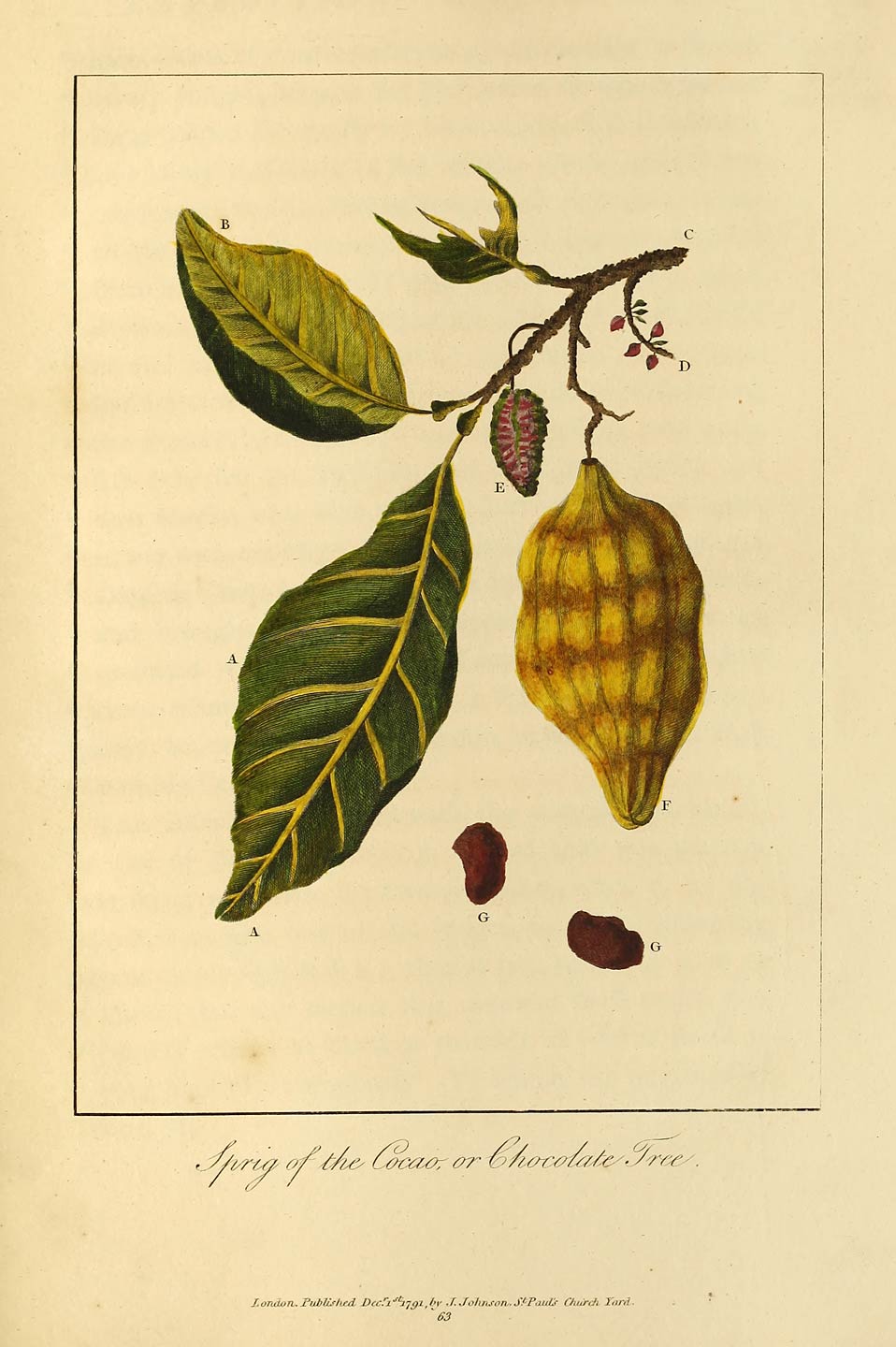
Sprig of the Cocao, or Chocolate Tree.
London, Published Decr. 1st, 1791, by J. Johnson, St. Paul’s Church Yard.
“I was born in Africa, where, defending my prince during an engagement, I was made a captive, and sold for a slave on the coast of Guinea by my own countrymen.—One of your countrymen, who is now to be one of my judges, became my purchaser, in whose service I was treated so cruelly by his overseer, that I deserted, and joined the rebels in the woods.—Here again I was condemned to be a slave to Bonny, their chief, who treated me with even more severity than I had experienced from the Europeans, till I was once more forced to elope, determined to shun mankind for ever, and inoffensively to end my days by myself in the forest. Two years had I persevered in this manner quite alone, undergoing the greatest hardships and anxiety of mind, preserving life only for the possibility of once more seeing my dear family, who were perhaps starving on my account, in my own country; I say two miserable years had just elapsed, when I was discovered by the rangers, taken, and brought before this tribunal, who are now acquainted with the history of my wretched life, and from whom the only favour I have to ask is, that I may be executed next Saturday, or as soon as it may possibly be convenient.”
This speech was uttered with the utmost moderation, by one of the finest-looking negroes that was perhaps ever seen; to which his former master, who, as he observed, was now one of the judges, made the following laconic reply—“Rascal! that is not what we want to know; but the torture this moment shall make you confess crimes as black as yourself, as well as those of your hateful accomplices.” To which the negro, who now swelled in every vein with indignation and ineffable contempt: “Massera, the tigers have trembled for these hands,” holding them up; “and dare you think to threaten me with your wretched instrument? No, I despise the utmost tortures you can now invent, as much as I do the pitiful wretch who is going to inflict them.” Saying which, he threw himself down on the rack, where amidst the most excruciating torments he remained with a smile, without uttering a syllable; nor did he ever speak again, until he ended his unhappy days at the gallows.
What good man can “reflect the tear-stain’d eye,
When blood attests even slaves for freedom die?
On cruel gibbets, high disclos’d they rest,
And scarce one groan escapes one bloated breast.
There Afric Platos, tortur’d hope a God,
While jetty Brutus for his country sighs,
And sooty Cato with his freedom dies!”
Having dined with Colonel Fourgeoud on the 8th of March, when we celebrated the Prince of Orange’s birthday, while Mr. Reyndorp gave a treat to all the soldiers, he acquainted me that the rangers were now alone encamped at the Wana Creek; that the pestilential spot Devil’s Harwar was at last entirely forsaken; and that the two lately raised companies of sable volunteers had taken a few prisoners, and killed others on the Wanica path, behind Paramaribo. I was at this time a good deal better, but still, not being quite recovered, he who had formerly treated me so severely, now even insisted on my staying some longer time at Paramaribo: nay, gave me an offer to return to Europe, which I absolutely refused; in short, about the middle of the month, I was as well as ever I was in my life. At this time Colonel Fourgeoud and myself were daily visitors of the ladies, in whose company no man could behave better, while I could often not avoid disgust; indeed so languid were many in their looks, and so unrestrained were some in their conversation, that a Mrs. N—— even asked me, sans ceremonie, to supply the place of her husband; while she might as well have asked me to drink, for a relish, a tumbler of salts.
“Then to the flood they rush’d; the parted flood
Its lovely guests with closing waves receiv’d,
And every beauty soft’ning, every grace
Flushing anew, a mellow lustre shed.”
Leaving them to enjoy their innocent amusement of bathing, I spent the remaining hour before dinner amongst the shady fruit-trees, blooming bowers, and serpentine gravel walks; where indeed I saw greater variety of European plants than I imagined were produced in a tropical climate, such as mint, fennel, sage, rosemary, golden-rod and jessamine, the sensitive plant, pomegranates, roses, figs, and even some grapes.—Of the pomegranate flowers, a specimen may be seen in plate, No XXIX. The figs are both within and without of a beautiful crimson colour; but the roses are rather pale. Here were some beautiful pine-apples and melons, which, though they are so generally known, I will nevertheless give some account of. The imperial fruit, called Anana or pine-apple grows in the centre of an elegant sea-green plant, on a stalk of the same hue, about eight inches in length, its leaves diverging near the surface of the earth, which are smooth, long, strong, pointed, and dentulated with hard prickles. The shape of this fruit is nearly oval, the size of a sugar-loaf, all over chequered, and of a most beautiful orange or golden colour, being crowned with a sea-green tuft, of the same leaves as the mother plant, and which when put in the ground produces another pine-apple in the space of about eighteen months. The delicious taste and flavour of this fruit has in the space of half a century become so well known, that I have introduced it merely to notice its plenty in the country I write of; for so spontaneously indeed do the former grow in this climate, and of such different kinds, without any cultivation, that on many estates they serve as a common food for hogs.
The musk and water melons grow also plentifully in this country; the first is of a globular form, large, like the crown of a small hat, ribbed, buff colour, orange and green. The pulp is yellow, firm, sweet, and succulent; still it is eaten with sugar, but more frequently with black pepper and salt—the smell of this fruit is excellent.
The water-melon is of an oval or cylindrical shape, its colour is a bright polished green, and partly a very pale buff; the pulp of this fruit is a pink colour, and of a mellow watery substance; its taste is sweet, exceedingly cooling, and of a most agreeable flavour.
Both the above melons are of the cucumber kind, growing on rough stalks, with large leaves, that creep along the ground. It is remarkable that the water-melon, which may be freely eaten in all distempers without the least pernicious consequence, thrives best in very dry and sandy places.—In the annexed plate may be seen the Anana or pine-apple, with the musk and water-melon, besides the seed from which this last is produced.
I sent about this period, to a Mr. Reygersman in Holland, a most elegant collection of Surinam butterflies, which are here caught in great abundance and variety, and by which alone some people make no small profit; but the very idea of pinning them alive to a sheet of paper, was sufficient to prevent me from becoming a fly-catcher:
“Lo! the poor beetle that we tread upon——
Feels a like pang, as when a giant falls.”
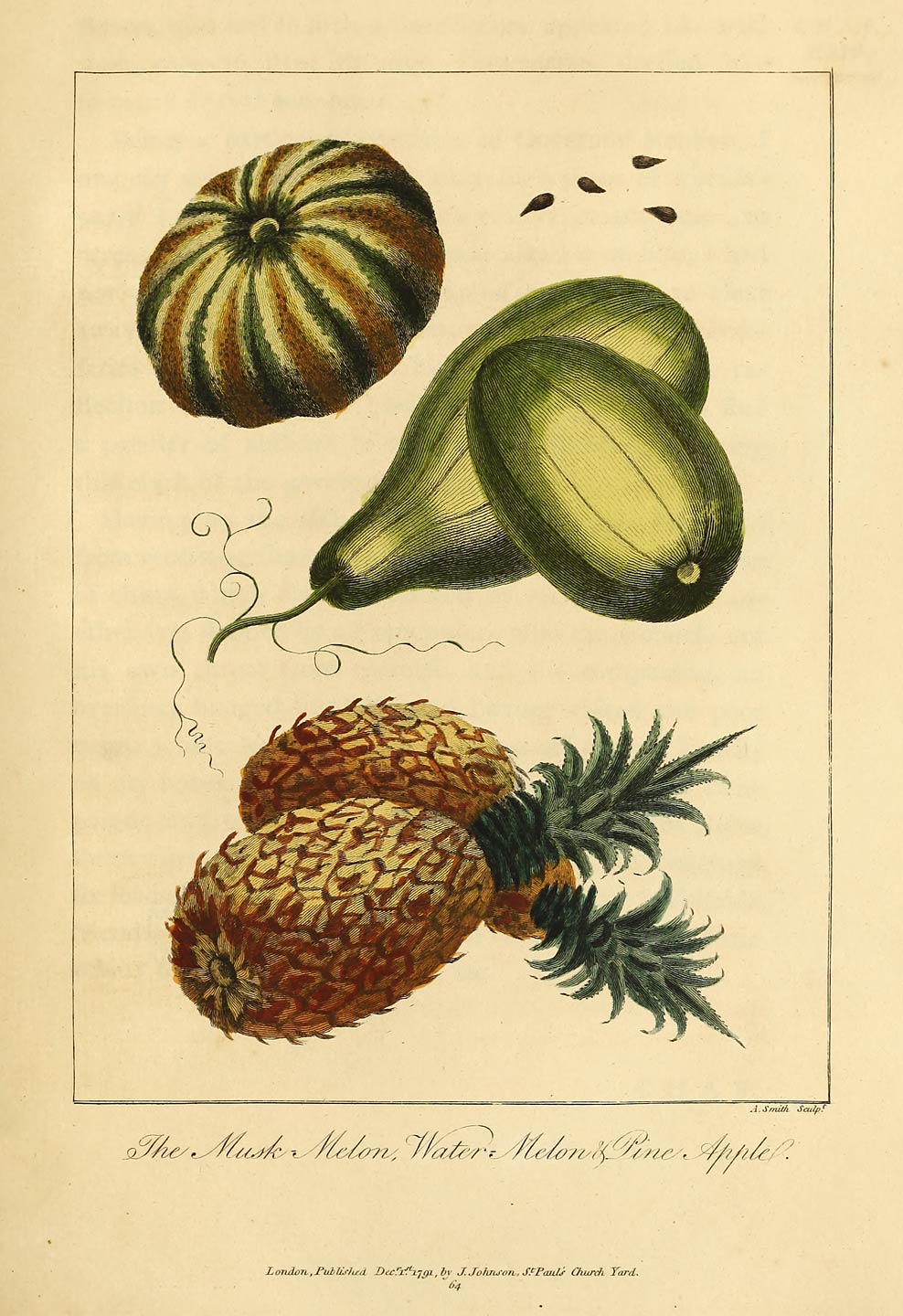
A. Smith Sculpt.
The Musk-Melon, Water-Melon & Pine-Apple.
London, Published Decr. 1st, 1791, by J. Johnson, St. Paul’s Church Yard.
Being a particular favourite of Governor Nepveu, I one day was induced to ask him for a piece of uncultivated forest ground; when he readily granted me 400 acres: but when I inconsiderately asked it of him, I had not calculated how large a capital it required to clear away woods, purchase negroes, and provide other necessaries for such an undertaking; and when a little reflection convinced me how difficult it would be to find a partner of abilities to assist me, I declined accepting this mark of the governor’s regard.
Having on the 26th once more saved a poor black girl from receiving some hundred lashes, by replacing a dozen of china, which she had broken by accident; while another was stabbed by a Frenchman, who immediately cut his own throat from remorse, and his companion, an overseer, hanged himself; and having visited the poor negro whose leg had lately been cut off by law, I packed my boxes to set out next morning on my sixth campaign; and once more take the command of the River Comewina: at which moment arrived at my lodgings six loaded negro slaves with presents from my hospitable friends, of every kind that Guiana could produce, and the colony of Surinam could afford me.