SERIES P
Reading edition
1812
"'Tis the same landscape which the modern Mars saw Who march'd to Moscow, led by Fame, the siren! To lose by one month's frost, some twenty years Of conquest, and his guard of grenadiers." —Byron (Don Juan, canto x. stanza 58).
SERIES P
(For subjoined Notes to this Series see pages 312-315.)
LETTER PAGE
No. 1. Konigsberg 312
No. 2. Gumbinnen 313
1812.
Montgaillard sums up his tirade against Napoleon for the Russian campaign by noting that it took the Romans ten years to conquer Gaul, while Napoleon "would not give two to the conquest of that vast desert of Scythia which forced Darius to flee, Alexander to draw back, Crassus to perish; where Julian terminated his career, where Valerian covered himself with shame, and which saw the disasters of Charles XII."
January 9th.—Suchet captures Valencia, 18,000 Spanish troops, and 400 cannon. The marshal is made Duke of Albuféra.
January 15th.—Imperial decree ordains 100,000 acres to be put under cultivation of beetroot, for the manufacture of indigenous sugar.
January 19th.—Taking of Ciudad Rodrigo by Wellington.
January 26th.—French, under General Friand, occupy Stralsund and Swedish Pomerania.
February 24th.—Treaty of alliance between France and Prussia; the latter to support France in case of a war with Russia.
March 13th.—Senatus Consultus divides the National Guards into three bans, to include all capable men not already in military service. They are not to serve outside France. A hundred cohorts, each 970 strong, of the first ban (men between 20 and 26), put at disposal of Government.
March 14th.—Treaty between France and Austria; reciprocal help, in need, of 30,000 men and 60 guns. The integrity of European Turkey mutually guaranteed.
March 26th.—Treaty between Russia and Sweden. Bernadotte is promised Norway by Alexander.
April 7th.—The English take Badajoz by assault. "The French General, Philippon, with but 3000 men, has been besieged thrice within thirteen months by armies of 50,000 men" (Montgaillard).
April 24th.—Alexander leaves St. Petersburg, to take command of his Grand Army.
May 9th.—Napoleon leaves Paris for Germany.
May 11th.—Assassination of English Prime Minister, Perceval.
May 17th-28th.—Napoleon at Dresden; joined there by the Emperor and Empress of Austria, and a fresh "parterre of kings".
May 28th.—-Treaty of Bucharest, between Turkey and Russia. The Pruth as boundary, and Servia restored to Turkey. This treaty, so fatal to Napoleon, and of which he only heard in October, was mainly the work of Stratford de Redcliffe, then aged twenty-five. Wellington, thinking the treaty his brother's work, speaks of it as "the most important service that ever fell to the lot of any individual to perform."
No. 1.
June 12th.—Suchet defeats an Anglo-Spanish army outside Tarragona.
To the Empress Josephine, at Malmaison.
June 12th, 1812.
My Dear,—I shall always receive news from you with great interest.
The waters will, I hope, do you good, and I shall see you with much pleasure on your return.
Never doubt the interest I feel in you. I will arrange all the matters of which you speak.
Napoleon.
June 16th.—Lord Liverpool Prime Minister of England.
June 18th.—United States declares war against England concerning rights of neutrals.
June 19th.—The captive Pope (Pius VII.) brought to Fontainebleau.
No. 2.
To the Empress Josephine, at Malmaison.
Gumbinnen, June 20th, 1812.
I have your letter of June 10th. I see no obstacle to your going to Milan, to be near the Vice-Reine. You will do well to go incognito. You will find it very hot.
My health is very good. Eugène is well, and is doing good work. Never doubt the interest I have in you, and my friendship.
Napoleon.
June 22nd.—Napoleon from his headquarters, Wilkowyszki, declares war against Russia. His army comprised 550,000 men and 1200 cannon, and he held sway at this epoch over 85,000,000 souls—half the then population of Europe.
June 24th.—French cross the Niemen, over 450,000 strong.[40] Of these 20,000 are Italians, 80,000 from Confederation of the Rhine, 30,000 Poles, 30,000 Austrians, and 20,000 Prussians. The Russian army numbers 360,000.
June 28th.—French enter Wilna, the old capital of Lithuania. Napoleon remains here till July 16th, establishing a provisional government, and leaving his Foreign Minister, Maret, there.
July 12th.—Americans invade Canada.
July 18th.—Treaty of peace between England and Sweden; and between Russia and the Spanish Regency at Cadiz.
July 22nd.—Battle of Salamanca (Arapiles). Marmont defeated by Wellington, and badly wounded. French lose nearly 8000 men and 5000 prisoners; English loss, 5200. The Spanish Regency had decided to submit to Joseph Bonaparte, but this battle deters them. French retire behind the Douro.
July 23rd.—Combat of Mohilow, on the Dneiper. Davoust defeats Bagration.
July 28th.—French enter Witepsk.
August 1st.—Treaty of alliance between Great Britain and Russia. English fleet henceforward guards the Gulf of Riga. Combat of Obaiarzma, on the bank of the Drissa. Marshal Oudinot defeats Wittgenstein. Russians lose 5000 men and 14 guns.
August 9th.—Battle of Brownstown (near Toronto). Americans defeated; surrender August 16th with 2500 men and 33 guns to General Brock.
August 12th.—Wellington enters Madrid.
August 17th-18th.—Battle and capture of Smolensk. Napoleon defeats Barclay de Tolly; Russians lose 12,000, French less than half.
August 18th.—Battle of Polotsk, fifty miles from Witepsk, down the Dwina. St. Cyr defeats Wittgenstein's much larger army, and takes 20 guns. (St. Cyr made marshal for this battle, August 27th.)
August 19th.—Combat of Volontino-Cova, beyond Smolensk. Ney defeats Russians.
August 27th.—Norway guaranteed Sweden in lieu of Finland by Russia.
August 28th.—Interview at Abo, in Finland, between Alexander, Bernadotte, and Lord Cathcart (English ambassador). Decided that Sweden shall join the crusade against France, and that Moreau be imported from U.S.A. to command another army.
August 29th.—Viazma, burnt by Russians, entered by the French.
September 7th.—Battle of Borodino (La Moskowa). Nearly all the Russian generals are present: Barclay de Tolly, Beningsen, Bagration (who is killed), all under Kutusoff. Russians lose 30,000 men, French 20,000, including many generals who had survived all the campaigns of the Revolution. The French, hungry and soaked in rain, have no energy to pursue.
September 14th.—Occupation of Moscow; fired by emissaries of Rostopchin, its late governor. Of 4000 stone houses only 200 remain, of 8000 wooden ones 500. Over 20,000 sick and wounded burnt in their beds. Fire lasts till September 20th.
September 18th.—Russian Army of the Danube under Admiral Tschitchagow joins the Army of Reserve.
September 26th.—Russian troops from Finland disembark at Riga.
September 30th.—Napoleon finds a copy of Treaty of Bucharest at Moscow.
October 11th.—Admiral Tschitchagow with 36,000 men reaches Bresc, on the Bug, threatening the French communications with Warsaw.
October 17th-19th.—Second combat of Polotsk. Wittgenstein again defeated by St. Cyr, who is wounded.
October 18th.—Combat of Winkowo; Kutusoff defeats Murat. Americans defeated at Queenston Heights, on the Niagara, and lose 900 men.
October 19th.—Commencement of the Retreat from Moscow.
October 22nd.—Burgos captured by Wellington.
October 23rd.—Conspiracy of Malet at Paris; Cambacérès to the rescue. Evacuation of Moscow by Mortier after forty days' occupation. The French army now retreating has only half its original strength, and the best cavalry regiments boast only 100 horses.
October 24th.—Battle of Malo-Jaroslavitz. Eugène with 17,000
men defeats Kutusoff with 60,000; but Napoleon finds the enemy too strong and too tenacious to risk the fertile Kaluga route.
November 3rd.—Battle of Wiazma. Rearguard action, in which Ney and Eugène are distinguished.
November 9th.—Napoleon reaches Smolensk and hears of Malet conspiracy.
November 14th.—Evacuation of Smolensk.
November 16th.—Russian Army (of the Danube) takes Minsk, and cuts off the French from the Niemen.
November 16th-19th.—Combat of Krasnoi, twenty-five miles west of Smolensk. Kutusoff with 30,000 horse and 70,000 foot tries to stop the French, who have only 25,000 effective combatants. Magnificent fighting by Ney with his rearguard of 6000.
November 21st.—Russians seize at Borizow the bridges over the Beresina, which are
November 23rd.—Retaken by Oudinot.
November 26th-28th.—French cross the Beresina, but lose 20,000 prisoners and nearly all their cannon (150).
November 29th.—Napoleon writes Maret he has heard nothing of France or Spain for fifteen days.
December 3rd.—Twenty-ninth bulletin dated Malodeczna, fifty miles west of Borisow.
December 5th.—Napoleon reaches Smorgoni, and starts for France.
December 10th.—Murat, left in command, evacuates Wilna. French retreat in utter rout; "It is not General Kutusoff who routed the French, it is General Morosow" (the frost), said the Russians.
December 14th.—Napoleon reaches Dresden, and
December 18th.—Paris.
December 19th.—Evacuation of Kovno and passage of the Niemen.
December 20th.—Napoleon welcomed by the Senate in a speech by the naturalist Lacépède: "The absence of your Majesty, sire, is always a national calamity."
December 30th.—Defection of the Prussian General York and Convention of Taurogen, near Tilsit, between Russia and Prussia. This defection is the signal for the uprising of Germany from the Oder to the Rhine, from the Baltic to the Julienne Alps.
1813.
January 5th.—Konigsberg occupied by the Russians.
January 13th.—Senatus Consultus calls up 250,000 conscripts.
January 22nd.—Americans defeated at Frenchtown, near Detroit, and lose 1200 men.
January 25th.—Concordat at Fontainebleau between Napoleon and Pope Pius VII., with advantageous terms for the Papacy. The Pope, however, soon breaks faith.
January 28th.—Murat deserts the French army for Naples, and leaves Posen. "Your husband is very brave on the battlefield, but he is weaker than a woman or a monk when he is not face to face with an enemy. He has no moral courage" (Napoleon to his sister Caroline, January 24, 1813. Brotonne, 1032). Replaced by Eugène (Napoleon's letter dated January 22nd).
February 1st.—Proclamation of Louis XVIII. to the French people (dated London).
February 8th.—Warsaw surrenders to Russia.
February 10th.—Proclamation of Emperor Alexander calling on the people of Germany to shake off the yoke of "one man."
February 28th.—Sixth Continental Coalition against France. Treaty signed between Russia and Prussia at Kalisch.
March 3rd.—New treaty between England and Sweden at Stockholm: Sweden to receive a subsidy of a million sterling and the island of Guadaloupe in return for supporting the Coalition with 30,000 men.
March 4th.—Cossacks occupy Berlin. Madison inaugurated President U.S.A.
March 9th.—Eugène removes his headquarters to Leipsic.
March 12th.—French evacuate Hamburg.
March 21st.—Russians and Prussians take new town of Dresden.
April 1st.—France declares war on Prussia.
April 10th.—Death of Lagrange, mathematician; greatly bemoaned by Napoleon, who considered his death as a "presentiment" (D'Abrantès).
April 14th.—Swedish army lands in Germany.
April 15th.—Napoleon leaves Paris; arrives Erfurt (April 25th). Americans take Mobile.
April 16th.—Thorn (garrisoned by 900 Bavarians) surrenders to the Russians. Fort York (now Toronto) and
April 27th.—Upper Canada taken by the Americans.
May 1st.—Death of the Abbé Delille, poet. Opening of campaign. French forces scattered in Germany, 166,000 men; Allies' forces ready for action, 225,000 men. Marshal Bessières killed by a cannon-ball at Poserna.
May 2nd.—Napoleon with 90,000 men defeats Prussians and Russians at Lutzen (Gross-Goerschen) with 110,000; French loss, 10,000. Battle won
chiefly by French artillery. Emperor of Russia and King of Prussia present.
May 8th.—Napoleon and the French reoccupy Dresden.
May 18th.—Eugène reaches Milan, and enrols an Italian army 47,000 strong.
May 19th-21st.—Combats of Konigswartha, Bautzen, Hochkirch, Würschen. Napoleon defeats Prussians and Russians; French loss, 12,000; Allies, 20,000.
May 23rd.—Duroc (shot on May 22nd) dies. "Duroc," said the Emperor, "there is another life. It is there you will go to await me, and there we shall meet again some day."
May 27th.—Americans capture Fort George (Lake Ontario) and
May 29th.—Defeat English at Sackett's Harbour.
May 30th.—French re-enter Hamburg and
June 1st.—Occupy Breslau. British frigate Shannon captures Chesapeake in fifteen minutes outside Boston harbour.
June 4th.—Armistice of Plesswitz, between Napoleon and the Allies.
June 6th.—Americans (3500) surprised at Burlington Heights by 700 British.
June 15th.—Siege of Tarragona raised by Suchet; English re-embark, leaving their artillery. "If I had had two marshals such as Suchet, I should not only have conquered Spain, but I should have kept it" (Napoleon in Campan's Memoirs).
June 21st.—Battle of Vittoria; total rout of the French under Marshal Jourdan and King Joseph. In retreat the army is much more harassed by the guerillas than by the English.
June 23rd.—Admiral Cockburn defeated at Craney Island by Americans.
June 24th.—Five hundred Americans surrender to two hundred Canadians at Beaver's Dams.
June 25th.—Combat of Tolosa. Foy stops the advance of the English right wing.
June 30th.—Convention at Dresden. Napoleon accepts the mediation of Austria; armistice prolonged to August 10th.
July 1st.—Soult sent to take chief command in Spain.
July 10th.—Alliance between France and Denmark.
July 12th.—Congress of Prague. Austria, Prussia, and Russia decide that Germany must be independent, and the French Empire bounded by the Rhine and the Alps; "but to reign over 36,000,000 men did not appear to Napoleon a sufficiently great destiny" (Montgaillard). Congress breaks up July 28th.
July 26th.—Moreau arrives from U.S., and lands at Gothenburg.
July 31st.—Soult attacks Anglo-Spanish army near Roncesvalles in order to succour Pampeluna. Is repulsed, with loss of 8000 men.
August 12th.—Austria notifies its adhesion to the Allies.
August 15th.—Jomini, the Swiss tactician, turns traitor and escapes to the Allies. He advises them of Napoleon's plans to seize Berlin and relieve Dantzic [see letter to Ney, No. 19,714, 20,006, and especially 20,360 (August 12th) in Correspondence]. On August 16th Napoleon writes to Cambacérès: "Jomini, Ney's chief of staff, has deserted. It is he who published some volumes on the campaigns and who has been in the pay of Russia for a long time. He has yielded to corruption. He is a soldier of little value, yet he is a writer who has grasped some of the sound principles of war."
August 17th.—Renewal of hostilities in Germany. Napoleon's army, 280,000, of whom half recruits who had never seen a battle; the Allies 520,000, excluding militia. In his counter-manifesto to Austria, dated Bautzen, Napoleon declares "Austria, the enemy of France, and cloaking her ambition under the mask of a mediation, complicated everything.... But Austria, our avowed foe, is in a truer guise, and one perfectly obvious. Europe is therefore much nearer peace; there is one complication the less."
August 18th.—Suchet, having blown up fortifications of Tarragona, evacuates Valentia.
August 21st.—Opening of the campaign in Italy. Eugène, with 50,000 men, commands the Franco-Italian army.
August 23rd.—Combats of Gross-Beeren and Ahrensdorf, near Berlin. Bernadotte defeats Oudinot with loss of 1500 men and 20 guns. Berlin is preserved to the Allies. Oudinot replaced by Ney. Lauriston defeats Army of Silesia at Goldberg with heavy loss.
August 26th-27th.—Battle of Dresden.—Napoleon marches a hundred miles in seventy hours to the rescue. With less than 100,000 men he defeats the Allied Army of 180,000 under Schwartzenberg, Wittgenstein, and Kleist. Austrians lose 20,000 prisoners and 60 guns. Moreau is mortally wounded (dies September 1st). Combat of the Katzbach, in Silesia. Blucher defeats Macdonald with heavy loss, who loses 10,000 to 12,000 men in his retreat.
August 30th.—Combat of Kulm. Vandamme enveloped in Bohemia, and surrenders with 12,000 men.
August 31st.—Combat of Irun. Soult attacks Wellington to save San Sebastian, but is repulsed. Graham storms San Sebastian.
September 6th.—Combat of Dennewitz (near Berlin). Ney routed by Bulow and Bernadotte; loses his artillery, baggage, and 12,000 men.
September 10th—Americans capture the English flotilla on Lake Erie.
September 12th.—Combat of Villafranca (near Barcelona). Suchet defeats English General Bentinck.
October 7th.—Wellington crosses the Bidassoa into France. "It is on the frontier of France itself that ends the enterprise of Napoleon on Spain. The Spaniards have given the first conception of a people's war versus a war of professionals. For it would be a mistake to think that the battles of Salamanca (July 22nd, 1812) and Vittoria (June 21st, 1813) forced the French to abandon the Peninsula.... It was the daily losses, the destruction of man by man, the drops of French blood falling one by one, which in five years aggregated a death-roll of 150,000 men. As to the English, they appeared in this war only as they do in every world-crisis, to gather, in the midst of general desolation, the fruits of their policy, and to consolidate their plans of maritime despotism, of exclusive commerce" (Montgaillard).
October 15th.—Bavarian army secedes and joins the Austrians.
October 16th-19th.—Battles of Leipsic. Allied army 330,000 men (Schwartzenberg, Bernadotte, Blucher, Beningsen), Napoleon 175,000. Twenty-six battalions and ten squadrons of Saxon and Wurtemberg men leave Napoleon and turn their guns against the French. Napoleon is not defeated, but determines to retreat. The rearguard (20,000 men) and 200 cannon taken. Poniatowski drowned; Reynier and Lauriston captured.
October 20th.—Blucher made Field-Marshal.
October 23rd.—French army reach Erfurt.
October 30th.—Combat of Hanau. Napoleon defeats Wrede with heavy loss.
October 31st.—Combat and capture of Bassano by Eugène. English capture Pampeluna.
November 2nd.—Napoleon arrives at Mayence (where typhus carries off 40,000 French), and is
November 9th.—At St. Cloud.
November 10th.—Wellington defeats Soult at St. Jean de Luz.
November 11th.—Surrender of Dresden by Gouvion St. Cyr; its French soldiers to return under parole to France. Austrians refuse to ratify the convention, and 1700 officers and 23,000 men remain prisoners of war.
November 14th.—Napoleon addresses the Senate: "All Europe marched with us a year ago; all Europe marches against us to-day. That is because the world's opinion is directed either by France or England."
November 15th.—Eugène defeats Austrians at Caldiero. Senatus-Consultus puts 300,000 conscripts at disposal of government.
November 24th.—Capture of Amsterdam by Prussian General Bulow.
December 1st.—Allies declare at Frankfort that they are at war with the Emperor and not with France.
December 2nd.—Bulow occupies Utrecht. Holland secedes from the French Empire.
December 5th.—Capture of Lubeck by the Swedes, and surrender of Stettin (7000 prisoners), Zamosk (December 22nd), Modlin (December 25th), and Torgau (December 26th, with 10,000 men).
December 8th-13th.—Soult defends the passage of the Nive—costly to both sides. Murat (now hostile to Napoleon) enters Ancona.
December 9th-10th.—French evacuate Breda.
December 11th.—Treaty of Valençay between Napoleon and his prisoner Ferdinand VII., who is to reign over Spain, but not to cede Minorca or Ceuta (now in their power} to the English.
December 15th.—Denmark secedes from French alliance.
December 21st.—Allies, 100,000 strong, cross the Rhine in ten divisions (Bâle to Schaffhausen). Jomini is said to have contributed to this violation of Swiss territory.
December 24th.—Final evacuation of Holland by the French.
December 28th.—Austrians capture Ragusa.
December 31st.—Napoleon, having trouble with his Commons, dissolves the Corps Législatif. Austrians capture Geneva. Blucher crosses the Rhine at Mannheim and Coblentz. Exclusive of Landwehr and levies en masse, there are now a million trained men in arms against Napoleon.
1814.
"The Allied Powers having proclaimed that the Emperor Napoleon was the sole obstacle to the re-establishment of the Peace of Europe, the Emperor Napoleon, faithful to his oath, declares that he renounces, for himself and his heirs, the thrones of France and Italy, and that there is no personal sacrifice, even that of life itself, that he will not be ready to make for the sake of France."—(Act of Abdication.)
January 1st.—Capitulation of Danzic, which General Rapp had defended for nearly a year, having lost 20,000 (out of 30,000) men by fever. Russians, who had promised to send the French home, break faith, following the example of Schwartzenberg at Dresden.
January 2nd.—Russians take Fort Louis (Lower Rhine); and
January 3rd.—Austrians Montbéliard; and Bavarians Colmar.
January 6th.—General York occupies Trèves. Convention between Murat and England and (January 11th) with Austria. Murat is to join Allies with 30,000 men.
January 7th.—Austrians occupy Vesoul.
January 8th.—French Rentes 5 per cents. at 47.50. Wurtemberg troops occupy Epinal.
January 10th.—General York reaches Forbach (on the Moselle).
January 15th.—Cossacks occupy Cologne.
January 16th.—Russians occupy Nancy.
January 19th.—Austrians occupy Dijon; Bavarians, Neufchâteau. Murat's troops occupy Rome.
January 20th.—Capture of Toul by the Russians; and of Chambéry by the Austrians.
January 21st.—Austrians occupy Châlons-sur-Saône. General York crosses the Meuse.
January 23rd.—Pope Pius VII. returns to Rome.
January 25th.—General York and Army of Silesia established at St. Dizier and Joinville on the Marne. Austrians occupy Bar-sur-Aube. Napoleon leaves Paris; and
January 26th.—Reaches Châlons-sur-Marne; and
January 27th.—Retakes St. Dizier in person.
January 29th.—Combat of Brienne. Napoleon defeats Blucher.
February 1st.—Battle of La Rothière, six miles north of Brienne. French, 40,000; Allies, 110,000. Drawn battle, but French retreat on Troyes; French evacuate Brussels.
February 4th.—Eugène retires upon the Mincio.
February 5th.—Cortes disavow Napoleon's treaty of Valençay with Ferdinand VII. Opening of Congress of Châtillon. General York occupies Châlons-sur-Marne.
February 7th.—Allies seize Troyes.
February 8th.—Battle of the Mincio. Eugène with 30,000 conscripts defeats Austrians under Bellegarde with 50,000 veterans.
February 10th.—Combat of Champaubert. Napoleon defeats Russians.
February 11th.—Combat of Montmirail. Napoleon defeats Sacken. Russians occupy Nogent-sur-Seine; and
February 12th.—Laon.
February 14th.—Napoleon routs Blucher at Vauchamp. His losses, 10,000 men; French loss, 600 men. In five days Napoleon has wiped out the five corps of the Army of Silesia, inflicting a loss of 25,000 men.
February 17th.—Combat near Nangis. Napoleon defeats Austro-Russians with loss of 10,000 men and 12 cannon.
February 18th.—Combat of Montereau. Prince Royal of Wurtemberg defeated with loss of 7000.
February 21st.—Comte d'Artois arrives at Vesoul.
February 22nd.—Combat of Méry-sur-Seine. Sacken defeated by Boyer's Division, who fight in masks—it being Shrove Tuesday.
February 24th.—French re-enter Troyes.
February 27th.—Bulow captures La Fère with large stores. Battle of Orthes (Pyrenees), Wellington with 70,000 defeats Soult entrenched with 38,000. Foy badly wounded.
February 27th-28th.—Combats of Bar and Ferté-sur-Aube. Marshals Oudinot and Macdonald forced to retire on the Seine.
March 1st.—Treaty of Chaumont—Allies against Napoleon.
March 2nd.—Bulow takes Soissons.
March 4th.—Macdonald evacuates Troyes.
March 7th.—Battle of Craonne between Napoleon (30,000 men) and Sacken (100,000). Indecisive.
March 9th.—English driven from Berg-op-Zoom.
March 9th-10th.—Combat under Laon: depôt of Allied army. Napoleon fails to capture it.
March 12th.—Duc d'Angoulême arrives at Bordeaux. This town is the first to declare for the Bourbons, and to welcome him as Louis XVIII.
March 13th.—Ferdinand VII. set at liberty.
March 14th.—Napoleon retakes Rheims from the Russians.
March 19th.—Rupture of Treaty of Châtillon.
March 20th.—Battle of Tarbes. Wellington defeats French.
March 20th-21st.—Battle of Arcis-sur-Aube. Indecisive.
March 21st.—Austrians enter Lyons. Augereau retires on Valence. Had Eugène joined him with his 40,000 men he might have saved France after Vauchamp.
March 25th.—Combat of Fère-Champenoise. Marmont and Mortier defeated with loss of 9000 men.
March 26th.—Combat of St. Dizier. Napoleon defeats Russians, and starts to save Paris.
March 29th.—Allies outside Paris. Napoleon at Troyes (125 miles off).
March 30th.—Battle of Paris. The Emperor's orders disobeyed. Heavy cannon from Cherbourg left outside Paris, also 20,000 men. Clarke deserts to the Allies. Joseph runs away, leaving Marmont permission to capitulate. After losing 5000 men (and Allies 8000) Marmont evacuates Paris and retires. Napoleon reaches Fontainebleau in the evening, and hears the bad news.
March 31st.—Emperor of Russia, King of Prussia, and 36,000 men enter Paris. Stocks and shares advance. Emperor Alexander states, "The Allied Sovereigns will treat no longer with Napoleon Bonaparte, nor any of his family."
April 1st.—Senate, with Talleyrand as President, institute a Provisional Government.
April 2nd.—Provisional Government address the army: "You are no longer the soldiers of Napoleon; the Senate and the whole of France absolve you from your oaths." They also declare Napoleon deposed from the throne, and his family from the succession.
April 4th.—Napoleon signs a declaration of abdication in favour of his son, but after two days' deliberation, and Marmont's defection, Alexander insists on an absolute abdication.
April 5th.—Convention of Chevilly. Marmont agrees to join the Provisional Government, and disband his army under promise that Allies will guarantee life and liberty to Napoleon Bonaparte. Funds on March 29th at 45, now at 63.75.
April 6th.—New Constitution decreed by the Senate. The National Guard ordered to wear the White Cockade in lieu of the Tricolor.
April 10th.—Battle of Toulouse. Hotly contested; almost a defeat for Wellington.
April 11th.—Treaty of Paris between Napoleon and Allies (Austria, Russia, and Prussia). Isle of Elba reserved for Napoleon and his family, with a revenue of £200,000; the Duchies of Parma and Placentia for Marie Louise and her son. England accedes to this Treaty. Act of Abdication of the Emperor Napoleon.
April 12th.—Count d'Artois enters Paris.
April 16th.—Convention between Eugène and Austrian General Bellegarde. Emperor of Austria sees Marie Louise at the little Trianon, and decides upon his daughter's return to Vienna.
April 18th.—Armistice of Soult and Wellington.
April 20th.—Napoleon leaves Fontainebleau, and bids adieu to his Old Guard: "Do not mourn over my fate; if I have determined to survive, it is in order still to dedicate myself to your glory; I wish to write about the great things we have done together."
April 24th.—Louis XVIII. lands at Calais, and
May 3rd.—-Enters Paris.
May 4th.—-Napoleon reaches Elba.
May 29th.—Death of Josephine, aged 51.
May 30th.—Peace of Paris.
NOTES
THE ITALIAN CAMPAIGNS, 1796-97
SERIES A
(The numbers correspond to the numbers of the Letters.)
No. 1.
Bonaparte made Commander-in-Chief of the Army of Italy.—Marmont's account of how this came to pass is probably substantially correct, as he has less interest in distorting the facts than any other writer as well fitted for the task. The winter had rolled by in the midst of pleasures—soirées at the Luxembourg, dinners of Madame Tallien, "nor," he adds, "were we hard to please." "The Directory often conversed with General Bonaparte about the army of Italy, whose general—Schérer—was always representing the position as difficult, and never ceasing to ask for help in men, victuals, and money. General Bonaparte showed, in many concise observations, that all that was superfluous. He strongly blamed the little advantage taken from the victory at Loano, and asserted that, even yet, all that could be put right. Thus a sort of controversy was maintained between Schérer and the Directory, counselled and inspired by Bonaparte." At last when Bonaparte drew up plans—afterwards followed—for the invasion of Piedmont, Schérer replied roughly that he who had drawn up the plan of campaign had better come and execute it. They took him at his word, and Bonaparte was named General-in-Chief of the army of Italy (vol. i. 93).
"7 A.M."—Probably written early in March. Leaving Paris on March 11th, Napoleon writes Letourneur, President of the Directory, of his marriage with the "citoyenne Tascher Beauharnais," and tells him that he has already asked Barras to inform them of the fact. "The confidence which the Directory has shown me under all circumstances makes it my duty to keep it advised of all my actions. It is a new link which binds me to the fatherland; it is one more proof of my fixed determination to find safety only in the Republic."[41]
No. 2.
"Our good Ossian."—The Italian translation of Ossian by Cesarotti was a masterpiece; better, in fact, than the original. He was a friend of Macpherson, and had learnt English in order to translate his work. Cesarotti lived till an advanced age, and was sought out in his retirement in order to receive honours and pensions from the Emperor Napoleon.
"Our good Ossian" speaks, like Homer, of the joy of grief.
No. 4.
"Chauvet is dead."—Chauvet is first mentioned in Napoleon's correspondence in a letter to his brother Joseph, August 9, 1795. Mdme. Junot, Memoirs, i. 138, tells us that Bonaparte was very fond of him, and that he was a man of gentle manners and very ordinary conversation. She declares that Bonaparte had been a suitor for the hand of her mother shortly before his marriage with Josephine, and that because the former rejected him, the general had refused a favour to her son; this had caused a quarrel which Chauvet had in vain tried to settle. On March 27th Bonaparte had written Chauvet from Nice that every day that he delayed joining him, "takes away from my operations one chance of probability for their success."
No. 5.
St. Amand notes that Bonaparte begins to suspect his wife in this letter, while the previous ones, especially that of April 3rd, show perfect confidence. Napoleon is on the eve of a serious battle, and has only just put his forces into fighting trim. On the previous day (April 6th) he wrote to the Directory that the movement against Genoa, of which he does not approve, has brought the enemy out of their winter quarters almost before he has had time to make ready. "The army is in a state of alarming destitution; I have still great difficulties to surmount, but they are surmountable: misery has excused want of discipline, and without discipline never a victory. I hope to have all in good trim shortly—there are signs already; in a few days we shall be fighting. The Sardinian army consists of 50,000 foot, and 5000 horse; I have only 45,000 men at my disposal, all told. Chauvet, the commissary-general, died at Genoa: it is a heavy loss to the army, he was active and enterprising."
Two days later Napoleon, still at Albenga, reports that he has found Royalist traitors in the army, and complains that the Treasury had not sent the promised pay for the men, "but in spite of all, we shall advance." Massena, eleven years older than his new commander-in-chief, had received him coldly, but soon became his right-hand man, always genial, and full of good ideas. Massena's men are ill with too much salt meat, they have hardly any shoes, but, as in 1800,[42] he has never a doubt that Bonaparte will make a good campaign, and determines to loyally support him. Poor Laharpe, so soon to die, is a man of a different stamp—one of those, doubtless, of whom Bonaparte thinks when he writes to Josephine, "Men worry me." The Swiss, in fact, was a chronic grumbler, but a first-rate fighting man, even when his men were using their last cartridges.
"The lovers of nineteen."—The allusion is lost. Aubenas, who reproduces two or three of these letters, makes a comment to this sentence, "Nous n'avons pu trouver un nom à mettre sous cette fantasque imagination" (vol. i. 317).
"My brother," viz. Joseph.—He and Junot reached Paris in five days, and had a great ovation. Carnot, at a dinner-party, showed Napoleon's portrait next to his heart, because "I foresee he will be the saviour of France, and I wish him to know that he has at the Directory only admirers and friends."
No. 6.
Unalterably good.—"C'est Joseph peint d'un seul trait."—Aubenas (vol. i. 320).
"If you want a place for any one, you can send him here. I will give him one."—Bonaparte was beginning to feel firm in the saddle, while at Paris Josephine was treated like a princess. Under date April 25th, Letourneur, as one of the Directory, writes him, "A vast career opens itself before you; the Directory has measured the whole extent of it." They little knew! The letter concludes by expressing confidence that their general will never be reproached with the shameful repose of Capua. In a further letter, bearing the same date, Letourneur insists on a full and accurate account of the battles being sent, as they will be necessary "for the history of the triumphs of the Republic." In a private letter to the Directory (No. 220, vol. i. of the Correspondence, 1858), dated Carru, April 24th, Bonaparte tells them that when he returns to camp, worn-out, he has to work all night to put matters straight, and repress pillage. "Soldiery without bread work themselves into an excess of frenzy which makes one blush to be a man."[43]... "I intend to make terrible examples. I shall restore order, or cease to command these brigands. The campaign is not yet decided. The enemy is desperate, numerous, and fights well. He knows I am in want of everything, and trusts entirely to time; but I trust entirely to the good genius of the Republic, to the bravery of the soldiers, to the harmony of the officers, and even to the confidence they repose in me."
No. 7.
Aubenas goes into ecstasies over this letter, "the longest, most eloquent, and most impassioned of the whole series" (vol. i. 322).
Facsimile of Letter dated April 24, 1796.
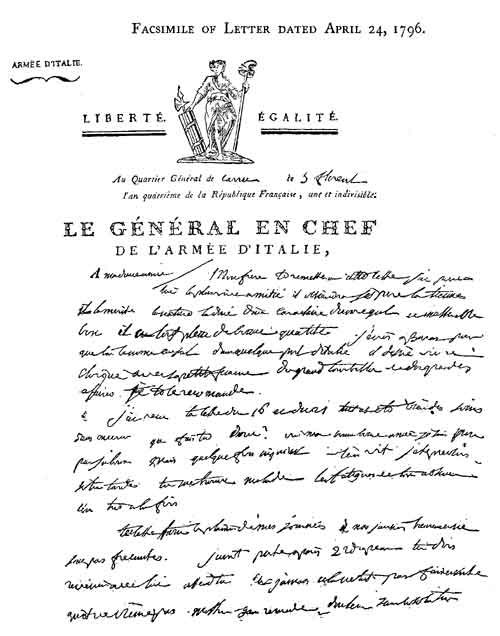
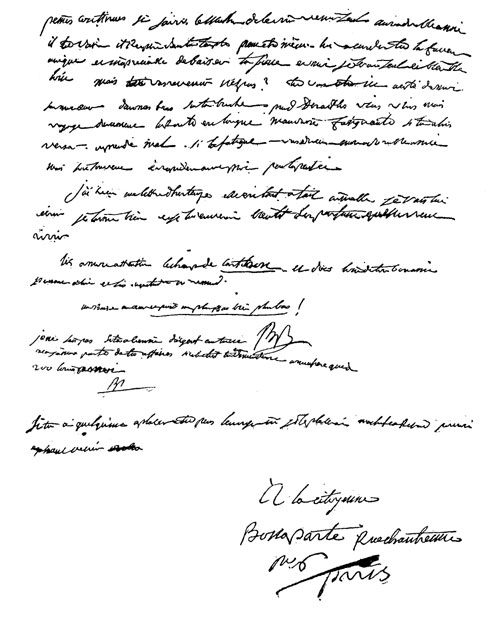
View larger image recto View larger image verso
June 15.—Here occurs the first gap in the correspondence, but his letters to the Directory between this date and the last letter to Josephine extant (April 24) are full of interest, including his conscientious disobedience at Cherasco, and the aura of his destiny to "ride the whirlwind and direct the storm" which first inspired him after Lodi. On April 28th was signed the armistice of Cherasco, by which his rear was secured by three strong fortresses.[44] He writes the Directory that Piedmont is at their mercy, and that in making the armistice into a definite peace he trusts they will not forget the little island of Saint-Pierre, which will be more useful in the future than Corsica and Sardinia combined. He looks upon northern Italy as practically conquered, and speaks of invading Bavaria through the Tyrol. "Prodigious" is practically the verdict of the Directory, and later of Jomini. "My columns are marching; Beaulieu flees. I hope to catch him. I shall impose a contribution of some millions on the Duke of Parma: he will sue for peace: don't be in a hurry, so that I may have time to make him also contribute to the cost of the campaign, by replenishing our stores and rehorsing our waggons at his expense." Bonaparte suggests that Genoa should pay fifteen millions indemnity for the frigates and vessels taken in the port. Certain risks had to be run in invading Lombardy, owing to want of horse artillery, but at Cherasco he secured artillery and horses. When writing to the Directory for a dozen companies, he tells them not to entrust the execution of this measure "to the men of the bureaus, for it takes them ten days to forward an order." Writing to Carnot on the same day he states he is marching against Beaulieu, who has 26,000 foot out of 38,000 at commencement of campaign. Napoleon's force is 28,000, but he has less cavalry. On May 1st, in a letter dated Acqui to Citizen Faipoult, he asks for particulars of the pictures, statues, &c., of Milan, Parma, Placentia, Modena, and Bologna. On the same day Massena writes that his men are needing shoes. On May 6th Bonaparte announces the capture of Tortona, "a very fine fortress, which cost the King of Sardinia over fifteen millions," while Cherasco has furnished him with twenty-eight guns. Meanwhile Massena has taken possession of Alessandria, with all its stores. On May 9th Napoleon writes to Carnot, "We have at last crossed the Po. The second campaign is begun; Beaulieu ... has fool-hardiness but no genius. One more victory, and Italy is ours." A clever commissary-general is all he needs, and his men are growing fat—with good meat and good wine. He sends to Paris twenty old masters, with fine examples of Correggio and Michael-Angelo. It is pleasant to find Napoleon's confidence in Carnot, in view of Barras' insinuations that the latter had cared only for Moreau—his type of Xenophon. In this very letter Napoleon writes Carnot, "I owe you my special thanks for the care that you have kindly given to my wife; I recommend her to you, she is a sincere patriot, and I love her to distraction." He is sending "a dozen millions" to France, and hopes that some of it will be useful to the army of the Rhine. Meanwhile, and two days before Napoleon's letter to Carnot just mentioned, the latter, on behalf of the Directory, suggests the division of his command with the old Alsatian General Kellermann. The Directory's idea of a gilded pill seems to be a prodigiously long letter. It is one of those heart-breaking effusions that, even to this day, emanate from board-rooms, to the dismay and disgust of their recipients. After plastering him with sickening sophistries as to his "sweetest recompense," it gives the utterly unnecessary monition, "March! no fatal repose, there are still laurels to gather"! Nevertheless, his plan of ending the war by an advance through the Tyrol strikes them as too risky. He is to conquer the Milanais, and then divide his army with Kellermann, who is to guard the conquered province, while he goes south to Naples and Rome. As an implied excuse for not sending adequate reinforcements, Carnot adds, "The exaggerated rumours that you have skilfully disseminated as to the numbers of the French troops in Italy, will augment the fear of our enemies and almost double your means of action." The Milanais is to be heavily mulcted, but he is to be prudent. If Rome makes advances, his first demand should be that the Pope may order immediate public prayers for the prosperity and success of the French Republic! The sending of old masters to France to adorn her National Galleries seems to have been entirely a conception of Napoleon's. He has given sufficiently good reasons, from a patriotic point of view; for money is soon spent, but a masterpiece may encourage Art among his countrymen a generation later. The plunderers of the Parthenon of 1800 could not henceforward throw stones at him in this respect. But his real object was to win the people of Paris by thus sending them Glory personified in unique works of genius.
The Directory, already jealous of his fame, endeavour to neutralise the effect of his initiative by hearty concurrence, and write, "Italy has been illumined and enriched by their possession, but the time is now come when their reign should pass to France to stablish and beautify that of Liberty." The despatch adds somewhat naïvely that the effects of the vandalism committed during their own Republican orgies would be obliterated by this glorious campaign, which should "join to the splendour of military trophies the charm of beneficent and restful arts." The Directory ends by inviting him to choose one or two artists to select the most valuable pictures and other masterpieces.
Meanwhile, the Directory's supineness in pushing on the war on the Rhine is enabling the Austrians to send large reinforcements against Napoleon. Bonaparte, who has recently suffered (Jomini, vol. viii. 113) from Kellermann's tardiness in sending reinforcements at an important moment, replies to the letters of May 7th a week later, and writes direct to Citizen Carnot from Lodi, as well as to the Executive Directory. "On the receipt of the Directory's letter of the 7th your wishes were fulfilled, and the Milanais is ours. I shall shortly march, to carry out your intentions, on Leghorn and Rome; all that will soon be done. I am writing the Directory relatively to their idea of dividing the army. I swear that I have no thought beyond the interest of my country. Moreover, you will always find me straight (dans la ligne droite).... As it might happen that this letter to the Directory may be badly construed, and since you have assured me of your friendship, I take this opportunity of addressing you, begging you to make what use of it your prudence and attachment for me may suggest.... Kellermann will command the army as well as I, for no one is more convinced than I am that the victories are due to the courage and pluck of the army; but I think joining Kellermann and myself in Italy is to lose everything. I cannot serve willingly with a man who considers himself the first general in Europe; and, besides, I believe one bad general is better than two good ones. War is like government: it is an affair of tact. To be of any use, I must enjoy the same confidence that you testified to me in Paris. Where I make war, here or there, is a matter of indifference. To serve my country, to deserve from posterity a page in our history, to give the Government proofs of my attachment and devotion—that is the sum of my ambition. But I am very anxious not to lose in a week the fatigues, anxieties, and dangers of two months, and to find myself fettered. I began with a certain amount of fame; I wish to continue worthy of you." To the Directory he writes that the expeditions to Leghorn, Rome, and Naples are small affairs, but to be safely conducted must have one general in command. "I have made the campaign without consulting a soul; I should have done no good if I had had to share my views with another. I have gained some advantages over superior forces, and in utter want of everything, because, certain of your confidence, my marches have been as quick as my thoughts." He foretells disaster if he is shackled with another general. "Every one has his own method of making war. General Kellermann has more experience, and will do it better than I; but both together will do it very badly." With Barras he knew eloquence was useless, and therefore bribed him with a million francs. On May 10th was gained the terrible battle of the Bridge of Lodi, where he won promotion from his soldiers, and became their "little corporal," and where he told Las Cases that he "was struck with the possibility of becoming famous. It was then that the first spark of my ambition was kindled." On entering Milan he told Marmont, "Fortune has smiled on me to-day, only because I despise her favours; she is a woman, and the more she does for me, the more I shall exact from her. In our day no one has originated anything great; it is for me to give the example."
On May 15th, thirty-five days after the commencement of the campaign, he entered Milan, under a triumphal arch and amid the acclamations of the populace. On the previous evening he was guilty of what Dr. Johnson would have considered a fitting herald of his spoliation of picture-galleries—the perpetration of a pun. At a dinner-table the hostess observed that his youth was remarkable in so great a conqueror, whereat he replied, "Truly, madam, I am not very old at present—barely twenty-seven—but in less than twenty-four hours I shall count many more, for I shall have attained Milan" (mille ans).
On May 22nd he returned to Lodi, but heard immediately that Lombardy in general, and Pavia in particular, was in open revolt. He makes a terrible example of Pavia, shooting its chief citizens, and, for the only time, giving up a town to three hours' pillage. The Directory congratulates him on these severe measures: "The laws of war and the safety of the army render them legitimate in such circumstances." He writes them that had the blood of a single Frenchman been spilt, he would have erected a column on the ruins of Pavia, on which should have been inscribed, "Here was the town of Pavia."
On May 21st, Carnot replies to the letter from Lodi: "You appear desirous, citizen general, of continuing to conduct the whole series of military operations in Italy, at the actual seat of war. The Directory has carefully considered your proposition, and the confidence that they place in your talents and republican zeal has decided this question in the affirmative.... The rest of the military operations towards the Austrian frontier and round Mantua are absolutely dependent on your success against Beaulieu. The Directory feels how difficult it would be to direct them from Paris. It leaves to you in this respect the greatest latitude, while recommending the most extreme prudence. Its intention is, however, that the army shall cross into the Tyrol only after the expedition to the south of Italy."
This was a complete victory for Bonaparte (Bingham calls it the Directory's "abject apology"), and, as Scott points out, he now "obtained an ascendency which he took admirable care not to relinquish; and it became the sole task of the Directory, so far as Italy was concerned, to study phrases for intimating their approbation of the young general's measures."
He had forged a sword for France, and he now won her heart by gilding it. On May 16th the Directory had asked him to supply Kellermann with money for the army of the Alps, and by May 22nd he is able to write that six or eight million francs in gold, silver, ingots, or jewels is lying at their disposal with one of the best bankers in Genoa, being superfluous to the needs of the army. "If you wish it, I can have a million sent to Bâle for the army of the Rhine." He has already helped Kellermann, and paid his men. He also announces a further million requisitioned from Modena. "As it has neither fortresses nor muskets, I could not ask for them."
Henceforth he lubricates the manifold wheels of French policy with Italian gold, and gains thereby the approbation and gratitude of the French armies and people. Meanwhile he does not neglect those who might bear him a grudge. To Kellermann and to all the Directors he sends splendid chargers. From Parma he has the five best pictures chosen for Paris—the Saint Jerome and the Madonna della Scodella, both by Correggio; the Preaching of St. John in the Desert, a Paul Veronese, and a Van Dyck, besides fine examples of Raphael, Caracci, &c.
The Directory is anxious that he shall chastise the English at Leghorn, as the fate of Corsica is somewhat dependent on it, whose loss "will make London tremble." They secretly dread a war in the Tyrol, forgetting that Bonaparte is a specialist in mountain fighting, educated under Paoli. They remind him that he has not sent the plans of his battles. "You ought not to lack draughtsmen in Italy. Eh! what are your young engineer officers doing?"
On May 31st Carnot writes to urge him to press the siege of Mantua, reasserting that the reinforcements which Beaulieu has received will not take from that army its sense of inferiority, and that ten battalions of Hoche's army are on the way. It approves and confirms the "generous fraternity" with which Bonaparte offers a million francs to the armies on the Rhine. On June 7th he tells the Directory that Rome is about to fulminate a bull against the French Royalists, but that he thinks the expedition to Naples should be deferred, and also a quarrel with Venice—at least till he has beaten his other enemies; it is not expedient to tackle every one at once. On June 6th he thanks Carnot for a kind letter, adding that the best reward to sweeten labour and perils is the esteem of the few men one really admires. He fears the hot weather for his men: "we shall soon be in July, when every march will cost us 200 sick." The same day he writes General Clarke that all is flourishing, but that the dog-star is coming on at a gallop, and that there is no remedy against its malign influence. "Luckless beings that we are! Our position with nature is merely observation, without control." He holds that the only safe way to end the campaign without being beaten is not to go to the south of Italy. On the 9th he thanks Kellermann for the troops he sends, and their excellent discipline. On the 11th—always as anxious to help his generals as himself—he urges the Directory to press the Swiss Government to refund La Harpe's property to his children.
"Presentiment of ill."—Marmont tells us what this was. The glass of his wife's portrait, which he always carried with him, was found to be broken. Turning frightfully pale, he said to Marmont, "My wife is either very ill, or unfaithful." She left Paris June 24th. Marmont says, "Once at Milan, General Bonaparte was very happy, for at that time he lived only for his wife.... Never love more pure, more true, more exclusive, has possessed the heart of any man."
No. 8.
Between June 15th and the renewal of Josephine's correspondence a glance at the intervening dates will show that Bonaparte and his army were not wasting time. The treaty with Rome was a masterpiece, as in addition to money and works of art, he obtained the port of Ancona, siege-guns with which to bombard Mantua, and best of all, a letter from the Pope to the faithful of France, recommending submission to the new government there. In consideration of this, and possibly yielding to the religious sentiments of Josephine, he spared Rome his presence—the only capital which he abstained from entering, when he had, as in the present case, the opportunity. It was not, however, until February 1797 that the Pope fulfilled his obligations under this Treaty, and then under new compulsion.
Fortuné.—Josephine's dog (see note 45 to Letter 2, Series B).
SERIES B
No. 1.
July 6, Sortie from Mantua of the Austrians.—According to Jomini the French on this occasion were not successful (vol. viii. 162). In one of his several letters to the Directory on this date is seen Bonaparte's anxiety for reinforcements; the enemy has already 67,000 men against his available 40,000. Meanwhile he is helping the Corsicans to throw off the British yoke, and believes that the French possession of Leghorn will enable the French to gain that island without firing a shot.
No. 2.
Marmirolo.—On July 12th he writes to the Directory from Verona that for some days he and the enemy have been watching each other. "Woe to him who makes a false move." He indicates that he is about to make a coup de main on Mantua, with 300 men dressed in Austrian uniforms. He is by no means certain of success, which "depends entirely on luck—either on a dog[45] or a goose." He complains of much sickness among his men round Mantua, owing to the heat and miasmata from the marshes, but so far no deaths. He will be ready to make Venice disgorge a few millions shortly, if the Directory make a quarrel in the interim.
On the 13th he was with Josephine, as he writes from Milan, but leaves on the 14th, and on the 17th is preparing a coup de
main with 800 grenadiers, which, as we see from the next letter, fails.
Fortuné.—Arnault tells an anecdote of this lap-dog, which in 1794, in the days of the Terror, had been used as a bearer of secret despatches between Josephine in prison and the governess of her children outside the grille. Henceforward Josephine would never be parted from it. One day in June 1797 the dog was lying on the same couch as its mistress, and Bonaparte, accosting Arnault and pointing to the dog with his finger, said, "You see that dog there. He is my rival. He was in possession of Madame's bed when I married her. I wished to make him get out—vain hope! I was told I must resign myself to sleep elsewhere, or consent to share with him. That was sufficiently exasperating, but it was a question of taking or leaving, and I resigned myself. The favourite was less accommodating than I. I bear the proof of it in this leg."
Not content with barking at every one, he bit not only men but other dogs, and was finally killed by a mastiff, much to Bonaparte's secret satisfaction; for, as St. Amand adds, "he could easily win battles, accomplish miracles, make or unmake principalities, but could not show a dog the door."
No. 3.
"The village of Virgil."—Michelet (Jusqu'au 18 Brumaire) thinks that here he got the idea of the Fête of Virgil, established a few months later. In engravings of the hero of Italy we see him near the tomb of Virgil, his brows shaded by a laurel crown.
No. 4.
Achille.—Murat. He had been appointed one of Bonaparte's aides-de-camp February 29th, made General of Brigade after the Battle of Lodi (May 10th); is sent to Paris after Junot with nine trophies, and arrives there first. He flirts there outrageously with Josephine, but does not escort her back to her husband.
No. 5.
'Will o' the wisp,' i.e. l'ardent.—This word, according to Ménage, was given by the Sieur de St. Germain to those lively young sparks who, about the year 1634, used to meet at the house of Mr. Marsh (M. de Marest), who was one of them.
No. 6.
The needs of the army.—Difficulties were accumulating, and Napoleon was, as he admits at St. Helena, seriously alarmed. Wurmser's force proves to be large, Piedmont is angry with the Republic and ready to rise, and Venice and Rome would willingly follow its example; the English have taken Porto-Ferrajo, and their skilful minister, Windham, is sowing the seeds of discord at Naples. Although on July 20th he has written a friend in Corsica that "all smiles on the Republic," he writes Saliceti, another brother Corsican, very differently on August 1st. "Fortune appears to oppose us at present.... I have raised the siege of Mantua; I am at Brescia with nearly all my army. I shall take the first opportunity of fighting a battle with the enemy which will decide the fate of Italy—if I'm beaten, I shall retire on the Adda; if I win, I shall not stop in the marshes of Mantua.... Let the citadels of Milan, Tortona, Alessandria, and Pavia be provisioned.... We are all very tired; I have ridden five horses to death." Reading between the lines of this letter to Josephine, it is evident that he thinks she will be safer with him than at Milan—Wurmser having the option of advancing viâ Brescia on Milan, and cutting off the French communications. The Marshal's fatal mistake was in using only half his army for the purpose. This raising of the siege of Mantua (July 31st) was heart-rending work for Bonaparte, but, as Jomini shows, he had no artillery horses, and it was better to lose the siege train, consisting of guns taken from the enemy, than to jeopardise the whole army. Wurmser had begun his campaign successfully by defeating Massena, and pushing back Sauret at Salo. "The Austrians," wrote Massena, "are drunk with brandy, and fight furiously," while his men are famished and can only hang on by their teeth. Bonaparte calls his first war council, and thinks for a moment of retreat, but Augereau insists on fighting, which is successfully accomplished while Wurmser is basking himself among the captured artillery outside Mantua. Bonaparte had been perfectly honest in telling the Directory his difficulties, and sends his brother Louis to the Directory for that purpose on the eve of battle. He is complimented in a letter from the Directory dated August 12th—a letter probably the more genuine as they had just received a further despatch announcing a victory. On August 3rd Bonaparte won a battle at Lonato, and the next day Augereau gained great laurels at Castiglione; in later years the Emperor often incited Augereau by referring to those "fine days of Castiglione." Between July 29th and August 12th the French army took 15,000 prisoners, 70 guns, and wounded or killed 25,000, with little more than half the forces of the Austrians. Bonaparte gives his losses at 7000, exclusive of the 15,000 sick he has in hospital; from July 31st to August 6th he never changed his boots, or lay down in a bed. Nevertheless, Jomini thinks that he showed less vigour in the execution of his plans than in the earlier part of the campaign; but, as an opinion per contra, we may note that the French grenadiers made their "little Corporal" Sergeant at Castiglione. Doubtless the proximity of his wife at the commencement (July 31st) made him more careful, and therefore less intrepid. On August 18th he wrote Kellermann with an urgent request for troops. On August 17th Colonel Graham, after hinting at the frightful excesses committed by the Austrians in their retreat, adds in a postscript—"From generals to subalterns the universal language of the army is that we must make peace, as we do not know how to make war."[46]
On August 13th Bonaparte sent to the Directory his opinion of most of his generals, in order to show that he required some better ones. Some of his criticisms are interesting:—
Berthier—"Talents, activity, courage, character; he has them all."
Augereau—"Much character, courage, firmness, activity; is accustomed to war, beloved by the soldiers, lucky in his operations."
Massena—"Active, indefatigable, has boldness, grasp, and promptitude in making his decisions."
Serrurier—"Fights like a soldier, takes no responsibility; determined, has not much opinion of his troops, is often ailing."
Despinois—"Flabby, inactive, slack, has not the genius for war, is not liked by the soldiers, does not fight with his head; has nevertheless good, sound political principles: would do well to command in the interior."
Sauret—"A good, very good soldier, not sufficiently enlightened to be a general; unlucky."
Of eight more he has little good to say, but the Directory in acknowledging his letter of August 23rd remarks that he has forgotten several officers, and especially the Irish general Kilmaine.
About the same time Colonel Graham (Lord Lynedoch) was writing to the British Government from Trent that the Austrians, despite their defeats, were "undoubtedly brave fine troops, and an able chief would put all to rights in a little time."[47] On August 18th he adds—"When the wonderful activity, energy, and attention that prevail in the French service, from the commander-in-chief downward, are compared to the indecision, indifference, and indolence universal here, the success of their rash but skilful manœuvres is not surprising."
No. 7.
Brescia.—Napoleon was here on July 27th, meeting Josephine about the date arranged (July 25th), and she returned with him. On July 29th they were nearly captured by an Austrian ambuscade near Ceronione, and Josephine wept with fright. "Wurmser," said Napoleon, embracing her, "shall pay dearly for those tears." She accompanies him to Castel Nova, and sees a skirmish at Verona; but the sight of wounded men makes her leave the army, and, finding it impossible to reach Brescia, she flees viâ Ferrara and Bologna to Lucca. She leaves the French army in dire straits and awaits news anxiously, while the Senate of Lucca presents her with the oil kept exclusively for royalty. Thence she goes viâ Florence to Milan. By August 7th the Austrian army was broken and in full retreat, and Bonaparte conducts his correspondence from Brescia from August 11th to 18th. On the 25th he is at Milan, where he meets his wife after her long pilgrimage, and spends four days. By August 30th he is again at Brescia, and reminds her that he left her "vexed, annoyed, and not well." From a letter to her aunt, Madame de Renaudin, at this time, quoted by Aubenas, we can see her real feelings: "I am fêted wherever I go; all the princes of Italy give me fêtes, even the Grand Duke of Tuscany, brother of the Emperor. Ah, well, I prefer being a private individual in France. I care not for honours bestowed in this country. I get sadly bored. My health has undoubtedly a great deal to do with making me unhappy; I am often out of sorts. If happiness could assure health, I ought to be in the best of health. I have the most amiable husband imaginable. I have no time to long for anything. My wishes are his. He is all day long in adoration before me, as if I were a divinity; there could not possibly be a better husband. M. Serbelloni will tell you how he loves me. He often writes to my children; he loves them dearly. He is sending Hortense, by M. Serbelloni, a lovely repeater, jewelled and enamelled; to Eugène a splendid gold watch."
No. 9.
"I hope we shall get into Trent by the 5th."—He entered the city on that day. In his pursuit of Wurmser, he and his army cover sixty miles in two days, through the terrific Val Saguna and Brenta gorges, brushing aside opposition by the way.
No. 12.
"One of these nights the doors will be burst open with a bang."—Apparently within two or three days, for Bonaparte is at Milan on September 21st, and stays with his wife till October 12th. On October 1st he writes to the Directory that his total forces are only 27,900; and that the Austrians, within six weeks, will have 50,000. He asks for 26,000 more men to end the war satisfactorily: "If the preservation of Italy is dear to you, citizen directors, send me help." On the 8th they reply with the promise of 10,000 to 12,000, to which he replies (October 11th) that if 10,000 have started only 5000 will reach him. The Directory at this time are very poverty stricken, and ask him once more to pay Kellermann's Army of the Alps, as being "to some extent part of that which you command." This must have been "nuts and wine" for the general who was to have been superseded by Kellermann a few months earlier. On October 1st they advise him that Wurmser's name is on the list of emigrants, and that if the Marshal will surrender Mantua at once he need not be sent to Paris for trial. If, however, Bonaparte thinks that this knowledge will make the old Marshal more desperate, he is not to be told. Bonaparte, of course, does not send the message. For some time these letters had been signed by the President Lareveillère Lépeaux, but on September 19th there was a charming letter from Carnot: "Although accustomed to unprecedented deeds on your part, our hopes have been surpassed by the victory of Bassano. What glory is yours, immortal Bonaparte! Moreau was about to effect a juncture with you when that wretched reculade of Jourdan upset all our plans. Do not forget that immediately the armies go into winter quarters on the Rhine the Austrians will have forces available to help Wurmser." At Milan Bonaparte advises the Directory that he is dealing with unpunished "fripponeries" in the commissariat department. Here he receives from young Kellermann, afterwards the hero of Marengo, a précis of the condition of the Brescia fever-hospitals, dated October 6th: "A wretched mattress, dirty and full of vermin, a coarse sheet to each bed, rarely washed, no counterpanes, much dilatoriness, such is the spectacle that the fever-hospitals of Brescia present; it is heart-rending. The soldiers justly complain that, having conquered opulent Italy at the cost of their life-blood, they might, without enjoying comforts, at least find the help and attention which their situation demands. Bread and rice are the only passable foods, but the meat is hard. I beg that the general-in-chief will immediately give attention to his companions in glory, who wish for restored health only that they may gather fresh laurels." Thus Bonaparte had his Bloemfontein, and perhaps his Burdett-Coutts.
On October 12th he tells the Directory that Mantua will not fall till February—the exact date of its capitulation. One is tempted to wonder if Napoleon was human enough to have inserted one little paragraph of his despatch of October 12th from Milan with one eye on its perusal by his wife, as it contains a veiled sneer at Hoche's exploits: "Send me rather generals of brigade than generals of division. All that comes to us from La Vendée is unaccustomed to war on a large scale; we have the same reproach against the troops, but they are well-hardened." On the same day he shows them that all the marvels of his six months' campaign have cost the French Government only £440,000 (eleven million francs). He pleads, however, for special auditors to have charge of the accounts. Napoleon had not only made war support war, but had sent twenty million francs requisitioned in Italy to the Republic. On October 12th he leaves Milan for Modena, where he remains from the 14th to the 18th, is at Bologna on the 19th, and Ferrara from the 19th to the 22nd, reaching Verona on the 24th.
Jomini has well pointed out that Napoleon's conception of making two or three large Italian republics in place of many small ones minimised the power of the Pope, and also that of Austria, by abolishing its feudal rigours.
By this time Bonaparte is heartily sick of the war. On October 2nd he writes direct to the Emperor of Germany: "Europe wants peace. This disastrous war has lasted too long;" and on the 16th to Marshal Wurmser: "The siege of Mantua, sir, is more disastrous than two campaigns." His weariness is tempered with policy, as Alvinzi was en route, and the French reinforcements had not arrived, not even the 10,000 promised in May.
No. 13.
"Corsica is ours."—At St. Helena he told his generals, "The King of England wore the Corsican crown only two years. This whim cost the British treasury five millions sterling. John Bull's riches could not have been worse employed." He writes to the Directory on the same day: "The expulsion of the English from the Mediterranean has considerable influence on the success of our military operations in Italy. We can exact more onerous conditions from Naples, which will have the greatest moral effect on the minds of the Italians, assures our communications, and makes Naples tremble as far as Sicily." On October 25th he writes: "Wurmser is at his last gasp; he is short of wine, meat, and forage; he is eating his horses, and has 15,000 sick. In fifty days Mantua will either be taken or delivered."
No. 14.
Verona.—Bonaparte had made a long stay at Verona, to November 4th, waiting reinforcements which never came. On November 5th he writes to the Directory: "All the troops of the Directory arrive post-haste at an alarming rate, and we—we are left to ourselves. Fine promises and a few driblets of men are all we have received;" and on November 13th he writes again: "Perchance we are on the eve of losing Italy. None of the expected reinforcements have arrived.... I am doing my duty, the officers and men are doing theirs; my heart is breaking, but my conscience is at rest. Help—send me help!... I despair of preventing the relief of Mantua, which in a week would have been ours. The wounded are the pick of the army; all our superior officers, all our picked generals are hors de combat; those who have come to me are so incompetent, and they have not the soldiers' confidence. The army of Italy, reduced to a handful of men, is exhausted. The heroes of Lodi, Millesimo, Castiglione, and Bassano have died for their country, or are in hospital;[48] to the corps remain only their reputation and their glory. Joubert, Lannes, Lanusse, Victor, Murat, Chabot, Dupuy, Rampon, Pijon, Menard, Chabran, and St. Hilaire are wounded.... In a few days we shall make a last effort. Had I received the 83rd, 3500 strong, and of good repute in the army, I would have answered for everything. Perhaps in a few days 40,000 will not suffice." The reason for this unwonted pessimism was the state of his troops. His brother Louis reported that Vaubois' men had no shoes and were almost naked, in the midst of snow and mountains; that desertions were taking place of soldiers with bare and bleeding feet, who told the enemy the plans and conditions of their army. Finally Vaubois bungles, through not knowing the ground, and is put under the orders of Massena, while two of his half-brigades are severely censured by Napoleon in person for their cowardice.
No. 15.
"Once more I breathe freely."—Thrice had Napoleon been foiled, as much by the weather and his shoeless soldiers as by numbers (40,000 Austrians to his 28,000), and his position was well-nigh hopeless on November 14th. He trusts Verona to 3000 men, and the blockade of Mantua to Kilmaine, and the defence of Rivoli to Vaubois—the weakest link in the chain—and determines to manœuvre by the Lower Adige upon the Austrian communications. He gets forty-eight hours' start, and wins Arcola; in 1814 he deserved equal success, but bad luck and treachery turned the scale. The battle of Arcola lasted seventy-two hours, and for forty-eight hours was in favour of the Austrians. Pending the arrival of the promised reinforcements, the battle was bought too dear, and weakened Bonaparte more than the Austrians, who received new troops almost daily. He replaced Vaubois by Joubert.
No. 18.
"The 29th."—But he is at Milan from November 27th to December 16th. Most people know, from some print or other, the picture by Gros of Bonaparte, flag in hand, leading his men across the murderous bridge of Arcola. It was during this visit to Milan that his portrait was taken, and Lavalette has preserved for us the domestic rather than the dignified manner of the sitting accorded. He refused to give a fixed time, and the artist was in despair, until Josephine came to his aid by taking her husband on her knees every morning after breakfast, and keeping him there a short time. Lavalette assisted at three of these sittings—apparently to remove the bashful embarrassment of the young painter. St. Amand suggests that Gros taking the portrait of Bonaparte at Milan, just after Arcola, would, especially under such novel conditions, prove a fitting theme for our artists to-day! From December 16th to 21st Bonaparte is at Verona, whence he returns to Milan. There is perhaps a veiled innuendo in Barras' letter of December 30th. Clarke had advised the Directory that Alvinzi was planning an attack, which Barras mentions, but adds: "Your return to Milan shows that you consider another attack in favour of Wurmser unlikely, or, at least, not imminent." He is at Milan till January 7th, whence he goes to Bologna, the city which, he says, "of all the Italian cities has constantly shown the greatest energy and the most considerable share of real information."
No. 20.
General Brune.—This incident fixes the date of this letter to be 23 Nivôse (January 12), and not 23 Messidor (July 11), as hitherto published in the French editions of this letter. On January 12, 1797, he wrote General Clarke from Verona (No. 1375 of the Correspondence) almost an exact duplicate of this letter—a very rare coincidence in the epistles of Napoleon. "Scarcely set out from Roverbella, I learnt that the enemy had appeared at Verona. Massena made his dispositions, which have been very successful; we have made 600 prisoners, and we have taken three pieces of cannon. General Brune has had seven bullets in his clothes, without having been touched by one of them; this is what it is to be lucky. We have had only ten men killed, and a hundred wounded." Bonaparte had left Bologna on January 10, reaching Verona viâ Roverbella on the 12th.
No. 21.
February 3rd.—"I wrote you this morning."—This and probably other letters describing Rivoli, La Favorite, and the imminent fall of Mantua, are missing. In summing up the campaign Thiers declares that in ten months 55,000 French (all told, including reinforcements) had beaten more than 200,000 Austrians, taken 80,000 of them prisoners, killed and wounded 20,000. They had fought twelve pitched battles, and sixty actions. These figures are probably as much above the mark as those of Napoleon's detractors are below it.
One does not know which to admire most, Bonaparte's absence from Marshal Wurmser's humiliation, or his abstention from entering Rome as a conqueror. The first was the act of a perfect gentleman, worthy of the best traditions of chivalry, the second was the very quintessence of far-seeing sagacity, not "baulking the end half-won, for an instant dole of praise." As he told Mdme. de Rémusat at Passeriano, "I conquered the Pope better by not going to Rome than if I had burnt his capital." Scott has compared his treatment of Wurmser to that of the Black Prince with his royal prisoner, King John of France. Wurmser was an Alsatian on the list of émigrés, and Bonaparte gave the Marshal his life by sending him back to Austria, a fact which Wurmser requited by warning Bonaparte of a conspiracy to poison him[49] in Romagna, which Napoleon thinks would otherwise have been successful.
No. 24.
"Perhaps I shall make peace with the Pope."—On February 12th the Pope had written to "his dear son, General Bonaparte," to depute plenipotentiaries for a peace, and ends by assuring him "of our highest esteem," and concluding with the paternal apostolic benediction. Meanwhile Napoleon, instead of sacking Faenza, has just invoked the monks and priests to follow the precepts of the Gospel.
No. 25.
"The unlimited power you hold over me."—There seems no question that during the Italian campaigns he was absolutely faithful to Josephine, although there was scarcely a beauty in Milan who did not aspire to please him and to conquer him. In his fidelity there was, says St. Amand, much love and a little calculation. As Napoleon has said himself, his position was delicate in the extreme; he commanded old generals; every one of his movements was jealously watched; his circumspection was extreme. His fortune lay in his wisdom. He would have to forget himself for one hour, and how many of his victories depended upon no more! The celebrated singer, La Grassini, who had all Italy at her feet, cared only for the young general who would not at that time vouchsafe her a glance.
SERIES C
THE CAMPAIGN OF MARENGO, 1800
Elected to the joint consulate by the events of the 18th Brumaire (November 9), 1799, Napoleon spent the first Christmas Day after his return from Egypt in writing personal letters to the King of England and Emperor of Austria, with a view to peace. He asks King George how it is that the two most enlightened nations of Europe do not realise that peace is the chief need as well as the chief glory ... and concludes by asserting that the fate of all civilised nations is bound up in the conclusion of a war "which embraces the entire world." His efforts fail in both cases. On December 27th he makes the Moniteur the sole official journal. On February 7th, 1800, he orders ten days' military mourning for the death of Washington—that "great man who, like the French, had fought for equality and liberty." On April 22nd he urges Moreau to begin his campaign with the army of the Rhine, an order reiterated on April 24th through Carnot, again made Minister of War. A diversion to save the army of Italy was now imperative. On May 5th he congratulated Moreau on the battle of Stockach, but informs him that Massena's position is critical, shut up in Genoa, and with food only till May 25th. He advises Massena the same day that he leaves Paris that night to join the Army of Reserve, that the cherished child of victory must hold out as long as possible, at least until May 30th. At Geneva he met M. Necker. On May 14th he writes General Mortier, commandant of Paris, to keep that city quiet, as he will have still to be away a few days longer, which he trusts "will not be indifferent to M. de Mélas."
No. 3.
This letter was written from Ivrea, May 29th, 1800. On the 30th Napoleon is at Vercelli, on June 1st at Novara, and on June 2nd in Milan. Eugène served under Murat at the passage of the Ticino, May 31st.
M.'s; probably "Maman," i.e. his mother.
Cherries.—This fruit had already tender associations. Las Cases tells us that when Napoleon was only sixteen he met at Valence Mademoiselle du Colombier, who was not insensible to his merits. It was the first love of both.... "We were the most innocent creatures imaginable," the Emperor used to say; "we contrived little meetings together. I well remember one which took place on a midsummer morning, just as daylight began to dawn. It will scarcely be believed that all our happiness consisted in eating cherries together" (vol. i. 81, 1836).
No. 4.
Milan.—He arrived here on June 2nd, and met with a great reception. In his bulletin of June 5th we find him assisting at an improvised concert. It ends, somewhat quaintly for a bulletin, as follows: "Italian music has a charm ever new. The celebrated singers, Billington,[50] La Grassini, and Marchesi are expected at Milan. They say they are about to start for Paris to give concerts there." According to M. Frédéric Masson, this Paris visit masked ulterior motives, and was arranged at a déjeûner on the same day, where La Grassini, Napoleon, and Berthier breakfasted together. Henceforward to Marengo Napoleon spends every spare day listening to the marvellous songstress, and as at Eylau, seven years later, runs great risks by admitting Venus into the camp of Mars. At St. Helena he declares that from June 3rd to 8th he was busy "receiving deputations, and showing himself to people assembled from all parts of Lombardy to see their liberator." The Austrians had declared that he had died in Egypt. The date of No. 4 should probably be June 9th, on which day the rain was very heavy. He reached Stradella the next day.
SERIES D
No. 1.
The date is doubtless 27 Messidor (July 16), and the fête alluded to that of July 14. The following day Napoleon signed the Concordat with the Pope, which paved the way for the restoration of the Roman Catholic religion in France (September 11).
The blister.—On July 7 he quaintly writes Talleyrand: "They have put a second blister on my arm, which prevented me giving audience yesterday. Time of sickness is an opportune moment for coming to terms with the priests."
Some plants.—No trait in Josephine's character is more characteristic than her love of flowers—not the selfish love of a mere collector,[51] but the bountiful joy of one who wishes to share her treasures. Malmaison had become the "veritable Jardin des Plantes" of the epoch,[52] far better than its Paris namesake in those days. The splendid hothouses, constructed by M. Thibaut, had been modelled on those of Kew, and enabled Josephine to collect exotics from every clime, and especially from her beloved Martinique. No jewel was so precious to her as a rare and beautiful flower. The Minister of Marine never forgot to instruct the deep-sea captains to bring back floral tributes from the far-off tropics. These often fell, together with the ships, into the hands of the British sea-dogs, but the Prince Regent always had them sent on from London, and thus rendered, says Aubenas, "the gallant homage of a courtly enemy to the charming tastes and to the popularity already acquired by this universally beloved woman." Her curator, M. Aimé Bonpland, was an accomplished naturalist, who had been with Humboldt in America, and brought thence 6000 new plants. On his return in 1804 he was nominated by Josephine manager of the gardens of Malmaison and Navarre.
In the splendid work, Le Jardin de la Malmaison, in three volumes, are plates, with descriptions of 184 plants, mostly new, collected there from Egypt, Arabia, the United States, the Antilles, Mexico, Madeira, the Cape of Good Hope, Mauritius, the East Indies, New Caledonia, Australia, and China. To Josephine we owe the Camellia, and the Catalpa, from the flora of Peru, whilst her maiden name (La Pagerie) was perpetuated by Messrs. Pavon and Ruiz in the Lapageria.
If the weather is as bad.—As we shall see later, Bourrienne was invaluable to Josephine's court for his histrionic powers, and he seems to have been a prime favourite. On the present occasion he received the following "Account of the Journey to Plombières. To the Inhabitants of Malmaison,"—probably the work of Count Rapp, touched up by Hortense (Bourrienne's Napoleon, vol. ii. 85. Bentley, 1836):—
"The whole party left Malmaison in tears, which brought on such dreadful headaches that all the amiable company were quite overcome by the idea of the journey. Madame Bonaparte, mère, supported the fatigues of this memorable day with the greatest courage; but Madame Bonaparte, consulesse, did not show any. The two young ladies who sat in the dormeuse, Mademoiselle Hortense and Madame Lavalette, were rival candidates for a bottle of Eau de Cologne; and every now and then the amiable M. Rapp made the carriage stop for the comfort of his poor little sick heart, which overflowed with bile; in fact, he was obliged to take to bed on arriving at Epernay, while the rest of the amiable party tried to drown their sorrows in champagne. The second day was more fortunate on the score of health and spirits, but provisions were wanting, and great were the sufferings of the stomach. The travellers lived on in the hope of a good supper at Toul, but despair was at its height when on arriving there they found only a wretched inn, and nothing in it. We saw some odd-looking folks there, which indemnified us a little for spinach dressed with lamp-oil, and red asparagus fried with curdled milk. Who would not have been amused to see the Malmaison gourmands seated at a table so shockingly served!
"In no record of history is there to be found a day passed in distress so dreadful as that on which we arrived at Plombières. On departing from Toul we intended to breakfast at Nancy, for every stomach had been empty for two days, but the civil and military authorities came out to meet us, and prevented us from executing our plan. We continued our route, wasting away, so that you might see us growing thinner every moment. To complete our misfortune, the dormeuse, which seemed to have taken a fancy to embark on the Moselle for Metz, barely escaped an overturn. But at Plombières we have been well compensated for this unlucky journey, for on our arrival we were received with all kinds of rejoicings. The town was illuminated, the cannon fired, and the faces of handsome women at all the windows gave us reason to hope that we shall bear our absence from Malmaison with the less regret.
"With the exception of some anecdotes, which we reserve for chit-chat on our return, you have here a correct account of our journey, which we, the undersigned, hereby certify.
"Josephine Bonaparte. Beauharnais Lavalette. Hortense Beauharnais. Rapp. Bonaparte, mère.
"The company ask pardon for the blots."
"21 Messidor (July 10).
"It is requested that the person who receives this journal will show it to all who take an interest in the fair travellers."
At this time Hortense was madly in love with Napoleon's favourite general, Duroc, who, however, loved his master more, and preferred not to interfere with his projects, especially as a marriage with Hortense would mean separation from Napoleon. Hortense and Bourrienne were both excellent billiard players, and the latter used this opportunity to carry letters from Hortense to her lukewarm lover.
Malmaison, without you, is too dreary.—Although Madame la Grassini had been specially summoned to sing at the Fête de la Concorde the day before.
No. 2.
This is the third pilgrimage Josephine has made, under the doctor's orders, to Plombières; but the longed-for heir will have to be sought for elsewhere, by fair means or foul. Lucien, who as Spanish Ambassador had vainly spent the previous year in arranging the divorce and remarriage of Napoleon to a daughter of the King of Spain, suggests adultery at Plombières, or a "warming-pan conspiracy," as the last alternatives.[53] Josephine complains to Napoleon of his brother's "poisonous" suggestions, and Lucien is again disgraced. In a few months an heir is found in Hortense's first-born, Napoleon Charles, born October 10.
The fat Eugène had come partly to be near his sister in her mother's absence, and partly to receive his colonelcy. Josephine is wretched to be absent, and writes to Hortense (June 16):—"I am utterly wretched, my dear Hortense, to be separated from you, and my mind is as sick as my body. I feel that I was not born, my dear child, for so much grandeur.... By now Eugène should be with you; that thought consoles me." Aubenas has found in the Tascher archives a charming letter from Josephine to her mother in Martinique, announcing how soon she may hope to find herself a great-grandmother.
No. 3.
Your letter has come.—Possibly the one to Hortense quoted above, as Josephine was not fond of writing many letters.
Injured whilst shooting a boar.—Constant was not aware of this occurrence, and was therefore somewhat incredulous of Las Cases (vol. i. 289). The account in the "Memorial of St. Helena" is as follows:—"Another time, while hunting the wild boar at Marly, all his suite were put to flight; it was like the rout of an army. The Emperor, with Soult and Berthier,[54] maintained their ground against three enormous boars. 'We killed all three, but I received a hurt from my adversary, and nearly lost this finger,' said the Emperor, pointing to the third finger of his left hand, which indeed bore the mark of a severe wound. 'But the most laughable circumstance of all was to see the multitude of men, surrounded by their dogs, screening themselves behind the three heroes, and calling out lustily "Save the Emperor![55] save the Emperor!" while not one advanced to my assistance'" (vol. ii. 202. Colburn, 1836).
"The Barber of Seville."—This was their best piece, and spectators (except Lucien) agree that in it the little theatre at Malmaison and its actors were unsurpassed in Paris. Bourrienne as Bartholo, Hortense as Rosina, carried off the palm. According to the Duchesse d'Abrantès, Wednesday was the usual day of representation, when the First Consul was wont to ask forty persons to dinner, and a hundred and fifty for the evening. As the Duchess had reason to know, Bonaparte was the severest of critics. "Lauriston made a noble lover," says the Duchess—"rather heavy" being Bourrienne's more professional comment. Eugène, says Méneval, excelled in footman's parts.[56] Michot, from the Theatre Français, was stage manager; and Bonaparte provided what Constant has called "the Malmaison Troupe," with their dresses and a collection of dramas. He was always spurring them on to more ambitious flights, and by complimenting Bourrienne on his prodigious memory, would stimulate him to learn the longest parts. Lucien, who refused to act, declares that Bonaparte quoted the saying of Louis XVI. concerning Marie Antoinette and her company, that the performances "were royally badly played." Junot, however, even in these days played the part of a drunkard only too well (Jung, vol. ii. 256).
No. 4.
The Sèvres Manufactory.—After his visit, he wrote Duroc: "This morning I gave, in the form of gratuity, a week's wages to the workmen of the Sèvres manufactory. Have the amount given to the director. It should not exceed a thousand écus."
No. 5.
Your lover, who is tired of being alone.—So much so that he got up at five o'clock in the morning to read his letters in a young bride's bed-chamber. The story is brightly told by the lady in question, Madame d'Abrantès (vol. ii. ch. 19). A few days before the Marly hunt, mentioned in No. 3, the young wife of seventeen, whom Bonaparte had known from infancy, and whose mother (Madame Permon) he had wished to marry, found the First Consul seated by her bedside with a thick packet of letters, which he was carefully opening and making marginal notes upon. At six he went off singing, pinching the lady's foot through the bed-clothes as he went. The next day the same thing happened, and the third day she locked herself in, and prevented her maid from finding the key. In vain—the unwelcome visitor fetched a master-key. As a last resource, she wheedled her husband, General Junot, into breaking orders and spending the night with her; and the next day (June 22) Bonaparte came in to proclaim the hunting morning, but by her side found his old comrade of Toulon, fast asleep. The latter dreamily but good-humouredly asked, "Why, General, what are you doing in a lady's chamber at this hour?" and the former replied, "I came to awake Madame Junot for the chase, but I find her provided with an alarum still earlier than myself. I might scold, for you are contraband here, M. Junot." He then withdrew, after offering Junot a horse for the hunt. The husband jumped up, exclaiming, "Faith! that is an amiable man! What goodness! Instead of scolding, instead of sending me sneaking back to my duty in Paris! Confess, my Laura, that he is not only an admirable being, but above the sphere of human nature." Laura, however, was still dubious. Later in the day she was taken to task by the First Consul, who was astounded when she told him that his action might compromise her. "I shall never forget," she says, "Napoleon's expression of countenance at this moment; it displayed a rapid succession of emotions, none of them evil." Josephine heard of the affair, and was jealous for some little time to come.
General Ney.—Bonaparte had instructed Josephine to find him a nice wife, and she had chosen Mlle. Aglaé-Louise Auguié, the intimate friend and schoolfellow of Hortense, and daughter of a former Receveur-Général des Finances. To the latter Ney goes fortified with a charming letter from Josephine, dated May 30—the month which the Encyclopædia Britannica has erroneously given for that of the marriage, which seems to have taken place at the end of July (Biographie Universelle, Michaud, vol. xxx.). Napoleon (who stood godfather to all the children of his generals) and Hortense were sponsors for the firstborn of this union, Napoleon Joseph, born May 8, 1803. The Duchess d'Abrantès describes her first meeting with Madame Ney at the Boulogne fête of August 15, 1802. Her simplicity and timidity "were the more attractive inasmuch as they formed a contrast to most of the ladies by whom she was surrounded at the court of France.... The softness and benevolence of Madame Ney's smile, together with the intelligent expression of her large dark eyes, rendered her a very beautiful woman, and her lively manners and accomplishments enhanced her personal graces" (vol. iii. 31). The brave way in which she bore her husband's execution won the admiration of Napoleon, who at St. Helena coupled her with Mdme. de Lavalette and Mdme. Labedoyère.
SERIES E
No. 1.
Madame.—Napoleon became Emperor on May 18th, and this was the first letter to his wife since Imperial etiquette had become de rigueur, and the first letter to Josephine signed Napoleon. Méneval gives a somewhat amusing description of the fine gradations of instructions he received on this head from his master. This would seem to be a reason for this uncommon form of salutation; but, per contra, Las Cases (vol. i. 276) mentions some so-called letters beginning Madame et chère épouse, which Napoleon declares to be spurious.
Pont de Bricques, a little village about a mile from Boulogne. On his first visit to the latter he was met by a deputation of farmers, of whom one read out the following address: "General, here we are, twenty farmers, and we offer you a score of big, sturdy lads, who are, and always shall be, at your service. Take them along with you, General; they will help you to give England a good thrashing. As for ourselves, we have another duty to fulfil: with our arms we will till the ground, so that bread be not wanting to the brave fellows who are destined to destroy the English." Napoleon thanked the honest yeomen, and determined to make the only habitable dwelling there his headquarters. The place is called from the foundations of bricks found there—the remains of one of Cæsar's camps.
The wind having considerably freshened.—Constant tells a good story of the Emperor's obstinacy, but also of his bravery, a few days later. Napoleon had ordered a review of his ships, which Admiral Bruix had ignored, seeing a storm imminent. Napoleon sends off Bruix to Holland in disgrace, and orders the review to take place; but when, amid the wild storm, he sees "more than twenty gunboats run aground," and no succour vouchsafed to the drowning men, he springs into the nearest lifeboat, crying, "We must save them somehow." A wave breaks over the boat; he is drenched and nearly carried overboard, losing the hat he had worn at Marengo. Such pluck begets enthusiasm; but, in spite of all they could do, two hundred lives were lost. This is Constant's version; probably his loss is exaggerated. The Emperor, writing Talleyrand on August 1st, speaks only of three or four ships lost, and "une quinzaine d'hommes."
No. 2.
The waters.—Mlle. d'Avrillon describes them and their effect—the sulphur baths giving erysipelas to people in poor health. Corvisart had accompanied the Empress, to superintend their effect, which was as usual nil.
All the vexations.—Constant (vol. i. 230, &c., 1896) is of use to explain what these were—having obtained possession of a diary of the tour by one of Josephine's ladies-in-waiting, which had fallen into Napoleon's hands. In the first place, the roads (where there were any[57]) were frightful, especially in the Ardennes forest, and the diary for August 1st concludes by stating "that some of the carriages were so battered that they had to be bound together with ropes. One ought not to expect women to travel about like a lot of dragoons." The writer of the diary, however, preferred to stay in the carriage, and let Josephine and the rest get wet feet, thinking the risk she ran the least. Another vexation to Josephine was the published report of her gift to the Mayoress of Rheims of a malachite medallion set in brilliants, and of her saying as she did so, "It is the colour of Hope." Although she had really used this expression, it was the last thing she would like to see in print, taking into consideration the reason for her yearly peregrinations to Plombières, and now to Aix, and their invariable inefficiency. Under the date August 14th, the writer of the diary gives a severe criticism of Josephine. "She is exactly like a ten-year-old child—good-natured, frivolous, impressionable; in tears at one moment, and comforted the next.... She has just wit enough not to be an utter idiot. Ignorant—as are most Creoles—she has learned nothing, or next to nothing, except by conversation; but, having passed her life in good society, she has got good manners, grace, and a mastery of that sort of jargon which, in society, sometimes passes for wit. Social events constitute the canvas which she embroiders, which she arranges, and which give her a subject for conversation. She is witty for quite a whole quarter of an hour every day.... Her diffidence is charming ... her temper very sweet and even; it is impossible not to be fond of her. I fear that ... this need of unbosoming, of communicating all her thoughts and impressions, of telling all that passes between herself and the Emperor, keeps the latter from taking her into his confidence.... She told me this morning that, during all the years she had spent with him, never once had she seen him let himself go."
Eugène has started for Blois, where he became the head of the electoral college of Loir et Cher, having just been made Colonel-General of the Chasseurs by Napoleon. The Beauharnais family were originally natives of Blois.
No. 3.
Aix-la-Chapelle.—In this, the first Imperial pilgrimage to take the waters, great preparations had been made, forty-seven horses bought at an average cost of £60 apiece; and eight carriages, which are not dear at £1000 for the lot, with £400 additional for harness and fittings.
At Aix they had fox-hunting and hare-coursing so called, but probably the final tragedy was consummated with a gun. Lord Rosebery reminds us that at St. Helena the Emperor actually shot a cow! They explored coal mines, and examined all the local manufactories, including the relics of Charlemagne—of which great warrior and statesman Josephine refused an arm, as having a still more puissant one ever at hand for her protection.
When tidings come that the Emperor will arrive on September 2, and prolong their stay from Paris, there is general lamentation among Josephine's womenkind, especially on the part of that perennial wet blanket and busybody, Madame de Larochefoucauld, who will make herself a still greater nuisance at Mayence two years later.
No. 4.
During the past week.—As a matter of fact he only reached Ostend on April 12th from Boulogne, having left Dunkirk on the 11th.