A SONG OF THE MARCH[K]
Reading edition
A SONG OF THE MARCH[K]
Sioux
Now set up the tipi, Now set up the tipi, Around the bottom, Around the bottom, Drive in the pegs, Drive in the pegs, In the meantime I shall cook, In the meantime I shall cook.
“To those who know the Indian life it brings up a vivid picture of a prairie band on the march, halting at noon or in the evening. As soon as the halt is called by some convenient stream, the women jump down and release the horses from ... the travois, in the olden times, and hobble them to prevent them from wandering away. Then, while some of the women set up the tipi poles, draw the canvas over them, and drive in the pegs around the bottom and the wooden pins up the side, other women take axes and buckets and go down to the creek for wood and water. When they return, they find the tipis set up and the blankets spread out on the grass, and in a few minutes fires are built and the meal is in preparation.”
FOOTNOTE:
SIOUAN TENTS
B. Tent of Little Cedar, belonging to the order of Sun and Moon shamans. The circle represents the sun in which stands a man holding deer rattles.
C. Those persons who belong to the Inke-sabe sub-gens known as Keepers of the Pipes, paint their tents with the pipe decorations.
D. Used by a member of the order of Grizzly Bear shamans. “When they have had visions of grizzly bears, they decorate their tents accordingly.” (George Miller.) The bear is represented as emerging from his den. The dark band represents the ground.
E. Sketch furnished by Chief Dried Buffalo. The circle at the top represents a bear’s cave. Below there are lightnings, then prints of bears’ paws. E also represents the grizzly bear vision.
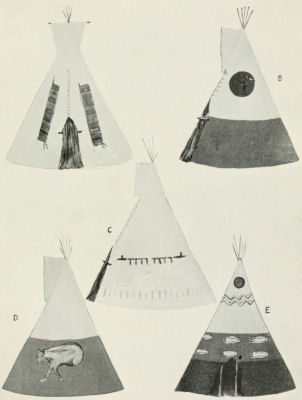
Enlarged from plate in report of the Bureau of Ethnology
An Arapahoe Bed
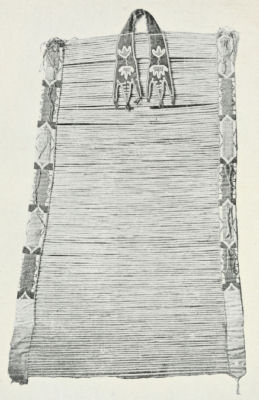
Courtesy of the Smithsonian Institution