Chapter III · : EARLY BABYLONIAN RELIGION (continued 2)
Reading edition
Lang on the Esther Story
Commenting on this theory, Lang in his Magic and Religion (p. 161) says: "The name Mordecai resembles Marduk, Esther is like Ishtar, Haman is like Humman, the Elamite god, and there is a divine name in the inscriptions, read as resembling 'Vashti,' and probably the name of an Elamite goddess. Thus the human characters in Esther are in peril of merging in Babylonian and Elamite gods. But, lest that should occur, we ought also to remember that Mordecai was the real name of a real historical Jew of the Captivity, one of the companions of Nehemiah in the return from exile to Jerusalem. Again, Esther appears to me to be the crown-name of the Jewish wife of Xerxes, in the Book of Esther: 'Hadassah, that is Esther.' In the Biblical story she conceals her Jewish descent. Hadassah, says Nöldeke, 'is no mere invention of the writer of Esther.' Hadassah is said to mean 'myrtle bough,' and girls are still called Myrtle. Esther appears to have been an assumed name, after a royal mixed marriage. Now if a real historical Jew might be named Mordecai, which we know to be the case, a Jewess, whether in fact, or in this Book of Esther, which, says Dr. Jastrow, 'has of course some historical basis,' might be styled Esther.... But, if Mordecai be, as it is, an historical name of a real Jew of the period, while Esther may be, and probably is, a name which a Jewess might bear, it is not ascertained that Vashti really is the name of an Elamite goddess. Yet Vashti is quite essential as a goddess to Mr. Frazer's argument. 'The derivation,' he says, 'of the names of Haman and Vashti is less certain, but some high authorities are disposed to accept the view of Jensen that Haman is identical with Humman or Homman, the national god of the Elamites, and that Vashti is in like manner an Elamite deity, probably a goddess whose name appears in inscriptions.'"
It is thus seen that the facts regarding these names make such an explanation as is advanced by Sir James Frazer rather a hazardous one. Haman, according to his theory, would represent the dying god, whilst Mordecai would play the part of the re-risen god of vegetation. Lang puts forward a counter-theory, and that is that Haman or Humman was a conquering god of the Elamites, which accounts for him having been whipped and hanged in derision. This Humman was, he thinks, possibly an Elamite god of vegetation.
Nin-Girsu
Girsu was a part of the city of Lagash, and the name Nin-Girsu means 'Lord of Girsu.' Gods frequently had lordship over a city quarter, one of the best-known instances of this being that of Huitzilopochtli, who ruled over that part of the city of Tenochtitlan, called Mexico, which afterwards gave its name to the entire community. Girsu had originally been a city itself and had become merged into Lagash, so its god was probably of ancient origin. Nin-Girsu is frequently alluded to as 'the warrior of Bel'—he who broke through the hostile ranks to aid the worshippers of the great god of the netherworld. Like many combatant deities, however, he presided over local agriculture, and in this connexion he was known as Shul-gur, 'Lord of the corn heaps.' He is even identified with Tammuz.
Bau
In ancient inscriptions, especially those of Gudea, Urbau, and Uru-kagina, the goddess Bau is alluded to as the great mother of mankind, who restores the sick to health. She is called 'chief daughter of Anu,' and seems to play the part of a fate to some extent. She has also an agricultural side to her character. Gudea was especially devoted to her, and has left it on record that she "filled him with eloquence." Her temple was at Uru-Azagga, a quarter of Lagash, and as the goddess of that neighbourhood she would, of course, have come into close contact with Nin-Girsu. Indeed she is spoken of as his consort, and when Uru-Azagga became part of Lagash, Bau was promoted as tutelar goddess of that city and designated 'Mother of Lagash.' She has been identified with the primeval watery depths, the primitive chaos, and this identification has been founded on the similarity between the name Bau and the Hebrew bohu, the word for 'chaos,' but proof is wanting to support the conjecture. A closely allied form of her seems to be Ga-tum-dug, a goddess who has probably a common origin with Bau, and who certainly is in some manner connected with water—perhaps with the clouds.
Nannar
Nannar was the moon-god of Ur, the city whence came Abram, and with that place he was connected much as was Shamash with Sippar—that is to say, Ur was his chief but not his only centre of adoration. Why he came to have his principal seat at Ur it would be difficult to say. The name Ur signifies 'light,' so it may be that a shrine dedicated to Nannar existed upon the site of this city and constituted its nucleus. In Babylonian mythology the sun was regarded as the offspring of the moon, and it is easy to see how this conception arose in the minds of a race prone to astronomical study. In all civilizations the lunar method of computing time precedes the solar. The phases of the moon are regarded as more trustworthy and more easily followed than the more obscure changes of the brighter luminary, therefore a greater degree of importance was attached to the moon in very early times than to the sun. The moon is usually represented on Babylonian cylinders as bearing a crescent upon his head and wearing a long, flowing beard described as of the colour of lapis-lazuli—much the same shade as his beams possess in warmer latitudes. Nannar was frequently alluded to as 'the heifer of Anu,' because of the horn which the moon displays at a certain phase. Many monarchs appear to have delighted in the upkeep and restoration of his temple, among them Nur-Ramman and Sin-iddina.
Nannar in Decay
But, as happens to many gods, Nannar became confounded with some earthly hero—was even alluded to as a satrap of Babylonia under the Median monarch Artaios—a personage unknown to history. Ctesias hands down to us a very circumstantial tale concerning him as follows:[9]
"There was a Persian of the name of Parsondes, in the service of the king of the Medes, an eager huntsman, and an active warrior on foot and in the chariot, distinguished in council and in the field, and of influence with the king. Parsondes often urged the king to make him satrap of Babylon in the place of Nannaros, who wore women's clothes and ornaments, but the king always put the petition aside, for it could not be granted without breaking the promise which his ancestor had made to Belesys. Nannaros discovered the intentions of Parsondes, and sought to secure himself against them, and to take vengeance. He promised great rewards to the cooks who were in the train of the king, if they succeeded in seizing Parsondes and giving him up. One day, Parsondes in the heat of the chase strayed far from the king. He had already killed many boars and deer, when the pursuit of a wild ass carried him to a great distance. At last he came upon the cooks, who were occupied in preparations for the king's table. Being thirsty, Parsondes asked for wine; they gave it, took care of his horse, and invited him to take food—an invitation agreeable to Parsondes, who had been hunting the whole day. He bade them send the ass which he had captured to the king, and tell his own servants where he was. Then he ate of the various kinds of food set before him, and drank abundantly of the excellent wine, and at last asked for his horse in order to return to the king. But they brought beautiful women to him, and urged him to remain for the night. He agreed, and as soon as, overcome by hunting, wine, and love, he had fallen into a deep sleep, the cooks bound him and brought him to Nannaros. Nannaros reproached Parsondes with calling him an effeminate man, and seeking to obtain his satrapy; he had the king to thank that the satrapy granted to his ancestors had not been taken from him. Parsondes replied that he considered himself more worthy of the office, because he was more manly and more useful to the king. But Nannaros swore by Bel and Mylitta that Parsondes should be softer and whiter than a woman, called for the eunuch who was over the female players, and bade him shave the body of Parsondes and bathe and anoint him every day, put women's clothes on him, plait his hair after the manner of women, paint his face, and place him among the women who played the guitar and sang, that he might learn their arts. This was done, and soon Parsondes played and sang better at the table of Nannaros than any of the women. Meanwhile the king of the Medes had caused search to be made everywhere for Parsondes; and since he could nowhere be found, and nothing could be heard of him, he believed that a lion or some other wild animal had killed him when out hunting, and lamented for his loss. Parsondes had lived for seven years as a woman in Babylon, when Nannaros caused a eunuch to be scourged and grievously maltreated. This eunuch Parsondes induced by large presents to retire to Media and tell the king the misfortune which had come upon him. Then the king sent a message commanding Nannaros to give up Parsondes. Nannaros declared that he had never seen him. But the king sent a second messenger, with orders to put Nannaros to death if he did not surrender Parsondes. Nannaros entertained the messenger of the king; and when the meal was brought, 150 women entered, of whom some played the guitar, while others blew the flute. At the end of the meal, Nannaros asked the king's envoy which of all the women was the most beautiful and had played best. The envoy pointed to Parsondes. Nannaros laughed long and said, 'That is the person whom you seek,' and released Parsondes, who on the next day returned home with the envoy to the king in a chariot. The king was astonished at the sight of him, and asked why he had not avoided such disgrace by death. Parsondes answered, 'In order that I might see you again and by you execute vengeance on Nannaros, which could never have been mine had I taken my life.' The king promised him that his hope should be realized, as soon as he came to Babylon. But when he came there, Nannaros defended himself on the ground that Parsondes, though in no way injured by him, had maligned him, and sought to obtain the satrapy over Babylonia. The king pointed out that he had made himself judge in his own cause, and had imposed a punishment of a degrading character; in ten days he would pronounce judgment upon him for his conduct. In terror, Nannaros hastened to Mitraphernes, the eunuch of greatest influence with the king, and promised him the most liberal rewards, 10 talents of gold and 100 talents of silver, 10 golden and 200 silver bowls, if he could induce the king to spare his life and retain him in the satrapy of Babylonia. He was prepared to give the king 100 talents of gold, 1000 talents of silver, 100 golden and 300 silver bowls, and costly robes, with other gifts; Parsondes also should receive 100 talents of silver and costly robes. After many entreaties, Mitraphernes persuaded the king not to order the execution of Nannaros, as he had not killed Parsondes, but to exact from him the compensation which he was prepared to pay Parsondes and the king. Nannaros in gratitude threw himself at the feet of the king; but Parsondes said, 'Cursed be the man who first brought gold among men; for the sake of gold I have been made a mockery to the Babylonians.'"
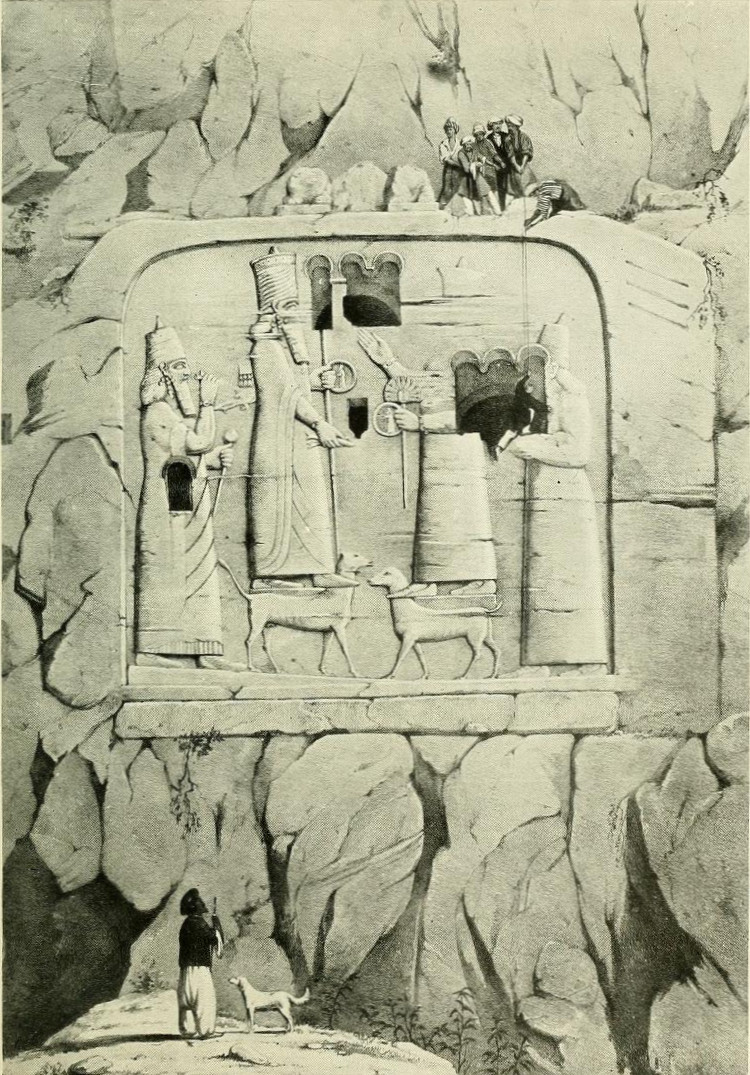
Assyrian Rock Sculpture from The Monuments of Nineveh, by Sir Henry Layard.
It is impossible to say what the mythological meaning hidden in this tale may portend. We have the moon-god attempting to feminize an unfortunate enemy. Does this mean that Parsondes came under the influence of the moon-god—that is, that he became a lunatic?
Aralu, or Eres-ki-Gal
The deities of the underworld, of the region of the dead, are usually of later origin than those of the heavens.[10] They are frequently the gods of an older and discredited religion, and are relegated to the 'cold shades of opposition,' dwelling there just as the dead are supposed to 'dwell' in the grave. A legend exists regarding Aralu which was discovered among other texts at Tel-el-Amarna. The story goes that the gods once gave a feast to which they invited Aralu, apologizing at the same time that they were unable to go down to her and regretting that she could not ascend to them. In their dilemma they requested her to send a messenger to bring to her the viands which fell to her share. She complied with the request, and when the messenger arrived all the gods stood up to do him honour for his mistress's sake—all save Nergal. The messenger acquainted Aralu with this slight, and greatly enraged she sent him back to the dwelling of the gods to ask that the delinquent might be delivered into her hands so that she might slay him. The gods after some discussion requested the messenger to take back him who had offended the dark goddess, and in order that the envoy might the more easily discover him, all the gods were gathered together. But Nergal remained in the background. His absence was discovered, however, and he was despatched to the gloomy realm of Aralu. But he had no mind to taste death. Indeed Aralu found the tables turned, for Nergal, seizing her by the hair, dragged her from her throne and prepared to cut off her head. She begged to be allowed to speak, and upon her request being granted, she offered herself as a wife to her conqueror, along with the dominions over which she held sway. Nergal assented to her proposals and they were wed.
Nergal is the sun which passes through the gloomy underworld at night just as does Osiris, and in this character he has to conquer the powers of death and the grave. It is rare, however, to find the sun-hero allying himself by marriage to one of the infernal powers, although in the Central American Popol Vuh one of the explorers to the underworld weds the daughter of one of its overlords, and Persephone, the corn-goddess, is forced to become the spouse of the lord of Hades.
Dagon
Dagon, alluded to in the Scriptures, was, like Oannes, a fish-god. Besides being worshipped in Erech and its neighbourhood, he was adored in Palestine and on occasion among the Hebrews themselves. But it was in the extreme south of Palestine that his worship attained its chief importance. He had temples at Ashdod and Gaza, and perhaps his worship travelled westward along with that of Ishtar. Both were worshipped at Erech, and where the cult of the one penetrated it is likely that there would be found the rites of the other.
Dagon his name; sea-monster, upward man And downward fish,
as Milton expresses it, affords one of the most dramatic instances in the Old Testament of the downfall of a usurping idol.
"And the Philistines took the ark of God, and brought it from Eben-ezer unto Ashdod.
"When the Philistines took the ark of God, they brought it into the house of Dagon, and set it by Dagon.
"And when they of Ashdod arose early on the morrow, behold, Dagon was fallen upon his face to the earth before the ark of the Lord. And they took Dagon, and set him in his place again.
"And when they arose early on the morrow morning, behold, Dagon was fallen upon his face to the ground before the ark of the Lord; and the head of Dagon and both the palms of his hands were cut off upon the threshold; only the stump of Dagon was left to him.
"Therefore neither the priests of Dagon, nor any that come into Dagon's house, tread on the threshold of Dagon in Ashdod unto this day.
"But the hand of the Lord was heavy upon them of Ashdod, and he destroyed them, and smote them with emerods, even Ashdod and the coasts thereof.
"And when the men of Ashdod saw that it was so, they said, The ark of the God of Israel shall not abide with us: for his hand is sore upon us and upon Dagon our god."
Thus in the Bible story only the 'stump' or fish's tail of Dagon was left to him. In some of the Ninevite sculptures of this deity, the head of the fish forms a kind of mitre on the head of the man, while the body of the fish appears as a cloak or cape over his shoulders and back. This is a sure sign to the mythological student that a god so adorned is in process of quitting the animal for the human form.[11]
Nirig, or Enu-Restu
This deity is alluded to in an inscription as "the eldest of the gods." He was especially favoured by the Kings of Assyria, and we find his name entering into the composition of several of their texts. In a certain poem he is called the "son of Bel," and is described as being made "in the likeness of Anu." He rides, it is said, against the gods of his enemies in a chariot of lapis-lazuli, and his onset is full of the fury of the tempest. Bel, his father, commands him to set forth for the temple of Bel at Nippur. Here Nusku, the messenger of Bel, meets him, bestows a gift upon him, and humbly requests that he will not disturb the god Bel, his father, in his dwelling-place, nor terrify the earth-gods. It would appear from this passage that Nirig was on the point of taking the place of Bel, his father, but that he ever did so is improbable. As a deity of storm he is also a god of war, but he was the seed-scatterer upon the mountains, therefore he had also an agricultural significance. It is strange that in Babylonia tempest-gods possess the same functions and attributes—those of war and agriculture—as do rain or thunder, or rain-thunder, or wind and rain deities elsewhere-a circumstance which is eloquent of the power of climatic conditions in the manufacture of myth. In Mesopotamia fierce sand-storms must have given the people the idea of a savage and intractable deity, destructive rather than beneficent, as many hymns and kindred texts witness.
We have now briefly examined the elder gods of the Babylonian pantheon. Other, and in some cases more imposing, gods were yet to be adopted by the Babylonians, as we shall see in the following chapters.