PART II.—LEGENDS.
Reading edition
CADMUS.
The following is the legendary account of the founding of Thebes:—
After the abduction of his daughter Europa by Zeus, Agenor, king of Phœnicia, unable to reconcile himself to her loss, despatched his son Cadmus in search of her, desiring him not to return without his sister.
For many years Cadmus pursued his search through various countries, but without success. Not daring to return home without her, he consulted the oracle of Apollo at Delphi; and the reply was that he must desist from his task, and take upon himself a new duty, i.e. that of founding a city, the site of which would be indicated to him by a heifer which had never borne the yoke, and which would lie down on the spot whereon the city was to be built.
Scarcely had Cadmus left the sacred fane, when he observed a heifer who bore no marks of servitude on her neck, walking slowly in front of him. He followed the animal for a considerable distance, until at length, on the site where Thebes afterwards stood, she looked towards heaven and, gently lowing, lay down in the long grass. Grateful for this mark of divine favour, Cadmus resolved to offer up the animal as a sacrifice, and accordingly sent his followers to fetch water for the libation from a neighbouring spring. This spring, which was sacred to Ares, was situated in a wood, and guarded by a fierce dragon, who, at the approach of the retainers of Cadmus, suddenly pounced upon them and killed them.
After waiting some time for the return of his servants Cadmus grew impatient, and hastily arming himself with his lance and spear, set out to seek them. On reaching the spot, the mangled remains of his unfortunate followers met his view, and near them he beheld the frightful monster, dripping with the blood of his victims. Seizing a huge rock, the hero hurled it with all his might upon the dragon; but protected by his tough black skin and steely scales as by a coat of mail, he remained unhurt. Cadmus now tried his lance, and with more success, for it pierced the side of the beast, who, furious with pain, sprang at his adversary, when Cadmus, leaping aside, succeeded in fixing the point of his spear within his jaws, which final stroke put an end to the encounter.
While Cadmus stood surveying his vanquished foe Pallas-Athene appeared to him, and commanded him to sow the teeth of the dead dragon in the ground. He obeyed; and out of the furrows there arose a band of armed men, who at once commenced to fight with each other, until all except five were killed. These last surviving warriors made peace with each other, and it was with their assistance that Cadmus now built the famous city of Thebes. In later times the noblest Theban families proudly claimed their descent from these mighty earth-born warriors.
Ares was furious with rage when he discovered that Cadmus had slain his dragon, and would have killed him had not Zeus interfered, and induced him to mitigate his punishment to that of servitude for the term of eight years. At the end of that time the god of war became reconciled to Cadmus, and, in token of his forgiveness, bestowed upon him the hand of his daughter Harmonia in marriage. Their nuptials were almost as celebrated as those of Peleus and Thetis. All the gods honoured them with their presence, and offered rich gifts and congratulations. Cadmus himself presented his lovely bride with a splendid necklace fashioned by Hephæstus, which, however, after the death of Harmonia, always proved fatal to its possessor.
The children of Cadmus and Harmonia were one son, Polydorus, and four daughters, Autonoe, Ino, Semele, and Agave.
For many years the founder of Thebes reigned happily, but at length a conspiracy was formed against him, and he was deprived of his throne by his grandson Pentheus. Accompanied by his faithful wife Harmonia, he retired into Illyria, and after death they were both changed by Zeus into serpents, and transferred to Elysium.
PERSEUS.
Perseus, one of the most renowned of the legendary heroes of antiquity, was the son of Zeus and Danaë, daughter of Acrisius, king of Argos.
An oracle having foretold to Acrisius that a son of Danaë would be the cause of his death, he imprisoned her in a tower of brass in order to keep her secluded from the world. Zeus, however, descended through the roof of the tower in the form of a shower of gold, and the lovely Danaë became his bride.
For four years Acrisius remained in ignorance of this union, but one evening as he chanced to pass by the brazen chamber, he heard the cry of a young child proceeding from within, which led to the discovery of his daughter's marriage with Zeus. Enraged at finding all his precautions unavailing, Acrisius commanded the mother and child to be placed in a chest and thrown into the sea.
But it was not the will of Zeus that they should perish. He directed Poseidon to calm the troubled waters, and caused the chest to float safely to the island of Seriphus. Dictys, brother of Polydectes, king of the island, was fishing on the sea-shore when he saw the chest stranded on the beach; and pitying the helpless condition of its unhappy occupants, he conducted them to the palace of the king, where they were treated with the greatest kindness.
Polydectes eventually became united to Danaë, and bestowed upon Perseus an education befitting a hero. When he saw his stepson develop into a noble and manly youth he endeavoured to instil into his mind a desire to signalize himself by the achievement of some great and heroic deed, and after mature deliberation it was decided that the slaying of the Gorgon, Medusa, would bring him the greatest renown.
For the successful accomplishment of his object it was necessary for him to be provided with a pair of winged sandals, a magic wallet, and the helmet of Aïdes, which rendered the wearer invisible, all of which were in the keeping of the Nymphs, the place of whose abode was known only to the Grææ. Perseus started on his expedition, and, guided by Hermes and Pallas-Athene, arrived, after a long journey, in the far-off region, on the borders of Oceanus, where dwelt the Grææ, daughters of Phorcys and Ceto. He at once applied to them for the necessary information, and on their refusing to grant it he deprived them of their single eye and tooth, which he only restored to them when they gave him full directions with regard to his route. He then proceeded to the abode of the Nymphs, from whom he obtained the objects indispensable for his purpose.
Equipped with the magic helmet and wallet, and armed with a sickle, the gift of Hermes, he attached to his feet the winged sandals, and flew to the abode of the Gorgons, whom he found fast asleep. Now as Perseus had been warned by his celestial guides that whoever looked upon these weird sisters would be transformed into stone, he stood with averted face before the sleepers, and caught on his bright metal shield their triple image. Then, guided by Pallas-Athene, he cut off the head of the Medusa, which he placed in his wallet. No sooner had he done so than from the headless trunk there sprang forth the winged steed Pegasus, and Chrysaor, the father of the winged giant Geryon. He now hastened to elude the pursuit of the two surviving sisters, who, aroused from their slumbers, eagerly rushed to avenge the death of their sister.
His invisible helmet and winged sandals here stood him in good stead; for the former concealed him from the view of the Gorgons, whilst the latter bore him swiftly over land and sea, far beyond the reach of pursuit. In passing over the burning plains of Libya the drops of blood from the head of the Medusa oozed through the wallet, and falling on the hot sands below produced a brood of many-coloured snakes, which spread all over the country.
Perseus continued his flight until he reached the kingdom of Atlas, of whom he begged rest and shelter. But as this king possessed a valuable orchard, in which every tree bore golden fruit, he was fearful lest the slayer of the Medusa might destroy the dragon which guarded it, and then rob him of his treasures. He therefore refused to grant the hospitality which the hero demanded, whereupon Perseus, exasperated at the churlish repulse, produced from his wallet the head of the Medusa, and holding it towards the king, transformed him into a stony mountain. Beard and hair erected themselves into forests; shoulders, hands, and limbs became huge rocks, and the head grew up into a craggy peak which reached into the clouds.
Perseus then resumed his travels. His winged sandals bore him over deserts and mountains, until he arrived at Æthiopia, the kingdom of King Cepheus. Here he found the country inundated with disastrous floods, towns and villages destroyed, and everywhere signs of desolation and ruin. On a projecting cliff close to the shore he beheld a lovely maiden chained to a rock. This was Andromeda, the king's daughter. Her mother Cassiopea, having boasted that her beauty surpassed that of the Nereides, the angry sea-nymphs appealed to Poseidon to avenge their wrongs, whereupon the sea-god devastated the country with a terrible inundation, which brought with it a huge monster who devoured all that came in his way.
In their distress the unfortunate Æthiopians applied to the oracle of Jupiter-Ammon, in the Libyan desert, and obtained the response, that only by the sacrifice of the king's daughter to the monster could the country and people be saved.
Cepheus, who was tenderly attached to his child, at first refused to listen to this dreadful proposal; but overcome at length by the prayers and solicitations of his unhappy subjects, the heart-broken father gave up his child for the welfare of his country. Andromeda was accordingly chained to a rock on the sea-shore to serve as a prey to the monster, whilst her unhappy parents bewailed her sad fate on the beach below.
On being informed of the meaning of this tragic scene, Perseus proposed to Cepheus to slay the dragon, on condition that the lovely victim should become his bride. Overjoyed at the prospect of Andromeda's release, the king gladly acceded to the stipulation, and Perseus hastened to the rock, to breathe words of hope and comfort to the trembling maiden. Then assuming once more the helmet of Aïdes, he mounted into the air, and awaited the approach of the monster.
Presently the sea opened, and the shark's head of the gigantic beast of the deep raised itself above the waves. Lashing his tail furiously from side to side, he leaped forward to seize his victim; but the gallant hero, watching his opportunity, suddenly darted down, and producing the head of the Medusa from his wallet, held it before the eyes of the dragon, whose hideous body became gradually transformed into a huge black rock, which remained for ever a silent witness of the miraculous deliverance of Andromeda. Perseus then led the maiden to her now happy parents, who, anxious to evince their gratitude to her deliverer ordered immediate preparations to be made for the nuptial feast. But the young hero was not to bear away his lovely bride uncontested; for in the midst of the banquet, Phineus, the king's brother, to whom Andromeda had previously been betrothed, returned to claim his bride. Followed by a band of armed warriors he forced his way into the hall, and a desperate encounter took place between the rivals, which might have terminated fatally for Perseus, had he not suddenly bethought himself of the Medusa's head. Calling to his friends to avert their faces, he drew it from his wallet, and held it before Phineus and his formidable body-guard, whereupon they all stiffened into stone.
Perseus now took leave of the Æthiopian king, and, accompanied by his beautiful bride, returned to Seriphus, where a joyful meeting took place between Danaë and her son. He then sent a messenger to his grandfather, informing him that he intended returning to Argos; but Acrisius, fearing the fulfilment of the oracular prediction, fled for protection to his friend Teutemias, king of Larissa. Anxious to induce the aged monarch to return to Argos, Perseus followed him thither. But here a strange fatality occurred. Whilst taking part in some funereal games, celebrated in honour of the king's father, Perseus, by an unfortunate throw of the discus, accidentally struck his grandfather, and thereby was the innocent cause of his death.
After celebrating the funereal rites of Acrisius with due solemnity, Perseus returned to Argos; but feeling loath to occupy the throne of one whose death he had caused, he exchanged kingdoms with Megapenthes, king of Tiryns, and in course of time founded the cities of Mycenæ and Midea.
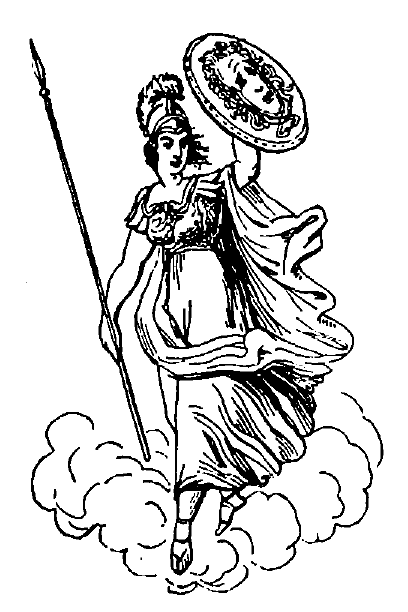
The head of the Medusa he presented to his divine patroness, Pallas-Athene, who placed it in the centre of her shield.
Many great heroes were descended from Perseus and Andromeda, foremost among whom was Heracles, whose mother, Alcmene, was their granddaughter.
Heroic honours were paid to Perseus, not only throughout Argos, but also at Athens and in the island of Seriphus.
ION.
Ion was the son of Crëusa (the beauteous daughter of Erechtheus, king of Athens) and the sun-god Phœbus-Apollo, to whom she was united without the knowledge of her father.
Fearing the anger of Erechtheus, Crëusa placed her new-born babe in a little wicker basket, and hanging some golden charms round his neck, invoked for him the protection of the gods, and concealed him in a lonely cave. Apollo, pitying his deserted child, sent Hermes to convey him to Delphi, where he deposited his charge on the steps of the temple. Next morning the Delphic priestess discovered the infant, and was so charmed by his engaging appearance that she adopted him as her own son. The young child was carefully tended and reared by his kind foster-mother, and was brought up in the service of the temple, where he was intrusted with some of the minor duties of the holy edifice.
And now to return to Crëusa. During a war with the Eubœans, in which the latter were signally defeated, Xuthus, son of Æolus, greatly distinguished himself on the side of the Athenians, and as a reward for his valuable services, the hand of Crëusa, the king's daughter, was bestowed upon him in marriage. Their union, however, was not blest with children, and as this was a source of great grief to both of them, they repaired to Delphi in order to consult the oracle. The response was, that Xuthus should regard the first person who met him on leaving the sanctuary as his son. Now it happened that Ion, the young guardian of the temple, was the first to greet his view, and when Xuthus beheld the beautiful youth, he gladly welcomed him as his son, declaring that the gods had sent him to be a blessing and comfort to his old age. Crëusa, however, who concluded that the youth was the offspring of a secret marriage on the part of her husband, was filled with suspicion and jealousy; when an old servant, observing her grief, begged her to be comforted, assuring her that the cause of her distress should be speedily removed.
When, upon the occasion of the public adoption of his son, Xuthus gave a grand banquet, the old servant of Crëusa contrived to mix a strong poison in the wine of the unsuspecting Ion. But the youth—according to the pious custom of the ancients, of offering a libation to the gods before partaking of any repast—poured upon the ground a portion of the wine before putting it to his lips, when suddenly, as if by a miracle, a dove flew into the banquet-hall, and sipped of the wine of the libation; whereupon the poor little creature began to quiver in every limb, and in a few moments expired.
Ion's suspicions at once fell upon the obsequious servant of Crëusa, who with such officious attention had filled his cup. He violently seized the old man, and accused him of his murderous intentions. Unprepared for this sudden attack he admitted his guilt, but pointed to the wife of Xuthus as the instigator of the crime. Ion was about to avenge himself upon Crëusa, when, by means of the divine intervention of Apollo, his foster-mother, the Delphic priestess appeared on the scene, and explained the true relationship which existed between Crëusa and Ion. In order to set all doubts at rest, she produced the charms which she had found round the neck of the infant, and also the wicker basket in which he had been conveyed to Delphi.
Mother and son now became reconciled to each other, and Crëusa revealed to Ion the secret of his divine origin. The priestess of Delphi foretold that he would become the father of a great nation, called after him the Ionians, and also that Xuthus and Crëusa would have a son called Dorus, who would be the progenitor of the Dorian people, both of which predictions were in due time verified.
DÆDALUS and ICARUS.
Dædalus, a descendant of Erechtheus, was an Athenian architect, sculptor, and mechanician. He was the first to introduce the art of sculpture in its higher development, for before his time statues were merely rude representations, having the limbs altogether undefined.
But great as was his genius, still greater was his vanity, and he could brook no rival. Now his nephew and pupil, Talus, exhibited great talent, having invented both the saw and the compass, and Dædalus, fearing lest he might overshadow his own fame, secretly killed him by throwing him down from the citadel of Pallas-Athene. The murder being discovered, Dædalus was summoned before the court of the Areopagus and condemned to death; but he made his escape to the island of Crete, where he was received by king Minos in a manner worthy of his great reputation.
Dædalus constructed for the king the world-renowned labyrinth, which was an immense building, full of intricate passages, intersecting each other in such a manner, that even Dædalus himself is said, upon one occasion, to have nearly lost his way in it; and it was in this building the king placed the Minotaur, a monster with the head and shoulders of a bull and the body of a man.
In the course of time the great artist became weary of his long exile, more especially as the king, under the guise of friendship, kept him almost a prisoner. He therefore resolved to make his escape, and for this purpose ingeniously contrived wings for himself and his young son Icarus, whom he diligently trained how to use them. Having awaited a favourable opportunity, father and son commenced their flight, and were well on their way when Icarus, pleased with the novel sensation, forgot altogether his father's oft-repeated injunction not to approach too near the sun. The consequence was that the wax, by means of which his wings were attached, melted, and he fell into the sea and was drowned. The body of the unfortunate Icarus was washed up by the tide, and was buried by the bereaved father on an island which he called after his son, Icaria.
After this sad event, Dædalus winged his flight to the island of Sicily, where he met with a kind welcome from king Cocalus, for whom he constructed several important public works. But no sooner did Minos receive the intelligence that his great architect had found an asylum with Cocalus than he sailed over to Sicily with a large army, and sent messengers to the Sicilian king demanding the surrender of his guest. Cocalus feigned compliance and invited Minos to his palace, where he was treacherously put to death in a warm bath. The body of their king was brought to Agrigent by the Cretans, where it was buried with great pomp, and over his tomb a temple to Aphrodite was erected.
Dædalus passed the remainder of his life tranquilly in the island of Sicily, where he occupied himself in the construction of various beautiful works of art.
THE ARGONAUTS.
Aeson, king of Iolcus, was forced to fly from his dominions, which had been usurped by his younger brother, Pelias, and with difficulty succeeded in saving the life of his young son, Jason, who was at that time only ten years of age. He intrusted him to the care of the Centaur Chiron, by whom he was carefully trained in company with other noble youths, who, like himself, afterwards signalized themselves by their bravery and heroic exploits. For ten years Jason remained in the cave of the Centaur, by whom he was instructed in all useful and warlike arts. But as he approached manhood he became filled with an unconquerable desire to regain his paternal inheritance. He therefore took leave of his kind friend and preceptor, and set out for Iolcus to demand from his uncle Pelias the kingdom which he had so unjustly usurped.
In the course of his journey he came to a broad and foaming river, on the banks of which he perceived an old woman, who implored him to help her across. At first he hesitated, knowing that even alone he would find some difficulty in stemming the fierce torrent; but, pitying her forlorn condition, he raised her in his arms, and succeeded, with a great effort, in reaching the opposite shore. But as soon as her feet had touched the earth she became transformed into a beautiful woman, who, looking kindly at the bewildered youth, informed him that she was the goddess Hera, and that she would henceforth guide and protect him throughout his career. She then disappeared, and, full of hope and courage at this divine manifestation, Jason pursued his journey. He now perceived that in crossing the river he had lost one of his sandals, but as it could not be recovered he was obliged to proceed without it.
On his arrival at Iolcus he found his uncle in the market-place, offering up a public sacrifice to Poseidon. When the king had concluded his offering, his eye fell upon the distinguished stranger, whose manly beauty and heroic bearing had already attracted the attention of his people. Observing that one foot was unshod, he was reminded of an oracular prediction which foretold to him the loss of his kingdom by a man wearing only one sandal. He, however, disguised his fears, conversed kindly with the youth, and drew from him his name and errand. Then pretending to be highly pleased with his nephew, Pelias entertained him sumptuously for five days, during which time all was festivity and rejoicing. On the sixth, Jason appeared before his uncle, and with manly firmness demanded from him the throne and kingdom which were his by right. Pelias, dissembling his true feelings, smilingly consented to grant his request, provided that, in return, Jason would undertake an expedition for him, which his advanced age prevented him from accomplishing himself. He informed his nephew that the shade of Phryxus had appeared to him in his dreams, and entreated him to bring back from Colchis his mortal remains and the Golden Fleece; and added that if Jason succeeded in obtaining for him these sacred relics, throne, kingdom, and sceptre should be his.
STORY OF THE GOLDEN FLEECE.
Athamas, king of Bœotia, had married Nephele, a cloud-nymph, and their children were Helle and Phryxus. The restless and wandering nature of Nephele, however, soon wearied her husband, who, being a mortal, had little sympathy with his ethereal consort; so he divorced her, and married the beautiful but wicked Ino (sister of Semele), who hated her step-children, and even planned their destruction. But the watchful Nephele contrived to circumvent her cruel designs, and succeeded in getting the children out of the palace. She then placed them both on the back of a winged ram, with a fleece of pure gold, which had been given to her by Hermes; and on this wonderful animal brother and sister rode through the air over land and sea; but on the way Helle, becoming seized with giddiness, fell into the sea (called after her the Hellespont) and was drowned.
Phryxus arrived safely at Colchis, where he was hospitably received by king Aëtes, who gave him one of his daughters in marriage. In gratitude to Zeus for the protection accorded him during his flight, Phryxus sacrificed to him the golden ram, whilst the fleece he presented to Aëtes, who nailed it up in the Grove of Ares, and dedicated it to the god of War. An oracle having declared that the life of Aëtes depended on the safe-keeping of the fleece, he carefully guarded the entrance to the grove by placing before it an immense dragon, which never slept.
Building and Launch of the Argo.—We will now return to Jason, who eagerly undertook the perilous expedition proposed to him by his uncle, who, well aware of the dangers attending such an enterprise, hoped by this means to rid himself for ever of the unwelcome intruder.
Jason accordingly began to arrange his plans without delay, and invited the young heroes whose friendship he had formed whilst under the care of Chiron, to join him in the perilous expedition. None refused the invitation, all feeling honoured at being allowed the privilege of taking part in so noble and heroic an undertaking.
Jason now applied to Argos, one of the cleverest ship-builders of his time, who, under the guidance of Pallas-Athene, built for him a splendid fifty-oared galley, which was called the Argo, after the builder. In the upper deck of the vessel the goddess had imbedded a board from the speaking oak of the oracle of Zeus at Dodona, which ever retained its powers of prophecy. The exterior of the ship was ornamented with magnificent carvings, and the whole vessel was so strongly built that it defied the power of the winds and waves, and was, nevertheless, so light that the heroes, when necessary, were able to carry it on their shoulders. When the vessel was completed, the Argonauts (so called after their ship) assembled, and their places were distributed by lot.
Jason was appointed commander-in-chief of the expedition, Tiphys acted as steersman, Lynceus as pilot. In the bow of the vessel sat the renowned hero Heracles; in the stern, Peleus (father of Achilles) and Telamon (the father of Ajax the Great). In the inner space were Castor and Pollux, Neleus (the father of Nestor), Admetus (the husband of Alcestes), Meleager (the slayer of the Calydonian boar), Orpheus (the renowned singer), Menoctius (the father of Patroclus), Theseus (afterwards king of Athens) and his friend Pirithöus (the son of Ixion), Hylas (the adopted son of Heracles), Euphemus (the son of Poseidon), Oileus (father of Ajax the Lesser), Zetes and Calais (the winged sons of Boreas), Idmon the Seer (the son of Apollo), Mopsus (the Thessalian prophet), &c. &c.
Before their departure Jason offered a solemn sacrifice to Poseidon and all the other sea-deities; he also invoked the protection of Zeus and the Fates, and then, Mopsus having taken the auguries, and found them auspicious, the heroes stepped on board. And now a favourable breeze having sprung up, they take their allotted places, the anchor is weighed, and the ship glides like a bird out of the harbour into the waters of the great sea.
Arrival at Lemnos.—The Argo, with her brave crew of fifty heroes, was soon out of sight, and the sea-breeze only wafted to the shore a faint echo of the sweet strains of Orpheus.
For a time all went smoothly, but the vessel was soon driven, by stress of weather, to take refuge in a harbour in the island of Lemnos. This island was inhabited by women only, who, the year before, in a fit of mad jealousy, had killed all the male population of the island, with the exception of the father of their queen, Hypsipyle. As the protection of their island now devolved upon themselves they were always on the look-out for danger. When, therefore, they sighted the Argo from afar they armed themselves and rushed to the shore, determined to repel any invasion of their territory.
On arriving in port the Argonauts, astonished at beholding an armed crowd of women, despatched a herald in one of their boats, bearing the staff of peace and friendship. Hypsipyle, the queen, proposed that food and presents should be sent to the strangers, in order to prevent their landing; but her old nurse, who stood beside her, suggested that this would be a good opportunity to provide themselves with noble husbands, who would act as their defenders, and thus put an end to their constant fears. Hypsipyle listened attentively to the advice of her nurse, and after some consultation, decided to invite the strangers into the city. Robed in his purple mantle, the gift of Pallas-Athene, Jason, accompanied by some of his companions, stepped on shore, where he was met by a deputation consisting of the most beautiful of the Lemnian women, and, as commander of the expedition, was invited into the palace of the queen.
When he appeared before Hypsipyle, she was so struck with his godlike and heroic presence that she presented him with her father's sceptre, and invited him to seat himself on the throne beside her. Jason thereupon took up his residence in the royal castle, whilst his companions scattered themselves through the town, spending their time in feasting and pleasure. Heracles, with a few chosen comrades, alone remained on board.
From day to day their departure was delayed, and the Argonauts, in their new life of dissipation, had almost forgotten the object of the expedition, when Heracles suddenly appeared amongst them, and at last recalled them to a sense of their duty.
Giants and Doliones.—The Argonauts now pursued their voyage, till contrary winds drove them towards an island, inhabited by the Doliones, whose king Cyzicus received them with great kindness and hospitality. The Doliones were descendants of Poseidon, who protected them against the frequent attacks of their fierce and formidable neighbours, the earth-born Giants—monsters with six arms.
Whilst his companions were attending a banquet given by king Cyzicus, Heracles, who, as usual, had remained behind to guard the ship, observed that these Giants were busy blocking up the harbour with huge rocks. He at once realized the danger, and, attacking them with his arrows, succeeded in considerably thinning their numbers; then, assisted by the heroes, who at length came to his aid, he effectually destroyed the remainder.
The Argo now steered out of the harbour and set sail; but in consequence of a severe storm which arose at night, was driven back once more to the shores of the kindly Doliones. Unfortunately, however, owing to the darkness of the night, the inhabitants failed to recognize their former guests, and, mistaking them for enemies, commenced to attack them. Those who had so recently parted as friends were now engaged in mortal combat, and in the battle which ensued, Jason himself pierced to the heart his friend king Cyzicus; whereupon the Doliones, being deprived of their leader, fled to their city and closed the gates. When morning dawned, and both sides perceived their error, they were filled with the deepest sorrow and remorse; and for three days the heroes remained with the Doliones, celebrating the funereal rites of the slain, with every demonstration of mourning and solemnity.
Heracles left behind.—The Argonauts once more set sail, and after a stormy voyage arrived at Mysia, where they were hospitably received by the inhabitants, who spread before them plentiful banquets and sumptuously regaled them.
While his friends were feasting, Heracles, who had declined to join them, went into the forest to seek a fir-tree which he required for an oar, and was missed by his adopted son Hylas, who set out to seek him. When the youth arrived at a spring, in the most secluded part of the forest, the nymph of the fountain was so struck by his beauty that she drew him down beneath the waters, and he was seen no more. Polyphemus, one of the heroes, who happened to be also in the forest, heard his cry for help, and on meeting Heracles informed him of the circumstance. They at once set out in search of the missing youth, no traces of whom were to be found, and whilst they were engaged looking for him, the Argo set sail and left them behind.
The ship had proceeded some distance before the absence of Heracles was observed. Some of the heroes were in favour of returning for him, others wished to proceed on their journey, when, in the midst of the dispute, the sea-god Glaucus arose from the waves, and informed them that it was the will of Zeus that Heracles, having another mission to perform, should remain behind. The Argonauts continued their voyage without their companions; Heracles returned to Argos, whilst Polyphemus remained with the Mysians, where he founded a city and became its king.
Contest with Amycus.—Next morning the Argo touched at the country of the Bebrycians, whose king Amycus was a famous pugilist, and permitted no strangers to leave his shores without matching their strength with his. When the heroes, therefore, demanded permission to land, they were informed that they could only do so provided that one of their number should engage in a boxing-match with the king. Pollux, who was the best pugilist in Greece, was selected as their champion, and a contest took place, which, after a tremendous struggle, proved fatal to Amycus, who had hitherto been victorious in all similar encounters.
Phineus and the Harpies.—They now proceeded towards Bithynia, where reigned the blind old prophet-king Phineus, son of Agenor. Phineus had been punished by the gods with premature old age and blindness for having abused the gift of prophecy. He was also tormented by the Harpies, who swooped down upon his food, which they either devoured or so defiled as to render it unfit to be eaten. This poor old man, trembling with the weakness of age, and faint with hunger, appeared before the Argonauts, and implored their assistance against his fiendish tormentors, whereupon Zetes and Calais, the winged sons of Boreas, recognizing in him the husband of their sister Cleopatra, affectionately embraced him, and promised to rescue him from his painful position.
The heroes prepared a banquet on the sea-shore, to which they invited Phineus; but no sooner had he taken his place, than the Harpies appeared and devoured all the viands. Zetes and Calais now rose up into the air, drove the Harpies away, and were pursuing them with drawn swords, when Iris, the swift-footed messenger of the gods, appeared, and desired them to desist from their work of vengeance, promising that Phineus should be no longer molested.
Freed at length from his tormentors the old man sat down and enjoyed a plentiful repast with his kind friends the Argonauts, who now informed him of the object of their voyage. In gratitude for his deliverance Phineus gave them much useful information concerning their journey, and not only warned them of the manifold dangers awaiting them, but also instructed them how they might be overcome.
Passage of the Symplegades.—After a fortnight's sojourn in Bithynia the Argonauts once more set sail, but had not proceeded far on their course, when they heard a fearful and tremendous crash. This was caused by the meeting of two great rocky islands, called the Symplegades, which floated about in the sea, and constantly met and separated.
Before leaving Bithynia, the blind old seer, Phineus, had informed them that they would be compelled to pass between these terrible rocks, and he instructed them how to do so with safety. As they now approached the scene of danger they remembered his advice, and acted upon it. Typhus, the steersman, stood at the helm, whilst Euphemus held in his hand a dove ready to be let loose; for Phineus had told them that if the dove ventured to fly through, they might safely follow. Euphemus now despatched the bird, which passed swiftly through the islands, yet not without losing some of the feathers of her tail, so speedily did they reunite. Seizing the moment when the rocks once more separated, the Argonauts worked at their oars with all their might, and achieved the perilous passage in safety.
After the miraculous passage of the Argo, the Symplegades became permanently united, and attached to the bottom of the sea.
The Stymphalides.—The Argo pursued her course along the southern coast of the Pontus, and arrived at the island of Aretias, which was inhabited by birds, who, as they flew through the air, discharged from their wings feathers sharp as arrows.
As the ship was gliding along, Oileus was wounded by one of these birds, whereupon the Argonauts held a council, and by the advice of Amphidamas, an experienced hero, all put on their helmets, and held up their glittering shields, uttering, at the same time, such fearful cries that the birds flew away in terror, and the Argonauts were enabled to land with safety on the island.
Here they found four shipwrecked youths, who proved to be the sons of Phryxus, and were greeted by Jason as his cousins. On ascertaining the object of the expedition they volunteered to accompany the Argo, and to show the heroes the way to Colchis. They also informed them that the Golden Fleece was guarded by a fearful dragon, that king Aëtes was extremely cruel, and, as the son of Apollo, was possessed of superhuman strength.
Arrival at Colchis.—Taking with them the four new-comers they journeyed on, and soon came in sight of the snow-capped peaks of the Caucasus, when, towards evening, the loud flapping of wings was heard overhead. It was the giant eagle of Prometheus on his way to torture the noble and long-suffering Titan, whose fearful groans soon afterwards fell upon their ears. That night they reached their journey's end, and anchored in the smooth waters of the river Phases. On the left bank of this river they beheld Ceuta, the capital of Colchis; and on their right a wide field, and the sacred grove of Ares, where the Golden Fleece, suspended from a magnificent oak-tree, was glittering in the sun. Jason now filled a golden cup with wine, and offered a libation to mother-earth, the gods of the country, and the shades of those of the heroes who had died on the voyage.
Next morning a council was held, in which it was decided, that before resorting to forcible measures kind and conciliatory overtures should first be made to king Aëtes in order to induce him to resign the Golden Fleece. It was arranged that Jason, with a few chosen companions, should proceed to the royal castle, leaving the remainder of the crew to guard the Argo. Accompanied, therefore, by Telamon and Augeas, and the four sons of Phryxus, he set out for the palace.
When they arrived in sight of the castle they were struck by the vastness and massiveness of the building, at the entrance to which sparkling fountains played in the midst of luxuriant and park-like gardens. Here the king's daughters, Chalciope and Medea, who were walking in the grounds of the palace, met them. The former, to her great joy, recognized in the youths who accompanied the hero her own long-lost sons, whom she had mourned as dead, whilst the young and lovely Medea was struck with the noble and manly form of Jason.
The news of the return of the sons of Phryxus soon spread through the palace, and brought Aëtes himself to the scene, whereupon the strangers were presented to him, and were invited to a banquet which the king ordered to be prepared in their honour. All the most beautiful ladies of the court were present at this entertainment; but in the eyes of Jason none could compare with the king's daughter, the young and lovely Medea.
When the banquet was ended, Jason related to the king his various adventures, and also the object of his expedition, with the circumstances which had led to his undertaking it. Aëtes listened, in silent indignation, to this recital, and then burst out into a torrent of invectives against the Argonauts and his grand-children, declaring that the Fleece was his rightful property, and that on no consideration would he consent to relinquish it. Jason, however, with mild and persuasive words, contrived so far to conciliate him, that he was induced to promise that if the heroes could succeed in demonstrating their divine origin by the performance of some task requiring superhuman power, the Fleece should be theirs.
The task proposed by Aëtes to Jason was that he should yoke the two brazen-footed, fire-breathing oxen of the king (which had been made for him by Hephæstus) to his ponderous iron plough. Having done this he must till with them the stony field of Ares, and then sow in the furrows the poisonous teeth of a dragon, from which armed men would arise. These he must destroy to a man, or he himself would perish at their hands.
When Jason heard what was expected of him, his heart for a moment sank within him; but he determined, nevertheless, not to flinch from his task, but to trust to the assistance of the gods, and to his own courage and energy.
Jason ploughs the Field of Ares.—Accompanied by his two friends, Telamon and Augeas, and also by Argus, the son of Chalciope, Jason returned to the vessel for the purpose of holding a consultation as to the best means of accomplishing these perilous feats.
Argus explained to Jason all the difficulties of the superhuman task which lay before him, and pronounced it as his opinion that the only means by which success was possible was to enlist the assistance of the Princess Medea, who was a priestess of Hecate, and a great enchantress. His suggestion meeting with approval, he returned to the palace, and by the aid of his mother an interview was arranged between Jason and Medea, which took place, at an early hour next morning, in the temple of Hecate.
A confession of mutual attachment took place, and Medea, trembling for her lover's safety, presented him with a magic salve, which possessed the property of rendering any person anointed with it invulnerable for the space of one day against fire and steel, and invincible against any adversary however powerful. With this salve she instructed him to anoint his spear and shield on the day of his great undertaking. She further added that when, after having ploughed the field and sown the teeth, armed men should arise from the furrows, he must on no account lose heart, but remember to throw among them a huge rock, over the possession of which they would fight among themselves, and their attention being thus diverted he would find it an easy task to destroy them. Overwhelmed with gratitude, Jason thanked her, in the most earnest manner, for her wise counsel and timely aid; at the same time he offered her his hand, and promised her he would not return to Greece without taking her with him as his wife.
Next morning Aëtes, in all the pomp of state, surrounded by his family and the members of his court, repaired to a spot whence a full view of the approaching spectacle could be obtained. Soon Jason appeared in the field of Ares, looking as noble and majestic as the god of war himself. In a distant part of the field the brazen yokes and the massive plough met his view, but as yet the dread animals themselves were nowhere to be seen. He was about to go in quest of them, when they suddenly rushed out from a subterranean cave, breathing flames of fire, and enveloped in a thick smoke.
The friends of Jason trembled; but the undaunted hero, relying on the magic powers with which he was imbued by Medea, seized the oxen, one after the other, by the horns, and forced them to the yoke. Near the plough was a helmet full of dragon's teeth, which he sowed as he ploughed the field, whilst with sharp pricks from his lance he compelled the monstrous creatures to draw the plough over the stony ground, which was thus speedily tilled.
While Jason was engaged sowing the dragon's teeth in the deep furrows of the field, he kept a cautious look-out lest the germinating giant brood might grow too quickly for him, and as soon as the four acres of land had been tilled he unyoked the oxen, and succeeded in frightening them so effectually with his weapons, that they rushed back in terror to their subterranean stables. Meanwhile armed men had sprung up out of the furrows, and the whole field now bristled with lances; but Jason, remembering the instructions of Medea, seized an immense rock and hurled it into the midst of these earth-born warriors, who immediately began to attack each other. Jason then rushed furiously upon them, and after a terrible struggle not one of the giants remained alive.
Furious at seeing his murderous schemes thus defeated, Aëtes not only perfidiously refused to give Jason the Fleece which he had so bravely earned, but, in his anger, determined to destroy all the Argonauts, and to burn their vessel.
Jason secures the Golden Fleece.—Becoming aware of the treacherous designs of her father, Medea at once took measures to baffle them. In the darkness of night she went on board the Argo, and warned the heroes of their approaching danger. She then advised Jason to accompany her without loss of time to the sacred grove, in order to possess himself of the long-coveted treasure. They set out together, and Medea, followed by Jason, led the way, and advanced boldly into the grove. The tall oak-tree was soon discovered, from the topmost boughs of which hung the beautiful Golden Fleece. At the foot of this tree, keeping his ever-wakeful watch, lay the dreadful, sleepless dragon, who at sight of them bounded forward, opening his huge jaws.
Medea now called into play her magic powers, and quietly approaching the monster, threw over him a few drops of a potion, which soon took effect, and sent him into a deep sleep; whereupon Jason, seizing the opportunity, climbed the tree and secured the Fleece. Their perilous task being now accomplished, Jason and Medea quitted the grove, and hastened on board the Argo, which immediately put to sea.
Murder of Absyrtus.—Meanwhile Aëtes, having discovered the loss of his daughter and the Golden Fleece, despatched a large fleet, under the command of his son Absyrtus, in pursuit of the fugitives. After some days' sail they arrived at an island at the mouth of the river Ister, where they found the Argo at anchor, and surrounded her with their numerous ships. They then despatched a herald on board of her, demanding the surrender of Medea and the Fleece.
Medea now consulted Jason, and, with his consent, carried out the following stratagem. She sent a message to her brother Absyrtus, to the effect that she had been carried off against her will, and promised that if he would meet her, in the darkness of night, in the temple of Artemis, she would assist him in regaining possession of the Golden Fleece. Relying on the good faith of his sister, Absyrtus fell into the snare, and duly appeared at the appointed trysting-place; and whilst Medea kept her brother engaged in conversation, Jason rushed forward and slew him. Then, according to a preconcerted signal, he held aloft a lighted torch, whereupon the Argonauts attacked the Colchians, put them to flight, and entirely defeated them.
The Argonauts now returned to their ship, when the prophetic board from the Dodonean oak thus addressed them: "The cruel murder of Absyrtus was witnessed by the Erinyes, and you will not escape the wrath of Zeus until the goddess Circe has purified you from your crime. Let Castor and Pollux pray to the gods that you may be enabled to find the abode of the sorceress." In obedience to the voice, the twin-brothers invoked divine assistance, and the heroes set out in search of the isle of Circe.
They arrive at the Island of Circe.—The good ship Argo sped on her way, and, after passing safely through the foaming waters of the river Eridanus, at length arrived in the harbour of the island of Circe, where she cast anchor.
Commanding his companions to remain on board, Jason landed with Medea, and conducted her to the palace of the sorceress. The goddess of charms and magic arts received them kindly, and invited them to be seated; but instead of doing so they assumed a supplicating attitude, and humbly besought her protection. They then informed her of the dreadful crime which they had committed, and implored her to purify them from it. This Circe promised to do. She forthwith commanded her attendant Naiads to kindle the fire on the altar, and to prepare everything necessary for the performance of the mystic rites, after which a dog was sacrificed, and the sacred cakes were burned. Having thus duly purified the criminals, she severely reprimanded them for the horrible murder of which they had been guilty; whereupon Medea, with veiled head, and weeping bitterly, was reconducted by Jason to the Argo.
Further Adventures of the Argonauts.—Having left the island of Circe they were wafted by gentle zephyrs towards the abode of the Sirens, whose enticing strains soon fell upon their ears. The Argonauts, powerfully affected by the melody, were making ready to land, when Orpheus perceived the danger, and, to the accompaniment of his magic lyre, commenced one of his enchanting songs, which so completely absorbed his listeners that they passed the island in safety; but not before Butes, one of their number, lured by the seductive music of the Sirens, had sprung from the vessel into the waves below. Aphrodite, however, in pity for his youth, landed him gently on the island of Libibaon before the Sirens could reach him, and there he remained for many years.
And now the Argonauts approached new dangers, for on one side of them seethed and foamed the whirlpool of Charybdis, whilst on the other towered the mighty rock whence the monster Scylla swooped down upon unfortunate mariners; but here the goddess Hera came to their assistance, and sent to them the sea-nymph Thetis, who guided them safely through these dangerous straits.
The Argo next arrived at the island of the Phæaces, where they were hospitably entertained by King Alcinous and his queen Arete. But the banquet prepared for them by their kind host was unexpectedly interrupted by the appearance of a large army of Colchians, sent by Aëtes to demand the restoration of his daughter.
Medea threw herself at the feet of the queen, and implored her to save her from the anger of her father, and Arete, in her kindness of heart, promised her her protection. Next morning, in an assembly of the people at which the Colchians were invited to be present, the latter were informed that as Medea was the lawful wife of Jason they could not consent to deliver her up; whereupon the Colchians, seeing that the resolution of the king was not to be shaken, and fearing to face the anger of Aëtes should they return to Colchis without her, sought permission of Alcinous to settle in his kingdom, which request was accorded them.
After these events the Argonauts once more set sail, and steered for Iolcus; but, in the course of a terrible and fearful night, a mighty storm arose, and in the morning they found themselves stranded on the treacherous quicksands of Syrtes, on the shores of Libya. Here all was a waste and barren desert, untenanted by any living creature, save the venomous snakes which had sprung from the blood of the Medusa when borne by Perseus over these arid plains.
They had already passed several days in this abode of desolation, beneath the rays of the scorching sun, and had abandoned themselves to the deepest despair, when the Libyan queen, who was a prophetess of divine origin, appeared to Jason, and informed him that a sea-horse would be sent by the gods to act as his guide.
Scarcely had she departed when a gigantic hippocamp was seen in the distance, making its way towards the Argo. Jason now related to his companions the particulars of his interview with the Libyan prophetess, and after some deliberation it was decided to carry the Argo on their shoulders, and to follow wherever the sea-horse should lead them. They then commenced a long and weary journey through the desert, and at last, after twelve days of severe toil and terrible suffering, the welcome sight of the sea greeted their view. In gratitude for having been saved from their manifold dangers they offered up sacrifices to the gods, and launched their ship once more into the deep waters of the ocean.
Arrival at Crete.—With heartfelt joy and gladness they proceeded on their homeward voyage, and after some days arrived at the island of Crete, where they purposed to furnish themselves with fresh provisions and water. Their landing, however, was opposed by a terrible giant who guarded the island against all intruders. This giant, whose name was Talus, was the last of the Brazen race, and being formed of brass, was invulnerable, except in his right ankle, where there was a sinew of flesh and a vein of blood. As he saw the Argo nearing the coast, he hurled huge rocks at her, which would inevitably have sunk the vessel had not the crew beat a hasty retreat. Although sadly in want of food and water, the Argonauts had decided to proceed on their journey rather than face so powerful an opponent, when Medea came forward and assured them that if they would trust to her she would destroy the giant.
Enveloped in the folds of a rich purple mantle, she stepped on deck, and after invoking the aid of the Fates, uttered a magic incantation, which had the effect of throwing Talus into a deep sleep. He stretched himself at full length upon the ground, and in doing so grazed his vulnerable ankle against the point of a sharp rock, whereupon a mighty stream of blood gushed forth from the wound. Awakened by the pain, he tried to rise, but in vain, and with a mighty groan of anguish the giant fell dead, and his enormous body rolled heavily over into the deep. The heroes being now able to land, provisioned their vessel, after which they resumed their homeward voyage.
Arrival at Iolcus.—After a terrible night of storm and darkness they passed the island of Ægina, and at length reached in safety the port of Iolcus, where the recital of their numerous adventures and hair-breadth escapes was listened to with wondering admiration by their fellow-countrymen.
The Argo was consecrated to Poseidon, and was carefully preserved for many generations till no vestige of it remained, when it was placed in the heavens as a brilliant constellation.
On his arrival at Iolcus, Jason conducted his beautiful bride to the palace of his uncle Pelias, taking with him the Golden Fleece, for the sake of which this perilous expedition had been undertaken. But the old king, who had never expected that Jason would return alive, basely refused to fulfil his part of the compact, and declined to abdicate the throne.
Indignant at the wrongs of her husband, Medea avenged them in a most shocking manner. She made friends with the daughters of the king, and feigned great interest in all their concerns. Having gained their confidence, she informed them, that among her numerous magic arts, she possessed the power of restoring to the aged all the vigour and strength of youth, and in order to give them a convincing proof of the truth of her assertion, she cut up an old ram, which she boiled in a cauldron, whereupon, after uttering various mystic incantations, there came forth from the vessel a beautiful young lamb. She then assured them, that in a similar manner they could restore to their old father his former youthful frame and vigour. The fond and credulous daughters of Pelias lent an all too willing ear to the wicked sorceress, and thus the old king perished at the hands of his innocent children.
Death of Jason.—Medea and Jason now fled to Corinth, where at length they found, for a time, peace and tranquillity, their happiness being completed by the birth of three children.
As time passed on, however, and Medea began to lose the beauty which had won the love of her husband, he grew weary of her, and became attracted by the youthful charms of Glauce, the beautiful daughter of Creon, king of Corinth. Jason had obtained her father's consent to their union, and the wedding-day was already fixed, before he disclosed to Medea the treachery which he meditated against her. He used all his persuasive powers in order to induce her to consent to his union with Glauce, assuring her that his affection had in no way diminished, but that for the sake of the advantages which would thereby accrue to their children, he had decided on forming this alliance with the royal house. Though justly enraged at his deceitful conduct, Medea dissembled her wrath, and, feigning to be satisfied with this explanation, sent, as a wedding-gift to her rival, a magnificent robe of cloth-of-gold. This robe was imbued with a deadly poison which penetrated to the flesh and bone of the wearer, and burned them as though with a consuming fire. Pleased with the beauty and costliness of the garment, the unsuspecting Glauce lost no time in donning it; but no sooner had she done so than the fell poison began to take effect. In vain she tried to tear the robe away; it defied all efforts to be removed, and after horrible and protracted sufferings, she expired.
Maddened at the loss of her husband's love Medea next put to death her three sons, and when Jason, thirsting for revenge, left the chamber of his dead bride, and flew to his own house in search of Medea, the ghastly spectacle of his murdered children met his view. He rushed frantically to seek the murderess, but nowhere could she be found. At length, hearing a sound above his head, he looked up, and beheld Medea gliding through the air in a golden chariot drawn by dragons.
In a fit of despair Jason threw himself on his own sword, and perished on the threshold of his desolate and deserted home.
PELOPS.
Pelops, the son of the cruel Tantalus, was a pious and virtuous prince. After his father was banished into Tartarus, a war ensued between Pelops and the king of Troy, in which the former was vanquished and forced to fly from his dominions in Phrygia. He emigrated into Greece, where, at the court of Œnomaus, king of Elis, he beheld Hippodamia, the king's daughter, whose beauty won his heart. But an oracle having foretold to Œnomaus that he would die on the day of his daughter's marriage, he threw every obstacle in the way of her suitors, and declared that he would only give her to him who succeeded in vanquishing him in a chariot race, but that all unsuccessful competitors should suffer death at his hands.
The conditions of the contest were as follows:—The race was to be run from a given point at Pisa to the altar of Poseidon at Corinth; the suitor was allowed to start on his course whilst Œnomaus performed his sacrifice to Zeus, and only on its completion did the king mount his chariot, guided by the skilful Myrtilus, and drawn by his two famous horses, Phylla and Harpinna, who surpassed in swiftness the winds themselves. In this manner many a gallant young prince had perished; for although a considerable start was given to all competitors, still Œnomaus, with his swift team, always overtook them before they reached the goal, and killed them with his spear. But the love of Pelops for Hippodamia overcame all fears, and, undeterred by the terrible fate of his predecessors, he announced himself to Œnomaus as a suitor for the hand of his daughter.
On the eve of the race, Pelops repaired to the sea-shore and earnestly implored Poseidon to assist him in his perilous undertaking. The sea-god heard his prayer, and sent him out of the deep a chariot drawn by two winged horses.
When Pelops appeared on the course, the king at once recognized the horses of Poseidon; but, nothing daunted, he relied on his own supernatural team, and the contest was allowed to proceed.
Whilst the king was offering his sacrifice to Zeus Pelops set out on the race, and had nearly reached the goal, when, turning round, he beheld Œnomaus, spear in hand, who, with his magic steeds, had nearly overtaken him. But in this emergency Poseidon came to the aid of the son of Tantalus. He caused the wheels of the royal chariot to fly off, whereupon the king was thrown out violently, and killed on the spot, just as Pelops arrived at the altar of Poseidon.
As the hero was about to return to Pisa to claim his bride, he beheld, in the distance, flames issuing from the royal castle, which at that instant had been struck by lightning. With his winged horses he flew to rescue his lovely bride, and succeeded in extricating her uninjured from the burning building. They soon afterwards became united, and Pelops reigned in Pisa for many years in great splendour.
HERACLES (Hercules).
Heracles, the most renowned hero of antiquity, was the son of Zeus and Alcmene, and the great grandson of Perseus.
At the time of his birth Alcmene was living at Thebes with her husband Amphitryon, and thus the infant Heracles was born in the palace of his stepfather.
Aware of the animosity with which Hera persecuted all those who rivalled her in the affections of Zeus, Alcmene, fearful lest this hatred should be visited on her innocent child, intrusted him, soon after his birth, to the care of a faithful servant, with instructions to expose him in a certain field, and there leave him, feeling assured that the divine offspring of Zeus would not long remain without the protection of the gods.
Soon after the child had been thus abandoned, Hera and Pallas-Athene happened to pass by the field, and were attracted by its cries. Athene pityingly took up the infant in her arms, and prevailed upon the queen of heaven to put it to her breast; but no sooner had she done so, than the child, causing her pain, she angrily threw him to the ground, and left the spot. Athene, moved with compassion, carried him to Alcmene, and entreated her kind offices on behalf of the poor little foundling. Alcmene at once recognized her child, and joyfully accepted the charge.
Soon afterwards Hera, to her extreme annoyance, discovered whom she had nursed, and became filled with jealous rage. She now sent two venomous snakes into the chamber of Alcmene, which crept, unperceived by the nurses, to the cradle of the sleeping child. He awoke with a cry, and grasping a snake in each hand, strangled them both. Alcmene and her attendants, whom the cry of the child had awakened, rushed to the cradle, where, to their astonishment and terror, they beheld the two reptiles dead in the hands of the infant Heracles. Amphitryon was also attracted to the chamber by the commotion, and when he beheld this astounding proof of supernatural strength, he declared that the child must have been sent to him as a special gift from Zeus. He accordingly consulted the famous seer Tiresias, who now informed him of the divine origin of his stepson, and prognosticated for him a great and distinguished future.
When Amphitryon heard the noble destiny which awaited the child intrusted to his care, he resolved to educate him in a manner worthy of his future career. At a suitable age he himself taught him how to guide a chariot; Eurytus, how to handle the bow; Autolycus, dexterity in wrestling and boxing; and Castor, the art of armed warfare; whilst Linus, the son of Apollo, instructed him in music and letters.
Heracles was an apt pupil; but undue harshness was intolerable to his high spirit, and old Linus, who was not the gentlest of teachers, one day corrected him with blows, whereupon the boy angrily took up his lyre, and, with one stroke of his powerful arm, killed his tutor on the spot.
Apprehensive lest the ungovernable temper of the youth might again involve him in similar acts of violence, Amphitryon sent him into the country, where he placed him under the charge of one of his most trusted herdsmen. Here, as he grew up to manhood, his extraordinary stature and strength became the wonder and admiration of all beholders. His aim, whether with spear, lance, or bow, was unerring, and at the age of eighteen he was considered to be the strongest as well as the most beautiful youth in all Greece.
The Choice of Heracles.—Heracles felt that the time had now arrived when it became necessary to decide for himself how to make use of the extraordinary powers with which he had been endowed by the gods; and in order to meditate in solitude on this all-important subject, he repaired to a lonely and secluded spot in the heart of the forest.
Here two females of great beauty appeared to him. One was Vice, the other Virtue. The former was full of artificial wiles and fascinating arts, her face painted and her dress gaudy and attractive; whilst the latter was of noble bearing and modest mien, her robes of spotless purity.
Vice stepped forward and thus addressed him: "If you will walk in my paths, and make me your friend, your life shall be one round of pleasure and enjoyment. You shall taste of every delight which can be procured on earth; the choicest viands, the most delicious wines, the most luxuriant of couches shall be ever at your disposal; and all this without any exertion on your part, either physical or mental."
Virtue now spoke in her turn: "If you will follow me and be my friend, I promise you the reward of a good conscience, and the love and respect of your fellowmen. I cannot undertake to smooth your path with roses, or to give you a life of idleness and pleasure; for you must know that the gods grant no good and desirable thing that is not earned by labour; and as you sow, so must you reap."
Heracles listened patiently and attentively to both speakers, and then, after mature deliberation, decided to follow in the paths of virtue, and henceforth to honour the gods, and to devote his life to the service of his country.
Full of these noble resolves he sought once more his rural home, where he was informed that on Mount Cithæron, at the foot of which the herds of Amphitryon were grazing, a ferocious lion had fixed his lair, and was committing such frightful ravages among the flocks and herds that he had become the scourge and terror of the whole neighbourhood. Heracles at once armed himself and ascended the mountain, where he soon caught sight of the lion, and rushing at him with his sword succeeded in killing him. The hide of the animal he wore ever afterwards over his shoulders, and the head served him as a helmet.
As he was returning from this, his first exploit, he met the heralds of Erginus, king of the Minyans, who were proceeding to Thebes to demand their annual tribute of 100 oxen. Indignant at this humiliation of his native city, Heracles mutilated the heralds, and sent them back, with ropes round their necks, to their royal master.
Erginus was so incensed at the ill-treatment of his messengers that he collected an army and appeared before the gates of Thebes, demanding the surrender of Heracles. Creon, who was at this time king of Thebes, fearing the consequences of a refusal, was about to yield, when the hero, with the assistance of Amphitryon and a band of brave youths, advanced against the Minyans.
Heracles took possession of a narrow defile through which the enemy were compelled to pass, and as they entered the pass the Thebans fell upon them, killed their king Erginus, and completely routed them. In this engagement Amphitryon, the kind friend and foster-father of Heracles, lost his life. The hero now advanced upon Orchomenus, the capital of the Minyans, where he burned the royal castle and sacked the town.
After this signal victory all Greece rang with the fame of the young hero, and Creon, in gratitude for his great services, bestowed upon him his daughter Megara in marriage. The Olympian gods testified their appreciation of his valour by sending him presents; Hermes gave him a sword, Phœbus-Apollo a bundle of arrows, Hephæstus a golden quiver, and Athene a coat of leather.
Heracles and Eurystheus.—And now it will be necessary to retrace our steps. Just before the birth of Heracles, Zeus, in an assembly of the gods, exultingly declared that the child who should be born on that day to the house of Perseus should rule over all his race. When Hera heard her lord's boastful announcement she knew well that it was for the child of the hated Alcmene that this brilliant destiny was designed; and in order to rob the son of her rival of his rights, she called to her aid the goddess Eilithyia, who retarded the birth of Heracles, and caused his cousin Eurystheus (another grandson of Perseus) to precede him into the world. And thus, as the word of the mighty Zeus was irrevocable, Heracles became the subject and servant of his cousin Eurystheus.
When, after his splendid victory over Erginus, the fame of Heracles spread throughout Greece, Eurystheus (who had become king of Mycenæ), jealous of the reputation of the young hero, asserted his rights, and commanded him to undertake for him various difficult tasks. But the proud spirit of the hero rebelled against this humiliation, and he was about to refuse compliance, when Zeus appeared to him and desired him not to rebel against the Fates. Heracles now repaired to Delphi in order to consult the oracle, and received the answer that after performing ten tasks for his cousin Eurystheus his servitude would be at an end.
Soon afterwards Heracles fell into a state of the deepest melancholy, and through the influence of his inveterate enemy, the goddess Hera, this despondency developed into raving madness, in which condition he killed his own children. When he at length regained his reason he was so horrified and grieved at what he had done, that he shut himself up in his chamber and avoided all intercourse with men. But in his loneliness and seclusion the conviction that work would be the best means of procuring oblivion of the past decided him to enter, without delay, upon the tasks appointed him by Eurystheus.
1. The Nemean Lion.—His first task was to bring to Eurystheus the skin of the much-dreaded Nemean lion, which ravaged the territory between Cleone and Nemea, and whose hide was invulnerable against any mortal weapon.
Heracles proceeded to the forest of Nemea, where, having discovered the lion's lair, he attempted to pierce him with his arrows; but finding these of no avail he felled him to the ground with his club, and before the animal had time to recover from the terrible blow, Heracles seized him by the neck and, with a mighty effort, succeeded in strangling him. He then made himself a coat of mail of the skin, and a new helmet of the head of the animal. Thus attired, he so alarmed Eurystheus by appearing suddenly before him, that the king concealed himself in his palace, and henceforth forbade Heracles to enter his presence, but commanded him to receive his behests, for the future, through his messenger Copreus.
2. The Hydra.—His second task was to slay the Hydra, a monster serpent (the offspring of Typhon and Echidna), bristling with nine heads, one of which was immortal. This monster infested the neighbourhood of Lerna, where she committed great depredations among the herds.
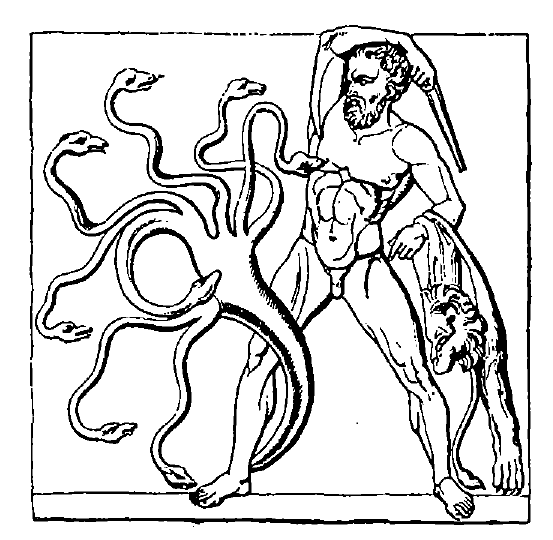
Heracles, accompanied by his nephew Iolaus, set out in a chariot for the marsh of Lerna, in the slimy waters of which he found her. He commenced the attack by assailing her with his fierce arrows, in order to force her to leave her lair, from which she at length emerged, and sought refuge in a wood on a neighbouring hill. Heracles now rushed forward and endeavoured to crush her heads by means of well-directed blows from his tremendous club; but no sooner was one head destroyed than it was immediately replaced by two others. He next seized the monster in his powerful grasp; but at this juncture a giant crab came to the assistance of the Hydra and commenced biting the feet of her assailant. Heracles destroyed this new adversary with his club, and now called upon his nephew to come to his aid. At his command Iolaus set fire to the neighbouring trees, and, with a burning branch, seared the necks of the monster as Heracles cut them off, thus effectually preventing the growth of more. Heracles next struck off the immortal head, which he buried by the road-side, and placed over it a heavy stone. Into the poisonous blood of the monster he then dipped his arrows, which ever afterwards rendered wounds inflicted by them incurable.
3. The Horned Hind.—The third labour of Heracles was to bring the horned hind Cerunitis alive to Mycenæ. This animal, which was sacred to Artemis, had golden antlers and hoofs of brass.
Not wishing to wound the hind Heracles patiently pursued her through many countries for a whole year, and overtook her at last on the banks of the river Ladon; but even there he was compelled, in order to secure her, to wound her with one of his arrows, after which he lifted her on his shoulders and carried her through Arcadia. On his way he met Artemis with her brother Phœbus-Apollo, when the goddess angrily reproved him for wounding her favourite hind; but Heracles succeeded in appeasing her displeasure, whereupon she permitted him to take the animal alive to Mycenæ.
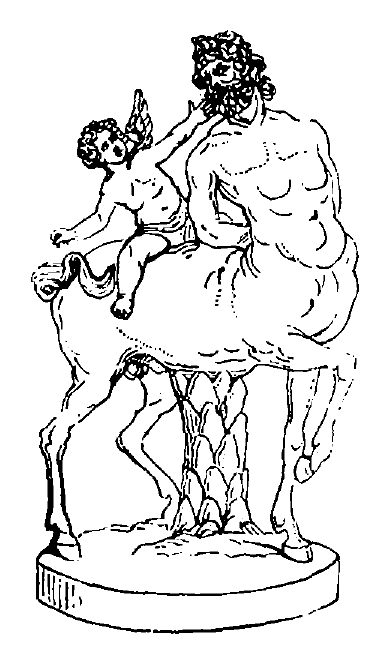
4. The Erymantian Boar.—The fourth task imposed upon Heracles by Eurystheus was to bring alive to Mycenæ the Erymantian boar, which had laid waste the region of Erymantia, and was the scourge of the surrounding neighbourhood.
On his way thither he craved food and shelter of a Centaur named Pholus, who received him with generous hospitality, setting before him a good and plentiful repast. When Heracles expressed his surprise that at such a well-furnished board wine should be wanting, his host explained that the wine-cellar was the common property of all the Centaurs, and that it was against the rules for a cask to be broached, except all were present to partake of it. By dint of persuasion, however, Heracles prevailed on his kind host to make an exception in his favour; but the powerful, luscious odour of the good old wine soon spread over the mountains, and brought large numbers of Centaurs to the spot, all armed with huge rocks and fir-trees. Heracles drove them back with fire-brands, and then, following up his victory, pursued them with his arrows as far as Malea, where they took refuge in the cave of the kind old Centaur Chiron. Unfortunately, however, as Heracles was shooting at them with his poisoned darts, one of these pierced the knee of Chiron. When Heracles discovered that it was the friend of his early days that he had wounded, he was overcome with sorrow and regret. He at once extracted the arrow, and anointed the wound with a salve, the virtue of which had been taught him by Chiron himself. But all his efforts were unavailing. The wound, imbued with the deadly poison of the Hydra, was incurable, and so great was the agony of Chiron that, at the intercession of Heracles, death was sent him by the gods; for otherwise, being immortal, he would have been doomed to endless suffering.
Pholus, who had so kindly entertained Heracles, also perished by means of one of these arrows, which he had extracted from the body of a dead Centaur. While he was quietly examining it, astonished that so small and insignificant an object should be productive of such serious results, the arrow fell upon his foot and fatally wounded him. Full of grief at this untoward event, Heracles buried him with due honours, and then set out to chase the boar.
With loud shouts and terrible cries he first drove him out of the thickets into the deep snow-drifts which covered the summit of the mountain, and then, having at length wearied him with his incessant pursuit, he captured the exhausted animal, bound him with a rope, and brought him alive to Mycenæ.
5. Cleansing the Stables of Augeas.—After slaying the Erymantian boar Eurystheus commanded Heracles to cleanse in one day the stables of Augeas.
Augeas was a king of Elis who was very rich in herds. Three thousand of his cattle he kept near the royal palace in an inclosure where the refuse had accumulated for many years. When Heracles presented himself before the king, and offered to cleanse his stables in one day, provided he should receive in return a tenth part of the herds, Augeas, thinking the feat impossible, accepted his offer in the presence of his son Phyleus.
Near the palace were the two rivers Peneus and Alpheus, the streams of which Heracles conducted into the stables by means of a trench which he dug for this purpose, and as the waters rushed through the shed, they swept away with them the whole mass of accumulated filth.
But when Augeas heard that this was one of the labours imposed by Eurystheus, he refused the promised guerdon. Heracles brought the matter before a court, and called Phyleus as a witness to the justice of his claim, whereupon Augeas, without waiting for the delivery of the verdict, angrily banished Heracles and his son from his dominions.
6. The Stymphalides.—The sixth task was to chase away the Stymphalides, which were immense birds of prey who, as we have seen (in the legend of the Argonauts), shot from their wings feathers sharp as arrows. The home of these birds was on the shore of the lake Stymphalis, in Arcadia (after which they were called), where they caused great destruction among men and cattle.
On approaching the lake, Heracles observed great numbers of them; and, while hesitating how to commence the attack, he suddenly felt a hand on his shoulder. Looking round he beheld the majestic form of Pallas-Athene, who held in her hand a gigantic pair of brazen clappers made by Hephæstus, with which she presented him; whereupon he ascended to the summit of a neighbouring hill, and commenced to rattle them violently. The shrill noise of these instruments was so intolerable to the birds that they rose into the air in terror, upon which he aimed at them with his arrows, destroying them in great numbers, whilst such as escaped his darts flew away, never to return.
7. The Cretan Bull.—The seventh labour of Heracles was to capture the Cretan bull.
Minos, king of Crete, having vowed to sacrifice to Poseidon any animal which should first appear out of the sea, the god caused a magnificent bull to emerge from the waves in order to test the sincerity of the Cretan king, who, in making this vow, had alleged that he possessed no animal, among his own herds, worthy the acceptance of the mighty sea-god. Charmed with the splendid animal sent by Poseidon, and eager to possess it, Minos placed it among his herds, and substituted as a sacrifice one of his own bulls. Hereupon Poseidon, in order to punish the cupidity of Minos, caused the animal to become mad, and commit such great havoc in the island as to endanger the safety of the inhabitants. When Heracles, therefore, arrived in Crete for the purpose of capturing the bull, Minos, far from opposing his design, gladly gave him permission to do so.
The hero not only succeeded in securing the animal, but tamed him so effectually that he rode on his back right across the sea as far as the Peloponnesus. He now delivered him up to Eurystheus, who at once set him at liberty, after which he became as ferocious and wild as before, roamed all over Greece into Arcadia, and was eventually killed by Theseus on the plains of Marathon.
8. The Mares of Diomedes.—The eighth labour of Heracles was to bring to Eurystheus the mares of Diomedes, a son of Ares, and king of the Bistonians, a warlike Thracian tribe. This king possessed a breed of wild horses of tremendous size and strength, whose food consisted of human flesh, and all strangers who had the misfortune to enter the country were made prisoners and flung before the horses, who devoured them.
When Heracles arrived he first captured the cruel Diomedes himself, and then threw him before his own mares, who, after devouring their master, became perfectly tame and tractable. They were then led by Heracles to the sea-shore, when the Bistonians, enraged at the loss of their king, rushed after the hero and attacked him. He now gave the animals in charge of his friend Abderus, and made such a furious onslaught on his assailants that they turned and fled.
But on his return from this encounter he found, to his great grief, that the mares had torn his friend in pieces and devoured him. After celebrating due funereal rites to the unfortunate Abderus, Heracles built a city in his honour, which he named after him. He then returned to Tiryns, where he delivered up the mares to Eurystheus, who set them loose on Mount Olympus, where they became the prey of wild beasts.
It was after the performance of this task that Heracles joined the Argonauts in their expedition to gain possession of the Golden Fleece, and was left behind at Chios, as already narrated. During his wanderings he undertook his ninth labour, which was to bring to Eurystheus the girdle of Hippolyte, queen of the Amazons.
9. The Girdle of Hippolyte.—The Amazons, who dwelt on the shores of the Black Sea, near the river Thermodon, were a nation of warlike women, renowned for their strength, courage, and great skill in horsemanship. Their queen, Hippolyte, had received from her father, Ares, a beautiful girdle, which she always wore as a sign of her royal power and authority, and it was this girdle which Heracles was required to place in the hands of Eurystheus, who designed it as a gift for his daughter Admete.
Foreseeing that this would be a task of no ordinary difficulty the hero called to his aid a select band of brave companions, with whom he embarked for the Amazonian town Themiscyra. Here they were met by queen Hippolyte, who was so impressed by the extraordinary stature and noble bearing of Heracles that, on learning his errand, she at once consented to present him with the coveted girdle. But Hera, his implacable enemy, assuming the form of an Amazon, spread the report in the town that a stranger was about to carry off their queen. The Amazons at once flew to arms and mounted their horses, whereupon a battle ensued, in which many of their bravest warriors were killed or wounded. Among the latter was their most skilful leader, Melanippe, whom Heracles afterwards restored to Hippolyte, receiving the girdle in exchange.
On his voyage home the hero stopped at Troy, where a new adventure awaited him.
During the time that Apollo and Poseidon were condemned by Zeus to a temporary servitude on earth, they built for king Laomedon the famous walls of Troy, afterwards so renowned in history; but when their work was completed the king treacherously refused to give them the reward due to them. The incensed deities now combined to punish the offender. Apollo sent a pestilence which decimated the people, and Poseidon a flood, which bore with it a marine monster, who swallowed in his huge jaws all that came within his reach.
In his distress Laomedon consulted an oracle, and was informed that only by the sacrifice of his own daughter Hesione could the anger of the gods be appeased. Yielding at length to the urgent appeals of his people he consented to make the sacrifice, and on the arrival of Heracles the maiden was already chained to a rock in readiness to be devoured by the monster.
When Laomedon beheld the renowned hero, whose marvellous feats of strength and courage had become the wonder and admiration of all mankind, he earnestly implored him to save his daughter from her impending fate, and to rid the country of the monster, holding out to him as a reward the horses which Zeus had presented to his grandfather Tros in compensation for robbing him of his son Ganymede.
Heracles unhesitatingly accepted the offer, and when the monster appeared, opening his terrible jaws to receive his prey, the hero, sword in hand, attacked and slew him. But the perfidious monarch once more broke faith, and Heracles, vowing future vengeance, departed for Mycenæ, where he presented the girdle to Eurystheus.
10. The Oxen of Geryones.—The tenth labour of Heracles was the capture of the magnificent oxen belonging to the giant Geryon or Geryones, who dwelt on the island of Erythia in the bay of Gadria (Cadiz). This giant, who was the son of Chrysaor, had three bodies with three heads, six hands, and six feet. He possessed a herd of splendid cattle, which were famous for their size, beauty, and rich red colour. They were guarded by another giant named Eurytion, and a two-headed dog called Orthrus, the offspring of Typhon and Echidna.
In choosing for him a task so replete with danger, Eurystheus was in hopes that he might rid himself for ever of his hated cousin. But the indomitable courage of the hero rose with the prospect of this difficult and dangerous undertaking.
After a long and wearisome journey he at last arrived at the western coast of Africa, where, as a monument of his perilous expedition, he erected the famous "Pillars of Hercules," one of which he placed on each side of the Straits of Gibraltar. Here he found the intense heat so insufferable that he angrily raised his bow towards heaven, and threatened to shoot the sun-god. But Helios, far from being incensed at his audacity, was so struck with admiration at his daring that he lent to him the golden boat with which he accomplished his nocturnal transit from West to East, and thus Heracles crossed over safely to the island of Erythia.
No sooner had he landed than Eurytion, accompanied by his savage dog Orthrus, fiercely attacked him; but Heracles, with a superhuman effort, slew the dog and then his master. Hereupon he collected the herd, and was proceeding to the sea-shore when Geryones himself met him, and a desperate encounter took place, in which the giant perished.
Heracles then drove the cattle into the sea, and seizing one of the oxen by the horns, swam with them over to the opposite coast of Iberia (Spain). Then driving his magnificent prize before him through Gaul, Italy, Illyria, and Thrace, he at length arrived, after many perilous adventures and hair-breadth escapes, at Mycenæ, where he delivered them up to Eurystheus, who sacrificed them to Hera.
Heracles had now executed his ten tasks, which had been accomplished in the space of eight years; but Eurystheus refused to include the slaying of the Hydra and the cleansing of the stables of Augeas among the number, alleging as a reason that the one had been performed by the assistance of Iolaus, and that the other had been executed for hire. He therefore insisted on Heracles substituting two more labours in their place.
11. The Apples of the Hesperides.—The eleventh task imposed by Eurystheus was to bring him the golden apples of the Hesperides, which grew on a tree presented by Gæa to Hera, on the occasion of her marriage with Zeus. This sacred tree was guarded by four maidens, daughters of Night, called the Hesperides, who were assisted in their task by a terrible hundred-headed dragon. This dragon never slept, and out of its hundred throats came a constant hissing sound, which effectually warned off all intruders. But what rendered the undertaking still more difficult was the complete ignorance of the hero as to the locality of the garden, and he was forced, in consequence, to make many fruitless journeys and to undergo many trials before he could find it.
He first travelled through Thessaly and arrived at the river Echedorus, where he met the giant Cycnus, the son of Ares and Pyrene, who challenged him to single combat. In this encounter Heracles completely vanquished his opponent, who was killed in the contest; but now a mightier adversary appeared on the scene, for the war-god himself came to avenge his son. A terrible struggle ensued, which had lasted some time, when Zeus interfered between the brothers, and put an end to the strife by hurling a thunderbolt between them. Heracles proceeded on his journey, and reached the banks of the river Eridanus, where dwelt the Nymphs, daughters of Zeus and Themis. On seeking advice from them as to his route, they directed him to the old sea-god Nereus, who alone knew the way to the Garden of the Hesperides. Heracles found him asleep, and seizing the opportunity, held him so firmly in his powerful grasp that he could not possibly escape, so that notwithstanding his various metamorphoses he was at last compelled to give the information required. The hero then crossed over to Libya, where he engaged in a wrestling-match with king Anteos, son of Poseidon and Gæa, which terminated fatally for his antagonist.
From thence he proceeded to Egypt, where reigned Busiris, another son of Poseidon, who (acting on the advice given by an oracle during a time of great scarcity) sacrificed all strangers to Zeus. When Heracles arrived he was seized and dragged to the altar; but the powerful demi-god burst asunder his bonds, and then slew Busiris and his son.
Resuming his journey he now wandered on through Arabia until he arrived at Mount Caucasus, where Prometheus groaned in unceasing agony. It was at this time that Heracles (as already related) shot the eagle which had so long tortured the noble and devoted friend of mankind. Full of gratitude for his deliverance, Prometheus instructed him how to find his way to that remote region in the far West where Atlas supported the heavens on his shoulders, near which lay the Garden of the Hesperides. He also warned Heracles not to attempt to secure the precious fruit himself, but to assume for a time the duties of Atlas, and to despatch him for the apples.
On arriving at his destination Heracles followed the advice of Prometheus. Atlas, who willingly entered into the arrangement, contrived to put the dragon to sleep, and then, having cunningly outwitted the Hesperides, carried off three of the golden apples, which he now brought to Heracles. But when the latter was prepared to relinquish his burden, Atlas, having once tasted the delights of freedom, declined to resume his post, and announced his intention of being himself the bearer of the apples to Eurystheus, leaving Heracles to fill his place. To this proposal the hero feigned assent, merely begging that Atlas would be kind enough to support the heavens for a few moments whilst he contrived a pad for his head. Atlas good-naturedly threw down the apples and once more resumed his load, upon which Heracles bade him adieu, and departed.
When Heracles conveyed the golden apples to Eurystheus the latter presented them to the hero, whereupon Heracles placed the sacred fruit on the altar of Pallas-Athene, who restored them to the garden of the Hesperides.
12. Cerberus.—The twelfth and last labour which Eurystheus imposed on Heracles was to bring up Cerberus from the lower world, believing that all his heroic powers would be unavailing in the Realm of Shades, and that in this, his last and most perilous undertaking, the hero must at length succumb and perish.
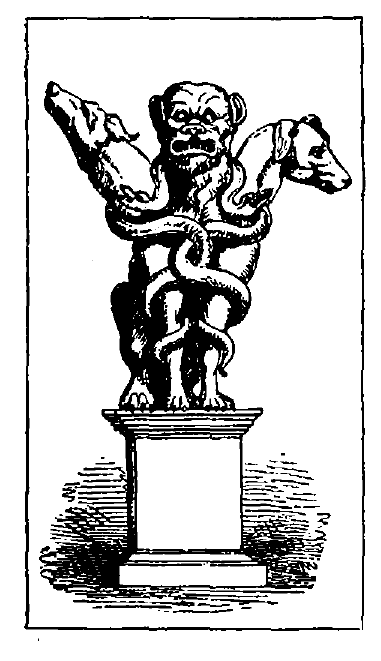
Cerberus was a monster dog with three heads, out of whose awful jaws dripped poison; the hair of his head and back was formed of venomous snakes, and his body terminated in the tail of a dragon.
After being initiated into the Eleusinian Mysteries, and obtaining from the priests certain information necessary for the accomplishment of his task, Heracles set out for Tænarum in Lacolia, where there was an opening which led to the under-world. Conducted by Hermes, he commenced his descent into the awful gulf, where myriads of shades soon began to appear, all of whom fled in terror at his approach, Meleager and Medusa alone excepted. About to strike the latter with his sword, Hermes interfered and stayed his hand, reminding him that she was but a shadow, and that consequently no weapon could avail against her.
Arrived before the gates of Hades he found Theseus and Pirithöus, who had been fixed to an enchanted rock by Aïdes for their presumption in endeavouring to carry off Persephone. When they saw Heracles they implored him to set them free. The hero succeeded in delivering Theseus, but when he endeavoured to liberate Pirithöus, the earth shook so violently beneath him that he was compelled to relinquish his task.
Proceeding further Heracles recognized Ascalaphus, who, as we have seen in the history of Demeter, had revealed the fact that Persephone had swallowed the seeds of a pomegranate offered to her by her husband, which bound her to Aïdes for ever. Ascalaphus was groaning beneath a huge rock which Demeter in her anger had hurled upon him, and which Heracles now removed, releasing the sufferer.
Before the gates of his palace stood Aïdes the mighty ruler of the lower world, and barred his entrance; but Heracles, aiming at him with one of his unerring darts, shot him in the shoulder, so that for the first time the god experienced the agony of mortal suffering. Heracles then demanded of him permission to take Cerberus to the upper-world, and to this Aïdes consented on condition that he should secure him unarmed. Protected by his breastplate and lion's skin Heracles went in search of the monster, whom he found at the mouth of the river Acheron. Undismayed by the hideous barking which proceeded from his three heads, he seized the throat with one hand and the legs with the other, and although the dragon which served him as a tail bit him severely, he did not relinquish his grasp. In this manner he conducted him to the upper-world, through an opening near Troezen in Argolia.
When Eurystheus beheld Cerberus he stood aghast, and despairing of ever getting rid of his hated rival, he returned the hell-hound to the hero, who restored him to Aïdes, and with this last task the subjection of Heracles to Eurystheus terminated.