Chapter II · MYTHS AND FOLK-LORE OF THE TIMAGAMI OJIBWA.
Reading edition
[
Contents
]
Introduction.
In the following pages are presented the myths and items of folk-lore related by various informants through Aleck Paul, the second chief of the Timagami band of Ojibwa. I present them without any comparisons with other mythologies at this time, as we may expect before long to have more northern Algonkian mythology available for study and analysis.
[
Contents
]
(1) Nenebuc, the Transformer.
So the old man put the dish upside down before the fire. The first morning he lifted the edge of the dish, looked under, and there he saw Nenebuc, the child of the sun, sitting. The next morning he did the same thing and he saw Nenebuc’s brother sitting with him. He kept doing this the third, fourth, and fifth mornings, until there were Nenebuc and his four brothers all sitting under the dish. Then the old man picked up the dish. One of the brothers, the second brother, had horns on his head and the old man said to him, “You won’t stay here. You go to the west.” Then he sent one brother to the east, one to the south, and one to the north. So Nenebuc, the eldest of the five, was left. The old man told him to attend to the world and to keep the winds going just right lest the water get stagnant and bad. Then Nenebuc stayed, and his four brothers started to the four parts of the earth.
One day Nenebuc asked his grandfather, “Where have I been born? Had I a mother like other people?” His grandfather would not tell him, but his grandmother told him that he had been found. This appeared queer to Nenebuc and he thought to himself, “The other people have mothers, but I have none. I must find out.” So he took a whetstone and, scraping it on a rock, he asked it, “Have I any mother?” “Yes, you have a mother,” replied the whetstone and then it told him his story. Then Nenebuc told his grandfather, “I have a mother and four brothers besides. The whetstone told me so.”
Soon Nenebuc began growing larger and he thought it strange that he had not been sent out into the world like his brothers, so he asked his grandfather for what reason he had kept him. His grandfather told him that he had kept him at home so that when he became old and feeble Nenebuc would be able to help him, cut wood for him, and hunt for him. This satisfied Nenebuc and he used to help his grandfather in many ways, spearing fish for him in calm days, hunting for him, and doing many other things. He never got into any mischief and he grew very fast.
(b) Nenebuc Tempers the Wind.
One summer Nenebuc was unable to get fish for the whole summer on account of the high winds. The people almost starved, and then Nenebuc became very angry. He did not like to see his grandfather starving and his anger was aroused against the West Wind for blowing so much. So he told his grandfather that he was going to kill the West Wind for this, but the old man said to him, “Don’t kill him. Make him let the wind blow a while and then stop, so that everything will be all right, but don’t kill him.” “Well, I won’t be long away and I’ll punish my brother”, replied Nenebuc.
(c) Nenebuc Starts Travelling, Anum Suum Castigat for Deceiving Him, Changes the Colour of the Partridge Family, and Originates Rock Tripe from his Scabs for the Benefit of the People.
When Nenebuc awoke, anum suum interrogavit, “Did any one come?” “I don’t know,” anus ejus respondit. “As soon as you fell asleep, I slept. I don’t know.” Nenebuc then pulled up the legs of the geese and found nothing else. “It’s well cooked,” said he. He made a big fire. “Now I’ll punish you,” ano suo dixit and he held it over the fire. “Tcį·′įį!” clamavit anus ejus. “You can cry all you want to. I’ll punish you,” said Nenebuc, ano suo strepitum urendi faciente. He didn’t feel the burns then. Then he started walking.
By and by he came upon a brood of young partridges and said, “Where is your mother?” “Our mother is away,” said they. “What’s your names?” They answered “Kαckuŋge′s·i” (“Jump out and frighten”). Nenebuc turned around upon hearing this and super totam familiam defaecavit. Up to this time the Partridges had been white, but after this they have always been brown.
(d) Nenebuc Prepares a Feast and Gets Caught Between Two Trees, While the Animals Receive a Distribution of Fat.
After this Nenebuc began travelling again. One time he feasted a lot of animals. He had killed a big bear, which was very fat and he began cooking it, having made a fire with his bow-drill. When he was ready to spread his meat, he heard two trees scraping together, swayed by the wind. He didn’t like this noise while he was having his feast and he thought he could stop it. He climbed up one of the trees and when he reached the spot where the two trees were scraping, his foot got caught in a crack between the trees and he could not free himself.
When the first animal guest came along and saw Nenebuc in the tree, he, the Beaver, said “Come on to the feast, Nenebuc is caught and can’t stop us.” And then the other animals came. The Beaver jumped into the grease and ate it, and the Otter did the same, and that is why they are so fat in the belly. The Beaver scooped up the grease and smeared it on himself, and that is the reason why he is so fat now. All the small animals came and got fat for themselves. Last of all the animals came the Rabbit, when nearly all the grease was gone—only a little left. So he put some on the nape of his neck and some on his groin and for this reason he has only a little fat in those places. So all the animals got their fat except Rabbit. Then they all went, and poor Nenebuc got free at last. He looked around and found a bear’s skull that was all cleaned except for the brain, and there was only a little of that left, but he couldn’t get at it. Then he wished himself to be changed into an ant in order to get into the skull and get enough to eat, for there was only about an ant’s meal left.
(e) Nenebuc Gets Caught in the Bear’s Skull.
Then he became an ant and entered the skull. When he had enough he turned back into a man, but he had his head inside the skull; this allowed him to walk but not to see. On account of this he had no idea where he was. Then he felt the trees. He said to one, “What are you?” It answered, “Cedar.” He kept doing this with all the trees in order to keep his course. When he got too near the shore, he knew it by the kind of trees he met. So he kept on walking and the only tree that did not answer promptly was the black spruce, and that said, “I’m Se·′se·ga‵ndαk” (black spruce). Then Nenebuc knew he was on low ground. He came to a lake, but he did not know how large it was, as he couldn’t see. He started to swim across. An Ojibwa was paddling on the lake with his family and he heard someone calling, “Hey! There’s a bear swimming across the lake.” Nenebuc became frightened at this and the Ojibwa then said, “He’s getting near the shore now.” So Nenebuc swam faster, and as he could understand the Ojibwa language, he guided himself by the cries. He landed on a smooth rock, slipped and broke the bear’s skull, which fell off his head. Then the Ojibwa cried out, “That’s no bear! That’s Nenebuc!” Nenebuc was all right, now that he could see, so he ran off, as he didn’t want to stay with these people.
(f) Nenebuc Wounds the Giant Lynx, Disguises Himself in a Toad’s Skin, and Finally Slays Her.
As he went along the shore, the next morning, he heard someone singing and shaking a rattle. Nenebuc stood there wondering and waiting, and pretty soon he saw an old woman making the song. So he went across to see her, and when they met, he asked her, “What are you doing?” “I’m a doctor,” she answered. “The queen of the Lions has been shot by Nenebuc and I am going to cure her.” She didn’t know that it was Nenebuc to whom she was talking, for she was too old. So Nenebuc told her, “Let me hear you singing. Is that what you are going to do to cure her?” “Yes, I will sing and then pull out that arrow.” The Lions had sent for her at the foot of the lake to cure the queen. Nenebuc picked up a club and killed her, saying, “You are no doctor (macki·ki·′winini‵k·we ‘medicine-person woman’) at all.” Then he discovered that she was no person at all, but a big toad (omα′kαk·i·‵). So he skinned her and put on the skin. The skin had a hole in the groin, and as he had no needle to sew it up with, his scrotum hung out when he put it on himself. This did not worry Nenebuc, for he thought, “It will be all right, unless they notice me too closely.” So he walked past the cave in which the Lions lived and kept singing and rattling all the time.
When he had finished eating, Nenebuc said, “Don’t watch me. I’m going to pull out the arrow point. You will hear her suffering and me singing, but don’t look until you hear her stop suffering. Then she will be cured, and the arrow point will be out. So don’t look, for I am going to cure her.” Then he began rattling and singing, and, as he did so, he shoved the arrow point farther into the wound of the queen in order to kill her. When she yelled, her people thought that the hurt was caused in pulling it out. At last one of the little lion children peeped and saw Nenebuc pushing the arrow farther in. He told his sister, “That’s Nenebuc himself inside!” Then Nenebuc ran outside and the Queen Lion was dying. Nenebuc had difficulty to clear himself. He pulled off the toad skin and tried to climb up the rock.
(g) The Giant Lynx Causes the World Flood and Gathers the Animals on a Raft; Muskrat Dives for Earth, which Nenebuc Transforms into a New World.
Seven days after this he allowed the Muskrat to try and bring the land. Muskrat dove and they waited for a long time, but he didn’t come up. This Muskrat doubled up and put his nose into the hair of his breast which enabled him to breathe by the bubbles clinging there. By doing this he could rest and dive still deeper. At last he used up all the air in his breast hair and could only grab a little piece of mud. Then he started up to the surface of the water, but drowned before he reached the raft. Nenebuc pulled the Muskrat in and he still was holding the mud. Nenebuc said, “I am going to dry this. As soon as it is dry, you can all run around again and have this world.” So he dried it, but not entirely, and that is the reason why some parts of the world are swampy and wet, while others are dry like this. So the animals had the earth again and the world was made.
(h) Nenebuc Sends Crow Out, for Disobedience Changes Him Black and Gull Partly Black, then Retires to the West, until He Will Return Again.
Nenebuc knew the world was round like a ball, but he didn’t know how large it was. He was sitting down, tired. So he said to Crow, “Go fly around the world and don’t eat until you come back again. If you do, we will know it.” Crow at that time was white. Crow had to do as he was told, because Nenebuc was chief of all men and animals. So Crow started and flew and flew along the salt water beach. Soon he became very hungry and wondered how far he was away from Nenebuc. One morning he was flying along the shore and he saw an old dead fish. He was so hungry that he tasted a little bit of it, and finally made a meal of it. When he finished eating, he found he had turned black. This is the way Crow became black.
When Crow reached the place from which he started out, he found Nenebuc and all the animals waiting for him. He told Nenebuc that he had eaten, and then Nenebuc said to Gull, “You go try. Do the same and don’t eat until you come here.” So Gull went. When he got to the same place at which Crow had felt hungry, Gull felt hungry. One morning he saw the same dead fish. He thought, “Well, I mustn’t eat it, for if I do, I’ll be as black as Crow.” He took one mouthful and started flying. When Gull returned, Nenebuc could see a little black on his wings, so he said, “Gull has had a mouthful too.”
Then Nenebuc let all the animals go from the raft. He started west and is there yet, lying on his back, singing and hammering at his wigwam poles, in place of drumming, all the time. He will stay there until he gets up again three years before the end of the world, when he will travel all over the world to see the animals and the Ojibwa again. He will not die until the end of the world.
Once the Goose met Nenebuc and gave him two wings. He told him that if he flapped them he could fly with them, but that he must not look downwards while he flew. So Nenebuc took the wings and began flying. When he got very far up, he wondered how high he was and looked down. Then he tumbled down and down until he fell into a big hollow stump where he couldn’t get out. Soon two girls came along with an axe to get some wood and began cutting at the hollow pine in which Nenebuc was. They cut a hole and Nenebuc kept quiet, for he was hoping they would free him. When they looked in the hole, they saw his belly and they pulled out a hair. They went back to camp and told their father, “Here is a porcupine quill we found in a tree.” The old man looked at it and, laughing, said, “That’s not a porcupine quill, that’s a hair from Nenebuc’s groin!”
Nenebuc in his tracks encountered the great Bear that killed and ate the Indians—so many of them that they feared they would all be killed. So Nenebuc went to the Bear and said, “You are eating so many of the Indians that they will all be gone soon. Now I am going to make you small and harmless.” Then he made him into the Squirrel and turned the Squirrel into the Bear, and the Bear, now in Squirrel’s shape, felt so badly that he cried until his eyebrows turned grey. That is the reason why to this day squirrels have grey eyelids.
“Now,” said Nenebuc, “what will you eat?” The Bear, now a Squirrel, said he would continue to eat people, but he was so small that he could not do anything. “That is good,” said Nenebuc. “Now you can’t do any harm to the Indians. But you had better change your food. Just run up that black-spruce tree and taste the acorn seeds and then see whether you want to eat people any more. You are too small to eat people as you used to do.” So the Squirrel ran up the black-spruce tree and tasted the sweet seed of the cone. He liked it so well, it tasted so sweet, that he chose this for his food and said that he would not want anything better any more. That is his food to-day.
(4) Wemicus.
Wemicus had a very large family. Many of his children had married the different animals who lived in various parts of the surrounding country. By and by he had nearly all kinds of animals for his sons-in-law, and there were still a great many children left in his family. When winter came, Wemicus was unable to support his family, as there were too many of them. They were all living in one wigwam.
The next morning, when Wemicus started for home, he was given some rice soup to take home to his children. Before leaving the wigwam of Ninicip, however, Wemicus had purposely left behind one of his mittens. One of the children saw the mitten and Ninicip’s wife sent the child to return it, bidding him not to go too close to Wemicus but to throw him the mitten. The child did the bidding of his mother and, when the mitten was thrown to Wemicus, he said, “Ask your father to come and see me,” and he named a certain day. On the way back home Wemicus thought, “I wonder what this soup tastes like when it is cold. I must try it. My children don’t need any of it, so I might as well eat it all.” So he ate all of the soup. When he reached his wigwam he said, “Ninicip and his family are starving also. To-morrow he will come to see us and perhaps he will bring us something. We had better fix up our wigwam.” Then they fixed up the wigwam in the same manner as that of Ninicip. The next day Ninicip came and they gave him the best place. Wemicus said to his wife, “We’ll get ready to eat now. Put some water in the stone pail.” “There is no use putting any water in the pail,” answered his wife, “we have nothing to cook.” “Well, bring the pail, anyway, and get some spoons,” said Wemicus. When the water began boiling, Wemicus jumped up on the cross-poles, in vas defaecavit, all over his children and the inside of the wigwam. Then Ninicip went out. His wife scolded Wemicus, saying, “You always do something like that. You must have seen someone do that.” Then Wemicus kept quiet and everything had to be cleaned up. The wife then invited Ninicip to come in again and he told her that he would fix up the meal. Igituo interum in vas defaecavit and they had good rice soup, and everyone, even Wemicus, had a good meal. The following morning Ninicip made soup for the family again and then went home. Soon Wemicus and his family were starving again and Wemicus said, “I must go and see my son-in-law, Muskrat. He lives not far away.” “All right,” said his wife and Wemicus set out. When he had almost reached Muskrat’s home, the little Muskrat children called out, “Our grandfather is coming.” Wemicus told Muskrat that he was starving and Muskrat said to his wife, “You had better make a fire in the hot sand.” So the fire was made, and Muskrat went out with a big sack made out of hide and returned with the sack full of ice, which he dumped into the hot ashes. Wemicus expected that it would explode but it only cooked nicely. Wemicus wondered what it was. Soon Muskrat said, “We are ready now,” and they took off the sand and there were a lot of nicely baked potatoes. Wemicus thought that was an easy way in which to live—just to get ice for potatoes.
Next morning Wemicus started out for home and left his mitten behind as he had done with Ninicip. Muskrat’s wife sent a child after him and told the child, “Don’t go too close to Wemicus. He’s always in mischief.” Everything happened as before. The child threw the mitten to Wemicus and Wemicus sent an invitation to Muskrat to come to his home the next day. As Wemicus went on his way he had some potatoes which Muskrat had given him for his family. Half way home he rested and thought he would eat the potatoes, as they looked very good. So he ate every one. “I am the one who works hard,” he said to himself. “My family can wait until Muskrat comes.” When he reached home he told his wife, “Muskrat is also starving. I brought nothing. Muskrat is coming tomorrow to see us.” Next day Muskrat came and they put him on the opposite side of the wigwam. Wemicus said, “We have nothing much, but, wife, make a fire in the hot sand.” The wife answered, “I suppose you saw somebody else do something. Don’t you try any more mischief.” But he made his wife make the fire. He then went out and returned with the sack full of ice, which he dumped on the fire. The sack blew up all over everybody and put out the fire. Then his wife said, “I suppose you saw someone do that again.” She made another fire and Muskrat said, “Give me that bag.” He went out and brought back the sack full of ice, dumped and buried it in the fire, and, after a while, they got the potatoes. All of them had a good meal. The next morning, before Muskrat left, he got them another bag of potatoes.
The next morning they had another raccoon to eat. Then everything happened as before. Wemicus was given a raccoon to take home. He left his mitten behind, and sent an invitation to Meme to visit him the next day. On the way home Wemicus thought to himself, “I wonder how this raccoon tastes cold.” So he ate the entire raccoon. When he got home, he told his wife that Meme was starving but that he was coming to visit them the following day. They put the wigwam in order and Wemicus fixed up a big pine like that belonging to Meme and cut two pieces of wood, which he pointed and shoved into his nose to imitate Meme. When Meme came along he saw Wemicus sitting there with sticks in his nose. Wemicus told his wife, as usual, to prepare for supper, and she told him that they had nothing. When she had the water boiling in the pail, Wemicus climbed up the tree and pecked upon it in imitation of Meme. He fell down, however, and drove the sticks into his head. He fell into the fire, but after a while he gained consciousness. Then Meme stepped out of the wigwam, climbed the tree, and brought down a raccoon. And then the whole family had a good supper. Next morning Meme got another raccoon and left it for the family, and then went home.
In the morning Skunk said to Wemicus, “I’ll give you three shots and a horn. You can make a fence for yourself. This horn will last forever, as long as you don’t lose it. If you do, it will be bad.” Then Skunk gave Wemicus three shots to be used in the future, and he did this urinando super eum to load him up three times. He did not give him any food, because he would be able to get enough for himself. Then Wemicus thought, “Now I am going to do something.” As Wemicus was on his way home he said to himself, “I wonder if it will go off!” So, just as he was passing a tree stump, pepedit at the stump and blew it up. “That’s fine, but I have only two more shots left,” said he. Later he tried the same thing and then only had one left. A little while after this he saw a big pine tree, and thought he would try a shot at this. So he blew up the pine tree, and so used up all his shots.
When he reached his wigwam, he showed his wife the horn which Skunk had given him, saying, “Skunk gave me that.” Then he built a large fence of poles. He told his wife to hold the horn and stay near by, while he got a club to kill the game with. Then he blew on the horn and the fence was filled with bear, deer, and all kinds of animals. Although he had no shots left, Wemicus managed to kill one caribou, and his wife was very happy. He cut the fat from the breast of the caribou, made a fire, and got some grease from it. He then spilled the caribou grease in his water hole in order to deceive Skunk and make him believe that he had a great quantity of meat. Not long after this Skunk started out to visit Wemicus and, on his way, he passed the three stumps which Wemicus had blown up and knew that he had no more shots left. When he reached Wemicus’ water hole he said, “I guess he got one any way.” When he came to the wigwam, he found that Wemicus and his family had hardly any meat left, so he said to Wemicus, “Come out and let me see your fence.” They went out and Wemicus blew his horn, and inside the fence it became full of game. Skunk pepedit and killed all of them, and then Wemicus and his family had plenty. Skunk stayed over night and departed the next morning.
The next morning the man started on and left Wemicus there with no shoes. Wemicus started to work. He got a big boulder, made a fire, and placed the boulder in it until it became red hot. He then wrapped his feet with spruce boughs and pushed the boulder ahead of him in order to melt the snow. In this way he managed to walk on the boughs. Then he began to sing, “Spruce is warm, spruce is warm.” When the man reached home he told his wife what had happened. “I hope Wemicus will die,” she said. A little while after this, they heard Wemicus coming along singing, “Spruce is warm, spruce is warm.” He came into the wigwam and, as he was the head man, they were obliged to get his meal ready.
The ice was getting bad by this time, so they stayed in camp a while. Soon Wemicus told his son-in-law, “We’d better go sliding.” He then went to a hill where there were some very poisonous snakes. The man’s wife warned her husband of these snakes and gave him a split stick holding a certain kind of magic tobacco, which she told him to hold in front of him so that the snakes would not hurt him. Then the two men went sliding. At the top of the hill Wemicus said, “Follow me,” for he intended to pass close by the snakes’ lair. So when they slid, Wemicus passed safely and the man held his stick with the tobacco in it in front of him, thus preventing the snakes from biting him. The man then told Wemicus that he enjoyed the sliding.
The following day Wemicus said to his son-in-law, “We had better go to another place.” When she heard this, the wife told her husband that, as it was getting summer, Wemicus had in his head many poisonous lizards instead of lice. She said, “He will tell you to pick lice from his head and crack them in your teeth. But take low-bush cranberries and crack them instead.” So the man took cranberries along with him. Wemicus took his son-in-law to a valley with a great ravine in it. He said, “I wonder if anybody can jump across this?” “Surely,” said the young man, “I can.” Then the young man said, “Closer,” and the ravine narrowed and he jumped across easily. When Wemicus tried, the young man said “Widen,” and Wemicus fell into the ravine. But it did not kill him, and when he made his way to the top again, he said, “You have beaten me.” Then they went on.
They came to a place of hot sand and Wemicus said, “You must look for lice in my head.” “All right father,” replied the son-in-law. So Wemicus lay down and the man started to pick the lice. He took the cranberries from inside his shirt and each time he pretended to catch a louse, he cracked a cranberry and threw it on the ground, and so Wemicus got fooled a second time that day. Then they went home and Wemicus said to his son-in-law, “There are a whole lot of eggs on that rocky island where the gulls are. We will go get the eggs, come back, and have an egg supper.” As Wemicus was the head man, his son-in-law had to obey him.
So they started out in their canoe and soon came to the rocky island. Wemicus stayed in the canoe and told the man to go ashore and to bring the eggs back with him and fill the canoe. When the man reached the shore, Wemicus told him to go farther back on the island, saying, “That’s where the former husbands got their eggs, there are their bones.” He then started the canoe off in the water by singing, without using his paddle. Then Wemicus told the gulls to eat the man, saying to them, “I give you him to eat.” The gulls started to fly about the man, but the man had his paddle with him and he killed one of the gulls with it. He then took the gulls’ wings and fastened them on himself, filled his shirt with eggs, and started flying over the lake by the aid of the wings.
When he reached the middle of the lake, he saw Wemicus going along and singing to himself. Wemicus, looking up, saw his son-in-law but mistook him for a gull. Then the man flew over him and defecated in his face, and Wemicus said, “Gull’s excrement always smells like that when they have eaten a man.” The man flew back to camp and told his wife to cook the eggs, and he told his children to play with the wings. When Wemicus reached the camp, he saw the children playing with the wings and said, “Where did you get those wings?” “From father,” was the reply. “Your father? Why, the gulls ate him!” Then he went to the wigwam and there he saw the man smoking. Then Wemicus thought it very strange how the man could have gotten home, but no one told him how it had been done. Thought he, “I must try another scheme to do away with him.”
(5) Ciŋgibis.
At the time of which my story speaks people were camping just as we are here. In the winter time they used birch bark wigwams. All animals could then talk together. Two girls, who were very foolish, talked foolishly and were in no respect like the other girls of their tribe, made their bed out-of-doors, and slept right out under the stars. The very fact that they slept outside during the winter proves how foolish they were.
One of these girls asked the other, “With what star would you like to sleep, the white one or the red one?” The other girl answered, “I’d like to sleep with the red star.” “Oh, that’s all right,” said the first one, “I would like to sleep with the white star. He’s the younger; the red is the older.” Then the two girls fell asleep. When they awoke, they found themselves in another world, the star world. There were four of them there, the two girls and the two stars who had become men. The white star was very, very old and was grey-headed, while the younger was red-headed. He was the red star. The girls stayed a long time in this star world, and the one who had chosen the white star was very sorry, for he was so old.
The younger girl heard the noise of the mite′win down below. When it was almost daylight, the old woman sat over the hole again and the noise of mite′win stopped; it was her spirit that made the noise. She was the guardian of the mite′win.
One morning the old woman told the girls, “If you want to go down from where you came from, we will let you down, but get to work and gather roots to make a string-made rope, twisted. The two of you make coils of rope as high as your heads when you are sitting. Two coils will be enough.” The girls worked for days until they had accomplished this. They made plenty of rope and tied it to a big basket. They then got into the basket and the people of the star world lowered them down. They descended right into an Eagle’s nest, but the people above thought the girls were on the ground and stopped lowering them. They were obliged to stay in the nest, because they could do nothing to help themselves.
Said one, “We’ll have to stay here until some one comes to get us.” Bear passed by. The girls cried out, “Bear, come and get us. You are going to get married sometime. Now is your chance!” Bear thought, “They are not very good-looking women.” He pretended to climb up and then said, “I can’t climb up any further.” And he went away, for the girls didn’t suit him. Next came Lynx. The girls cried out again, “Lynx, come up and get us. You will go after women some day!” Lynx answered, “I can’t, for I have no claws,” and he went away. Then an ugly-looking man, Wolverine, passed and the girls spoke to him. “Hey, Wolverine, come and get us.” Wolverine started to climb up, for he thought it a very fortunate thing to have these women and was very glad. When he reached them, they placed their hair ribbons in the nest. Then Wolverine agreed to take one girl at a time, so he took the first one down and went back for the next. Then Wolverine went away with his two wives and enjoyed himself greatly, as he was ugly and nobody else would have him. They went far into the woods, and then they sat down and began to talk. “Oh!” cried one of the girls, “I forgot my hair ribbons.” Then Wolverine said, “I will run back for it.” And he started off to get the hair ribbons. Then the girls hid and told the trees, whenever Wolverine should come back and whistle for them, to answer him by whistling. Wolverine soon returned and began to whistle for his wives, and the trees all around him whistled in answer. Wolverine, realizing that he had been tricked, gave up the search and departed very angry.
The girls continued through the woods until they came to a big marsh, late in the afternoon. There they saw a big birch bark house. Everything around the house was very clean, the poles were scraped clean of their bark and were perfectly white, while there was neither smoke nor ashes to be seen anywhere. The girls looked at this and said, “The person who lives here must be very clean; we have never seen such a clean house.” There was no dry or green wood lying around, but inside the house they saw a fire-place and plenty of hay. One girl said to the other, “We’d better cut a little wood.” So they cut wood and made the fire in case the man came home late. By this time, the ice was beginning to break. Late in the evening they heard someone crying out, “Who spoiled my wigwam? Who made smoke and ashes?” The owner of the wigwam didn’t know who had done this, so he came in and looked at the two girls. He then cut all the wood. This man was Woodpecker (Meme “pileated woodpecker”). Woodpecker made a fire of the hay, which was beaver hay. It gave no smoke to stain the wigwam and burned as well as wood. He brought in two nice beavers which belonged to him, and gave one to the girls, saying, “You can have this.” He then cooked the other one for himself. He showed the girls where to sleep and since the place where they were to sleep was not near him, they knew that he would not marry either of them.
Next morning, after breakfast, he said to them, “Go! Don’t stay here. You go that way and you will find a big river. There you’ll find lots of people and maybe you’ll get married.” So the girls went on. They left Woodpecker and he is there yet. They came to the big river and beheld canoes and all kinds of people passing. First they saw White Duck (wa′bəci·p). He was a good looking man, and as he passed them in his canoe, the girls said to him, “Put us in your canoe, you are going to get married sometime.” White Duck answered, “My canoe is too small. Other people are coming; they will marry you.” And he passed on. Next came Fish Duck (azi′k), a good looking man. They cried out, “Put us in your canoe, you are going to get married anyway.” “No, my canoe is too small,” replied Fish Duck. A great many people passed, but all of them said that their canoes were too small, so the girls had to stay where they were. The people were passing to the mouth of the creek where the village of the chief was. At last came Black Duck (ni′nicip). He was also nice looking. “Come over and get us; you will get married sometime,” cried the girls. “No, My canoe is too small. Ciŋgibis is coming soon and he will marry you.” He was going to be the last person to pass. At last Ciŋgibis came along.
When they saw him, one of the girls said, “He is a very ugly man, but we will go in his canoe and, when we get to the village, we’ll get rid of him.” So they called out to him, “Come over and get us; you will get married anyway.” Ciŋgibis was very glad to have two wives, so he paddled over and got the two girls. They said, “Your canoe is a very small canoe.” “Oh no,” said Ciŋgibis, “my canoe is a magic canoe. It is enough.” So the girls got into the canoe and they went down the stream. By and by one girl said, “I’m getting hungry.” “Well,” said Ciŋgibis, “not far down is a nice rock and there we will have lunch. You can pull roots for lunch.” So Ciŋgibis and the two girls went ashore and pulled roots and made a string out of them. “That’s enough,” said Ciŋgibis to one of the girls. “Tie the string to my leg and I’ll dive for something to eat. When you see the string jerk, pull me up.” They did this, and he dove into the water. When the girls saw the string jerk, they pulled him up and he brought with him a big beaver. They skinned and cooked the beaver for lunch; then Ciŋgibis and his two wives continued their journey. Soon Ciŋgibis said, “Well, we are not far from the village now. I am going to place my caribou snare.” He meant rabbit when he said caribou. So he placed his snares. He then told the girls, “At the village your sister-in-law will come down to see you. Maŋg (Loon) is the name of the chief of the village. But we won’t camp near them; we’ll camp a little to one side.” They went down the river until they came to the mouth, and at that point they saw the wigwams.
All the people yelled when they saw Ciŋgibis, for he was a great man, although he was the ugliest one among them. They cried, “Ee Ciŋgibis! He has two wives.” So they all laughed and the sister of Ciŋgibis came to shake hands with his two wives. Then Ciŋgibis pitched his wigwam. Soon a man who was a second chief came to Ciŋgibis and said, “Chief Maŋg wants to see you. He is going to have a dance tonight.” Ciŋgibis said to his wives, “Stay here and don’t go to the dance. There are too many nice-looking men there.” On account of this the two wives became angry with him. Ciŋgibis put on his best clothes and went to the dance.
By and by the wives heard drumming and fine voices singing. So they decided to go and peep in at the dancers if Ciŋgibis should not see them. They did this and peeped in through the bark, and there they saw Loon singing. He was a fine-looking man with a fine voice and fine clothes. Ciŋgibis was beside Loon, looking exceedingly ugly in contrast to him. The wives said, “It is a shame that Loon is so good-looking.” They then went back to camp and put two stumps in the place where they were to sleep, covered them with blankets and ran off.
Ciŋgibis came back from the dance and, thinking that he was sleeping with his two wives, he lay down between the two stumps and fell asleep. But his two wives went to sleep with Chief Loon. By and by ants began to bite Ciŋgibis and he scolded his wives, saying, “Don’t do that.” At last he discovered the stumps and threw them out. At daybreak he went to the chief’s wigwam and there, sleeping with the Chief, he saw his two wives. “You are a dead man for this!” said Ciŋgibis.
He then went to his grandmother. “What do you want?” asked she. “I want a chisel and a flint.” “What do you want with them, grandchild? Are you going to be in mischief again?” said the grandmother. However, she gave them to him, and Ciŋgibis tied two flints to his feet and placed the chisel in the fire to make it red hot. Then he asked for some eagle feathers (but this was a wiske·djak (Canadian Jay) feather). He got them and placed them on his head. When the ice chisel became red hot, the old grandmother said, “Say, Ciŋgibis, don’t do any mischief again,” but Ciŋgibis picked up the chisel and ran away with it to the wigwam of Loon.
Loon always slept with his mouth open. When Ciŋgibis reached the wigwam, he found every one in it asleep. He shoved the chisel into Loon’s open mouth, killing him, ran off to his canoe, jumped into it, and paddled away to his snares. He did this so that no one would suspect that he had killed their chief. This is the reason why the Loon always has a black mouth—from where he was burned. Ciŋgibis found a rabbit in his snare. He placed the blood of the rabbit in some hay and tied the hay to his stomach.
When he returned to the camp, the people were mourning for Loon. Ciŋgibis came in slowly. The second chief said, “Ciŋgibis will be very sorry when he hears that Chief Loon is dead. He was his great friend. We must tell him before he arrives.” Then the people called to Ciŋgibis, “Ee Ciŋgibis, the chief is dead.” “What!” said Ciŋgibis, “the chief is dead!” Then he drew out his knife and pierced the hay full of rabbit blood. The blood ran out and all the people thought that he had killed himself. Ciŋgibis then dived into the water and the people came out in their canoes to look for him. They saw the rabbit blood upon the water and gave up looking for him. After a few days, they made another chief, Goose (nixka′), since both Loon and Ciŋgibis were dead.
Ten days after this had happened, early in the morning the people heard somebody singing near the shore three times, “Who killed our chief? I am the one.” They awoke Chief Goose and he exclaimed, “I was thinking that that Ciŋgibis was in all kinds of mischief. So we must try to kill him.” Accordingly he sent all the men after him in canoes. When Ciŋgibis dived, they could only see his feathers which his grandmother had given him, but they could not catch him. Ciŋgibis said to them, “You are all spirits. Drink all this water and you will get me.” Then the Ducks and Geese drank all the lake dry and chased Ciŋgibis among the rocks, and thought that they would catch him. “No, no,” laughed Ciŋgibis, “I know some more tricks yet.” So he ran about and kicked the rocks with the flints his grandmother had given him, which were fastened to his feet, and water began flowing out and finally covered everything. The people who were pursuing him had to swim for their lives. They all became ducks. This is the origin of all the ducks. When the people left their canoes, they were obliged to swim and so they are swimming yet.
(6) Beaver Gives a Feast.
So one time the Beaver sent a man to invite all the people to another feast. He sent the messages all through the camp. Now the people told the Otter this time, “You must not come; you never keep your mouth shut; you always laugh. If you only knew enough to keep still like the rest of us, it would be all right, but you had better stay home.” “Oh well, all right,” said the Otter, “I’ll stay back.” All went to the feast except the Otter. But he asked the others, “You will have to bring my share to me, since I can’t come. Tell the chief to send me my share.” The others agreed and went to attend the feast; but they asked him, “How big a piece of grease do you want?” The Otter replied, “Bring me a piece the size of my forearm.” (The otter has a very small forearm.) When the guests arrived at the feast, the Beaver chief saw that the Otter was not with them. Said he, “Where, indeed, is Otter? I like him because he is so funny.” They informed him that the Otter had not come, but that he wanted the chief to send him a piece of grease as large as his forearm. The Beaver cut a piece that size and sent it to the Otter; that is all the Otter got. He did not get very much because he had such a short forearm. That is the end of my story.
(7) Tcaka·bįs.
Tcaka·bįs lived with his grandmother. One time he made a long journey and was away for quite a while. He came to where there were some giant women who were scraping frozen beaver skins, “kąc, kąc.” He returned home and told his grandmother, “I heard the giant women scraping beaver hides.” “Don’t go near them,” said his grandmother. And she repeated this warning often to Tcaka·bįs.
However, one day he returned to where he had heard the giant women, and when he reached the lake, there they were, chasing beaver on the ice. When he came up, they knew him and cried out, “Ee, come on, come on, Tcaka·bįs!” So he went over to them and they said, “There is a beaver here and you must pull him up.” Tcaka·bįs was small and they thought the beaver would pull him through the hole into the ice. But he caught hold of the beaver’s tail and pulled him through all right. Then they asked him to stay with them, but he went away after he had stolen the big beaver tail, six feet long, and went back to his grandmother. When he got home, he showed her the tail, and she asked, “Did you steal it?” “No, no,” answered he. Then he made a door for their wigwam out of the tail.
Some time after this, Tcaka·bįs went back again to the giant women and found them pounding up and boiling moose bones to make soup. As he came up, one of the giant women seized him and threw him into the pot. There he stayed for a long time, boiling and circling round and round in the pot, but still he was alive. At last, when the giant women needed grease, they dipped up Tcaka·bįs with a wooden spoon and threw him outside. Then Tcaka·bįs went back to his grandmother. He was very thin, because he had been boiled so long, nothing but skin and bones. That’s the end; he was a small fellow.
Aniwɔ·ye was the monster Skunk. He used to travel all over this world, trying to find the Ojibwa. He hunted them to kill them. He often took the form of a man. Whenever he would encounter people, he would approach them et pepedit towards their camp with his back to them, killing the people malo ejus odore. In those days there was no other sickness. That was the only sickness which people had to kill them.
Once upon a time in a camp where there were lots of people, hunters of a big band, they beheld the tracks of Aniwɔ·ye near one of their trails. It was winter time. When they saw these tracks, they turned back from their object because they were afraid Aniwɔ·ye would see their own tracks and follow them to camp and kill all their people. On this account they started off in every direction in order to lead Aniwɔ·ye away from the camp and so save their own people and possibly themselves. Said they, “We will go to Big Fisher lake, where the Big Fisher lives.” So they started off. But there was one old woman who could hardly see. She could not travel with them, so they had to leave her, as nobody could carry her.
Soon Aniwɔ·ye found their trails and followed them, and soon he came to the wigwam in which the people had left the old woman. He looked in the door and saw her sitting near the fire. “Where are all your people?” he asked her. “They have gone away,” she answered. “They saw Aniwɔ·ye’s track and departed. But I am too old. I can’t see, I can’t walk; so they left me here.” This poor old woman thought it was a young man who spoke to her; she did not know, indeed, that it was Aniwɔ·ye himself. Then Aniwɔ·ye spoke, “If you can’t walk, I can cure you, so that you will be as well and strong as you ever were.” So he turned his back to her et pepedit. He blew the wigwam and the old woman all to pieces.
Then Aniwɔ·ye followed on the trail of the people. When he had tracked them to Big Fisher lake, he could see right across the lake, because there was no island in the way, and there, on the other side, he saw where Big Fisher lived. The people had arrived here after a hard trip and begged Big Fisher for protection from Aniwɔ·ye. So fast had they travelled that some of the old people, unable to keep up with the younger ones, had died of their efforts to hurry. Those who had reached Big Fisher’s camp kept watching for Aniwɔ·ye to appear across the lake on their tracks. At last they saw him emerge on the lake and come towards them. All the way along this pursuit, when he had found the people who had died on the march, he pulled at them to see if they were dead. Now, when Aniwɔ·ye appeared Big Fisher said to the people, “We will go to meet him. You men go ahead and I will hide behind you. So we will approach him until we get almost within his range. Do not let him see me, sed cum anum suum nobis verteret, spread apart and let me pass you to the front. While his back is turned to us, we will fix him.” They did as they were told, and the band started forward to meet Aniwɔ·ye, who also approached them slowly.
When they were near enough ut odore ejus attingerentur, Aniwɔ·ye turned slowly. When his back was toward them, et cum pediturus esset, they opened ranks and Big Fisher ran forth et prius anum Aniwɔ·yei cepit quam hie pedere posset. He pinched anum ejus dure. “Ayu!” exclaimed Aniwɔ·ye. “Ayu, ayu! Let go of me! Non iterum pedam!” But Big Fisher held on and would not let go. They struggled for some time, but Big Fisher held fast, and at last Aniwɔ·ye died because he could not discharge. He died and they were all exceedingly glad, rejoicing that he was done for. So they cut him up into small bits and scattered the bits all about. Immediately these turned into little skunks which ran off into the bush. That was the end of Aniwɔ·ye, the Monster Skunk, but there are plenty of small skunks now.
(9) The Man Who Transformed a Doll into a Woman and Followed Her into the World Above.
There was once a man. He was hunting. He had his own wigwam, where he lived with an old man and an old woman who called him grandchild. He did not even know his father and mother. He had never seen young people, so when he became about twenty years old, he began to think that he ought to get himself a wife. So he started out and travelled all over, but could not find one. At last, one day, he took a piece of wood and tried to carve for himself a big doll. He worked hard and after a while he made it so nearly perfect that it could speak a little. It was a female, but it did not seem to be complete quite yet.
Said the doll to him, “Put me in your wigwam, cover me up, and do not look at me for three days. Be sure not to look, because if you do, I won’t be here.”
He now decided to follow her. He went to the woods, cut a piece of cedar, and made himself a bow and a lot of arrows. The next day he started—this was two days after the woman had left. Then he walked very fast, starting early in the morning. Soon he came to a small lake lying still and frozen. When he reached the edge of the ice, he shot an arrow across, then he sped so fast that he reached the other side of the lake before the arrow got there. Before noon-time he came to where a camp was located, and going up to it, beheld an old woman cooking there. “Oh, my grandchild,” said she, “don’t stand there looking in the door. Come in and eat.” So he went in. Then he asked her whether she had seen a woman pass there. She answered, “Yesterday, about noon.” And the old woman gave him a mess of corn and said, “My dear grandchild, it is very hard where you are going. Many people have tried to go where your road leads; but they have never gotten there, for many creatures are seeking their lives. But I will help you.” Then she gave him a leg-bone of a lynx. “When you are in trouble, you may need this,” she told him. Then he started on, following the tracks of his woman. Every time he came to a lake, he shot an arrow across and sped before it as he had done at first. He was fast indeed.
Soon he came to another wigwam and peeped into this as he had done into the first. An old woman who was cooking inside spoke to him, as had the first, and invited him to come in and eat. Then he asked her when she had seen the woman pass by. “A little after noon time,” she replied. Now, by this, he knew that he had not gained very much. As before, he ate a little snack of corn and the old woman said to him, “Where you are going will be a very hard trip for you. Many people try it, but never succeed. They die.” And she, too, gave him a lynx bone and told him, as the other had done, that it would help him in time of need on his journey; and he started on again, doing the same at every lake, until it began to grow late in the day. He had been going so fast that he felt very tired.
By and by he came to another camp and peeped in, as before, asked the same question, and was received in the same way. After he had eaten here, the old woman gave him a squirrel’s tail to help him overcome the dangers which she warned him against. Said she, “From now on you won’t see any more camps. Walk very fast now. Soon you will see a big tree with a square trunk, which will reach very far up into the sky. Now you won’t see any trail, but look carefully around. That is where your wife climbed up. There are, indeed, steps cut into the trunk, but you will not be able to see them. To you it will look smooth.”
So he proceeded on his way and soon came to the place she had spoken about. There was the big tree, but no tracks were in sight. Around the base he saw lots of bones, bones of people who had tried to climb but had fallen down and died. He was bewildered. Then suddenly he recollected the bones the old women had given him. Taking one in each hand, like a pick, he began climbing up the great tree. At last he ascended so high that the bones began to wear away. When they were so short that he could hardly use them, he looked down. He had gone so high that he could neither see the world beneath nor the end of the tree in the sky above. Now his bones were too short to help him, but he had his bow on his back. He could hardly hold on any longer, so he cried and yelled for help, but nobody could hear him. Soon he heard a spirit nearby which murmured to him, “Close your eyes and look through the tree. You will see steps to climb on.” Then he did as the voice said and perceived steps. He placed his feet in them and started running up. But now he made another mistake, he did not keep his eyes closed. When he looked, lo! he found himself back to where he had begun to climb the steps, holding on with his worn-out bones. Then he bethought himself of the squirrel’s tail, and at the same moment found himself transformed into a squirrel. He found that he could run up the great tree by tapping his tail on the trunk at each step. At last he came to a hole in the sky, in the middle of which the great tree protruded. A wide space, however, surrounded the tree, separating it from the edge of the sky. It would be necessary for him to jump across from the trunk to this edge. He made a great effort and sprang for the edge, but he just managed to catch on at the line of his waist; his upper parts, which reached above the edge, at once became human; his lower parts, extending below the edge, remained in the form of the squirrel.
Then he beheld his wife coming across the surface of this upper world toward him. Said she, “You should not have come here, because, after all your trouble, you will die anyway.” She took hold of him and made shift to raise him. Then she pulled him out after teasing him a little while. “Now,” she said to him, “we always play ball up here. There are men here whom you will meet. They are your brothers-in-law. They will want you to play ball. If they beat you in the game, they will kill you; but if you beat them, you will survive.”
Then she led him away to a village, where they saw a lot of great White Bears. This was the great White Bear’s home and his family. Now the old Bear arranged a contest for the stranger. Said he, “You take this ball and go around the edge of this world, running. One of these Bears will race with you, to see who gets back here first.” So they started. The Bear took the ball in his mouth and, as soon as he started running, the man jumped upon his back and shook his ears, which made the Bear drop the ball. Then he threw the ball ahead. In this way, repeating the trick, they went around the world, and the man succeeded in getting back first. When he reached the starting point, the Bears said, “You seem to be a pretty good man; but there are still more tricks for you to perform. If you win, you can stay.”
And they all went out together and came to a big rock. One of the White Bears tried to move this rock, and with a great effort he succeeded in moving it a little. “Now, you try,” said they, “and if you can’t move it, you are a dead man.” Then the man took his bow and arrow and shot it at the rock. The rock immediately broke into fragments. “Indeed, you are a great man, our brother-in-law, and can stay here and hunt and live with us,” said the old White Bear. Then the old Bear told him, after a while, that he had better go and hunt, or he would grow lonesome in his new life. By this time they had grown to like him very much.
(10) Ayas·e and the Origin of Bats.
The Ayas·e family was a large family. They lived in a camp. Very often they used to go picking berries, for their country was a rocky country where berries abounded. Very often some of the berry-pickers would get lost and never be found again. It was thought that some creature made a prey of them and ate them.
One time one of the Ayas·e men was travelling. On his way he came across a kind of cabin of rock, from the top of which smoke was rising and in front of which a number of human skulls hung in the opening. Now this Ayas·e managed to enter. By being very careful and not touching the skulls, he gained the inside of the rock house without making any noise. These skulls were put there to rattle when anybody tried to pass. When Ayas·e got inside, he beheld two old blind women. As soon as they became aware of his presence, one of them said, “We had better begin to cook something and we will find out if Ayas·e is passing here.” Now these old women had some grease in a bark dish and one of them put some of the grease in a cooking pail. When she did this, Ayas·e pulled it out with his hand and ate it. Then she took the spoon to taste her grease, but found it gone. So she put another lump in the dish. Ayas·e took this, and when she started to dip it up, it, too, was gone. This happened three or four times. At last the old woman said, “Ayas·e must have passed; somebody told us that Ayas·e was going to pass. He must have passed now.” Then she took a stick which she used to poke the fire with and began feeling all around, poking in the corners of the wigwam to find if Ayas·e were there. Every time she came near poking him, he moved to another part of the wigwam, so she could not reach him. Pretty soon she touched him with the poker and then he took off his coat of fisher-skin which he was wearing and threw in into the door-way. The old women jumped up and when they felt the fur coat they thought it was Ayas·e trying to escape through the door. Now these old women had a sharp pointed bone at each elbow. With this pointed bone they began stabbing the fur coat in their haste to kill Ayas·e, and pretty soon in their blind fury they fell to stabbing each other, each one thinking she was stabbing Ayas·e. They killed each other. One of the old women said before she died, “I believe you hit me by mistake.” It was too late; they both died.
Now Ayas·e in the wigwam sat down and looked at them a long time. Then he dragged them outside and looked at them a long time. All around the wigwam he saw the men’s and women’s bones, the bones of the victims of these two old blind women. Then he knew that all of his lost people had been killed by the old women and eaten. They were cannibals in the shape of monster bats, large enough to kill and eat people. Then Ayas·e took their bodies and cut them up into small pieces. These he threw into the air and they sailed off, transformed into small bats as we see them to-day. I did not see any more.
The Fisher (mustela pennanti) was living somewhere in this world. Nobody knows where. Now in those times they had no summer. It was winter, winter all the time. They knew that summer existed somewhere, but it never came to them, although they wanted it very much.
Now, once upon a time a man captured some little birds which are called ni·bənis·e “summer (guardian) birds.” He tied them in bundles and kept them with him all the time. That was the reason why it was continually winter, for so long as he held these birds, they could not bring summer to the North Country. The people pondered very much how to go about freeing these birds from the creature who kept them. At last somebody discovered where this creature lived, and they decided that some one would go and try to free the Summer-birds. Now the Fresh-water Herring lived in the same wigwam with the man who kept the Summer-birds.
The Fisher at last decided to go and free the birds, so that summer would come. He travelled a long while and reached the wigwam where the captor and the Herring lived. When he went in, he found the Herring alone. He captured the Herring and put some pitch on his mouth, so that he could not cry out. Then Fisher took the bundles of birds and tried to break the bindings, so that he could free them. Using his teeth at last he tore open the bundles and the Summer-birds flew free into the air. Then the pitch broke from the Herring’s mouth and he cried out, “Fisher breaks the bundle! The Summer-birds! Fisher breaks the bundles with his teeth! The Summer-birds!” Two or three times he cried out, until their captor heard him. Then he came up running, but when he arrived, the Fisher and the Summer-birds were already far away.
(12) The Young Loon.
Once in the autumn of the year, when the birds were ready to fly to the south for the winter, a young Loon was unable to fly far enough to go with the rest of the birds. So he said to his mother, “I cannot go back south with you, as I am not strong enough. But I will stay here all winter in this place, and in the spring, when you come back, I will meet you here at this very spot. When you come back and find me here, it will be on a misty morning.” So they all flew away to the south, and the young Loon was left behind for the winter. The mother was very sad because she had to leave him and because he was not strong enough to go with them.
In the spring time, when the ice is breaking up in the lake, and it becomes misty, the Indians say, “The Loon is coming back from her winter sojourn in the South.”
(13) The Giant Pike.
So these two boys used to play around, shooting bows and arrows for fun, just as the Ojibwa boys do now. They used to play near a lake. Then their grandmother would say to them, “Don’t swim in that lake. There is a big pike in there and he might swallow you.” The older boy believed his grandmother, but the younger did not. So one day, while they were playing, the younger boy by mistake shot his arrow out in the lake. He could see it floating on the surface, so he took off his clothes to swim to it. But his brother said, “You know what grandmother told you. The big pike might swallow you.” But the boy started to swim nevertheless, saying, “Koga′miko” (“swallowed in the water”) with each stroke that his arms took. When he called this out, the big pike came and swallowed him.
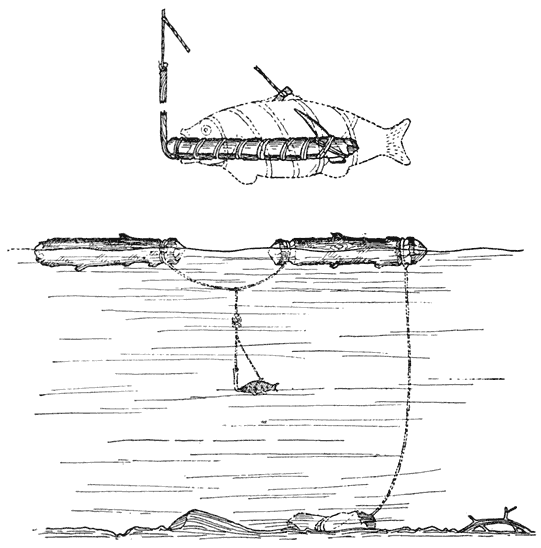
Figure 1. Night set-line.
(14) Lynx and His Two Wives.
(15) Story of Seal Rock in Lake Timagami.
Once upon a time, on a small island in Lake Timagami, some people went ashore, and one of the women left her baby in a cradle-board on a rock, while she went a short distance off. When she came back, the baby was gone; it had been taken by a big manitu (magic) seal who lived in a rock and he had taken the child inside with him. The child’s father was also a manitu, so he began burrowing and digging into the rock for his baby and he dug a channel. This hole is there yet. When he reached the baby, it was dead, and the seal was gone. It had dived and crossed two miles under water to Seal island and gone into a big rock there. He dove and followed, as he was mi·te·′ and came to the big rock where the seal had gone in. With his chisel he split the rock, but the seal escaped. The rock is there yet, split down the centre.
(16) Rabbit, Lynx, and Fisher.
At the time of which my story speaks Lynx and Fisher had the same sharp nose and face. Fisher used to jump right through a big boulder as high as a man whenever he wanted to. One day he told Lynx to try to beat him and jump through. So Lynx tried to do it and smashed his face flat, as it is now. He went away very sore. Soon he met Rabbit. “Kwe, kwe,” Lynx asked Rabbit, “where are you going?” Rabbit answered, “I am going to the short flat-faced country.” Lynx did not understand the joke, and he let Rabbit pass.
Lynx went on and came to a stream into whose waters he looked, and saw some flints. He tried to reach some to pick them up and beheld himself in the water. He discovered how ugly he was. “I’m so ugly. That is what Rabbit meant when he met me. I’ll fix him.” So he went back, struck Rabbit’s trail, and followed him. So he followed the trail until it went into a hole in the snow under a bush. Lynx looked in and saw Rabbit sitting there, reading. He asked Rabbit, “Has anybody been passing here lately Hee!” Rabbit made no answer. Lynx asked this question twice and at last Rabbit spoke, “Tsc, tsc, it’s Sunday to-day.” Lynx asked the same question again and received the same reply. Then Rabbit said, “Why don’t you go around and find his track?”. When Lynx went around, Rabbit ran out and off. When Lynx saw him run, he chased him and caught him.
“Can you talk English?” said Lynx. “Yes,” answered Rabbit. “Well, can’t you talk white?” “Yes,” answered Rabbit. “Well, if you don’t talk white, I’ll kill you.” So Rabbit had to talk white. “Well, what do you call ‘fire’ in English.” “Wayaʻkabi·′te” (people sitting around a fire), answered Rabbit. “How do they say ‘axe’ there?” “Me′matowes‵iŋg” (“noise of chopping”). “What do you call knife?” asked Lynx. “Taya′tacki·‵wəgis·e” (“sliced meat”), answered Rabbit. “You are a liar”, said Lynx. “Ki·niŋgwa‵zəm, you are a liar.” And he killed Rabbit.
(17) Snaring the Sun.
There was once a boy who used to set his snares for his living. One day he saw a track where the snow was melted, and after a while he decided to set his snares there and catch the animal that made the tracks. So he set his snare and went away. That track was the sun’s track, and when the sun came by next day, it got caught. The sun didn’t rise the next day and there was steady darkness. The people began to be puzzled. “Where did you set your snare?” they asked him. He told them, and they went to look. There they saw the sun caught, but no one could go near enough to loosen it A number of animals tried to do this, but they all got burned. At last the Beaver-mouse managed to cut it with his teeth and freed it. But his teeth got burned with the heat, and so they are brown to this day, but the sun is here and we have the daylight.
(18) Homo Excrementi.
There were a number of people camping, and one man was camping by himself. He was a young man and he tried to get his neighbour’s daughter to marry him, but she wouldn’t have him, saying that he was not good enough. And so the young man went back and forth trying to get a wife.
And so Homo excrementi came, early in the morning, crunching through the snow to where the girls were in camp. When they saw him coming, they cried, “Somebody’s coming. Make a fire.” And when he reached the camp every one received him in fine style, as he was such a nice fellow. “Where do you come from? Who is your father?” they asked him. “Hump-back,” said he. “Who is your mother?” “Flat-set excrementum,” answered he. But the old people did not understand him. He was unable to stay near the fire long, for fear he would melt. They wished him to stay at the camp, but he couldn’t, so he hurried away.
Then one of the girls who had refused the young man in marriage followed him and he led her a long chase. She began to feel it grow warmer (it was April) and soon she found one of his mittens and later his hat. At last it became so warm that she came to the place where he had melted altogether et ibi erat agger excrementi. When she examined the hat, internum ejus excrementi illitum invenit. So she went back home saying, “Good for him, he’s melted. I’m glad he is melted.” She couldn’t catch him anyway, so she was angry.
So young girls should not try always to get a nice-looking man, but take the man selected for them. The old people tell them this story for a lesson, lest they lose a good man, though not so handsome, to get a “stinker.”
(19) The Origin of Snakes.
A man was one time walking along and came to a lake which he wanted to cross. But he had no canoe, and so he walked along the shore until he saw a big Snake lying in the water with his head on the shore. “Will you carry me across?” asked the hunter. “Yes,” answered the Snake. “But it looks cloudy and I am afraid of the lightning, so you must tell me if it thunders while we are crossing.” The hunter got on the Snake’s back and they started to swim across the lake. As they went along, thunder began rumbling, “kαx kαx,” and the lightning flashed. “Mah, mah, listen!” said the Snake in fear. “I hear something.” Just as they reached the shore, when the hunter could leap to safety, a stroke of lightning hit the Snake and broke him into numberless pieces, which began swimming about and finally came to land. The great Snake was not killed, but his pieces turned into small snakes which we see all about to-day.
(20) Muskrat Warns the Beaver.
The Muskrat, Beaver, Dog, and some Ojibwa were companions and hunters. They were real people who could talk to one another. They started out one day and came to a small lake and there they saw Beaver houses and families. It was early in the winter. They said, “That’s a good lake to drive the beaver, as it’s all rocky and they can’t escape. The season is right, so we will come tomorrow with dogs.” The Beavers were in their houses and they saw the Indians, but they couldn’t hear the talking. The Muskrat heard, however, and went to the Beaver and told them. “You must look out for yourselves, uncles. Those Indians say you are very easy to catch.” Now the Muskrat had stayed outside the Indians’ wigwam and listened to what they were saying, until his feet got so cold that he could stay no longer. So that this was all that he had heard to tell his uncle the Beaver.
So the Indians had their feast, and when they threw the bones into the water, one of the little Beavers came back to life and went back to his parents. He said to them, “I had a fine time, father. They hung me over the fire, and I danced for them.” Shortly all the Beavers came back, but one of them said, “I’m very sick, father. They didn’t use me right.” This was the Beaver whose bone from his hind foot the hunters had lost. He was very sore and disgusted and showed his father the fresh mark of his foot where the flat bone was lost, when they asked him what was the matter. The Beavers did not like this and they became angry. So nowadays the Indians tell the young boys neither to talk about the Beavers, nor the prospects of a hunt before attacking a beaver colony, lest the Muskrat hear them and tell the Beaver. And also, when the hunting dogs suddenly go off from camp and run over the ice, the hunters say the dogs hear the beavers whistling.
(21) Story of a Hunter.
There were two men living in a camp with two women and the rest of the band. On a cold day in winter one of the men said he was going to track a moose, and left on his snowshoes. He said he would be back by night. He was gone all day and by night he had not returned, so his wife began to think that possibly he had shot a moose, but, as he had taken his axe with him, he might have cut himself in some way. They waited until morning and then, taking up his trail, they tracked him to where he had shot a moose and farther on to where he had skinned it. The meat was there, but the skin was gone. Looking around they saw a fire not far off. When they reached the fire they discovered that the hunter had rolled himself up in the green hide to sleep, and during the night it had frozen around him and he had been unable to get out. They thawed out the skin and all went back to camp.
(22) A Timagami Story.
(23) Story of a Fast Runner.
Once a hunter was so quick of foot that when he shot his arrow at a beaver plunging into the lake from the shore, he would run down, catch the beaver by the tail before the arrow got to it, and hold it until the arrow struck. He was a fast runner, indeed.
(24) The Hunter and the Seven Deer.
There once was a hunter who lived in a camp. The summer had been very dry and the whole country was on fire. He stayed in his camp, however, although the smoke was so thick that no one could see any distance. One day he saw seven deer walking along, each holding the other’s tail in its mouth. The leader alone could see, and he was guiding the others. So he killed the leader and then took hold of the second deer’s nose, and so lead them all to his camp alive, where he butchered them.
(25) Story of a Conjurer.
There was another mi·te′ Indian one day’s journey from where Gitcikwe′we was camping. This Indian was so full of mi·te′ also that, while he was asleep, he heard Windigo passing overhead with a great moaning noise as if he were in pain. No other people heard it except this man, because they were not mi·te′.
(26) Legend of Obabika Lake.
Obabika lake is called Ma′nitu Pi·pa′gi·, “Spirit Echo.” On the eastern shore of this lake is a great rock where a Manitu is believed to live. Whenever anyone makes a noise in the vicinity, the Manitu becomes angry and growls. His plaints, the Indians believe, can be clearly heard when he is offended. The Ojibwa never go near there when they can avoid it; and they seldom throw a stone in the lake, splash their paddles, or shoot their guns near its shores.
(27) Iroquois Pictographs.
The Ojibwa attributed nearly all pictographs to the Iroquois. On Lady Evelyn lake are a number of such figures, showing animals and men in canoes.
(28) An Iroquois Legend.
At that time there were people living, four in number: a woman, a young baby who could hardly walk, and two sons who were grown-up men. Their father had died and the family lived together in a wigwam. It was winter and the sons had two rabbit snares’ trails, one to the east and the other to the north, and they went to different lines on different days. The mother would attend to the snares and leave the baby, wrapped in a rabbit skin blanket, alone in the camp, while the two sons would hunt and look around for game, having only bows and arrows.
When they came home in the evening, they would sometimes bring with them spruce partridge and other kinds of partridge. Their mother used to bring home partridges also, but she had no bow or arrows, and the men wondered how she did it, because she often brought home as many as ten birds. They could not understand how she was able to do better than they, so they asked her, “What did you do it with?” They never went with their mother to where she had her snares, but they were continually asking her how she caught the partridges. She answered, “I cut a pole, put a string there on the end, and catch them by the neck, since I have no bow.” But they didn’t believe her, as they often saw arrow wounds in the partridges’ breasts. They looked at these wounds and said, “Somebody must have shot them for you. Was it not the Iroquois?” “No,” answered the mother, “I caught them with a pole snare and poked them with a stick in order to bloat them with blood, so they will make more bouillon.” But still they didn’t believe her and they said to each other, “Mother doesn’t like to tell us. Some Iroquois, I guess, are going to kill us. We’ll fool our mother and these Iroquois. When we go to bed, we’ll sleep with our baby.”
So that night they said to their mother, “We want to sleep with our brother the baby, on his side of the wigwam.” They dried their moccasins, put them on, and also put on rabbit skin blankets, for they were preparing to run out during the night. They had discovered a place the day before where trees had fallen down and snow had covered them, thus making a tunnel. So that night they rolled their little brother up in a blanket and left early in the night, unknown to their mother. When they left, the Iroquois were getting closer. The mother awoke and cried out, “Madja′wαk they are going!” She did this to help the Iroquois find them. The Iroquois followed them on snowshoes, but the sons made a great number of branch trails in order to deceive them.
The three finally reached their windfall tunnel and there they stayed and waited for the Iroquois. At daylight the Iroquois took up the trail and followed until they finally reached them. The three in the cave could hear the Iroquois talking above them. One of the Iroquois dug a hole in the snow above the tunnel and peeped down to see if the three were there. As one by one the Iroquois looked through the hole, the sons shot them, the arrow falling back through the hole so that they could use it again. They killed nearly all of them, and at last no more Iroquois faces appeared above the hole, but the sons could hear crying. Finally they decided to come out, and one of the sons went out first to look around, but he could see no one. They then started back to the wigwam, following the Iroquois tracks, but they only saw two trails. One of the sons went a little ahead and the other followed behind with the baby.
[
Contents
]
Timagami Folk-Lore.
It is not proper to tell stories in summer, lest one die; but, if stories are told, they must be told for ten successive evenings in order to prevent the evil.
In order to foretell the sex of the child about to be born, the first vertebra of a moose or deer may be used. The appearance of one side of this bone resembles a man’s face, while the other resembles a woman’s. The seeker for information may place this bone on top of his head and let it drop to the ground. Whichever face turns upward like a die indicates the sex of the child. This bone is called uta′backo‵k·e “back neck-bone”.
A little device to bring rain: suck the flat side of a green leaf until it snaps, or slap one hand with the palm of the other, holding the leaf in the fist of the first.
Northern Lights: Wase′tibik·an, “light of night.”
Bine·′s·i·wi·mi·′k·‵an, “birds’ path”. This is the Milky Way, which is believed to be the guide to the birds in their spring and autumn migrations.
Wətα′gwanobi·‵s·an “mist from the water” (?). This is the rainbow, which is thought to be caused by mist generated in the air by waves of some great sea.
(The Matachewan Indians of Montreal river call the rainbow Ani′miki·unujea‵bi “thunder’s legging string”!)
The whippoorwill (wa′hone·‵s·i) is very rarely heard in Bear island, although the bird frequents some parts of the lake. Its cry is considered an omen of ill fortune or of death. Another idea connected with the whippoorwill’s cry is that it is the signal cry of the Iroquois (Ma′djina‵dowes·i “bad Iroquois,” referring to the tribes of the League as distinct from those of Caughnawaga) and that it indicates the proximity of enemies.
When robins (gwi·′ckwe) sing noticeably during the day it is a sign of coming rain. The toad’s (omα′k·αki) song in the daytime has the same portent.
To kill blue-bottle flies will bring rain.
If anyone finds or sees a live mole it is a sign that some member of the family will die soon. Moles are very rare in the Timagami neighbourhood and quite a stir is raised when one is encountered.
Hiccoughing is a sign that the victim has been stealing something. If it is true and the victim is accused of it, he will stop hiccoughing from fright.
If a child is born feet first he is gifted with curing powers for people with sore backs. They let him jump on the patient’s back.
The method of cooking squirrels (dji·′tɔ′mǫ) has an influence upon the weather forces. Squirrels are usually cooked by splitting the carcass, after it has been skinned, and roasting it in the flames until done. Should the animal, however, be boiled instead, it will bring rain. When rain is needed, squirrels are boiled purposely to bring it.
To bring on a snowstorm an infant is allowed to make its moccasin print in the snow.
If an infant warms its hands before the fire, it is a sure sign of cold weather coming.
A red sunset with red clouds is a sign of wind.
A whirling buzzer, made by spinning a bone or wooden disk on a string operated by the two hands, will cause the wind to rise.
A divination device is used before the hunt to foretell what kind of game is going to be killed. It is as follows. The metacarpal bone of a beaver’s hind leg, with its sinew covering, is taken and cut nearly through, so that it will break easily.
This is stuck upright in the ground near the fire and a series of lines radiating from it are traced in the ashes or ground, each line being named for some game animal: moose, beaver, caribou, deer, bear, otter, martin, fisher, etc. Then, as the heat shrinks the sinew, it breaks the bone at the cut and the upper piece points along one of the lines marked. This answers what kind of game is going to be gotten. The lines sometimes also are used to denote the direction to be followed to get the animals designated.
(A variation of this operation was noted from the Mattagami band. Here a stick is used instead of a beaver bone and the base of the stick is burned. When this falls, it denotes the direction to be taken to secure game).
(19) Supernatural Creatures.
Pa·′gαk. This is a personification of a human skeleton without the flesh, which wanders about the country. When he travels, he goes as fast as he thinks. When he wishes himself to be in a place, he is there as soon as he thinks of it. When he is heard by the people, it is a sign that someone will die. It is thought that he is heard occasionally three times in succession, making his peculiar noise, once at the horizon, once at the zenith, and again at the opposite horizon.
Me·′megwe·‵s·i. A species of creature which lives in the high remote ledges. They are small and have hair growing all over their bodies. The Indians think they are like monkeys, judging from specimens of the latter they have seen in the picture-books. These dwarf-like creatures have ugly faces and seek to hide them when they meet with people. A little narrative of a meeting with these creatures is told by some Timagami Indians who had been to Lake Timiskaming. The Indians were passing the high ledge of rock a few miles below Haileybury, where the water was very deep and where they had set their nets. They found that somebody had been stealing fish. They proceeded to watch the nets and soon saw three Me·′megwe·‵s·i come out astride of an old log for a canoe, using sticks for paddles. The Indians pursued them, the fairies meanwhile hiding their faces. Finally the Indians caught one. Then one Indian said, “Look behind!” When the fairy turned quickly they got a glimpse of how ugly he was. The Indians then took a knife from this fairy and the rest disappeared, riding their log through the rock wall to the inside, where they could be heard crying, as this was where they lived. The Indians then threw the knife at the rock and it went right through to the inside to its owner.
Figure 2. Markings on birch bark.
[
Contents
]