Chapter I · (continued 2)
Reading edition
Though it seems a tremendous drop from the mythical phœnix of Arabia and its dissolution in fragrant spices to the old Dun Cow in Warwickshire, yet the latter proved herself, if legends may be credited, a foe fully worthy of the prowess of a right knightly arm, and as deserving of our notice as the dragon-slaying of that valiant brother star of chivalry St. George himself. Sir Guy of Warwick takes a high place amongst the famous ancient champions, and Dugdale and other good authorities hold that the stories connected with his name are not wholly apocryphal, though doubtless the monks and other early chroniclers drew the long bow at a venture sometimes. Dugdale, in his “Warwickshire,” A.D. 1730, writes—“Of his particular adventures, lest what I say should be suspected for fabulous, I will onely instance that combat betwixt him and the Danish champion, Colebrand, whom some (to magnifie our noble Guy the more) report to have been a giant. The storie whereof, however it may be thought fictitious by some, forasmuch as there be those that make a question whether there was ever really such a man, yet those that are more considerate will neither doubt the one nor the other, inasmuch as it hath been so usual with our ancient Historians, for the encouragement of after ages unto bold attempts, to set forth the exploits of worthy men with the highest encomiums possible; and therefore, should we be for that cause so conceited as to explode it, all history of those times might as well be vilified.[10] And having said thus much to encounter with the prejudicate fancies of some and the wayward opinions of others, I come to the story.” We do not ourselves propose to “come to the story,” though it is all duly set down in Dugdale; though if the fact of Guy’s Danish antagonist being a giant could be fully substantiated, he might perhaps claim a place in our pages. The date of the combat seems to have been the year 929. The exploits of Guy were long held in high favour not only in England but abroad; we find a French version dated 1525, and the British hero is referred to in a Spanish romance which was written almost a hundred years before this. Chaucer evidently knew the story well, for he tells us that
“Men speken of romances of price, Of Horne Childe and Ippotis, Of Bevis and Sir Guy;”
while Shakespeare, in “King Henry VIII.,” makes one of his characters say, “I am not Samson, nor Sir Guy, nor Colbrand, to mow them down before me.”
In Percie’s “Reliques of Antient Poetry” is a long black letter ballad upon the exploits of Guy. It seems unnecessary to quote it in extenso, so we pick out a verse here and there, sufficient at least to show how doughty a champion our hero must have been:—
“I slew the gyant Amarant In battle fiercelye hand to hand: And doughty Barknard killed I, A treacherous knight of Pavye land. Then I to England came againe, And here with Colbronde fell I fought: An ugly gyant whom the Danes Had for their champion hither brought. I overcame him in the field, And slewe him soone right valliantlye; Wherebye this land I did redeeme From Danish tribute utterlye. And afterwards I offered upp The use of weapons solemnlye At Winchester, whereas I fought, In sight of manye farr and nye. But first, near Winsor, I did slaye A bore of passing might and strength; Whose like in England never was For hugenesse both of bredth and length. Some of his bones in Warwicke yet, Within the castle there do lye, One of his shield-bones to this day Hangs in the citye of Coventrye. On Dunsmore heath I alsoe slewe A monstrous wyld and cruell beast, Called the Dun-Cow of Dunsmore heath, Which manye people had opprest. Some of her bones in Warwicke yett Still for a monument doe lye; Which unto every lookers viewe As wondrous strange, they may espye. A dragon in Northumberland, I alsoe did in fight destroye, Which did both man and beast oppresse, And all the countrye sore annoye. My body that endured this toyle, Though now it be consumed to mold; My statue faire engraven in stone, In Warwicke still you may behold.”
The origin of the story of the mythical dun cow is lost in obscurity, but in the north-west of Shropshire will be found an eminence known locally as the Staple Hill, and on this a ring of stones of the rude Druidic type seen in various parts of England, and most notably at Avebury, in Wiltshire. This circle is some ninety feet or so in diameter, and legend has it that this enclosure was used by a giant as a cow-pen. This cow was no ordinary creature, but yielded her milk miraculously, filling any vessel that was brought to her. She seems to have deeply resented the act of an old crone in bringing her a sieve thus to fill, construed it into a direct insult to her powers (though one scarcely sees on what ground), broke loose from her enclosure, and wandered into Warwickshire, doing enormous mischief, until her career was cut short by the redoubtable Guy. Bones of the dun cow may be seen in many places, a circumstance that is explained by telling us that on the victory of the knight over the cow he sent its bones far and wide over the district it had ravaged, as tokens of victory and a manifest proof that the monster was no longer to be dreaded. At Warwick a rib is exhibited: this is some seven feet long, and at Coventry there is a gigantic blade-bone some eleven feet round. In some cases these probably are the bones of whales, and in others of the wild bonasus or urus; but it must be distinctly understood that they do not give credibility to the legend, but only, in fact, derive an added glory from being associated with it. In the fine old church of Chesterfield is another gigantic rib some seven feet or more in length and a foot in circumference. This rests on the altar-tomb of a now unknown knight, whose marble effigy is represented clothed in a suit of armour, and local tradition has naturally bestowed on the once nameless warrior the proud title of Guy, Earl of Warwick. Another big rib may be seen in the grand church of St. Mary Redcliff at Bristol. Near it used to be suspended a grimy old picture representing a fierce-looking dun cow, and, though the inference was sufficiently obvious, the sexton, in showing people round, used to boldly affirm that this undoubtedly was one of the ribs of the monster slain by Sir Guy. Both rib and picture may now possibly be removed in deference to more modern ideas, but they certainly were there within a very recent period. A third rib may be seen at Caerleon, once a place of much importance, but now an insignificant little town, and chiefly interesting from its association with the history of the great King Arthur. Caerleon boasts a museum containing a very valuable collection of Roman and old British relics, and here too is the rib in question. It has only recently been removed from the church, and it is, by the way, curious to note the association of these bones with churches in almost every case. In the church of Pennant Melangell, in Montgomeryshire, is another gigantic rib said by some of the natives to be that of a giant, while others affirm that it is one of the ribs of St. Monacella, to whom the church is dedicated. As the bone is over four feet long, her stature must have been something considerable altogether. Another big bone is in the church at Mallwyd, in the same county. In Buckland’s “Curiosities of Natural History” it is stated that “the ribs of the dun cow at Warwick and the gigantic rib at St. Mary’s, Bristol, are the bones of whales;” and in his interesting account of the whale he mentions that he found whale-bones in all parts of the country, one of them being a large blade-bone hanging from a ceiling in Seven Dials. Assuming, as we probably may, that most if not all of these big bones scattered over the country are those of whales, one is still at a loss to know how or why they got so scattered, and more especially why they were placed in the churches. The legend of the dun cow appears to afford a very convenient popular explanation of them, but one feels that there is a mystery that this account does not dissipate.
The Salamander received its full mythical development during mediæval times, though the older writers refer to it occasionally. We see in the writings of such men as Pliny the first steps taken towards the erection of that fabric of fancy and superstition that in the Middle Ages was reared on so slight a foundation. Pliny asserts that the Salamander is made in the fashion of a lizard and marked with spots like stars; that it is never seen during fair weather, but only in heavy rain; and that it is of so cold a nature that if it do but touch fire it will as effectually quench it as if ice were placed thereon. He, moreover, declares its poisonous nature—a nature that, according to later writers, is so noxious that the mere climbing of the tree by the animal poisons all the fruit, so that all who afterwards eat thereof perish without remedy, and that if one enters a river the stream is effectually poisoned, and all who drink therefrom for an indefinite date thereafter must die. Glanvil, a learned English Cordelier monk who lived in the thirteenth century, goes so far as to declare roundly, as though undoubted and historic fact, that 4000 men of the army of Alexander the Great and 2000 of the beasts of burden were lost through drinking at a stream that had been thus infected. It was in the Middle Ages an article of belief that the salamander was bred and nourished in fire, and we have ourselves been gravely told that if the fires at the ironworks in the Midland Counties were not occasionally extinguished, an uncertain but fearful something would be created in them. When the salamander is represented it is always placed in the midst of flames. We see that the book to which we have already frequently referred as that to which our grandfathers went for instruction puts the poisonous nature of the salamander in the following graphic way:—“A man bit by a salamander should have as many physicians to cure him as the salamander has spots.”
The salamander is the well-known device of Francis I. of France, A.D. 1515-1547, the monarch who met our own King Henry VIII. at “the field of the cloth of gold.” On this occasion the French Guard had the salamander embroidered on their uniform, and we also find the device freely in the sculpture, wall paintings, and stained glass at Fontainebleau, Chambord, Orleans, in fact in all the palaces of Francis I. The motto adopted with it was Nutrisco et extinguo, “I nourish and extinguish,” a somewhat contradictory saying based on a somewhat contradictory story, for while we are told on the one hand that the salamander is reared and nourished in flame, we are also told that “he is of so cold a complexion that if he doe but touch the fire he will quench it as presently as if yce were put into it.” John, king of Aragon, had, almost a hundred years before, adopted the same device, adding to it the motto, Durabo, “I will endure.” Asbestos, though really, of course, of a mineral nature, was, from its incombustible property, held in the Middle Ages to be the wool of the salamander. We are told that the Roman emperors had napkins of this material, and that if they became at all soiled they were thrown into the fire, the fierce heat quickly destroying all foreign matter. As the testing flames purified the good while they destroyed the bad, so we presume King Francis intended to hold himself up as a terror to evil-doers and a rewarder of the loyal and faithful. The motto is none the less faulty, however; for while we find the king claiming both functions, it will be noticed in the legend that it is the fire which nourishes and the creature which extinguishes.
The writings of Pliny abound in strange ideas; some of these he evidently set down without putting the statements to the test, but in many cases he shattered the old beliefs by bringing them to the crucial test of experiment. The story of the extreme frigidity of the salamander’s body at once putting out the fiercest fire was a matter that he thus brought to the testing-point, the result being that the unfortunate victim of science was quickly shrivelled up and consumed. Another old statement, equally capable of being brought to the trial, was that if even the foot of a man came in contact with the liquid exuded from the skin of the salamander all his hair would fall off. Perhaps the reason why one statement was tested and not the other was that in the first case any ill consequences that might arise would affect the reptile, while the second would come home more closely to the experimenter himself.
In Breydenbach’s travels we find a salamander included amongst the other animals, a position that it probably owed to its association with legend, for we also find in the same old author that the unicorn is frankly accepted as a beast that may be met with by the traveller. The book is interesting, too, as giving the first figure that had then been made of a giraffe, or, as he terms it, seraffa.[11] The existence of the giraffe was long afterwards denied by naturalists, and his seraffa was for a very lengthened period held to be but a myth. Breydenbach was a canon of the cathedral of Mentz, and seems to have been of a somewhat adventurous spirit, for despite all the difficulties of the undertaking—difficulties that in these days of steam-boats, railways, and through bookings we cannot at all realise—we find him visiting Sinai and the Holy Land. His travels were first printed as a folio volume at Mentz in 1486. This was a Latin edition; but two years later we find one in German, and in less than ten years six different editions were called for in Germany, besides others printed in Holland and elsewhere for the benefit of those to whom both Latin and German were unknown tongues. The book is full of quaint woodcuts, and is altogether a treasure-house of history, natural and unnatural.
The salamander is commonly to be met with in many parts of Europe, but the real and the ideal creature are two very different things—as different as the deer-eyed cows quietly ruminating in their verdant pasturage are to the dun cow that taxed all the heroism of Sir Guy of Warwick, or as old grey Dobbin to Pegasus. The real creature is very similar in form to the newts that are so commonly to be found in ponds, but the salamander of Francis I. is more like a wingless dragon, while some of the mediæval heralds made it a quadruped something like a dog. Such a creature, breathing forth flames, may be seen in the crest of Earl Douglas A.D. 1483.
Shakespearian students will recall how Falstaff rails at Bardolph, calling him the “Knight of the Burning Lamp,” “admiral, bearing lantern in the poop,” “ball of wildfire,” and so forth, all compliments called forth from the effects of strong liquor on the rubicund countenance of Bardolph. He winds up by saying, “Thou hast saved me a thousand marks in links and torches, walking with thee in the night betwixt tavern and tavern, but the sack that thou hast drunk me would have bought me lights as good cheap, at the dearest chandler’s in Europe. I have maintained that salamander of yours with fire any time this two and thirty years.”
The salamander, like the toad, the slow-worm, or the water newt, is still held to be decidedly uncanny. In our younger days our seeking after such small objects of natural history was always held by wondering rustics as a foolish tempting of Providence, and we have repeatedly been told the most moving stories of the poisonous nature of all such creatures, and especially how newts developed the most alarming properties if interfered with, biting out pieces of the captor’s flesh, and then spitting fire into the wound. Prompt amputation or death was the dire alternative offered, though in our own case matters never reached so dread a climax. “Them pisonous effets” were many a time in those by-gone days held in the hand that now guides our pen. The belief in such fatal powers must have a very disquieting influence on the rustics who hold it. When farm animals, as calves or colts, die mysteriously, some one is sure to start the theory that they have been bitten by an effet while drinking; and in view of such a belief even the fetching of a pail of water from the pond that too often supplies the drinking water in country places must appear attended with no little risk. The following graphic and amusing letter from one of the correspondents of the Field newspaper shows how the salamander is still regarded in rural France:—
“Returning homeward a few evenings ago from a country walk in the environs of D——, I discovered in my path a strange-looking reptile, which, after regarding me steadfastly for a few moments, walked slowly to the side of the road, and commenced very deliberately clambering up the wall. Never having seen a similar animal, I was rather doubtful as to its properties; but, reassured by its tranquil demeanour, I put my pocket-handkerchief over it, and it suffered itself to be taken up without resistance, and was thus carried to my domicile. On arriving chez moi, I opened the basket to show my captive to the servants, when, to my surprise and consternation, they set up such a screaming and hullabaloo that I thought they would have gone into fits.
“‘Oh! la, la, la, la, la!—Oh! la, la, la, la, la!’ and then a succession of screams in altissimo, which woke up the children and brought out the neighbours to see what could be the matter.
“‘Oh, monsieur a rapporté un sourd!’
“‘Un sourd!’ cried one.
“‘Un sourd!’ echoed another.
“‘UN S-O-U-R-D!!!’ cried they all in chorus; and then followed a succession of shrieks.
“When they calmed down into a mild sample of hysterics, they began to explain that I had brought home the most venomous animal in creation.
“‘Oh! le vilaín bête!’ cried Phyllis.
“‘Oh! le méchant!’ chimed in Abigail; ‘he kills everybody that comes near him; I have known fifty people die of his bite, and no remedy in the world can save them. As soon as they are bitten they gonflent, gonflent, and keep on swelling till they burst, and are dead in a quarter of an hour.’
“Here I transferred my curiosity from the basket to a glass jar, and put a saucer on the top to keep it safe.
“‘O Monsieur! don’t leave him so; if he puts himself in a rage, nothing can hold him. He has got such force that he can jump up to the ceiling; and wherever he fastens himself he sticks like death.’
“‘Ah! it’s all true,’ cried my landlady, joining the circle of gapers; ‘Oh! la la! Ça me fait peur; ça me fait tr-r-r-r-embler!’
“‘Once I saw a man in a haycart try to kill one, and the bête jumped right off the ground at a bound and fastened itself on the man’s face, when he stood on the haycart, and nothing could detach it till the man fell dead.’
“‘Ah! c’est bien vrai,’ cried Abigail; ‘they ought to have fetched a mirror and held it up to the bête, and then it would have left the man and jumped at its image.’
“The end of all this commotion was that, while I went to inquire of a scientific friend whether there was any truth in these tissue of bêtises, the whole household was in an uproar, tout en émoi, and they sent for a commissionnaire, and an ostler with a spade and mattock, and threw out my poor bête into the road and foully murdered it, chopping it into a dozen pieces by the light of a stable lantern; and then they declared that they could sleep in peace!—les miserables!
“But there were sundry misgivings as to my fate, and, as with the Apostle, ‘they looked when I should have swollen or fallen down dead suddenly;’ and next morning the maids came stealthily and peeped into my room to see whether I was alive or dead, and were not a little surprised that I was not even gonflé, or any the worse for my rencontre with a sourd.
“And so it turned out that my poor little bête that had caused such a disturbance was nothing more nor less than a salamander—a poor, inoffensive, harmless reptile, declared on competent authority to be noways venomous, but whose unfortunate appearance and somewhat Satanic livery have exposed it to obloquy and persecution.”
As the French word sourd primarily means one who is deaf, we get a curious parallelism of ideas between the salamander deaf to all sense of pity, and insensible to all but its own fell purpose, and the old idea of the deafness of the poisonous adder. “Deaf as an adder” is a common country saying, and the passage in the Psalms of David where we read that “the deaf adder stoppeth her ears, and will not heed the voice of the charmer, charm he never so wisely,” naturally rises to one’s mind. The deafness, it will be noted, is no mere lack of the hearing faculty, but a wilful turning away from gentle influence. It was an old belief that when the asp heard the voice of the serpent-charmer it stopped its ears by burying one of them in the sand and coiling its folds over the other.
In turning over the quaint pages of the “Bestiary” of De Thaun we find allusion made to a creature that is evidently the salamander again, though we cannot quite make out the reference to King Solomon. Like all such books written in the Middle Ages, everything is introduced to point some moral or religious truth, though it may at first seem difficult for our readers to realise what possible connection there can be between the dreaded “sourd” and any spiritual instruction. The reference is as follows:—“Ylio is a little beast made like a lizard. Of it says Solomon that in a king’s house it ought to be and to frequent, to give an example. It is of such nature that if it come by chance where there shall be burning fire it will immediately extinguish it. The beast is so cold and of such a quality that fire will not be able to burn where it shall enter, nor will trouble happen in the place where it shall be. A beast of such quality signifies such men as was Ananias, as was Azarias, and as was Misael, who served God fairly: these three issued from the fire praising God. He who has faith only will never have hurt from fire.”[12]
Like the salamander, the Griffin was to our forefathers no mere creature of the imagination. Ctesias describes them in all sober earnestness as “birds with four feet, of the size of a wolf, and having the legs and claws of a lion. Their feathers are red on the breast and black on the rest of the body.” Glanvil says of them, “The claws of a griffin are so large and ample that he can seize an armed man as easily by the body as a hawk a little bird. In like manner he can carry off a horse or an ox, or any other beast in his flight.” The creature is, if anything, still more terrible when met with in the description given by Sir John Mandeville:—“Thai have the body upward as an egle, and benethe as a lyoun, but a griffonne hath the body more gret, and is more strong than eight lyouns, and more grete and strongere than an hundred egles such as we have among us. For he hath his talouns so large and so longe and grete upon his fete as though thei weren homes of grete oxen, so that men maken cuppes of them to drinken of.” Oriental writers, who appear to have an especial delight in the marvellous, go even beyond this, and the creature becomes with them the roc, the terrible creature we read of, for example, in the wonderful adventures of “Sindbad the Sailor.” Milton introduces the creature very finely in his noble poem, as for instance:—
“As when a gryphon through the wilderness With wingèd course o’er hill and moory dale Pursues the Arimaspian, who by stealth Has from his watchful custody purloin’d The guarded gold: so eagerly the fiend O’er bog, or steep, through strait, rough, dense, or rare, With head, hands, wings, or feet, pursues his way, And swims, or sinks, or wades, or creeps, or flies.”
The Arimaspians were a one-eyed people of Scythia, who braided their hair with gold and drew their supplies of the precious metal as best they could from the stores guarded by the griffins. The griffin has long been employed as a symbol of watchfulness, courage, and perseverance, on account of this fabled treasure-guarding. But Browne, who, as we have seen, took great delight in vivisecting the vulgar errors of his day and generation, discourses as follows on the matter—“Aristeus affirmed that neer the Arimaspi, or one-eyed nation, griffins defended the mines of gold, but this, as Herodotus delivereth, he wrote from hearsay, and Michovius, who hath expressly written of those parts, plainly affirmeth that there is neither gold nor griffins in that country, nor any such Animall extant, for so doth he conclude, ‘Ego vero contra veteres authores, gryphes nec in illa septentrionis nec in alius orbis partibus inveniri affirmarim.’”
Like the dragon, the griffin seems to have been a good sort of fellow to deal with if you only took him the right way, and though a terrible monster to encounter if one had any burglarious intentions, he seems to have served his masters with a singleness of purpose and bull-dog tenacity that were very much to his credit. In Ariosto’s “Orlando Furioso” we read of a griffin-steed that flew through the air with its master on its back, and landed him wheresoever he listed.
The griffin was fabled to be the offspring of the union of the lion and the eagle; it has the leonine body and stout claws of one parent, the hooked beak, keen eye, and wings of the other. The form is very often met with in heraldry, past and present, either as a crest or as a supporter to the arms. A very familiar example of their employment in this latter service will be seen in the arms of the city of London. It is also a very common form in Roman and Renaissance painting and sculpture. Gryphius, a celebrated French printer, adopted the creature as his device, and on his decease the following epitaph was written:—
“La grande griffe Qui tout griffe A griffé le corps de Gryphe.”
Though ordinarily written as griffin or griffon, the alternative rendering gryphon is somewhat more correct, as the word is derived from the Greek grypos, or hook-nosed, in evident allusion to its eagle-beak. Shakespeare frequently refers to the creature, but the only instance we need here refer to is where a considerable difference in the spelling of the word might lead some of our readers astray. The passage to which we allude will be found in “The Rape of Lucrece,” where she
“Like a white hind under the grype’s sharp claws Pleads in a wilderness, where are no laws.”
In the forests of Bohemia, we are told by Burton in his “Miracles of Art and Nature,” there is a little beast called the Lomie, “which hath hanging under its neck a bladder always full of scalding water, with which, when she is hunted, she so tortureth the dogs that she thereby easily makes her escape.” Elsewhere he tells of four-footed serpents, strange creatures that, unlike many of his wonders—only to be found in Peru or India, or such like distant lands—are to be seen as near home as Poland. The people of Poland, we are told, are “boysterous, rude, and barbarous; nourishing amongst them a kind of four-footed serpent, above three handfuls in length, which they worship as their household gods, tending them with fear and reverence when they call them out to their repasts; and if any mischance do happen to any of their family it is imputed presently to some want of due observations of these ugly creatures.”
Vegetable Lambs were another of the wonders of our forefathers. The credulous Sir John Mandeville says that in Cathay a gourd-like fruit is found that when ripe contains “as though it were a lytylle lomb withouten wolle.” In the twenty-sixth chapter of his book the lamb-tree is duly figured, and its peculiar fruit development graphically delineated. In many old books of natural history we find representations of some such creature under the names of the Scythian or Tartarian lamb. According to some old writers it was said to be purely an animal, and although rooted to the ground, was held to have so deadly an effect on vegetation in its neighbourhood that it effectually prevented the growth of all herbage within the scope of its baleful influence. So singular a creature naturally provoked attention and curiosity, and in the earlier days of the Royal Society the matter was considered quite worthy of their notice. Naturally, also, the supply endeavoured to keep pace with the demand, and as the belief in mermaids led to their fabrication and exhibition, so also the myth of the Scythian lamb took visible shape. One of these impositions was formerly preserved in the British Museum, not from any belief in it, of course, but as an illustration of the old belief.[13]
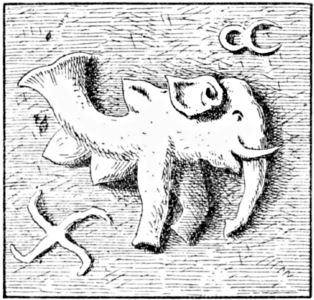
The reference to the mermaid reminds us that the sea no less than the land bore in ancient and mediæval days its full share of wonders. Of the mermaids we shall have occasion to say more presently, as we propose to class together all those forms that are more or less human, and to deal with them separately; but the sculptures of classic antiquity or the fancies of the mediæval herald afford us illustrations of the sea-horse, the sea-lion, and many other quaint imaginings. On an antique seal we once even saw a sea-elephant, a creature having the fore-legs, tusks, trunk, and great flapping ears of the African elephant, yet terminating in the body of a fish, and duly furnished with piscine tail and fins. The combination was of the most outrageous character, and would seem to indicate the limit possible to absurdity in this direction. When the ancient writers would desire to people the vast unknown of air or sea their thoughts naturally turned to those creatures of the land with which they were more familiar; hence the denizens of the air or ocean are not really creations at all, but adaptations, wings or fins being added to horses, lions, and the like according to the new element in which they were to figure. Of these, the sea-horses that draw the chariot of Neptune through the waves and the winged-horse Pegasus are examples that at once occur to one’s mind.
Pegasus or Pegasos, the offspring of Medusa and Poseidon, was the symbol of poetic inspiration. Its association with Perseus and Bellerophon, with the fountain of Peirene and the heights of Olympus, may all be found duly set forth in classic story and engraved or sculptured on the gems and marbles of antiquity. It is also introduced in mediæval heraldry, but there seems to be no reference in any book of this period to lead us to suppose that it was then regarded as a living verity. Shakespeare refers to it from time to time, but in one case it is only as an inn-sign, and in another the very terms employed indicate that the reference to it must be taken in a poetic rather than a literal sense. The first of the two to which we allude will be found in the “Taming of the Shrew,” and runs as follows:—
“Signior Baptista may remember me, Near twenty years ago, in Genoa, Where we were lodgers at the Pegasus.”
The second will be met with in the first part of “King Henry IV.;” it will probably be very familiar to many of our readers:—
“I saw young Harry, with his beaver on, His cuisses on his thighs, gallantly arm’d, Rise from the ground like feather’d Mercury, And vaulted with such ease into his seat As if an angel dropp’d down from the clouds, To turn and wind a fiery Pegasus, And witch the world with noble horsemanship.”
The arms of the Barrister Templars of the present day consist of the Pegasus on an azure shield. The original devices of the Templars were the Agnus Dei, a device that may still be seen carved on the Temple buildings in London, and two knights riding one behind the other on the same horse. This badge or device was originally chosen to denote the poverty of the order in its earlier days, but at a later day, when the symbol was misunderstood, these two rude figures of knights were taken for wings, and hence we get the modern device of the winged steed or Pegasus.
The Vampyre was another of the strange imaginings of our forefathers. It was thought that men and women sometimes returned, body and soul, from the other world after their death, and wandered about the earth doing all kinds of mischief to the living, one of their favourite pursuits being to suck the blood of those who were asleep, and these became vampyres in turn. The superstition took deepest hold in Eastern Europe, and is still an article of firm faith in Hungary and Servia. One reads ghastly stories of men unconsciously entertaining and sheltering vampyres and perishing miserably, of lonely travellers pining suddenly away, of the bodies of the dead being disinterred and the corpse found with the tell-tale stains of blood around its mouth, and the like; and we can easily see how such beliefs as this, or the wehr-wolf or loup-garou of the Germans and French, or the ghoul of the Arabs and Persians, would have a terrible effect on the minds of the superstitious. The vampyre was a terror of the night, since the corpse then, after lying in the stillness of the grave throughout the day, awoke to a fearful vitality. The forms it assumed were not always human, but were believed to be at times those of the dog, frog, toad, cat, flea, spider, and many other innocent creatures. Hence the contemptuous expression one sometimes hears used to deride a needless anxiety, “a mere flea-bite,” could have had no counterpart in mediæval days, for the anxiety such a misadventure might create would be of the most alarming and harassing description. In old books one finds the most circumstantial details as to how to detect when one has been bitten, or to prevent further mischief. To this end the grave of the suspected vampyre was opened during daylight when his powers of evil were quiescent, the corpse was decapitated and the head buried elsewhere, a stake was driven through the body, and many other elaborate and horrible precautions were taken to prevent a recurrence of the nightly resurrection. On the whole, we may well congratulate ourselves that we do not live in “the good old times.” Even now in country districts and amongst the uneducated one comes across such striking instances of superstitious belief and thraldom as suffice to enable us to faintly realise what it must have been when all alike were enwrapped in a dreadful bondage to unseen powers of evil far more intense than is now possible even to the few.
The vampyre bat, a native of South America, is so called from its blood-sucking propensities. It is the legend of the vampyre that has given the name to the bat, not the habits of the bat that originated the fable of the vampyre, for at the time that these legends of the destroyer were articles of faith in Europe, the American animal was quite unknown. The natural tendency towards exaggeration surrounded the vampyre bat with a mysterious horror, and having once gained its name of ill-omen, it became easy to rear upon it a superstructure of morbid fancy. The researches on the spot of Waterton, Darwin, and other reliable authorities show that the name is not altogether ill bestowed, as both Europeans and natives suffer severely from its attacks during the night, and the horses and cattle that are out in the pastures frequently return in the morning with their flanks covered with blood.
Though the Chameleon, unlike the phœnix, the griffin, or the basilisk, is a living verity, so large a body of fable has grown up around it that the animal is almost as mythical as those creatures of the imagination. The name is derived from two Greek words signifying “ground-lion,” a name singularly inappropriate in every way, as it has nothing leonine in look or nature, while its organisation fits it especially for living on trees. When we consider the singularity of its appearance and the peculiarity of its habits, it is by no means surprising that it should have attracted attention; and when we recall the numerous erroneous beliefs current amongst our rustics in England in this nineteenth century in the matter of frogs, newts, slow-worms, and the like, we can hardly wonder at the superstitions that have surrounded it. The eyes of the creature are quite expressionless, and are worked perfectly independently of each other, so that one may be directed upwards and the other downwards at the same time, or turned simultaneously to front and rear. Its exceeding slowness of movement is another curious feature, and though this exposes them to easy capture when seen, for “un Caméléon aperçu est un Caméléon perdu,” it has its advantages in another direction, for a creature that takes some hours to advance a yard or so will certainly not attract attention by any sudden movement; and the assimilation in colour of its skin with the surrounding foliage is another great protection. The creature has a singular habit of puffing out its body until it is nearly as large again, and in this state it will sometimes remain for hours. The best known fact, however, is its capacity for changing colour, passing from green to violet, blue, or yellow; but this power of varying the tint has been greatly exaggerated. We have been told that if the creature be placed on any colour, as bright scarlet, it will assume that colour; but this is one of those fragments of unnatural history that will not bear putting to the test. The following lines of Prior convey aptly enough this popular but erroneous notion:—
“As the chameleon, who is known To have no colours of its own, But borrows from his neighbour’s hue His white or black, his green or blue.”
Aristotle was acquainted with the singular motions of the eyes of the creature, and his description may well have been taken from nature. At the same time, these old writers knew nothing of comparative anatomy or dissection and conducted no scientific post-mortem examinations; hence in all matters of internal structure they are often ludicrously in error, while the weakness of their statements is only perhaps equalled by the strength with which they are asserted. We are, therefore, not surprised to read in Aristotle that the chameleon has no blood except in its head. Pliny re-states all the errors made by Aristotle, and further adds that it lives without either eating or drinking, deriving its nourishment wholly from the air, and that, though ordinarily harmless, it becomes terrible during the greatest summer heats. Even Pliny, however, could not believe everything that was told him, though his powers of imbibing outrageous notions were of the keenest, and whenever any old writers deal with something more than usually incredible they fortify their statement and evade personal responsibility by adding “as Plinie saith.” Pliny, then, rejects the still older idea that its right leg artfully cooked with certain herbs conveys the power of invisibility on the eater, and will not believe that the thigh of its left leg boiled in sow’s milk will induce gout in any one so injudicious as to bathe their feet in this peculiar broth. Neither will he credit that a man may be made to incur the hatred of all his fellow-citizens by having his gate-posts anointed with another nasty preparation of chameleon. As a set-off to all this very unusual incredulity he hastens to adopt the statement of another wise man, Democritus, that it has the power of attracting to the earth birds of prey, so that they in turn become the prey of other animals—a most unselfish proceeding on the part of the creature, as its own food consists of flies and such like small matters. Democritus also asserts, and Pliny confirms him in the assertion, that if the head and neck of the chameleon be burned on oak charcoal it will cause thunder and heavy rain. One is lost in astonishment at the fertility of the imagination in these old naturalists; and though it is now easy when one has once been put on the track of discovery to surmise that the tail of a chameleon burnt on walnut charcoal might produce snow or possibly fog, much of the credit of the discovery should go to the man who first gave the clue to these physiologico-meteorological influences. Aldrovandus, another man of science gifted with a strong imagination and the power of assimilating the fancies of others, informs us that if a viper passes beneath a tree in the branches of which a chameleon is resting, the latter will eject from its mouth a poisonous secretion that effectually rids the world of the equally venomous snake; and he further adds that elephants sometimes unknowingly eat a chameleon in the midst of the foliage on which they are browsing, a mishap that is rapidly fatal to them unless they can at once have recourse to the wild olive-tree as a remedy and antidote.
Many other strange beasts might engage our attention were it not that we have much new ground yet to explore, for not only might we discourse of the strange beliefs that have clustered round these monsters, but of the equally strange fancies that have been associated with such familiar creatures as cats and dogs, hares and spiders, goats and mice, while in another section we must dwell on the equally unnatural fancies that have been associated with various plants. Before, however, passing to these we must refer to those strange imaginings, such as the troglodytes, centaurs, and pigmies, that owe more or less to the combination of the human with other forms—a large class that deserves a measure of attention that may well suggest the advisability of opening a new chapter for its benefit.