Chapter III
Reading edition
MY EXPERIMENTS WITH EUSAPIA PALADINO.
In the earlier pages of this volume some of my later experiments with the Neapolitan medium, Eusapia Paladino, have been described. We shall now revert to the earlier ones.
My first experimental séance with this remarkable medium took place on the 27th of July, 1897. In response to the invitation of an excellent and honorable family,—that of Blech,—the name of which has for a long time been happily associated with modern researches in theosophy, occultism, and psychological studies, I betook myself to Montfort-l'Amaury, to make the personal acquaintance of this medium, whose case had already been studied in several particulars by MM. Lombroso, Charles Richet, Ochorowicz, Aksakof, Schiaparelli, Myers, Lodge, A. De Rochas, Dariex, J. Maxwell, Sabatier, De Watteville, and a great number of other scholars and scientists of high standing. Mme. Paladino's gifts had even been made the subject of a work by Count de Rochas upon The Externalization of Motivity, as well as of innumerable articles in the special reviews.
The impression that results from the reading of all the official reports is not altogether satisfactory, and besides leaves us with our curiosity entirely ungratified. On the other hand, I can say, as I have already had occasion to remark, that, during the last forty years, almost all the celebrated mediums have been present at one time or another in my salon in the avenue l'Observatoire in Paris, and that I have detected them nearly all in trickery. Not that they always deceive: those who affirm this are wrong. But, consciously or unconsciously, they bring with them an element of trouble against which one is obliged to be constantly on guard, and which places the experimenter in conditions diametrically opposed to those of scientific observation.
Apropos of Eusapia I had received from my illustrious colleague, M. Schiaparelli, director of the observatory at Milan, to whom science is indebted for so many important discoveries, a long letter from which I will quote a few passages:
During the autumn of 1892 I was invited by M. Aksakof to be present at a certain number of Spiritualistic séances held under his direction and care, for the purpose of meeting the medium Eusapia Paladino, of Naples. I saw a number of very surprising things, a part of which, to tell the truth, could be explained by very ordinary means. But there are others the production of which I should not know how to explain by the known principles of natural philosophy. I add, without any hesitation, that, if it had been possible to entirely exclude all suspicion of deceit, one would have had to recognize in these facts the beginning of a new science pregnant with consequences of the highest importance. But it must be admitted that these experiments have been made in a manner little calculated to convince impartial judges of their sincerity. Conditions were always imposed that hindered the right comprehension of what was really taking place. When we proposed modifications in the program suited to give to the experiments the stamp of clearness and to furnish evidence that was lacking, the medium invariably declared that, if we did so, the success of the séance would thereby be made impossible. In fine, we did not experiment in the true sense of the word: we were obliged to be content with observing that which occurred under the unfavorable circumstances imposed by the medium. Even when mere observation was pushed a little too far, the phenomena were no longer produced or lost their intensity and their marvellous nature. Nothing is more offensive than these games of hide-and-seek to which we are obliged to submit
All that kind of thing excites distrust. Having passed all my life in the study of nature, which is always sincere in its manifestations and logical in its processes, it is repugnant to me to turn my thoughts to the investigation of a class of truths, which it seems as if a malevolent and disloyal power was hiding from us with an obstinacy the motive of which we cannot comprehend. In such researches it is not sufficient to employ the ordinary methods of natural philosophy, which are infallible, but very limited in their action. We must have recourse to that other critical method, more subject to error, but more audacious and more powerful, of which police officers and examining magistrates make use when they are trying to bring out a truth in the midst of disagreeing witnesses, a part at least of whom have an interest in hiding that truth.
In accordance with these reflections, I cannot say that I am convinced of the reality of the things which are comprised under the ill-chosen name of Spiritualism. But neither do I believe in our right to deny everything; for, in order to have a good basis for denial, it is not sufficient to suspect fraud, it is necessary to prove it. These experiments, which I have found very unsatisfactory, other experimenters of great confidence and of established reputation have been able to make in more favorable circumstances. I have not enough presumption to oppose a dogmatic and unwarranted denial to proofs in which scientists of great critical ability, such as MM. Crookes, Wallace, Richet, Oliver Lodge, have found a solid basis of fact and one worthy their examination, to such an extent that they have given to it years of study. And we should deceive ourselves if we believed that men convinced of the truth of Spiritualism are all fanatics. During the experiments of 1892 I had the pleasure of knowing some of these men. I was obliged to admire their sincere desire to know the truth; and I found, in the case of several of them, philosophic ideas very sensible and very profound, joined to a moral character altogether worthy of esteem.
That is the reason why it is impossible for me to declare that Spiritualism is a ridiculous absurdity. I ought, then, to abstain from pronouncing any opinion whatever: my mental state on this subject may be defined by the word "agnosticism."
I have read with much attention all that the late Professor Zöllner has written on this subject. His explanation has a purely material basis,—that is to say, it is the hypothesis of the objective existence of a fourth dimension of space, an existence which cannot be comprised within the scope of our intuition, but the possibility of which cannot be denied on that ground alone. Once grant the reality of the experiments which he describes, and it is evident that his theory of these things is the most ingenious and probable that can be imagined. According to this theory, mediumistic phenomena would lose their mystic or mystifying character and would pass into the domain of ordinary physics and of physiology. They would lead to a very considerable extension of the sciences, an extension such that their author would deserve to be placed side by side with Galileo and Newton. Unfortunately, these experiences of Zöllner were made with a medium of poor reputation. It is not only the sceptics who doubt the good faith of M. Slade: it is the Spiritualists themselves. M. Aksakof, whose authority is very great in similar matters, told me himself that he had detected him in trickery. You see by this that these theories of Zöllner lose any support they might have derived from the exact demonstration of experiment, at the same time that they remain very beautiful, very ingenious, and quite possible.
Yes, quite possible in spite of everything; in spite of the lack of success that I had when I tried to reproduce them with Eusapia. On the day when we shall be enabled to make, with absolute sincerity, a single one of these experiments, the matter will have made great progress; from the hands of charlatans it will have passed into those of physicists and physiologists.
Such is the communication made to me by M. Schiaparelli. I found his reasoning to be without defect, and it was in a state of mind entirely analogous to his that I arrived at Monfort-l'Amaury (with all the more interest because Slade was one of the mediums of whom I was just now speaking).
Eusapia Paladino was introduced to me. She is a woman of very ordinary appearance, a brunette, her figure a little under the medium height. She was forty-three years old, not at all neurotic, rather stout. She was born on January 21, 1854, in a village of La Pouille; her mother died while giving birth to the child; her father was assassinated eight years afterward, in 1862, by brigands of southern Italy. Eusapia Paladino is her maiden name. She was married at Naples to a merchant of modest means named Raphael Delgaiz, a citizen of Naples. She manages the petty business of the shop, is illiterate, does not know how to either read or write, understands only a little French. I conversed with her, and soon perceived that she has no theories and does not burden herself by trying to explain the phenomena produced by her.
The salon in which we are going to conduct our experiments is a room on the ground floor, rectangular, measuring twenty feet in length by nineteen in breadth; there are four windows, an outside entrance door and another in the vestibule.
Before the sitting, I make sure that the large doors and windows are closely shut by window-blinds with hooks and by wooden blinds on the inside. The door of the vestibule is simply locked with a key.
In an angle of the salon, at the left of the large entrance door, two curtains of a light color have been stretched on a rod, joining in the middle and forming thus a little cabinet. In this cabinet there is a sofa, and leaning against this a guitar; on one side is a chair, on which have been placed a music-box and a bell. In the recess of the window which is included in the cabinet there is a music-rack, upon which has been placed a plate containing a well-smoothed cake of glazier's putty, and under which, on the floor, is a huge tray containing a large smoothed cake of the same. We have prepared these plaques of putty because the annals of Spiritualism have often shown the imprint of hands and of heads produced by the unknown beings whom it is our business in this work to investigate. The large tray weighs about nine pounds.
Why this dark cabinet? The medium declares it is necessary to the production of the phenomena "that relate to the condensation of fluids."
I should prefer that there should be nothing of the kind. But the conditions must be accepted, though we must have an exact understanding about them. Behind the curtain the stillness of the aërial waves is at its maximum, the light at its minimum. It is curious, strange, infinitely regrettable that light prohibits certain effects. Undoubtedly, it would not be either philosophic or scientific to oppose this condition. It is possible that the radiations, the forces, which act may be the rays of the invisible end of the spectrum, I have already had occasion to remark, in the first chapter, that he who would seek to make photographs without a dark chamber would cloud over his plate and obtain nothing. The man who would deny the existence of electricity because he had been unable to obtain a spark in a damp atmosphere would be in error. He who would not believe in the existence of stars because we only see them at night would not be very wise. Modern progress in natural philosophy has taught us that the radiations that impinge on the retina represent only the smallest fraction of the totality. We can then admit the existence of forces which do not act in the full light of day. But, in accepting these conditions, the essential point is not to be their dupe.
Hence, before the séance, I examined carefully the narrow corner of the room before which the curtain was stretched, and I found nothing except the objects mentioned above. Nowhere in the room was there any sign whatever of concealed mechanism, no electric wires or batteries or anything of the kind, either on the floor or in the walls. Moreover, the perfect sincerity of M. and Mme. Blech is beyond all suspicion.
Before the séance, Eusapia was undressed and dressed before Mme. Zelma Blech. Nothing suspicious was found.
The sitting was begun in full light, and I constantly laid stress upon obtaining the largest number of phenomena we could in the full light of day. It was only gradually, according as the "spirit" begged for it, that the light was turned down. But I obtained the concession that the darkness should never be absolute. At the last limit, when the light had to be entirely extinguished, it was replaced by one of the red lanterns used by photographers.
The medium sits before the curtain, turning her back to it. A table is placed before her,—a kitchen table, made of spruce, weighing about fifteen pounds. I examined this table and found nothing in it suspicious. It could be moved about in every direction.
I sit at first on the left of Eusapia, then at her right side. I make sure as far as possible of her hands, her legs, and her feet, by personal control. Thus, for example, to begin with, in order to be sure that she should not lift the table either by her hands or her legs, or her feet, I take her left hand in my left hand, I place my right open hand upon her knees, and I place my right foot upon her left foot. Facing me, M. Guillaume de Fontenay, no more disposed than I to be duped, takes charge of her right hand and her right foot.
There is full light,—a big kerosene lamp with a wide burner and a light yellow shade, besides two lighted candles.
At the end of three minutes the table begins to move, balancing itself, and rising sometimes to the right, sometimes to the left. A minute afterwards it is lifted entirely from the floor, to a height of about nine inches, and remains there two seconds.
In a second trial, I take the two hands of Eusapia in mine. A notable levitation is produced, nearly under the same conditions.
We repeat the same experiments thrice, in such a way that five levitations of the table take place in a quarter of an hour, and for several seconds the four feet are completely lifted from the floor, to the height of about nine inches. During one of the levitations the experimenters did not touch the table at all, but formed the chain above it and in the air; and Eusapia acted in the same way.
So then it seems that an object can be lifted, in opposition to the law of gravity, without the contact of the hands which have just been acting upon it. (Proof already given above, pp. 5-8, 16.)
A round centre table placed at my right comes forward without contact towards the table, always in full light, be it understood, as if it would like to climb up on it, and falls down. Nobody has moved aside or approached the curtain, and no explanation of this movement can be given. The medium has not yet entered into a trance and continues to take part in the conversation.
Five raps in the table indicate, according to a convention arranged by the medium, that the unknown cause asks for less light. This is always annoying: I have already said what I think of this. The candles are blown out, the lamp turned down, but the light is strong enough for us to see very distinctly everything that takes place in the salon. The round table, which I had lifted and set aside, approaches the table and tries several times to climb up on it. I lean upon it in order to keep it down, but I experience an elastic resistance and am unable to do so. The free edge of the round table places itself on the edge of the rectangular table, but, hindered by its triangular foot, it does not succeed in clearing itself sufficiently to climb upon it. Since I am holding the medium, I ascertain that she makes no effort of the kind that would be needed for this style of performance.
The curtain swells out and approaches my face. It is at this moment that the medium falls into a trance. She utters sighs and lamentations and only speaks now in the third person, saying that she is John King, a psychic personality who claims to have been her father in another existence and who calls her "my daughter" (mia figlia). This is an auto-suggestion proving nothing as to the identity of the force.
Five new taps ask for still less light, and the lamp is most completely turned down, but not extinguished. The eyes, growing accustomed to the clare-obscure, still distinguish pretty well what is taking place.
The curtain swells out again, and I feel that I am touched on the shoulder, through the stuff of the curtain, as if by a closed fist. The chair in the cabinet, upon which are placed the music-box and the bell, is violently shaken, and the objects fall to the floor. The medium asks again for less light, and a red photographic lantern is placed upon the piano, the light of the lamp being extinguished. The control is rigorously kept up, the medium agreeing to it with the greatest docility.
For about a minute the music-box plays intermittent airs behind the curtain, as if it was turned by some hand.
The curtain moves forward again toward me, and a rather strong hand seizes my arm. I immediately reach forward to seize the hand, but I grasp only the empty air. I then press the two legs of the medium between mine and I take her left hand in my right. On the other side, her right hand is firmly held in the left hand of M. de Fontenay. Then Eusapia brings the hand of the last named toward my cheek, and imitates upon the cheek, with the finger of M. de Fontenay, the movement of a little revolving crank or handle. The music-box, which has one of these handles, plays at the same time behind the curtain in perfect synchronism. The instant that Eusapia's hand stops, the music stops: all the movements correspond, just as in the Morse telegraphic system. We all amused ourselves with this. The thing was tried several times in succession, and every time the movement of the finger tallied the playing of the music.
I feel several touches in the back and on the side. M. de Fontenay receives a hard slap on the back that everybody hears. A hand passes through my hair. The chair of M. de Fontenay is violently pulled, and a few moments afterwards he cries, "I see the silhouette of a man passing between M. Flammarion and me, above the table, shutting out the red light!"
This thing is repeated several times. I do not myself succeed in seeing this silhouette. I then propose to M. de Fontenay that I take his place, for, in that case, I should be likely to see it also. I soon distinctly perceive a dim silhouette passing before the red lantern, but I do not recognize any precise form. It is only an opaque shadow (the profile of a man) which advances as far as the light and retires.
In a moment, Eusapia says there is some one behind the curtain. After a slight pause she adds:
"There is a man by my side, on the right: he has a great soft forked beard." I ask if I may touch this beard. In fact, while lifting my hand, I feel a rather soft beard brushing against it.
A block of paper is put on the table with a lead-pencil, with the hope of getting writing. This pencil is flipped clear across the room. I then take the block of paper and hold it in the air: it is snatched violently from me, in spite of all my efforts to retain it. At this moment, M. de Fontenay, with his back turned to the light, sees a hand (a white hand and not a shadow), the arm showing as far as the elbow, holding the block of paper; but all the others declare that they only see the paper shaking in the air.
I did not see the hand snatch the packet of paper from me; but only a hand could have been able to seize it with such violence, and this did not appear to be the hand of the medium, for I held her right hand in my left, and the paper with arm extended in my right hand, and M. de Fontenay declared that he did not let go of her left hand.
I was struck several times in the side, touched on the head, and my ear was smartly pinched. I declare that after several repetitions I had enough of this ear pinching; but during the whole séance, in spite of my protestations, somebody kept hitting me.
The little round table, placed outside of the cabinet, at the left of the medium, approaches the table, climbs clear up on it and lies across it. The guitar in the cabinet is heard moving about and giving out sounds. The curtain is puffed out, and the guitar is brought upon the table, resting upon the shoulder of M. de Fontenay. It is then laid upon the table, the large end toward the medium. Then it rises and moves over the heads of the company without touching them. It gives forth several sounds. The phenomenon lasts about fifteen seconds. It can readily be seen that the guitar is floating in the air, and the reflection of the red lamp glides over its shining surface. A rather bright gleam, pear-shaped, is seen on the ceiling in the other corner of the room.
The medium, who is tired, asks for rest. The candles are lighted. Mme. Blech returns the objects to their places, ascertains that the cakes of putty are intact, places the smallest upon the little round table and the large one upon the chair in the cabinet, behind the medium. The sitting is resumed by the feeble glimmer of the red lantern.
The medium, whose hands and feet are carefully controlled by M. de Fontenay and myself, breathes heavily. Above her head the snapping of fingers is heard. She still pants, groans, and sinks her fingers into my hand. Three raps are heard. She cries, "It is done" ("E fatto"). M. de Fontenay brings the little dish beneath the light of the red lantern and discovers the impression of four fingers in the putty, in the position which they had taken when she gripped my hand.
Seats are taken, the medium asks for rest, and a little light is turned on.
The sitting is soon resumed as before, by the extremely feeble light of the red lantern. John is spoken of as if he existed, as if it was he whose head we perceived in silhouette; he is asked to continue his manifestations, and to show the impression of his head in the putty, as he has already several times done. Eusapia replies that it is a difficult thing and asks us not to think of it for a moment, but to go on speaking. These suggestions of hers are always disquieting, and we redouble our attention, though without speaking much. The medium pants, groans, writhes. The chair in the cabinet on which the putty is placed is heard to move. The chair comes forward and places itself by the side of the medium, then it is lifted and placed upon the head of Mme. Z. Blech, while the tray is lightly placed in the hands of M. Blech, at the other end of the table. Eusapia cries that she sees before her a head and a bust, and says, "E fatto" ("It is done"). We do not believe her, because M. Blech has not felt any pressure on the dish. Three violent blows as of a mallet are struck upon the table. The light is turned on, and a human profile is found imprinted upon the putty.
Mme. Z. Blech kisses Eusapia upon both cheeks, for the purpose of finding out whether her face has not some odor (glazier's putty having a very strong odor of linseed oil which remains for some time upon the fingers). She discovers nothing abnormal.
This discovery of a "spirit head" in the putty is so astonishing, so impossible to admit without sufficient verification, that it is really still more incredible than all the rest. It is not the head of the man whose profile I perceived, and the beard I felt on my hand is not there. The imprint has a resemblance to Eusapia's face. If we supposed she produced it herself, that she was able to bury her nose up to the cheeks and up to the eyes in that thick putty, we should still have to explain how that large and heavy tray was transported from the other end of the table and gently placed in the hands of M. Blech.
The resemblance of the imprint to Eusapia was undeniable. I reproduce both the print and the portrait of the medium.[21] Every one can assure himself of it. The simplest thing, evidently, is to suppose the Italian woman imprinted her face in the putty.
But how?
We are in the dark as to this, or nearly so. I sit at the right hand of Eusapia, who rests her head upon my left shoulder, and whose right hand I am holding. M. de Fontenay is at her left, and has taken great care not to let go of the other hand. The tray of putty, weighing nine pounds, has been placed upon a chair, twenty inches behind the curtain, consequently behind Eusapia. She cannot touch it without turning around, and we have her entirely in our power, our feet on hers. Now the chair upon which was the tray of putty has drawn aside the hangings, or portières, and moved forward to a point above the head of the medium, who remained seated and held down by us; moved itself also over our heads,—the chair to rest upon the head of my neighbor, Mme. Blech, and the tray to rest softly in the hands of M. Blech, who is sitting at the end of the table. At this moment Eusapia rises, declaring that she sees upon the table another table and a bust, and cries out, "E fatto" ("It is done"). It was not at this time, surely, that she would have been able to place her face upon the cake, for it was at the other end of the table. Nor was it before this, for it would have been necessary to take the chair in one hand and the cake with the other, and she did not stir from her place. The explanation, as can be seen, is very difficult indeed.
Let us admit, however, that the fact is so extraordinary that a doubt remains in our mind, because the medium rose from her chair almost at the critical moment. And yet her face was immediately kissed by Mme. Blech, who perceived no odor of the putty.
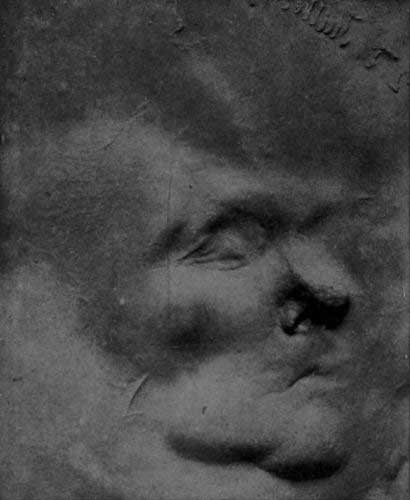
Plate IV. Plaster Cast of Imprint Made in Putty without Contact by the Medium Eusapia Paladino.
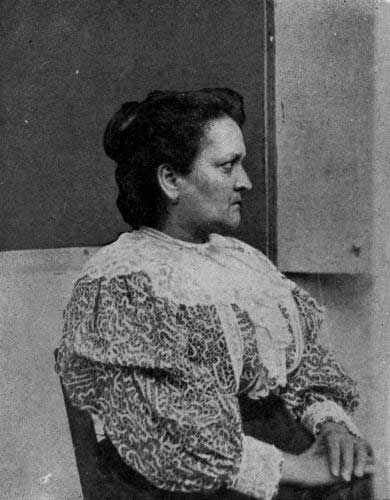
Plate V. Eusapia Paladino, Showing Resemblance to the Imprint in Putty.
Dr. Ochorowicz writes as follows apropos of these prints of faces and of the study which he made of them at Rome:[22]
The imprint of this face was obtained in darkness, yet at a moment when I held the two hands of Eusapia, while my arms were entirely around her. Or, rather, it was she who clung to me in such a way that I had accurate knowledge of the position of all her limbs. Her head rested against mine, and even with violence. At the moment of the production of the phenomenon a convulsive trembling shook her whole body, and the pressure of her head on my temples was so intense that it hurt me.
At the moment when the strongest convulsion took place, she cried, "Ah, che dura!" ("Oh, how severe!") We at once lighted a candle and found a print, rather poor in comparison with those which other experimenters have obtained,—a thing due, perhaps, to the bad quality of the clay which I used. This clay was placed about twenty inches to the right of the medium, while her head was inclined to the left. Her face was not at all soiled by the clay, which was yet so moist as to leave traces upon the fingers when touched. Moreover, the contact of her head with mine made me suffer so much that I am absolutely sure it was not intermitted for a single moment. Eusapia was very happy when she saw a verification made under conditions in which it was impossible to suspect her good faith.
I then took the tray of clay, and we passed into the dining-room in order to better examine the imprint, which I placed on a large table near a big kerosene lamp. Eusapia, who had fallen into a trance, remained for some moments standing, her hands resting upon the table, motionless and as if unconscious. I did not lose sight of her, and she looked at me without seeing anything. Then, with an uncertain step, she moved backward toward the door and passed slowly into the chamber which we had just left. We followed her, observing her all the while, and leaving the clay behind upon the table. We had already got into the chamber when, leaning against one of the halves of the double door, she fixed her eyes upon the tray of clay which had been left upon the table. The medium was in a very good light: we were separated from her by a distance of from six to ten feet, and we perceived distinctly all the details. All of a sudden Eusapia stretched her hand out abruptly toward the clay, then sank down uttering a groan. We rushed precipitately towards the table and saw, side by side with the imprint of the head, a new imprint, very marked, of a hand which had been thus produced under the very light of the lamp, and which resembled the hand of Eusapia. I have, myself, obtained head prints a dozen times, but always rather poor, owing to the quality of the clay, and often broken while the experiment was going on.
The Chevalier Chiaia, of Naples, who first obtained these fantastic pictures through the agency of Eusapia, wrote as follows, in this connection, to Count de Rochas:
I have imprints in boxes of clay weighing anywhere between fifty-five and sixty-five pounds. I mention the weight in order to let you see the impossibility of lifting and transporting with one hand alone so heavy a tray, even upon the supposition that Eusapia might, unknown to us, free one of her hands. In almost every case, in fact, this tray, placed upon a chair three feet behind the medium, was brought forward and placed very gently upon the table about which we were seated. The transfer was made with such nicety that the persons who formed the chain and held firmly the hands of Eusapia did not hear the least noise, did not perceive the least rustling. We were forewarned of the arrival of the tray upon the table by seven taps, which, according to our conventional arrangement, John struck in the wall to inform us that we could turn on the light. I did so at once by turning the cock of the gas-fixture which was suspended above the table. (We had never completely extinguished it.) We then found the tray upon the table, and, upon the clay, the imprint which we supposed must have been made before its transfer, and while it was behind Eusapia, in the cabinet where John usually materializes and manifests himself.
The totality of these observations (which are very numerous) leads us to the thought that, in spite of the improbability of the thing, these imprints are produced at a distance by the medium.
However, some days after the séance at Montfort-l'Amaury I wrote as follows:
These different manifestations are not to me equally authentic. I am not sure of all of them, for the phenomena were not all produced under the same conditions of certainty. I should wish to class the facts in the following order of decreasing certainty:
1. Levitations of the table.
2. Movements of the round table without contact.
3. Mallet blows.
4. Movements of the curtain.
5. Opaque silhouette passing before the red lamp.
6. Sensation of a beard upon the back of the hand.
7. Touchings.
8. Snatching of the block of paper.
9. Throwing of the lead-pencil.
10. Transference of the round table to the top of the other table.
11. Music from the little box.
12. Transfer of the guitar to a point above the head.
13. Imprints of a hand and of a face.
The first four events, having taken place in full light, are incontestable. I should put almost in the same rank Nos. 5 and 6. No. 7 may perhaps be due very often to fraud. The last in the list, having been produced toward the end of the séance, at a time when attention was necessarily relaxed, and being still more extraordinary than all the others, I confess that I cannot admit it with certainty, although I can not understand how it could have been due to fraud. The four others seem genuine; but I should like to observe them anew; a man could wager ninety-nine to one hundred that they are true. I was absolutely sure of them during the séance. But the vividness of the impressions grows weak, and we have a tendency to listen only to the voice of plain common sense,—the most reasonable and the most deceptive of our faculties.
The first impression we get upon the reading of these reports is that these different manifestations are rather vulgar, altogether banal, and do not tell us anything about the other world—or about other worlds. Surely it does not seem probable that any spiritual being would take part in such performances. For these phenomena are of an absolutely material class.
On the other hand, however, it is impossible not to recognize the existence of unknown forces. The simple fact, for example, of the levitation of a table to a height of six and one-half, eight, sixteen inches from the floor is not banal at all. It seems to me, speaking for myself alone, so extraordinary that my opinion is very well expressed when I say that I do not dare to admit it without having seen it myself, with my own eyes: I mean that which is called seeing, in full light and under such conditions that it would be impossible to suspect. While we are very sure that we have proved it, we are at the same time sure that in such experiments there emanates from the human body a force that may be compared with the magnetism of the loadstone, able to act upon wood, upon matter (somewhat as the loadstone acts upon iron), and counterbalancing for some moments the action of gravity. From the scientific point of view, that is a weighty fact in itself. I am absolutely certain that the medium did not lift that weight of fifteen pounds either by her hands or by her legs, or by her feet, and, furthermore, no one of the company was able to do it. The table was lifted by its upper surface. We are, therefore, certainly in the presence of an unknown force here which emanates from the persons present, and above all from the medium.
A rather curious observation ought to be made here. Several times during the course of this séance, and during the levitation of the table, I said, "There is no spirit." Every time I said this two violent blows of protestation were struck in the table. I have already remarked that, generally, we are supposed to admit the Spiritualistic hypothesis and to ask a spirit to exert himself in order that we may obtain the phenomena. We have here a psychological matter not without importance. Still, it does not seem to me, for all that, to prove the real existence of spirits, for it might happen that this idea was necessary to the concentration of the forces present and had a purely subjective value. Religious zealots who believe in the efficacy of prayer are the dupes of their own imagination; and yet no one can doubt that certain of these petitions appear to have been granted by a beneficent deity. The Italian or Spanish girl who goes to beg of the Virgin Mary that she will punish her lover for an infidelity may be sincere, and never suspects the strangeness of her request. In dreams we all converse every night with imaginary beings. But there is something more here: the medium really duplicates herself.
I take the point of view solely of the physicist whose business is to observe, and I say, whatever may be the explanatory hypothesis you may adopt, there exists an invisible force derived from the organism of the medium, and having the power to emerge from him and to act outside of him.
That is the fact: what is the best hypothesis to explain it? 1. Is it the medium who herself acts, in an unconscious manner, by means of an invisible force emanating from her? 2. Is it an intelligent cause apart from her, a soul that has already lived upon this earth, who draws from the medium a force which it needs in order to act? 3. Is it another kind of invisible beings? Nothing authorizes us to affirm that there may not exist, side by side with us, living, invisible forces. There you have three very different hypotheses, none of which seems to me, as far as my personal experience goes, to be as yet conclusively proved.
But there certainly emanates from the medium an invisible force; and the participants, by forming the psychic chain and by uniting their sympathetic wills, increase this force. This force is not immaterial. It may be a substance, an agent emitting radiations of wave-lengths which make no impression on our retina, and which are nevertheless very powerful. In the absence of light rays it is able to condense itself, take shape, affect even a certain resemblance to the human body, to act as do our organs, to violently strike a table, or touch us.
It acts as if it were an independent being. But this independence does not really exist; for this transitory being is intimately connected with the organism of the medium, and its apparent existence ceases when the conditions of its production themselves cease.
While writing these monstrous scientific heresies, I feel very deeply that it is difficult to accept them. Still, after all, who can trace the limits of science? We have all learned, especially during the last quarter of a century, that our knowledge is not a very colossal affair, and that, apart from astronomy, there is as yet no exact science founded upon absolute principles. And then, when all is said, there are the facts to be explained. Doubtless it is easier to deny them. But it is not decent or civil. He who has merely failed to find what satisfies him has no right to deny. The best he can do is simply to say, "I know nothing about it."
The fact is that, as yet, we have not elementary data enough to enable us to characterize these forces; but we ought not to lay the blame upon those who study them.
To sum up, I believe that I am able to go a little farther than M. Schiaparelli and affirm the certain existence of unknown forces capable of moving matter and of counterbalancing the action of gravity. There is a complex totality, as yet difficult to disentangle, of psychic and physical forces. But such facts, however extravagant they may appear, are worthy of coming within the sphere of scientific observation. It is even probable that they tend powerfully to elucidate the problem (a matter of supreme importance to us) of the nature of the human soul.
After the end of that séance of the 27th of July, 1897, as I desired to see again the levitation of a table in full light, the chain was formed standing, the hands lightly placed upon the table. The latter began to oscillate, then rose up to a height of nine inches from the floor, remained there several seconds (all the participators remaining on their feet), and fell heavily back again.[23]
Plate VI
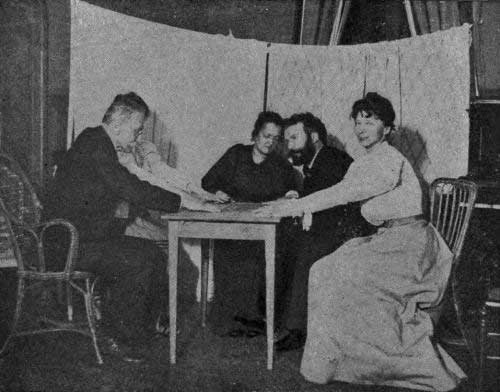
Photograph of the Table Resting on the Floor.
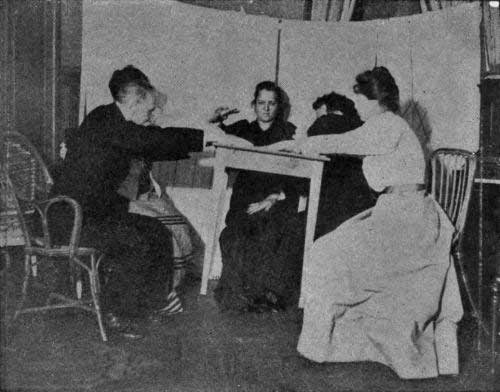
Photograph of the Same Table Raised to a Height of Twenty-five Centimetres. Made by M. G. de Fontenay.
M. G. de Fontenay succeeded in getting several photographs by the magnesium light. I reproduce two of them here (Pl. VI.). There are five experimenters who are, from left to right, M. Blech, Mme. Z. Blech, Eusapia, myself, Mlle. Blech. In the first photograph the table rests upon the floor. In the second it floats in air, coming up as high as the arms, at a height of about ten inches on the left and eight inches on the right. I hold my right foot resting upon Eusapia's feet and my right hand upon her knees. With my left hand I hold her left hand. The hands of all the others are upon the table. It is therefore altogether impossible for her to employ any muscular action. This photographic record confirms that of Pl. I., and it seems to me difficult not to recognize its undeniable documentary value.[24]
After this séance my most ardent desire was to see the same experiments reproduced at my own house. In spite of all the care I took with my observations, several objections can be taken to the absolute certainty of the phenomena. The most important arises from the existence of the little dark cabinet. Personally, I was sure of the perfect probity of the honorable Blech family, and I am unable to accept the idea of any trickery whatever on the part of any of its members. But the opinion of readers of the formal report may not be so well assured. It was not impossible that, even unknown to the members of the family, some one, with the connivance of the medium, glided into the room, favored by the dim light, and produced the phenomena. An accomplice entirely clothed in black and walking barefoot would have been able to hold the instruments up in the air, put them in movement, make the touches, and cause the black mask to move at the end of a rod, etc.
This objection could be verified or quashed by renewing the experiments at my house, in a room of my own, where I should be absolutely certain that no confederate could enter. I should myself arrange the curtain, I should place the chairs, I should be certain that Eusapia would come alone to my apartments, she would be asked to undress and dress in the presence of two lady examiners, and every supposition of fraud alien to her proper personality would thus be annihilated.
At this epoch (1898) I was preparing, for l'Annales politiques et litteraires, some articles upon psychic phenomena, which, revised and amplified, afterwards formed my work, The Unknown. The eminent and sympathetic editor of the review showed himself assiduous in examining with me the best means of realizing this scheme of personal experiences. Upon our invitation, Eusapia came to Paris to pass the month of November, 1898, and to devote eight soirées especially to us—namely, the 10th, 12th, 14th, 16th, 19th, 21st, 25th, and 28th of November. We had invited several friends to be present. Each one of these séances was the subject of a formal report by several of those who were present, notably by MM. Charles Richet, A. de Rochas, Victorien Sardou, Jules Claretie, Adolphe Brisson, Réne Baschet, Arthur Lévy, Gustave Le Bon, Jules Bois, Gaston Méry, G. Delanne, G. de Fontenay, G. Armelin, André Bloch, etc.
We met in my salon in the avenue de l'Observatoire, in Paris. There were no special arrangements, except the stretching of two curtains in one corner, before the angle of two walls, thus forming a kind of triangular cabinet, the walls about which are there unbroken, without door or window. The front of the cabinet was closed by these two curtains, reaching from the ceiling to the floor and meeting in the middle.
It is before this kind of cabinet that the reader will please imagine the medium to be seated, with a white wooden table (kitchen table) before her.
Behind the curtain, upon the plinth of the projection of a bookcase and upon a table, we placed a guitar, also a violin, a tambourine, an accordion, a music-box, cushions, and several small objects, which were to be shaken, seized, thrown about by the unknown force.
The first result of these séances in Paris, at my house, was absolutely to establish the fact that the hypothesis of a confederate is inadmissible and ought to be entirely eliminated. Eusapia acts alone.
The fifth séance led me, moreover, to think that the phenomena take place (at least a certain number) when the hands of Eusapia are closely held by two controllers, that it is not generally with her hands that she acts, in spite of certain possible trickeries; for it would be necessary to admit (an abominable heresy!) that a third hand could be formed in organic connection with her body!
Before every séance Eusapia was undressed and dressed again in the presence of two ladies charged with seeing that she did not hide any tricking apparatus under her clothes.
It would be a little long to go thoroughly into the details of these eight sittings, and it would be partly to go over what has already been described and commented upon in the first chapter, as well as in the preceding pages. But it will not be uninteresting to give here the estimate of several of the sitters, by reproducing some of the reports.
I will begin with that of M. Arthur Lévy, because he describes very fully the installation, the impression produced upon him by a medium, and the greater part of the facts observed.
Report of M. Arthur Lévy
(Séance of November 16)
That which I am going to relate I saw yesterday at your house. I saw it with distrust, closely observing all that might have resembled trickery; and, after I had seen it, I found it so far beyond the things that we are accustomed to conceive that I still ask myself if I really saw it. Yet I must confess that I have not been dreaming.
When I arrived at your salon, I found the furniture and all the other arrangements as usual. On entering, only a single change could be remarked at the left, where two thick curtains of gray and green rep concealed a little corner. Eusapia was to perform her wonders before this kind of alcove. This was the mysterious corner: I examined it very minutely. It had in it a little round uncovered table, a tambourine, a violin, an accordion, castanets, and one or two cushions. After this precautionary visit, I was certain that in this place at least there was no preparation, and that no communication with the outside was possible.
I hasten to say that from this moment up to the end of the experiments we did not leave the room for a single minute, and that, so to speak, we had our eyes constantly fixed upon this corner, the curtains of which, however, were always partly open.
Some moments after my examination of the cabinet Eusapia arrives,—the famous Eusapia. As almost always happens, she looks quite different from what I had anticipated. Where I had expected to see—I do not well know why, indeed—a tall thin woman with a fixed look, piercing eyes, with bony hands, and abrupt movements, agitated by nerves incessantly trembling under perpetual tension, I find a woman in the forties, rather plump, with a tranquil air, soft hand, simple in her manners, and slightly shrinking. Altogether, she has the air of an excellent woman of the people. Yet two things arrest the attention when you look at her. First, her large eyes, filled with strange fire, sparkle in their orbits, or, again, seem filled with swift gleams of phosphorescent fire, sometimes bluish, sometimes golden. If I did not fear that the metaphor was too easy when it concerns a Neapolitan woman, I should say that her eyes appear like the glowing lava fires of Vesuvius, seen from a distance in a dark night.
The other peculiarity is a mouth with strange contours. We do not know whether it expresses amusement, suffering, or scorn. These peculiarities impress themselves on the mind almost simultaneously, without our knowing on which one to fix the attention. Perhaps we should find in these features of her face an indication of forces which are acting in her, and of which she is not altogether the mistress.
She takes a seat, enters into all the commonplaces of the conversation, speaking in a gentle, melodious voice, like many women of her country. She uses a language difficult for herself and not less difficult for others, for it is neither French nor Italian. She makes painful efforts to make herself understood, and sometimes does this by mimicry (or sign-language) and by willing to obtain that which she wants. However, a persistent irritation of the throat, like a pressure of blood returning at short intervals, forces her to cough, to ask for water. I confess that these paroxysms, in which her face became deeply flushed, caused me great anxiety. Were we going to have the inevitable indisposition of the rare tenor, on the day when he was to be heard on the stage? Happily, nothing of the kind took place. It was rather a sign of the contrary, and seemed like a forerunner of the extreme excitement which was going to take possession of her on that evening. In fact, it is very remarkable that from the moment when she put herself—how shall I say it?—in condition for work, the cough, the irritation of the throat, completely disappeared.
When her fingers were placed on black wool,—to be frank, upon the trousers cloth of one of the company,—Eusapia called our attention to the kind of diaphanous marks made upon them (the fingers), a distorted, elongated second contour. She tells us that that is a sign that she is going to be given great power to-day.
While we are talking some one puts a letter-weigher on the table. Putting her hands down on each side of the letter-weigher, and at a distance of four inches, she causes the needle to move to No. 35 engraved on the dial plate of the weigher. Eusapia herself asked us to convince ourselves, by inspection, that she did not have a hair leading from one hand to the other, and with which she could fraudulently press upon the tray of the letter-weigher. This little by-play took place when all the lamps of the salon were fully lighted. Then commenced the main series of experiments.
We sit around a rectangular table of white wood, the common kitchen table. There are six of us. Close to the curtains, at one of the narrow ends of the table, sits Eusapia; at her left, also near the curtains, is M. Georges Mathieu, an agricultural engineer at the observatory in Juvisy; next comes my wife; M. Flammarion is at the other end, facing Eusapia; then Mme. Flammarion; finally myself. I am thus placed at the right hand of Eusapia, and also against the curtain. M. Mathieu and myself each hold a hand of the medium resting upon his knee, and, furthermore, Eusapia places one of her feet upon ours. Consequently, no movements of her legs or arms can escape our attention. Note well, therefore, that this woman has the use only of her head and of her bust, which latter is of course without the use of the arms, and is in absolute contact with our shoulders.
We rest our hands on the table. In a few moments it begins to oscillate, stands on one foot, strikes the floor, rears up, rises wholly into the air,—sometimes twelve inches, sometimes eight inches, from the ground. Eusapia utters a sharp cry, resembling a cry of joy, of deliverance; the curtain behind her swells out, and, all inflated as it is, comes forward upon the table. Other raps are heard in the table, and simultaneously in the floor at a distance of about ten feet from us. All this in full light.
Already excited, Eusapia asks in a supplicating voice and broken words that we lessen the lights. She cannot endure the dazzling glare in her eyes. She affirms that she is tortured, wants us to hurry; "for," she adds, "you shall see fine things." After one of us has placed the lamp on the floor behind the piano, in the corner opposite the place where we are (at a distance of about twenty-three feet), Eusapia no longer sees the light and is satisfied; but we can distinguish faces and hands. Let it not be forgotten that M. Mathieu and I each have a foot of the medium on ours, and that we are holding her hands and knees, that we are pressing against her shoulders.
The table is always shaking and makes sudden jolts. Eusapia calls to us to look. Above her head appears a hand. It is a small hand, like that of a little girl of fifteen years, the palm forward, the fingers joined, the thumb projecting. The color of this hand is livid; its form is not rigid, nor is it fluid; one would say rather that it is the hand of a big doll stuffed with bran.
When the hand moves back from the brighter light, as it disappears,—is it an optical illusion?—it seems to lose its shape, as if the fingers were being broken, beginning with the thumb.
M. Mathieu is violently pushed by a force acting from behind the curtain. A strong hand presses against him, he says. His chair is also pushed. Something pulls his hair. While he is complaining of the violence used upon him, we hear the sound of the tambourine, which is then quickly thrown upon the table. Next the violin arrives in the same manner, and we hear its strings sound. I seize the tambourine and ask the Invisible if he wishes to take it. I feel a hand grasping the instrument. I am not willing to let it go. A struggle now ensues between myself and a force which I judge to be considerable. In the tussle a violent effort pushes the tambourine into my hand, and the cymbals penetrate the flesh. I feel a sharp pang, and a good deal of blood flows. I let go of the handle. I just now ascertain, by the light, that I have a deep gash under the right thumb nearly an inch long. The table continues to shake, to strike the floor with redoubled strokes, and the accordion is thrown upon the table. I seize it by its lower half and ask the Invisible if he can pull it out by the other end so as to make it play. The curtain comes forward, and the bellows of the accordion is methodically moved back and forth, its keys are touched, and several different notes are heard.
Eusapia utters repeated cries, a kind of rattling in the throat. She writhes nervously, and, as if she were calling for help, cries, "La catena! la catena!" ("The chain! the chain!"). We thereupon form the chain by taking hold of hands. Then, just as if she was defying some monster, she turns, with inflamed looks, toward an enormous divan, which thereupon marches up to us. She looks at it with a satanic smile. Finally she blows upon the divan, which goes immediately back to its place.
Eusapia, faint and depressed, remains relatively calm. Yet she is dejected; her breast heaves violently; she lays her head on my shoulder.
M. Mathieu, tired of the blows which he is constantly receiving, asks to change places with some one. I agree to this. He changes with Mme. F., who then sits at the right of Eusapia, while I am at her left. Mme. F. and I never cease to hold the feet, hands, and knees of the medium. M. F. sets a water bottle and a glass in the middle of the table. The latter's brisk, jolting movements overturn the water bottle, and the water is spilled over its surface. The medium imperatively requires that the liquid be wiped up; the water upon the table blinds her, tortures, paralyzes her, she says. M. F. asks the Invisible if he can pour water into the glass. After some moments the curtain advances, the carafe is grasped, and the glass seems to be half full. That takes place several different times.
Mme. F., being no longer able to endure the blows given her through the curtain, exchanges seats with her husband.
I put my repeating watch upon the table. I ask the Invisible if he can sound the alarm. (The mechanism of the alarm is very difficult to understand, delicate to operate, even for me, doing it every day. It is formed by a little tube cut in two, one half of which glides smoothly over the other. In reality, there is only a projection of one-fiftieth of an inch of thickness of tube, upon which it is necessary to press with the finger-nail and give quite a push in order to start up the alarm.) In a moment the watch is taken by the "spirit." We hear the stem-winder turning. The watch comes back upon the table without having been sounded.
Another request is made for the alarm to sound. The watch is again taken; the case is heard to open and shut. (Now I cannot open this case with my hands: I have to pry it open with a tool like a lever.) The watch comes back once more without having sounded.
I confess that I experienced a disenchantment. I felt that I was going to doubt the extent of the occult power, which had, nevertheless, manifested itself very clearly. Why could it not sound the alarm of this watch? In making my request, had I overstepped the limits of its powers? Was I going to be the cause of all the well-proved phenomena of which we have had testimony losing the half of their value? I said aloud:
"Am I to show how the alarm is operated?"
"No, no!" Eusapia warmly replies, "it will do it."
I will note here that at the moment when I proposed to point out the mechanism, there passed through my mind the method of pressing upon the little tube. Immediately the watch was brought back to the table; and, very distinctly, three separate times, we heard it sound a quarter to eleven.
Eusapia was evidently very tired; her burning hands seemed to contract or shrivel; she gasped aloud with heaving breast, her foot kept quitting mine every moment, scraping the floor and tediously rubbing along it back and forth. She uttered hoarse panting cries, shrugging up her shoulders and sneering; the sofa came forward when she looked at it, then recoiled before her breath; all the instruments were thrown pell-mell upon the table; the tambourine rose almost to the height of the ceiling; the cushions took part in the sport, overturning everything on the table; M. M. was thrown from his chair. This chair—a heavy dining-room chair of black walnut, with stuffed seat—rose into the air, came up on the table with a great clatter, then was pushed off.
Eusapia seems shrunken together and is very much affected. We pity her. We ask her to stop. "No, no!" she cries. She rises, we with her; the table leaves the floor, rises to a height of twenty-four inches, then comes clattering down.
Eusapia sinks prostrated into a chair. We sit there troubled, amazed, in consternation, with a tense and constricted feeling in the head, as if the atmosphere were charged with electricity.
With many precautions, M. F. succeeds in calming the agitation of Eusapia. After about a quarter of an hour she returns to herself. When the lamps are again lighted, she is seen to be very much changed, her eye dull, her face apparently diminished to half its usual size. In her trembling hands she feels the pricking of needles which she asks us to pull out. Little by little she completely recovers her senses. She appears to remember nothing, not to comprehend at all our expressions of wonder. All that is as foreign to her as if she had not been present at the sitting. She isn't interested in it. So far as she is concerned, it would seem as if we were speaking of things of which she had not the faintest idea.
What have we seen? mystery of mysteries!
We took every precaution not to be the dupes of complicity, of fraud. Superhuman forces acting near us, so near that we heard the very breathing of a living being,—if living being it were,—such are the things our eyes took cognizance of for two mortal hours.
And when, on looking back, doubts begin to creep into the mind, we must conclude that, given the conditions in which we were, the chicanery necessary to produce such effects would be at least as phenomenal as the effects themselves.
How shall we name the mystery?
So much for the report of M. Arthur Lévy. I have no commentary to make at present upon these reports of my fellow-experimenters. The essential thing, it seems to me, is to leave to every one his own exposition and his personal judgment. I shall proceed in the same way with the other reports which are to follow. I shall reproduce the principal ones. In spite of some inevitable repetitions, they will surely be read with extreme interest, especially when we take into consideration the high intellectual standing of the observers.
Report of M. Adolphe Brisson.
(Séance of November 10)
(There were present at this séance, besides the hosts of the occasion, M. Prof. Richet, M. and Mme. Ad. Brisson, Mme. Fourton, M. André Bloch, M. Georges Mathieu.)
The following are occurrences which I personally observed with the greatest care. I did not once cease to hold in my right hand the left hand of Eusapia or fail to feel that we were in contact. The contact was only interrupted twice,—at the moment when Dr. Richet felt a pricking in his arm. Eusapia's hand, making violent movements, escaped from my grasp; but I seized it again after two or three seconds.
1. After this sitting had begun,—that is, at the end of about ten minutes,—the table was lifted up away from Eusapia, two of its legs leaving the floor simultaneously.
2. Five minutes later the curtain swelled out as if it had been inflated by a strong breeze. My hand, never letting go of that of Eusapia, pressed gently against the curtain, and I experienced a resistance, just as if I had pressed against the sail of a ship bellied out by the wind.
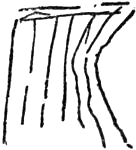
3. Not only was the curtain puffed out, forming a big pocket, but the perpendicular edge of the curtain that touched the window moved automatically aside and drew back as if it were pushed by an invisible curtain holder, making nearly this kind of a movement.
4. The curtain, inflated anew, took the form of a nose or of an eagle's beak, projecting above the table about eight or ten inches. This shape was visible for several seconds.
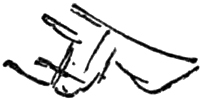
5. We heard behind the curtain the noise of a chair rolling over the floor; by a first push it arrived as far as I was; a second push turned it upside down, its feet in the air, in the position shown. It was a heavy stuffed chair. Succeeding pushes moved it again, lifted it up, and made it turn somersaults; it finally came to a standstill almost in the place where it had fallen over.
6. We heard the noise of two or three objects falling to the floor (I mean objects behind the curtain upon the centre-table). The curtain parted in the middle, and in the dim light the little violin appeared. Sustained in the air by an invisible hand, it came gently forward above our table, whence it settled down upon my hand and upon that of my neighbor on the left.[25]
On two separate occasions the violin rose from the table and at once fell back again, making a vigorous leap, like a fish flopping upon the sand. Then it glided down to the floor, where it remained motionless until the end of the sitting.
7. A new rolling noise was heard behind the curtain. This time it was the centre-table. A preliminary effort, quite vigorous, enabled it to rise half-way to the top of our table. By a second effort it got clear on top and rested upon my fore-arm.
8. Several times I distinctly felt light blows upon my right side, as if made with the point of a sharp instrument. But the truth compels me to declare that these blows were no longer given after Eusapia's feet were held under the table by M. Bloch. I note this correlation of things without drawing from it any presumption against Eusapia's loyalty. I have so much the less reason to suspect her in that her left foot did not leave my right foot during the whole sitting.
Report of M. Victorien Sardou
(Séance of November 19)
(There were present at this séance, besides the hosts of the evening, M. V. Sardou, M. and Mme. Brisson, M. A. de Rochas, M. Prof. Richet, M. G. de Fontenay, M. Gaston Méry, Mme. Fourton, M. and Mlle. des Varennes).
I shall only relate here phenomena controlled by myself personally in the séance of last Saturday. Consequently, I say nothing of the arrangement of the apartment, of the experimenters, nor of the events which were first produced in the dark and which all the participants were able to authenticate,—such as cracking sounds in the table, levitations, displacements of the table, raps, etc., as well as the blowing out of the curtain over the table, the bringing on of the violin, of the tambourine, and so forth.
Eusapia having invited me to take the place at her side which had been vacated by M. Brisson, I sat down on her left, while you preserved your place on her right. I took her left hand in my right hand, while my left hand placed upon the table was in contact with that of my neighbor, the medium insisting on this several times in order that the chain might not be broken. Her left foot rested upon my right foot. All through the experiment I never let go her hand for a single second. She grasped my hand with a strong pressure, and it followed her through all her movements. In the same way her foot always kept in contact with mine. My foot always kept touch with hers in all her foot scrapings on the floor, her shiftings of place, shrinkings, twitchings, etc., which never had anything suspicious in them, nor were they of such a nature as to explain the events which took place at my side, behind me, around me, and upon me.
In the first place, and in less than a minute after I had been placed on the left of the medium, the curtain nearest to me was puffed out and brushed against me, as if impelled by a gust of wind. Then three times I felt upon my right side a pressure which lasted but for a moment, yet was very marked. At that moment we were in a very dim light, yet enough to make the faces and the hands of all who were present distinctly visible. After Eusapia's violent nervous contractions, struggles, and energetic pushes (precisely like those which I had seen in similar cases elsewhere and which only astonish those who have slightly studied these phenomena), suddenly the curtain nearest to me was blown forward with an astonishing propulsive power between Eusapia and me, in the direction of the table, entirely concealing from me the face of the medium; and the violin, which, with the tambourine, had, before my introduction, been replaced in the dark chamber, was hurled to the middle of the table, as if by an invisible arm. To accomplish this, the arm must have lifted the curtain and drawn it along with it.
After this the curtain returned to its first position, but not completely; for it still remained puffed out a little between Eusapia and me, one of its folds remaining upon the edge of the table at my side.
Then you took the violin and held it out at such a distance from the two curtains that it was wholly visible to the company; and you invited the occult agent to take it.
This was done, the mysterious agent taking it back with him into the dark closet, with as much good will as he had shown in bringing it on.
The violin then fell upon the floor behind the curtains, or portières. One of these which was nearest to me resumed its vertical position, and for a time I heard upon my right upon the floor behind the curtains a kind of scrimmage between the violin and the tambourine, which were displaced, pulled about, and lifted, clashing and resounding at a great rate; and yet it was impossible to attribute any of these manifestations to Eusapia, whose foot never moved, but remained firmly pressed against my own.
A little after, I felt against my right leg, behind the curtain, the rubbing of a hard body which was trying to climb upon me, and I thought it was the violin. And so it was, in fact; and, after an unsuccessful effort to climb higher than my knee, this apparently living creature fell with a bang upon the floor.
Almost immediately I felt a new pressure upon my right hip, and mentioned the circumstance. You disengaged your left hand from the chain, and, turning toward me, twice made in the air the gesture of the director of an orchestra moving his bâton to and fro. And each time, with perfect precision, I felt upon my side the repercussion of a blow exactly tallying your gesture, which reached me after the delay of a second more or less, and which seemed to me to correspond exactly to the time necessary for the transference of a billiard ball or a tennis ball from you to me.
Some one, Dr. Richet, I believe, having spoken at that time of strokes upon the shoulders of the sitters in which the action and shape of a human hand was very marked, I will mention as a proof of his remark that I received in succession three blows upon the left shoulder (that is to say, the one most distant from the curtain and from the medium), more violent than the preceding ones; and this time the heavy pressure of the five fingers was very evident. Then a last blow with the flat of the hand, applied in the small of the back, without hurting me at all, was strong enough to make me lean forward, in spite of myself, toward the table.
Some moments after, my chair, moving under me, glided over the floor, and was shifted in such a way as to leave my back turned a little in the direction of the dark closet.
I leave to other witnesses the task of telling the results of their personal observations,—how, for example, the violin, having been picked up by you from the floor and replaced upon the table, was held out by Mme. Brisson, as you had already done, and lifted up in the same way in the sight of all, while I held the left hand of Eusapia, you her right hand, and with the hand which remained free you pressed the wrist of her left hand.
Nor do I say anything of a hand-pressure through the opening in the curtain, having seen nothing of this myself.
But that which I did see very well indeed was the sudden appearance of three very vivid little lights between my neighbor and myself. They were promptly extinguished and seemed like a kind of will-o'-the-wisp, similar to electric sparks coming and going with great rapidity.
In short, I can only repeat here what I have said during the course of these experiments, "If I had not been convinced forty years ago, I should be this evening."
Report of M. Jules Claretie.
(Séance of November 25)
(There were present at this sitting, in addition to the hosts of the occasion, M. Jules Claretie and his son, M. Brisson, M. Louis Vignon, Mme. Fourton, Mme. Gagneur, M. G. Delanne, M. René Baschet, M. and Mme. Basilewska, M. Mairet, photographer.)
I note only the impressions I received after the moment when Eusapia, who had taken my hand at the time when M. Brisson was still seated by her, asked me to replace him. I am certain that I did not let go of Eusapia's hand during all the experiments. Every moment I felt the pressure of her foot upon mine, the heel being especially perceptible. I do not believe that I relaxed my fingers for a moment, nor released the hand that I held. I was struck with the throbbing of the arteries at the end of Eusapia's fingers: the blood bounded feverishly through them.
I sat next the curtain. It goes without saying that it was drawn from right to left or from left to right just as it happened. That which I can't understand is that it could swell out until it floated over the table like a sail inflated by the wind.
I felt at first a little light blow on my right side. Then, through the curtain, two fingers seized me and pinched my cheek. The pressure of the two fingers was evident. A blow more violent than the first hit me on the right shoulder, as if it came from a hard, square body. My chair was twice moved and turned, first backward, then forward.
Those two fingers which pinched my cheek I had already felt—before I took my place at Eusapia's side—when I was holding over against the curtain the little white book which M. Flammarion had given me. This book was seized by two naked fingers (I say naked, because the folds of the curtain did not cover them) and then disappeared. I did not see these fingers: I touched them, or they touched me, if you will. My son held out and handed over also a leather cigar-holder, which was grabbed in the same way.
One of the persons present saw a rather heavy little music-box disappear in the same way.
With hardly a moment's delay the box was removed from our side with some violence; and I can speak with the more feeling of the force of the projection and of the weight of the object, because it struck me under the eye, and this morning I still have upon my face the only too visible mark of it, and feel the pain of it. I don't understand how a woman seated by my side could have the strength to throw with such force a box which, so to speak, should have come from quite a distance.
I observe, however, that all the phenomena are produced on the same side of the curtain; namely, behind it, or through it, if you will. I saw leafy branches fall upon the table, but they came from the side of the said curtain. Some persons assert that they saw a green twig come in through the open window which gives upon Cassini Street. But I did not see that.
There was a little round table behind the curtain, very near me. Eusapia takes my hand and places it, held in hers, upon the round table. I feel this table shaking, moving. At a given moment I believe that I perceive two hands near by and upon mine. I am not deceived; but this second hand is that of M. Flammarion, who, on his side, is holding the hand of the medium. The round table bestirs itself. It leaves the floor, it rises. I have the feeling of this at once. Then, the curtain having lifted and, as it were, spread itself over the table, I can distinctly see what passes behind it. The round table moves; it rises; it falls.
Suddenly tipping partly over, it rises and comes toward me, upon me. It is no longer vertical, but is caught between the table and me in a horizontal position. It comes with sufficient force to make me recoil, draw in my shoulders, and try to push back my chair to let this moving piece of furniture pass. It seems, like a living thing, to struggle between the table and me. Or, again, it seems like an animated being struggling against an obstacle, desiring to pass or move on and not being able to do so, being stopped by the table or by myself. At a given moment the round table is upon my knees, and it moves, it struggles (I repeat the word), without my being able to explain to myself what force is moving it.
This force is a formidable one. The little table literally pushes me back, and in vain I throw myself backward to let it pass.
Some of those present, M. Baschet among others, have said to me that at this moment it was upon two fingers. Two fingers of Eusapia push up the round table![26]
But I, who had not lost my hold on her left hand nor her foot,—I, who had by me the little round table (quite visible in the semi-obscurity to which we had accustomed ourselves), saw nothing, nor did I perceive any effort on the part of Eusapia.
I should like to have seen luminous phenomena produced, visions of brilliant lights, of sudden gleams of fire. M. Flammarion hoped that we were going to see some of these. He asked for them. But Eusapia was evidently fatigued by this long and very interesting séance. She asked for "un poco di luce" ("a little light"). The lamps were relighted. Everything was finished.
This morning I recall with a kind of anxious curiosity the least details of this very fascinating soirée. When we had returned to the observatory, on leaving our amiable hosts, I asked myself if I had been in a dream. But I said to myself, "We were present at the skilful performances of a woman prestidigitator; we witnessed only theatrical tricks." My son recalled to me the prodigies of skill of the brothers Isola. This morning, strange to say, reflection makes me at once more perplexed and less incredulous. We perhaps witnessed (we undoubtedly did witness) the manifestation of an unknown force which will hereafter be studied and perhaps one day utilized. I should no longer dare to deny the genuineness of Spiritualism. It isn't a question of animal magnetism: it is something else, I know not what; a quid divinum (a divine something), although science will some day analyze it and catalogue it. That which perhaps astonished me the most was the curtain swelling out like a sail! Where did the puff of wind come from? A regular breeze would have been needed to put such life into it as that. However, I do not discuss: I give in my evidence. I have seen these things, observed them carefully. I shall think of them for a long time. I do not stop here. I shall seek an explanation. Possibly I shall find one. But this much is certain, that we ought to be modest in the presence of all that appears to us to be for the moment inexplicable, and that, before affirming or denying, we ought to wait, to reserve our judgment.
In the mean time, while feeling of my right maxillary tooth, which is a little sore, I think of that line of Regnard and allow myself to mangle it a little while recalling that hard music-box,—
"Je vois que c'est un corps et non pas un esprit." (I see that it is a body and not a spirit.)
Report of Dr. Gustave Le Bon
(Séance of November 28)
(There were present at this séance, besides the hosts, M. and Mme. Brisson, MM. Gustave Le Bon, Baschet, de Sergines, Louis Vignon, Laurent, Ed. de Rothschild, Delanne, Bloch, Mathieu, Ephrussi, Mme. la Comtesse de Chevigné, Mmes. Gagneur, Syamour, Fourton, Basilewska, Bisschofsheim.)
Eusapia is undoubtedly a marvellous subject. It struck me as something wonderful that, while I was holding her hand, she was playing on an imaginary tambourine to which the sounds of the tambourine that was behind the curtain accurately corresponded.
I do not see how any trick is possible in such a case, any more than in the case of the table.
My cigarette-holder was grasped by a very strong hand, which wrenched the object from me with a good deal of energy. I was on my guard and asked to see the experiment again. The phenomenon was so singular and so beyond all that we can comprehend that we must first try natural explanations.
1. It is impossible that it could have been Eusapia. I was holding one of her hands and was looking at the other arm, and I placed my cigarette-holder in such a position that, even with her two arms free, she would not have been able to accomplish such a marvellous thing.
2. It is not probable that it could have been an accomplice; but is it not possible that the unconscious mind of Eusapia suggested to the unconscious mind of a person near the curtain to pass a hand behind it and operate there? Everybody would be acting in good faith and would have been deceived by the unconscious element. This important point ought to be verified, for no experiment would be so valuable if it were once demonstrated.
Could not Eusapia's departure be put off? We shall not have a similar opportunity, and we surely ought to clear up that phenomenon of the hand.
It is very evident that the table was lifted; but that is a material phenomenon which one can readily grant. The hand which came to seize my cigarette-holder performed an act of the will implying an intelligence, but the other is nothing of the kind. Eusapia might lift a table to the height of three feet without my scientific conception of the world being changed by it; but to bring in the intervention of a spirit, that would be to prove the existence of spirits, and you see the consequences.
As for the hand which seized the cigarette-case, it is absolutely certain that it was not that of Eusapia (you know that I am very sceptical and that I was looking about me); but close to the curtain, in the salon, there were a good many people, and several times you heard me ask people to stand aside from the curtain. If we two had been able to study Eusapia absolutely alone, in a room to which we had the key, the problem would soon be solved.
I have not been able to make this verification, the sitting at which Dr. Le Bon was present having been the last which Eusapia had consented to give at my house. But his objection is of no value. I am absolutely certain that nobody glided behind the curtain, neither in this particular case nor in any other. My wife, also, particularly occupied herself in observing what took place in that part of the room and never was able to discover anything suspicious. There is only one hypothesis; that is, that Eusapia herself handled the objects. Since Dr. Le Bon declares that the thing was impossible, he himself personally inspecting it, we are compelled to admit the existence of an unknown psychic force.[27]
Report of M. Armelin
(Séance of November 21)
(For this sitting I had asked three members of the Astronomical Society of France to exercise the severest control possible; namely, M. Antoniadi, my assistant astronomer at the observatory of Juvisy, M. Mathieu, agricultural engineer at the same observatory, and M. Armelin, secretary of the Astronomical Society. The last-named gentleman sent me the following report. There were also present M. and Mme. Brisson, M. Baschet, M. Jules Bois, Mme. Fourton, Mme. La Comtesse de Labadye.)
At quarter of ten Eusapia takes her seat, her back to the place where the two curtains meet, her hands resting upon the table. At the invitation of M. Flammarion, M. Mathieu takes his seat at her right, charged with the duty of keeping constant watch upon her left hand, and M. Antoniadi is enjoined to do the same for her right hand. They also make themselves sure of her feet. At the right of M. Mathieu sits Mme. la Comtesse de Labadye; on the left of M. Antoniadi, Mme. Fourton. Facing Eusapia, between Mmes. de Labadye and Fourton, MM. Flammarion, Brisson, Baschet, and Jules Bois.
The gas chandelier is lighted and the full light turned on. This chandelier is almost over the table. A little lamp with a shade is placed on the floor behind an easy-chair, near the opposite side of the room, in the direction of its greatest length, and to the left of the fireplace.
At five minutes of ten the table is lifted from the side opposite to the medium and falls back with a bang.
At ten o'clock it rises from the side of the medium, who withdraws her hands, the other persons holding their hands lifted up. The same effect is produced three times. The second time, while the table is in the air, M. Antoniadi declares that he is leaning on it with all his weight and is unable to lower it. The third time, M. Mathieu leans on it in the same way and experiences the same resistance. During this time, Eusapia holds her closed fist about four inches above the table, looking as if she were strongly grasping something. The action lasts several seconds. There is no doubt whatever about this levitation. When the table falls back, Eusapia experiences something like a relaxation after a great effort.
At 10.03 the table is lifted clean off its four feet at once, at first on the side opposite to the medium, rising about eight inches; then it falls abruptly back. While it is in the air, Eusapia calls her two neighbors to witness that they are closely holding her hands and her feet, and that she is not in contact with the table.
Then light raps are heard in the table. Eusapia makes M. Antoniadi lift his hand about eight inches above the table and taps three times upon his hand with her fingers. The three taps are heard simultaneously in the table.
To prove that she is not using either her hands or her feet, she sits down sidewise upon her chair on the left, stretches out her legs, and puts her feet on the edge of the chair of M. Antoniadi: she is in full view and her hands are held. At once the curtain is shaken in the direction of M. A.
From 10.10 to 10.15, several times in succession, five raps are heard in the table. Each time the gas is turned down a little, and each time the table moves without contact.
At 10.20 it balances itself, suspended in the air, and resting upon the two legs of the longer side. Then it rises off of its four feet to a height of eight inches.
10.25. The curtain moves, and M. Flammarion says that there is some one behind it, that somebody is pressing his hand. He holds his hand out toward the curtain, at a distance of about four inches. The curtain is pushed out into something like a pocket made by a hand which is drawing near. The medium with nervous laugh cries, "Take it, take it." M. A. feels through the curtain the touch of a soft body, like a cushion. But the hand of M. F. is not taken. Objects are heard to move, including the bells of a tambourine.
All of a sudden the medium, leaving M. Mathieu, stretches her hand above the table toward M. Jules Bois, who takes it. At this moment, behind the curtain, an object falls to the floor with a great noise.
10.35. Eusapia, again freeing her right hand, lifts it up above her left shoulder, the fingers forward, at a distance of several inches from the curtain, and beats four or five strokes in the air which are heard to sound in the tambourine. Several persons think they see a will-o'-the-wisp through the gap between the curtains.
Up to that point the gas has been gradually lowered. After the lapse of a full moment I find that I can no longer read, but I can distinguish very clearly the horizontal lines of my writing. I can see the hour perfectly by my watch, as well as the faces of those present, (that of Eusapia especially) turned toward the light. The gas is now completely extinguished.
At 10.40, the gas being out, I can still read my watch, but with difficulty; I still see the lines of my writing, though without being able to read.
Eusapia wants somebody to hold her head, which is done. Then she asks somebody to hold her feet. M. Baschet gets down on his knees under the table and holds them.
M. Antoniadi cries, "I am touched!" and says that he has felt a hand. I have very distinctly seen the curtain puffing out. Mme. Flammarion, whom I see silhouetted on the bright glass of the window, her head leaning forward, goes behind the curtain in order to assure herself that the medium is not doing anything suspicious in the way of motions.
One of the persons present having changed places, Eusapia utters complaints: "La catena! la catena!" ("The chain! the chain!") The chain is re-established.
At 10.45 the curtain is inflated again. A bump is heard. The round table touches the elbow of M. Antoniadi. Mme. Flammarion, who has kept looking behind the curtain, says that she sees the round table turned over. Its feet are in the air, and it is moving to and fro. She thinks she sees glimmers of light near the floor.
M. Mathieu feels a hand and an arm pushing the curtain against him. M. Antoniadi says that he is touched by a cushion; his chair is pulled and turns under him as if on a pivot. He is touched again on the elbow by some object.
It is ascertained that M. Jules Bois is holding Eusapia's right hand above the table; M. Antoniadi assures us that he is holding her left hand, and M. Mathieu her feet.
The curtain is again shaken twice; M. Antoniadi is hit in the back very hard, he says, and a hand pulls his hair. The only light remaining is the little lamp with a shade, behind an easy-chair at the farther end of the salon. I continue to write, but my strokes take all kinds of shapes.
Suddenly, M. Antoniadi exclaims that he is enveloped by the curtain, which rests upon his shoulders. Eusapia cries, "What is this that is passing over me?" The round table comes forth beneath the curtain. Mme. Flammarion, who is standing opposite the window, and has kept looking behind the curtain, says that she sees some very white object. At the same moment M. Flammarion, Mme. Fourton, and M. Jules Bois exclaim that they have just seen a white hand between the curtains, above Eusapia's head; and, at the same moment, M. Mathieu says that his hair is being pulled. The hand we saw seemed small, like that of a woman or of a child.
"If there is a hand there," says M. Flammarion, "could it perhaps grasp an object?" M. Jules Bois holds a book out toward the middle of the right-hand curtain. The book is taken and held two seconds. Mme. Flammarion, whom I see always silhouetted upon the bright glass of the window, and who is looking behind the curtain, cries that she has seen the book pass through.
M. F. proposes to light up and verify. But everybody agrees in thinking that the curtain may have already changed its position. A moment afterwards the curtain is again puffed out, and M. Antoniadi says that he is hit four or five times on the shoulder. Eusapia has asked him more than ten times whether he is quite "seguro" (sure) that he has hold of her hand and her foot.
"Yes, yes," he replies, "seguro, segurissimo" ("sure, quite sure").
Mme. Fourton says that for the second time she has seen a hand stretched out and that this time it touched the shoulder of M. Antoniadi. M. Jules Bois says that for the second time he has seen a hand stretched out at the end of a small arm, the fingers moving, the palm forward. (It is impossible to decide whether these two visions were simultaneous or not.)
We are getting accustomed to the almost complete darkness; I can still read "11.15" by my watch. M. Antoniadi says his ear is pinched very hard. M. Mathieu says he is touched. M. Antoniadi feels his chair pulled: it falls to the floor. He lifts it again and seats himself on it, and is again hit very hard on the shoulder.
About 11.20, at the request of Eusapia, M. Flammarion replaces M. Mathieu. He holds her two feet and one hand; M. Antoniadi holds the other hand. The lamp is lowered still more. The darkness is almost complete. M. Flammarion, having remarked that an unknown physical force is evidently present, but perhaps not an individual personality, feels his hand seized all of a sudden by some one (or some thing), and is interrupted. Then, a little after, he complains that his beard is being pulled (on the side opposite the medium, where I am. I did not perceive anything).
At 11.30 the lamp is turned up. It is comparatively bright in the room. The curtain, after all these movements, is seen to be more and more pushed aside, enveloping the head of Eusapia. Suddenly, above her head, we all see the tambourine slowly appear and fall upon the table with a noise like that of sheep-bells. It seems to me brighter than the feeble glimmer of the concealed lamp would justify and as if accompanied by white phosphorescent gleams; but they are perhaps flashes of light from its gilded ornaments, which, however, ought to appear yellower.