ALEXANDRE DUMAS
E. M. (Emily Mary) Waller translation
TRANSLATED BY
E. M. WALLER
WITH AN INTRODUCTION BY
ANDREW LANG
VOL. II
1822 TO 1825
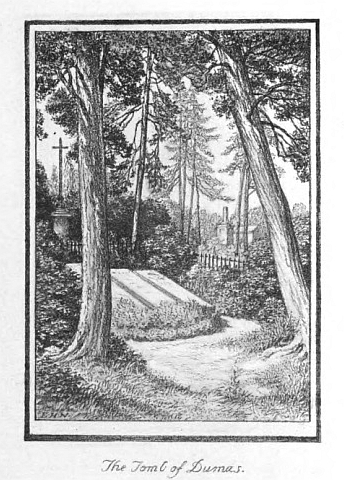
WITH A FRONTISPIECE
NEW YORK
THE MACMILLAN COMPANY
1907
CONTENTS
BOOK I
CHAPTER I
An unpublished chapter from the Diable boiteux—History of Samud and the beautiful Doña Lorenza 1
CHAPTER II
The good my flouting at the hands of the two Parisians had done me—The young girls of Villers-Cotterets—My three friends—First love affairs 13
CHAPTER III
Adolphe de Leuven—His family—Unpublished details concerning the death of Gustavus III.—The Count de Ribbing—The shoemakers of the château de Villers-Hellon 24
CHAPTER IV
Adolphe's quatrain—The water-hen and King William—Lunch in the wood—The irritant powder, the frogs and the cock—The doctor's spectre—De Leuven, Hippolyte Leroy and I are exiled from the drawing-room—Unfortunate result of a geographical error—M. Paroisse 34
CHAPTER V
Amédée de la Ponce—He teaches me what work is—M. Arnault and his two sons—A journey by diligence—A gentleman fights me with cough lozenges and I fight him with my fists—I learn the danger from which I escaped 48
CHAPTER VI
First dramatic impressions—The Hamlet of Ducis—The Bourbons en 1815—Quotations from it 57
CHAPTER VII
The events of 1814 again—Marmont, Duc de Raguse, Maubreuil and Roux-Laborie at M. de Talleyrand's—The Journal des Débats and the Journal de Paris—Lyrics of the Bonapartists and enthusiasm of the Bourbons—End of the Maubreuil affair—Plot against the life of the Emperor—The Queen of Westphalia is robbed of her money and jewels 63
CHAPTER VIII
Account of the proceedings relative to the abstraction of the jewels of the Queen of Westphalia by the Sieur de Maubreuil—Chamber of the Court of Appeal—The sitting of 17 April, 1817 88
BOOK II
CHAPTER I
The last shot of Waterloo—Temper of the provinces in 1817, 1818 and 1819—The Messéniennes—The Vêpres siciliennes—Louis IX.—Appreciation of these two tragedies—A phrase of Terence—My claim to a similar sentiment—Three o'clock in the morning—The course of love-making—Valeat res ludrica 96
CHAPTER II
Return of Adolphe de Leuven—He shows me a corner of the artistic and literary world—The death of Holbein and the death of Orcagna—Entrance into the green-rooms—Bürger's Lénore—First thoughts of my vocation 103
CHAPTER III
The Cerberus of the rue de Largny—I tame it—The ambush—Madame Lebègue—A confession 109
CHAPTER IV
De Leuven makes me his collaborator—The Major de Strasbourg—My first couplet-Chauvin—The Dîner d'amis—The Abencérages 117
CHAPTER V
Unrecorded stories concerning the assassination of the Duc de Berry. 123
CHAPTER VI
Carbonarism 132
CHAPTER VII
My hopes—Disappointment—M. Deviolaine is appointed forest-ranger to the Duc d'Orléans—His coldness towards me—Half promises—First cloud on my love-affairs—I go to spend three months with my brother-in-law at Dreux—The news waiting for me on my return—Muphti—Walls and hedges—The summer-house—Tennis—Why I gave up playing it—The wedding party in the wood 147
CHAPTER VIII
I leave Villers-Cotterets to be second or third clerk at Crespy—M. Lefèvre—His character—My journeys to Villers-Cotterets—The Pélerinage d'Ermenonville—Athénaïs—New matter sent to Adolphe—An uncontrollable desire to pay a visit to Paris—How this desire was accomplished—The journey—Hôtel des Vieux-Augustins—Adolphe—Sylla—Talma 155
CHAPTER IX
The theatre ticket—The Café du Roi—Auguste Lafarge—Théaulon—Rochefort—Ferdinand Langlé—People who dine and people who don't—Canaris—First sight of Talma—Appreciation of Mars and Rachel—Why Talma has no successor—Sylla and the Censorship—Talma's box—A cab-drive after midnight—The return to Crespy—M. Lefèvre explains that a machine, in order to work well, needs all its wheels—I hand in my resignation as his third clerk 166
BOOK III
CHAPTER I
I return to my mother's—The excuse I give concerning my return—The calfs lights—Pyramus and Cartouche—The intelligence of the fox more developed than that of the dog—Death of Cartouche—Pyramus's various gluttonous habits 184
CHAPTER II
Hope in Laffitte—A false hope—New projects—M. Lecomier—How and on what conditions I clothe myself anew—Bamps, tailor, 12 rue du Helder—Bamps at Villers-Cotterets—I visit our estate along with him—Pyramus follows a butcher lad—An Englishman who loved gluttonous dogs—I sell Pyramus—My first hundred francs—The use to which they are put—Bamps departs for Paris—Open credit 191
CHAPTER III
My mother is obliged to sell her land and her house—The residu—The Piranèses—An architect at twelve hundred francs salary—I discount my first bill—Gondon—How I was nearly killed at his house—The fifty francs—Cartier—The game of billiards—How six hundred small glasses of absinthe equalled twelve journeys to Paris 204
CHAPTER IV
How I obtain a recommendation to General Foy—M. Danré of Vouty advises my mother to let me go to Paris—My good-byes—Laffitte and Perregaux—The three things which Maître Mennesson asks me not to forget—The Abbé Grégoire's advice and the discussion with him—I leave Villers-Cotterets 213
CHAPTER V
I find Adolphe again—The pastoral drama—First steps—The Duc de Bellune—General Sébastiani—His secretaries and his snuff-boxes—The fourth floor, small door to the left—The general who painted battles 223
CHAPTER VI
Régulus—Talma and the play—General Foy—The letter of recommendation and the interview—The Duc de Bellune's reply—I obtain a place as temporary clerk with M. le Duc d'Orléans—Journey to Villers-Cotterets to tell my mother the good news—No. 9—I gain a prize in a lottery 234
CHAPTER VII
I find lodgings—Hiraux's son—Journals and journalists in 1823—By being saved the expense of a dinner I am enabled to go to the play at the Porte-Saint-Martin—My entry into the pit—Sensation caused by my hair—I am turned out—How I am obliged to pay for three places in order to have one—A polite gentleman who reads Elzevirs 251
CHAPTER VIII
My neighbour—His portrait—The Pastissier françois—A course in bibliomania—Madame Méchin and the governor of Soissons—Cannons and Elzevirs 263
CHAPTER IX
Prologue of the Vampire—The style offends my neighbour's ear—First act—Idealogy—The rotifer—What the animal is—Its conformation, its life, its death and its resurrection 272
CHAPTER X
Second act of the Vampire—Analysis—My neighbour again objects—He has seen a vampire—Where and how—A statement which records the existence of vampires—Nero—Why he established the race of hired applauders—My neighbour leaves the orchestra 284
CHAPTER XI
A parenthesis—Hariadan Barberousse at Villers-Cotterets—I play the rôle of Don Ramire as an amateur—My costume—The third act of the Vampire—My friend the bibliomaniac whistles at the most critical moment—He is expelled from the theatre—Madame Allan-Dorval—Her family and her childhood—Philippe—His death and his funeral 295
BOOK IV
CHAPTER I
My beginning at the office—Ernest Basset—Lassagne—M. Oudard—I see M. Deviolaine—M. le Chevalier de Broval—His portrait—Folded letters and oblong letters—How I acquire a splendid reputation for sealing letters—I learn who was my neighbour the bibliomaniac and whistler 307
CHAPTER II
Illustrious contemporaries—The sentence written on my foundation stone—My reply—I settle down in the place des Italiens—M. de Leuven's table—M. Louis-Bonaparte's witty saying—Lassagne gives me my first lesson in literature and history 323
CHAPTER III
Adolphe reads a play at the Gymnase—M. Dormeuil—Kenilworth Castle—M. Warez and Soulié—Mademoiselle Lévesque—The Arnault family—The Feuille—Marius à Minturnes—Danton's epigram—The reversed passport—Three fables—Germanicus —Inscriptions and epigrams—Ramponneau—The young man and the tilbury—Extra ecclesiam nulla est salus—Madame Arnault 334
CHAPTER IV
Frédéric Soulié, his character, his talent—Choruses of the various plays, sung as prologues and epilogues—Transformation of the vaudeville—The Gymnase and M. Scribe—The Folie de Waterloo 349
CHAPTER V
The Duc d'Orléans—My first interview with him—Maria-Stella-Chiappini—Her attempts to gain rank—Her history—The statement of the Duc d'Orléans—Judgment of the Ecclesiastical Court of Faenza—Rectification of Maria-Stella's certificate of birth 360
CHAPTER VI
The "year of trials"—The case of Potier and the director of the theatre of the Porte-Saint-Martin—Trial and condemnation of Magallon—The anonymous journalist—Beaumarchais sent to Saint-Lazare—A few words on censorships in general—Trial of Benjamin Constant—Trial of M. de Jouy—A few words concerning the author of Sylla—Three letters extracted from the Ermite de la Chaussée-d'Antin—Louis XVIII. as author 375
CHAPTER VII
The house in the rue Chaillot—Four poets and a doctor—Corneille and the Censorship—Things M. Faucher does not know—Things the President of the Republic ought to know 389
BOOK V
CHAPTER I
Chronology of the drama—Mademoiselle Georges Weymer—Mademoiselle Raucourt—Legouvé and his works—Marie-Joseph Chénier—His letter to the company of the Comédie-Française—Young boys perfectionnés—Ducis—His work 398
CHAPTER II
Bonaparte's attempts at discovering poets—Luce de Lancival—Baour-Lormian—Lebrun-Pindare—Lucien Bonaparte, the author—Début of Mademoiselle Georges—The Abbé Geoffroy's critique—Prince Zappia—Hermione at Saint-Cloud 407
CHAPTER III
Imperial literature—The Jeunesse de Henri IV—Mercier and Alexandre Duval—The Templiers and their author—César Delrieu—Perpignan—Mademoiselle Georges' rupture with the Théâtre-Français—Her flight to Russia—The galaxy of kings—The tragédienne acts as ambassador 420
CHAPTER IV
The Comédie-Française at Dresden—Georges returns to the Théâtre-Français—The Deux Gendres—Mahomet II.—Tippo-Saëb—1814—Fontainebleau—The allied armies enter Paris—Lilies—Return from the isle of Elba—Violets—Asparagus stalks—Georges returns to Paris 430
CHAPTER V
The drawbacks to theatres which have the monopoly of a great actor—Lafond takes the rôle of Pierre de Portugal upon Talma declining it—Lafond—His school—His sayings—Mademoiselle Duchesnois—Her failings and her abilities-Pierre de Portugal succeeds 438
CHAPTER VI
General Riégo—His attempted insurrection—His escape and flight—He is betrayed by the brothers Lara—His trial—His execution 445
CHAPTER VII
The inn of the Tête-Noire—Auguste Ballet—Castaing—His trial—His attitude towards the audience and his words to the jury—His execution 452
CHAPTER VIII
Casimir Delavigne—An appreciation of the man and of the poet—The origin of the hatred of the old school of literature for the new—Some reflections upon Marino Faliero and the Enfants d'Édouard—Why Casimir Delavigne was more a comedy writer than a tragic poet—Where he found the ideas for his chief plays 465
CHAPTER IX
Talma in the École des Vieillards—One of his letters—Origin of his name and of his family—Tamerlan at the pension Verdier—Talma's début—Dugazon's advice—More advice from Shakespeare—Opinions of the critics of the day upon the débutant—Talma's passion for his art 480