MY MAMIE ROSE (continued 2)
Reading edition
The reception accorded to me was none too cordial. He seemed to regard me as a blackmailer, and, alas! he was very nearly correct in his estimate. After entreating me not to breathe a word to any living soul about his nightly adventure, he invited me to follow him to the stable in the rear of the house, where I was to receive the reward for my righteous conduct.
My hopes fell at this.
Stables are the lodging places of horses, and I began to wonder if he could imagine the consequences were I to attempt to lead a gift horse through the streets down to the Bowery. The police, if in nothing else, are very careful in looking after strayed horses and delight in finding, by accident, a pretended owner at the other end of the halter rope.
I mentioned all this to him, but he only laughed and bade me wait. He took me to a stall, and there pointed with pride at a litter of pure-bred bull pups who were taking a nap at the breast of their mother. He stooped and, one by one, lifted them up by the scruff of their necks for my inspection.
I felt disappointed, saw my dream of reward evaporate, and could not screw up any interest in the canine exhibition.
My aversion for all dogs dated from my years as newsboy in Park Row. One homeless little cur, a mongrel looking for a bit of sympathy in his miserable existence, once made friendly overtures to me. I was still a brute—bestial, cruel—and sent the poor thing yelping with a kick. As soon as he had regained his footing he waited for his chance and then bit me in the leg.
Therefore I hated dogs, and reveled in the execution of my hatred.
I watched the pups with ill-concealed disgust. The little fat fellows hung limp and listless until dropped back into their nest. Just as I was priming myself to propose a compromise on a cash basis, a little rogue, different from his brothers, was elevated for examination. Instead of hanging quietly like the rest of the younger generation of the family, he twisted and wriggled, while his eyes, one of them becomingly framed in black, shone with play, appeal and good nature.
The shadow of a smile must have been on my lips, for the owner placed the pup in my arms and presented me with it.
My first impulse was to drop the pup and kick it back into the stall, but the little fellow seemed to consider his welcome as an understood thing, and with a sigh of content snuggled into the hollow of my arm. He was on my left side, and his warmth must have been infective, for I felt a peculiar if dull glow creep into my heart.
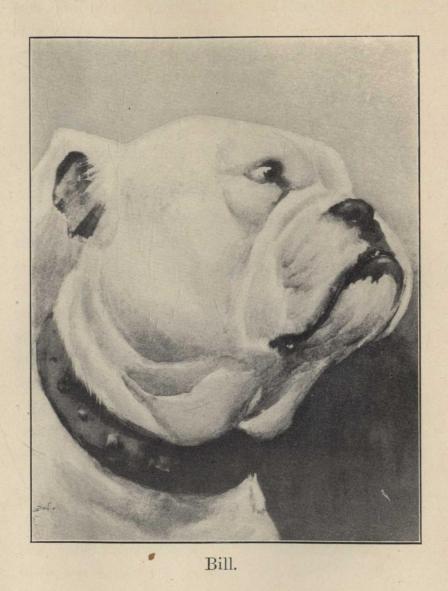
Bill.
Without exactly knowing what I was doing, I tucked my new property under my coat and made my way to my room. It is a question whether the pup gained by the exchange of quarters. My room was on the top floor of an old-fashioned tenement. The ceiling was slanting and not able to cope efficiently with the rain. Of the original four panes of glass in the window, only two remained, paper having been substituted for the others. There was a cot, a three-legged chair, and a washstand with a cracked basin, and a pitcher.
I dropped the pup on the cot, and intended to note how he would take to his new surroundings. He failed to notice them. First, he squatted down and looked at me intently. I must have passed inspection, for, not seeing me draw closer, he came to the edge of the bed and gave a little whine. I meant to grab him by the neck and throw him to the floor, but when my hand touched him he felt so soft and warm, and—well, I patted him. Of course, I had no intention of allowing a pup to change the tenor of my life. That night I went to the saloon at the accustomed time and did my "duty" as well as before. However, at odd moments, I would think of the little fellow up in the room.
It had been our custom to spend the major part of the night drinking and carousing after the close of business. But on the morning succeeding the pup's arrival, I thought it best to go to my room at once, as he might have upset things or caused other damage. That is what I tried to make myself believe—a rather difficult feat in view of the pup's enormous bulk and ferocity—not caring to interpret my feelings. I opened the door of my attic room and peeped in. The little fellow was curled upon the blanket and did not wake until I stood beside him. Then he lifted his little nose, recognized me, and went off again into the land of canine dreams.
As I was burdened with the dog, I could not let him starve. Therefore, my neighbors had the wonderful, daily spectacle before them of seeing me, the champion rough and tumble fighter of the city, go to the grocery store on the corner and buy three cents' worth of milk and sundry other delicacies suitable to my room-mate. Had they taken it good-naturedly, I would have felt ashamed and the pup would have fared badly in his nursing, but my neighbors sneered and smiled at my unusual proceeding which did seem rather incongruous, and, mainly to spite them and give them a chance to break their amused silence, did I persist in playing my new part, that of care-taker and nurse to his royal highness, the dog.
I became used to him, after a fashion, and, though showering very little affection on the pup, he seemed to be supremely happy in my company. We had been together for some time before I was sure of our relative positions. Always finding him asleep on my return from the saloon, I was surprised to hear him move about, one morning, as I was inserting the key in the lock. I opened the door, and before me danced the pup in a veritable frenzy of delight at beholding me. This not being a psychological essay, only a plain, true story, I shall not attempt to analyze, but will tell you straight facts in a straight way.
It was a new, a bewildering sensation to me to perceive a living being to be so pleased at my appearance. It was a new, a strange welcome, perhaps not entirely unselfish, because milk and good things to eat generally came with me, but, still, much purer and more sincere than, the greeting "hello" or loud-mouthed invitation to drink vouchsafed me by ribald companions.
I had not yet softened, at least, did not realize it, or would not admit it, but in occasional, unobserved moments, a sporadic, spontaneous dropping of the hard outer shell would come to me and I would not deny it until my "manhood" whispered to me: "Why, what is the matter with you? Are you not ashamed of giving way to your feelings? You are a man, a great, big, tough man, and not supposed to have any softer emotions. Get yourself together and be again a worthy member of your class!"
I must have been in one of these softer moods on the morning when the pup gave his first outspoken recognition. Why I did it, I do not know, but I lifted the little fellow to my arms and sat down on the bed. To us two a critical moment had come and it was best to make the most of it.
"Do you like me, pup?" I asked in all seriousness.
Bless me, if that little thing did not try to bark an emphatic "Yes!" Oh, it was no deep-toned growl or snarl. It was the pup's first effort in the barking line, and it sounded very much like a compound of whine and grunt. But I understood and we settled down to talk the matter over.
I realized that the pup was entitled to be named, and that matter was first in order.
"See here, pup; you and I are very plain and ordinary people, and it wouldn't do to give you a 'high-toned' name. Now, what do you say to 'Bill'?—just plain 'Bill'?"
The motion was speedily passed, and then Bill and I went to discuss other questions.
"Bill, you and I aren't overburdened with friends. If you and I were to die at the same moment, not even a cock or crow would croak a requiem for us. Now, I am going to make you a proposition. You're friendless, and so am I; you're ugly and so am I; you belong to the most unintelligent class of your kind and so do I; why not establish a partnership between us?"
Bill had sat, watching my lips and looking as wise as a sphinx, until I asked the question. He answered in the affirmative, without a moment's hesitation.
"I'm glad you like my proposition, Bill. Now you and I are going to live our own life, without regard for others. We're going to stick to each other, Bill; we're going to be loyal to each other, and, though we do not amount to much in the world, to each other we must be the best of our class. We're going to be true friends."
I took Bill's paw, and, there and then, we sealed the compact, which was never broken.
Our relationship being founded on this basis, I spent a good deal of my spare time in the room, which until Bill's arrival, had been nothing but my sleeping place. Soon the bare walls and the dilapidated condition of the furniture began to grate on me and, slowly, I improved our home. I bought a few pictures from a peddler, purchased two plaster casts from an Italian, and even employed a glazier to put our window in good shape. Bill and I took pride in our home, and thought it the very acme of coziness. You see, neither one of us had ever known a real home.
But dogs, as well as men, need exercise, and, in the afternoon, attired in our best—Bill with his glittering collar, on which the proceeds of a whole night had been expended—we took our walk along the avenue. He was beautifully ugly, and the usual pleasant witticisms, such as, "Which is the dog?" were often inflicted upon us. But we didn't mind, being a well-established firm of partners, who could afford to overlook the comments of mere outsiders.
In the midst of our prosperity came an unexpected break. A reform wave swept over the city and closed most of the "resorts." The loss of my position left us in a badly crippled financial condition.
Bill and I had lived in a style befitting two celebrities. Porterhouse steaks, fine chops, and cutlets had been frequent items on our bills of fare. The drop was sudden and emphatic. Stews, fried liver, and hash took the place of the former substantial meals, and our constitutions did not thrive very well. It did not even stop at that, for, ere long, we were regular habitués of the free-lunch counters. It often almost broke my heart to see my Bill, well bred and blooded, feed on the scraps thrown to him from a lunch counter. But there was a dog for you! Instead of turning his nose up at it, or eating it with growl and disgust, Bill would devour the pickled tripe or corned beef with a well-feigned relish. Between the mouthfuls his glance would seek mine and he would say, quite plainly: "Don't worry on my account. I'm getting along very nicely on sour tripe. In fact, it is a favorite dish of mine."
You poor, soulless Bill, of whom many men; with souls, could learn a lesson in grit and pluck!
During that spell of idleness our hours in the room were less cheerful than before. I must confess that my "blues" were inspired by material cares, and not by any regrets or self-reproaches; but, whatever the cause, they were sitting oppressively on me, and I often found myself in an atmosphere of the most ultra indigo. It did not take Bill very long to understand these moods, and, by right of his partnership, he took a hand in dispelling them.
He would place himself directly in front of me, and stare at me with unflinching gaze. Not noticing any effect of his hypnotic suggestions, he would go further, and place his paw on my knee, with a little pleading whine. Having awakened my attention, he would put himself into proper oratorical pose and loosen the flood-gates of his rhetoric.
"Say, Kil, I gave you credit for more sense and courage. Here you are, sitting with your hands in your lap, and bemoaning a fate which is largely of your own making. Besides—excuse me for being so brutally frank—you ought to be ashamed of yourself. Big and strong, you live in idleness, and now you kick because you are down and out and deprived of your despicable means of livelihood. Owen Kildare, brace up and be a man. You are not friendless. I am here. True, I'm only a dog, a soulless brute, but I'm your Bill, and we're going to stick until we both win out!"
You will not offend me by calling me a silly fool for putting these words into Bill's mouth. Perhaps I err greatly in believing that Bill was not without influence over me, or that I could understand him; perhaps it was all imagination, but, if it was—and I doubt it—it was good, because, no matter what it may be, whether imagination, inspiration or aspiration, if it leads up and not down, it cannot be too highly appreciated.
There were times when Bill's speech was either less convincing or my period of blues more pronounced than usual, and then he would resort to more drastic measures. He undertook to prove by the most vivid object lesson that a buoyancy of spirits is the first essential. Dogs, when gay and playful, run and romp. Bill made believe he was gay, and romped and raced and ran. If you will take note of the fact that the exact measurements of the room were fifteen by twelve feet, you can easily imagine the difficulties opposing Bill's exercise. Snorting and puffing, he would cavort about the narrow precincts, now running into a bedpost, now bumping against the shaky washstand. But he always accomplished his object, because, before his collapse from his exertions, he never failed to put me into a paroxysm of laughter. No "blues" could ever withstand Bill's method.
Still, he was but a brute—a poor, dumb brute.
KNIGHTS ERRANT.
CHAPTER VIII.
KNIGHTS ERRANT.
An episode, which occurred about this time, took me into latitudes and scenes never before dreamed of by me.
As near as I can figure it, the event happened in March, 1893. I admit that in view of the seriousness of the incident my indefiniteness seems strange, but it is typical of my class.
Since I have moved in different spheres I have often wondered at this and tried to explain it to myself. No other explanation seems to be at hand except that this disregard of dates, of time and place is a characteristic of the world Bohemian, whether on the Bowery or in the Tenderloin. Recently I had an illustration of this.
In preparing a story, treating of a certain phase of Bowery life for a newspaper, I bethought myself of a man, who had been closely connected with the very occurrence I intended to mention. I sent for him and he came to my house, willing to tell me all he could remember. He recalled it all and graphically described every detail.
At last I asked him to tell me the year and month in which it had happened. That caused an immediate halt in the narrative and many minutes were spent in serious reflection. It was of no avail. We fixed the date of it to be in "about" such and such a year, and such and such a month, but it was impossible to accurately settle the year and month.
And this in view of the fact that the occurrence had been a cold-blooded murder, that my informant had been an eye-witness of it and had spent several months in the House of Detention.
Why others are so careless of dates I do not know and it is not to the point here, but I do know that in the life of the East Side, every existence is so crammed full of reality that even the most important occurrences are only of temporary moment. There, events are dated by events.
Ask a fellow of the Bowery when he had lost his father or mother, and he will very likely answer:
"Oh, about five or six years ago."
If you insist on a more precise answer, he will scratch his head, ponder for a while, and then: "Let's see! Yes, the old man died about two months after I came from the penitentiary on my last bit, and that was somewhere in 1891."
I was playing my now familiar rôle of bouncer at "Fatty Flynn's," an ex-convict, who was running a dance hall and dive at 34 Bond street. It was only a few doors from the Bowery and enjoyed a great vogue among the transient sightseers, traversing the Bowery in search of "good times."
On the night in question, two Princeton students, arrayed in yellow and black mufflers and wearing the insignia of their fraternity, visited the dance hall in the course of their lark. It was rather early for that sort of thing, the place was half-empty, and I, to do the honors of the establishment and also to speed their "buying," stepped over to the two young men for a "jollying" chat.
They were very young, had a considerable amount of money, and seemed flattered by my mark of distinction.
We spoke about "sporting" life in general and they asked me concerning several dives which were the most notorious of the day. As I had worked in every dive of notoriety, it was not a difficult matter for me to give all desired information. This seemed to invite their hunger for knowledge and they invited me to make the third in their party and to spend the night in going from dive to dive. This, by the way, this unofficial guide-business is another way in which the man, who has to live by his wits, turns many an "honest" dollar.
I could not accept the invitation as they held out no financial inducement and, that not forthcoming, I felt myself in duty bound to stick to my post and employer. However, it was a rainy night, business was slow and my chances for making any "extra" money very slim, and I entrusted one of my favorite waiters with the diplomatic mission of "boosting my game" with the two students. Moved by their curiosity and the skillful strategy of my emissary they made me an offer which was far more than I had expected, but which was nevertheless declined by me, until my persistent refusal to utilize my services in their behalf screwed their bid up to a figure, which I could not conscientiously decline.
I made my excuses to "Fatty" Flynn, and, that done, we started out on our expedition of studying social conditions and evil. Measured by dive time-standards, we had started out too early. It was only nine o'clock and the "fun" in the dives hardly ever began before midnight. Still, thanks to my knowing guidance, we found quite a number of dance halls where we could spend the intervening hours to the profit of the respective proprietors.
One thing, which soon disgusted me with my two charges, was that they were unable to stand much drink. I warned them against too much indulgence, as that would incapacitate them for the pleasures to come, but youth is proverbially obstinate and they went their whooping way rejoicing.
After having left the "Golden Horn," a well-known dance hall in East Thirteenth street, we walked down Third avenue as far as Twelfth street, where they insisted on going into a gin-mill, which shed its garish radiance across our path. It was not a regulation dive and only known as the rendezvous of a gang of tough fellows, who made that part of the thoroughfare none too safe for passing strangers. From this it should not be supposed that they were unkempt in appearance. Quite the reverse, they were rather well-dressed.
We happened to drop into the place at a most inopportune moment. A crowd of these fellows were at the bar spending lavishly the proceeds of some successfully worked "trick." They were very hilarious; so were my protégés, and I was kept constantly on the alert to prevent friction between the hilarious majority and minority. It was not my policy to become embroiled in any useless rows and I entreated the students to continue on our way downtown. But they were not in a condition to listen to reasoning and, attracted by several unclean stories told by members of the other faction, began to treat the "house" and intermingle with them.
There seemed to be no immediate prospect of any disturbance, and I permitted myself to leave the room for a few minutes. On my return the scene had completely changed. The crowd had closed around the students and were threatening them. I learned afterward that one of the students had taken umbrage at the rough familiarity of one of the gang and had attempted to hit him. The situation seemed critical, but not dangerous, and I was about to smooth matters, when my eye caught the reflection of some suspiciously glittering object. It was a knife in the hand of the tough offended and only partly concealed by the sleeve of the coat.
He was sneaking around the crowd to get beside his intended prey and had almost reached him when I decided to interfere. I had not measured my distance well, for just as I jumped between the two men, the knife was on its downward path and found the fulfillment of its mission in my neck.
A three-inch cut, a tenth part of an inch from the jugular vein, is not exactly the sort of souvenir one cares to take with him from an evening dedicated to "fun" and "good times." And when it confines one to the hospital for several weeks, it becomes a decided bore. All this was recognized by my new found friend, the student, who had been the indirect cause of my disfigurement, and having in the meantime, been expelled from his college for some wild escapade, he decided to show his gratitude to me, for what he was pleased to call "having saved his life," by taking me abroad.
"You are not educated. Travel is the greatest educator, therefore, I will show you the world."
It did not require much coaxing to accept the proposition, and after arranging for a boarding-place for my good, old Bill, we started out to see the world.
The next six months were and are like a dream to me. I was perfectly willing to have the world shown to me, but am inclined to believe that I had a rather imperfect demonstrator. To be quite candid, I doubted if my fellow-traveler was any more familiar with the world at large than I was.
At any rate, after a hurried and zig-zagged jaunt through Europe, we landed in Algiers with a fearfully shrunken cost capital. The cafés of that African Paris certainly broadened my education.
An expected remittance from home failed to arrive and my partner fell into a trance of deep and pondering thought. The conclusion of it was that we, by decree of my "college chum," were forthwith appointed adventurers, soldiers of fortunes, dare-devils and anything else that could make us believe our miserable, stranded condition was the stepping stone to great, chivalrous deeds to come. We enlisted in the Legion of Strangers.
But chivalry loses half of its charm when it comes in red trousers, blue jacket and on the back of a bony Rosinante, carrying you through stretches and stretches of glowing, burning sand. In short, the life of an African trooper, banished into the interior and subsisting on food as foreign to a Bowery stomach as the jargon spoken by his messmates, had absolutely no charm for me.
I am not very good at disguising my moods and emotions, and that I was homesick, that my heart, in spite of the excitement of the occasional skirmishes, yearned for my old Bowery, became apparent to my brother in misery. Then, a stranger coincidence, it also cropped out that my partner would much prefer to be on Broadway or Fifth avenue than in the dreary stockade of Degh-del-ker.
Alas, then, the railroad system of that part of Africa was hardly in existence, and even if it had been, it would not have been advisable for us to take berths of civilization, as the government foolishly wanted to retain our valuable service. History informs me that, shortly after our departure the garrison of Degh-del-ker had several disastrous encounters with some of the rebellious tribes, which would have probably resulted differently had we two lent our arms and strength to the cause of the tri-colored flag.
I mention this merely for the purpose of explaining the delicacy with which I have related this experience. Neither my friend nor myself have the slightest intention of becoming the unfortunate causes for international complications between our own country and France, for having bereft the latter of two such valiant warriors as ourselves.
We of the Bowery love colors and I had often had a potent wish that I could show myself in all the glory of my gaudy raiment to the gang of my old, beloved street. A Bowery boy in blue coat and red trousers, with clanking sabre by his side, I would have made the hit of my life if appearing thus attired in my favorite haunts. However, this pleasure was denied to me.
We managed to procure less stunning costumes and successfully besting the sentinels, started on our march for the coast.
It was a fearful trip. For six long weeks we plodded on through blinding sand and blistering heat, carefully avoiding all native villages and, yet, often saved from perishing just in the nick of time by tribesmen, who found us in helpless state in hiding places.
From the coast we shovelled our way across the Mediterranean in the boiler-room of the good ship St. Heléne. It was suffocating work, and time and again, we were hauled up from the regions of below, thrown on the deck, and revived by streams of cold water.
At last, we steamed into the harbor of Marseilles, where we expected to find a letter of credit. It was there and we both fell on our knees in the most sincere thanksgiving ever offered.
Nothing more can be told in relation to this episode, excepting that we both felt we had been sufficiently educated by seeing the world and that we were urgently needed at home.
We lost no time in getting there.
A PLAYER OF MANY PARTS.
CHAPTER IX.
A PLAYER OF MANY PARTS.
You will easily believe me when I tell you that my very first task on coming home was to look up my good, old pal, my Bill.
His temporary home was a stable. The owner of it was an old acquaintance of mine and I was satisfied that Bill had been well treated during my absence. But how I had longed for him!
In Europe and Africa I had seen dogs of purest breed and best pedigree, but, to me, they were only as mongrels when compared to my Bill, my loyal boy. There had not been a day in our travels, when I had not asked myself the question: "I wonder what Bill is doing just now?"
And here I was home and rushing up to meet my pal.
The owner of the stable met me at the door and congratulated me on my safe return. Then he grew serious and began: "See, here, Kil, whatever we could do for Bill, we did, but there's something the matter with him. He's off his feed and not half the lively dog he used to be."
I did not wait to hear any more, but went to look for Bill. Up in the hayloft I caught a glimpse of him. On a bale, nearest to the dilapidated window, there lay my Bill, the picture of loneliness. He looked right straight in front of him and never shifted his eyes.
I stood and watched him for a few minutes, then, stepping behind a post, whispered: "Bill."
One ear went up, the eyes blinked once or twice, but otherwise he remained unchanged. He was afraid to trust his sense.
Again I whispered: "Bill, Oh Bill," and then hid myself.
I did not hear him move, but when I peeped out from my hiding place I found the gaze of his true eyes upon me and, with a whine and cry, my Bill and I were partners once again.
What a meeting that was I cannot describe to you, and, were I to attempt it, you would laugh at our silliness. Still, I think that some of you would not laugh and you will need no description of the scene.
That night saw Bill and me back in our ramshackle attic, and we sat up late into the morning exchanging experiences.
Divedom was still flourishing. The reform movement had subsided after the election, and things grew livelier every day. In spite of my ocean voyage and change of scene, my health was not very good, and it took considerable time to eliminate all traces of my African adventure.
There is an old German saw, which reads that any one that goes travelling can tell a good many tales afterward. Not being strong enough to take up my former calling of "bouncer," I hung around the back room of Steve Brodie's place on the Bowery, and became a raconteur par excellence. It was not my rhetoric or elocution which made me the lion of the hour. It was solely the recapitulation of my trip, and, particularly my African experience. This should not astonish you, for, I beg to assure you, Bowery boys are not in the habit of extending their tours to the Dark Continent, confining their excursions mainly to Hoboken and other convenient picnic grounds along the Hudson or East River.
I cannot mention the name of Steve Brodie without relating to you a curious phase of fraud, which is not entirely without humor. In saying this, I do not refer to Mr. Steve Brodie's accomplishments in the bridge jumping line. Whether he really did jump from the Brooklyn and other bridges is a question, which will never disturb the equanimity of the world's history. I may have my opinion and a foundation for it, but have neither the inclination or time to air it.
It was not very long before the stories of my travels had been told and told again, until every one of the habitués of the Brodian emporium was surfeited with them. This largely curtailed the number of drinks bought for me by admiring listeners, and I was sorely puzzled how to fill this aching void. I was not yet fully able to "hustle" very much, and still stuck to the sheltering shadow of Steve Brodie's back room.
It was the veriest chance that put me in the way of a new "graft" and again brought me the surety of food and drink. I became a splendid exemplification of the saying that life is but a stage and we players of many parts.
The scheme developed finally owing to prevalent hero-worship. Take the greatest celebrity of the day, push him into a crowd which is not aware of his identity, and he will pass unnoticed. But only properly label him and the multitude will kneel before the erstwhile nonentity.
Now, while we always have the inclination for hero-worship, heroes are rather scarce and not always handy for the occasion. This is especially the case on the Bowery, where quantities of heroes are always supposed to be waiting around, "but ain't." Their supposed presence draws the usual attendance of worshippers, and it was solely for the purpose of not wishing to disappoint these worthy people that Steve Brodie, with my co-operation, decided upon a plan, which proved satisfactory from the start, and was the means of conveying many pleasant recollections into the houses of many uptown people and into the rural homes of our land.
The plan itself was very simple, and was originated by John Mulvihill, at the time the dispenser of liquids of the Brodie establishment.
The Horton Boxing Law had not yet been thought of, and the fistic cult had more followers than ever before. A few of the lesser lights of pugilism had their permanent headquarters at Brodie's, while some aspirants for champion honors and even real champions dropped in whenever happening to be in the neighborhood.
Brodie's well engineered fame and the many odd decorations and pictures in the place did not fail to draw the many, and they, after inspecting Brodie and the other oddities, invariably inquired if "some prominent fighters" were not present. As a rule, Johnnie Mulvihill was able to produce some celebrity to satisfy this craving of the curious, but there were times when the stock of stars was very low; then the mentioned plan was resorted to. It was the inspiration born of emergency.
On a certain evening I happened to be quietly sitting in the desolated back-room. Business was dreadfully slow. My quiet was suddenly disturbed by Mulvihill, who came tearing through the swinging doors.
"Say, Kil, you got to do me a favor. Steve is out, and there ain't a single solitary man in the place whom I can introduce to the bunch I got up against the bar. They just came in and are fine spenders, but I'll lose them if you don't do this for me."
Mulvihill's request was not fully understood by me, yet, owing him many debts of gratitude for having given me a drink on the sly and for having often shared his corned beef and cabbage with me, I was quite willing to do him the favor desired, which, I thought, would be nothing else than to "jolly" the men at the bar into the buying of more drinks.
"No, no," interjected Mulvihill, "that ain't what I want you to do."
He immediately unfolded his scheme, which was nothing more or less than that I should face the expectant as a pretended Jack Dempsey, famous throughout the land as one of the best and squarest fighters that ever entered a ring.
Naturally, I rebelled, not wishing to expose myself to an easy discovery of the palpable fraud, but Mulvihill pleaded with his most persuasive voice.
"Don't you see, those fellows don't know Jack Dempsey from Adam. Any old thing at all would convince them they are in the presence of the real man, and you know enough about Jack Dempsey and his history not to be tripped up by those fellows, who never saw a prize fight in their lives."
Who could resist such gentle pleading? I could not, and followed my mentor in the path of deception.
Assuming the proper pose, I stepped into the barroom and was ceremoniously introduced by Mulvihill to the "easies," who had traveled quite a distance to bask in the radiance of a real fighter.
"Gentlemen, permit me to introduce you to the famous champion of the world, Mr. Jack Dempsey," quoted the artful Mulvihill, and, thereby, started me in a repertoire, which, in the number of different rôles cannot be surpassed by the most versatile actor.
The visitors pumped my hands and arms with fervid enthusiasm and showed their appreciation of the honor afforded them by copious buying of many rounds of drinks.
Well, the ball had been set rolling and it was a long time before it stopped.
The plan proved surprisingly profitable, at least for Steve Brodie, and although Mulvihill and I had to be satisfied with the crumbs from the feast, we had a lot of fun out of it and that was no mean recompense. You can imagine some of it, when I tell you that rather often some of the "sightseers" would bring themselves to my remembrance (?) by recalling to me something, which had happened to me (?) in their own town, or how they had seen me defeat Tom, Dick or Harry by one mighty swing from my tremendous left.
If there was fun in it, there was also some embarrassment attached to it. The male sex is not the only one which admires physical prowess, and ladies, escorted by gentlemen, appeared quite frequently at this newly founded shrine of pugilistic worship.
I cannot recollect having ever been so confused as I was on a certain night when I was cast for the rôle of Jake Kilrain, the man who tried to wrest the heavyweight championship from the redoubtable John L. Sullivan. In my limited but appreciative audience were several ladies.
A short while after my introduction I noticed a lot of whispering among the ladies. One, the spokeswoman, stepped over to me and presented the guest of the others.
"Oh, Mr. Kilrain, you must have a perfectly developed arm and chest. They are necessary in your profession, are they not? And may we not have the privilege of testing your strength?"
Before I fully realized what they intended to do they had gathered around me and with many "oh's" and "oh, my's" they began to feel my biceps and to prod me in the chest.
Of course, this was only an odd occurrence, and did not happen every night, but it did not help me to respect my "betters."
It was also very embarrassing when, at the same time, I had to "double" and even "treble." As an illustration, just let me tell you that in one evening, and at the same time, I represented Jack McAuliffe at the head of the bar, Mike Boden at the end of it, and Johnny Reagan in the back-room—all well-known pugilists and champions in their class. My audiences were especially annoying that night, holding me down to dates and details and keeping me on the edge of apprehension lest I should mix my identities.
Also, on a certain auspicious occasion, while portraying a certain renowned pugilist with admirable accuracy, the said pugilist happened to appear on the scene in person and it was only his true friendship for me which prevented the imitation ending in a fizzle, if not worse.
Now, when all that lies behind me and belongs to a different world and personality, I cannot fail to see the wrongness of it, but, at the time of its happening, I cannot deny having often laughed heartily at the silliness of those gaping curiosity-seekers.
Later, when on account of a disagreement with Steve Brodie, I transferred my headquarters to the palace of the king—Barney Flynn, the King of the Bowery—at the corner of Pell street and the Bowery, we instituted another fraudulent scheme intended to interest and entertain our many friends and provide drink and small change for us.
The palace of the King of the Bowery is not a very imposing building. On the ground floor a saloon, overhead a lodging house, it serves the two purposes of refreshing and resting the subjects of his majesty. For two weighty reasons the saloon has always been the Mecca of the curious. It is, so to speak, the entrance-gate to Chinatown and, also, the official address of Chuck Connors.
Besides the transient crowds of nightly visitors to Chinatown, the saloon is often honored by calls from literary personages. For some time, it seemed to be the proper thing for writers of a certain genre to come there to study types.
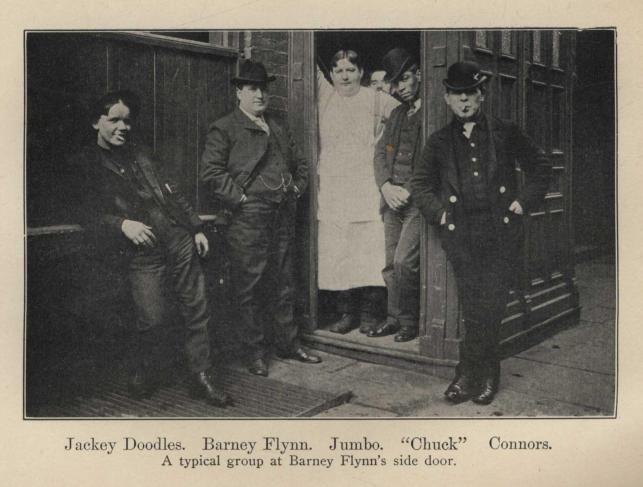
Jackey Doodles. Barney Flynn. Jumbo. "Chuck" Connors. A typical group at Barney Flynn's side door.
Right here let me say, that, without wishing to discredit any writer of dialect stories, I have yet to find the story which presents the idiom of the Bowery as it is spoken. I have taken the trouble to compare different stories—each one guaranteed to be a true and realistic study of the underworld—written by different writers and the discrepancies in the dialect are flagrant.
One, throughout his entire tale, puts "youse" in the mouth of his most important character. The other only uses "ye." One spells the question: "Do you?"; the other phrases it: "D'you?"
Perhaps this also applies to other stories written in New England or Southern dialect, but whether it does or not, it seems to be a case of "you pays your money and you takes your choice."
I have yet to see the "low life" story which is not studded with "cul" and "covey." Take my advice and do not use this form of address on the Bowery. They would not understand it and, therefore, would feel insulted.
Also, the men of the East Side are not so lacking in gallantry as to call their lady loves "bundles" and other similar names.
Then, in the matter of emphatic language the writers are far from hitting the target. The favorite phrase is "Wot'ell," which is a hundred leagues removed from the distinct utterance with which this dainty bit of conversation is used by a Bowery boy in a moment of rhetorical flight.
So I might cite hundreds of instances.
The same carelessness of detail is manifested in other things, when writing about us. They are not all important errors or serious mistakes, but are grave enough to prove the unreliability of those "true East Side studies."
A writer, who for a considerable time, has been accepted as an authority on conditions in the underworld, is the most profligate in calling beings and things of the sphere he describes by their wrong name. He persists in claiming that thieves are called "guns" by police and fellows. Every man, who has lived all his life on the Bowery, as I have, knows that "gun" means an important personage. A millionaire is a "gun," so is a prominent lawyer, or a politician, or a famous crook; in short, anybody who is foremost in his profession or calling, be he statesmen or thief, is a "gun."
The Bowery is not hard to reach and, if so inclined, you can easily test my assertion. Take a page from one of the many East Side stories extant and read it to a typical Bowery boy and he will ask you to interpret it for him.
The East Side dialect does not abound in slang. Whatever of it there is in it has been absorbed from the Tenderloin and other sources. To coin a funny slang phrase one must have time to invent and try it. They have no time for this on the East Side, where even time for schooling cannot always be spared. And that accounts for ungrammatical expressions and whimsically twisted sentences, but not for the idiotic gibberish and forced coinages of words slipped onto the tongues of my people.
The courtiers of the King of the Bowery, being a good-natured set of fellows, did not wish to curb the fervency of the literary "gents," and did their best to supply the ever-increasing demand for types.
The inner sanctum of the royal palace was divided from the outer room by the usual glass and wood partition. As Barney Flynn, the King of the Bowery, was a genial and jovial monarch, the more secluded chamber did not resemble a throne-room so much as a rendezvous of kindred spirits. It was a specimen of another strata of nether world Bohemia.
Tables and chairs were about the place in picturesque disorder. On the walls were three gigantic oil paintings, "done" by a wandering Bowery artist for his board and lodging, including frequent libations. In one corner was the voluntary orchestra, consisting of Kelly, the "rake," the fiddler, and Mickey Doolan, the flute-player. Their day's work over—they were both "roustabouts" along the river front—the two court musicians would take their accustomed seats, and, without paying much attention to those present, would fiddle and flute themselves back again to their own green shores of old Erin.
They are pathetic figures, these men of the Bowery, who live their evenly shiftless lives in dreams of days passed, but not forgotten.
Being directly in the path to and from Chinatown, Barney Flynn's saloon was, at odd times, visited by the sociological pilgrims to this centre of celestial colonization. One night, a writer happened to stumble into the place. Whether his impressions were perceived in normal or abnormal condition is not known. The "gang" was engaged in a little celebration of its own, were observed by the writer, and, forthwith, Barney Flynn's and the royal staff became a mine for authors of low-life stories.
With the acumen acquired in my dive training, I saw very soon that those coming to study us were most willing to pay for grotesquely striking types. The "real thing" had very little interest for them. What were we to do? To get the money we had to be types, therefore, whenever the word was passed that a searcher for realism—with funds—had arrived, we put on our masks, lingual and otherwise, to help along the glorious cause of literature.
No good purpose would be accomplished were I to mention the names of authors, who portrayed us so correctly. They are now celebrities with more paying aims. Their stories of us are still remembered, but only because of their "beautiful and pure sentiment," and not because of their "true realism." The latter differs with every writer and has bewildered the casual reader.
I am strongly tempted to call by name one, whose glory as demonstrator was dimmed in an unexpected manner. The writer in question had come here from Philadelphia, preceded by a reputation for his sympathy with those in the slums. Several of his "low down" stories had been hailed as the models for all the other writers of that tribe.
With his usual aggressiveness, not devoid of a touch of almost medieval dash and chivalry, this young man threw himself into the study of New York slums with wonted ardor, and, naturally, mastered the subject almost immediately. Being socially well-connected, or, rather, being well-taken up by society, he had no trouble in interesting his friends in his hobby. He was not niggardly in the spending of his money and quite popular on that account with my friends in Barney Flynn's. As a matter of fact, this promising young writer—a promise since then fulfilled—was a favorite of the highest and lowest; verily, an enviable position.
With note-book in hand, this young man sat among us for hours, jotting down phrases and slang expressions, manufactured most laboriously and carefully for the occasion. The interest of his friends increased, and one night we were honored by a visit of a large party of ladies and gentlemen, piloted by the aforesaid author.
Before the precious cargo had been unloaded from the cabs and hansoms, word had been taken to the back-room. As actors respond to the call of the stage-manager, so did we prepare ourselves to play our parts with our well-known finesse and correctness of detail. By that I mean, that we knew what was expected of us and that we emphasized our "characteristics" as we had seen them burlesqued on the stage.
The promising young writer was in his glory. With irrepressible glee, he introduced us, one by one, to his admirers, watching the effects of our "quaint" salutations. The chorus of enthusiastic approval was unanimous. We were "absolutely charming," "perfectly thrilling," and "too droll for anything." Encouraged by this warm reception of our feeble efforts, we surpassed ourselves and assault, battery, murder was committed on the English language in most wilful frenzy. Taking it all in all, it was a gem of slum mosaic, and is still remembered by most of the offenders.
Having given our performance and exhausted our programme, we were told by our friends how "very glad, charmed and delighted" they had been at meeting us.
The doors had barely closed behind the last of the promising young author's friends, before all the performers rushed up to the bar to spend the money given to them for their instructive entertainment. The comments on the visitors were many and very much to the point, but were not uttered in the manufactured dialect. There was much laughter and many imitations of our late audience, and none of us had noticed that the promising young author, accompanied by a few of the party, had returned to look for a pair of gloves forgotten by one of the ladies. Part of our conversation was overheard and the laugh was at the writer's expense.
Of course, we instantly endeavored to rectify our mistake and fell back to addressing each other as "cull" and "covey," but, somehow, the effect was not convincing.
One of his friends turned to the promising young author on leaving:
"Old man, you certainly deserve another medal for this, but this time, it should be a leather one."
I did not know then to what the above remark referred.
BOWERY POLITICS.
CHAPTER X.
BOWERY POLITICS.
The death-knell of divedom had been sounded by the legislature. Albeit, it had been sounded before, without stopping the dives from resurrecting themselves. But vice had become so rampant, so nauseating that the righteous of the city braced their backbones a trifle stiffer than usual and insisted on having a committee of investigation appointed.
All the daily papers heralded the coming of the inquisitors in big head lines, and the inhabitants of divedom began to quake in their shoes like fallen angels on the eve of judgment day.
Shortly before the beginning of the upheaval, I had overcome one of my many spells of lassitude and gentlemanly idleness and had accepted the position of bouncer in the "Slide," the most notorious dive which ever disgraced a community.
When a body is covered with a cancerous growth, the most dangerous ulcer is the first to receive the surgeon's attention. For that reason, the "Slide" was the first to be put under the prying probe. The investigation was thorough. The investigators and prosecuting officials, stimulated by fear of public censure and thoughts of political advancement, were merciless, and, as a consequence, the "Slide" was closed forever and the nominal proprietor sent to jail.
Without waiting for further developments, the other dive-keepers retired from business and a general cleansing process struck all quarters of the city.
The immediate effect of this was that a shifting of quarters of the vicious began. The harlots, bereft of their known places of business, hid themselves in the obscurity of virtuous surroundings, and the male element of the lowest dives congregated on the Bowery, ever the dumping-ground of human scum and offal. In a short time, the Bowery was full of a muttering crowd of able-bodied men, each one cheating the world out of an honest day's labor, all proclaiming loudly at the injustice which deprived them of their "living." Even the recollection is loathsome.
In company with a number of fellows who, like me, were "thrown out of work" by this "uncalled-for interference," we established headquarters in a ginmill owned by a legislator. As a matter of course, the "back-room," seemingly a legislative annex, was very much in evidence, and by no means subdued in its proceedings. If anything, the business behind the "partition" had increased in volume since the other dives, operated by less influential citizens, had been obliged to close. So we have here another of the many paradoxes of our political conditions. While his fellow-legislators were scouring the city with really commendable zeal to rend the evil-doer limb from limb, this being of their kin could be seen daily in front of his hall, sunning himself in the radiance of his increased prosperity and influence, and looking with self-satisfied smile across Chatham Square at the closed windows of minor dives.
Yes, as the Romans clothed the men of wisdom and love of country in the flowing robes of dignity and called them patriots, statesmen and senators, so do we take—take by the will of the people—the men fat of jowl and fat of paunch from beneath us and place them above us in the seats of the mighty and give them power over us. And if you would growl at my saying "from beneath us to above us," and would wrathfully confront me with the slogan of political and other equality, I would not wish to stand in your way of being their equal, but would have trifling respect for your integrity. As I tell the stars by seeing them and find but small difference in their lustre, so do I tell the rascals by their rascality, and there is small difference in the degrees of rascality.
Senators! Rome and Albany! Would the difference of time, of centuries, were the only one between them!
In all governments by and for the people, the making of the nation lies with the common people; that great mass, which you would call "rabble" were it not for the continental sound of the word and the danger of being quoted. An ever-watchful press keeps its eye on you, and would readily pillorize you as an offender against the most sacred of our possessions and privileges; our sacred freedom; our sacred equality; our sacred franchise, and, by no means lastly, our sacred screaming eagle, screaming ofttimes from veriest agony. The buncombe of press and loud-mouthed gabbers has decreed it to be treason to see the truth and to speak it, and you must, to be above suspicion of being a traitor to the land you love, on the Fourth of July let off in sissing streams of pyrotechnics your patriotism, which, after its one gala day, is forgotten for the rest of the year in the strenuous pursuit of getting all you can out of "what's in it."
The common people of the fields and meadows plow, sow and reap their harvest. They pluck the weeds from out among the useful growth and stamp them under foot. The common people of our cities live "downtown"—that vague and indefinite region—in tenement and barracks. (Notice how "down" and "common" always run together).
They have no knowledge of agriculture, and, with their seldom sight of plant or flower, even the stink-weed, for it is leafed and green, finds a welcome and place among them through their ignorance. Yes, more, it is cared for and nurtured until, as all ill-weeds, it grows to tremendous proportions, overshadowing and dwarfing those who have spared its life instead of plucking it out by the roots and pressing the heel upon it.
Who plants the weeds? Who is their sower? They care not.
Does not the same blessed sunshine and dew of heaven fall upon them as on the corn and roses? And do they not get more of it than the flower and the fruit-bearing plant? For they are greedy and strive for that which is not theirs according to merit.
Not most, but all the men, who played their part in our history so well as to be immortalized forever were self-made from the field and farm. Remember that there they destroy the weeds!
Not most, but all the men, who have made it a risk to a fair name and reputation to become actively engaged in the affairs of one's own country and state were self-made from the slums and gutters, with their only chance of immortalization via Rogues' Gallery. We of the city do not destroy the weeds!
They of the gutter, who have been forced upon and above the multitude, if not caught or not too notoriously prominent, keep the data of their success and formulative period secret. If, however, they run foul of the calcium, which often strikes, unexpectedly, dark places, they become arrogantly defiant in their ill-gotten might. Even against the scorn of the decent and to the awe of their own kind, they swing themselves onto the pedestal of the self-made man and strike their pose. All that is intended as a parallel to several rail-splitting and canal-boating men in our little history, who, as a "patriot" remarked, deserve a whole lot of credit "even if they was farmers."
Then, when forced into the public focus from their disturbed obscurity, is theirs the cry of repentance? Do they sob and cry: "Peccavi! Yes, I have sinned! I have wronged you and my country! Have mercy and forgive!"
If it were that it would be the cry of a tortured soul, rotten and distorted, yet still a soul and worthy of the chance of atonement. No; what reaches us from the usurped pedestal is the self-satisfied grunt of the swine: "Look and behold! You know or can surmise what I have been! Look now and wonder at what I am and how I got there!"
Surely this affront is resented and the daring knave pulled from his lofty perch to be punished for his insults and ill deeds? Some are foolish and un-American enough to suggest such a course of proceeding. But what really does happen is a taking up of that refrain of self-adulation by the admiring throng. There in almost worshipping attitude, we find that the chicaning game of politics makes mates of all sorts and conditions of men, and pickpocket and tax-paying citizen, cut-throat and that very peculiar animal, the intelligent workingman, all kneel in equal humility before the rum-soaked idol of their own creation.
A subject for deep guesswork is where the workingman keeps his well advertised intelligence. To claim to be one thing and then prove yourself the opposite, which, in this case means a fool, is a rather absurd proceeding. Presumably a good part of that intelligence is occupied in defending their rights, which nobody assails. Howling and haranguing do not require much intelligence, and of both the "intelligent" workingman does more than enough and to no purpose. When the time of his usefulness approaches—although it should be the time for him to assert himself—he stops his howling and listens to the strongly flavored persuasion of the wily politician—the weed he permitted to grow and to prosper—and becomes the gently led sheep, to awaken after election and find himself the twin brother of the donkey. They will not recognize that far better, by virtue of his sincerity, would be the sincere demagogue as leader than the dishonest politician of the gutter breed.
No man can choose his birthplace. Mansion and tenement have each furnished their quota of honest and dishonest men. If he of the gutter gets above it and gets there by means which are those of a man and an American, he will not lack the respect and esteem of those whose ranks he has fought to join. That is what proves this the land of opportunities and therein lies true equality.
There is another way to get out of the gutter, and that was the way employed by statesmen of the stamp of the Hon. Michael Callahan, of the State Legislature.
Mike Callahan's place in horticulture was most decidedly among the rankest weeds. "Lucky" Callahan, as he was sometimes called, had escaped the inconvenient calcium of public opinion, and, on that account, little was known about his origin, except by his intimates. Perhaps bootblack, perhaps newsboy, he had early learned to make himself subservient to his superiors, genial to his equals and condescending to his inferiors. Of course, these social lines were drawn by him according to his viewpoint.
Mike's striving for political recognition was aggressive from the start, and, having no other aim or ambition, he threw himself into the game of intrigue and wire-pulling with all his energetic intensity. Never questioning, always obeying, he became the ideal plastic mass to be molded by the enterprising chiefs of the organization. His promotion from ward heeler to captain, and from captain to the leadership of the district was his logical reward.
Yet, even in spite of his usefulness, his ascendancy to the leadership was not accomplished in a day. He did not mind this much, his bulldog tenacity keeping him alive to his ultimate purpose. His manhood and individuality, whatever they might have been, had long been sacrificed.
To strengthen his own power in the district it was necessary to weaken the influence of the incumbent leader, and, to effect this, knowing nothing of diplomacy, Callahan resorted to plain treachery. The fact that the leader to be deposed had been his benefactor and stanch friend was of small moment. Certainly Mike was sorry, but what could he do? Take a back seat and beat himself out of his chances? "Not much," said he, and invented the useful and often quoted phrase, "Friendship in poker and politics don't go."
Mike's assumption of the leadership was worked by decisive methods. There was no vagueness about him. The great leaders in the history of nations were endowed with attributes and traits of the highest and noblest order. Mike's most pronounced attribute in his functions as leader was directness. It was this that enabled some of the brilliant young men of the party press to apostrophize him as "rugged, bluff, stalwart, frank and straightforward."
The district contained a population in which the intelligent workingman was not greatly represented. The few of them who lived in the many lodging houses had very little belief left in the dignity of labor and toiled only enough to "square" themselves with their landlords and liquor dealers. Still, they were of use. They could talk beautifully about the rights of labor, and were encouraged—before election day—to spout grandiosely about the tyrannical oppression of the American workingman by the opposing faction.
The great majority of the voters in the district belonged to the class of grafters, and for that reason if no other, the Hon. Michael Callahan of the State Legislature was their born leader.
Callahan was at his best shortly before election. Then no man or woman—unfortunately the ladies of the district would indulge too strongly—had to linger in the throes of the law. It was the sacred duty of the leader to call daily at the police court to save his constituents and their "lady friends" from their impending fate.
On the eve of election no time had to be wasted in speculating on how much the free and independent voter could expect to receive for the exercise of his sacred franchise. According to the amount sent down from the headquarters of the organization, Mike's ultimatum would settle the market price of votes. One or one and a half, or two dollars were the rates paid, although the last named rate was only given to liquidate the voter's claim at the most critical periods. In this way the voter could figure with certainty, and with very little interruption resume his dissertation on the betterment of municipal and national politics.
The most important events in our history were conceived amidst surroundings of severest simplicity. No marble hall, no lofty council chamber, just the Common with its green sward and sturdy oak was the favorite meeting place of our forefathers. In the shadow of the mighty tree they spoke of liberty, of the rights of man and of the welfare of our country, and we reap to-day the benefit of their integrity, in spite of the machinations of politicians, whose very thoughts are a pollution of patriotism.
A careful and thoughtful student of American history, the Honorable Mike tried to live up to tradition as much as possible. Customs have changed, civilization has progressed, real estate has risen in price, and the political leader of to-day has felt himself obliged to substitute the gin-mill and the dive for the Common of old. Besides, "there is not much in Commons," excepting when the city fathers, in the goodness of their charitable hearts, decide to create another breathing place and playground for the poor children of the East Side, and, thereby can get a "chance at" the property owners of the site.
When one is a leader, one must do as leaders do. Mike could not swerve from the accustomed practice, and, nolens volens, found himself the proprietor of a dive. But, forced into this, he had at least the satisfaction of opening this adjunct to his legislative office on the Common, or Square, as it is now called. True, there was no sturdy oak and no green sward, but there were elevated railway pillars and their shadows were quite sufficient for the practice of side issues in politics. The oak bears only acorns. The pillars and their shadows bore better fruit of silvery and golden sheen, and their sturdiness was often welcome to the backs of the many weary pilgrims who had traveled far to imbibe the pure draught of American patriotism as dispensed by the Hon. Michael Callahan of the State Legislature.
With the characteristic modesty of great men, Mike refrained from making the exterior of his place too showy. This superficial attraction to his resort was absolutely needless, as his more lasting fame—some detractors called it "disgraceful notoriety"—was firmly established. Did he not have several fist-fights with "officious" police officers to his credit, and, did he not openly dare and defy all known authorities to "monkey" with him. He feared no man but one, and that one only, because he was a more successful thug than himself and the Great Leader and Chieftain.
Dives of a certain kind make no effort to attract transient trade by bright, or, at least, neat and clean exteriors. Their business is not supplied by the honest man, who is looking for an honest place to have an honest drink. They depend on that flotsam and jetsam that can find a dive blindfolded. Callahan's place was more suggestive than attractive in its front and the interior was fairly dazzling in its austere plainness. Sawdust and traces of former expectorations were the most evident features in the bar-room, which only ran the length of the bar. At the end of it a partition jealously claimed the rest of the space for the back-room. There, and not in front, was the real business transacted. The front, a pretense of respectability; the back, without any pretense whatsoever.
I cannot tell you what furnished the real attraction of the back-room. A minimum clearance of space in the centre of the room was reserved for dancing and surrounded by tables and chairs which were nightly occupied by young men and women, many of whom had been born and brought up in the immediate neighborhood, under the very eyes of the legislating dive-keeper. But that fact made no difference to this vile thing, empowered by our sanction to make laws which were to safeguard homes, property and life.
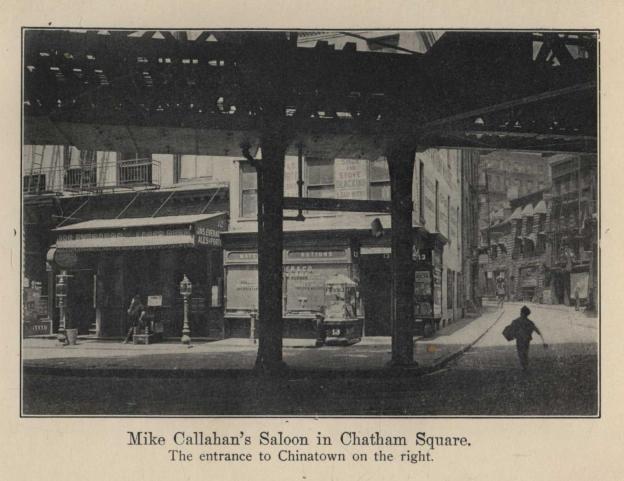
Mike Callahan's Saloon in Chatham Square. The entrance to Chinatown on the right.
And there, safe in the protecting radius of our friend and statesman, we found a resting-place; for our enforced retirement from dive activity, and there, in all my uncleanness, there came to me the sweet messenger of a newer, better life, and took me from it by the all-powerful persuasion of an unquenchable love.
Before telling you how this miracle transformed me in a way, which will tax my power of description to the utmost, I must relate to you the one and only attempt we, myself and two cronies, made to get away from a life which was the only one we knew.
A PILGRIMAGE TO NATURE.
CHAPTER XI.
A PILGRIMAGE TO NATURE.
It was in May. The side-walk in front of Mike Callahan's dive was wide, and we, the gang of discharged dive employees, were in the habit of lounging on the empty beer barrels along the curb or sticking ourselves up against the swinging doors of the place. People, whom we knew from having met them in the "better" days, when we were still working, often passed by and were eagerly hailed by us in the hope that they might buy a drink for our thirsty throats.
Corner loafers are despised by all people who lead useful lives, and justly so. Still, there is something very moving in thinking about the dreary existence of these fellows. With brains as empty as their pockets, they assemble with praiseworthy regularity at their open-air clubs, and waste their days in pessimistic conjectures. The loafer is a born pessimist and cynic. No matter what subject or event you may mention to him, he will sneer at it and promptly proceed to pick it to pieces. His criticisms are as acidly sarcastic as his excuses are ingenious. Ask him his opinion about the work done by some skilled mechanic, and he will find a multitude of faults and then expound how the job ought to have been done. Surprised at his technical knowledge you ask in a mild way why he does not put his evident ability to practical use, and are forthwith shocked by suggesting such a thing to a man, who has such a wealth of haughty and convincing reasons for remaining a loafer.
Loafers are forever hovering in the ante-room of crime. If his Satanic Majesty bethinks himself of his own and calls them, they willingly and without compunction, do any crooked commission provided it does not require too much physical courage. After due time, crime seems easy, they have not yet been caught, and from their familiarity with evil-doing, and not because of any lately awakened courage, they commit deeds which are called "desperate" by every conscientious reporter.
Jack Dempsey, Frank Casey and myself formed a sort of inner circle in the larger gang. We often philosophized together, exchanged ideas and commented on things in general. At one of our confabs, Frank Casey seemed to be entirely out of humor.
"What's the matter with you, Frank?" I asked.
"What do you think there is? There's nothing the matter with me, excepting that I'm dead sick o' this game." We could see he was deeply moved by some unsuspected emotion and were deeply interested in its development.
"I tell you what I'd like to do," he resumed. "I'd like to cut this all out and go to work some place. There's nothing in this kind o' life and it's the same every day. See, it's years and years since I done what you may call an honest day's work."
"Ah, you're only kidding!"
"Kidding?" he echoed, indignantly. "Say, Kil, and you, too, Dempsey, I was never more serious in me life. What are we getting out o' this? It's hanging round here all day, looking for graft and the few pennies to go to bed with or to buy a beef-stew; and when a fellow does make a piece o' money, does it do him any good? Not on your life! If you flash it, you got to blow it in for booze, and if you don't they think you're no good, and the whole gang gets sore on you. A fellow that's working and making his dollar and a half or two dollars a day, is better off than the whole bunch of us taken together."
"For the love of heaven, you ain't thinking about going to work?"
"That's just what I'm doing, and the sooner I can start in the better," attested Casey with emphasis.
A warm discussion followed. It is hard to tell if it was the novelty of the proposition or Casey's evident sincerity, but Dempsey and I began to consider it very seriously.
"Say Casey," I asked, "supposing the three of us really wanted to go to work, where could we get it? They don't take men like us in shops or factories, where there are a whole lot of trained help looking for work every day. So, even if we wanted work, we couldn't get it."
"Is that so? You're talking as if New York City is the whole thing. What's the matter with the country? That's where we ought to go, because we'll never amount to anything here. In the first place, even if we was to get jobs here, the three of us would be going on a drunk on the first pay day and stay on it until we're broke. But in the country you ain't got no chance to spend your money, and it's healthy and it's better anyway."
The surety of Casey amused me.
"Will you tell me where you have ever been in the country to know so much about it, and where you got your information from?"
"That don't make no difference," insisted Casey stubbornly, "I know there's lots o' fellows going over to Philadelphia or Jersey or some place over there every year about this time, and they come back like new and with money from picking strawberries and whatever else there's growing out there."
We put our heads together, discussed the matter, came to the conclusion that, surely, we would not be in worse circumstances in the country than we were in the city, and resolved to try our luck at strawberry picking.
To financier our expedition was our first duty. We skirmished round and raised about six dollars as our joint capital. Casey went on a secret errand to make inquiries of some well-known "hobo" authority where to go, and how to get there, and then undertook to personally conduct the tour into the unknown land.
Baggage did not encumber us. I had thought of taking my good old pal, my Bill, along with us, but did not wish to expose him to the dangers, which, no doubt, were lurking for us.
At the ferry, Casey flew his flag and read us the last orders. To save our small capital, we were to walk or "jump" freight trains. Also, for reasons of economy and sagacity, we were not to indulge in one solitary drop of anything intoxicating.
The first hitch occurred in Hoboken. To get a freight train was impossible. Dempsey and I never knew why we were unable to make connections, as Casey's plausibility drove the question from our minds and made us follow him blindly.
We walked from Hoboken to Newark. It was a scorching afternoon, the sand was hot and heavy under foot, and our mouths became parched at an uncomfortable rate. A few wells and pumps were passed by us, but Casey would not permit us to slake our thirst, as "Newark is only a step or so further on, and it's dangerous to monkey with them country people. They got dogs and are kind of suspicious of fellows like us, who come from New York."
Ah, really and truly, it would have been the most confiding and unsophisticating nature that would not have been suspicious of us, no matter where we hailed from. Three tough specimens of humanity, indeed, we were!
No stop was made until we reached the railroad station at Newark. Quite a crowd was assembled to wait for either an incoming or outgoing train, but we, without paying the slightest attention to the many mistrustful glances given in our direction, raced for the ice-water tank, prepared to gorge ourselves with the cooling drink.
Casey was the last to have his turn at the chained tin cup. He started off splendidly, but paused after, his first gulp and smacked his lips in a most critical manner.
"Taste anything funny in that water?"
We replied in the negative.
"There's something wrong with it, just the same," Casey persisted. "And do you know, the worst thing a man can do this time o' the year is to drink bad water."
"But we got to drink something. We ain't going to drink any beer, and I hate to spend money for soda and ginger-ale and stuff like that," remarked Dempsey.
"That's true enough," admitted Casey, "but, I'll tell you what we'll do. The same fellow who gave me points on how to get to the strawberries, also, told me that the biggest glass of beer in the country was sold right here in Newark. Now, we ain't going to get full or anything like that, but, being as the water ain't fit to drink, I guess we might have one, just one o' those biggest schooners, which I never seen and which, besides quenching our thirst, are surely worth looking at, the same as any curiosities."
Without the aid of a Baedeker, we found our way to Newark's most interesting spot. We entered the hospitable tavern at about seven o'clock, and, at ten o'clock, were still tarrying there admiring the size and beauty of the biggest beers in the world.
Regardless of the size of the drink, the beer alone,—never a product of malt and hops—a vile concoction of injurious chemicals, is sufficient to put the indulger far above the most worrying troubles. Late that night, the quiet streets of Newark were profaned by three unsteady musketeers, who, with song and laughter, were making their way to the "meadows."
Only one more resolution made and broken. It was not the first and was not the last.
Out in the "meadows," the train-yard, where the freight trains were made up, we succeeded, after many mishaps, including Casey's tumble from a moving train into a ditch, in catching a train at about midnight. We had only traveled about a mile, when a trainman, stepping from car to car with lighted lantern, saw us huddled between the bumpers.
"Where are you fellows going?"
"Philadelphia," came the answer in sleepy, drowsy tones.
"You're on a wrong train. This train goes to the 'branch.'"
At the time we did not know that this was only a common ruse to make "hoboes" leave the train and accepted it at its face value.
"Where did he say we were going?" asked Casey.
"To the 'branch,' wherever that may be," I answered.
"I guess we better get off, then. This train ain't going to Philadelphia," suggested Dempsey.
"What we'll get off for? This train goes somewhere, don't it? And it don't make much difference where it goes to, as long as it goes somewhere into the country and away from New York," said Casey, with the evident intention of ending further argument.
The heavy, damp night air and the drink partaken by us lulled us into deep slumber, forgetful of our precarious attitude. We had journeyed for hours without waking and were not aroused until the coldness in our limbs became actually painful. Without speaking a word and merely staring at each other we jolted on and on into the unknown, and the dawning morning.
Suddenly a brilliant spectacle caught our eyes. Coming out from wooded land, the train sped along a level stretch and we fed our looks on the Fata Morgana of a large city. The size, brilliancy of illumination and distance from New York left no doubt in our minds that we were not far from Philadelphia, and had we known how to pray, we would surely have done so. I have never regretted the experience, still have no wild desire to repeat it. There are more easily obtainable joys in life than the riding on the bumpers of a freight train on a chilly May morning.
It was not long before we were slinking along Market street in Philadelphia. After fortifying ourselves against the bad consequences of our benumbing voyage by sampling some "speak-easy" whiskey, we visited "Dirty Mag's" famous all-night restaurant on Sixth street and feasted on steak-pie and coffee, with crullers included. The bill amounted to ten cents.
We were so tired out by our traveling that it was out of the question to continue our journey. Down on Calomel street we found a resting-place for our weary and frozen bones at fifteen cents per couch. It was almost noon before we woke from our sleep and held a conference. At its termination we hied ourselves to the nearby grocery store and spent almost the entire remainder of our depleted treasury in buying provisions for our trip into the wilds of Pennsylvania. After that, with a last parting drink, we turned our backs on Philadelphia and set boldly out to win our fortunes.
Just as the suburbs had been reached by us we were reminded by our stomachs that we had forgotten to breakfast. An inviting tree stood nearby, a brook, as clear as crystal, was rippling past our feet, and the place seemed to be made for a picnic ground. The enjoyment of the meal was marred by the thought that now we would have no lunch or dinner.
"What's the use of worrying about that now? Besides, we won't have to carry so much," was Casey's way of consoling us.
We rose and began our tramp in earnest. For hours we walked, giving little attention to the things about us and only holding desultory conversation. Not one of us knew the route to the "strawberry country," and we were often obliged to ask people whom we met for directions. We had little luck in this. Most of the people addressed by us would quickly button their coats and hurry on without heeding us. Others would barely stop and throw us such a small scrap of information that, instead of enlightening us, they only bewildered us the more. At last, Casey got tired of this way of securing information and burst upon us with his latest and brightest inspiration.
"It's no use of asking any o' these men. Most o' them are hayseeds and been to New York and have been buncoed. They can see in a minute that we're from New York and ain't going to take no chances with us. It's different with women. They're always nice and gentle and, especially, when they get spoken to the way I know how to talk to them. Leave this to me. Don't ask any more men. Wait till we meet some women, and then I'll ask them, and then you'll be surprised in the difference."
Casey, who had given voice to this speech with properly inflated chest, proved himself to be a true prophet. We found there was a difference in the way in which men and women received our approach.
Before long, we saw two women with baskets coming our way.
"Now, you fellows want to keep a little behind, and watch me how I do this," was Casey's final instruction.
Giving his clothes a quick brushing with his hands and setting his hat jauntily over his ear, Casey went toward his fate with a grace all his own.
Dempsey and I could not hear the first passage of words, but it was hardly necessary, as the effects of it were immediately visible.
One woman proceeded to pummel Casey with her umbrella, while the other was trying to fit her market-basket on his head. When they saw Dempsey and me come running to the rescue, they left Casey and took it on a run across the fields, but they took good care to shout back to us that they would have the sheriff or constable after us.
"For heaven's sake, what did you say to those women?" I asked Casey, after I had pulled the basket from his head.
"What did I say to them? They ain't civilized, and it don't make no difference what a fellow says to them kind o' people. I spoke to them like a regular dude. This is what I said: 'Ain't this a fine morning, girls. We're strangers here and didn't like this country very much until it was our good fortune to see you, who are sweeter than any sugar, and now we'd like to stay here if you will tell us the road to where the strawberries grow and where there are as many girls as beautiful as yourselves!' And the minute I said that they soaked me."
We consoled Casey and resumed our tramp.
It was now late in the afternoon and I determined that we should know something about our whereabouts. I stopped the very next man we met in such a way that he could not get away from us.
After assuring him that we had no intention of robbing him, I insisted on getting correct information.
Can you imagine our feelings when he told us that we had spent our time and energy in describing circles around Philadelphia, without getting away from it?
Dempsey and Casey made no attempt to hide their chagrin. The blow was too crushing. I, also, felt fearfully discouraged, but did not want to give in.
"There is no use in going back. We're here now, and must go on. If we go back to Philadelphia, we might as well go back to New York. We're in the country now, and we might as well stay here. I don't care what you fellows do, I'm going to go ahead."
The last sentence was a fearful bluff. Had Dempsey and Casey decided to return to New York, I would have joined them on the spot. Fortunately, they adopted my way of looking at it, and we once more pursued our sorry pilgrimage.
Now, we were sure of penetrating right into the heart of the country and evidences of it were not lacking. Suburban villas grew fewer and fewer and we had to walk for a considerable distance before we passed another farmhouse. With our inborn stubbornness we kept plodding on, until our legs almost refused to obey.
It was the hour in which evening unwittingly yields supremacy to night. We felt it, as was proven by Casey in answer to Dempsey's question in regard to the time.
"Well, when it looks like this they always begin to light up in Callahan's, and that's about seven o'clock."
Again we were silent and tramped and tramped. Dempsey was the next to speak.
"Say, fellows, I ain't seen any strawberries yet. And even if we were to see any now, we couldn't go to work at them this evening, it being so late now, and I think the best thing we can do is to sit down some place and take a rest."
Only a few more steps and we saw a spot, which by you, would have been called a dell. We called it nothing, just saw the soft grass and, with one accord, sank down on it.
The tone of evening now rang unmistakably clear. Evening and its partner, the gloaming, were at the last and best moment of their supremacy. Too short, by far, are evenings in the country, those short brief hours of nature's neutral state, before retiring to its well-earned rest. But that I only feel now, and did not then.
Remember! this was my first night in God's country. Like thousands of others who live and die in the southeast corner of Manhattan—along the Bowery—I had never had a sight of nature. I could not have told a daisy from a rose; or a crow from a robin. All that I write here are the impressions that linger in my mind of this, my first night with nature.
It was one grand moment in our lives, yet we did not feel it. Hold, I am wrong! We did feel it, perhaps subconsciously, but feel it we did. Our kind is not given to much talking while doing anything of import. Then our energies are in our task, no matter how dirty that may be. As soon as we rest, we change, and the silent drudge becomes a veritable magpie. We three were resting as, like three daisies in the wilderness, we sat in our dell, but there was something all about and around us that stopped our flow of talk from loosening itself.
We sat and stared, and the most insignificant changes in the tranquil scene before us left their unrecognized, yet deep impressions on us. And looking back through all the years passed since then, I see it all still before me, though I cannot attempt to picture it to you.
From where we sat it looked before us like the setting for a glorious play. On both sides, small sketches of woodland interjected just far enough to serve as the wings on the stage. Back of it, there was a grand, majestic last drop, a range of hills, running unbrokenly from where to where we could see. The cast, the actors of the play were supplied by all the many living things about us and, above it all, like the last curtain, hung the forerunners of the coming night.
It was no tumultuous melodrama, no rollicking farce, it was a pastoral play so successful, so wisely composed and staged that from its first night it has been enacted every night through all the ages. No wonder that with so many rehearsals the scene, as we saw it, was played with perfection.
Out from a loophole in the sky, a bird came flying toward us with unfaltering swing. Night after night it had flown the same course, night after night it had the same rôle, that of bringing their share to the young striplings in the nest above our heads. Along the road came a creaking, lumbering farm-wagon. The farmer looked at us with suspicion, still, gave us a "good evening, boys." I do not know if we returned his greeting or not.
It was quiet, so quiet, that the many little noises, made by unseen beings, pealed like tornadoes of sound. The snatch of laughter, coming from the tree-encircled farm-house behind us, was as the laughter of a multitude; the chirrup of that homeward bound bird was as a lofty, airy chorus; the croaking of the frog was as a grunting wail from many, many, who never get above the very ground. While we had sat staring holes into the air before us, evening had flown, and night, a gallant victor, had unrolled the standard of the stars. I know I cannot tell you my impressions, but even had I the gift and genius of a hundred of our greatest writers, I could not convey to you what a picture that night, my first night in God's country, left with me. It seemed to me that all and everything, before becoming wrapped in slumber, gave one praise-offering to Above. The corn of the field and the poor lowly flower by the roadside and even the tiny blade of grass, they all were straightened by one last, upward tremor before relaxing to their drooping doze. The birds of the air and the beasts of the ground, all sounded their evening song. With some it was a thrill of sweetest divine melody, with others it was but a grunt, but it all seemed like a thanksgiving for having lived and worked a day made by the Creator of all.
And from beneath all this, the silent attitude of prayer and the intoned evening hymn of creatures rose onward, upward, like an anthem to the sky, where brilliant orbs and shining, milky veils were interwoven in a web of glory, and peeping over the tops of hours into the birthing cradle of another day. It is a witching hour, this hour, when stars and nature in unison sing their evening song.
Where nature is grandest, man most likes to profane it.
The sublime, sweet spell held us enthralled. Not a word had been spoken by us. How long we had sat there we did not know. How much longer we would have sat there is a matter of unprofitable conjecture. As if turned loose from the regions of the arch-fiend, with howling screech, with snorting, rumbling, rattling, a train, looking like a string of toy-cars in the distance, clattered along the range of hills, the last drop of our scene. Spitting fire before it, leaving white streamers behind it, the iron disrespecter of nature's sanctity rushed into the very heart of the hills and took the haze of idealism with it.
The spell was broken, and we were not long in getting back to terra firma.
"Say," remarked Casey very pensively, "ain't it very quiet here?"
"Well, I should say so," hastened Dempsey to corroborate him. "It's so quiet you couldn't sleep here if you wanted to. This ain't no place for us. Let's go."
We started ahead and tumbled along the country road. All directions, as to our route, were, for the present, forgotten. We only had one purpose now, to get away from the haunting quiet. With every step our nerves became more unstrung. A rabbit scooted across the road and made us grasp each other's arms. The faint rustle of the leaves sent shivers down our backs.
Out in the open, we felt the hazy, vapory night air enshroud us, which showed every object in ghost-like mold. A dog barked far away, then it howled, and I can swear to it, we trembled.
It was not physical fear. It was the weirdness of the unaccustomed that played havoc with our reasoning powers. Some may doubt all this and mention as proof the "hoboing" tramps, who spend their most pleasing and profitable period of vagrancy in their country. I am not prepared to discuss this at all, but am quite sure that every tramp, at the beginning of his career as such, was similarly impressed on his first night in the country, provided he had not found shelter in a barn or haystack or had not been born and lived in the country before.
We, we were city bred to the bone, and noise was essential to us as ozone is to the country lad. He cannot sleep with noise,—we could not sleep without it.
Our musings—we had not spoken for a long time—were interrupted by Dempsey, who had fallen over a rail, which he had not noticed in the shadowy Darkness. Yes, it was a full-fledged railroad track and, for some obscure reason, it seemed to possess a great deal of fascination for us. We were apparently not able to get away from it. We stood and looked at it as if we had never seen a railroad track before.
This lasted until the ever-ready Casey interpreted our feelings.
"I wonder if this is the Pennsylvania railroad?"
That started a chorus of "wonders."
"I wonder which end of this runs into New York;" "I wonder how far we are from New York;" "I wonder if we could get to New York from here;" "I wonder how long it takes to get to New York from here;" "I wonder if there is a station near here."
How it happened, whether any one proposed it, or how we got there I do not know, but I do know that, quite unexpectedly, we found ourselves at a little wayside station, with a lot of milk cans on its platform. There is no mistaking the fact that we were entirely unbalanced mentally, and it was a good thing for the crew of the freight train, which rolled in to unload and load milk cans, that they were an easy-going crowd of men. We made no pretense of hiding ourselves, but climbed boldly on to the cars and would have committed murder had they attempted to put us off. The spectre of the stillness had taken possession of our brains, and we wanted to flee from it as from a plague.