Part 1 — CHAPTER II NANCY
Reading edition
Nancy, a dream of the eighteenth century, with the réveillé of twentieth-century guns.
We arrived at Nancy five hours late, at seven o’clock.
No sign of E. M., no sign of anything familiar. Fortunately I was flanked by Brittany, and a stout heart did the rest. When we found that the next train for Lunéville would leave at nine o’clock, I asked them to dine with me and take a little walk about the town. Our luggage—we were all traveling light, I with a hand-bag and flat straw valise, they with two iron helmets—was given to the consigne and, after my sauf-conduit had been stamped in three separate places, we departed.
The square before the station was surging with the usual pale-blue waves, and as we crossed it the odor of leather and tired feet and hot men was a good deal stronger than the linden scent. We passed a very banal statue of Thiers, Libérateur du Territoire, and some horrors of art nouveau. A construction with colored-glass windows and unnatural cupolas and gilding and mushy outlines protruded from a corner, and its name, for its sins, was Hôtel Excelsior. But we were searching for the celebrated Place Stanislas. After asking a passer-by, we were directed to a street whose name I have forgotten, and we started down its rather distinguished length of gray, well-built houses of another century, many of them having the double Lorraine cross in red to indicate cellar accommodations, with the number they could shelter.
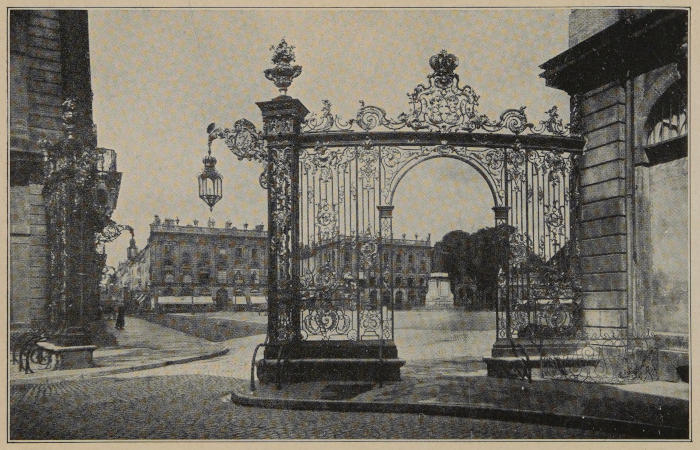
PLACE STANISLAS, NANCY
When, suddenly, we stepped into the Place Stanislas, I almost swooned with joy. I was in full eighteenth century, in the midst of one of its most perfect creations, with the low boom of the twentieth-century guns in the distance.
Quickly my spirit was ravished from the world of combat into the still, calm, beautiful world of art, within the enchantments of the grilles of Jean Lamour. A sensation sweet, satisfying, unfelt since the beginning of the war, invaded me. I gazed entranced upon that delicate tracery of wrought iron, like some rich guipure, at the four corners of the square of buildings, its lovely gilding reflecting a soft light; and, outlined against a heaven colored especially for them—pale blue, with threads of palest pink, and a hint of gray and yellow—were urns and torches and figures, half human, half divine, supporting them. The beautiful fountains in the corners were banked with sand-bags, but their contours were in harmony with the other grilles, and one was surmounted by an Amphitrite, the other by a Neptune. It was all a symbol of a state of mind, a flowering of feeling, to which had been vouchsafed a perfection of expression.
There is an Arc de Triomphe, put up by Stanislas at one end, in honor of his kingly son-in-law, in front of the Hôtel de Ville, and a statue of Stanislas himself in the middle, bearing the name “Stanislas,” the date of 1831, and “La Lorraine Reconnaissante.” In looking about, my eye fell on the Restaurant Stanislas, dans la note, certainly, and I decided to dine there. We found that we had time to investigate a little further, and turned down by the café into a most lovely linden-scented square called Place de la Carrière. Through the double lines of trees between the fountains at the farther end was visible an old palace, and the square was flanked by houses that courtiers only could have lived in. It all cried out, “Stay with me awhile.” An old park was at one side, with trees planted en quinconce[2]—chestnuts, ash, trembling poplars—and everywhere was the penetrating fragrance of the lindens. It was so sweet and loosening under the shade, after the long hot day in the train, that the young officers began to talk, one of his fiancée waiting in Les Landes, the other of his wife of a year, seen only twice seven days. And then again we were silent, and under the flowering trees I was seized with a great longing for the beautiful and calm, for the arts and ways of Peace. It seemed to me I could not longer think of this, that, or the other “offensive,” but that I must see before my eyes, hear with my ears, feel with my touch, the lovely, the melodic, the benign. O bon Jésus! Not of the battle-fields, not of réformés, of limbless, sightless men, not of starving, frightened children, not of black-robed women, not of lonely deaths, not of munition-factories. What is this world we are in?
I don’t know how long we were silent, but at last one of the young men said, “We must think of the hour.” Then came a glancing at wrist watches, rattling of identity disks, and we went back to the café and got a table by the window, where we could look out on the lovely, calm ensemble and the fading sky. The menu was brought; it was a meatless day, but with a snap of the eye the waiter recommended œufs à la gelée. We understood later, when we found, concealed in the bottom of each little dish under the egg, a thick, round piece of ham. Fried perch, new potatoes, salad, strawberries and cream, with the celebrated macarons of Nancy—des Sœurs Macarons, as the little piece of paper underneath each says—made a delicious menu. A certain petit vin gris du pays had been recommended us with another snap of the eye.
As we sat waiting, one of the officers exclaimed at a giant, lonely, priestly figure passing through the Place:
“Le voilà, l’aumônier du 52ème.”
I said, “Do run after him and ask him for dinner, too.”
He came back with the young man and we had a most enjoyable repast. The chaplain knew all the things about Nancy that we didn’t. He was a huge, bearded man, who might have been with the hosts of Charlemagne, and was a native of Commercy, where Stanislas used to go with his court. The two Bretons were very Catholic and very royalist; when I remarked upon it, they said, simply, “Oh, we are all that way, par là,” and they spoke names of great men born in Brittany, and the aumônier told tales of near yesterdays surpassing those of the heroic age. The gayest of the Bretons, he who had not just left his young wife and his child unborn, began to sing, “Voici un sône tout nouveau,” and suddenly it was a quarter before nine and we had time only for a dash to the station d’une bonne allure militaire, which left me breathless. The nine-o’clock train didn’t, however, leave till ten, as it was waiting for the Paris train, which didn’t arrive at all. Finally, in a strange heat, vagaries of lightning without thunder or rain—the thunder we did hear wasn’t the old-time, pleasant, celestial sort, but something with an easily traceable, regular, decisive sound—we pulled out of the station, I not knowing where I was going—no address in the town of Lunéville.
A thick, heavy, soft, enveloping night was about us.
Groups of soldiers were lying, sitting, standing in the little stations. We stopped every few minutes, and I could distinguish them by the light of cigarette or lantern on their guns and equipment, waiting for motors to take them to the trenches. At one place I had to descend to show my sauf-conduit; it was inspected and stamped by the flickering light of a blue-veiled lantern, and I climbed in again. I was beginning to feel a bit tired, and the end was not in sight.
We descended at Lunéville in complete darkness, a motley crowd of military and civilians. My companions were due at different points at dawn—Baccarat and the Forest of Parroy. As I write, they are in the trenches. They put me into the hands of a commissaire who said he lived opposite E. M.’s. I waited, standing by the door, while he locked up the station, looking out on the silhouette of a gutted, roofless house, showing dimly against the soft night sky. At last there was a sound of rattling of keys and the commissaire picked me and my luggage up. We started forth, the only human beings visible, in what seemed a deserted town—no lights in streets or houses.
As we passed a wide open space the scent of flowering lindens enveloped me, and with me walked the ghosts of lovely and too-amiable ladies, of witty rulers loving the arts as well as women—Duke Léopold and Madame de Craon, King Stanislas and Madame de Boufflers, and Voltaire and Madame du Châtelet.
We walked seemingly through the entire town toward a freshness of parks, and in darkness we arrived before a garden gate; silence, and the bell nowhere to be found. After looking for it in the light of various matches—vainly, of course—the commissaire had the brilliant idea of going to the house next door, la maison de M. le Maire, the celebrated M. Keller. A woman came out and showed the bell where nobody would ever have thought of looking for it, and, furthermore, masked by vines. The door was finally opened by a tall, slender, white-robed figure with two black braids showing over her shoulders and a floating scarf. I thought it a vision of Isolde, but it proved to be Miss P., who cried:
“We had given you up! We waited at Nancy till the train came in, and then had to motor back as quickly as possible on account of the lights.”
I went in, to find E. M. in a most becoming, slinky, pale-blue satin négligé, also with braids on her shoulders. I’d rather have found them both in paniers, shaking the powder out of their hair. However, I can’t complain; it was all pretty good as regards the stage-setting. We embraced. I explained that various zealous guardians of the gates of Nancy had stamped my sauf-conduit, and, as I was certainly the only one of my species arriving by that train, they should have given news of me when asked concerning une Américaine. Then, as the only healthy rooms in Lunéville in 1917 are on the ground floor, I departed to one that had been retained for me at the Hôtel des Vosges. Again through the soft-scented night, guided by my commissaire, to a room of extreme cleanliness and a most comfortable bed.
It is 2 A.M. I am too tired to sleep. My mind is jacked up by all the twists and turns of the day. I have been reading the Cour de Lunéville, by Gaston Maugras, found in my room, belonging to E. M.
Three o’clock. Soft, very soft booming of cannon, and a deep-toned bell. But no “poppy throws around my bed its lulling charities.”