this book is Dedicated (continued 2)
Reading edition
Tuesday, July 13, 1915.
We finished getting ready the stores for the dispensary to-day. Dr. Dearmer and Dr. Marsden left for Malta; Dr. Dearmer has his son there.
Wednesday, July 14, 1915.
This morning we were up at 4.15 as ten of the new unit were leaving to start the dispensary, twenty-five miles away; they left with all their equipments. Just as they were ready to start the Rev. Mr. Sewell arrived, and Mrs. Sewell from Belgrade. Dr. Hanson and Mr. and Mrs. Sewell and I had tea together in Dr. Atkinson's tent. This morning Major Potridge took me to the arsenal to choose a transport kitchen which the Serbians captured from the Austrians. I was taken all over the arsenal, which was most interesting. It is most wonderful the amount of guns which the Serbs have taken from the Austrians. Mr. Paulhan, the French aviator, is here. He won the Daily Mail prize; he flies over the camp very often going to Belgrade. Six of our unit go to Belgrade this evening for a few days. I hope to go before returning to England.
Friday, July 16, 1915.
Mrs. Stobart and three of the Government officials went to choose a site for another dispensary. I was up at 3.30 and we had breakfast at 4.30. I went to the market to order things for the week. Sunday is the great day for the market. It is so picturesque to see all the Serbs in their quaint costumes. The gipsies are lovely. They have gorgeous striped skirts, homespun, lovely coloured belts with large buckles, home-made stockings wonderfully embroidered, fancy zouave, and fancy coloured scarves on their heads. One of the doctors and I were invited out to an engagement ceremony. It was really most interesting. One of our interpreters who was single was told that there was a girl who would make him a suitable wife, so he went to see her early last week, liked her, so proposed. She is nineteen and he is about thirty-five years of age. The girl possesses a maize field, a wheat field and a walnut tree. This is considered a very good dowry. At 3.30 the interpreter called for us; the cottage where the girl and her people live is about ten minutes walk from the camp. On our way we met several of the man's relations. On arriving at the house we were met by her relations, who were standing all along the pathway to the front door. The men shook hands with us and the women kissed our hands. We were taken into the front room, a good sized one with a table in the middle; there was tapestry all round the walls which had been done by the girl. The Serbs do the most beautiful work with the handlooms, and it is all done with the pure wool from the sheep, which one sees the women spinning as they walk along the streets. We sat round the table and talked till all the guests had arrived. The girl went round kissing all the women relations on the hands and face, the men and the guests on the hands, the fiancé did likewise; then the engaged couple stood in the centre of the room and had the ring presented, a gold ring with a diamond and ruby. The ring was put on the little finger of the right hand. The engaged couple kissed all the people again; we then started with refreshments. The girl did everything. A tray was handed round first with a dish of cakes and glasses of wine; this was to drink the health of the guests. We only took a sip of wine and the glasses were put back on the tray; then the girl went out and brought in another tray, the same wine and cakes; this was to drink the bride's health; then a third lot was brought in to drink the bridegroom's health. Then a tray came in with two dishes of jam and glasses of cold water and spoons. We all eat a spoonful of jam and drank a little water; the last tray had little cups of Turkish coffee. After this we sat and talked; the ceremony was over. Fortunately we were not far from the camp as a blizzard came up with a terrible sand storm. We rushed round to help with the tents and patients. This was a difficult task. We got our patients taken away in the motors to our new building near. The hospital ward tents stood well; as they are all double, only three came down, and the poles were not broken, so were soon put up. Fifteen came down in all, the staff mess tent, the men's mess tent, the kitchen tent and some of the sleeping tents. We had several of the military authorities helping us. The storm lasted for two hours and then all was quite calm again. We had a lovely picnic supper under a large shelter the Government officials had put up for us. The next day we were busy putting things straight after the storm. I was not well again, so was sent to bed. I had to get up in the afternoon to pack, as Dr. Atkinson had arranged for me to go to Belgrade to the British Fever Hospital. Four of our unit are returning to England, so they have come with us to Belgrade. Eight of us left for Belgrade by the 12 train. We had a through carriage, most comfortable. Dr. Curcin had arranged it for us. The English military attaché, Col. Harrison, came to see us off. A motor took us from the camp; we had a lovely journey and arrived at Belgrade at 10 a.m. It is sad to see how Belgrade is destroyed. Our driver was too funny. The roads were terribly bad; we had quite a young boy to drive us. He jumped off the box part way to shake hands with some of his friends in a cart; he got a cigar from them, lighted it and then ran after his carriage again. We had gone on quite a long distance with our two horses. When we got a little further our driver jumped down again, this time for a drink of water on the roadside, and to buy a cake. We arrived at the British Fever Hospital at 11 o'clock; we were given a very nice ward, and the two nurses and I were sent to bed, and we had to go on light diet for forty-eight hours. I have been put on milk only, so I am very cross; it is very dull in bed, but I know many of the Farmers' unit as so many came out in the Saidieh with us.
Tuesday, July 20, 1915.
We have had a dull day in bed. Belgrade has been terribly shattered with bombs. This hospital faces the Danube; it is most interesting. The snipers have been firing a good deal to-day, and we hear the guns at night. It seems a shame that so many of these lovely buildings are in ruins.
Wednesday, July 21, 1915.
Still in bed on milk diet; it is dull work. This afternoon an Austrian aeroplane has been flying over us, and the Serbs have been firing at it.
Thursday, July 22, 1915.
At 3.40 this morning heavy firing started, and it continued for half an hour; soon after we heard aeroplanes; there were two Austrian ones which came over dropping bombs. They flew over this hospital many times. The Serbs started firing at them, and the shrapnel fell on the road below, quite a lot of it. If I had been all right I should have got some. The aeroplanes now have dropped a lot of sealed packets with long silvery ribbon which floated along for many miles in the air; it was quite nice to see them in the sun. We have just heard that the long silver ribbon contained a sealed packet addressed to the governor of Belgrade, saying that unless the Serbians surrender they will start bombarding the town. It is the anniversary of the declaration of war on Serbia to-day. I have just had three more months' extension of leave from the Governors of the Institute, saying they have appreciated all the valuable work I have been doing, and have granted me another three months' leave, from the commencement of next session.
The British Fever Hospital, Belgrade, Serbia, Friday, July 23, 1915.
Six of our unit arrived over from the camp to say good-bye to us; they were returning to England; they wanted to see Belgrade before returning. A few guns were fired at Semlin by the Serbs. It is splendid to see the way the Serbian women work. Some of the work-rooms at the arsenal were full of them, and even little boys and girls of fourteen and fifteen years of age. When the bullets and cartridges are finished they are tested in another machine, and if they have any defects they are shot out again. The Austrian kitchens are considered wonderful, they are so well fitted up.
Saturday, July 24, 1915.
I was awakened this morning at 5 o'clock by more guns being fired, but it only lasted a short time. Sir Ralph and Lady Paget called to see one of their nurses who is at this hospital with typhus (so they came in to see us). One of the doctors is here with an orderly to look after her. Lady Paget still looks very ill after her illness of typhus. I had a long talk with her; she is a charming woman, and Sir Ralph is very nice. There has been an interesting fête given to-day by the gipsies; they sent invitations to all the hospitals here. It was held in a large building. Several trays of refreshments were handed round; after that they played violins and some other funny instruments; they play and sing very well, but it is so weird. The French have sent round to the gipsy villages as their huts were condemned as not being fit to live in; but the funny part is that the gipsy quarter has had no cases of disease like other parts of Serbia. It is pouring with rain and the streets are simply flooded several inches deep; the children take off their shoes and stockings and paddle, but most of the children do not wear shoes and stockings. This is the only place in Serbia where there are wood and asphalt roads, all the other roads are in a terribly cobbly state, and in a most deplorable condition. The shops are nearly all closed. Some of the people just open in the evening. The air raid we had the other day: a French aviator went up and there was a battle in the air; Monsieur Paulhan fired on the Austrian aeroplane and brought it down in Austrian territory; the aviator was killed; a photograph was taken after shooting. This is the third Austrian aeroplane that has been brought down by the French aviator since he came here. We hear the guns each day; the French aeroplane goes over the Austrian territory, and then we hear the Austrians firing on it. We have some of our Marines five miles from here with large guns, also French and Russian. The doctor allowed one of the nurses and me to go for an hour's drive to-day. We drove all round the town past the King's Palace. Some of the buildings are very fine but so many are in ruins. No trams or trains are allowed to run, otherwise the Austrians begin firing. If any of the nurses are seen near with their caps and aprons the Austrians begin at once firing; they think they must be Serbian officers.
Wednesday, July 28, 1915.
The French aeroplane has been flying round again to-day. One of the nurses and I went for another drive in a ramshackle carriage with two horses. When we got a little way the wheel came off; it was soon mended and we started off again, and the poor old carriage came to grief a second time, but fortunately we were near a blacksmith's place.
Thursday, July 29, 1915.
This has been a dull day. The doctor would not allow me to go out as my temperature is inclined to go up and I have a bad pulse. The Austrians are splendid men, and it seems so terrible to see these nice refined men doing all kinds of dirty work; it makes me think of our poor English prisoners in Germany.
I am much better to-day and the doctor allowed the nurse to take me across to the hotel where we had tea; it was such a nice change. Another of our unit came over from the camp to stay a few days. I had a letter from Dr. Atkinson telling me that Dr. May had arrived from England, and that Mrs. Stobart had gone to Lapovo to start another dispensary. Two Serbian regiments passed last evening, the best drilled Serbs we have seen since we arrived; there were eighty in each regiment; then a lot of horses and donkeys passed, laden with wood. I am proud to say that I have not seen any soldiers march better than our men in England since I left.
Sunday, August 1, 1915.
I have not been allowed out the last two days, as the doctor was not pleased with me. This is a lovely hospital, it will hold over 500 beds; it was an university before the war; the art rooms on the top floor are splendid.
Monday, August 2, 1915.
I have been allowed out for a little to-day. I went round to the hotel to tea with our nurses who were returning to England with eight of this unit.
In the morning our French aeroplane flew over to spy on the Austrians, so the Austrians fired on it. It was so curious to see clouds of grey and red smoke when the shells burst; it was quite different from the ordinary shot that had been fired at the aeroplanes before. A lot of the people here had a near shave of being blown up with the bombs. One fell just near a man I met yesterday and he was blown up four feet and not hurt at all.
Tuesday, August 3, 1915.
To-day I had a walk round Belgrade to see the shops; some of them are very fine, but things are most expensive and the shop-people are very quaint, they do not care if they sell their goods or not. The sister who looks after me took me for a little walk this afternoon. We went down near the Save to look across at Semlin; we are not allowed to go too near, otherwise the snipers fire upon us. We saw the bridge that crosses the Save, which the Serbians blew up to prevent the Austrians crossing. We also went into several houses that have been ruined with bombs. We could see the cathedral at Semlin quite plainly. The sister and I went after to see the cathedral; the paintings are very fine. It is fortunate that—up to the present—it has not been damaged inside. Malaria is starting here; we had four cases in yesterday. The doctor is afraid of our getting it, so we are to return to the camp to-morrow. I am not to go on duty for another two weeks. There has been much discussion in Serbia about our camp, and it seems that the site chosen was not a suitable one. First of all a camp should be on a slope, as I have always learnt from my V.A.D. lectures. Secondly, the kind of soil should have been taken into consideration; I should have thought that a porous soil would have been best, but our camp is on clay. Thirdly, I think inquiries should have been made as to what the land had been used for before pitching our tents. Another camp had been on our site before, and we heard that refugees had been living on the land for some time. When we arrived the land was covered with bullocks, sheep, goats, pigs, fowls, ducks, which, of course, produced flies, and as flies carry disease, I should think it was very unsuitable.
Friday, August 6, 1915.
I was taken bad in the night, so the doctor would not let me return to the camp with the other members of our unit. The nurses are giving us a tea-party, as they have had all kinds of lovely things sent from England. I had Sister Barnes looking after me, such a nice girl, who has travelled a great deal; a nurse who was at the Battersea A.V.S.H. for four years, also a doctor's wife, who is married to one of the doctors here; she is a Yorkshire girl, very charming. The three members in our unit return to the camp this evening at Vrynatchka Banja. One of the patients produced an egg every morning for his breakfast; it was discovered that he had encouraged a hen to come into his bed, and then it took to laying its eggs. We have sixteen more patients brought in to-night with malaria; it seems to be spreading rapidly, so it is a good thing that our people have returned to Kragujevatz. All the doctors out here think that mistakes were made at the first when typhus broke out, by sending the cases all over Serbia to different hospitals, instead of keeping them in hospitals at Nish, where it first started, and finding out the cause. It seems that Serbia still requires more sanitary inspectors, though a great deal has been done and is being done at the present time.
Saturday, August 7, 1915.
I was taken bad again in the night, so I am again in bed. The doctor has given me something to make me sleep, so I feel a little better. They say I went on duty too soon after enteric. It does seem a shame that the Austrian prisoners from the hospital have been sent elsewhere to-day, they were such nice men and they do their work splendidly. The one that looked after my ward brought me a large bowl of flowers this morning, and he was always so pleased when the nurse allowed him to bring me my medicine. I have had forty-five letters in less than three weeks, people are so good in writing to me. I hear that I have more letters than any one in the camp. Mrs. Askew is staying in Belgrade, and she heard I was ill, so came in to see me. They have no work to do in their unit just now. Mrs. Askew has had a horse given her, so she goes out riding every morning from 4.30 to 5.30. The chaplain, Mr. Sewell, comes to see me very often; his wife helps in the kitchen; they are a delightful couple. They come from Bristol; a good many people here come from the North of England. A little boy of thirteen years of age was brought in here yesterday; he has fever, was in the Serbian uniform, and is a sergeant-major, such a curious little fellow.
Monday, August 9, 1915.
This morning Mr. Sewell had a little service for one of the nurses who has had typhus and me; it is very nice having a chaplain with us. Still in bed, so feel rather dull. Mr. Winch, the head of this unit, paid me a visit this morning; then Mr. Sewell, the chaplain, came. Miss Trendle, the matron, brought me books and papers. A nurse was telling me a story that had been told her: the doctors heard a great scream, went out to see what had happened; an old woman had fallen and dislocated her patella; she would not allow any one to touch her, and they sent off for a funny old woman whom they looked upon as a witch. She came, and first put some sugar over the fractured part, then a poached egg; then a bandage was put on; then the old witch got people to hold the injured woman while she took the bad foot and pulled and pulled as hard as she could.
We hear that a lot of Austrians swam across the Danube the other day to join the Serbian Army; the Austrians were drowned; the Serbs sent a boat to rescue them, but it was too late. A few weeks ago one of the Serbs swam across and joined the Austrians.
Thursday, August 12, 1915.
This afternoon at 2 o'clock the Austrians started shelling this town. The first shell dropped two doors from this hospital, setting the place in flames; two shells struck two of the hotels. The shelling lasted about three-quarters of an hour, but our firing soon stopped them. It was from Semlin the Austrians were firing, and the guns must have been very big as the shells were a very large size; I have a piece of one. This is indeed a wicked war, so many people absolutely ruined and their homes smashed to pieces. The matron from this hospital returns to England in about ten days' time; she is having a picnic this afternoon in the Botanical Gardens. One of our naval men has just come up here. It seems that the Austrians fired two shells on to Milanovatz; we replied by firing back four shells into one of their towns. The Austrians replied by firing back eleven shells on Belgrade; we sent back twenty-two shells into Semlin; then the house was set on fire two doors from this hospital. A man blew a big whistle for the fire alarm in the middle of the road. The doctor had me moved into one of the back wards, as this ward is in the range for firing; all the patients were removed to the back.
Friday, August 13, 1915.
We hear that twenty-two bombs fired from here destroyed a lot of houses and a lot of people in Semlin. Fires were seen blazing all round; only one man was killed here and very little damage done. The shells fired by the Austrians were from their 6-inch guns. The ward I am in is a mass of flowers to-day; a lot of the nurses brought them for me last night; they are all so kind to me.
Saturday, August 14, 1915.
This evening about 10 o'clock a fire broke out at the back of this hospital, about 150 yards away. It was a large brewery and was burnt to the ground. We watched it until 12 o'clock; the sparks were a sight floating along in the air. It was a chance for the Austrians to attack, as Belgrade was lighted up all round. The searchlights look lovely all along the Danube. We have Serbs, English and French here.
Sunday, August 15, 1915.
This morning the Serbians have been shelling some of the islands along the Danube.
Monday, August 16, 1915.
The Serbians and Austrians have been busy firing all the afternoon and evening. We hear that the Austrians have found out where the English guns are. They have smashed one of our English cannons; several Serbians have been wounded. The Austrians have been trying for some time to move their camp, as they want to go and help the Turks. The Serbs, as soon as any attempt is made, fire on them. The sky was lighted up with searchlights last night; this has never occurred before, and probably Zeppelins were expected. The searchlights are generally on the Danube and Save. My doctor here returned from our camp this evening, so I have had another doctor looking after me.
Wednesday, August 18, 1915.
Several of our unit came over from the camp to-day; they have two days' leave, so they have come over to see Belgrade. Two are staying on for a few days, as one is still feeling ill. I hear Dr. Atkinson is over at Vrynatchka Banja with one of the orderlies who has had an operation; they thought she was going to have cancer in the chest, but it is a cist. I am much better this evening.
Thursday, August 19, 1915.
We have had no more of the Austrian fireworks over here the last two days; I expect the Serbs, English and French quieted them down the other evening; we have plenty of large guns here. King Peter has a lovely palace, but it has been very much damaged. This afternoon I was allowed to go for a short walk, then I went to tea with one of the nurses who has had typhus. Nineteen of us went to her tea-party.
Friday, August 20, 1915.
Sister Barnes goes to Uskub to-morrow, so it has been arranged that she takes me with her to stay a few days before returning to Kragujevatz. We have had a nice wire from Lady Paget this afternoon, saying that she was sending to meet us. Every one is so kind to me; the doctors will not allow me to return to the camp until I have had another change. This morning I went to the fort, as I had not been anywhere; the commandant took us all over and showed us everything. We looked through glasses from the trenches and saw the Austrians on the other side; we could see the damage done by our shells on Semlin. We could see two monitors on the Danube; they are only allowed to move a few miles, otherwise we fire on them. We went into the trenches, but had to be careful not to be seen. We saw a large unexploded bomb; it was fortunate it had not burst; we also saw a small one which had gone right into a tree. The buildings round the forts are quite in ruins. At 4.30 the matron had a carriage for me and let me go to see the hospital they have got for babies; so many babies had died through neglect, so they have got this "Baby Farm," as they call it. It looks on the Danube, and you can see the railway bridge that went over to Austria, which was blown up by the Serbs. We had tea with a friend of mine, Miss Bankhart, and the doctor who has been attending me; we could not stay long as the carriage was waiting for us. I forgot to say at the forts we went under a dark tunnel, which goes under the Danube and lands one in Austria; it is blocked up part-way now. I hear the other three nurses from Kragujevatz returned this evening; they came to say good-bye to me but I was up at the Baby Farm. I leave for Lady Paget's this evening.
Saturday, August 21, 1915.
Sister Barnes and I left Belgrade at 6 o'clock; our coachman was a boy of thirteen. He took us along a forbidden road to Topschaite; we had to drive furiously on account of the snipers in the hedges on the river Save which we were skirting, and only fifty miles away. The horses went at such a speed that Miss Barnes' box took a flying leap off the carriage; the Jehu turned round and gazed as if we were to get out and pick it up. We left Topschaite station at 8. We had some interesting Americans who have a camp at Nish; their camp is called "Columbia" owing to the unit being chiefly made up from the university of that name. One specially interested us as he told us that an American Jew had inoculated him for typhus, a thing that we heard in London was quite impossible. He was a Dr. Plot from New York; he is only twenty-five years of age. We are told typhus is due to dirt, lice, and sanitary conditions, and it was introduced into Serbia by the Austrian prisoners. Among the other travellers who interested us was a man with a blue-grey hat, a khaki coat, red knickers and black top boots. He was very sorry for himself; his bull-dog had taken a slice out of his trousers. He carried a beautiful embossed sword. We arrived at Nish, which is a place that seems to be suffering from the seven plagues of Egypt, from flies, dust, dirt, smells, etc. We were told that the Serbs have brains like scrambled eggs, as they scatter their diseases all over their country. We arrived at Nish at 11 o'clock. We were taken to the rest house by the Americans. We visited the American camp, then went to the Serbian Red Cross office to get Miss Barnes' typhus medal. We left by the 8 o'clock train for Uskub, or Scoplie.
Monday, August 23, 1915.
We had a comfortable night in the train, arriving at Scoplie at 6 a.m. We saw a lot of buffalo and storks in the fields on the way. Lady Paget sent to meet us. We had breakfast and then went to bed. Lady Paget has Lord and Lady Templemore; they are the father and mother of Mr. Chichester who died a few days ago from typhoid. I shall be here about a week.
The change is doing me a lot of good here, and I am feeling quite better again and ready for work. I hope to return to the camp on Sunday evening, arriving at Kragujevatz early Tuesday morning. I have thoroughly enjoyed being here, and am quite in love with this place, it is so Eastern.
After breakfast Sister Barnes and I went to rest, had lunch and then went to the village in a carriage which was driven by Turks. We bought a lot of lovely things. This is the most ideal place in Serbia; it is like an Eastern village, and it is full of Turks, and the costumes are most picturesque. This has been a wet day; there is a large market held here every Tuesday. The train for Salonika left at 6 o'clock. I went down to the station with some of the doctors and Lady Paget; the latter was seeing Lord and Lady Templemore off. We met some of the Farmers' unit from Belgrade, who were passing through. We got home about 8 o'clock and I was sent to rest until luncheon. After lunch I went into the village to do some shopping with two of the nurses. Scoplie belonged to the Turks only two years ago; it is more Turkish than Serbian.
Wednesday, August 25, 1915.
This morning the four night nurses and I drove down to the market to do some shopping; I also went to see the park. The market here is very picturesque. To ring the church bells a man has to sit on the roof. Some of the roofs of the houses are made of biscuit tins; as long as the rain does not come in it does not matter what they use.
Thursday, August 26, 1915.
Have been to the Turkish villages again to-day. We went to see a chapel which is full of coffins. There was a white cloth over them and a Turkish hat, and also a stone at the top, and a lighted candle. These coffins have to be kept for 100 years; they contain the bodies of priests and Turkish kings. To advertise tailors here, one sees a large placard of an Englishman in a frock coat and a top hat. To advertise dentists they have large cases of false teeth, and they write the name of the dentist with the teeth. Turkish cemeteries are to be seen everywhere, and one sees skeletons and bones lying about the fields. The cemeteries are not railed in at all. There are harems all over the place; one can always tell them as the windows are barred. Most of the pathways round here are paved with old Turkish tombstones.
Friday, August 27, 1915.
We hear that Belgrade is being bombarded again, and that no private people are allowed to go there. This morning we went into the Turkish quarter, and we went over some old Turkish baths. I saw over the wards at the hospital; there are over 400 patients. Malaria is very bad here, and there have been several deaths from it. It is the malignant malaria that is so dangerous. Mr. Chichester died of typhoid and para-typhoid combined. Para-typhoid affects the nervous system. There is also another kind of typhoid, A and B, and one can be inoculated for the three.
Saturday, August 28, 1915.
This morning the night nurses and I drove over to see the melon and tobacco fields. The tobacco leaves are threaded on string and are dried on the outside of houses under the eaves; it looks so nice hanging down. After tea one of the sisters and I went for a drive by the river, and we passed thousands and thousands of troops coming from Albania. They were Albanians and Serbians; they had hundreds of horses, who were laden with ammunition and all kinds of transport on their backs. Lots of them had goats and fowls on their backs, which looked perfectly happy and quite tame. I expect all these troops were going to line the Bulgarian border, but we have not heard yet. 150,000 have passed through Scoplie the last few days. If the roofs of the small cottages get damaged they are repaired with petrol or biscuit tins.
Sunday, August 29, 1915.
We went down into the little village for a drive. On our way back we saw a quaint band and a lot of Turks and Serbs in the most lovely costumes, wrestling; it was amusing to watch them. I left Lady Paget's to catch the 7 o'clock train. Lady Paget came to see me off. Mr. Askew was on the train, so it was nice knowing some one.
Monday, August 30, 1915.
We arrived at Nish at 8 a.m. Our carriage was very full: a Serbian doctor, three Serbian officers, and a French lady who was travelling with me. The Serbians brought us a beautiful melon; they are quite different to our English ones. I am writing this at the station at Nish. My train leaves to-night for Kragujevatz at 8 o'clock. We got off comfortably. Mr. Askew went down and got me a nice sleeping-carriage, but unfortunately I had to change at 3 o'clock at Lapovo. I arrived at Kragujevatz at 6 o'clock.
Tuesday, August 31, 1915.
On arriving at the camp, Mrs. Stobart was just off to another dispensary. We have five dispensaries working now. Another is to be started on Saturday; this is the last. The chief, I hear, is to return to England in about three weeks, as her son has returned from America. Dr. May will be left in charge of this camp. Colonel Harrison came to dinner; he is the English Military Attaché. He is returning to England as his health has broken down. Very few English people can stand the climate for very long.
Wednesday, September 1, 1915.
Mrs. Stobart returned from the dispensary. Colonel Harrison came to dinner with the new English Attaché; Colonel Harrison left directly after for England. He has left us the most beautiful gramaphone.
We heard the sad news to-day that Nurse Berry died on arriving in England. She was a beautiful girl and a splendid nurse. She was my nurse when I first became ill, and she was taken bad a few days after we were together at Vrynatchka Banja; she was craving to get home.
Thursday, September 2, 1915.
Nothing of interest has happened to-day. I am not on duty, but hope to be in a day or two.
The weather is still very hot, but we have a good deal of wind; the guy ropes constantly want tightening.
Sunday, September 5, 1915.
We had service at 5.30 a.m. I helped one of the sisters get ready for Mr. Little. Several of the Scotch unit came up. Friday and Saturday I was busy doing the accounts, as my part has not been done since I left, and we have about fifty of the staff and 125 patients.
Monday, September 6, 1915.
I have been for two walks to-day, first with one of the doctors, and then with one of the sisters, the first walk since I was ill. This morning we went through maize fields, and on our way met several women spinning; they are always at their knitting or spinning working on the fields. Their knitting is wonderful as they make such lovely patterns with different coloured wools. We saw a man making baskets. He first gathered the willow sticks, which he put into boiling water, removed the skin, then he started his basket work. This morning I went up to the cemetery. Fancy, over 11,000 graves since November, 1914, all soldiers, and there are just plain little wooden crosses to each, and four in a grave. Dr. and Lady Finlay came over to see our camp; she came out with us on the Saidieh.
I got the accounts finished up to date, and in the afternoon about fifteen of us went off on two bullock wagons to get blackberries, as we have scarcely any jam left. Mrs. Stobart had asked us at lunch who would volunteer. We took tea with us. We went about two miles but did not get any, only one of our unit who lost us, and she found a hedge covered and so managed to get a bowl full. The fields are full of maize, and amongst the maize they grow pumpkins and marrows, and large sunflowers, and up the maize stalks they grow beans. The soil is wonderfully rich. Some of our party brought a large pumpkin back with them. The peasant women are much to be admired; they do all the field work, and one will meet them driving the oxen and nursing a baby. The oxen are lovely beasts and so well cared for, but they are very slow in their movements. The hills round are lovely; the most wonderful colourings.
Tuesday, September 7, 1915.
I am not on duty yet, so this morning I have been doing a little washing and ironing. This afternoon I went for a short walk and got some lovely cape gooseberries and flowers; they are very plentiful. The Serbians make quite a nice jam out of the cape gooseberries.
Wednesday, September 8, 1915.
I went into Kragujevatz this morning to do some shopping; met Miss Vera Holmes. We bought a hat for one of the sisters going to a dispensary. You never saw such things; the hats are just like those at the sales in London for which we give 6-½d. I went for a walk with Dr. Coxon, and as we were passing a vineyard such a nice woman called us in and gave us grapes and flowers. It is wonderful the richness of the soil, for when we arrived here in April there was very little on the land, and it all seems to spring up at once. We are getting short of provisions here; we managed to get some Serbian bacon, but when you want anything of this kind you find there is a long line of people outside the shop waiting for it to open, and my commissionaire goes in at the back door and buys it all up; it seems too bad. Tea is 15s. per lb.; bread, 8-½d. per loaf; sugar, 1s. 6d.; butter, 7s.
Thursday, September 9, 1915.
I went to see a camp of Serbian soldiers; they had many large guns and carts full of shells which they showed us. Sixteen shells in each cart; they were 15 cc. They also had boxes full of rings of gun cotton, with powder in the centre; these they put on the top part of the shell before firing it off. There are about 200 bullocks and carts at this camp. The hood part of the ox-cart is used as a shelter for two soldiers to sleep under, and very comfortable it looks, and they only have a very few tents to pitch and quite small ones, low to the ground; one cannot stand up in them. Six men sleep in one tent. We went to see the air-craft guns and were shown how they were worked; it was most interesting. We then went on to where the Serbs were practising firing the shells. They have high stone walls which they use as a target, and there are two or three trenches near the walls. We saw lots of bursted shells. In the afternoon we went for another walk and saw the women making wine out of plums. They pack large barrels full of plums, then fill them up with water and put some sugar in; these are left for a month or longer; then the liquor is drawn off and bottled. I wish the plums had been washed! We met some women knitting some elaborate coloured stockings; the colour is worked in after the stockings are knitted. Some of the walnuts here are almost as large as a hen's egg.
Saturday, September 11, 1915.
To-day I have been in the wards taking the numbers down of all the patients. I also did some washing, then I got some lovely wild flowers and arranged them in our sitting-room. We have a gorgeous Indian tent; it is cool in the hot weather and warm in cold; it is lined inside with yellow. I have a very large tent all to myself; it would hold quite six or eight beds, so I am in luck's way. On my table I constantly find dishes of grapes, and to-night I found a dish of boiled corn—so good, I invited four of the nurses up to help eat it. The farm girls bring me all these good things, but of course I have to be careful what I eat. Five of the Second Farmers' unit have been to spend the day with us; one of them comes from St. Leonards. She has asked me to go and see her when I return to England. I also met a nurse from Holland; she knows me quite well by sight; she used to work for Dr. Stanley Turner at Battersea.
Sunday, September 12, 1915.
I have been for two short walks to-day. The fields are still a mass of lovely wild flowers, and the hedges full of red berries. I keep the sitting-room supplied with flowers as I am not allowed to do work, so I do all kinds of odd jobs.
Monday, September 13, 1915.
A wet day, so I wrote cards this morning and mended stockings. Letters and papers are coming very badly from home. We have seven dispensaries at work; Mrs. Stobart has just started the last one.
Tuesday, September 14, 1915.
I went for a walk with one of the sisters. We saw a large Serbian camp, then on to a gipsy village. We had crowds of little children after us; they are not used to seeing strangers about. We then saw a cemetery where some Austrian prisoners were digging up some old graves; the skulls and bones they were collecting and putting into handkerchiefs to re-bury them; it was a ghastly sight. In this cemetery they had little arched fireplaces made of brick at the head of each grave. I suppose in the cold weather when they come to wail over the grave they light a fire. I have picked up seven horseshoes, so I ought to have some good luck.
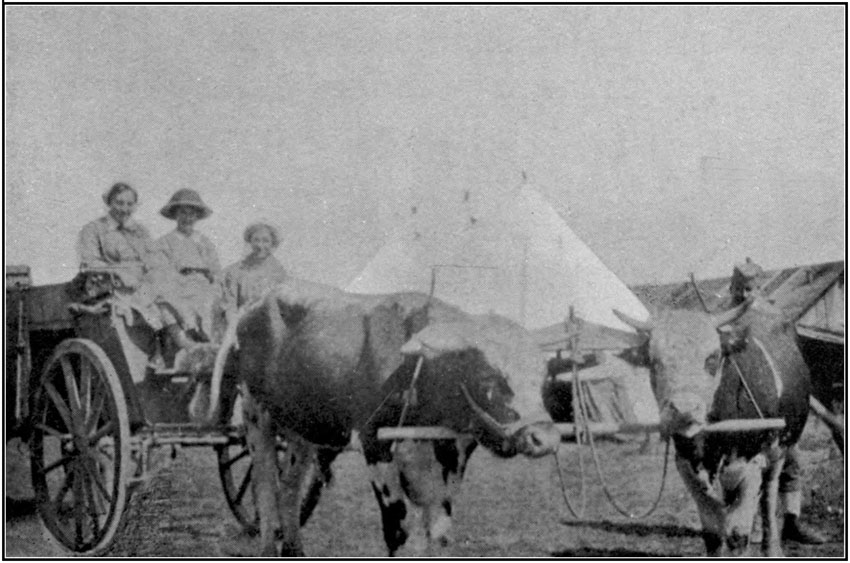
A waggon drawn by oxen at Kragujevatz.
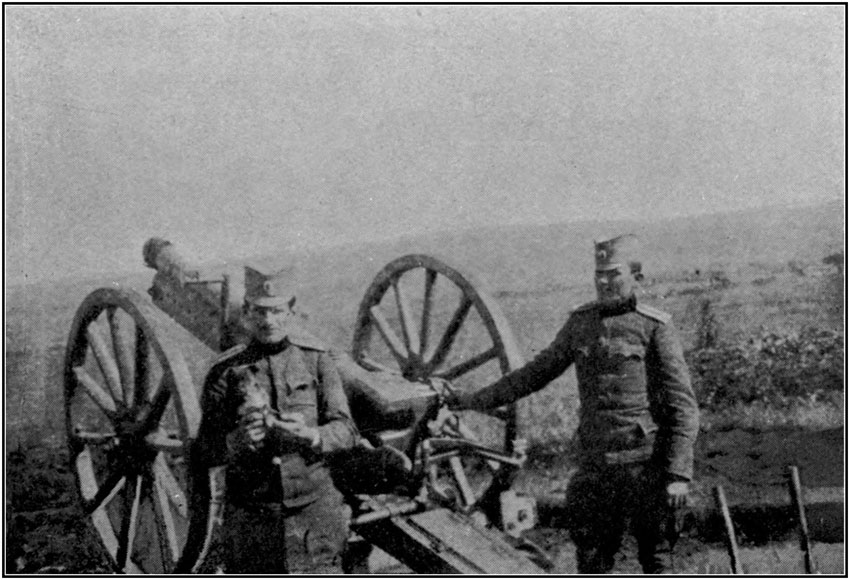
Gun captured from the Turks in the last war. Used by the Serbs to bring down German aeroplanes.
Face page 96.
Wednesday, September 15, 1915.
I was not well again to-day, so I stayed in bed all day. The doctors say I am not to do any work for six months in the kitchen departments; it is very annoying.
Thursday, September 16, 1915.
It seems that the peasants only have three sets of clothes to last them their life; the cloth is homespun, very strong and heavy, and a dark brown colour, most serviceable. It is trimmed with black braid.
Saturday, September 18, 1915.
Two of the sisters arrived last night from the dispensary. They have had several cases of small-pox; out of six cases in the village, two died. The peasants are the most funny people. Three days before the death of one of the smallpox patients everything was got ready for the burial. The coffin was made by friends on the premises. The girl was told, when our nurse went to feed her, not to take any more food. Before the girl was actually dead she was put in her very best clothes to be buried in; she was also laid out before the breath was out of her body. The coffin was left open until just before putting into the grave. There were no priests in the village, and the girl was buried by her friends.
Sunday, September 19, 1915.
We had service at 5.30 a.m. The priests in Serbia are not allowed to go into the church until they are married. In war time no priests are allowed to marry, so they are not able to go into the church. The priest at Natalintse went to have dinner at our dispensary. He took with him all the things that he thought they would not have, cheese and wine. They were having goose for dinner. He took this course, and then he kept stretching across the table, took a fork without asking, and kept helping himself; he had five helpings of goose. Pudding he refused, but our interpreter was sitting next to him, so he took a fork and took a taste of his pudding without asking. Five little boys keep the church in order and they ring the bell. The priests and people think nothing of spitting on the floor of the church. I thought this habit was bad enough in the streets in England, but I find that it is worse abroad. This morning a Red Cross ambulance corps, pulled by bullock-wagons, passed this camp; they were the first to go to Malanovatz to join the first field ambulance, the Bevis unit. This afternoon I went up to see another Serbian camp, and took photographs.
Monday, September 20, 1915.
We are having lovely weather, but the nights are terribly cold, and there is a thick frost in the morning. The days are very hot. It seems that when the Austrians last year got into Belgrade they were there for thirteen days. When the Serbs drove them out, they found a freshly-made cemetery full of wooden crosses. The Serbs thought that it was strange within such a short time, and the graves were a curious shape. The Serbs turned up the soil and found about 80,000 pieces of ammunition.
Tuesday, September 21, 1915.
Mrs. Stobart, Mr. Greenhalgh, Colonel Gentnich, Mr. Little and myself motored over to Vilanovatz to see the dispensary. There is one doctor, a nurse, a cook and two orderlies; the dispensary site is very beautiful. They are doing good work and they have about 70 to 100 patients every day; they come for miles; some of them are in a terrible condition. This dispensary is fifteen miles away; the ride is lovely, the scenery being so very beautiful. The fields are looking so pretty with wild crocuses. There is only one shop in the village. Paprica grows very plentifully out here; the stews are quite red with it. The paprica is also eaten in the green state filled with meat minced.
Wednesday, September 22, 1915.
This morning one of the sisters and I went on the top of some hills to see the Serbians practising and testing some Turkish shells. It was most interesting, for they were telephoning up to the arsenal after every one that was fired, stating the distances. In the afternoon we both went up to get a shell; there were fourteen unexploded ones.
Thursday, September 23, 1915.
We have heard nothing but firing most of the day. I forgot to say that on Tuesday a message came up from the Government to say that an aerial raid was expected, but they were again driven back.
Friday, September 24, 1915.
To-day we hear that the Bulgarians have joined with the Austrians, and that fighting has started on the Bulgarian frontier. All along the Danube and at Belgrade the Austrians were bombarding. One hundred shells were fired.
Saturday, September 25, 1915.
To-day we had a message from the Serbian Government to say that part of our unit had to go to form a hospital near the Bulgarian frontier. The Serbians have a splendid equipment ready. Twenty of this unit are going: Mrs. Stobart, Mr. Greenhalgh, two doctors, six chauffeurs, two cooks, two orderlies, and six nurses. They are taking six motors. We shall be very busy here with so many of the staff away. The doctors want me to stay a little longer to help in the wards, do the diet sheets and the accounts, and help the nurses.
Sunday, September 26, 1915.
We had two services to-day, one at 5 a.m., the other at 5 p.m. We are still having very hot days but the nights are cold. The wild flowers are beautiful, and there are lots of butterflies, little blues, and a dark yellow with black edge round the wings, and swallow-tail. There are scarcely any cabbage butterflies here, but there are some quite small white, like the cabbage.
Monday, September 27, 1915.
The part of our unit that was to go to the Bulgarian frontier had to be inspected to-day, with all their baggage. There is some difficulty in getting through to Salonika, owing to the troops going to the frontier.
Tuesday, September 28, 1915.
I hope to be back on duty in a few days. To-night the sky was most gorgeous, quite indescribable; there were two of the most beautiful rainbows, absolutely perfect, with a sunset which illuminated the mountains all round. Moles are very plentiful here; they make a dreadful mess of all the fields. One lived under the ground-sheet in our sleeping-tent, but, poor thing, it got trodden on and we found it dead. There are a few bats; they are a tremendous size, much larger than they are in England. Grasshoppers and locusts are also plentiful. Small birds are scarce, only a few sparrows and swallows and sand-martins and larks. The swallows have their nests right inside some of the houses on the tops of the electric light and in some of the corners. They fly about at night, catching flies, not caring for any one. We heard last night that the Scottish unit had lost one of their nurses, with typhoid; it was at Valievo. Dr. Inglis, from Kragujevatz, and the head of the Scottish women's hospital, a woman doctor, had to read the burial service. I had a lovely large bunch of hyssop given to me this morning; it is used in the churches at christenings to sprinkle the infant with holy water.
Wednesday, September 29, 1915.
To-day we had a medal presented to us from King Peter. It is a coat of arms on a cross of Serbia, and is called the Cross of Charity. Two of the Government officials came up to present us with them, and they gave us a testimonial of their appreciation of our services. We hear to-day that the Bulgarians have started fighting. I saw some of the Serbian cavalry starting for the Bulgarian frontier; they were going to Nish, then towards Pirot. The Serbs are very brave and some of them stand pain so well. One man had an operation on his spine, some broken bone removed, and he was walking about two hours after. Another man had some varicose veins removed and he was walking ten minutes after.
Thursday, September 30, 1915.
This morning at 7 o'clock we had an air raid; six German aeroplanes came over dropping thirty bombs on Kragujevatz. Most of the bombs dropped near the arsenal and at the station; they tried to get the magazine, but did not succeed. The bombs did little damage, but six people were killed and several wounded. We brought one aeroplane down; we saw quite plainly and the bombs seemed to drop right on the aeroplane—a great blaze of fire we could see—and the aeroplane fell to the ground only a few minutes' walk from this camp in the main street, just near the cathedral. It came down quite gently, and as it got to the ground there was a great crash; the men were both Germans; they were smashed to pieces. I have taken two photographs; all the woodwork was burnt away. I have several interesting pieces of the aeroplane. The Germans had their diaries on them; these of course were taken to the Government office. An officer was killed at the arsenal, so they had a military funeral for him this afternoon. The other portion of our unit may go to the front any time now; they are only waiting for orders.
Friday, October 1, 1915.
This morning at 6.45 we had another air raid. We soon cleared the camp of the patients. Three aeroplanes came over in all, and dropped about fifteen bombs on Kragujevatz. Five fell in the arsenal, but little damage was done; several fell round about the station. Several of the station men got into a truck for shelter. One shell fell just outside smashing up the pavement along the line. A piece of the shell went through the truck; no one was injured, and it was given to me afterwards. The air raid lasted about one hour. When all was over Dr. May and Dr. Berry asked me to take them to see the aircraft guns. These were about seven minutes' walk from the camp on the top of a hill; two of the Serbian camps were also near by. I knew several of the officers at the camp. On arriving we were met by some of them; they took us round and showed us the guns and the shells, explaining and describing all about them. There are three very large guns, and these took the 12 inch shells; they were of French make, and two smaller ones which were captured from the Turks in the last war.
We had only been up on the firing ground about five minutes when the signal was given that enemy aeroplanes were sighted. All men were at their posts in a second, and it was splendid to see the order and discipline.
It was no use our retiring, as it would not have been safe, so we stood by while the firing was going on. The vibration and noise were terrific; one could not see even these large shells coming out of the guns, only fire and smoke. I took a photograph while the firing was going on. Five bombs were dropped in Kragujevatz, one on our camp, which fortunately did not explode. It was only a few yards away from the night nurse's tent and mine, otherwise we should have had our poor tents in pieces. Two bombs fell on the magazine, destroying lots of our stores; three tents were burnt, but the fire was soon extinguished. Nine 7 lb. tins of marmalade were smashed to pieces; marmalade was all over the floor, windows, ceilings and walls, making the place in the most terrible mess; other stores were also spoilt; pieces of shrapnel were found in the sugar. About eighty shells were fired on the aeroplanes, and it got so hot for them that they soon fled. The air raid was over at 10, so our patients were allowed to return.
In the evening we had a farewell party, given by one of the sisters, as she was leaving for Lady Paget's hospital, and twenty of our unit were leaving for the Bulgarian frontier with Mrs. Stobart, and they were to go to Perot. They left at 10 p.m., and slept in the train all night; the train left at 7.20 in the morning. They have taken five motor ambulances, three bullock wagons, one kitchen that was captured from the Austrians by the Serbs, a few bandages and medical stores. A Serbian army was supplying all the other necessary medical stores and equipments for "The Flying Field Hospital." I was to have gone, but owing to having had typhoid was not allowed. It was arranged that the doctors, nurses, cooks and orderlies should change over every month, so that all could get a variety of work.
Saturday, October 2, 1915.
Another telephone message arrived at 7 a.m., to say that three aeroplanes had crossed the frontier. We got breakfast over at 5.30 and the camp was cleared of all the patients, and then we left ourselves. It is interesting to see all the townspeople going out miles into the country for safety. Fortunately the wind got up and the flyers had to return, but they managed to drop their fifteen bombs on another town close by. On our return home to the camp we went by the guns, and I was introduced to the man who brought down the aeroplane on Thursday, September 30. It was the Turkish aircraft gun he was using, quite a small one. We expect air raids every day now; this means breakfast at 5.30. We are clearing this hospital of the old patients, and are getting ready for the fresh wounded, and it will not take us long to be straight.
We can do nothing much in the mornings now, so we work hard all afternoon. The arsenal is also closed in the mornings.
Sunday, October 3, 1915.
It has been too cloudy and too windy for an air raid to-day, so we have had a day of rest. Pontoon bridges have been passing most of the afternoon on the road by our camp. I expect these are going to the Bulgarian frontier.
A very young student at a village near here was full of mischief, and for a lark he poured a pot of red paint into the holy water. The priest at the early service looked up, and found that all his congregation had red crosses on their foreheads. The priest told us this story, and the boy got into great trouble over it.
The name of the aeroplane that was brought down at Kragujevatz was the "Albatross." The younger German killed was an engineer twenty-six years of age.
Pieces of aeroplane were found at Ratcher, but nothing else. Another aeroplane was seen to turn over outside a small village, but has not been found.
Monday, October 4, 1915.
The camp was cleared about 7 o'clock, as we received a message that six aeroplanes had been sighted over the frontier; they were prevented from getting to Kragujevatz. The Germans say they will smash up Kragujevatz, also the railway line. A very little damage has been done considering.
We had a card from the other part of our unit which left for Perot, saying that they had arrived safely, and that they liked their position; they were on the top of a hill, and looked down on the enemy.
Tuesday, October 5, 1915.
Two aeroplanes flew over Lapovo, dropped three bombs on the line, but no damage was done. We cleared our camp as on previous days but nothing happened.
Wednesday, October 6, 1915.
We are about ready for the fresh wounded; we have put up one or two fresh marquees, which hold each about twenty-six beds. We have seventy-two tents in all, and a number in reserve if required. We have long buildings when the weather gets cold, which have been built during the summer by the Austrian prisoners; these were intended for cholera, but fortunately we did not get this disease in Serbia, so the buildings have been promised us by the Government for wards for our patients during the winter months. They are very long low buildings and would hold about thirty or forty beds; there were about six buildings in all.
On one occasion, in our ward, a patient who was on light diet, was found to have a parcel under his pillow. This parcel was found to contain a little roasted pig, from which he had been helping himself to small pieces. His relations had been to visit him that afternoon and had given it to him, regardless of whether it was a suitable present or not. Pigs in this country are cooked when they are quite tiny, and a leg is only sufficient for one person's meal. Lambs are also killed and cooked about the same age, and it is really difficult to find any meat on the bones after they are roasted. The Serbs do not consider meat good when it is fully grown, excepting oxen, and beef in Serbia is one of the worst classes of meat, probably on account of their being used for labour. Milk is scarce owing to the cows being used for transport.
They have an extraordinary one-stringed instrument which they will play for the whole of the day; crowds of people will sit round listening; this was most trying when the patients got hold of it in the wards, very monotonous and trying, and some of the singing is also very weird, being only on one or two notes, but on the whole they are the most musical people. In the cathedrals the singing is perfectly lovely, such well trained voices.
We hear that the Germans started shelling Belgrade at 3 a.m.; it lasted for many hours. We had a thick fog at night, which reminded one of London, being equally dense but not so yellow.
Thursday, October 7, 1915.
Still a thick fog, and we hear that Belgrade is still being bombarded. The English and French troops have been expected for some time to help the poor Serbs, and we are told that Nish and many other towns are decorated in their honour.
I understand that the bombardment of Belgrade has not been quite so severe to-day, but all English missions have been told to leave. The Germans have landed in three places. They crossed the Save in boats and by pontoon bridges; there were about 3,000 of them. It was a misty night, and they thought they would not be noticed. The Serbs allowed them to cross, and then took 2,000 prisoners. The pontoon bridges and boats were sunk; then they had a hand-to-hand fight in the streets, knives being principally used, and we heard that even the women joined in. Many bodies were floating in the Danube and the Save; we heard that two of our Marines were killed and several wounded.
This afternoon we went over the wounded Allies' hospital at Kragujevatz with one of the sisters. In one ward there was a brigand who was wounded; he had told the nurses that that was his profession. We also saw an Austrian who was an artist, and he had obtained in the hospital several orders for his pictures, for which he made the sum of 10s. We also saw a German who had had both his legs amputated; he was allowed to make baskets, and was selling them.
This evening one of the doctors consented to my leaving, as having an appointment in England I had only another two or three weeks leave of absence and as we heard it might be rather difficult later on to get away. I was asked to look after an orderly from the second Farmers' unit, who had just recovered from typhoid; she would not have been able to do any work for some weeks so it was decided she should return to England in my care.
Friday, October 8, 1915.
I was busy packing most of the morning, then I did up the accounts and the diet sheets for the wards, finishing up this part of my work. In the afternoon one of the sisters and I went to the arsenal and I was presented with a medal of King Peter. We also saw many of the treasures which were taken off the German aeroplane which was brought down. They showed us an orange printed paper with full instructions on. It was of course in German and it said that they had to come to Kragujevatz and drop four bombs.
It was very painful saying good-bye to my kitchen staff, principally Austrian prisoners who had done such good work. When they first came they said, "No pay, therefore no work." I replied, "No work, therefore no food," and they quickly fell in with my views, which they never resented but really worked well. The commissionaire came up to say good-bye with his daughter, and brought from his wife two cooked chickens for our journey, a dozen eggs, walnuts, apples and jam. I packed these up, then went in to dinner. When I returned I found my parcels had been unpacked by the dogs from the farm near by; the chickens had gone, the eggs eaten, and bits of shell all over the floor of my tent. Eggs when boiled hard out here the white will often be found soft no matter how long one boils it. Also the apples and the nuts scattered about; my tent was a sight to behold, but fortunately we had other things provided for the journey.
At 9 o'clock fifteen wounded men were brought in from Belgrade. They were in the most terrible condition, and they described to us the most awful slaughter that had taken place there.
At 10 o'clock one of the Government officials came up to say good-bye, and to bring my pass on the railway as far as the Greek frontier, and also gave me some sweets.
At 11.30 the carriage came to take us to the station. The train was leaving at 12 o'clock. A terrible night, pouring with rain, and we all got wet through before starting. We had a comfortable journey as far as Lapovo, where we arrived at 2 a.m. Here we had to change, and were supposed to get a train on in an hour's time, but waited about till 5 o'clock, and were then told that there would not be a train on till noon. We piled our luggage up and went to our dispensary, which is on the line. We found the windows open and the door unlocked and every one in bed. They had left it like this as they were expecting the doctor from Nish, who had gone to fetch fresh supplies of stores. We took off our boots and lay down on the beds in the ward until 7 o'clock, then we had breakfast and took it in turns to go back to the station to take charge of the luggage. It was a pitiful sight while in the station, watching the train loads of refugees coming in from Belgrade. Many of the women were crying as they related their sad experiences to the people on the platform. Also train loads of wounded were coming in; many had been to our dispensary on the Thursday to have their wounds dressed before going on to a permanent hospital.
We were told that 6,000 or 7,000 shells had been fired in Belgrade, and that many places were on fire.
At 11 o'clock a train came in from Belgrade, and I heard several voices calling to me, and I found there were some of Admiral Troubridge's unit on the train, and three or four of the first Farmers' unit. They all looked very ill and were covered with mud. They had left Belgrade at 6 o'clock the night before, and had had to walk many miles before they could get the train, and had left everything behind them, only having the clothes they stood up in. They had only had bread to eat and were almost famished, so I told them to come and get into our carriage, as we could give them some of the food we had for our journey. I then went to the guard and asked where this train was going to, and he replied "to Nish"; but there was only a cattle truck for us, so we all got into it, and as it was very doubtful about our getting a train at 12 o'clock we thought it better to go on. We gave them all a good meal of tongue and beef sandwiches, bread and cheese and apples and lemonade, and they were indeed thankful, poor things! for they had gone through a terrible time. They told us many sad stories of our brave Serbians, who ran into the hospitals, had their wounds dressed, and then went back to fight. All the patients in the hospitals who were suffering from bronchitis, pneumonia, and consumption, and many other diseases, put on their clothes and went to the trenches. They also told us that the American hospital was staying on, so all their luggage was sent to this hospital for safety; later on the American hospital was seen in flames. The members of these units got out of the train at Chupria, to join Admiral Troubridge. We heard that the English batteries, with the exception of one, had been quieted at Belgrade. At Chupria many wounded soldiers got into our truck. They were going to the hospital at Nish, we to the rest station which belonged to Sir Ralph and Lady Paget, and it was for the use of the different English units that were coming to Serbia. We arrived at 9.30, and as we were very tired we went to bed at once.
Sunday, October 10, 1915.
We had breakfast at 7.30, then went to see Sir Ralph Paget, then to the bank, which fortunately we found open, then to the Serbian Red Cross.
Several other members of different units arrived from Belgrade during the day.
At 2.30 an enemy aeroplane came over Nish. No bombs were dropped, so they had come to spy. Three French aeroplanes went after it and drove it away; they also fired on it with the aircraft guns. We heard that one of the trains from Belgrade had been fired at by the Germans and that twenty-five civilians had been killed. We had a service at the rest house at 5 o'clock. Two aeroplanes had arrived during the afternoon and were going on to Kragujevatz.
We left by the 8.30 p.m. train for Salonika.
Monday, October 11, 1915.
It was a lovely day and most interesting journey. All along there are camps, wire entanglements and trenches. Some of the camps are amongst the trees and can scarcely be seen, as they are made of sticks and mud. The sentry guards also along the line have curious dug-outs, to which they go down by steps. The haystacks, instead of being on the ground as in England, are fixed up in trees, like huge beehives, as the ground gets so swampy. The Serbs and the Albanians look most picturesque. These must have been the regiments I saw coming along when I was staying at Uskub. We have just seen a wolf chasing a young deer; they passed close by the train. It seems dreadful to leave this glorious country with its brilliant sunshine and bright colours, until we see all the horrors that are going on so near to us.
We arrived at Uskub at 7 o'clock; had breakfast at the station, and a few minutes before our train arrived 170 Bulgarian prisoners had been brought in. They were tied together in batches by ropes. I saw one or two of the nurses from Lady Paget's on the platform; they had been to see some friends off. Our train left again at 7.25; then we passed through wonderful gorges; this of course would make the fighting very difficult.
Our next stop was the frontier Ghevghili(?). Most of the passengers' luggage was examined; it was also weighed, and we had to pay on ours.
We arrived at Salonika at 8.30 p.m. We found the station full of Greek soldiers; many of them were on the ground asleep. We had to leave our large luggage for the night, then we took a carriage and went to the hotel Olympus, where we had wired for rooms. We saw many of our English and French troops as we drove down; this of course cheered us up. We heard there were 25,000 French and 11,000 English, and that they had been detained by the Greeks, as they were expected in Serbia some days before.
On arriving at the hotel we made ourselves tidy, went down to dinner, found the room full of English and French; several of them gave us a hearty welcome as there were no English women in Salonika. One officer told us that an American, sitting at their table had insisted on it that we were Americans, and what a great deal the Americans had been doing in Serbia, and the point had been argued, so there was great excitement to know what nationality we were, and the English officers were delighted to find they were right.
We are all hoping that the Greeks will join us, and that they will all be going up to Serbia in a day or so.
Tuesday, October 12, 1915.
Two English officers invited us out to tea to the café near, and were much interested in hearing all our experiences in Serbia. In the evening we went to a cinema.
Wednesday, October 13, 1915.
We had to go and have our passports inspected by the English, French, and Italian consuls; we got some money changed and did some shopping.
The Turkish markets are very interesting and the salesmen very amusing, and bargaining is very necessary as they begin by asking often more than double the amount they are prepared to take.
The Greek shops are very fine, full of beautiful things, and the fashions quite up to date. We have a nice little Greek lady staying here from Athens; she told us it was a known fact that the Germans had lost over three million men. She also told us that seven French officers had escaped from Stuttgart; they were let out of prison as they bribed the man who was looking after them. They walked all the way from Stuttgart through Switzerland to France, having been given sufficient food for their journey, a compass and a map, and advised not to speak to any one on the way. They said they never met a man all the way through Germany; women were armed outside forts, railways and along roads; every man had gone to fight.
Thursday, October 14, 1915.
There are eight battleships in the harbour, French and English. The Greeks are mobilized, and are ready to join whichever side they think the best. They have copied the English in their uniform.
A Turkish aeroplane passed over to-day. Our boat, the Sydney, has arrived in the harbour, so we went to choose our berths.
About forty boats arrived to-day with English, French, and Greek troops. We went to watch the horses and mules being unloaded at the docks; there are more mules than horses; they find them much hardier.
Friday, October 15, 1915.
We had an interesting day; one of the doctors from Lady Paget's came to see me, then the captain from the Abbassieh, who had brought out some of the units and knew the three sisters who were with me. He invited us to lunch on his ship; he had brought in troops from the Dardanelles, and was doing transport work. He told us that he had brought 1,300 and that he had only sufficient life boats for 300. In Salonika we had the Dorsets, the Norfolks, the Herefords, Royal West Kent, Royal Engineers, the Army Service Corps, and the Royal Army Medical Corps, and several other regiments that were going up to Serbia.
The captain asked what boat I had come out on to Serbia. When I said "the Saidieh," he said, "Why, the chief officer is now on my boat, as the Saidieh was torpedoed some time ago"; and he sent for him to see us. It was very pleasant meeting again and hearing his story; he was made captain of another boat, but it had been so much damaged with shell fire that it could not be used.
Saturday, October 16, 1915.
In the afternoon the commander from the battleship H.M.S. Albion came to have tea with us, and invited us to tea on his ship the following day.
We heard to-day that some of the French troops had gone up to the Bulgarian frontier; we also heard that Perot had been taken by the Bulgarians, and that the line between Nish and Uskub had been blown up.
Martial law is in force here, and pickets are all along the front. The English, French, and Greek officers all had to salute each other.
Sunday, October 17, 1915.
This morning we went over two old Greek temples, Demetrius and St. George; they were taken by the Turks and turned into mosques. The Turks had whitewashed all over the mosaic and marble pillars; fortunately the whitewash is crumbling away, and one can see the mosaic through.
A story is told that one of the large panels of marble is supposed to bleed when anything serious is going to happen; it is a kind of grey-red, very lovely, and the blood trickles through the cracks. The priest in Demetrius was standing with a cross and a piece of bosaliac, known to us as hyssop. The Greek soldiers were going up to him, kissing the cross, and then he sprinkled their heads with holy water with the bosaliac.
We went to see the wonderful old bridge that Hadrian, the Roman Emperor, built.
In the afternoon we went to H.M.S. Albion to tea; it is a very fine ship, and of course of great interest to us. It has been damaged many times with shell fire; we went all over and it was most interesting.
Lady Paget arrived here last evening, and five of the sisters from Admiral Troubridge's unit, as they had been staying the night with her at Uskub. Two of them were returning to England with us.
Monday, October 18, 1915.
We hear that the Sydney sails to-morrow at 4 o'clock, so we made our preparations for leaving.
We have seen crowds of refugees coming into the town to-day, many of them sleeping on the doorsteps, huddled up in the corners. One poor man died on the road, and I expect many others will not survive as they had walked so many miles.
Tuesday, October 19, 1915.
We got our luggage on our boat the Sydney early, then we took a small boat out to the hospital ship, the Grantully Castle, London, as the military doctor said the matron would so much like to see us. On arriving we were received by the matron and the English chaplain; we were taken all over the ship; it was beautifully fitted up, and they had every convenience. There were three of our naval men from Belgrade, two of whom had been wounded, and the other one was threatened with appendicitis. Forty English soldiers had been taken on board the night before, suffering from illnesses of different kinds. The nine nurses were Australians, the matron English. We were invited to lunch, but could not spare the time, as we had to get back early to the hotel on account of leaving in the afternoon. We left the hotel at 3.30 and at once went on board. One of the doctors from Lady Paget's hospital is with us, two of the nurses from Admiral Troubridge's unit, six of the Scottish nurses from the women's hospital, Valievo, two French doctors, and an English lady from Bulgaria who had been teaching there for the last six years, also the military attaché from Bulgaria, a naval member of Parliament who was carrying dispatches, also Brigadier General Koe, who was engaged in transport work.
We left Solonika at 5 o'clock. This boat is quite nice and beautifully clean, very different from the one we came out in. It is a French boat belonging to the Maritime Line. We had a good passage as far as Lemnos, where we arrived at 7 p.m. General Koe got off here.
Wednesday, October 20, 1915.
Lemnos is a barren-looking place, mountainous all round, no trees, and it is covered with the English and French camps. There is a new hospital being built at the water's edge. There is no fresh water, and experts have been sent from England to sink artesian wells. The water had to be taken out in tanks. One lady at Marseilles sent out ship-loads of soda water for the soldiers. The harbour is full of battleships, chiefly French, and there are several hospital ships, also many transports. The largest ship is the Aquitania from Liverpool, with four large funnels. Mines and nets are all round us; at several points of the island guns are fixed; we could hear firing this afternoon, and we were told that at Imbros one could see the shells bursting at the Dardanelles. We stayed at Lemnos eight hours; it is a lovely day and very calm.
Thursday, October 21, 1915.
We arrived at Piraeus at 6 a.m., landed at 8, then took the train to Athens, and went straight to Cook's office and wrote letters to friends staying here, arranging to return for any answers. We then took a carriage and went to the museum; the statuary is very fine and beautiful. We returned to Cook's and found a letter from our Greek friends, inviting us to luncheon at 1 o'clock. We had an hour and a half more to spare, so took a carriage and went to the Acropolis. It is indeed wonderful the view of Athens from the top, most beautiful. We thoroughly enjoyed this sight; the trees all along are most interesting—avenues of pepper trees, date palms, aloes and cactus; we also saw a few orange trees. We then went to our friend's house at 1 o'clock. There were three married sisters and their children, and an English girl, governess to the children. After luncheon they took us sight-seeing, first to the Polytechnic Institute, founded in 1837 by some wealthy Greek, and containing memoirs of the Greek War of Independence, portraits and native costumes, and the clothes of the Greek King who was shot at Salonika. A tomb has been erected on the pavement there where he was shot, and a chapel is to be built near. The pistol that shot him was in the case with the clothes. We also saw many flags that the Greeks had captured in many different wars, a sword of Lord Byron's, and his portrait and visiting card.
After leaving here we took the carriage and drove round the principal streets, then went to the Keremakos market, where there are wonderful tombs containing the remains of three people in each; the bones are visible, and the statue of the bull. We then went down the oldest streets, and to the ancient Church Eglise de Capnicarea. We saw the temple, the bank, the general post office and the theatre; had tea at a café and took the train back to the port, and arrived on the boat in time for dinner. Another lovely night; I slept on deck. I forgot to mention we passed, on Wednesday, some burning rocks; the chief officer told us they are set on fire by oil by the shepherds, to watch their flocks by night.
Friday, October 22, 1915.
We did not leave Athens until 8.30 this morning. We were held up much longer than we expected. An aeroplane followed our boat for a little way, but it was a Greek one, so we had nothing to fear. At 3 p.m. we had quite an excitement; a message was sent to the ship to say we had to go into the Island of Milos for orders; submarines had been seen round the neighbourhood. We got into Milos and found five French battleships, submarine destroyers. One of the maritime ships was in the harbour that had been torpedoed two weeks ago. The island is very picturesque; the houses are built in the Turkish style. We remained in the harbour for about two hours. We have a submarine destroyer escorting us, also another ship was with us, so we feel quite safe. Written notices were sent round to each passenger with instructions what to do in case we were struck. The captain had an anxious voyage from here on, keeping watch all the time. We kept going out of our course and the destroyer and our boat were constantly signalling to each other. We had to come round by Crete instead of Cape Matapan. The wind has risen and it is very rough; most of the people are ill. We had a bad night, continuous thunderstorms and heavy rain. The boat is rolling as well as pitching.
Saturday, October 23, 1915.
It still continues very rough and very few passengers are visible. Nothing exciting has happened; our two escorts are still in front of us.
Sunday, October 24, 1915.
This morning a large steamer signalled to our destroyer, so it left us for two or three hours and then returned. In the night it was exchanged for another one. We were told that they had to be very careful along this route, as nine boats were torpedoed in one week; naturally we were all more or less anxious, looking down into the cold water. I much dreaded the risk we ran as I should much prefer to be shot or shelled to being drowned. We heard that we reach Malta in the evening, but owing to our having to go so much out of our course we did not arrive until the following morning at 6 a.m. It was an anxious night; neither the captain nor the chief officer appeared for dinner; no end of men were on the watch for enemy submarines; it seems that there are many in the Mediterranean just now, and we were told that this is the worst danger zone at present. The Germans have a specially large new one here which is doing a lot of damage. It has been very rough all night, and the boat had to slacken speed as we were not allowed to enter Malta before 6 a.m. I met a very interesting English lady from Constantinople on board this morning. She has lived there for forty years. Her husband is a doctor. She had three sons—two solicitors, the third an invalid. He suffers from fits. The youngest son's name was down on the list to be sent to Gallipoli with the English and French prisoners, whom the Turks were sending from Constantinople, in the hope that this would prevent our troops from bombarding Gallipoli. This poor mother was so distressed, and pleaded so hard to the Turkish officials that they consented that her son should be released. She then made another plea for her husband to be allowed to leave the country, and he left for Malta. Then she procured the release of her delicate son, and he also joined his father, and now she herself is on her way to join them. The other two sons were not allowed to leave; they are being kindly treated, but have come down to breaking stones. I felt very sorry for her, but admired her courage and cheerfulness in such distressing circumstances. All her valuables from her lovely home she sent to the Turkish bank, but of course has no hope of seeing them again; they are sure to be confiscated. Fifty or more of our men were sent to Gallipoli from Constantinople, so that should the place be bombarded they would be the first to fall; but the English and French threatened the Turks with other reprisals, and they were withdrawn. They left the ship and spent five days in a mosque, where they had to rough it terribly, though the officials were very kind to them, and on their return to Constantinople gave them a good dinner. Everybody out here speaks so well of the Turks, and all those we have met seem so very sorry that they are fighting against the English, and they said it would be their ruin joining the Germans, their great dread being the loss of Constantinople. Three little birds are following our boat, often coming on board; one is a robin, but the other two we do not know. We had several cats on board and were much afraid for the safety of the birds. Two sparrowhawks also pursued them.
Monday, October 25, 1915.
We were allowed to land at Malta at 8 a.m. As we only had three hours on land we took a carriage, only 1 fr.80 the hour, and drove all round. The carriages are different from ours, so picturesque, and the Maltese women, with their curious headgear, are very fascinating. We went first to the gardens to see flowers and palms, which were looking lovely, then to the Church of St. John's, where a service was taking place, so we remained a little time. We saw the Governor's Palace, then the Chapel of Bones, formerly attached to the hospital. Over 2,000 skulls are shown, and the remaining framework of the body is most artistically arranged, but very gruesome. We had not time to enter the museum as we had to do a little shopping before returning to the boat. We sailed at 11.30, still very rough, and we could not keep a straight course; our escort was with us.
There were three suspicious characters on board, and we hear they had been locked up.
Tuesday, October 26, 1915.
Still very rough, and most of the passengers have had to retire; those who were able to remain played bridge.
We have no butter for tea, only biscuits and dry bread; this was not such a hardship to me as to some of the other passengers. We had had no butter in Serbia for more than three months as butter cost there 7s. per pound, and as we could only obtain such small quantities, even at that price, it was not worth buying for our large unit.
Wednesday, October 27, 1915.
We had a bad thunderstorm to-day, and the sea is still very rough. Nothing of any importance happened.
Thursday, October 28, 1915.
We arrived at Marseilles at 8 a.m., for which we were all truly thankful, as it is not much pleasure to be facing such dangers as we had done.
At the Customs our luggage was most carefully searched, even the leaves of our Bibles and other books being turned over. We were all much amused and wondered if we should be searched next. This I believe happened to some of the women, but not any of our party.
We had our passports seen, and also paid a visit to the police station to obtain a pass to Boulogne. This took up most of the day, and we remained two nights in Marseilles. There is an Indian camp, as they come here to be climatized before going to the front. It was interesting seeing them about the town.
Saturday, October 30, 1915.
We left at 7 p.m., and on our arrival at Boulogne found the times had been altered, and our boat did not leave until the next day at 3 p.m.
Monday, November 1, 1915.
When we got on to the quay a hospital train came along, and we were told our King was in it, and his boat left just before ours, so we felt quite safe—and not at all sorry when we arrived once more in England.
Butler & Tanner Frome and London
Typographical errors corrected in text:
Page 51: "Temperatures are 1048" changed to "Temperatures are 104.8"
Page 69: areoplane replaced with aeroplane