MEMOIR.
Reading edition
Arthur Giffard Whiteside Johnstone was born December 3rd, 1861, the fourth son of the Rev. Edward Johnstone and Frances Mills. His father was then taking the duty at Colton in Staffordshire, but in the following year accepted the living of Warehorne in Kent; this he resigned in 1866 and went to live at St. Leonards. Mr. Johnstone died in 1870, and the direction of Arthur's education fell entirely upon his mother. Mrs. Johnstone gave her life to good works and to the care of her children, one of whom was an invalid. Arthur looked on her as a saint, and the thought held up his belief in humanity during the somewhat long struggle when his powers and aims were uncertain, and when he had to observe excessive dulness, dreariness, and meanness at close quarters. He was also beholden to her for the gift that was at last to determine his career. She was a good musician, and it was from her that Johnstone inherited his fine taste and received his first instruction in music. Later he studied under Mr. W. Custard, a local organist. The atmosphere of his home was religious—extreme Anglican approaching to Roman Catholic. Johnstone, though he became by reaction anti-clerical, continued to appreciate the value of religion, chiefly through art and music, as his letters and criticisms show. But his bent was secular as well as artistic; a high Anglican school and a high Anglican college were therefore not a pasture in which he could thrive. His spirit was foreign to theirs. It says much for his strength of mind, that these institutions left him able to admire certain forms of Christian art.
In 1874 he went to Radley and remained there four years, doing neither well nor ill, stifled rather in the ecclesiastical atmosphere of the school, caring little for games, and out of sympathy with the public school spirit. He therefore lived his own life, learnt to protect himself by ingenious tact and reserve, and read irregularly what he liked. Though not specially built for athletics he was by no means lacking in bodily arts and dexterities. When quite young he was a first rate billiard-player, a good skater, and at lawn tennis well above the average. His chief accomplishment was an odd one which never left him. During these early years he made a constant pastime of conjuring, and devoted to it much of his leisure and some of his business hours. He even gave elaborate entertainments in public, from the age of fourteen. On one occasion when he was only seventeen he was able to apply his skill to a really practical use. He was going by train to give a performance and happened to enter a compartment where there was a gang of card sharpers. They drew him into playing "Nap" with them; soon he began losing and knew that he was being cheated. They were using the ordinary conjuror's cards with plain white backs, of which he had a supply in his pocket. He soon found an opportunity of replacing their pack with one of his own, won back his losses with schoolboy satisfaction, and changed carriages at the first stopping-place, leaving the experts to solve the mystery for themselves. His self-possession in public and private, the mature and slightly initiate air that became less marked as he grew older, were probably due to these performances. They served in his real education. The intellectual side of what is usually common showman's art attracted him. The psychology of the conjuror's victim, amused and angry, straining all his wits on the wrong point; the festal atmosphere, or Stimmung, of inattentive youth and good temper necessary for success, the real poverty of intricate mechanical appliance compared with skill and patter—of these things he would talk in youth with an Edgar-Poe-like elaboration and solemnity, no doubt as well as any man in England. The best of these exhibitions was when Johnstone was professing to explain to a few friends a trick of his own doing. There came first, in long and well-cut sentences, a kind of metaphysic of conjuring; an account of those principles of delusion that were inapplicable in the present instance; exposure of the vulgar and obvious methods, which seemed to the crowd the same as those subtler ones which merely satisfied the conscience of the artist; and lastly, on the verge of the "explanation," a long parenthesis or a touch of coldness and abstraction, not to be interrupted, which ended, if at all, not in any explanation whatever, but in a last performance of the trick. Johnstone made a point of seeking acquaintance with the chief professors of manual illusion who visited England. He well knew, of course, the methods of signalling to counterfeit clairvoyance; and in one case, that of "Little Louie," whose show at the Westminster Aquarium was the best public marvel of the sort, he was convinced that the performers only eked out by signalling and other tricks the failures of some genuinely supernormal power of the "telepathic" kind which they themselves did not fully understand. We say thus much about legerdemain, as it was long our friend's quaint and picturesque substitute for the less original forms of young men's amusement. It gave a good deal of pleasure to other people, and he needed amusement, for his life was not to be easy.
Johnstone left Radley at the end of the summer term 1878, and for the next two years worked under Messrs. Wren and Gurney for the Indian Civil Service, the limit of entrance then being nineteen years. It must be admitted that he made no serious attempt to succeed, and that here, as at Oxford later, the prospect of an examination proved to be the reverse of an incentive to work. Perhaps it was fortunate for him that he failed, for though he would have found a great interest in the natives (and extended his répertoire of tricks) he would have been repelled by the average Anglo-Indian; besides, his abilities did not lie in the direction of legal and political administration. In October, 1880, Johnstone came up to Keble College, Oxford, and he quickly had a small circle round him. Among his friends were R. A. Farrar, son of the well-known Dean, and G. H. Fowler, the biologist, of his own College; Winter, of St. John's, the best musician among undergraduates; his biographers; and, later, Prof. York Powell, who instantly detected his ability and force of nature. Amongst the dons of Keble, Johnstone cared for two. One was the Warden, the Rev. E. S. Talbot, now Bishop of Southwark, who behaved with tact, and encouraged as far as he might a mind of no pattern type, which would not bring the College any regulation honours; the other was the Rev. J. R. Illingworth, the best writer of the school, and since known as a philosophical preacher. Ascetic, but thoroughly humane, Mr. Illingworth attracted Johnstone by his honesty and fineness of temper. But these clergymen, after all, dwelt in their own world, not in his. Until he met York Powell, Johnstone had found no older man from whom he could learn without cautions and reservations, and who struck him as a master-mind and a perfectly free spirit. The two men signally valued each other's conversation; they had many delicate qualities in common—the kind of delicacy only found in Bohemians of experience who have kept their perceptions at the finest edge. Powell materially helped Johnstone more than once by letting persons of consequence know what he thought of his younger friend. Even in Powell's record there was hardly any friendship more completely unruffled.
In youth, as an undergraduate, Johnstone was sallow, but healthy, rather lean and light, with a large and well-moulded musician's head, like Beethoven's or, still more, Rubinstein's, in the outline of the overhanging brow. It is easy to recall that earnest face, that delightful smile always characteristic of him, and, above all, the fascination of his playing on the piano. His voice was clear and carried well, with a sharp metallic ring when he was indignant, but was usually pitched low, as if unwilling to be overheard. His manner was formed and his talk was from the first what it remained: forcible, emphatic, and undoubtedly over-superlative at times, cut into quaintly elaborate but perfectly built sentences, which came so naturally to him that we have heard him discharge one of them the moment after opening his eyes in the morning. They can best be illustrated by his more familiar style in his writings and letters; the latter, indeed, give a fairly exact reflex of his talk. A flâneur of the best kind, he observed closely and curiously; in spite of long spells of apparent idleness, the alert quality of his mind never showed the faintest trace of slackness. He described vividly and accurately; and he had a remarkable gift for explaining any subject or point of view unfamiliar to his listeners, careful that the slightest detail should not escape them. And, in turn, he would quickly catch up and develop the ideas of his friends however vaguely suggested or insufficiently thought out. Johnstone professed Radical principles and was a member of the Russell Club, where the advanced Liberals met for papers and debates; but his Radicalism was social rather than political, and after the foreign experiences of his later years his opinions tended in the direction of strong government and Imperialism. At this time it amused him to be rather eccentric in dress, though he afterward became trim and fairly modish. In 1882 the intellectual undergraduate was capable of wearing a wide-brimmed, light-brown, hard hat, descending over the ears and eyes and long hair penthouse fashion. He had one of these "built for me, ground plan and projection" on a special scale. He also had a tie which could be folded into twenty-five different aspects or patterns, some of them striking; it was a mosaic of squares, and the harvest of a long search; twenty-five neckties in one. His collars were ultra-Byronic. Otherwise he was not markedly strange in attire; though the real incongruity was between these freaks of dress, and the keen intent grey gleam of his eyes, and the look of held-in vehemence and sensibility.
To what did this sensibility tend, what did it crave for? Not chiefly for definite learning, or book-knowledge, or for abstract philosophical truth. Johnstone's nature and gifts did not set towards scholarship (except afterwards to musical scholarship) or to pure speculation. He wanted, no doubt, to write, but he never cared to practise style as a mere handicraft; "let us have," he would say, "something with blood in it." He did not ask for religious solutions or consolations. Since nearly all he printed was on musical subjects, only his letters and our memories can give the impression of what he wanted. It was a sufficiently rare ambition among the Oxford young men of our time, though often enough professed. He wanted art and beauty. This desire, of course, in others often was a cant; there were scholars and verse-makers—more or less of the "æsthetic" type—sentimental and hard at bottom like most such persons, who cultivated beauty, and have usually come to nothing except prosperity. Johnstone was of another race to these; they never heard of him; he did not care for the main chance; he was in profound earnest. Few young men looked at life with so definite an aspiration to get the grace, enjoyment, and beauty out of it, and so definite a conviction that not much of these things is attainable. To such spirits, pre-appointed to suffer and wait, society seems at first an irrational welter, out of which, as by a miracle, emerge enchanting islets of grace, and wit, and cheer. The desire to find beauty in things or persons, and the desire to find soul and humanity, are the unalloyed, intense, and usually disappointed passions of elect youth claiming its rights. It is the second of them that saves a young man from the conceit and exclusive folly that may beset the first. Johnstone's tastes, his reading, loves and friendships were guided by these two passions, and by a third which took off from the strain of them, and was equally imperious—the wish to study the world and to be entertained reasonably. Classes did not exist for him, except that he often felt he was more likely to be able to foregather with and help men and women who were at a discount in the world. With such warring elements and a spirit so hard to satisfy, it was no wonder that his earlier years seemed planless, and in part were so. The instinct for travel and odd experience lasted long. No one but his near friends had much knowledge of this complex but essentially single nature. To them there seemed to be more than a seed of nobility and fair example in such a youth, so externally disappointing to parents, and guardians, and shepherds of colleges. Out of it was gradually wrought a character full of fire and aspiration, fundamentally austere and uncompromising in loyalty and in artistic conscience, but masked under a certain reticence. But this is to forestall by several years.
Aged 20.
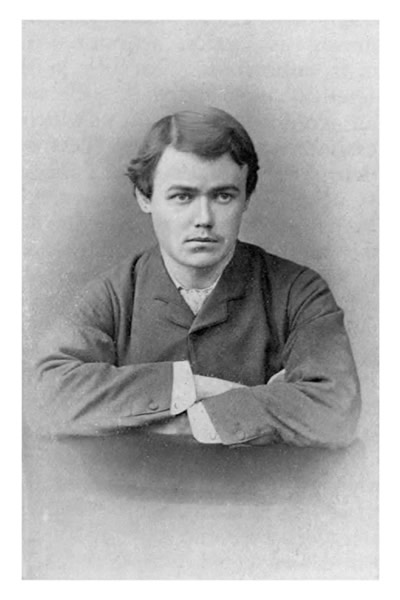
Johnstone had entered Oxford at a time of great intellectual ferment. Looking back we can now see that it was during the years about 1880 that the revolutionary flood ran highest. The authority of Darwin and Huxley was unquestioned by many of the younger generation and all-embracing. The vague Christianity and sentimental optimism of Tennyson was held in little esteem beside the wider tolerance, the subtle analysis, the ceaseless curiosity of Browning. Above all "the Bard," as Swinburne was admiringly called, was the poet of the young men. Another very important factor in the mental development of our generation—and for Johnstone, perhaps, the strongest of all—was supplied by the French literature of the century, from the Romantic School onwards. It is no wonder, therefore, that the reaction from the High Church influences and surroundings of his youth was severe and complete, and that his highly æsthetic nature demanded the fullest artistic and intellectual freedom. The so-called "æsthetic movement," as we have before implied, left him untouched. He would have nothing to do with the attempt to symbolise and revive a civilisation that had utterly passed away, nor with the deliberate neglect of the modern world, and its most intense and living art—Music. Johnstone had not much mediæval sense, and was sparing in his appreciation of Rossetti, to whom he became unjust. What he liked best was "Jenny," though he was rightly critical on the unsound streaks in its rhetoric. It was first brought home to him, as to others of his group, by the skilful and dramatic reading, in a singular clanging voice, of his chief Keble friend, C. W. Pettit: a young man of high and melancholy character who was found drowned, probably by accident, in the Upper River, near Oxford, in the spring of 1882. A memorial stone with Pettit's initials marks the place, in an unfrequented reach of the stream, and the inscription, if not effaced, is now a mystery except to some few who remember him.
"Jenny" also struck upon what may be mentioned now as the deepest chord in Johnstone's sympathies; it is heard sounding in the letters, quoted below, that review the stories of Ruth, Fantine, and Tess of the D'Urbervilles. His attitude in this matter was free from conventional ethics, and was, therefore, essentially Christian; and the relations of society to technically errant women, who have lapsed even once by accident, preoccupied him bitterly, and that in no theoretical or sequestered way. In his own gipsy experience, he witnessed at least one instance where the issue only just escaped disaster. He was haunted by the story, as De Quincey was by that of his lost companion in Oxford Street. The girl whom Johnstone, though generally hard up, managed to befriend in his secret, chivalrous and effectual fashion, finally married some one decent and respectable. Concealing the place and circumstance, he afterwards cast the incident of the "Fantine of Shotover" (we also conceal, of course, the name of the village) into a kind of prose sketch or poème, which he finished when he was about twenty-six, re-wrote twice, and thought of printing. It is unfortunately not now to be traced. Its musical, exalted prose, if inexperienced in form, gave genuine promise in that kind of composition; but he never to our knowledge, pursued the vein, and the prose in which he became expert was, apart from his letters, purely critical and expository. Still, enough has been said to show the force and unusual bent of Johnstone's human sympathies. It is clear that a young man's truth of instinct and strength of head are never more hardly taxed than when he is confronted with a concrete story of this kind. He may become foolish in opposite ways, especially if he is also an artist and has strength of temperament. He may be personally entangled through his sympathies, and make ill worse. He may be superior, and spoil everything by clumsy missionary benevolence, hard of hand. It is something if he can get behind the ordinary, blind, damnatory formulæ of society. This however, is not so difficult to a free mind. What is harder is to do it, and yet to see the facts without mere theorising, without the cumber of rhetorical and literary sentiment that obscures them. A Scotch-descended brain is useful at this point. In our memory Johnstone rose to the occasion thus presented, and acted and judged with balance. But we are more concerned now with the road by which he arrived at his force of sympathy. Æstheticism of the rootless academic kind had, it is evident, no hold upon him; he was too angry to be precious; but his motive power at bottom was that of the artist, as it was surely not that of the radical theorist or philanthropic organiser; although it was, if we use accurate language, by no means less human than theirs. What was at work was his sense of beauty; of physical beauty, first of all, or of grace, in the victimised person, as the sign and vesture of an originally sound and simple, or gay and innocently festal nature; beauty inbred, and then marred by some rough contact, and then marred more by social punishment, and seldom retrieved, even in part—as in the particular instance it chanced to be retrieved—by any fortunate and final escape. All this revolts the deepest of human feelings, which distinguishes us from most of the beasts, namely the æsthetic feeling, which at this point happens to coincide closely with the religious. A certain depth and rarity were thus super-added to the plain good feeling and kindliness of the man; and we can draw these facts from the jealous hiding-place of the past without undue violence to the shyness in which he wrapped them, as they show his personal and special path of approach to the human tragedy, and may even come to the notice of, and serve for the encouragement of similar minds at a corresponding stage of discontent. We may now go back to his early youth, when he was halfway through Oxford, and when some of these ideas were germinating into necessarily crude expression, which none the less has its interest. In a letter of 1881, he writes:—
"How can we escape from Swinburne? Does not modern society drive one to his school, at least the sort of society that I am supposed to have been brought up in, whose moral atmosphere is a sort of perpetual afternoon tea, where all the men are pale young curates and the women district visitors, their excitements vulgar ritualistic tea-pot tempests, the doctrinal significance of birettas, purificators.... Their minds ever on the alert to quash the smallest expression of any delight in natural beauty—'beauty is only skin-deep,' the damnedest lie that was ever formulated (compare Browning's Paracelsus). I wish with Gautier that I had been born in the days of the Roman Empire, when asceticism was almost unknown and what there was of it entirely specialised, before ever such an astounding classification as the World, the Flesh, and the Devil had been made, or every natural beauty writhed, like the divine feminine torso, in the accused grip of fashion." These are the outpourings of a very young man only twenty. It may fairly be said that Johnstone was always far more of an ascetic, personally, than he ever admitted, and the articles on Bach and Sir Edward Elgar abundantly prove the religious habit of mind induced by the training and associations of his early years. A year later his views have become better balanced, as shown by the following extract from a letter on the same subject.
"I read most of the Apologia a month or two back. As you say, Newman stands quite alone in his sincerity and spiritual power, the only orthodox thinker who is not an instance of self-deception resulting from reiterated untruth. All the purest and most beautiful aspects of the old faith seem to group round him. But the lights are almost out on the stage where he poses so magnificently, a rough crowd is spoiling all the scenic illusion, and garish sunbeams are coming in through the roof.
"I was moved to tears the day before yesterday by the appearance in this place [Tunbridge Wells] of a pretty face.
"There she was, a radiant and triumphant vindication of human nature among the myriad libels on the human form.
"I love the wonderful human body. How utterly the most beautiful of imaginable things in its strange dualism; perfect form expressed with infinite subtlety in two mutually supplemental phases. The one—tall, lithe-limbed, and athletic, with its shifting net-work of muscles beneath the clear brown skin, boldly chiselled features and short crisp hair—emblem of strength and swiftness and godlike protection, buoyant and fearless; the other—a harmony of exquisite curves, white and sensitive, and crowned with rippling hair, fulfilled of tender life and wondrous grace—living type of fruitfulness. To say that either deviated from the abstract perfection of form is merely to say the very idea of sex is such a deviation; and is there not a certain divine suggestiveness in this very fact? Their union is perfect Beauty—veils of the great human Sacrament. And all this is faded clean out of modern life. The belief in the body is dead. I believe some of us live and die never knowing the likeness of the human form, just as some of us do without ever seeing the sunrise.
"The 'pale Galilean' has banished Beauty; and only here and there, disguised almost beyond recognition, has it ventured with infinite apology to return.... Yet let us not be all unthankful to the pale Galilean and his lessons of suffering; there are too many of us who see in their own instincts the very impress of impossibility to be satisfied, who have to reflect with some bitterness, not 'il faut mourir,' but 'il faut vivre' and gather up our scraps and skulk along, hoping, perhaps, some day for a lowly place in some court in the House of Life, if it be only that of a scullion. And then at what a frightful cost have those lessons become part of the world's inheritance! Surely it cannot have been for nothing."
Obviously, in all this outburst, if its literary and intellectual origins are not hard to trace, there was no pose whatever; it was a mood that Johnstone honestly and passionately lived through, or rather it remained as a background to his nature. He was far from happy at this period. He had many friends and varied interests, but he felt that life was being wasted; in fact he had not "found himself," nor was he to do so until his visit to Germany. No doubt Keble was not the college for one of his temperament, and the English system of teaching the classics made them, for him, dead languages indeed; but had their oral use been encouraged (the practice of the late Professor Blackie) it is possible that he might have taken a real interest in them. With one of his friends he would speak constantly in Latin.
During the next few years Johnstone was mainly engaged in scholastic work, and the necessity of earning his own living prevented him from taking his degree. In a letter of September 1885, he regrets that he "had to live much in continuous utter rebellion against outward circumstances. In the morning is much strife and crying; in the evening, comfort of the pot. The Day of Rest brings loneliness in crowds—'stalled oxen and hatred.' Ca finira."
In the spring of 1887 he inherited a small legacy, which set him free, for a time, from the drudgery of teaching, and enabled him to carry out his long-deferred wish for a course of serious musical study at a foreign conservatorium. At this period he knew absolutely no German, and had only a fair knowledge of French, and was quite unconscious of possessing the natural gift for modern languages, which he was afterwards to turn to good account at the Edinburgh Academy and elsewhere. In August he went to Kreuznach to acquire the elements of German before proceeding to the Cologne Conservatorium, where he had determined to study. The family where he stayed could speak no English and but little French, so he was forced from the outset to express himself in a strange tongue and make shift to understand it. Early in October he entered the Conservatorium as a student, and engaged himself to take the year's course. His chief friend was M. Sidney Vantyn, now Professor of the Piano at the Liège Conservatoire, and then in his last year of study. They met in the class of Professor Eibenschütz, one of the most severe masters there, who made no allowance for Johnstone's previous amateur training, and was rather harsh and discouraging. He knew no English and Johnstone's German was still elementary, so Vantyn, who knew English thoroughly, acted as interpreter between them. In his recollections of those days M. Vantyn writes:—
"It was certainly evident that he had never had a musical training before his arrival in Cologne. Johnstone's fingers were stiff and he had to begin almost at the very beginning. And this he had the courage to do. At that time I was one of the advanced pupils, I offered to help, and for some months we practised together every day, more especially with a view to developing the fingers. In April, 1888, he showed me a sketch of a Valse de Concert. This composition was what one would have expected from Johnstone—bright, original, thorough. At my request he completed the Valse which I played shortly afterwards at a concert, where it met with a decided success. A little later it was sold to a music publisher at Liège. He soon left Herr Eibenschütz for Dr. Klauwell, with whom he studied the piano and harmony." Among the other professors at the Conservatorium were Humperdinck, afterwards famous as the composer of Hansel und Gretel, and Gustav Jensen, the brother of the better-known song writer.
At length, Johnstone was living in a world which brought out his best qualities and stimulated his keenest interests. But he now realised that he had come ten years too late for the attainment of any eminence, either as executant or composer, and contented himself with considerably extending his general knowledge of music. Nor did he ever confine his attention to music alone; but he endeavoured to see as much as possible of German methods of work, especially as regards the teaching of languages. In reading the Cologne verdict on Johnstone's early training it must be remembered that in his youth the piano was not well taught in England, where the principles and importance of a good technique were alike unknown. Of course, the principal and all his masters liked him personally, but naturally their chief interest lay with young pupils who promised to make a name in the musical world. The year's course at the Conservatorium ended in July, and about this time he writes:—
"As regards intentions, I am quite resolved now (and quite contented) to become a modern language teacher for life. During this year I have obtained some insight into the musical profession, with the conclusion that for all but the very few of quite the first rank it is a wretched life. So I am after all going to take my degree, and shall reside next term as a member of Balliol.... I could get a living by music now, but that would be to sink into a drudgery yet worse than anything I have yet had to do. I will not teach beginners. Besides, I can make a much better living in another profession."
Johnstone returned to England at the end of August, 1888, in wonderful spirits and in better health than he had ever before enjoyed, bursting with ideas and enthusiasm for everything German. It was Gulliver's homecoming after the voyage to the Houyhnhnms, and his friends had to listen to criticism of a similar kind. There is no doubt that this year brought real maturity to Johnstone. He gained a confidence in himself and a grip on life, which even when the prospect seemed most hopeless prevented him from ever again falling into his old moods of despondency. In October he returned to Oxford. Some years back he had taken his name off the books of Keble and migrated to New Inn Hall. The Hall had lately been absorbed by Balliol, and so in the end Johnstone became a member of the College which should have sheltered him from the beginning. In Balliol he was tolerably well at home, though now senior to the men around him. He forgathered with Farmer, who had just left Harrow for Balliol and with the Master's support arranged a concert in the Hall every Sunday evening. Once he gave a conjuring show, by Farmer's request. Jowett shrilled in cherubic mirth, sent for Johnstone, listened to his conversation, which flowed more easily than that of most of Jowett's undergraduate visitors and was of another stamp; and continued to treat him with politeness. Johnstone, whose classics had somewhat rusted during his stay in Germany, read with Mr. St. George Stock, the philosophical writer, then and since a well-known private teacher in Oxford. In December he passed the necessary schools and took his degree; his last experience of the old, disquieting city was pleasant, if brief—a period of recueillement before embarking upon the new career which he had chosen.
In the March following, 1889, he received an offer to go as tutor to the young son of Prince Abamélek in Podolia, a province of Southern Russia. The following account of his journey is interesting:—
"I left Berlin on Thursday morning at 8.30; the stage through Galicia, Oswiecim, Cracow, Lemberg, Podwoloczyska was a bad twenty-four hours. Just at the frontier the snow was immensely deep, standing in a wall on each side of the train. It was like being let into Russia through the works of a great snow fortification. The worst mistake I made was in bringing no victuals with me. I noticed at the frontier examination that my portmanteau was the only one not half full of food. The restaurants at the large junctions are excellent, being all under the management of Tartars, a race possessing the genius of cookery, but if you have to wait as I did, more than twenty-four hours at an out-of-the-way country station, you may find nothing obtainable but tea. Travelling in Russia is in any case tiring; the distances are interminable, and every journey has to be regarded as a sort of pilgrimage. On coming from Osipoffka here, we had to leave about ten in the evening to meet the desired train.
"The start was rather amusing, for we were a considerable caravan with children, servants, horses and dogs. All night we drove across the Steppe, accompanied by several mounted men with torches, which they lighted when the way was bad.
"I had an outside place and was somewhat dazed and curried by the wind and dust by the time we got to the station. Railway travelling is interesting if you have got the courage not to go first class. The carriages are on the American plan, with an opening down the middle. Instead of dapper bagmen you find long-coated and long-haired Jews, besides soldiers and students in curious costumes, while whole families, travelling together, produce the effect of an emigrant convoy. Everyone undresses with complete sang-froid.
"The family always come for the summer to this estate. It lies in a well-wooded district of Podolia, some hundred miles further north than the region to which I first went. The house is very large, and the garden magnificent. It is skirted by a river and there are primitive boats and an excellent bathing place. They have also a steam-launch of English manufacture, which is shortly to be got afloat.
"The neighbourhood is a paradise of Gipsies. The river throws out arms and endless windings, and the ground between is much broken and covered with undergrowth. Here the Gipsies encamp. One sees them in the evening bathing with their horses, and thus I had an opportunity of observing a thing, the peculiar and suggestive appropriateness of which is remarked on by Darwin in his 'Voyage of the Beagle,' namely, a naked man on a naked horse. This is the true centaur; they become one thing. I am now convinced that the Gipsies are the most physically beautiful of all races. In England they are abject beggars, but here rather more well-to-do than the average of the population; for they are not like the peasants, more than half-starved by ecclesiastical regulation, and obviously, in a country in such a stage as Russia is at present, they have a better time. There are plenty of immense regions where they can trap and fish quite unmolested, and the climate favours their mode of life—doubly, I should imagine, the winter giving a short account of defective constitutions. I suppose they are thieves, but to the casual observer they are entirely admirable. Troops of splendid little brown children go about in the evening singing or shrieking with shrill laughter. Their music, by the way, is valued in Russia. There are several troops who get large sums for attending various festivities.
"It has gradually been borne in upon me that the climate of this region is almost ideal. The sky is deep blue and far off, yet the heat is never really oppressive, on account of a constant breeze which brings balsam from the woods. For the landscape a finer contrast could scarcely be found to the Southern Steppe, which is like the burnt and scraped bottom of a pot. It has a character of its own, of course. From the fact of being usually able to see to the level horizon in all directions, it reminds one of the sea, while in summer the heated and quivering air which rises from the ground produces marvellous atmospheric effects; but there is always a wind, skin-drying and far from healthy. Here, on the other hand, we are well watered and surrounded by deep and lordly forest, and the aspect of the whole country is riant.
"I have not yet seen much of the kirchliches Wesen. The priest at Osipoffka, I gathered, is a man who has to get in a mass as often as he is sober enough. The Abaméleks do not receive him, and never go to Church while there. In any case, I do not think the Princess is particularly dévote. She is of Polish descent, and her family having given up Western Catholicism, have never become, I suppose, enthusiastic as Russian orthodox.
"Of the children the boy is much the most interesting. The eldest girl, though not without promise of beauty, is at present in a somewhat gaping and lumbering stage. The younger one is much smaller, though only a little younger than her sister, also of better intelligence, if worse temper. She laughs with a curious abandon and is full of câlineries, and is two totally different persons when pleased and bored.
"Master Paul has not the faintest resemblance that I can trace to either of them. He is an exceptionally round-limbed and well-made child, with low forehead and hair like dead-black fur showing a dead-white skin between, tending to stand up though perfectly soft, and always with a backward sweep, as though he had lately stood facing a high wind; beady brown eyes, clear brown colour, delicate little nose and chin and a mouth like a cherry, make up a face which is no false promise of his vivacity of temperament. It changes in the hundredth part of a second from bubbling laughter to a sort of Last Judgment seriousness.
"He wags his little tête de Polichinelle over his victuals, and converses with them in several languages. Sometimes his mother interrupts him and asks if he knows what he is saying, when he swears that he hasn't spoken for a quarter of an hour. Pauvre petit bijou she calls him."
In the autumn of 1889 his engagement as tutor ended, and he spent the winter in Odessa to study the language. He put himself, as usual, under conditions where it was impossible to speak any other language; entered a Russian family; prepared his questions in Russian when he shopped; and addressed in Russian the official who delayed his necessary papers until he had silently put down a bribe of two roubles, and who then shook him warmly by the hand. He was full of tales; he told of the English journalist, so aggressively and deliberately English that he would not uncover before the Tsar's portrait in a hairdresser's shop; of the Prince Abamélek, who was always talking of taking him out shooting, but never did so; of the Princess, who feared that her little Paul was "trop jeune encore pour profiter de son esprit eminemment cultivé"; of the social tyranny of Russian orthodoxy, which drove free-thinking persons of quality in the country to church and sacrament at all the Christian festivals; and, finally, of his shortness of funds which forced him to find his way home in humble style.
As an English liberal, Johnstone was naturally a welcome guest in the society of the Reform party; and on his return to England he was to meet Stepniak at the house of their common friend, York Powell, and to enroll himself among the Friends of Russian Freedom. But he was more in sympathy with the members of the Reform movement than with their objects. While in Russia, such connections secured him a mild surveillance on the part of the officials, and he had a little difficulty in obtaining the necessary passport to leave the country; but these vexations did not prevent him from holding that a paternal government was required in Russia, and that his countrymen as a whole were to blame for their harsh judgment of a civilisation merely because it ran counter to their own political ideals. The late Bishop Creighton arrived at precisely the same conclusion after his visit to Russia to attend the Coronation in 1896.
Aged 26.
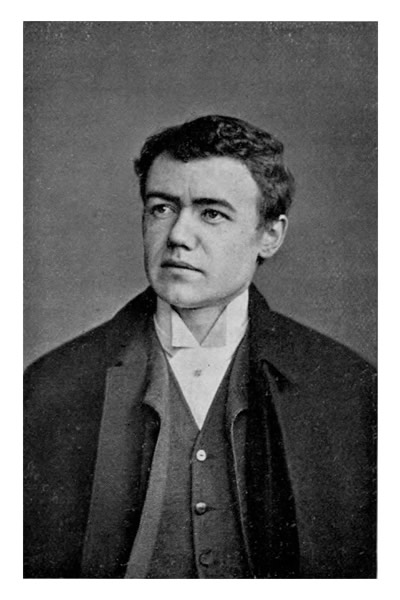
On his way home he spent some months in Buda-Pesth, Vienna, and the Tyrol, and made his first visit to Bayreuth and the Passion Play at Oberammergau.
Shortly after his return to England Johnstone accepted a mastership in Modern Languages at the Edinburgh Academy, where his elder brother had been a classical master for some years. He came into residence in September, 1890, and Edinburgh was his home until he left that city for Manchester, in January, 1896. On the whole he was happy there; for though teaching foreign languages to boys is rather a thankless task, he was cheered from time to time by the successes of his pupils in examinations elsewhere, mainly those for entrance to Woolwich and Sandhurst. He could even confess, after a long summer holiday on the Continent, that "he was again thoroughly penetrated with the atmosphere of gray old long-faced Sawbath-keeping Edinburgh." After all, Johnstone, though he considered himself an Englishman, was, as may be gathered from his name, Scotch on his father's side; his mother, too, had a strain of Scotch blood. So perhaps that quiet self-contained manner and all that it implied came to him from north of the Tweed.
About this time, he was penetrated with the excellent purpose of training his bodily nerve. He knew that he could never be noticeably muscular, or anything more than wiry, with his light frame and high tension. But he would say, "we ought to be able to see a man fall from a high scaffolding on to the pavement, just before our feet, battered, and to do whatever is necessary without turning a hair." Accordingly, though himself most sensitive to pain and to the sight of it, he fraternised with the young doctors and surgeons whom he met, accompanied them to operations, watched the worst things, and even gave his help, which was more than once invited owing to his deftness and neatness of handling. In this way he got over any shrinking of the nerves. In Edinburgh he also managed to find some amusement. He was a foreigner in his adaptiveness to restaurant life, and found a quiet French café to his taste, where he took his visitors. The odd stratification of Edinburgh society into the various aristocracies of the country, University, professions and commerce, and its broad Scotch democratic feeling, entertained him. He was in one emergency summoned as French interpreter in the police court, and was pleased at having given satisfaction to himself and the magistrate, as the case was a somewhat delicate one and demanded nicety of expression. York Powell, writing to a friend in June, 1893, spoke of Johnstone as
"a fine fellow, very interesting; a musician doomed for the sins of others (for he is not a great sinner) to be a dominie in Edinboro', where he is consoled by an old Frenchman who can talk and understand; and they have, with one or two more, a little French club. Each pays sixpence a night for expenses, and you have simple refreshments and sound conversation."
Above all, his musical opportunities were good and varied, and he took the fullest advantage of them. Music in Edinburgh had, for many years, maintained a high standard. The orchestral concerts were second only to those conducted by Hallé and Richter; the latter brought his own band occasionally, and every solo player of eminence came there from time to time. He found many congenial friends, and was a frequent guest at the houses of Mrs. Sellar, the widow of the Professor of Humanity at Edinburgh, and Dr. Berry Hart, the famous surgeon, where musical amateurs met constantly; and he was a member of the "Rhyme and Reason Club," where literary and artistic questions were discussed.
His most noteworthy contribution to the Club was a paper on the "Relation of Music to the Words in Songs," which he afterwards read at the Manchester College of Music, and which well merits a summary here (and some extracts). It shows how his mind was steadily working in the direction of musical criticism. Its origin was a statement made in a paper on Tennyson's songs, that poetry, if it be true poetry, is self-sufficient, and the addition of music to it, however fine the music may be in itself, is an intrusion and a disturbance for the true lover of poetry.
The first part of his paper is concerned with an examination into the nature of music and its place among the arts. He goes on to deplore the divorce between music and the songs of modern English poets, none of which are capable of being sung, and traces this divergence back to the days when Puritanism banished music from church and village green. Burns, he adds, wrote genuine songs; but he is the only song-writer since the days of Elizabeth, and worthy of being ranked with Heine. He concludes by claiming for music "that it is not an inferior art, a mere hand-maid to poetry, but a direct revelation of the principle of beauty and on a footing of honourable equality with poetry. The songs of all the really great lyrical poets are obviously and radiantly singable, and meant to be sung, and in their authors' lifetime they were sung. So far then from the finest lyrical poetry being impaired by association with music, it is only the maimed poetry of decadence that does not admit of such association, one unfailing mark of a lyric of the highest order being that it rises to the true singing quality." In the following passage Johnstone sets forth the ideal at which the composer of songs should aim:—
"The great German song composers, such as Schubert, Schumann, Franz and Brahms, working in profound sympathy with the 'Volkslied,' have arrived at a conception of the song infinitely richer, more refined, and more genial than is to be found elsewhere. With Franz and Schumann we find that, in the best cases, the music positively furnishes a sort of literary criticism on the text, with such exquisite exactness does the composer appreciate the text and supply the appropriate musical counterpart.
"We often hear of the music being wedded to the words of a song, and it is very curious to find so wonderfully neat and perfect a metaphor being used by people who are far from suspecting its perfection. This is in fact, precisely what takes place when a good song is composed—the music is wedded to the verse, though the expression is often used by those who think that the music has nothing to do but to express again, more forcibly perhaps, whatever feeling is expressed by the verse, who think, in other words, that the music is enslaved, not wedded, to the poetry.
"But music is not restricted to the expression of the feeling of certain verses or of any other feeling or feelings. The poetry and the music have each their independent character and their measure of independent beauty, and this independent beauty and character is in no sense destroyed by the union. The music has far more to do than merely express again or emphasise whatever feeling is expressed by the verse. It may accompany the verse, adorn the verse, brighten the verse, show up the character of the verse in a new light, and, in turn, be much improved by the association; but on the other hand, if destitute of independent beauty, the music can never become beautiful by being wedded to something.
"It will now have become clear, what according to the view of music that I have endeavoured to explain, is the task of a song composer. He has far more to do than to express again in tones the feeling of the song. He has to furnish a composition that, in the first place, has life; and, in the domain of art, to have life is to have beauty.
"Secondly, it must have no incompatibility of temperament with the text, but must be such as can once for all be wedded to the text with happy results.
"It is needless to say that a composer who takes this view, or has a subconscious appreciation of the facts on which this view is based, will not, if he cares for his text, be satisfied with the first outworn rubbish that comes to hand, by way of musical setting. He will regret whatever is totally wanting in naturalness and freshness.
"He will not, like the composer of drawing-room ballads, capture some wretched cadence, threadbare with much use, and trick it out, dragging up the melody into long high notes, crowing and shouting as though he had discovered America, whereas all he has really discovered is an old shoe lying by the roadside that once, perhaps, belonged to a prince, but after being stolen by the valet was given to a beggar, and so through a succession of beggars, the last of whom left it by the side of the high road."
Johnstone's interest in music was becoming more and more intense. In the intervals of his school work he composed a Gavotte which had a quaint origin. He was one day in a music publisher's shop in Edinburgh, when he saw a gavotte on the counter which had won a prize of £5 or £10 offered by the firm for the best composition in gavotte form submitted to them. "And is this your prize gavotte?" said Johnstone, "Well, if I couldn't compose a better gavotte than that in the time it takes to write it down I should think even worse of myself than I do." "Why then," said the representative of the firm, "go home and compose your gavotte, we will publish it if we take it and give you the same money as this prize-winner got." Johnstone went home and composed it, and the firm carried out their promise.
His few compositions were nearly always actually produced and completed under some sudden pressure from outside. Left to himself, his critical impulse was always stronger than his productive; he became dissatisfied and dropped the thing he was working at. His friend, the well-known singer, Fritz Hedmondt, having obtained from him a promise to arrange a certain song, let matters drop until the concert date was fixed and the programmes printed with the song announced "arranged by Mr. Arthur Johnstone." He then forwarded the programme to Johnstone with the observation that, of course, the thing had to be done. And it was done, in twenty-four hours, and was a beautiful and original bit of harmonization. He also set several songs, which, like the gavotte, met with the approval of Prof. F. Niecks, and were the main subjects of a fairly regular correspondence with Vantyn. In one of these letters he gives an appreciation of the pianoforte piece he most admired.
"About Schumann's Etudes Symphoniques I can only say this: For a long time past I have privately held the opinion that the work is on the whole, the finest composition for pianoforte solo in existence. This will no doubt seem to you exaggerated, but such is my feeling about it. The extraordinary wealth of imaginative beauty in those variations I believe to be quite without parallel. Just think of that last variation before the finale. There is nothing else in music which bears even the faintest resemblance to it."
Every summer he spent several weeks on the continent, and it was on one of these visits that he first made the acquaintance of Nietzsche's philosophy, which was then hardly known in England though beginning to be talked of in Scotland under the influence of Dr. Tille of Glasgow.
In December, 1903, he writes to Miss Sellar:—
"The author of Schopenhauer als Erzicher is Friedrich Nietzsche. I suppose you will no more agree with the point of view than with Sudermann's; for, in fact, the point of view of the two writers is practically identical, but I do not think you can fail to recognise the extraordinary originality and force, and, above all, the magnificent honesty of Nietzsche.
"Have you not noticed that most serious-minded and well-intentioned people in our day go about with a revised table of the virtues, saying 'truth' when they mean a certain group of optimistic delusions; saying 'courage' for readiness in accepting and energy in reiterating such delusions, and persistency in closing the eyes to all those facts of life which do not harmonise with them.
"So far as my experience goes, the only people in our day who say and admit the truth to the best of their lights are the disciples of Schopenhauer—Ibsen, Tolstoi, Zola, Sudermann, Nietzsche.
"No doubt you will regard this statement with my 'personal equation' looming large. I mean you will consider there is no more in it than that these are the teachers with whom I happen to agree. But I shall be surprised if you do not admit Nietzsche's honesty and the extraordinarily searching and luminous character of his thought."
If Johnstone had been put through the mangle of the Honour School called "Greats," it might have left him superciliously deaf to Nietzsche. As it was, being without philosophic training, but deeply sensitive to any new, articulate and daring voice, as well as perfectly at home in German, he found in Nietzsche a liberating and refreshing power. And then his personal experiences disposed him to accept the main thesis of Nietzsche's philosophy that mankind, owing to the teachings of Christianity, had sacrificed the future of the race to over-much care for the weaker brethren. At the same time he kept his head, and signed no vow of submission to Nietzsche. The review of Tille's translation, well bears partial reprinting in this volume for its keen intelligence and also as a quite early sketch of the Nietzschian system in the English press. It was one of the first articles written by Johnstone for the Manchester Guardian, and makes us regret, unwisely no doubt, that his mind was to be absorbed more and more in music.
Yet, in spite of that absorption, he was as deeply interested as ever in literature and the drama, when dealing with the most serious issues and problems of life. The purely technical and executive side of these arts appealed less to him, and so, to take one instance, he soon outgrew his early enthusiasm for Swinburne, wondered "whether he ever actually gets there," and was even too severe in revulsion. Intentional obscurity irritated him. Mallarmé and his school he would not attempt to understand. His suspicions indeed were well founded, for at the last Mallarmé in his lecture on "La Musique et les Lettres" had arrived at forecasting a new future for music when the sound and rhythm of words would replace the more clumsy and material tones of instruments.
Browning and Meredith repelled him by their style, though they attracted him by their subjects and method of treatment. Some of his letters on literature can be quoted here, as this side of his gifts is little represented in reviews. It will be seen that he talks less of the style and form, than of the temper and insight of the three great romancers, Meredith, Hugo, and Hardy. He is still intent, as they are, on the special kind of subject, "man's inhumanity to women," which we have seen absorbing him. Meredith was not widely read in Oxford in the early eighties by the younger men, though he had always had a small and impassioned public there since 1870. In our time he was rarely quoted. He was too strong for tender youth; and any "scholar" or worshipper of pure form or arbiter of elegancies could preach on Meredith's harshness and quaintness, and wish that he were more considerately feeble. Johnstone's tone when at twenty-five, in 1886, he writes of Meredith is decisive enough, though his words would now be taken as a repetition of the obvious.
"Rhoda Fleming," he writes, "left me with increased wonder that its author has not a more generally recognised position. He is the only living English prose-writer with a real mind-kingdom of his own. The story moves like fate—as inevitably, as cruelly (the white sacrifice!), but just misses being dramatic. Why does he not write a play? He could; perhaps something better than has been done for centuries."
A year earlier he had written:—"When you say Hugo is 'so false' you must mean not quite practical. Mrs. Gaskell's 'Ruth' is 'false' if you like, as well as irrelevant. Its real tendency is the reverse of the authoress' ostensible purpose. The woman becomes a partner in a union perfectly unpolluted and humane, but unauthorised, and even this is made inevitable. The Quaker element then turns it into tragedy, and the climax is effected by a person who is a sufficiently remarkable instance of a figure created by an apostle of mild propriety. He would have upset the whole scheme of the Redemption by making the good Jesus sin the sin of hate. This worthy, but rather Pharisaical Methodist—this large-boned man of substance who makes responses louder than anyone else—this nameless monster, whose foul-mouthed brawling on discovery of the woman's history while under him as a governess, is made the insult in answer to which her protector produces the plea (which is the purpose of the book); who, perhaps, takes his place as the best type in fiction of the most hateful character that the varying conditions of climate and creed ever yet conspired to produce on this, God's flowery earth—comes duly in for his share in the comprehensive wash-brush at the finish. By the simple expedient of turning his hair from black to white he is qualified for service at the heroine's peaceful tomb, where he joins in dropping the charitable tear.
"The beautiful touches in this work are the seal of its futility, arising as they do from the character of Ruth—an impossible incarnation of all the virtues and graces—a sort of virgin mother, at last in fact a crowned saint; and I cannot believe in her story, perhaps from being too young. It may be that the remembrance of Ruth and other such works, while reading Fantine, misled me; that the escape from the high-pew and hassock flavour of Methodism to Hugo's 'prophetic soul of the wide world' blinded. Yet, when a work like 'Les Misérables,' with the prodigious activity of its dramatic impulse, takes in its sweep the story of Fantine, something may surely be expected, if ever a writer is to be adequate on such a subject, and, I cannot but think, rightly. The 'eternal Priestess of Humanity blasted for the Sins of the People'—Fantine is just the thought dramatised.
"Essentially hopeless and inexorable, surpassing the limit of horror permissible in art.... And still the nameless agonies of the martyr's death are forgotten for the angel-benediction at her grave. And is it nothing to have achieved that this benediction should have been possible after such a life?...
"Yes, 'Les Misérables,' notwithstanding incidental impossibilities, albeit ever in extremes, looms in my mind as incomparably the greatest thing in fiction with which I am acquainted, and the longer ago it gets since I read it and the more I read, the stronger this impression grows. It seemed to me that the touches of truth in this 'false' work were quite fearful in their power; such, for instance, of that gang of convicts being jolted by in the van, 'their heads knocking together.' He produces the physical effects of actual presence at what he describes. Of course, it violates every possible canon from the 'Unities' downwards; in fact, it might almost be made the basis of a new law of multiplicities."
Some years later, in 1892, he wrote his impression on reading Hardy's masterpiece: "I have just finished 'Tess of the D'Urbervilles.' You may have noticed a passage in Vol. I. running thus (chap. xvi.):—'Long thatched sheds stretched round the enclosure, their slopes encrusted with vivid green moss, and their eaves supported by wooden posts rubbed to a glossy smoothness by the flanks of infinite cows and calves of bygone years, now passed to an oblivion almost inconceivable in its profundity.'
"If a man speaks so of cattle how must he feel towards his human brothers and sisters! How strong must be in him that profoundest of poetic passions, the 'carent quia vate sacro' feeling! For, no doubt, sometimes in these quiet country places a heart of such gold as Tess's throbs away in complete obscurity its allotted number of pulses. Our temper has altered from the time when this emotion was dismissed with a 'Let not ambition mock their useful toil,' etc., and Hardy has fully realised the appalling paths of such tragedies in humble life. 'This time,' he seems to have said, 'this time no mincing and no hedging. Let the disdainful smilers and those others who shift all responsibilities on to Providence look to themselves.'
"There are passages of infinite pathos in this story: the 'too-late' meeting of Tess with Angel Clare in the sea-side lodging, and the terrific scene immediately after, when Angel is gone and she is left to sob out her distraction; where Tess says to Angel, 'Why didn't you stay and love me when I was sixteen with my little sisters and brothers?':—the long letter she writes about a year after Angel has left her, and where she practises the ballads that he had liked best, while working in the field, 'the tears running down her cheeks all the while at the thought that, perhaps, he would not after all come to hear her, and the silly words of the songs resounding in painful mockery of the aching heart of the singer.' And, earlier, the baptising by Tess of her own infant, and—perhaps lying nearest of all to the fountain of tears—those glimpses of her early innocence. 'Tess's pride would not allow her to turn her head again to learn what her father's meaning was, if he had any, and thus she moved on with the whole body to the enclosure where there was to be dancing on the green' ... when one knows against what fate the poor girl is going! But is it not all just a little too cruel? To represent such adorable goodness, and sweetness, and faithfulness as being rewarded with the actual gibbet—is not this a little hard, even on Providence? The unsparingly tragic ending is not the only thing, nor even the main thing that distinguishes this from other stories dealing with the same sort of subject.
"In George Eliot's Hetty we evidently have to do with a character quite other than Tess's. The imputation of depravity attached to the fact that Hetty, when scarcely more than a child, looked long in the glass and thought how fine it would be to be a lady—this seems to me an exceedingly miserable evidence of the somewhat crude vice of character by which, notwithstanding George Eliot's immense genius, her sympathy with the simple-hearted was, in certain cases, marred or destroyed. But Hetty's character must be taken as it is revealed in action and intention, and she abandons her infant, whereas the soul of Tess goes out in an agony of endeavour to preserve hers, and, long after its death, she exposes herself to ridicule by tending its outcast's grave. In Hetty's dreams and schemes, again no thought of her parents and people or hope of bettering their lot has place, while Tess at the darkest moment of her via dolorosa—at Stonehenge, just before God finally forsakes her—thinks of her sister 'Liza-Lu, and secures a protector for those she is leaving behind.
"Scott is, of course, without a trace of George Eliot's defect, and always treats Effie Deans like a gentleman. By certain touches, too, he indicates how deep is his concern for her, such as that crowd of blackguards and urchins about the court-house, for whose holiday Effie was so nearly murdered. But besides the fact that Scott has no true grasp of feminine character, he makes Jeanie his heroine and never really undertakes to tell Effie's story. And George Eliot, after disposing of Hetty in a hurry, actually offers to interest us in the love affairs of that preaching woman! In Fantine there are details perhaps more intolerable to hear than this story of Hardy's, but the general effect is less strong. For partly we distrust Hugo's rhetoric, and besides, we are beguiled and consoled at the end, however unreasonably, by his 'fortunately God knows where to look for graves,' while in 'Tess' the concluding incidents come with a thunderbolt inevitableness, and at the end nothing stands between us and the hideous ignominy, the entire forgetfulness, the utter nakedness. But though her life has become forfeit, perhaps that ignominy of the actual gibbet might have been spared. In any case, there is nothing to be said at the end of such a tale but—
"Tir'd with all these, for restful death I cry, * * * * * * * And maiden virture rudely strumpeted!"
Yet let us not find fault, for terrible as it is to find a man who, discarding the tradition that it is the office of poets to soothe and amuse their fellow-prisoners with pretty fables and tales of the governor's beneficence—a man who rejects this almost universal tradition and appals his hearers with an account of malignant treacheries committed by that governor—yet I sympathise with the temper that does this, and believe that it has its roots in a genuine and manly feeling, the feeling that I tried to suggest at the beginning.
"Hardy is a strong example of that curious, inverted Manichæism so characteristic of our time—a sort of mediæval horror of the grossness of matter, balanced by a most unmediæval sense of the utter madness of insulting and despising matter, seeing that the tyranny of it is absolute.
"He is perhaps the first Briton to write as a true man of the people on such a subject, that is to say, to take it quite seriously. His story is told with such passion that almost every particle of doctrinaire affectation or easy pattern work is consumed and refined away, and he has created in Tess the most inexpressibly pathetic figure that I know of in literature."
About Zola he writes in a letter of July, 1893:—
"Perhaps you have read 'Le Rêve.' It and 'La Debâcle' are the only two of Zola's longer novels that could be recommended to a lady, and even the latter with some misgiving. I cannot say that I think 'Le Rêve' one of Zola's best works. I am far from sure that the French critic who said: 'Nous préférons Monsieur Zola à quatre pattes' was not in the right. Nevertheless, there are passages in it stamped by Zola's unique greatness. With regard to its defects, I would rather say nothing at present, except one—the end strikes me as absurd, franchement mauvais et du placage litteraire—a recrudescence of something that we have left far behind, something dead that should have been left to bury its dead. All the same there are, I think, truly great things in the book."
Of Marie Bashkirtseff, September, 1891, he writes:—
"Concerning Marie Bashkirtseff, she seems to me to have had nearly every gift except two, namely imagination and heart. Above all, a sort of critical intuition, which prevented her from ever resting satisfied in anything second-rate. She was a typical little Russian, small of stature, dark of tint; in temperament sensitive, romantic, versatile; unlike the northern Russians, who are prevalently tall and fair and have a certain contempt for the unpractical. Nearly the whole Russian harvest of folk-songs and cognate treasure comes from the south, from Cossacks and little Russians, the true Muscovite being almost a songless bird. Marie must have had in a high degree the incomparable grace and distinction of her countrywomen, with that wonderful animation and 'fever of life' which makes the atmosphere of Russian society the warmest and brightest in the world. As to your statement that 'some of her failings, like her love of luxury and her desire to be attended to at all costs, are pure vanity and wormwood,' I have always stuck up for this barbaric element, and believe that largely on it depends the prodigious formative power of a free feminine influence—that thing of such rarity as to be almost non-existent in our puritanical society. I know a man at half a glance who has ever been under it."
Referring to his correspondent's remarks that Russians seem to look at religious questions like intelligent children, he writes:—
"Did you ever hear of the Soo-ré-ye-vites, the sect of which Leo Tolstoi is a member?
"Soorayeff was a peasant ignorant of reading and writing. He had read in church 'God is a Spirit, and they that worship Him must worship Him in spirit and in truth,' and by pure sympathy and unaided intelligence he jumped to the conclusion that Jesus Christ meant what He said. Think of the prodigious freshness of nature and the promise that this shows.
"There are the five hundred sects of Great Britain all accepting the same fundamental absurdities, and yet this simple man, never having heard of criticism, is enabled to penetrate the viewless veil, woven by the years and the churches over the face of the Son of Man, so as to understand that Christ actually meant that God was a Spirit.
"Suppose a missionary went among a savage tribe and tried to teach them what Justice is; told them he himself was a son of Justice, and that Justice was made manifest in him; lastly, that Justice is a spirit. Suppose he came back after an absence and found the people teaching that Justice was three persons and burning alive those who did not accept this view!"
In England, unless it were in London, Johnstone seldom felt at home; in Scotland, still less. He liked to wander from one easy variegated foreign city to another, where good music and good plays are quickly accessible, and British convention is a mere figure in the comic papers. He valued his friends in Edinburgh, but the place displeased him. He would sit on Arthur's seat and hate the modern Athens steaming there below him. Its curious old mossy layers of culture, professional and academic, could hardly satisfy him, and he quickly got through the moss to the stone. The ferment of the young "Celtic" writers and painters seemed to come to little. He did not inure himself to the occasionally inconsiderate manners of the Lowland Scotch, nor could he bring himself to repay them steadily in kind. Some of the officials with whom he dealt appeared to have been born, where they would die, in Gath. He would hardly agree with, but he could understand the unqualified remark of his old French associate, "Il n'y a pas d'amour dans ce pays." Probably he was unjust to Edinburgh; but though his forbears were partly Scotch, he was not, like Stevenson, born Scotch, and he never really saw the native character from within. Teaching may not have been the best introduction to it. He taught well, having the right sort of delivery and insistent method. But it is disgusting to an artist to teach anything for bread, except, perhaps, his own craft. The hard work, the pull on the nerves and patience, can scarcely have strengthened Johnstone's health.
Indeed, wherever he lived he had a touch of the exile. He dwelt really in some region not of this earth at all, where the masters of music sit in their Valhalla, where the hard waste matter that makes up most of our life is eliminated, while the essence of its pain and pleasure is distilled through art and presented in sublime purity of form. The saint has his vision of personal goodness, the philosopher his of systematic truth, the reformer his of a new society. The artist—for the term must be extended to those who perceive as well as those who produce—has his ideal vision, which varies in form with his special art. It follows that the valuable part of actual life, to such a temper, is made up of such stray hours of vivid experience and intelligence as, taken together, give some notion of that other world. We had written "moments" instead of "hours," but the former word would be misleading, with the false suggestion of fleeting passive sensation, for which Walter Pater, or rather those who misinterpret him, must answer. Every experience, in truth, whether moral, sensuous, or intellectual, that is, of real worth, contributes to the artist's dream. Johnstone posed so little and lived by this principle so naturally and unwittingly that he could not be called a doctrinairè. But few men save up their vital impressions about everything so carefully, engraving them patiently on the memory, and dismissing the vast mass of experience that tells us nothing. Hence Johnstone was never quite naturalised in any abode, though he managed to be sociable and festive when the chances came. In Edinburgh, however, for the reasons given, he stayed over long, and we may regret that he was not sooner freed from teaching school.
Practically, there was some compensation for so late an escape. The teacher's attitude, as of one clearly laying down the law, remained in much of his press work, and to its advantage. The public as a whole, though it must not be told so, is like a large, impatient, grumbling, half-ignorant class of schoolboys. Reviewing is therefore educational work. Not that the dominie-tone is wanted; for that is the worst of faults, even in school-teaching! But the teacher does not take his class into the secret of his own doubts, hesitations, or revulsions; he gives his results, he gives what he thinks the truth. Or, if a figure from another calling be preferred, the critic operates, beneficently if often without anæsthetics. Further, there was something to be said for the late specialisation of Johnstone's ruling talent. His nature was rich; his articles have the style of a man who has lived, as well as one who knows his trade. No youth, though ever so clever, could have made them. He treats music as a means by which all the emotions, whether large and solemn, or light and happy, or sombre, or perverse, are transformed, often out of recognition, into their counterparts in sound; so that the kinds of joy and pain given by music, like those given by high drama but in a rarer measure, are stripped of any stinging personal reference, while unweakened in force. The hearer is thus mysteriously shown, as Rossetti says, the "road he came," and yet has no more, for the time, to do with himself, save in so far as he is one of a thousand men to whom the music interprets their experience, widely and deeply. Therefore, to understand music, a man must have suffered. Johnstone had met and weathered some of the suffering which an intense nature, even under conditions easier than his, must absolutely meet with on this earth, and must either give in to and go under, or must get over and appropriate—there is no choice! He chose the latter way, being strong enough, and so became a better musical critic.
Besides, his bent for music was growing more marked during the last years in Edinburgh. It was clear to his friends what his profession ought to be, and his chance of adopting it came at the end of 1895. The musical critic of the Manchester Guardian, Mr. Fremantle, died; and it was hard to find a successor who would stamp his own mark and make the critical judgments of the paper a power, in the musical capital in the North of England. Johnstone had already written for the Manchester Guardian articles of sundry kinds; a review of the translation of Nietzsche, part of which is reprinted in this book, and a notice on Tolstoi; as well as on musical matters. York Powell was foremost in commending his friend to the editor as a man of worth and high special talent. An offer was sent to Johnstone, which he weighed with even more than his usual deliberation. He felt the break with his friends in Scotland, and he had misgivings, being a slow writer and not fond of his pen, as to his power to work under journalistic conditions. As even his letters show, he composed carefully and was a master of exact expression; thus he felt some anxiety at having to work under the pressure of a time limit, and that too at a late hour. He therefore sent, without in any way jumping at the offer as an escape from usherdom, a dignified reply that gave an impression of his quality. It was not easy for his friends to make him decide with the necessary haste. In the end he accepted the proposal, much to their relief, and came to Manchester in January, 1896. There he stayed for the rest of his life.
In Manchester, Johnstone's existence and outlook were quite altered. He had not to wait until the daily chare was over before he could turn to music, which now took up his force and time for the working part of the year. He had taught well, but others could have done that. Now, for nine years, he gave himself to the work for which he was built, and which few could do so well. Certainly no one did it in quite his way. The union of temperament, knowledge, style, gave him an accent of his own. His lore and his sensibility always grew and enriched each other. He did not wholly limit himself to music, and before passing to this his chief occupation, we may note his activity elsewhere. It was too much to hope he would have any great distracting interest. Music is enough and more for one man. But he spared some time for literature. He had a swift preference even as a boy for all that was fresh, vehement, and strange in modern drama and fiction. He was not at all like the complacent, young, up-to-date college tutor, who reads the latest exotic writers, but remains unaltered. Johnstone, if he liked a play or story at all, was seized and shaken; a kind of enthusiasm which is a better preface to a true judgment than any amount of accomplished and balanced coldness, or the pseudo-"judicial" frame of mind. He was not so fond of poetry, or so sure in his perception of it, caring too little for purely verbal in contrast with accompanied or wordless music. We have reprinted above, however, a part of his lecture on the scientific frontier between the two arts. He found time also, when the press of the season was over, for some byplay as a reviewer. He wrote in commanding style about books on conjuring, on billiards, and on cooking. He used to say that cooking was his real gift. To go to a certain café and quote Mr. Johnstone's name, was to ensure a respectful and an even terrified service; and the well-drilled waiter would commend a particular sauce-bottle as that which his distinguished customer had used. But he remembered, with more pleasure than banquets, having slept on shelves with the Cretan rebels in the mountains, and sharing and digesting their extremely dried fish. He also wrote on weighty matters outside music; the chief of these were English and German plays. The companies that travelled from the Fatherland to the Germanic city of the British Empire, and acted in the Schiller-Anstalt, often played pieces involving actual dialect. Johnstone's familiarity with German, as well as his natural sympathy with writers like Hauptmann (and Sudermann in a less degree), marked him out as the right reviewer. Plays, like concerts, have to be noticed in hot haste on the very evening; or, at best, if given on Saturday, by the following evening; for so much expedition is the minotaur-public of a daily paper supposed to stipulate. The work done on such terms is not always the worst in substance, though only long wont can give the kind of finish or varnish that is desired. The same remark applies to musical reviewing; but Johnstone's distrust of himself was needless. The result was more in accordance with the expectation of his friends than with his own. Many of his articles were written at great speed, and as one of his colleagues said, if it had been possible for him to wait till he felt he could do justice to the subject, most of them would never have been written at all.
Before passing to his main labours as a journalist, we may here quote, in illustration, part of the notice that he wrote on the Johannisfeuer of Sudermann. Our reprints in this book deal almost wholly with music, and, as we have said, he thought of music as a comment, at several removes and after strange distillations, on life and experience. But the drama, which is a copy of life, not indeed a direct one, but subject to the laws of theatrical art, also engrossed him, especially when it was at once modern in form and homely and passionate in theme.
The Bavarian peasants and their girls still jump through the dying embers of their bonfires on the eve of St. John:—
"For the truth is Mr. Parson, a remnant of heathenism stirs in the blood of us all. It has persisted through all the centuries since ancient Germanic times, and, once a year, it blazes up with the fire of St. John's Eve. For that night the spooks of ancient heathenism are unchained. Witches ride on broomsticks, instead of being beaten with them, and pass through the air, with mocking laughter, on their way to the Blocksberg. The Wild Hunt scours over the forest and wilder desires over our hearts—all that is most frenzied and most utterly doomed to nonfulfilment. No matter what the order may be that for the time being reigns in the world, for one single heart's desire to be realised, and to give us something to live on, a thousand others must go to ruin, not only for the ever unattainable, but others, allowed to escape from a hand that held them too carelessly. Yes, those bonfires which blaze up—do you know what they are? They are the spectres of our heart's desires, the red-winged birds of paradise that we might have kept by us for life but allowed to escape, the spooks of the old order, of the heathenism that is in us. However satisfied we may be in the light of day and beneath the reign of law and order, this is St. John's Eve in the night sacred to Midsummer Madness. I drink to your ancient heathen fires. Let them blaze high! Will no one clink glasses with me?"—(Act. iii., sc. 3.)
"So the title 'Johannisfeuer,' with its double meaning, literal and symbolical, must be rendered into English—according as we wish to lay stress on the former or the latter—'The Bonfires of St. John's Eve' or 'Midsummer Madness.' On seeing the remarkably fine performance of this play the non-German spectator, impressed with the general worthlessness of German drama since the Augustan age (that is, the age of Goethe and Schiller), might well wonder how it is possible for a German writer to produce such a thing—a play, simple and unpretentious in design, yet fraught through and through with poetic beauty; a play written with northern sharpness of characteristic and, at the same time, with Italian warmth, eloquence, and keenness of sympathy with the moods of nature; a play distinctly Ibsenesque in structure and largely also in style, yet, for all its sombre colouring, not haggard and aghast, like nearly all the products of the Scandinavian's demonic spirit. The scene is in a farm in East Prussia, in a neighbourhood with a mixed population of Germans, Poles, and Lithuanians. The name of the farmer's family is Vogelreuther. Marikke, a Lithuanian gipsy girl, is a foster-child in their house, having been picked up along with her mother and carried home by Mr. and Mrs. Vogelreuther in their sledge during the famine winter of 1867. In the house she is known as Heimchen (the Cricket) and in the neighbourhood as the 'famine child.' In the farm-house lives a young man named George, an orphan nephew of Vogelreuther, indebted to the famine for his upbringing. In the opening of the play George has made a good start in life, having been apprenticed to an architect in Königsberg and done well. He is betrothed to the farmer's daughter Gertrude, but some years before there had been a love affair between him and Heimchen, who had repulsed him hastily, not because she did not care for him, but because she did not believe in the honesty of his intentions. While busying herself with preparations for her foster-sister's coming marriage, Heimchen discovers a manuscript book belonging to George and containing verses and a diary. She cannot resist the temptation to read, and she thus discovers that George had loved her deeply and seriously, despite the difference in their standing. Heimchen's mother—a besotted and thievish old woman—haunts the neighbourhood, and has been recognised by her daughter. Heimchen has been told that her mother is dead, but knows better. Meetings with the terrible old woman re-awaken the gipsy instincts in Heimchen. George loves her still at heart, and circumstances draw the two together. The crisis is reached on the night of St. John's eve, when after an evening in which the whole neighbourhood, lit up with bonfires, is given over to punch drinking, dancing, and excitement. George is requested by the unsuspecting farmer to escort Heimchen to the railway station, she having a night train to catch to Königsberg. The ending is intensely Ibsenesque in style. George, on the very day fixed for his wedding with Gertrude, is ready to fly with Heimchen, but, mindful of the immense obligations binding them both to the farmer's family, he insists that there shall be at least an explanation. Heimchen, instinctively grasping the difference between a man's and a woman's love, foresees the regrets that would result from the overthrow of George's plans. She changes her attitude and forbids him to speak to the farmer. The St. John fires are burnt out. The midsummer madness is over. It is now for her to return to duty and dulness and the burden of a starved heart. For life she must remain satisfied with her one night of bliss on St. John's eve. So she stands alone and watches the departure of George's and Gertrude's wedding procession.
"The great scene of the play, in which Heimchen and George are left alone together, is managed with wonderful stagecraft. Till the last moment they seem to be adhering to 'good resolutions,' but a series of incidents, all absolutely natural, occur to distract attention and cause delay, till they hear the whistle of the train and know that it is too late. The bonfires, the punch-drinking, and, above all, George's speech, from which the quotation at the head of these notes is taken, have fired their blood, and Heimchen is unstrung by the painful meeting with her disreputable mother earlier in the day, when she had been obliged to buy back things that her mother had pilfered. At last she throws herself on her knees before George and says, 'Du! Küss' mich nicht! Ich will dich küssen. Ich will alles auf mich nehmen. Meine Mutter stiehlt. Ich stehl' auch'—and the curtain falls."
To return to the date of Johnstone's arrival at the Guardian office in Manchester, where he was made welcome. He found friends upon the staff, and kept them in spite of his want of sympathy with some of the political views of the paper. On politics he never wrote, except when recording matters of fact on his mission to the Greco-Turkish war. But, not to speak of living persons, he was brought for some years into close contact with one of the best-equipped and finest-tempered journalists of our time. William Thomas Arnold, the son of Thomas, and nephew of Matthew Arnold, was one of the two or three men, senior to himself, in his personal circle, for whom Johnstone had a profound regard both as a man and as a master-craftsman. This regard was well-deserved. An authoritative scholar in the history of the early Roman Empire, a critic who cast original light on Keats and some of the Jacobean poets, at home in Dryden, in the French literature both of the great century and the romantic age, abreast also of criticism in both countries, and a sound vigorous judge of acting and the drama, Arnold made time to share the daily burdens and aid in sustaining the high uncompromising standards of a newspaper whose many foes have never questioned its consistent and iron courage during the last ten years. Arnold often stood to Johnstone in the capacity of actual editorial chief for the evening. It is hateful to be edited, even to the change of a comma, except where errors of fact or risks of libel are in question. Political contributions are another thing; a common line—the "view of the paper"—must be adhered to, and self-sacrifice in detail, within large limits, is simply necessary. That is warfare; you may resign your commission, but, if you do not, must accept instructions. But in art and letters! The mutual respect of the two men may be measured by the freedom that was left to Johnstone, and by the spirit in which he, rightly the most sensitive of men in such concerns and naturally irritable, took the occasional blue-pencillings. His other colleagues also held Johnstone in regard, in spite of the vehemence with which he went his own way. Sometimes he would come in from the concert, like an instrument whose strings are still quivering at full pitch, and this is not the mood for rapid committee work at night. There might be one great explanation from time to time which cleared the air. It was seen that he was thinking of his subject, and not of his own vanity, and that he was immensely, indignantly, and delightfully wrapped up in that subject. On the whole it was a good training for him, and few strong men, beginning at the age of thirty-four, would have shown themselves, despite occasional rubs, so reasonably adaptive. It may also be said that few newspapers would have stood so well by a writer who, whenever he felt it his duty to do so, would promptly perturb the musical hive, careless whether drone or hornet minded. Mr. John Morley, who ought to know, has expressed some doubt as to whether journalism tends to special elevation of character. There are cases where the doubt does not arise. When the critic, on artistic, and therefore on public, grounds, and with due store of knowledge, raises a fury by his condemnations, and when the editor, who has to think of his paper and its standing, supports the critic, believing him likely to be right, that is a good evening's work. The scope therefore granted to Johnstone as a journalist by his editor was a proof of sagacity, for he became a power in the musical community, not only of Manchester but of the larger region the Manchester Guardian reaches. No doubt, though he was allowed as free a hand in expressing his opinions as any other of his craft, and a much freer one than the majority, he sometimes wearied of the necessary restrictions of a journalist's position and their deadening effect upon the mind. An outburst, expressive of a deep and recurring mood, occurs in a letter of January, 1902, written on his return to Manchester, and describing a day he had spent in London with York Powell.
"There is now no one in this neighbourhood with whom I can converse. I find myself permanently in the journalistic attitude, regarding it as luck if I can say two per cent. of what I think about anything; so the meeting with Powell was an oasis at the end of some very sandy months."
This complaint was laid not against the paper he served, but against the sparseness of the kind of society he liked best. To understand it some curious features of life in Manchester must be recalled. He used at times to come to a small society of friends, which lasted for eight or nine years, and met during the business year at about monthly intervals, at the members' dwellings, for free conversation. He is remembered as having there discoursed on Tolstoy's conceptions of art with his usual energy and elaboration. The stringent mad-logic of the great art-hater had once attracted, but at last disgusted him, and he saw that even Tolstoy's famed novels, with their show of godlike equity, really held the seed of his later prejudices against science, art, and sexual love. But such occasions when he could talk freely seemed to grow rarer. The fault lay somewhat, no doubt, in his own radical solitariness of mind, but also in the surrounding conditions.
Huge Manchester, almost a metropolis, is full of force, full of mental as well as commercial stir; it is not, no, it is not! a social city. If it ever learns how to amuse itself, it will really be that; it will be a metropolis. The reasons of the defect are partly physical. It has an air, a rainfall, a climate, and an aspect, that do not make for good spirits. The suburbs lie far apart in a ring round the business crater, which becomes dark and most unfestal after ten o'clock at night, and which those who cannot drive think twice of crossing. Also there is an unfused mixture of races and classes. Apart from Greeks and Armenians, who stand apart from one another and from other nations, there are the German and other Jews on one side, and the Germans who are not Jews markedly on another side. There are the big Lancashire money-makers, of the soil; the shopkeepers and the vast clerkly multitude; the professional classes, or castes; and the hand-workers, rough, but in essential breeding and wits perhaps the soundest of all. For social purposes many of these elements do not count. It is the Germans, the Jews, and the professional classes, with many of the intelligent business men in a large way, who probably civilise Manchester, in the stricter sense of the term. It is as civilised an English city as can be found in England outside London, if the press, the libraries, the university, the theatres, and the music, be all weighed together. But its bent hardly lies towards society, in the sense of ringing, collective, intellectually disinterested talk, or towards gaiety of the more bearable kind. There is ample dining, dancing, and official entertainment, but those are not enough for salvation. The vast number of philanthropic, educational, religious, and political agencies, which fill playtime with labour for the good of mankind or party, entitle the city to be called great and progressive, but they do not precisely make it blithe. They inspire respect, and no one who has not lived there many years can realise their number or the strenuous, positive, character of the place; the southern nature seems soft and vague in comparison. But the free talk of the real capitals, and their resources for witty amusement, imply a large leisured class, an element of flâneurs in the population, which is hardly possible in a big North-English city. There is personal isolation in a curious measure—a want of rallying points for talk. The atoms repel each other and fly apart. Men go home to their families or rooms and stop there. If they go out, it is often for some "meeting" of an earnest description, not to amuse themselves; or, if they wish to do this, they go to music, which is a somewhat solitary pleasure. Talk, for the satisfaction of talking, is less common. There are exceptions; but this is the impression given by long residence in Manchester. The Germans, with their club and singing and cheerfulness, have done their best for their adopted city. But it was hard for a cosmopolitan person like Arthur Johnstone, at once deeply bent on art and beauty of all kinds, and also demanding some kind of cheerful foreign life in the intervals of work, to find his account quickly in his new abode, and the opinion of it we have recorded above is largely his own.