PART XII. (continued 2)
Reading edition
3952. Perches should be round and strong without crevices or shoulders for insects to breed or harbor, and every corner of the cage should be brushed out and kept thoroughly clean.
3953. The claws are sometimes so long as to occasion accidents by catching in the wires; in which case trim them.
Mortar placed in the cage facilitates the production of eggs.
3954. Teach singing by separating the bird from the others, so that he may hear no singing, cover his cage for a few days with a thin cloth, then play your flageolet or bird organ several times each day, without harshness. At the end of fifteen days, change the thin cloth for a thick green or red serge, and keep covered till perfect in the air you wish to teach. Feed once a day and night. It is better to teach one good tune well than several imperfectly. The bird will copy all imperfections. Bad or dull singers are improved by hearing the more spirited and perfect.
3955. Surfeit indicated by swelling of lower part of body, and occasioned by too much chickweed, salad, or soft food. Put alum in the water for three or four days, or put a rusty nail in the water, or common salt. Put the bird, if bad, in lukewarm milk a few minutes, then wash with water, wipe and dry gently.
3956. Sick birds may have boiled bread and milk with canary seed boiled in it; lettuce seed; and when moulting, or renewing its feathers, indicated by drooping, putting its head under its wing, dropping small feathers, give nourishing food, as hemp-seed, sponge, biscuit, &c., keep warm and quiet, and keep much in the sun. A cold air or draft is injurious. Put in the water a little refined liquorice.
3957. American Yellow Bird.—Beautiful plumage and fine song. They are hardy, and the cage should be often hung out. Give plenty of water, gravel, rich oily seeds, with occasional sunflower and lettuce seeds; leaves of beet, salad, apples, and other fruits.
Gold Finch.—Treat similar to American yellow bird.
3958. Bullfinches.—Old birds should be fed with German Paste, No. 2, and occasionally rape-seed. The Germans occasionally give them a little poppy-seed, and a grain or two of rice, steeped in canary wine, when teaching them to pipe, as a reward for the progress they make. Bird organs or flageolets, are used to teach them.
3959. Cardinal Grosbeak.—Of splendid plumage and exquisite song. They are hardy and may be kept without fire in a room most of the winter, except in the northern States. Allow frequent air and sun. Feed on rough unhulled rice and hemp, wheat, brown gravel, cracked corn, and millet occasionally, with plenty of water for bathing. These birds are long lived; the Philadelphia Museum having one which died when twenty-one years old.
3960. Java Sparrow.—Very delicate, with pretty plumage, but little music. Feed on unhulled rice and canary seed, with plenty of brown gravel.
3961. Purple Finch or Linnet.—A delightful songster. Give canary, hemp, millet, and sunflower seeds, with juniper and cedar-berries through the winter, salad and beet-tops in summer. Any other of the Finch tribe may be fed on seeds generally, as the preceding. Perfect cleanliness of the cage, and a constant supply of fresh water and gravel are essential.
3962. Baltimore Oriole.—A bird of delightful plumage, and rich brilliant music, well repaying the utmost care. They eat fruit of all kinds, seeds, insects, &c. Give them a large cage, protection from frost, and an abundance of insects. Rear same as mocking bird.
East India Oriole.—Possesses greater musical powers, and is to be treated same as the Baltimore.
3963. American Mocking Bird.—The sweet "bird of many voices," imitating almost every variety of notes and sounds imaginable. Feed regularly every morning with Indian meal mixed with milk, not very stiff. Give wild cherries, cedar, elder, poke, and whortleberries. An occasional egg, boiled hard and grated; a little raw minced beef; water for washing as well as drink, with plenty of insects, grasshoppers, spiders, particularly during moulting, when they should be kept quiet and away from cold drafts of air.
3964. Regular feeding is important. Adopt a regular hour, say eight o'clock in the morning for feeding and watering, and strictly adhere to it.
If sickly, treat kindly, give spiders daily, and meal-worms; gravel the bottom of the cage and keep very quiet.
The male has a regular line of white feathers in the wing, forming almost a regular curve from tip to shoulder.
3965. American Robin.—Sprightly, beautiful, and musical. Treat similar to mocking bird.
3966. Reed Bird or Bob-o-link.—Is apt to die in November, if too well fed. Give oats, buckwheat, and canary seed, and abundant water for bathing. At other seasons feed same indiscriminately, as the Finch tribe.
3967. Chickweed or salad, which in proper season is excellent, are absolutely poison if given too early, before the bitterness is off, and the cold acrid juices are dissipated by the sun.
Insects from Bird-cages, Drawers, &c.—To keep away insects from birds' eyes, suspend a little bag of sulphur in the cage. This is said to be healthful for birds generally, as well as serving to keep away insects by which they become infested.
3968. Aviaries.—The aviary must face the south or west; the ground within may be covered with fine turf, and divided by gravel walks. The evergreens planted inside are, phyllerca, holly, laurel, Portugal laurel, lauristinus, yew, box, and furze. The building should be principally wire, and open to the air, but there should be wings on either side, protected by a roof of wood or glass. In putting goldfinches, linnets, and canaries in an aviary for the purpose of breeding, the males of the two former should be put in with hen canaries as the male birds of the wild species will mate only with canaries. Two or three male canaries may be put amongst them, as the young male birds will learn some of the canaries' notes.
3969. Gold-fish.—Great care must be taken of gold-fish, as they are very susceptible; and hence a loud noise, strong smell, violent or even slight shaking of the vessel, will ofttimes destroy them.
3970. Food for Gold-fish.—Foreign vermicelli, in minute portions, given at intervals of two or three days, is the very best aliment for gold-fish. A frequent cause of their death is injudicious food, and too much of it; bread kills them, and biscuit is scarcely to be trusted, because the materials of which it is composed are not always pure. Water contains so much nourishment, that if it be changed every day, little food need be given in addition. The most proper situation for a globe of fish is near a window, but not in the direct rays of the sun.
3971. Squirrels.—In a domestic state these little animals are fed with hazel nuts, or indeed any kind of nuts; and occasionally bread and milk. They should be kept very clean.
3972. Birdlime.—Take any quantity of linseed oil, say half a pint; put it into an old pot, or any vessel that will stand the fire without breaking; the vessel must not be more than one-third full, put it on a slow fire, stir it occasionally until it thickens as much as required; this will be known by cooling the stick in water, and trying it with the fingers. It is best to make it rather harder than for use. Then pour it into cold water. It can be brought back to the consistency required with a little Archangel tar.
3973. Pet Dogs should never be washed with soap. They should be washed with beaten eggs, and afterward washed with warm water. The best way to keep a dog healthy is to let him have plenty of exercise, and not to over-feed him.
3974. Drink.—Let them at all times have a plentiful supply of clean water, and encourage them to take to swimming, as it assists their cleanliness.
Washing.—When you wash them do not use a particle of soap, or you will prevent their licking themselves, and they may become habitually dirty.
3975. Feeding.—Properly-treated dogs, should be fed only once a day. Meat boiled for dogs and the liquor in which it is boiled, thickened with barley-meal, or oatmeal, forms capital food.
3976. Sickness.—The distemper is liable to attack dogs from four months to four years old. It prevails most in spring and autumn. The disease is known by dulness of the eye, husky cough, shivering, loss of appetite and spirits, and fits. When fits occur, the dog will most likely die, unless a veterinary surgeon is called in.
3977. Remedies.—During the distemper, dogs should be allowed to run on the grass; their diet should be spare; and a little sulphur be placed in their water. Chemists who dispense cattle medicines can generally advise with sufficient safety upon the diseases of dogs, and it is best for unskillful persons to abstain from physicking them.
3978. Hydrophobia.—Hydrophobia is the most dreadful of all diseases. The first symptoms are attended by thirst, fever, and languor. The dog starts convulsively in his sleep, and when awake, though restless, is languid.
3979. Treatment.—When a dog is suspected, he should be firmly chained in a place where neither children nor dogs nor cats can get near him. Any one going to attend him should wear thick leather gloves, and proceed with great caution. When a dog snaps savagely at an imaginary object, it is almost a certain indication of madness; and when it exhibits a terror of fluids, it is confirmed hydrophobia.
3980. Music.—Some dogs exhibit a great dislike of musical sounds, and when this is the case they are too frequently made sport of. But it is dangerous sport, as dogs have sometimes been driven mad by it. In many diseases dogs will be benefitted by warm baths.
3981. Mange.—The mange is a contagious disease, which is difficult to get rid of when once contracted. The best way is to apply to a veterinary chemist for an ointment, and to keep applying it for some time after the disease has disappeared, or it will break out again.
3982. Cats.—It is generally supposed that cats are more attached to places than to individuals, but this is an error. They obstinately cling to certain places, because it is there they expect to see the persons to whom they are attached. A cat will return to an empty house, and remain in it many weeks. But, when at last she finds that the family does not return, she strays away, and if she chances then to find the family, she will abide with them.
3983. Rules, &c.—The same rules of feeding which apply to dogs apply also to cats. They should not be over-fed, nor too frequently. Cats are liable to the same diseases as dogs; though they do not become ill so frequently. A little brimstone in their milk occasionally, is a good preventive. The veterinary chemist will also prescribe for the serious diseases of cats.
SWIMMING.
3984. The art of swimming is, in fact, very easy, and those persons who take the few brief hints we are about to offer, will soon find themselves rewarded by complete success.
3985. The first consideration is not to attempt to learn to swim too soon. That is, you must not expect to succeed in your efforts to swim until you have become accustomed to the water, and have overcome your repugnance to the coldness and novelty of bathing. Every attempt will fail until you have acquired a certain confidence in the water, and then the difficulty will soon vanish.
3986. Dr. Franklin's Advice to Swimmers.—"The only obstacle to improvement in this necessary and life-preserving art, is fear; and it is only by overcoming this timidity that you can expect to become a master of the following acquirements."
3987. It is very common for novices in the art of swimming to make use of corks or bladders to assist in keeping the body above water; some have utterly condemned the use of them; however, they may be of service for supporting the body, while one is learning what is called the stroke, or that manner of drawing in and striking out the hands and feet, that is necessary to produce progressive motion.
3988. The practice I mean is this: choosing a place where the water deepens gradually, walk coolly into it till it is up to your breast; then turn round your face to the shore, and throw an egg into the water between you and the shore; it will sink to the bottom, and be easily seen there if the water is clean.
3989. It must lie in the water so deep that you cannot reach to take it up but by diving for it.
3990. To encourage yourself, in order to do this, reflect that your progress will be from deep to shallow water, and that at any time you may, by bringing your legs under you, and standing on the bottom, raise your head far above the water; then, plunge under with your eyes open, which must be kept open before going under, as you cannot open the eyelids for the weight of water above you; throwing yourself toward the egg, and endeavoring, by the action of your hands and feet against the water, to get forward till within reach of it. In this attempt you will find that the water buoys you up against your inclination; that it is not so easy to sink as you imagine; and that you cannot, but by active force get down to the egg.
3991. Thus you feel the power of water to support you, and learn to confide in that power while your endeavors to overcome it and reach the egg, teach you the manner of acting on the water with your feet and hands, which action is afterward used in swimming to support your head higher above the water, or to go forward through it.
3992. The exercise of swimming is one of the most healthy and agreeable in the world.
3993. Let every boy and girl, if possible, be taught this healthful and life-preserving art.
3994. Life-Belts.—An excellent and cheap life-belt, for persons proceeding to sea, bathing in dangerous places, or learning to swim, may be thus made:—
3995. Take a yard and three-quarters of strong jean, double and divide it into nine compartments. Let there be a space of two inches after each third compartment.
3996. Fill the compartments with very fine cuttings of cork, which may be made by cutting up old corks, or (still better) purchased at the cork-cutters.
3997. Work eyelet-holes at the bottom of each compartment to let the water drain out.
3998. Attach a neck-band and waist strings of stout boot-web, and sew them on strongly.
3999. Another.—Cut open an old boa, or victorine, and line it with fine cork-cuttings instead of wool.
4000. For ladies going to sea these are excellent, as they may be worn in stormy weather, without giving appearance of alarm in danger. They may be fastened to the body by ribands or tapes, of the color of the fur. Gentlemen's waistcoats may be lined the same way.
4001. Rules to Govern Persons who have Fallen into Deep Water.—1. As soon as you find yourself at the surface, whither you are raised by your buoyancy, let your body quickly take its level, when the water will reach a little above your chin.
4002. 2. Place one leg a little forward, the other a little backward, and stretch out your arms on either side under the water. By a slight paddling motion you may regulate the position of your head, and keep the mouth and nose above the surface of the surrounding fluid. Make no efforts, but wait tranquilly until succor arrives. You cannot sink.
4003. 3. Do not lay hold of your companion or assistant, or you will infallibly sink him without benefiting yourself. The best swimmer has no more natural buoyancy than you, and would be sunk by the exertion of very little force.
4004. 4. Remain perfectly passive till your helper seizes you by the hair. Upon this endeavor to second his efforts by throwing yourself on your back. Hold your neck stiff, and let the back of your head sink into the water. Try to propel yourself at this stage by regularly and slowly kicking against the water.
4005. 5. Be careful to keep every part of your body except your face under the water. 6. If two or more persons are immersed together, let them keep near to each other. By this means one boat may save the whole party at once; but if they are dispersed, one at a time only can be picked up.
4006. Rules to Govern Persons who Attempt to Rescue the Drowning.—1. In removing a body from the water, whether into a boat or drawing it along by your own efforts, always keep the face upward.
4007. 2. Recollect that you have no more buoyancy than the person you are attempting to rescue. Therefore do not attempt to raise him out of the water, or you will sink. By a gentle traction, you may draw him toward the boat or landing-place without fatigue or danger.
4008. 3. Always aim at seizing the hind hair of the head, and keep the nape of the neck and your own arm under the water. Thus you will insure his face and your own being above the surface.
4009. 4. Keep your most powerful arm disengaged for swimming, and maintain the other projected forward, having hold, as directed, by the hind hair of the head. In this way you may advance side by side, he floating on his back, and you on your breast.
4010. 5. As you approach the person distressed, let him know by your voice; the prospect of his speedy succor will add to his confidence and strength.
4011. 6. Let all your movements be deliberate, firm, and gentle.
4012. 7. Hold the hat reversed in both hands, the arms and hands of course under water. If a person has presence of mind to accomplish this, the hat will by its buoyancy afford him great assistance, until it becomes saturated and admits the water.
4013. Riding.—To ride well on horseback is a healthful and very graceful accomplishment for a lady or gentleman.
4014. Dress.—The lady's riding dress should be of a material that rain will not spoil, made to fit easily, and by no means tight.
4015. The length should not exceed an ordinary dress more than from fourteen to eighteen inches.
4016. To keep the front of the dress down, sew small quantities of shot in bits of muslin, tack these around the inside of the front breadth of the skirt, at equal distances.
4017. The Hat or cap should be as light as possible. Tie on securely.
4018. Have no loose ribbons or strings flying about your cap or dress to frighten the horses.
4019. Fasten your hair up securely, and do not blind your eyes with curls.
4020. Gloves should be of a kind that will permit you to handle the reins easily.
4021. Ride slowly.—The true secret of learning to ride well is to ride slowly.
4022. Always ride slowly when you start, and when returning, you are near home.
4023. Ride slowly up hill and down hill. Let the reins be slack when ascending; tighten them as you descend.
4024. Speak gently to your horse; pat his neck, and show kindness to him; it is the surest and safest mode of management.
4025. In crossing a river, if the horse should have to swim, be sure to let the rains fall loose. Do not attempt to hold up his head, he cannot swim if you do.
4026. On which side of a lady should a gentleman ride?—is often asked.
4027. On the left.—He can then protect and assist the lady much more advantageously than he would if riding on the right side of her horse.
4028. A lady's horse should be fifteen or fifteen and a half hands high. A hand is four inches.
4029. How to judge a Horse.—If the color be light sorrel, or chestnut, his feet, legs, and face white, these are marks of kindness.
4030. If he is broad and full between the eyes, he may be depended on as a horse of good sense, and capable of being trained to any thing.
4031. As respects such horses, the more kindly you treat them the better you will be treated in return. Nor will a horse of this description stand a whip, if well fed.
4032. If you want a safe horse, avoid one that is dish-faced. He may be so far gentle as not to scare; but he will have too much go-ahead in him to be safe with everybody.
4033. If you want one that will never give out, never buy a large, overgrown one.—(See pages 198, 199.)
HOME COUNSELS.
4034. Prudence.—The great end of prudence is to give cheerfulness to those hours which splendor cannot gild, and acclamation cannot exhilarate.
4035. To be happy at home is the ultimate result of all ambition; the end to which every enterprise and labor tends, and of which every desire prompts the prosecution.
4036. It is indeed, at home that every man and woman must be known, by those who would make a just estimate of his virtue or felicity; for smiles and embroidery are alike, occasional, and the mind is often dressed for show in painted honor and fictitious benevolence.—Dr. Johnson.
4037. Reading aloud, speaking, and particularly singing, affords a healthful exercise; while wind-instruments are injurious.
4038. To young ladies the habit of reading aloud has much to recommend it.
4039. As mere exercise, it is highly beneficial on account of the strength and vigor which it confers on the chest and lungs; while the mental pleasure derived therefrom is one of the most delightful that can adorn the family circle.
4040. Gathered around the winter's fire, or evening lamp, what could be more cheerful for the aged and infirm, what more instructive to the younger branches, or more exemplary to the careless, than the reading aloud of some entertaining author.
4041. Were females of all ranks to adopt the practice more than they do at present, they would bind to their homes many who are disposed to go in search of unworthy enjoyments, and would add another chain of delightful associations, wherewith to attach the young to the family hearth.
4042. Fatuity from old age cannot be cured; but may be prevented by employing the mind constantly in reading and in conversation in the evening of life.
4043. A Word to the Young.—-Never be cast down by trifles. If a spider breaks his thread twenty times, twenty times will he mend it again.
4044. Make up your minds to do a thing and you will do it. Fear not if a trouble comes upon you; keep up your spirits, though the day be a dark one.
4045. If the sun is going down, look up to the stars. If the earth is dark, keep your eye on Heaven! With God's promises, a man or child may be cheerful.
4046. Mind what you run after! Never be content with a bubble that will burst, firewood that will end in smoke and darkness.
4047. Get that which you can keep, and which is worth keeping. Fight hard against a hasty temper. Anger will come, but resist it strongly. A fit of passion may give you cause to mourn all the days of your life.
4048. Never revenge an injury. If you have an enemy, act kindly to him and make him your friend. You may not win him over at once, but try again. Let one kindness be followed by another, till you have compassed your end. By little and little, great things are completed; and repeated kindness will soften a heart of stone.
4049. Whatever you do, do it willingly. A boy that is whipped to school never learns his lessons well. A man who is compelled to work cares not how badly it is performed.
4050. He that pulls off his coat cheerfully, strips up his sleeves in earnest, and sings while he works, is the man of action.
4051. The Voice.—In ordinary conversation, the modulation and proper management of the voice is a point worthy of the attention of young ladies; for a fine and melodious voice, "sweet as music on the waters," makes the heart-strings vibrate to the very core.
4052. The thin, small voice is the most difficult to manage, as it is liable to degenerate into shrillness; and ladies who have this kind of voice must keep strict guard over their temper, when within hearing of any one on whom they may wish to make a favorable impression; for the very idea of a shrill-voiced scold makes us place our hands to our ears.
4053. But with a sweet temper, a pretty little harmonious voice is pleasing enough. Always recollect, however, that affectation, constraint, or striving for effect, is the certain ruin of the prettiest voice in the world.
4054. Utility of Singing.—It is asserted, and we believe with some truth, that singing is a corrective of the too common tendency to pulmonic complaints.
4055. Dr. Rush, an eminent physician, observes on this subject:—The Germans are seldom afflicted with consumption; and this, I believe, is in part occasioned by the strength which their lungs acquire by exercising them in vocal music, for this constitutes an essential branch of their education.
4056. The music master of an academy has furnished a remark still more in favor of this opinion. He had known several instances of persons who were strongly disposed to consumption, who were restored to health by the exercise of their lungs in singing.
4057. Music.—Had I children, my utmost endeavor should be to teach them music. Considering I have no ear, nor ever thought of music, the preference seems odd, and yet it is embraced on frequent reflection. In short, my aim would be to make them happy. I think it the most probable method.
4058. Music is a resource which will last them their lives unless they grow deaf; it depends upon themselves, not on others; always amuses and soothes, if not consoles; and of all fashionable pleasures, it is the cheapest. It is capable of fame, without the danger of criticism; is susceptible of enthusiasm, and is sure of being gratified in Heaven.—Horace Walpole.
4059. Spectacles—Use of.—The following rules will enable any one to judge whether his eye-sight may be assisted or preserved by the use of glasses.
4060. When we are obliged to remove small objects to a distance from the eye to see them distinctly.
4061. If we need more light than formerly, as, for instance, if we place the candle between the eye and the object.
4062. If, on attentively considering a neat object, it fatigues the eye, and becomes confused, or has a kind of mist before it.
4063. When small printed letters seem to run into each other, and, by looking steadfastly on them, appear double or treble.
4064. If the eyes are so fatigued by a little exercise, that we are obliged to shut them from time to time.
4065. When these circumstances occur, either separately or together, glasses should be immediately resorted to; otherwise the sight will be liable to be injured by the constant effort required.
PARLOR AMUSEMENTS.
4066. Riddles.—It may be asked, What is a riddle? Ah! what is it? That's just the rub! Well, then, it is a queer affair, without shape, size, humanity, compassion, breath, or sex. It is caressed, abused, courted, slighted, jostled, hustled, and, notwithstanding all that is said against it, universally looked upon as a welcome guest when it is not in a dull mood.
4067. The oldest riddle on record is that put forth by Samson (Judges xiv.)—"Out of the eater came forth meat, and out of the strong came forth sweetness." His solution is well known, as it is explained in the same chapter.
4068. M. Voltaire's Riddle.—What is the longest, and yet the shortest thing in the world; the swiftest and the most slow; the most divisible and the most extended; the least valued, and the most regretted; without which nothing can be done; which devours every thing, however small, and yet gives life and spirit to all things however great? Answer—Time.
4069. Enigmas may be founded upon simple catches, like conundrums, in which form they are usually called Riddles, such as—
"Though you set me on foot, I shall be on my head."
4070. The answer is, A nail in a shoe.
4071. Ancient Enigma.—The ancients fabled a monster whom they named the Sphinx, and whom they described as having the head and breasts of a woman, the body of a dog, the tail of a serpent, the wings of a bird, the paws of a lion, and a human voice.
4072. This monster, it was said, was sent into the neighborhood of Thebes by Juno, who wished to punish the family of Cadmus. It was further stated, that he laid this part of Bœotia under continual alarms, by proposing enigmas, and devouring the inhabitants if unable to explain them.
4073. Also, that as the calamity of this monster was become an object of public concern, and as the successful explanation of an enigma would end in the death of the Sphinx, Creon promised his crown and Jocasta to him who succeeded in the attempt.
4074. The enigma proposed was this:— "What animal in the morning walks on four feet, at noon on two, and in the evening on three?"
4075. Œdipus solved the enigma—on which the monster dashed his head against a rock, and perished.
4076. Answer—Man; in the morning, or days of infancy, he crawls, or walks on all-fours; at noon, or in the days of youth and middle age, he uses two feet only; in the evening, or in his old age, he requires the support of a staff, so that he may be said to walk upon three feet.
4077. Puzzles vary very much. One of the simplest that we know is this:—Take away half of thirteen, and let eight remain.
4078. Write XIII on a slate, or on a piece of paper—rub out the lower half of the figures, and VIII will remain.
4079. What are termed "practical puzzles" are cut out of wood, cardboard, ivory, &c., and may be purchased at the toyshops.
4080. The three Jealous Husbands.—This is a very ingenious puzzle, and should be performed with small counters of two different colors.
4081. Three jealous husbands, with their wives, having to cross a small stream, find a boat without an owner, which is only sufficiently large to carry two persons at a time.
4082. Wanted to know,—how the six persons can transport themselves over the river in pairs, so that no woman shall be left in company with any of the men unless her husband is present.
4083. Answer.—At first two wives cross the river, then one returns and takes over the remaining wife; after which she recrosses, and stays with her husband, and the two husbands cross over. Then a husband and wife come back, and the two husbands cross. Then the wife returns and takes over one of the others, and lastly the husband of the remaining one comes back for his wife.
4084. Arithmetical Puzzle.—Arrange the figures 1 to 9 in such order that, by adding them together, they amount to 100. 15 36 47 It is done thus:— –— 98 2 –— 100
4085. The Charade is a poetical or other composition founded upon a word, each syllable of which constitutes a noun, and the whole of which word constitutes another noun, of somewhat a different meaning from those supplied, by its separate syllables.
4086. Words which fully answer these conditions are the best for the purposes of charades; though many other words are employed.
4087. In writing, the first syllable is termed "My first," the second syllable, "My second," and the complete word, "My whole."
4088. Charade.—
My first a mineral, England can produce, Much prized for ornament as well as use; It adds new beauty to our "cottage homes," And to the fireside of the wealthy comes. My second is a rough and boisterous thing, And much calamity and woe may bring; My whole is but a little fluttering bird, Which near to men's abode is often heard.
4089. Answer.—Sparrow.
4090. Ventriloquism.—The main secret of ventriloquism simply consists in first making a strong and deep inspiration, by which a considerable quantity of air is introduced into the lungs, to be afterward acted upon by the flexible powers of the larynx, or cavity situated behind the tongue and the windpipe; thus prepared, the expiration should be slow and gradual. Any person, by practice can, therefore, obtain more or less expertness in this exercise, in which, though not apparently, the voice is still modified by the mouth and tongue; and it is in the concealment of this aid that much of the perfection of ventriloquism lies.
4091. Curious Facts.—If a tallow candle be placed in a gun and be shot at a door, it will go through without sustaining any injury; and if a musket-ball be fired into water, it will rebound and be flattened as if fired against any hard substance.
4092. A musket-ball may be fired through a pane of glass, and if the glass be suspended by a thread it will make no difference, and the thread not even vibrate.
4093. The Author.—If you would write to any purpose, you must be perfectly free from without, in the first place, and yet more free from within.
4094. Give yourself the natural rein; think on no pattern, no patron, no paper, no press, no public; think on nothing, but follow your own impulses.
4095. Give yourself as you are, what you are, and how you see it. Every man sees with his own eyes, or does not see at all. This is incontrovertibly true.
4096. Bring out what you have. If you have nothing, be an honest beggar rather than a respectable thief.
4097. Letter-writing.—Great care and attention should be devoted to epistolary correspondence, as nothing exhibits want of taste and judgment so much as a slovenly letter.
4098. Postage.—Since the establishment of the cheap postage it is recognized as a rule that all letters should be prepaid; indeed, many persons make it a point of never taking in an unpaid letter.
4099. Always put a stamp on your envelope at the top of the right-hand corner.
4100. Let the direction be written very plain; this will save the postman trouble, and facilitate business by preventing mistakes.
4101. At the head of your letter, in the right-hand corner, put your address in full, with the day of the month underneath; do not omit this, though you may be writing to your most intimate friend three or four times a day.
4102. What you have to say in your letter, say as plainly as possible, as if you were speaking; this is the best rule; do not revert three or four times to one circumstance, but finish up as you go on.
4103. Let your signature be written as plainly as possible (many mistakes will be avoided, especially in writing to strangers) and without any flourishes, as they tend not to add in any way to the harmony of your letter.
4104. A letter of introduction is to be enclosed in an unsealed envelope.
4105. In writing notes of invitation, adhere to the old forms, never use any unusual phrase or flourish about it.
4106. In letters of ceremony employ the third person, thus, "Mr. B. requests the honor of Mr. A.," &c.
4107. Romantic ladies are sentimental in their letters; the warm-toned are passionate: both styles are bad; avoid them.
4108. Never be guilty of falsehood by the pen; it is premeditated sin, and seems worse than falsehood of speech.
4109. Use no preamble in your letters, come at once to the point, state what you have to state, and conclude.
4110. Neither sex should enter into long details, or give vent to their feelings in letters. They are always a standing memorial for, or against—we must say generally against, for it requires a peculiar talent to write a good letter.
4111. If you write to a stranger for information, or on your own business, fail not to send a stamped envelope with your address, plainly written; this will not fail to procure you an answer.
4112. If you are not a good writer, it is advisable to use the best ink, the best paper, and the best pens, as, though they may not alter the character of your handwriting, yet they will assist to make your writing look better.
4113. The paper on which you write should be clean, and neatly folded.
4114. There should not be stains on the envelope; if otherwise, it is only an indication of your own slovenliness.
4115. Care should be taken in giving titled persons to whom you write, their proper directions.
4116. For a love letter, good paper is indispensable. When it can be procured, that of a costly quality, gold-edged, perfumed, or ornamented in the French style, may be properly used.
4117. The letter should be carefully enveloped, and nicely sealed with a fancy wafer—not a common one, of course, where any other can be had; or, what is better, plain or fancy sealing-wax. As all persons are more or less governed by first impressions and externals, the whole affair should be as neat and elegant as possible.
4118. Young ladies should never engage in correspondence with young gentlemen who are not near relations, unless with the knowledge and consent of parents and guardians.
4119. A young lady should on no account correspond with a married man.
4120. Letters of business or inquiry may be sometimes properly addressed by a young lady to a married man—but when a correspondence becomes necessary, then write to the wife, not the husband.
4121. Dress of Children, etc.—At home nothing can be more foolish or more hurtful than to load a child with finery which confines it, and which its every movement may destroy and spoil. When at home or in the play-ground, the simplest covering only is necessary, so that it be strong and warm.
4122. It is a vulgar error to suppose that children should be left bare as to their legs, their chest, and arms, and that men and women, who are so much stronger, should be covered.
4123. The truth is, that more children die through the stupidity of their parents in this respect, than from any single disease which can be mentioned.
4124. "I am certain," says a great medical authority, "that half the deaths of children in the middle and upper classes of society is to be attributed to the vanity and ignorance of their parents.
4125. "I never see a poor child dressed as a young Highlander, or in any fancy dress, with its uncomfortable look and naked appearance, its poor bare knees and open neck, but I prophecy for that child, whilst I pity, a future of colds, coughs, and throat disease, and a probable death of consumption."
4126. Another important thing in the dress of children, besides keeping them warmly clad, is to keep them well, though loosely shod. The evils of a tight shoe or boot in a grown-up person is ten times multiplied in a child.
4127. Splay-feet, knock-knees, or bandy-legs, are the consequence, all of which the ignorant would certainly lay to nature, though they are nothing but the production of an art as cruel as it is ignorant, and which is entirely contrary to beauty of Form, or to Good Taste.
4128. High Shoulders.—A medical correspondent of an English paper attributes the high shoulder and the lateral curvature of the spine, which so frequently disfigures young girls, to the shoulder straps of their dresses resting below the shoulder and on the muscles of the arm, instead of being on the shoulder, which compels the wearer to be constantly hitching her shoulders to keep up her dress, an action that results in forcing up the shoulder, a distortion of the chest, and a lateral curvature of the spine.
4129. He also states that from the dangerous practice, and the consequent exposure of the chest to the cold, that inward tubercles are formed, and not unfrequently consumption is engendered.
4130. Sudden alterations of heat and cold are dangerous especially to the young and the aged.
4131. Therefore, clothing, in quantity and quality, should be adapted to the alternations of night and day, and of the seasons.
4132. And therefore, also, drinking cold water when the body is hot, and hot tea and soups when cold, are productive of many evils.
4133. A bed-room, or nursery, ought to be spacious and lofty, dry, airy, and not inhabited during the day.
4134. No servants, if possible, should be suffered to sleep in the same room; and no linen or washed clothes should ever be hung there to dry, as they contaminate the air in which so considerable a portion of infantine life must be spent.
4135. The consequences attending a vitiated atmosphere in such rooms are various, and often fatal.
4136. Change of apparel greatly promotes the secretion from the skin, so necessary to health.
4137. But no damp clothing should be worn, nor damp linen put on the beds. Every thing should be well aired.
4138. Feather-beds should be banished from nurseries, as they are an unnatural and debilitating contrivance.
4139. The windows should seldom be opened at night, but left open the whole day, in fine, clear weather. A door into the sleeping room may be left open.
4140. Lastly, the bedstead must not be placed too low on the floor; nor is it proper to let children sleep on a couch which is made without any elevation from the ground; because the most mephitic and pernicious stratum of air in an apartment, is that within one or two feet from the floor, while the most wholesome, or atmospheric air, is in the middle of the room, and the inflammable gas ascends to the top.
4141. The power of Kindness.—Soft words soften the soul.—Angry words are fuel to the flame of wrath, and make it blaze more freely.
4142. Kind words make other people good-natured—cold words freeze people, and hot words scorch them, and bitter words make them bitter, and wrathful words make them wrathful.
4143. There is such a rush of all other kinds of words in our days, that it seems desirable to give kind words a chance among them.
4144. There are vain words, and idle words, and hasty words, and spiteful words, and silly words, and empty words, and profane words, and boisterous words, and warlike words.
4145. Kind words also produce their own image on men's souls, and a beautiful image it is. They sooth, and quiet, and comfort the hearer. They shame him out of his sour, and morose, and unkind feelings. We have not yet begun to use kind words in such abundance as they ought to be used.
4146. Gossiping.—If you wish to cultivate a gossiping, meddling, censorious spirit in your children, be sure when they come home from church, a visit, or any other place where you do not accompany them, to ply them with questions concerning what everybody wore, how everybody looked, and what everybody said and did; and if you find any thing in this to censure, always do it in their hearing.
4147. Amusements for Children.—These should be provided. Children must play; a large portion of their waking hours must be passed in action if we would make them healthy and happy.
4148. School and study should not occupy more than three hours of the day, till the child is over ten years of age.
4149. Out door play is best for children when the season and weather will permit.
4150. In door, one of the best exercises for children and youth is dancing.
4151. Let your children learn to dance.
4152. The abuse of the art can be avoided, and its benefits are great.
4153. Terms used to describe the movements of dances—
4154. Balancez—Set to partners.
4155. Chaine Anglaise—The top and bottom couples right and left.
4156. Chaine Anglaise double—The right and left double.
4157. Chaine des dames—The ladies' chain.
4158. Chaine des dames double—The ladies' chain double, which is performed by all the ladies commencing at the same time.
4159. Chassez—Move to the right and left.
4160. Chassez croisez—Gentlemen change places with partners, and back again.
4161. Demie Chaine Anglaise—The four opposite persons half right and left.
4162. Demie Promenade—All eight half promenade.
4163. Dos-à-dos—The two opposite persons pass round each other.
4164. Demie Moulinet—The ladies all advance to the centre, giving hands and return to places.
4165. La grand chaine—All eight chassez quite round, giving alternately right and left hands to partners, beginning with the right.
4166. Le grand rond—All join hands and advance and retire twice.
4167. Pas d'Allemande—The gentlemen turn the partners under their arms.
4168. Traversez—The two opposite persons change places.
4169. Vis-à-vis—The opposite partner.
4170. La Galopade—Is an extremely graceful and spirited dance in a continual chassez. An unlimited number may join; it is danced in couples as waltzing. This is a pretty dance for children.
THE TRAINING OF DAUGHTERS, ETC.
4171. Make them religious; the foundation of all excellence is in true piety of the heart.
Mothers, who wish not only to discharge well their own duties in the domestic circle, but to train up their daughters at a later day to make happy and comfortable firesides for their families, should watch well, and guard well, the notions which they imbibe, and with which they grow up.
4172. One main falsity abroad in this age is the notion, that women, unless compelled to it by absolute poverty, are out of place when engaged in domestic affairs.
4173. Let mothers avoid such danger. If they would do so, they must bring up their daughters from the first with the idea that in this world it is required to give as well as to receive, to minister as well as to enjoy; that every person is bound to be useful, practically, literally useful, in his or her sphere.
4174. Woman's sphere is the house—her home; its concerns and demands: these are her first duties.
4175. Once really imbued with this belief, and taught to see how much the happiness of woman herself, as well as her family, depends on this part of her discharge of duty, a young girl will usually be anxious to learn all that her mother is disposed to teach.
4176. She will be proud and happy to aid in any domestic occupations assigned to her, which need never be made so heavy as to interfere with the peculiar duties of her age, or its peculiar delights.
4177. If a mother wishes to see her daughter become a good, happy, and rational woman, never let her admit of contempt for domestic occupations, or even suffer them to be deemed secondary. They may be varied in character by station, but they can never be secondary to a woman.
4178. Therefore teach your daughters to keep accounts, so that they may learn the value of money.
4179. Teach them to work, that they may not waste their time if rich, nor be helpless if poor.
4180. Teach them cooking, that they may guard against the waste of servants, and be able to help themselves and others, if necessary.
4181. Educate the mind, refine the taste, and exalt the character, by keeping the love of excellence, in all they do, before them.
4182. Then they will be fitted to shine in domestic and social life, and to understand Literature, Art, and Science, as these conduce to goodness and happiness.
4183. The Mother at Home.—By the quiet fireside at home, the true mother, in the midst of her children, is sowing as in the vases of the earth, the seeds of plants that shall some time give to Heaven the fragrance of their blossoms, and whose fruit shall be to us a rosary of angelic deeds, the noblest offering that she can make through the ever ascending and expanding souls of her children to her Maker.
4184. Every word that she utters goes from heart to heart with a power of which she little dreams. Philosophers tell us in their speculations that we cannot lift a finger without moving distant spheres.
4185. Solemn is the thought that every word that falls from a mother's lip, every expression of her countenance, may leave an indelible impress upon the young souls about her, and form the underlaying strain of that education which peoples Heaven with celestial beings, and gives to the white brow of the angel, next to the grace of God, its crown of glory.
4186. Teach your Children Obedience.
It is unspeakable what a blessing it is to a child, what a saving of unhappiness and wickedness in after life, to be early taught absolute obedience; there must be no hesitating or asking why, but what a mother says must at once be done.
4187. The young twig bends easily, but remember, that in after years it grows hard, and will break before you bend it. A little steadiness at first will save you many years' sorrow.
4188. While you insist upon obedience, however, you must take care that you do not provoke a child, and tempt it to disobedience by unreasonable and foolish commands.
4189. "Provoke not your children to wrath;" and when it is necessary to punish them, see that it never be done violently and in a passion, but as a duty.
4190. Going in Debt.—A lady should never go in debt, unless she is sure of having the means of payment.
4191. Shopping.—Never go shopping for amusement—you rob the shopkeeper of his time and waste your own.
4192. A young lady at home can find or make pleasant amusements; one of the most healthful is the study of botany or flowers.
4193. A garden, or rather the fields and woods, will be filled with new interest if you love the flowers, and can read their history.
4194. The language of flowers has been studied and arranged by the people of the East. A few specimens of this may be admitted here, as an amusement for those who are idle or curious.
SENTIMENTS OF FLOWERS.
4195. What each flower enumerated signifies when sent to a friend or lover.
4196. Almond, flowering—Concealed love.
4197. Althea, Frutex—I am deeply in love.
4198. Amaranth—Immortality, or piety.
4199. Anemone—Fading hope.
4200. Arbor-Vitæ—Unchanging friendship.
4201. Auricula, Scarlet—Pride. You are proud.
4202. Bachelor's Button—Hope in love.
4203. Balm—I long for your society.
4204. Balsamine—Impatience; or, pray come.
4205. Bay Leaf—I change but in dying.
4206. Box—I believe in your constancy.
4207. Buttercup—Riches. You are rich.
4208. Calla Ethiopica—Magnificent beauty.
4209. Carnation—Pride and beauty.
4210. Camelia Japonica—Surpassing excellence.
4211. Cedar—Think of me.
4212. China Astar—Caprice.
4213. Cypress—Despair, and without hope.
4214. Dahlia—Dignity—I will sustain it.
4215. Daisy—Youthful beauty.
4216. Dandelion—Coquetry, I accuse you of.
4217. Eglantine—I wound to heal.
4218. Forget-me-not—True love forever.
4219. Fox-glove—Insincerity. You are false.
4220. Geranium—Gentility and elegance.
4221. Gilly-Flower—Thou art fair.
4222. Golden Rod—Encouragement. You will succeed.
4223. Grass—Submission.
4224. Heart's Ease—Love in idleness.
4225. Heliotrope—Devotion. Let us pray for each other.
4226. Hellebore—Calumny. You have listened.
4227. Hollyhock—Ambition. I seek glory.
4228. Honeysuckle—Dost thou love me?
4229. Houstonia—Content ever with thee.
4230. Hyacinth, Purple—Sorrow. I am sad.
4231. Hydrangea—Heartlessness.
4232. Ivy—Wedded love. We are happy.
4233. Jasmine, White—I desire a return of my affection.
4234. Larkspur—Haughtiness.
4235. Laurel—Ambition. I will win.
4236. Laurustinus—A token. Pray remember.
4237. Lavender—Acknowledgment.
4238. Lilac—Fastidiousness.
4239. Lily, White—Purity and beauty.
4240. Magnolia—You are beautiful.
4241. Marigold—Jealousy—I have cause.
4242. Mignionette—I live for thee.
4243. Moss—Patience, or pray wait.
4244. Oak-Leaf—Courage. I will endure.
4245. Passion-Flower—Piety. Trust in God.
4246. Periwinkle—Memory. Never forget.
4247. Pink—Household love. I am at home.
4248. Poppy—Forgetfulness.
4249. Primrose—Neglected merit.
4250. Rose—Love, or I love you.
4251. Rue—Disdain. Go: never return.
4252. Saffron—Marriage—when?
4253. Snow-Drop—Faithful in adversity.
4254. Thyme—Thriftiness. I am diligent.
4255. Tulip—Beautiful eyes. Look on me.
4256. Violet—I dream of thee.
4257. Willow—Forsaken—never more.
4258. Wheat—Prosperity—I wish thee.
4259. Yew—Penitence. I am sorry.
4260. Poisonous Plants.—Plants with five stamens and one pistil, with a dull-colored lurid carolla, and a nauseous sickly smell, are always poisonous. As tobacco, henbane, nightshade, thorn-apple.
Umbelliferous plants of the aquatic kind, and with a nauseous scent, are always poisonous. As water-hemlock, cow-parsley.
4261. Plants with labiate corollas and seeds in capsules, are frequently poisonous. As snap-dragon, fox-glove.
4262. Plants from which issue a milky juice on being broken, are poisonous, unless they bear compound flowers. As milk-weed, dogbane.
4263. Plants having any appendage to the calyx or corolla, and eight or more stamens, are generally poisonous. As columbine, nasturtium.
4264. Plants having twelve or more stamens, and a nauseous sickly smell, are generally poisonous.
4265. To ascertain the Length of the Day and Night.—At any time of the years add twelve hours to the time of the sun's setting, and from the sum subtract the time of rising, for the length of the day. Subtract the time of setting from twelve hours, and to the remainder add the time of rising next morning, for the length of the night. These rules are equally true for apparent time.
4266. Leap Year.—Leap years are those that are exactly divisible by four, and also by 400, and not by 100. The year 1900, therefore, will not be a leap year.
4267. True Time.—Two kinds of time are used in Almanacs; clock or mean time in some, and apparent or sun time in others. Clock time is always right, while sun time varies every day. People generally suppose it is twelve o'clock when the sun is due south, or at a properly made noon-mark. But this is a mistake. The sun is seldom on the meridian at twelve o'clock; indeed this is the case only on four days of the year: namely, April 15, June 15, September 1, and December 24.
4268. The time when the sun is on the meridian or at the noon-mark is also given to the nearest second, for every day in the year. This affords a ready means of obtaining correct time and for setting a clock by using a noon-mark, adding or subtracting as the sun is slow or fast.
4269. Old-fashioned Almanacs, which use apparent time, give the rising and setting of the sun's centre, and make no allowance for the effect of refraction of the sun's rays by the atmosphere. The more modern and improved Almanacs, which use clock time, give the rising and the setting of the sun's upper limb, and duly allow for refraction.
4270. Velocity of Sound and Light.—Sound moves about thirteen miles in a minute. So that if we hear a clap of thunder half a minute after the flash, we may calculate that the discharge of electricity is six and a half miles off.
4271. In one second of time—in one beat of the pendulum of a clock—light travels over 192,000 miles. Were a cannon ball shot toward the sun, and it were to maintain full speed, it would be twenty years in reaching it—and yet light travels through this space in seven or eight minutes.
SIGNS OF THE WEATHER.
4272. Dew.—If the dew lies plentifully on the grass after a fair day, it is a sign of another. If not, and there is no wind, rain must follow.
4273. A red evening portends fine weather; but if it spreads too far upward from the horizon in the evening, and especially in the morning, it foretells wind or rain, or both.
4274. When the sky, in rainy weather, is tinged with sea-green, the rain will increase; if with deep blue, it will be showery.
4275. Clouds.—Against much rain, the clouds grow bigger, and increase very fast, especially before thunder.
4276. When the clouds are formed like fleeces, but dense in the middle and bright toward the edges, with the sky bright, they are signs of a frost, with hail, snow, or rain.
4277. If clouds form high in the air, in thin white trains like locks of wool, they portend wind, and probably rain.
4278. When a general cloudiness covers the sky, and small black fragments of clouds fly underneath, they are a sure sign of rain, and probably it will be lasting. Two currents of clouds always portend rain, and, in summer, thunder.
4279. Heavenly Bodies.—A haziness in the air, which fades the sun's light, and makes the orb appear whitish, or ill-defined—or at night, if the moon and stars grow dim, and a ring encircles the former, rain will follow.
4280. If the sun's rays appear like Moses' horns—if white at setting, or shorn of his rays, or goes down into a bank of clouds in the horizon, bad weather is to be expected.
4281. If the moon looks pale and dim we expect rain; if red, wind; and if of her natural color, with a clear sky, fair weather. If the moon is rainy throughout, it will be clear at the change, and perhaps the rain return a few days after. If fair throughout, and rain at the change, the fair weather will probably return on the fourth or fifth day.
4282. The Weather and the Blood.—In dry, sultry weather the heat ought to be counteracted by means of a cooling diet. To this purpose, cucumbers, melons, and juicy fruit are subservient.
4283. We ought to give the preference to such alimentary substances as lead to contract the juices which are too much expanded by the heat, and the property is possessed by all acid food and drink.
4284. To this class belong all sorts of salad, lemons, oranges, pomegranates sliced and sprinkled with sugar, for the acid of this fruit is not so apt to derange the stomach as that of lemons; also cherries and strawberries, curds turned with lemon acid or cream of tartar; cream of tartar dissolved in water—lemonade and Rhenish or Moselle wine mixed with water.
AIR—ITS EFFECTS ON LIFE.
4285. What is carbonic acid gas?
4286. A gas formed by the union of carbon and oxygen. It used to be called "fixed air."
4287. Under what circumstances does carbon most readily unite with oxygen?
4288. 1. When its temperature is raised: thus, if carbon be red-hot, oxygen will most readily unite with it; and 2. When it forms part of the fluid blood.
4289. Why do oxygen and carbon so readily unite in the blood?
4290. Because the atoms of carbon are so loosely attracted by the other materials of the blood, that they unite very readily with the oxygen of the air inhaled.
4291. Is carbonic acid wholesome?
4292. No: it is fatal to animal life: and (whenever it is inhaled) acts like a narcotic poison—producing drowsiness, which sometimes ends in death.
4293. How can any one know if a place be infested with carbonic acid gas?
4294. If a pit or well contain carbonic acid, a candle (let down into it) will be instantly extinguished. The rule, therefore, is this—Where a candle will burn, a man can live; but what will extinguish a candle, will also destroy life.
4295. Why does a miner lower a candle into a mine before he descends?
4296. Because the candle will be extinguished, if the mine contains carbonic acid gas; but if the candle is not extinguished, the mine is safe, and the man may fearlessly descend.
4297. Why does a crowded room produce headache?
4298. Because we breathe the air vitiated by the crowd.
4299. Why is the air of a room vitiated by a crowd?
4300. Because it is deprived of its due proportion of oxygen, and laden with carbonic acid.
4301. How is the air of a room affected thus by a crowd?
4302. The elements of the air (inhaled by the breath) are separated in the lungs;—the oxygen is converted in the blood into carbonic acid; and the carbonic acid (together with the nitrogen) is then thrown off by the breath into the room.
4303. Why is country air more pure than the air in cities?
4304. 1. Because there are fewer inhabitants to vitiate the air: 2. There are more trees to restore the equilibrium of the vitiated air: and 3. The free circulation of air keeps it pure and wholesome; in the same way as running streams are pure and wholesome, while stagnant waters are the contrary.
4305. Why does the scantiness of a country population render the country air more pure?
4306. Because the fewer the inhabitants the less carbonic acid will be exhaled; and thus country people inhale pure oxygen, instead of air impregnated with the narcotic poison, called carbonic acid gas.
4307. Why do trees and flowers help to make country air wholesome?
4308. 1. Because trees and flowers absorb the carbonic acid generated by the lungs of animals, putrid substances, and other noxious exhalations: and 2. Trees and flowers restore to the air the oxygen which has been inhaled by man and other animals.
4309. Why is the air of cities less wholesome than the country air?
4310. 1. Because there are more inhabitants to vitiate the air: 2. The sewers, drains, bins, and filth of a city, very greatly vitiate the air: 3. The streets and alleys prevent a free circulation: and 4. Besides all this, there are fewer trees to absorb the excess of carbonic acid gas, and restore the equilibrium.
4311. Why are persons who live in close rooms and crowded cities generally sickly?
4312. Because the air they breathe is not pure, but is (in the first place) defective in oxygen: and (in the second) impregnated with carbonic acid gas.
4313. Where does the carbonic acid of close rooms and cities come from?
4314. From the lungs of the inhabitants, the sewers, drains, and other like places, in which organic substances are undergoing decomposition.
4315. What becomes of the carbonic acid of crowded cities?
4316. Some of it is absorbed by vegetables; and the rest is blown away by the wind, and diffused through the whole volume of the air.
4317. Does not this constant diffusion of carbonic acid affect the purity of the whole air?
4318. No; because it is wafted by the wind from place to place, and absorbed in its passage by the vegetable world.
4319. What is choke damp?
4320. Carbonic acid gas accumulated at the bottom of wells and pits, which renders them noxious, and often fatal to life.
4321. Offensive Cesspools.—Sulphate of zinc can be purchased of any druggist, in the form of a salt, and a pound of it dissolved in two pails of warm water and thrown into an offensive cesspool, will soon deodorize it.
4322. Directions for Pruning Vines.—In pruning always cut upward, and in a sloping direction.
4323. Always leave an inch of blank wood beyond a terminal bud, and let the cut be on the opposite side of the bud.
4324. Prune so as to leave as few wounds as possible, and let the surface of every cut be perfectly smooth.
4325. In cutting out an old branch, prune it even with the parent limb, that the wound may heal quickly.
4326. Prune so as to obtain the quantity of fruit desired on the smallest number of shoots possible.
4327. Never prune in frosty weather, nor when a frost is expected.
4328. Never prune in the months of March, April, or May; pruning in either of these months causes bleeding, and occasions thereby a wasteful and injurious expenditure of sap.
4329. Let the general autumnal pruning take place as soon after the 1st of October as the gathering of the fruit will permit. Lastly. Use a prying-knife of the best description; and let it be, if possible, as sharp as a razor.
4330. Curious Properties of some Figures.—To multiply by 2 is the same as to multiply by 10 and divide by 5.
4331. Any number of figures you may wish to multiply by 5, will give the same result if divided by 2—a much quicker operation than the former; but you must remember to annex a cipher to the answer where there is no remainder, and where there is a remainder annex a 5 to the answer.
4332. Thus, multiply 464 by 5, the answer will be 2320; divide the same number by 2, and you have 232, and as there is no remainder you add a cipher. Now, take 357, and multiply by 5—the answer is 1785. On dividing 357 by 2, there is 178, and a remainder; you therefore place 5 at the right of the line, and the result is again 1785.
4333. There is something more curious in the properties of the number 9. Any number multiplied by 9 produces a sum of figures which, added together, continually makes 9. For example, all the first multiples of 9, as 18, 27, 36, 45, 54, 63, 72, 81, sum up 9 each. Each of them multiplied by any number whatever produces a similar result; as 8 times 81 are 648, these added together make 18, 1 and 8 are 9. Multiply 648 by itself, the product is 419,904—the sum of these digits is 27, 2 and 7 are 9. The rule is invariable.
4334. Take any number whatever and multiply it by 9; or any multiple of 9, and the sum will consist of figures which, added together, continually number 9. As 17 × 19 = 306, 6 and 3 are 9; 117 × 27 = 3159, the figures sum up 18, 8 and 1 are 9; 4591 × 72 = 330,552, the figures sum up 18, 8 and 1 are 9. Again, 87,363 × 54 = 4,717,422; added together, the product is 27, or 2 and 7 are 9, and so always.
4335. Technical terms relative to Books, Engravings, etc:
4336. Books are distinguished according to the number of pages in a sheet of the paper on which they are printed; as, two leaves, four pages, folio; four leaves, eight pages, quarto, or 4to.; eight leaves, sixteen pages, octavo, or 8vo.; twelve leaves, twenty-four pages, twelves, duodecimo, or 12mo.; sixteen leaves, thirty-two pages, sixteens, or 16mo.; eighteen leaves, thirty-six pages, octodecimo, eighteens, or 18mo.
4337. The size of a book is determined by the size or designation of a sheet of the paper on which it is printed; as foolscap 4to., or 8vo.; post 8vo.; demy 8vo; royal 8vo. &c.
4338. The letters A, B, C, D, &c., and the letters and figures, A 2, A 3, A 4, &c., at the bottoms of the first, third, fifth, seventh, &c., pages of printed sheets, are marks for directing the printer, bookseller, and bookbinder in collecting, collating, folding and placing the sheets in proper order. These marks are usually termed signatures.
4339. When the page of a book is divided into two or more parts by a line or lines, or blank spaces, running from the top to the bottom, each division is called a column. This work is printed in columns.
4340. Vignette is a French term, designating the ornamental engraving, without a border, which is sometimes placed in the title-page of a book, at the head or termination of a chapter, &c.
4341. Xylography is the art of engraving upon wood; etching, mezzotinto, aquatinta, are varieties of the art of engraving upon copper. Until within these few years, copper and wood were the substances employed by engravers for book illustrations. For certain purposes, wood (box-wood) continues in the highest repute: but copper has been in a great measure superseded by steel, where a large number of impressions is required.
4342. Electrography is a newly-discovered electrical process, by which one copper plate may be expeditiously produced, in fac simile from another.
4343. Glyphography is a somewhat similar process, by which, through the action of the voltaic battery, plates may be obtained from drawings, affording impressions ad libitum.
4344. Lithography is the art of taking impressions from drawings or writings made on prepared and highly-polished calcareous stone.
4345. Zincography is an adaptation of the same principle to plates of zinc. All these processes are now extensively employed in the illustrations of books for various purposes.
LAWS—IMPORTANCE OF LAWS.
4346. Every citizen should earnestly and constantly bear in mind the important fact, that his only safety for person, property, liberty and life, is in the absolute supremacy of the constitution and the laws.
4347. Betting on Elections.—This is an extensive and pernicious evil, alike injurious to the citizen and to the purity of elections. All are interested in its suppression; let all then unite in getting up and presenting petitions to the several State legislatures for the passage of a law similar to that introduced into the Legislature of Missouri against betters and stakeholders, and fining both to the amount of money or property bet. Also punishing by fine any person who may publish a bet, or assist in any way in making it.
4348. A decision in Ohio makes proprietors of stages responsible for passengers' baggage, notwithstanding their caution of "All baggage at the risk of the owners."
4349. A Non-resident.—A person having a place of business in a city or town, and boarding and lodging in another, is a non-resident in his place of business.
4350. Titles of land derived under sales for taxes are declared good by Supreme Court of Illinois.
4351. A salesman receiving a per centage is not thereby constituted a partner.
4352. Breach of trust is where valuables are received in the course of employment, for or in the name of the employer, and embezzled; but if the valuables have come to the possession of the employer, the offense is larceny.
4353. A husband is liable for goods furnished his wife, if, from ill-treatment or other sufficient cause, she does not live with him; but if she leave him from unjustifiable causes, he is not liable even for necessaries, whether the tradesman knows of such separation or not.
4354. Erasing or altering an endorsement on a note is forgery.
4355. A town is liable for damages occasioned by any obstruction placed on the road by human agency, and is bound to make roads safe and convenient for travelers.
4356. Common Carriers.—The owners of a steamboat are responsible to shippers of goods as common carriers. Common carriers, if they make a wrong delivery, are responsible for any loss.
4357. The owners of goods must have them properly marked, and entered in carriers' books; and if he neglects to do it, he must bear the loss.
4358. An account current rendered, and accepted without objection being made in a reasonable time, precludes objection afterward, and makes it a stated account.
4359. A will dictated and taken down in pencil only, and signed by two witnesses, is valid, if deceased was in sound mind when he gave the instructions.
4360. Wills.—A will is an instrument in writing, executed in form of law, by which a person makes a disposition of his property, to take effect after his death.
4361. A codicil is a supplement or addition to a will, and by which the will is altered, explained or added to, but in no case wholly revoked.
4362. A bequest to a subscribing of a will is void.
4363. Let every man about to make a will endeavor to make it as concise as possible; and if he employs a lawyer, agree to pay him, not by the length, but by the transaction. Let him keep in his mind that every trust or use he creates, also creates the danger of a lawsuit. Every will should be dated on the day it is executed.
4364. It is also of the first importance that it should be prepared without blot or alteration, or erasure, for it is an instrument that may not come into operation for many years—of a surety not until the party best capable of explaining it, the testator himself, is removed from the scene of evidence, and possibly not until both the writer of it, and the witnesses, have either ceased to exist, or whose locality is not to be traced.
4365. Homestead Exemption.—It has been truly, as well as eloquently said, that "Women are the Corinthian pillars that adorn and support society; the institutions that protect women throw a shield also around children; and where women and children are provided for, man must be secure in his rights."
4366. From this radical law of society, which makes the best interests of humanity dependent on the integrity and comfort of the Homes of the People, arises the necessity that legislation should protect the sacredness, and insure the safety of the places where women and children dwell. We hope that every State in our broad land will take heed of this paramount duty.
The following extracts exhibit the various qualifications of the Homestead Exemption Laws now in force in the several States named:—
4367. Maine.—A lot of land, a dwelling-house, and out-buildings thereon, or so much thereof as shall not exceed $5000 in value.
4368. Vermont.—The homestead of every housekeeper, or head of a family, to the value of $500, and the yearly products thereof.
4369. Massachusetts.—The lot and buildings thereon occupied as a residence, to the value of $5000.
4370. New York.—The lot and buildings thereon occupied as a residence, to the value of $5000.
4371. Maryland.—All real estate acquired by marriage during the life of a wife, from execution for debt of husband.
4372. Georgia.—Twenty acres of land, including dwelling and improvements, not to exceed $200; and the additional amount of five acres for each child under fifteen years of age.
4373. Florida.—Forty acres of land, when not in any town or city, and provided such does not exceed in value $400.
4374. Alabama.—Forty acres of land to every farmer; and to every housekeeper, residing in a town or city, a house and lot not to exceed $3000 in value.
4375. Texas.—Two hundred acres of land (when not in any town lots), not to exceed $2000 in value.
4376. Ohio.—Every family a homestead not to exceed $500 in value.
4377. Michigan.—Forty acres, with dwelling-house and appurtenance, when not in town or city; if in town or city, a lot or dwelling-house not to exceed in value $1500.
4378. Illinois.—Lot of ground and building occupied as a residence, not exceeding in value $1000.
4379. Iowa.—Forty acres of land, not in town or city, or a town or city lot not exceeding in amount one-fourth of an acre.
4380. California.—The homestead, consisting of a quantity of land, together with the dwelling-house thereon and its appurtenances, and not exceeding in value the sum of $5000.
4381. New Jersey.—A homestead to each head of a family, being the family residence, to the value of $500; not to be assets in the hands of an administrator, but to remain for the benefit of the widow, and until the maturity of the minor child.
4382. South Carolina.—A homestead of fifty acres of land, including the dwelling-house and appurtenances, not to exceed $500 in value, and to extend to any property situated within the limits of any city or town corporate.
4383. Arkansas has an homestead exemption.
4384. Pennsylvania.—The amount of $300, in real or personal property.
4385. Other States may have exemption laws, but I have not found any record.
4386. Naturalization Laws.—Congress alone has power to make or regulate the laws of naturalization.
4387. An alien must renounce, in court, allegiance, &c., to any foreign power, and declare his intention of becoming a citizen at least two years before admission. Must swear to support the Constitution, renounce any hereditary title or order of nobility, and must have resided five years in the country, and satisfy the court that he has behaved as a man of good moral character, attached to the principles of the Constitution of the United States, and well disposed to the good order and happiness of the same.
4388. Children of naturalized citizens, if under twenty-one years of age at the time of their parents' naturalization, shall, if dwelling in the United States, be considered as citizens. An alien, having declared his intention, and dying before he was naturalized, his widow and children, on taking the oaths prescribed, shall be entitled to all the rights of citizenship.
4389. Receipts.—A receipt is not conclusive evidence of payment, but it throws the burden of proof upon him who attempts to impeach it.
4390. Receipts may be either in full of all demands, for a special account, in part payment of an account, or for a special purpose.
4391. The arrangement of the wording of a receipt is not important, if the object and time be distinctly stated in it.
4392. A general receipt "in full of all demands" is a discharge of all debts except special debts under seal.
4393. The legality of signatures in pencil has ever been questioned.
4394. Account books, notes or receipts, written in pencil, would not be respected in any law court.
4395. In those States in which exemption laws are enforced, the drawer of a promissory note may expressly waive all right of benefit from those laws. Conditions which the subscriber may add to a "note of promise," if accepted by the receiver, holds good in every State, unless they directly contravene local laws.
PHRENOLOGY.
4396. The word is derived from two Greek words, signifying mind and doctrine or discourse.
4397. Phrenology designates that system of mental philosophy which treats of the special manifestation of minds.
4398. Phrenology teaches that the faculties of the mind have, each one, its special organ or place in the brain; and that these organs, in their aggregate, constitute the brain. Therefore the brain is the organ of the mind.
4399. Powers of Mind.—These are manifested by the size and developments of the brain—when temperament, health, and opportunities are equal.
4400. The size of each organ measures the power of the faculty which is exercised by means of it.
4401. Each organ desires its own active gratification in proportion to its development, the larger controlling the smaller.
4402. This is a brief outline of the science or study. The general principles are, more or less, interwoven into our literature, and influence our systems of education; therefore the following may be found interesting and curious, if not useful.
4403. Heads:—
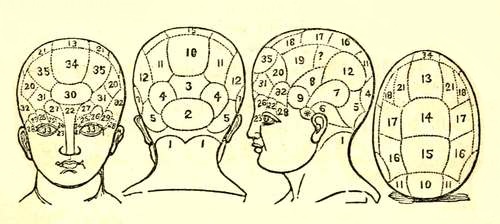
4404. Faculties of the Mind.
4405. Of the Feelings or Affective Faculties, usually styled propensities.
4406. Alimentativeness—Gives appetite for food. It has been a question whether this organ was in the brain or the stomach, therefore it is not numbered on the head.
4407. 1. Amativeness—Produces sexual love, desire, physical love.
4408. 2. Philoprogenitiveness—Love of children and young beings.
4409. 3. Concentrativeness—Continues the mind on emotion or ideas.
4410. 4. Adhesiveness—Friendship, sociability, attachment generally.
4411. 5. Combativeness—Courage, opposition, intrepidity, quarrelsomeness.
4412. 6. Destructiveness—Desire to destroy, torment; harshness, cruelty.
4413. 7. Secretiveness—Concealment, prudence, cunning, hypocrisy.
4414. 8. Acquisitiveness—Desire to acquire property; avarice, selfishness.
4415. 9. Constructiveness—Mechanical genius, desire to build.
SENTIMENTS—INFERIOR AND SUPERIOR.
4416. 10. Self-Esteem—Self-respect, personal dignity, pride, haughtiness.
4417. 11. Approbativeness—Thirst for praise, fame, or glory; ambition, vanity.
4418. 12. Cautiousness—Circumspection, timidity, fear, despondency.
4419. 13. Benevolence—Universal charity, mildness of disposition.
4420. 14. Veneration—Reverence, superstitious adoration, bigotry.
4421. 15. Firmness—Determination, perseverance, obstinacy, resolution.
4422. 16. Conscientiousness—Love of truth, sense of justice, duty.
4423. 17. Hope—Expects future good; cherishes faith, love of scheming.
4424. 18. Wonder—Desire of novelty, belief in the supernatural.
4425. 19. Ideality—Love of the beautiful, or excellent, poetic feeling.
4426. 20. Mirthfulness—Wit, humor, glee, love of the ludicrous.
4427. 21. Imitation—Expression in arts, or action; mimicry.
INTELLECT, OR KNOWING AND REFLECTING FACULTIES.
4428. 22. Individuality—Observes existences, simple facts.
4429. 23. Form—Observes configuration and the shape of bodies generally.
4430. 24. Size—Gives the idea of space, distance, dimension.
4431. 25. Weight—Perceives momentum, resistance, equilibrium.
4432. 26. Coloring—Gives perception of colors, and their harmonies.
4433. 27. Locality—Gives the idea of relative position, place.
4434. 28. Number—Talent for calculation, quickness in figures.
4435. 29. Order—Communicates the love of physical arrangement.
4436. 30. Eventuality—Observes and remembers occurrences and events.
4437. 31. Time—Perceives duration in nature, time in music.
4438. 32. Tune—Sense of musical harmony, melody.
4439. 33. Language—Verbal memory, fluency in speech or writing.
4440. 34. Comparison—Discovers analogies and differences.
4441. 35. Causality—Traces the relation of cause and effect.
4442. Memory is merely a degree of activity of the knowing and reflecting organs, each organ enabling the mind to recall the impressions which it served at first to receive.
4443. Judgment is the decision of 34 and 35 upon feelings and ideas furnished by the other faculties.
4444. The faculties, in themselves, are instructive; the moral sentiments and intellect being higher than the animal propensities.
4445. Temperaments.—These are four in number, viz:—The Nervous, the Bilious, the Sanguine, and the Lymphatic.
4446. The Nervous temperament is known by the person having fine, thin hair, usually brown; thin, pale or fair skin; gray or dark blue eyes; small muscles. Very active.
4447. The Bilious temperament has black hair and eyes, dark or swarthy skin, firm muscles, strong features, and great energy of will.
4448. The Sanguine temperament is fair and florid; happy, healthy countenance; handsome in youth, and hopeful in spirit always.
4449. The Lymphatic temperament has soft fat muscles; pale or bloodless complexion; slow and languid in action, and usually dull or very easy in mind.
SYNOPSIS OF AMERICAN HISTORY.
4450. Showing the year in which each State was settled, by what people, the number of square miles, and the capital of each State, etc.
4451. Maine.—Settled 1630, by English; 36,000 square miles; capital, Augusta; admitted into the Union 1820.
4452. New Hampshire.—Settled 1623, by English; 9,500 square miles; capital, Concord; one of the "Old Thirteen."
4453. Massachusetts.—Settled 1620, by English; 7,500 square miles; capital, Boston; one of the "Old Thirteen."
4454. Vermont.—Settled 1749, by English; square miles, 10,200; capital, Montpelier; admitted into the Union 1791.
4455. Rhode Island.—Settled 1636, by English; 1350 square miles; capital, Providence and Newport; one of the "Old Thirteen."
4456. Connecticut.—Settled 1633, by English; 4,760 square miles; capital, Hartford and New Haven; one of the "Old Thirteen."
4457. New York.—Settled 1614, by Dutch; square miles, 46,000; capital, Albany; one of the "Old Thirteen."
4458. New Jersey.—Settled 1624, by Dutch and Danes; square miles, 8,300; capital, Trenton; one of the "Old Thirteen."
4459. Pennsylvania.—Settled 1682, by English; square miles, 44,000; capital, Harrisburg; one of the "Old Thirteen."
4460. Delaware.—Settled 1627, by Swedes and Finns; square miles, 2100; capital, Dover; one of the "Old Thirteen."
4461. Maryland.—Settled 1634, by English; square miles, 14,000; capital, Annapolis; one of the "Old Thirteen."
4462. Virginia.—Settled 1607, by English; square miles, 64,000; capital, Richmond; one of the "Old Thirteen."
4463. North Carolina.—Settled 1650, by English; square miles, 48,000; capital, Raleigh; one of the "Old Thirteen."
4464. South Carolina.—Settled 1689, by English; square miles, 24,000; capital, Columbus; one of the "Old Thirteen."
4465. Georgia.—Settled 1733, by English; square miles, 60,000; capital, Milledgeville; one of the "Old Thirteen."
4466. Florida.—For near two hundred years under Spain, was ceded to the United States in 1819, and the East and West formed one territory in 1822; St. Augustine is the oldest town in the United States; Tallahasse is the capital; Pensacola, U. S. naval station. Admitted into the Union 1845.
4467. Ohio.—Settled 1788, by English; square miles, 39,000; capital, Columbus; admitted into the Union 1802.
4468. Indiana.—Settled 1730, by French; square miles, 36,000; capital, Indianapolis; admitted into the Union 1816.
4469. Illinois.—Settled 1749, by French; square miles, 52,000; capital, Springfield; admitted into the Union 1818.
4470. Missouri.—Settled 1763, by French; square miles, 60,000; capital, Jefferson city; admitted into the Union 1821.
4471. Michigan.—Settled 1670, by French; square miles, 65,000; capital, Lansing; admitted into the Union 1836.
4472. Iowa.—Settled by emigrants from other of the United States and Germans; square miles, 150,000; capital, Iowa city; admitted into the Union 1846.
4473. Wisconsin.—Settled by emigrants chiefly from New England and Europe; square miles, 80,000; capital, Madison; admitted into the Union 1848.
4474. Alabama.—Settled 1713, by French; square miles, 44,000; capital, Montgomery; admitted into the Union 1819.
4475. Mississippi.—Settled 1716, by French; square miles, 45,000; capital, Jackson; admitted into the Union 1817.
4476. Louisiana.—Settled 1699, by French; square miles, 48,000; capital, Baton Rouge; admitted into the Union 1811.
4478. Texas.—Settled 1692, by Spanish; square miles, 240,000; settled by Americans 1821; capital, Austin; admitted into the Union 1845.
4479. Arkansas.—Settled by French from Louisiana, and formed part of Missouri in 1819; square miles, 57,000; capital, Little Rock; admitted into the Union 1836.
4480. Tennessee.—Settled 1765, by English; square miles, 40,000; capital, Nashville; admitted into the Union 1796.
4481. Kentucky.—Settled by Virginians; square miles, 42,000; capital, Frankfort; admitted into the Union 1792.
4482. California.—Settled 1769, by Spaniards; ceded to the United States by Mexico, 1848; square miles, 188,000; capital, Sacramento; admitted into the Union 1850.
4483. Territories of the United States.
4484. Oregon Territory.—Beyond the Rocky Mountains; settled by emigrants from the States; will soon be admitted into the Union; capital, Oregon city; square miles over 300,000.
4485. Minnesota Territory.—Settled by emigrants from the older States; capital, St. Paul; will soon be admitted into the Union.
4486. Utah Territory.—Settled by Mormons; capital, Salt Lake city; not to be admitted into the Union with its present institutions.
4487. New Mexico Territory.—Settled by Spaniards; ceded to the United States 1849; capital, Santa Fe; will probably soon be admitted into the Union.
4488. Washington Territory.—Settled by English; square miles, 257,000; capital, Puget's Sound; very few American settlers.
4489. Kansas Territory.—Settled by emigrants chiefly from Missouri and the New England States; capital, Lecompton; will soon be admitted into the Union.
4490. Nebraska Territory.—Settled by emigrants from the older States; capital, Omaha city.
WORDS OF WASHINGTON.
4491. The following rules were found among the early papers of this great hero, patriot and statesman. He wrote them when, probably, about fourteen or fifteen years of age.
4492. As these rules were a guide to him, evidently shown in his life and character, so may they influence the conduct of Young America.
4493. Rules of civility and decent behavior in company and conversation, written by George Washington.
4494. Every action in company ought to be with some sign of respect to those present.
4495. Be no flatterer; neither play with any one that delights not to be played with.
4496. Read no letters, books, or papers in company; but when there is a necessity for doing it, you must ask leave. Come not near the books or writings of any one so as to read them, unless desired, nor give your opinion of them unasked; also look not nigh when another is writing a letter.
4497. Let your countenance be pleasant, but in serious matters somewhat grave.
4498. Show not yourself glad at the misfortune of another, though he were your enemy.
4499. When you meet with one of greater quality than yourself, stop and retire, especially if it be at a door or any strait place, to give way for him to pass.
4500. They that are in dignity, or in office, have in all places precedency; but whilst they are young they ought to respect those that are their equals in birth, or other qualities, though they have no public charge.
4501. It is good manners to prefer them to whom we speak before ourselves, especially if they be above us, with whom in no sort we ought to begin.
4502. Let your discourse with men of business be short and comprehensive.
4503. In visiting the sick, do not presently play the physician, if you be not knowing therein.
4504. In writing, or speaking, give to every person his due title, according to his degree and the custom of the place.
4505. Strive not with your superiors in argument, but always submit your judgment to others with modesty.
4506. Undertake not to teach your equal in the art he himself professes; it savors of arrogance.
4507. When a man does all he can, though it succeeds not well, blame not him that did it.
4508. Being to advise or reprehend any one, consider whether it ought to be in public or in private; presently or at some other time; in what terms to do it; and in reproving show no signs of choler, but do it with sweetness and mildness.
4509. Take all admonitions thankfully, in what time or place soever given; but afterward, not being culpable, take a time or place convenient to let him know it that gave them.
4510. Mock not, nor jest at any thing of importance; break no jests that are sharp-biting; and if you deliver any thing witty and pleasant, abstain from laughing thereat yourself.
4511. Wherein you reprove another, be unblamable yourself; for example is more prevalent than precepts.
4512. Use no reproachful language against any one, neither curse nor revile.
4513. Be not hasty to believe flying reports to the disparagement of any.
4514. In your apparel be modest, and endeavor to accommodate nature rather than to procure admiration; keep to the fashion of your equals, such as are civil and orderly with respect to times and places.
4515. Associate yourselves with men of good quality, if you esteem your own reputation, for it is better to be alone than in bad company.
4516. Be not immodest in urging your friend to discover a secret.
4517. Utter not base or frivolous things amongst grave and learned men; nor very difficult questions or subjects among the ignorant; nor things hard to be believed.
4518. Speak not of doleful things in time of mirth, nor at the table; speak not of melancholy things, as death, and wounds; and if others mention them, change, if you can, the discourse. Tell not your dreams but to your intimate friend.
4519. Break not a jest where none takes pleasure in mirth; laugh not aloud, nor at all without occasion. Deride no man's misfortune, though there seem to be some cause.
4520. Speak not injurious words neither in jest nor earnest; scoff at none, although they give occasion.
4521. Be not forward, but friendly and courteous; the first to salute, hear, and answer; and be not pensive when it is a time to converse.
4522. Detract not from others, neither be excessive in commending.
4523. If two contend together, take not the part of either unconstrained, and be not obstinate in your own opinion; in things indifferent, be of the major side.
4524. Think before you speak; pronounce not imperfectly, nor bring out your words too hastily, but orderly and distinctly.
4525. When another speaks, be attentive yourself, and disturb not the audience. If any hesitate in his words, help him not, nor prompt him without being desired; interrupt him not, nor answer him till his speech be ended.
4526. Make no comparisons; and if any of the company be commended for any brave act of virtue, commend not another for the same.
4527. Be not apt to relate news, if you know not the truth thereof. In discoursing of things you have heard, name not your author always. A secret discover not.
4528. Undertake not what you cannot perform, but be careful to keep your promise.
4529. In disputes be not so desirous to overcome as not to give liberty to each one to deliver his opinion, and submit to the judgment of the major part, especially if they are judges of the dispute.
4530. Speak not evil of the absent, for it is unjust.
4531. Be not angry at table, whatever happens; and if you have reason to be so, show it not; put on a cheerful countenance, especially if there be strangers, for good humor makes one dish of meat a feast.
4532. When you speak of God, or his attributes, let it be seriously in reverence. Honor and obey your natural parents, although they be poor.
4533. Let your recreations be manful, not sinful.
4534. Labor to keep alive in your breast that little spark of celestial fire called conscience.
USEFUL FAMILY TABLES.
WEIGHTS AND MEASURES.
4535. A—Measure of Length.
12Inches = 1 Foot,
3Feet "1 Yard,
5½Yards "1 Rod, or Pole,
40Poles "1 Furlong,
8Furlongs "1 Mile,
691/51Miles "1 Degree of Great Circle of Earth.
4536. An inch is the smallest lineal measure to which a name is given, but subdivisions are used for many purposes. Among mechanics the inch is commonly divided into eighths. By the officers of the revenue, and by scientific persons, it is divided into tenths, hundredths, &c. Formerly it was made to consist of twelve parts called lines.
4537. B.—Particular Measures of Length.
A Nail = 2¼inches} }Used for measuring Cloth }of all kinds. }
Quarter " 4Nails
Yard " 4Quarters
Ell " 5Quarters
Hand " 4Inches,used for the height of Horses.
Fathom " 6Feet,used in measuring depths.
Link " 7In. 92 hdths.}Used in Land Measure to }facilitate computation of } being equal to an acre.
Chain " 100Links
4538. C.—Measure of Surface.
144Square Inches = 1 Square Foot
9Square Feet "1 Square Yard
30¼Square Yards "1 Perch, or Rod
40Perches "1 Rood
4Roods "1 Acre
640Acres "1 Square Mile.
4539. D.—Measures of Solidity and Capacity.
DIVISION I.—SOLIDITY.
1728Cubic Inches = 1 Cubic Foot
27Cubic Feet "1 Cubic Yard
DIVISION II.—CAPACITY.
4 Gills = 1 Pint = 34⅔cubic inches nearly.
2 Pints " 1 Quart " 69½"
4 Quarts " 1 Gallon " 277¼"
2 Gallons " 1 Peck "554½"
8 Gallons " 1 Bushel "2218¼"
8 Bushels " 1 Quarter " 10¼cubic feet nearly.
5 Quarters " 1 Load " 51½"
4540. The four last denominations are used for dry goods only. For liquids several denominations have been heretofore adopted, viz.:—for Beer, the Firkin of 9 gallons, the Kilderkin, of 18, the Barrel, of 36, the Hogshead, of 54, and the Butt, of 108 gallons. These will probably continue to be used in practice. For Wine and Spirits, there are the Anker, Runlet, Tierce, Hogshead, Puncheon, Pipe, Butt, and Tun; but these may be considered rather as the names of the casks in which such commodities are imported, than as expressing any definite number of gallons. It is the practice to gauge all such vessels, and to charge them according to their actual content.
4541. Flour is sold nominally by measure, but actually by weight, reckoned at 7 lbs. Avoirdupois to a gallon.
4542. E.—Measure of Avoirdupois Weight.
2711/32Grains = 1 Dram = 2711/32grains
16Drams " 1 Ounce " 437½"
16Ounces " 1 Pound (lb.) " 7000"
28Pounds " 1 Quarter (qr.)
4Quarters " 1 Hundred- weight (cwt.)
20Cwt. " 1 Ton.
This weight is used in almost all commercial transactions, and in the common dealings of life.
A Firkin of Butter56 lb. A Barrel of Soap256 lb.
------------- Soap64 " ----------- Raisins112 "
A Barrel of Anchovies30 " A Fother of Lead19½ cwt.
4543. F.—Measures of Pounds.
The following table of the number of pounds of various articles to a bushel, may be of interest to some of our farming friends.
Wheat60 lbs.is 1 bus. Clover Seed60 lbs.is 1 bus.
Shelled Corn46 " " Timothy seed45 " "
Corn in cob70 " " Flax Seed56 " "
Oats35 " " Hemp Seed44 " "
Barley48 " " Buckwheat42 " "