PILL-DOCTOR HERDAL
Reading edition
[Prefatory Note.—The original title—Mester-Pjil-drögster Herdal—would sound a trifle too uncouth to the Philistine ear, and is therefore modified as above, although the term "drögster," strictly speaking, denotes a practitioner who has not received a regular diploma].
ACT FIRST
An elegantly furnished drawing-room at Dr. Herdal's. In front, on the left, a console-table, on which is a large round bottle full of coloured water. On the right a stove, with a banner-screen made out of a richly-embroidered chest-protector. On the stove, a stethoscope and a small galvanic battery. In one corner, a hat and umbrella stand: in another, a desk, at which stands Senna Blakdraf, making out the quarterly accounts. Through a glass-door at the back is seen the Dispensary, where Rübub Kalomel is seated, occupied in rolling a pill. Both go on working in perfect silence for four minutes and a half.
Dr. Haustus Herdal.
[Enters through hall-door; he is elderly, with a plain sensible countenance, but slightly weak hair and expression.] Come here Miss Blakdraf. [Hangs up hat, and throws his mackintosh on a divan.] Have you made out all those bills yet?
[Looks sternly at her.
Senna.
[In a low hesitating voice.] Almost. I have charged each patient with three attendances daily. Even when you only dropped in for a cup of tea and a chat. [Passionately.] I felt I must—I must!
Dr. Herdal.
[Alters his tone, clasps her head in his hands, and whispers.] I wish you could make out the bills for me, always.
Senna.
[In nervous exaltation.] How lovely that would be! Oh, you are so unspeakably good to me! It is too enthralling to be here!
[Sinks down and embraces his knees.
Dr. Herdal.
So I've understood. [With suppressed irritation.] For goodness' sake, let go my legs! I do wish you wouldn't be so confoundedly neurotic!
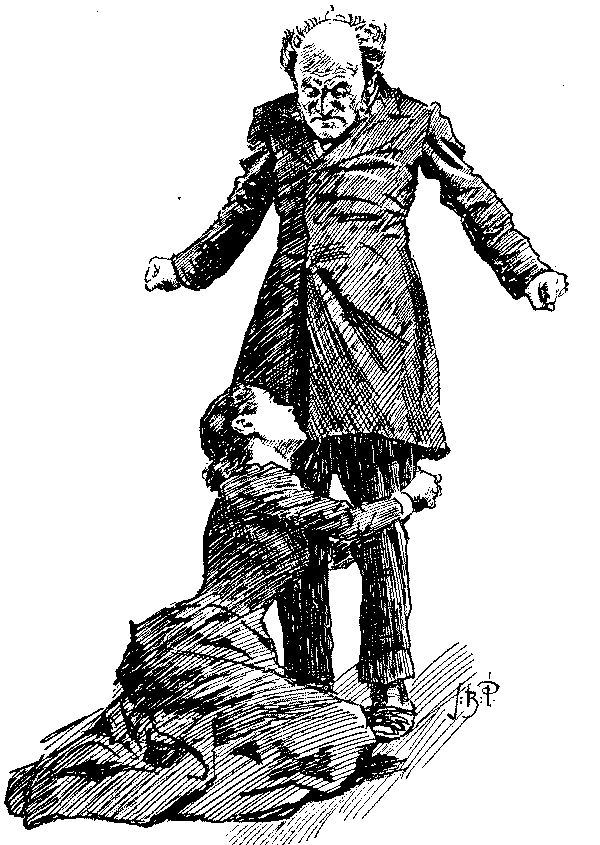
"For goodness' sake, let go my legs!"
Rübub.
[Has risen, and comes in through glass-door, breathing with difficulty; he is a prematurely bald young man of fifty-five, with a harelip, and squints slightly.] I beg pardon, Dr. Herdal, I see I interrupt you. [As Senna rises.] I have just completed this pill. Have you looked at it?
[He offers it for inspection, diffidently.
Dr. Herdal.
[Evasively.] It appears to be a pill of the usual dimensions.
Rübub.
[Cast down.] All these years you have never given me one encouraging word! Can't you praise my pill?
Dr. Herdal.
[Struggles with himself.] I—I cannot. You should not attempt to compound pills on your own account.
Rübub.
[Breathing laboriously.] And yet there was a time when you, too——
Dr. Herdal.
[Complacently.] Yes, it was certainly a pill that came as a lucky stepping stone—but not a pill like that!
Rübub.
[Vehemently.] Listen! Is that your last word? Is my aged mother to pass out of this world without ever knowing whether I am competent to construct an effective pill or not?
Dr. Herdal.
[As if in desperation.] You had better try it upon your mother—it will enable her to form an opinion. Only mind—I will not be responsible for the result.
Rübub.
I understand. Exactly as you tried your pill, all those years ago, upon Dr. Ryval.
[He bows and goes out.
Dr. Herdal.
[Uneasily.] He said that so strangely, Senna. But tell me now—when are you going to marry him?
Senna.
[Starts—half glancing up at him.] I—I don't know. This year—next year—now—never! I cannot marry him ... I cannot—I cannot—it is so utterly impossible to leave you!
Dr. Herdal.
Yes, I can understand that. But, my poor Senna, hadn't you better take a little walk?
Senna.
[Clasps her hands gratefully.] How sweet and thoughtful you are to me! I will take a walk.
Dr. Herdal.
[With a suppressed smile.] Do! And—h'm!—you needn't trouble to come back. I have advertised for a male book-keeper—they are less emotional. Good-night, my little Senna!
Senna.
[Softly and quiveringly.] Good-night, Dr. Herdal!
[Staggers out of hall-door, blowing kisses.
Mrs. Herdal.
[Enters through the window, plaintively.] Quite an acquisition for you, Haustus, this Miss Blakdraf!
Dr. Herdal.
She's—h'm—extremely civil and obliging. But I am parting with her, Aline—mainly on your account.
Mrs. Herdal.
[Evades him.] Was it on my account, indeed, Haustus? You have parted with so many young persons on my account—so you tell me!
Dr. Herdal.
[Depressed.] Oh, but this is hopeless! When I have tried so hard to bring a ray of sunlight into your desolate life! I must give Rübub Kalomel notice too—his pill is really too preposterous!
Mrs. Herdal.
[Feels gropingly for a chair, and sits down on the floor.] Him, too! Ah, Haustus, you will never make my home a real home for me. My poor first husband, Halvard Solness, tried—and he couldn't! When one has had such misfortunes as I have—all the family portraits burnt, and the silk dresses, too, and a pair of twins, and nine lovely dolls.
[Chokes with tears.
Dr. Herdal.
[As if to lead her away from the subject.] Yes, yes, yes, that must have been a heavy blow for you, my poor Aline. I can understand that your spirits can never be really high again. And then for poor Master Builder Solness to be so taken up with that Miss Wangel as he was—that, too, was so wretched for you. To see him topple off the tower, as he did that day ten years ago——
Mrs. Herdal.
Yes, that too, Haustus. But I did not mind it so much—it all seemed so perfectly natural in both of them.
Dr. Herdal.
Natural! For a girl of twenty three to taunt a middle-aged architect, whom she knew to be constitutionally liable to giddiness, never to let him have any peace till he had climbed a spire as dizzy as himself—and all for the fun of seeing him fall off—how in the world——!
Mrs. Herdal.
[Laying the table for supper with dried fish and punch.] The younger generation have a keener sense of humour than we elder ones, Haustus, and perhaps after all, she was only a perplexing sort of allegory.
Dr. Herdal.
Yes, that would explain her to some extent, no doubt. But how he could be such an old fool!
Mrs. Herdal.
That Miss Wangel was a strangely fascinating type of girl. Why, even I myself——
Dr. Herdal.
[Sits down and takes some fish.] Fascinating? Well, goodness knows, I couldn't see that at all. [Seriously.] Has it never struck you, Aline, that elderly Norwegians are so deucedly impressionable—mere bundles of overstrained nerves, hypersensitive ganglia. Except, of course, the Medical Profession.
Mrs. Herdal.
Yes, of course; those in that profession are not so inclined to gangle. And when one has succeeded by such a stroke of luck as you have——
Dr. Herdal.
[Drinks a glass of punch.] You're right enough there. If I had not been called in to prescribe for Dr. Ryval, who used to have the leading practice here, I should never have stepped so wonderfully into his shoes as I did. [Changes to a tone of quiet chuckling merriment.] Let me tell you a funny story, Aline; it sounds a ludicrous thing—but all my good fortune here was based upon a simple little pill. For if Dr. Ryval had never taken it——
Mrs. Herdal.
[Anxiously.] Then you do think it was the pill that caused him to——?
Dr. Herdal.
On the contrary; I am perfectly sure the pill had nothing whatever to do with it—the inquest made it quite clear that it was really the liniment. But don't you see, Aline, what tortures me night and day is the thought that it might unconsciously have been the pill which—— Never to be free from that! To have such a thought gnawing and burning always—always, like a moral mustard plaster!
[He takes more punch.
Mrs. Herdal.
Yes; I suppose there is a poultice of that sort burning on every breast—and we must never take it off either—it is our simple duty to keep it on. I too, Haustus, am haunted by a fancy that if this Miss Wangel were to ring at our bell now——
Dr. Herdal.
After she has been lost sight of for ten years? She is safe enough in some sanatorium, depend upon it. And what if she did come? Do you think, my dear good woman, that I—a sensible clear-headed general practitioner, who have found out all I know for myself—would let her play the deuce with me as she did with poor Halvard? No, general practitioners don't do such things—even in Norway!
Mrs. Herdal.
Don't they indeed, Haustus? [The surgery-bell rings loudly.] Did you hear that? There she is! I will go and put on my best cap. It is my duty to show her that small attention.
Dr. Herdal.
[Laughing nervously.] Why, what on earth!—— It's the night-bell. It is most probably the new book-keeper! [Mrs. Herdal goes out; Dr. Herdal rises with difficulty, and opens the door.] Goodness gracious!—it is that girl, after all!
[Hilda Wangel enters through the dispensary door. She wears a divided skirt, thick boots, and a Tam o' Shanter with an eagle's wing in it. Somewhat freckled. Carries a green tin cylinder slung round her, and a rug in a strap. Goes straight up to Herdal, her eyes sparkling with happiness.
How are you? I've run you down, you see! The ten years are up. Isn't it scrumptiously thrilling, to see me like this?
Dr. Herdal.
[Politely retreating.] It is—very much so—but still I don't in the least understand——
Hilda.
[Measures him with a glance.] Oh, you will. I have come to be of use to you. I've no luggage, and no money. Not that that makes any difference. I never have. And I've been allured and attracted here. You surely know how these things come about?
[Throws her arms round him.
Dr. Herdal.
What the deuce! Miss Wangel, you mustn't. I'm a married man! There's my wife!
[Mrs. Herdal enters.
Hilda.
As if that mattered—it's only dear, sweet Mrs. Solness. She doesn't mind—do you, dear Mrs. Solness?
Mrs. Herdal.
It does not seem to be of much use minding, Miss Wangel. I presume you have come to stay?
Hilda.
[In amused surprise.] Why, of course—what else should I come for? I always come to stay, until—h'm! [Nods slowly, and sits down at table.
Dr. Herdal.
[Involuntarily.] She's drinking my punch! If she thinks I'm going to stand this sort of thing, she's mistaken. I'll soon show her a pill-doctor is a very different kind of person from a mere Master Builder!
[Hilda finishes the punch with an indefinable expression in her eyes, and Dr. Herdal looks on gloomily as the Curtain falls.
ACT SECOND
Dr. Herdal's drawing-room and dispensary, as before. It is early in the day. Dr. Herdal sits by the little table, taking his own temperature with a clinical thermometer. By the door stands the New Book-keeper; he wears blue spectacles and a discoloured white tie, and seems slightly nervous.
Dr. Herdal.
Well, now you understand what is necessary. My late book-keeper, Miss Blakdraf, used to keep my accounts very cleverly—she charged every visit twice over.
The New Book-keeper.
I am familiar with book-keeping by double entry. I was once employed at a bank.
Dr. Herdal.
I am discharging my assistant, too; he was always trying to push me out with his pills. Perhaps you will be able to dispense?
The New Book-keeper.
[Modestly.] With an additional salary, I should be able to do that too.
Dr. Herdal.
Capital! You shall dispense with an additional salary. Go into the dispensary, and see what you can make of it. You may mistake a few drugs at first—but everything must have a beginning.
[As the New Book-keeper retires, Mrs. Herdal enters in a hat and cloak with a watering-pot, noiselessly.
Mrs. Herdal.
Miss Wangel got up early, before breakfast, and went for a walk. She is so wonderfully vivacious!
Dr. Herdal.
So I should say. But tell me, Aline, is she really going to stay with us here?
[Nervously.
Mrs. Herdal.
[Looks at him.] So she tells me. And, as she has brought nothing with her except a tooth-brush and a powder-puff, I am going into the town to get her a few articles. We must make her feel at home.
Dr. Herdal.
[Breaking out.] I will make her not only feel but be at home, wherever that is, this very day! I will not have a perambulating Allegory without a portmanteau here on an indefinite visit. I say, she shall go—do you hear, Aline? Miss Wangel will go!
[Raps with his fist on table.
Mrs. Herdal.
[Quietly.] If you say so, Haustus, no doubt she will have to go. But you must tell her so yourself.
[Puts the watering-pot on the console table, and goes out, as Hilda enters, sparkling with pleasure.
Hilda.
[Goes up straight to him.] Good morning, Dr. Herdal. I have just seen a pig killed. It was ripping—I mean, gloriously thrilling! And your wife has taken a tremendous fancy to me. Fancy that!
Dr. Herdal.
[Gloomily.] It is eccentric certainly. But my poor dear wife was always a little——
Hilda.
[Nods her head slowly several times.] So you have noticed that too? I have had a long talk with her. She can't get over your discharging Mr. Kalomel—he is the only man who ever really understood her.
Dr. Herdal.
If I could only pay her off a little bit of the huge, immeasurable debt I owe her—but I can't!
Hilda.
[Looks hard at him.] Can't I help you? I helped Ragnar Brovik. Didn't you know I stayed with him and poor little Kaia—after that accident to my Master Builder? I did. I made Ragnar build me the loveliest castle in the air—lovelier, even, than poor Mr. Solness's would have been—and we stood together on the very top. The steps were rather too much for Kaia. Besides, there was no room for her on top. And he put towering spires on all his semi-detached villas. Only, somehow, they didn't let. Then the castle in the air tumbled down, and Ragnar went into liquidation, and I continued my walking-tour.
Dr. Herdal.
[Interested against his will.] And where did you go after that, may I ask, Miss Wangel?
Hilda.
Oh, ever so far north. There I met Mr. and Mrs. Tesman—the second Mrs. Tesman—she who was Mrs. Elvsted, with the irritating hair, you know. They were on their honeymoon, and had just decided that it was impossible to reconstruct poor Mr. Lövborg's great book out of Mrs. Elvsted's rough notes. But I insisted on George's attempting the impossible—with Me. And what do you think Mrs. Tesman wears in her hair now?
Dr. Herdal.
Why, really I could not say. Vine-leaves, perhaps.
Hilda.
Wrong—straws! Poor Tesman didn't fancy that—so he shot himself, un-beautifully, through his ticket-pocket. And I went on and took Rosmershölm for the summer. There had been misfortune in the house, so it was to let. Dear good old Rector Kroll acted as my reference; his wife and children had no sympathy with his views, so I used to see him every day. And I persuaded him, too, to attempt the impossible—he had never ridden anything but a rocking-horse in his life, but I made him promise to mount the White Horse of Rosmershölm. He didn't get over that. They found his body, a fortnight afterwards, in the mill-dam. Thrilling!
Dr. Herdal.
[Shakes his finger at her.] What a girl you are, Miss Wangel! But you mustn't play these games here, you know.
Hilda.
[Laughs to herself.] Of course not. But I suppose I am a strange sort of bird.
Dr. Herdal.
You are like a strong tonic. When I look at you I seem to be regarding an effervescing saline draught. Still, I really must decline to take you.
Hilda.
[A little sulky.] That is not how you spoke ten years ago, up at the mountain station, when you were such a flirt!
Dr. Herdal.
Was I a flirt? Deuce take me if I remember. But I am not like that now.
Hilda.
Then you have really forgotten how you sat next to me at the table d'hôte, and made pills and swallowed them, and were so splendid and buoyant and free that all the old women who knitted left next day?
Dr. Herdal.
What a memory you have for trifles, Miss Wangel; it's quite wonderful!
Hilda.
Trifles! There was no trifling on your part. When you promised to come back in ten years, like a troll, and fetch me!
Dr. Herdal.
Did I say all that? It must have been after table d'hôte!
Hilda.
It was. I was a mere chit then—only twenty-three; but I remember. And now I have come for you.
Dr. Herdal.
Dear, dear! But there is nothing of the troll about me now I have married Mrs. Solness.
Hilda.
[Looking sharply at him.] Yes, I remember you were always dropping in to tea in those days.
Dr. Herdal.
[Seems hurt.] Every visit was duly put down in the ledger and charged for—as poor little Senna will tell you.
Hilda.
Little Senna? Oh, Dr. Herdal, I believe there is a bit of the troll left in you still!
Dr. Herdal.
[Laughs a little.] No, no; my conscience is perfectly robust—always was.
Hilda.
Are you quite quite sure that, when you went indoors with dear Mrs. Solness that afternoon, and left me alone with my Master Builder, you did not foresee—perhaps wish—intend, even a little, that—— H'm?
Dr. Herdal.
That you would talk the poor man into clambering up that tower? You want to drag Me into that business now!
Hilda.
[Teasingly.] Yes, I certainly think that then you went on exactly like a troll.
Dr. Herdal.
[With uncontrollable emotion.] Hilda, there is not a corner of me safe from you! Yes, I see now that must have been the way of it. Then I was a troll in that, too! But isn't it terrible the price I have had to pay for it? To have a wife who—— No, I shall never roll a pill again—never, never!
Hilda.
[Lays her head on the stove, and answers as if half asleep.] No more pills? Poor Doctor Herdal!
Dr. Herdal.
[Bitterly.] No—nothing but cosy commonplace grey powders for a whole troop of children.
Hilda.
[Lively again..] Not grey powders! [Quite seriously.] I will tell you what you shall make next. Beautiful rainbow-coloured powders that will give one a real grip on the world. Powders to make every one free and buoyant, and ready to grasp at one's own happiness, to dare what one would. I will have you make them. I will—I will!
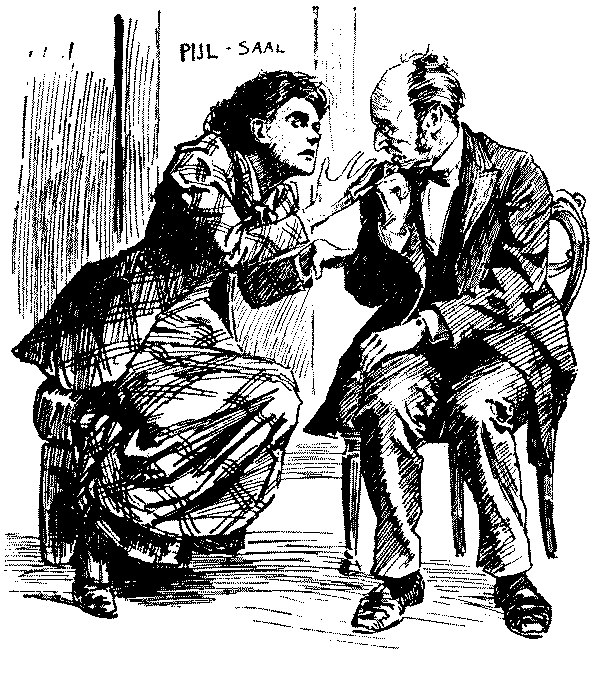
"Beautiful rainbow-coloured powders that will give one a real grip on the world!"
Dr. Herdal.
H'm! I am not quite sure that I clearly understand. And then the ingredients——?
Hilda.
What stupid people all of you pill-doctors are, to be sure! Why, they will be poisons, of course!
Dr. Herdal.
Poisons? Why in the world should they be that?
Hilda.
[Without answering him.] All the thrillingest, deadliest poisons—it is only such things that are wholesome, nowadays.
Dr. Herdal.
[As if caught by her enthusiasm.] And I could colour them, too, by exposing them to rays cast through a prism. Oh, Hilda, how I have needed you all these years! For, you see, with her it was impossible to discuss such things.
[Embraces her.
Mrs. Herdal.
[Enters noiselessly through hall-door.] I suppose, Haustus, you are persuading Miss Wangel to start by the afternoon steamer? I have bought her a pair of curling-tongs, and a packet of hairpins. The larger parcels are coming on presently.
Dr. Herdal.
[Uneasily.] H'm! Hilda—Miss Wangel I should say—is kindly going to stay on a little longer, to assist me in some scientific experiments. You wouldn't understand them if I told you.
Mrs. Herdal.
Shouldn't I, Haustus? I daresay not.
[The NEW BOOK-KEEPER looks through the glass door of dispensary.
Hilda.
[Starts violently and points—then in a whisper.] Who is that?
Dr. Herdal.
Only the new Book-keeper and Assistant—a very intelligent person.
Hilda.
[Looks straight in front of her with a far-away expression, and whispers to herself.] I thought at first it was.... But no—that would be too frightfully thrilling!
Dr. Herdal.
[To himself.] I'm turning into a regular old troll now—but I can't help myself. After all, I am only an elderly Norwegian. We are made like that.... Rainbow powders—real rainbow powders! With Hilda!.... Oh, to have the joy of life once more!
[Takes his temperature again as Curtain falls.
ACT THIRD
[On the right, a smart verandah, attached to Dr. Herdal's dwelling-house, and communicating with the drawing-room and dispensary by glass doors. On the left a tumble-down rockery, with a headless plaster Mercury. In front, a lawn, with a large silvered glass globe on a stand. Chairs and tables. All the furniture is of galvanised iron. A sunset is seen going on among the trees.
Dr. Herdal.
[Comes out of dispensary-door cautiously, and whispers.] Hilda, are you in there?
[Taps with fingers on drawing-room door.
Hilda.
[Comes out with a half-teasing smile.] Well—and how is the rainbow-powder getting on, Dr. Herdal?
Dr. Herdal.
[With enthusiasm.] It is getting on simply splendidly. I sent the new assistant out to take a little walk, so that he should not be in the way. There is arsenic in the powder, Hilda, and digitalis too, and strychnine, and the best beetle-killer!
Hilda.
[With happy, wondering eyes.] Lots of beetle-killer. And you will give some of it to her, to make her free and buoyant. I think one really has the right—when people happen to stand in the way——!
Dr. Herdal.
Yes, you may well say so, Hilda. Still—[dubiously]—it does occur to me that such doings may perhaps be misunderstood—by the narrow-minded and conventional.
[They go on the lawn, and sit down.
Hilda.
[With an outburst.] Oh, that all seems to me so foolish—so irrelevant! As if the whole thing wasn't intended as an allegory!
Dr. Herdal.
[Relieved.] Ah, so long as it is merely allegorical, of course—— But what is it an allegory of, Hilda?
Hilda.
[Reflects in vain.] How can you sit there and ask such questions? I suppose I am a symbol—of some sort.
Dr. Herdal.
[As a thought flashes upon him.] A cymbal? That would certainly account for your bra—— Then, am I a cymbal too, Hilda?
Hilda.
Why yes—what else? You represent the artist-worker, or the elder generation, or the pursuit of the ideal, or a bilious conscience—or something or other. You're all right!
Dr. Herdal.
[Shakes his head.] Am I? But I don't quite see—— Well, well, cymbals are meant to clash a little. And I see plainly now that I ought to prescribe this powder for as many as possible. Isn't it terrible, Hilda, that so many poor souls never really die their own deaths—pass out of the world without even the formality of an inquest? As the district Coroner, I feel strongly on the subject.
Hilda.
And, when the Coroner has finished sitting on all the bodies, perhaps—but I shan't tell you now. [Speaks as if to a child.] There, run away and finish making the rainbow-powder, do!
Dr. Herdal.
[Skips up into the dispensary.] I will—I will! Oh, I do feel such a troll—such a light-haired, light-headed old devil!
Rübub.
[Enters garden-gate.] I have had my dismissal—but I'm not going without saying good-bye to Mrs. Herdal.
Hilda.
Dr. Herdal would disapprove—you really must not, Mr. Kalomel. And, besides, Mrs. Herdal is not at home. She is in the town buying me a reel of cotton. Dr. Herdal is in. He is making real rainbow powders for regenerating everybody all round. Won't that be fun?
Rübub.
Making powders? Ha! ha! But you will see he won't take one himself. It is quite notorious to us younger men that he simply daren't do it.
Hilda.
[With a little snort of contempt.] Oh, I daresay—that's so likely! [Defiantly.] I know he can, though. I've seen him!
Rübub.
There is a tradition that he once—but not now—he knows better. I think you said Mrs. Herdal was in the town? I will go and look for her. I understand her so well.
[Goes out by gate.
Hilda.
[Calls.] Dr. Herdal! Come out this minute. I want you—awfully!
Dr. Herdal.
[Puts his head out.] Just when I am making such wonderful progress with the powder. [Comes down and leans on a table.] Have you hit upon some way of giving it to Aline? I thought if you were to put it in her arrowroot——?
Hilda.
No, thanks. I won't have that now. I have just recollected that it is a rule of mine never to injure anybody I have once been formally introduced to. Strangers don't count. No, poor Mrs. Herdal mustn't take that powder!
Dr. Herdal.
[Disappointed.] Then is nothing to come of making rainbow powders, after all, Hilda?
Hilda.
[Looks hard at him.] People say you are afraid to take your own physic. Is that true?
Dr. Herdal.
Yes, I am. [After a pause—with candour.] I find it invariably disagrees with me.
Hilda.
[With a half-dubious smile.] I think I can understand that. But you did once. You swallowed your own pills that day at the table d'hôte, ten years ago. And I heard a harp in the air, too!
Dr. Herdal.
[Open-mouthed.] I don't think that could have been me. I don't play any instrument. And that was quite a special thing, too. It's not every day I can do it. Those were only bread pills, Hilda.
Hilda.
[With flashing eyes.] But you rolled them, you took them. And I want to see you stand once more free and high and great, swallowing your own preparations. [Passionately.] I will have you do it! [Imploringly.] Just once more, Dr. Herdal!
Dr. Herdal.
If I did, Hilda, my medical knowledge, slight as it is, leads me to the conclusion that I should in all probability burst.
Hilda.
[Looks deeply into his eyes.] So long as you burst beautifully! But no doubt that Miss Blakdraf——
Dr. Herdal.
You must believe in me utterly and entirely. I will do anything—anything, Hilda, to provide you with agreeable entertainment. I will swallow my own powder! [To himself, as he goes gravely up to dispensary.] If only the drugs are sufficiently adulterated!
[Goes in; as he does so, the New Assistant enters the garden in blue spectacles, unseen by Hilda, and follows him, leaving open the glass door.
Senna.
[Comes wildly out of drawing-room.] Where is dear Dr. Herdal? Oh, Miss Wangel, he has discharged me—but I can't—I simply can't live away from that lovely ledger.
Hilda.
[Jubilantly.] At this moment Dr. Herdal is in the dispensary, taking one of his own powders.
Senna.
[Despairingly.] But—but it is utterly impossible! Miss Wangel, you have such a firm hold of him—don't let him do that!
Hilda.
I have already done all I can.
[Rübub appears, talking confidentially with Mrs. Herdal, at gate.
Senna.
Oh, Mrs. Herdal, Rübub! The Pill-Doctor is going to take one of his own preparations. Save him—quick!
Rübub.
[With cold politeness.] I am sorry to hear it—for his sake. But it would be quite contrary to professional etiquette to prevent him.
Mrs. Herdal.
And I never interfere with my husband's proceedings. I know my duty, Miss Blakdraf, if others don't!
Hilda.
[Exulting with great intensity.] At last! Now I see him in there, great and free again, mixing the powder in a spoon—with jam!... Now he raises the spoon. Higher—higher still! [A gulp is audible from within.] There, didn't you hear a harp in the air? [Quietly.] I can't see the spoon any more. But there is one he is striving with, in blue spectacles!
The New Assistant's Voice.
[Within.] The Pill-Doctor Herdal has taken his own powder!
Hilda.
[As if petrified.] That voice! Where have I heard it before? No matter—he has got the powder down! [Waves a shawl in the air, and shrieks with wild jubilation.] It's too awfully thrilling! My—my Pill-Doctor!
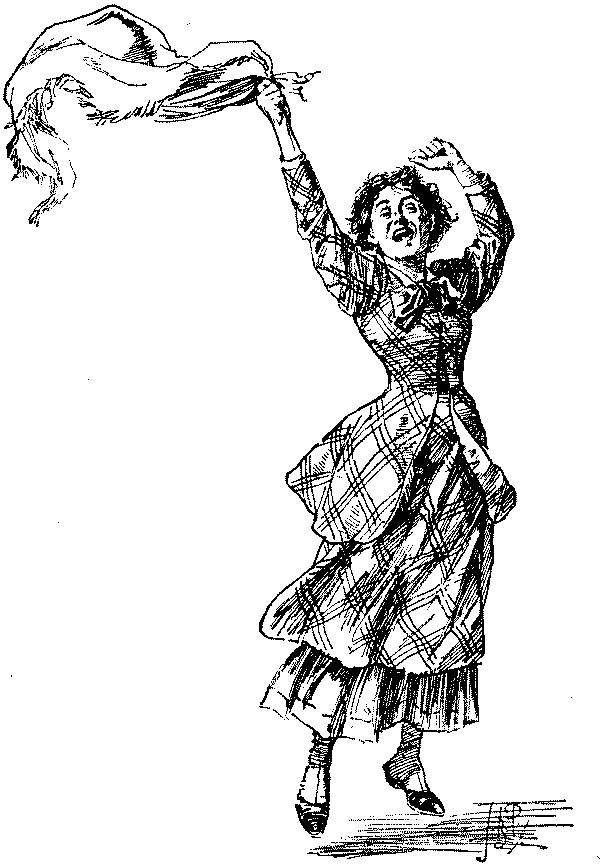
"My, my Pill-doctor!"
The New Assistant.
[Comes out on verandah.] I am happy to inform you that—as, to avoid accidents, I took the simple precaution of filling all the dispensary-jars with camphorated chalk—no serious results may be anticipated from Dr. Herdal's rashness. [Removes spectacles.] Nora, don't you know me?
Hilda.
[Reflects.] I really don't remember having the pleasure—— And I'm sure I heard a harp in the air!
Mrs. Herdal.
I fancy, Miss Wangel, it must have been merely a bee in your bonnet.
The New Assistant.
[Tenderly.] Still the same little singing-bird! Oh, Nora, my long-lost lark!
Hilda.
[Sulkily.] I'm not a lark—I'm a bird of prey—and when I get my claws into anything——!
The New Assistant.
Macaroons, for instance? I remember your tastes of old. See, Nora! [Produces a paper-bag from his coat-tail pocket.] They were fresh this morning!
Hilda.
[Wavering.] If you insist on calling me Nora, I think you must be just a little mad yourself.
The New Assistant.
We are all a little mad—in Norway. But Torvald Helmer is sane enough still to recognise his own little squirrel again! Surely, Nora, your education is complete at last—you have gained the experience you needed?
Hilda.
[Nods slowly.] Yes, Torvald, you're right enough there. I have thought things out for myself, and have got clear about them. And I have quite made up my mind that Society and the Law are all wrong, and that I am right.
Helmer.
[Overjoyed.] Then you have learnt the Great Lesson, and are fit to undertake the charge of your children's education at last! You've no notion how they've grown! Yes, Nora, our marriage will be a true marriage now. You will come back to the Dolls' House, won't you?
Hilda-Nora-Helmer-Wangel.
[Hesitates.] Will you let me forge cheques if I do, Torvald?
Helmer.
[Ardently.] All day. And at night, Nora, we will falsify the accounts—together!
Hilda-Nora-Helmer-Wangel.
[Throws herself into his arms, and helps herself to macaroons.] That will be fearfully thrilling! My—my Manager!
Dr. Herdal.
[Comes out very pale, from dispensary.] Hilda I did take the—— I'm afraid I interrupt you?
Helmer.
Not in the least. But this lady is my little lark, and she is going back to her cage by the next steamer.
Dr. Herdal.
[Bitterly.] Am I never to have a gleam of happiness? But stay—do I see my little Senna once more?
Rübub.
Pardon me—my little Senna. She always believed so firmly in my pill!
Dr. Herdal.
Well—well. If it must be. Rübub, I will take you into partnership, and we will take out a patent for that pill, jointly. Aline, my poor dear Aline, let us try once more if we cannot bring a ray of brightness into our cheerless home!
Mrs. Herdal.
Oh, Haustus, if only we could—but why do you propose that to me—now?
Dr. Herdal.
[Softly—to himself.] Because I have tried being a troll—and found that nothing came of it, and it wasn't worth sixpence!
[Hilda-Nora goes off to the right with Helmer; Senna to the left with Rübub; Dr. Herdal and Mrs. Herdal sit on two of the galvanised-iron chairs, and shake their heads disconsolately as the Curtain falls.
Printed by Ballantyne, Hanson and Co. London and Edinburgh.
* * * * *
ADVERTISEMENTS
* * * * *
"Caustic satire and kindly humour."—
The Daily Telegraph.
WOMAN—THROUGH A MAN'S EYEGLASS
BY
MALCOLM C. SALAMAN
WITH ILLUSTRATIONS
By
DUDLEY HARDY
"Written with brightness and elegance, and embellished with illustrations by Dudley Hardy in his happiest sketchy vein."—Daily Telegraph.
"Shrewd observation and brisk utterances."—Athenæum.
"It gratifies curiosity in a manner peculiarly agreeable."—Queen.
"You will enjoy reading the book."—Truth.
"Full of good feeling and good sense."—Daily Chronicle.
Price Three Shillings and Sixpence London: Wm. HEINEMANN, 21 Bedford Street, W.C.
"Very funny, shrewd, and whimsical."—Vanity Fair.
THE OLD MAIDS' CLUB
BY I. ZANGWILL AUTHOR OF "THE BACHELORS' CLUB," "CHILDREN OF THE GHETTO," "MERELY MARY ANN," "THE PREMIER AND THE PAINTER," ETC. WITH FORTY-FOUR ILLUSTRATIONS
By F. H. TOWNSEND
"Most strongly to be recommended to all classes of readers."—Athenæum.
"Mr. Zangwill has a very bright and a very original humour, and every page of this closely printed book is full of point and go, and full, too, of a healthy satire that is really humorously applied common sense."—National Review.
"There is excellent fooling in the big book."—World.
"Extremely amusing. The illustrations add greatly to the fun of the book."—Literary World.
Price Three Shillings and Sixpence London: Wm. HEINEMANN, 21 Bedford Street, W.C.
Nearly Ready
FROM WISDOM COURT
BY HENRY SETON MERRIMAN AND STEPHEN GRAHAM TALLENTYRE WITH THIRTY ILLUSTRATIONS By E. COURBAIN
CONTENTS
ON A BED OF SICKNESS.—ON MATRIMONY.—ON THE POSTCARD.—ON THE SEA.—ON VISITORS.—ON LUCK.—ON UNSELFISHNESS.—ON GOOD WORKS.—ON LOVE.—ON THE MUSIC STOOL.—ON PURPOSE.—ON GIRL.—ON SUNDAY MORNING.—ON MEALS.—ON HEART.—ON SLEEP.—ON SOCIETIES.—ON LANGUAGE.—ON LEARNING.—ON OUR OWN BUSINESS.—ON PLEASURE.—ON OUR BIRTHPLACE.—ON OUR DOGS.—ON BEING ENGAGED.—ON LETTERS.—ON CHURCH.—ON COURAGE.—ON HONOUR AND GLORY.—THE LAST WORD.
Price Three Shillings and Sixpence London: Wm. HEINEMANN, 21 Bedford Street, W.C.
"A work of rare humour, a thing of beauty, and a joy for now and ever."—Punch.
THE GENTLE ART OF MAKING ENEMIES
AS PLEASINGLY EXEMPLIFIED IN MANY INSTANCES, WHEREIN THE SERIOUS ONES OF THIS EARTH, CAREFULLY EXASPERATED, HAVE BEEN PRETTILY SPURRED ON TO INDISCRETION AND UNSEEMLINESS, WHILE OVERCOME BY AN UNDUE SENSE OF RIGHT.
BY J. M'NEILL WHISTLER
"The book in itself, in its binding, print, and arrangement, is a work of art."—Punch.
"There is no lack of wit, bright and original, in the book; indeed, Mr. Whistler's happy thoughts are often irresistibly comic, the very perfection of flippancy and banter."—St. James's Gazette.
"The book is altogether so curious, so dainty in all externals, so absolutely unlike anything that ever before has proceeded from a printing-press."—Academy.
Price Ten Shillings and Sixpence London: Wm. HEINEMANN, 21 Bedford Street, W.C.
Telegraphic Address:
Sunlocks, London.
21 Bedford Street, W.C.
March 1893.
A LIST OF
Mr. WILLIAM HEINEMANN'S
Publications
AND
Forthcoming Works
The Books mentioned in this List can be obtained to order by any Bookseller if not in stock, or will be sent by the Publisher post free on receipt of price.
* * * * *
INDEX OF AUTHORS.
PAGE
Alexander13
Arbuthnot8
Atherton13
Baddeley8
Balestier9, 13
Barrett9
Behrs6
Bendall16
Björnson11, 14
Bowen5
Brown9
Brown and Griffiths16
Buchanan8, 10, 14
Butler5
Caine8, 12
Caine16
Cambridge12
Chester7
Clarke10
Colomb6
Compayre5
Couperus11
Crackanthorpe13
Davidson5
Dawson16
De Quincey7
Dowson9
Eeden4
Ellwanger8
Ely8
Farrar8
Fitch5
Forbes6
Fothergill9
Franzos11
Frederic7, 12
Garner8
Garnett4
Gaulot4
Gilchrist10
Gore16
Gosse4, 7, 10
Grand9
Gray8
Gray (Maxwell)9
Griffiths16
Hall16
Harland13
Hardy12
Heine4, 6
Henderson14
Howard10
Hughes5
Hungerford9, 10, 13
Ibsen14
Irving14
Ingersoll9
Jæger7, 15
Jeaffreson6
Keeling10
Kimball16
Kipling and Balestier10
Lanza13
Le Caron6
Lee10
Leighton9
Leland16
Lie11
Lowe6, 7
Lowry10
Lynch13
Maartens10
Maeterlinck14
Maude6
Mantegazza4
Maupassant11
Maurice6
Merriman4
Michel3
Mitford13
Moore9
Murray6
Norris9
Ouida10
Palacio-Valdés11
Pearce10
Pennell7
Philips14
Phelps13
Pinero15
Rawnsley8
Renan7
Richter8
Riddell13
Rives10
Roberts (C.G.D.)9
Roberts (A. von)11
Salaman (M. C.)7
Salaman (J. S.)7
Scudamore6
Serao11
Sergeant13
Sienkiewicz11
Tallentyre4
Tasma10, 12
Terry4
Thurston16
Tolstoy11, 14
Tree15
Valera11
Ward13
Warden13
Waugh6
Weitemeyer8
West5
Whistler4, 7
White10
Whitman8
Williams8
Wood10
Zangwill7, 10
Zola13
In preparation.
REMBRANDT:
HIS LIFE, HIS WORK, AND HIS TIME.
BY
ÉMILE MICHEL,
MEMBER OF THE INSTITUTE OF FRANCE.
EDITED AND PREFACED BY
FREDERICK WEDMORE.
Nothing need be said in justification of a comprehensive book upon the life and work of Rembrandt. A classic among classics, he is also a modern of moderns. His works are to-day more sought after and better paid for than ever before; he is now at the zenith of a fame which can hardly decline.
The author of this work is perhaps, of all living authorities on Rembrandt, the one who has had the largest experience, the best opportunity of knowing all that can be known of the master.
The latest inventions in photogravure and process-engraving have enabled the publisher to reproduce almost everything that is accessible in the public galleries of Europe, as well as most of the numerous private collections containing specimens of Rembrandt's work in England and on the Continent.
This work will be published in two volumes 4to, each containing over 300 pages. There will be over 30 photogravures, about 40 coloured reproductions of paintings and chalk drawings, and 250 illustrations in the text.
Two Editions will be printed—one on Japanese vellum, limited to 200 numbered copies (for England and America), with duplicates of the plates on India paper, price £10 10s. net. The ordinary edition will be published at £2 2s. net.
An illustrated prospectus is now ready and may be had on application. Orders will be received by all booksellers, in town and country.
Forthcoming Works.
QUESTIONS AT ISSUE. Essays. By Edmund Gosse. In One Volume, crown 8vo (uniform with "Gossip in a Library").
A FRIEND OF THE QUEEN. Being Correspondence between Marie Antoinette and Monsieur de Fersen. By Paul Gaulot. In One Volume, 8vo.
FROM WISDOM COURT. By Henry Seton Merriman and Stephen Graham Tallentyre. With 50 Illustrations by E. Courboin. In One Volume, crown 8vo (uniform with "Woman through a Man's Eyeglass" and "The Old Maid's Club").
THE ART OF TAKING A WIFE. By Professor Mantegazza. Translated from the Italian. In One Volume. Crown 8vo.
THE SALON; or Letters on Art, Music, Popular Life, and Politics. By Heinrich Heine. Translated by Charles Godfrey Leland. Crown 8vo (Heine's Works, Vol. 4).
THE BOOK OF SONGS. By Heinrich Heine. Translated by Charles Godfrey Leland. Crown 8vo (Heine's Works, Vol. 9).
THE WORKS OF HEINRICH HEINE. Large Paper Edition, limited to 100 Numbered Copies. Price 15s. per volume net, sold only to subscribers for the complete work. Vols. I. II. and III. are now ready.
LIFE OF HEINRICH HEINE. By Richard Garnett, LL.D. With Portrait. Crown 8vo (uniform with the translation of Heine's Works).
LITTLE JOHANNES. By Frederick van Eeden. Translated from the Dutch by Clara Bell. With an Introduction by Andrew Lang. Illustrated.
⁂ Also a Large Paper Edition.
STRAY MEMORIES. By Ellen Terry. In one volume. 4to. Illustrated.
SONGS ON STONE. By J. McNeill Whistler. A series of lithographic drawings in colour, by Mr. Whistler, will appear from time to time in parts, under the above title. Each containing four plates. The first issue of 200 copies will be sold at Two Guineas net per part, by Subscription for the Series only.
There will also be issued 50 copies on Japanese paper, signed by the artist, each Five Guineas net.
The Great Educators.
A Series of Volumes by Eminent Writers, presenting in their entirety "A Biographical History of Education."
The Times.—"A Series of Monographs on 'The Great Educators' should prove of service to all who concern themselves with the history, theory, and practice of education."
The Speaker.—"There is a promising sound about the title of Mr. Heinemann's new series, 'The Great Educators.' It should help to allay the hunger and thirst for knowledge and culture of the vast multitude of young men and maidens which our educational system turns out yearly, provided at least with an appetite for instruction."
Each subject will form a complete volume, crown 8vo, 5s.
Now ready.
ARISTOTLE, and the Ancient Educational Ideals. Thomas Davidson, M.A., LL.D.
The Times.—"A very readable sketch of a very interesting subject."
LOYOLA, and the Educational System of the Jesuits. By Rev. Thomas Hughes, S.J.
Saturday Review.—"Full of valuable information.... If a schoolmaster would learn how the education of the young can be carried on so as to confer real dignity on those engaged in it, we recommend him to read Mr. Hughes' book."
ALCUIN, and the Rise of the Christian Schools. By Professor Andrew F. West, Ph.D.
FROEBEL, and Education by Self-Activity. By H. Courthope Bowen, M.A.
ABELARD, and the Origin and Early History of Universities. By Jules Gabriel Compayre, Professor in the Faculty of Toulouse.
In preparation.
ROUSSEAU; or, Education according to Nature.
HERBART; or, Modern German Education.
PESTALOZZI; or, the Friend and Student of Children
HORACE MANN, and Public Education in the United States. By Nicholas Murray Butler, Ph.D.
BELL, LANCASTER, and ARNOLD; or, the English Education of To-Day. By J. G. Fitch, LL.D., Her Majesty's Inspector of Schools.
Others to follow.
VICTORIA: Queen and Empress. By John Cordy Jeaffreson, Author of "The Real Lord Byron," &c. In Two Volumes, 8vo. With Portraits. £1 10s.
ALFRED, LORD TENNYSON: a Study of his Life and Work. By Arthur Waugh, B.A. Oxon. With Twenty Illustrations, from Photographs Specially Taken for this Work, and Five Portraits. Second Edition, Revised. In One Volume, demy 8vo, 10s. 6d.
TWENTY-FIVE YEARS IN THE SECRET SERVICE. The Recollections of a Spy. By Major Le Caron. Eighth Edition. In One Volume, 8vo. With Portraits and Facsimiles. Price 14s.
RECOLLECTIONS OF COUNT LEO TOLSTOY. Together with a Letter to the Women of France on the "Kreutzer Sonata." By C. A. Behrs. Translated from the Russian by C. E. Turner, English Lecturer in the University of St. Petersburg. In One Volume, 8vo. With Portrait. 10s. 6d.
THE GREAT WAR IN 189—. A Forecast. By Rear-Admiral Colomb, Col. Maurice, R.A., Captain Maude, Archibald Forbes, Charles Lowe, D. Christie Murray, and F. Scudamore. In One Volume, large 8vo. With numerous Illustrations, 12s. 6d.
THE FAMILY LIFE OF HEINRICH HEINE. Illustrated by one hundred and twenty-two hitherto unpublished letters addressed by him to different members of his family. Edited by his nephew Baron Ludwig Von Embden, and translated by Charles Godfrey Leland. In One Volume, 8vo. With 4 Portraits. 12s. 6d.
THE WORKS OF HEINRICH HEINE. Translated by Charles Godfrey Leland, M.A., F.R.L.S. (Hans Breitmann.) Crown 8vo, cloth, 5s. per Volume.
Times.—"We can recommend no better medium for making acquaintance at first hand with 'the German Aristophanes' than the works of Heinrich Heine, translated by Charles Godfrey Leland. Mr. Leland manages pretty successfully to preserve the easy grace of the original."
I. FLORENTINE NIGHTS, SCHNABELEWOPSKI, THE RABBI OF BACHARACH, and SHAKESPEARE'S MAIDENS AND WOMEN.
II., III. PICTURES OF TRAVEL. 1823-1828. In Two Volumes.
IV. THE SALON.
V., VI. GERMANY. In Two Volumes.
VII., VIII. FRENCH AFFAIRS. Letters from Paris 1832, and Lutetia. In Two Vols.
IX. THE BOOK OF SONGS. [Others in preparation.
⁂ Large Paper Edition, limited to 100 Numbered Copies, 15s. each, net. Volumes 1-3 ready. Prospectus on application.
THE OLD MAIDS' CLUB. By I. Zangwill, Author of "The Bachelors' Club." Illustrated by F. H. Townsend. Crown 8vo, cloth, 3s. 6d.
WOMAN—THROUGH A MAN'S EYEGLASS. By Malcolm C. Salaman. With Illustrations by Dudley Hardy. Crown 8vo, cloth, 3s. 6d.
GIRLS AND WOMEN. By E. Chester. Pott 8vo, cloth, 2s. 6d., or gilt extra, 3s. 6d.
GOSSIP IN A LIBRARY. By Edmund Gosse, Author of "Northern Studies," &c. Second Edition. Crown 8vo, buckram, gilt top, 7s. 6d.
⁂ Large Paper Edition, limited to 100 Numbered Copies, 25s. net.
THE LIFE OF HENRIK IBSEN. By Henrik Jæger. Translated by Clara Bell. With the Verse done into English from the Norwegian Original by Edmund Gosse. Crown 8vo, cloth, 6s.
DE QUINCEY MEMORIALS. Being Letters and other Records here first Published, with Communications from Coleridge, The Wordsworths, Hannah More, Professor Wilson and others. Edited with Introduction, Notes, and Narrative, by Alexander H. Japp, LL.D. F.R.S.E. In two volumes, demy 8vo, cloth, with portraits, 30s. net.
THE POSTHUMOUS WORKS OF THOMAS DE QUINCEY. Edited with Introduction and Notes from the Author's Original MSS., by Alexander H. Japp, LL.D., F.R.S.E., &c. Crown 8vo, cloth, 6s. each.
I. SUSPIRIA DE PROFUNDIS. With other Essays.
II. CONVERSATION AND COLERIDGE. With other Essays.
STUDIES OF RELIGIOUS HISTORY. By Ernest Renan, late of the French Academy. In One Volume, 8vo, 7s. 6d.
THE ARBITRATOR'S MANUAL. Under the London Chamber of Arbitration. Being a Practical Treatise on the Power and Duties of an Arbitrator, with the Rules and Procedure of the Court of Arbitration, and the Forms. By Joseph Seymour Salaman, Author of "Trade Marks," etc. Fcap. 8vo, 3s. 6d.
THE GENTLE ART OF MAKING ENEMIES. As pleasingly exemplified in many instances, wherein the serious ones of this earth, carefully exasperated, have been prettily spurred on to indiscretions and unseemliness, while overcome by an undue sense of right. By J. M'Neill Whistler. A New Edition. Pott 4to, half-cloth, 10s. 6d.
THE JEW AT HOME. Impressions of a Summer and Autumn Spent with Him in Austria and Russia. By Joseph Pennell. With Illustrations by the Author. 4to, cloth, 5s.
THE NEW EXODUS. A Study of Israel in Russia. By Harold Frederic. Demy 8vo. Illustrated. 16s.
PRINCE BISMARCK. An Historical Biography. By Charles Lowe, M.A. With Portraits. Crown 8vo, 6s.
QUEEN JOANNA I. OF NAPLES, SICILY, AND JERUSALEM; Countess of Provence Forcalquier, and Piedmont. An Essay on her Times. By St. Clair Baddeley. Imperial 8vo. With Numerous Illustrations. 16s.
THE COMING TERROR. And other Essays and Letters. By Robert Buchanan. Second Edition. Demy 8vo, cloth, 12s. 6d.
ARABIC AUTHORS: A Manual of Arabian History and Literature. By F. F. Arbuthnot, M.R.A.S., Author of "Early Ideas," "Persian Portraits," &c. 8vo, cloth, 5s.
THE LABOUR MOVEMENT IN AMERICA. By Richard T. Ely, Ph.D., Associate in Political Economy, Johns Hopkins University. Crown 8vo, cloth, 5s.
THE LITTLE MANX NATION. (Lectures delivered at the Royal Institution, 1891.) By Hall Caine, Author of "The Bondman," "The Scapegoat," &c. Crown 8vo, cloth, 3s. 6d.; paper, 2s. 6d.
NOTES FOR THE NILE. Together with a Metrical Rendering of the Hymns of Ancient Egypt and of the Precepts of Ptah-hotep (the oldest book in the world). By Hardwicke D. Rawnsley, M.A. 16mo, cloth, 5s.
DENMARK: Its History, Topography, Language, Literature, Fine Arts, Social Life, and Finance. Edited by H. Weitemeyer. Demy 8vo, cloth, with Map, 12s. 6d.
⁂ Dedicated, by permission, to H.R.H. the Princess of Wales.
THE REALM OF THE HABSBURGS. By Sidney Whitman, Author of "Imperial Germany." In One Volume. Crown 8vo, 7s. 6d.
IMPERIAL GERMANY. A Critical Study of Fact and Character. By Sidney Whitman. New Edition, Revised and Enlarged. Crown 8vo, cloth 2s. 6d.; paper, 2s.
THE SPEECH OF MONKEYS. By Professor R. L. Garner. Crown 8vo, 7s. 6d.
THE WORD OF THE LORD UPON THE WATERS. Sermons read by His Imperial Majesty the Emperor of Germany, while at Sea on his Voyages to the Land of the Midnight Sun. Composed by Dr. Richter, Army Chaplain, and Translated from the German by John R. Mcilraith. 4to, cloth, 2s. 6d.
THE HOURS OF RAPHAEL, IN OUTLINE. Together with the Ceiling of the Hall where they were originally painted. By Mary E. Williams. Folio, cloth, £2 2s. net.
THE PASSION PLAY AT OBERAMMERGAU, 1890. By F. W. Farrar, D.D., F.R.S., Archdeacon and Canon of Westminster, &c. &c. 4to, cloth, 2s. 6d.
THE GARDEN'S STORY; or, Pleasures and Trials of an Amateur Gardener. By G. H. Ellwanger. With an Introduction by the Rev. C. Wolley Dod. 12mo, cloth, with Illustrations, 5s.
IDLE MUSINGS: Essays in Social Mosaic. By E. Conder Gray, Author of "Wise Words and Loving Deeds," &c. &c. Crown 8vo, cloth, 6s.
THE CANADIAN GUIDE-BOOK. Part I. The Tourist's and Sportsman's Guide to Eastern Canada and Newfoundland, including full descriptions of Routes, Cities, Points of Interest, Summer Resorts, Fishing Places, &c., in Eastern Ontario, The Muskoka District, The St. Lawrence Region, The Lake St. John Country, The Maritime Provinces, Prince Edward Island, and Newfoundland. With an Appendix giving Fish and Game Laws, and Official Lists of Trout and Salmon Rivers and their Lessees. By Charles G. D. Roberts, Professor of English Literature in King's College, Windsor, N.S. With Maps and many Illustrations. Crown 8vo, limp cloth, 6s.
Part II. WESTERN CANADA. Including the Peninsula and Northern Regions of Ontario, the Canadian Shores of the Great Lakes, the Lake of the Woods Region, Manitoba and "The Great North-West," The Canadian Rocky Mountains and National Park, British Columbia, and Vancouver Island. By Ernest Ingersoll. With Maps and many Illustrations. Crown 8vo, limp cloth, 6s.
THE GENESIS OF THE UNITED STATES. A Narrative of the Movement in England, 1605-1616, which resulted in the Plantation of North America by Englishmen, disclosing the Contest between England and Spain for the Possession of the Soil now occupied by the United States of America; set forth through a series of Historical Manuscripts now first printed, together with a Re-issue of Rare Contemporaneous Tracts, accompanied by Bibliographical Memoranda, Notes, and Brief Biographies. Collected, Arranged, and Edited by Alexander Brown, F.R.H.S. With 100 Portraits, Maps, and Plans. In two volumes. Royal 8vo. Buckram, £3 13s. 6d.
Fiction.
In Three Volumes.
KITTY'S FATHER. By Frank Barrett, Author of "The Admirable Lady Biddy Fane," &c.
THE HEAVENLY TWINS. By Sarah Grand, Author of "Ideala," &c.
ORIOLE'S DAUGHTER. By Jessie Fothergill, Author of "The First Violin," &c. [Just ready.
THE LAST SENTENCE. By Maxwell Gray, Author of "The Silence of Dean Maitland," &c. [In April.
THE COUNTESS RADNA. By W. E. Norris, Author of "Matrimony," &c. [In May.
BENEFITS FORGOT. By Wolcott Balestier. [In June.
THE HOYDEN. By Mrs. Hungerford. [In July.
AS A MAN IS ABLE. By Dorothy Leighton. [In preparation.
A COMEDY OF MASKS. By Ernest Dowson and Arthur Moore. [In preparation.
In Two Volumes.
WOMAN AND THE MAN. A Love Story. By Robert Buchanan, Author of "Come Live with Me and be My Love," "The Moment After," "The Coming Terror," &c. [In preparation.
In One Volume.
THE NAULAHKA. A Tale of West and East. By Rudyard Kipling and Wolcott Balestier. Crown 8vo, cloth, 6s. Second Edition.
AVENGED ON SOCIETY. By H. F. Wood, Author of "The Englishman of the Rue Cain," "The Passenger from Scotland Yard." Crown 8vo, cloth, 6s.
THE O'CONNORS OF BALLINAHINCH. By Mrs. Hungerford, Author of "Molly Bawn," &c. Crown 8vo, cloth, 6s.
PASSION THE PLAYTHING. A Novel. By R. Murray Gilchrist. Crown 8vo, cloth, 6s.
THE SECRET OF NARCISSE. By Edmund Gosse. Crown 8vo, 5s.
ACCORDING TO ST. JOHN. By Amélie Rives, Author of "The Quick or the Dead." Crown 8vo, cloth, 5s.
THE PENANCE OF PORTIA JAMES. By Tasma, Author of "Uncle Piper of Piper's Hill," &c. Crown 8vo, cloth, 5s.
INCONSEQUENT LIVES. A Village Chronicle, shewing how certain folk set out for El Dorado; what they attempted; and what they attained. By J. H. Pearce, Author of "Esther Pentreath," &c. Crown 8vo, cloth, 5s.
A QUESTION OF TASTE. By Maarten Maartens, Author of "An Old Maid's Love," &c. Crown 8vo, cloth, 5s.
COME LIVE WITH ME AND BE MY LOVE. By Robert Buchanan, Author of "The Moment After," "The Coming Terror," &c. Crown 8vo, cloth, 5s.
VANITAS. By Vernon Lee, Author of "Hauntings," &c. Crown 8vo, cloth, 5s.
THE DOMINANT SEVENTH. A Musical Story. By Kate Elizabeth Clarke. Crown 8vo, cloth, 5s.
In preparation.
THE TOWER OF TADDEO. By Ouida, Author of "Two Little Wooden Shoes," &c. New Edition.
CHILDREN OF THE GHETTO. By I. Zangwill, Author of "The Old Maids' Club," &c. New Edition.
A BATTLE AND A BOY. By Blanche Willis Howard, Author of "Guenn," &c.
WRECKERS AND METHODISTS. By H. D. Lowry.
MR. BAILEY MARTIN. By Percy White.
APPASSIONATA: The Story of a Musician. By Elsa D'esterre Keeling.
Heinemann's International Library.
Edited by EDMUND GOSSE.
New Review.—"If you have any pernicious remnants of literary chauvinism I hope it will not survive the series of foreign classics of which Mr. William Heinemann, aided by Mr. Edmund Gosse, is publishing translations to the great contentment of all lovers of literature."
Each Volume has an Introduction specially written by the Editor. Price, in paper covers, 2s. 6d. each, or cloth, 3s. 6d.
IN GOD'S WAY. From the Norwegian of Björnstjerne Björnson.
Athenæum.—"Without doubt the most important and the most interesting work published during the twelve months."
PIERRE AND JEAN. From the French of Guy de Maupassant.
Pall Mall Gazette.—"Admirable from beginning to end."
Athenæum.—"Ranks amongst the best gems of modern French fiction."
THE CHIEF JUSTICE. From the German of Karl Emil Franzos, Author of "For the Right," &c.
New Review.—"Few novels of recent times have a more sustained and vivid human interest."
WORK WHILE YE HAVE THE LIGHT. From the Russian of Count Leo Tolstoy.
Manchester Guardian.—"Readable and well translated; full of high and noble feeling."
FANTASY. From the Italian of Matilde Serao.
Scottish Leader.—"The book is full of a glowing and living realism.... There is nothing like 'Fantasy' in modern literature."
FROTH. From the Spanish of Don Armando Palacio-Valdés.
Daily Telegraph.—"Vigorous and powerful in the highest degree."
FOOTSTEPS OF FATE. From the Dutch of Louis Couperus.
Gentlewoman.—"The consummate art of the writer prevents this tragedy from sinking to melodrama. Not a single situation is forced or a circumstance exaggerated."
PEPITA JIMÉNEZ. From the Spanish of Juan Valera.
New Review (Mr. George Saintsbury):—"There is no doubt at all that it is one of the best stories that have appeared in any country in Europe for the last twenty years."
THE COMMODORE'S DAUGHTERS. From the Norwegian of Jonas Lie.
Athenæum.—"Everything that Jonas Lie writes is attractive and pleasant; the plot of deeply human interest, and the art noble."
THE HERITAGE OF THE KURTS. From the Norwegian of Björnstjerne Björnson.
National Observer.—"It is a book to read and a book to think about, for, incontestably, it is the work of a man of genius."
LOU. From the German of Baron Alexander Von Roberts.
DONA LUZ. From the Spanish of Juan Valera.
In the Press.
WITHOUT DOGMA. From the Polish of H. Sienkiewicz.
MOTHER'S HANDS, and other Stories. From the Norwegian of Björnstjerne Björnson.
Popular 3s. 6d. Novels.
CAPT'N DAVY'S HONEYMOON, The Blind Mother, and The Last Confession. By Hall Caine, Author of "The Bondman," "The Scapegoat," &c.
THE SCAPEGOAT. By Hall Caine, Author of "The Bondman," &c.
Mr. Gladstone writes:—"I congratulate you upon 'The Scapegoat' as a work of art, and especially upon the noble and skilfully drawn character of Israel."
Times.—"In our judgment it excels in dramatic force all his previous efforts. For grace and touching pathos Naomi is a character which any romancist in the world might be proud to have created."
THE BONDMAN. A New Saga. By Hall Caine. Twentieth Thousand.
Mr. Gladstone.—"'The Bondman' is a work of which I recognise the freshness, vigour, and sustained interest no less than its integrity of aim."
Standard.—"Its argument is grand, and it is sustained with a power that is almost marvellous."
DESPERATE REMEDIES. By Thomas Hardy, Author of "Tess of the D'Urbervilles," &c.
Saturday Review.—"A remarkable story worked out with abundant skill."
A LITTLE MINX. By Ada Cambridge, Author of "A Marked Man," &c.
A MARKED MAN: Some Episodes in his Life. By ADA CAMBRIDGE, Author of "Two Years' Time," "A Mere Chance," &c.
Morning Post.—"A depth of feeling, a knowledge of the human heart, and an amount of tact that one rarely finds. Should take a prominent place among the novels of the season."
THE THREE MISS KINGS. By Ada Cambridge, Author of "A Marked Man."
Athenæum.—"A charming study of character. The love stories are excellent, and the author is happy in tender situations."
NOT ALL IN VAIN. By Ada Cambridge, Author of "A Marked Man," "The Three Miss Kings," &c.
Guardian.—"A clever and absorbing story."
Queen.—"All that remains to be said is 'read the book.'"
A KNIGHT OF THE WHITE FEATHER. By Tasma, Author of "The Penance of Portia James," "Uncle Piper of Piper's Hill," &c.
UNCLE PIPER OF PIPER'S HILL. By Tasma. New Popular Edition.
Guardian.—"Every page of it contains good wholesome food, which demands and repays digestion. The tale itself is thoroughly charming, and all the characters are delightfully drawn. We strongly recommend all lovers of wholesome novels to make acquaintance with it themselves, and are much mistaken if they do not heartily thank us for the introduction."
THE RETURN OF THE O'MAHONY. By Harold Frederic, Author of "In the Valley," &c. With Illustrations.
IN THE VALLEY. By Harold Frederic, Author of "The Lawton Girl," "Seth's Brother's Wife," &c. With Illustrations.
Times.—"The literary value of the book is high; the author's studies of bygone life presenting a life-like picture."
PRETTY MISS SMITH. By Florence Warden, Author of "The House on the Marsh," "A Witch of the Hills," &c.
Punch.—"Since Miss Florence Warden's 'House on the Marsh,' I have not read a more exciting tale."
THE STORY OF A PENITENT SOUL. Being the Private Papers of Mr. Stephen Dart, late Minister at Lynnbridge, in the County of Lincoln. By Adeline Sergeant, Author of "No Saint," &c.
NOR WIFE, NOR MAID. By Mrs. Hungerford, Author of "Molly Bawn," &c.
Queen.—"It has all the characteristics of the writer's work, and greater emotional depth than most of its predecessors."
Scotsman.—"Delightful reading, supremely interesting."
MAMMON. A Novel. By Mrs. Alexander, Author of "The Wooing O't," &c.
Scotsman.—"The present work is not behind any of its predecessors. 'Mammon' is a healthy story, and as it has been thoughtfully written it has the merit of creating thought in its readers."
DAUGHTERS OF MEN. By Hannah Lynch, Author of "The Prince of the Glades," &c.
Daily Telegraph.—"Singularly clever and fascinating."
Academy.—"One of the cleverest, if not also the pleasantest, stories that have appeared for a long time."
A ROMANCE OF THE CAPE FRONTIER. By Bertram Mitford, Author of "Through the Zulu Country," &c.
Observer.—"This is a rattling tale, genial, healthy, and spirited."
'TWEEN SNOW AND FIRE. A Tale of the Kafir War of 1877. By Bertram Mitford.
THE MASTER OF THE MAGICIANS. By ELIZABETH Stuart Phelps and Herbert D. Ward.
Athenæum.—"A thrilling story."
THE HEAD OF THE FIRM. By Mrs. Riddell, Author of "George Geith," "Maxwell Drewett," &c. [In preparation.
THE AVERAGE WOMAN. By Wolcott Balestier. With an Introduction by Henry James.
THE ATTACK ON THE MILL, and Other Sketches of War. By Emile Zola. With an essay on the short stories of M. Zola by Edmund Gosse.
WRECKAGE, and other Stories. By Hubert Crackanthorpe.
MADEMOISELLE MISS, and Other Stories. By Henry Harland, Author of "Mea Culpa," &c. [In the Press.
LOS CERRITOS. A Romance of the Modern Time. By GERTRUDE FRANKLIN ATHERTON, Author of "Hermia Suydam," and "What Dreams May Come."
Athenæum.—"Full of fresh fancies and suggestions. Told with strength and delicacy. A decidedly charming romance."
A MODERN MARRIAGE. By the Marquise CLARA LANZA.
Queen.—"A powerful story, dramatically and consistently carried out."
Black and White.—"A decidedly clever book."
Popular Shilling Books.
MADAME VALERIE. By F. C. Philips, Author of "As in a Looking-Glass," &c.
THE MOMENT AFTER: A Tale of the Unseen. By Robert Buchanan.
Athenæum.—"Should be read—in daylight."
Observer.—"A clever tour de force."
Guardian.—"Particularly impressive, graphic, and powerful."
CLUES; or, Leaves from a Chief Constable's Note-Book. By William Henderson, Chief Constable of Edinburgh.
Mr. Gladstone.—"I found the book full of interest."
Dramatic Literature.
THE MASTER BUILDER. A Play in Three Acts. By Henrik Ibsen. Translated from the Norwegian by Edmund Gosse and William Archer. Small 4to, with Portrait, 5s. [Just ready.
A NEW PLAY. By Björnstjerne Björnson. Translated from the Norwegian. [In preparation.
THE PRINCESSE MALEINE: A Drama in Five Acts (Translated by Gerard Harry), and THE INTRUDER: A Drama in One Act. By Maurice Maeterlinck. With an Introduction by Hall Caine, and a Portrait of the Author. Small 4to, cloth, 5s.
Athenæum.—"In the creation of the 'atmosphere' of the play M. Maeterlinck shows his skill. It is here that he communicates to us the nouveau frisson, here that he does what no one else has done. In 'The Intruder' the art consists of the subtle gradations of terror, the slow, creeping progress of the nightmare of apprehension. Nothing quite like it has been done before—not even by Poe—not even by Villiers."
THE FRUITS OF ENLIGHTENMENT: A Comedy in Four Acts. By Count Lyof Tolstoy. Translated from the Russian by E. J. Dillon. With Introduction by A. W. Pinero. Small 4to, with Portrait, 5s.
Pall Mall Gazette.—"The whole effect of the play is distinctly Molièresque; it has something of the large humanity of the master. Its satire is genial, almost gay."
HEDDA GABLER: A Drama in Four Acts. By Henrik Ibsen. Translated from the Norwegian by Edmund Gosse. Small 4to, cloth, with Portrait, 5s. Vaudeville Edition, paper, 1s. Also a Limited Large Paper Edition, 21s. net.
Times.—"The language in which this play is couched is a model of brevity, decision, and pointedness.... Every line tells, and there is not an incident that does not bear on the action immediate or remote. As a corrective to the vapid and foolish writing with which the stage is deluged 'Hedda Gabler' is perhaps entitled to the place of honour."
THE DRAMA, ADDRESSES. By Henry Irving. Fcap. 8vo. With Portrait by J. McN. Whistler. 3s. 6d. Second Edition.
SOME INTERESTING FALLACIES OF THE MODERN STAGE. An Address delivered to the Playgoers' Club at St. James's Hall, on Sunday, 6th December, 1891. By Herbert Beerbohm Tree. Crown 8vo, sewed, 6d.
THE LIFE OF HENRIK IBSEN. By Henrik Jæger. Translated by Clara Bell. With the Verse done into English from the Norwegian Original by Edmund Gosse. Crown 8vo, cloth, 6s.
St. James's Gazette.—"Admirably translated. Deserves a cordial and emphatic welcome."
Guardian.—"Ibsen's dramas at present enjoy a considerable vogue, and their admirers will rejoice to find full descriptions and criticisms in Mr. Jæger's book."
THE PLAYS OF ARTHUR W. PINERO. With Introductory Notes by Malcolm C. Salaman. 16mo, Paper Covers, 1s. 6d.; or Cloth, 2s. 6d. each.
THE TIMES: A Comedy in Four Acts. With a Preface by the Author. (Vol. I.)
Daily Telegraph.—"'The Times' is the best example yet given of Mr. Pinero's power as a satirist. So clever is his work that it beats down opposition. So fascinating is his style that we cannot help listening to him."
Morning Post.—"Mr. Pinero's latest belongs to a high order of dramatic literature, and the piece will be witnessed again with all the greater zest after the perusal of such admirable dialogue."
THE PROFLIGATE: A Play in Four Acts. With Portrait of the Author, after J. Mordecai. (Vol. II.)
Pall Mall Gazette.—"Will be welcomed by all who have the true interests of the stage at heart."
THE CABINET MINISTER: A Farce in Four Acts. (Vol. III.)
Observer.—"It is as amusing to read as it was when played."
THE HOBBY HORSE: A Comedy in Three Acts. (Vol. IV.)
St. James's Gazette.—"Mr. Pinero has seldom produced better or more interesting work than in 'The Hobby Horse.'"
LADY BOUNTIFUL: A Play in Four Acts. (Vol. V.)
THE MAGISTRATE: A Farce in Three Acts. (Vol. VI.)
DANDY DICK: A Farce in Three Acts. (Vol. VII.)
SWEET LAVENDER. (Vol. VIII.)
To be followed by The Schoolmistress, The Weaker Sex, Lords and Commons, and The Squire.
Poetry.
LOVE SONGS OF ENGLISH POETS, 1500-1800 With Notes by Ralph H. Caine. Fcap. 8vo, rough edges, 3s. 6d.
⁂ Large Paper Edition, limited to 100 Copies, 10s. 6d. Net.
IVY AND PASSION FLOWER: Poems. By Gerard Bendall, Author of "Estelle," &c. &c. 12mo, cloth, 3s. 6d.
Scotsman.—"Will be read with pleasure."
Musical World.—"The poems are delicate specimens of art, graceful and polished."
VERSES. By Gertrude Hall. 12mo, cloth, 3s. 6d.
Manchester Guardian.—"Will be welcome to every lover of poetry who takes it up."
IDYLLS OF WOMANHOOD. By C. Amy Dawson. Fcap. 8vo, gilt top, 5s.
Heinemann's Scientific Handbooks.
MANUAL OF BACTERIOLOGY. By A. B. Griffiths, Ph.D., F.R.S. (Edin.), F.C.S. Crown 8vo, cloth, Illustrated. 7s. 6d.
Pharmaceutical Journal.—"The subject is treated more thoroughly and completely than in any similar work published in this country.... It should prove a useful aid to pharmacists, and all others interested in the increasingly important subject of which it treats, and particularly so to those possessing little or no previous knowledge concerning the problems of micro-biology."
MANUAL OF ASSAYING GOLD, SILVER, COPPER, AND LEAD ORES. By Walter Lee Brown, B.Sc. Revised, Corrected, and considerably Enlarged, with a chapter on the Assaying of Fuel, &c. By A. B. Griffiths, Ph.D., F.R.S. (Edin.), F.C.S. Crown 8vo, cloth, Illustrated, 7s. 6d.
Colliery Guardian.—"A delightful and fascinating book."
Financial World.—"The most complete and practical manual on everything which concerns assaying of all which have come before us."
GEODESY. By J. Howard Gore. Crown 8vo, cloth, Illustrated, 5s.
St. James's Gazette.—"The book may be safely recommended to those who desire to acquire an accurate knowledge of Geodesy."
Science Gossip.—"It is the best we could recommend to all geodetic students. It is full and clear, thoroughly accurate, and up to date in all matters of earth-measurements."
THE PHYSICAL PROPERTIES OF GASES. By Arthur L. Kimball, of the Johns Hopkins University. Crown 8vo, cloth, Illustrated, 5s.
Chemical News.—"The man of culture who wishes for a general and accurate acquaintance with the physical properties of gases, will find in Mr. Kimball's work just what he requires."
HEAT AS A FORM OF ENERGY. By Professor R. H. Thurston, of Cornell University. Crown 8vo, cloth, Illustrated, 5s.
Manchester Examiner.—"Bears out the character of its predecessors for careful and correct statement and deduction under the light of the most recent discoveries."
LONDON: WILLIAM HEINEMANN, 21 BEDFORD STREET, W.C.