SCENE IV.
Reading edition
FIRST “DISCOVERY.”
SIZING UP AH SIN, AND LU.
The sage Oseba, after locating China on the globe, threw a view of the map of the Empire on the wall. He explained that this country “embraced” 4,000,000 square miles of the surface of Oliffa, and contained about 400,000,000 “souls,” or nearly one-third of all the Outeroos. But this includes the Mandarins, who are not supposed to have “souls.”
With amusing speech, he reviewed the history, the social, political, and industrial conditions of this “peculiar” people.
It was in China that Oseba became first acquainted with the aggressiveness, the pretentiousness, and the real power of the European or Occidental Nations. As a race, these “foreign devils” were taller in stature, stronger of limb, and lighter in complexion, and they had better opinions of themselves than the Orientals. Conceit is a strong factor in all these mighty games.
The clergymen, or missionaries, were among his first acquaintances from over the seas.
A mischievous consular clerk, he says, who seemed to have a grievance, used to sing:—
“They came in shoals, To save the souls, Of Hop, Lee, Sing, and Wu. They gathered gear, Both far and near, As you or I would do.”
These “solemn men,” as Oseba called them, apologising for the digression, came first of their countrymen, not for “filthy lucre,” but to “save all the sons of Confucius and to take them to Heaven, where, together, they could sing and associate forever, and forever, and forever.” “This,” said Oseba, “seemed kind of them,” but he soon learned that the nations who sent these agents to prepare the social situation for “the sweet by-and-bye,” were “not at home,” to Hop, Lee, Sing, or Wu, during their brief stay on the surface of Oliffa.
“We love you,” said the genteel agents of a hundred disputing creeds, “go with us to a land that is better than day.”
“Velly well,” says Hop, Lee, Sing, and Wu, “we likely go ’Melica.”
“Nay, nay!” says the good shepherd, “afterwhile, in the sweet by-and-bye. ’Tis of a better world we speak—patience, meekness, and love.”
“Why,” asked the poetess Vauline, “are the other Outeroos not ‘at home’ to the Chinese while they are quite alive?”
With a smile, Oseba said, “The Chinese, my children, are very industrious and frugal.”
“Are they an inferior race?” asked the poetess Vauline.
“They are ‘different,’” said Oseba, “but every race, people, nation, tribe, or creed on Oliffa, thinks itself ‘superior’ to any and all others. Vanity is absent—with few of the Outeroos.”
At considerable length, he reviewed the political, social, and industrial situation of China, and said:—
“All the outer world might learn lessons of patient industry from China, but for us, there is nothing in China.”
After a brief review of the social and political situation of each, he dismissed all the countries of Continental Asia, but he said Hongkong and Singapore, two of the world’s modern wonders, had done much to apprise the world of the hidden treasures in these Tartarean regions.
He drew attention to his discovery of Japan, as it appeared on the map with Asia, and then removing this, he threw the globe on the canvas. He dwelt in almost raptures on the beauty of the country he was now to examine. Of the Japanese, of whose condition he would first inquire, he said they had an old history. They had been isolated for many centuries. They dreamed in their narrow world, played in their little backyards, worshipped their monarch, and had been happy; but recently, touched by the magic wand of modern civilisation, they aroused, and having for a brief spell cast about them, they “girded up their loins”—tightened their belts—and hurried to join the front ranks of the army of progress, with an enthusiasm, and even a wisdom, never before known on this little globe.
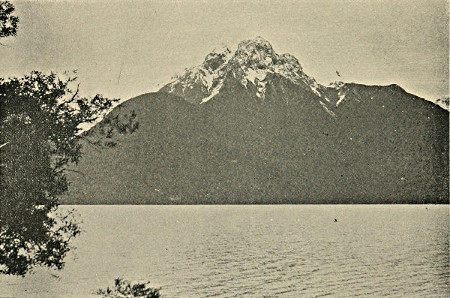
Cathedral Peaks, Lake Manapouri
Once aroused by the exhilarating thrill of progress, they as readily adjusted themselves to the peculiar conditions of their natural environments as children to a new playground. The mountains suggest liberty, the seas adventure, and to the fearless adventurers of those inhabiting the indented shores of the water-front, are the Outeroos indebted for all the blessings of modern progress—for civilisation is the ripened fruit of ocean commerce.
“But,” said the sage Oseba, “the present 42,000,000 Japs have but 147,000 square miles of dirt, half of which is waste. Under the delirium of modern conditions the population is rapidly increasing, and thus are the inhabitants already beginning to crowd each other. The nation is becoming wealthy, while the people are becoming poor. The real estate on little Oliffa is already staked out, and conspicuously adorned with that strange device—‘keep off the grass.’ There is no vacant corner for the surplus population, my children, and the Japs are land animals.”
The sage Oseba told his audience that “Many nations among the Outeroos regarded the ‘Japs’ as an ‘inferior race,’ but if the achievements of man is the measure of the soul and the intellect, the Japs have no superiors on little Oliffa, for her recent progress pales the lustre of the world’s authentic history; but,
‘If the zenith of strife, sheds a mystical lore, And coming events cast their shadows before,’”
said the sage, as he tortured the immortal Thomas, the brilliancy of Japanese story may soon wane, and as, owing to lack of room, her only path to glory is through unfashionable war, the prospects are not rosy. Though that nation may, for a long time, remain flamboyant, the people may soon writhe in a lower misery than ‘pagan Japan’ ever knew.
However, should the little brown man clip the claws from the Russian bear, and send him back, lame and growling, to his northern lair, and then arouse China, and, by the skill of his wonderful capacity, organize it, Eastern Asia may remember a few thousands of the “insults” heaped upon her people during the last half-century, and conclude to test the question of “superiority” by other than industrial methods.
Of the known Monarchies of Asia, he said, the people were ignorant and impoverished, the officials were insolent and corrupt, the rulers were vicious and despotic, and the governments rotten beyond cure.
As to India, the sage Oseba spoke with sympathy. “Britain,” he said, “is the only country capable of governing an ‘inferior’ race. She has done much to rescue the country from periodic, if not from almost constant war, and famine, and despair; but the ‘people,’ the offspring of thousands of years of misrule and oppression, have reached a condition of crystallized non-progressiveness, and they must finally die out, as they cannot adjust themselves to modern conditions. Its past is sad, its future is hopeless. It will long be a country in which a few cunning bees may load themselves with golden honey, that their far away hives may be filled; but slowly and sadly that strange brown people must pass away. They have reached their ultimate. In them the oak and the steel, necessary for the contests of the future, are wanting.”
EUROPE, SOMEWHAT “DISCOVERED.”
The globe was so adjusted as to give a perfect view of the Continent of Europe, and, in interesting speech, were the countries and their peoples described.
Referring to the influence of environment, the orator explained how the comparative smallness of this continent, the fertility of the soil, the variety of plant and animal life, the mountains, and plains, and indented shore lines, with enormous stretch of water-front, together with its extensive river systems and healthful, but erratic climatic conditions, marked this as the garden and nursery for the most active, sturdy, intelligent, and emotional of all peoples on the globe.
Continental Europe covers an area of 3,500,000 square miles, and supports, in various degrees of opulence and wretchedness, some 380,000,000 people—chiefly men, women, and clergymen—with 20,000,000 men in “uniform,” who seem well seized with their own importance. These latter are very influential personages, as they are equipped with very persuasive arguments.
The orator explained that the many-hued and irregular patches on the map represented the possessions and the rule, of as many nations, all of whom had good opinions of themselves, and stood ready to back their pretensions.
These countries were ruled by persons who were fortunate in the selection of parents, or who, at least, were furnished with proper birth certificates.
But with her many governments and nationalities, he said, there was constant confusion. There were fear and oppression, for all these imaginary lines had to be guarded. The armies had to be kept up; the 5,000,000 soldiers must be in constant readiness for slaughter, for only by this means could the people be sufficiently impressed with the validity of the birth certificate.
Asked by the poetess Vauline, what these so-called soldiers did for a living, Mr. Oseba answered:—
“They kill folks, for, short as are the lives of the Outeroos among the superior nations, wholesale murder is the most honored of all pursuits.”
Oseba said: “All the civilised nations keep these armed men, whose duty it is to kill somebody—to whom they may never have been introduced—when their ruler has a grievance, and has no time to attend to the matter himself.
“These armies, too, are potent in diplomatic controversies. When a monarch has a little misunderstanding with one of his class from a neighboring paddock, he says in deep tones:—
“‘Sire, these are the facts, and if you don’t believe it, Sire, look!’—and he points to his ready battalions.
“To a people who never knew of war or poverty—among whom probably not one man would care to be killed, or could find a person to accommodate him if he should, these statements seemed most amazing.”
Mr. Oseba concluded, from the conspicuousness of military show, that every toiler in Europe carried a soldier on his back. And worse—he had to feed him, to clothe him, to pay him, and then to constantly submit to his insolence. From every home and fireside in Europe the most sturdy supporter, and the best loved one, was taken for target practice; and the burden imposed upon industry for showy barbarism, was crushing the whole of Europe and driving the people into revolution, anarchy and ruin.
“Tell us,” said the poetess Vauline, “are you speaking of the superior, the Christian or civilised peoples?”
“Rather,” said the Sage, “for only the Christian nations could enjoy, and only the superior nations could afford such heroic entertainments. As a fact, the size of the army and range of the gun are the true tests of a country’s civilisation and ‘superiority.’
“Strange, my children, but the ‘superior’ peoples, those worshipping Him who said, ‘Thou shalt not kill,’ have the longest guns, and the strongest battalions, and they are most ready to kill on the least provocation.”
The audience, say the notes, was most impressed when told that these arguments—loaded—were aimed by the most civilised nations at each other. Oseba continues:—“The guns and the military show, help to amuse the people; they regulate home prices, and guard the dignity of the managers. They are practically the ‘keep off the grass’ notice; but, as a fact, my children, they are kept to-day more to overawe the people who pay the bills than to ward off any external danger.
“But there is a marked difference between the Oriental and the Occidental. The Oriental is selfish—he wants peace, and is indifferent to the fate of others. The Oriental don’t care what a man believes, or what god he worships, so long as he pays the liken, and moves on; while the superior races are deeply concerned about the soul, and they want to discover all other people, and get them to join them—afterwhile.
“As social units, the Occidentals are more progressive and free, but less secure; they are more sympathetic, but less just; more interested in others, but less tolerant; and more inclined to action, and less to meditation than the Orientals.
“While there is a vast difference in the degree of oppression in Continental Europe, between class assumption, military despotism, official insolence, and creed interference, save for those for whom custom would render hell salubrious, there is no room for a liberty-loving man—especially is it no place for a people with the lofty aspirations of the Shadowas. But, oh, the poverty, the misery, the humiliating sorrow! Oh, my children! If the faith of those pretentious mortals be not folly, if there be somewhere an all-powerful God of Love and Justice, if kneeling at His throne there be hosts of saints and angels, who behold the bloody conflicts, see the widow’s tears and the agonizing gasp of want; who hear the sighs of the over-worked slave, the groans of poverty and the prayers that go up to heaven from the white lips of innocence, let the Shadowas implore the masters of Europe’s millions to grant mercy, or the beseeching hearts of heaven will break, and the tears of the angels will drown the world.”
But, like Uphus swinging the doors to welcome the dawn of a new day, we turn to more pleasing scenes.