Jockey Hollow: the “Hard” Winter of 1779-80
Reading edition
INTERMISSION: WAR IN DEADLOCK.
Nearly two and a half years passed by before the main body of the Continental Army again returned to Morristown. During that interval the British both captured and abandoned Philadelphia, Burgoyne’s Army surrendered to the Americans at Saratoga, and France and Spain entered the conflict against Great Britain. Washington’s soldiers had stood up under fire on numerous occasions, besides weathering the winter encampment periods at Valley Forge in 1777-78, and at Middlebrook in 1778-79. On the other hand, the financial affairs of the young United States had gone from bad to worse. Hoped-for benefits from the French Alliance had not yet materialized, and the 3-year enlistments in the Continental Army had only 4 or 5 months more to run before their expiration. Moreover, while the military scales somewhat balanced in the North, the enemy held Savannah, and there were rumors that Sir Henry Clinton, Howe’s successor, would 12 soon leave New York by sea to attack Charleston. With the final issue still in doubt, America approached what was destined to be the hardest winter of the Revolutionary War.
MORRISTOWN AGAIN BECOMES THE MILITARY CAPITAL.
Such was the general condition of affairs when, on November 30, Washington informed Nathanael Greene, then Quartermaster General, that he had finally decided “upon the position back of Mr. Kembles,” about 3 miles southwest of Morristown, for the next winter encampment of the Continental forces under his immediate command. As he later wrote to the President of Congress, this was the nearest place available “compatible with our security which could also supply water and wood for covering and fuel.”
The site thus chosen lay in a somewhat mountainous section of Morris County known as Jockey Hollow, and included portions of the “plantation” owned by Peter Kemble, Esq., and the farms of Henry Wick and Joshua Guerin. Some of the American brigades being already collected at nearby posts, Greene at once sent word to their commanders of Washington’s decision: “The ground I think will be pretty dry; I shall have the whole of it laid off this day; you will therefore order the troops to march immediately; or if you think it more convenient tomorrow morning. It will be well to send a small detachment from each Regiment to take possession of their ground. You will also order on your brigade quarter master to draw the tools for each brigade and to get a plan for hutting which they will find made out at my quarters.”
Simultaneously with this instruction, which was dated December 1, Washington himself arrived in Morristown, during a “very severe storm of hail & snow all day.” He promptly established his headquarters at the Ford Mansion, presumably at the invitation of Mrs. Theodosia Ford, widow of Col. Jacob Ford, Jr., who was then living in the house with her four children. Morristown had again become the American military capital.
BUILDING THE “LOG-HOUSE CITY.”
Events now moved swiftly. Many of the American troops reached Morristown during the first week of December, and the rest arrived before the end of that month. Estimates vary as to their total effective strength, but it was probably not under 10,000 men, nor over 12,000, at that particular time. Eight infantry brigades—Hand’s, New York, 1st and 2d Maryland, 1st and 2d Connecticut, and 1st and 2d Pennsylvania—took up compactly arranged positions in Jockey Hollow proper. Two additional brigades, also of infantry, were assigned to campgrounds nearby: Stark’s Brigade on the east slope of Mount Kemble, and the New Jersey Brigade at “Eyre’s Forge,” on the Passaic River, somewhat less than a mile further southwest. Knox’s Artillery Brigade took post about a mile west of Morristown, on the main road to Mendham, and there also the Artillery Park of the army was established. The Commander in Chief’s Guard occupied ground directly opposite the Ford Mansion. All the positions noted are shown exactly on excellent maps of the period prepared by Robert Erskine, Washington’s Geographer General, and by Capt. Bichet de Rochefontaine, a French engineer. A brigade of Virginia troops was included in original plans for the encampment, but it was ordered southward soon after arriving at Morristown, and played no major part in the story here related.
13
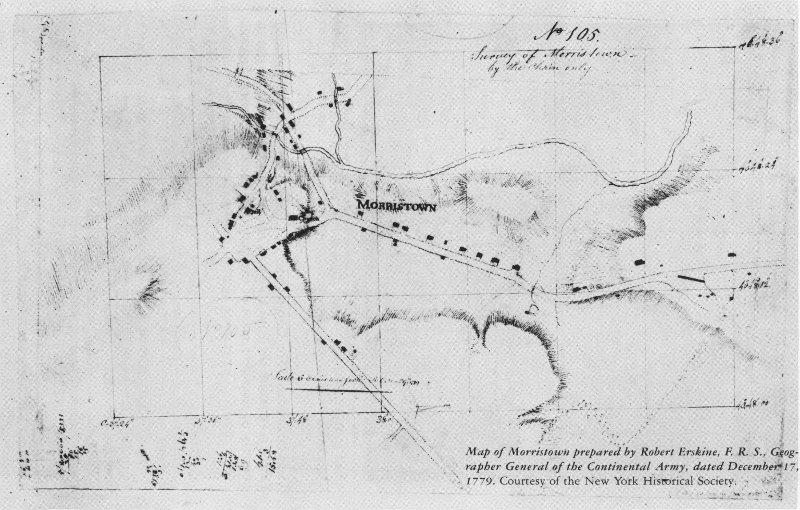
Map of Morristown prepared by Robert Erskine, F. R. S., Geographer General of the Continental Army, dated December 17, 1779. Courtesy of the New York Historical Society.
No 105. Survey of Morristown— by the chain only
14
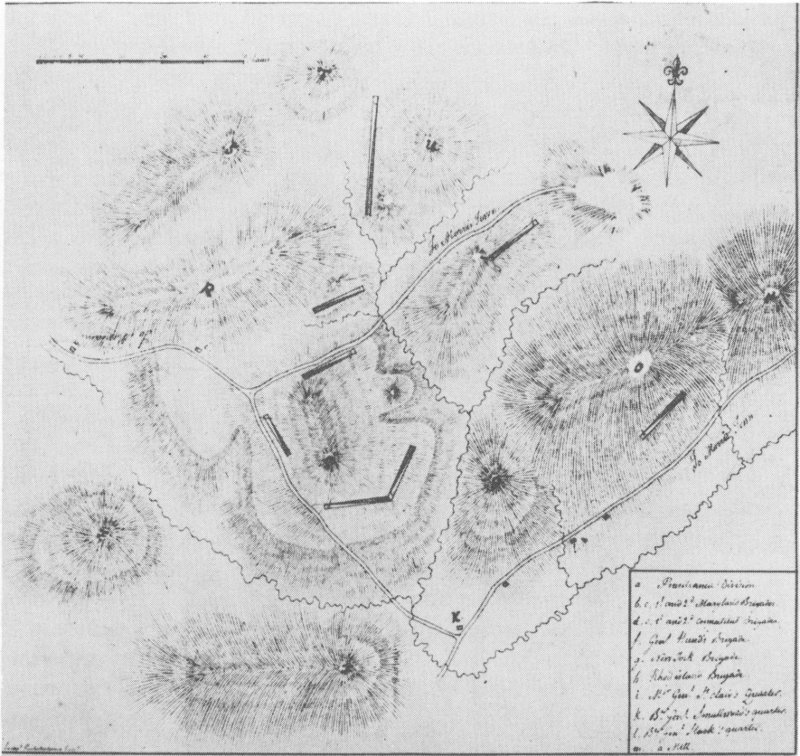
Position of the Continental Army at Jockey Hollow in the winter of 1779-80. Drawn by Capt. Bichet de Rochefontaine, a French engineer.
As they arrived in camp, the soldiers pitched their tents on the frozen ground. Then work was begun at once on building log huts for more secure shelter from the elements. This was a tremendous undertaking. There was oak, walnut, and chestnut timber at hand, but the winter had set in early with severe snowstorms and bitter cold. Dr. James Thacher, a surgeon in Stark’s Brigade, testified that “notwithstanding large fires, we can scarcely keep from freezing.” Maj. Ebenezer Huntington, of Webb’s Regiment, wrote that “the men have suffer’d much without shoes and stockings, and working half leg deep in snow.” In spite of 15 these handicaps, however, nearly all the private soldiers had moved into their huts around Christmastime, though some of the officers’ quarters, which were left till last, remained unfinished until mid-February. A young Connecticut schoolmaster who visited the camp near the end of December described it as a “Log-house city,” where his own troops and those of other States dwelt among the hills “in tabernacles like Israel of old.” About 600 acres of woodland were cut down in connection with the project.
Each brigade camped in the Jockey Hollow neighborhood occupied a sloping, well-drained hillside area about 320 yards long and 100 yards in depth, including a parade ground 40 yards deep in front. Above the parade were the soldiers’ huts, eight in a row and three or four rows deep for each regiment; beyond those the huts occupied by the captains and subalterns; and higher still the field officers’ huts. Camp streets of varying widths separated the hut rows. This arrangement is clearly shown in a contemporary sketch of the Stark’s Brigade Camp.
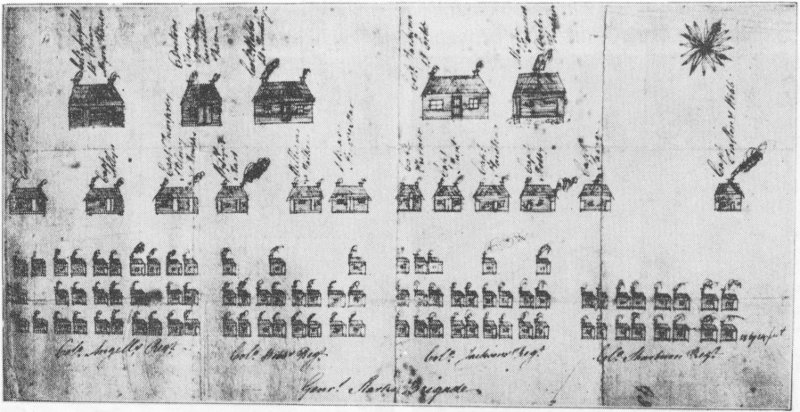
The “hutting” arrangement for General Stark’s Brigade, 1779-80. From an original manuscript once owned by Erskine Hewitt, of Ringwood, N. J.
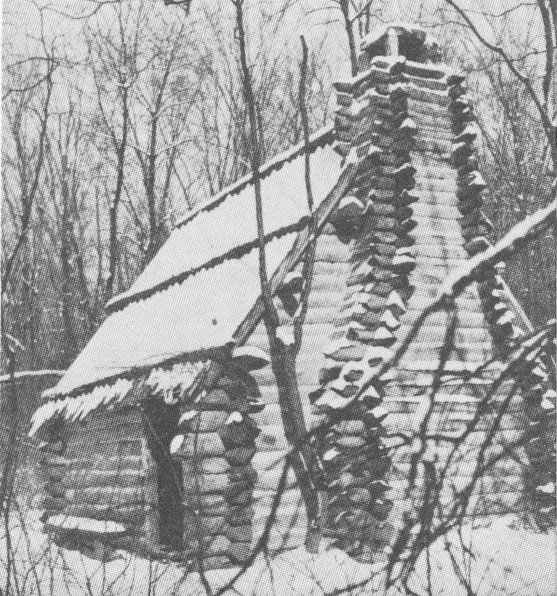
Logs notched together at the corners and chinked with clay formed the sides of the huts. Boards, slabs, or hand-split shingles were used to cover their simple gable roofs, the ridges of which ran parallel to the camp streets. All the soldiers’ huts, designed to accommodate 12 men each, were ordered built strictly according to a uniform plan: about 14 feet wide and 15 or 16 feet long in floor dimensions, and around 6½ feet high at the eaves, with wooden bunks, a fireplace and chimney at one end, and a door in the front side. Apparently, windows were not cut in these huts until spring. The officers’ cabins were generally larger in size, and individual variation was permitted in their design and construction. Usually accommodating only two to four officers, they had two fireplaces and chimneys each, and frequently two or more doors and 16 windows. Besides these two main types of huts, there were some others built for hospital, orderly room, and guardhouse purposes. The completed camp seems to have contained between 1,000 and 1,200 log buildings of all types combined.
TERRIBLE SEVERITY OF THE WINTER.
Weather conditions when the army arrived at Morristown were but a foretaste of what was yet to come, and long before all the huts were up, the elements attacked Washington’s camp with terrible severity. As things turned out, 1779-80 proved to be the most bitter and prolonged winter, not only of the Revolutionary War, but of the whole eighteenth century.
One observer recorded 4 snows in November, 7 in December, 6 in January, 4 in February, 6 in March, and 1 in April—28 falls altogether, some of which lasted nearly all day and night. The great storm of January 2-4 was among the most memorable on record, with high winds which no man could endure many minutes without danger to his life. “Several marquees were torn asunder and blown down over the officers’ heads in the night,” wrote Dr. Thacher, “and some of the soldiers were actually covered while in their tents, and buried like sheep under the snow.” When this blizzard finally subsided, the snow lay full 4 feet deep on a level, drifted in places to 6 feet, filling up the roads, covering the tops of fences, and making it practically impossible to travel anywhere with heavy loads.
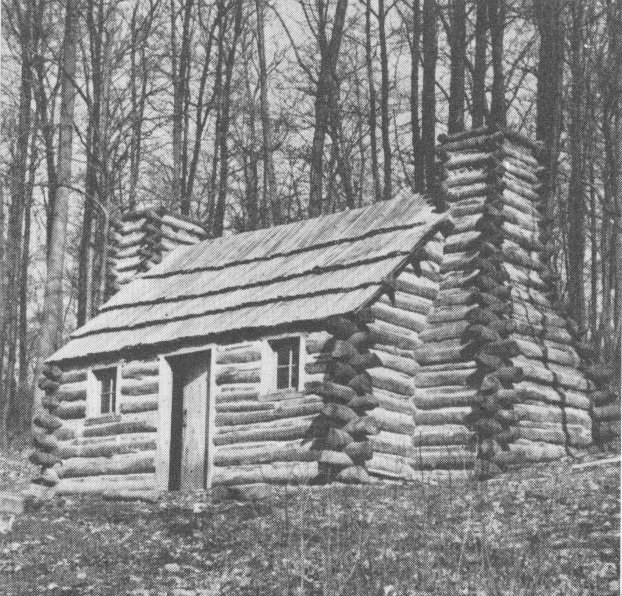
Reconstructions of typical log huts used by the officers (above) and by soldiers of the line (below) in the winter encampment of 1779-80.
What made things still worse was the intense, penetrating cold. General Greene noted that for 6 or 8 days early in January “there has been no living abroad.” Only on 1 day of that month, as far south as Philadelphia, did the mercury go above the freezing point. All the rivers froze solid, including both the Hudson and the Delaware, so that troops and even large cannon could pass over them. Ice in the Passaic River formed 3 feet thick, and, as late as February 26, the Hudson above New 17 York was “full of fixed ice on the banks, and floating ice in the channel.” The Delaware remained wholly impassable to navigation for 3 months. “The oldest people now living in this country,” wrote Washington on March 18, “do not remember so hard a Winter as the one we are now emerging from.”
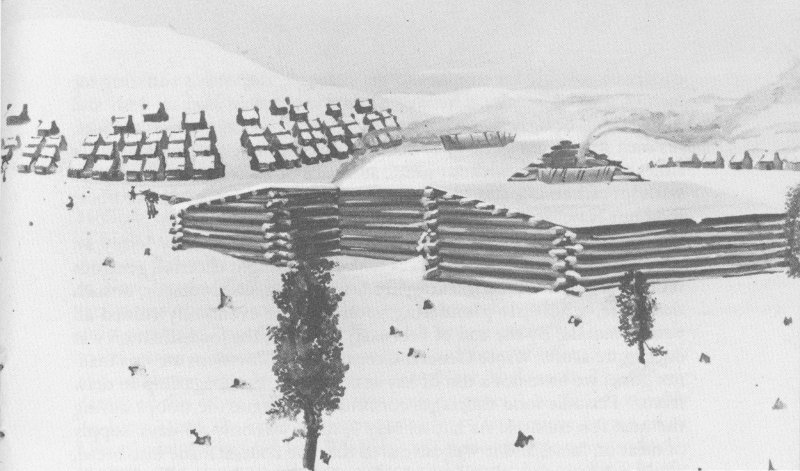
The Pennsylvania Line campground in 1779-80, with a hospital hut in the foreground. From a recent painting in the park collection.
LACK OF ADEQUATE CLOTHING.
Not even good soldiers warmly clothed could be expected to endure this ordeal by weather without some complaint. How much more agonizing, then, was such a winter for Washington’s men in Jockey Hollow, who were again poorly clad! A regimental clothier in the Pennsylvania Line referred to some of the troops being “naked as Lazarus.” By the time their huts were completed, said an officer in Stark’s Brigade, not more than 50 men of his regiment could be returned fit for duty, and there was “many a good Lad with nothing to cover him from his hips to his toes save his Blanket.” As late as March, when “an immense body of snow” still remained on the ground, Dr. Thacher wrote that the soldiers were “in a wretched condition for the want of clothes, blankets and shoes.”
SHORTAGE OF PROVISIONS AND FORAGE.
Still more critical was the lack of food for the men, and forage for the horses and oxen on which every kind of winter transportation depended. December 1779 found the troops subsisting on “miserable fresh beef, without bread, salt, or vegetables.” When the big snows of midwinter blocked the roads, making it 18 totally impossible for supplies to get through, the army’s suffering for lack of provisions alone became almost more than human flesh and blood could bear. Early in January 1780, said the Commander in Chief, his men sometimes went “5 or Six days together without bread, at other times as many days without meat, and once or twice two or three days without either ... at one time the Soldiers eat every kind of horse food but Hay.”
Thanks to the magistrates and civilian population of New Jersey, an appeal from Washington in this urgent crisis brought cheerful, generous relief. This alone saved the army from starvation, disbandment, or such desperate, wholesale plundering as must have eventually ruined all patriot morale. By the end of February, however, the food situation was once more acute. Wrote General Greene: “Our provisions are in a manner gone; we have not a ton of hay at command, nor magazines to draw from.” Periodic food shortages continued to plague the troops during the next few months. As late as May 9, there was only a 3-days’ supply of meat on hand, and it was estimated that the flour, if made into bread, could not last more than 15 or 16 days. Officers and men alike literally lived from hand to mouth all through the 1779-80 encampment period.
MONEY TROUBLES AND THEIR CONSEQUENCES.
The cause of many difficulties faced by Washington that winter appears to have been the near chaotic state of American finances. Currency issued by Congress tumbled headlong in value, until in April-June 1780 it took $60 worth of “Continental” paper to equal $1 in coin. “Money is extreme scarce,” wrote General Greene on February 29, “and worth little when we get it. We have been so poor in camp for a fortnight that we could not forward the public dispatches for want of cash to support the expresses.” Civilians who had provisions and other necessaries to sell would no longer “trust” as they had done before; and without funds, teams could not be found to bring in supplies from distant magazines. Reenlistment of veteran troops and recruitment of new levies became doubly difficult. Even the depreciated money wages of the army were not punctually paid, being frequently 5 or 6 months in arrears. Dr. Thacher wailed at length about “the trash which is tendered to requite us for our sacrifices, for our sufferings and privations, while in the service of our country.” No wonder that desertions soon increased alarmingly, and that many officers, no longer able to support families at home, resigned their commissions in disgust! At the end of May an abortive mutiny of two Connecticut regiments in Jockey Hollow, though quickly suppressed, foreshadowed the far more serious outbursts fated to occur within a year.
GUARDING THE LINES.
Keeping the Continental Army intact under all these conditions was but part of Washington’s herculean task in 1779-80. Again, as at Morristown in the winter of 1777, and at Middlebrook in the winter of 1778-79, the threat of attack by an enemy superior in manpower 19 and equipment hung constantly over his head. Communications between Philadelphia and the Hudson Highlands had to be protected, and the northern British Army had to be prevented from extending its lines, now confined chiefly to New York and Staten Island, or from obtaining forage and provisions in the countryside beyond.
While the main body of American troops was quartered in Jockey Hollow, certain parts of it, varying in strength from about 200 men to as high as 2,000, were stationed at Princeton, New Brunswick, Perth Amboy, Rahway, Westfield, Springfield, Paramus, and similar outposts in New Jersey. Washington changed the most important of these detachments once a fortnight at first, but toward the spring of 1780 some units remained “on the Lines” for much longer periods. Thus Morristown served again as the vital center of a defensive-offensive web for the northern New Jersey and southern New York areas. The enemy damaged the outer margins of that web on several occasions, notably on June 7 and 23, when they penetrated to Connecticut Farms (now Union) and Springfield, but Washington’s defenses were never seriously broken, and through all that winter and spring his position in the Morris County hills remained relatively undisturbed.
THE STATEN ISLAND EXPEDITION.
Routine duty on the lines was interrupted on January 14-15 by what might be termed a “commando” raid on Staten Island. This daring expedition, planned by Washington and undertaken by Maj. Gen. William Alexander, Lord Stirling, was prepared with the utmost secrecy. Five hundred sleighs were obtained on pretence of going to the westward for provisions. On the night of the 14th, loaded with cannon and about 3,000 troops, these crossed over on the ice from Elizabethtown Point “with a determination,” to quote Q. M. Joseph Lewis, “to remove all Staten Island bagg and Baggage to Morris Town.”
Unfortunately for American hopes, the British learned about the scheme in time to retire into their posts, where they could defy attack. After lingering on the island for 24 hours without covering, with the snow 4 feet deep and the weather extremely cold, Stirling’s force could bring off only a handful of prisoners and some blankets and stores. What disturbed Washington most, however, was the disgraceful conduct displayed by large numbers of New Jersey civilians who joined the expedition in the guise of militiamen, and who, in spite of Stirling’s earnest efforts, looted and plundered the Staten Island farmers indiscriminately. All the stolen property that could be recovered was returned to the British authorities a few days later, but the harm had been done. On the night of January 25, the enemy retaliated by burning the academy at Newark and the courthouse and the meeting house at Elizabethtown. That exploit also marked the beginning of a new series of British raids in Essex and Bergen Counties which kept those districts in considerable uneasiness for several months to come.
20
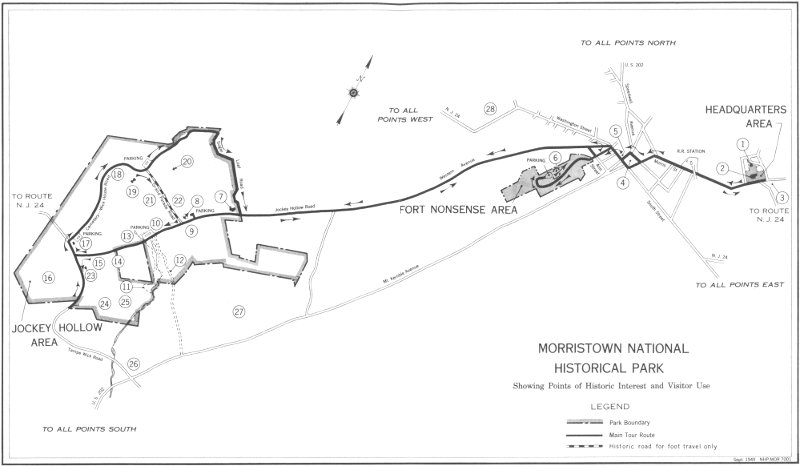
MORRISTOWN NATIONAL HISTORICAL PARK Showing Points of Historic Interest and Visitor Use
High-resolution Version
LEGEND
Park Boundary
Main Tour Route
Historic road for foot travel only
TABLE OF DISTANCES
Total Mileage, Main Tour Route—9 Miles
Headquarters Area to Fort Nonsense Area—1.5 Miles
Fort Nonsense Area to Jockey Hollow Area—3.3 Miles
1. HISTORICAL MUSEUM.
2. FORD MANSION, WASHINGTON’S HEADQUARTERS, 1779-80.
3. SITE OF WASHINGTON’S LIFE GUARD CAMP, 1779-80.
4. PARK SQUARE (MORRISTOWN GREEN, 1779-80).
5. SITE OF ARNOLD TAVERN, WASHINGTON’S HEADQUARTERS, 1777.
6. FORT NONSENSE, 1777 (NOW RECONSTRUCTED).
7. GUERIN HOUSE (PARK SUPERINTENDENT’S RESIDENCE).
8. RANGER STATION (INFORMATION POINT).
9. NEW YORK BRIGADE CAMP, 1779-80.
10. PICNIC AREA AND REST ROOMS.
11. NATURE TRAIL.
12. OLD CAMP ROAD, 1779-80.
13. FIRST MARYLAND BRIGADE CAMP, 1779-80.
14. SECOND MARYLAND BRIGADE CAMP, 1779-80.
15. BETTIN OAK AND FORT HILL.
16. NEW JERSEY BRIGADE CAMP, 1781-82.
17. WICK HOUSE, ST. CLAIR’S QUARTERS, 1779-80.
18. ARMY BURYING GROUND, 1779-80.
19. RECONSTRUCTED ARMY HOSPITAL HUT, 1779-80.
20. FIRST PENNSYLVANIA BRIGADE CAMP AND RECONSTRUCTED OFFICERS’ HUT, 1779-80.
21. SECOND PENNSYLVANIA BRIGADE CAMP, 1779-80.
22. GRAND PARADE, 1779-80.
23. HAND’S BRIGADE CAMP, 1779-80, AND RECONSTRUCTED SOLDIERS’ HUT.
24. FIRST CONNECTICUT BRIGADE CAMP, 1779-80.
25. SECOND CONNECTICUT BRIGADE CAMP, 1779-80.
26. SITE OF KEMBLE HOUSE, WAYNE’S QUARTERS, 1780-81.
27. STARK’S BRIGADE CAMP, 1779-80.
28. KNOX ARTILLERY CAMP, 1779-80.
Sept. 1949 NHP-MOR-7001
22
SIDELIGHTS ON THE PATTERN OF ARMY LIFE.
Except on rare occasions, such as participation in an occasional public celebration might afford, the average soldier found camp life at Morristown hard, unexciting, and often monotonous. Sometimes his whole existence seemed like an endless round of drill, guard duty, and “fatigue” assignments, the latter including such unpleasant chores as burying the “Dead carcases in and about camp.” What little recreation the line troops could find was largely unorganized and incidental. Washington proclaimed a holiday from work on St. Patrick’s Day 1780, which the Pennsylvania Division observed by sharing a hogshead of rum purchased for that purpose by Col. Francis Johnston, its then commander. Regulations prohibited gambling and drunkenness, however, and the prankster who strayed too far from military discipline “paid the piper” if caught. One soldier, convicted by court martial of “Quitting his Post, and riding Gen. Maxwell’s Horse,” received 150 lashes on his bare back. This war was a stern business; men who enlisted as privates in the Continental Army were not supposed to be looking for amusement.
The officers were somewhat more fortunate. Most of the generals obtained furloughs and went home to their families for part of the winter. Others could escape the tedium of camp life occasionally at least. Writes Lt. Erkuries Beatty, in a letter dated March 13, 1780: “I got leave of absence for three Days to go see Aunt Mills and Uncle Read who lives about 12 Miles from here ... that night Cousin Polly and me set off a Slaying with a number more young People and had a pretty Clever Kick-up, the next Day Polly and I went to Uncle Reads who lives about 4 Miles from Aunts, here I found Aunt Read and two great Bouncing female cousins and a house full of smaller ones, here we spent the Day very agreeably Romping with the girls who was exceeding Clever & Sociable.” Almost at the same time, “the lovely Maria and her amiable sister” were entertaining Capt. Samuel Shaw, of the 3d Artillery Regiment, at Mount Hope. “By heavens,” Shaw confidentially informed a fellow officer on February 29, “the more I know of that charming girl, the better I like her; every visit serves to confirm my attachment, and I feel myself gone past recovery.”
Dancing was another popular diversion among the officers that winter. At least two balls were held in Morristown by subscription, one on February 23 and the other on March 3. Lieutenant Beatty mentioned attending “two or three Dances in Morristown,” and also “a Couple of Dances at my Brother John’s Quarters at Battle [Bottle] Hill.” Many of these events were lively affairs patronized by a goodly proportion of the fair sex. Indeed, the energy displayed by “some of the dear creatures in this quarter” nearly exhausted Captain Shaw, who complained that “three nights going till after two o’clock have they made us keep it up.”
But for all such pleasurable excursions, the average Continental officer had adversities with which to deal. Frequently, he shared the greatest hardships of his men, and from day to day worked unremittingly to improve 23 their lot along with his own. Nor must it be forgotten that, unlike a private, an officer was expected to support and clothe himself largely from his pay or private means, and that he paid for recreation out of his own pocket. Sometimes officers were so deficient in clothing that they could not appear upon parade, much less enjoy visits with the ladies. Even Washington, at his headquarters in the Ford Mansion, often lacked necessities for his table, or experienced some other inconvenience. “I have been at my prest. quarters since the 1st day of Decr.,” he observed to General Greene on January 22, 1780, “and have not a Kitchen to Cook a Dinner in, altho’ the Logs have been put together some considerable time by my own Guard; nor is there a place at this moment in which a servant can lodge with the smallest degree of comfort. Eighteen belonging to my family and all Mrs. Fords are crouded together in her Kitchen and scarce one of them able to speak for the colds they have caught.”
LUZERNE AND MIRALLES.
Among the most interesting events which took place at Morristown in the spring of 1780 were those connected with the Chevalier de la Luzerne, Minister of France, and Don Juan de Miralles, a Spanish grandee who accompanied him, unofficially, on a visit to the American camp. These gentlemen arrived at headquarters on April 19, but Miralles became violently ill immediately afterwards, and it was only Washington’s distinguished French guest who could participate in the celebrations that followed during the next few days.
The highlight of Luzerne’s visit, which occurred on April 24, was eloquently described by Dr. Thacher: “A field of parade being prepared under the direction of the Baron Steuben, four battalions of our army were presented for review, by the French minister, attended by his Excellency and our general officers. Thirteen cannon, as usual, announced their arrival in the field.... A large stage was erected in the field, which was crowded by officers, ladies, and gentlemen of distinction from the country, among whom were Governor Livingston, of New Jersey, and his lady. Our troops exhibited a truly military appearance, and performed the manoeuvres and evolutions in a manner, which afforded much satisfaction to our Commander in Chief, and they were honored with the approbation of the French minister, and by all present.... In the evening, General Washington and the French minister, attended a ball, provided by our principal officers, at which were present a numerous collection of ladies and gentlemen, of distinguished character. Fireworks were also exhibited by the officers of the artillery.” Next day, amid the music of fifes and drums, and with another 13-cannon salute, Luzerne inspected the whole Continental Army encampment. Then he left for Philadelphia, escorted part-way on his journey by an honor guard which Washington provided.
Don Juan de Miralles saw nothing of these parades, entertainments, and reviews. The sickness which had seized him on his arrival at Morristown 24 was to prove fatal. His condition grew steadily worse as the days passed, and on April 28 he died. Final obsequies were held late the following afternoon, and again Dr. Thacher was on hand to describe events: “I accompanied Dr. Schuyler to head quarters, to attend the funeral of M. de Miralles.... The top of the coffin was removed, to display the pomp and grandeur with which the body was decorated. It was in a splendid full dress, consisting of a scarlet suit, embroidered with rich gold lace, a three cornered gold laced hat, and a genteel cued wig, white silk stockings, large diamond shoe and knee buckles, a profusion of diamond rings decorated the fingers, and from a superb gold watch set with diamonds, several rich seals were suspended. His Excellency General Washington, with several other general officers, and members of Congress, attended the funeral solemnities, and walked as chief mourners. The other officers of the army, and numerous respectable citizens, formed a splendid procession, extending about one mile ... the coffin was borne on the shoulders of four officers of the artillery in full uniform. Minute guns were fired during the procession, which greatly increased the solemnity of the occasion. A Spanish priest performed service at the grave, in the Roman Catholic form. The coffin was enclosed in a box of plank, and all the profusion of pomp and grandeur was deposited in the silent grave, in the common burying ground, near the church at Morristown. A guard is placed at the grave, lest our soldiers should be tempted to dig for hidden treasure. It is understood that the corpse is to be removed to Philadelphia.”
THE COMMITTEE AT HEADQUARTERS.
The “members of Congress” mentioned by Dr. Thacher as having attended Miralles’ funeral were undoubtedly Philip Schuyler, John Mathews, and Nathaniel Peabody, who had arrived in Morristown only the day before. These men had been appointed by their colleagues as a “committee at head-quarters” to examine into the state of the Continental Army, and to take such steps, in consultation with the Commander in Chief, as might improve its prospects of winning the war. The committee remained active until November 1, 1780, and during its life rendered valuable service as a liaison body between Congress, on the one hand, and headquarters on the other. Its very first report detailed at length “the almost inextricable difficulties” in which the committee found American military affairs involved. The report also stated, in unmistakeably plain words, what Washington had been saying all along, namely, that Congress itself would have to act quickly if the situation were to be saved.
LAFAYETTE BRINGS GOOD NEWS.
Even as Schuyler and his co-workers penned their report, however, good news was arriving at headquarters. On May 10, 1780, following more than a year’s absence in his native France, the Marquis de Lafayette came to Morristown, fortified with word that King Louis XVI had determined to send a second major 25 armament of ships and men to aid the Americans. This assistance would prove more beneficial, it was hoped, than the first French expedition under the Count d’Estaing, which, after failing to take Newport in the late summer of 1778, had finally sailed away to the West Indies. Washington’s joy at seeing Lafayette again was doubled by this welcome information, and the army as a whole shared his feelings.
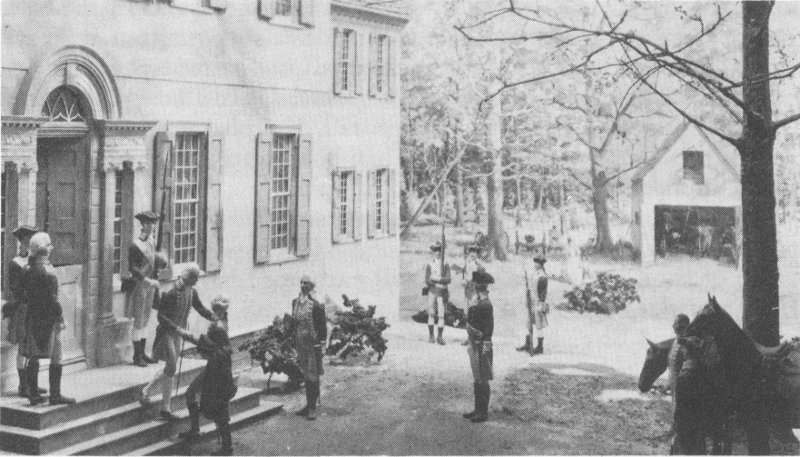
Washington greeting Lafayette on his arrival at headquarters, May 10, 1780. From a diorama in the historical museum.
The gallant young Frenchman remained a guest of his “beloved and respected friend and general” until May 14, when he left for Philadelphia, carrying with him letters from Washington and Hamilton informing members of Congress about his work in France. Approximately 6 days later he returned to Morristown, and from that time forth until the end of 1780 he continued with the Continental Army in New Jersey and New York State.
TWO BATTLES END THE 1779-80 ENCAMPMENT.
Early in June there was far less cheerful news. Reports reached camp that the enemy had taken Charleston, capturing General Lincoln with his entire army of 5,000 men. Worse still, the British forces under Sir Henry Clinton’s immediate command would now be released, in all probability, for military operations in the North.
This was the dark moment chosen by Lt. Gen. Wilhelm von Knyphausen, then commanding the enemy forces at New York, for an invasion of New Jersey, ostensibly to test persistent rumors that war-weariness among the Americans had reached a point where, suitably encouraged, they might abandon the struggle for independence. Five thousand British and German troops accordingly crossed over from Staten Island to Elizabethtown Point on June 6, and the next morning began advancing 26 toward Morristown. The first shock of their attack was met by the New Jersey Brigade, then guarding the American outposts; but as heavy fighting progressed, local militia came out in swarms to assist in opposing the invader. During the action, which lasted all day, the enemy burned Connecticut Farms. By nightfall, Knyphausen had come to within a half mile of Springfield. Then he retreated, in the midst of a terrific thunderstorm, to Elizabethtown Point.
Word of Knyphausen’s crossing from Staten Island reached Washington in the early morning hours of June 7. There were then but six brigades of the Continental Army still encamped in Jockey Hollow—Hand’s, Stark’s, 1st and 2d Connecticut, and 1st and 2d Pennsylvania—the two Maryland Brigades having left for the South on April 17, and the New York Brigade having marched for the Hudson Highlands between May 29 and 31. The troops at Morristown, ordered to “march immediately” at 7 a. m., reached the Short Hills above Springfield that same afternoon. There the Commander in Chief held them in reserve against any British attempt to advance further toward Morristown.
Except for occasional shifts in advanced outposts on both sides, there was no significant change in this situation for 2 weeks. Knyphausen’s troops continued at Elizabethtown Point, and the Americans remained at Springfield. On June 21, however, having learned positively that Sir Henry Clinton’s forces had reached New York 4 days earlier, Washington decided that the time had come to leave Morristown as his main base of operations. Steps were accordingly taken to remove military stores concentrated in the village to interior points less vulnerable to immediate attack. Stark’s and the New Jersey Brigades, Maj. Henry Lee’s Light Horse Troop, and the militia were left at Springfield, under command of General Greene. The balance of the Continental Army began moving slowly toward Pompton, but was encamped at Rockaway Bridge when Washington, having left his headquarters in the Ford Mansion, joined it on June 23. This dual disposition of the American forces was taken with a view to protecting the environs of both Morristown and West Point, either of which might be the next major British objective.
On June 23, the very day of Washington’s departure from Morristown, the enemy struck once more. This time, with one column headed by General Mathew and the other by Knyphausen, they succeeded in getting through Springfield, where the British burned every building but two. Greene’s command met the assault with such determination, however, that the attackers again retreated to their former position. That night they abandoned Elizabethtown Point and crossed over to Staten Island. Never again during the Revolutionary War was there to be another major invasion of New Jersey.
While this second Battle of Springfield was in progress, Washington moved the main body of the Continental Army “back towards Morris Town five or six miles,” where he would be in a better position to defend 27 the stores remaining there in case the British attack should carry that far. Then, on June 25, with definite assurance that the enemy had retired to Staten Island, he put all the troops under marching orders for the Hudson Highlands. The second encampment at Morristown was ended.