THE CHILD HEROINE.
Reading edition
On a clear balmy morning in July, six years ago, two magnificent steamboats, the Henry Clay and the America, left Albany at the same time, for New York. A gentle breeze just curled the waters of the noble and beautiful Hudson River. Both boats were filled with happy-looking people, and the bustle of departure, the laughing voices, and general hilarity, combined with the bright, blue sky above, contributed to raise the spirits, and fill every one with that exhilarating gladness, which makes the mere physical sense of living and breathing a happiness.
And now the rush and roar of steam arose; the ponderous wheels make great waves in the hitherto tranquil tide, and, with the cry of "All aboard," the stately boats cleave their paths through the waters, and move swiftly down the river.
Too swiftly, for they were racing, and on the Henry Clay, especially, the captain and officers, excited and reckless, were crowding on steam, and forcing the boat to her utmost speed. For a while some of the passengers enjoyed the race, and urged and encouraged the officers to "go ahead," and one comfortable, fat old lady, who was going down to "York market, with farm produce, consisting of fat pork, butter, and various kinds of sass," and who was certainly old enough and ugly enough to know better, was in such a high state of exhilaration at the bustle and fun of the race, that she could not keep still an instant. She answered every body's questions she chanced to hear, whether addressed to her or not, and when the Henry Clay fell back a very little the foolish old soul twitched off her spectacles, set her arms a-kimbo, and declared "she never seed sich a goosey gander of a capting," and straightway fell into such a state of worry and excitement, that a waggish young gentleman, standing near, solemnly advised her to do like another silly old lady, under similar circumstances, who hobbled up to the captain and screamed in his ears, "Capting, now don't you give it up now; now, don't now; ef all your wood is out, capting, I've got a bar'l of fat pork aboard—could you put that on the fire to help on the steam?"
Swiftly the boats sped past the smiling, picturesque villages dotting each side, and entered the bolder parts of the majestic river, where the high banks curve sharply round into mimic bays. And now the passengers, seeing the great danger in these sudden turns, vainly entreated the captain of the Henry Clay to give up the race, and have a regard for their lives. But his passions were aroused, and he turned a deaf ear to their remonstrances; he cared nothing for their precious lives in comparison with being beaten by his opponent; and he was only awakened to a sense of his broken trust, by a shriek of horror and a simultaneous crash! as the America came into violent collision with the Henry Clay.
Fortunately the damage done was not great; but the people on the Henry Clay had not recovered from their fright and excitement, as she stopped at Poughkeepsie to receive more passengers.
Waiting at the wharf was a tall, fair and graceful lady. She held by the hand a sweet little girl, about ten years of age, whose large, dark, dreamy eyes, transparent purity of complexion, and great delicacy of form and feature, caused her to seem scarcely an inhabitant of earth, but rather an ærial being, whom a breath of wind might melt away like a summer cloud. Not that the little one was either sad or grave; on the contrary, as she held her mother's hand a continual little dancing motion, and a childish song, that came in broken snatches from her rosy and beautiful mouth, caused many to turn and smile upon her, and rejoice in her innocent gayety.
"Now, dear mother," said Maggie, in a sweet coaxing voice, "let us hurry on board, or the boat will leave us. I want to see my dear father this very night."
But the mother had a vague presentiment that made her reluctant to go. She observed the excitement, and apparent confusion, on the crowded boat, and if she had not thought that yielding to a presentiment was foolish, she would have turned back. As it was, after hesitating until the last moment, she stepped on board, trembling at she knew not what, and her feelings of disquiet were greatly increased, when the ladies in the saloon informed her of the disaster that had already occurred.
But little Maggie, in her childlike and happy ignorance of any thing to fear, was delighted with all she saw. She flitted hither and thither, with her little dancing step, and her bird-like song, now gazing at the diamond sparkles in the river, now peering fearfully down into the raging depths of the great iron monster who, with seething sighs and hoarse groans, was bearing them along.
Many were the smiles and blessings that followed the dainty little lady as she glided about, and if any sought to detain her she answered their questions with a kind of child-like dignity, mingled with bashfulness enchanting to behold, and then darted back to her mother, whose melancholy eyes were always on the watch.
What is that they hear? A cry of "fire! fire! The boat is on fire!"
Maggie on board the Steamer.
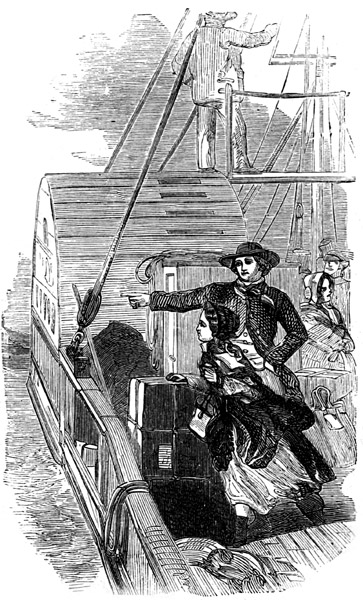
With a thrill of horror every person in the saloon arose and rushed to the doors, and Maggie, with a shrill scream of terror, fell into her mother's arms. The ladies were rudely pushed back by the men in charge of the boat, with an assurance that there was "no danger," and they must "keep quiet," and the doors were shut upon them. They heard the frantic cries outside, and a dense smoke came in upon them. Bewildered, despairing, fainting on every side, a scene of indescribable distress and confusion ensued. The flames were approaching. Already they felt their scorching breath, and the distracted mother, with a burst of passionate tears, folded her child, her sweet Margaret, her "pearl"—so truly named—in her arms, and prepared for death.
Choked with her sobs, but struggling to speak calmly, she said, "My darling child—my own little Maggie,—life is sweet to both of us: but we must die! The awful flames are coming nearer every moment. I cannot bear to think, that my darling should die by the torture of fire. Let us bid each other good-bye, Maggie, and jump into the water. We shall not suffer long; but, oh! how bitter to think I shall never more look upon my husband's face—never embrace my two noble boys!"
With a wild, despairing cry issuing from her white, parted lips, Maggie clung to her mother, and sobbed out, "Oh, mother! I cannot jump—I cannot jump! I am afraid!" and her sweet little face grew more ghastly with terror. "Some one will surely come, dear mother; they will not let us die without trying to save us. Oh! they will try to come! They will not let a poor little girl burn up in these dreadful flames! and if they save me, I will save you, mother! I will never go without you!"
But, alas! all was in the wildest, the most frantic confusion. The panic-stricken passengers, pressing upon each other, were jumping and falling overboard in every direction. The fire separated the two extremes of the boat, and no help or succor was near. And now came the pang of parting. For a brief, agonizing moment, the mother held her child in her arms, then drew her to one of the windows.
All at once, a wonderful change came over the little tender child. For one moment, a radiant flush lighted up the sweet face, and then died away, leaving a deathly paleness as before, but with it a rapt, angelic expression, as if, in that moment, a loving, merciful Father had given the pure spirit a glimpse of heaven.
Drawing her garments closely about her, she said, "Kiss me, dear mother, I am going;" and, climbing through the window, she leapt into the water—in her eyes the same uplifted, celestial expression, as she sank beneath the wave. God, in His mercy, had taken away the sting of death. Little Maggie was going Home.
The poor mother turned away in agony; then, with a prayer that their sufferings might be short, she followed her child, and the waves closed over her.
But now the ways of God, which are not our ways, became manifest. Maggie's buoyant form rose out of the water directly under one of the stanchions, which supported that part of the deck projecting beyond the hull. Gasping, panting, and almost senseless, she instinctively clutched at this, and passing her arm around it, hung there, half in, half out of the water. As she regained her consciousness, she looked vainly around for her mother, and the poor little child became convulsed with terror, at finding herself alone in this painful and fearful position.
At this moment, Maggie felt something coming to the surface directly beneath her, and to her joy, recognized her mother's bonnet. Grasping it with all her little strength, what was her horror to feel it give way, and remain in her hand, while her mother sank slowly down again out of sight! Coming up the second time, the child, with desperate energy, clutched at her hair, and this time raised her mother's head above the water.
"Mother, mother!" she cried, "here I am—your own little Maggie. Speak to me, oh! speak to me, mother, or I shall die!"
The large hazel eyes of the mother unclosed, and, struggling with the water that was choking her, she murmured,—"Thank God! thank God! we may yet be saved."
"Oh, yes, mother," answered the little one, "God did not mean that we should die. I will hold you up, until my arm burns off. Don't be afraid—I will never let you go. Only see, dear mother, how strong I am. I have wound your long hair all round my hand. Do not shut your eyes, dear mother—look at me. While you look at me, I can bear any thing."
And now, the cruel, hungry flames were bursting through the hull, and the poor, little strained arm that supported them both, was scorching, and the hand was burning! but the brave heart of the child flinched not; earthly pain had no power over her; an overshadowing presence sustained the little spirit. She even smiled—that brave child!—that her mother should not know the fierce pain she was enduring. But at last, her strength began to fail; an intense ashen paleness overspread her lovely face, and the large, soul-lit eyes were now bent upon the shore with a look so piteous—so appealing! Oh! how long it seemed! Would help never—never come?
A few moments more, and it would be too late. But now they are seen by a gentleman on shore. He rushes to a boat lying at the dock, and offers the owner a reward if he will row him to the drowning lady and child.
"I can't go," said the man. "It is too dangerous. I am waiting to see the boiler burst. I expect it to burst every moment."
"Will you suffer those poor unfortunates to perish before our eyes, you heartless fellow?" remonstrated the other. "Give me the oars—I will go alone."
"I will not," growled the man. "It is no use. You can't save them, and you will lose your own life. I tell you, the boiler will burst, and you will be killed."
But with one effort of his powerful arm, this good Samaritan hurled the boatman away, and jumping into the boat, and springing to the oars, he soon rowed to where little Maggie hung, her arm, by this time, wrenched, strained, and burned, beyond the endurance of many a strong man.
Supporting the mother with one arm, with the other, he tenderly lifted the poor little sufferer into the boat. Her mother was so much exhausted, that it was with the utmost difficulty he raised her out of the water; and, although he rowed quickly back, she was perfectly senseless when she was laid on the beach.
And now, Maggie watched with alarm and anxiety the means used to bring her mother back to life.
After a while they were successful, and then, with such dry clothes as could be hastily procured, the grateful pair departed, on the Hudson River Railroad for New York, accompanied by the gentleman who had so generously risked his life to save theirs.
In the rail-car, Maggie's mother fainted. Her strength was utterly gone, from long exposure to the water. With earnest sympathy, the kind-hearted gentleman once more came to their relief. He took off his coat and wrapped it around her, and the increased warmth it afforded soon restored her to consciousness. A dim recollection crossed her mind, as she looked up to thank their "friend in need." Another look, and she recognized, to her great surprise and pleasure, one whom she had known well many years ago; and he was doubly thankful that he had been an instrument, in the hands of God, of saving from a violent death a lady for whom, through long years of separation, he had retained the highest esteem and friendship.
And now, dear little reader, I must tell you, the wonderful telegraph had sent the news of the burning of the steamboat to New York, while yet the panic-stricken passengers were making their awful choice of death by fire or water, and little Maggie's father was one of the first at the terrible scene. He knew that his wife and daughter were to return in this boat, and with anguish he searched upon the beach, and looked into the faces of the dead, dreading to find his loved ones among them.
But they were not there. Then he went down to the water side, and, nearly all that dreadful night, he dived to the bottom again and again, bringing up many a poor victim, and every time his cheek grew paler and his heart throbbed more wildly. At last, exhausted and despairing, he gave up the dreadful task. They were gone for ever—he should never again see even the dead faces of his dear wife and his sweet little "pearl of great price."
Suddenly a faint hope, like a far-off star, dawned upon his heart. It was just possible that Maggie and her mother were safe in Poughkeepsie; they might have changed their minds at the last moment. An engine was there ready to start; it was offered to him. He gratefully accepted, and, without a single car, the engineer and himself jumped upon the panting iron monster and almost flew back to Poughkeepsie.
Alas! they had gone. These terrible words blanched his cheek again, and, all hope deserting him—utterly broken down, the strong man covered his face with his hands and burst into a passionate flood of tears. His wife—his dear companion, and his little Margaret—his tender, delicate bud of promise, to be burned—burned, till nothing human was left of them, or else now lying among the rocks beneath the waters. It was too horrible. It must not be. He would go back; he would try once more. Surely, this time, he would recover the drowned bodies of those he loved so well; and then, at least, he would have the melancholy comfort of knowing that they were tenderly and reverently laid in the earth.
In the gray dawn of the morning he came back to Yonkers, where the remains of the still burning steamer lay, and hastened once more to the beach. Preparing once more to dive into the river again, a simple object—a child's bonnet met his eye, floating on the water. It was Maggie's bonnet. His heart stood still; his blood froze in his veins; his eyes strained wildly after the little token of his dreadful loss, as it floated idly by, its wet and stained blue ribbons fluttering in the summer breeze. He neither spoke nor stirred; he seemed turned into stone; his hands clasped tightly together, and his gaze fastened upon that tiny, but terrible sign of the hapless fate of his wife and child. The pitying bystanders tried to arouse and draw him away. They assured him that it was useless to attempt finding any more bodies—every possible effort had been made; and, at length, the heart-broken man went sadly away to return to his desolated home.
When he arrived in the street where he lived, and drew near the familiar house, a shudder came over him. Little Maggie had always watched for him at the door, to spring into his arms and receive "the first kiss." With a keen pang at his heart and a smothered groan, he murmured, "They are gone—they are dead. Oh, I cannot go there! I shall be mad if I do."
But suddenly One stood by his side invisible to mortal eyes, and there came into his heart, like a soft, sweet strain of heavenly music, these words, "Blessed are they that mourn, for they shall be comforted."
Great tears came to his relief, and softened the fierce pain at his heart; and now, with deep-drawn sighs, he entered first a neighbor's house to seek that sympathy which his sorely stricken soul had before refused, and which would give him strength to enter the home where they were not.
His friends met him with extended hands and glad voices, exclaiming, "Oh, how glad we are that you have come! We rejoice with you that your dear ones are safe."
"Safe—SAFE?" he cried, "do you mock me in my misery?"
"Why," they answered, "do you not know that they have returned, and are safe in your house?"
With a cry that rent the air, Maggie's father rushed out of the door and into his own house, and in a moment his wife and his dear little child were clasped tight in his arms—his shrieks of hysterical laughter, mingled with the great sobs that convulsed his frame, showing, too plainly, alas! that joy had finished what grief began; for now he had indeed lost his senses. The sudden revulsion had been too much; but, after a while, the gentle soothings of his wife and the loving caresses of Maggie restored him to himself; and soon he was ready to listen to the wonderful account of their escape—many times interrupting the narrative to fold his little Maggie, with tears, to his breast, and to thank God again and again for the blessing of such a child.
And now, dear little reader, Maggie has grown up to be a young lady. She has the same dark, thoughtful eyes and transparent purity of complexion. She flits about her father's house like a sunbeam, bringing joy and delight into his heart, and her voice issues from her beautiful mouth so sweet and clear that it seems like the singing of a lark. With the thrilling memory of the past ever before him, her father oftentimes gazes into her sweet young face with an earnest tenderness impossible to describe.
I wish every girl and boy that will read this could have known Maggie when she was a child; they would have wondered how such a delicate little creature could have shown so much courage and endurance. It seems incredible, and yet every word I have written is true.
I also wish that I could tell them her whole name; but I promised, when permission was given me to write this account of heroism, I would not tell her name, or even where she lived. But I will tell this much: She lives, at this very moment, on a beautiful island, very near the city of New York; and she is so modest and retiring that her very next-door neighbor does not suspect he is living close to THE CHILD HEROINE!