THE HISTORY OF A LOUIS D'OR. (continued 2)
L. Burke translation
The flames quickly spread to a heap of faggots, thence to a quantity of goods which were near, and before there was time to suppress them, they had injured the building. The landlord entered a process against the shoemaker, in order to make him pay the damages, saying that it was he who had set the place on fire, which, indeed, there was every reason for suspecting. It was known that he was in the habit of searching in the court for rags, and suchlike things, that happened to be thrown from the windows. There had also been found in the ashes underneath the grating and on the spot occupied by the heap of straw, the remains of a pipe which had not been consumed. It was observed that when the shoemaker gave the information, he was without his pipe, a thing quite extraordinary for him. He was also known to have bought a new one on the same day, and every one was aware that he was not a man to buy a new pipe if he had an old one in his possession. It was then more than probable that it was his pipe which had fallen into the cellar, and set it on fire. Besides, two persons believed that they had seen him, from a distance, going out of the court.
The shoemaker had nothing to oppose to these charges, but the assertion that he was not on the spot when the place took fire; but in order to have this assertion received, he must find witnesses who would consent to give a false testimony. He thought Roch might do him this service, and he reminded him of all the indulgence which he had granted to him. Roch made no objections; he was so great a knave, that he seemed to take a pleasure in doing what was wrong. He simply demanded, as the reward of this service, that the shoemaker should introduce and recommend him, as a servant, to M. de la Fère, a gentleman for whom the shoemaker worked, and who at that time was in want of a servant. Roch was very desirous of getting this place, but quite at a loss as to the means of doing so, as he could find no one willing to give him a character. The shoemaker consented; for we can never ask others to do what is wrong for us without being obliged to do at least as much for them in return. But two witnesses were requisite. Roch undertook to procure another, on condition that the shoemaker should give him a louis d'or.
The latter, at first, made many objections; for he valued his money more than his conscience, but there was no alternative in the case. He therefore gave him the very louis d'or that Janette had paid him, and Roch and his comrade both affirmed on oath, that the shoemaker was returning home in their company, at the time that he perceived from the street the smell of the smoke then issuing from the court. They also affirmed, that during their walk, a porter had knocked against him so roughly, that his pipe was thrown out of his mouth, and that in stepping forward to gain his balance, he had trodden upon it, and crushed it. To give their assertions a greater appearance of truth, they repeated the remarks which they pretended to have made upon the occasion. The shoemaker gained his cause. Roch kept the louis, giving only twelve francs to his comrade, and entered the service of M. de la Fère, who was on the point of leaving France, where, like many others, he did not consider himself in safety; for it was the close of the year 1792. Neither his man-servant nor his wife's maid was willing to accompany them; so that being in a great hurry to leave, they were compelled to take Roch without inquiry, and upon the sole recommendation of the shoemaker, whom they believed to be an honest man. They were desirous of obtaining gold for their journey, as being more convenient than silver, and at that time the value of the louis d'or was high, for it was much in request, as many families were leaving France for the same cause as M. de la Fère. Roch therefore sold to his master the louis which he had received from the shoemaker. It thus came into the possession of M. de la Fère, and you shall see presently all that it produced. As for Roch, before his departure with M. de la Fère, he defrauded the shoemaker out of the amount of a rather heavy bill which his master had ordered him to pay. He produced a false receipt, and kept the money. The shoemaker did not become aware of his departure till several days afterwards, and thus found himself punished for recommending a rogue. We must now see what the louis produced in the hands of its new possessor.
THE WEEK.
It was at the commencement of the year 1793, that M. de la Fère, accompanied by his wife, his son Raymond, a lad of fifteen, and his daughter Juliette, who was thirteen, his servant Roch, and his wife's new maid, left France, to establish themselves in a small town in Germany. They had brought with them sufficient money to enable them, if necessary, to remain away for several years, and the more easily, as having chosen a town in which no French had as yet arrived, and where they were not acquainted with any Germans, they hoped to lead the kind of life which suited them, without being obliged to incur greater expenses than they wished. Thus they hoped, by means of a reasonable, but not inconvenient economy, to pass the period of trouble in comfort and tranquillity, attending to the education of their children, who, delighted with the change of scene, thought only of enjoying the various new objects which their journey presented to them.
Although much afflicted at leaving their country, and deeply grieved for the misfortunes which were daily occurring there, M. and Madame de la Fère would not depress the spirits of their children, by recurring to events over which they had no control; but on the contrary, they procured for them such pleasures as were compatible with their situation. They had somewhat prolonged their journey, in order to show them various interesting objects situated at a short distance from their route, and had been settled in the town in which they intended to reside only a few days, when their host, M. Fiddler, spoke of a rather curious kind of fair which was then being held at some distance from that place. They hired one of the carriages of the country, and wishing to take advantage of the opportunity which the occasion afforded of enjoying the scenery of the neighbourhood, which was very beautiful, they set out early, carrying with them sufficient provisions to enable them to pass the whole day in the fields. It was in the month of June; they prolonged their walks so much, that it was ten o'clock in the evening when they reached town. They were surprised, on arriving, to find that the servant, whom they had left in the house, did not come to assist them. They supposed that he must have gone to the fair on his own account, together with the maid, whom they also called for in vain. They were at a loss to get in, as the door of the house was locked, M. Fiddler having also gone to the fair. At last, a little boy who had been left in charge of it, and who likewise had been amusing himself, came back, opened the door, and procured a light from a neighbour, who presented to M. de la Fère a letter which had arrived during his absence. M. de la Fère stopped to read it, and then entered the house, so completely absorbed, that he did not notice the exclamations of distress which were uttered by his wife and children. At last they ran to him, spoke to him, roused him from his abstraction, and showed him all their cupboards open and emptied, the secretary forced, and their money and jewels carried off: there was nothing left. Roch and the maid, who had also been taken without sufficient inquiry, and who was an equally ill-disposed person, had several times, during their journey, given them cause for distrusting them, and it was their intention to send them back to France. They had apparently suspected this intention, and profited by their absence to rob them. This they could very easily do, as the pavilion, which was the part of the residence occupied by M. and Madame de la Fère, was separated from the rest of the house, and on one side opened upon the fields. On this side, the open doors and windows showed traces of their flight; but there was no possibility of following them at that hour, nor any hope of otherwise arresting them. The town was situated on the frontiers of two small German states, and there was no doubt that they had entered the neighbouring one, as, from several circumstances which were then recollected, it might be presumed that they had taken their precautions beforehand. However, M. de la Fère went to the magistrate of the town to lodge his complaints, and to take the necessary proceedings.
When he returned, his family had not yet had time to recover from their consternation. Juliette was crying, and her mother, though herself overwhelmed with grief, was endeavouring to soothe her; Raymond, who understood German, was talking to M. Fiddler, who hearing of their misfortune on his return from the fair, had hastened with great kindness to offer them his assistance. All this Raymond communicated to his mother and sister. M. de la Fère also thanked him in German, for M. Fiddler did not understand French, and told him that though they had indeed experienced a most serious misfortune, he hoped, nevertheless, that they would be able to extricate themselves from it; and M. Fiddler, who was very considerate, fearing to be importunate, immediately retired.
When they were alone, assembled round a candle which M. Fiddler had lent them, M. de la Fère, after tenderly embracing his wife and children, made them sit down by him, and remained for some time silent, as if he knew not what to say to them.
At length Raymond, who had heard his father's reply to M. Fiddler, broke the silence.
"Papa," he said, "you told M. Fiddler that we should be able to extricate ourselves from our difficulties; does the letter, which you have just received, say that money will be sent to us from France?"
"On the contrary, my child."
"What! on the contrary?" exclaimed Madame de la Fère, with a movement of alarm. Her husband pressed her hand, and she restrained herself. He had accustomed her to preserve her self-command in the presence of their children, in order not to give them exaggerated ideas of what might happen to them.
"My beloved friends," continued M. de la Fère, taking his daughter on his knees, and retaining the hand of his wife within his own, "we must not rely, at least for a very long time to come, on any assistance from France; for all our property is seized, and God only knows when we shall regain possession of it."
Madame de la Fère turned pale, but said nothing. Juliette wept and trembled, and Raymond, leaning on the back of a chair, listened attentively to his father, whose calm and firm manner completely reassured him. M. de la Fère continued—
"Of all our effects there remains absolutely nothing, but what we have upon us, and a small trunk of linen, which I see in the corner there, and which they seem to have forgotten. Of all our money, there remains but this louis d'or," said he, holding it up, "which I had in my pocket."
"Good heavens," exclaimed Juliette, in a tone of despair, "what will become of us?"
Her father pressed her in his arms. "Have a little patience, sister," said Raymond, quickly. He saw that his father had something to propose, and whatever it might be, he was eager to execute it. M. de la Fère continued—
"A louis, my dears, may still become a resource, provided one knows how to turn it to account. We cannot live without work: we must, therefore, find the means of working."
Madame de la Fère replied, that she and her daughter could embroider, and that M. Fiddler would be able to recommend them in the town. "Yes," replied M. de la Fère, "but that is not sufficient. Before these recommendations have produced their effect, before we receive work, and before that work is finished, our louis d'or may very easily be spent; and my watch, which is the only thing left us that we can sell, for they have taken Raymond's, will not afford us a very considerable resource: we must, therefore, devise some plan for not exhausting too rapidly our means of existence."
Juliette said that M. Fiddler, who had so kindly offered his aid, would be able to assist them until their work afforded them the means of living.
"We must only accept assistance from others," said M. de la Fère, "when we can do absolutely nothing for ourselves. Do you feel the courage to impose upon yourselves, for one week only, the most severe privations?"
All answered "Yes!" "Even if it be to live on bread and water," said Raymond. M. de la Fère pressed his son's hand with an air of satisfaction. But Juliette turned towards her father with a somewhat terrified expression, and Madame de la Fère looked first upon her husband, and then upon her children, and could not restrain a few tears. M. de la Fère, making a great effort to preserve his firmness, said to them:
"Listen, my dears, and I hope you will agree with me, that a week's courage is a very trifling matter, if it can insure our preservation. This is my calculation. Our rent is paid three months in advance. We have in the trunk as much linen as we shall want for three weeks, without requiring anything washed; as it is summer, we shall not need any fire; the days being long, if we get up and go to bed with the sun, there will be no necessity for candles; thus, without expending anything, we are secured on all these points, from all suffering, and indeed from every real inconvenience, for more than a week. We have only our food to pay for. In limiting ourselves for a week only to what is absolutely necessary,—to bread, my dear Juliette," said he, tenderly embracing his daughter, whom he still held upon his knee, "it will be possible for us to employ a part of this louis on the purchase of materials to enable you to embroider, and myself and Raymond to paint boxes and screens, and various other things which M. Fiddler doubtless will enable us to sell. In a week we shall probably have gained something by our labour. If we are compelled to wait longer, I have still my watch, and I will answer for it, that before its price is expended, we shall be free from anxiety."
Raymond, animated by the manner in which his father pronounced these words, embraced his mother, and then his sister, who was still weeping a little. "Consider, Juliette," he said, "a week is so soon over!"
Hitherto, indeed, Raymond had always been much more of an epicure than his sister, and much more eager in the pursuit of what pleased him; but at the same time, he had more determination, and was better able to make a sacrifice, where any great object was to be attained. Besides, the present moment had inspired him with what a great misfortune ought always to inspire a man—an increased amount of sense and courage; whilst Juliette, on the contrary, somewhat overcome by the fatigues of the day, had not been able to recover from the surprise and terror of the first moment. Their ill-lighted room gave her melancholy impressions, everything seemed dark around her, and she felt excessively unhappy, without being exactly able to tell why. The caresses of her parents calmed her a little; her mother made her go to bed, and she soon sunk into that sound sleep which grief usually produces at her age; and on awakening the following morning, she felt entirely reanimated. Her mother had already made the purchases necessary for commencing work. It had been the fashion in France, for some time before their departure, to wear lawn handkerchiefs, embroidered in coloured silks; and this custom, though now rather antiquated, had not yet reached the town in which they were residing, although its inhabitants affected to follow the French fashions. She bought sufficient lawn for a handkerchief, silks to embroider it, and some card-board and colours for her husband and son. These cost rather less than fourteen francs; the remaining ten were carefully reserved for the maintenance of the family. Madame de la Fère felt her heart a little oppressed when she beheld this trifling sum, but the recollection of the watch gave her confidence that her children would not want for bread; and besides, accustomed to rely upon her husband, of whose courage and firmness she was well aware, so long as she saw him tranquil, she could not feel very uneasy. As M. de la Fère was returning with the bread he had purchased for the family, he met M. Fiddler, who expressed his grief for the inconveniences which he suffered, and once more offered his services. M. de la Fère again thanked him, promising that if he really stood in need of assistance, it would be to him that he would apply; and M. Fiddler, being a man of the greatest discretion, did not press the matter further.
When Juliette entered the room in which the family was assembled, she found her mother and Raymond already occupied in arranging an old embroidery-frame, which they had found in a corner of the apartment, while M. de la Fère was drawing upon the piece of lawn, the wreath with which it was to be embroidered. The sun shone brilliantly into the apartment, which looked out upon a magnificent landscape, and Juliette, forgetting the troubles of the previous evening, set herself gaily to assist her mother and brother. The wreath was soon drawn, the frame soon mounted; the tasks were distributed, and each commenced his labour. During this time, M. de la Fère began to design the ornaments for a work-box, whilst Raymond, who was tolerably adroit, cut and gummed the card-board, and even assisted his father in the less difficult ornaments. After working for some time, Juliette began to feel hungry. She was afraid to say anything as yet; Raymond, however, having asked his father if it was not time for breakfast, opened a cupboard in which the bread had been placed, and exclaimed, laughing, "Behold our week's provisions!" then he cut for his mother and sister some slices of bread, which he assured them had been selected with great care. As to himself, he separated his own into five or six pieces, calling one a cutlet, another a leg of mutton, and so on. This made them laugh, and thenceforth they constantly amused themselves, while eating their bread, with bestowing upon it the names of the most refined dishes.
Although Madame de la Fère often made Juliette leave her work and walk with her brother in the road that passed beneath their windows, yet in three days the handkerchief was embroidered, and M. de la Fère, on his part, had completed a box, the top of which, painted in bistre, represented one of the points of view to be seen from his window, while the sides were ornamented with arabesques, also in bistre. M. Fiddler, to whom M. and Madame de la Fère had communicated their determination of living by their labour, recommended them to a lady in the town, the only one who understood French. Madame de la Fère called upon her, accompanied by Juliette, who although somewhat ashamed at being presented under such circumstances, nevertheless felt a certain degree of pride, in thinking that her work should be of some consequence. The German lady, to whom M. Fiddler had related their misfortunes, received them with great kindness. She purchased the handkerchief, at the price of a louis, in the money of the country, and also the work-box for twelve francs, and told Madame de la Fère that she would enable her to sell others. They returned delighted. "Mamma," said Juliette, on their way home, "since we have been so successful, I think for to-day at least, we might have something to eat with our bread."
Madame de la Fère replied that that must depend upon her father; but when, after relating their success, Juliette renewed her proposition; "My dears," said M. de la Fère, looking at his children, for Raymond had listened to his sister's proposition with great attention, "if we break our fast to-day, it will be more difficult to keep it to-morrow, and if we do not maintain it until the end of the week, the fruit of our courage will be lost, for we shall still be inconvenienced to purchase the materials necessary for continuing our labours; whereas our having a little in advance will make us quite comfortable."
"Come," said Raymond, running to the cupboard, and cutting a large slice of bread, "here is my sturgeon pasty for this day."
"My dear Juliette," said M. de la Fère to his daughter, who seemed a little sad, "it is merely an advice which I have given you. The money which we possess is in part gained by your labour, and it would be unjust to prevent you from spending it according to your fancy; if you wish; we will give you your share, and you can do what you please with it." Juliette threw her arms round her father's neck, and told him that she always wished to do as he did, and whatever he pleased; and the money was immediately employed in purchasing new materials.
If Juliette had rather more difficulty, on this day, and the following ones, in eating her bread, to which her brother in vain gave the most tempting names, she consoled herself by calculating with her mother, the number of hours, of minutes even, which must intervene before the close of the last day; and then how many minutes were required to work a flower. This shortened the time; for when Juliette had not finished her task in the period which she had allotted to it, she found the time pass much too quickly. She was greatly delighted that the watch had not been sold, and felt a certain pride in thinking that they might be able to preserve it by their industry.
As constant work suggests methods of abridging labour, they this time finished, in five days, two handkerchiefs and three boxes, and to complete their happiness, on the evening of the eighth day, the German lady sent to inquire if any more were ready. She had given a party on the previous evening; her handkerchief had been admired; she had shown her box also, and several of her friends expressed a wish to purchase similar articles of both kinds. When Madame de la Fère and her daughter called upon her the following morning, she not only took all that were finished, but gave orders for a fresh supply. Juliette could not contain her joy. She had eaten her dry bread very cheerfully before starting, thinking that, according to all appearances, they would have a better dinner; and now on their return, she assisted her mother in preparing it; she could never have believed it possible for her to have experienced so much pleasure as she now felt, in peeling onions, touching greasy spoons, or broiling herself in skimming saucepans, on a hot summer's day. Her mother wished that, for this day, she should entirely lay aside all other work. Raymond and she, therefore, passed the morning in laughing till tears came into their eyes, at the thousand absurdities which their joy prompted them to utter; and M. and Madame de la Fère, delighted at seeing them so happy, forgot for a time that they had ever experienced sorrow.
With what delight Juliette helped her brother to set the table, to lay the cloth, to place the covers and plates lent them by M. Fiddler. Just at the moment that she was about to serve up the dinner, she heard exclamations of joy from Raymond, who came running to tell her that the Chevalier de Villon, an old friend of his father, whom they had not seen for several years, as he had left France a long time before them, had just arrived in the town, and was coming to dine with them. "How fortunate!" said Raymond, "that he did not come yesterday;" and he ran out to rejoin the chevalier.
"He comes to diminish our dinner," said Juliette, in a tone of ill temper, which she was not able to control; for it seemed to her that the least alteration must interfere with the happiness she anticipated.
"Juliette," said her mother, "if during the past week you had found a friend, who was willing to share his dinner with you, you would have been very glad, even though you thought that he would thereby deprive himself of something."
"It is because I think M. de Villon does not stand in need of it," said Juliette, completely ashamed of what she had said. At this moment the chevalier entered, his clothes in rags, and himself so pale and so thin, that Madame de la Fère, on beholding him, could not suppress a cry of grief; as for him, with his Gascon vivacity, he ran to embrace her.
"You see," said he, "to what I am reduced. This is now the uniform of a French gentleman, my dear Madame. Why I am not sure that I have eaten anything these two days."
Madame de la Fère turned to Juliette, who with a supplicating look seemed to entreat her to forget what she had said. The chevalier sat down, for he could scarcely stand; nevertheless his gaiety never forsook him, as long as his strength remained; but they felt that it was sinking with every sentence. Juliette laid a cover for him, and placed a chair at the table, for he was so much fatigued that he seemed scarcely able to move. When the soup was served, and the chevalier, with his accustomed politeness, wished to pass to her the first plate, she entreated him to keep it with so much earnestness, that he could not refuse. She then raised her eyes to her mother as if to ask forgiveness: Madame de la Fère smiled, and joy returned to Juliette's heart. She was at length helped in her turn, and thought she had never enjoyed anything so much; while Raymond, who, until then, fancied he disliked carrots and turnips, did not leave a single bit of them upon his plate. A piece of beef, and a dish of vegetables, appeared to all this family a magnificent repast. How happy the poor chevalier felt, at finding himself once more seated, and at table, and in the midst of his friends! How he amused Raymond and Juliette, by relating his campaigns and adventures! M. Fiddler, knowing that M. de la Fère had a friend to dinner, had requested permission to send in a couple of bottles of good wine, and M. de la Fère, who was no longer afraid of being obliged to have recourse to compassion, considered that he ought not to refuse a friendly present. The wine completely restored to the chevalier his strength, his originality, and even his hopes. By the time the dinner was over, he had completely forgotten that he had not a sou, that he had not a shirt, that his shoes were without soles, and his coat almost without sleeves; his friends had equally forgotten it, for on this day no one thought of the future, and it passed away in the enjoyment of a degree of happiness of which those who have never suffered can form no conception. At night, M. Fiddler lent them a bed, and the chevalier slept in the room occupied by M. de la Fère and Raymond, who could hardly sleep from the joy he felt at having a new companion.
The following morning, M. de la Fère said to the chevalier: "Well! you remain with us; but every one in this house works,—what can you do?"
"Faith, not much," said the chevalier. "I can attend to the house, go of errands, and see to the cooking, when there is any," for they had related to him the history of the eight days' fast. "Oh, I forgot," he continued, "I have a marvellous talent for mending old clothes. Look!" and he showed them his coat, which was hanging in tatters at all points. Every one laughed; but on a closer examination, they found, that if indeed the chevalier's coat was thus torn, it had been previously well mended. "This," said he, "is the only talent I have as yet needed; set me to work, and perhaps some other will spring up." It was agreed that, for the present, he should confine himself to the exercise of his talents as a tailor, upon the remains of his coat, in order to make it look somewhat more respectable, while he was waiting for a better; and that he should undertake the rough work, while the family was occupied in executing the orders, which were now numerous and pressing. A few days after, M. Fiddler consented to let them have, instead of the pavilion which they occupied, and which was unsuited to their present circumstances, a much smaller dwelling, to which was attached a little garden; this the chevalier undertook to cultivate, and it supplied them with some fruit and vegetables. He also prepared the card-board for the boxes and screens, and even chimney ornaments, and pendule cases, which were made by M. de la Fère and his son. These productions, as well as those of Madame de la Fère, became quite the fashion in the country. The chevalier took them to the neighbouring fairs, where, at the same time, he found opportunities of making more advantageous purchases than in the town. M. de la Fère gave him a per-centage on all he bought and sold for him, so that in a short time he was able to carry on a small trade on his own account, in which he displayed considerable ability. Raymond often accompanied him in these excursions, and thus began to acquire a knowledge of business. As for Madame de la Fère, who added to her skill in embroidery, a talent for millinery, she had soon so much to do that she was obliged to take work-women, and she opened a shop, to which people came from all parts, to get the French fashions, of which the chevalier, by his activity, contrived to obtain for her the patterns. When their circumstances had so much improved, that there was no longer any danger of another fast, M. de la Fère said to Raymond and Juliette, "My children, you have hitherto worked for the benefit of the community, it is but just that you should also work for yourselves; I give you each a louis d'or, you now know what it is capable of producing, turn it to profit on your own account."
They did turn it to so good a use, that it served for their maintenance during the remainder of the time they continued abroad. M. and Madame de la Fère, when they returned to France, had acquired by their industry, a sufficient sum to repurchase a portion of their property which had been sold, and the Chevalier de Villon, who remained with them, was in a condition to pay them a small sum annually. As to Raymond, he had acquired habits of business and industry, and Juliette those of activity and economy. She had also learned never to close her heart to the miseries of others, as sometimes happens with those who are very much engrossed by their own trials; but it was in the midst of the anxieties of a most painful position, that Juliette had seen how little it sometimes costs to alleviate a great misfortune, and it was the louis d'or which had taught her all this.
CONTINUATION OF THE HISTORY OF A LOUIS D'OR.
The louis d'or paid by Madame de la Fère to the merchant from whom she had bought the lawn for her first handkerchiefs, was passed by him to a fellow-tradesman, who was going to another town of Germany, where he was established as a dealer in lace. Among the workpeople who supplied him, was a young girl named Victorine, a refugee like M. and Madame de la Fère. Victorine worked for the support of her godmother, Madame d'Alin, an elderly person who had formerly been well off; but the dread of the revolution had seized upon her to such a degree, that almost at the very outbreak she precipitately quitted France, without taking any precautions to preserve her property, and without any money but what she happened to have at the moment for her current expenses. Thinking only of flight, she took no one with her but her godchild Victorine, the daughter of one of her old servants, whom she had brought up. She had had her instructed in every kind of female employment; and when they fell into misfortune, Victorine, who, though scarcely seventeen years of age, possessed both sense and courage, set herself vigorously to work for her godmother, whom age, delicate health, and weakness of character, rendered incapable of overcoming the difficulties of such a situation.
The first thought of Victorine, when they found themselves without means, had been to sell a piece of lace, which she had just finished for herself. Having succeeded in disposing of it, she continued this kind of work. She could not devote to it as much time as she wished, having to attend to the domestic arrangements, and to wait upon Madame d'Alin, who was not accustomed to do anything for herself. Occasionally also she had to read aloud to Madame d'Alin, who was sometimes a little vexed that she could not do so more frequently. Victorine often felt annoyed at being disturbed from her work, but she did not display this feeling; for she knew that her godmother was so kind, that had she perceived it, she would have deprived herself of many pleasures and dispensed with many services, which habit had rendered necessary to her.
Notwithstanding these interruptions, Victorine's labour was sufficient to provide for their ordinary wants; but it was only just sufficient. The least additional expense would have deranged everything, and since they had been in Germany, their wardrobes had not been renewed. Madame d'Alin suffered no inconvenience on this account, because she went out so rarely that her dresses were but little used, so that the clothes she had brought with her were sufficient for a long time; but Victorine's stock, never very considerable, was soon exhausted, and the poor girl, notwithstanding her good sense, was not insensible to the annoyance of going out in a dress the different parts of which did not well match the pattern, and the sleeves of which only reached half way down her arm; for she had grown. Madame d'Alin, who was kindness itself, and who was extremely fond of Victorine, endeavoured to improve matters by giving her some of her own dresses; but the dresses of Madame d'Alin, who was small and thin, while Victorine was very tall and rather stout, suited her still worse than those which had, at least, been made for her; and although her godmother's bonnet and old mantle preserved her from the cold and rain, they gave her so strange an appearance, that she could not help being a little uncomfortable when she had to go into the streets thus muffled up, and especially when she entered the shop where she sold her lace. She longed for the time when she should be able to buy a dress and bonnet in the fashion of the country, and as everything was very cheap there, and Victorine had no desire to dress expensively, she hoped to be able to accomplish her wish for a sum of about a louis.
The possession of this louis, then, was the object of her ambition: she thought of it night and day, and pictured to herself the delight she should feel the first time she went out dressed like other people: but she must first be able to spare a louis, and to accomplish this was no easy matter; for Victorine, from the situation in which she was placed, and the whole responsibility of which devolved upon her, had acquired such habits of economy, that she would never have run the risk of spending so considerable a sum, without having in advance sufficient money and work for several months. She had then put a louis aside, but determined not to purchase her dress and bonnet until she had collected a certain sum. At first she was very far from the point, then some weeks of cheapness and the talent which she had acquired for economy enabled her to increase her store. Sometimes it augmented so rapidly that she hoped to see it soon complete; but all at once the price of vegetables was raised, or the bushel of charcoal had gone more quickly: then the treasure ceased to increase: Victorine no longer knew when it would be complete, and the slightest accident which happened to diminish it made her lose all hope. Then would she add another patch to her dress, which, in the anticipation of a new one, she had a little neglected, and for several days her heart would be sad, and she would feel some difficulty in working with her usual diligence and pleasure.
One day when she happened to be in a happier mood, she carried her work to the dealer, who, in paying her, said, "See! here is some of the money of your own country." And he showed her the louis. Victorine, on beholding it, was greatly moved; it was so long since she had seen a French coin. Oh! how she longed to possess it! But it was in vain that she calculated; the sum owing to her in the currency of the country did not amount to a louis. At last she begged the shopkeeper to save it for her, promising in a short time to bring sufficient work to make up the amount. In fact, the desire of possessing this louis redoubled her energies. Shortly afterwards she went to obtain it, brought it away with great delight, and as everything was referred to her favourite idea, she determined to purchase with it her dress and bonnet, as soon as she was able. This was the louis d'or which she had put by, and which she kept so carefully.
The increased quantity of work which she had for some time executed, in order to obtain it the sooner, together with a few weeks favourable to her economy, brought her near the accomplishment of her wishes. At length the day arrived when the work she was to take home would complete the necessary amount, provided the provisions she had to purchase did not exceed a certain price. The provisions happened to be cheap, and Victorine, overjoyed, stopped on her way back at the shop of a linendraper with whom she was acquainted, and selected a pattern, in order to increase the pleasure she would have in buying it; and perhaps, also, that she might the sooner have the gratification of telling some one that she was going to purchase a dress. She had not yet communicated her intention to Madame d'Alin, but she felt quite sure of her approbation. After having made her choice, she returned home, almost running, to leave her provisions, and to fetch her louis. On entering, she opened the door so hastily, that Madame d'Alin, who did not expect her, started, and her spectacles, which were lying on her knee, fell, and both the glasses were broken. "Good heavens!" exclaimed Madame d'Alin, partly from fright, and partly from the vexation she felt at having broken her glasses. As for Victorine, she remained motionless. The pleasure which she had promised herself was so great, that her vexation was proportionally extreme. At length, taking the spectacles from the hands of Madame d'Alin, with a movement of impatience, which she could not control, she said, "Now, then, there are some glasses to be bought!"
"No, my child," replied Madame d'Alin, mildly, "I will do without them." Victorine felt that she had done wrong; and telling her godmother, in a tone of greater gentleness, that she could not do without glasses, she went out to replace them. However, in calling on the linendraper to tell him that she should not buy the dress, she had to turn away her head, that he might not see the tears which started to her eyes.
She purchased the glasses, returned home, and was greatly astonished at finding with Madame d'Alin a man, whom she did not at first recognize, so little did she think it possible for him to be there. It was the steward of the little estate on which Madame d'Alin usually resided. He had come from France for the purpose of informing his mistress that there was no longer the slightest danger in returning; that she had not been put upon the list of emigrants; that her tenant, who was an honest man, had punctually paid his rent; and that he himself, having been unable to transmit to her the money, had allowed it to accumulate, and had now come to seek her, in order that she might return home. Madame d'Alin, while listening to him, was agitated between hope and fear; and as for Victorine, she was so troubled, that she knew not what she felt. Though she had longed to revisit France, yet this had appeared to her a thing so impossible, that she had never dwelt upon the idea; but from this moment it took such possession of her mind, that she could think of nothing else, and her entreaties and arguments, added to those of the steward, as well as the representations of several of the friends of Madame d'Alin, from whom he had brought letters, which her spectacles now enabled her to read, made her resolve on returning. The day was fixed for their departure; and Victorine, for whom her godmother immediately bought a dress and bonnet, having no need of her louis for this purpose, reserved it, in order to buy, when she got back to France, something which might afford her very great pleasure.
On her return, she was for a long time unable to decide on the manner in which she should employ it. Madame d'Alin, who regarded her as her own child, supplied her abundantly with everything she required, and as she was too much accustomed to economy to have any very strong fancies, she always kept it for some better opportunity than had as yet presented itself. Besides, when after some stay in Paris, they returned to the little estate of Madame d'Alin, Victorine was placed at the head of her household, and as she found many things which required to be put in order, she was too much occupied to think about spending her louis. At length, one of her relatives, a servant, in a town a few leagues distant, having occasion to visit her, spoke of the difficulty she felt in managing with her low wages, having her mother to support, whose strength no longer permitted her to do much. Victorine thought that the best use she could make of her louis, was to give it to her friend; the latter promised to send it as soon as possible to her mother, who was called Old Mathurine, and who resided two leagues distant from her. As to Victorine, she shortly after married the son of the honest steward, who had so well preserved the fortune of his mistress. While Madame d'Alin lived, they took care of her, as if they had been her own children, and at her death, she left them a considerable part of her property.
You see, continued M. de Cideville, how much time and trouble are sometimes required in order to obtain a louis d'or. The following story will show you how many vexations might sometimes be avoided by the possession of a sum much less considerable.
THE TEMPTATIONS.
Madame de Livonne, after having been in affluent circumstances, had fallen into a state of great poverty. Being left a widow, with her daughter Euphemia, who was about twelve years of age, and having only distant relations, who were far from wealthy, and to whom she did not wish to be a burden, she took the reasonable and courageous resolution of providing, by her own exertions, for herself and daughter. She therefore established herself in a small town where she was unknown, that she might be able to live as she pleased, without being obliged to go into company, or receive visits. She applied herself to plain work, with Euphemia, who was gentle and reasonable, and who loved her mother, whom she had seen very unhappy, so tenderly, that provided she saw her tranquil, nothing troubled her. It was not because Euphemia did not, at first, experience much difficulty in accustoming herself to certain privations which daily increased, or to duties somewhat repugnant to her feelings; but she found her mother so ready to neglect herself on her account, and so anxious to spare her as much as possible everything that was disagreeable, that she felt eager to anticipate her, and made a pleasure of what would otherwise have been a pain. Thus, for instance, she had no fancy for counting the linen, or washing the dishes, but if she could manage to be the first to see the laundress, she hastened to give her the clothes, delighted with the thought that her mother would not have to do it; and after dinner she generally contrived to surprise her, by washing and arranging the things before Madame de Livonne rose from table, who, upon seeing what was done, would embrace her child with the greatest tenderness.
With the happiness which these attentions caused, would sometimes mingle a feeling of melancholy and uneasiness, relative to the future prospects of Euphemia; but Madame de Livonne possessed so much fortitude, that she was enabled to overcome her fears, and to place her trust in Providence. Besides, there could not well be any sadness where Euphemia was, for she laughed and sung over all she did, and her mother, who was still young, and had a pleasing voice, often joined in her songs. In the evening, when the weather was fine, they walked into the country, and Euphemia, after having been shut up all day, enjoyed with transport the beauty of the weather and the freshness of the air; and, satisfied with having worked with diligence, she thought with pleasure of the duties of the succeeding day. To see and hear her, one would have imagined that she was the happiest creature in the world; and in truth she was happy, for she did nothing wrong, she had no fancies that tormented her, she was never wearied, and always spent her time in useful occupations.
Madame de Livonne was so economical, and proportioned so well her expenses to her means, that since they had been compelled to work for their living, they had never been embarrassed. But she was taken ill, even dangerously so. However, Euphemia's joy, when she beheld her convalescent, was so great, that she could scarcely think of the situation in which they were soon to be placed. Almost all their money had been spent during the time that Madame de Livonne had been unable to work, and when Euphemia, occupied in nursing her, her heart always heavy, and her eyes full of tears, was scarcely able to work either. It was not what the poor child had eaten during this time that cost much, but medicines and nourishing food had been required for her mother. Several persons of the town who esteemed Madame de Livonne, on account of her fortitude and her virtues, had, indeed, sent her various things, of which she stood in need, but this assistance ceased as soon as she was better, and she herself even, in order not to encroach upon their kindness, had assured them that such things were no longer necessary for her. They therefore found themselves in such a state of destitution, that as soon as Madame de Livonne had, in some degree, regained her strength, she determined to go to a town, about two leagues distant from where they lived, in order to collect some money for work sent home before her illness.
They set out very early one morning, and when just on the point of starting, the daughter of Mathurine called upon them. It was in this town that she was in service, and her mother lived in the one to which they were going. She was acquainted with them, as they worked for her mistress, and being aware of their intended journey, she begged them to carry to her mother the louis d'or that Victorine had given her. They willingly took charge of it, and set off full of spirits. Euphemia was so delighted to breathe the morning air, that, although repeatedly reminded by her mother that they had four leagues to walk during the day, she could not refrain from jumping about, and running on before, and into the fields, on each side of the road; so that when the heat increased, she became very thirsty, and the more so as she had eaten, while skipping about, a large piece of bread. Her mother exhorted her to bear the inconvenience with patience, as there was no means of procuring anything to drink. Euphemia said no more about it, as she did not wish to grieve her mother needlessly; but presently she uttered a cry of joy.
"Oh, mamma, there is a man selling gooseberries; we can buy a pound to refresh ourselves."
"My poor child," said her mother, "you know we have no money."
"I thought," replied Euphemia, timidly, "that they would not be very dear."
"But I have no money at all, my dear Euphemia; none whatever."
"I thought, mamma, that this man might change for us old Mathurine's louis d'or, and when we arrived, we could give her her money, together with what we had borrowed from it."
"But we have neither the permission of Mathurine, nor of her daughter, to borrow from this money; it was not given us for that purpose."
"Oh! I am quite sure," continued Euphemia, in a sorrowful tone, "that if they knew how thirsty I am, they would gladly lend us sufficient to buy a pound of gooseberries."
"My poor child," replied her mother, still more sorrowfully, "we can be sure only of our own will, and dispose only of that which belongs to us. As this money does not belong to us, is it not the same as if we had not got it at all?"
As she spoke, she put her arms round her daughter's neck, and embraced her tenderly, regarding her with a look of distress, as if to entreat her not to persist in a request which she could not grant. Euphemia kissed her mother's hand, and turned away her head, that she might not see the basket of gooseberries which was passing by them at the moment; and hearing her mother sigh heavily, she determined not to give her any more uneasiness.
"Are you still very thirsty?" said Madame de Livonne to her, some time afterwards.
"Yes, mamma;" and she added, "this is like the child of Hagar in the desert." But seeing that her comparison brought tears to her mother's eyes, she continued gaily, "But I shall not die of it," and she began to skip about, in order to show that she was not overcome by the heat and thirst. Nevertheless, she was very much flushed, and her mother, looking at her with great anxiety, saw that she was really suffering. She stopped, and looked around her. "Listen, Euphemia," said she to her daughter; "it is possible that behind this rising ground, which overhangs the road, we may find a hollow, and perhaps some water. Get up and see."
Euphemia ascended, and at first saw nothing but a vast plain covered with corn, without a tree, without the least verdure indicative of water. For the moment, she felt ready to cry; she stood on tiptoe, and notwithstanding the heat of the sun, which was shining full upon her head, she could not make up her mind to come down and resign the hope of quenching her thirst. At length she heard a dog bark not far from the spot where she stood. After hearing it several times, she remarked that the sound always proceeded from the same place, and that it was, moreover, the voice of a large dog, and not that of a shepherd's dog. She judged that the animal must be at the door of some dwelling, and running in the direction of the sound, she discovered, to her extreme joy, a house which had been hidden by the elevation on which she stood. She announced the news to her mother, who telling her to go on, followed after her. Before Madame de Livonne arrived, Euphemia had drunk off a large glass of water, with a little wine in it, which a good-natured woman had given her, although Euphemia at first refused the wine, as she had no money to pay for it. She also asked for a glass for her mother, and ran to meet her; and Madame de Livonne, delighted at seeing the poor child refreshed and comforted, forgot half her own fatigues.
Having fully rested and refreshed themselves, and warmly thanked their kind entertainer, they again set out on their journey, by a path which she had pointed out to them, as shorter and pleasanter than the high road. Euphemia, quite reanimated, could not refrain from congratulating herself on her good fortune, and a little also on her cleverness, in having inferred that there was a house there.
"You must allow," said her mother, "that you would not have shown so much discrimination, had you not been so thirsty. Necessity is the parent of invention."
"Oh, most certainly," replied Euphemia, "if I had eaten the gooseberries, we should not have sought for something to drink, and I should not have had that good glass of wine and water, which has done me so much more good."
Whilst thus conversing, a poor woman approached them, carrying an infant, which was very pale, and so weak, that it could not hold up its head; she herself was frightfully emaciated, and her eyes were red and hollow from weeping; she asked them for alms.
"Good Heavens! we have nothing," said Euphemia, in a most sorrowful tone.
"Only enough to buy something for my poor child, who has had no milk for two days! only enough to save it from dying!"
"I have nothing in the world," said Madame de Livonne, with inexpressible anguish. The poor woman sat down on the ground and burst into tears. Euphemia, her heart torn with grief, clasped her hands and exclaimed, "Mamma, mamma, shall we leave this poor child and its mother to die of hunger? Would not that be worse than borrowing from Mathurine's money? We are still near the house; let me go and change the louis." Madame de Livonne cast down her eyes, and for a moment appeared to reflect.
"Euphemia," said she, "have you forgotten that as this money does not belong to us, it is the same as if it were not in our possession?"
Euphemia began to cry bitterly, hiding her face in her hands. The poor woman, seeing them stop, got up and again approached Madame de Livonne.
"For the love of God," she exclaimed, "and that he may preserve your young lady, take pity on my poor child!"
"Tell me," said Madame de Livonne, "have you sufficient strength to reach the town?" The poor woman replied that she had, and Madame de Livonne, drawing from her pocket the cover of a letter, on the back of which she wrote a few lines in pencil, told her to take it to the Curé of the town in which she resided, promising her that he would give her assistance. Euphemia, hearing the poor woman thank her mother, felt courage at last to turn to her her tearful face. The expression of her pity seemed to shed a gleam of comfort over the heart of this unhappy creature. She looked alternately at Euphemia and at her child, as if to tell him also to thank her. Euphemia just then remembering that she had in her bag a piece of bread, left from her breakfast, gave it to the poor woman, who went away loading them with blessings, for she plainly saw that they had done for her all that was in their power. They continued their journey: their minds were relieved, but they were serious. Euphemia could talk of nothing but the poor woman. "You see, my child," said her mother, "that there are sometimes terrible temptations in life."
"Oh, mamma! so terrible that I do not know how it is possible to resist them."
"By fully persuading ourselves that there is nothing truly impossible but a breach of duty."
"But, mamma, if you had not been able to write to the Curé, could you have made up your mind to allow this poor woman to die, rather than change Mathurine's louis?"
"I would rather have begged for her."
This reply, in proving to Euphemia that resources are never wanting to him who has the courage to employ all those which are allowable, calmed a little the alarm inspired by the severity of certain duties.
At length they reached the town. One of the two persons with whom Madame de Livonne had business, lived at its entrance, and she felt a little uneasy at seeing the shutters of the house closed. Nevertheless she made inquiries. A servant, the only one remaining in the house, informed her that her mistress was gone to see her sister, who was ill, and living at a distance of thirty leagues. Euphemia looked at her mother with dismay; however, she thought it very fortunate that they had not touched Mathurine's louis. They then went to the other customer; but she no longer resided in the town. A neighbour told them that she had only stayed there a short time, and that no one knew where she was gone to. On receiving this reply, Madame de Livonne sat down on a step. Her daughter saw her turn pale, and lean for support, as if she was going to faint; and indeed it was only her courage which had until then supported her against the debility left by her malady, the fatigues of the journey, and the vexation occasioned by her first disappointment. Now her strength entirely gave way, and she fainted outright. Euphemia, trembling, and in despair, embraced her as long as she was able, and called her, and shook her, in order to make her revive. She was afraid to leave her for the purpose of seeking assistance; brought up in habits of self-restraint, she dared not cry out, and no one happened to be passing by; every one was in the fields. At length, the neighbour who had spoken to them again coming out, Euphemia called her, and pointed to her mother. Two other old women also come up and gave their aid in restoring her to consciousness. Madame de Livonne opened her eyes, and turned them upon her daughter, who kneeling by her side, kissed her hands, and exclaimed in a transport of joy, "Mamma, here I am;" for at this moment she thought of nothing but the happiness of being once more restored to each other.
However, she soon become very anxious about their return home; but her mother told her not to torment herself, as she would soon recover her strength; and yet at every moment she seemed on the point of fainting again. Every time she closed her eyes, Euphemia turned pale and was ready to burst into tears, but restrained herself, in order not to grieve her mother, and clasping her hands, she murmured in a suppressed voice, "My God! what shall we do? how are we to get home?" One of the women told her that a coach would be passing in two hours which would take them back, but Euphemia knew very well that they had no money to pay for their places, and besides she thought that it would be impossible for her mother, weak as she was, to continue her journey without taking some refreshment. However, she had not once thought of making use of Mathurine's money; but at last it occurred to her that if she were to carry it to her, she might perhaps lend them a part of it. Delighted with this idea, she forgot her timidity, and hastily searching for the louis in her mother's pocket, and begging one of the women to accompany her to Mathurine's house, she looked at her mother for permission. Madame de Livonne by a sign gave her consent, and Euphemia set off, walking so quickly that the woman who accompanied her had some difficulty in following her. Her heart beat violently as she reached the house; the door was locked; Mathurine had gone four leagues off to assist in the harvest, and was not to return until the following day. Euphemia looked at the person who gave her this information without uttering a word. She was unable to speak, for her heart was bursting, and her ideas were confused to such a degree, on receiving an intelligence which destroyed her last hope, that, happily for her, she no longer felt all the misery of her situation. She returned slowly, looking mechanically around her, as if seeking some one who might give her aid; but all she saw seemed poorer than herself, though she felt that at that moment there were none of them so wretched. Presently the air resounded with the cracking of postilions' whips; a travelling carriage drove up, and stopped at the inn: it occupied the whole of the narrow street, and obliged Euphemia and her companion to stop. A lady, her husband and daughter, and a lady's-maid, descended from it, and were quickly surrounded by poor asking for alms. This sight made Euphemia weep, without very well knowing why. She watched them, and listened to the lady's soft voice; she looked at her husband, whose countenance was good and amiable, and at the young girl, who was nearly of her own age; she could not make up her mind to pass on. At last she heard the husband, in a tone of kindness, say to the poor who were begging, "My children, I can give you nothing here; but come to Béville, ask for the château, and you shall have work."
A thought suddenly struck Euphemia: they might perchance give her work too. She rushed into the yard, regardless of the horses that were crossing it, and stood before the lady, who was just entering the house; but once in her presence, she stopped, cast down her eyes, and was afraid to speak. Madame de Béville, such was the lady's name, seeing before her a young girl neatly dressed and in tears, asked her kindly what she wanted. Euphemia hesitated, stammered, but at length the thought that her mother was waiting for her, and perhaps uneasy, forced her to make an effort, and with clasped hands, and downcast eyes, for she dared not look at Madame de Béville, she said in a low voice, "Let me have some work too."
"Some work, my child? certainly I will, but how—what sort of work?"
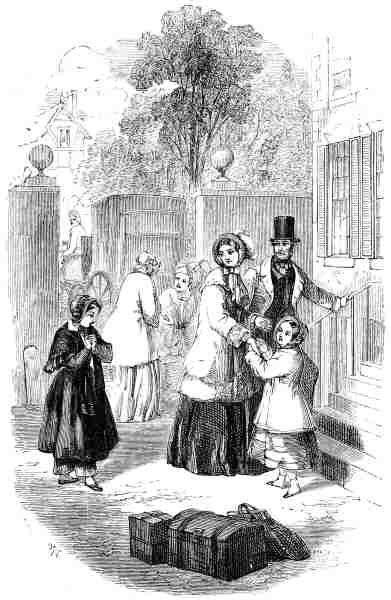
Madame de Béville, seeing before her a young girl neatly dressed, and in tears, asked her kindly what she wanted.—P. 92.

Euphemia could not reply; the little girl then approached her, and said in the most encouraging tone, "Come, speak to mamma."
Euphemia took courage, and addressing Madame de Béville in her former manner, said, "But I want to be paid in advance, immediately; and then," she added, raising her head, and in a tone of great earnestness, "then, I will work for you as long and as much as you please."
She stopped, trembling. Madame de Béville questioned her with great kindness, and Euphemia related her troubles; but while speaking, the louis d'or, which she held in her hand, fell to the ground. The little girl picked it up, and returned it to her, blushing, grieved at the thought that Euphemia had been trying to deceive them.
"My child," said Madame de Béville, in a reproachful tone, "why did you tell me that you had no money?"
"It is not ours," replied Euphemia with simplicity, "it has been intrusted to us for another, and therefore we cannot touch it."
The young girl, much moved, looked at Madame de Béville, who kissed Euphemia, and asked to be conducted to the place where she had left her mother. At this moment, Madame de Livonne entered the yard, supported by M. de Béville, who had recognised her from having often seen her in Paris, and who begged his wife to join him in persuading her to pass a few days with them, in order to regain her strength. Madame de Béville, deeply affected by Euphemia's narrative, pressed the hand of Madame de Livonne, entreating her, in the kindest manner, to accompany them. Madame de Livonne turned to Euphemia, who smiled at her with a look of entreaty; the little girl had already taken her by the arm to lead her away. Madame de Livonne could no longer hesitate, and they entered the carriage of Madame de Béville, whose horses had arrived to conduct them to the château, which was only a few leagues distant. Euphemia could not contain her joy when she saw her mother seated in that comfortable carriage, and surrounded by persons who took care of her; and her pleasure was enhanced by the thought of the delightful time they should pass at Béville. The following day the louis was sent to Mathurine by a confidential person.
Madame de Livonne only required rest, and was soon perfectly restored. M. and Madame de Béville, greatly pleased with the principles she had impressed upon the mind of her daughter, and knowing besides that she was well educated, and very talented, told her that, as they could not obtain in the country, where they lived the greater part of the year, such masters as they wished for their daughter, they would be delighted if she would remain with them, and assist them in her education. Madame de Livonne, although for herself she would have preferred her independence, nevertheless accepted a proposition, which insured to Euphemia a happier existence, and probably, also, a valuable protection.
As to Euphemia, she was delighted beyond measure at the thought of having to live with Mademoiselle de Béville, with whom she had already formed a most intimate friendship; and while rejoicing with her mother at this good fortune, she remarked that it would not have happened to them, if they had been so weak as to change Mathurine's louis d'or.
"We have done our duty," she added, "and God has rewarded us."
"My child," said her mother, "our present situation is a blessing bestowed on us by God, but not a reward."
"And why so, mamma?"
"Because this is not the kind of recompense he assigns to the fulfilment of duty. Do you remember the lines I made you read to me the other day from an English book?—
'What! then is the reward of virtue bread?'[A]
"It is not by giving to the virtuous the means of living, that God rewards them, but by giving them the satisfaction of having done their duty, and obeyed his will. This, sometimes, is their only reward in the present world; sometimes, even, they are unhappy during the whole of their lives: do you suppose from this that God is unjust to them?"
"No, mamma."
"And do you not think that among these virtuous yet afflicted people, there must have been many who have had much more difficult duties to fulfil than ours, and who have fulfilled them without obtaining those things which you look upon as a reward?"
"Oh, certainly, mamma."
"It is not, then, probable, that God has wished to reward us, in preference to others, who have better merited a recompense."
"But, mamma, nevertheless, it is because we have done our duty, that we are now so happy."
"Yes, my child; and things like this should often happen, for a very simple reason. God, who has willed that the accomplishment of our duties should be rewarded by peace of mind, has also permitted that happiness should usually be the portion of those who take the most pains to attain it. Now, it is certain, that he who feels no hesitation in neglecting his duty, will not, in a case of emergency, trouble himself with the search of any more difficult resource than this."
"That is quite clear."
"Whereas, he who is anxious not to fail in his duty, will exert all the energies of his mind, in order to discover some other means of success; and as the Gospel says, 'Seek, and ye shall find.' Thus it may often happen, that the efforts we make to avoid a breach of duty, enable us to discover many important resources, which would not otherwise have occurred to us."
"Yes, mamma, just as with the pound of gooseberries. And if, also, when I saw you so ill, I had considered myself justified in making use of Mathurine's louis, I should not have thought of addressing myself to Madame de Béville, which has been so much more advantageous to us."
At this moment, the poor woman whom they had met upon the road presented herself. Her child was quite restored, and she herself, though still very thin, appeared happy. The Curé had at first relieved her, and afterwards sent her to a manufactory, where she obtained employment. Assured of a subsistence, she had come to announce her happiness to those who had been the means of procuring it, and to bring her child for Mademoiselle Euphemia to kiss, now that he had become handsome again.
"Mamma! mamma," said Euphemia, overwhelming it with caresses, "it is still because you would not change Mathurine's louis, that you sent them to the Curé. Oh! how much good this louis has done us!"
Here M. de Cideville paused.
"Is that all?" asked Ernestine.
"Yes," replied her father, "I think that is the whole history of the louis d'or; and that from old Mathurine it has come to me, without any adventures."
"And now, papa," said Ernestine, "you forbade me to question you until the end of the story; but is it not true, that you do not know whether all the adventures you have related, have really happened to the louis d'or you showed me?"
M. de Cideville smiled, and said, "It is true that I do not exactly know whether these adventures have really happened; but you must allow that they are possible." Ernestine assented.
"You must also allow, that if some of them are rather romantic, some at least are probable, and may have occurred without any very extraordinary combination of accidents." She again assented.
"Well, then, my child," replied M. de Cideville, "it is partly for want of knowing the truth, and partly for want of sufficient imagination to supply its place, that I have not related many other histories, all more simple and more interesting than my own, in which you might have seen a louis d'or, or even a much smaller sum, prevent the greatest misfortunes. Picture to yourself a family which had eaten nothing for three days: can you imagine the delight with which they would receive a louis d'or, which would afford them time to await, without dying, such other assistance as might save them entirely? And again, the unhappy wretch whose reason has been so far disturbed by excess of misery, that he is led to attempt his own life, can you doubt that a louis d'or, by delaying the moment, would often give him time to return to calmer feelings, and seek some better resource than an act of crime? I give you only two examples, but I repeat, that there are thousands remaining, of which it would be impossible to think, without losing every wish to spend such a sum in a frivolous manner."
"But, papa," said Ernestine, "is it then never allowable to spend a louis on pleasure?"
"My child," said M. de Cideville, "if we impose upon ourselves restrictions too severe, on one point, we run the risk of failing in others. There are duties proportioned to every situation in life. It is proper that those who enjoy a certain degree of affluence, should occupy in the world a position suitable to their means, and also that they should mix in society, which they cannot do without some expense; for it is highly important that society should be kept up, since it binds men together, and gives them opportunities of mutually instructing each other. It is also good for the poor, because the expenses of the rich give them the means of exerting their industry, and maintaining their families. It is necessary, too, that those employed in important labours, as I am every morning in my study, should be able sometimes to repose the mind by occupations of a less serious nature, as otherwise they would end by losing the means of fulfilling the duties of their station. It is for reasons of this kind that many expenses which do not appear directly useful, are nevertheless proper and necessary. But a mind accustomed to judge of the real value of things, will easily draw a distinction between money spent in this manner, and that which is thrown into the sea, as the saying is; and while such a person will never feel tempted to indulge in expenses of the latter kind, he will permit himself to enjoy the others without remorse. I know very well, my dear Ernestine, that you may easily deceive yourself in regard to your pleasures: at your age, every pleasure appears of great importance; but I am anxious that you should at least understand the value of what you bestow upon it; therefore, I promise to give you this louis as soon as you have found a really useful means of employing it."
Ernestine, quite enchanted, promised to seek one; we shall see whether she succeeded in her search.
CONCLUSION OF THE HISTORY OF A LOUIS D'OR.
For a whole week, Ernestine could think of nothing but her louis, and the use she was to make of it, but she found none that suited her. The stories which her father had related, made her reflect on what might really be useful, and as her parents supplied her abundantly with everything necessary, and even interested themselves in her pleasures, whenever they were reasonable, she saw nothing that could justify her in spending it on herself; besides, she had determined to apply it to some benevolent purpose. But, at her age, she was ignorant of the best means of doing good. She often met poor people, and delighted in relieving them; but as her little monthly allowance was almost sufficient for these acts of charity, she would have been very sorry to have expended her louis upon them. Besides, she did not know whether one of these poor people was in greater need than another, nor could she tell how to ascertain this; she therefore experienced great anxiety on this head; but the arrival of the season of gaiety dissipated her cares. She went to five or six balls; she had never danced so much in her life, and her head was so completely turned with joy, that she forgot her louis; for, of course, she would never have thought of spending it upon her toilette. At length the time arrived for their departure into the country; and seeing her father paying some money at the inn, she recollected her louis d'or, and mentioned it to him. M. de Cideville told her that it was in the country she would find the best means of employing it to advantage, as it was there that the greatest amount of good might be done, with the smallest amount of money.
They had only been a few days at Saulaye, the estate of M. de Cideville, when Ernestine came running to her father, quite out of breath, to tell him that she required her louis, for that one of the villagers, named Marianne, whom he knew very well, as she had assisted at his haymaking the previous year, had just had her leg broken in the fields, by a kick from a horse. The surgeon of the neighbouring town, who was also the medical attendant at the château, happened fortunately to pass by while she lay upon the ground, screaming dreadfully. He set the leg immediately, and had her taken home. But this was not all; Marianne would require remedies, and she was very poor; her husband was in the army, and she had only a very small garden and her labour to depend upon, for the maintenance of herself and a little girl, eight years of age. It was, therefore, absolutely necessary to assist her.
M. de Cideville agreed to this. "But," said he to his daughter, "have you well considered the manner of employing your louis, so as to render it as beneficial to her as possible?"
"If I give it to her, papa, she will be able to buy what is necessary with it."
"Do you think she will be able to buy much?"
"Oh! dear, no; but that is always the way."
"But if you could so employ it as to make it yield a considerable profit to her? Do you remember the advantages which the family of M. de la Fère derived from a louis d'or?"
"Yes, papa, but their history is not true," said Ernestine, quickly.
"It is quite sufficient that it is possible."
"Yes; but if it be necessary," said Ernestine, with a sorrowful and embarrassed look, "to bring oneself, as they did, to bread and water...."
"You are not reduced to this extremity: this is one of those resolutions which we ought to have the courage to take, when necessity demands them, but which would be ridiculous when unnecessary?"
These words restored Ernestine's cheerfulness. "Whilst we are talking," said she to her father, caressing him, "poor Marianne does not know that we are coming to her aid."
Her father reassured her. M. de Cideville had been informed of the accident before Ernestine came to tell him, and had given orders to the housekeeper, who was a confidential person, to attend for the moment Marianne's wants. "But henceforward," said M. de Cideville, "it is to you we look for her being taken care of, and for seeing that she wants for nothing: do you think your louis will be sufficient for this?"
"Good gracious, no! What is to be done?"
"What do you think she will stand in need of?"
"Why, first of all, she must be nursed, for she can do nothing for herself, and Suzette, her daughter, is too young to attend upon her."
"She has many neighbours about her, and I am sure they will relieve each other in nursing, and taking care of her, as long as it is necessary. You already see how much these poor women can do without the aid of money."
"Yes, but I cannot do what they do."
"Therefore you ought to do something else. Will she not require medicines?"
"We must buy some for her."
"The greater part of the herbs, of which her draughts and poultices will probably be composed, grow wild in the fields: we know them, and will teach you to distinguish them also. If you like to employ your walks in seeking for them, you may, I think, easily gather a good provision of such of them as are most required, and we will show them to the surgeon, in order to be quite sure that we are not mistaken."
"There, again, is the surgeon! I never thought of him; he, too, must be paid."
"He attends the château, and receives a certain sum annually; we treat him well, and he is satisfied with us; besides, he is a very worthy man, and attends gratuitously to the poor of the village, as much from humanity as from the wish to oblige us; while some presents from our produce, as a cask of our wine, for instance, enable us, from time to time, to testify our gratitude to him."
"But, papa, it is you and other people who do all this; it is not I."
"You can do but little of yourself, my child, since you have neither strength, nor wealth; but it is precisely because you are dependent on us for all your wants, that you ought to count among your resources the pleasure we feel in obliging you, in everything that is reasonable, and the predisposition which people feel to comply with your requests, when you ask for what is proper."
"Oh papa, to ask! but that is so difficult. I should never have the courage to do that."
"It is in this, my child, that the greatest merit of charity often consists. I could relate to you many admirable stories on this subject. In order to do good, we must often be able to conquer our pride, which makes us dislike to have recourse to others; our idleness, which makes us dislike exertion; our indolence or thoughtlessness, which makes us lose a thousand things which would be useful. We must learn to do much, with little means; otherwise, we shall never manage to accomplish anything of importance. Those who only give money soon exhaust all they have to give, whereas the contrivances of charity, in aid of the unfortunate, are inexhaustible."
"Dear papa, I shall beg you to teach me to find the herbs; but I assure you I am very much afraid I shall not be able to discover anything else."
"You will see: meanwhile, here is your louis; if you take my advice, you will not spend it, except in the purchase of such things as you cannot otherwise obtain. As for the others, seek the means of procuring them. In a house of any consideration there are always many things which may be given away without any positive expense, as they would be otherwise lost, or nearly so. You can ask us for these, and in this way, we will aid you, with the greatest pleasure, in succouring poor Marianne, whom from this moment I place under your care."
Ernestine, though a little frightened at a duty, which she was afraid of not fulfilling in a proper manner, still felt proud and happy in having some one under her protection. Madame de Cideville entering at this moment, her husband informed her of the important charge he had committed to her daughter; and as a servant came to say that Marguerite, one of the women who took care of Marianne, wanted some old linen for her, Madame de Cideville said, "It is to Ernestine you must apply."
Ernestine looked at her mother, with an air of utter astonishment. "But, mamma," she said, "I have no old linen."
"And you cannot think of any means of procuring some?"
"Madame Bastien" (this was the housekeeper's name) "has plenty; the old sheets and napkins belonging to the house serve her for making bandages; but she is always angry when any one applies for them. Last year, when my nurse hurt her foot, she hardly even dared to ask her for any."
"Nevertheless, you must endeavour to obtain some between this and to-morrow, for to-morrow they will be needed for Marianne."
"Mamma, if you were to tell Madame Bastien to give me some?"
"She would give them to you, most assuredly; but do you think she would do so with less ill-humour? She is well aware that I wish her to give to all who require it, but as she has sometimes to supply a great many persons, she is afraid that each will take too much; perhaps too she likes to show her authority a little; therefore, you may be quite sure that whatever she does, she will do it with a much better grace for the sake of obliging you, than she would if I were to order it."
As Ernestine was going out, she met Marguerite, and told her that she would endeavour to have some linen to send her, for the following day. Marguerite replied that it was absolutely necessary, for without it she could not change Marianne's poultices. Ernestine was very much embarrassed; she was afraid of Madame Bastien, who had been in the family thirty years, and possessed great authority. The servants feared her, because she was exact and economical, and Ernestine, without knowing why, did the same. At that moment, she would have been very glad if her papa and mamma had themselves undertaken to provide for Marianne's wants. She saw in this charge a host of embarrassments, from which she knew not how to extricate herself, but she did not dare to say so. While standing, thoughtfully, on the spot where Marguerite had left her, she saw Madame Bastien approaching. She blushed, for she thought of what she had to ask her, and stooped down as if to look at her Hortensia, which was placed upon the step, at the side of the yard. Madame Bastien stopped to look at it, and remarked that it was very beautiful. Ernestine, who was anxious to prolong the conversation, showed her two slips from it which she had planted the preceding year; they each bore two buds which were beginning to swell. Madame Bastien admired these also.
"Will you accept of them?" asked Ernestine, with eagerness. Madame Bastien refused, saying she did not like to deprive her of them.
"Oh yes! yes!" said Ernestine, and taking the two pots under her arm she lightly descended the steps and ran to place them on the window of the lower room, where Madame Bastien usually worked. Madame Bastien followed her, thanking her very much for this present, with which she seemed to be greatly pleased, and at the same time admiring the hortensias. Ernestine went and got some water for them, wiped the leaves, and changed the sticks intended for their support, but which were beginning to be too short for them. Madame Bastien hardly knew how to thank her sufficiently for so much attention.
"Madame Bastien," said Ernestine, as she tied the last prop, "could you not give me some old linen for poor Marianne? Mamma has given me permission to ask you for some."
"Very willingly," said Madame Bastien, in the best-humoured manner in the world; "the poor woman shall have as much as she requires; she is laid up for a long time;" and she took Ernestine to the linen closet, where she made up a large parcel, which Ernestine, her heart bounding with joy, carried off, and hastened to show it triumphantly to her mother, who allowed her to take it herself to Marianne. Whilst waiting on the step for her nurse, she saw Suzette, Marianne's little girl, enter the yard, walking slowly by the side of the wall, looking first on one side, and then on the other, as if fearful, yet anxious to be seen. Ernestine descended a few steps and called to her.
"How is your mother?" she asked. "Pretty well," replied Suzette, with a heavy sigh.
"What are you looking for?"
"Nothing;" and this nothing was followed by a sigh still heavier than the former. She began to look at Ernestine's flowers, and said, "What beautiful flowers!" then, as if continuing the conversation, she added:
"I have had no dinner to-day."
"You have had no dinner?"
"No, and I don't think I shall get any."
"Why not?"
"Because mother cannot give me any."
"Stay, then," said Ernestine, and running to her mother, she exclaimed, "Mamma, here is Suzette, and she has had no dinner."
"Very well, my child, something must be done for her."
"Yes, mamma; do you think," and she hesitated—"do you think it would be a positive expense if Suzette were to be fed here? It seems to me that there is sufficient in the pantry...."
"I think, my dear, there is; there would only be the bread...."
"Oh, yes; but, mamma, they bake at home for the servants; would it be necessary to bake more on account of Suzette?"
"I think not, provided at least that you will not waste it as you are in the habit of doing, by cutting large slices to give to Turc, who ought to have only the fragments."
Ernestine promised, and Madame de Cideville consented to Suzette's being fed at the château, during her mother's illness. While now waiting for her dinner, Ernestine got her a piece of bread, to which she added, as it was the first time, a little gingerbread cake which she brought from her own room, as it belonged to her. In passing by Turc, who as soon as he saw her, came out of his kennel, and got as near to her as the length of his chain would permit, all the time wagging his tail and lowering his ears: "My poor Turc," said she, "you will have nothing now but the pieces." Nevertheless she begged Suzette to give him a bit of her bread, as a mark of friendship, and promised herself to go and look for some in the piece-basket, in order not to forfeit Turc's good graces.
She would carry the bundle of linen herself, although it was rather heavy. Fortunately, Marianne lived quite close to the château. On reaching her house, all flushed with pleasure as well as embarrassment, she said, "Here, Marianne, here is some old linen I have got for you."
"I assure you," said the nurse, "she was very anxious to bring it to you."
"It is very kind, Mademoiselle Ernestine," said one of the women who was there, "to come and comfort poor people."
This speech gratified Ernestine, but embarrassed her still more. Children, and especially girls, are timid with the poor, because they have seen little of them, are unaccustomed to their manners and language, and do not know how to talk to them. This timidity, which they do not sufficiently endeavour to overcome, often causes them to be accused of haughtiness. Fortunately for Ernestine, Suzette, who had followed her, came forward eating, with good appetite, a piece of bread. She was asked where she got it, and replied that Mademoiselle Ernestine had given it to her.
"I have asked mamma," said Ernestine, addressing Marianne, "to let her be fed at the château, all the time you are ill."
"This is just what was wanted to cure her," said the woman who had before spoken, "for she has done nothing for a long time but cry, and say, 'Who will take care of my poor child?' I told her that if she tormented herself in that manner her blood would be curdled."
"Suzette shall want for nothing, my poor Marianne," said Ernestine, with great earnestness, "nor you either, I hope."
Joy and gratitude were painted on the suffering countenance of Marianne; she clasped her hands under the bedclothes, for she had been forbidden to move. An old woman who was seated near her bed, let fall her crutch, and taking the hand of Ernestine within her own, said to her, "You are a good young lady, and God will bless you." Ernestine was so moved, that tears almost came to her eyes. She now felt more at her ease and her nurse having questioned the women who were there as to what had been done, and what ordered by the surgeon, she joined in the conversation, and in a short time her embarrassment quite vanished. When she left, Marianne raised her feeble voice to bless her; and the old woman again said, "You are a good young lady." The other woman followed her to the door and looked after her. She felt that they would talk about her in that poor cottage, and say that she was good, and this thought made her experience a pleasure which had hitherto been unknown to her. Suzette, who followed her like her shadow, she considered as under her especial protection, and she seemed to herself to be older and more reasonable, now that she was able to protect some one. At this moment, she would not have exchanged the pleasure of having Marianne under her charge for all the enjoyments in the world. She hastened to communicate to her parents all the joy she experienced, and they shared it with her. She told her mother that there was still one thing which she had to beg of her, but she hoped that it would be the last. It was some broth for Marianne; "I could easily," she said, "boil her some meat, but then I should require wood, and besides meat would not be good for her. If the broth were made for two days, it would turn at the first storm; and, besides, it would give more trouble to her neighbours. Perhaps some could be sent to her from here without increasing the expense."
"I see," said her mother, smiling, "that you begin to understand what you are about." This was the result of her conversation with the women who took care of Marianne. Madame de Cideville permitted her to ask M. François the cook for some broth, and M. François promised to give her some with great pleasure, provided Mademoiselle Ernestine did not incessantly say to him, "M. François, do not so often give us melted butter with asparagus in it;" "M. François, the spinach had no taste to-day;" or else, "I do not like pease soup!"
Ernestine promised to be satisfied with everything, and she was, at all events, perfectly satisfied with her day's work.
In the afternoon, she gathered in the fields several of the herbs which she had been told might be required for Marianne. She also learned to distinguish a few which grew in the uncultivated parts of the park, and even in the crevices of the walls. They were shown to the surgeon, who thought many of them very good; some others were necessary, and these he promised to supply himself; Ernestine asked him the price. "Nothing to you, my dear young lady," he replied, "I do not wish to ruin so pretty a sister of charity." Ernestine blushed and thanked him, and from that moment treated him with a degree of respect and politeness, which charmed the good doctor so much, that he redoubled his attentions to Marianne. He gave Ernestine an account of her condition, and told her what was necessary to be done, and Ernestine thanked him in a manner which completely won his heart. He joked with her, she laughed with him; they became the best friends imaginable. One day a rather expensive drug was wanted: Ernestine insisted on paying for it; he would not allow it; "I am also an apothecary," he said; "I prepare that myself."