Front matter (continued 4)
Reading edition
"If the Man slips the Dogs, and the snow keeps hard and dry, there will be more fighting than running," he said to himself, "for these brutes will come faster than I care to go. But there is a strong crust, strong enough to bear me, and if the sun warms the snow so that it will ball in the haired toes, then I'll have a chance in the run. The Man moves," he continued, whiffing at the air. "Two of them!" he muttered, as their forms outlined against the morning sky; "Rof brought tidings of but one. Now for it! I'm coming, Boy!"
He turned and walked slowly back on his track, breaking into a shuffling trot farther on.
In a few minutes the two men, snow-shoe clad, rifle in hand, and cartridge-belted, reappeared circling through the woods on the bank. With one of them were four Scotch Stag-hounds in leash. Mooswa's eyes took in the situation as he trotted, carrying his head a little to one side. "The flank movement," he muttered, "and a stolen shot at the next bend--they'll not slip the Dogs while they have hope of a shot."
When the first river-bank point hid him from their sight he raced. "They're running now," he thought, for he was down wind from them, and the telegraph was working.
When the two hunters reached the belly of the next bend they saw a big Bull Moose quietly browsing at the point beyond. He was walking slowly, snipping at the tree branches as he moved.
"Keep the dogs back," one hunter said; "we are sure to get a quiet shot at him, for he's on the feed."
Point after point, bend succeeding bend, Mooswa played this game; mile after mile they toiled, the tantalizing expectation of a stolen shot leading them an amazing distance on the Moose trail.
"It's the Stag-hounds that keep him moving," remarked the man who had spoken before; "he's down wind, and gets them in his big, fat nose--if I could rustle a shot into his carcass, I'd slip them quick enough; but if we let them go now it will be a play of twenty or thirty miles before we get another sight of him. I'm not struck on following a Bull Moose under full trot with a pack of dogs behind him."
"We'll get a shot on the quiet soon," remarked his comrade. "He is a bit on edge just now, but will settle down after he has seen us a few times." They had given up travelling in the bush, and were following straight on the hoof-marks in the river-bed.
"Hello!" sang out one, pointing to a depression in the snow, "he's been lying down resting here--he's getting fagged. Somebody else must have been running him before we struck his trail--he's nearly beat."
As they crossed the Wolf trail Mooswa had found on his way down, the Trapper in the lead said, significantly, "It's the Gray Hunters have done the Bull up; they've been after him, and he's dead beat."
The big Stag-hounds sniffed the Wolf trail, dropped their long, bony tails in sullen fear, raised their heads, and bayed a howling note of defiance.
"Shut up, Bruce!" exclaimed one of the men, pulling at the raw-hide leash, "you'll be better up against a Moose than tackling that gang."
Now the mark in the snow had been made by Mooswa just to draw the hunters on; he wasn't tired, for the hard crust held him up, and he could have kept that gait for two days.
They had travelled probably thirty miles when the leader said, "Better slip the dogs, Mac, this Moose is putting up a game on us; he's as cunning as an old fox, and we'll lose him to-night, I'm afraid."
When the straps were unbuckled the Scotch hounds broke into a chorus of delight: "Yi, yi, yi, yi! yap! yap! yi, yi! Bah-h-h! Bah-h-h!" stretched their long limbs and raced on the Bull Moose's trail. That showed a strain of Collie blood in their veins, for if they had been pure bred they would have run silent, and by sight only.
"Pleasant greeting that," muttered Mooswa, as his flanks lengthened out in a terrific pacing gait.
"We're coming--we're coming! yi, yi!" sang the Stag-hounds, their heads low to the snow; their lean flanks stretching out until they seemed like something shot from a catapult. But swift as they were, Mooswa was swifter. They were running at high pressure, straining every nerve, using every ounce of speed that was in their wire-haired bodies; the Bull was running with a little in hand--something in reserve. "They will upset everything," he thought. "Those blood thirsters will chase me on past the Shack, and the Men may never see it."
At the Second Rapid, with its tortuous ice-humps, the Bull lost a little ground--he had to go slower. The dogs, quicker of foot, and able to turn sharper, gained on him. Each time they caught sight of their prey they gave a savage yelp of eager exultation, and ran with heads high--ran by the eye.
"Sing, gaunt Brothers!" said Mooswa; "on the level you'll have to run with your bellies closer to the trail to keep your advantage."
Well clear of the Rapid ice, the Bull again swung his awkward-looking body forward with increased pace. Suddenly a hoof crashed through the crust almost bringing him on his nose; before he had gone a hundred yards this happened again. Fringed by giant Spruce, tall banks on either side had stood as barrier between the fierce biting frost-wind and snow crust; also the day's hot sun was beginning to rot its brittle shell. Oftener and oftener it broke under the racing Moose; the lighter dogs ran freely over its treacherous surface. The Bull looked over his shoulder at his pursuers; they were gaining--he could see that. "Six points more to the Shack," he muttered, as he rounded a low-reaching headland that turned the river wide in its snake-like course. Animals count river distances as do the Indians, so many land points from one place to another; Mooswa's six points were a good ten miles.
Each time he floundered in the deep Snow his swift-running enemies gained at least a dozen yards.
"I wish Blue Wolf were here," thought Mooswa; "I'll never make the Shack. I'll try a Boundary Call." He stretched his throat, and called, "Wha-a-a--i-i-n-g," which is not unlike the cry of a Rook. The hounds answered with an ironical yell; but another sound struck the runner's ear, very faint, and very far ahead; it was the Help-call of The Boundaries--Blue Wolf's voice.
"Good old Rof!" cried the Moose, as he shot forward with revived strength.
The hounds were now running by sight, head up all the time. Every few minutes Mooswa repeated his signal--each time it was answered ahead, stronger and closer; and behind him the eager yap! of the pursuers was drawing nearer. "There'll be more fighting than running presently," he thought; "it's just as well--if Rof has the Pack, it won't take long to settle these hungry Hunters."
Rounding the next bend a clear stretch of two miles lay straight away, and at the farther end of it his trained eye discovered three moving specks. Behind him, not thirty yards back, raced the dogs.
"It will be a battle," he muttered; "four against four--four of the Boundaries in the Starvation Year, against four Fish-fed Dwellers in Man's camp."
Another mile and the foremost dog was snapping at the Bull's hocks, just falling short each jump; but Blue Wolf and his comrades were only a stone's-throw off.
As Mooswa and his pursuers neared the great, gaunt, blue-coated Wolf, the latter crouched--chest, and neck, and jaw flat on the snow; behind, well spread in rigid leverage, were the strong, gnarled legs. A length off two younger wolves waited ready for battle, flat-lying as their leader. Mooswa understood. As he slashed by Blue Wolf, almost touching him, the close-following Stag-hound sprang for his quarters, all but dragging him to earth; but the fangs failed to hold, tearing a gash down Moose's thigh, and as the Dog fell sideways a pair of jaws, strong as a bear-trap, closed on his lean throat.
"Hold fast, Brother!" wheezed Mooswa, swinging around in his own length, and making a vicious sword-cut at the hound's back with his iron hoof. A second dog sprang at the Bull's throat, only to strike the big antlers quickly lowered to guard it.
Rof's two sons had closed with the other hounds, and a battle to the death raged. There was not much noise, only a snarling sucking from where Blue Wolf's fangs were fastened in the throat of the hound he had pinned down.
Once Mooswa got a clean slash at his fighting dog with a fore-foot that laid the brute's shoulder open; once the dog fastened in Mooswa's throat as the treacherous crust gave way and threw him off his guard. It seemed anybody's battle. Blue Wolf knew better than to let go the first hold he had taken. It was said in the Boundaries that long ago, two or three generations back, a Bull-dog had mated with one of his ancestors, and the strong strain had more than held its own--the way of the Bull-dog, which is to catch and hold, against the way of the Wolf, which is to cut and jump, cut and jump. Certain it is that Rof fought as no other Wolf ever did--except his two Sons, holding and sucking, and working his jaws saw-like, as an Otter-hound does, more and more into the grip. But the Stag-hound had a well-fed strength which stood him in good stead. Over and over the two rolled; the hound's jaws fastened on one of Blue Wolf's fore-legs, close to the paw. The bone had been broken long ago--chewed into splinters, and the pain was terrific; but if Blue Wolf had the tenacity of the Bull-dog strain, he also had the wild wisdom of the Wolf brain, and he knew that to let go meant death.
Once something swept the hound sideways with terrific force from over the top of Rof, almost breaking the dog's back; that was a little side help from the shovel-horns of Bull Moose. Up to that time it had been all hoarse growls from the strong-fighting animals, for the advantage had lain not much on either side. Suddenly a "Wh-u-f-f! ki-yi-yi-yi--wh-e-e-e, yi-i-i," dying into a piercing treble, went up. Mooswa was grinding his dog into the snow-crust with his hundred-pound antlers. A lucky pass with a fore-foot had brought the hound down, and before he could recover, Mooswa had thrown the weight of his fighting charge upon him, and was cutting his steel-gray body into fragments.
There was still hot work to be done, for one of the young Wolves had been overcome, stretched out with a broken neck, and the released dog was helping his comrade pull down the other. They were both at him when Mooswa charged. Once, twice, three times, as a trip-hammer hits hot iron, the heart-shaped hoofs, knife-like on the edges, smote the dogs, for they were taken unawares; then, as before, his horns made the work complete.
As Mooswa straightened himself a little staggeringly, for his throat was badly torn, there were only two left fighting; all the rest were dead--the two sons of Blue Wolf, and the three Stag-hounds.
"Thanks, Brother," said Blue Wolf, rising on weak legs, as a deft, dragging blow from Moose's right arm laid open the hound's stomach, and finished the work Rof's fast-tiring strength was hardly equal to. "Very neatly done--I could almost fancy it was a rip from Muskwa's paw. My two Lads are done for," he whined piteously, looking at the gaunt, gray bodies stretched out on the white snow, all splashed crimson with red wine from their veins. "Wolf-blood and Dog-blood--it scents much alike," he said, turning his head away, as he sat on his haunches holding up a broken leg. Drip, drip-drip, drip, little red drops ate their hot way into the snow from Bull-Moose's neck.
"That is a nasty slash, Mooswa," sympathized Blue Wolf, looking at his companion's wound.
"We twig-feeders have strong gullets," answered the Bull, "else it had been worse. There's nothing torn, for I still breathe through my nose; but for many a day you'll hunt on three legs because of me, Comrade."
"I suppose so," moaned Blue Wolf, regretfully, licking nervously at his crushed paw. "I'll mate well with Black King. But it is all in the life of the Pack, and not your fault; no one takes blame to himself who calls when his life is at bay. Where go you, Brother--how far back are the Hunters?"
Mooswa straightened his head sharp into the wind--it still held steady from the North. "Their scent comes from the second point, and we must trail again; the Firestick is not like a Dog--it bites beyond reach. Get in my horns, Rof, and I'll carry you."
"No," said Blue Wolf, decidedly; "each takes his own hurt to his Burrow--that is the way of the Pack; each to himself in the fight--one down is all on top. Besides, Comrade, your long legs are knocking together in weariness; the snow drinks much of your red blood."
"Come," called Mooswa, "the Man-scent turns the first point."
Blue Wolf, whining piteously, was rubbing his red-stained jowl up the neck of one of his dead Sons. He turned, balanced himself unsteadily, and tried to kick snow over their dead bodies. Bull-Moose, seeing this, lowered his head, gave three or four mighty scrapes with his wide horns, and piled great white mounds over Blue Wolf's dead children.
"Come away now," he commanded again; "the Hunt-men sight us--they are racing."
"They'll have a fair trail to follow for a little," answered Wolf; "then it will be dark, and we'll lose them. I go to the Pack for safety; had I known of the Dogs and this other Man I should have brought more than two Cub-wolves."
"I go to the Shack," said Mooswa, shortening his steps to keep pace with Wolf.
"To be killed by the Hunt-men?"
"I don't know; I go to The Boy."
As they climbed the bank, "Bang! pin-g-g-g!" sang a leaden messenger, fairly whistling through the crotches of Mooswa's horns.
"The Firestick!" he grunted; "sight of his dead Train-dogs has angered the Hunt-man. Slip off to your Pack now," he continued, as they trailed through the little clearing surrounding the Shack. "Get Umisk to fix up your foot as he did Black King's."
"And you?" queried Blue Wolf.
"I stop here!" the other answered, swaying as he stood in his tracks for a second.
"Come with me," pleaded Rof; "my Pack shall turn back the Hunters."
"Here they come--off to the Woods!" Mooswa answered, going himself to the Shack door and rattling his horns against the boards. The noise wakened Whisky-Jack, who had curled up for his night's sleep under the eave.
"Thieves!--Hello, Mooswa!" he piped, craning his neck around the corner, and seeing the big horned head.
Inside a faint querulous voice asked impatiently, "Is that you, François, or is it the angels with wood? If it is, throw it down the chimney, please--I'm too sick to get up."
Mooswa "whuffed," blowing the wind through his blood-coated nostrils with a sound The Boy knew, and scraped his horn up and down the door again. There was a muffled, slipping noise of some one crawling to the door. The bar dropped, Mooswa pushed it gently open, staggered in, and plumped down exhausted on the floor.
Carcajou had heaped the fire-place well with wood for the night--dry Tamarack to make it blaze, and green Poplar to make it last; the bright light shone on Mooswa's blood-matted body and revealed to Roderick his terrible condition.
"Mooswa, Mooswa!" he cried, dragging himself close and putting his arm around the big nose, "who has done this? You are wounded." Just then two men, with the blood-thirst of the chase hot in their hearts, glided to the door on snow-shoes. One had thrust forward a rifle, but his companion knocked it up with his arm. "What would you shoot?" he asked.
"I don't know," answered the other, his Winchester almost falling from shaking fingers, as he caught sight of a small boy-figure huddled against the animal's head. "Is it a banshee, Donald?" he continued, in a frightened, husky whisper.
"Is that you, François?" cried Rod, sitting up in his eagerness, as the voices came to him from the outer dusk.
"Great Powers!" exclaimed the man Donald, stepping through the door, "that's Factor McGregor's kid, Rod. I heard he was down here somewhere trapping with that Breed, François. What's the matter, Laddie?" the thick Scotch voice burred.
"Well, I'm hanged if I ever outspanned anything like this," said the other man; "it's like that thing we used to read, 'Babes in the Woods.'"
"Where's your mate--François?" asked Donald again. "And what's the matter with you--scurvy?"
"François," answered the Boy hesitatingly, for days of wound-fever had clouded his young brain,--"François? oh, yes, I remember--he went to The Landing long ago."
"And left a kid like that here alone!" cried Donald's companion.
"What's the matter with your leg--scurvy?" asked the leader again.
"My leg? yes, it's sore--awfully sore. Sometimes I dream that it's another person, and I talk to it."
"What's the matter with it?" the man reiterated huskily, pulling the roll of a fur cap down over his eyes to hide something, for the little, pale, pinched face, backed by a mass of yellow knotted hair, made him feel queer.
"My leg? oh, yes--yes, there was so much snow, and I slipped, and the axe cut it."
"Better get in the blankets, Laddie;" and standing his rifle against the wall Donald reached down with his strong arms to lift up Roderick.
The little fellow shrank away, and clasped the Moose's head closer. Mooswa's big ears were flipping back and forth nervously; he knew that something was being settled, and lay still, waiting.
"Come, Laddie," said the big man again, coaxingly, "don't be afraid; don't you remember me?--I worked for your daddy, old Factor McGregor, at Fort Resolution--Donald Bain is my name."
The small pinched face looked up at him. "I'm not afraid, but you'll hurt Mooswa; you've shot him now--see the blood. He's been taking care of me."
Donald Bain straightened himself up and looked at his comrade. His companion understood, and nodded encouragingly.
"No, Laddie, I'll give you the word of a Scotchman that we'll not harm him. God's truth! in the old land if one's enemy came hard pressed to the house for shelter it would be a blackguard that would injure him, or give him away. Get in the blankets, now, Laddie, and we'll take care of both you and the Moose."
The presence of friends, and a cup of hot tea which they brewed him, soothed The Boy, and he became quite rational.
"This is the queerest thing I ever saw in my life," said Donald Bain. "I've heard of a hunted fox, close run, taking refuge in a house, but this Moose staggering into the Shack is very extraordinary. Who kept the fire going and fed you, McGregor?" he asked.
"Oh, I prayed every night, and in the day too, and the Angels came and dropped wood down the chimney, and fish, and bacon."
Donald's companion tapped his forehead significantly, and, turning his face away, stalked over to the fire and poked it vigorously.
"Mooswa came every day," added The Boy. "He's the Moose Father used to have at the Fort--I didn't know him at first, and was afraid."
"Oh, ho-o-o!" exclaimed the big man, ending with a distinct whistle. "I remember him. He took to the bush when he was a two-year-old. That accounts for his coming to the Shack--he couldn't quite shake off the civilization he got. Here, Dave," he continued, addressing the other man, "get a pail of water, and give the wounded beast a drink."
"He's killed four of the best hounds ever came to the North-west," Dave remonstrated, looking at Mooswa.
"So would you, man, if you could, when they tried to pull you down. It was a fair fight, and not of his seeking either."
The Boy also pleaded for Mooswa.
"Now, we've got to get young McGregor to The Landing just as quick as we can," declared Donald Bain, as he examined The Boy's limb. "Look at the size of it--it'll be a case of blood-poisoning, I'm afeerd."
"How will you manage it?" queried Dave, sullenly. "This brute has killed our dogs--will you carry him on your shoulders?"
"That's so," mused Donald, taking off his cap, and scratching the thick grizzled hair; "I suppose we'll have to rig up a carryall, and pull him ourselves."
"You want to go to The Landing?" asked Roderick.
"We don't want to--" commenced Donald, but checked himself, and added, "yes, me and Dave must go up for more dogs, and some baccy," fabricating with chivalrous ingenuity, to reassure the sick boy. "We was thinking you'd better go along too; there's no dog-train, but me and Dave could track you up on a small jumper--does there happen to be one about?"
"I think Mooswa would drag the sleigh--he used to at the Fort," suggested Rod.
"By the Great Wallace!" exclaimed Bain, slapping his thigh, "that he will--if he's not grown too wild. Hitched to a sled, he could run clean away from a dog-train, in the old days."
"He's been harnessed right enough, some time or another," declared Dave. "Here are two white-haired spots on his back--that means saddle-galls. Gracious! he's as quiet as an old horse."
They put in a busy evening, the two men, bathing The Boy's leg, and with a sailor's needle they found in his outfit sealing up the torn wounds in Mooswa's neck. He never moved, just looked on stolidly. He knew they meant him no harm. Any animal can tell from the touch of a man's finger, or the look in his eye, whether it's war or kindness.
Whisky-Jack had been intensely interested in all this--the clatter and noise kept even his bird eyes open. "Wonderful doings!" he exclaimed; "the Boundaries are being turned into a regular Sun-dance--but I'm glad I saw it all. The Boy will be all right now--Good old Mooswa!" He flopped about drunkenly outside, for his eyes were not quite like Owl's, and the different lights bothered him.
Then he fired a word of encouragement at Mooswa. "Stick to The Boy, old Dainty-head-gear; you're Big Buck of the Boundaries--I'll tell Black King and all the fellows so. Stupid light this--fancy they'll get on without me now," and scrambling up to the eave he stuck his head under wing and went fast asleep.
In the morning a carryall was made, a rude harness constructed from shaganappi, Trap-chains, and straps, and before noon they were on their way to The Landing; Mooswa submitting to be hitched up with patient gentleness.
Whisky-Jack grinned when he saw the Moose decked out in these trappings. "Now you're a dandy, my fine fellow," he said, patronizingly. "We'll never see you again. Remember me to François when you see him, and tell him not to hurry back--Good-bye, good old Mooswa."
"I guess our Shack and things will be all right till we get back," said Donald. "At any rate, Factor McGregor's kid has first call, I reckon. I'd like to put a bullet through that Breed, though."
"What if the Moose bolts?" asked Dave. "Here's a tracking-line they used on their canoe,--suppose we take a hitch on his horns or his nose with it; we could stop him if he tried to get away."
"Yes," answered Donald, "and if we can't, if the worst comes to the worst, we can drop him with a bullet before any harm's done."
But they need not have bothered their heads about the line, for Mooswa knew just what was being done; he was taking his Boy to the land of good care. Like an old cart-horse, he plodded along. The snow was frost-hardened again, and the going was good.
In three days they arrived at The Landing. François was just ready to start with a new outfit the Factor had given him debt for. Then for days he had to hide from Donald Bain, for there was sheer murder in the big Scotchman's heart.
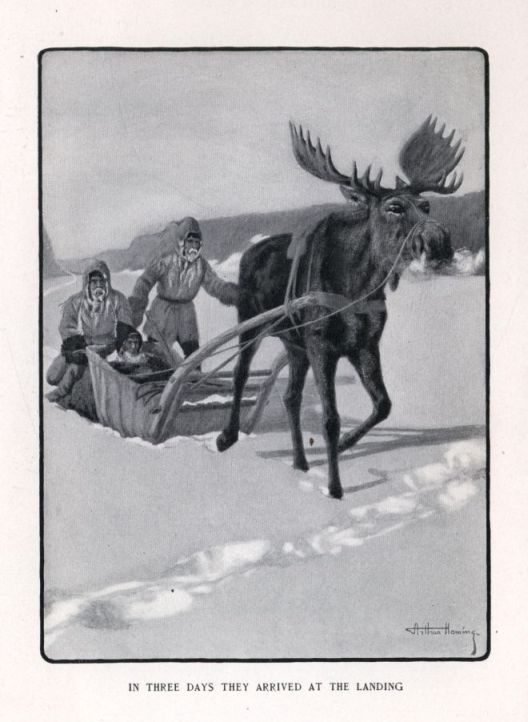
IN THREE DAYS THEY ARRIVED AT THE LANDING
The day after their arrival Mooswa disappeared. When he got back to his comrades he found that Whisky-Jack had told them everything, and next to Black King he was the greatest hero in the Boundaries.
The Factor sent Roderick in to Edmonton with his own team, and nursing soon put him right.
When he told about the angels feeding him, and keeping his fire going, the people listened a little awe-stricken, for they saw that he believed it firmly. Also the two Hunters asserted that the fire was burning brightly when they came. Perhaps after all it was the angels.
* * * * * * * *
By John B. Grant
OUR COMMON BIRDS AND HOW TO KNOW THEM
BY JOHN B. GRANT. With 64 full-page plates. Oblong 12mo, $1.50 net.
PARTIAL LIST OF PLATES: HOOT OWL, BELTED KINGFISHER, WHIP-POOR-WILL, KINGBIRD, PHOEBE, BLUE JAY, BOBOLINK, MEADOWLARK, ORCHARD ORIOLE, PURPLE FINCH, RED CROSSBILL, SNOWFLAKE, SNOWBIRD, SONG SPARROW, CARDINAL, SUMMER REDBIRD, CEDARBIRD, MAGNOLIA WARBLER, BROWN THRUSH, WINTER WREN, WOOD THRUSH, ROBIN, and 42 Others.
The author of this attractive volume dwells upon some ninety specimens of our common birds, and between the remarkably lifelike illustrations and the straightforward, easily intelligible descriptions, no one need be at a loss for the name or habits of any bird an outdoor ramble reveals. A calendar of the times of arrival and departure of the various species in the latitude of New York enables the student to know what to look for at any given date, and the fine literary quality of the book adds a charm to its use quite dispelling any unpleasant "textbook" associations.
"The book is learned, but not too much so for common use, and, if carefully studied, it will introduce the student into that interesting world of bird life where a few favored mortals, such as the author, Bradford Torrey, Olive Thorne Miller and a small handful more, have won their way and brought back so much of delight. The book has more than sixty plates of the commoner American birds, with descriptions, and a very enjoyable and instructive introductory essay."--The Congregationalist.
"It gives plain, practical illustration regarding birds and how best to study them in their haunts and homes in the woods and fields. The plates adorn the pages and give value to the concise, clearly written text."--Chicago Inter-Ocean.
"With the fine illustrations and the simple and comprehensive text, there is no excuse for the lover of birds to remain in ignorance of all the information he needs to enable him to recognize at sight, and to name unerringly, any bird he is likely to see in his walks in wood and field,"--Boston Saturday Gazette.
By Ernest Seton-Thompson
WILD ANIMALS I HAVE KNOWN
Being the Personal Histories of Lobo the Wolf, Silverspot the Crow, Raggylug the Rabbit, Bingo my Dog, The Springfield Fox, The Pacing Mustang, Wully the Yaller Dog, and Redruff the Partridge. With 200 illustrations from drawings by the author. Fifty-first Thousand. Square 12mo, $2.00.
CRITICAL NOTICES
"It should be put with Kipling and Hans Christian Andersen as a classic."--The Athenaeum.
"Mr. Thompson is now drawing the best mammals of any American artist.. . . This is artistic fidelity to nature in high degree.... Nothing of equal simplicity could be more effective than these little marginal oddities and whimsies. The book is thoroughly good, both in purpose and execution."--New York Evening Post.
"This book is unique in conception and illustration.... One of the most valuable contributions to animal psychology and biography that has yet appeared. Mr. Seton-Thompson is not only a naturalist and an animal artist of very high attainments, but is master of a literary style that is at once graphic and fascinating.... The author of 'Wild Animals I Have Known' is a keen woodsman, as well as an accomplished artist and writer, and has given us a book that opens a new field to our vision."--J. A. Allen in The American Naturalist.
"In its mechanical make-up the book is a great success. The illustrations by the author are among the best of modern book-making."--Boston Universalist Leader.
"Nothing apart from 'The Jungle Book' has ever approached these tales in interest, and the 200 illustrations add greatly to their charm."--New York World.
"The originality and freshness of these stories is irresistible.... In everything he does, Mr. Thompson has a way peculiarly his own.... Even if naked and unadorned, the facts he tells us would be very interesting; but when we have the facts and the factors fairly dancing before us, clothed in all the quaint quips and droll persiflage of an accomplished humorist and born story-teller, they are--as I have said--irresistible."--Mr. William T. Hornaday, Director N. Y. Zoölogical Park, in Recreation.
By Ernest Seton-Thompson
THE TRAIL OF THE SANDHILL STAG
Written and illustrated with 60 drawings, by ERNEST SETON-THOMPSON. Square 12mo, $1.50.
CRITICAL NOTICES
"One of the most thoroughly attractive of the autumn books.... The story is almost too perfect a whole to lend itself readily to quotation.... A story to be read and re-read, finding fresh beauty at each reading, and a book well worth the owning.... It is impossible to write too highly of the illustrations. Pictures which really illustrate are all too rare, and the combination of author-artist is usually a fascinating one."--New York Times.
"It is difficult to determine which gives one the most pleasure in a book by Mr. Ernest Seton-Thompson--the author-artist's narrative or the artist-author's pictures. The two together certainly, as in the case of 'The Trail of the Sandhill Stag,' unite to produce a singularly harmonious result. Mr. Seton-Thompson can read the heart of the hunted animal as well as count the pulse-beats of the huntsman himself, and in this tale is condensed the whole tragic story of the chase. This double point of view is unique with this writer."--"Droch" in Life.
"Bliss Carman, speaking of 'The Trail of the Sandhill Stag,' says: 'I had fancied that no one could touch 'The Jungle Book' for a generation at least, but Mr. Thompson has done it. We must give him place among the young masters at once.' And we agree with Mr. Carman."--The Bookman.
"Nothing more beautiful in a dainty way has been brought out in Canada."--Toronto World.
"It gives us again glimpses of the life of animals that are astonishing for their delicacy of perception, and charming by the deftness of their literary form."--New York Mail and Express.
"A breezy little narrative of outdoor life.... The author has celebrated the steadfast hunt and its interesting end with art and emotion"--New York Tribune.
"Is a truly poetic bit of impressionistic prose."--Chicago Tribune.
By Frances Theodora Parsons (Mrs. Dana)
HOW TO KNOW THE FERNS
A Guide to the Names, Haunts, and Habits of our Native Ferns. By FRANCES THEODORA PARSONS (Mrs. Dana). With 144 full-page illustrations, and 6 full-page illustrations from photographs. Crown 8vo, $1.50 net.
"Since the publication, six years ago, of 'How to Know the Wild Flowers,' I have received such convincing testimony of the eagerness of nature-lovers of all ages and conditions to familiarize themselves with the inhabitants of our woods and fields, and so many assurances of the joy which such a familiarity affords, that I have prepared this companion volume on 'How to Know the Ferns.' It has been my experience that the world of delight which opens before us when we are admitted into some sort of intimacy with our companions other than human, is enlarged with each new society into which we win our way."--From the Author's Preface.
"Of the ferns, as the flowers, she writes as one who not only knows but loves them. The charm of her fern-book is as irresistible and pervading as is the charm of nature itself. This gifted and enthusiastic naturalist knows the ferns literally 'like a book,' and her book makes the first lesson of the novice in the lore of fern-life an easy and a delightful task."--New York Mail and Express.
"This is a notably thorough little volume. The text is not voluminous, and even with its many full-page illustrations the book is small; but brevity, as we are glad to see so many writers on nature learning, is the first of virtues in this field.... The author of 'How to Know the Ferns' has mastered her subject, and she treats of it with authority."--New York Tribune.
"The inspiration that entered into and made 'How to Know the Wild Flowers' so deservedly popular has not been lost in 'How to Know the Ferns.'"--New York Times.
ACCORDING TO SEASON
Talks about the Flowers in the Order of their Appearance in the Woods and Fields. 16mo, 75 cents.
"Whoever shall start out for a country walk with this little book will add greatly to present enjoyments, and will be continually acquiring a fund of useful and agreeable knowledge."--Public Opinion.
A SELECTION OF FIFTY PLATES
From "How to Know the Wild Flowers." Printed on Special Paper suitable for Coloring by Hand, The set, in a portfolio, $1.00 net.
Books for Lovers of Nature
On Flowers, Animals and Birds
CHARLES SCRIBNER'S SONS, Publishers
HOW TO KNOW THE WILD FLOWERS
By MRS. WILLIAM STARR DANA
With 48 Colored Plates and New Black and White Drawings, Enlarged, Rewritten and Entirely Reset
A Guide to the Names, Haunts, and Habits of our Native Wild Flowers. With 48 full-page colored plates by ELSIE LOUISE SHAW, and no full-page illustrations by MARION SATTERLEE. 60th Thousand. Crown 8vo, $2.00 net.
This new edition has been enlarged, revised, and entirely reset, the illustrations have been remade, and it has in addition 48 full-page colored plates from drawings by Miss ELSIE LOUISE SHAW, made especially for this edition. The Nation says: "Every flower-lover who has spent weary hours puzzling over a botanical key in the efforts to name unknown plants, will welcome this satisfactory book, which stands ready to lead him to the desired knowledge by a royal road. The book is well fitted to the need of many who have no botanical knowledge and yet are interested in wild flowers."
"I am delighted with it.... It is so exactly the kind of work needed for outdoor folks who live in the country but know little of systematic botany, that it is a wonder no one has written it before."--Hon. Theodore Roosevelt.
"It is not often that a book so suggestive of pleasure, pure and simple, comes our way. So far as we recall books on flowers, it is the first that makes country walks an intelligent joy for those who know nothing of botany but who have eyes to see and minds to question."--The New York Times.
By H. E. Parkhurst
HOW TO NAME THE BIRDS
Illustrated. 16mo, leather, $1.00 net.
"Mr. Parkhurst has compiled a convenient pocket guide to the birds of the New England States, New York, New Jersey and Pennsylvania. He has greatly simplified the common system of bird classification for the beginner by omitting such details as are invisible at field-range, and by emphasizing such characteristics as color, size, and time of appearance."--Review of Reviews.
"He has given to his book every advantage essential to a plain, straight-forward account of honest observation."--N. Y. Tribune.
"The advantage of H. E. Parkhurst's 'How to Name the Birds' is not merely in its concise and careful descriptive matter, but in its form. It is the only book of the sort that one can put into the pocket of an ordinary coat and carry into the woods and fields when he is away on his country rambles."--Brooklyn Eagle.
SONG BIRDS AND WATER FOWL
Illustrated. 12mo, $1.50 net.
"This most entertainingly as well as carefully written volume has for one of its best values the attention it gives to that most untrampled, and yet peculiarly alluring domain of bird lore--the stream and the lake, the sea-beach and the wave. With this book Mr. Parkhurst must receive full confirmation as one of the most companionable and beguiling writers on birds."--G. W. Cable.
"It will be welcome to the many friends his former book made. The illustrations are the finest that have ever been printed in this country in black and white, with exception of another series by the same artist."--The Nation.
THE BIRDS' CALENDAR
Illustrated. 12mo, $1.50 net.
"A charming book. It contains a year's individual experience of study and observation, the birds for each month being enumerated and described, with comments on their characteristics and habits, and with very useful and beautifully printed illustrations."--The Outlook.
CHARLES SCRIBNER'S SONS, Publishers 153-157 Fifth Avenue, New York
By Harriet L. Keeler
OUR NATIVE TREES
AND HOW TO IDENTIFY THEM
With 178 full-page plates from photographs, and 162 text-drawings. Crown 8vo, $2.00 net.
CONTENTS: GENERA AND SPECIES; ILLUSTRATIONS; GUIDE TO THE TREES; DESCRIPTIONS OF THE TREES; FORM AND STRUCTURE OF ROOTS, STEMS, LEAVES, FLOWERS AND FRUITS; THE TREE-STEM OR TRUNK; SPECIES AND GENUS; GLOSSARY OF BOTANICAL TERMS; INDEX OF LATIN NAMES; INDEX OF COMMON NAMES.
CRITICAL OPINIONS
C. S. SARGENT, Professor of Arboriculture in Harvard University: "Of such popular books the latest and by far the most interesting is by Miss Harriet L. Keeler.... Miss Keeler's descriptions are clear, compact, and well arranged, and the technical matter is supplemented by much interesting and reliable information concerning the economical uses, the history and the origin of the trees which she describes. Outline drawings of the flowers and of the fruits of many of the species, and beautifully reproduced full-page photographic plates of the leaves or of branches of the principal trees, facilitate their determination."
"The value of a book of this character is not only enhanced by its numerous illustrations, but positively dependent upon them; those in the present volume being of unusual interest; and the book ... is one which should add new interest to the coming Summer for many to whom nature is practically a sealed book, as well as heighten the pleasure of others to whom she has long been dear."--N. Y. Times Saturday Review.
"The plan of the book must be heartily commended. No admirer of trees should be without it, and if you go away into the country for even a short stay, and care to know--as you should care--anything about our native trees you will find this volume an invaluable guide. One could bring home from a walk a collection of leaves and then, with the aid of the illustrations in this book, identify them all. Then you will know those trees the next time you encounter them, and they will take on a new interest and meaning to your eyes."--Brooklyn Eagle.
"The book is altogether an admirable specimen of book-making, alike to eye and touch. The illustrations, over 300 in number, include almost every tree mentioned, and are rarely beautiful. Especially satisfactory are the plates of the varying foliage and cones of the conifers."--N. Y. Commercial Advertiser.