SEVILLE (continued 2)
Reading edition
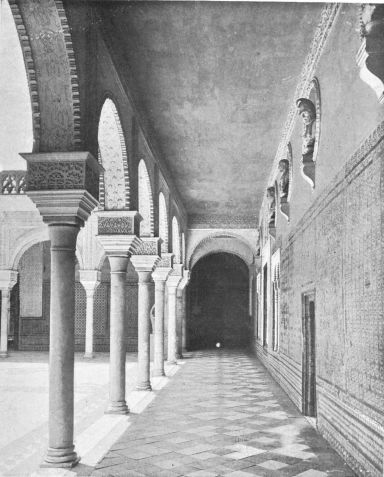
SEVILLE
GALLERY OF THE HOUSE OF PILATOS.
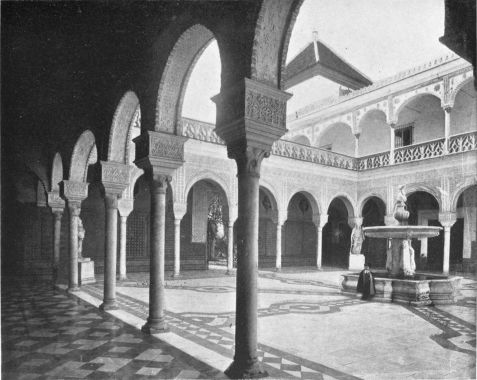
SEVILLE
GALLERY OF THE COURT OF THE HOUSE OF PILATOS.
PLATE XL.
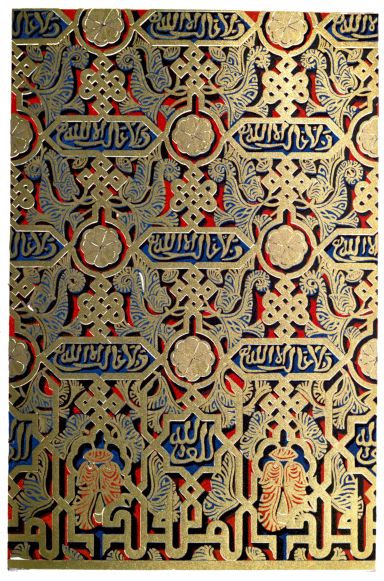
Ornaments on Panels.
Moorish summit was crowned with four brazen balls, so large that in order to get them into the building it was necessary to remove the keystone of a door called the Gate of the Muezzin, leading from the mosque to the interior of the tower. The iron bar, which supported the balls, weighed about ten cwt., and the whole was cast by a celebrated alchemist, a Sicilian, named Abu Leyth, at a cost of £50,000 sterling. These particulars were set down by a Mohammedan writer of the period, and their accuracy was proved in 1395 (157 years after the overthrow of the Arab dominion), when the earthquake threw the entire mechanism, balls and supports, to the ground, where they were weighed, and the figures were found to be absolutely correct. The figure of La Fé, “The Faith,” which now tops the Giralda, was cast by Bartolomé Morel in 1568. It stands fourteen feet high, and weighs twenty-five cwts., yet so wonderful is the workmanship that it turns with every breath of the wind. The head of the female figure is crowned with a Roman helmet, the right hand bears the Labaro, or banner, of Constantine, and in the left it holds out a palm branch, symbolical of conquest.
But when we return from this “strange composite fane,” with its Christian summit surmounting a Moslem tower, which again has its foundations in a Roman temple, when we re-cross the Court of Oranges, with its Moorish fountain, flanked by a Christian pulpit, and enter the cathedral, the mind is transported at a bound from the fairy-like beauties of Morisco ornamentation to the sombre, awe-inspiring majesty, which prompted Theophile Gautier to the reflection that “the most extravagant and monstrously prodigious Hindoo pagodas are not to be mentioned in the same century as the Cathedral of Seville. It is a mountain scooped out, a valley turned topsy-turvy; Notre Dame, at Paris, might walk erect in the middle nave, which is of frightful height; pillars as large round as towers, and which appear so slender that they make you shudder, rise out of the ground, or descend from the vaulted roof, like stalactites in a giant’s grotto.” Lomas, who finds the exterior of the cathedral “simply beneath criticism,” and deplores that “age after age a great band of glorifiers of self, through self’s handiwork, should have been employed in producing what they determined should be a world’s marvel,” is compelled to admit that “the first view of the interior is one of the supreme moments of a lifetime. The glory and majesty of it are almost terrible. No other building, surely, is so fortunate as this in what may be called its presence.” Even George Borrow, who thought more of his beloved testaments than of Spanish monuments erected to “the spiritual tyranny of the Court of Rome,” was feign to declare that it is impossible to wander through the cathedral of Seville “without experiencing sensations of sacred awe and deep astonishment”; and Caveda describes the general effect as “truly majestic.”
The Italian rhapsodist, Edmondo de Amicis, who always succeeds in conveying a strikingly convincing impression of the spectacles that fascinate his sensitive mind, is at his best in his description of Seville cathedral. “At your first entrance,” he says, “you are bewildered, you feel as if you are wandering in an abyss, and for several moments you do nothing but glance around you in that immense space, almost as if to assure yourself that your eyes are not deceiving you, nor your fancy playing you some trick. Then you approach one of the pillars, measure it, and look at the more distant ones, which, though as large as towers, appear so slender that it makes you tremble to think that the building is resting upon them. You traverse them with
PLATE XLI.
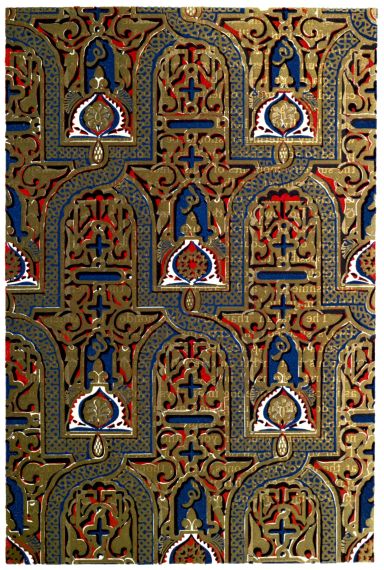
Ornaments on Panels.
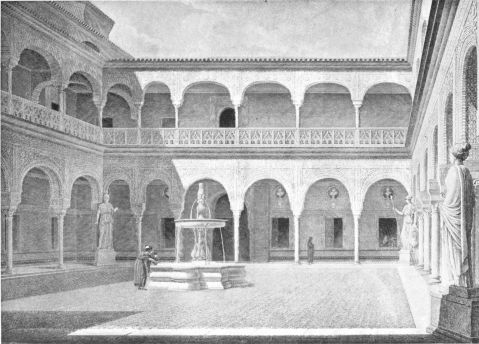
SEVILLE
COURT OF THE PALACE OF MEDINA-CŒLI.
a glance from floor to ceiling, and it seems as if you could almost count the moments it would take for the eye to climb them. There are five aisles, each one of which might form a church. In the centre one, another cathedral, with its cupola and bell tower, could easily stand. All of them together form sixty-eight bold vaulted ceilings, which seem to expand and rise slowly as you look at them. Every thing is enormous in this cathedral. The principal chapel, placed in the centre of the great nave, and almost high enough to touch the ceiling, looks like a chapel built for giant priests, to whose knees the ordinary altars would not reach. The paschal candle seems like the mast of a ship, and the bronze candlestick which holds it, like the pillars of a church. The choir is a museum of sculpture and chiselling. The chapels are worthy of the church, for they contain the masterpieces of sixty-seven sculptors and thirty-eight painters.... The chapel of San Ferdinand, which contains the sepulchres of this king and his wife Beatrice, of Alonso the Wise, the celebrated minister, Florida Blanca, and other illustrious personages, is one of the richest and most beautiful of all. The body of Ferdinand, who redeemed Seville from the dominion of the Arabs, clothed in his uniform, with crown and mantle, rests in a crystal casket, covered with a veil. On one side, is his sword which he carried on the day of his entrance into Seville; on the other, a staff of cane, an emblem of command. In that same chapel is preserved a little ivory Virgin, which the holy king carried to war with him, and other relics of great value.” And here also, although De Amicis makes no mention of them, are the keys of Seville which Abdul Hassan handed to Ferdinand at the surrender of the city. One key is of silver, and bears the inscription, “May Allah grant that Islam may rule for ever in this city.” The other key is made of iron gilt, and is of Mudejar workmanship. It is inscribed, “The King of Kings will open; the King of the Earth will enter.”
In its churches and its old houses, Seville is rich in Moorish influences, and exhibits abundant traces of Morisco art, which prevailed against the material dominancy of the Christian conquerors. The reconciled Arabs who remained as subjects of Ferdinand became the chief of the most lavishly-remunerated artisans of the city. They pursued their craft in the dwellings of the rich; and in the churches of the “infidel.” Untrammelled by religion and uninspired by faith, they worked for art’s sake, and the substantial pecuniary award that sweetened their labours. The church of San Marco has a beautiful Moorish tower built in imitation of the Giralda, and second only to the minaret tower of the cathedral in point of height; San Gil is a Christianised Mezquita; Santa Catalina reveals the survival of Moorish art in its façade, while its principal chapel is Gothic. In nearly all the sacred edifices of antiquity the combination of Moorish and Renaissance architecture betrays an incongruity of style and sentiment which is only to be found among the Christian churches of Spain. And if the Catholic kings, who were sworn to the extirpation of the Moslems, allowed the Moors to build their churches in the style of temples devoted to Allah, it is not surprising that many of the finest private residences of the city retain a Moorish design, and possess a distinctly Oriental atmosphere.
The Casa de Pilatos, which has been pronounced the fourth great monument of older Seville, was commenced in 1500 by Don Pedro Enriquez, in the then popular decadent Saracenic style, and was completed by his son, Fadrique, in imitation of Pilate’s palace at Jerusalem. In accordance with this scheme, he fashioned a reception-hall, called the
PLATE XLII.
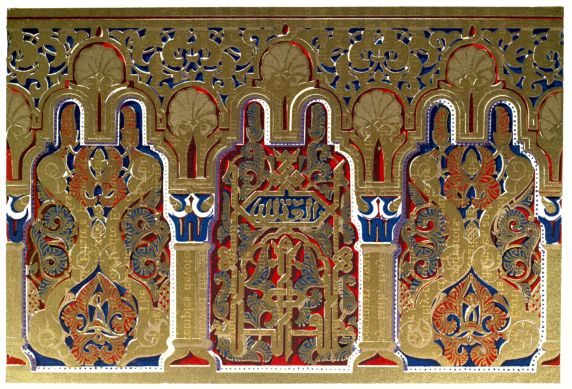
Frieze in the Upper Chamber, House of Sanchez.
Prætorium, erected an upright column—a gift of Pope Pius V.—copied from the pillar at which Christ was scourged, and made a replica of the basin into which the thirty pieces of silver were counted. When the house came into the possession of the first Duke of Alcalá, he was acting as the Spanish viceroy at Naples, and he filled the rooms and corridors with Roman busts and statuary, gathered from Italy and the ruins of Italica. On every side the art treasures of the Romans adorn the perfect Moorish colonnades, and the shadows of Roman sculptures are thrown upon diapered marble pavements from light that enters through Arab lattices and ajimez windows. It has been described as a great curiosity shop, but to the art lover it is a treasure house of almost infinite beauty and variety.
The Moorish palace of the Duke de Alba, in the Calle de las Dueñas, once consisted of eleven courtyards, nine fountains, and more than a hundred marble pillars, and was surrounded by a garden, which is a forest of orange trees and myrtles. In Seville one wanders through streets which are redolent of Arabia, and peep into countless Oriental patios, cool with fountains, and shaded by palms and Eastern canopies. One “feels the East a-calling”—the colour, the scent, the witchery of it gets into one’s blood—and one recognises the truth that inspired the old Spanish saying: “To whom God loves He gives a house in Seville.”