THE LIVERPOOL DOCKS.
Reading edition
We are enabled, after many experiments, to present our readers with a plan of the Liverpool Docks, executed by a new process—namely, by a union of lines cut upon wood, and of moveable type. The completion of our wishes, in this respect, will enable us to illustrate any subject of geography or topography, by maps and plans, executed with more precision than we could have attained by any other means. We subjoin to this plan a short account of these extraordinary public works, which the growing commerce of Liverpool has created:—
The town of Liverpool was originally a small fishing-village, till Henry the Second, in 1172, first used its port as a station for the embarkation of troops to Ireland. This circumstance, with the gradually increasing commerce consequent on the connection ever since maintained between the two countries, and the excellence of its port, doubtlessly laid the foundation of its present magnitude and prosperity. Yet its growth for a long period was slow, and even at times seemed to retrograde. In 1571 the inhabitants of the “poor decayed town of Liverpool” petitioned Queen Elizabeth to be relieved from a subsidy imposed on them; and in 1630, while Bristol was assessed at 1,000l. for ship-money by Charles I., Liverpool was rated at only 26l.
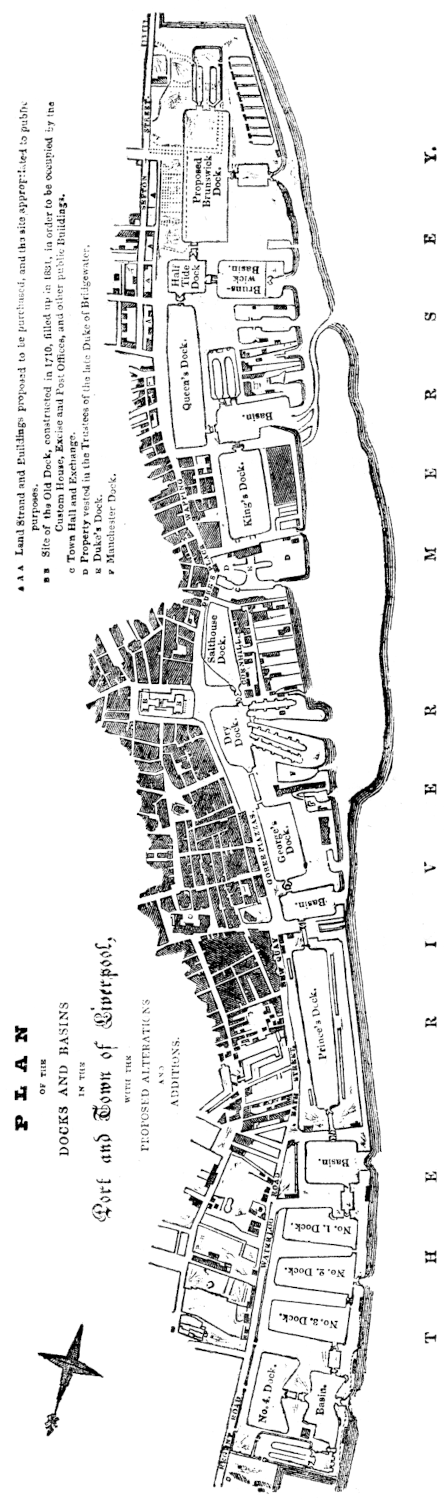
The first great increase which took place in the importance of Liverpool appears to have been shortly after the commencement of the war with France in 1778, in the first year of which one hundred and twenty privateers, manned by eight thousand seven hundred and fifty seamen, issued from this port. Since that period its increase has been constant and wonderfully rapid. The population, which in 1801 was 77,653, in 1831 amounted to 165,175. In the year ending June, 1830, the number of vessels, entered inwards and outwards, amounted to 11,214, of which the tonnage was 1,411,964, and the customs duties 3,123,758l. 8s. 10d. To provide facilities for this immense traffic great exertions have been made, and vast expense incurred, in the construction of docks and the erection of warehouses. 173The plan we have given shows their position; and the following account, extracted from Lewis’s Topographical Dictionary of England, a valuable work recently completed in four quarto volumes, affords such information as may render the plan perfectly intelligible:—
For the security of the shipping in the port, and for the greater facility of loading and unloading merchandize, an immense range of docks and warehouses, extending nearly two miles along the eastern bank of the river (the Mersey), has been constructed on a scale of unparalleled magnificence, and forming one of those characteristics of commercial greatness in which this town is unrivalled. The docks are of three kinds, the wet docks, the dry docks, and the graving docks; the wet docks are chiefly for ships of great burden employed in the foreign trade, and which float in them at all states of the tide, the water being retained by gates; the dry docks, so called because they are left dry when the tide is out, are chiefly appropriated to coasting vessels; and the graving docks, which admit or exclude the water at pleasure, are adapted to the repair of ships, during which they are kept dry, and when completed are floated out by admitting the tide. The Old Dock, which was the first of the kind constructed in England, and for making which, an act of parliament was obtained in 1708, is not now in use, its site having been appropriated to the erection of a new custom-house, and other offices connected with the trade of the port. The Dry Dock, which is about to be converted into a wet dock, was constructed under the authority of an act passed in the 11th of George II., and is chiefly occupied by sloops from the north coast, which import corn, provisions, and slate, and convey back the produce of the West Indies, the Mediterranean, Portugal, and Baltic: it has a quay five hundred yards in length, and has communication with three graving docks; it has been considerably enlarged, and many of the buildings surrounding it have been taken down with the view of obtaining more quay room. The Salthouse Dock, so named from some salt-works formerly contiguous to it, was constructed about the same time as the Dry Dock; the upper part of it is chiefly for ships that are laid up, and the lower part for vessels in the Levant, Irish, and coasting trades; the quay is seven hundred and fifty-nine yards in extent, and is provided with convenient warehouses, with arcades for foot-passengers on the east side, and extensive sheds on the west side; between this dock and the river are some ship-builders’ yards, which the corporation intend to convert into docks for the craft employed in the inland trade. George’s Dock was constructed in the 2d of George III., at an expense of 21,000l.; it was originally two hundred and forty-six yards in length, and one hundred yards in breadth, with a quay of seven hundred yards in extent; but it has been enlarged, and the quay is now one thousand and one yards in length: on the east side is a range of extensive warehouses, in front of which is an arcade for foot-passengers: and on the west side are sheds for protecting the merchandize from the weather: at the north and south ends of the dock are handsome cast-iron bridges; and a parade is continued westward for a considerable distance into the river: this dock has a communication with the two preceding docks, and also with the Prince’s Dock, by basins, which preclude the necessity of returning into the river. The King’s Dock, constructed in the 25th of George III., is two hundred and seventy yards in length, and ninety-six in breadth, and is appropriated to vessels from Virginia and other parts, laden with tobacco, which article is exclusively landed here: the new tobacco warehouses extend the whole length of the quay, on the west side, and are five hundred and seventy-five feet in length, and two hundred and thirty-nine in depth; the old warehouses on the opposite side, which were appropriated to that purpose, have been converted into sheds for the security of merchandize: ships from the Baltic, freighted with timber and naval stores, discharge their cargoes on the quay; across the entrance is a handsome swivel bridge of cast-iron: this dock has a communication on the south with a dry dock and two graving docks. The Queen’s Dock, constructed at the same time, is four hundred and seventy yards long, and two hundred and twenty-seven and a half in breadth, with a spacious quay, and is chiefly occupied by vessels freighted with timber, and by those employed in the Dutch and Baltic trades; at the south end it communicates with a basin of considerable extent, called the Brunswick Half-Tide Dock, which is also connected with the Brunswick Dry Basin. On the south of the half-tide dock, a new dock of larger dimensions 174than any of the preceding, for vessels laden with timber, is in progress, to be called the Brunswick Dock, with a basin to the south of it, and patent slips for the repairing of vessels, which will probably terminate the range of docks at the southern extremity. The Prince’s Dock, constructed under an act passed in the 51st of George III., was opened with great pomp on the day of the coronation of his late Majesty, George IV.; it is five hundred yards in length, and one hundred and six in breadth; at the north end is a spacious basin, belonging to it, and at the south end it communicates with the basin of George’s Dock. The quays are spacious, and there are sheds for the protection of goods from the weather: along the west side, near the river, is a beautiful marine parade, seven hundred and fifty yards long, and eleven wide, defended by a stone parapet wall, from which is a delightful view of the river and the shipping; at convenient intervals are three flights of steps leading down to the river, where boats are in constant attendance. To the north of the basin belonging to this dock, four spacious wet docks, and a large graving dock, which latter is to be fitted up with patent slips, are at present in a state of rapid progress; and, when completed, will probably terminate the range of docks on the north side of the town. The Duke’s Dock, between Salthouse and the King’s Dock, is a small dock belonging to the trustees of the late Duke of Bridgewater, for the use of his flats, with commodious warehouses. The several carriers by water have also convenient basins on the river, for the use of their barges, with quays for loading and unloading their goods; and the Mersey and Irwell navigation company have a small dock, called the Manchester Dock, for the flats employed in that extensive trade, and for the transport to this town of the productions of Cheshire, and the adjoining counties. The whole range of the docks, when the northern and southern additions are completed, will be two miles and eight hundred and twenty yards in length. Spacious as they are they are still considered inadequate to the increasing commerce of the port, and measures are in contemplation for their further extension. The sums expended in the formation of these docks amount to more than two millions sterling; for clearing them from the accumulation of silt brought in by the tide, a dredging-machine, worked by a steam-engine of ten-horse power, is in constant operation, by which fifty tons per hour are raised into barges, and deposited where it may be washed away by the current of the river.
To this we are enabled to add, from an official paper, the following table, showing the area of water and the quantity of quay-space of these splendid docks:—
Area of water in Square Yards. Quay-Space in Lineal Yards.
Dry Basins.
Prince’s Basin 20,909 509
Seacombe Basin 1,805 188
George’s Basin 16,372 455
George’s Ferry Basin 1,344 160
Old Dock Gut 7,737 447
Queen’s Basin 24,391 601
Brunswick Basin 23,622 572
South Ferry Basin 2,927 205
Wet Docks.
Prince’s Dock, with its two locks 57,129 1613
George’s Dock, with its two passages 26,793½ 1001
Dry Dock as altered 19,095 500
Salthouse Dock, with its passage 23,025 759
King’s Dock, with its passage 37,776 875
Queen’s Dock, with its two passages 51,501½ 1255
Half-tide Dock, with its passage 13,185½ 497
New North Works.
No. 1 Dock, with No. 1 Lock, and half of passage 30,764½ 1012
No. 2 Dock, with Entrance-Lock, and half of two passages 29,085½ 839
No. 3 Dock, with No. 2 Lock, and half of passage 33,642½ 1050
No. 4 Dock, with its Lock 29,313 914
Half-tide Basin 17,605 586
New South Docks.
Brunswick Dock, with its passage 60,824 1092
Half-tide Basin 9,245 483
This forms a total of dock-room of one hundred and eleven acres; and the quay-space extends to the length of eight miles, within a few yards. The whole length of the river-wall is two miles, eight hundred and twenty yards, exclusive of the openings.