PREFACE. (continued 2)
Reading edition
When the Vendeans, transported with fury, rushed forward and cut the grenadier down, there was in the air the noise of an approaching hostile column. In the utmost distress the detachment at Nouaillé, to whose command Stofflet now succeeded, enjoined it upon a trusty farmer to bury their chief in a hasty grave. They would not have the grenadier parted from him, that his uniform might be a silent defence against profanation and conceal the identity of Henri, who, stripped of his own insignia, had the enemy’s cap and cockade drawn over his forehead. Thrice were the two moved from pit to pit in the lonely neighborhood a mile or two from Chollet, and always by the loyal, secret, and shrewd hands of the farmer Girard.
Madame de Sapinaud de Bois-Huguet says that the Royalists at large supposed Henri to have been seriously hurt only, and carried to a place of safety, up to the treaty of peace signed by Sapinaud and Charette. This allegation alone would confound the ready rhetoric of the Count of C—— and the “glorious tomb” which never existed. Great confusion as to the date of Henri’s death is found in all contemporary accounts, caused by the prolonged lack of calendars; and uncertainty of the fact itself bewildered those interested without. Henri’s mother knew nothing of her loss until the following summer. Meanwhile Stofflet temporarily carried on energetic operations in his colleague’s name. The rumor of the truth reached Paris slowly, and it bred so great a doubt in Turreau’s mind that he wrote Cordelier to secure proof, by discovering and digging up the body. Thanks to the foresight of others, no such indignity befell what was Henri. But how little Turreau recognized the splendid oblique flattery of this order, which, as Crétineau-Joly remarks, was accorded only once before in history, and then by the Romans to Hannibal!
In 1816, twenty-two years after, by the piety of Mademoiselle Louise de La Rochejaquelein, upheld by the most minute and accurate converging testimony of eye-witnesses, the remains of her brother, easily recognizable by the tall frame and the bullet-hole through the head, were officially disinterred, and laid under the altar of Saint Sebastian, in the old church of Saint Peter at Chollet. And within the year, the centre of a solemn and moving spectacle, borne by his former comrades and the returned exiles of his family, amid the muffled music of the march, the salutation of the Latin liturgy, and the proud rapture of public tears, Henri de La Rochejaquelein was brought home to the parish cemetery of Saint Aubin de Baubigné. He was buried at the right hand of his brother Louis, who, with another Cathelineau and another Charette, had died at his post in June of 1815, just before Waterloo, at the head of the Vendean army raised to oppose the Emperor Napoleon. “Accident,” says Genoude very sweetly, “took upon herself the writing of their epitaphs, and sowed in abundance over their dust what is known as the Achilles-flower.” “That is more touching to me,” adds Madame de Genlis, in a note to the Mémoires of Madame de Bonchamp, “than the legendary laurel which sprung from Virgil’s grave.”
Again, in 1857, all the precious dust in that little tomb was gathered into the vault of the new church near, where Henri lies with very many of his high-hearted kindred; and with the venerated gentlewoman who was his cousin both by her first marriage and by birth, and who became, after his death, his brother’s wife: Victoire de Donnissan, his junior by three months, his dear friend of the camp and the fireside, his survivor of over sixty years. In the still aisle-chapel above them, the rich light of a memorial window slides down on delicate sculptured marbles, through the figures of the dying Maccabees; and around the walls, graven like a triumphal scroll, is the cry of the same Hebrew martyrs that it is far, far better to fall in battle, than to let ruin come upon the things that are holy. The spotless name of La Rochejaquelein must, with the ebb of this century, be withdrawn from among men; but whoso fears for it is not wise. Every villager to-day, passing the low sepulchral outer door between Le Rabot and the inn, affectionately raises his cap, and, walking in the ways of his fathers, forgets not the prayer, which, as some yet think with Sir Thomas Browne, is “more noble than a history.”


HE strength and beauty of the cause vanished with Henri. The war did not end for more than a twelve-month; fresh recruits carried it on with wonderful persistence and pluck, under Charette, still in the Marais, Stofflet in the interior, and the Chouan leaders in Brittany. But towards the close, itself the disciple of accursed experience, it became merely “a war of ruffians, carried on by treachery,” and accomplished in carnage and wrath; its last flutter on Quiberon sands, its last allaying, far gentler than any anticipation of it, from the steady hand of General Hoche.
“So quick bright things come to confusion!”
The Vendean captains were patriots, as is well said in the preface to Mr. George J. Hill’s admirable little book, “whose patria was not of this world,” Cathelineau, with his thirty-six kinsmen, Bonchamp and Lescure, gloriously perished while yet hope was high; D’Elbée, in a sick-chair in his own garden, laden with abuse, and bearing himself gallantly, was shot at Noirmoutiers; Mondyon and other faithful youths “died into life” at Angers, bound in couples like dogs; Stofflet paid the wages of his exceeding loyalty in the same rocky town; Bernard de Marigny was cut off in his prime by the acquiescence of Stofflet, who was under an evil influence, and by the orders of Charette, to the bitter sorrow, afterwards, of the former; Charette himself, having made terms to his advantage in March of 1795, at Nantes, and renewing hostilities for what he thought to be sufficient cause, though offered a thousand pounds and free passage to England for his good-will, kept up to the last the unequal struggle with Travot, and, closing a career of signal splendor, was taken and put to death, lion-stanch, with a salute to the King upon his lips. As soon as his grave was dug, General Hoche withdrew his forces. The war was finished.
It is the word of homage to be spoken of the Vendeans, that they fought long with honor and with pity, in the face of unnameable brutality and treachery. During the first Royalist occupation of Chollet, when it was for a while Cathelineau’s gay and free little capital, full of festivity and transient peace, the public treasury, known to be packed, was not touched. Tributes to facts of this kind are to be gathered from the pages of every hostile or neutral annalist. And Madame de La Rochejaquelein recalled, for the amusement of another generation, her own amusement at Bressuire in 1793, when the rueful masters of the situation complained to her that they had no money to buy tobacco, it never having occurred to them to seize it in the shops! It is clear that persons who so scrupled to appropriate the goods the gods provided, were not destined easily to become experts in wanton slaughter, which relieved no need of their honest stomachs. The Republicans began their business at once with the master-stroke of homicide, and forecasted the immortal axiom of De Quincey, that when once a man indulges in murder he soon gets to think little of robbing and lying, of drinking and Sabbath-breaking, and even of incivility and procrastination. But in La Vendée they had a breed of misgiving hearts. Marigny, indeed, mild and brotherly towards his own, was as a demon towards his foes; Charette, the very Charette who had put a stop to the cruelties of Souchu at the beginning, was, with D’Elbée, the first to sanction reprisals. But Cathelineau, Bonchamp, Lescure, La Rochejaquelein and priests innumerable stood then, and stand always, ranged on the side of Christ-like charity.
To any student of the great Revolution not much need be said of the unequal exchange of grim attentions. The Blues outdid themselves on Vendean territory. Arrest, with them, meant an immediate commission to explore the spheres. The burials alive at Clisson, the holocaust at Vezins, the atrocities in the wood of Blanche Couronne, the week-long fusillade at Savenay, Westermann’s thousands shot at Angers, Carrier’s drowned at Nantes, the hellish policy of Commaire, Crignon, Amey, Dufour—these were the things which crazed the gentler rebels until they, too, learned to throw forgiveness by, as a coin hollow and vile. In May of 1794, Vimeux, then in command, went to lay their country waste. Only Victor Hugo’s pen could fitly portray the results. The Convention desired report of a landscape without a man, without a house, without a tree; in due season they had it, true to the letter. It was Westermann’s boast to the Committee of Public Safety that he had crushed the children under the horses’ hoofs, and massacred the women, who should bring forth no more “brigands;” that not a prisoner could be laid to his charge, for he had exterminated them; that La Vendée was heaped, like the pyramids, with bodies. At Rennes the children were made to fire upon their parents: it was a novel, awkward, and lengthy proceeding, entirely to the minds of its originators. At Savenay, hundreds were lured under cover by a promise of amnesty, and as they entered, they were shot down. An adjutant was brought to La Rochejaquelein, during the last days of his life, in whose pocket was an order to repeat this brilliant joke. During that January, also, at Barbastre, fifteen hundred insurgents capitulated, and were cheated in the same way. What wonder if, outside Laval, with horror on horror bruited in their ears, the peasants destroyed a whole battalion of Mayence men who were laying down their arms? But after, marching on Angers from Antrain, they sent to Rennes one hundred and fifty prisoners, with the significant message that this was the sort of vengeance taken by choice for old injuries. It was the work of the kindly incumbent of Sainte-Marie-de-Rhé. On the morning of this release, Monsieur de Hargues, for whom Henri (who had once a hot quarrel with him) interceded passionately, mounted the scaffold. For the bitter deeds of Souchu at Machecould the army did voluntary penance. Until it was practically disorganized, it did not sin in the same way again. We are aware how pretty a burlesque between nominal captor and captives came off at Bressuire. And in Thouars, Fontenay, and many towns like them, inhabited by Republicans and revolutionists who trembled for their fate, no violence whatever was wreaked.
A truly humorous retaliation was made, at the suggestion of the Marquis of Donnissan, at Fontenay. There were four thousand prisoners, and no forts nor cells to hold them. Should they be loosed they could not be trusted on parole. (What a thing for Frenchmen to know of Frenchmen!) To solve the difficulty their heads were shaved, so that if during the following weeks they again attempted to fight, they might be caught and punished. The wild barbers had infinite entertainment out of this circumstance. La Rochejaquelein’s clemency was a proverb. He waived the very show of superiority, as when, at Bois-Grolleau, he made Tribert keep his proferred sword. As one who had accepted beforehand the painfulest surprises of fate, he heard of the destruction of La Durbellière without a sigh. Precisely the same danger which proved fatal to him, having rehearsed itself before him early in his career, and the pistol having missed fire, the marksman flung himself at his feet, crying out that he could now have his satisfaction. “That is to let thee live,” was the Alexander-like reply, made over and over to those who thus fell into his power. He was destined to perish through his belief in the honor of others. The best acknowledgment of the influence which he had upon his headstrong band, was that although they slew, in his absence, the Republican officer who led the first raid upon his homestead, yet, when he was murdered by the hand of one of the two grenadiers, they spared the man who had not fired, because he had been offered mercy in Henri’s last spoken word. The Marigny, who bore to his imminent misfortune the surname of an active Royalist, was so charmed with the spirited behavior of Richard Duplessis, made captive at the siege of Angers, that he sent him back under escort to his own lines. La Rochejaquelein, never to be outdone in a handsome service, instantly freed two dragoons, with their arms, thanking him, and offering him, in the future, an exchange of any two prisoners for his one. “This was the only Republican general,” adds Madame de Lescure, “who had been wont to show us any humanity: he was killed that very day.” Marceau and Quétineau, both scrupulously fair, deserve to share this mention of Bouin de Marigny. And to Kléber and Hoche, the knightliest of foemen, no acknowledgment would be too great.
Lescure himself was the consummate type of the early Christian: so tolerant, so self-controlling, that to be able to impute one vicious deed to him would be a gratification. “The Saint of Poitou,” however, was once known to swear steadily for several minutes. An enemy, in action, having cocked a pistol within a rod of his menaced head, Lescure, fearless and quick, dislodged the barrel with a swing of his sword, and told the astonished invader to go free. The Poitevins behind had a mind of their own on the subject, and presently cut the bold Blue to pieces. When the general learned how he had been obeyed, his rage was something to be remembered. This was the aristocrat who, when his ancestral halls were razed to the ground, would not burn Parthenay, which he had taken, not only lest it should be, on his part, a revenge for Clisson, but lest, being a precaution merely, it should disedify by having the look of a revenge! And it is a curious instance of the “governance of blood” in his most lovely character, that although he was invariably in the thickest of the fight, his hand inflicted no wilful wound throughout the war, and that to his personal interference no fewer than twenty thousand owed their lives. Again, at the crossing of the Loire, in an hour of unexampled perplexity, between five and six thousand captives were in the hands of the migrating army, and shut in the Benedictine Abbey church, which still tops the crescent-shaped heights of Saint Florent-le-Vieil. There could be no question of transporting them; the simplest expedient was to destroy them. Nor was this proposal made in cold blood, for the Marquis of Bonchamp was dying young from the last of many wounds, “for the sacred cause of the lilies,” and his troops were in a frenzy of excitement and grief. Not an officer could be found to give the revolting order. The men had the guns already pointed at the doors, and the slaughter was about to begin, when Bonchamp, apprised of what was pending, with his last breath commanded, as he had done before at Pallet, that the Blues should be spared. From the house where he lay the echo rolled along the crowd: “Quarter for the prisoners; quarter! It is Bonchamp’s order!” They were delivered. With the genuine Gallic sense of the apportioning of things, Bonchamp’s gracious valedictory is inscribed upon his tomb, lifting its glorious outlines to-day in the transept of that very church, and bearing, in a free-will offering, the name of the sculptor, David d’Angers, whose father was among the ransomed soldiery. As to the amnesty, the Convention, guided by the advice of Merlin de Thionville, growled over it. “Freemen accept their lives from slaves! ’Tis against the spirit of the Revolution.... Consign the unfortunate affair to oblivion.” There was different speech in the Temple. “Capet!” said the brute Simon to the wretched little King, when the news came of the crossing of the Loire, “if the Vendeans deliver you, what will you do first?” “Forgive you!” replied the child.
La Vendée, forbearing wrong, and seeking after righteousness, has no mean martyrology. What people in the modern world so sweetly rival the holy race of whom it is said in the Pharsalia that they hurried on their own extermination, and, brimming with life, spilled it as a libation to the gods? But since these others were not pagan, there is a yet more endearing and more becoming word: “Æterna fac cum sanctis tuis in gloria numerari!”
T is a brief and moving story, and it is over. Small comment is to be made at any time, on promise cut short, on the burning of Apollo’s laurel-bough. La Rochejaquelein of Poitou, with his goodness, genius, health, breeding, wealth, and beauty—who in his day would have measured for him the renown which seemed so nigh and so wide? And the first reward of that fine heart and brain was a wild grave in the grassy trenches with the assassin; no dues, no amends, no appeal, beyond that piteous ending. He was a boy, rash and romantic, as boys are, and so pyrotechnically French that some must smile at him. His chivalry went to the upholding of kings; all he did has a sole value of loyalty, and the application of it is open to dispute. But his spirit, disentangled from old circumstances of action, is that which helps humanity towards the dawn, and sets oppressions aside with bad by-gone dreams; a spirit infinitely suggestive and generative, then and now a durable sign of hope.
It is difficult to account for the halo which gathers about such heads, and stays, to make of a sometime aimless intelligence a vision of extreme force and charm to the youth of his own land. Nor ought we try to account for it. Henri de La Rochejacquelein is one with whom statistics and theories have distant dealings. He is a fond incongruity, a compliment to human nature almost as great as it can bear. He has precisely the look, language, and physical radiance of the demigods: we infer how, from his counterparts, the early myths grew. Wherever there is a liberal air, and discipline, behold, the demigods are again; and the senses no longer boggle at them. They rise often, and repeat one another, preaching affirmation, and inclining us to allow that what Greece and Japan have had, England has, Alaska and the Congo shall have. Stress must be laid upon heroes: they are the universal premise. Like Emerson’s stars, they “light the world with their admonishing smile;” they warn us, if we will not adore, at least not to deny that they shine forever.
Among Henri de La Rochejacquelein’s peers there were those who would have been men of weight and of mark in any career. But perhaps he, more sensitive and solitary, had no such adaptabilities to bear him out. He was not twenty-two when the dark curtain was rung down upon him. To regret it, is to show small appreciation of the masterly consistency which Fate sometimes allows herself. No spectator of the little drama enacted within the Revolution can forget how dominant, distinct, unrepeated, this artful image of Henri burns itself in upon the memory. To wish him age and a competency were superstition. Mark how, even in her hasty finishing touches, Nature did not bungle with him. She rounds out her white ideal. She leaves us convinced that living a span, and dying in the hurly-burly, he best fulfilled himself. He is placed in an allotted light perfectly kind to him, perfectly soft and clear to the looker-on.
Virtually, what did he amount to? What testimony of him is left? To the man of facts, who asks the questions, the answers are: Nothing and None. There is a laconic apology in the Spanish Gypsy:
“The greatest gift the hero leaves his race Is to have been a hero.”
Such a one makes a jest of values; he has the freedom of every city; he need pay no taxes; he cripples criticism; he can do without a character; theology itself will not exact faith and good works from him. This Henri lived with his whole soul. His interest to us now is that he blazed with genuine fire, and played no tricks with his individuality. Among the serious war-worn leaders of the insurrection he stands, a fairy prince, with a bright absurd glamour. Never was anybody more like the fiction of an artist’s brain. He is all that children look for in a tale, and he has no moral. He is the embodiment of “l’inexplicable Vendée.”
He was made to despatch this world, like an errand or a game. He had no sovereign interests here of his own; rather was he his brother’s keeper. A sort of rich unreason shot him past the work, the musing, the sight-seeing for self, and the pleasant banquets over which men linger. Careless for the making of a name, for the gain of experience, even for the duty of prolonging his usefulness, he chose the first course which he believed honorable, and to which he could give his heart; and so stumbled on death. The war had a thousand sanctions in his eyes. His enlisting was honest and humble. If he flashed into the most unexampled comet-like activity before he had been long apprenticed, it was merely that he warmed with the motion, that he felt sure at last of himself, and so blazoned abroad his content and comprehension of life. He is less flesh and blood than a magnificent quibble for all the philosophies of the cold schools. He represents, in the economy of things, the waste which is thrift, the daring which is prudence, the folly which is wisdom ineffable.
Despite the white heat of enthusiasm, which is apt to singe the susceptibilities of others, his, at least, was a modest, merry, and balanced mind. Ranked as he will be always with his Cathelineau, Bonchamp, and Lescure, he differs sharply from them: that is, he was farther from a saint or a conventional hero. None the less is he a type of young French manhood ere it had grown wholly modern and complex; the last of a single-minded race, soldiers by accident, helpers and servers of men by choice. In short, he was a Vendean, behind his century in shrewdness, ahead of it in joy; a straggler from the pageant of the ancestral crusaders, having all the thirst for justice, the rational gayety, the boyish bel air of the sworded squires of the Middle Ages. A phrase meant for Sidney will grace him: “God hath disdeigned the worlde of this most noble Spirit.” Let him ride ever now in memory, a beardless knight erect upon Fallowdeer, his white scarf around him, the nodding cockade of his foes behind; women watching his lips for comfort and assurance, the happy Hermenée prattling between his knees; beautiful indeed, even in the smoke of war, with his oval face, his hale and winning aspect, his terse speech and candid ways; not the Count nor the General La Rochejaquelein, but “Master Henry, a hard hitter and a dear fellow,” as his compatriots knew him, and as Froissart, his fittest chronicler, might have loved him.
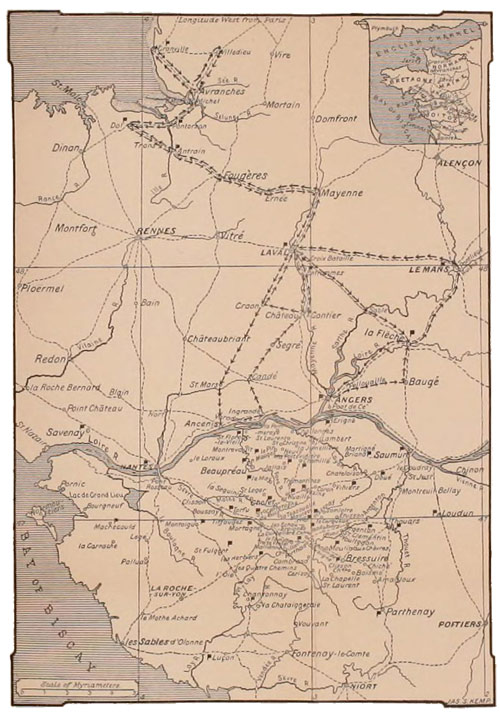
CHART ON A REDUCED SCALE OF VENDÉE MILITAIRE.
Larger image
Transcriber’s Note:
Spelling has been retained as used in the original publication, including both Rochejaquelein and Rochejacquelein and possible typographical errors.