LIST OF FULL-PAGE ILLUSTRATIONS. (continued 2)
Reading edition
"What does it mean?" asked the new doll.
"Vocabulary?" cried the Unwiseman. "Vocabulary? Don't you know what a vocabulary is?"
"I know," said Whistlebinkie. "It's an animal with an hump on its back."
"Nonsense," said the Unwiseman. "A vocabulary is nothing of the sort. It's a—a sort of little bureau talkers have to keep their words in. It's a sort of word-cabinet. I haven't really got one, but that's because I don't need one. I have so few words I can carry them in my head, and if I can't, I jot them down on a piece of paper. It's a splendid idea, that. It's helped me lots of times in conversation. I'm as fond of the word microcosm as I am of vocabulary, too, but I never can remember it, so I keep it on a piece of paper in my vest-pocket. Whenever I want to use it, I know just where to find it."
"And what does microcosm mean?" asked Mollie.
"I don't know," said the Unwiseman; "but few people do; and if I use it, not one person in a thousand would dare take me up, so I just sprinkle it around to suit myself."
As the Unwiseman spoke, the postman came to the door with a letter.
"Ah!" said the Unwiseman, opening it and reading it. "I am sorry to say that I must leave you now. I have an engagement with my hatter this afternoon, and if I don't go now he will be much disappointed."
"Is that letter from him?" asked Mollie.
"Oh no," said the Unwiseman, putting on his coat. "It is from myself. I thought about the engagement last night, and fearing that I might forget it I wrote a short note to myself reminding me of it. This is the note. Good-bye."
"Good-bye," said Mollie, and then, as the Unwiseman went off to meet his hatter, she and the others deemed it best to go home.
"But why did he say he expected you to call and then seemed surprised to see you?" asked the new doll.
"Oh—that's his way," said Mollie. "You'll get used to it in time."
But the new doll never did, for she was a proud wax-doll, and never learned to love the Unwiseman as I do for his sweet simplicity and never-ending good nature.
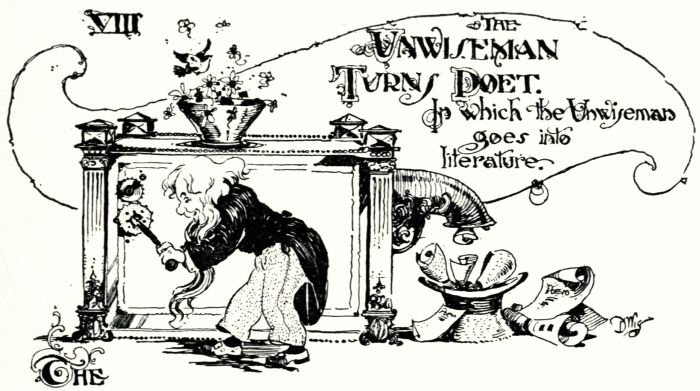
ground was white with snow when Mollie awakened from a night of pleasant dreams. The sun shone brightly, and as the little girl looked out of her bed-room window it seemed to her as if the world looked like a great wedding-cake, and she was very much inclined to go out of doors and cut a slice out of it and gobble it up, just as if it were a wedding-cake and not a world.
Whistlebinkie agreed with her that that was the thing to do, but there were music-lessons and a little reading to be done before Mollie could hope to venture out, and as for Whistlebinkie, he was afraid to go out alone for fear of getting his whistle clogged up with snow. Consequently it was not until after luncheon that the two inseparable companions, accompanied by Mollie's new dog, Gyp, managed to get out of doors.
"Isn't it fine!" cried Mollie, as the snow crunched musically under her feet.
"Tsplendid!" whistled Whistlebinkie.
Gyp took a roll in the snow and gleefully barked to show that he too thought it wasn't half bad.
"I wonder what the Unwiseman is doing this morning," said Mollie, after they had romped about for some little while.
"I dare say he is throwing snow-balls at himself," said Whistlebinkie. "That's about as absurd a thing as any one can do, and he can always be counted upon to be doing things that haven't much sense to 'em."
"I've half a mind to go and see what he's doing," said Mollie.
"Let's," ejaculated Whistlebinkie, and Gyp indicated that he was ready for the call by rushing pell-mell over the snow-encrusted lawn in the direction of the spot where the Unwiseman's house had last stood.
"Gyp hasn't learned that the Unwiseman moves his house about every day," said Mollie.
"Dogs haven't much sense," observed Whistlebinkie, with a superior air. "It takes them a long time to learn things, and they can't whistle."
"That they haven't," came a voice from behind Whistlebinkie. "That little beast has destroyed eight lines of my poem with his horrid paws."
Mollie turned about quickly and there was the house of the Unwiseman, and sitting on the door-step was no less a person than the old gentleman himself, gazing ruefully at some rough, irregular lines which he had traced in the snow with a stick, and which were punctuated here and there by what were unmistakably the paw-marks of Gyp.
"Why—hullo!" said Mollie; "moved your house over here, have you?"
"Yes," replied the Unwiseman. "There is so much snow on the ground that I was afraid it would prevent your coming to see me if I let the house stay where it was, and I wanted to see you very much."
"It was very thoughtful of you," said Mollie.
"Yes; but I can't help that, you know," said the Unwiseman. "I've got to be thoughtful in my new business. Thoughts and snow and a stick are things I can't get along without, seeing that I haven't a slate or pen, ink and paper, in the house."
"You've got a new business, then, have you?" said Mollie.
"Yes," the Unwiseman answered. "I had to have. When the Christmas toy business failed I cast about to find some other that would pay for my eclaires. My friend the hatter wanted me to go in with him, but when I found out what he wanted me to do I gave it up."
"What did he want you to do?" asked Mollie.
"Why, there is a restaurant next door to his place where two or three hundred men went to get their lunch every day," said the Unwiseman. "He wanted me to go in there and carelessly knock their hats off the pegs and step on them and spoil them, so that they'd have to call in at his shop and buy new ones. My salary was to be fifteen a week."
"Fifteen dollars?" whistled Whistlebinkie in amazement, for to him fifteen dollars was a princely sum.
"No," returned the Unwiseman. "Fifteen eclaires, and I was to do my own fighting with the ones whose hats were spoiled. That wouldn't pay, because before the end of the week I'd be in the hospital, and I am told that people in hospitals are not allowed to eat eclaires."
"And so you declined to go into that business?" asked Mollie.
"Exactly," returned the Unwiseman. "I felt very badly on my way back home, too. I had hoped that the hatter wanted to employ me as a demonstrator."
"A what?" cried Whistlebinkie.
"A demonstrator."
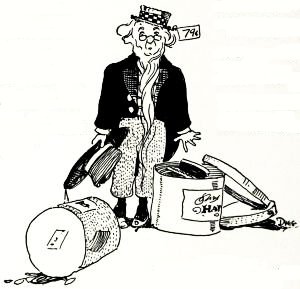
"A demonstrator," repeated the Unwiseman. "A demonstrator is one who demonstrates—a sort of a show-man. In the hat business he would be a man who should put on new styles of hats so as to show people how people looked in them. I suggested that to the hatter, but he said no, it wouldn't do. It would make customers hopeless. They couldn't hope to look as well in his hats as I would, and so they wouldn't buy them; and as he wasn't in the hat trade for pleasure, he didn't feel that he could afford a demonstrator like me."
"And what did you do then?" asked Mollie.
"I was so upset that I got on board of a horse-car to ride home, forgetting that the horse-cars all ran the other way and that I hadn't five cents in my pocket. That came out all right though. I didn't have to walk any further," said the Unwiseman. "The conductor was so mad when he found out that I couldn't pay my fare that he turned the car around and took me back to the hatter's again, where I'd got on. It was a great joke, but he never saw it."
And the Unwiseman roared with laughter as he thought of the joke on the conductor, and between you and me, I don't blame him.
"Well, I got home finally, and was just about to throw myself down with my head out of the window to weep when I had an idea," continued the Unwiseman.
"With your head out of the window?" echoed Mollie. "What on earth was that for?"
"I always weep out of the window."
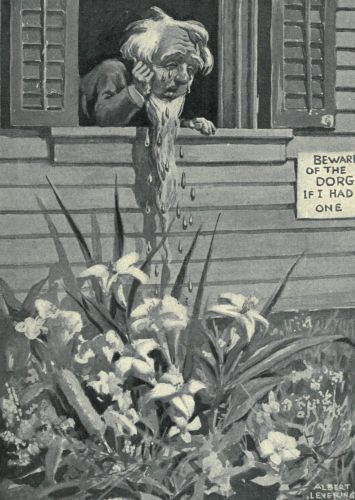
"So that my tears wouldn't fall on the carpet, of course," returned the Unwiseman. "What else? I always weep out of the window. There isn't any use of my dampening the house up and getting rheumatism just because it happens to be easier to weep indoors. When you're as old as I am, you have to be careful how you expose yourself to dampness. Rheumatism might be fun for you, because you can stay home from school, and be petted while you have it, but for me it's a very serious matter. I had it so bad once I couldn't lean my elbow on the dinner-table, and it spoiled all the pleasure of dining."
"Well—go on and tell us what your idea was," said Mollie, with difficulty repressing a smile. "Are you going to patent your scheme of weeping through a window?"
"No, indeed," said the Unwiseman. "I'm willing to let the world have the benefit of my discoveries, and, besides, patenting things costs money, and you have to send in a model of your invention. I can't afford to build a house and employ a man to cry through a window just to supply the government with a model. My idea was this. As my tears fell to the ground my ears and nose got very cold—almost froze, in fact. There was the scheme in a nutshell. Tears rhyme with ears, nose with froze. Why not write rhymes for the comic papers?"
"Oho!" said Mollie; "I see. You are going to be a poet."
"That's the idea," said the Unwiseman. "There's heaps of money in it. I know a man who gets a dollar a yard for writing poetry. If I can write ten yards of it a week I shall make eight dollars anyhow, and maybe ten. All shop-keepers calculate to have remnants of their stock left over, and I've allowed two yards out of every ten for remnants. The chief trouble I have is in finding writing materials. I haven't any pen and ink; I don't own any slates; the only paper I have in the house is the wall paper and a newspaper, and I can't use them, because the wall paper is covered with flowers and the newspaper is where I get my ideas—besides, it's all the library I've got. I didn't know what to do until this morning when I got up and found the ground all covered with snow. Then it came to me all of a sudden, why not get a stick and write your poems on the snow, and then maybe, if you have luck, you call sell them before the thaw. I dressed hurriedly and hastened downstairs, moved the house up near yours, so that I'd be near you and be sure to see you, feeling confident that you could get your papa to come out and see the poems and maybe buy them for his paper. Before long I had written thirty yards of poetry, and just as I had finished what I thought was a fair day's work, up comes that horrid Gyp and prances the whole thing into nothing."
"Dear me!" said Whistlebinkie. "That was too bad."
"Wasn't it!" sighed the Unwiseman. "It was such a beautifully long poem—and what's more, it isn't easy work. It's almost as hard as shoveling snow, only, of course, you get better pay for it."
"You can rewrite it, can't you?" asked Mollie, gazing sadly at the havoc Gyp had wrought in the Unwiseman's work.
"I am afraid not," said the Unwiseman. "My disappointment has driven it quite out of my head. I can only remember the title."
"What did you call it?" asked Mollie.
"A Poem, by Me."
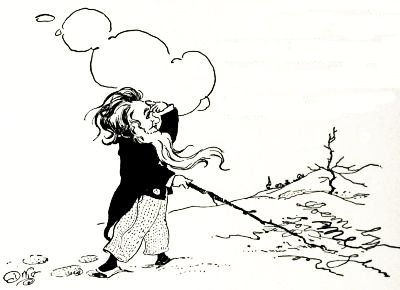
"It was a simple little title," replied the Unwiseman. "It was called 'A Poem, by Me.'"
"And what was it about?" asked Mollie.
"About six hundred verses," said the Unwiseman; "and not one of 'em has escaped that dog. Those that he hasn't spoiled with his paws he has wagged his tail on, and he chose the best one of the lot to lie on his back and wiggle on. It's very discouraging."
"I'm very sorry," said Mollie; "and if you want me to I'll punish Gyp."
"What good would that do me?" queried the Unwiseman. "If chaining him up would restore even half the poem, I'd say go ahead and chain him up; but it won't. The poem's gone, and there's nothing left for me to do but go in the house and stick my head out of the window and cry."
"Perhaps you can write another poem," said Mollie.
"That's true—I hadn't thought of that," said the Unwiseman. "But I don't think I'd better to-day. I've lost more money by the destruction of that first poem than I can afford. If I should have another ruined to-day, I'd be bankrupt."
"Well, I'll tell you what I'll do," said Mollie. "I'll ask papa to let me give you a lead-pencil and a pad to write your next poem on. How will that do?"
"I should be very grateful," said the Unwiseman; "and if with these he could give me a few dozen ideas and a rhyming dictionary it would be a great help."
"I'll ask him," said Mollie. "I'll ask him right away, and I haven't any doubt that he'll say yes, because he always gives me things I want if they aren't harmful."
"Very well," said the Unwiseman. "And you may tell him for me, Miss Whistlebinkie, that I'll show him how grateful I am to him and to you for your kind assistance by letting him have the first thousand yards of poetry I write for his paper at fifty cents a yard, which is just half what I shall make other people pay for them."
And so Mollie and Whistlebinkie bade the Unwiseman good-by for the time being, and went home. As Mollie had predicted, her father was very glad to give her the pencil and the pad and a rhyming dictionary; but as he had no ideas to spare at the moment he had to deny the little maid that part of the request.
The Unwiseman becomes a poet.
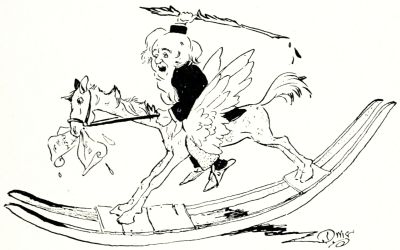
What the Unwiseman did with the pad and the pencil and the dictionary I shall tell you in the next chapter.
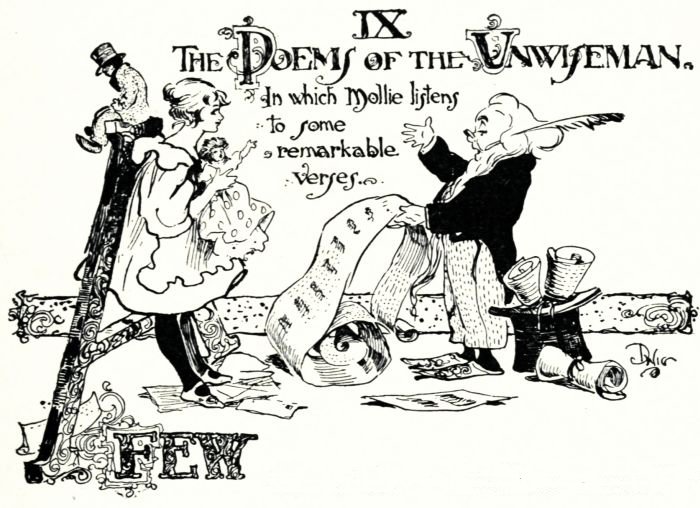
days after he had received the pencil and pad and rhyming dictionary from Mollie, the Unwiseman wrote to his little benefactress and asked her to visit him as soon as she could.
"I've written eight pounds of poetry!"
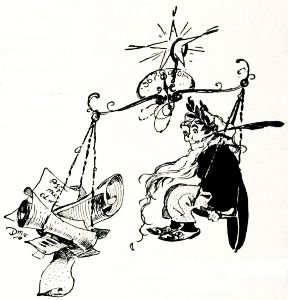
"I've written eight pounds of poetry," he said in his letter, "and I'd like to know what you think of some of it. I've given up the idea of selling it by the yard because it uses up so much paper, and I'm going to put it out at a dollar a pound. If you wouldn't mind, I'd like to have you tell your papa about this and ask him if he hasn't any heavier paper than the lot he sent me. If he could let me have a million sheets of paper twice as heavy as the other I could write a pound of sonnits in half the time, and could accordingly afford to give them to him a little cheaper for use in his newspaper. I'd have been up to see you last night, but somehow or other my house got moved out to Illinois, which was too far away. It is back again in New York this morning, however, so that you won't find any trouble in getting him to see the poetry, and, by the way, while I think of it, I wish you'd ask your papa if Illinois rhymes with boy or boys. I want to write a poem about Illinois, but I don't know whether to begin it with
"'O, the boys, Of Illinois, They utterly upset my equipoise'; "'O, thou boy, Of Illinois! My peace of mind thou dust destroy?'
"You see, my dear, it is important to know at the start whether you are writing about one boy or several boys; and that rhyming dictionary you sent me doesn't say anything about such a contiguity. You might ask him, too, what is the meaning of contiguity. It's a word I admire, and I want to work it in somewhere where it will not only look well, but make a certain amount of sense.
"Yoors tooly, "Me."
It was hardly to be expected, after an invitation of this sort, that Mollie should delay visiting the Unwiseman for an instant, so summoning Whistlebinkie and Gyp, she and her two little friends started out, and ere long they caught sight of the Unwiseman's house, standing on one corner of the village square, and in front of it was a peculiar looking booth, something like a banana-stand in its general outlines. This was covered from top to bottom with placards, which filled Mollie with uncontrollable mirth, when she saw what was printed on them. Here is what some of them said:
GO TO ME'S FOR POTERY.
This was the most prominent of the placards, and was nailed to the top of the booth. On the right side of this was:
LISENSED TO SELL SONNITS
ON THE PREMISSES.
Off to the left, printed in red crayon, the curious old man had tacked this:
EPIKS WROTE WHILE
YOU WEIGHT.
Besides these signs, on the counter of this little stand were arranged a dozen or more piles of manuscript, and behind each of these piles were short sticks holding up small cards marked "five cents an ounce," "ten cents a pound," and back of all a larger card, which read:
SPESHUL DISSCOUNTS TO ALL
COSTUMERS ORDERING
BY THE TUN.
"This looks like business," said Whistlebinkie.
"Yes," said Mollie, with a laugh. "Like the peanut business."
Gyp said nothing for a moment, but after sniffing it all over began to growl at a placard at the base of the stand on which was drawn by the Unwiseman's unmistakable hand the picture of two small dogs playing together with a line to this effect:
DOGGERELL A SPESHIALITY.
As Mollie and Whistlebinkie were reading these signs the door of the Unwiseman's house was opened and the proprietor appeared. He smiled pleasantly when he saw who his visitors were, although if Mollie had been close enough to him to hear it she might have noticed that he gave a little sigh.
"I didn't recognize you at first," he said; "I thought you might be customers, and I delayed coming out so that you wouldn't think I was too anxious to sell my wares. Of course, I am very anxious to sell 'em, but it don't do to let the public know that. Let 'em understand that you are willing to sell and they'll very likely buy; but if you come tumbling out of your house pell-mell every time anybody stops to see what you've got they'll think maybe you aren't well off, and they'll either beat you down or not buy at all."
"Aren't you afraid of being robbed though?" Mollie asked.
"The newspapers would be full of it."
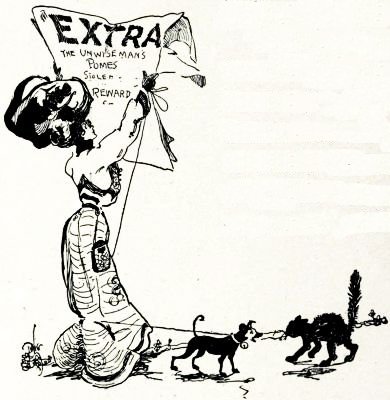
"Oh, I wouldn't mind being robbed," replied the Unwiseman. "It would be a good thing for me if somebody would steal a pound or two of my poems. That would advertise my business. I can't afford to advertise my business, but if I should be robbed it would be news, and, of course, the newspapers would be full of it. Your father doesn't know of any kind-hearted burglar who's temporarily out of work who'd be willing to rob a poor man without charge does he?"
"No," said Mollie, "I don't think papa knows any burglars at all. We have literary men, and editors, and men like that visiting the house all the time, but so far we haven't had any burglars."
"Well, I suppose I'll have to trust to luck for 'em," sighed the Unwiseman; "though it would be a great thing if an extra should come out with great big black headlines, and newsboys yelling 'em out all over the country, 'The Unwiseman's Potery Stand Visited by Burglars! Eight Pounds of Triolets Missing! The Police on the Track of the Plunderers!'"
"It would be a splendid advertisement," said Mollie. "But I'm afraid you'll be a long time getting it. Have you any poems to show me?"
"Yes," said the Unwiseman, running his eye over his stock. "Yes, indeed, I have. Here's one I like very much. Shall I read it to you?"
"Yes, if you will," said Mollie. "What is it about?"
"It's about three dozen to the pound, the way I weigh it," replied the Unwiseman. "It's called 'My Wish, and Why I Wish It.'"
"That's an awfully long name, isn't it?" said Mollie.
The unwiseman reads his poem, "My wish and why I wished it."
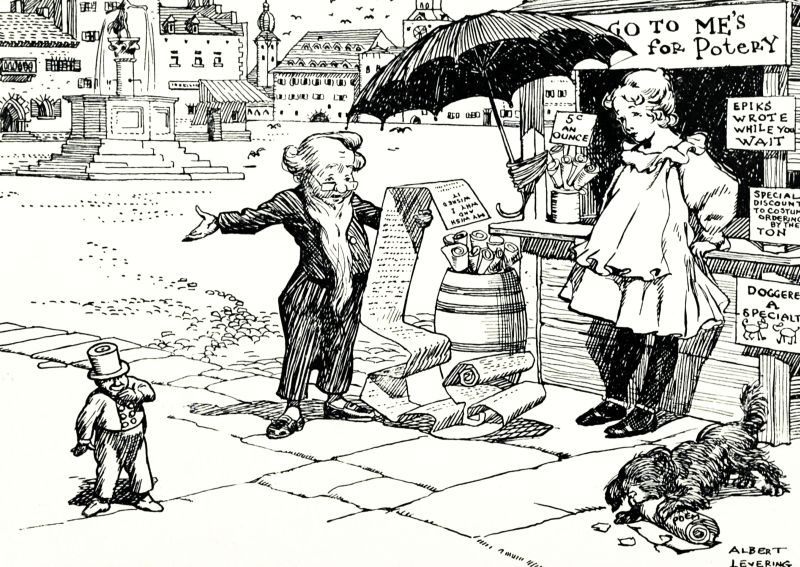
"Yes, but it makes the poem a little heavier," replied the old man. "I've made up a little for its length, too, by making the poem short. It's only a quartrain. Here's how it goes:
"I wish the sun would shine at night, Instead of in the day, dear, For that would make the evenings bright, And day time would be shadier!"
"Why, that isn't bad!" cried Mollie.
"No," returned the Unwiseman. "I didn't try to make it bad, though I could have if I'd wanted to. But there's a great thing about the thought in that poem, and if you'll only look into it you'll see how wonderful it is. It can be used over and over again without anybody's ever noticing that it's been used before. Here's another poem with just the same idea running through it:
"I wish the oceans all were dry, And arid deserts were not land, dear, If we could walk on oceans—My! And sail on deserts, 'twould be handier."
"How is that the same idea?" asked Mollie, a little puzzled to catch the Unwiseman's point.
"Why, the whole notion is that you wish things were as they aren't, that's all; and when you consider how many things there are in the world that are as they are and aren't as they aren't, you get some notion as to how many poems you can make out of that one idea. For instance, children hate to go to bed at night, preferring to fall asleep on the library rug. So you might have this:
"I wish that cribs were always rugs, 'Twould fill me chock up with delight, For then, like birds and tumble-bugs, I'd like to go to bed at night."
"Tumble-bugs don't like to go to bed at night," said Mollie. "They like to buzz around and hit their heads against the wall."
"I know that; but I have two excuses for using tumble-bugs in that rhyme. In the first place, I haven't written that rhyme yet, and so it can't be criticized. It's only what the dictionary people would call extemporious. I made it up on the spur of the moment, and from that standpoint it's rather clever. The other excuse is that even if I had written it as I spoke it, poets are allowed to say things they don't exactly mean, as long as in general they bring out their idea clearly enough to give the reader something to puzzle over."
"Well, I suppose you know what you mean," said Mollie, more mystified than ever. "Have you got any more poems?"
"Could not restore Namby to where he was at."
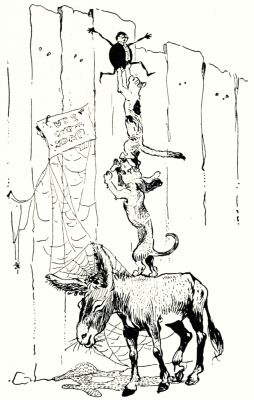
"Yes. Here's a new bit of Mother Goose I've dashed off:
"Namby Pamby sat on the fence, Namby Pamby tumbled from thence. Half the queen's donkeys, her dog, and her cat, Could not restore Namby to where he was at."
"Why!" cried Mollie. "You can't write that. It's nothing but Humpty Dumpty all over again."
"You're all wrong there," retorted the Unwiseman. "And I can prove it. You say that I can't write that. Well, I have written it, which proves that I can. As for its being Humpty Dumpty all over again, that's plain nonsense. Namby Pamby is not Humpty Dumpty. Namby Pamby begins with an N and a P, while Humpty Dumpty begins with H and D. Then, again, Humpty Dumpty sat on a wall. My hero sat on a fence. Humpty Dumpty fell. Namby Pamby tumbled—and so it goes all through the poem. Mine is entirely different. Besides, it's a hysterical episode, and I've got just as much right to make poems about hystery as Mother Goose had."
"Maybe you're right," said Mollie. "But if I were you, I wouldn't write things that are too much like what other people have written."
"I don't see why," said the Unwiseman, impatiently. "If Peter Smith writes a poem that everybody likes and buys, I want to write something as much like what Peter Smith has made a fortune out of as Peter Smith has. That's the point. But we won't quarrel about it. Girls don't know much about business, and men do. I'm a man and you're only a girl."
"Well, I think Mollie's right," put in Whistlebinkie.
"You have to," retorted the Unwiseman. "If you didn't, she'd pack you up in a box and send you out to the sheathen."
"The what?" asked Mollie.
"The Sheathen."
"The sheathen. Little girl savages. I call 'em sheathen to extinguish them from heathen, who are, as I understand it, little boy savages," explained the Unwiseman. "But what do you think of this for a poem. It's called Night, and you mustn't laugh at it because it is serious:
"Oh night, dear night, in street and park, Where'er thou beest thou'rt always dark. Thou dustent change, O sweet brunette, No figgleness is thine, you bet. And what I love the best, on land or sea, Is absence of the vice of figglety."
"What's figglety?" asked Mollie.
"Figglety?" echoed the Unwiseman. "Don't you know that? Figglety is figgleness, or the art of being figgle."
"But I don't know what being figgle is," said Mollie.
"Hoh!" sneered the Unwiseman, angry at Mollie's failure to understand and to admire his serious poem. "Where have you been brought up? Figgle is changing. If you pretend to like pie to-day better than anything, and change around to pudding to-morrow, you are figgle. Some people spell it fickle, but somehow or other I like figgle better. It's a word of my own, figgle is, while fickle is a word everybody uses—but I won't argue with you any more," he added with an impatient gesture. "You've found fault with almost everything I've done, and I'm not going to read any more to you. It's discouraging enough to have people pass you by and not buy your poems, without reading 'em to a little girl that finds fault with 'em, backed up in her opinion by a pug dog and a rubber doll like Whistlebinkie. Some time, when you are better natured, I'll read more to you, but now I won't."
Saying which, the Unwiseman turned away and walked into his house, banging the door behind him in a way which plainly showed that he was offended.
Mollie and Whistlebinkie and Gyp went silently home, very unhappy about the Unwiseman's temper, but, though they did not know it, they were very fortunate to get away before the Unwiseman discovered that the mischievous Gyp had chewed up three pounds of sonnets while their author was reading his poem "Night," so that on the whole, I think, they were to be congratulated that things turned out as they did.
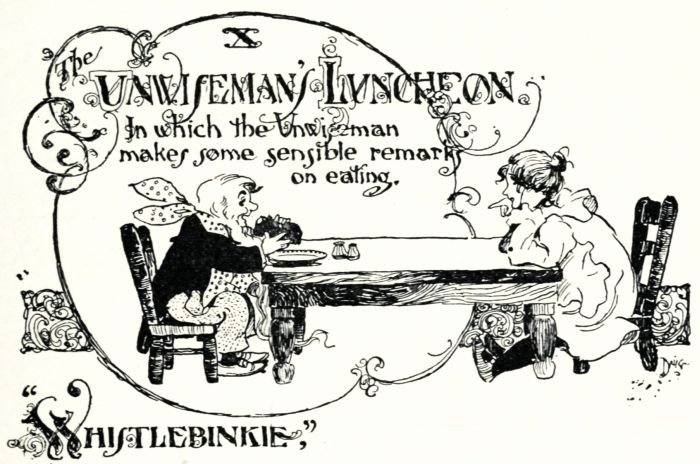
said Mollie, one morning in the early spring, "it's been an awful long time since we saw the Unwiseman."
"Thasso," whistled Whistlebinkie. "I wonder what's become of him."
"I can't even guess," said Mollie. "I asked papa the other morning if he had seen any of his poetry in print and he said he hadn't so far as he knew, although he had read several books of poetry lately that sounded as if he'd written them. I say we go out and try to find him."
"Thasoots me," said Whistlebinkie.
"What's that?" said Mollie. "You still talk through the top of your hat so much that I really can't make out what you say half the time."
"I forgot," said Whistlebinkie, meekly. "What I meant to say was that that suits me. I'd like very much to see him again and hear some of his poetry."
"I don't much think he's stayed in that business," observed Mollie. "He's had time enough to be in sixteen different kinds of businesses since we saw him, and I'm pretty certain that he's tried eight of them any how."
"I guess may be so," said Whistlebinkie. "He's a great tryer, that old Unwiseman."
Mollie donned her new spring hat and Whistlebinkie treated his face and hands to a dash of cold water, after which they started out.
"It's the same old question now," said Mollie, as she stood on the street corner, wondering which way to turn. "Where would we better go to find him?"
"Well, it seems to me," said Whistlebinkie, after a moment's thought, "it seems to me that we'd better look for him in just the same place he was in the last time we saw him."
"I don't see why," returned Mollie. "We never did that before."
"That's why," explained Whistlebinkie. "He's such an unaccountable old man that he's sure to turn up where you least expected him. Now, as I look at it, the place where we least expect to find him is where he was before. Therefore I say let's go there."
"You're pretty wise after all, Whistlebinkie," said Mollie, with an approving nod. "We'll go there."
And it turned out that Whistlebinkie was right.
The house of the Unwiseman was found standing in precisely the same place in which they had last seen it, but pasted upon the front door was a small placard which read, "Gawn to Lunch. Will be Back in Eight Weeks."
"He must be fearfully hungry to go to a lunch it will take that long to eat."
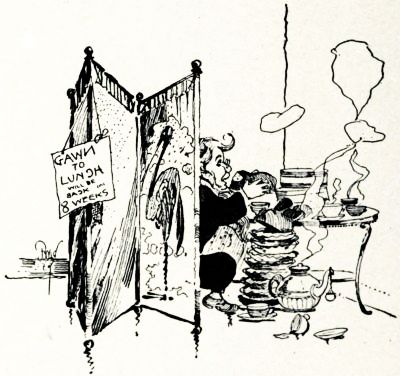
"Dear me!" cried Whistlebinkie, as Mollie read the placard to him. "He must have been fearfully hungry to go to a lunch it will take that long to eat."
Mollie laughed. "I guess maybe I know him well enough to know what that means," she said. "It means that he's inside the house and doesn't want to be bothered by anybody. Let's go round to the back door and see if that is open."
This was no sooner said than done, but the back door, like the first, was closed. Like the front door, too, it bore a placard, but this one read, "As I said before, I've gone to lunch. If you want to know when I'll be back, don't bother about ringing the bell to ask me, for I shall not answer. Go round to the front door and find out for yourself. Yours tooly, the Unwiseman. P. S. I've given up the potery business, so if you're a editor, I don't want to see you any how; but if your name's Mollie, knock on the kitchen window and I'll let you in."
"I thought so," said Mollie. "He's inside."
Then the little girl tiptoed softly up to the kitchen window and peeped in, and there the old gentleman sat nibbling on a chocolate eclaire and looking as happy as could be.
Mollie tapped gently on the window, and the Unwiseman, hurriedly concealing his half-eaten eclaire in the folds of his newspaper, looked anxiously toward the window to see who it might be that had disturbed him. When he saw who it was his face wreathed with smiles, and rushing to the window he threw it wide open.
"Come right in," he cried. "I'm awfully glad to see you."
"I can't climb in this way," said Mollie. "Can't you open the door?"
"Can't possibly," said the Unwiseman. "Both doors are locked. I've lost the keys. You can't open doors without keys, you know. That's why I lost them. I'm safe from burglars now."
"But why don't you get new keys?" said Mollie.
"What's the use? I know where I lost the others, and when my eight weeks' absence is up I can find them again. New keys would only cost money, and I'm not so rich that I can spend money just for the fun of it," said the Unwiseman.
"Then, I suppose, I can't come in at all," said Mollie.
"Oh, yes, you can," said the Unwiseman. "Have you an Alpine stock?"
"What's that?" said Mollie.
"Ho!" jeered the Unwiseman. "What's an Alpine stock! Ha, ha! Not to know that; I thought little girls knew everything."
"Well, they do generally," said Mollie, resolved to stand up for her kind. "But I'm not like all little girls. There are some things I don't know."
"I guess there are," said the Unwiseman, with a superior air. "You don't know what rancour means, or fixity, or garrulousness."
"No, I don't," Mollie admitted. "What do they mean?"
"I'm not in the school-teacher business, and so I shan't tell you," said the Unwiseman, with a wave of his hand. "Besides, I really don't know myself—though I'm not a little girl. But I'll tell you one thing. An Alpine stock is a thing to climb Alps with, and a thing you can climb an Alp with ought to help you climbing into a kitchen window, because kitchen windows aren't so high as Alps, and they don't have snow on 'em in spring like Alps do."
"Oh," said Mollie. "That's it—is it? Well, I haven't got one, and I don't know where to get one, so I can't get in that way."
"Then there's only two things we can do," observed the Unwiseman. "Either I must send for a carpenter and have him build a new door or else I'll have to lend you a step-ladder. I guess, on the whole, the step-ladder is cheaper. It's certainly not so noisy as a carpenter. However, I'll let you choose. Which shall it be?"
"The step-ladder, I guess," said Mollie. "Have you got one?"
"No," returned the Unwiseman; "but I have a high-chair which is just as good. I always keep a high-chair in case some one should bring a baby here to dinner. I'd never ask any one to do that, but unexpected things are always happening, and I like to be prepared. Here it is."
Saying which the Unwiseman produced a high-chair and lowered it to the ground. Upon this Mollie and Whistlebinkie climbed up to the window-ledge, and were shortly comfortably seated inside this strange old man's residence.
"I see you've given up the poetry business," said Mollie, after a pause.
"Yes," said the Unwiseman. "I couldn't make it pay. Not that I couldn't sell all I could write, but that I couldn't write all that I could sell. You see, people don't like to be disappointed, and I had to disappoint people all the time. I couldn't turn out all they wanted. Two magazine editors sent in orders for their winter poetry. Ten tons apiece they ordered, and I couldn't deliver more than two tons apiece to 'em. That made them mad, and they took their trade elsewhere—and so it went. I disappointed everybody, and finally I found myself writing poetry for my own amusement, and as it wasn't as amusing as some other things, I gave it up."
"But what ever induced you to put out that sign, saying that you wouldn't be back for eight weeks?" asked Mollie.
"I didn't say that," said the Unwiseman. "I said I would be back in eight weeks. I shall be. What I wanted was to be able to eat my lunch undisturbed. I've been eating it for five weeks now, and at the end of three weeks I shall be through."
"It musterbin a big lunch," said Whistlebinkie.
"I don't know any such word as musterbin," said the Unwiseman, severely; "but as for the big lunch, it was big. One whole eclaire."
"I could eat an eclaire in five seconds," said Mollie.
"No doubt of it," retorted the Unwiseman. "So could I; but I know too much for that. I believe in getting all the enjoyment out of a thing that I can; and what's the sense of gobbling all the pleasure out of an eclaire in five seconds when you can spread it over eight weeks? That's a queer thing about you wise people that I can't understand. When you have something pleasant on hand you go scurrying through it as though you were afraid somebody was going to take it away from you. You don't make things last as you should ought to."
"Excuse me," interrupted Whistlebinkie, who had been criticized so often about the way he spoke, that he was resolved to get even. "Is 'should ought to' a nice way to speak?"
"If you want to speak some other language, you can go outside and speak it."
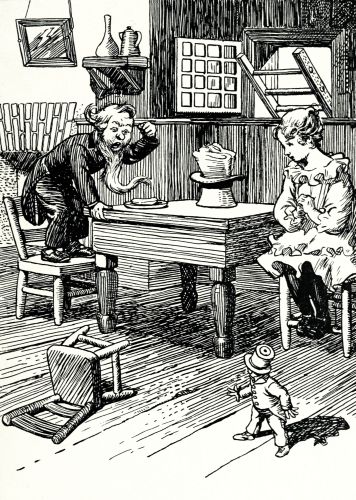
"It's nice enough for me," retorted the Unwiseman. "And as this is my house I have a right to choose the language I speak here. If you want to speak some other language, you can go outside and speak it."
Poor Whistlebinkie squeaked out an apology and subsided.
"Pleasure ought to be spread."
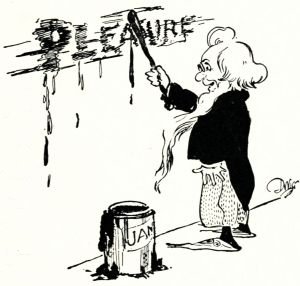
"Take bananas, for instance," said the Unwiseman, not deigning to notice Whistlebinkie's apology. "I dare say if your mother gives you a banana, you go off into a corner and gobble it right up. Now I find that a nibble tastes just as good as a bite, and by nibbling you can get so many more tastes out of that banana, as nibbles are smaller than bites, and instead of a banana lasting a week, or two weeks or eight weeks, it's all gone in ten seconds. You might do the same thing at the circus and be as sensible as you are when you gobble your banana. If the clown cracked his jokes and the trapezuarius trapozed, and the elephants danced, and the bare-back riders rode their horses all at once, you'd have just as much circus as you get the way you do it now, only it wouldn't be so pleasant. Pleasure, after all, is like butter, and it ought to be spread. You wouldn't think of eating a whole pat of butter at one gulp, so why should you be greedy about your pleasure?"
"Thassounds very sensible," put in Whistlebinkie.
"It is sensible," said the Unwiseman, with a kindly smile; "and that is why, having but one eclaire, I make it last me eight weeks. There isn't any use of living like a prince for five minutes and then starving to death for seven weeks, six days, twenty-three hours, and fifty-five minutes."
Here the Unwiseman opened the drawer of his table and took out the eclaire to show it to Mollie.
"It doesn't look very good," said Mollie.
"That's true," said the Unwiseman; "but that helps. It's awfully hard work the first day to keep from nibbling it up too fast, but the second day it's easier, and so it goes all along until you get to the fourth week, and then you don't mind only taking a nibble. If it stayed good all the while, I don't believe I could make it last as long as I want to. So you see everything works for good under my system of luncheoning. In the first place the pleasure of a thing lasts a long time; in the second, you learn to resist temptation; in the third place, you avoid greediness; and last of all, after a while you don't mind not being greedy."
"The old gentleman put the eclaire away."
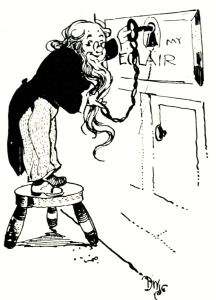
With this the old gentleman put the eclaire away, locked the drawer, and began to tell Mollie and Whistlebinkie all about the new business he was going into.
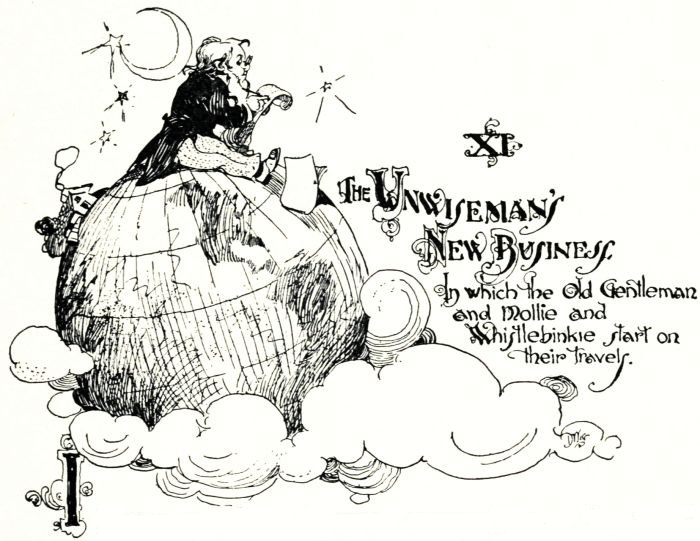
have at last found something to do," he said, as he locked the eclaire up in the drawer, "which will provide me in my old age with all the eclaires I need, with possibly one or two left over for my friends."
"Thassnice," whistled Whistlebinkie.
"Yes," said the Unwiseman. "It's very nice, particularly if you are one of my friends, and come in for your share of the left-over eclaires—as, of course, you and Mollie will do. It all grew out of my potery business, too. You see, I didn't find that people who wanted potery ever bought it from a street-corner stand, but from regular potery peddlers, who go around to the newspaper offices and magazines with it, done up in a small hand-bag. So I gave up the stand and made a small snatchel——"
"A small what?" demanded Mollie.
"A small snatchel," repeated the Unwiseman. "A snatchel is a bag with a handle to it."
"Oh—I know. You mean a satchel," said Mollie.
"Maybe I do," observed the Unwiseman. "But I thought the word was snatchel, because it was a thing you could snatch up hurriedly and run to catch a train with. Anyhow, I made one and put some four or five pounds of potery in it, and started out to sell it. The first place I went to they said they liked my potery very much, but they couldn't use it because it didn't advertise anything. They wanted sonnets about the best kind of soap that ever was; or what they called a hook-and-eye lyric; or perhaps a few quatrains about baking-powders, or tooth-wash, or some kind of silver-polish. People don't read poems about mysteries and little red school-houses, and patriotism any more, they said; but if a real poet should write about a new kind of a clothes-wringer or a patent pickle he'd make a fortune, because he'd get his work published on fences and in railroad cars, which everybody sees, instead of in magazines that nobody reads."
"I've seen lots of those kinds of poems," said Mollie.
"They're mighty good reading, too," said Whistlebinkie. "And is that what you are going to do?"
"They'd pay for it when they published it."
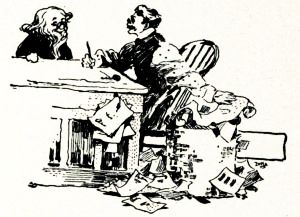
"Not I!" retorted the Unwiseman, scornfully. "No, indeed, I'm not. Shakespeare never did such a thing, and I don't believe Milton did either, and certainly I shall not try it. The next place I went to they said they liked my potery well enough to print it, but I'd have to pay for having it done, which was very hard, because I hadn't any money. The next place they took a sonnet and said they'd pay for it when they published it, and when I asked when that would be, they said in about thirty-seven years."
"Mercy!" cried Mollie.
"That's what I said," said the Unwiseman, ruefully. "So again I went on until I found an editor who was a lovely man. He read all my things through, and when he'd finished he said he judged from the quality of my potery I must be a splendid writer of prose."
Whistlebinkie laughed softly.
"Yes," said the Unwiseman, "that's what he said. 'Mr. Unwiseman,' said he, 'after reading your poetry, it seems to me your forte is prose.' And I told him perhaps he was right, though I didn't know what he meant. At any rate, he was very good to me, and asked me where I lived, and all that. When I told him that I lived everywhere; how I just moved my house around to suit myself, and lived one day here and another day in Illinois, and another in Kamschatka, he grew interested at once."
"I should think he might," put in Mollie. "I didn't know you could move as far as Kamschatka."
"Certainly I can," said the Unwiseman; "and in a way that is what I am going to do. I have been engaged to travel in various parts of the world just by moving my house around at will, and what I see and do under such circumstances I am to write up for that editor's paper."
"Why it's perfectly splendid!" cried Mollie, clapping her hands together with glee at the very idea. "I wish I could go with you."
"Me too!" whistled Whistlebinkie.
"Woof—woof!" barked Gyp, which the Unwiseman took to mean that Gyp wished also to be included.
"All right," said the Unwiseman. "I've no objection."
"I don't know what they'd say at home," said Mollie, as she thought of possible objections to the trip.
"Why they won't say anything," said the Unwiseman. "I'll only travel afternoons. We'll be back every day by six o'clock, and I don't suppose we'll start much before three. This house is a rapid traveller once she gets started. Just wait a minute and I'll show you. Sit tight in your chairs now. One—two—three—let her go!"
"The house, whizzed rapidly through the air."
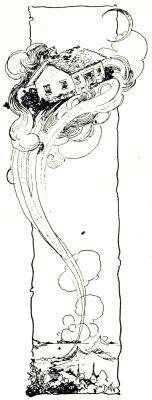
The old gentleman touched a button in the wall. The house shook violently for a second, apparently whizzed rapidly through the air, if the whistling of the wind outside meant anything, and then suddenly, with a thump and a bump, came to a standstill.
"Here we are," said the Unwiseman, opening the door. "Come outside."
The little party emerged, and Mollie was amazed to find herself standing on the top of a wonderful hill gazing out over the waters of a beautiful body of water of the most heavenly blue. At her feet a little yellowish city nestled into the hillside, and across a strip of silvery water was a huge and frowning fortress.
"This, Miss Whistlebinkie, is the city of Havana," said the Unwiseman to the astonished little maid. "You have come all the way from home to Cuba in five seconds—a distance of 1200 miles. So you see we can do all our travelling in the afternoons, and without your being away from your home any more than you naturally are during your play-time hours."
Mollie made no answer for a moment. She was too astonished to speak. Whistlebinkie was the first to recover, and he was not long in expressing his sentiments.
"Imagoin'," he whistled.
Gyp barked a similar resolution, whereupon Mollie said she'd see.
"But let us hurry back home again," she added, somewhat anxiously. She did not quite like being so far away from home without her mother knowing it.
"Certainly," said the Unwiseman, touching the button again. The violent shaking and whizzing sounds were repeated, and again, with a thump and a bump, the house came to a standstill. The Unwiseman opened the front door, and there they were, safe and sound, in the back yard of Mollie's home.
That night the little girl told the story of the day's adventure to her father, and he said that, under the circumstances, he had not the slightest objection to her making the grand tour of the world.
"Only," he said, "you must remember, dear, to be home to supper. Even if you find yourself at the coronation of a king, remember that it is your duty to be punctual at your meals. London, Paris, Pekin, or Kalamazoo are always ready to be seen, night or day, no matter what the time, but breakfast, dinner, and supper do not go on forever, and are served only at stated hours."
And so Mollie and Gyp and Whistlebinkie joined in the adventures of the Unwiseman Abroad, and, in point of fact, they started off that very afternoon, though what they saw I do not know, for I have not encountered them since. I only know that their journey was safely accomplished, and that they all got home that night without harm, for Mollie's papa told me so. He also told me, in confidence, that I might hope soon to hear some remarkable tales on the subject of their adventures; and if I do, I shall not fail to let you in turn hear what happened to "Mollie and The Unwiseman Abroad."