THE BRITISH NAVY.
Reading edition
By SIR EDWARD J. REED.
When timber gave place to iron and steel in the construction of war-ships, the naval possibilities of Great Britain became practically illimitable. Prior to that great change the British Admiralty, after exhausting its home supplies of oak, had to seek in the forests of Italy and of remote countries those hard, curved, twisted, and stalwart trees which alone sufficed for the massive framework of its line-of-battle ships. How recently it has escaped from this necessity may be inferred from the fact that the present writer, on taking office at the Admiralty in 1863, found her Majesty’s dockyards largely stored with recent deliveries of Italian and other oak timber of this description.
And here it may not be inappropriate for one whose earliest professional studies were devoted to the construction of wooden ships, but whose personal labors have been most largely devoted to the iron era, to pay a passing tribute of respect to the constructive genius of those great builders in wood who designed the stanch and towering battle-ships of the good old times. Skilful, indeed, was the art, sound, indeed, was the science, which enabled them to shape, assemble, and combine thousands of timbers and planks into the Grace de Dieu of Great Harry’s day (1514), the Sovraigne of the Seas of Charles’s reign (1637), the Royal William of half a century later (1682-92), the Victory, immortalized by Nelson, and in our own early day such superb ships as the Queen, the Howe, and scores of others. Only those who have made a study of the history of sea architecture can realize the difficulties which the designers of such structures had to overcome.
With the introduction of iron and steel for ship-building purposes the necessity for ransacking the forests of the world for timber suitable for the frames and beam-knees of ships passed away, and Great Britain, which early became, and thus far remains, first and greatest in the production of iron and steel, was thus invited to such a development of naval power as the world has never seen. The mercantile marine of England at the present time furnishes a splendid demonstration of the readiness with which the commercial classes have appreciated this great opportunity; but the Royal Navy, by almost universal assent, supplies a melancholy counter-demonstration, and shows that neither the capabilities of a race nor the leadings of Providence suffice to keep a nation in its true position when it falls into the hands of feeble and visionary administrators. Any one who will contrast the British navy of to-day with the British navy as it might and would have been under the administration, say, of such a First Lord of the Admiralty as the present Duke of Somerset proved himself in every department of the naval service five-and-twenty years ago, will understand the recent outcry in England for a safer and more powerful fleet.
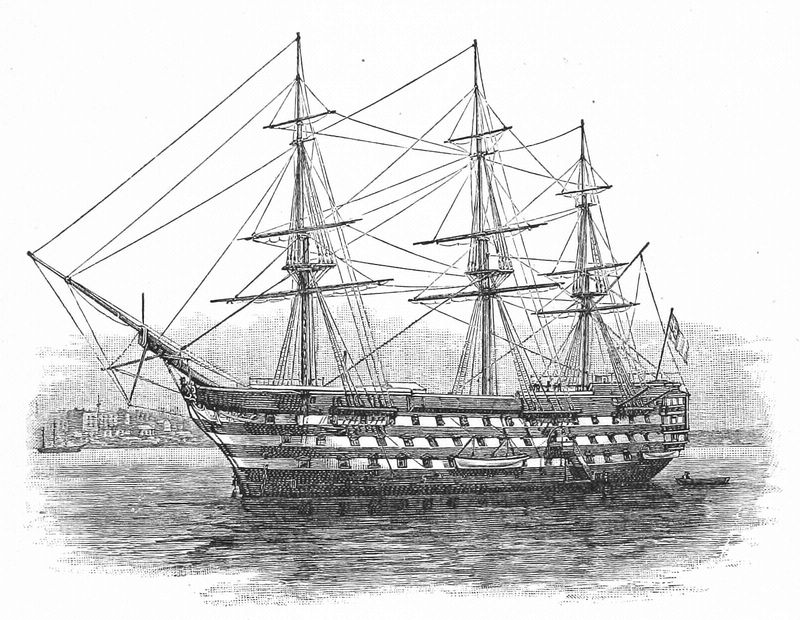
THE “VICTORY.”
From a photograph by Symonds & Co., Portsmouth.
It is impossible, as will presently appear, to describe the existing British navy without making reference to those administrative causes which have so largely and so unhappily influenced it; but the primary object of this chapter is, nevertheless, to describe and explain it, and only such references will be made to other circumstances as are indispensable to the fulfilment of that object.
It is fitting, and to the present writer it is agreeable, in this place, to take early note of a matter which has, perhaps, never before been fully acknowledged, viz., the indebtedness of Great Britain and of Europe to the United States for some invaluable lessons in naval construction and naval warfare which were derived from the heroic efforts of their great civil war. The writer is in a position to speak with full knowledge on this point, as his service at the Admiralty, in charge of its naval construction, commenced during the American conflict, and continued for some years after its fortunate conclusion. There can be no doubt whatever that from the Monitor and her successors European constructors and naval officers derived some extremely valuable suggestions. The Monitor system itself, pure and simple, was never viewed with favor, and could never be adopted by England, except under the severest restrictions, because the work of England has mainly to be done upon the high seas and in distant parts of the world, and the extremely small freeboard of the Monitor, or, in other words, the normal submersion of so very much of the entire ship, is highly inconvenient and not a little dangerous on sea service, as the fate of the Monitor itself demonstrated. But for the work the Monitor was designed to do in inland waters she was admirably conceived, and her appearance in the field of naval warfare startled seamen and naval constructors everywhere, and gave their thoughts a wholly novel direction. In saying this I am not unmindful that seven years previously England had constructed steam-propelled “floating batteries,” as they were called, sheathed with iron, and sent them to operate against the defences of Russia. But useful as these vessels were in many respects, their construction presented no striking novelty of design, and their employment was unattended by any dramatic incidents to powerfully impress the naval mind. The Monitor was both more novel and more fortunate, and opened her career (after a severe struggle for life at sea) with so notable a display of her offensive and defensive qualities that all eyes turned to the scene of her exploits, and scanned her with a degree of interest unknown to the then existing generation of sailors and ship-builders. Her form and character were in most respects singular, her low deck and erect revolving tower being altogether unexampled in steamship construction. He must have been a dull and conservative naval architect, indeed, whose thoughts Ericsson’s wonderful little fighting ship did not stimulate into unwonted activity. But the service rendered to Europe was not confined to the construction and exploits of the Monitor itself. The coasting passages, and, later on, the sea-voyages, of other vessels of the Monitor type, but of larger size, were watched with intense interest, and gave to the naval world instructive experiences which could in no other way have been acquired. Some of these experiences were purchased at the cost of the lives of gallant men, and that fact enhanced their value.
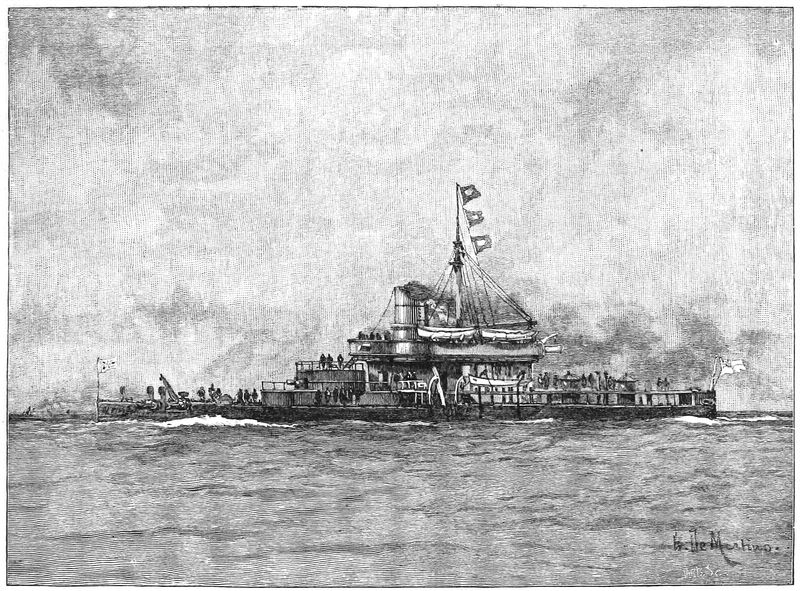
THE “GLATTON.”
It is not possible to dwell at length upon the means by which the Monitor influence took effect in the navies of Europe, but it may be doubted whether ships like the Thunderer, Devastation, and Dreadnought, which naval officers declare to be to-day the most formidable of all British war-ships, would have found their way so readily into existence if the Monitors of America had not encouraged such large departures from Old-world ideas. In this sense the Times correctly stated some years ago that the “American Monitors were certainly the progenitors of our Devastation type.” The one ship in the British navy which comes nearest to the American Monitor, in respect of the nearness of her deck to the water, is the Glatton, a very exceptional vessel, and designed under a very peculiar stress of circumstances. But even in her case, as in that of every other armored turret-ship of the present writer’s design, the base of the turret and the hatchways over the machinery and boilers were protected by an armored breastwork standing high above this low deck, whereas in the American Monitors the turret rests upon the deck, which is near to the smooth sea’s surface.
We have here, in the features just contrasted, the expression of a fundamental difference of view between the American system, as applied to sea-going turret-ships, and the European system of sea-going ships introduced by the writer. It has never been possible, in our judgment on the British side of the Atlantic, to regard even such Monitors as the Puritan and Dictator were designed to be, as sufficiently proof to sea perils. At the time when these lines were penned the following paragraph appeared in English newspapers: “The Cunard steamer Servia arrived at New York yesterday, being three days overdue. During a heavy sea the boats, the bridge, and the funnel were carried away, and the saloon was flooded.” Any one who has seen the Servia, and observed the great height above the smooth sea’s surface at which her boats, bridge, and funnel are carried, will be at no loss to infer why it is that we object to ships with upper decks within two or three feet only of that surface. In short, it can be demonstrated that ships of the latter type are liable, in certain possible seas, to be completely ingulfed even to the very tops of their funnels. In the case of the Glatton, which had to be produced in conformity to ideas some of which were not those of the designer, one or two devices were resorted to expressly in order to secure in an indirect manner some increase of the assigned buoyancy, and thus to raise the upper deck above its prescribed height. The officers who served in her, however, judiciously regarded her, on account of her low deck, as fit only for harbor service or restricted coast defence.
A very dangerous combination, as the writer regards it, was once proposed for his adoption by the representative of a colonial government, but was successfully resisted. This was the association of a “Coles” or English turret (which penetrates and passes bodily through the weather deck) with a low American Monitor deck. This was opposed on the ground that with such an arrangement there must of necessity be great danger at sea of serious leakage around the base of the turret as the waves swept over the lower deck. It would be extremely difficult to give to the long, circular aperture around the turret any protection which would be certain, while allowing the turret to revolve freely, both to withstand the fire of the guns and to resist the attack of the sea.
It will now be understood that while the Monitor system was from the first highly appreciated in Europe, and more especially in England, it never was adopted in its American form in the British navy. Russia, Holland, and some other powers did adopt it, and the Dutch government had to pay the penalty in the total disappearance of a ship and crew during a short passage in the North Sea from one home port to another. In a largely altered form, and with many modifications and additions due to English ideas of sea service, it was, however, substantially adopted in the three powerful ships already named, of which one, the Dreadnought, lately bore the flag of the British admiral who commands the Mediterranean fleet. If the opinion of officers who have served in these ships may be accepted as sufficiently conclusive, it was a great misfortune for the British navy when the ruling features of this type of ship were largely departed from in its first-class ships, and made to give place to a whole series of so-called first-class iron-clads, of which only about one-third of the length has been protected by armor, and which are consequently quite unfit to take a place in any European line of battle.
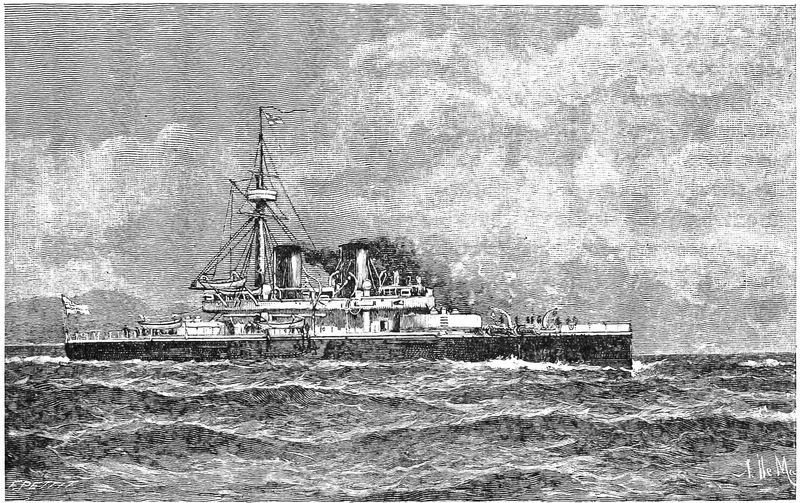
THE “DREADNOUGHT.”
The characteristic differences between the American type and the English type of sea-going Monitors (if we may apply that designation to the Devastation type) have already been stated, but may be restated here in a single sentence, viz., the elevation in the English ship of the turret breastwork deck to a height of eleven or twelve feet above the sea’s surface, and the raising of the upper deck generally, or of a considerable part of it, to at least that height, by means of lightly built superstructures. Over these again, and many feet above them, are built bridges and hurricane decks, from which the ships may be commanded in all weathers. Lofty as these ships are by comparison with American Monitors, it is only gradually that they have acquired the confidence of the naval service, so freely do the waves sweep over their weather decks when driven, even in moderate weather, against head-seas.
The British navy, having very diversified services to perform during both peace and war, requires ships of various kinds and sizes. Its first and greatest requirement of all is that of line-of-battle ships in sufficient numbers to enable England to stand up successfully against any European naval force or forces that may threaten her or her empire. If any one should be disposed to ask why this requirement—which is obviously an extreme one, and an impossible one for more than a single power—is more necessary for England than for any other country, the answer must be, Circumspice! To look round over England’s empire is to see why her failure on the sea would be her failure altogether. France, Germany, Italy, and even Holland, might each get along fairly well, losing nothing that is absolutely essential to their existence, even if every port belonging to them were sealed by an enemy’s squadron. But were Great Britain to be cut off from her colonies and dependencies, were her ships to be swept from the seas, and her ports closed by hostile squadrons, she would either be deprived of the very elements of life itself, or would have to seek from the compassion of her foes the bare means of existence. It is this consideration, and the strong parental care which she feels for her colonies, that make her sons indignant at any hazardous reduction of her naval strength. There are even in England itself men who cannot or will not see this danger, and who impute to those who strive to avert it ambitious, selfish, and even sordid motives. But it is to no unworthy cause that England’s naval anxieties are due. We have no desire for war; we do not hunger for further naval fame; we cherish no mean rivalry of other powers who seek to colonize or to otherwise improve their trade; we do not want the mastery of the seas for any commercial objects that are exclusively our own. What we desire to do is to keep the seas open thoroughfares to our vast possessions and dependencies, and free to that commercial communication which has become indispensable to our existence as an empire. To accomplish that object we must, at any cost, be strong, supremely strong, in European waters; and it is for this reason that England’s line-of-battle ships ought to be always above suspicion both in number and in quality.
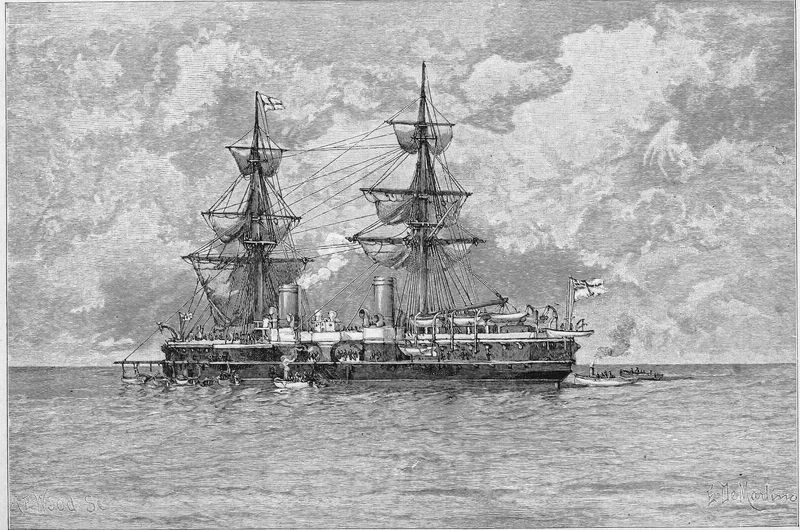
THE “INFLEXIBLE.”
It is not a pleasant assertion for an Englishman to make when he has to say that this is very far from being the case at present. A few months ago this statement, from whomsoever it emanated, would have been received with distrust by the general public, for the truth was only known to the navy itself and to comparatively few outsiders. But the official communications made to both Houses of Parliament early in December, 1885, prepared the world for the truth, the First Lord of the Admiralty in the Chamber of Peers and Lord Brassey in the House of Commons having then proposed to Parliament a programme of additional ship-building which provided for a considerable increase in the number of its first-class ships and cruisers, and which also provided, on the demand of the present writer, that the cruisers should be protected with belts of armor—an element of safety previously denied to them. It need hardly be repeated, after this wholesale admission of weakness by the Admiralty, that Great Britain is at present in far from a satisfactory condition as regards both the number and the character of its ships. Were that not so, no public agitation could have moved the government to reverse in several respects a policy by which it had for so long abided.
It will be interesting to broadly but briefly review the causes of the present deplorable condition of the British navy. In the first place, in so far as it is a financial question, it has resulted mainly from the sustained attempt of successive governments to keep the naval expenditure within or near to a fixed annual amount, notwithstanding the palpable fact that every branch of the naval service, like most other services, is unavoidably increasing in cost, while the necessities of the empire are likewise unavoidably increasing. The consequence is that, as officers and men of every description must be paid, and all the charges connected therewith must in any event be fully met, the ship-building votes of various kinds are those upon which the main stress of financial pressure must fall. From this follows a strong desire, to which all Boards of Admiralty too readily yield, to keep down the size and cost of their first-class ships, to the sacrifice of their necessary qualities. This may be strikingly illustrated by the fact that, although the iron Dreadnought, a first-class ship, designed fifteen or sixteen years ago, had a displacement of 10,820 tons, and was powerful in proportion, the Admiralty has launched but a single ship (the Inflexible) since that period, of which the displacement has reached 10,000 tons. In fact, every large iron-clad ship for the British navy since launched has fallen from twelve hundred to twenty-four hundred tons short of the Dreadnought’s displacement, and has been proportionally feeble.
If this cutting down in the size of the principal ships of Great Britain had been attended by a corresponding reduction in the sizes of the ships of other powers, or even by some advantages of design which largely tended to make up for the defect of size, there might be something to say for it. But the French ships have shown no such falling off in size, and have benefited as fully as the English ships by the use of steel and by the improved power and economy of the marine steam-engine.
Simultaneously with the reduction in the size of the English ships there has been brought about—voluntarily, and not as a consequence of reduced size, for it was first applied in the largest of all British men-of-war, the Inflexible—a system of stripping the so-called armored ships of the English navy of a large part of their armor, and reducing its extent to so deplorable a degree that, as has already been said, they are quite unfit to take part, with any reasonable hope of success, in any general engagement. Here, again, there might have been something to say for a large reduction in the armored surface of ships if it had been attended by some great compensation, such as that which an immense increase in the thickness of the armor applied might have provided, although no such increase could ever have compensated for such a reduction of the armored part of the ship as would have exposed the whole ship to destruction by the mere bursting in of the unarmored ends, which is what has been done. But although in the case of the large Inflexible the citadel armor was of excessive thickness, that is not true of the more recent ships of England, the armor of which sometimes falls short of that of the French ships, in two or three instances by as much as four inches, the French ships having 22-inch armor, and the English 18-inch. But by the combined effect of injudicious economy and of erroneous design, therefore—both furthered by a sort of frenzied desire on the part of the British Admiralty to strip the ships of armor, keep down their speed, delay their completion, and otherwise paralyze the naval service, apparently without understanding what they were about—the British navy has been brought into a condition which none but the possible enemies of the country can regard without more or less dismay.
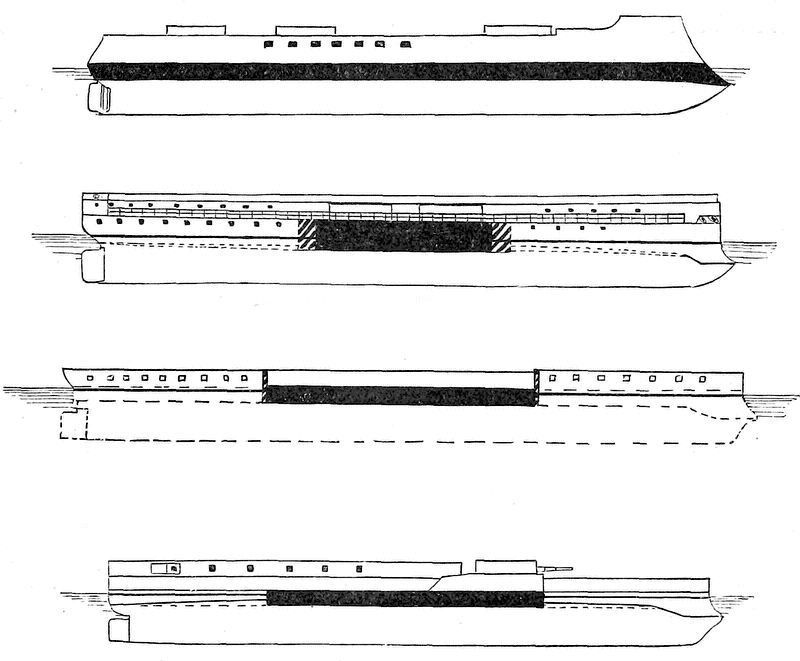
SECTION OF THE “AMIRAL DUPERRÉ.”
SECTION OF THE “INFLEXIBLE.”
SECTION OF THE “COLLINGWOOD.”
NEW ADMIRALTY SHIP.
In order to illustrate the extent to which side armor has been denied to the British ships, as compared with the French, we refer the reader to these diagrams of the Amiral Duperré (French) and of the Inflexible and Collingwood (both English). The black portions represent the side armor in each case. It is scarcely possible for any one friendly to Great Britain to look at these diagrams, and realize what they signify, without profoundly regretting that a sufficient force of public opinion has not yet been exerted to compel the Admiralty to a much more liberal use of armor in the new first-class ships, the intended construction of which was announced to Parliament in December, 1885. In these new ships, while the length of the partial belt has been slightly increased, no addition to its height above water has been made (as compared with the Collingwood or “Admiral” class), so that the slightest “list” towards either side puts all the armor below water. To describe such ships as “armored ships” is to convey a totally false impression of their true character. A side view of one of these new ships shows that the two principal guns are carried high up forward in an armored turret, which sweeps from right ahead, round the bow on each side, and well towards the stern, while several smaller guns are carried abaft with very thin armor protection to complete the offensive powers of the ship. The arrangement of the two principal guns in a turret forward resembles that of the Conqueror, but in her the armor rises high above the water, and a belt extends to the bow and nearly to the stern. It is a matter of inexpressible regret that the armored surface of these new ships is so excessively contracted as to be wholly insufficient to preserve the ship from that terrible danger to which so many of their predecessors have been exposed, viz., that of capsizing from loss of stability when the unarmored parts alone have been injured.
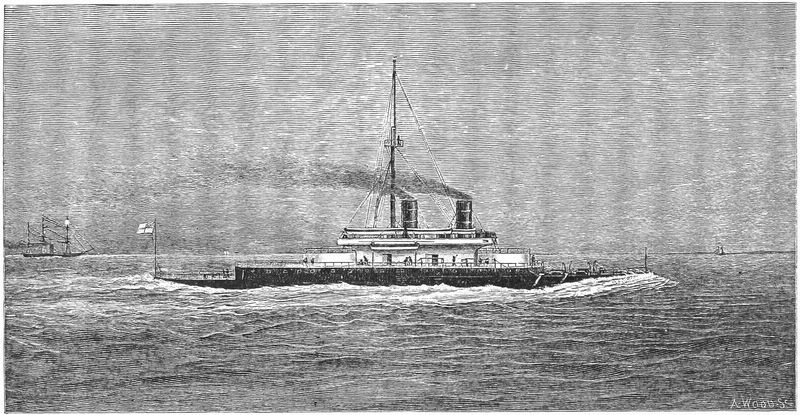
THE “DEVASTATION.”
There is a sense in which all the British ships to which reference has thus far been made may be roughly regarded as developments of, or at least as starting from, the Devastation, or British Monitor type of ship, for in all of them masts and sails have been done away with, and steam propulsion relied upon, a single military mast alone remaining.[1] We have now to notice another and more numerous class of ships, which may be regarded as the lingering representatives of those sailing-ships which have come down to us through the long centuries, but which are now rapidly disappearing, yielding to the all-prevalent power of steam. Some of these ships were built for the line of battle, in their respective periods, but as they range in size from about one thousand tons of displacement up to nearly eleven thousand tons, it is obvious that many of them were built for various other employments. In dealing with the full-rigged ships, we are taking account of types of war-ships which, for all but secondary purposes, are passing away. It fell to the lot of the present writer (under the rule of Mr. Childers, then First Lord of the Admiralty, and of Admiral Sir Robert Spencer Robinson, then Controller of the Navy) to introduce the mastless war-ship, and thus to virtually terminate what had certainly been for England a glorious period, viz., that of the taunt-masted, full-rigged, and ever-beautiful wooden line-of-battle ship. It is now, alas! but too apparent (from what has gone before) that in virtually terminating that period, and opening the era of the steam and steel fighting engine, we were also introducing an era in which fantastic and feeble people might but too easily convert what ought to have been the latest and greatest glory of England into her direct peril, and possibly even her early overthrow.
The first British iron-clad (neglecting the “floating batteries” of 1854) was the Warrior, a handsome ship 380 feet long, furnished with steam-power, and provided with masts, spars, and a large spread of canvas. Her ends were unprotected by armor, and her steering gear consequently much exposed. She was succeeded by a long series of full-rigged iron-clads, all of them supplied with steam-power likewise, the series continuing down to the present time. The little dependence which is now placed in the British navy upon the use of sail-power in armored ships will be seen, however, when it is stated that of all the ships protected by side armor which are now under construction in the royal dockyards, but two are to be given any sail-power at all, and these are to be rigged on two masts only, although the ships are of large size, and intended for cruising in distant seas.[2]
It is unnecessary in a popular subject of this description to dwell upon, or even to state, the minor differences which exist between the different types of rigged iron-clads. There are, however, some points of interest in connection with their armor and armament to be mentioned. In the design of the first group (speaking chronologically) were commenced those changes in the disposition of the armor which continue down to the present time, the British Admiralty being so mixed and so virtually irresponsible a body that it is not obliged to have a mind of its own for any great length of time, even when many of the same men continue in office.
The Warrior, as we saw, and the sister ship Black Prince, had a central armored battery only; the same is true of those reduced Warriors, the Defence and the Resistance. But the next succeeding ships of the Warrior’s size, the Minotaur and Agincourt, were fully armored from end to end; and the somewhat smaller ship the Achilles was furnished with a complete belt at the water-line. The Hector and Valiant (improved Defences) had complete armor above the water, but, oddly enough, had part of the water-line at each end left unarmored. A third ship of the Minotaur class, the Northumberland, was modified by the present writer at the bow and stern on his entering the Admiralty, the armor above water being there reduced, and an armored bow breastwork constructed. Within this armored breastwork were placed two heavy guns firing right ahead. With this exception, all these early ships, nine in number, were without any other protected guns than those of the broadside.
These ships were followed by a series of rigged ships of the writer’s design, viz., the Bellerophon, Hercules, Sultan, Penelope, Invincible, Iron Duke, Vanguard, Swiftsure, and Triumph, all with hulls of iron, or of iron and steel combined, together with a series of rigged ships constructed of wood, converted from unarmored hulls or frames, viz., Enterprise, Research, Favorite, Pallas, Lord Warden, Lord Clyde, and Repulse. Every one of these ships was protected by armor throughout the entire length of the vessel in the region of the water-line, and in some cases the armor rose up to the upper deck. Most of them, however, had the armor above the belt limited to a central battery. The chief interest in these vessels now lies in the illustrations they furnish of the evolution, so to speak, of bow and stern fire. In several of them a fire approximately ahead and astern (reaching to those directions within about twenty degrees) was obtained by means of ports cut near to the ship’s side, through the transverse armored bulkheads. In others these bulkheads were turned inward towards the battery near the sides of the ship in order to facilitate the working of the guns when firing as nearly ahead and astern as was practicable. In the Sultan an upper-deck armored battery was adopted for the double purpose of forming a redoubt from which the ship could be manœuvred and fought in action, and of providing a direct stern fire from protected guns. In the five ships of the Invincible class a direct head and stern fire was obtained from a somewhat similar upper-deck battery, which projected a few feet beyond the side of the ship.
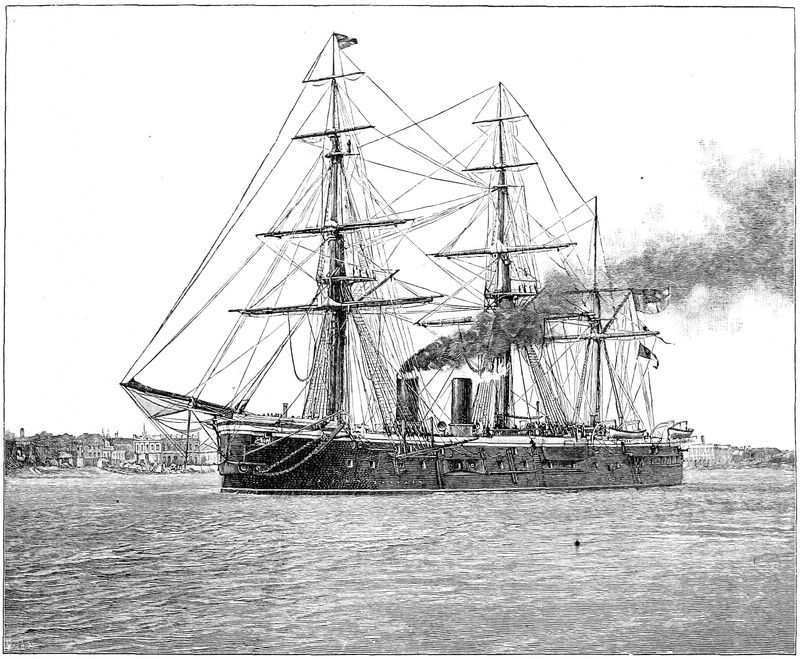
THE “SULTAN.”
The rigged ships of later design than the writer’s present a still greater variety in the disposition of their armor and armaments. This variety may be in part illustrated by four examples, which for convenience are principally taken from Lord Brassey’s book.[3] The scales of these small drawings, as given there, are not all the same. These examples are the Alexandra, the Téméraire, the Nelson, and the Shannon. The Alexandra (of which a separate view, in sea-going condition, is given), which is probably the best of the rigged iron-clads of the British navy, may be regarded as a natural, but not the less meritorious, development of the combined broadside and bow and stern fire of the central-battery ships which preceded her. In her were provided a broadside battery on the main-deck, a direct bow fire, also on that deck, and both a direct bow and a direct stern fire on the upper deck from within armor, as in the Invincible class. The guns employed for bow and stern fire were all available for broadside fire. The upper-deck battery did not project beyond the main-deck as in the Invincible class, the forward and after parts of the ship above the main-deck being greatly contracted in breadth in order to allow the guns to fire clear both forward and aft. The Téméraire is a smaller ship than the Alexandra, and has a battery similar to hers on the main-deck, but with one gun less on each side, the danger of a raking fire entering through the foremost battery port being met by a transverse armored bulkhead, as shown in the plan of the ship. She is provided with an additional bow gun and a stern-chaser, carried high up in barbette towers, but worked on Colonel Moncrieff’s disappearing principle.
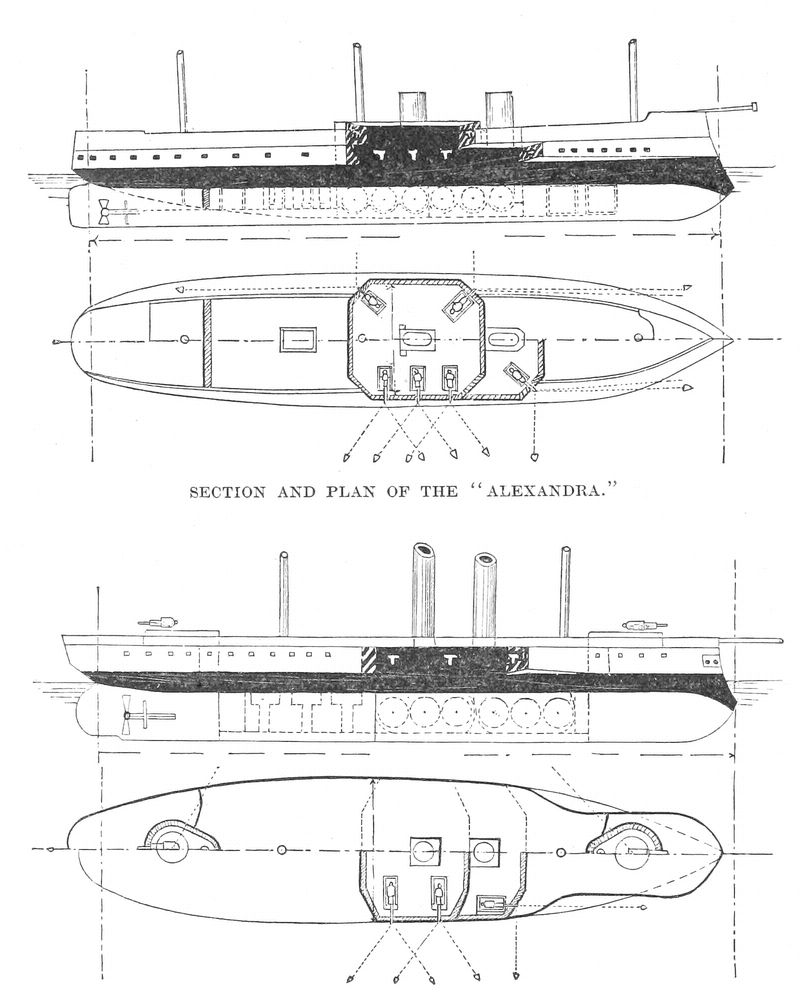
SECTION AND PLAN OF THE “ALEXANDRA.”
SECTION AND PLAN OF THE “TÉMÉRAIRE.”
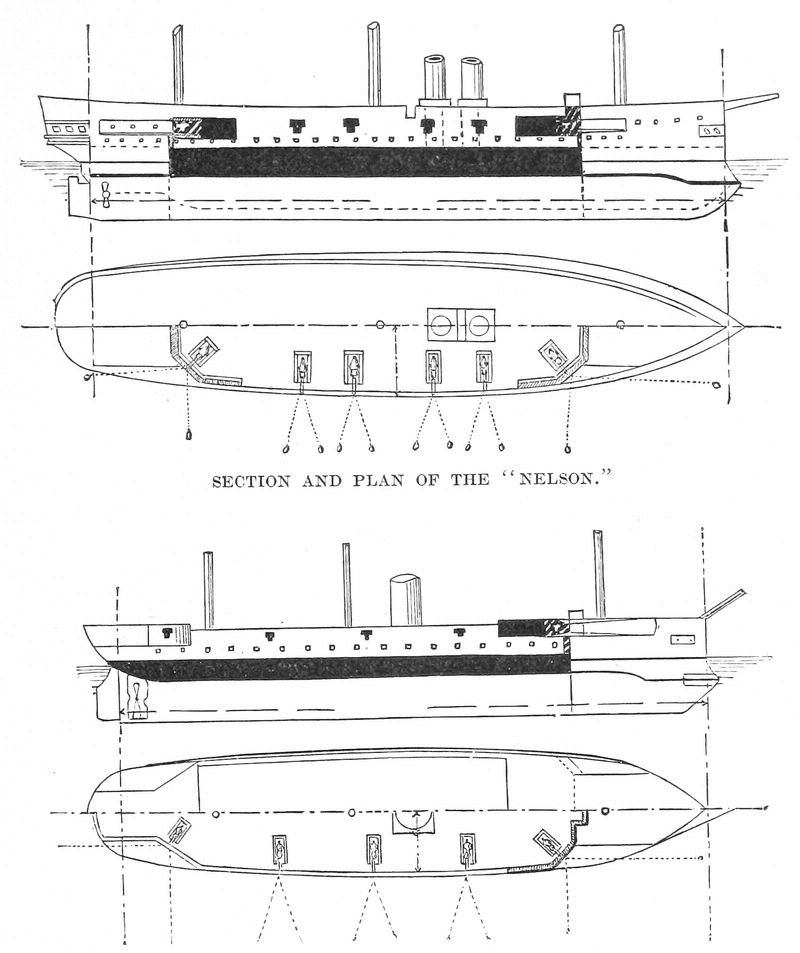
SECTION AND PLAN OF THE “NELSON.”
SECTION AND PLAN OF THE “SHANNON.”
“The Téméraire fires three 25-ton guns right ahead, against two 25-ton and two 18-ton guns in the Alexandra; on either bow, two 25-ton against one 25-ton and one 18-ton; right aft, one 25-ton against two 18-ton; on either quarter, one 25-ton against one 18-ton; on either beam, if engaged on one side at a time, two 25-ton and two 18-ton, with a third 25-ton available through only half the usual arc, against three 18-ton guns, with two of the same weight and one of 25-tons, each available with the limitation just described.”[4]
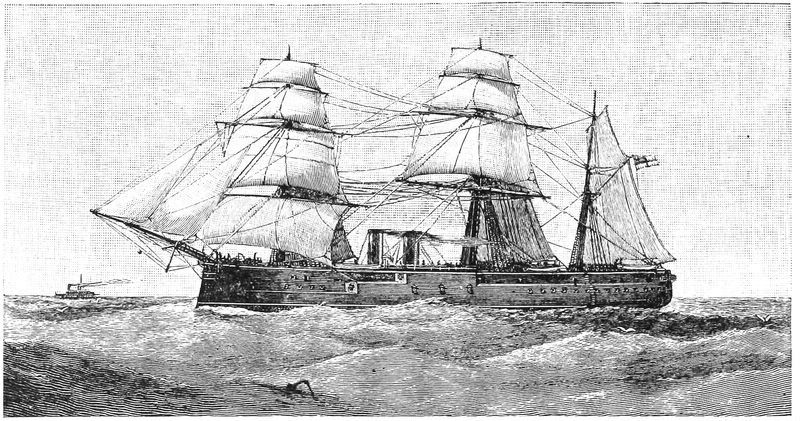
THE “ALEXANDRA.”
The Alexandra is a ship of 9500 tons displacement, the Téméraire is of 8500 tons; after them came the Nelson (to which the Northampton is a sister ship), of 7320 tons displacement. This vessel cannot be regarded as an armored ship at all, in the usual sense of the word, having but a partial belt of armor, and none of her guns being enclosed within armor protection, although two guns for firing ahead and two for firing astern are partially sheltered by armor. Even less protection than this is afforded to the guns of the Shannon, which also has but a partial belt of armor, and protection for two bow guns only. The comparatively small size of the Shannon (5400 tons displacement) relieves her in some degree from the reproach of being so little protected; but it is difficult (to the present writer) to find a justification for building ships of 7320 tons, like the Nelson and Northampton, and placing them in the category of armor-plated ships, seeing that their entire batteries are open to the free entrance of shell fire from all guns, small as well as large. Where a ship has a battery of guns protected against fire in one or more directions, but freely exposed to fire coming in other directions, to assume that the enemy will be most likely to attack the armor, and avoid firing into the open battery, appears to be a reversal of the safe and well-accepted principle of warfare, viz., that your enemy will at least endeavor to attack your vulnerable part. No doubt, when the size or cost of a particular ship is limited, the designer has to make a choice of evils, but where people are as free as is the British Board of Admiralty to build safe and efficient ships, the devotion of so much armor as the Nelson and Northampton carry to so limited a measure of protection is a very singular proceeding, and illustrates once more with how little wisdom the world is governed.
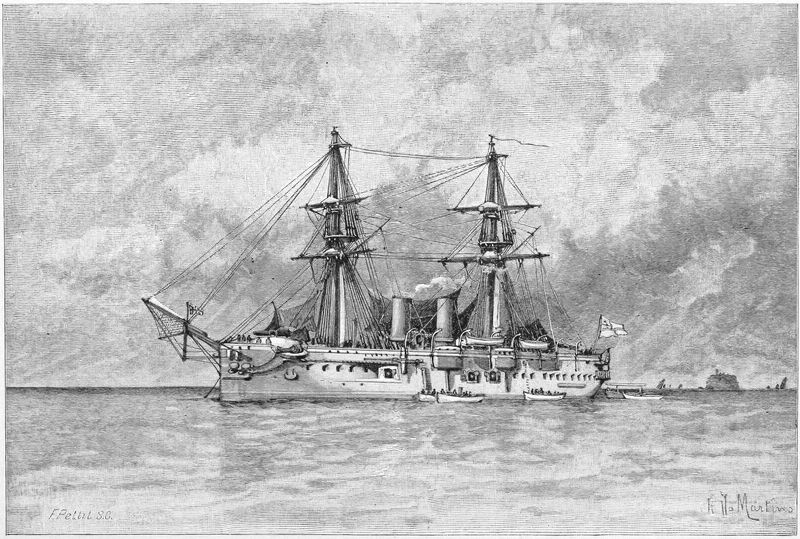
THE “TÉMÉRAIRE.”
Before passing from the armored ships of the navy—or, rather, as we must now say, in view of some of the ships just described and illustrated, before passing from the ships which have some armor—it is desirable to take note of a few exceptional vessels which cannot be classed either with the pretentious and so-called line-of-battle ships or with the rigged iron-clads generally. Among these will be found two comparatively small ships, designed by the writer many years ago to serve primarily as rams, but to carry also some guns. These were the Hotspur and Rupert. The water-line of the Hotspur was protected with very thick armor for her day (11-inch), extending from stem to stern, dipping down forward to greatly strengthen the projecting ram. She carried (besides a few smaller guns) the largest gun of the period, one of twenty-five tons, mounted on a turn-table, but protected by a fixed tower pierced with four ports.[5] This fixed tower was years afterwards replaced by a revolving turret, similar to that which the writer gave in the first instance to the Rupert, designed soon after the Hotspur. Both the armor and the armament of the second vessel were heavier than those of the first, but the ram, as before, was the chief feature of the ship.
It is needless here to describe some of the very early turret-ships, such as the Prince Albert, Scorpion, Wyvern, and Royal Sovereign, all of which embodied the early (though not by any means the earliest) views of that able, energetic, and lamented officer, the late Captain Cowper Coles, R.N., who was lost at sea by the capsizing of his own ship, the Captain, her low sides failing to furnish the necessary stability for enabling her to resist, when under her canvas, the force of a moderate gale of wind. Had he been able to foresee the coming abandonment of sail-power in rigged ships, and had he been placed, as the writer advised, in charge of the revolving turrets of the navy, leaving ship-designing to those who understood it, he might have been alive to this day, to witness the very general adoption in the British navy of that turret system to which he for some years devoted and eventually sacrificed his life.
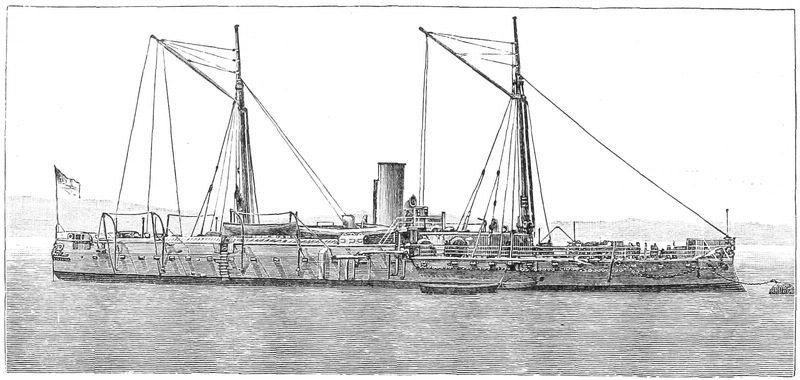
THE “HOTSPUR.”
The first real sea-going and successful ship designed and built to carry the revolving turret of Coles was, by universal consent, the Monarch, whose sea-going qualities secured for her the distinction of transporting to the shores of America—as a mark of England’s good-will to the people of the United States, and of her admiration of a great and good citizen—the body of the late Mr. George Peabody. “The performances of the Monarch at sea,” says Brassey’s “British Navy,” “were in the highest degree satisfactory;” and nothing could exceed the frank and liberal praises bestowed upon her for her performances during the voyage to New York by the officers of the United States man-of-war which accompanied her as a complimentary escort.
A great deal has been written and said at different times about four other turret-ships of the British navy, viz., the Cyclops, Gorgon, Hecate, and Hydra—far less terrible vessels than these formidable names would seem to import. Whether these four comparatively small turret-ships possess the necessary sea-going qualities for coast defence (as distinguished from harbor service) is a question which has been much discussed, and is not yet settled. The truth is that the defence of the coasts of England, Wales, Scotland, and Ireland is a service in which the sea-going qualities of vessels may be called into requisition as largely as in any service in the world. There are some (this writer among them) who much prefer the mid-Atlantic in a heavy gale of wind to many parts of these coasts, more especially if there be any doubt about the perfect obedience of the ship to her steam-power and her helm. The worst weather the writer has ever experienced at sea was met with in the English Channel, and the only merchant-ship which he ever even in part possessed was mastered by a Channel storm, had to cast anchor outside of Plymouth Breakwater, was blown clean over it, and sank inside of it, with her cables stretched across that fine engineering work. It is therefore difficult, and has always been difficult, not to say impossible, for him to regard a “coast-defence ship,” which certainly ought to be able to defend the coast, and to proceed from one part of it to another, as a vessel which may be made less sea-worthy than other vessels. Only in one respect, viz., that of coal supply, may such a ship be safely made inferior to sea-going ships.
But whether the four vessels under notice be fit for coast defence or not, it ought to be known that they were not designed for it. They were hastily ordered in 1870, when the Franco-German war was breaking out, under the impression that Great Britain might get involved in that war. The British Admiralty knew then (as it knows now, and as it has known for years past) that the navy had not been maintained in sufficient strength, and it consequently seized the first design for a small and cheap ship that it could lay hands on, and ordered the construction, with all despatch, of four such vessels. The design which it happened to take, or which seemed to it most suitable, was that of the Cerberus—a breastwork Monitor designed by the writer for special service in inland colonial waters, and made as powerful as was then possible on 3300 tons of displacement, both offensively and defensively, but with no necessity for, and no pretensions whatever to, sea-going qualities. It is scarcely to be supposed that four vessels having such an origin could be expected to take their place as sea-going ships of the British navy; nor could they, either, for reasons already suggested, be expected to possess any high qualities as vessels for the defence of
“That land ’round whose resounding coasts The rough sea circles.”
The Admiralty which ordered their construction may possibly be able to state why it built them, but even that is not at all certain. One of the evil results of mean economies in national enterprises in ordinary times is extravagant and aimless expenditure in times of necessity.
A later example of this kind of expenditure under very similar circumstances was furnished during Lord Beaconsfield’s administration, when war with Russia seemed likely to occur. Again the insufficiency of the navy was strongly felt, and again public money to the extent of two millions sterling or more was expended upon the acquisition of such ships as could be most readily acquired, regardless of cost. At this time the Neptune (of 9170 tons displacement), the Superb (of 9100 tons), and the Belleisle and Orion (each of 4830 tons), were purchased into the service, and having been built for other navies, and under very peculiar circumstances in some cases, required large dockyard expenditure to convert them to their new uses in the British navy.
It only remains, in so far as existing armored, or rather “partly armored,” ships are concerned, to advert to the Impérieuse and Warspite, two cruisers building for distant service. These ships are three hundred and fifteen feet long, and to them has been allowed, by the extraordinary generosity of the Admiralty, as much as one hundred and forty feet of length of armored belt. If this had been extended by only twenty feet, these British cruisers, which Lord Brassey—whether grandiloquently or satirically it is hard to say—calls “armored cruisers,” would have actually had one-half of their length protected by armor-plating at the water-line. In what spirit and with what object is not known, but Lord Brassey, in his outline sketch of these ships, writes the word “coals” in conspicuous letters before and abaft the belt. Can it be possible that he, undoubtedly a sensible man of business, and one who laboriously endeavors to bring up the knowledge and sense of his fellow-countrymen to a level with his own, and who was once Secretary to the British Admiralty—can it be possible that he considers coal a trustworthy substitute for armor, either before or after it has been consumed as fuel?
It is very distressing to have to write in these terms, and put these questions about Admiralty representatives and Admiralty ships; but what is to be done? Here are two ships which are together to cost nearly half a million of money, which are expressly built to chase and capture our enemies in distant seas, which are vauntingly described as “armored cruisers,” which cannot be expected always by their mere appearance to frighten the enemy into submission, like painted Chinese forts, which must be presumed sometimes to encounter a fighting foe, or at least to be fired at a few times by the stern guns of a vessel that is running away, and yet some eighty or ninety feet of the bows of these ships, and as much of their sterns, are deliberately deprived of the protection of armor, so that any shell from any gun may pierce them, let in the sea, and reduce their speed indefinitely; and in apparent justification of this perfectly ridiculous arrangement—perfectly ridiculous in a ship which is primarily bound to sustain her speed when chasing—a late Secretary to the Admiralty tells us that she is to carry in the unprotected bow some coals! May my hope formerly expressed in Harper’s Magazine find its fruition by giving to the British Admiralty a piece of information of which it only can be possibly ignorant, viz., that even while coal is unconsumed, it differs largely from steel armor-plates in the measure of resistance which it offers to shot and shell; and further, that coal is put on board war-ships that it may be consumed in the generation of steam? It is very desirable that this information should somehow be conveyed to Whitehall in an impressive manner, and possibly, if the combined intelligence of the two great nations to which Harpers’ publications chiefly appeal be invoked in its favor, it may at length be understood and attended to even by the Admiralty, and one may hear no more of the protection of her Majesty’s ships by means of their “coal.”
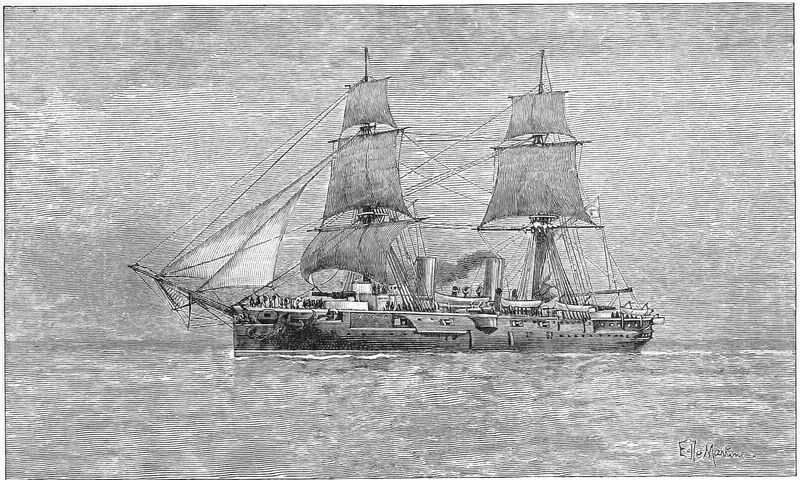
THE “WARSPITE.”
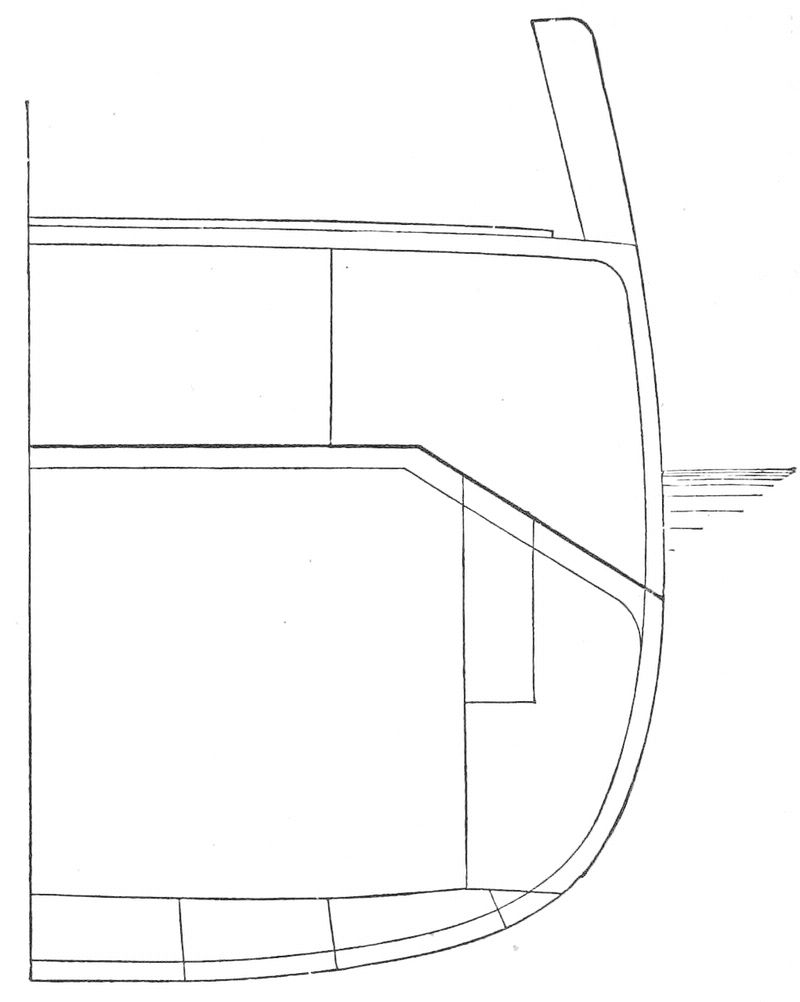
TRANSVERSE SECTION OF THE “MERSEY.”
Passing now from the so-called iron-clads of the British navy, we come to a class of vessels which have their boilers, etc., protected from above by iron decks sweeping over them from side to side. The section of the Mersey, one of the most important British ships of this type, will illustrate the system of construction. Various attempts have been made to impose numerous ships of this kind upon a sometimes too credulous public as armored vessels, and Lord Brassey, while publishing descriptions and drawings which demonstrated beyond all question that the buoyancy and stability of these ships are not at all protected by armor, nevertheless deliberately includes some of them in his list of “armored ships.”[6] Now, the thick iron deck certainly protects (in some degree, according to its thickness) all that is below it against the fire of guns, and armor itself is sometimes employed to protect the gun machinery; but the existence of a thickish deck under the water, or mainly under the water, occasionally associated with patches of armor above water here and there to protect individual parts, does not constitute the ship itself an armored ship in any such sense of the term as is ordinarily accepted and understood. How can that be properly called an “armored ship” which can be utterly destroyed by guns without any shot or shell ever touching such armor as it possesses? The British Admiralty, in the “Navy Estimates” for 1883-84, under some unknown influence, put forward two ships of this description as armored vessels, and was afterwards forced to remove them from that category, but only removed them to place them in another not less false, not less misleading, not less deceptive and dangerous, viz., that of “protected ships.” And this most improper description is still applied to various ships of which the special characteristic is that they themselves are not protected. If the ship’s own coal and stores may be regarded as her protection, or if the existence of a certain number of exposed and extremely thin internal plates can be so regarded, then may these vessels be deemed partly, but only partly, “protected;” but if “protected ship” means, as every honest-minded person must take it to mean, that the ship herself is protected by armor against shot and shell, then the designation “protected ship,” as employed by the British Admiralty, is nothing less than an imposition. These ships are not protected. Neither their power to float, nor their power to keep upright, nor their power to exist at all, after a few such injuries as even the smallest guns afloat can inflict, is “protected,” as any war whatever is likely to demonstrate.
Those who employ such language ignore the essential characteristic of a ship-of-war, and some of the gravest dangers which menace her. It is conceivable that in the old days, when men wore armor, the protection of the head with an “armet,” and of the breast by a breastplate, might have justified the description of the man so defended as an “armored man,” although it is difficult to see why, since he might have been put hors de combat by a single stroke. But protect the boilers and magazines of a ship how you will, if you do not protect the ship itself sufficiently in the region of the water-line to prevent such an invasion of the sea as will sink or capsize her, she remains herself essentially unprotected, liable to speedy and complete destruction, and cannot truly be called a “protected ship.”
It must not for a moment be supposed that this is a mere question of words or designations. On the contrary, it is one of the most vital importance to all navies, and most of all to the navy of Great Britain. What the Admiralty says, the rest of the government, and beyond them the country, are likely to believe and to rely upon, and when the stress of naval warfare comes, the nation which has confidingly understood the Admiralty to mean “armored ships” and “protected ships” when it has employed these phrases, and suddenly finds out, by defeat following defeat, and catastrophe catastrophe, that it meant nothing of the kind, may have to pay for its credulity, allowable and pardonable as it may be, the penalty of betrayal, and of something worse even than national humility.
On the other hand, it is not to be inferred from the objections thus offered to the employment of deceptive designations that objection is also offered to the construction of some ships with limited or partial protection, falling short of the protection of the buoyancy and the stability, and therefore of the life, of the ship itself. It is quite impossible that all the ships of a navy like that of Great Britain, or of the navies of many other powers, can be made invulnerable, even in the region of the water-line, to all shot or shell. Indeed, there are services upon which it is necessary to employ armed ships, but which do not demand the use of armored or protected vessels. Unarmored vessels, with some of their more vital contents protected, suffice for such services. Moreover, even where it would be very desirable indeed to have the hull protected by armor to a sufficient extent to preserve the ship’s buoyancy and stability from ready destruction by gun-fire, it is often impracticable to give the ship that protection. This is true, for example, of all small corvettes, sloops, and gun-vessels, which are too small to float the necessary armor-plates, in addition to all the indispensable weights of hull, steam-machinery, fuel, armament, ammunition, crew, and stores. It would be both idle and unreasonable, therefore, to complain of the construction of some ships with the protecting armor limited, or even, in certain cases, with no protecting armor at all. Such ships must be built, and in considerable number, for the British navy. But this necessity should neither blind us to the exposure and destructibility of all such vessels, nor induce us to endeavor to keep that exposure and destructibility out of our own sight. Still less should it encourage us to sanction, even for a moment, such an abuse of terms as to hold up as “armored” and “protected” ships those which, whether unavoidably or avoidably, have been deprived of the necessary amount of armor to keep them afloat under the fire of small or even of moderately powerful guns.
We are now in a position to review the British navy, and to see of what ships it really consists. In this review it will not be necessary to pass before the eyes of the reader that large number of vessels of which even the boilers and magazines are without any armor or thick-plate protection whatever. It will help, nevertheless, to make the nature and extent of the navy understood if these are grouped and summarized in a few sentences. Neglecting altogether all large vessels with timber frames (which may be regarded as out of date, seeing that all the war vessels of considerable size now built for the navy have iron or steel frames), it may be first said that there are but three ships of the large or frigate class in the British navy which carry no thick protecting plate at all, viz., the Inconstant, the Shah, and the Raleigh. Of much less size than these, and equally devoid of protection, are the two very fast vessels, the Iris and Mercury, built as special despatch-vessels, steaming at their best at about eighteen knots. Among the unarmored corvettes are the Active, Bacchante, Boadicea, Euryalus, Rover, and Volage, all exceeding fourteen knots in speed, and all more than three thousand tons displacement. Then follow thirty-six smaller and less swift corvettes, nearly one-half the number being built wholly of wood, most of which exceed, however, thirteen knots in speed; and below these about an equal number of sloops of less speed and tonnage. The smaller gun-vessels and gun-boats need not be summarized.
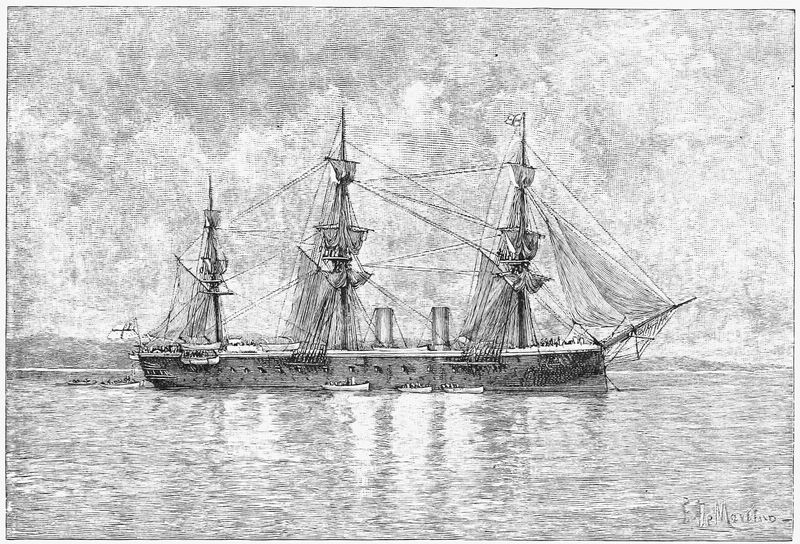
THE “INCONSTANT.”
Passing on to vessels which, although themselves unarmored, have thick-plate decks to give some protection to the machinery, we observe first that there are eight ships of three thousand five hundred to three thousand seven hundred tons built and under construction, viz., the Amphion, Arethusa, Leander, Phaeton, Mersey, Severn, Forth, and Thames.[7] Lord Brassey very properly classes such of these vessels as he mentions in his lists as “unarmored ships,” although, as before mentioned, when two of them—the Mersey and Severn—were designed, with a deck two inches thick, the Admiralty at first ventured to put them forward as “armored ships.”
Ascending in the scale of protection, and dealing for the present with sea-going vessels only, we come to a long series of ships which are undeserving of the designation of armored ships, because they are liable to destruction by guns without the limited amount of armor which they carry being attacked at all. These ships are the Impérieuse and Warspite, previously discussed, and also the Ajax, Agamemnon, Colossus, Edinburgh, and the six large ships of the “Admiral” class. Any one who has intelligently perused the report of the committee on the Inflexible would justify the inclusion of that ship in this category; but she is omitted here out of deference to the strenuous exertions which were made to invent or devise some little stability for her, even when her bow and stern are supposed to be badly injured, and out of compassion upon those officers of the Admiralty who have long ago repented those trying compromises with conscience by aid of which they expressed some slight confidence in her ability to float upright with her unarmored ends badly damaged. She is omitted also out of gratitude to Lord Brassey for a sentence in which, while saving her from being placed in so dreadful a category, he honestly places some of the other ships in it without qualification or circumlocution. He says: “In one important particular the Ajax and Agamemnon are inferior to the Inflexible. The central armored citadel is not, as it is in the case of the Inflexible, of sufficient displacement to secure the stability of the ship should the unarmored ends be destroyed.”[8] In another place the former Secretary to the Admiralty, referring to the report of the Inflexible committee (which was nominated by the Admiralty, and under heavy obligations to support it), says: “It is doubtless very desirable that our armored ships should possess a more ample margin of stability than is provided in the armored citadel of the Inflexible. The ideas of the committee and of Sir Edward Reed on this point were in entire accord.”[9]
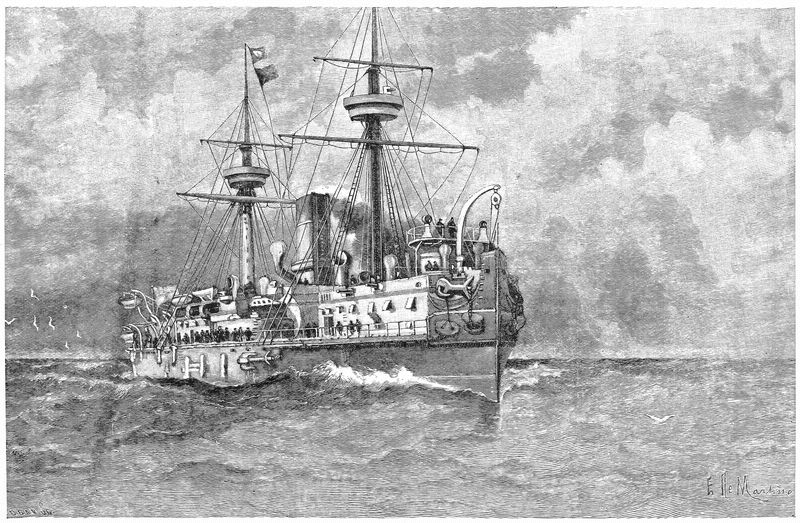
THE “COLOSSUS.”
It has recently been acknowledged that, as Lord Brassey states, the Ajax and Agamemnon are so constructed that they are dependent for their ability to float, the right side uppermost, upon their unarmored ends. To call such ships “armored ships” is, as we have seen, to mislead the public. But some pains have been taken of late to show that the “Admiral” class is better off in this respect, and certainly the known opinions of the present writer have been so far respected in these ships that their armored citadels, so called, have been made somewhat longer and of greater proportionate area. The following figures have been given:
Percentage of water-line area
covered by armor.
Inflexible 42.
Agamemnon 45.4
Collingwood 54.15
Camperdown 56.35
But any one who understands this question knows perfectly well that “percentage of water-line area covered by armor” in no way represents the relative stabilities of these ships. Indeed, that is obvious upon the face of the matter, because we have seen the Ajax and Agamemnon pronounced devoid of the necessary stability when injured, while the Inflexible is said to possess it, although the former vessel has 45½ per cent. of the water-line area covered, while the latter has but 42 per cent. But this is not the consideration which has led to the condemnation of the whole “Admiral” class of so-called iron-clads as not possessing the essential characteristic of an armored ship, viz., the power to float, and to float with needful buoyancy and stability, all the time the armor is unpierced. The ground of that condemnation is to be found in the introduction into the “Admirals” of a dangerous combination from which the Inflexible and Agamemnon and other like ships are exempt—the combination of long unarmored ends comprising about forty-five per cent. of the water-line area with so shallow a belt of armor that, when the unarmored ends are injured and filled by the sea (as they would be in action), there would remain so little armor left above water that a very slight inclination of the ship would put it all below water. In the Agamemnon class, small as the initial stability may be (and with the unarmored ends torn open it would be nothing), the armor is carried up to a reasonable height above water. But in the “Admiral” class all the advantage arising from a slightly lengthened citadel is more than destroyed by this lowering of the armor. So great is the consequent danger of these ships capsizing, if ever called upon to engage in a serious battle at close quarters, that the writer cannot conscientiously regard them as “armored ships,” but must in common fairness to the officers and men who are to serve in them, and to the nation which might otherwise put its trust in them, relegate them to the category of ships with only parts protected.
It will be observed that nothing has yet been said about thickness of armor, although that is, of course, a very important element of a ship’s safety or danger. But important as it is, it has to be kept scrupulously separated from the question just discussed—the limitation of the armor’s extent—because no misrepresentation and no misconception can well arise concerning the relative power or trustworthiness of ships armored variously as to thickness, while much misrepresentation has actually taken place, and much consequent misconception has actually arisen, on the other matter, more than one European government having deliberately placed in the category of “armored ships” ships which in no true sense of the word can be so classed.
The following classifications will conform to the foregoing views, describing as “armored ships” only those which have sufficient side-armor to protect them from being sunk or capsized by the fire of guns all the time the armor remains unpierced:
BRITISH SHIPS OF WAR, BUILT AND BUILDING.
ARMORED SHIPS WITH THICK ARMOR.
Name of Ship Tons Displacement. Indicated Horse-power. Speed, in Knots. Maximum Thickness of Armor, in Inches. Largest Guns, in Tons.
Alexandra 9,490 8,610 15 12 25
Belleisle 4,830 3,200 12¼ 12 25
Conqueror 5,200 4,500 15 12 43
Devastation 9,330 6,650 13¾ 12 35
Dreadnought 10,820 8,200 14½ 14 38
Hero 6,200 4,500 15 12 43
Inflexible[10] 11,400 8,000 14 24 80
Neptune 9,170 9,000 14½ 12 38
Orion 4,830 3,900 13 12 25
Rupert 5,440 4,630 13½ 12 18
Superb 9,100 7,430 14 12 18
Thunderer 9,330 6,270 13½ 12 38
Glatton[11] 4,910 2,870 12 12 25
ARMORED SHIPS WITH MEDIUM ARMOR.
Name of Ship Tons Displacement. Indicated Horse-power. Speed, in Knots. Maximum Thickness of Armor, in Inches. Largest Guns, in Tons.
Hercules 8,680 8,530 14¾ 9 18
Hotspur 4,010 3,500 12¾ 11 25
Sultan 9,290 8,630 14 9 18
Téméraire 8,540 7,700 14½ 11 25
ARMORED SHIPS WITH THIN ARMOR.[12]
Name of Ship Tons Displacement. Indicated Horse-power. Speed, in Knots. Maximum Thickness of Armor, in Inches. Largest Guns, in Tons.
Achilles 9,820 5,720 14½ 4½ 12
Agincourt 10,690 6,870 15 5½ 12
Audacious 6,910 4,020 13 8 12
Bellerophon 7,550 6,520 14¼ 6 12
Black Prince 9,210 5,770 13¾ 4½ 9
Gorgon[13] 3,480 1,650 11 9 18
Hecate[13] 3,480 1,750 11 9 18
Hector[13] 6,710 3,260 12½ 4½ 9
Hydra[13] 3,480 1,470 11¼ 8 18
Invincible 6,010 4,830 14 8 12
Iron Duke 6,010 4,270 13¾ 8 12
Minotaur 10,690 6,700 14½ 5½ 12
Monarch 8,320 7,840 15 7 25
Northumberland 10,580 6,560 14 5½ 12
Penelope 4,470 4,700 12¾ 6 9
Prince Albert 3,880 2,130 11¾ 4½ 12
Swiftsure 6,640 4,910 15¾ 8 12
Triumph 6,640 4,890 14 8 12
Valiant 6,710 3,560 12¾ 4½ 9
Warrior 9,210 5,470 9¼ 4½ 9
SHIPS ARMORED IN PLACES.
The ships in this list, although having some armor upon their sides, being liable to capsize at sea from injuries inflicted upon their unarmored parts, cannot be classed with the armored ships.
Name of Ship Tons Displacement. Indicated Horse-power. Speed, in Knots. Maximum Thickness of Armor, in Inches. Largest Guns, in Tons.
Ajax 8,490 6,000 13 18 38
Agamemnon 8,490 6,000 13 18 38
Anson 10,000 7,500 14 18 63
Benbow 10,000 7,500 14 18 110
Camperdown 10,000 7,500 14 18 63
Collingwood 9,150 7,000 14 18 43
Colossus 9,150 6,000 14 18 43
Edinburgh 9,150 6,000 14 18 43
Howe 9,600 7,500 16 18 63
Rodney 9,600 7,500 14 18 63
Impérieuse[14] 7,390 8,000 16 10 18
Warspite[14] 7,390 8,000 16 10 18
To the preceding list may now be added two ships of 10,400 tons displacement, with 18-inch armor, and five cruisers of 5000 tons displacement, with 10-inch armor, recently ordered by the Admiralty to be built by contract.
UNARMORED SHIPS WITH UNDER-WATER STEEL DECKS.[15]
Name of Ship Tons Displacement. Indicated Horse-power. Speed, in Knots. Maximum Thickness of Armor, in Inches. Largest Guns, in Tons.
Amphion 3,750 5,000 16¾ 1½ 6
Arethusa 3,750 5,000 16¾ 1½ 6
Leander 3,750 5,000 16¾ 1½ 6
Phaeton 3,750 5,000 16¾ 1½ 6
Mersey 3,550 6,000 17 2 6
Severn 3,550 6,000 17 2 6
Thames 3,550 6,000 17 2 6
Forth 3,550 6,000 17 2 6
Armored ships with 12-inch armor and upward are called ships with thick armor; those with armor less than twelve inches but more than eight inches thick are designated as ships with medium armor; and those with 8-inch armor or less as ships with thin armor.
A number of vessels of the “Scout” class are now under construction for the Admiralty. There is a disposition in certain quarters to include these among the ships of the class recorded in the last table. A transverse section of one of these is given here, in which the so-called protective deck is but three-eighths of an inch in thickness, and can therefore be pierced by any gun afloat, from the largest down to the very smallest. It would be quite absurd to speak of this class of vessels as being in any way “protected” against gun fire.
The first-class ships, so called, and the armored cruisers referred to in the former part of this chapter as having been promised to Parliament by the Admiralty representatives, were ordered, and work upon them is well under way in the yards of those firms to whom their building has been intrusted. The former are two in number, and their principal dimensions and particulars are as follows: length, 340 feet; breadth, 70 feet; draught of water, 26 feet; displacement, 10,400 tons; indicated horse-power, 10,000; estimated speed, 16 knots; thickness of armor, 18 inches; largest guns, 110 tons. The armor-belt in these ships is a little more than 160 feet long, or about half their length, but rises to a height of only two feet six inches above the water. Before and abaft the belt under-water armored decks extend to the stem and stern respectively, as in the “Admiral” class. Besides the two 110-ton guns, which, as has been said, are placed in a turret forward and fire over the upper deck, there are twelve 6-inch guns ranged round the after-part of the ship on the upper deck. A certain amount of protection has been given to these guns by means of armor-plating, but as this is only three inches thick, it can be said to do little more than protect the gun crews from the fire of rifles and of the smallest machine-guns.
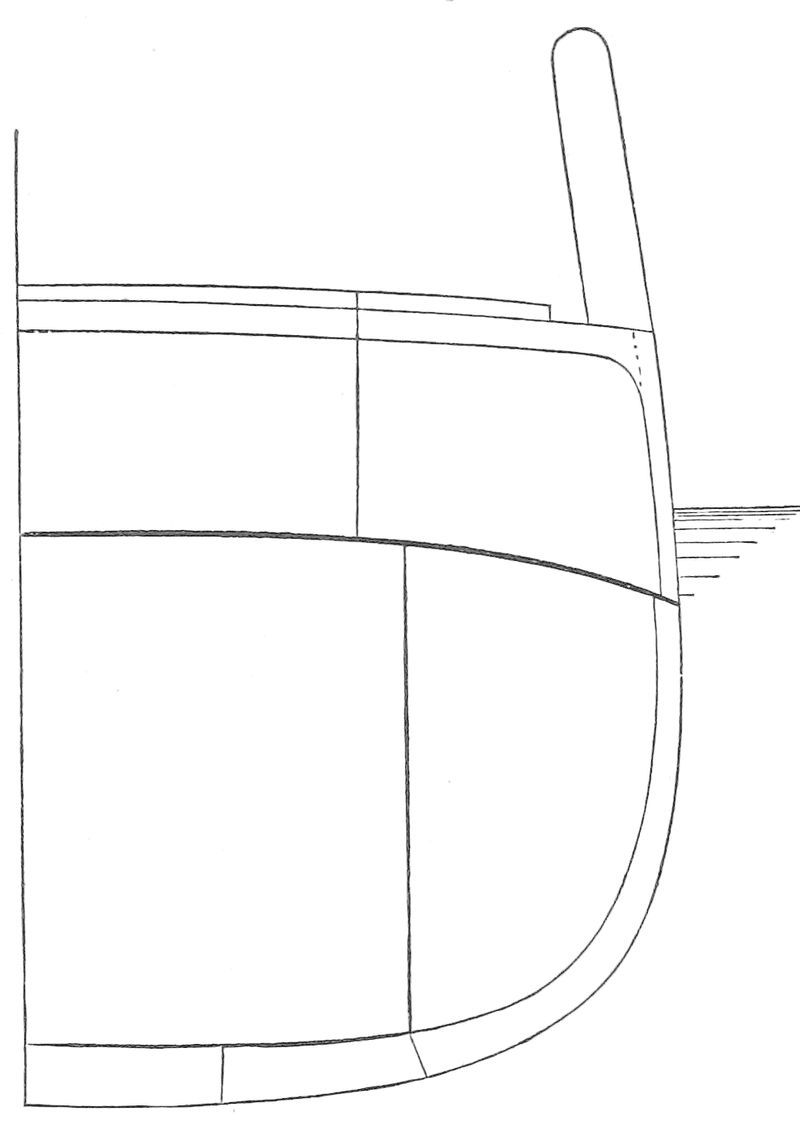
TRANSVERSE SECTION OF ONE OF THE NEW “SCOUTS”
Of the armored cruisers,[16] five have been contracted for. Their principal dimensions and particulars are: length, 300 feet; breadth, 56 feet; draught of water, 21 feet; displacement, 5000 tons; indicated horse-power, 8500; estimated speed, 18 knots; thickness of armor, 10 inches; largest guns, 18 tons. These vessels are protected by an armor-belt nearly two hundred feet long, which extends to a height of one foot six inches above the water, and to a depth of four feet below it, and they also have under-water decks before and abaft the belt. They carry two 18-ton guns, one well forward, ranging right round the bow, and the other well aft, ranging right round the stern, as well as five 6-inch guns on each broadside, the foremost and aftermost of which are placed on projecting sponsons, by which they are enabled to fire right ahead and right astern respectively. None of these guns is protected except by the thin shields usually fitted to keep off rifle fire from those actually working the guns.
No mention has yet been made of the troop or transport ships of the British navy. There are in all about a dozen of these, but by far the most conspicuous and important of them are the five Indian transports which were built about twenty years ago, conjointly by the Admiralty and the government of India, and ever since worked by those departments of the State with general satisfaction. One of these, the Jumna, is illustrated in the annexed figure. So satisfied was the late Director of Transports, Sir William R. Mends, K.C.B., with the services of these ships that, before retiring from his office, he informed the writer that if he had to assist in the construction of a new fleet of such transports he would desire but a single improvement in them, as working ships, and that was the raising of the lower deck one foot, in order to increase to that extent the stowage of the holds.
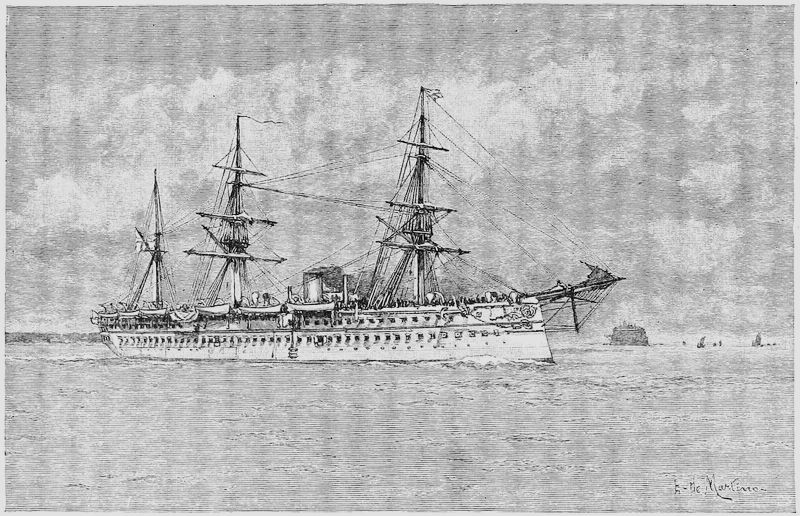
THE “JUMNA.”
In the early part of this chapter the writer made reference to the influence exerted upon European ship-building by the incidents of the American civil war. He will conclude by a reference to an influence exerted upon his own mind and judgment by the most distinguished naval hero of that war, the late Admiral Farragut. On the occasion of that gallant officer’s visit to England the Board of Admiralty invited him, as a wholly exceptional compliment, to accompany it on its annual official visit of inspection to her Majesty’s dockyards. On the way from Chatham to Sheerness in the Admiralty yacht, the writer had a most instructive conversation with the admiral as to the results of his practical experience of naval warfare at the brilliant capture of New Orleans, and elsewhere, and one of those results was this: “Never allow your men to be deceived as to the ships in which you expect them to fight. They will fight in anything, and fight to the death, if they know beforehand what they are going about, and what is expected of them. But if you deceive them, and expose them to dangers of which they know nothing, and they find this out in battle, they are very apt to become bewildered, to lose heart all at once, and to fail you just when you most require their utmost exertions.” The writer has not forgotten this, and will not forget it. The British Admiralty is, unhappily, altogether unmindful of it.