RABBI MOOSHIE G. DANIEL, (continued 2)
Reading edition
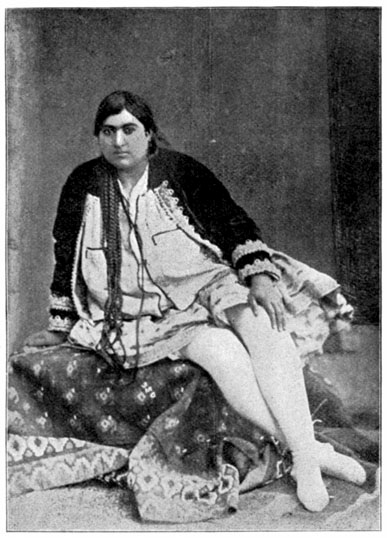
HAREM COSTUME.
COSTUMES AT HOME.
The shirt worn at home by woman is an article made of silk or cotton. It is short, open breast, well embroidered, and is red or white and reaches to the middle of the thigh. Over the shirt is the cula-ja, rather loose, with long sleeves fastened with buttons of silver.
The Shalwar is similar to the ordinary skirt only it is very short. Some wear from three to ten of these skirts. The outer one is very rich and trimmed with gold lace. The head covering is called Char-Kat and is made square of a long embroidered article of fine silk or thin cotton and is fastened under her chin. Sometimes at home they are bareheaded. Hose are white and long. The hair is generally black, heavy, braided and spread on her back. In front it is parted in the middle when bangs are not worn. The hair is usually painted to appear black and smooth.
HER JEWELRY.
The middle class of women are fond of jewelry, but do not burden themselves with heavy ornaments as do some of the lower class. They usually wear two or three finger rings, small earrings of gold, bracelets and necklace. There is frequently a large emerald, incased in gold, hanging from the necklace, bearing this inscription: "There is no god but Allah." Beautiful ornaments of gold and silver are attached to the ends of their braided hair.
When a wife has perfumed and adorned herself she will await the coming of her husband from his shop. She knows at what time he will return home. An hour before his coming she will go before the mirror to see if she is dressed beautifully enough to please her husband. Ten minutes before his arrival she will prepare a delicious Kalyon, (which is a smoke and water pipe.) Holding it in her hand she will rise and offer him the Kalyon, saying, "My lord, command your pleasure." He will take the pipe and smoke. While he is sitting she will sprinkle perfume on his head and clothes. For several minutes they exchange the pipe and smoke alternately. This is the first thing which a husband of the middle class expects of his wife—not to work for him but to adorn herself and please him. It cannot be said that the Mohammedan does not love his wife. He buys her whatever she asks for; not because he considers her his equal, but for the sake of his own pleasure.
MEN'S COSTUME.
Most men of the middle class, at some time in life go on a pilgrimage to Mecca and Medina. After a pilgrim returns he is given the title of Ha-jeh and thereafter wears a turban on his head instead of the ordinary cap. The cap commonly worn by the Persian is about eight inches high, has no brim and is black in color. The shirt is of white cotton, open in front and fastened with a button on the right shoulder. The trousers are very much like the bloomers worn by some bicyclists of modern times, and old people wear garments even wider than bloomers. They are made of wool or cotton and are usually black. The coat is called ar-ka-look. Some are long enough to reach the ankle, while others reach about the middle of the thigh. The sleeves fasten at the wrist by a button of silk cord. There is a pocket on either side near the belt. Various colors are worn. The gima or overcoat is a heavy wool garment reaching to the knee, the lower part of which is pleated. It is open in front and fastened with a number of buttons. The belt is a large piece of linen folded many times around the waist. Some wear heavy and costly shawls.
It is a general custom to shave the head except a small place on each side of the head just over the ear and a spot on the crown of the head. The hair-covered spots are called Zoolf and are dyed with Hana. The most religious men and the aged shave the entire surface of the head. The young men shave the beard, except the mustache, till the age of thirty years after which time the beard is clipped at the length of about one inch till the age of forty. After the age of forty the beard is never cut. The mustache is never shaved, by young or old. It is a mean thing to do, and is against their religion. No man has been seen in Persia with a smooth upper lip except Europeans. A man who will shave his mustache is not a Mohammedan but an infidel; not a man, but a girl. The long mustache is regarded as the glory of man.
THE LOWER CLASS.
The lower class of people are farmers and day labors and among them is much misery. They work long hours and get from fifteen to twenty-five cents a day. Their clothing is of cheap material, poorly made, and shorter than the garments of the higher classes. In order to save time and soap their clothes are sometimes not washed for a month. Some farmer's wives use the sickle all day long in the field during harvest-time. Many women do the lighter work of killing weeds. Sometimes a woman will take her babe to the field with her and leave it in the care of an older child while she labors. In the fall of the year the laborers are busy in the vineyards, a great abundance of grapes being produced in this country. A familiar scene of an evening is to see men and women trudging homeward bearing heavy burdens of fruit, raisins, etc. stored in baskets. Some of the children are employed through the day looking after and feeding the cattle, buffaloes and sheep, while it is the duty of others to carry food and drink to the workers in the fields. In the winter the men are employed feeding cattle or in weaving coarse cloths for the clothing of the lower class. Others who are not thus engaged spend the winter in carrying dried fruits, wheat, fuel and various kinds of goods to the cities on donkey caravans.
The women of this class spend the winter in spinning cotton and wool, making carpets, sacks, etc. and in sewing garments for their children and husbands. Young girls are busy in preparing useful articles for their wedding. The dozen or more holidays that come during the year are celebrated by this class in having big dinners, and the women cease from the heavy burdens of their labor for the day and attempt to beautify themselves after the fashion of women of the higher classes with paint and finery. Their taste not being cultivated in that art they often make themselves more hideous than beautiful.
CHAPTER VII.
THE MOSQUES AND THEIR SERVICES.
The mosque is the Mohammedan holy temple or church. There is one in most every community which has been erected by lords or rich people. In the cities they have some magnificent mosques built of stone and brick. A mosque is divided into several small rooms and two large halls. One hall is for winter service, the other for summer. The summer hall is in the front end of the building, is enclosed with three walls, the front being open. The pillars that guard the entrance to this hall are adorned with artistic designs. The interior walls of the mosque are painted white and on them are inscribed in large letters numerous verses from the Koran. The floors of the halls are not covered with carpets or rugs, as they would be stolen; but there are cheap mats made of reeds on the floor. There are no chairs but the worshipers sit on the floor.
It is believed that any man who builds a mosque has remission of his sins. It gives him great reputation and he is known as a holy and religious man. There are some very old mosques, a few having stood as long as 900 years. In some instances Christian churches have been converted into mosques in times of persecution. In the city of Oroomiah one very fine church was converted into a mosque about 600 years ago. It is a very large building with a high steeple and stands in the heart of the city, surrounded by fine grounds of about three acres. The grounds are surrounded by high wall, inside of which are rows of small buildings divided into rooms and used by students. These were originally used by the Christians as a kind of a university. Even to-day the door facing the east which Christians entered to worship Jesus remains. When the Mohammedans took possession of the building a new door was made on the south side facing the holy city of Mecca. Mosques are regarded as holy and no animal is allowed to step in, especially dogs. If a Mohammedan knew that dogs sometimes enter Christian churches they would despise Christians the more. Jews and Christians are not allowed to enter a mosque. They can only stand before the door and listen solemnly.
The Mohammedans have no bells on their mosques. They say Satan is in the bell, and that its sound is the sound of Satan. Sometimes they stop our bells, saying that Allah will not accept their prayers on account of our bells.
They have no bell, but a man, sometimes a Mool-lah, who ascends to the roof of the mosque three times daily, morning, noon and night and in a loud voice calls men to prayer. The call is made in the following words: "Al-lah Ak-par." This means Almighty God and is repeated three times. Then he continues: "Ashuddu-in-nah la il-la-ha ella Allah," meaning, "I testify that there is no god but God." "Ashud-du in-nah Mohammed rus-sool Al-lah," meaning, "I testify that Mohammed is the only apostle of God." "Hay-ya alal sa-lah," meaning, "Hasten to prayer." "Hay-ya alal falah," meaning, "Hasten to the place of refuge and hope." "Hay-ya allal Kher-ul amal," meaning, "Hasten to do good works." The call is concluded by again repeating three times the words, "Allah Ak-par."
The mosque is open day and night, and men may come into prayer at any hour. Friday is holy day and corresponds somewhat to the Christian Sunday. No man is chastised if he works on Friday but all faithful Mohammedans attend public services on that day. The services in the mosques of the cities are conducted by Muj-ta-hids or high priests. The priest starts to the house of worship when he hears the voice of the Mah-zin calling to prayer from the top of the mosque. He is accompanied by eight or ten servants beside numbers of worshipers who may fall in line with the holy man. When he enters the assembled worshipers rise to their feet and remain standing until the priest has seated himself in the pulpit. He will recite from the Koran and tell traditions in a chanting voice. Women are allowed to attend these services but they are required to sit in one corner of the mosque apart from men.
SPECIAL SERVICES.
Among Muj-ta-hids two titles are given to those who excel in holiness, viz., Pish-Namaz and Imam-Ju-ma. The former means mediator in prayer; the latter, the prophet of holy Friday. They are indeed more devoted to their faith and at the same time more fanatical in their hatred for Christianity. When one of these priests goes to the mosque he wears a large turban on his head, some of them costing $50, a cloak of fur, a staff with gold or silver handle. He wears a long beard which is painted black. Following him is a procession of from fifty to one hundred men, mostly mollah, or lower class, who are faithful Moslems. Proceeding toward the mosque with slow and solemn tread, he is saluted by the people of all classes along the street by their rising to their feet, crossing the breast with the arms and reverently bowing before him, uttering the words "Sallam ali-Kun Agha," which means "peace be unto you, sir." This service occurs on holy Friday Sometimes 2,000 or 3,000 men will be gathered in the mosque. Women are not admitted in these most holy and solemn services. The Muj-ta-hid stands in the front part of the mosque, facing Mecca, and all the audience is back of him. As he advances in the prayer all the people repeat what he prays. They imitate every motion he makes. When he kneels, they kneel. When he puts the end of his front fingers in his ears, the entire audience does the same. They believe all prayers which are prayed in that way are accepted through his mediatorial prayer.
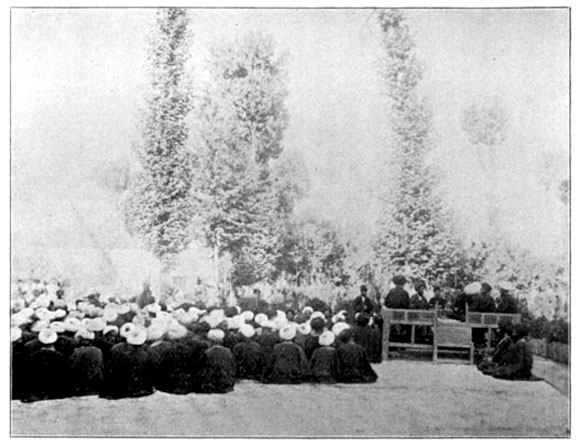
PRIESTS AT WORSHIP.
CHAPTER VIII.
MOSLEM'S PRIVATE PRAYER AND FASTING.
PRAYER.
Prayer carries the Musselman half way to heaven. There is no salvation by grace or by atonement. Allah forgives his sins only on the condition of good works. Hence it is an obligation with every one to pray. Prayer is not a duty issuing from his love to Allah, but a yoke which binds him against his will. It is reduced to a mechanical act without spirit. The Moslem always washes with cold water before prayer. He will take a jar of water and say, "Bism Allah" meaning, "in the name of God I do this holy service." Then dipping his right hand in the water he rubs his arms from the wrist to the elbow; with the tips of his fingers he will wet his forehead and the inside of his ears, and the surface of his feet. Travelers in the desert, use sand as a substitute for water. The worshiper must have a seal of Mecca which is made of clay and is about the size of a half-dollar. On it are the words, "There is no God but God." Facing Mecca, he puts the seal on the ground and standing erect he raises both hands to his head, kneels to the ground, puts his brow on the seal, then kisses it. Rising to his feet he puts both index fingers in his ears; and also makes numerous other gestures. They have one prayer which is always repeated. They have five stated seasons daily for prayer; daybreak, noon, soon after noon, after sunset (to avoid the idea of sun worship) and just before retiring. The general place of prayer is the mosque, but few of the Moslems pray there, as they prefer praying in the streets, open squares and in meadows before mosques where they will be seen by more men and can better show their piety and integrity. In the midst of his prayer he will stop and speak a few words to the surrounding people as a religious custom, or to revile children whose noise while at play may have interrupted him. A prayer often prayed by faithful Moslems, quoted from the Koran, is a foolish and selfish prayer and is entirely against the spirit and teachings of our Lord Jesus Christ. It reads: "O Allah, I seek refuge to thee from Satan and all evil spirits. O Lord of all creatures destroy all heathen and infidels, even those who believe in the Trinity, the enemy of our religion. O Allah, make their children orphans, their wives widows, and defile their abodes. Give their families, their households, their women, their children, their relatives, their possessions, their race, their wealth, their lands, and their daughters as a booty to the Moslems, Thy only people, O Lord of all creatures." Every word is against the blessed teachings of our Lord who said: "Love your enemies, bless them that curse you, do good to them that hate you, and pray for them which despitefully use you and persecute you."
The Mohammedan religion does not require women to pray. It is a question if she has the same soul that man has. However some women among the higher classes and some old widows do pray. But they cannot pray in the most holy mosques on account of their uncleanness, nor in the streets for they ought not to be seen of men. If they wish to they may pray in their private houses.
While prayer carries a Musselman half way to heaven, fasting carries him to the gate and alms admit him. So fasting and alms are the keys to paradise and every man must practice them. The Moslems have only one month of fasting called the ramadhan. Their month begins with the new moon; but sometimes in some parts of the land it is cloudy and they cannot see the moon. So men will be appointed by the government throughout all the empire to watch carefully for the new moon, sometimes from the peaks of mountains. When she is discovered telegrams are sent announcing the beginning of the fast on the morrow. They will fast from one hour before sunrise to one half hour after sunset, or till it becomes too dark for a man to discriminate between red and black thread. During this time they abstain from eating, drinking, and smoking. The poor class work till noon. The rich do not work at all. The most of the day is spent in reciting the Koran, praying and sleeping. Christians cannot eat in the street, for the Moslems might long to eat too, or even take a taste, and thus break their fast. Boys and girls above eight years must fast, while sick men are not compelled to during this month. However when they recover they are required to fast thirty days as soon as they are able. They do not converse much in the day but wear a sad countenance. They do not allow a Christian to speak to them. At morning and evening in the cities a cannon is fired for the beginning and ending of the fast. During this month much alms is given. The lords and princes especially send meals from their table. They believe fasting and giving secure absolute forgiveness of sins and admittance to heaven. The night is changed to a feast. They eat and drink and converse till twelve o'clock. Then they retire but are up again at three and eat and drink till one hour before sun is down. Death among them occurs most often in that month because many eat too much. So many different meals hurt their stomach and they fall sick and die. The Mohammedans say they go to heaven for its gates are open during this month for Musselmen. Hundreds of them eat everything they want and at any time of the day. They do not believe in fasting: But they must be careful that the high priest does not catch them breaking the fast, for he would punish such offence severely. The writer has seen many Mohammedans eating in this month. They would eat and smoke in their houses and then wash out their mouths and tell everyone they were fasting. Thousands fast either for their own glory or from the fear of men.
CHAPTER IX.
THE PILGRIMAGES.
Islam's religion has many holy places and it is the duty of every Mohammedan to visit these shrines unless circumstances hinder him. Pilgrimages secure not only forgiveness of sins, but a great reputation as well. Of all Mohammedan shrines there are four most remarkable. Medina is the first. It was the birthplace of Mohammed. Here he lived till he was six years old when his mother, Amina, died. A slave girl faithfully nourished him and took him to Mecca. But his last days were spent in Medina. When he was dying in the arms of Ayesha, Omar asked him: "Prophet where do you wish us to bury you?" He answered: "Throw the rein of the bridle on my camel's neck and I believe the angel Gabriel will come and direct her where to go. There bury me." They did so. His camel started off, but soon stopped and would not proceed further. So they buried Mohammed there and a magnificent mosque stands above his grave. This building is adorned with silver and gold and Mohammedans worship it.
The second place is Mecca. This city is the most holy for all the Mohammedan world. Here is the old temple of the Arabs the Kaaba which was converted by Mohammed into a mosque. It has been rebuilt many times by the rich kings of Islam. This mosque is among the seven wonders of the world and is not inferior in beauty and cost' to Solomon's temple. Outside at the gate is a black stone which the ancient Arabs worshiped before Mohammed. Some said the stone was cast out of paradise with Adam; others that it was cast down from heaven. Upon it Abraham offered Isaac. The worshipers held a tradition that if anyone should place a smooth stone on this holy stone and it should stick fast he should have the wish of his heart. Many childless women use this means to find if God will give them a child. Near the mosque is the well of Ab Zimzim, i.e., living water. Mohammedans claim Abraham, Hagar and Jacob quenched their thirst at this well. Jacob and other patriarchs, they say, watered their sheep here. Many pilgrims have assured the writer that the mosque of the Kaaba was originally built by the angel Gabriel. There are two hundred million Moslems scattered throughout the world and each of them turns his face toward this mosque and prays five times daily.
The third place is Karballa. This city holds the second place in sacredness in the estimation of the Mohammedans. It is situated in Asiatic Turkey, near the famous city of Bagdad, where Saleek and Katispon once flourished, ancient towns of the Christian Nestorians. Here their patriarch dwells who ruled over all the Nestorian church. After the death of Mohammed his four caliph successors overthrew these places and took them from the Nestorians. Later a battle took place here between these caliphs and the grandchildren of Mohammed to decide which should be at the head of the new religion. The caliphs were successful; the grandchildren being slain. They were buried here and upon their graves was reared a magnificent mosque. Like that of Mecca this, too, is adorned with gold and silver. Hundreds of rich men from all parts of Persia give large offerings for this temple. Karballa has different meanings. Some translate it the place of danger, some the place of mourning, some the place of the killing of martyrs, others the place of those holy men. Here in this city is the pope of all Persia,—they call him prophet. In his hands is all the power of his religion, and he has more power than the king. Everything he commands they must do, even to the killing or massacring of all the Christians. The king must do him formal reverence.
The fourth place is Mashhad. This city is situated in the northeast part of Persia, in the state of Khorason, near the Caspian sea. This is the most holy city in Persia. Here are buried many famous persons as the grandchildren of Mohammed. This mosque is more rich than Mecca and Karballa. The dome is gilded with gold outside and inside. Generally each king of Persia makes expensive presents, but the most remarkable event in this connection was two hundred years ago. Nadirshah, a powerful king of Persia, he that conquered India and despoiled Calcutta of its treasures,—made a present to this temple of a crown of gold, adorned with precious stones. They say at night it is like the Electricity building at the Columbian Exposition. They call it Mashhad-Mokaddas, meaning holy. It is a place of martyrs. No Christians or Jews are permitted to reside in this city. In the thirteenth century this was the cathedral of the archbishop of the Nestorians.
PILGRIMAGES TO THE HOLY PLACES.
Mohammedan law commands all to go to these holy places. The books of ceremony emphasize the importance of such pilgrimages. The hope of remission of sins is given to all visitors, and they are thereafter called by a different name from ordinary men. Everyone has confidence in them; and sometimes for a witness they call from this class of men. Their law is, every man able must go and God will be merciful to his family, and afterward he will be rich. Everyone who refuses to go is not a true Moslem and does not love his religion.
PREPARATION FOR THE JOURNEY.
Before going on this journey many fast and pray. They must repent of every sin and sometimes one sees men praying in various ways, and it is easy to see that they are preparing for a pilgrimage. They put on a sorrowful countenance and walk about sadly,—all of which is merely for vain glory. Every day they must wash and cleanse themselves and go to the mosque. If they are at enmity with any man, they must first be reconciled before their journey will be recognized. Some days before starting some Say-yids, descendants of Mohammed who wear a blue turban and are considered most honorable and holy men, who do not work, who are not punished for any violation of law, will ride on blue horses with long spears in their hands. They will walk in the streets crying in a loud voice to all those who are to make a pilgrimage to prepare themselves and be ready on a certain day. Together with this command is uttered words of comfort and encouragement. They tell the people not to fear. God will send for the sake of Mohammed His angels and prophets, riding on blue horses, to deliver them from all robbers and thieves. Yet many do die on this pilgrimage at the hands of desperate characters of the desert or mountains.
ALMS-GIVING.
One month before starting each man must give according to his ability for alms. They are besieged by the others to prepare food and drink for feasts. If a man is rich the demand is repeated. Before starting the pilgrim goes to the leader to inquire what is necessary for him to do and how to do it that his pilgrimage be accepted. The priest will say if the man is rich, "You found a mosque." If a man is poor a smaller amount of money is required. The very poor are commanded to fast from ten to forty days. Those who make their pilgrimage on horseback scatter money on the way for the benefit of the beggars and the poor. As the pilgrim sets out he is accompanied by friends for some distance as a mark of honor to the faithful Islam. Before the band of pilgrims the leader rides calling out in a loud voice, "Säläwät."
CARRYING THE DEAD.
Their law requires that not only the living but also the dead shall go to these places. The dead are sometimes carried to the sacred cities forty years after burial. Sometimes when a stingy man dies who has not gone on a pilgrimage in his lifetime, he exacts a promise from his relatives that a certain amount of his money will be used to carry his body to a holy city. If this promise is not kept, the priest will compel his relatives and heirs not only to restore the specified sum for sacred purposes but more. When the poor man is about to die he administers an oath to his relatives that after his death his body shall at some future time be taken to Karballa. As a reward for this service, the relatives will be blessed of God and made rich. The dead are buried in a box so that at some appointed time the remains may be exhumed and transferred to a new box and strapped to the back of a horse and carried to the holy city. It matters not if the body has decayed. If the bones remain it is not too late for the pilgrimage. If the deceased has been very poor and his friends cannot take him in person, they hire strangers to do it. Thus one may see the caravans with hundreds of horses—sometimes thousands—with the boxes of dead strapped to their backs on their way to the holy places.
MOTIVE IN PILGRIMAGES FOR THE DEAD.
The object of these trips is to secure heaven for the dead. Their religion teaches that all who die in a holy city or who are buried there find a home in heaven. Some say God has a multitude of spiritual camels with riders who will come and carry the dead bodies to heaven. If you say to them, "Flesh and bones cannot inherit the holy place of God," they will answer, "Their spirit is taken to heaven, not their body." Others will say, "The bones are not the original ones but likenesses of them." Others say, "it is an honor to the prophets who are buried in the holy city for other dead men to be buried there." At an appointed time after burial it is believed that the dead will rise and bow to the tombs of the prophets. This is the manner of their worship: Those who go to Medina must arrive before a certain day because on that particular day their worship is commenced. For two or three days various ceremonies are performed such as fasting, prayer, purification and washing of their bodies. When these are concluded, on the fourth day they array themselves in a special robe for worship. Without any covering on their feet they walk around the mosque seven times. When they enter the mosque they bow themselves before the tomb of Mohammed. After this bowing they walk seven times around the tomb of the prophet. They then kneel down and kiss the tomb at the same time placing such money upon it as they can spare. Upon leaving the mosque a ram is killed as a sacrificial offering. On that day more than one hundred thousand sheep are killed in that small city. This together with the warm sun beating on the blood of the victims gives rise to the most fearful of all scourges, cholera. In Karballa, Medina and Mashhad worship is conducted in this manner.
THE FEMALE PILGRIM.
The law requires that females also go to these holy places. Girls at every age are allowed to go, also children. Widows under fifty years are not accepted as pilgrims, first, because of their probable desire for marriage, and second because the law says no women must undertake a pilgrimage alone for thus they would expose themselves to men. So in order to go some marry for the occasion. The husband accompanies them hither and upon returning either divorces them or keeps them as wives or concubines.
THE RETURN OF THE PILGRIMS.
Those who went to Mecca from certain parts before trains began to run in the east consumed a year or more in their journey, but now it takes only six or eight months. Those going to Karballa take from three to five months, likewise those going to Mashhad. Every band of pilgrims when returning to their own city will send a messenger about ten days ahead to announce that in so many days a band of pilgrims will appear in the city. On the day of their arrival many hundred men will meet them several miles from the city. The Say-yids ride before them crying säläwäts. Friends and relatives kill lambs as a sacrifice before them. This sacrifice is a holy thing and no man can touch it till its blood is shed, but when it is beheaded, it belongs to God and the strongest man takes it for his own. This being a sacred thing all are very anxious to partake of it. The weak will do all they can to keep the strong from carrying the sacrifice away. So there is always quarreling when the pilgrims return. The acquaintances of the pilgrims will come and say, "My portion be as thy portion. Blessed art thou. May your pilgrimage be accepted," and the pilgrim will answer, "God grant that you may also go to this Holy Place and receive remission of sin." Women will sometimes cut pieces from the pilgrim's garments which are supposed to be holy. At the pilgrims home many sheep are killed and a variety of fine meats are cooked. People gather there to eat and drink and they say to the host, "God bless your pilgrimage." He will answer, "May the prophet give you success and grant that you, too, may visit the Holy Place."
It is evident from the above descriptions that there is no place in Islam for peace of conscience or absolute assurance of heaven. The writer has often asked of Mohammedans: "Have you any hope of heaven?" They say, "We don't know God knows." "Yes God knows everything but what do you say of your hope?" He will reply, "I have no hope—but God is merciful."
Many of them would receive Christ if there was freedom of worship. There are even now some true Christians among the Moslems who secretly like Nicodemus. Let us pray that God will open the way of freedom for them.
CHAPTER X.
THE SHIITE MOSLEM'S MU-HAR-RAM.
When Mohammed was dying he announced, against his will, that Abbubaker his father-in-law was his rightful successor. It was his real desire to be succeeded by Ali his son-in-law, but he saw that Abbubaker had a much wider influence than Ali. In the next generation after the four caliphs, or chief disciples of the head of the faith, and Ali had died there arose divisions in the church. Hassan and Hussein, sons of Ali, claimed to be the rightful caliphs after the death of Abbubaker. They contended that their grandfather had made Abbubaker caliph because he was old and faithful, and therefore that that office should not descend to his children. A great body of Moslems followed them. One of them, Hassan, was too timid to push his claims. His death came soon from a dose of poison administered to him by some of his enemies. The energetic young Hussein continued to assert his claims, but he had no army. With seventy men, mostly relatives, he started for a fortified city, but was surrounded by the army of Yazid. Taking shelter in a cave beneath a huge rock, Hussein and his followers defended themselves for three days and three nights. At last they were driven to desperation by hunger and thirst. Drawing their swords they came out and met an army of several thousand men. After a brief contest Hussein and his men were overcome. Hussein was captured alive. The Shiite Moslems of Persia say that when Hussein was taken before the chief captain for execution, he was very thirsty and asked for a drink of water before being beheaded. But this request was not granted and he was executed with his thirst unquenched. In memory of this tragedy there may now be seen walking the streets of Persian cities every warm summer day men carrying a bottle or jar of water and crying aloud: "Sakkaw, sakkaw" (their name) and giving water to any who may be thirsty, in the name of Hussein. Moslems take this drink in a cup carried by the sakkaw, but a Christian must furnish his own cup or drink from the palms of his hands. If offered one or two cents the sakkaw will take it, but he never asks for money.
The killing of Hussein and his followers occurred in the month called Mooharram. This entire month and ten days of the following month are observed as a time of lamentation for Hassan, Hussein and their followers who were slain. During this period every man, woman and child of the Shiite Moslems are under obligations to wear black garments. The last ten days of Mooharram are observed in a fanatical spirit as a revival of religion. This period is called Ashara, meaning ten days. The first seven days are for preparation. The mosques will be crowded with men and women. The Mas-ya-Khans, or revivalist priests, are in charge of these services. Followed by a large procession this priest goes to the mosque and mounting a high pulpit preaches to large crowds. His general theme is tragic tales, stories of martyrs, the manner of their death, their last utterances and the wailing and moaning of their friends and relatives. Often in the concluding words of a pathetic story, the entire audience, sometimes numbering thousands, will be deeply moved and slapping their foreheads with the palms of their hands will cry aloud to give vent to their emotions. The mosques cannot accommodate all the worshipers during this period, so some parts of a street are laid with carpets and rugs where the people sit while listening to preaching.
The last three days are the most solemn. All the stores of the city are closed and no business of any kind is transacted. At an early hour on these days the whole population, except the old men and women who stay at home to take care of young children, gather around the mosques. In and near the mosque a national and a religious emblem are carried on a pole by strong men. These are quite heavy and the standard bearers change every few minutes. Headed by these emblems the large crowd, often numbering 3,000 to 6,000 people will march through the streets. Each company visits from one mosque to another. Passing through the streets the men bearing the national and religious emblems are followed by musicians playing mournful dirges with such instruments as drum, flute, and cymbals. Surrounding the musicians are hundreds of men marching with bare breasts, shouting "Hassan, Hussein Hassan, Hussein" and pounding upon their breasts with bare hands. Following them is another band surrounding a Say-yid a descendant of Ali, and all of them are shouting "Hassan, Hussein" and beating their breasts. Next in the procession comes a band of ascetic darwishes, wearing neither hat nor shoes nor other garments than a pair of pants, when the weather is mild. Holding in their bands a whip about two feet long and one or two inches in diameter, made of small iron strands, they beat their bare shoulders and back with the same as they march shouting, "Yahu, Yamalhu" which are names of their god. Following comes another band of darwishes bearing in one hand a knotty club to which is fastened nails, bits of brass, etc. With the other hand they beat their breasts as they repeat the cry of the preceding band. These worshipers torture the flesh by beating it thus and bruise it black. The procession is completed by a crowd of boys and girls and women following. The marching commences early in the morning and continues till eleven; is taken up again at two in the afternoon and continues till six o'clock.
The greatest demonstration of all occurs on the last of the ten days. At sunrise the crowds of former days gather around the mosques to start again on the marches. On this day there are also fresh recruits. In front of the mosque is a band of 50 to 100 men and boys of 13 to 40 years of age. They are bareheaded, and uniformed with a white shirt over the other clothing that reaches to the feet. Held in the right hand before each one is a two edged sword. The left hand rests on the belt of the soldier next in front. The leader standing at the head of the band recites their creed: "Allah is God and the only God. Mohammed is the prophet of God and Ali is his vicar." All the band repeats this creed. Immediately the leader smites his own brow with his sword, and this act is imitated by all his followers. Soon the faces and white clothing of the men are red with blood. Bleeding they go marching through the streets shouting: "Hassan Hussein," and waving their swords in harmony with step and voice. Their rout can often be traced by drops of blood in the streets. When zeal reaches a high pitch, the blows are repeated on their brows. Fearing that these zealous young men may lose all regard for life, and inflict upon themselves mortal blows, relatives or friends frequently walk near with long sticks in hand to hinder them from such deeds.
This band first marches to the courthouse to be seen by the governor. Every band has a right to ask the governor for the freedom of some one prisoner, and these requests are always granted, no matter what the crime of the imprisoned. These bleeding men are as martyrs, and would go direct to heaven if death resulted from these self-inflicted wounds. After the parade ends, the bloody shirts of these men are divided among their friends and kept as holy relics. The men who compose these bands are usually the most wicked in the community. They go through these ceremonies for the remission of sins, and to redeem themselves in the eyes of others; but they usually continue in their wickedness as time goes on.
Another important feature of the last day in the procession, is a richly decorated hearse containing a coffin, in which lies a man representing the corpse of Hassan. Beside the coffin sits a woman, the widow of Hassan, dressed in sackcloth, and her head covered with mud. Following the hearse are three beautiful Arabian horses, finely saddled and harnessed, with a flake of gold embedded with pearls on their foreheads. On two of them are seated two girls representing the daughters of martyrs. The top of the girls' heads are covered with mud and straw. The third horse is riderless to remind one of the missing martyr. Following next is a large number of women, boys and girls and some men, all with yokes about their necks, their hands chained behind them, seated on horses and mules. These are to represent the captives taken by Yazid, the captain who killed Hussein. Near them are men in helmets to represent the soldiers of Yazid. They are armed with whips and are driving these women and children of Moslems into captivity. Next in line may be seen false heads, raised aloft on poles, representing Yazid, Mawya, and other ancient enemies of Hussein. Boys and men gather around them spitting at and reviling them. Gathered, all the sword bearers, chain strikers, and the many men beating their breasts, they make a great crowd and tremendous noise. The bystander is struck with horror when two fanatical bands meet, each trying to excel the other in self mutilation. Then are frightful gushes cut; the thumping of chains on bruised bodies, and the pounding of breasts is heard louder than before. With an upward sweep of the right arm every man cries in a loud voice: "Ya Ali, Ya Ali!" as the companies pass each other.
At 4 P.M. on the last day the marching ceases, and the throng halts by some tents pitched in the middle of a public square. The population of the city is gathered round about. There is not even standing room for all, and hundreds or thousands of people are gathered at windows or on housetops near by. Perhaps 20,000 people are present. The sword and chain strikers approach the tents and with a shout of victory, utter the names of Ali, Hassan and Hussein, then set fire to the tents and burn them and their contents to the ground. They imagine that their enemies were in those tents, and now that they have been destroyed it is a time of great rejoicing. The marching clubs disband and the active ones are soon found at the mosques drinking sharbat, a sweet drink, as a sort of a reward for performing their religious duties.
SINGERS.
The closing hours of the last day are given to the singing of poems by the best musicians, gathered at the mosques. The singing band usually numbers from twenty to thirty men. They sing poems about the last utterances of Hussein and other martyrs, or about the sayings and weeping of the relatives of these martyrs.
It is not very safe for Christians to mix with the crowds on these last days, unless in company with some honest Mohammedan. If one is seen laughing at the ceremonies he is apt to be beaten by some one whose fanatical spirit is thoroughly aroused. Our missionaries sometimes ask the privilege of using a roof by which the procession passes. This is always granted. The three nights are considered holy and the most religious Moslems do not retire until midnight. Services are held in the mosques, reciting traditions. The audience is composed of men only. It would not be safe for the women to attend, owing to the wickedness of the men. The audience is frequently deeply moved by the tragic tales, and weep angry tears. They curse and revile their enemies and their enemies' wives and daughters. The last night is called watch night, and many Moslems do not even slumber during the night. It is holy night in which Hussein and other martyrs were buried in their tombs. It is a dishonor, and even a sin, for them to go to bed without meditation on their prophets. In the mosque services the people shout: "O Hassan and Hussein, let my soul be a sacrifice for thee." They believe the observance of that night is absolute remission of sins; that the gates of heaven are open to all believers for the sake of martyrs. Some pious Moslems preserve the tears of that night in small bottles, as it is believed they will cure disease when applied to the brows of sick men. These tears are prized as a most holy relic. The Musselman says: "Even David the prophet believed in the efficacy of tears when he wrote in the Psalms, 'Put thou my tears in thy bottle, O God.'"
On the last night many Shiite Moslems walk to the mosque in bare feet, wearing sackcloth. Often a governor or lord accompanied by 40 to 100 servants, all barefooted, will be seen slowly treading their way toward a mosque. Wearied by the great exertions of the past ten days it is difficult to keep awake during the last night; so many men will be seen coming out of the mosques during the night to walk around and keep awake. At daybreak these solemn ceremonies end. In all these ten days of special religious services not one word is said in condemnation of sin. There is no moral teaching. Nothing is taught about man's duty to God, or his duty to fellow-men. Nothing is said to strengthen his character, to make him a purer and nobler man. The only teaching is in tragic tales of martyrs; the only inspiration is hatred to enemies.
Compare this religion with that of our blessed Savior, Jesus Christ, God-man. He gave His life for all nations, even His enemies. He calls mankind to sacrifice, but it has a practical object: that they may be purer and live a higher and nobler life. Christianity is as the sun shining in its fulness, while Mohammedanism, in its ignorance and superstition, is as the darkness of midnight.
CHAPTER XI.
HEAVEN AND HELL.
HEAVEN.
Mohammed declared in the Koran that there are seven heavens. Above all is the heaven for prophets, martyrs, those who die in battle for religion's sake, and for angels. Chief among all in this heaven is Mohammed, mediator between God and believers. The other heavens will be inhabited by believers, the degree of piety and integrity determining to which heaven they shall go.
Heaven was pictured as an earthly paradise. There are beautiful gardens, vineyards, green pastures, fresh fountains, the river of living water, many bathing pools of glass, a palace of marble and glass, ornamented with pearls and diamonds. The trees bear fruit continuously, some in blossom, others ripe with fruit. Prominent are the palm, and grape, fruits which were favorites of Mohammed while on earth. Choice fruits grow in abundance and on low trees so that a man can stand on the ground and eat of the fruit. Each vine bears 7,000 clusters of grapes, and every grape contains 7,000 gallons of juice. The pastures are eternally green, and in them grow many thousand varieties of flowers of exquisite odors. There are no animals in heaven as they are not needed. There will be no dogs, cats, swine, nor unclean birds, as eagles, hawks, and buzzards. But there are millions of brilliantly plumaged birds whose melodies continually ring through heaven. The walls and gates of heaven are as described in the 22nd chapter of Revelation.
Believers will spend eternity in the joys of luxurious life in paradise, amidst blooming gardens and beautiful virgins. To an ordinary believer will be given 72 houries or female angels. These creatures are described in the Koran as being fair, with rosy cheeks, black eyes, and in blooming youth. Such beauty the eyes of men have not seen on earth. Martyrs and more pious men have more than 72 houries, the number increasing in proportion to the believer's prominence. The believer will sit under a fragrant tree in a golden chair, or lie on a golden cot, while birds overhead sing wonderfully sweet. His fairies will be about him and offer him choice unfermented wine in a golden cup on an emerald tray. Such is the Moslem's heaven.
These were the promises with which Mohammed aroused the enthusiasm of his followers. Fanatical zeal has been so enkindled in men that many thousands have perished in an effort to spread these doctrines throughout the world.
Saints will live nearer to Allah than ordinary believers and will have conversation with him. No people can enter heaven unless they be Moslems. The gate to heaven is reached by a bridge. This bridge is as narrow as a hair, and only believers can walk it. When a soul approaches the gate it finds Fatima, the daughter of Mohammed, standing there. She asks him to recite the creed: "Allah is the only God, and Mohammed is his prophet." If repeated, the soul enters heaven; if not, with a breath Fatima blows him off the bridge and he falls into hell, the regions below.
HELL.
As there are seven heavens according to degree of integrity of believers even so there are seven hells. Gehenna is beneath the lowest part of the earth and the seas of darkness. It is a place of fire, as a great ocean without limits. It burns with brimstone and like materials. There are thousands of terrible flames and bad smells. Satan is there with all infidels, Christians, Jews, fire-worshipers and apostate Mohammedans. The torture of the latter will be worse than the torture of others. There are in hell thousands of wild animals, as lions, tigers, vipers and serpents. Every lion has in his mouth 7,000 teeth, and every tooth has 7,000 different stings or poisons. So with the tiger and serpents. Every viper has 7,000 tails and on every tail 7,000 stingers, and every stinger contains 7,000 kinds of poison. The common drink of the inmates of hell is poison drunk from iron cups. Their meals will be the flesh of animals and even their own flesh. Satan and his servants will torture them with spears and swords of iron. There will be no rest for them day or night. Men and women will gnash their teeth against their own children. All will be weeping, cursing and blaspheming. Hell is surrounded by walls of iron over which none can escape.
CHAPTER XII.
MATRIMONY.
Marriage among Assyrians is considered as sacred as the ordination of priests, but is subordinate to or less sacred than the sacrament of the Lord's supper or baptism. Therefore marriage is a solemn service and the rules relating to it are very strict. Engagements for marriage are made by the parents of the contracting parties rather than by the young people themselves. Girls are strictly forbidden speaking of or referring to marriage in the presence of their parents or brothers. If a young man loves a young lady, he does not ask his parents' consent to marriage, but tells his aunt or married sister about what cupid has done for him. This news is soon conveyed to his mother and then it is proper for her to call on the mother of the young lady. If not already acquainted with the young woman, this visit will give her an opportunity to form an opinion of her. If that opinion is favorable, all is well and the matter will be further considered. But if the opinion is unfavorable she returns home and tells her son that she is not pleased and does not want him to marry this girl. This method must be resorted to as the girls and boys in Assyria do not have an opportunity to associate as they do in America. Mothers always advise their girls not to walk with boys and young men, and custom does not permit it. Therefore, if she meets a young man in the street, she bows, and perhaps blushes a little, as she passes. If lovers are passing each other, custom does not allow them to stop and converse, but it does allow the young man to telegraph his message of love with a wink. Several months usually elapse between the engagement and marriage.
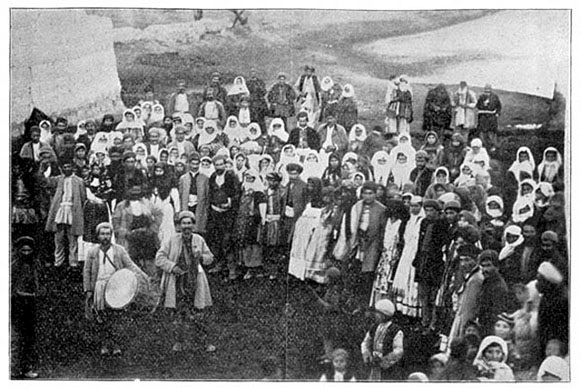
NESTORIAN WEDDING.
The method of making an engagement is quite different from that of Americans. After a mother has assured herself that a certain girl whom her son fancies would make him a good wife, she, with two or three relatives, will send word to the girl's parents that they will call at a certain time, and stay over night. While there the object of their visit will be made known and the matter discussed. If the girl's parents are ever so willing, they will not give their consent at the first visit, but will take the matter into consideration. The friends are invited to call again in two or three weeks for an answer. A third or fourth visit may be made before a final answer is obtained. At the last visit the father of the girl says, in reply to a request for an answer, that the girl does not belong to him. He says he gave her to his brother. The brother then says he gave her to his sister, etc., until the person is reached who can give her away. This man rises and says, "I give our daughter to Mr. and Mrs. —— as a handmaiden." The question now being settled, refreshments are served and the company rejoices until a late hour. Sometimes the foregoing proceedings are witnessed from an opening in the roof by the young man who is most interested and who is anxiously awaiting the result. During the period of the betrothal, the young man is allowed to make but one visit. He is not allowed to kiss his betrothed until after marriage. The Assyrian idea of a virgin is a pure maiden who is not married nor has ever been kissed by any man.
Two weeks before the wedding the young man's parents make another call to settle the amount of dowry with which to purchase wedding garments for the bride. The wedding feast lasts two or three days. On the last day a company of the groom's friends go to bring the bride. Dressed in her wedding garments, and seated on a fine horse she is taken to the groom's home. The company make merry on the way with music of drum and flute, and dancing. The horse is stopped about fifty yards from the house, and the groom appears on the roof of his father's house with three red apples in his hands. Kissing each one he tries to throw it over the bride. When the apples strike the ground there is a crowd of boys ready to scramble for them as there is a superstition that the lucky boy will be the next to marry. The bride now goes to her new home.
The wedding ceremony, which is performed by a minister and a deacon, is taken largely from the Bible. It lasts about two hours, during which time the bride and groom remain standing. The bride's dress covers her body and face from view except her forehead. She wears a crown and is called a queen. The groom wears a high feather on his crown, a sash around his chest and is called a king. For two months after the wedding they are called king and queen. They do no work during this time but visit and take life easy.
MOSLEM MARRIAGES.
The marriage ceremony of the Mohammedans takes place about a week before the formal wedding. It is very simple. Representatives of the contracting parties go to a priest and get two ceremonial letters, one for the bride, the other for the groom. In them is stated the sum necessary for the groom to pay, if he ever divorces the woman. It further states that it is the groom's duty to love this woman and all other women that he may marry thereafter. That it is the bride's duty to love the groom and no one else.
The prevailing low regard for woman grows out of the teaching of Mohammed. Among his last words he charged husbands not to place any confidence in their wives. He stated that they had been the cause of much of the crime and misery in the world.
When a Moslem goes out with his wife he is disgraced if she goes before or even beside him; she should follow. A man can marry four wives, but can divorce any one of them at any time. But a woman cannot get a divorce from her husband. A man is angry when his wife gives birth to a girl babe, and his friends fear to break the news to him. One man was known to be so angry when his fourth daughter was born, that he did not speak to his wife for three months. The mother of a son is loved the more, and the first person who breaks the news to the father is given a present.
If a man murders his wife he may be fined a sum of money, but can't be executed because woman is not equal to man. The question as to whether a woman has a soul is sometimes discussed. Men do not salute women in meeting them, but women are expected to bow their heads to men.
PART III.
CHAPTER I.
THE ROYAL FAMILY.
The present dynasty is called the Kajar dynasty. It began with Agha Mohammed Khan who was taken captive by the enemy when he was a child and all of the prominent members of the family excepting children were slain. Agha Mohammed Khan, then a boy six years of age was made a eunuch by the new king to serve in his harem. But at the age of twenty or twenty five he escaped from his master and returned to his relatives and former friends. Collecting a force he attacked the king's army and after several engagements overthrew the king and took possession of the throne. As a ruler he was very cruel to his enemies but very kind to his officers and subjects. One night while resting in his tent two servants or subordinate officials in an adjoining tent quarreled and awakened the king with their noise. This angered him and the next day he ordered that both of them be beheaded. The following night, before the time for execution had come, the two condemned men formed a plot with some other officials who hated their ruler's cruelty, to kill the king. This plot was successfully carried out. The king's nephew, Futteh Ali, became his successor. He became one of the most noted kings of Persia, and was called the king of kings. Futteh Ali had several sons, one of whom, Abbas Mirza, was chosen as crown prince This prince died in early manhood. He left a son, Mohammed by name, who afterwards became king. After Mohammed, the late Nasiraldinshah became king and was assassinated May 1st, 1896. Nasiraldin was a good king and did more for Persia than any ruler during the past 700 years. He made three visits to Europe and gathered many modern ideas which he wished to introduce in his kingdom. He organized a postal system connecting all the prominent towns and cities of Persia. Telegraphic communication was also established. He built roads between important towns and cities and detailed soldiers as guards where the roads passed through sections infested with robbers. This king reigned forty-eight years. A year ago he became a victim of a fanatical Babei, a new religious sect. The assassin took the king's life while the latter was worshiping in the most holy place of a mosque. Nasiraldin left four sons. The eldest is named Zelli Sultan. He is a highly educated and powerful man. The second son, Mozafferedden succeeded his father and is now king of Persia. The third son is governor of the capital. The fourth son is a youth of twelve years.
Before the death of the late king, Zelli Sultan, his first, son, began making secret preparations to usurp the throne. When the plot was learned, the son was stolen from his home one night and taken before the king. All implements of war prepared by him were confiscated, and he was sentenced to death. But high officials interceded for the son, and the sentence was changed to that of blinding him. When the hour came for putting out the prince's eyes, the king was moved by the young man's beauty, and said there was not a handsomer pair of eyes in all his empire, and that he would not destroy them. Therefore Zelli Sultan's punishment was changed to three years' imprisonment. At the expiration of the term, the king gave him solemn warning that any further attempt at usurpation would be punished by death.
I have often been asked why the first son did not take the throne instead of the second. The reason is this. The king had several wives, but the first one was a princess from his own tribe, and is called the queen. Her first son must be successor to the throne. Therefore Zelli Sultan was not eligible to the throne, as his mother was not a princess.
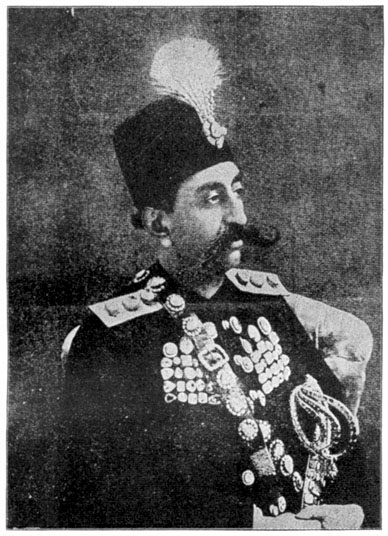
PRESENT SHAH.
The present Shah is a man who has a strong desire to rule in peace. He tolerates all religious beliefs, even though they differ from his own. He is loved by all classes of people, and all religious sects because he is kind and considerate toward them.
The Shah is very friendly toward the Christian missionaries. A few years ago he visited the Presbyterian college, the Ladies' Seminary, and listened to some of the recitations. As an evidence of his friendliness he was a guest at the home of Dr. Cochran, and dined with him. Not every one is so honored, for I have heard that an army officer in that part of Persia offered the Shah £3,000 to take dinner with him, but the invitation was not accepted. The Shah has also visited a Nestorian bishop, who resides in a cottage so humble that some lords would be ashamed to enter it. On the other hand when he was in our city of Oroomiah he did not visit the homes of any of the Mujtahids, but met these high priests in a mosque by appointment.
Of late years the royal family has been kind to Christians. Nine out of ten cases of cruelty to Christians come from the Mujtahids and the lords. The priesthood is stronger than the government in Persia. Sometimes the king has to give up his ideas to please the priests. For example: The late Shah desired to introduce the modern railroad into Persia, but the priests were bitterly opposed to it, and the king had to give up his plans. When asked why they opposed railroads, one priest gave two reasons: "First, our country is weak. If we built railroads, Europeans could run in on us and take our country. Second, it would destroy our religion. And we could not control our wives. If we beat them they could take the train and be in Europe in one day, while now it takes twenty days. Again, some of our women might marry Christians and escape to Europe."
THE KING IN HIS PALACE.
The royal palace is surrounded by high stone walls. The grounds are entered by four beautiful gates. The walls at the sides and above the gates are adorned with the pictures of former kings and brave generals; also decorative carvings of lions, the standards of Persia, and of birds. The grounds are beautifully arranged, all the roads leading to the king's palace in the center, and beautified with ornamental trees and hedges of roses of varied hues. Guarding the entrances to the gates and the roadways that lead to the palace doors are numerous officers of superior rank, those nearest the palace ever standing with drawn swords. When the king sits in judgment he uses the peacock throne, and is surrounded by his six cabinet officers, who are advisers. He is absolute, and may overrule the advice of the cabinet. This body makes the laws of the land. The king appoints the members of his cabinet, the people having no voice whatever in government. When the Shah tires of the routine of governmental duties, his secretary reads to him from Shahnameh, a poetical history of Persian kings. It is one of the king's duties to become very familiar with the history of Persia and her former rulers. When the king retires to his private room at night, the entrance to the room is guarded by two most trusted officials with drawn swords. One of the four gates in the walls around the palace is called the king's gate, as he always enters through it. No other person, be he lord, count, or high official is permitted to pass through this gate on horseback or in carriage. He must dismount and walk through.
When the king goes from the palace for a hunt or vacation, he is escorted out of the city by a large guard. First, coming down the street will be seen about thirty infantry bearing each a golden club, and shouting: "Get out; get out!" Whereupon the street is cleared of all traffic that the royal procession may pass. The infantry is followed by about fifty cavalrymen with drawn swords. Next comes ten or a dozen riderless Arabian horses. These horses are beauties, and are adorned with bridles of gold and many precious stones.
HIS TABLE.
The king's table is set with the luxuries of the land. From the time of the purchase until it appears on the table, the food is inspected by two trusted officials whose duty it is to see that the king is not poisoned. Before the king eats of the food it is further examined by his physician.
TREASURY.
The late Shah left $200,000,000 to his son, nearly half of which was in the form of precious stones and jewelry. Perhaps he has a larger amount invested in precious stones than any other king in the world. His peacock throne which was brought from Delhi, India, by king Nadirshah, who captured that city about 200 years ago, was prized at $12,500,000 some years ago, and is worth more than that now. It is made of solid gold, and is embedded with diamonds, pearls, and other precious stones. The rug upon which he prays is worth $2,500,000. At the beginning of each new year, seated on the peacock throne, he wears his crown, and all of his officers bow before him and wish him a prosperous reign during the new year. On such occasions his person is covered with many dazzling jewels.
WIVES.
The late Shah had forty regular wives and about sixty concubines. The present Shah has seven wives. The palace in which the king's wives reside is almost as beautiful as the king's palace, near which it is located. A number of soldiers guard the entrance to this palace. There are no men inside the palace except a few eunuch servants. There is also a large number of maid servants therein. When the king has many wives he marries some of them against their will. If he fancies a beautiful daughter of a lord, her parents will frequently marry her to the king in order to get an office or a title. The eunuchs have authority to rebuke the wives of the king. Sometimes a number of the women will playfully resent the eunuch's authority and push him against a wall or knock his high hat down over his eyes. Once they picked an old fellow up and threw him into a pool of water greatly damaging his fine suit of clothes. At times they give a valuable present to a eunuch such as a nice robe.
CHAPTER II.
GOVERNOR.
Persia is divided into thirteen states. The King appoints a governor over each state; this governor appoints a mayor over each city within his territory. This office is not awarded on the basis of education, ability or worthiness, but is given to the man who will pay the most money, provided his ancestry is fairly good. Many mayors of cities are related to the royal family. These offices are limited to terms of one year, but many times a mayor is removed before his time is out; the subjects may complain, or some person may bid more money for the office. When a man is appointed mayor of a city, the lords and counts of that city, accompanied by soldiers, will go three miles out of the city to meet the new official. He is greeted with discharges of artillery. These lords ride on very fine Arabian horses, with goldbitted bridles, and escort the mayor into the city. The new governor of the city admires the fine horses of his lords, and sometimes covets some fine steed, and before his term expires finds a way to get possession of it by helping the lord out of some trouble.
If the new mayor is a prince all prisoners confined in the city jails are taken before him as he enters the city. This is to signify that, as a member of the royal family, he has authority to behead them. The third day after a new mayor has arrived in a city it is customary for lords and counts to visit him with presents of money, golden articles, Arabian horses etc. as presents. A mayor has from one hundred to three hundred servants. He pays them no salary. Some became his servants for the name, some from fear, and others from choice. Most of these servants get their living from fines and bribes. Some of them are detailed to settle quarrels between men in some village that belongs to the city. This is their opportunity and they early learn to make the most of it. The mayor has great power. He is judge, sheriff, tax-collector, etc. He has things his own way. When there is an injustice done there is no other local officer to appeal to.
PRISONS.
The prisons are frequently cellars, underground, without windows, damp and infested with flies. They are seldom ventilated, and there is no bed nor furniture in them. The government does not feed the inmates. Friends of the imprisoned ones bring bread and throw to them, and some of this even, is sometimes picked up by the jailer and kept for his own nourishment. No men are allowed to visit the prisons, but wives or daughters are allowed to visit their friends if they pay a fee to the jailer. The torture of prisoners is regulated according to the nature of their crimes. The common method of torture for thieves, robbers and murderers is to put the bare foot of the criminal in a vice and squeeze it until he cries in agony. If he gives the jailer some money or promises to give some the next time his friends visit him, the pressure on the foot is lessened. If a man goes to jail wearing good clothes, the jailer often exchanges his own poorer suit for the good clothes.
EXECUTION.
This is done in different ways. A prince from the royal family has authority to behead men. Sometimes when a good friend of the king is appointed governor, the king presents him with a knife. This is a sign and carries with it authority to behead men. Every prince-mayor or other governor who has been given this authority keeps two executioners. The uniform of their office is a suit of red clothes. These two men walk before the mayor when he goes through the streets. When a condemned man is to be executed he is brought from the cell, hands chained behind, and with a chain about his neck. He is surrounded by a group of soldiers with fixed bayonets. The guilty man has been in a dungeon for several months perhaps. His clothes are in rags, and, having had no bath since first imprisoned, he is very dirty, his hair and beard are long and shaggy. A few steps before him walks the executioner, with blood-red garments and a knife in his hand. Thus they proceed to the public square, and before the assembled crowd the executioner steps behind the kneeling victim and with a single stroke of the keen knife cuts his throat, and another soul takes its flight, having completed its part in the drama of life.
A common mayor who has not the authority to behead, may kill criminals by fastening them to the mouth of a cannon and sending a ball through the body. Another method is to bury the condemned alive in a cask filled with cement, leaving only the head exposed. The cement soon hardens and the victim dies. Sometimes when their crime is not very bad the punishment is the severing of one hand from the body. If the man thus punished should commit a second crime the remaining hand would be severed. If a Mohammedan becomes drunk with wine and gets loud and abusive, he is arrested, and the executioner punctures the partition skin between the nostrils of the drunken man, and a cord of twine, several feet long, is passed through the opening. Then the executioner starts down the street leading his victim. The man soon gets sober and is very much ashamed. Shopkeepers give the executioner pennies as he passes along the street. Men who quarrel and fight are punished by tying their feet to a post, with the bare soles upward, and then whipping the feet until the flesh is bruised and bleeding and, frequently, the nails torn from the toes. The victims frequently become insensible under this punishment. One good thing in the laws of punishment is that no Christians or Jews are ever beheaded. The Mohammedans consider the Christian and Jew as being unclean, and think it would be a mean thing to behead them.
Princes, lords and counts are never beheaded. The most severe punishment for a prince is to pluck out his eyes. The method of execution for counts and lords is of two kinds. The king will send a bottle of Sharbat to the condemned man which is given him in the form of a sweet drink but it contains a deadly poison. He is compelled to drink this and soon dies. Another form is for the condemned man to be met by a servant from the governor after having taken a bath and the servant cuts blood-vessels in the arm of the condemned until death results from loss of blood.
Thus it will be seen that the contrast in modes of punishment in a Christian nation and a Mohammedan nation is very great. The kind of punishment inflicted on criminals in any country grows out of the prevailing religious belief of that country. A religion that has much cruelty in it will lead a people to torture its criminals. But a nation whose religion is based upon love will deal with its criminals effectively, but as kindly as possible. The writer has visited prisons in both Persia and America and finds that the contrast between the prisons of the two countries is like the contrast of a palace and a cellar. Prisoners in America ought to be very thankful for the humane treatment they receive under this Christian government.
CHAPTER III.
COUNTS OR LORDS.
The counts and lords live in luxury. Their title was not obtained by great service to the nation or by high education. It descends from ancestors, and many ignorant and unworthy men bear this title. Wealthy merchants sometimes purchase a title for their sons. The titled class in Persia is very numerous. In one city of 30,000 inhabitants there are more than 500 counts. They own almost all of the land in Persia. In some instances one count owns as much as one hundred villages. All inhabitants of a village are subjects of the count and they pay taxes to him and also to the king. The men pay a poll tax of one dollar a year; a tax is levied on all horses, cows, sheep, and chickens.
The count gets two thirds of all grain raised by the farmers, and he expects a portion of all fruits raised, which portion is called a present. If this 'present' is not large enough to please the count, he has an unfavorable opinion of the subject and soon finds faults in him and withholds favors. All of the count's work is done by his subjects without pay. When he builds a palace or cultivates a vineyard, he calls upon his subjects to do the work. He punishes his subjects if they rebel or are discourteous to him. Sometimes the punishment is so severe that death is the result. The count collects a large sum of money annually from his subjects in the way of fines—some of them for most trivial offences or discourtesies, and these numerous fines keep the subjects very poor.
The counts are the most immoral class of people in Persia. They are without education, knowing nothing of the sciences, geography, mathematics or political economy, but most of them can read and write the Persian language and know something of Persian history. It is not much wonder that this leisure class becomes immoral, for it is a disgrace for them to do any kind of work, and "Satan finds work for idle hands to do." A count can't keep his own accounts or sell goods in a store. There are no newspapers and magazines circulated throughout Persia to occupy and lead out the thought of the people of leisure hours. No public libraries, and no private libraries except those of a few Persian volumes. The only newspaper published in Persia is an eight page paper published every three weeks. It does not circulate much outside of the capital city. The Presbyterian Mission publishes a monthly paper about Christian work.
When a subject goes before his lord, he finds the lord seated in his private room before a window. The subject bows before approaching near to the window. When the lord is ready to listen, the subject comes to the window. He usually meets with a frown and gets replies to his questions in a gruff voice. As a class the counts are not strong physically; they eat and drink too much for their own good.
CHAPTER IV.
CITIES, SCHOOLS AND HOLIDAYS.
The Persian cities generally are very old and most of them are surrounded by walls about six feet through and twenty feet high. The walls are made of clay, tramped solid by buffaloes or by men. The gates giving entrance to the city are opened during the day from eight o'clock in the morning until night. These walls would not withstand a charge from modern cannon, but they were very useful fourteen years ago when parts of the empire were overrun by about 60,000 Kurds, a tribe of wild nomads. They spoiled the villages wherever they went but could not take the walled cities. The streets of cities are generally narrow and crooked, and are not paved. The best houses are brick with stone foundation. Some poor men build homes with sun dried brick and still others make the walls of mud. The roof is flat and made of mud supported by timber. The houses are built adjoining one another, so that men can walk all over the city on the housetops. This is the common way of travel in winter when the streets are muddy. In some of the large cities like the capital, Tehran, and Isphahan and Shiraz modern paving of streets with stone is being introduced.
On each business street a single line of goods is sold. One will be devoted to drygoods, another to groceries, another to carpenter shops, another to iron and silver smiths, etc. The streets are from ten to thirty feet in width, and many of them are arched over with brick, so that rain and snow are shut out. Light is let into these enclosed streets by openings in the top of the arch. Camels, horses and donkeys bearing burdens of various kinds of goods may be seen passing through the streets. And in open squares of the city there stand many of these animals belonging to men who have come to the city to buy or sell goods. Before some of the mosques may be seen secretaries or mollahs whose business it is to write documents in business transactions for which they get from two to fifteen cents.
In buying goods in Persia a stranger is liable to be cheated. It is a custom among dealers to ask two or three times what an article is worth, expecting to come down with the price before making a sale. The silver smiths do some highly skillful work in making rings for the ears and fingers, and belts for the ladies. In all Persia you cannot find a lady selling goods in a store, except in one street where poor old women and widows are allowed to come for a few hours each day to sell such articles as caps, purses, sacks and soaps. Their faces must be covered except the eyes. Only a few women of the lower class are seen in the stores buying goods, and they must not have their faces exposed to view. No Christian can sell fluids such as milk, oil, syrups or juicy fruits like grapes. It is against the Mohammedan law to buy such things from a Christian. If a Christian wishes to buy any such goods from a Mohammedan he must not touch the same, as the merchant could not thereafter sell it to a Mohammedan.
There are many pick-pockets, both male and female in the crowded streets. A stranger must beware.
WEIGHTS.
The standard measure is the miscal, 100 of which equals a pound. Four Persian pounds equal one hapta while it takes five American pounds to equal one hapta. Eight hapta equal one batma. Four batma equal one khancaree. In this measure they weigh raisins, molasses, and tobacco. Ten batma equal one load. In this they weigh green wheat, corn, etc. Twenty-five batma equal kharwar. In this they weigh fuel.
The money is of copper and silver and a very little gold. The following table shows the values of Persian coins:
25 denars = ½ cent
50 denars = 1 cent
100 denars = 2 cent
500 denars = 10 cent
1,000 denars = 20 cent
10,000 denars = 100 dollar
The bankers sit on small rugs before the shops with boxes of money in their laps. Their chief business through the day is to change money. For changing 20 cents into copper, they charge one cent, and the fee increases in proportion to the amount of the bill changed. Interest in Persia, especially among Mohammedans, is very high, being from 12 to 15 per cent. per annum. But the synod of the Presbyterian Evangelical Church has a law which forbids any of their members charging more than 10 or 11 per cent.
There are no gas or electric lights in the streets of a Persian city. The mayor appoints an officer, who has a number of assistants, to watch over the city day and night. Every day of the year is given a name by the mayor; as, lion, eagle, Cyrus, fortune, etc. This word is known only to the officials and such persons as may have been given permission to be out at a late hour. If an officer finds a man on the street after 9 o'clock he calls to him to give the name of the night. If he can't do this he is arrested. One of the worst things in a Persian city is the large graveyards, which contain two to five acres of ground. Mohammedans dig up the remains of a dead relative to carry it to a shrine place, and these removals often fill the city with bad odors. These graveyards make excellent hiding places for robbers and thieves. There are many robbers outside of the city walls, and it is very dangerous to go out after night, even a distance of one mile. Victims are usually shot while at a distance, or stabbed and then plundered.
The hammams or bath-places are quite numerous in the cities. They are usually well-built, brick buildings and have within two or three pools of water, some hot, others cold. Men can bathe any day in the week except Friday, which day is reserved for women. The charge is three or four cents. Christians cannot enter a Mohammedan hammam, as they are considered unclean.
HOLIDAYS.
The Mohammedans have several holidays. Neither the government nor the priesthood compel observance of these days, but they are usually observed either for the sake of rest, religious profit or amusement. There is, however, one set of holidays, ten days known as Moharram, that is strictly observed by all faithful Mohammedans. There is also one national holiday generally observed in memory of the beginning of the Persian nation. It is called Newrooz, meaning new day. This name was given by a Persian king in ancient times. Two weeks before this day all stores will be decorated with different kinds of fruits, such as palms, figs, pomegranates, apples, almonds, and raisins. Also some fine shawls and rugs are hung before the stores. During these two weeks most people buy of these fruits and prepare for the national feast. On that day nearly every man, woman and child puts on some new garments of clothing and new clothes throughout if possible. People also clean their houses for this occasion. On the evening of Newrooz a table is spread with the finest fruits and the family will gather around and feast until a late hour in the night. The poor are remembered on these occasions and presents of fruit are sent to them. Christians are also frequently remembered in this way.
SCHOOLS.
There is no system of public or state schools in Persia. There are schools in all large towns and cities which are taught by the priest in a room of the mosque. These schools are voluntary, no person being obliged to send his children. The students pay the priest each from 5 to 25 cents per month. Those who can't pay anything are admitted free. The priest's food is brought to him by the students. The ages of the pupils range from ten to twenty years. These schools are for boys only. There are no schools for girls. If a girl gets any education at all, it must be from a private tutor. In the schools the textbooks in history and poetry are in the Persian language and Koran and grammar are taught in the Arabic language. Mathematics, geography, the sciences and the history of other nations are never taught. When the pupils are at study they reel back and forth and repeat words loud enough to be heard a block away. They imagine this is an aid to memory. The teacher has authority to punish the students very severely. Sometimes a parent will take his child to a teacher and will deliver him into the gentle keeping of the professor with the remark: "His bones are mine, but his flesh is yours. Teach him, but punish him as you see fit." A post is planted in the schoolroom to which a wild boy's feet are fastened, soles upward, and the bottoms are whipped with heavy switches. This punishment is only for the worst boys. For mild offences, the teacher raps the student over the head with a long switch which is always kept in a convenient place or carried in the teacher's hand. The religious teaching consists of quotations from Koran and traditions about their prophets. The boys are usually very bad about reviling each other and about fighting. The teacher does not protect the weaker, but urges him to return the revilings or the blows he has received. The students of one mosque often attack the students of a neighboring mosque as they regard them as enemies. The most prominent university of the Shiite Mohammedans is in the shrine place of Karballa. All those who are to become Mujtahids study at this place. In several of the large cities they have schools of higher rank than the ordinary mosque school in which a course of Persian literature is given. It is a pleasure to state that the late Shah, after his visit to some of the universities of Europe, founded a college in the capital city which is called the Place of Science. The French, English and Russian languages are taught, and the study of some modern sciences are being introduced. The college is only for princes and the children of rich people. It is only one flower in a vast wilderness. The problem of Mohammedanism is to keep the common people ignorant, so the priest can continue to rule them. Therefore the priesthood does not favor higher education. Some counts or lords send their sons to Paris to be educated, but the ordinary young men have no opportunities for education.
PART IV.
CHAPTER I.
BOBEISM.
The Mohammedan religion is to-day divided in about fifty different sects. This division greatly weakens it. The Bobe sect was started by Mirza Mohammed Ali of Shiraz, a city in which reside the most intellectual and poetical scholars of Persia. He began to plan the new religion at the age of eighteen, but did not reveal it until he was twenty-five years old. The foundation of his faith was this: Mohammed, like Christ, taught that the latter days will be a millennium. They have a tradition that when all the prophets had died, or had been killed by their enemies, a son six years of age was, by the direction of Allah, hid in an unknown well. He was to remain there until the time for the millennium. It was believed that he would be the ruler of the Mohammedans in these last days.
He was to lead both his victorious armies and conquer all the world, and Islam would become the universal religion. Mirza Mohammed Ali based his doctrine on this theory but changed it somewhat. At the age of twenty-five he made several pilgrimages to shrines, such as Karballa, Mecca, and Medina, and then returned to his native town of Shiraz. At first he began to teach his doctrine to his confidential friends and relatives until it was deepened in their hearts. And then he began to preach to the public that he was Mehdeialzaman.
HIS DOCTRINE.
He taught that every age must have its own prophet, inspired from God. He claimed that he was inspired and that he had frequent communications from God telling him how to direct the people. He openly claimed to be Mehdeialzaman. And he taught that the priesthood and the religion were corrupt and that he was appointed to renew them. He did not oppose the Koran, but at the same time said that every age needs a new bible. He claimed to have received a bible from God. This book is called Bayon, meaning exposition. He taught the equality of both sexes and paid homage to woman. He showed that it was against the law of God to marry more than one woman or to keep concubines. Further, it is against the law of society and the happiness of women to marry more than one wife. The law of divorce, which is common among Mohammedans, was not practised by the new sect. The place of woman among them is the same as among Christians. The prophet taught that the spirit of charity ought to be as a flame of fire in the hearts of his followers. He said we cannot please God if we see our brother in need and do not help him, if we pray He will not hear us, if we worship Him He will turn His face away from us. Believing this, the spirit of charity is very strong among them, and they support the needy. The use of wine and all intoxicants is strictly forbidden. They are very kind to people of other faiths who are not Mohammedans; them they hate. Mehdeialzaman preached these doctrines and won many hearts. The converts were generally intelligent and well educated. His doctrine spread through the southern and northeastern parts of Persia. Among his followers were two prominent and attractive persons, Mollah Hussein and Hajee Mohammed Ali. He called them his right and left hand supporters. Another convert of importance was a lady of rare attainments. In poetry she was accomplished, in beauty wonderfully rare, and she was highly educated. She traveled with two assistants from state to state and from city to city preaching the new doctrine. She never met Bobe, the founder and knew of him only through letters. She said that God had endowed him with unusual gifts for this holy cause. By the power of her eloquence she made many converts, and was called by her followers, Kurratool Alaein, which is a very high title.
PERSONAL APPEARANCE OF BOBE.
In stature he was tall and slender, eyes black; eyebrows, heavy and long; beard, patriarchal. His countenance was very pleasant and attractive. In conversation with high and low classes of people alike he showed himself a servant of all. He was poetical, a great orator and a deep thinker. He wrote many beautiful poems. His epistles to his disciples were philosophical. His words in sermons touched the hearts of men. When orthodox Mohammedans saw that Bobeism was spreading among the people, the priesthood and the government joined in severely persecuting the disciples of the new faith. The disciples were scattered by this persecution to different cities which resulted in a still greater spread of the new doctrine. At that time the prophet appointed eighteen of his apostles as guards of the faith. Two of them were women, and he requested that this rule be followed in future ages. About this time Bobe and his twelve disciples were arrested in Shiraz and taken to Isphahan. While imprisoned there his doctrines were being rapidly carried on by his followers. He was finally banished to Makoo, an obscure town between Persia and Russia, as it was thought his religion could not spread from such an obscure place. But his doctrine soon prevailed there. At last the priesthood and government decided to bring him to Tabreez to be shot. After his arrival in Tabreez many learned priests came to discuss doctrines with him, but none were able to answer his questions, but his enemies were determined to kill him. Bobe and his twelve disciples were hanged to a wall before the soldiers. Before the order to fire, the disciples were given a chance to save their lives by denying Bobe's faith. Only one denied the faith and was saved. The others asserted that they were willing to die for the truth. When the soldiers obeyed command to shoot, all the disciples on the wall were killed. But Bobe was not struck by the ball; it struck above his body cutting in two the rope by which he was suspended. Bobe fell to the ground unharmed and tried to escape through the crowd. He ran into a house which proved to be the home of an officer, who promptly arrested the fleeing prophet and returned him to the executioner. Before the second shot was fired Bobe was again promised freedom if he would deny his own teachings. He replied that many of the holy prophets of the past died for the truth and that he, too, was willing to die in this holy testimony.