Modern Painting (continued 4)
Reading edition
But there was another and more important side to Gauguin. He at least strove for a larger and more purely emotional interpretation of nature than had been attempted before: and our interest in him is due largely to the broad and peaceful vision he gives us. Monet put many greens in one tree. Gauguin saw the tree as green, but by depicting it in broad planes of pure pigment, he made it a more intense green than Monet could ever have done. “A metre of green is greener than a centimetre of green,” said Gauguin; and this principle he applied to all his work. Instead of portraying light by colour as the Impressionists did, he interested himself only in the colour which resulted from light. Thus he was able to raise his paintings to the highest possible pitch of purity, while still being preoccupied with nature. In painting a landscape where a woman with a cerulean blue dress was seated among green trees on an ochre beach with purple hills in the rear, and where the yellow sunlight shone on the tree trunks and in the woman’s hair, Gauguin would first of all draw apart the blues as much as possible. The woman’s dress would be painted almost blue-green, and in order to contrast this colour with the other blue in his subject, he would paint the sky blue-violet-violet. Thus he would produce a greater range of emotional colour than if the two blues had been pale and similar in tint. Furthermore, he would make the sunlight a yellow-orange-orange and the sand a spectrum yellow. The trees would then be recorded as yellow-green and the hills as red-red-purple. By this process all the parts of the picture were differentiated, with the result that the canvas had a strong carrying power. This power was further increased by the figures being sharply outlined.
Gauguin’s composition has little importance. It takes the form of perpendicularities, and rarely is any rhythmic order discernible. It is of a piece with the Romanesque painting in Saint-Savin near Poitiers. All his objects are personifications of calm, and are rooted in their environment as well as in the earth. They do not seem merely to pose there: Gauguin’s work is not superficial to this extent,—but they grow naturally out of their matrix like flowers or trees, unconscious but immovable. The passivity which pervades them is not the calm of completion or of the perfect rest which comes after mental exercise, but rather the calm of the lethargic mind which avoids thought, dislikes action and is content to dream. Technically this feeling is caused by lines at right angles to the horizon, by big simple planes on which the eye can rest free from the disturbance of line opposition, by large flat patterns of dark tonality conducive to peace and introspection. Even the contoured volumes have a greater extent of base than of apex and thus add to the picture’s aspect of immobility. Gauguin’s drawing is interesting in that it portrays a race highly susceptible of picturisation. His models are impelling because it is an adventure to explore their parts, their joints, their distortions and disproportions. Their beauty is heavy and cumbersome, like that of the stone images of the Aztecs.
That which interests us most in Gauguin however is his colour. In this medium he arrived at a sumptuousness unsurpassed by preceding painters. His art was a new application of the old principle of wall decoration. Many had made use of broad planes of colour before his advent, but none had heightened the significance of these planes sufficiently to express nature. He was the first realist in decoration, and from him come, by direct descent, Matisse and a horde of lesser men like Fritz Erler, Leo Putz, R. M. Eichler, Adolf Münzer, Rodolphe Fornerod, Alcide Le Beau and Gustave Jaulmes. The æsthetic import of a Puvis de Chavannes is almost equal to that of Gauguin, but the former’s greys and grey-blues appear washed-out and dead, while Gauguin’s pictures vibrate with the heat of tropical sunlight and the richness of tropical colour. Gauguin, however, could get no orders. His work was too sensuous. Interior decoration would have had to be far more joyous than it was at that time for his exotic creations to find a place on walls and ceilings.
Gauguin’s animating desire was to synthesise his picture—to make each part of them relative to all the other parts, to order them as to colour, line and tone in such a way that they would give forth the impression of a simple vision, a perfect ensemble. This desire was in the air of the day. The Impressionists had unconsciously approached synthesis by using light and air as a solvent. Cézanne had gone much deeper and ordered form by means of colour. In Seurat Gauguin saw almost completely set forth an expression which by its simplicity satisfied him. Some assert that he was also influenced by Degas. But whether this is so or not, certain it is that there is more of Ingres in him than of Giotto. With Seurat as a starting-point—that is, the linear Seurat of La Baignade and Un Dimanche à la Grande-Jatte—Gauguin quickly abolished the tiny and labourious spotting which Impressionism and Pointillism had taught him, and branched out into simpler design and greater chromatic brilliancy. By these departures he achieved his synthesis. But this triumph must not be overestimated. There are degrees of synthesis. Rubens, Giotto, Degas, Ingres, Böcklin, Botticelli—all are synthetic, but all are by no means of equal importance. While synthesis is necessary to art, it is not the ear-mark of great art alone. The order which is obtained by three harmonious lines is not so extended an order as that found in the multilinear drawings of Pollaiuolo: and this complication of æsthetic ordonnance is what makes a Donatello more significant than a piece of negro sculpture, a Scarsellino greater than a Matisse, and an El Greco more puissant than a Mazzola-Bedoli. Furthermore, when this complete surface order extends itself into three dimensions it becomes an infinitely greater moving power. When from simple straight lines on a flat surface the artist carries his creation into opposition, development and finality, he is pushing the frontiers of his painting to art’s extreme limits.
Gauguin’s temperament was simple in the extreme. He had fallen under the sway of Manet: he had gone to a rugged country of primitive instincts where singular costumes were a part of the landscape: he had studied the stone and wooden figures in the old churches and cross-roads of Brittany, and had found the elemental to his liking. Consequently in synthesising his art he used simple forms, straight lines and large planes of shadow and light, all of which were presented on a flat surface, so that all the parallelisms and elementary curves of the picture would deliver themselves to the average spectator at first glance. His method of filling or balancing a canvas was little more than primitive, and the curved lines of light and shadow, which are intended to entice the eye, are so isolated that when we at length arrive at their end we discover they are without rhythmic intention. Nor is there a generating line out of which the others grow.
Gauguin’s linear harmony is no greater, if a trifle more diverse, than in the Byzantine mosaic decorations in S. Vitale. Indeed the emotion we experience before each of them is to all purposes the same. The richness of medium in the mosaics is amply compensated for by Gauguin’s richness of foliage forms and floral designs. The decorative colours in both are equally effective. As moderns we might get more enjoyment out of Gauguin’s heat and brilliance and the diversity of his silhouette, but at the same time there is a greater archæological attraction and a more spiritual interest for us in the ancient work. Intrinsically one is as great as the other. Those seeking for calm will find it in equal degree in both, for in each it is produced by the same method: by the static representation of form rather than by a sequence of movement. Gauguin’s sculpture has the same qualities as his paintings, and resembles the religious effigies of some barbaric tribe. The figures are upright and rigid, their backs against a straight support, as in Egyptian architectural art.
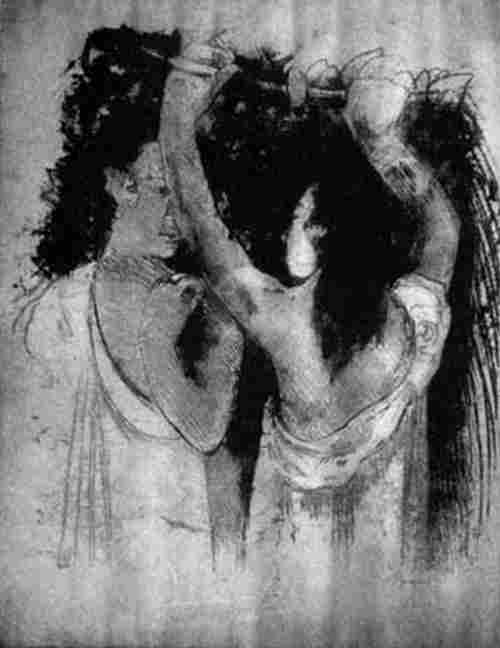
DEUX TAHÏTIENS GAUGUIN
Gauguin said many times that when a painter was before his easel he must not be the slave either of nature or the past. This is true, but as a principle it is too limited. Although he himself lived up to it, he did not go far enough beyond it to do truly significant work. He arrived at the brilliancy of nature by a method distinctly different from nature’s; and while refusing to be dominated by the past, his temperament was such that he fabricated an art much closer to antiquity than that of the Zaks and the Rousseaus who servilely imitated it. He accomplished what he set out to accomplish. His failure to give birth to great art was due to the intellectual limitations of his ambitions. His place in modern painting, however, is secure.
That great cycle of æsthetic endeavour which was set in motion by the discovery of oil painting found its termination in Rubens. The cycle which Delacroix and Turner ushered in was less extended. Being more concrete in its aims, it took only five decades to reach completion in the works of Renoir. The first cycle, born with fixed materials, was based on an absolute and physiological law of composition which can never radically change, and therefore permitted of an extensive development and variation. Decadence naturally set in after its means had lost their ability to inspire artists. The second cycle was one of research, and during it artists were so narrowly focused on nature that they lost sight of the foundation laid down during the first cycle. Had their concentration not been rudely disturbed their data hunting would have carried them hopelessly afield. Gauguin exposed the futility of the meticulous imitation of nature’s effects, and by so doing took a step forward toward liberty of method. For this reason he is of importance. Painters were rapidly becoming scientists. By turning men’s minds away from nature to broadly natural pictures Gauguin invited them once more to become artists. He was the link which joined experimental research to pure creation. The first cycle gave us an absolute composition: the second furnished a scientific hypothesis for art: the third, of which Cézanne was the primitive, combined the first two and thus opened the door on an infinity of achievement. Gauguin prevented the second from running into decadence by showing its uselessness as an isolated procedure.
IX
DEGAS AND HIS CIRCLE
THE development of art itself is no more mechanical than the artistic development of the individual: in both there are irregularities, retrogressions, forward spurts, divagations. Renoir first appeared with a rhythmic line-balance which first grew luminous, then voluminous, until it blossomed forth into his full form and line and colour. Sometimes he leapt ahead in one quality and deteriorated in another, abandoned one for the glory of the other, and sacrificed continually until by experience he knew his limitations. Then consciously, with all the reins in hand, he progressed steadily to his highest point of efficiency. Art in general also advances sporadically. Delacroix gave a new freedom to subject and drawing, resuscitated composition and found a new use for colour. He was the embryonic statement of the ends of modern art. Courbet, ignoring colour, totally divorced subject-matter from antiquity and liberated drawing from the accepted style. He carried art forward, but not in a direct line. Daumier gave us a new conception of form, but contented himself with Spanish colour: his art, though fragmentary, was another step toward a unique vision. Then came Manet who, forgetting composition, exalted the documentary freedom of Courbet and began the study of light. He, also, was a continuation of the modern art impulse, but in his struggle for the new he forgot the foundations. The Impressionists accepted passively all that had come before. They raised colour to an important place in painting and brought it to the consideration of all artists by showing its potency in the production of intense emotion. Renoir used their inspiration; reverted to the past through Delacroix, Courbet and Daumier; combined all that had preceded him; and in an incomparable flourish closed up the possibilities of his experimental forerunners. In him was a consummation. But there had to be a transition also, unless art was to stand still. Gauguin, though he went so far back that he passed to a time when composition did not exist, interpreted, but did not imitate, nature. The Neo-Impressionists continued the impetus of Pissarro. Cézanne unearthed secrets from nature which linked him to Impressionism, and by applying them arbitrarily to classic organisations, became an interpreter of the past as well as of the future.
At each step of this broad and prolific advance there were those painters who, profiting by the teachings of the great, set themselves to imitate and ornament the exteriors of their faintly-understood masters and to emphasise the qualities of texture, matière and prettiness. So rapid was the evolution of modern endeavour that nearly every painter overlapped his seemingly remote predecessor. Edgar Degas was born more than twenty years before the death of Delacroix. He was one of those painters who, content to remain stagnant, employ the qualities which have been handed down to them and breathe into old inspirations the flame of individual idiosyncrasy. He was a man who impressed everyone by the strength of his personality and by the power of his caustic wit. In his youth he travelled in Italy and America and went to school, not for artistic training, but merely as a concession to the conventions of the day. He copied Holbein and Lawrence. In his earlier portraits there are undeniable traces of the German master: the Lawrence influence exhibited itself in his femininity more than in actual technical innovations. He was an enthusiastic visitor to the Café Guerbois on the Avenue de Clichy where, from 1865 until the war, Manet was the dominating figure, and where the Impressionists and such men as Lhermitte, Cazin, Legros, Whistler and Stevens came to discuss æsthetics.
Although never radically opposed to scholasticism, as were these other men, Degas was nevertheless persuaded to share in a joint exhibition in 1867 with his revolutionary companions. But the ridicule of the public disgusted him so thoroughly that he never exposed again. He shut himself up in his studio, and there, isolated from his fellow painters and the vulgar populace, worked out his own salvation. He instinctively hated the brummagem show of popularity and put into his every subject this disgust with life’s hypocrisies. Even in his prancing ballet figures, though they are in full light and amid joyous settings, one senses the satire which led to the depiction of their apparent sans-souci. One reads in them the sordid misery of their home life, the long trying hours of muscular strain, and the deceit of their simulated smiles. His synthetic figures—synthetic in that they were without details and accidents of contour which would detract from the vision of the whole—came to him direct and with little variation from Ingres—not the Ingres of Stratonice but the Ingres of the drawings in the Musée Ingres at Montauban. His study of this master gave him a greater insight into the academic construction of the human figure than any school could have done. It permitted him to set forth a firmly drawn body in any pose with equal ease. This facile mastery of action is one of his greatest claims to popularity.
Gauguin held that nothing should be moving in a canvas, that all the figures should be static, arrested in their pose, and calm. Degas represented Gauguin’s antithesis. He strove to catch his model in flight. He immobilised their élan, and registered those characteristics of a model which express action at its intensest dynamic instant. In all his racecourse pictures the very horses have that delicate balance of mincing tread that we first feel when we look at their prototypes in life—that dainty and slight resiliency as of weight on springs. Monet, on the one hand, caught the ephemeral effect of light on nature: Degas, on the other, recorded the fleeting movement of objects, that is, the physical poise of a granted image, not the æsthetic poise which transmits itself to our subjectivities. He surprised the actional segment which epitomises the entire cycle of movement. Everything he touches becomes as charming and interesting as a wellstaged scene. His sympathies with the Impressionist colour methods and his manner of handling his material add to this charm and make pleasurable, fresh and adventuresome what would otherwise be banal and sometimes even ugly and devoid of interest. He paints the racehorse, which Géricault first introduced into French art, and, by surrounding it with a vernal spring atmosphere, violet hills and green and ochre stubble, and by catching its instantaneous action, makes of it a picture with a rich and colourful surface—a surface beside which a Géricault, judged from the same illustrative standpoint, appears stiff and black.
Degas, in short, paints the kind of pictures which the general public calls “artistic”—a word which, though loosely used, has come to have a distinct connotation when applied to arts and crafts. Vases, plaques, panels, screens, decorations, posters and book-plates are all “artistic” provided they fulfil certain simple requirements. The bizarre exteriors of German art have given great impetus to this qualitative adjective. The word is used indeterminately, and its popular meaning has not been defined. But in Degas we find it exemplified; and by studying him we may discover its exact limitations. “Artistic” commonly refers to paintings in which the exactitude of drawing is lost in a nonchalant sensibilité, and in which the matière takes on a seductive interest merely as a stuff or a substance, the love of which lies deep in the most intellectual of men. The tactile sense will be found at the roots of the average person’s idea of an “artistic” work. This desire for superficial and material beauty, as of a rare porcelain or of scintillating old silk, is a part of the same physical sensuality which makes some men choose rough-grained canvas, others the stone of the lithographer, others the fluid brushing of a Whistler or a Velazquez. The desire for texture is what led Degas to pastels. His pictures have something more than an illustrative value; they are highly attractive as objets d’art as well. But while this attractiveness heightened the popular value of his work, it indicated the inherent decadence of his aims.
Nor was it the only sign of his retrogression. There is not even pictorial finality in his work. He never painted subjects as such, but used them only as bases for arabesques. Surface-covering was his forte, and it is not remarkable that one so sensitive to objective action should have been such a master of balance. He could never have achieved such perfect balance had he not realised that a work of art must be done coldly and consciously and without passion for the model, and that all enthusiasm should come only from the progressing work itself. His arrangements are wholly natural ones, and we feel that no studio posing has gone into their making. In this naturalistic attitude he was continuing the modern spirit of arbitrary subject selection found in Courbet, Manet and Pissarro. But where these men painted with colour, Degas only tinted his drawings. Consequently his colour, as well as composition, was a reversion to a sterile past. Although we may admire his Après le Bain, La Toilette, the Trois Danseuses, Femme au Tub, La Sortie du Bain, Torse de Femme S’Essuyant, Musiciens a l’Orchestre for their verisimilitude and lightness of treatment, their imprévu of arrangement and balance and their charm of colour, we can never credit their creator with even a slight genius, for all his pictures lack the rich volumes of a Daumier and the order of a Renoir.
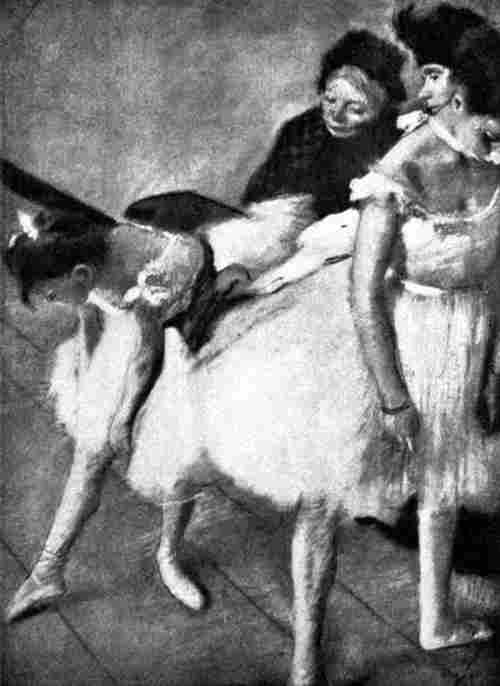
DANSEUSES À LEUR TOILETTE DEGAS
Degas was neither academic nor revolutionary. He struck a middle course in which the scholastic and the heretical blent, and in blending neutralised each other’s characteristics. In his canvases he tells inherently commonplace stories, but he does it with the force and the graceful ease of one on whom all the visions of the world have made a powerful impression. Life meant to him a pageant, neither moral nor immoral, but real, and as such interesting. If in what he tells us there seems a bit of the cynical indifference of a mind too fully disillusioned, it never obtrudes itself. He himself might have been surfeited and bitter, but his work contains only the barest hint of his temperamental retrospection. His comprehension of life’s tragedies did not spoil his enjoyment in depicting them. Louis Legrand reveals the metropolitan lust of mankind; Forain, its bestiality; Toulouse-Lautrec, its viciousness. Each was prejudiced in some direction. Degas merely goes behind the scenes and by stripping his characters of their pretences shows them to us as they are, intimately and unsentimentally.
The other men in this circle of illustrators of which Degas was the dominant figure had distinctly individual traits. In no sense were they followers of one leader. Their preoccupation with illustration alone held them together. Degas has given us well-balanced patterns with fragilely lovely surfaces. He was little interested in the traits of his models: he cared more for the picture than for individual character. With Henri de Toulouse-Lautrec this mental attitude was reversed. In his work are specific members of the demi-monde, marionettes who have all the accentuated vices, vulgarities, fatigues and pretensions of their trade. In their faces, moulded by unrestrained indulgences, joys and sorrows, we can read their innermost hopes and aspirations. We can reconstruct their entire day’s activities. In order to study his characters Lautrec went to the milieu where gaiety was unchecked, where the denizens of the under-world—those unreal beings who live like fantastic flowers nourished by artificial light and colour—come to work and play. He saw and set down the principals in the Bohemian music halls, the cafés-concerts and the cirques, and those daylight moralists who come to relax viciously at night with all the laisser-aller of violent reaction. His search was for character; and in these establishments character did not masquerade in the hypocritical garb of pride and dignity. Passions were aired frankly, even proudly.
Lautrec had personal as well as artistic reasons for choosing this sphere. He had an ardent, almost febrile, desire to live fully and furiously. He was deformed; he had a man’s head and body on a child’s legs—the result of incompetent bone-setting in his youth. His family was a very old and noble one: his father was a sportsman, a lover of horses, a sculptor in his leisure moments. All the pride of race and dignity of class tumbled from its pedestal in this young artist. He had worked in the schools of Bonnat and Cormon, had met and admired Forain, and had finally been revealed to himself by Degas who led him to the theatre. He drank much, one suspects, to forget his deformity, just as Van Gogh drank to forget disease. He sought solace in the ephemeral, visionary life of the cafés; and no action, no type, no expression escaped his probing notice. He had many friends to whom he confided. “I am only half a bottle,” he would say. He adored women impersonally and romantically, but in his own station of life they looked upon him askance. Consequently he lived where money would always buy attention and where good-fellowship was repaid with good-fellowship.
Lautrec was an indefatigable worker, but his pictures possess little of the surface beauty of a Degas. Rather do they attest to a love of exaggerated and uncommon form, as do Chinese paintings. But in him is more order than in Degas. Compare Une Table au Moulin-Rouge with Degas’s Café-Concert. In the first the character in the physiques of the principals harmonises with the character of the faces; and the female figure’s hair, hat and fur-trimmed coat indicate the artist’s love for grotesque and beautiful abstract form. There is more than balance here: there is the rudiment of an instinctive composition which Degas never had. Beside this picture the Café-Concert seems flat silhouette, sprightly and entertaining, but far from profound. The nucleus of composition can be found in all of Lautrec’s best canvases, especially those he painted after his return from Spain. Toward the end of his life he worked, for the most part, with a full brush and rich colours. Before this, however, pencil, chalk, lithographs and water-colours had claimed him. His greatest fluency was in the use of separated hachures of rich greyish colour on neutral backgrounds. This method of application permitted him line as well as colour; and with his lines, summary and economical though they were, he caught the animality of his subjects with as sure a hand as Monet caught the light and Degas the action.
Lautrec, with Chéret, revolutionised the poster art. There are few men today in this field who do not owe much to him. His love of the eccentricities of his model was an ideal gift for the poster-maker, and he had himself sufficiently in hand not to be led into the grotesque. He was a caricaturist in that he exaggerated characteristic traits, just as Matisse did in his sculpture. He always noted fully the uncommon, and his love of every manifestation of life gave him a wide range of inspiration. Life was his great adventure; his art was merely his diary. He is a historian of the theatre of his time and has left salient portraits of Loie Fuller, Polaire, Sarah Bernhardt, Mounet-Sully, Yahne and Anna Held. His types of the raptorial woman of the past—the kind that today is found in the hidden corners of Les Halles, at the fortifications and about the “Rue de la Joie”—are as real as the female characters of Balzac, Daudet, Augier and Prévost. They live in his pictures because one feels that they once were realities: his caricaturisations of them, as of his clowns and dancers, only intensify their intimate humanity. To some it may seem strange that Lautrec should have liked Massys and Memling. But in the first he found trenchant characterisation, especially in such things as Head of an Old Man, The Courtesan and Portrait of a Canon. And he was temperamentally akin to Memling in such arrangements as the latter’s The Casting of the Lots (a detail of Calvary) and Our Lord’s Passion, at the Museum in Turin.
That the illustrators of this group were decadent is borne out in their subject-matter as well as in their methods. Since the earliest recorded antiquity artists have been attracted to the moving, the glittering, the brilliant; and the human occupation which embodies these three qualities most obviously is dancing. The men who are in love with life and not art and who paint and draw pictures merely to record their impressions, have always been hypnotised by the colour, the grace, the fluent movement and the rhythmic shiftings of dancers. These men, unable to analyse their emotions, have dreamed only of depicting objectively their photographic impressions of the dance. The artists who penetrated to the fundamental causes of rhythm used the dance only arbitrarily, whereas the superficial painters of the past saw in it merely the mosaic, the pattern, the arabesque. They thought that in portraying the dance literally they would arrive at its motive significance. But in this they failed. Had they done their figures in clay or stone they would have approached nearer their desire. But even this more masculine medium has, with few exceptions, resulted in failure. The dancing girls in the Grottoes of Mahavelipore were used only by those puissant masters of form as friezes or shapes to fill in and ornament a vacant space. The Tanagra figurines are a purely decorative endeavour. In Greece it was not the men of Praxiteles’s calibre, but the smaller talents like the potters who used the dance in their designs. Even a man as slight as Hokusai leaves it to a Toba Sojo to make his models caper. But the feminine talent of Degas finds in the dance absolute and unordered expression; and Lautrec and Legrand, both more robust than Degas, though minor and ornamentally illustrative artists, are seduced into portraying it often.
Louis Legrand was more of the “maker” of pictures than were his two contemporaries. His nature leaned toward the heavy and boisterous Sodoma rather than toward the Latin ideal of Tiepolo. This almost Teutonic racial penchant in him explains why the bestiality of his subject-matter is so often done in the manner of Goya, with broad black and white masses, not with the suggested line and the attractive matière of his master, Degas. There is much Teutonic blood in Spain, and Goya, while being far the greater artist even in his slightest etchings, is the nearest approach to Legrand in the treatment of themes. Goya paints moral decay with disgust and genius, whereas Legrand, with his slight gropings after order of a surface variety, glories in it as in a pursuit, and paints it with a leer. The Spaniard uses it as a temperamental means. The Frenchman, whose whole talent lies in a formula of draughtsmanship, works toward its creation as an end. His shallowness is at once apparent when we compare his Maîtresse or his illustrations for Edgar Allan Poe’s tales with etchings like Donde Vá Mamá or Buen Viaje. Psychologically he is intimately related to the fin de siècle movement in England; and, although a better and more healthy workman, he has a temperament singularly akin to that ineffectual Victorian academician, Walter Sickert.
In J.-L. Forain we have a man of different stamp, one who, knowing his ability for certain things, clings to them and does not attempt to thrust himself into the rank of artist. By developing his small potentialities to their highest actuality he has achieved as much as his confrères have by extraneous tricks and appearances. And there is no doubt that he comprehends art much better than they. His iconoclastic and acidulous cynicism, his ability to wrench from behind the veil of mundane hypocrisy the real motivation of an action, and his probing analysis which cannot be imposed upon by pretence, have touched on many sides of contemporary life—politics, extortion, courts, merchants, the beau monde, prostitution, religion, the theatre and the tawdry Bohemianism of Montparnasse. With a few straight and fluent strokes of the pencil he builds up a type of the blustering parvenu Jew, the mercenary picture dealer, the childish and vain actor who is avid for praise and obsessed with his vocation. Forain calls the actor a “M’as-tu-vu?” and depicts him as with that phrase ever on his lips. Baudelaire Chez les Mufles is one of the world’s greatest monuments to human hypocrisy. A chlorotic bourgeoise is standing in the centre of a small gathering reciting Baudelaire’s verses. Around her are grouped types of self-satisfied and vicious masculinity, all pretending, like the speaker herself, to be feeling deeply the hidden spirituality of the poem. Some of the men have their heads raised high, others bowed low, for purposes of concentration. The whole picture is rough-hewn as though done with an axe in a square of clay. With the simplest means the artist gives us the impression of rugged stone and, at the same time, completion. The titles to his drawings are in the exact spirit of the pictures themselves, succinct, brutal and penetrating. Forain is the second greatest caricaturist the world has produced. He was not the artist that Daumier was, but as a serious creator of types and as a highly intelligent critic of contemporary shams, he is a master, even as Daumier was a master of a realm far above him.
Forain perfected what he set out to do, and for this praise is due him. That his ambition ran along a subpassage of æsthetic endeavour, as did that of his three confrères, he would be the first to admit. As artists these men cannot be judged either by the surface quality of their works or by their penetration into life and character. Such considerations have nothing to do with æsthetic emotion. No matter how much we may eulogise such painters—for they must be judged by their own standard rather than by a criterion set by a Rubens—our praise will never place them in the rank of plastic creators. They will ever remain in the realm of nearly perfect workmen with literary apperceptions. Toulouse-Lautrec, because of his love of formal distortion for its own sake, probably comes nearer the higher level: there is in his work a slight æsthetic element. Degas will ever remain the piece of old velvet in a frame; Louis Legrand, the illustrator of the bachelor clubs; Forain, the expositor of life’s pretensions.
It is these men who have given the greatest impetus to realistic illustration in all countries. Viewed from this standpoint they were a salutary, as well as a diverting, manifestation. By burrowing down into the depths of material existence they made unimportant such poetic men as Beardsley, Rossetti and Moreau. All good illustration after them took on a deeper meaning. It ignored the mendacious surfaces of things and strove to reproduce the undercurrents which lie at the bottom of human actions and reactions. Its mere prettiness was supplanted by subcutaneous characteristics. It sought for motives rather than emotions, for causes rather than effects. It became critical where once it had been only photographic. From Degas, Lautrec, Legrand and Forain comes directly the best illustrative talent in both Europe and America. Without these four men we would not possess the best work of Max Beerbohm, Hermann Paul, Bellows, Maxime Dethomas, Roubille, Carlopez, Carl Larson, Albert Engström, C. D. Gibson, E. M. Ashe, Boardman Robinson, Cesare, Blumenschein and Wallace Morgan, the last of whom is unquestionably the most artistic illustrator in either America or England.
X
HENRI-MATISSE
WHILE the bitter struggle against the narrow dictates of a retrospective and so-called classic academy was in progress, and before the older scholastic forces had finally been put to rout, the Impressionists calmly arrogated to themselves the authority of their dumbfounded predecessors. Their pictures, because more restricted and not based on the fundamentals of art, soon became as familiar and commonplace as the paintings of Gérôme, Cabanel and Bouguereau, and in becoming familiar settled into the groove of a new academism as immobile and self-satisfied as the old. The Neo-Impressionists were the first to react against them, and later Gauguin and his fellow synthesists openly declared war. Cézanne at that time was little known and less understood. Living apart and alone, he was counted out of the main struggle. The decadents of the movement, Degas and his circle, continued their popularising process: their eyes were so fixedly turned inward that they saw little of what was going on about them. Gauguin, putting aside imitation of nature for interpretation, began the great movement which was to culminate in the most extreme reaction against Impressionism—Cubism. And Matisse who, arousing public interest in the new, is responsible for the popular Cézanne discussions of today, was the next man to carry on Gauguin’s work of pigeon-holing Monet and his followers. But whereas the Impressionists had completely forgotten the classics, Gauguin wished to recommence the entire cycle by reverting to the forefathers of those very classics. He also had his decadent followers, but there was no one to continue his methods and inspiration. If it is difficult to perceive an analogy between him and a painter like Jacopo dei Barbari, compare the works of these men with a later drawing by Matisse. The similarity of the first two, by being contrasted with the latter, will at once become apparent. Gauguin clung close to the drawing of the primitive Christians; and the classic seed within him, though it never flowered, was never dead.
While the form in Matisse at times has all the suavity of contour of a Liombruno or a Romanelli, there is a more purely sensitive reason for it than in the well-taught decadents of the later Renaissance. In the classes of Bouguereau and Carrière at the Beaux-Arts he had seen to what an impasse a too great love of antiquity would lead. Furthermore, with his many copies in the Louvre, by command of the state, he began gradually to realise that the classics had become a fetich, and that the only salvation for a painter was to seek a different and less-known inspiration. This course was not so difficult as it had once been, for the younger men had already liberated themselves from popular mandates. The freedom of the artist was now an assured thing, and while the public still scoffed and offered suggestions, it no longer felt that a man’s expression was its personal concern. To be sure, popular rage against things which appeared incomprehensible was still evident, but it was the impotent rage which sneers because it can no longer strike. The Salon des Artistes Indépendants was in full swing, and the new artists who had ideas rather than tricks and who were intent on discovering new fields through devious experimentation, found therein a refuge where they could expose as conspicuously as could the academicians. In this healthful Salon Matisse has exhibited regularly up to a few years ago, and it was here and in the Salon d’Automne—another exhibition which at first was animated by high ideals but which has lately fallen into the hands of cliques and picture merchants—that his fame took birth.
With Matisse’s advent we behold the paradox of an artist who is in full reaction against the Impressionistic and classic doctrines and who at the same time reveals a certain composition and makes colour of paramount interest. The Matisse of exotic inspiration came from the studio of Gustave Moreau who, by his intelligent toleration of the virile enthusiasms of his pupils, facilitated the way toward complete self-expression. There are Matisse drawings extant which are impeccable from the academic standpoint—drawings in which is found all the cold “right drawing” of the school. There are paintings in the Neo-Impressionistic manner, except that they display a sensitive use of harmonious colours, which should have shown Signac and Cross the error of their rigid science. Also there are still-ives which recall Chardin, one of Matisse’s great admirations; and at least one study of a head, done in Colorossi’s old academy on the Rue de la Grande Chaumière, in which a love of Cézanne’s form and colour mingles with a respect for Manet’s method of applying paint.
Gauguin too served as a provenance for the later colour vision of Matisse. Indeed it is as much from Gauguin as from Cézanne that he stems. The broad planes of rich tones and the decorative employment of form in the former had as great an influence in Matisse’s art as did the perfect displacement of spaces in the canvases of the Provençal master. Gauguin, while still leaning to the classic, desired a fresher impetus. He therefore sought distortion in exotic inspiration; but the man who was led to distortion through a pure love of unfamiliar form and to whom Matisse owes the deciding influence toward a new body, was the Spaniard Goya. The deformed, the grotesque and the monstrous were with Goya a passion. In his Caprichos it is easily seen that he, too, was tired of the established formulas regarding the human body, and strove to vary and enrich it. By emphasising a characteristic trait, by shifting a certain form, by exaggerating a certain proportion, he sought to obtain, as did Matisse, the complete expression of what he felt to be essential in his model. The deformations in Gauguin came as a result of an outline which after the first drawing was left unchanged for the sake of its naïf effect. But in Goya and Matisse the deformations are the result of a highly developed plastic sense which glories in new and unusual forms. With them the human body is treated as the means through which an idea is expressed—an idea of form, not of literature. Compare, for instance, the drawing called Deux Tahïtiens, one of Gauguin’s best works, with Matisse’s Baigneuses, a canvas of three nudes one of which is playing with a turtle. In the former the proportions are distorted as much as in the latter, but these proportions are flat and are an end in themselves. They have no intellectual destiny. In the Matisse picture the exaggerations grow out of a desire to express more fully the form which the artist has felt to be important and characteristic. In the seated woman the torso and neck constitute a personal and original vision, and the crouching woman’s back has as much solidity as the Vénus Accroupie of the Louvre.
Matisse’s simplified vision of form came, as did all synthetic modern art, from Ingres and Daumier through Seurat, Degas and Gauguin. That Ingres, the master of so classic a school, should have unconsciously felt the need for modifying and simplifying an object is a significant indication of the fatigue which is always produced by an adherence to a set form. In his drawings the details are omitted merely because they do not further the achievement of his own particular kind of beauty. In Daumier they are absent because they detract from the spontaneous emotion of the whole; in Degas and Manet, because they hinder the fluency of action and obscure the complete and direct image; in Seurat, because they interfere with the suavity of line itself; and in Gauguin, because they preclude that naïveté of appearance he wished to obtain. In Matisse began the conscious process of making form arbitrary, of bending it to the personal requirement of expression. In Cubism form became even more abstract. In Ingres’s drawings there is an entire lack of suppleness: his figures appear like a first sketch in wood for a German carving. In Gauguin this wooden look becomes a trifle more fluent; the proportions are artistically improved. And in Matisse there is no trace of the awkward or the stiff. While his form is more simplified than that of the two other painters, the simplifications come as a result of that artistic rightness of proportion which is an outgrowth of the ultimate refinement of knowledge and taste.
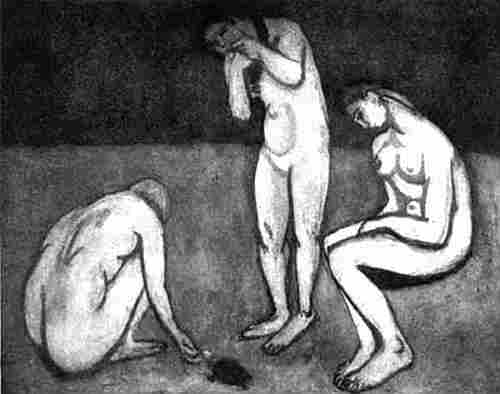
BAIGNEUSES HENRI-MATISSE
The trick of drawing of a Louis Legrand has no parallel in Matisse. In the work of the latter each figure or object, no matter how many times he has already drawn it, has a distinctively novel construction and presents a new vision. All familiar joints and hackneyed interpretations are absent. We have seen, for instance, the deltoids drawn in every conceivable pose of stress or calm. When one speaks of a nude we immediately visualise it with the angular shoulders, with the accustomed bulges over the upper arm which have been painted there in the same manner since the early Renaissance. In the delineation of deltoids the painter had become stagnant, accepting their conventional appearance as an external truth and recording them without thought. Matisse revolted against this fixed standard. Glance through his later nudes—and there are many of them—and every shoulder will present a different appearance; every arm will take on a novel form. We speak here of these particular muscles because they seem to obtrude themselves upon the sensitive sight more than any others. Matisse, seeking to overcome this structural monotony, made each shoulder he drew a new form, a new adventure, by expressing, not the actual bone and muscle of the clinic, but the salient meaning of that shoulder in a given milieu. It is this same desire to do away with the hackneyed forms of art that has driven the modern poets away from classic metres and caused them to seek a more plastic and adaptable medium in vers libre. Rondeaux, ballades, quatrains, octaves and the like are today as intrinsically perfect forms as they ever were, but the significance of their beauty has been lost through overuse, through too great familiarity. Our minds pass over them as over well-learned lessons committed to memory.
It is thus Matisse felt about the classic forms of his predecessors. These forms had once been beautiful; intrinsically they were still beautiful; but they had been habitualised by constant repetition; and new ones were needed. In order to find them Matisse says that, when before a model, he tried to forget that he had even seen a nude before and to look upon it with the eyes of one who had never seen a picture. By this he does not mean that his vision was naïve, but that it was innocent of set rules and preconceived ideas of how form should be obtained. As a theory this attitude proved fruitful because, while he did not succeed in setting aside memory, he was nevertheless led to a conscious thrusting aside of his first impulses to depict form as he saw it. All painters, even the greater artists of the past, had copied form as it presents itself to the eye, but Matisse forced himself, through painstaking analysis, to express form in a totally novel manner; and to a certain extent he succeeded. One might well ask why, in modifying the human body, he did not, for instance, omit a leg or a head, thus making his expression at once purer and more abstract. The answer is that he realised that the spectator, after the first shock at seeing the unexpected form and the consequent mental readjustment to the new vision, would nevertheless recognise the picture as a depiction of the human figure. Therefore a complete recognisability must be maintained. If the artist omitted an eye or a mouth, for example, the spectator would experience physically the incompleteness of the vision. He would feel, through personal association, the blindness or the suffocation as suggested in the picture; and these shocks, being secondary physiological sensations, would detract from the æsthetic pleasure provoked by the work. The point is an important one, for it demonstrates the impossibility of appreciating art purely as abstract form so long as recognisable objects are presented. As modern painting progressed the illustrative gradually became relegated.
Much impetus for his abbreviations and accentuations of form came to him with his personal discovery of the wood carvings of the African negroes, the sculpture of natives of Polynesia and Java and of the Peruvian and Mexican Indians. During the last five years we have heard much of these unknown artists and of their superlative ability for organisation and rhythm. But they have been a little too quickly and enthusiastically accepted as criteria at the expense of those greater artists, the Greeks, the Egyptians, the East Indians and the Chinese. Matisse found in them an inspiration toward synthesis and also a substantiation for his own desire to emphasise salient characteristics. They influenced his motives in depicting only what was personally important and in doing away with unnecessary details. After him there came a horde of imitators who saw in negro sculpture the quintessence of artistic expression, who looked upon it as a finality of organisation and rhythmic composing. Such judgment, however, contains more of enthusiasm than of critical acumen. Negro sculpture has an interest for us only in so far as it is novel and untutored. Its organisation is of the most primitive kind, symmetrical rather than rhythmic, architectonic rather than plastic. It is the work of slightly synthetic artists who were without models and whose visions encompassed only certain traits of form which, when expressed, became not composed but balanced, not imitative but abstract. The abstractness of negro sculpture, its bending of all human forms to an ornament, its archaic rigidity which is the antithesis of fluent movement—these are the qualities which have so gripped the imaginations of minor modern artists. In reality the negro sculptors did not seek these qualities consciously. Their lack of realistic observation was due to their partial isolation from exterior influences such as the Greeks and Egyptians, and to their desire to make an ornament of all images.
It was the Persians, however, who influenced Matisse more than did negro sculpture. He found in these artists a practical lesson in the application of his beliefs—a lesson which substantiated the tonic division and formal improvisation of Goya and the decorative colour application of Gauguin. Besides he learned from them a more direct method of image making, a method which was at once more delicate and more femininely sensitive. After seeing the pictures done by Matisse in Algiers, and such paintings as La Glace sans Tain, and after looking at the vistas through the open doors and windows in some of his large interiors, one realises at once the great influence these exquisitely delicate painters of ancient Persia had on him. The decorative illustrations of the Mille et Une Nuits, published in Paris by Fasquelle, are so similar to some of his pictures that one is inclined to believe he studied this book before painting them. His superiority lies in his liner comprehension of the human form and in the great diversity he exhibited in the repetition of its component parts. Persia, like other nations, had an academy, and while its yield was more charming and less given to complex reproductions, it had no more æsthetic importance than have the art schools of our own day. But unlike ours it had not forgotten the necessity of formal distribution in the making of artistic arrangements. This distribution in its flat sense Matisse appropriated to his own ends, and by applying to it freer modern means, made his art more æsthetically significant than that of the Persians.
His modern means were the outgrowth of his understanding of colour in its capacity to incite emotion. His first essays in this field were greyish. Later, through divisionistic methods, they grew brighter; and finally his colour became pure and was applied in large planes. His works of this period shine as a source of light, and with his development of exaggerated forms his colour interpretations also become exaggerated. Where he saw a green in a shadow he painted it a pure green; where he saw a yellow in light he made it a pure yellow; and so on with the other colours. But in these interpretations there is more than a mere desire to record hastily an optical vision. Each colour is pondered at length in its relation to the others. It is changed a score of times, modified and adjusted; and when it is finally posed it is artistically “right.” In other words, it fills harmoniously an important part in a picture where understanding and taste are the creators. In the work of Matisse sensibilité plays the all-important rôle, and while his results are satisfying as far as they go, there are times when we could wish for a greater rhythmic sense, a more conscious knowledge of the profundities of composition, and a less dominating desire to free each form and line from classic dictates.
With his colour we can find no such fault. Though here his knowledge, like that of all other artists before him, is limited, the perfect harmony between tints, which in him reaches a more advanced stage than in any preceding artist, is the result of a highly sensitive eye and an impeccable taste. The beauty of his colour alone makes him of paramount importance. Every one of his canvases is a complete colour gamut created by taste and authenticated by science not only as to pure colour but also as to greys and tone. In his still-lives he chooses objects alone for their colour and form, and his sense of proportion is so developed and his reduction of line is carried to so final an economy that, as flat as these objects are, they seem to have a rich consistency and to extend themselves into visual depth. As in the case of all men who deviate from the narrow and well-worn path of monotonous tonality, Matisse is accused of dealing in raucous and blatant colours which set the head aching and the eyes smarting. But the accusation is true only of his followers who display little sensitivity and even less artistry, and who, in imitating the superficial aspects of his work, see only grotesque distortions and pure colour. Matisse once had a school where he endeavoured to develop the native talents of the Americans, Poles, Russians and Germans; but when a Bohemian woman, in reply to his question as to what she wished to do, answered, “Je veux faire le ‘neuf’,” he abandoned the enterprise and retired to Clamart. She unwittingly summed up the desire of those meagre painters who, on seeing something novel, immediately throw themselves into imitating it. Matisse’s followers approach his colour gamut, but they never bridge that lacuna which separates a precise art from one which is à peu près. It is the last delicate refinement of perfect harmony which Matisse possesses and which his imitators can not attain to, which places him in the rank of greatness.
Matisse is called the Chef des Fauves, and his art has been catalogued and labeled, turned into a “school” and has come to be known in many quarters as Post-Impressionism, although that title, as well as the one of Fauvism, was originally intended to designate all the art movements after Impressionism and Neo-Impressionism and included such widely dissimilar men as Cézanne, Van Gogh, Picasso, Kandinsky, Matisse and Friesz. It stood for the new vitality in art, for the contemporary animating spirit, and implied an epoch rather than a movement. It was not sufficiently specific, however; and while modern art in the main is a homogeneous development of new means, its forces are too diverse and its evolution too complex to permit of its being described by a blanket term. It was therefore natural that in an endeavour to understand the underlying forces of modern painting a process of critical differentiation should have been instituted. But labels are offensive and impertinent when attached to serious æsthetic endeavours, and are apt to lead to misunderstanding and errors of judgment. The canvases themselves must be the final test of a movement’s enduring vitality. Matisse is himself the whole impetus of the movement he represents. With the one exception of Cézanne, he is more remote from his followers than any other modern leader. He repeats himself so little that his disciples cannot make a fetich of his canons. Indeed, he does not work by rote or law, except in so far as there is a law governing his personal impressions and predilections.
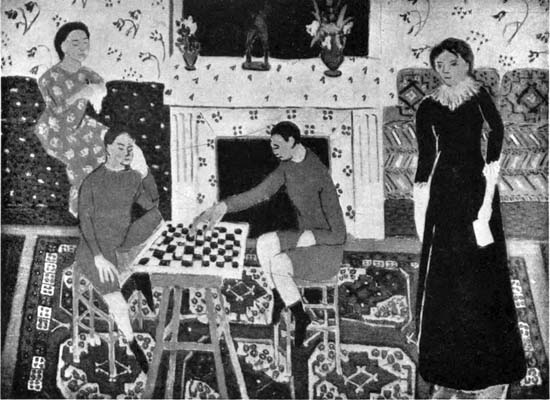
PORTRAIT DE FAMILLE HENRI-MATISSE
Although Matisse’s greatest impetus to modern art, after his carrying form nearer to an abstract conception, is the harmonising of colour, his finest canvases are those in which the form predominates, as for instance the Jeu de Balles, La Musique—Esquisse, La Musique (panneau décoratif) and Baigneuses. In these pictures, however, there is an entire absence of rhythm in the Renoir sense, but they possess a perfect disposition of forms to fill a given space, a harmony of subject with its frame, a dazzling succession of uncommon and beautifully proportioned spaces and an amazing feeling for two-dimensioned form. Where with Matisse the distinct parti pris of reverting to a primitive inspiration was excusable, such an attitude was worse than folly for those who came after him. With him it was a manifestation of the disgust of an impatient and experimental mind for stereotyped expression: with his followers it was only an imitation of his motives, and hence it was decadent. If Matisse partially understood Giotto and Michelangelo, the understanding contributed little to his art. His greatest claim to consideration is that he gave painting its final impulse toward abstraction. But his canvases, while being æsthetically just, are not æsthetically satisfying, because in composition he never penetrated further than the surface. And even on the surface he did not attain to a greater fluency than that permitted by parallelisms and simple oppositions, although there has never been an artist who more perfectly adapted his expression to the shape and size of his canvas.
That all great artists worked like him from the standpoint of creating recognisable form by abstract thought, does not detract from his fine destiny. Where other artists failed to drag art from the quicksands of literary instantaneity, Matisse succeeded. His evolution was direct and logical, as a close study of his work will show; and those who see in him an arriviste may with equal justice bring the same charge against Michelangelo. His æsthetic sources and admirations, of which so much has been written, are important in understanding the genealogical foundations of art, but they are of little moment in the actual enjoyment of his pictures. Looking impartially at his classic influences on the one hand and his Persian and negro influences on the other, it is difficult to see just where the benefits of the latter lie. Matisse merely shifted his inspiration from the greatest masters of form to the slighter masters—from a well-known and great antiquity to a little-known and less significant one. However, if negro sculpture can help produce a man like Picasso, and the Persian stuffs and enamels one like Matisse, they serve after all a high purpose.
XI
PICASSO AND CUBISM
CUBISM first and foremost is an attempt to make art more arbitrary in its selection of compositional forms. In all ancient painting only the human figure was used as a basis for organisation. Later landscape widened the scope of the painter’s material possibilities; but even the introduction of this new element merely extended the boundary of subject-matter. The essence of art remained the same. Landscape permitted new forms to be interwoven with the old ones, without making the old more plastic. The elasticising process was what the painter had always desiderated, but his literalness was such that he never went beyond primary distortions of the human body—distortions so small that they were almost unnoticeable. With the Greeks and Chinese these deformations were practised in order to beautify the body’s relative proportions; with the East Indians and Michelangelo, to accentuate the emotion of forceful movement; with Renoir, to express form fully in its relation to the generating line of each picture; and with Matisse the distortions were the result, first, of a reaction against a hackneyed classic system, and later, of a desire to divorce æsthetic pleasure from mental association, in other words, to make form abstract rather than personal. In him there is no rhythmic composition, and while, as in the case of Renoir, his pictures are great as ensembles, each part of them is a separate item which does not depend, for appreciation, on its rapport to the whole. His is an art of colour, of sensitive and inspiring form in two dimensions—a decorative art of a high order. As such it is at once a derivation of Impressionism and a development of Impressionistic colour through the channels of taste.
Cubism is a far more arbitrary art than Matisse’s. In its extreme expression it depends, not so much on the artist’s adroitness at interpreting nature, as on his ability to express pure æsthetic emotion in its relation to form—form being used here in its extended sense to connote the solidity of the entire picture and the block relation of each part to the other parts. Composition prior to the Cubists had been the rhythmic organisation of a picture’s integral parts by line, volume, chiaroscuro and colour. A totally unrelated set of objective figures or forms was drawn together into an ensemble by these abstract æsthetic means. Cubism retained the older methods of form and conception, and added to them the illustrative device of disorganising and rearranging objectivity so that the separated parts would intersect, overlap and partly obscure the image. Thus was presented a picture replete with all aspects of the model, that is, a picture in which the expression presented not only the vision of reality as it discloses itself to our eyes, but the vision which delivers itself to our intelligences, with its actions and reactions, its many and changing miens, its linear and voluminous struggles, its solidity and its transparency. In Cubism the details of this ubiquitous and omnifarious vision are subjugated to arbitrary order and expressed in tones of warm and cold.
At the outset Cubism was a Dionysian reaction against the flowing and soft decoration of the schools of Bouguereau and the Impressionists. The precise and masculine minds of a new cycle could not rest satisfied with the single melody of their immediate predecessors. Courbet, the Cubists’ prototype on the side of painting which dealt entirely with objectivity, reacted against corresponding feminine tendencies in the schools of David and Ingres; and the decisive blow he struck in 1850 with his L’Enterrement à Ornans had a psychological parallel in the Cubists’ exhibit in 1911. While Manet seemed to continue Courbet he in reality retrogressed to a classic prettiness. His achievements may be compared to those of the Orphists who, while seeming to carry on the principles of Cubism, nullified the effect of that school by the misapplication of colour. Cubism itself ignored colour and curved lines. It was a further step toward a more intellectual type of painting. The modern artist’s mind, in becoming more self-conscious, was consequently growing more precise in its expression. And since the Cubists were the primitives of a new era, it was natural that this precision should express itself in straight lines and angular forms. The inconsistency of these artists lay in the fact that, while their first desire was to make their art arbitrary, they were so preoccupied with the dynamism of objectivity that the main object of their work was deputised. In the canvases of Picasso’s followers naturalism is the first consideration. As a result the organisation of emotion-impelling form is obscured. It was from Cézanne that the Cubists garnered the greater part of their theories, and even the appearance of their work is not unlike his. Cézanne realised that a mere imitation of reality, no matter how interesting, could never set in motion the wheels of æsthetic ecstasy; and so he translated nature into a subjective impression of reality by expressing it in a complete order which was itself dynamic. The Cubists, profiting by his discoveries of linear and tonal modification, essayed to found a school on certain of his better-known and more easily grasped practices. The spirit of precision, the need for a renovation, and the example of Picasso who at one period copied the angularities of negro sculpture—all gave momentum to the movement. Later were introduced the philosophical reasonings and scientific explanations of which there has recently been so much discussion.
The total absence of colour in the Cubists is ascribable to the same revolt against prettiness and ambiguity that made them alter their line and form. They felt the subjective solidity of Cézanne without understanding that it was brought about by the use of colour whose emotional possibilities he had profoundly penetrated. In fact his art was composed entirely of minute chromatic planes which, by their complete adaptability to a given position in space, produced the intensest form. The Cubists’ planes are based, not on colour, but on objective form itself, and are expressed by tone. In this respect Cubism is diametrically opposed to the conception of Cézanne. With him form was a result of the plastic employment of colour. With the Cubists even tone is subjugated to formal planes. In them we do not experience the subjectivity of emotion which can be produced alone by colour. Their pictures represent a recognisable solidity which, by an image, expresses subjective processes. Cézanne’s simultaneous vision of reality had to do purely with the most mobile element of art; the Cubists attempted to express psychological phenomena by the limited methods of the early primitives. Their inability to sound (not in theory but actually) the possibilities of colour in the creation of æsthetic form, has caused them to diverge from the direct path in the development of means, and has restricted permanently their initial desire for concentrated composition. The Impressionists experimented in a highly dynamic element; but the Cubists have only dabbled in mental processes which, even should they become perfected, could give us only the sequential vision of a human action. The Cubist doctrine embraces no more than a side issue in an art which primarily has to do with the organisation of form. In the effort of the Cubists to create a pure art they merely disguise objectivity by abstract thought. This is by no means the same as creating abstract form—that is, form which is not reminiscent of a particular natural object; and by failing in this they let pass the great opportunity of taking the final step from Matisse to purity. They took only a half step, for in their exultation they forgot the preceding advances in composition.
In such forgetfulness there was nothing unusual. Every new movement in the progress of art has about it a certain isolation of ambition. The first innovators push out the boundary on one side; their followers, on another; and the final exponents of a method, having fully assimilated what has preceded them, combine the endeavours and accomplishments of their forerunners and go forward to new achievements. Cézanne had recognised that he could never round out his own cycle. No stricture can attach to his incompleteness: his life was too short for realisation. That the Cubists did not altogether achieve their desire does not detract from the importance of their departure from established precedent. Their reaction was a salutary event in the evolution of modern painting. The field of art was being overrun by the decadents of Impressionism and Cézanne, by the imitators of Toulouse-Lautrec and Degas, by those academicians who follow in the wake of every movement long after its methods have been accepted as vital. These scholastic men were incorporating spots and bright colours into their school-room drawings when Cubism came forward. By its unequivocal expression of opinions and by its neat delimitations of planes it has revealed the futility and pettiness of academic alterations. Besides their purely psychological innovations the Cubists have achieved all the ambitions of the academies in a way so net, so sure, so precise, that they have reduced the school, if not to silence, at least to ineffectualness. No longer can the admirers of scholastic art stand before a canvas exclaiming on the feeling, the atmosphere or the spirituality of the work. One must now use concrete terms and speak of those qualities which have to do with profound order; for although the theories of Cubism state one thing, the application of them has taken another and definite æsthetic form. In the Cubists’ work lies their greatest importance. We may without loss lay aside their explanations, their manifestos and the reports of their lectures.
The idea of synthesis in painting had been so thoroughly assimilated through familiarity with successive movements that, with the advent of Cubism, it was an accepted and unquestioned law of painting. Synthesis had in fact become an almost unconscious knowledge. Ingres, Daumier, Manet, Seurat and Matisse had, in quick succession, proclaimed its value in eliminating the unimportant and unessential from models. With Cubism, as with Matisse and Gauguin, synthesis was the supreme ambition—synthesis which had for its goal the artistic consistency of all the picture’s qualities. Subject-matter, colour and the method of expression were all harmonised in Gauguin: with him the synthesis was illustrative. In Matisse it manifested itself in the reduction of form and colour to their simplest and most personal expression, and was therefore a step toward a pure art. With Picasso synthesis went still further. It became almost basic. We know that the curved line stands for life, colour and movement; that the straight line represents the dead, the sombre and the static. A solid dark is conducive to peace, while quickly succeeding light and dark promote liveliness. Bearing these fundamental postulates in mind we can easily analyse Picasso’s quality of synthesis. The straight line which predominates in Cubism repudiates colour:—the Cubists were not colourists. The curved line, when profoundly comprehended, expresses movement and fluidity; when used haphazardly mere prettiness results. There are seldom any curves in Cubism, and then only for relieving the monotony, for the sake of ornament. In the Cubists’ scintillating succession of darks and lights, like a photographic negative of a Cézanne or an early Renoir, there is an unescapable feminine prettiness in which the twinkling of tone serves the same purpose as pretty colour. By their straight lines, subfuse tones and rigid forms, on the one hand, they achieve immobility. By their lights and darks, their curves and their dependence on nature, on the other hand, they reveal their emotional kinship to the illustrative schools of Whistler, Fragonard and Tiepolo. Now when we combine properly these two widely separated aspects of art—the one almost Egyptian and the other almost English—we obtain a combination of temperamental characteristics capable of the greatest achievements, for we have brought about the coalition of the purely masculine and the purely feminine. In Cubism, however, these two aspects are mingled disproportionately. The static predominates. The pretty is merely superimposed because of temperamental dictation: instead of functioning, it only attracts. But though in Cubism we do not find the perfect fusion of these creative sex impulses, the simultaneous presence of the two elements produces nevertheless a fundamental synthesis.
In order to bring about the greatest art, the form and order (which constitute the masculine side) must be all-pervading. Objective ornament and external beauty (which constitute the feminine side) must be only the inspiration to creation. This is an important principle, for all art, like all life, falls into either the masculine or the feminine category. All personal preferences for certain forms of art are imputable to the predomination of the male or the female in the individual. Necessarily all creation is to a certain extent masculine—in it there has to be order; and by the predomination of the male or female is meant simply the accentuation of one of these qualities in their relative combination in each of the sexes. For instance, should the feminine “predominate” in a man, the fact would merely indicate that the percentage of femininity in his bisexuality had over-balanced the normal ratio. Decoration, which is an ornamental art, is feminine, and it will appeal to men who have a subnormal amount of the creator in them. The colossally ordered art of a Rubens will be understood and enjoyed only by one highly capable of creation, for in the contemplation and comprehension of a profound work of art the spectator reconstructs the artist’s mind after his own formula, and thus recreates the work for himself. That side of art which is the recording of some emotion the artist has experienced so intensely that it demands concrete expression, is feminine. It is merely an overflow of receptivity into objectivity. To the contrary, when great art is produced it is not dependent on a specific exterior impulse. It grows abstractly out of a collection of assimilated impressions. When the will dominates the expression, these impressions must take plastic form. The desire to create is in itself feminine. The constructive ability is masculine. The first desire always is to decorate and beautify, but the masculine will dictates and rules the expression. In feminine art the will to co-ordinate is absent. Consequently the expression is only the direct result of the reception. The Cubists realise that the will must play a large part in painting, but they exert their will on the analysis of thought rather than on their actual productions. The result is that, while their expression is highly restrained and reasoned, the will is exercised only on the emotion of the received impression, and is not manifested on their canvases’ surface. In all their work they are decorators first and significant artists afterward. They belong distinctly to the lighter side of artistic tradition. They are the lyric poets of the plastic.
This is markedly true of Picasso who instigated the movement. When he first came to Paris he threw himself into a style of painting which recalled Steinlen at his best. From Steinlen he went to Toulouse-Lautrec and Impressionistic colour. Next he did carefully drawn portraits which proclaimed him a greater Gauguin. Later he become infatuated with the rhythm and skeleton-like creations of El Greco. It was at this period that he began to do his significant work. His pictures for the most part were painted in blue. They were sensitive to a high degree, and were, in the sculptural sense, sometimes ordered into a solid block form. Then, adopting a reddish colour gamut, he began to create full figures of nudes, portraits and animal studies. At this time he commenced his research in precise form. He organised copies of negro sculpture of which he had heard much from Matisse, and it was a result of his studying these rigid figures that angularities began to creep into his art. Other artists set to work along the same lines, and from the friction of ideas which followed the theory of Cubism was evolved. Picasso’s still-lives then became more precise, more hard-cut, more personal, more completely ordered. It is from this period we receive some of his greatest work.
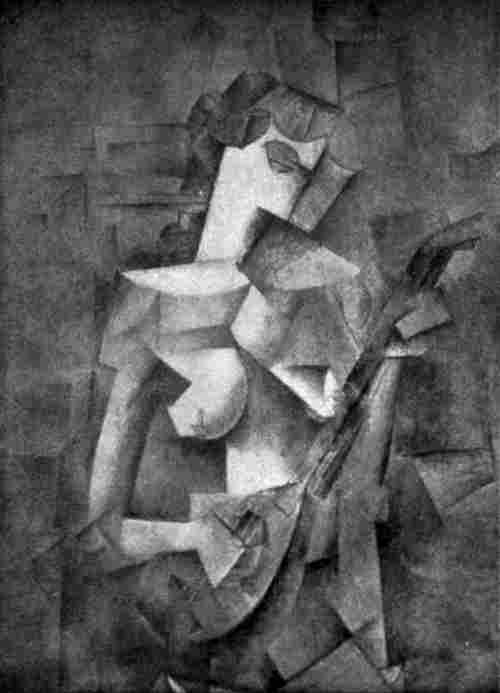
FEMME À LA MANDOLINE PICASSO
Shortly after came the Cubist theory of simultaneity. The authorship of this theory is in doubt. There has been much controversy as to whether it originated with Picasso or with one of his followers. But it was straightway adopted by the entire group and made one of the dominating principles of the movement. Simultaneity to these painters meant the combined presentation of a number of aspects of the same object from many different angles. In the visualisation of an object in nature during the absence of that object, we conceive it, not only as a silhouette or as a form with three dimensions, but as a congeries of silhouettes which, when imagined simultaneously, constitute the appearance of the object from every known angle. In short, our minds envelop it and all its attributes at the same instant. Such a vision is the result of collected and concentrated memory. In a desire to disarm criticism the Cubists offered as a theory the picturisation of this multilateral vision; but in reality it was little more than an excuse to make the utilisation of natural forms more arbitrary than in the case of Matisse, Cézanne and Gauguin and also to rid themselves entirely of the illustrative obstacle. Their ingrained weakness lay in that they did not possess sufficient genius to alienate themselves entirely from document and to create new abstract compositions. Nor did their instinct permit them to throw document aside when they sensed their inability to replace it with something more vital. Their spirit of revolution worked on the form which illustration would take, rather than on the discontinuance of illustration. But even in this attitude they marked a decided progress, for while in the paintings of their predecessors the disposition of line and form had made a unity of many separated figures, these figures, even to a mind unusually free from the taint of anecdote and objectivity in art, presented themselves separately as integers of a whole. The Cubists, by breaking up a model into parts which separately bore little resemblance to nature, proved that they not only recognised the demands of pure organisation but that they knew those demands could never be met so long as there were recognisable objects in a painting.
The presentation of a nude or a landscape from many different viewpoints was in itself no more important than the methods of the Impressionists. Indeed the pleasure derived from so constructing a picture is similar to the pleasure derived from copying light. It represents the nearest approach of the enthusiastic painter of form to the enthusiastic painter of light. They are both interested in recording a rather puzzling and interesting phenomenon: the one is after that which creates the impressions of form; the other, that which creates the impressions of colour. Both, in the broad sense, derive the same enjoyment in deciphering the work after it is finished. The one records only broad waves of scintillating colours with no demarcation of silhouettes; and these colours gradually resolve themselves into a sunny and ambiguous landscape. The other makes a number of broad planes of brown and white which, when diligently studied in their parts, become the angular representation of water, ships, sky-lines which run into and through houses, trees which obscure near-by objects, and houses which melt into distant skies. Both schools of painting are impressionistic; each treats of exactly what the other neglects. No artist as yet has seen the distinct advantage of uniting the two methods. Cézanne might be suggested as having approached this alliance, but his means were too profound for him to be led into portraying by concrete symbols his impressions of a model.
In painting the enveloping mental vision of a model, however, the Cubists actually failed in the synchronism for which they strove. In reality they extended the effect of their pictures into time more than ever before. To grasp their illustrative import, long and arduous search must be made. While their canvases present a simultaneous vision, each picture as a whole is incapable of creating a unified impression. A Cubist painting is, let us say, like the momentary blare of a hundred musical instruments all of which play consecutive bars. By approaching each performer in order and studying his particular notes, until every musical detail is learned, we might intellectually construct from our memory an impression of a related musical composition. But should the blare be repeated, even after our research, the music’s meaning would be no clearer than before. On the other hand, if, having first heard the composition in its natural development, we had studied its parts and motifs and then heard it repeated sequentially, a greater enjoyment and comprehension would result. In breaking up nature, either for the sake of extending the æsthetic appreciation into time like music, or for simultaneity of presentation, all the parts must answer to an organisation;—in the first case, so that, after the spectator’s first fleeting vision of the whole, his eye will be carried from one part to another by the rhythmic balance of volume, linear opposition and harmony of colour; and in the second case, so that the canvas will be an interdependent block-manifestation.
In constructing formal planes with definite tones whose values are mechanical and absolute, the Cubists have missed that possible subjectivity of movement which, in its highest degree, colour alone can give. They have constructed only primitively ordered bas-reliefs each plane and line of which has a distinct direction. And this direction, no matter what is added to or subtracted from the work, will remain the same. The planes are consequently static and absolute. In the great art of Cézanne there is only a relative absolutism. By any alteration in one of his pictures, the entirety is shattered: the direction of each plane and line is changed to concur with the needs of a different order. This is because Cézanne’s work possesses the poise which is demanded in the highest art. And this poise is what Cubism, with its rigid lines and planes, has entirely missed. Illustratively the Cubists’ conception was new, compositionally it was old; and an art cannot be significantly renovated save from the bottom upward. The foundation of all art is composition, and the only means which can be accepted as vital are those which increase the artist’s power to express that which is more inherent in painting than in any of the other arts, namely: rhythmic form in three dimensions. That the Cubists failed to develop such means may be perceived by comparing the compositions of Picasso’s “red” period, which were but slightly cubic and which contain a certain amount of arbitrary form, with his late and wholly cubic black-and-white drawings and paintings such as are seen at Kahnweiler’s back of the Madeleine. The latter are almost wholly flat. His Femme à la Mandoline marks the transition from the early period to the late one. In all his pictures one finds a charming rhythm of lights and darks and a slight comprehension of surface form. But he never goes very deep. Even in his sculptured heads, while there is order, there is no form in the compositional sense.
To ascribe Picasso’s Cubism to so childish an impulse as a desire to square an academic drawing is both untrue and unjust. Some have pointed to Dürer as his artistic forbear merely because Dürer once described a number of curves which he said could be made into a human body and drew a block-diagram of box-like forms which he said was the basis for the body’s construction. But no relationship exists between these two artists. Cubism’s first consideration was to cover the surfaces of its canvases with form, thus doing away with the empty spaces so prevalent in all art works, spaces which Cézanne left blank. To accomplish this logically it was necessary either to introduce superfluous figures, or to stretch the ones already present into impossible distortions. Since the elimination of all unessentials was the keynote of the day, Picasso decided to make multiplex his essentials. Herewith was born the Cubist conception of breaking up the model for the attainment of a more complete work and one in which there would be no dead planes. At first an extensive linear direction, which started at the lower frame, was carried up into the background by the demarcation of a shadow or an object, for the purpose of holding tightly together two or more forms. Later, in order to facilitate this procedure of multiplying their models, the Cubists began to walk round them. This process unchained them from the slavery to a single model and from the given contour of an absolute subject. At the same time it permitted them a fantastically arbitrary composition, and made their expression more dependent on the personality of the artist, and less contingent on preconceived ideas, than ever before.
Cubism expressed a laudable tendency toward an aristocratic vision as opposed to the popular vision of reality. Its pictures therefore became doubly complex, for in the contemplation of the picturisation of our mental process, another process is started which is far more complicated than the first. Herein we have an explanation for the fact that Cubism is incomprehensible to the untutored person who regards art as an imitation of nature. The very word “form” is æsthetically meaningless to the average spectator. In order to experience its meaning, aside from organisation, one’s attention has to be given over to the object’s weight, its force, its circumferential volume. A form in a picture cannot be considered merely as to its employment and its utilitarian destiny, or from the standpoint of one’s experience with it. To the great artist an object exists as a volume with which to fill a given space. He completely forgets its raison d’être in life, and views it only as a means for tightening a picture’s order. To this extreme of pure artistic conception the Cubists never attained. And while Cézanne advanced from Courbet’s surface realism to the realism of causes, the Cubists were unable to progress along similar lines. They simply translated abstraction into terms of concrete expression. The profound reasons for dynamism in art were left untouched by them. They endeavoured to portray objectively an abstract process, expecting its mere portrayal to be dynamic.
The dynamic, however, cannot be rendered by imitation. It is as impossible of attainment by this method as in the dancing-girl canvases of Degas. Behind the emotional power of nature there is a great abstract force; and the effect of dynamism can be got only when this force is expressed. Then the result is a natural outgrowth of a cause. Otherwise we have only a detached effect which does not lead us back into the undercurrents of causation. When a Cubist picture is interesting it will at most make us puzzle over the application of its theories; it can never move us æsthetically by the sheer power of its methods. The one dynamic element which the Cubists have in common with Cézanne—namely: the modification of lines and forms through contact with other lines and forms—they have nullified by constructing with rigid tones the planes which the lines delimit, thereby making their planes frozen and immovable. Because ignorant of the functionality of colour the Cubists were unable to present, at one and the same time, perfect mobility, planar solidity and indefinite depth. As a result of too much study of Cézanne’s and El Greco’s composition and too little study of Michelangelo and Rubens, they failed to achieve, even with the great arbitrariness and convenience of their means, a profound composition which is a rhythmic order of volume, as distinguished from a simple organisation of parts. Their accomplishments do not realise the promises of their programme because their theories were too inflexible. Cubism was too tightly bound by rigid systems and methods to produce plastically significant results.
The Cubists’ greatest apport to art (not in theory but in achievement) is their almost total abolition of the painter’s slavery to nature. It was but a step from Matisse to the complete elimination of recognisable objects, and though Cubism did not cover the entire distance, it nevertheless made an advance toward that pure expression which Cézanne saw was inevitable. Even today the followers of this school are beginning to realise their early mistakes and to throw off their self-imposed restrictions. They are launching forth into colour and are seeking expression in purely arbitrary form. But these new developments have not yet been productive of a new artistic worth. Indeed, it is doubtful if they will lead to important results so long as the geometrical phase of Cubism is adhered to, and so long as the Cubists ignore the dynamic possibilities of colour. In its present status Cubism can only continue striving toward a style that goes deeper than tonal prettiness and lyric immobility. Already Picasso has passed out of painting altogether. An artist with his extraordinary gift to do anything superficially well could not remain anchored to an idea after the novelty of its method had worn off. He is not a man who is the slave of thought, but rather an obstinate artist with a spark of genius who has passed through many different stages with a rapidity born of astounding dexterity and cleverness. Many of his early female heads rival in sheer classic beauty the best of the Renaissance painters. Some of his pen-and-ink drawings are the most sensitive of modern times. There are caricatures done by him which closely approach the fantasy of a Goya. Indeed it may be justly said that he is as great an illustrator as Raphael. And in this analogy lie both his glory and his limitation. Like Raphael he lacks that profound penetration of exteriors which would permit him a comprehension of his greater influences—of El Greco, for instance. But, with a glance, he can sound the depths of a Toulouse-Lautrec, a Steinlen or a piece of negro sculpture.
Picasso’s inability to conceive two elements at once and to construct a complicated development of composition, is exemplified in his earlier work, first, by his adherence to certain single colours at different stages of his career, secondly, by the extreme simplicity of his circus folk, and thirdly, by his figure compositions which, though they are never tedious or dull and possess an almost nervous sensibilité, are limited to one or two human forms. Again Picasso’s limitation of compositional conception is attested to by his stubborn use of brown and white in his latest Cubist pictures, by his employment of line alone in the drawings of his architectural-plan stage, and by his application of objects at hand to the clay blocks which mark his latest metamorphosis. But no matter what his medium or style, he remains essentially unchanged. In all his work is felt the superficial lightness of one who conceives order only as an ornament to decoration and who is interested in three-dimensional form merely as an after-thought. His sculpture is but his painting in a solider medium. It is broken up into planes and organised as to each contour in exactly the same manner as is his work in oils. The difference between Picasso, the sculptor, and Matisse, the sculptor, is the difference between a man who has a slight genius for rhythm and a block order, and one who has a slight genius for characterisation and a perfect ensemble. The art of Picasso, having to do with form as decoration, is admirably adapted to sculpture. The art of Matisse, being flat and dealing with colour as decoration, is inexpressible in clay.
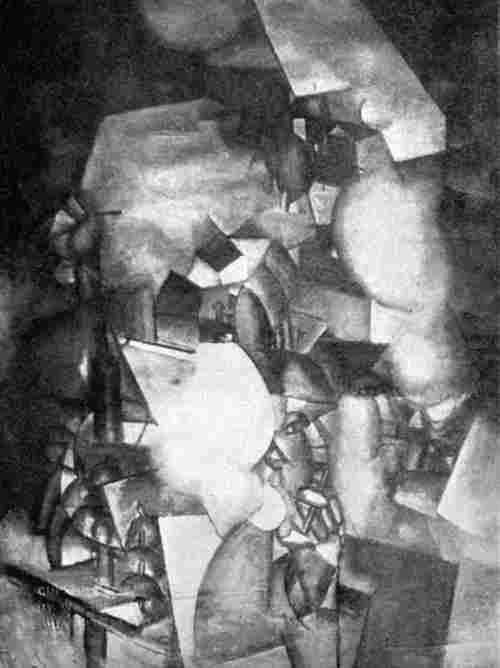
FUMEUR ET PAYSAGE LÉGER
Fernand Léger, with the exception of Picasso, is the most genuinely talented artist of the Cubist movement. His work at first was much less radical than that of his confrères and gave greater evidence of depth because it had never completely shaken off perspective. His canvases, Les Toits and Maisons et Fumées, represent little more than a highly artistic angularisation of a subject which, being angular in itself, lends itself admirably to Cubistic treatment. Léger’s method is to place in the foreground large planes which serve as a frame for the actual picture which is seen between them as through a tunnel. By this device he creates a diversity of form and with it a recognisable depth. His paint at first was light in tone, but is now taking on colour. Since his first Cubist exhibits he has made a logical progress in rhythmic conception, and if his past development can be assumed as a criterion of the future it is safe to prophesy that eventually he will be the most significant man of the original group. Albert Gleizes, Jean Metzinger, Marcel Duchamp, Georges Braque and Francis Picabia are all prominent figures in the Cubist movement. Gleizes manifested his first Cubist tendencies by giving form a solid angularity, thereby making it precise. His canvases are devoid of interest because so slightly creative. His well-known L’Homme au Balcon appears to us today almost Futuristic in conception. In fact, it was exposed at the Salon d’Automne in 1912 one year after the Futurist show; and when we compare it with his early and less significant Les Baigneuses, with which it was hung, it gives the impression of having been the result of a sudden and enthusiastic inspiration from the newer men. Later his work grew broader and simpler, but in it there is little or no composition. Even the order is that of the straight line. Metzinger is a better artist. In him is a greater order, although, as in Gleizes, it is produced by the straight line. During his artistic beginnings he was under the sway of negro sculpture and painted in small planes of light and dark. Later, turning from the influence of negro antiquity, he directed his talent on nature and began to interpret form into angularities. His La Femme au Cheval, done in 1912, was a distinct step, both as to form and composition, in advance of the naturalistic vision; and his Le Port is one of the finest examples of the Cubist theory of synchronous picturisation and interpenetrating lines and masses. Duchamp, a slighter talent than either Léger or Gleizes, is the Whistler of the movement. In his pictures are less form, less composition and less comprehension of volume than in any other Cubist work except that of Juan Gris whose lethargic canvases have not even the interest of an Aimé Morot. Braque has added nothing to Cubism. He followed Picasso closely, and his whole creative impetus seems derived from the latter’s canvases.
Picabia, despite his popularity, is but a second-rate Cubist. He was quick to grasp the fact that the Cubists were working away from illustration, and attempted to step beyond them. Where they had endeavoured to bring about the precise stylisation of form, he merely dealt in ribbon-like patches of colour which were without contour, shape, proportion or volume. His canvases wherein many of these strange amorphous hachures are grouped, have a highly bizarre appearance but are only remotely intelligible. He used almost monochromatic schemes, as did his master Picasso, and continued this style of work until his fellow Cubists, by diligent research and serious study, had approached the abstract appearance of his surfaces. Picabia then found a new impetus in the works of the Futurists—an impetus toward movement expressed, not by bodies, but by line. This Futurist influence resulted in his making flat pictures of many sharply defined silhouettes tinted red, green, blue and grey. His lines serve only to accentuate the chaos of his ensemble, for in his work there is no definite conception of the whole.
Cubism’s possibilities as a dynamic illustrative art have never been adequately exhausted, and, since the angular mode is rapidly disappearing as a result of newer and more vital visions, they probably never will. Picasso was its high priest up to two years ago, at which time colour, coming back on the wave of a counter-revolution, threw most of the Cubists into its application. Robert Delaunay was responsible for this reaction. Early in 1912 he came forward with a very large canvas entitled Ville de Paris, whose surface was broken up into many angular planes after the Cubist fashion. But instead of depicting forms and formal relations, the picture was painted in greys and high colours solely as a means of surface filling. Its contours recalled El Greco despite their being disguised by triangular dislocations. The picture represented three mammoth Graces standing before a distant Paris landscape, and so transparent and ethereal was it that it seemed as though a breath could have dispersed it into mist. It possessed the delicate loveliness of a butterfly, and the eye, in running over its glittering and pretty array of colours, was fascinated as in the contemplation of a kaleidoscope. But the canvas, while provoking a distinct visual pleasure, failed to arouse any æsthetic enjoyment.
Delaunay’s L’Équipe de Cardiff the following year was equally unemotional. Fundamentally this picture was the same as his Ville de Paris, though treated differently as to surface. The same up-shooting type of svelte beauty as formerly bodied forth in his three Graces was here repeated in the bodies of the athletes, but there was in addition a very slight surface rhythm; and the colour, because its application was broader, had a greater fascination. In his Ville de Paris, not daring to paint a naturally drawn nude with the colours his sense of prettiness and ornament dictated, he fragmentised the surface by luxating the lines. Thus, while the sensitive contour was retained, the picture appeared as if viewed through a polygonal prism. In the second canvas this artifice for the sake of charm was discarded. The players were dressed in solid colours of bright pigment; the sky was blue-violet; the Eiffel tower, eminently appreciable, stood to the right; down the centre of the canvas was a large affiche in yellow; and overhead soared an aeroplane. The transition from a hackneyed theme to a modern one was the result of the artist’s desire to pass beyond the methods of the day to more vigorous ones.