Chapter XVII · Stage Tricks.
Reading edition
The present Chapter will be devoted to such tricks as by reason of the cumbrousness or costliness of the apparatus required for them, are, as a rule, exhibited only upon the public stage. The stage performer may, if he pleases, avail himself of the aid of mechanical tables, electrical appliances, etc., which enable him to execute a class of tricks which are beyond the scope of an ordinary drawing-room performance, though the wealthy amateur will find no difficulty in converting his own drawing-room into a quasi-stage, and qualifying it for the presentation of the most elaborate illusions.
The leading items of apparatus in stage magic are mechanical tables. These are of various kinds, many being specially designed to assist in the performance of some one particular trick. Putting aside these, which will be separately noticed, stage tables may be broadly divided into three classes—trap tables, piston tables, and electrical tables. In practice, these classes are somewhat intermingled, for it is rather the rule than the exception for a stage table to be fitted with both traps and pistons, while either or both of these may be found in conjunction with electrical appliances.
Trap tables are such as are provided with one or more “traps,” their object being, at the will of the operator, to cause the disappearance of a given article into the interior of the table, or sometimes to produce or apparently change an article. The traps most generally used may be described as follows:—
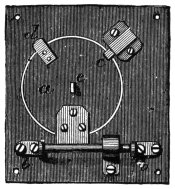
Fig. 261.
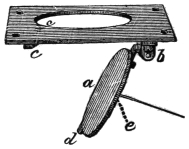
Fig. 262.
1. The Plain Trap.—This consists of a thin plate of metal, generally zinc, screwed down flush with the top of the table. In this, which we will call the surface plate, is cut a hole, generally circular, and from two to four inches in diameter, closed by a flap or door, which by the action of a spring hinge is pressed up level with the rest of the trap, though it instantly yields to pressure from above, again rising as soon as such pressure is removed. Figs. 261 and 262 represent the trap as seen detached from the table, Fig. 261 exhibiting its under side. a is the circular flap, b b the spring hinge, c a little bolt by means of which the trap may be fastened at pleasure, and which is worked by a pin projecting upwards through a slot in the surface plate, and through the cloth which covers the table; d is a small flat piece of metal, screwed to the under side of the flap a, and acting as a “stop” to prevent the flap being forced by the action of the spring above the level of the surface-plate. The “mountings” of the trap are generally brass, and attached to the zinc by screws. A brass eyelet, e, is sometimes soldered to the centre of the under side of the flap. To this is attached a cord, which may hang down ready to the performer’s hand at the back of the table, or may be carried down a groove in one of the hinder legs, and either terminate in a pedal (to be pressed by the foot of the performer), or be continued behind the scenes within reach of the hand of the assistant. The mode of working the trap is as follows:—Any small article, being placed on it, is covered over (either with an ornamental cover or with a simple handkerchief). The cord being gently pulled by either of the means above mentioned, the trap opens, and the article falls into the body of the table. As soon as the pull is relaxed, the flap again rises and closes the opening. Where a cord is not used, the performer gets rid of the article by direct pressure on the trap, or the article upon it, with the one hand, while with the other he veils the opening in the table.
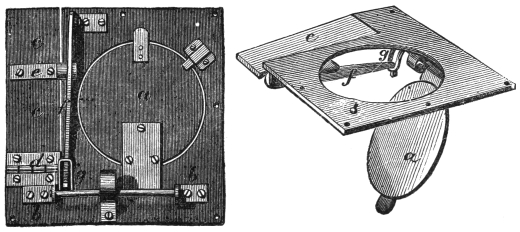
Fig. 263. Fig. 264.
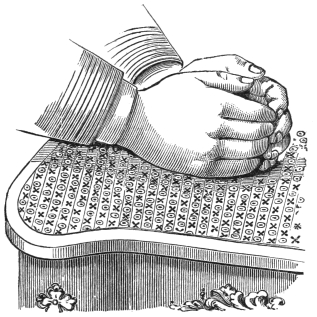
Fig. 265.
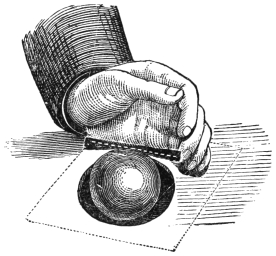
Fig. 266.
2. The “Wrist” or “Pressure” Trap.—With this form of trap the use of a cord is unnecessary, the trap being worked from the surface of the table, by pressure upon a particular spot. The manner of its construction will become clear upon an inspection of Figs. 263, 264. Fig. 263 represents the under side of the trap; a is the flap, working upon a spring hinge b b, as already explained in the case of the plain trap; c c is an oblong piece of metal, cut out of and lying flush with the surface-plate, and working upon an ordinary hinge at d. When c is pressed down, the crosspiece e, which is soldered to it, presses down the lever f, and this in turn acting upon the shorter lever g, which is fixed at right angles to the rod upon which the flap a is hinged, causes the latter to open.
The mode of using the wrist trap is as follows:—The performer has occasion, we will suppose, to cause the disappearance of an orange, as for instance, in the “Bran and Orange” trick, described at page 335. Placing the orange upon the flap a, he places both hands round it as though to pick it up between them. (See Fig. 265.) In this position the under side of the hand furthest from the audience (see Fig. 266, showing the right hand removed), is just over c, and pressing gently upon it, causes the flap to open, and the orange to fall through; the position of the hands completely veiling the operation. The operator now leaves the table, still holding his hands as though having the orange between them, and after a due interval, brings them closer and closer together, at last showing that it has vanished.
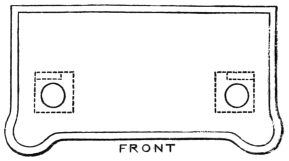
Fig. 267.
The wrist trap is generally worked by the performer standing at the side of the table, and the traps are therefore made right-handed and left-handed, according to the end at which they are intended to be placed, the rule being that c must be so placed with reference to a, as to be when in use under the hand furthest from the spectators. Fig. 267 illustrates this difference of make, to suit the one or the other end of the table.
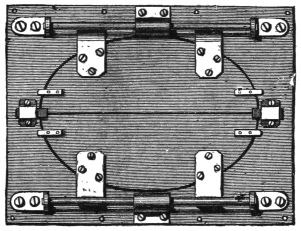
Fig. 268.
3. The “Rabbit” or “Dove” Trap.—This, as its name indicates, is a trap for causing the disappearance of a rabbit or pigeon. The opening is in this case oval, measuring about eight inches by six, and closed by a double flap, divided down the middle (see Fig. 268, representing the under side of the trap.) It has no string, the animal being simply pushed down through the trap under cover either of a second rabbit, or of a piece of paper in which the victim is supposed to be wrapped. As the rabbit trap requires considerable space, and, moreover, involves the necessity of some sort of an inclosure within the table to prevent an unexpected reappearance of the animal, it is a convenient plan to devote to it a small special table. This should be circular; about thirty-two inches in height, and sixteen to eighteen in diameter. The upper part of the table must form a circular wooden box, about eight inches in depth, with an opening behind to get out the rabbit. The table may, like the principal table, have a servante behind it, which will greatly increase its utility. The depth of the upper part may be concealed by a hanging fringe; the general appearance of the table (seen from the back) being as shown in Fig. 269. A table of this class makes a very pretty side table, and may be balanced on the opposite side of the stage by another of similar appearance, but designed for some different purpose.
The interior of the table should be well padded with wadding or hay, that the animal may not be hurt by its sudden descent.
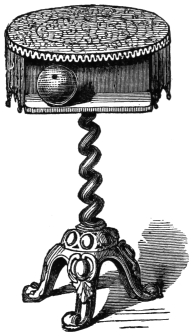
Fig. 269.
Each of the traps above-mentioned should be so made as to be capable of being secured, when necessary, by a bolt, or there would be considerable risk of a trap giving way unexpectedly under any article carelessly placed on it. The mode of bolting, however, varies considerably. Some traps are fastened by little bolts on the under side, which, being only get-at-able from the inside of the table, must be bolted or unbolted for good before the curtain rises, occasioning considerable embarrassment in the case of a slip of the memory. Others again are secured by means of long bolts, or wire rods extending across the under surface of the top of the table, each terminating in a hook at the back, within reach of the performer’s hand. A third, and, we think, the best, plan is to have the bolt (as shown in Figs. 261 and 262, and therein marked c) worked backwards and forwards by means of a little pin projecting upwards through the surface plate and the cloth of the table. By the adoption of this plan the performer is enabled to draw back the bolt with the finger-tip in the very act of placing the article upon the trap. It will readily suggest itself to the reader that some provision must be made within the table for making the various articles drop noiselessly through the traps. The best plan of effecting this is to use what is called a “railway.” This is a wooden frame just large enough to lie within the table, with a piece of black serge or alpaca stretched all over its under side. This is so placed within the table, as to slope gently down to the level of the servante, with a fall of three or four inches. Any article dropped through a trap will not only fall noiselessly upon the surface of the stretched alpaca, but will immediately roll down the incline towards the servante, so that it is instantly get-at-able, should the performer have occasion to reproduce the same article at a later stage of the trick.
4. “Changing” Traps.—The traps which we have hitherto discussed have only had the faculty of causing the disappearance of a given article. Those which we are about to describe will not only do this, but will, moreover, produce an article on the surface of the table where a moment previously there was nothing, or will replace a given object by another.
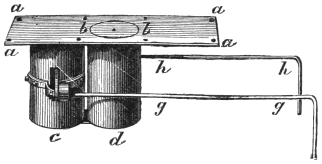
Fig. 270.
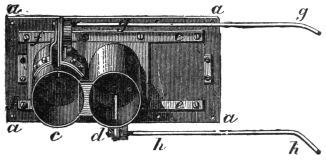
Fig. 271.
The trap for this purpose is a somewhat complicated arrangement, of the appearance shown in Figs. 270 and 271. The surface-plate, a a a a, is oblong, measuring about twelve inches by six, with a circular opening b b in the centre. Below it are fixed vertically two brass cylinders c and d, which are so arranged as to work backwards and forwards on a kind of railway e f e f, in the direction of the length of the surface-plate, just so far in either direction as to bring c or d in turn immediately under b. The two cylinders are soldered together, so that the one cannot move without the other. If, therefore, the cylinders are drawn back to the utmost by means of one of the bent iron rods or handles g h, the cylinder c will be below the opening b, as in Fig. 272. If, on the contrary, they be pushed forward, d will in turn be below the opening, as in Fig. 273. Each cylinder contains a brass piston, faced with zinc on its upper surface, and moved up and down by a lever attached at right angles to one or other of the iron handles g h already mentioned, and working through a vertical slot in the side of the cylinder. A piece of clock-spring, attached to the iron handle at the point of junction, gives the piston a gentle upward tendency, which is so regulated, that if either of the cylinders be brought under the opening b, the piston belonging to that cylinder is made to rise into the opening, its upper surface resting just flush with that of a a a a. The piston of the forward cylinder c is made to work very easily within it, so as to rise spontaneously by the action of the spring; but that of the hinder cylinder, d, for a reason which will presently appear, works a little more stiffly, so as to require a little assistance from the lever to make it rise into its proper position. The action of the handles g h is outwards, in the direction of the arrows in Fig. 274, the movement of either handle in the direction so indicated drawing down the piston to which it belongs.
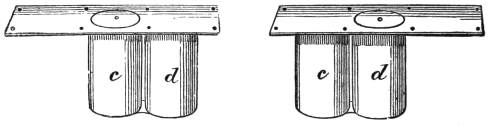
Fig. 272. Fig. 273.
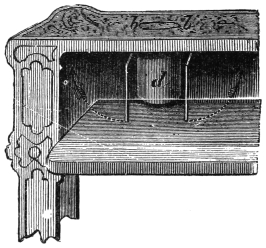
Fig. 274.
The handles further serve, as already mentioned, to move the cylinders backwards and forwards as may be required. It should, however, be noted that no backward or forward movement can take place so long as either of the pistons stops the opening b; but as soon as the piston is, by turning the proper handle, depressed ever so little below the level of the surface-plate, it no longer forms any obstacle to the movement. The trap is fixed in the table in such manner that the handles g h shall be just within the opening at the back of the table (see Fig. 274), and thus be within easy reach of the performer’s hands when standing behind it. We will suppose, for the sake of illustration, that the performer desires to change an empty tumbler (of small size) to a full one. The trap is beforehand prepared by bringing the foremost cylinder c under the opening b. The full glass is then placed on the top of the piston, which is then lowered gently downwards by means of the proper handle, the glass sinking into the cylinder. The cylinders are now pushed forward, so that d in turn comes under b, the piston being then moved up into its proper place, and so closing the opening. This is, of course, arranged before the curtain rises.
When the performer desires to perform the trick, he places the empty glass upon b, and conceals it with a cover of any kind. Standing carelessly behind the table, and keeping the attention of the audience occupied by any observations he may deem most appropriate for that purpose, he takes hold with his right hand of the handle h, and turns it outward, thereby lowering the empty glass into d. As soon as he feels that it will sink no further, he shifts his hand to the handle a, and therewith draws the cylinders back so as to bring c under b, and then, by turning g, gently raises the full glass of water up through b to the surface of the table. The reader will now perceive the reason why, as already mentioned, the piston in d is made a little tight, so as to require the assistance of the handle to raise it into its position. It is necessary that this piston, when once depressed with the object to be changed, shall remain down while the hand is shifted from handle h to handle g. If it were not made to work somewhat stiffly, the moment the handle h was released the piston would instantly fly up again with the object upon it, thus neutralizing what had been already done. The cylinder c, which is to produce the substitute object, is not brought under b until the hand of the performer is already on the handle belonging to it, and can thereby check its upward ascent as may be necessary.
It is obvious that the changing trap will be equally available to produce an object under an empty cover. The object to be produced will be placed in c as above, the piston in d going down empty, and that in c rising with the object upon it.
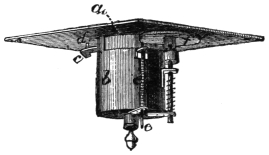
Fig. 275.
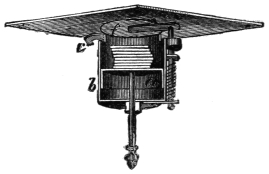
Fig. 276.
The above are the traps in most frequent use, but there are others designed for special purposes. Thus there is a trap for causing the disappearance of six or eight half-crowns (as, for instance, in the well-known trick of the “crystal cash-box,” which will be described in the course of the present chapter). Of course the coins could be made to disappear through an ordinary trap, but they would cause a suggestive “chink” in their fall. The trap to which we are now referring (see Figs. 275 and 276) is designed to prevent this tell-tale sound, and to cause the half-crowns to disappear in perfect silence. The opening in the surface plate is an inch and three-quarters in diameter, and is closed by a circular piston of brass or zinc, a, working up and down in a small brass cylinder b, and so arranged as to drop by its own weight to the bottom of the cylinder, save when kept up by a little lever catch at the side of the cylinder. A short pin d attached to this catch projects upwards through a slot in the surface plate, and stands up very slightly above the cloth of the table. The disc a being raised level with the surface plate, and secured by means of the catch, six or eight half-crowns or florins are placed on a. The performer, in making the motion of picking up the coins (with one hand), with the tip of the third finger pulls the pin d towards him. This withdraws the catch, and a instantly drops down to the bottom of the cylinder, carrying the coins with it. As soon as a reaches its lowest point, it draws down the pin e, thereby releasing a similar disc f, which, working laterally on a spring pivot at the edge of the opening, describes a semicircle, and assumes the position previously occupied by a, a portion of one side of the cylinder, at the top, being cut away to allow of its passage. Fig. 275 shows the trap in its first, and Fig. 276 in its second condition, the latter being, for greater clearness, drawn in section. The apparatus is rather complicated, and it is almost hopeless to endeavour to render it clearly intelligible by description only. In the absence of this special trap, the same object may be nearly as well effected with an ordinary trap by using half-crowns (be it remembered that it is always substitute coins which are made to disappear in this manner) which have been beeswaxed on both sides. A very slight pressure will cause a number of coins thus prepared to adhere together, and form for the time being a solid mass, which will fall through the trap without causing any “clink.”
We next come to—
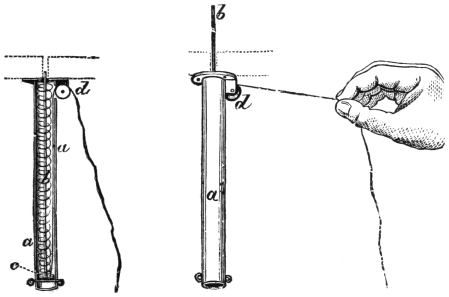
Fig. 277. Fig. 278.
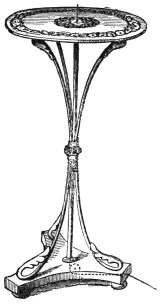
Fig. 279.
Pistons.—These are appliances for working pieces of mechanical apparatus—as, for example, the Watch Target, the Card Star, the Demon’s Head, etc., etc. A piston (see Figs. 277, 278) consists of a brass tube a, about five inches in length by five-eighths of an inch in diameter, with a collar at one end pierced with screw-holes for affixing it to the under surface of the table. Within this tube works a wire rod, b, three-sixteenths of an inch thick, and terminating in a small round disc of brass c, just large enough to work freely up and down the tube. A spiral spring, also of brass, keeps the rod down, unless when forced upwards by pulling a piece of whipcord, which is attached to the disc c, and thence passes up the tube, and over a small pulley d, which is soldered to the collar already mentioned. When this cord is pulled, b is forced to rise, which it does to the extent of about two inches above the surface of the table (see Fig. 278), again sinking under the pressure of the spring, as soon as the pull is relaxed. Each piston is screwed to the under surface of the top of the table, in which a small hole is bored, in order to allow of the upward passage of the piston rod. Where complicated mechanical pieces have to be worked, three, four, or more of these pistons are placed side by side. The cords are carried behind the scenes, either directly from the back of the table, or down grooves in the legs, and through holes in the stage to the hiding-place of the assistant. Where a single piston only is required, it may be made to work in the central pillar of a light guéridon, or fancy table, such as shown in Fig. 279, the lightness and simplicity of the table, and the thinness of its top, apparently precluding all possibility of the presence of concealed mechanism. The cord may be made to pass down the centre pillar, so as to be quite invisible to the audience.
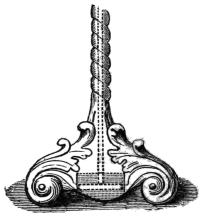
Fig. 280.
The mechanical pieces worked by the agency of these pistons vary greatly in construction, but they are alike in one particular, viz., that they are set in motion by one or more vertical rods passing up the shaft or column on which they stand, and each terminating in a flat metal disc, or pedal, which receives the upward pressure of the piston. Fig. 280 shows the arrangement of the foot of a mechanical piece worked by one such rod only. Another specimen will have been observed in the case of the pedestal for the animated money. (See page 186.) Where three or four pedals are necessary, they are generally enclosed in a square wooden base, as in the case of the “Demon’s Head,” described at page 458.
Before quitting the subject of the tables used upon the stage, we must not omit to say a few words as to what is called the “bellows” table, though it is now comparatively little used. It was formerly (say forty or fifty years ago) the fashion among conjurors to use tables with drapery hanging to within a few inches of the floor. The table being, say, two feet seven inches high, this gave room for a box-like arrangement, of two feet deep, or thereabouts, within the body of the table. In this box, which was open at the back, was hidden an assistant, who worked the pistons, managed the traps, effected necessary substitutions, etc., etc. Conjuring under such circumstances was very easy work. In 1845, however, Robert-Houdin gave his first public performance, and one of the earliest of his reforms in the magic art was the suppression of the too suggestive drapery, and the substitution of tables of light and elegant form, allowing no possible room for the concealment of an assistant. A reaction set in in favour of the new fashion, which has ever since maintained its ground. The “bellows” table combines the apparent simplicity of the undraped table with the internal capacity of the old-fashioned draped article. There is a trick, formerly very popular as the wind-up of an entertainment, which consists of the magical disappearance of a youthful assistant, male or female. The subject of the trick, generally dressed in a page’s costume, is made to mount upon a table, and is covered by a wicker cone, which being almost instantly removed, he or she has vanished. The table in this case is draped to within a few inches of the ground, but to show that no hidden receptacle is thereby concealed, the performer before commencing the trick lifts up the table-cloth, and shows that the top of the table is at most not more than two or three inches in thickness. The drapery is then again allowed to fall into position, and the trick proceeds. The table used in this trick is a bellows table; i.e., it has a double top, or rather two tops, one above the other. The upper one is a fixture, with a large wooden trap (opening upwards) in it, to allow of the passage of the person to be conjured away. The under top is moveable, being in its normal condition pressed against the upper one by the action of four spiral springs (one in each leg of the table), but sinking down to nearly the depth of the cover under the weight of a person stepping upon it, and thus affording the requisite hiding-place, in which the person remains until the fall of the curtain enables him or her to come forth with safety. Cloth is nailed round three sides of the upper and lower boards, folding between the two when closed, after the manner of the leather of a bellows; and from this circumstance the table derives its name.
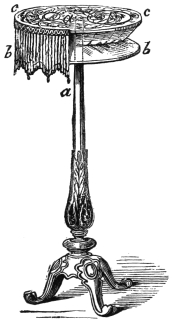
Fig. 281.
Small round tables (for the disappearance of a rabbit, or the like) are sometimes made on the same principle. The following will be found a simple and convenient arrangement:—Let the table be of the form shown in Fig. 281, and two feet seven inches high. Let the uppermost eight inches of the pillar be a plain cylinder a a, an inch and a half in diameter. Below this the pillar may increase in size, and may be of an ornamental character. Take two circular boards of deal or mahogany, each eighteen to twenty inches in diameter, and five-eighths of an inch thick. In the centre of one of them, b, cut a circular hole an inch and three-quarters in diameter. This will form the under side of the “bellows,” the object being to allow the board to slide freely up and down on a a. The other board, which we will call c, is screwed firmly on to the pillar, to form the top of the table. Next take a strip of black alpaca, ten inches in width, and nail its opposite edges round b and c, leaving a small space at one side to give access to the interior. Tie a piece of cord elastic round the centre of the alpaca, tightly enough to exercise a considerable degree of tension. Fix such traps as may be desired in c, and glue over it a fancy-patterned cloth, with a fringe or border hanging down nine or ten inches round the sides. The performer, before executing any trick with this table, may pointedly draw attention to the fact that it contains no drawer or other place of concealment. In doing this (see Fig. 282) he with one hand raises the lower board level with the upper (the action of the elastic drawing in the alpaca between the two), while with the other hand he raises the fringe, and shows, apparently, that the top of the table is but a single board.
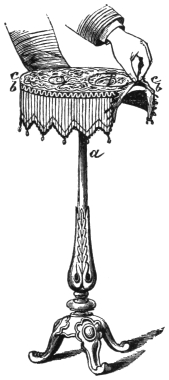
Fig. 282.
The top of every conjuring table should be covered with woollen cloth, not only to prevent the clatter which would be occasioned by the placing of objects upon the bare wood, but to conceal the presence of the traps and pistons. The cloth used should, for this latter reason, be of two colours, and of a tolerably intricate pattern, as the outline of the traps will be thereby rendered much less perceptible; indeed, if the pattern of the cloth be a favourable one for the purpose, the traps should be, by gas-light, absolutely invisible. The cloth should be glued over the top of the table after the manner of a card-table; the upper surface of the traps being first roughed slightly, to make the glue adhere to the metal. When the glue is thoroughly dry (but not until then) the cloth may be cut along the outline of the traps with a very sharp penknife, and small holes bored to allow of the upward passage of the piston rods. As it is necessary in placing a mechanical piece upon the table, to do so exactly over the pistons, it is well to have a couple of wire points projecting upwards a quarter of an inch or so from the surface of the table, in such positions that if the piece of apparatus rests firmly against these (which the performer can tell instantly by feel) it must necessarily be in proper position.
Where “wrist” traps are used, the cloth need not be cut out round the little oblong slab marked c in Figs. 263, 264, but the cloth should be without glue over this particular spot, and for half an inch round it on either side. The cloth will by this arrangement be found, without cutting, to stretch sufficiently over c to allow of the proper working of the trap.
Assuming that our stage appliances are complete, we will proceed to—
The Rabbit Trick.—The performer comes forward to the audience, and borrows a hat. He asks whether it is empty, and is answered that it is; but he, notwithstanding, finds something in it, which the owner is requested to take out. The article in question proves to be an egg. No sooner has this been removed, than the performer discovers that there is still something in the hat, and immediately produces therefrom a live rabbit, quickly followed by a second. Not knowing what other use to make of these, he proposes to pass one of them into the other. The audience decide which is to be the victim, and the performer, placing them side by side on the table, proceeds to roll them together, when one is found to have vanished, nobody knows when or how; but the theory is that it has been swallowed by the remaining rabbit, to the (imaginary) increased fatness of which the performer draws special attention.
Having thus passed one rabbit into the other, the next step is to get it out again. To do this the performer calls for some bran, and his assistant immediately brings forward, and places on a table or chair, a huge glass goblet, twelve inches or thereabouts in height, filled to the brim with that commodity. The performer takes the borrowed hat, and (after showing that it is empty) places it mouth upwards upon another table, so as to be at some considerable distance from the goblet of bran. He then places a brass cover over the glass, first, however, taking up and scattering a handful of the bran to prove its genuineness. Taking the surviving rabbit, and holding it by the ears above the covered goblet, he orders the one swallowed to pass from it into the glass, at the same time stroking it down with the disengaged hand, as though to facilitate the process. He remarks, “You must excuse the comparative slowness of the operation, ladies and gentlemen, but the fact is, the second rabbit passes downwards in an impalpable powder, and, if I were not to take sufficient time, we might find that a leg or an ear had been omitted in the process, and the restored rabbit would be a cripple for life. I think we are pretty safe by this time, however. Thank you, Bunny; I need not trouble you any more.” So saying, he releases the visible rabbit, and on taking off the cover the bran is found to have disappeared, and the missing rabbit to have taken its place in the goblet; while on turning over the borrowed hat the vanished bran pours from it.
The reader who has duly followed our descriptions of the appliances employed in the magic art will have little difficulty in solving the riddle of this trick. The performer first comes forward with an egg palmed in one hand, and with a small rabbit in an inner breast-pocket on each side of his coat (see page 9). The first step is the pretended finding of something (it is not stated what) in the hat. The owner is requested to take it out, and while all eyes are naturally turned to see what the article may prove to be, the performer, without apparent intention, presses the mouth of the hat with both hands to his breast, and tilts one of the rabbits into it. This is next produced, and in placing it on the ground at his feet, the performer brings the second rabbit in the same manner into the hat. When he undertakes to pass the one rabbit into the other, he places both upon the table which contains the rabbit-trap, and, standing sideways to the audience, pushes the hindmost, under cover of the other, through the trap. This particular rabbit is not again produced, the rabbit in the “bran glass,” which has already been explained (see page 383), being another as much like it as possible. It only remains to explain how the bran comes into the borrowed hat. This is effected by having a black alpaca bag filled with bran in one of the profondes or under the waistcoat of the performer. This bag is introduced into the hat after the manner of the goblets (see page 308), and the bran having been allowed to run out, the bag is rolled up in the palm, and so removed, the bran remaining, to be produced in due course.
It is obvious that the trick may be varied in many ways. The following is an effective modification:—A rabbit having been produced by natural or supernatural means, is placed on the principal table (close to the hinder edge), and temporarily covered with a borrowed hat, while the performer goes in search of a sheet of paper, which when obtained, he spreads upon a small side table. Lifting the hat slightly, he takes out the rabbit, and walking with it to the side table, rolls it up in the paper, making a somewhat bulky parcel. Coming forward with this to the audience, he turns toward the principal table, and saying, “Now, ladies and gentlemen, if you watch me very closely, you will see the rabbit fly out of the paper, and back to the hat.” He crushes the paper together between his hands, and tearing it, shows it empty, while on lifting the hat the rabbit is again found safely ensconced beneath it.
The ingenious reader will readily guess that duplicate rabbits are employed. One of them is placed under the hat, and remains there throughout the trick. A second, of similar appearance, is placed in a box or basket on the servante, immediately behind the hat. This box has no lid, but is pushed until wanted just within the interior of the table, the top of which prevents the rabbit making a premature appearance. The performer, slightly raising the hat, as though to take the rabbit from under it, lifts up this second rabbit, which the spectators naturally believe to be the same which they have already seen, and in apparently wrapping it in paper on the side table, presses it, under cover of the paper, through the rabbit trap, and screws up the ends of the paper (which should be rather stiff) in such manner as to make it appear that the animal is still inside it. The same trick may be performed with a pigeon with equally good effect, and considerably less difficulty.
The Fairy Star.—This is one of the most telling of stage card tricks. The performer, coming forward with a pack of cards, allows six to be chosen. His assistant meanwhile brings forward and places on a table a handsome gilt “star” on a stand. The performer, collecting the chosen cards, places them in his pistol, and fires them at the star, when, at the moment of the explosion, they are seen to attach themselves one to each of its points, as in Fig. 283.
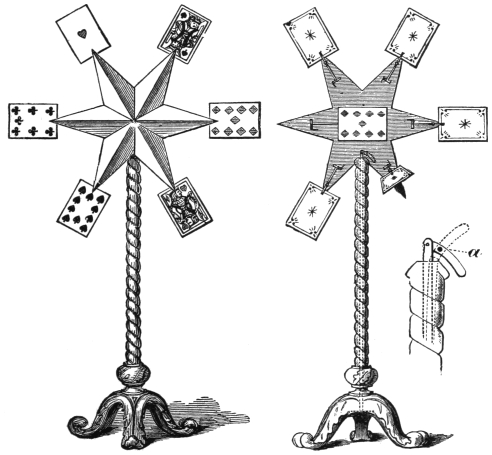
Fig. 283. Fig. 284.
The principal point to be explained is the construction of the star. Behind each “ray” is a moveable arm, working on a spring hinge at about two inches’ distance from the point, and carrying a spring clip at its outer end wherein to insert a card. (See Fig. 284, representing a back view of the apparatus.) A card being placed in each of the clips, the six arms, with the cards attached to them, are folded down one by one behind the centre of the star, which is just large enough to conceal them. Each card, as folded, holds down the one which has preceded it. When the last card is folded down, the free end of a moveable button or lever at the top of the pillar on which the star rests is so turned as to press upon the arm which holds the card last folded, and thus to keep it and the five other cards preceding it in place. This button, however, is so arranged as to be instantly withdrawn upon an upward movement being communicated to a wire rod which passes up the centre of the pillar, and terminates in a flat disc of metal at its foot. The apparatus, thus prepared, is placed immediately over one of the pistons of the table. At the moment of firing the pistol the cord of the piston is pulled. The piston rises, pressing up the disc and wire rod, the button is withdrawn, and the arms, being thereby released, revert to their natural position, exhibiting a card upon each point of the star.
There are many little differences of detail between the “stars” of rival manufacturers, but the foregoing may be taken to represent the general principle of all. Some have the addition of a rose in the centre, which opens simultaneously with the appearance of the cards, and discloses a watch, borrowed a moment previously from one of the spectators.
The mode of working the trick varies a good deal in the hands of different performers. The most legitimate method is to “force” cards corresponding to those already folded behind the star, and this method has the advantage of allowing the star to be brought in and placed upon the table before commencing the trick; and as it is not again touched by the performer or his assistant, the appearance on its points of (apparently) the identical cards just chosen seems really miraculous.
To be able, however, to force six cards in succession with ease and certainty, demands a more than average degree of dexterity on the part of the performer; and a “forcing pack” (see page 23) is hardly available where more than three, or at most four cards have to be forced. Various expedients have been adopted to get over this difficulty. Some professors simply collect, or allow their assistant to collect, the cards which have been drawn, and forthwith secretly exchange them for the same number of others. These latter are laid upon the table, and subsequently placed in the pistol, while the originals are carried off by the assistant behind the scenes, and there attached to the star, which is then for the first time brought forward. Others, again, use what are called “longs and shorts”—i.e., two packs of cards, one of which has had a small portion shaved off its length or breadth. The performer offers the uncut pack for the company to draw from, letting each person retain his card, and then secretly exchanging the pack for the shortened pack, he requests each of the drawers (singly) to replace his card, and to shuffle freely. The substituted pack being a shade smaller than the returned card, the latter becomes a “long” card (see page 60); and therefore, however well the cards are shuffled, the performer is able, with absolute certainty, to cut at that particular card. “Here is your card,” he remarks, “the knave of diamonds.” As he names the card, the assistant, behind the scenes, takes the cue, and attaches a corresponding card to the star. The card named is removed from the pack and laid upon the table, in order to be subsequently placed in the pistol, and a second drawn card is returned and shuffled with the like result.
The star may, in the absence of a mechanical table, be placed on the hand, the disc being pushed up by the fingers. Some stars have a moveable stud at the side of the pillar, connected with the rod within, to facilitate this mode of working the trick.
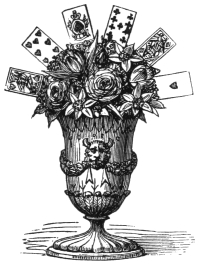
Fig. 285.
The Card Bouquet.—This is a trick very similar in effect to that last described, though differing a little as to the manner of the appearance of the cards. Six cards are drawn, and placed in a pistol, as in the last case. A vase (apparently of china, but really of tin, japanned), containing a handsome bouquet, is placed upon the table, and, at the instant of firing, the six cards appear ranged in a semicircle above the flowers in the bouquet. (See Fig. 285.) In this instance, the cards are attached to the branches of a sort of fan, so constructed as to open of its own accord, unless forcibly kept closed. The cards having been duly placed in position, this fan is shut, and pressed downwards through a narrow opening in the lower part of the vase, the pressure of whose sides keeps it, for the time being, closed. When pressed upwards by the action of a piston, the fan rises above the level of the flowers, and at the same time opens and exhibits the six cards.
The vase is sometimes made with a second pedal, to produce a second series of six cards. In this case twelve cards are drawn; six of these first appear, and then, at the command of the performer, these six suddenly change to the other six. This is effected as follows:—The twelve cards are pasted back to back in couples. Each of the six arms which hold the cards is so arranged as to be capable of being turned half round (after the manner of the centre of the “watch target”), in which position it is retained by a catch, flying back however to its old position as soon as the catch is released. The six arms are each turned round in this manner, bringing what are naturally the hindmost cards in front. The movement of the first lever exhibits these cards; that of the second lever releases the six catches, when the arms instantly fly round and reveal the other six cards, into which those first exhibited appear to have changed.
The Demon’s Head.—This is a large and effective piece of apparatus, standing about twenty-eight inches from the table. It consists of a grotesque papier maché head, representing that of a demon or satyr, and painted according to taste. It is supported by an ornamental brass column, about an inch in diameter, springing from a velvet-covered base, nine inches square and four and a half high. (See Fig. 286.) At the will of the operator, the head rolls its eyes and opens its mouth, and is sometimes made available in this way to answer questions; the rolling of the eyes being taken to signify a negative, and the opening of the mouth an affirmative. In addition to these accomplishments, the demon will indicate chosen cards in the following manner: Five cards having been selected, are returned to the pack, which, after being duly shuffled, is placed in the demon’s mouth. The performer now orders him to produce the chosen cards, when two of them fly from his mouth, and the other two spring up between his horns.
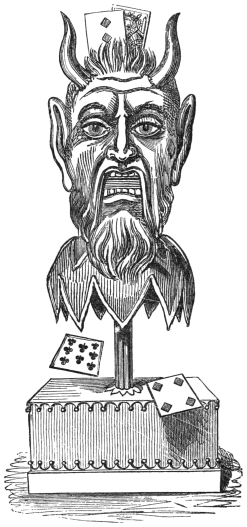
Fig. 286.
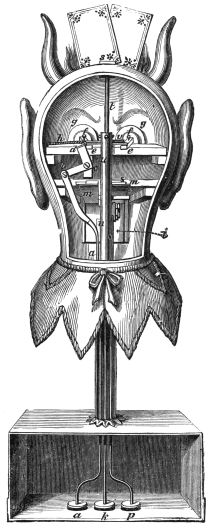
Fig. 287.
The head owes its movements to the action of three different sets of levers, each terminating in a disc or pedal immediately over a circular hole in the under side of the base. The apparatus is so placed upon the table that these openings correspond in position with the same number of pistons. Fig. 287 is a general view of the internal mechanism, the back of the head being removed (as in fact it may be in the original) to give access thereto. Fig. 288 exhibits (as seen from the rear) the action of the left-hand group of levers, producing the movement of the eyes. When an upward pressure is applied to the foot of the lever a, it causes the upper arm c d of the elbow piece b c d to describe an arc of about a quarter of an inch from left to right, thereby communicating a corresponding movement to the pair of levers e e, working on the pivots f f; and, as a necessary consequence, a reverse movement to the opposite ends of such levers, on which are fixed the eyes g g. As soon as the upward pressure is removed, the spring h, a spiral coil of fine brass wire, draws back the levers e e, and with them the eyes, to their original position. To produce a continuous rolling, the pressure of the piston is applied and relaxed alternately, the effect to the spectator being as if the figure looked first to the left and then to the right, although as already explained, the active movement of the levers is in the one direction only, the normal position of the eyes being in the other direction.
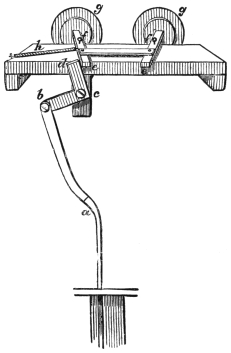
Fig. 288.
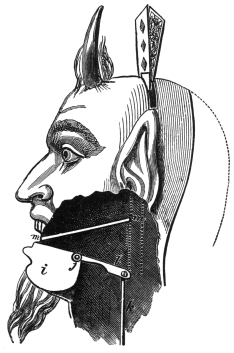
Fig. 289.
Fig. 289 shows the action of the second or middle group of levers, serving to produce the opening of the mouth. The chin of the figure consists of a solid block of wood i, working on a pivot j in each cheek, and so counterweighted that its normal position is as in Fig. 289, thus keeping the mouth closed. When, however, the shaft k is raised by pressure from below, the lever l rises with it, and proportionately depresses the opposite end of the block i, thereby opening the mouth. As soon as the pressure is removed, the block falls back into its original position, and the mouth closes.
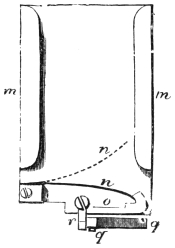
Fig. 290.
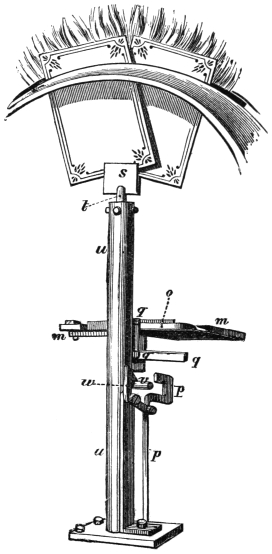
Fig. 291.
The third or right-hand set of levers is a little more complex in its operation, inasmuch as it has to perform a double office, the expulsion of two cards from the mouth, and the elevation of two others at the top of the head. The cards to be shot from the mouth are placed beforehand (from the front) in the receptacle indicated in Fig. 289 by the letters m m, and a “plan” of which is given in Fig. 290, and a back view in Fig. 291. m m is a flat piece of tin, its edges folded over so as to form a receptacle or platform just capable of holding easily a couple of cards; n is a spring, which, when the cards are put in position, is “set” by being drawn back into the notch of the catch o. When an upward pressure is exerted by the shaft p p on the elbow-piece q q q, the latter pressing against r draws back this catch, and releases the spring, which forthwith shoots out the two cards from the mouth. The other two cards are inserted in the clip s (see Fig. 291), consisting of two small pieces of sheet brass soldered to the end of the rod t, which works up and down piston-wise in the tube u u. Within the tube is a spiral spring which impels s upwards level with the top of the head, across which a slit or opening is made to allow of the passage of the cards. This portion of the apparatus is set by placing the two cards in the clip, and then drawing down the piston-rod by the cross-piece v, which is riveted thereto, and hitching such cross-piece under the catch w. The upward movement of the shaft p, at the same time that it draws back the catch o, also draws back the catch w, thereby releasing v, and allowing the clip s and the two cards therein to spring upward, and appear at the top of the head.
It is hardly necessary to remark that the cards chosen by the audience are “forced” cards, of which duplicates have beforehand been placed in the head.
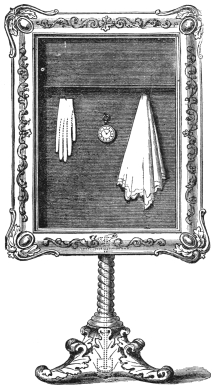
Fig. 292.
The Magic Picture Frame.—The performer, always borrowing, borrows this time a lady’s handkerchief, and any small articles—say a watch and a glove. These latter he rolls up in the handkerchief, and places the ball or bundle thus made upon the table. He looks about in search of his magic pistol, which is immediately afterwards brought in by the assistant. The performer places the handkerchief, etc., in the pistol, the assistant meanwhile bringing forward and placing on the table a handsome picture-frame, mounted on a stand. It contains no picture, the space which the picture should occupy being filled by a board covered with black cloth. The performer, standing at the farthest available distance from the frame, takes aim at it, and fires, when the borrowed articles are seen instantly to attach themselves to the black background, whence, being removed, they are handed to the owners for identification.
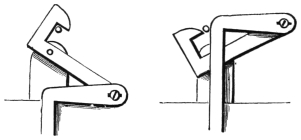
Fig. 293. Fig. 294.
The picture-frame, which is of the appearance shown in Fig. 292, and stands altogether about two feet high, is backed by a sort of wooden box, an inch and a half in depth, and a little smaller than the external measurement of the frame. The inside of this box is covered with black cloth, and in fact forms the true back of the frame; and it is upon this that the borrowed objects are fastened by means of small sharp hooks, the back opening on hinges to facilitate the doing so. An ordinary spring roller-blind, also of black cloth, works up and down just behind the opening of the frame. We have said an ordinary spring blind, but, in truth, the usual check at the side is wanting, and the blind therefore, if drawn down, instantly flies up again, unless held down from below. The blind terminates at bottom in a square lath, five-eighths of an inch in length by three-eighths in thickness, with a wire pin, half-an-inch in length, projecting at right angles from its hinder side. The ends of this lath, when the blind is drawn down, sink into two upright grooves, one at each side of the frame, thereby keeping the latter square, and the pin in a horizontal position. The catch a (an enlarged view of which is shown in Figs. 293, 294) is now hooked over the pin, as in Fig. 293, thus holding the blind down. A wire rod, attached to this catch, passes down the column on which the frame stands, and terminates in the usual disc or pedal at bottom. When an upward pressure is applied to this, the catch assumes the position shown in Fig. 294, thereby releasing the pin, and allowing the blind to fly up. The blind is represented in Fig. 292 in the act of flying up, but, in truth, its rise is so rapid as to be practically invisible.
The sudden appearance of the articles in the frame is thus sufficiently accounted for, but it remains to be explained in what manner they were placed there, as they have (apparently) never been removed from the sight of the audience. It will be remembered that the smaller articles were rolled up in the handkerchief, which was then placed on the table. In truth, what is placed upon the table is a substitute handkerchief, similarly rolled up, while the original is dropped on the servante, and carried off by the assistant when he brings in the pistol. Having thus obtained possession of the articles, he quickly places them in the frame, and draws down and fastens the blind. This done, he closes the door at the back, and brings forward the frame, taking care to place it immediately over one of the pistons of the table. As the pistol is fired he pulls the cord, the blind flies up, and the articles are revealed.
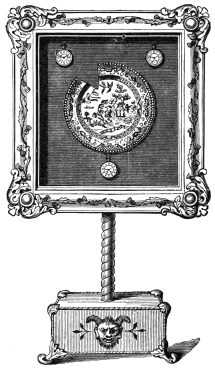
Fig. 295.
The Flying Watches and the Broken Plate.—This is a rather more elaborate form of the trick last described. The performer collects three or four watches from the company, the assistant, meanwhile, being sent to fetch a plate. On his return, the watches are laid one by one on the plate, and he is ordered to place them on the table. In attempting to do so he trips and falls, the watches being scattered in all directions, and the plate being smashed to pieces. The performer reprimands the offender for his carelessness, and picking up the watches, finds that they are injured in various ways. After a momentary hesitation, he hits on a way of repairing the damage. Calling for his pistol, he drops the battered watches and the fragments of the plate into it, keeping all down with a wad of newspaper. The assistant now brings in the picture-frame, as in the last trick, and the performer, taking good aim, fires at it. At the instant of firing, the plate is seen restored in the centre of the frame, with the borrowed watches encircling it. The performer advances to remove and return them to the owners, but is (or appears to be) thunderstruck at perceiving that the restoration is incomplete, a large piece being missing from the plate. (See Fig. 295.) After a moment’s reflection, he discovers the cause of the defect, for, looking about upon the stage, he finds and picks up a fragment which he had overlooked when he put the rest in the pistol, and which consequently is wanting in the restored plate. He apologizes for the oversight, and proceeds to remedy it. Standing at the furthest portion of the stage, he makes the motion of throwing the recovered fragment towards the frame. It is seen to vanish from his hand, and the plate at the same moment appears whole as at first. The plate is removed, and with the restored watches handed to the audience for examination, when the closest inspection fails to discover any trace of fracture.
The first point to be explained is the mode in which the assistant obtains possession of the borrowed watches, in order to place them in the frame. The watches are collected by the performer in a changing apparatus (say one of the changing caddies described at page 348, or a drawer-box with a shallow inner drawer, as described at page 346). In this is placed beforehand a like number of dummy watches, and it is these latter which are placed on the plate, and meet the pre-destined downfall. The apparatus being left apparently empty, no suspicion is excited by the fact that the assistant, when sent to fetch the pistol or the frame, carries it off as no longer needed.
The sudden restoration of the piece apparently wanting in the plate, though marvellous to the uninitiated, is really effected by very simple means. The restored plate is throughout whole and unbroken, but the effect of a piece wanting is produced by covering one portion of its outer rim with an angular piece of black velvet or alpaca, similar to that which covers the back of the frame. The illusive effect is perfect. The frame is provided with two pedals, the first releasing the black blind in front of the plate and watches, and the second serving to withdraw the angular piece of cloth already mentioned, and thus (apparently) effecting the complete restoration of the plate. The pretended disappearance of the broken piece from the hand at the moment of throwing is effected by taking it first in the left hand, and thence apparently transferring it to the right by the tourniquet, so that when the right hand is opened in the act of throwing, it is naturally found empty.
The Magic Picture and the Chosen Cards.—We notice this trick in this place as having a very close affinity, in effect, to the two last described. It is, however, wholly independent of stage appliances, and is equally well adapted for the drawing-room as for the platform. The performer, taking an ordinary pack of cards, allows three to be chosen. These are returned to the pack, and the pack shuffled. He then brings forward a small picture in a frame, and measuring, say, fourteen inches by twelve. Having exhibited both front and back, he entrusts the picture to a spectator to hold, and taking the pack of cards, throws them smartly against the glass, when in an instant the three chosen cards appear in front of the picture, but under the glass. The back of the frame is next taken out, and picture, back, frame, and glass are separately handed for inspection; but the closest scrutiny of the audience cannot discover any mechanism or special arrangement to account for the effect above described.
The reader will already have anticipated that the three cards are “forced.” The picture is on the principle of the frames last above described, with a slight variation. There are, in fact, two pictures exactly alike. One of these is pasted upon the wooden back of the frame, and upon this are fastened duplicates of the cards to be chosen. The second picture is mounted on cloth, and works on a spring roller artfully concealed in the upper part of the frame, taking, in fact, the place of the black blind in the other frames. This is kept down by a pin at the lower side of the frame, and is so arranged as to be released by the smallest pressure against the glass. The pack of cards, smartly thrown, supplies this pressure. The foremost picture flies up, and reveals apparently the same, but really a similar picture, with the chosen cards between it and the glass.
The Magic Portfolio.—The performer comes forward with a large portfolio, such as is used to contain engravings, and barely an inch in thickness. This he places sideways to the audience, upon a stand or trestle, thereby raising it to a convenient height, and at the same time negativing the possibility of its having any communication with the floor of the stage. Standing behind it, he proceeds to take from it a number of large engravings, then a couple of lady’s bonnets of the latest fashion, and showing no sign of creasing or compression. These are followed by a large bird-cage, containing a number of living birds; and finally by three brass stew-pans, one containing haricot beans; a second, water; and a third, fire. Other articles are sometimes produced, but the above are those most generally used.
This really surprising trick is performed by the simplest possible means. The bonnets and the bird-cage are made to fold nearly flat, on the principle of the reticules and bird-cages described at pages 309 and 311. In this flattened condition they are placed in the portfolio, which being turned sideways to the audience, and the performer standing behind it, the side which is towards the spectators naturally forms a cover for the operator, and gives him every facility for developing the folded articles. The stew-pans, however, cannot be made thus compressible, and consequently a different plan is adopted in respect of them. These have india-rubber covers, after the manner of the bowls of gold-fish, and, like them, are concealed about the person of the performer, who, producing them under cover of the portfolio, appears to take them out of it. The pan for the fire contains a little spirits of wine, which the performer, still behind the portfolio, ignites with a wax match before producing this particular pan.
Where it is desired to produce a child, or other specially bulky object, the portfolio is for a moment placed on the table, behind which such object is placed. The object having been introduced into the portfolio, the latter is then transferred to the proper stand.
The Glove Column.—This is an ornamental column, sometimes of brass, sometimes of glass, on a massive foot and standing about two and a half feet high. It is surmounted by a metal cup, about an inch and a half in depth and two inches in diameter.
The mode of using the column is as follows:—Three or four rings are borrowed, also a white kid glove, and the whole are placed in the magic pistol. The column is then brought in, and placed upon the table. The magician takes aim at it, and fires. At the instant of his doing so, the glove, expanded as though containing a living hand, appears at the top of the pillar, with one of the borrowed rings on each of its fingers.
The glove and rings, as the reader will probably conjecture, are exchanged at an early period of the trick. There are plenty of ways of effecting this exchange. Perhaps, as regards the rings, the expedient of having them collected on the performer’s wand by the assistant (see page 399) is as good as any. The assistant, having thus gained possession of the borrowed articles, arranges them as follows:—The glove is placed upon the end of a tube, which runs through the whole length of the column, terminating just within the cup at top, and is kept in position by an india-rubber ring slipped over it, and holding it tight to the tube. One of the borrowed rings is now placed over each of the fingers, and the glove thus prepared is pressed down into the cup, so as not to show above the rim. The column is now placed upon the table in such manner that the lower opening of the tube shall correspond with a small hole in the table, communicating by means of an india-rubber tube with a hollow ball of the same material, filled with air, and so placed as to be within reach of the hand or foot of the assistant. At the moment of firing a smart pressure is applied to the ball, thus causing a rush of air through the tube, and inflating the glove, which instantly springs up into a perpendicular position, with the rings upon it. The articles are now returned to the owners, and are identified as those which were borrowed.
Some columns have a large hollow black or gilt ball at the top, divided vertically into two parts, and so arranged as to fall apart at the moment of the inflation of the glove.
The Vanishing Pocket Handkerchief, found in a Candle.—This was a favourite trick of Robert-Houdin, by whom, we believe, it was invented. The performer borrows a lady’s handkerchief, drawing particular attention to the fact that he takes the first handkerchief which may be offered, and that it is wholly free from preparation. Fixing upon some gentleman among the audience, he asks him if he thinks he could set fire to the handkerchief. The person addressed naturally expresses his belief that he could. The performer ventures to doubt it, and at once fetches a lighted candle to enable him to try the experiment, meanwhile spreading the borrowed handkerchief over the top of a small round table, or guéridon, where it remains in full view of the spectators, showing clearly that it is not tampered with in any way. Returning with the candle, the performer hands it to the gentleman, and requests him to go and set fire to the handkerchief. Hardly, however, has he taken the first step to do so, when the handkerchief suddenly vanishes, its disappearance being so rapid that the spectators cannot even decide in which direction it travelled. The performer accuses the gentleman, who is still holding the candlestick, of having the handkerchief about him. This he naturally denies. The professor insists, and after keeping up the dispute as long as the audience are amused by it, offers to prove his assertion, and taking the candle from the candlestick, breaks it in half, and produces from it the borrowed handkerchief, which is immediately identified by the owner.
This capital trick requires the aid of a special table. The top is thin, and without fringe or ornament of any kind, allowing no apparent space for the concealment of even the smallest article. The centre pillar, however, is a hollow tube, and it is into this that the handkerchief is made to vanish. The first step in the trick is to exchange the handkerchief for a substitute. (See page 240.) This substitute is spread over the top of the table. The real handkerchief the performer carries with him when he leaves the stage under the pretence of fetching the candle, and utilizes his momentary absence in placing it inside the candle, which is hollow, and of the description mentioned at page 251. When the gentleman advances to set fire to the handkerchief, the pulling of a string by the assistant causes a clip to rise up in the centre of the table, and nip the middle of the handkerchief, which is instantly drawn down within the tube through a small trap at its upper extremity.
The Sphinx.—Few tricks have of late years caused so great a sensation as this now well-known illusion, which was first introduced to the London public by the late Colonel Stodare, in 1865. We cannot better preface the explanation of the trick than by quoting a portion of the Times notice on the subject, of October 19, 1865:—
“... Most intricate is the problem proposed by Colonel Stodare, when, in addition to his admirable feats of ventriloquism and legerdemain, he presents to his patrons a novel illusion called the ‘Sphinx.’ Placing upon an uncovered table a chest similar in size to the cases commonly occupied by stuffed dogs or foxes, he removes the side facing the spectators, and reveals a head attired after the fashion of an Egyptian Sphinx. To avoid the suspicion of ventriloquism, he retires to a distance from the figure supposed to be too great for the practice of that art, taking his position on the borderline of the stalls and the area, while the chest is on the stage. Thus stationed, he calls upon the Sphinx to open its eyes, which it does—to smile, which it does also, though the habitual expression of its countenance is most melancholy, and to make a speech, which it does also, this being the miraculous part of the exhibition. Not only with perspicuity, but with something like eloquence, does it utter some twenty lines of verse; and while its countenance is animated and expressive, the movement of the lips, in which there is nothing mechanical, exactly corresponds to the sounds articulated.
“This is certainly one of the most extraordinary illusions ever presented to the public. That the speech is spoken by a human voice there is no doubt; but how is a head to be contrived which, being detached from anything like a body, confined in a case, which it completely fills, and placed on a bare-legged table, will accompany a speech, that apparently proceeds from its lips, with a strictly appropriate movement of the mouth, and a play of the countenance that is the reverse of mechanical? Eels, as we all know, can wriggle about after they have been chopped into half-a-dozen pieces; but a head that, like that of the Physician Douban, in the Arabian tales, pursues its eloquence after it has been severed from its body, scarcely comes within the reach of possibilities; unless, indeed, the old-fashioned assertion that ‘King Charles walked and talked half-an-hour after his head was cut off,’ is to be received, not as an illustration of defective punctuation, but as a positive historical statement.
“Davus might have solved the ‘Anthropoglossus,’ but Colonel Stodare presents us with a Sphinx that is really worthy of an Œdipus.”
For the benefit of those who have never seen this illusion presented upon the stage, we will describe its effect a little more minutely. The Sphinx is always made a separate portion of the entertainment, as it is necessary to lower the curtain for a few moments before and after its appearance, in order to arrange and remove the necessary preparations. The curtain rises, and reveals a round or oval table, supported upon three slender legs, and utterly devoid of drapery. This stands in a curtained recess of ten or twelve feet square, open on the side towards the audience. The performer comes forward bearing a cloth-covered box, fifteen to twenty inches square, and places it upon the table already mentioned. He then unlocks the box, the front of which drops down, so as to give a perfect view of the interior, in which is seen a head of Egyptian fashion, and coloured in perfect imitation of life. (See Frontispiece.) The performer now retires to a position in the very midst of the audience, and raising his wand, says in a tone of command, “Sphinx, awake!” The Sphinx slowly opens its eyes, looking first to the front with a strong gaze; then, as if gradually gaining consciousness, to the one side and the other, the head moving slightly with the eyes. Questions are put by the performer to the head, and are answered by it, the play of the mouth and features being in perfect harmony with the sounds uttered. Finally, in answer to a query of the operator, the Sphinx declaims a neatly turned oracle in verse. This concludes the exhibition, and the performer closes the box. Should the audience call for an encore, the performer addresses them to the following or some similar effect:—“Ladies and gentlemen, I am glad that the Sphinx has afforded you satisfaction, and I should be only too pleased to be able to indulge the desire which you kindly testify of seeing it again. Unfortunately, this is not possible. The charm by which I am enabled, as you have seen, to revivify for a space the ashes of an ancient Egyptian, who lived and died some centuries ago, lasts but for fifteen minutes. That time has now expired, and the head which has astonished you with its mysterious eloquence has again returned to its original dust.” As he speaks the last words, he again opens the box, and the head is found to have disappeared, leaving in its place a handful of ashes.
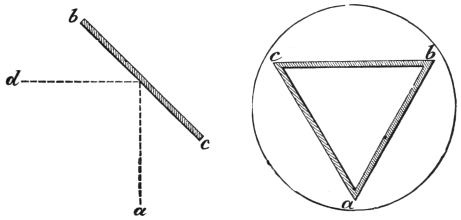
Fig. 296. Fig. 297.
This singular illusion depends upon the well-known principle, common to optics as to mechanics, that “the angle of reflection is equal to the angle of incidence.” Thus, if a person standing at the point a, in Fig. 296, look into a mirror placed in the position indicated by the line b c, he will see reflected, not himself, but whatever object may be placed at the point d. By an ingenious application of this principle a looking-glass may be used to conceal a given object behind it, while at the same time an image reflected in the glass may be made to represent what would be presumably seen if no glass were there, and thus prevent the presence of the mirror from being suspected. This is the secret of the Sphinx. The table, as already mentioned, has three legs, one in front, and one at each side. Between these legs the spectator sees apparently the curtains at the back of the recess, but really a reflection of the curtains at the sides. The space between the middle leg and that on either side is occupied by pieces of looking-glass (see Fig. 297, which represents a ground plan of the arrangement), extending from a to b, and a to c. The glass extends quite down to the floor, which is covered with cloth of the same material and colour as the surrounding curtains. The spectators, therefore, looking towards the table, see above it the curtains at the back, and below it the reflection of the curtains at the sides; which, however, if the relative angles are properly arranged, appears to be simply the continuation or lower portion of the curtains at the back. The illusion is perfect, and the spectator, from the position assigned to him, cannot possibly discover, by the evidence of his senses, that he is looking at any other than an ordinary bare-legged table, with the background visible in the usual way.
The rest is a very simple matter. The person who is to represent the Sphinx is beforehand placed, duly attired, underneath the table. There is a trap in the table through which he can pass his head at the proper moment. This trap is a round piece of wood, covered to match the surface of the table, and working on a hinge on the side nearest to the audience. It has no spring, but is kept closed by means of a button on the opposite side, and when released hangs down perpendicularly. It must be large enough to allow the passage of the somewhat elaborate headpiece of the Sphinx, and would therefore leave an open space visible round the neck. This difficulty is met by the expedient of having a wooden collar, whose upper surface is a facsimile in size and pattern of the trap, fastened round the neck of the representative of the Sphinx. When he lifts his head up through the trap, this collar exactly fills the opening, and thus shows no break in the surface of the table. The box is bottomless, and when brought forward by the performer is empty. A little caution has to be observed in placing it upon the table, for, if the performer were to approach the table from the side, his legs would be reflected in the glass, and would thereby betray the secret. He must therefore make his appearance from some quarter outside of the curtained recess, and advance to a position well in front of, and at some little distance from the table, when, by moving in a straight line from the audience towards the middle leg a, he prevents this inconvenient reflection. The placing the box upon the table, and the unlocking it, allow time for the representative of the Sphinx to get his head into position within it. This done, the box is opened, and the rest depends on the dramatic talent of the performer and his assistant. The performance being concluded, the box is again locked, and the head withdrawn, a handful of ashes being introduced on the trap in its stead.
The angle at which the two mirrors should be set cannot be determined absolutely, but will vary according to the distance and position of the surrounding drapery.
Some performers use a shawl or a screen of cardboard in place of the box, but we doubt whether any method is more effective than that above described.
The ghastly illusion of the so-called “Decapitated Head,” which drew crowds to the Polytechnic some few years since, was merely the “Sphinx” in a less pleasant form.
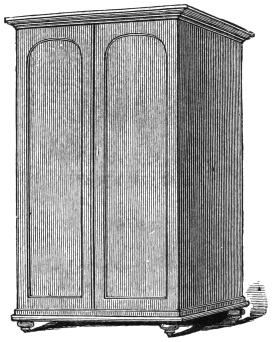
Fig. 298.
The Cabinet of Proteus.—This is another adaptation of the principle on which the Sphinx illusion is founded. It is the joint invention of Messrs. Pepper and Tobin, by whom it was patented in 1865. The first steps towards a patent for the Sphinx were also taken in the same year, but the latter invention never proceeded beyond provisional protection. The Cabinet of Proteus is a wooden closet, seven to eight feet in height by four or five feet square, supported on short legs, so as to exclude the idea of any communication with the floor. (See Fig. 298.) It has folding doors, and an upright pillar extends from top to bottom of the interior, at about the centre of the cabinet. At the top of this pillar, in front, is fixed a lamp, so that the whole of the interior is brightly illuminated.
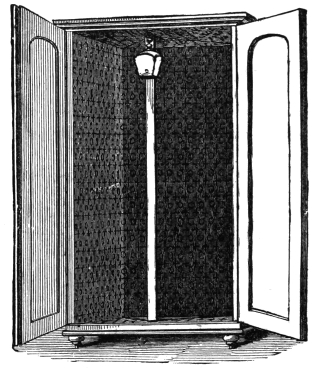
Fig. 299.
The cabinet may be used in various ways. One of the most striking is as follows:—The folding doors are opened, disclosing the interior perfectly empty. (See Fig. 299.) The exhibitor directs his assistant to walk into the cabinet. He does so, and the doors are closed. Meanwhile, a couple of gentlemen, selected by the audience, are invited to stand behind or beside the cabinet, and see that no one obtains ingress or egress by any secret opening. Notwithstanding these precautions, when the doors are again opened, the assistant is found to have vanished, and another person, different in dress, in stature, and in complexion, is found in his place. This person steps forth, makes his bow, and retires. Again the cabinet, now empty, is closed, and after an interval of a few moments, again opened. This time a human skeleton is found to occupy the vacant space. This ghastly object having been removed, and the door having been once more closed and opened, another person, say a lady, appears. This person having retired, the doors are again closed; and when they are again opened, the person who first entered is once more found within. A committee from the audience are now invited to examine the cabinet within and without, out all their scrutiny cannot detect any hidden space, even sufficient to conceal a mouse.
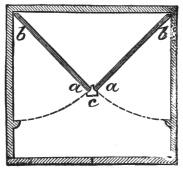
Fig. 300.
An examination of Fig. 300, representing a ground plan of the cabinet, will make plain the seeming mystery. A moveable flap a b, working on hinges at b, extends from top to bottom of each side, resting when thrown open against the post c in the middle, and thus enclosing a triangular space at the back of the cabinet. The outer surfaces of these flaps (i.e., the surfaces exposed when they are folded back against the sides of the cabinet) are, like the rest of the interior, covered with wall paper, of a crimson or other dark colour. The opposite sides of the flaps are of looking-glass, and when the flaps are folded back against the posts, reflect the surfaces against which they previously rested, and which are covered with paper of the same pattern as the rest. The effect to the eye of the spectator is that of a perfectly empty chamber, though, as we have seen, there is in reality an enclosed triangular space behind the post. This is capable of containing two or three persons, and here it is that the persons and things intended to appear in succession are concealed. The assistant, entering in sight of the audience, changes places, as soon as the door is closed, with one of the other persons. This person having retired, and the door being again closed, those who are still within place the skeleton in position in front of the post, and again retire to their hiding-place. When all the rest have appeared, the person who first entered presses the flaps against the sides of the cabinet, against which they are retained by a spring lock on each side, and the public may then safely be admitted, as their closest inspection cannot possibly discover the secret.
The Indian Basket Trick.—This is another of the sensational feats identified with the name of Colonel Stodare, and is imitated from a similar illusion performed by the Indian conjurors. It is not a pleasant trick to witness, but, like the “Decapitated Head,” it drew immense crowds, its fictitious horror being apparently its chief attraction. Its effect, as the trick was originally presented by Stodare, is as follows:—A large oblong basket, say five feet by two, and as deep as wide, is brought in, and placed on a low stand or bench, so as to be raised clear of the stage. The performer comes forward with a drawn sword in his right hand, and leading with the other hand a young lady, dressed in a closely-fitting robe of black velvet. Reproaching her upon some pretended ground of complaint, he declares that she must be punished, and forthwith begins to blindfold her eyes. She simulates terror, begging for mercy, and finally escaping from him, runs off the stage. He follows her, and instantly reappears, dragging her by the wrist. Regardless of her sobs and cries, he compels her to enter the basket, in which she lies down, and the lid is closed. Simulating an access of fury, he thrusts the sword through the basket (from the front) in various places. Piercing screams are heard from the interior, and the sword when withdrawn is seen to be red with blood. The screams gradually subside, and all is still. A thrill of horror runs through the audience, who are half inclined to call in the police, and hand over the professor to the nearest magistrate. For a moment there is a pause, and then the performer, calmly wiping the bloody sword on a white pocket-handkerchief, says, “Ladies and gentlemen, I fear you imagine that I have hurt the lady who was the subject of this experiment. Pray disabuse yourselves of such an idea. She had disobeyed me, and I therefore determined to punish her by giving her a little fright; but nothing more. The fact is, she had left the basket some time before I thrust the sword into it. You don’t believe me, I see. Allow me to show you, in the first place, that the basket is empty.” He turns over the basket accordingly, and shows that the lady has vanished. “Should you desire further proof, the lady will answer for herself.” The lady at this moment comes forward from a different portion of the room, and having made her bow, retires.
This startling illusion is performed as follows:—To begin with, there are two ladies employed, in figure and general appearance as nearly alike as possible. Their dress is also exactly similar. The little dramatic scene with which the trick commences is designed to impress upon the audience the features of the lady who first appears. When she is blindfolded, she, as already mentioned, runs off the stage. The performer runs after her, and apparently bringing her back, really brings back in her place the second lady, who is standing in readiness, blindfolded in precisely the same way, behind the scenes. As the bandage covers the greater part of her features, there is little fear of the spectators detecting the substitution that has taken place. The substitute lady now enters the basket, where she lies, compressing herself into as small a compass as possible, along the back. Knowing the position which she occupies, it is not a very difficult matter for the operator so to direct the thrusts of the sword as to avoid any risk of injuring her. The chief thing to be attended to for this purpose is to thrust always in an upward direction. The appearance of blood on the sword may be produced either by the lady in the basket drawing along the blade, as it is withdrawn after each thrust, a sponge saturated with some crimson fluid, or by a mechanical arrangement in the hilt, causing the supposed blood, on pressure, to trickle down the blade.
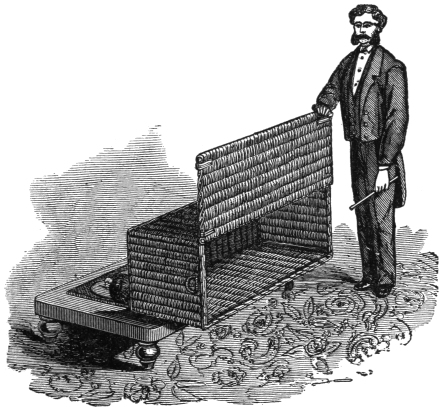
Fig. 301.
The only point that remains to be explained is the difficulty which will probably already have suggested itself to the reader, viz., “How does the performer manage to show the basket empty at the close of the trick?” Simply by having the basket made on the principle of the “inexhaustible box,” described at page 391. The performer takes care to tilt the basket over to the front before he raises the lid. This leaves the lady lying on the true bottom of the basket (see Fig. 302), while a moveable flap, fixed at right angles to the bottom, and lying in its normal position flat against the front of the basket, for the time being represents the bottom to the eyes of the audience. While the basket is thus shown apparently empty, the lady who first appeared in the trick comes forward, and is immediately recognized by the audience; and as they are fully persuaded that she was the person placed in the basket, the inference that she has escaped from it by some quasi-supernatural means seems inevitable.
The above is the form in which the trick was first introduced to the London public, but another modus operandi has since been adopted by some performers. The low table or bench on which the basket is placed is in this case constructed on the principle of the Sphinx-table, with looking-glass between the legs, and with a large trap in the top. The basket used is not made like the inexhaustible box, but the bottom is moveable, and hinged against the front, so as to lift up flat against it when required. One lady only is employed. When she is about to step into the basket, the bottom is pushed up from below, and she thus steps through the basket and the table, and thence passes, through a trap-door, beneath the stage. The basket is then closed, and the bottom allowed to fall back into its place. As the basket is left in this case empty, the performer may thrust into it in any direction at pleasure, the screams being uttered by the lady from her safe quarters below. At the proper moment the performer lifts the basket bodily off the table, and shows it really empty, while the lady, as in the former case, reappears in some other quarter.
Electrical Tricks.—Some of the most mysterious of the stage tricks are performed by means of electricity, or, to speak more correctly, of electro-magnetism. In describing these, which are nearly all attributable to the inventive genius of Robert-Houdin, it may be desirable, in the first place, to explain in a few words what electro-magnetism is, and how it operates. Every school-boy is acquainted with the ordinary steel horseshoe magnet, and knows that if the accompanying small iron bar, or “keeper,” is placed within a short distance from its ends or “poles,” it will be sharply attracted to them. In the case of the ordinary magnet this attractive force is permanent, but in that of the electro-magnet it may be produced or destroyed at pleasure. The electro-magnet consists of a short piece of soft iron, (either straight, or bent into a horseshoe form), with copper wire (covered with silk or cotton) wound round and round it nearly to the ends. If a current of electricity from a galvanic battery is made to pass through this wire, the iron core becomes powerfully magnetic, the attractive force, however, ceasing as soon as the current is interrupted.
Fig. 302.
Fig. 303.
Almost any kind of battery may be used to produce the necessary current, but for magical purposes one of the most convenient is the Bichromate Bottle Battery, depicted in Fig. 302. This consists of a plate of zinc and a plate of carbon (or sometimes two plates of carbon) immersed in an exciting fluid, consisting of two ounces and a half of bichromate of potash dissolved in a pint of water, with the addition of one-third of an ounce of sulphuric acid. The bottle is only filled to the top of the spherical portion, and the zinc is so arranged that it can be drawn up into the neck, and so out of the solution, when it is desired to suspend the action of the battery. The wires for conducting the current should be of copper covered with silk or cotton, and one of them must be connected with the zinc plate, and the other with the carbon plate of the battery, which has “binding screws” affixed for this purpose. For the purpose of instantly completing or disconnecting the electric circuit, the wires are affixed to the opposite sides of what is called a connecting stud (see Fig. 303), being a circular disc of wood or porcelain, with a moveable stud or button in the centre. On pressing this stud with the finger, the ends of the two wires are brought in contact, and the circuit is completed; but as soon as the pressure is removed, the stud rises by the action of a spring, and the circuit is again broken.
Among the conjuring tricks depending upon the principle of electro-magnetic attraction, the simplest is that of
The Light and Heavy Chest.—This is a small brass-bound box, with the ordinary handle at top. The performer shows that it is empty, and without mechanism or preparation. Having been duly inspected, it is placed upon a small pedestal fixed to the stage, when the performer requests that some gentleman of considerable personal strength will step forward. A volunteer having been found, the magician asks him whether he thinks he can lift the little box before him. He naturally answers that he can, and proves his assertion by lifting it accordingly, which, as the box only weighs a few pounds, it is not very difficult to do. “Wait a bit,” says the professor, “you were able to lift it then, because it was my will and pleasure that you should do so. It now weighs” (say) “six pounds. I have only to breathe on it thus, and it will instantly weigh two tons. Try if you can lift it now.” Again he tries, but the chest is as if glued to the pedestal, and the most violent efforts cannot dislodge it. Once more the performer breathes upon it, and it may be lifted with one finger.
The explanation may be given in half-a-dozen lines. The bottom of the box is an iron plate. The top of the pedestal is also an iron plate, and within it is contained a powerful electro-magnet, the poles being in contact with the plate, and the wires to convey the current passing beneath the stage to the hiding-place of the assistant. The latter, on receiving his cue from the expressions of the performer, presses the connecting stud and completes the circuit, thereby bringing the magnetic force into operation. Upon again receiving an agreed signal from the performer, he ceases to press the stud, the circuit is broken, and the iron ceases to possess any magnetic force. This may be repeated as often as desired.
The above trick is cited by Robert-Houdin in illustration of the great difference which there may be, in point of effect, between two modes of presenting the same illusion. The reader may possibly be aware that Robert-Houdin was employed by the French Government, at one period of his career, in a mission to Algeria, with the object of destroying, if possible, the popular belief in the pretended miracles of the Marabouts, whereby these latter had obtained an extraordinary ascendency over the minds of the ignorant Arabs. The plan adopted was to show, first, that a European could perform still greater marvels, and then to explain that these seeming mysteries were mere matters of science and dexterity, and wholly independent of supernatural assistance. The “Light and Heavy Chest” was one of the prominent features of the programme, but if presented under that name it would have produced but very little effect. The fact that the chest became immoveable at command would only have been attributed by the Arabs to some ingenious mechanical arrangement, beyond their comprehension, but exciting only a momentary wonder. With great tact, Robert-Houdin contrived to turn the attention of his audience from the object to the subject of the trick, professing, not to make the chest light or heavy, but to make the person who volunteered weak or strong at his pleasure. Thus presented, the trick had the appearance no longer of a mere achievement of mechanical or scientific skill, but of a manifestation of supernatural power. We will tell the rest of the story as nearly as possible in Robert-Houdin’s own words, as related in the story of his life:—
“An Arab of middle stature, but well-knit, wiry, and muscular; the very type of an Arab Hercules, came forward, with plenty of self-confidence, and stood by my side.
“‘Are you very strong?’ I inquired, eyeing him from head to foot.
“‘Yes,’ he replied, carelessly.
“‘Are you sure that you will always remain so?’
“‘Perfectly.’
“‘You are mistaken; for in one moment I shall take away all your strength, and leave you as weak as a little child.’
“The Arab smiled scornfully, in token of disbelief.
“‘Here,’ I said, ‘lift up this chest.’
“The Arab stooped, lifted the chest, and said disdainfully, ‘Is that all?’
“‘Wait a bit,’ I replied. Then, with the solemnity appropriate to my assumed character, I made a gesture of command, and gravely said—
“‘You are weaker than a woman. Try now to lift that box.’
“The strong man, perfectly indifferent about my magic spell, again catches hold of the box by the handle, and gives a vigorous pull to lift it; this time, however, the chest resists, and in spite of the most determined efforts, remains absolutely immoveable.
“The Arab wastes in vain over the unlucky chest an amount of force which would have lifted an enormous weight; till at last, exhausted, panting, and burning with shame, he ceases, looks dumfounded, and begins to appreciate the power of the magic art. He has half a mind to give up the attempt; but to give up would be to acknowledge himself conquered, and to admit his weakness; and after having been famed for his muscular strength, to sink to the level of a child. The bare idea makes him furious. Gathering new strength from the encouragement which his friends offer him by word and look, he casts towards them a glance which seems to say, ‘You shall see what the son of the desert can do.’ Once more he bends over the chest, his nervous hands grip the handle, and his legs, planted one on each side of the chest like two columns of bronze, serve as a fulcrum for the mighty effort which he is about to make. It seems almost impossible but that under such a strain the box must fly to pieces. Strange! this Hercules, a moment ago so strong and self-confident, now bends his head; his arms, riveted to the box, are drawn by a violent muscular contraction against his chest; his legs quiver, and he falls on his knees with a cry of agony.
“An electric shock, produced by an induction coil, had just been communicated, at a signal from me, from behind the scenes to the handle of the chest. Thence the contortions of the unlucky Arab. To prolong his agony would have been inhuman. I gave a second signal, and the electric current was cut off. My athletic friend, released from his terrible bondage, raised his hands above his head. ‘Allah! Allah!’ he cried, shaking with fright, then wrapping himself hastily in the folds of his burnous, as though to hide his disgrace, he rushed through the spectators, and made his way to the door of the hall.”
To describe completely the “induction coil,” above referred to, would be beyond the scope of the present treatise. It may, however, be summarily described as consisting of a coil of insulated copper wire, wound round a small bundle of straight iron wires, say five or six inches in length, and an inch in diameter. This is called the “primary” coil. Round this is again wound a quantity of much finer wire, also insulated. This constitutes the “secondary” coil. The ends of each coil are kept free. If a current of electricity be made to circulate through the wire of the primary coil, an independent current of great intensity is found to be thereby produced, by a mysterious process called induction, in the secondary coil. This current is strongest at the moment of first completing the circuit in the primary wire, and if a person is grasping the ends of the secondary wire, or any conducting substance in connection with it, at the moment when the circuit is completed, he will receive a very severe shock. A contrivance is attached to the coil, whereby the circuit is made and broken alternately with great rapidity, thereby producing a continuous shock, of such power that the victim loses for the time being the faculty of relaxing his muscles, and is compelled, after the manner of the unfortunate Arab, to grip, tighter and tighter, the cause of his pain, until released by the final severing of the circuit. Any reader who desires a more complete acquaintance with the induction coil, should purchase a little shilling manual, entitled, “Intensity Coils, How Made and How Used,” by “Dyer” (Suter, Alexander, and Co., Cheapside), where he will find an excellent account of this interesting subject.