Volume 3 — THEODORE ROOSEVELT
Reading edition
THE HOLLANDER AS AN AMERICAN
[Speech of Theodore Roosevelt at the eleventh annual dinner of the Holland Society of New York, January 15, 1896. The President, Dr. D. B. St. John Roosa, said: "The next regular toast is: 'The Hollander as an American,' and I shall have the pleasure of introducing a gentleman who is a member of this Society, and, therefore, descended on the male line [laughter] from some one who came here before 1675, is it not? [A voice—"That is right; 1675."] One of the first Roosevelts came very near outstripping Robert Fulton and inventing the steamboat. He did invent a steamboat, and you know the Roosevelts have had something of a steamboat in them ever since. Now there is another thing I want you Dutchmen to teach the Yankees to do—pronounce his name Rosavelt and not Rusevelt. And, by the way, mine is pronounced Rosa too. Now Mr. Roosevelt is a man, evidently, who has the courage of his convictions [A Voice—"That is right." Applause], and it will be a cold day for the party to which he belongs if they undertake to turn him down. I hoped that you all thought so. There was an old darky that used to say about the Commandments: 'Yes, preacher, they are all right, but in this here neighborhood the eighth Commandment ought to be taught with some discreetions.' [Great laughter.] [A Voice: "Which is the eighth Commandment?"] 'Thou shalt not steal.' Now in New York there are some people who think there are some commandments that ought to be taught with some 'discreetions.' But they had better alter their law if they don't like it, and they had better not put a Dutchman in office after an oath to enforce the law and then ask him why he does enforce it. [Great applause.] This gentleman does not need any introduction, evidently—the Hon. Theodore Roosevelt." [Great applause. Three cheers were proposed and given for Mr. Roosevelt. A Voice: "Tiger!"] Mr. Roosevelt: "In the presence of the judiciary, no!" [Laughter.] There was great cheering when Mr. Roosevelt rose to respond.]
Mr. President, Gentlemen, and Brethren of the Holland Society:—I am more than touched, if you will permit me to begin rather seriously, by the way you have greeted me to-night. When I was in Washington, there was a story in reference to a certain President, who was not popular with some of his own people in a particular Western State. One of its Senators went to the White House and said he wanted a friend of his appointed postmaster of Topeka. The President's Private Secretary said: "I am very sorry, indeed, sir, but the President wants to appoint a personal friend." Thereupon the Senator said: "Well, for God's sake, if he has one friend in Kansas, let him appoint him!" [Great laughter.]
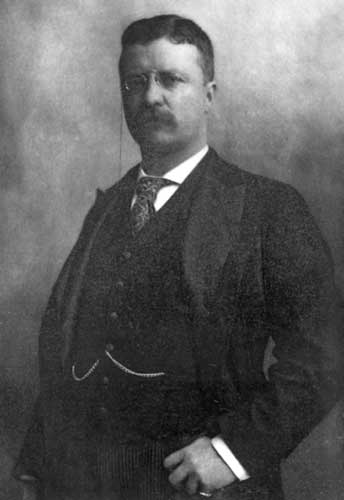
THEODORE ROOSEVELT
Photogravure after a photograph from life
There have been periods during which the dissembled eulogies of the able press and my relations with about every politician of every party and every faction have made me feel I would like to know whether I had one friend in New York, and here I feel I have many. [Great applause.] And more than that, gentlemen, I should think ill of myself and think that I was a discredit to the stock from which I sprang if I feared to go on along the path that I deemed right, whether I had few friends or many. [Cries of "Good! Good!" and great applause.]
I am glad to answer to the toast, "The Hollander as an American." The Hollander was a good American, because the Hollander was fitted to be a good citizen. There are two branches of government which must be kept on a high plane, if any nation is to be great. A nation must have laws that are honestly and fearlessly administered, and a nation must be ready, in time of need, to fight [applause], and we men of Dutch descent have here to-night these gentlemen of the same blood as ourselves who represent New York so worthily on the bench, and a Major-General of the Army of the United States. [Applause.]
It seems to me, at times, that the Dutch in America have one or two lessons to teach. We want to teach the very refined and very cultivated men who believe it impossible that the United States can ever be right in a quarrel with another nation—a little of the elementary virtue of patriotism. [Cries of "Good! Good!" and applause.] And we also wish to teach our fellow-citizens that laws are put on the statute books to be enforced [cries of "Hear! Hear!" and applause]; and that if it is not intended they shall be enforced, it is a mistake to put a Dutchman in office to enforce them.
The lines put on the programme underneath my toast begin: "America! half-brother of the world!" America, half-brother of the world—and all Americans full brothers one to the other. That is the way that the line should be concluded. The prime virtue of the Hollander here in America and the way in which he has most done credit to his stock as a Hollander, is that he has ceased to be a Hollander and has become an American, absolutely. [Great applause.] We are not Dutch-Americans. We are not "Americans" with a hyphen before it. We are Americans pure and simple, and we have a right to demand that the other people whose stocks go to compose our great nation, like ourselves, shall cease to be aught else and shall become Americans. [Cries of "Hear! Hear!" and applause.]
And further than that, we have another thing to demand, and that is that if they do honestly and in good faith become Americans, those shall be regarded as infamous who dare to discriminate against them because of creed or because of birthplace. When New Amsterdam had but a few hundred souls, among those few hundred souls no less than eighteen different race-stocks were represented, and almost as many creeds as there were race-stocks, and the great contribution that the Hollander gave to the American people was, as your President has so ably said, the inestimable lesson of complete civil and religious liberty. It would be honor enough for this stock to have been the first to put on American soil the public school, the great engine for grinding out American citizens, the one institution for which Americans should stand more stiffly than for aught other. [Great applause.]
Whenever America has demanded of her sons that they should come to her aid, whether in time of peace or in time of war, the Americans of Dutch stock have been among the first to spring to the aid of the country. We earnestly hope that there will not in the future be any war with any power, but assuredly if there should be such a war one thing may be taken for certain, and that is that every American of Dutch descent will be found on the side of the United States. We give the amplest credit, that some people now, to their shame, grudge to the profession of arms, which we have here to-night represented by a man, who, when he has the title of a Major-General of the Army of the United States [Thomas H. Ruger], has a title as honorable as any that there is on the wide earth. [Applause.] We also need to teach the lesson, that the Hollander taught, of not refusing to do the small things because the day of large things had not yet come or was in the past; of not waiting until the chance may come to distinguish ourselves in arms, and meanwhile neglecting the plain, prosaic duties of citizenship which call upon us every hour, every day of our lives.
The Dutch kept their freedom in the great contest with Spain, not merely because they warred valiantly, but because they did their duty as burghers in their cities, because they strove according to the light that was in them to be good citizens and to act as such. And we all here to-night should strive so to live that we Americans of Dutch descent shall not seem to have shrunk in this respect, compared to our fathers who spoke another tongue and lived under other laws beyond the ocean; so that it shall be acknowledged in the end to be what it is, a discredit to a man if he does not in times of peace do all that in him lies to make the government of the city, the government of the country, better and cleaner by his efforts. [Great applause.]
I spoke of the militant spirit as if it may only be shown in time of war. I think that if any of you gentlemen, no matter how peaceful you may naturally be, and I am very peaceful naturally [laughter], if you would undertake the administration of the Police Department you would have plenty of fighting on hand before you would get through [renewed laughter]; and if you are true to your blood you will try to do the best you can, fighting or not fighting. You will make up your mind that you will make mistakes, because you won't make anything if you don't make some mistakes, and you will go forward according to your lights, utterly heedless of what either politicians or newspapers may say, knowing that if you act as you feel bound according to your conscience to act, you will then at least have the right when you go out of office, however soon [laughter], to feel that you go out without any regret, and to feel that you have, according to your capacity, warred valiantly for what you deemed to be the right. [Great applause.]
These, then, are the qualities that I should claim for the Hollander as an American: In the first place, that he has cast himself without reservation into the current of American life; that he is an American, pure and simple, and nothing else. In the next place, that he works hand in hand and shoulder to shoulder with his fellow Americans, without any regard to differences of creed or to differences of race and religion, if only they are good Americans. [Great applause.] In the third place, that he is willing, when the need shall arise, to fight for his country; and in the fourth place, and finally, that he recognizes that this is a country of laws and not men, that it is his duty as an honest citizen to uphold the laws, to strive for honesty, to strive for a decent administration, and to do all that in him lies, by incessant, patient work in our government, municipal or national, to bring about the day when it shall be taken as a matter of course that every public official is to execute a law honestly, and that no capacity in a public officer shall atone if he is personally dishonest. [Tremendous applause.]
TRUE AMERICANISM AND EXPANSION
[Speech of Theodore Roosevelt at the nineteenth annual dinner of the New England Society in the City of Brooklyn, December 21, 1898. The President, William B. Davenport, in calling upon Theodore Roosevelt to speak to the toast, "The Day we Celebrate," said: "For many years we have been celebrating this day and looking at ourselves through Yankee eyes. To-night it is to be given us to see ourselves as others see us. We have with us one of whom it may be said, to paraphrase the epitaph in the Welsh churchyard:—
"'A Dutchman born, at Harvard bred, In Cuba travelled, but not yet dead.'
In response to this toast, I have the honor of introducing Hon. Theodore Roosevelt."]
Mr. President, Ladies and Gentlemen:—The gentleman on my right, with the unmistakably Puritan name of McKelway, in the issue of the "Eagle" to-night alluded to me as a Yankeeized Hollander. I am a middling good Yankee. I always felt that at these dinners of the New England Society, to which I come a trifle more readily than to any other like affairs, I and the president of the Friendly Sons of St. Patrick, who is also invariably in attendance, represent, what you would say, the victims tied to the wheels of the Roman chariot of triumph. You see I am half Irish myself, and, as I told a New England Senator with whom I am intimate, when he remarked that the Dutch had been conquered by the New Englanders, "the Irish have avenged us."
I want to say to you seriously, and, singularly enough, right along the lines of the admirable speech made by your President, a few words on the day we celebrate and what it means.
As the years go by, this nation will realize more and more that the year that has just passed has given to every American the right to hold his head higher as a citizen of the great Republic, which has taken a long stride forward toward its proper place among the nations of the world. I have scant sympathy with this mock humanitarianism, a mock humanitarianism which is no more alien to the spirit of true religion than it is to the true spirit of civilization, which would prevent the great, free, liberty and order-loving races of the earth doing their duty in the world's waste spaces because there must needs be some rough surgery at the outset. I do not speak simply of my own country. I hold that throughout the world every man who strives to be both efficient and moral—and neither quality is worth anything without the other—that every man should realize that it is for the interests of mankind to have the higher supplant the lower life. Small indeed is my sympathy with those people who bemoan the fact, sometimes in prose, sometimes in even weaker verse, that the champions of civilization and of righteousness have overcome the champions of barbarism or of an outworn tyranny, whether the conflict be fought by the Russian heralds of civilization in Turkestan, by the English champion of the higher life in the Eastern world, or by the men who upheld the Stars and Stripes as they freed the people of the tropic islands of the sea from the mediæval tyranny of Spain.
I do not ask that you look at this policy from a merely national standpoint, although if you are good Americans you must look from the national standpoint first. I ask that you look at it from the standpoint of civilization, from the standpoint of righteousness, and realize that it is better for the men who are as yet ages behind us in the struggle upward that they be helped upward, and that it does not cease to be better for them, merely because it is better for us also. As I say, cast aside the selfish view. Consider whether or not it is better that the brutal barbarism of northern Asia should be supplanted by the civilization of Russia, which has not yet risen to what we of the Occident are proud to claim as our standard, but which, as it stands, is tens of centuries in advance of that of the races it supplants. Again, from the standpoint of the outsider, look at the improvement worked by the Englishmen in all the islands of the sea and all the places on the dark continents where the British flag has been planted; seriously consider the enormous, the incalculable betterment that comes at this moment to ninety-five per cent. of the people who have been cowering under the inconceivably inhuman rule of Mahdism in the Sudan because it has been supplanted by the reign of law and of justice. I ask you to read the accounts of the Catholic missionary priests, the Austrian priests who suffered under Mahdism, to read in their words what they have suffered under conditions that have gone back to the stone age in the middle of the nineteenth century. Then you will realize that the Sirdar and his troops were fighting the battle of righteousness as truly as ever it was fought by your ancestors and mine two or three or four centuries ago.
I think you can now understand that I admire what other nations have done in this regard, and, therefore, that you will believe that I speak with sincerity when I speak of what we ourselves have done. Thank heaven that we of this generation, to whom was denied the chance of taking part in the greatest struggle for righteousness that this century has seen, the great Civil War, have at least been given the chance to see our country take part in the world movement that has gone on around about us. Of course it was partly for our own interest, but it was also largely a purely disinterested movement. It is a good thing for this nation that it should be lifted up beyond simply material matters. It is a good thing for us that we should have interests outside of our own borders. It is a good thing for us that we must look outward; that we must consider more than the question of exports and imports; that we must consider more than whether or not in one decade we have increased one and a half per cent. more than the average rate of increase in wealth or not. It is a good thing that we of this nation should keep in mind, and should have vividly brought before us the fact to which your ancestors, Mr. President and members of this Society, owe their greatness; that while it pays a people to pay heed to material matters, it pays infinitely better to treat material as absolutely second to moral considerations. I am glad for the sake of America that we have seen the American Army and the American Navy driving the Spaniard from the Western world. I am glad that the descendants of the Puritan and the Hollander should have completed the work begun, when Drake and Hawkins and Frobisher singed the beard of the King of Spain, and William the Silent fought to the death to free Holland. I am glad we did it for our own sake, but I am infinitely more glad because we did it to free the people of the islands of the sea and tried to do good to them.
I have told you why I am glad, because of what we have done. Let me add my final word as to why I am anxious about it. We have driven out the Spaniards. This did not prove for this nation a very serious task. Now we are approaching the really serious task. Now it behooves us to show that we are capable of doing infinitely better the work which we blame the Spaniards for doing so badly; and woe to us unless we do show not merely a slight but a well-nigh immeasurable improvement! We have assumed heavy burdens, heavy responsibilities. I have no sympathy with the men who cry out against our assuming them. If this great nation, if this nation with its wealth, with its continental vastness of domain, with its glorious history, with its memory of Washington and Lincoln, of its statesmen and soldiers and sailors, the builders and the wielders of commonwealths, if this nation is to stand cowering back because it is afraid to undertake tasks lest they prove too formidable, we may well suppose that the decadence of our race has begun. No; the tasks are difficult, and all the more for that reason let us gird up our loins and go out to do them. But let us meet them, realizing their difficulty; not in a spirit of levity, but in a spirit of sincere and earnest desire to do our duty as it is given us to see our duty. Let us not do it in the spirit of sentimentality, not saying we must at once give universal suffrage to the people of the Philippines—they are unfit for it. Do not let us mistake the shadow for the substance. We have got to show the practical common sense which was combined with the fervent religion of the Puritan; the combination which gave him the chance to establish here that little group of commonwealths which more than any others have shaped the spirit and destiny of this nation; we must show both qualities.
Gentlemen, if one of the islands which we have acquired is not fit to govern itself, then we must govern it until it is fit. If you cannot govern it according to the principles of the New England town meeting—because the Philippine Islander is not a New Englander—if you cannot govern it according to these principles, then find out the principles upon which you can govern it, and apply those principles. Fortunately, while we can and ought with wisdom to look abroad for examples, and to profit by the experience of other nations, we are already producing, even in this brief period, material of the proper character within our own border, men of our own people, who are showing us what to do with these islands. A New Englander, a man who would be entitled to belong to this Society, a man who is in sympathy with all that is best and most characteristic of the New England spirit, both because of his attitude in war and of his attitude toward civic morality in time of peace, is at present giving us a good object lesson in administering those tropic provinces. I allude to my former commander, the present Governor-General of Santiago, Major-General Leonard Wood. General Wood has before him about as difficult a task as man could well have. He is now intrusted with the supreme government of a province which has been torn by the most hideously cruel of all possible civil wars for the last three years, which has been brought down to a condition of savage anarchy, and from which our armies, when they expelled the armies of Spain, expelled the last authoritative representatives of what order there still was in the province. To him fell the task of keeping order, of preventing the insurgent visiting upon the Spaniard his own terrible wrongs, of preventing the taking of that revenge which to his wild nature seemed eminently justifiable, the preserving of the rights of property, of keeping unharmed the people who had been pacific, and yet of gradually giving over the administration of the island to the people who had fought for its freedom, just as fast as, and no faster than, they proved that they could be trusted with it. He has gone about that task, devoted himself to it, body and soul, spending his strength, his courage, and perseverance, and in the face of incredible obstacles he has accomplished very, very much.
Now, if we are going to administer the government of the West Indies Islands which we have acquired, and the Philippines, in a way that will be a credit to us and to our institutions, we must see that they are administered by the General Woods. We have got to make up our minds that we can only send our best men there; that we must then leave them as largely unhampered as may be. We must exact good results from them, but give them a large liberty in the methods of reaching these results. If we treat those islands as the spoil of the politician, we shall tread again the path which Spain has trod before, and we shall show ourselves infinitely more blameworthy than Spain, for we shall sin against the light, seeing the light.
The President says that this is New England doctrine. So it is. It is Dutch doctrine, too. It is the doctrine of sound Americanism, the doctrine of common sense and common morality. I am an expansionist. I am glad we have acquired the islands we have acquired. I am not a bit afraid of the responsibilities which we have incurred; but neither am I blind to how heavy those responsibilities are. In closing my speech, I ask each of you to remember that he cannot shove the blame on others entirely, if things go wrong. This is a government by the people, and the people are to blame ultimately if they are misrepresented, just exactly as much as if their worst passions, their worst desires are represented; for in the one case it is their supineness that is represented exactly as in the other case it is their vice. Let each man here strive to make his weight felt on the side of decency and morality. Let each man here make his weight felt in supporting a truly American policy, a policy which decrees that we shall be free and shall hold our own in the face of other nations, but which decrees also that we shall be just, and that the peoples whose administration we have taken over shall have their condition made better and not worse by the fact that they have come under our sway.