Volume 2 — OLIVER WENDELL HOLMES
Reading edition
WELCOME TO THE ALUMNI
[Speech of Oliver Wendell Holmes as President of the day, at the annual dinner of the Harvard Alumni Association, in Cambridge, July 19, 1860, inaugurating the practice of public speaking at the "Harvard Dinners." That year also took place the inauguration of President C. Felton, an event to which the speaker alludes in his graceful reference to the "goodly armful of scholarship, experience and fidelity" once more filling the "old chair of office."]
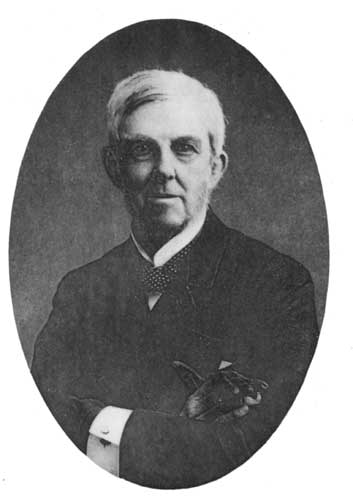
OLIVER WENDELL HOLMES Photogravure after a photograph from life
Brothers, by the side of her who is mother of us all, and Friends, whom she welcomes as her own children:—The older sons of our common parent who should have greeted you from this chair of office, being for different reasons absent, it has become my duty to half fill the place of these honored, but truant, children to the best of my ability—a most grateful office, so far as the expression of kind feeling is concerned; an undesired duty, if I look to the comparisons you must draw between the government of the association existing de jure, and its government de facto. Your President [Robert C. Winthrop] so graces every assembly which he visits, by his presence, his dignity, his suavity, his art of ruling, whether it be the council of a nation, the legislature of a State, or the lively democracy of a dinner-table, that when he enters a meeting like this, it seems as if the chairs stood back of their own will to let him pass to the head of the board, and the table itself, that most intelligent of quadrupeds, the half reasoning mahogany, tipped him a spontaneous welcome to its highest seat, and of itself rapped the assembly to order. [Applause.]
Your first Vice-President [Charles Francis Adams], whose name and growing fame you know so much better than his bodily presentment, has not been able to gratify your eyes and ears by showing you the lineaments and stirring you with the tones inherited from men who made their country or shaped its destinies. [Applause.] You and I have no choice therefore, and I must submit to stand in this place of eminence as a speaker, instead of sitting a happy listener with my friends and classmates on the broader platform beneath. Through my lips must flow the gracious welcome of this auspicious day, which brings us all together in this family temple under the benignant smile of our household divinities, around the ancient altar fragrant with the incense of our grateful memories.
This festival is always a joyous occasion. It resembles a scattered family without making any distinction except that which age establishes, an aristocracy of silver hairs which all inherit in their turn, and none is too eager to anticipate. In the great world outside there are and must be differences of lot and position; one has been fortunate, another, toiling as nobly perhaps, has fallen in with adverse currents; one has become famous, his name stares in great letters from the hand-bills of the drama of his generation; another lurks in small type among the supernumeraries. But here we stand in one unbroken row of brotherhood. No symbol establishes a hierarchy that divides one from another; every name which has passed into our golden book, the triennial catalogue, is illuminated and emblazoned in our remembrance and affection with the purple and sunshine of our common Mother's hallowed past and hopeful future.
We have at this time a twofold reason for welcoming the return of our day of festive meeting. The old chair of office, against whose uneasy knobs have rested so many well-compacted spines, whose uncushioned arms have embraced so many stately forms, over whose inheritance of cares and toils have ached so many ample brows, is filled once more with a goodly armful of scholarship, experience and fidelity. The President never dies. Our precious Mother must not be left too long a widow, for the most urgent of reasons. We talk so much about her maternity that we are apt to overlook the fact that a responsible Father is as necessary to the good name of a well-ordered college as to that of a well-regulated household. As children of the College, our thoughts naturally centre on the fact that she has this day put off the weeds of her nominal widowhood, and stands before us radiant in the adornment of her new espousals. You will not murmur, that, without debating questions of precedence, we turn our eyes upon the new head of the family, to whom our younger brothers are to look as their guide and counsellor as we hope and trust through many long and prosperous years.
Brothers of the Association of the Alumini! Our own existence as a society is so bound up with that of the College whose seal is upon our foreheads, that every blessing we invoke on our parent's head returns like the dew from Heaven upon our own. So closely is the welfare of our beloved Mother knitted to that of her chief counsellor and official consort, that in honoring him we honor her under whose roof we are gathered, at whose breast we have been nurtured, whose fair fame is our glory, whose prosperity is our success, whose lease of long life is the charter of our own perpetuity.
I propose the health of the President of Harvard University: We greet our brother as the happy father of a long line of future alumni.
DOROTHY Q.
[Speech of Oliver Wendell Holmes at the banquet of the Boston Merchants' Association at Boston, Mass., May 23, 1884, in honor of the Hon. John Lowell.]
Mr. Chairman and Gentlemen:—It was my intention, when I accepted the public invitation to be with you this evening, to excuse myself from saying a word. I am a professor emeritus, which means pretty nearly the same thing as a tired-out or a worn-out instructor. And I do seriously desire that, having during the last fifty years done my share of work at public entertainments, I may hereafter be permitted, as a post-prandial emeritus, to look on and listen in silence at the festivals to which I may have the honor of being invited—unless, indeed, I may happen to wish to be heard. [Applause.] In that case I trust I may be indulged, as an unspoken speech and an unread poem are apt to "strike in," as some complaints are said to, and cause inward commotions. [Applause.] Judge Lowell's eulogy will be on every one's lips this evening. His soundness, his fairness, his learning, his devotion to duty, his urbanity,—these are the qualities which have commended him to universal esteem and honor. [Applause.] I will not say more of the living; I wish to speak of the dead.
In respectfully proposing the memory of his great-great-grandmother [laughter], I am speaking of one whom few if any of you can remember. [Laughter.] Yet her face is as familiar to me as that of any member of my household. She looks upon me as I sit at my writing-table; she does not smile, she does not speak; even the green parrot on her hand has never opened his beak; but there she is, calm, unchanging, in her immortal youth, as when the untutored artist fixed her features on the canvas. To think that one little word from the lips of Dorothy Quincy, your great-great-grandmother, my great-grandmother, decided the question whether you and I should be here to-night [laughter], in fact whether we should be anywhere [laughter] at all, or remain two bodiless dreams of nature! But it was Dorothy Quincy's "Yes" or "No" to Edward Jackson which was to settle that important matter—important to both of us, certainly—yes, Your Honor; and I can say truly, as I look at you and remember your career, important to this and the whole American community. [Applause.]
The picture I referred to is but a rude one, and yet I was not ashamed of it when I wrote a copy of verses about it, three or four of which this audience will listen to for the sake of Dorothy's great-grandson. I must alter the pronouns a little, for this occasion only:—
Look not on her with eyes of scorn— Dorothy Q. was a lady born; Ay! since the galloping Normans came England's annals have known her name; And still to the three-hilled rebel town Dear is that ancient name's renown, For many a civic wreath they won, The youthful sire and the gray-haired son. O damsel Dorothy! Dorothy Q.! Strange is the gift (we) owe to you! Such a gift as never a king Save to daughter or son might bring— All (our) tenure of heart and hand, All (our) title to house and land; Mother and sister and child and wife And joy and sorrow and death and life! What if a hundred years ago Those close-shut lips had answered "No!" When forth the tremulous question came That cost the maiden her Norman name, And under the folds that look so still The bodice swelled with the bosom's thrill— Should (we) be (we), or could it be One-tenth (two others) and nine-tenths (we)? Soft is the breath of a maiden's Yes: Not the light gossamer stirs with less; But never a cable that holds so fast Through all the battles of wave and blast, And never an echo of speech or song That lives in the babbling air so long! There were tones in the voice that whispered then You may hear to-day in a hundred men. O lady and lover, now faint and far Your images hover—and here we are, Solid and stirring in flesh and bone— Edwards and Dorothys—all their own— A goodly record for time to show Of a syllable whispered so long ago.
[Applause prolonged.]
I give you: "The memory of Dorothy Jackson, born Dorothy Quincy, to whose choice of the right monosyllable we owe the presence of our honored guest and all that his life has achieved for the welfare of the community." [Great applause and cheers.]