Chapter VI · HOW TO SAIL AND STEER A MODEL YACHT.
Reading edition
The action of the wind upon the sails of a vessel presses her down sideways and forwards, this causes the lee bow (viz. that on the side opposed to the wind) to be more immersed than the weather bow (or wind side bow), and the curve of the bow acting like a rudder or wedge, forces the vessel strongly up in the wind, in exact proportion to the strength of the wind. This is a simple mechanical law any one can understand after watching a model yacht for five minutes, and to counteract while utilizing it, I build a model yacht much deeper aft than forward, make the bowsprit very long, the jib and foresail large, and the mainsail narrow at the head and slack in the outer leach or edge. These arrangements, properly adjusted, nearly neutralize this tendency of the lee bow to force the ship to windward, and leave only just enough, so that by setting the sails in the way shown later, a model yacht steers itself perfectly. Great care must be taken not to overdo it, otherwise the vessel will run off the wind, and not steer herself at all.
The part which the increased depth of keel aft plays in steering a model yacht is this; as the sails are very evenly balanced, and exert little more force at the stern than at the bow when the vessel is upright in the water; yet even then there is always the tendency more or less to come up in the wind, and as the bow is not so deep as the stern, the lateral pressure of all the sails forces the vessel sideways (called leeway),—she makes more leeway forward than aft, and thus this particular arrangement helps to make her steer herself. Necessarily, when the wind blows strongly it is of very great use, and enables increased length of bowsprit to be dispensed with: too long a bowsprit is a great drawback, it dips in the water, and is difficult to fasten firmly.
Again, a model vessel being well up by the stem, and deep aft, possesses another power of self-steering, viz. when the wind presses her down forward (when on the wind), it lightens her aft; this, of course, permits her to gripe more to windward, as she holds more water forward and less aft, but if she comes up too much, so as to relieve the mainsail of a great part of its pressure, the opposite action results, the bow is lightened and the stern depressed exactly in proportion, so that under all circumstances the vessel possesses a self-acting power to steer herself.
Now, as just shown, a model yacht, partly by the action of the sails (particularly the mainsail), and partly by the action of the lee bow, will always keep close to the wind,—in fact, too close; therefore, to make her steer herself, the jib and foresail are kept in a little closer (i.e. more in a parallel line with the keel) than the mainsail. So if the vessel comes too close to the wind, first the outer leach of the mainsail loses its power and shakes, and if this does not suffice, as it should, to make her fall off again, the whole mainsail will shake, and as the jib and foresail must keep full, the ship pays off till the mainsail fills again. So an equilibrium is attained, and in a steady wind, on the sea for instance, the yacht would sail on in the same direction as if on rails, till the sails dropped in pieces.
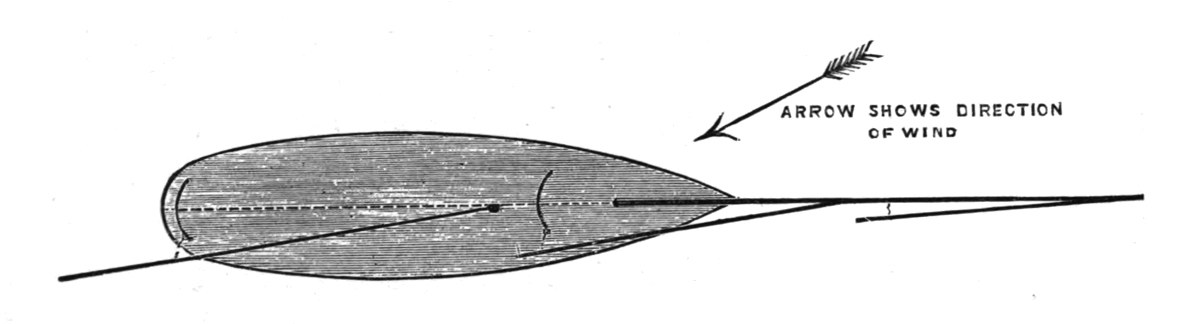
This diagram gives the disposition of the booms by means of their respective sheets. To make a yacht sail full and by, i.e. close to the wind, and neither run off or shake, the jib is nearly parallel to the bowsprit, the foresail less so, and the mainsail least of all, and clearly shows the principle, for it is evident that if the vessel turned more towards the wind, the mainsail would shake, and the jib and foresail keeping still full, would turn the ship back to her course again, viz. “full and by.” On the other hand, she cannot run off the wind, because the mainsail, well full as it must be, if she ran off, would bring her up again instantly.
I presume every intelligent person understands that a vessel cannot sail with her head to the wind (all the sails must shake, and she would go astern), and few vessels can sail nearer, if so near, as at an angle of 45° to the wind. In the next diagram will be shown the way to sail the vessel in any possible direction, and how the booms must be disposed, and the rudder or rudders and ballast bags used to accomplish it.
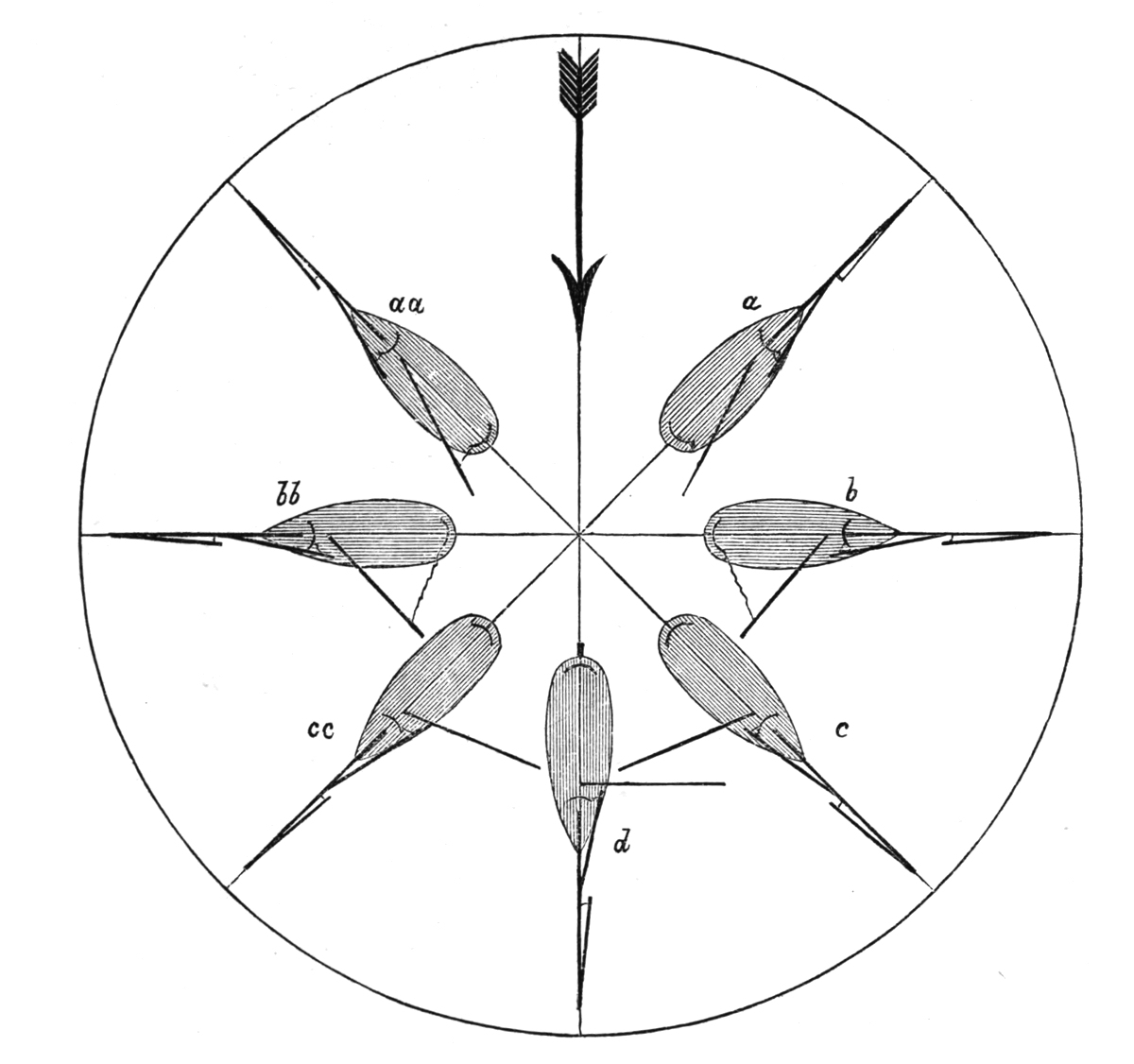
The wind is supposed to be blowing in the direction the arrow flies, and by holding this diagram with the arrow towards the point the wind is blowing from, your vessel can be made to sail in every direction there indicated.
No vessel can head nearer towards the wind shown by the arrow, than a and aa, one being on the larboard, the other on the starboard tack (as it is called), i.e. about 45°, four points of a compass, or half a right angle.
The vessel at a is therefore sailing close to the wind on the larboard tack, with the sails disposed for that purpose, as already shown (p. 90); to put her on the other tack, simply turn her in the direction aa, head to wind; the sails, being self-acting, will go over of themselves by the force of the wind, and she will continue on that tack till stopped or turned.
To sail her as at b, ease off the mainsheet till the mainboom is at an angle of 45° (this is called wind abeam) to the keel of the ship, and she will do so; it is seldom necessary to touch the jib or foresheets, leave those sails as at a. To sail her as at bb, turn her round, head to wind, and the sails take the same place on the other side, and that is done.
To sail as at c, let go the mainsheet altogether; if the wind is not too strong, she will do so, but if it is too strong, a light rudder, self-acting, of about ¼ lb. weight must be made and used, and that will do it. Turn her round as before, head to wind, if you wish to sail her as at cc. The rule is simple enough: if the sails are set, and propel her in a given direction on the one tack, she will, if turned, sail in the corresponding direction on the other tack.
To run before the wind at d, with the mainsheet let go, hook on the heavy rudder, and she will run more or less true before the wind, according to the perfection with which the ship is built and the rudder balanced. The cause is this: if the vessel turns, say to starboard, the wind necessarily presses her over to larboard, the self-acting rudder (being exactly upright when the ship is upright) falls over to larboard also, and instantly puts her straight again; the exact opposite takes place should she turn to larboard, and so she must sail straight before the wind.
When the wind is very light, it will sometimes occur, that the vessel on account of the large jib and foresail, will run off the wind; if so, put one or two of the bags of shot inside in her bows, and most likely that will remedy it; if not, change the angles of the jib and foresails, i.e. let the jib sheet out more, and haul the foresheet in as much as the jib was, so that you would then be steering more by the foresail than by the jib. This is sure to succeed.
Before all these manœuvres can be successfully performed, some little practice is necessary, of course; ships, like everything else, have little ways of their own, and must be studied.
The topsail must always be kept set, and needs no touching after being once set, for though of no great use as a propelling sail, save off the wind, it is so as a steadying sail, being so lofty. My experience has taught me never to dispense with it.
To prove the certainty with which a model yacht must sail in the direction intended, you can, as an experiment, put the vessel’s head in the water in any direction you please, and she will immediately take the course for which the sails are set, no matter how you put her in the water. For instance, place her in the water, head to wind, with the mainsheet let go, and the heavy rudder on, i.e. to sail as at d (p. 92), and she will of her own account turn round and run before the wind, an operation which, to those not in the secret, seems like magic.
Rigged in the way I have described, with every part of the standing and running rigging being made fast by hooks and slides, a cutter can be completely unrigged in one minute, and rigged again in three minutes: I have done it in these times easily. This is a very great advantage; there are no knots to make, no time is lost, and yet the rigging is as strong and as perfect as possible, and never fails till worn out.
I hope I have now made all clear, and that my readers may be enabled to build ships, and rig them to sail with as much satisfaction to themselves as mine are to me.
Model yachts can be rigged to sail and steer well, as schooners, luggers, &c., and I have vessels rigged in those ways. Should this treatise meet with success, I purpose writing a second, dealing with this subject.