Front matter (continued 7)
Reading edition
General Hill has since argued that only part of his division could oppose us; [Footnote: Century War Book, vol. ii. pp. 559, etc.] but his brigades were all on the mountain summit within easy support of each other, and they had the day before them. It was five hours from the time of our first charge to the arrival of our first supports, and it was not till three o'clock in the afternoon that Hooker's corps reached the eastern base of the mountain and began its deployment north of the National road. Our effort was to attack the weak end of his line, and we succeeded in putting a stronger force there than that which opposed us. It is for our opponent to explain how we were permitted to do it. The two brigades of the Kanawha division numbered less than 3000 men. Hill's division was 5000 strong, [Footnote: Official Records, vol. xix. pt. i. p. 1025.] even by the Confederate method of counting their effectives, which should be increased nearly one-fifth to compare properly with our reports. In addition to these Stuart had the principal part of the Confederate cavalry on this line, and they were not idle spectators. Parts of Lee's and Hampton's brigades were certainly there, and probably the whole of Lee's. [Footnote:Id., p. 819.] With less than half the numerical strength which was opposed to it, therefore, the Kanawha division had carried the summit, advancing to the charge for the most part over open ground in the storm of musketry and artillery fire, and held the crests they had gained through the livelong day, in spite of all efforts to retake them.
In our mountain camps of West Virginia I had felt discontented that our native Ohio regiments did not take as kindly to the labors of drill and camp police as some of German birth, and I had warned them that they would feel the need of accuracy and mechanical precision when the day of battle came. They had done reasonably well, but suffered in comparison with some of the others on dress parade and in the form and neatness of the camp. When, however, on the slopes of South Mountain I saw the lines go forward steadier and more even under fire than they ever had done at drill, their intelligence making them perfectly comprehend the advantage of unity in their effort and in the shock when they met the foe--when their bodies seemed to dilate, their step to have better cadence and a tread as of giants as they went cheering up the hill,--I took back all my criticisms and felt a pride and glory in them as soldiers and comrades that words cannot express.
It was about noon that the lull in the battle occurred, and it lasted a couple of hours, while reinforcements were approaching the mountain top from both sides. The enemy's artillery kept up a pretty steady fire, answered occasionally by our few cannon; but the infantry rested on their arms, the front covered by a watchful line of skirmishers, every man at his tree. The Confederate guns had so perfectly the range of the sloping fields about and behind us, that their canister shot made long furrows in the sod with a noise like the cutting of a melon rind, and the shells which skimmed the crest and burst in the tree-tops at the lower side of the fields made a sound like the crashing and falling of some brittle substance, instead of the tough fibre of oak and pine. We had time to notice these things as we paced the lines waiting for the renewal of the battle.
Willcox's division reported to me about two o'clock, and would have been up earlier, but for a mistake in the delivery of a message to him. He had sent from Middletown to ask me where I desired him to come, and finding that the messenger had no clear idea of the roads by which he had travelled, I directed him to say that General Pleasonton would point out the road I had followed, if inquired of. Willcox understood the messenger that I wished him to inquire of Pleasonton where he had better put his division in, and on doing so, the latter suggested that he move against the crests on the north of the National road. He was preparing to do this when Burnside and Reno came up and corrected the movement, recalling him from the north and sending him by the old Sharpsburg road to my position. As his head of column came up, Longstreet's corps was already forming with its right outflanking my left. I sent two regiments [Footnote: In my official report I said one regiment, but General Willcox reported that he sent two, and he is doubtless right. For his official report, see Official Records, vol. xix. pt. ii. p. 428.] to extend my left, and requested Willcox to form the rest of the division on my right facing the summit. He was doing this when he received an order from General Reno to take position overlooking the National road facing northward. [Footnote: Ibid.] I can hardly think the order could have been intended to effect this, as the turnpike is deep between the hills there, and the enemy quite distant on the other side of the gorge. But Willcox, obeying the order as he received it, formed along the Sharpsburg road, his left next to my right, but his line drawn back nearly at right angles to it. He placed Cook's battery in the angle, and this opened a rapid fire on one of the enemy's which was on the bastion-like hill north of the gorge already mentioned. Longstreet's men were now pretty well up, and pushed a battery forward to the edge of the timber beyond Wise's farm, and opened upon Willcox's line, enfilading it badly. There was a momentary break there, but Willcox was able to check the confusion, and to reform his lines facing westward as I had originally directed; Welch's brigade was on my right, closely supporting Cook's battery and Christ's beyond it. The general line of Willcox's division was at the eastern edge of the wood looking into the open ground at Fox's Gap, on the north side of the Sharpsburg road. A warm skirmishing fight was continued along the whole of our line, our purpose being to hold fast my extreme left which was well advanced upon and over the mountain crest, and to swing the right up to the continuation of the same line of hills near the Mountain House.
At nearly four o'clock the head of Sturgis's column approached. [Footnote: Sturgis's Report, Id., pt. i. p. 443.] McClellan had arrived on the field, and he with Burnside and Reno was at Pleasonton's position at the knoll in the valley, and from that point, a central one in the midst of the curving hills, they issued their orders. They could see the firing of the enemy's battery from the woods beyond the open ground in front of Willcox, and sent orders to him to take or silence those guns at all hazards. He was preparing to advance, when the Confederates anticipated him (for their formation had now been completed) and came charging out of the woods across the open fields. It was part of their general advance and their most determined effort to drive us from the summit we had gained in the morning. The brigades of Hood, Whiting, Drayton, and D. R. Jones in addition to Hill's division (eight brigades in all) joined in the attack on our side of the National road, batteries being put in every available position. [Footnote: Longstreet's Report, Official Records, vol. xix. pt. i. p. 839.] The fight raged fiercely along the whole front, but the bloodiest struggle was around Wise's house, where Drayton's brigade assaulted my right and Willcox's left, coming across the open ground. Here the Sharpsburg road curves around the hill held by us so that for a little way it was parallel to our position. As the enemy came down the hill forming the other side of the gap, across the road and up again to our line, they were met by so withering a fire that they were checked quickly, and even drifted more to the right where their descent was continuous. Here Willcox's line volleyed into them a destructive fire, followed by a charge that swept them in confusion back along the road, where the men of the Kanawha division took up the attack and completed their rout. Willcox succeeded in getting a foothold on the further side of the open ground and driving off the artillery which was there. Along our centre and left where the forest was thick, the enemy was equally repulsed, but the cover of the timber enabled them to keep a footing near by, whilst they continually tried to extend so as to outflank us, moving their troops along a road which goes diagonally down that side of the mountain from Turner's Gap to Rohrersville. The batteries on the north of the National road had been annoying to Willcox's men as they advanced, but Sturgis sent forward Durell's battery from his division as soon as he came up, and this gave special attention to these hostile guns, diverting their fire from the infantry. Hooker's men, of the First Corps, were also by this time pushing up the mountain on that side of the turnpike, and we were not again troubled by artillery on our right flank.
It was nearly five o'clock when the enemy had disappeared in the woods beyond Fox's Gap and Willcox could reform his shattered lines. As the easiest mode of getting Sturgis's fresh men into position, Willcox made room on his left for Ferrero's brigade supported by Nagle's, doubling also his lines at the extreme right. Rodman's division, the last of the corps, now began to reach the summit, and as the report came from the extreme left that the enemy was stretching beyond our flank, I sent Fairchild's brigade to assist our men there, whilst Rodman took Harland's to the support of Willcox. A staff officer now brought word that McClellan directed the whole line to advance. At the left this could only mean to clear our front decisively of the enemy there, for the slopes went steadily down to the Rohrersville road. At the centre and right, whilst we held Fox's Gap, the high and rocky summit at the Mountain House was still in the enemy's possession. The order came to me as senior officer upon the line, and the signal was given. On the left Longstreet's men were pushed down the mountain side beyond the Rohrersville and Sharpsburg roads, and the contest there was ended. The two hills between the latter road and the turnpike were still held by the enemy, and the further one could not be reached till the Mountain House should be in our hands. Sturgis and Willcox, supported by Rodman, again pushed forward, but whilst they made progress they were baffled by a stubborn and concentrated resistance.
Reno had followed Rodman's division up the mountain, and came to me a little before sunset, anxious to know why the right could not get forward quite to the summit. I explained that the ground there was very rough and rocky, a fortress in itself and evidently very strongly held. He passed on to Sturgis, and it seemed to me he was hardly gone before he was brought back upon a stretcher, dead. He had gone to the skirmish line to examine for himself the situation, and had been shot down by the enemy posted among the rocks and trees. There was more or less firing on that part of the field till late in the evening, but when morning dawned the Confederates had abandoned the last foothold above Turner's Gap and retreated by way of Boonsboro to Sharpsburg. The casualties in the Ninth Corps had been 889, of which 356 were in the Kanawha division. Some 600 of the enemy were captured by my division and sent to the rear under guard.
On the north of the National road the First Corps under Hooker had been opposed by one of Hill's brigades and four of Longstreet's, and had gradually worked its way along the old Hagerstown road, crowning the heights in that direction after dark in the evening. Gibbon's brigade had also advanced in the National road, crowding up quite close to Turner's Gap and engaging the enemy in a lively combat. It is not my purpose to give a detailed history of events which did not come under my own eye. It is due to General Burnside, however, to note Hooker's conduct toward his immediate superior and his characteristic efforts to grasp all the glory of the battle at the expense of truth and of honorable dealing with his commander and his comrades. Hooker's official report for the battle of South Mountain was dated at Washington, November 17th, when Burnside was in command of the Army of the Potomac, and when the intrigues of the former to obtain the command for himself were notorious and near their final success. In it he studiously avoided any recognition of orders or directions received from Burnside, and ignores his staff, whilst he assumes that his orders came directly from McClellan and compliments the staff officers of the latter, as if they had been the only means of communication. This was not only insolent but a military offence, had Burnside chosen to prosecute it. He also asserts that the troops on our part of the line had been defeated and were at the turnpike at the base of the mountain in retreat when he went forward. At the close of his report, after declaring that "the forcing of the passage of South Mountain will be classed among the most brilliant and satisfactory achievements of this army," he adds, "its principal glory will be awarded to the First Corps." [Footnote: Official Records, vol. xix. pt. i. pp. 214-215.]
Nothing is more justly odious in military conduct than embodying slanders against other commands in an official report. It puts into the official records misrepresentations which cannot be met because they are unknown, and it is a mere accident if those who know the truth are able to neutralize their effect. In most cases it will be too late to counteract the mischief when those most interested learn of the slanders. All this is well illustrated in the present case. Hooker's report got on file months after the battle, and it was not till the January following that Burnside gave it his attention. I believe that none of the division commanders of the Ninth Corps learned of it till long afterward. I certainly did not till 1887, a quarter of a century after the battle, when the volume of the official records containing it was published. Burnside had asked to be relieved of the command of the Army of the Potomac after the battle of Fredericksburg unless Hooker among others was punished for insubordination. As in the preceding August, the popular sentiment of that army as an organization was again, in Mr. Lincoln's estimation, too potent a factor to be opposed, and the result was the superseding of Burnside by Hooker himself, though the President declared in the letter accompanying the appointment that the latter's conduct had been blameworthy. It was under these circumstances that Burnside learned of the false statements in Hooker's report of South Mountain, and put upon file his stinging response to it. His explicit statement of the facts will settle that question among all who know the reputation of the men, and though unprincipled ambition was for a time successful, that time was so short and things were "set even" so soon that the ultimate result is one that lovers of justice may find comfort in. [Footnote: The text of Burnside's supplemental report is as follows:--
"When I sent in my report of the part taken by my command in the battle of South Mountain, General Hooker, who commanded one of the corps of my command (the right wing), had not sent in his report, but it has since been sent to me. I at first determined to pass over its inaccuracies as harmless, or rather as harming only their author; but upon reflection I have felt it my duty to notice two gross misstatements made with reference to the commands of Generals Reno and Cox, the former officer having been killed on that day, and the latter now removed with his command to the West.
"General Hooker says that as he came up to the front, Cox's corps was retiring from the contest. This is untrue. General Cox did not command a corps, but a division; and that division was in action, fighting most gallantly, long before General Hooker came up, and remained in the action all day, never leaving the field for one moment. He also says that he discovered that the attack by General Reno's corps was without sequence. This is also untrue, and when said of an officer who so nobly fought and died on that same field, it partakes of something worse than untruthfulness. Every officer present who knew anything of the battle knows that Reno performed a most important part in the battle, his corps driving the enemy from the heights on one side of the main pike, whilst that of General Hooker drove them from the heights on the other side.
"General Hooker should remember that I had to order him four separate times to move his command into action, and that I had to myself order his leading division (Meade's) to start before he would go." Official Records, vol. xix. pt. i. p. 422.] The men of the First Corps and its officers did their duty nobly on that as on many another field, and the only spot on the honor of the day is made by the personal unscrupulousness and vainglory of its commander.
Franklin's corps had attacked and carried the ridge about five miles further south, at Crampton's Gap, where the pass had been so stubbornly defended by Mahone's and Cobb's brigades with artillery and a detachment of Hampton's cavalry as to cause considerable loss to our troops. The principal fighting was at a stone wall near the eastern base of the mountain, and when the enemy was routed from this position, he made no successful rally and the summit was gained without much more fighting. The attack at the stone wall not far from Burkettsville was made at about three o'clock in the afternoon. The Sixth Corps rested upon the summit at night.
CHAPTER XIV
ANTIETAM: PRELIMINARY MOVEMENTS
Lee's plan of invasion--Changed by McClellan's advance--The position at Sharpsburg--Our routes of march--At the Antietam--McClellan reconnoitring--Lee striving to concentrate--Our delays--Tuesday's quiet--Hooker's evening march--The Ninth Corps command--Changing our positions--McClellan's plan of battle--Hooker's evening skirmish--Mansfield goes to support Hooker--Confederate positions--Jackson arrives--McLaws and Walker reach the field--Their places.
Before morning on the 15th of September it became evident that Lee had used the night in withdrawing his army. An advance of the pickets at daybreak confirmed this, and Pleasonton's cavalry was pushed forward to Boonsboro, where they had a brisk skirmish with the enemy's rear-guard. At Boonsboro a turnpike to Sharpsburg leaves the National road, and the retreat of the Confederate cavalry, as well as other indications, pointed out the Sharpsburg road as the line of Lee's retreat. He had abandoned his plan of moving further northward, and had chosen a line bringing him into surer communication with Jackson. His movements before the battle of South Mountain revealed a purpose of invasion identical with that which he tried to carry out in 1863 in the Gettysburg campaign. Longstreet, with two divisions and a brigade (D. R. Jones, Hood, and Evans), had advanced to Hagerstown, and it seems that a large part of the Confederate trains reached there also. D. H. Hill's division held Boonsboro and the passes of South Mountain at Turner's and Fox's Gaps. McLaws invested our fortifications on Maryland Heights, supported by R. H. Anderson's division. Jackson, with four divisions (A. P. Hill, Ewell, and Starke of his own corps, with Walker temporarily reporting to him), was besieging Harper's Ferry.
On Saturday, the 13th, Lee determined to draw back Longstreet from his advanced position, in view of the fact that Jackson had not yet reduced Harper's Ferry and that McClellan was marching to its relief. Longstreet's divisions therefore approached Boonsboro so as to support D. H. Hill, and thus it happened that they took part in the battle of South Mountain. Hill again occupied the summit where we found him on the 14th. From all this it is very plain that if McClellan had hastened his advance on the 13th, the passes of South Mountain at Turner's and Fox's gaps would not have been occupied in force by the enemy, and the condition of things would have been what he believed it was on the morning of the 14th, when a single brigade had been thought enough to support Pleasonton's reconnoissance. Twenty-four hours had changed all that.
The turnpike from Boonsboro to Sharpsburg continues southward a couple of miles, crossing the Potomac to Shepherdstown, which lies on the Virginia side of the river. A bridge which formerly carried the road over the stream had been burned; but not far below the ruined piers was a ford, which was a pretty good one in the present stage of water. Shepherdstown was the natural place of junction for Lee and Jackson; but for Lee to have marched there at once would have exposed Jackson to attack from the northern side of the Potomac. The precious stores and supplies captured at Harper's Ferry must be got to a place of safety, and this was likely to delay Jackson a day or two. Lee therefore ordered McLaws to obstruct Franklin's movement as much as he could, whilst he himself concentrated the rest of Longstreet's corps at Sharpsburg, behind the Antietam. If McClellan's force should prove overwhelming, the past experience of the Confederate general encouraged him to believe that our advance would not be so enterprising that he could not make a safe retreat into Virginia. He resolved therefore to halt at Sharpsburg, which offered an excellent field for a defensive battle, leaving himself free to resume his aggressive campaign or to retreat into Virginia according to the result.
McClellan had ordered Richardson's division of the Second Corps to support the cavalry in the advance, and Hooker's corps followed Richardson. [Footnote: Hooker's Report, Official Records, vol. xix. pt. i. p. 216.] It would seem most natural that the whole of Sumner's wing should take the advance on the 15th, though the breaking up of organizations was so much a habit with McClellan that perhaps it should not be surprising that one of Sumner's divisions was thus separated from the rest, and that Burnside's right wing was also divided. [Footnote: We must not forget the fact, however, that the order dividing the army into wings was suspended on that morning, and that this gives to the incident the air of an intentional reduction of the wing commanders to the control of a single corps. Official Records, vol. xix. pt. ii. p. 297.] The Ninth Corps was ordered to follow the old Sharpsburg road through Fox's Gap, our line of march being thus parallel to the others till we should reach the road from Boonsboro to Sharpsburg.
But we were not put in motion early in the day. We were ordered first to bury the dead, and to send the wounded and prisoners to Middletown It was nearly noon when we got orders to march, and when the head of column filed into the road, the way was blocked by Porter's corps, which was moving to the front by the same road. As soon as the way was clear, we followed, leaving a small detachment to complete the other tasks which had been assigned us. In the wooded slope of the mountain west of the gap, a good many of the Confederate dead still lay where they had fallen in the fierce combats for the possession of the crest near Wise's house. Our road led through a little hamlet called Springvale, and thence to another, Porterstown, near the left bank of the Antietam, where it runs into the Boonsboro and Sharpsburg turnpike. Sumner's two corps had taken temporary position on either side of the turnpike, behind the line of hills which there borders the stream. Porter's corps was massed in rear of Sumner, and Hooker's had been moved off to the right, around Keedysville. I was with the Kanawha division, assuming that my temporary command of the corps ended with the battle on the mountain. As we came up in rear of the troops already assembled, we received orders to turn off the road to the left, and halted our battalions closed in mass. It was now about three o'clock in the afternoon. McClellan, as it seemed, had just reached the field, and was surrounded by a group of his principal officers, most of whom I had never seen before. I rode up with General Burnside, dismounted, and was very cordially greeted by General McClellan. He and Burnside were evidently on terms of most intimate friendship and familiarity. He introduced me to the officers I had not known before, referring pleasantly to my service with him in Ohio and West Virginia, putting me upon an easy footing with them in a very agreeable and genial way.
We walked up the slope of the ridge before us, and looking westward from its crest, the whole field of the coming battle was before us. Immediately in front the Antietam wound through the hollow, the hills rising gently on both sides. In the background, on our left, was the village of Sharpsburg, with fields enclosed by stone fences in front of it. At its right was a bit of wood (since known as the West Wood), with the little Dunker Church standing out white and sharp against it. Farther to the right and left, the scene was closed in by wooded ridges with open farm lands between, the whole making as pleasing and prosperous a landscape as can easily be imagined.
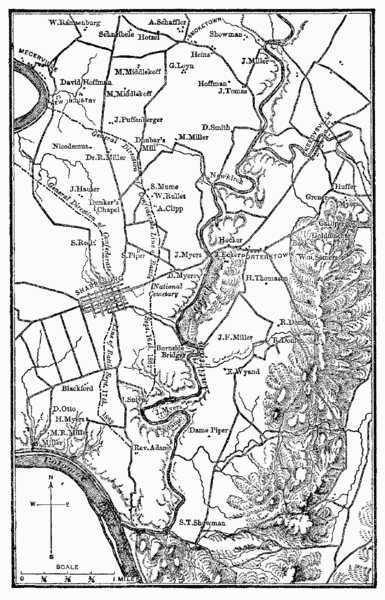
We made a large group as we stood upon the hill, and it was not long before we attracted the enemy's attention. A puff of white smoke from a knoll on the right of the Sharpsburg road was followed by the screaming of a shell over our heads. McClellan directed that all but one or two should retire behind the ridge, while he continued the reconnoissance, walking slowly to the right. I think Fitz-John Porter was the only general officer who was retained as a companion in this walk. I noted with satisfaction the cool and business-like air with which McClellan made his examination under fire. The Confederate artillery was answered by a battery of ours, and a lively cannonade ensued on both sides, though without any noticeable effect. The enemy's position was revealed, and he was evidently in force on both sides of the turnpike in front of Sharpsburg, covered by the undulations of the rolling ground which hid his infantry from our sight.
The examination of the enemy's position and the discussion of it continued till near the close of the day. Orders were then given for the Ninth Corps to move to the left, keeping off the road, which was occupied by other troops. We moved through fields and farm lands, an hour's march in the dusk of evening, going into bivouac about a mile south of the Sharpsburg bridge, and in rear of the hills bordering the Antietam.
The village of Sharpsburg is in the midst of a plateau which is almost enclosed by the Potomac River and the Antietam. The Potomac bounds it on the south and west, and the Antietam on the east. The plateau in general outline may be considered a parallelogram, four miles in length from north to south, and two and a half miles in width inside the bends of the river. The northern side of this terrain appears the narrowest, for here the river curves sharply away to the west, nearly doubling the width of the field above and below the bend. From the village the ground descends in all directions, though a continuous ridge runs northward, on which is the Hagerstown turnpike. The Boonsboro turnpike enters the village from the northeast, crossing the Antietam on a stone bridge, and continuing through Sharpsburg to the southwest, reaches Shepherdstown by the ford of the Potomac already mentioned. The Hagerstown turnpike enters the town from the north, passing the Dunker Church a mile out, and goes nearly due south, crossing the Antietam at its mouth, and continuing down the Potomac toward Harper's Ferry.
The Antietam is a deep creek, with few fords at an ordinary stage of water, and the principal roads cross it upon stone bridges. Of these there were three within the field of battle; the upper one in front of Keedysville, the middle one upon the Boonsboro turnpike, and the lower one on the Sharpsburg and Rohrersville road, since known as Burnside's bridge. McClellan's staff was better supplied with officers of engineers than the staff of most of our separate armies, and Captain Duane, his chief engineer, systematized the work of gathering topographical information. This was communicated to the general officers in connection with the orders which were given them. In this way we were instructed that the only fords of the Antietam passable at that time were one between the two upper bridges named, and another about half a mile below Burnside's bridge, in a deep bend of the stream. We found, however, during the engagement of the 17th, another practicable crossing for infantry a short distance above the bridge. This was not a ford in common use, but in the low stage of water at the time it was made available for a small force.
It was about noon of the 15th of September that Lee placed the forces which he had in hand across the turnpike in front of Sharpsburg. D. H. Hill's division was on the north of the road, and on the south of it Longstreet's own old division (now under General D. R. Jones), Hood's division, and Evans's independent brigade. Stuart's cavalry and the reserve artillery were also present. The rest of the army was with Jackson at Harper's Ferry, or co-operating with him in the neighborhood of Maryland Heights. Out of forty-four brigades, Lee could put but fourteen or fifteen in line that day to oppose McClellan. He was very strong in artillery, however, and his cannon looked grimly over the hill-crests behind which his infantry were lying. Cutts's and Jones's battalions of the reserve artillery were ordered to report to Hill for the protection of the left of the Confederate line, and gave him in all the sixty or seventy guns which he speaks of in his report, and which have puzzled several writers who have described the battle. Whenever our troops showed themselves as they marched into position, they were saluted from shotted cannon, and the numerous batteries that were developed on the long line of hills before us no doubt did much to impress McClellan with the belief that he had the great bulk of Lee's army before him.
The value of time was one of the things McClellan never understood. He should have been among the first in the saddle at every step in the campaign after he was in possession of Lee's order of the 9th, and should have infused energy into every unit in his army. Instead of making his reconnoissance at three in the afternoon of Monday, it might have been made at ten in the morning, and the battle could have been fought before night, if, indeed, Lee had not promptly retreated when support from Jackson would thus have become impossible. Or if McClellan had pushed boldly for the bridge at the mouth of the Antietam, nothing but a precipitate retreat by Lee could have prevented the interposition of the whole National army between the separated wings of the Confederates. The opportunity was still supremely favorable for McClellan, but prompt decision was not easy for him. Nothing but reconnoitring was done on Monday afternoon or on Tuesday, whilst Lee was straining every nerve to concentrate his forces and to correct what would have proven a fatal blunder in scattering them, had his opponent acted with vigor. The strongest defence the eulogists of the Confederate general have made for him is that he perfectly understood McClellan's caution and calculated with confidence upon it; that he would have been at liberty to perfect his combinations still more at leisure, but for the accident by which the copy of his plan had fallen into our hands at Frederick City.
During the 16th we confidently expected a battle, and I kept with my division. In the afternoon I saw General Burnside, and learned from him that McClellan had determined to let Hooker make a movement on our extreme right to turn Lee's position. Burnside's manner in speaking of this implied that he thought it was done at Hooker's solicitation, and through his desire, openly evinced, to be independent in command. I urged Burnside to assume the immediate command of the corps and allow me to lead my own division. He objected that as he had been announced as commander of the right wing of the army, composed of the two corps, he was unwilling to waive his precedence or to assume that Hooker was detached for anything more than a temporary purpose. I pointed out that Reno's staff had been granted leave of absence to take the body of their chief to Washington, and that my division staff was too small for corps duty; but he met this by saying that he would use his staff for this purpose, and help me in every way he could till the crisis of the campaign should be over. Sympathizing with his very natural feeling, I ceased objecting, and accepted with as good grace as I could the unsatisfactory position of nominal commander of the corps to which I was a comparative stranger, and which, under the circumstances, naturally looked to him as its accustomed and real commander. Burnside's intentions in respect to myself were thoroughly friendly, as he afterward proved, and I had no ground for complaint on this score; but the position of second in command is always an awkward and anomalous one, and such I felt it.
The 16th passed without serious fighting, though we had desultory cannonading and picket firing. It was hard to restrain our men from showing themselves on the crest of the long ridge in front of us, and whenever they did so they drew the fire from some of the enemy's batteries, to which ours would respond. McClellan reconnoitred the line of the Antietam near us, and the country immediately on our left, down the valley. As the result of this we were ordered to change our positions at nightfall, staff officers being sent to guide each division to its new camp. The selected positions were marked by McClellan's engineers, who then took members of Burnside's staff to identify the locations, and these in turn conducted our divisions. There was far more routine of this sort in that army than I ever saw elsewhere. Corps and division commanders should have the responsibility of protecting their own flanks and in choosing ordinary camps. To depend upon the general staff for this is to take away the vigor and spontaneity of the subordinate and make him perform his duty in a mechanical way. He should be told what is known of the enemy and his movements so as to be put upon his guard, and should then have freedom of judgment as to details. The changes made were as follows: Rodman's division went half a mile further to the left, where a country road led to the Antietam ford, half a mile below the Burnside bridge. Sturgis's division was placed on the sides of the road leading to the stone bridge just mentioned. Willcox's was put in reserve in rear of Sturgis. My own was divided, Scammon's brigade going with Rodman, and Crook's going with Sturgis. Crook was ordered to take the advance in crossing the bridge in case we should be ordered to attack. This selection was made by Burnside himself as a compliment to the division for the vigor of its assault at South Mountain. While we were moving we heard Hooker's guns far off on the right and front, and the cannonade continued an hour or more after it became dark.
What, then, was the plan of battle of which the first step was this movement of Hooker's? McClellan's dispositions on the 15th were made whilst Franklin's corps was still absent, and, under the orders he received, was likely to be so for a day at least. [Footnote: Official Records, vol. xix. pt. i. p. 29.] Sumner's two corps had been treated as the centre of the army in hand, Burnside's had been divided by putting Hooker on the extreme right and the Ninth Corps on the extreme left, and Porter's corps was in reserve. This looked as if a general attack in front with this organization of the army were intended. But the more McClellan examined the enemy's position the less inclined he was to attack the centre. He could cross the bridge there and on the right, and deploy; but the gentle slopes rising toward Sharpsburg were swept by formidable batteries and offered no cover to advancing troops. The enemy's infantry was behind stone fences and in sunken roads, whilst ours must advance over the open. Lee's right rested upon the wooded bluffs above the Burnside bridge, where it could only be approached by a small head of column charging along the narrow roadway under a concentrated fire of cannon and small arms. No point of attack on the whole field was so unpromising as this. Then, as Jackson was still at Harper's Ferry, there was the contingency of an attack in rear if anything less than the mass of our army were pushed beyond Lee's right.
On our right, in front of Hooker, it was easy to turn the Confederate line. The road from Keedysville through Smoketown to the Hagerstown turnpike crossed the Antietam in a hollow, out of the line of fire, and a march around Lee's left flank could be made almost wholly under cover. The topography of the field therefore suggested a flank attack from our right, if the National commander rejected the better strategy of interposing his army between Lee and Jackson as too daring a movement. This flank attack McClellan determined to make, and some time after noon of the 16th issued his orders accordingly. In his preliminary report of the battle, made before he was relieved from command, McClellan says:--
"The design was to make the main attack upon the enemy's left,--at least to create a diversion in favor of the main attack, with the hope of something more, by assailing the enemy's right,--and as soon as one or both of the flank movements were fully successful, to attack their centre with any reserve I might then have in hand." [Footnote: O R., vol. xix. pt. i. p. 30.]
His report covering his whole career in the war, dated August 4, 1863 (and published February, 1864, after warm controversies had arisen, and he had become a political character), modifies the above statement in some important particulars. It says:--
"My plan for the impending general engagement was to attack the enemy's left with the corps of Hooker and Mansfield supported by Sumner's and if necessary by Franklin's, and as soon as matters looked favorably there, to move the corps of Burnside against the enemy's extreme right upon the ridge running to the south and rear of Sharpsburg, and having carried their position to press along the crest toward our right, and whenever either of these flank movements should be successful, to advance our centre with all the forces then disposable." [Footnote: Official Records, vol. xix, pt. i, p. 55.]
The opinion I got from Burnside at the time, as to the part the Ninth Corps was to take, was fairly consistent with the design first quoted, namely, that when the attack by Sumner, Hooker, and Franklin should be progressing favorably, we were "to create a diversion in favor of the main attack, with the hope of something more." It is also probable that Hooker's movement was at first intended to be made by his corps alone, the attack to be taken up by Sumner's two corps as soon as Hooker began, and to be shared in by Franklin if he reached the field in time, thus making a simultaneous oblique attack from our right by the whole army except Porter's corps, which was in reserve, and the Ninth Corps, which was to create the "diversion" on our left and prevent the enemy from stripping his right to reinforce his left. It is hardly disputable that this would have been a better plan than the one actually carried out. Certainly the assumption that the Ninth Corps could cross the Antietam alone at the only place on the field where the Confederates had their line immediately upon the stream which must be crossed under fire by two narrow heads of column, and could then turn to the right along the high ground occupied by the hostile army before that army had been broken or seriously shaken elsewhere, is one which would hardly be made till time had dimmed the remembrance of the actual position of Lee's divisions upon the field. It is also noticeable that the plan as given in the final report leaves no "centre" with which to "advance" when either of the flank movements should be successful, Porter's corps in reserve being the only one not included in the movement as described.
Further evidence that the plan did not originally include the wide separation of two corps to the right to make the extended turning movement is found in Hooker's incomplete report, and in the wide interval in time between the marching of his corps and that of Mansfield. Hooker was ordered to cross the Antietam at about two o'clock in the afternoon of the 16th by the bridge in front of Keedysville and the ford below it. He says that after his troops were over and in march, he rode back to McClellan, who told him that he might call for reinforcements, and that when they came they should be under his command. Somewhat later McClellan rode forward with his staff to observe the progress making, and Hooker again urged the necessity of reinforcements. [Footnote: Official Records, vol. xix. pt. i. p. 217.] Yet Sumner did not receive orders to send Mansfield's corps to his support till evening, and it marched only half an hour before midnight, [Footnote: Id., p. 275.] reaching its bivouac, about a mile and a half in rear of that of Hooker, at 2 A.M. of the 17th. [Footnote: Id., p. 475.]
After crossing the Antietam, Hooker had shaped his course to the westward, aiming to reach the ridge on which the Hagerstown turnpike runs, and which is the dominant feature in the landscape. This ridge is about two miles distant from the Antietam, and for the first mile of the way no resistance was met. However, his progress had been observed by the enemy, and Hood's two brigades were taken from the centre and passed to the left of D. H. Hill. Here they occupied an open wood (since known as the East Wood) northeast of the Dunker Church. Hooker was now trying to approach the Confederate positions, Meade's division of the Pennsylvania Reserves being in the advance. A sharp skirmishing combat ensued, and artillery was brought into action on both sides. I have mentioned our hearing the noise of this engagement from the other extremity of the field in the fading light of evening. On our side Seymour's brigade had been chiefly engaged, and had felt the enemy so vigorously that Hood supposed he had repulsed a serious effort to take the wood. Hooker was, however, aiming to pass quite beyond the flank, and kept his other divisions north of the hollow beyond the wood, and upon the ridge which reaches the turnpike near the largest re-entrant bend of the Potomac, which is only half a mile distant. Here he bivouacked upon the slopes of the ridge, Doubleday's division resting with its right upon the turnpike, Ricketts's division upon the left of Doubleday, and Meade covering the front of both with the skirmishers of Seymour's brigade. Between Meade's skirmishers and the ridge were the farmhouse and barn of J. Poffenberger, on the east side of the road, where Hooker made his own quarters for the night. Half a mile further in front was the farm of D. R. Miller, the dwelling on the east, and the barn surrounded by stacks on the west of the road. [Footnote: Hooker's unfinished report says he slept in the barn of D. R. Miller, but he places it on the east of the road, and the spot is fully identified as Poffenberger's by General Gibbon, who commanded the right brigade, and by Lieutenant-Colonel Rufus R. Dawes, Sixth Wisconsin (afterward Brevet Brigadier-General), both of whom subsequently visited the field and determined the positions.] Mansfield's corps (the Twelfth), marching as it did late in the night, kept further to the right than Hooker's, but moved on a nearly parallel course, and bivouacked on the farm of another J. Poffenberger, [Footnote: Official Records, vol. xix. pt. i. pp. 275, 475.] near the road which, branching from the Hagerstown turnpike at the Dunker Church, intersects the one running from Keedysville through Smoketown to the same turnpike about a mile north of Hooker's position. [Footnote: See map, p. 299.]
On the Confederate side, Hood's division had been so roughly handled that it was replaced by two brigades of Ewell's division (commanded by Lawton), which with Jackson's own (commanded by J. R. Jones) had been led to the field from Harper's Ferry by Jackson, reaching Sharpsburg in the afternoon of the 16th. These divisions were formed on the left of D. H. Hill, and in continuation of his line along the turnpike, but with a brigade advanced to the East Wood, which was held as a salient. Hood's division, on being relieved, was placed in reserve near the Dunker Church, and spent part of the night in cooking rations, of which its supply had been short for a day or two. [Footnote: Official Records, vol. xix. pt. i. p. 923.] The combatants on both sides slept upon their arms, well knowing that the dawn would bring bloody work.
During the evening McClellan issued orders looking toward the joining of a general engagement at daybreak. McLaws's Confederate division, which had been opposing Franklin, crossed the Potomac at Maryland Heights, and marched by way of Shepherdstown, reaching Sharpsburg on the morning of the 17th. [Footnote: Id., pp. 855, 856.] Walker's division, which had come from Harper's Ferry on the 16th, extended Lee's right down the Antietam, covering the ford at which Rodman, on our side, was expected to cross. [Footnote: Id., p. 914.] A. P. Hill's division was the only force of the enemy completing the work at Harper's Ferry, and Franklin was ordered to leave Couch's division to observe Hill's movements from our side of the Potomac, and to bring the remainder of his corps on the field early in the morning. [Footnote: Id., p. 376.] In the respite given him since Sunday, Lee had therefore concentrated all his army but one division, and was better ready for the battle than McClellan, for Franklin's corps could come upon the field only after a considerable march, and he did not, in fact, reach it till ten o'clock or later. Sumner was ordered to have the Second Corps ready to march an hour before day, but he had no authority to move till explicit orders to that effect should reach him. I have said that Hooker claims in his report that the promise was made him that Mansfield's corps, when it came to reinforce him, should be under his orders. If this were so, it would unite all the troops now present which had fought in Pope's Army of Virginia. I find no trace, however, in the reports of the battle, that Hooker exercised any such command. He seems to have confined his work to the independent action of his own corps until Mansfield's death, and was himself disabled almost immediately afterward. As there were commanders of wings of the army duly designated, and two corps were now separated by a long interval from the rest in an independent turning movement, it can hardly be debated that that was the place of all others where one of them should have been, unless McClellan were there in person. Had Burnside's two corps been kept together as the right wing, the right attack could have been made a unit. If Sumner had then been directed to keep in communication with Burnside, and to advance when the latter did, nobody will doubt that Sumner would have been prompt in sustaining his comrades. But both Sumner and Burnside were made to feel that they were reduced from their proper rank, and however conscientious they might be in carrying out such orders as reached them, it was not in human nature that they should volunteer suggestions or anticipate commands. McClellan had thus thrown away the advantages, if there were any, in holding only two or three men directly responsible for the co-ordination of his movements, and had assumed the full personal responsibility of watching each phase of the battle and suiting the proper orders to each conjuncture as it should arise.
CHAPTER XV
ANTIETAM: THE FIGHT ON THE RIGHT
Hooker astir early--The field near the Dunker Church--Artillery combat--Positions of Hooker's divisions--Rocky ledges in the woods--Advance of Doubleday through Miller's orchard and garden--Enemy's fire from West Wood--They rush for Gibbon's battery--Repulse--Advance of Patrick's brigade--Fierce fighting along the turnpike--Ricketts's division in the East Wood--Fresh effort of Meade's division in the centre--A lull in the battle--Mansfield's corps reaches the field--Conflicting opinions as to the hour--Mansfield killed--Command devolves on Williams--Advance through East Wood--Hooker wounded--Meade in command of the corps--It withdraws--Greene's division reaches the Dunker Church--Crawford's in the East Wood--Terrible effects on the Confederates--Sumner's corps coming up--Its formation--It moves on the Dunker Church from the east--Divergence of the divisions--Sedgwick's passes to right of Greene--Attacked in flank and broken--Rallying at the Poffenberger hill--Twelfth Corps hanging on near the church--Advance of French's division--Richardson follows later--Bloody Lane reached--The Piper house--Franklin's corps arrives--Charge of Irwin's brigade.
Before the break of day on Wednesday the 17th, it was discovered that Doubleday's division of Hooker's corps lay exposed to artillery fire from batteries of the enemy supposed to be in position on their front and right. In rousing the men and changing their place, the stillness of the night was so far broken that the Confederates believed they were advancing to attack, and a lively cannonade and picket firing anticipated the dawn. [Footnote: R. R. Dawes, Service with the Sixth Wisconsin, p. 87.] The chance for getting their breakfast was thus destroyed, and Hooker prepared his whole command for action as soon as it should be light enough to move. Looking south from the Poffenberger farm along the turnpike, he then saw a gently rolling landscape of which the commanding point was the Dunker Church, whose white brick walls appeared on the right of the road, backed by the foliage of the West Wood, which came toward him filling a hollow that ran parallel to the turnpike, with a single row of fields between. On the east side of the turnpike was the Miller house, with its barn and stack-yard across the road to the right, and beyond these the ground dipped into a little depression. Still further on was seen a large cornfield between the East Wood and the turnpike, rising again to the higher level, and Hooker noticed the glint from a long line of bayonets beyond the corn, struck by the first rays of the rising sun. There was, however, another little hollow at the further side of the cornfield, which could not be seen from Hooker's position; and on the farthest ridge, near the church and extending across the turnpike toward the East Wood, were the Confederate lines, partly sheltered by piles of rails taken from the fences. They looked to Hooker as if they were deployed along the edge of the corn, but an open sloping field lay between the corn and them, after passing the second hollow. It was plain that the high ground about the little white church was the key of the enemy's position, and if that could be carried, Hooker's task would be well done.
The enemy's artillery had opened early from a high hill nearly east of the Miller house in a position to strike our forces in flank and rear as they should go forward, and Hooker placed batteries on the equally commanding height above Poffenberger's and detached Hofmann's brigade from Doubleday's division to support it and to prevent the enemy from turning our extreme right. [Footnote: Official Records, vol. xix. pt. i. p. 224.] This force maintained its position during the day, and was the nucleus about which both Hooker's and Sedgwick's men rallied after their fight. The enemy's artillery referred to were several batteries under Stuart's command supported by his cavalry and by Early's brigade of infantry which Jackson detached for that purpose. [Footnote: Official Records vol. xix. pt. i. p. 819.]
Doubleday's division (except Hofmann), was in two lines, Gibbon's and Phelps's in front, supported by Patrick's. Of Meade's division Seymour's brigade, which had sustained the combat of the evening before, had continued to cover the front with skirmishers during the night, and remained on the northeast side of the East Wood. The other brigades (Anderson and Magilton) were placed in reserve behind Doubleday. [Footnote: Id., p. 269.] The Tenth Regiment Pennsylvania Reserves was sent from Anderson's to a strong position west of the turnpike near the extremity of the strip of wood northwest of the Miller house. It was among ledges of rock looking into the ravine beyond which were Stuart and Early. The ravine was the continuation northward to the Potomac of a little watercourse which headed near the Dunker Church and along one side of which the West Wood lay, the outcrop of rock making broken ledges along its whole length. Indeed, all the pieces of wood in the neighborhood seemed to be full of such rocks, and for that reason had been allowed to remain in forest. The regiment was ordered to cover its front with skirmishers and to hold its position at all hazards. Ricketts's division had bivouacked in a wood east of Doubleday's. Its three brigades (Duryea's, Hartsuff's, and Christian's) were deployed on the left of Doubleday, and were to march toward the Dunker Church through the East Wood, passing the line of Seymour's brigade, which was then to become its support.
The Confederates opened a rapid artillery fire from the open ground in front of the Dunker Church as well as from Stuart's position, and Hooker answered the challenge by an immediate order for his line to advance. Doubleday directed Gibbon, who was on the right, to guide upon the turnpike. Patrick remained for a time in the wood north of the Miller house, till he should be needed at the front. [Footnote: Official Records, vol. xix. pt. i. p. 224.] Doubleday and his brigade commanders seem to have supposed that Meade's men occupied part at least of the West Wood, and that they would cover Gibbon's flank as he advanced. This belief was based on the stationing of the Tenth Pennsylvania Reserves; but that regiment was fifteen or twenty rods north of the northern end of the West Wood, and Gibbon's right flank, as he advanced, was soon exposed to attack from Ewell's division (Lawton in command), which held the wood, hidden from view and perfectly protected by the slope of the ground and the forest, as they looked over the rim into the undulating open fields in front. Part of Battery B, Fourth United States Artillery (Gibbon's own battery), was run forward to Miller's barn and stack-yard on the right of the road, and fired over the heads of the advancing regiments. [Footnote: Id., pp. 229, 248.] Other batteries were similarly placed, more to the left, and our cannon roared from all the hill crests encircling the field. The line moved swiftly forward through Miller's orchard and kitchen garden, breaking through a stout picket fence on the near side, down into the moist ground of the hollow, and up through the corn which was higher than their heads and shut out everything from view. [Footnote: Dawes, Sixth Wisconsin, p. 88.] At the southern side of the field they came to a low fence, beyond which was the open field already mentioned, and the enemy's line at the further side of it. But the cornfield only covered part of the line, and Gibbon's right had outmarched the left, which had been exposed to a terrible fire. The direction taken had been a little oblique, so that the right wing of the Sixth Wisconsin (the flanking regiment) had crossed the turnpike and was suddenly assailed by a sharp fire from the West Wood on its flank. They swung back into the road, lying down along the high, stout post-and-rail fence, keeping up their fire by shooting between the rails. [Footnote: Dawes, Sixth Wisconsin, p. 89.]
Leaving this little band to protect their right, the main line, which had come up on the left, leaped the fence at the south edge of the cornfield, and charged up hill across the open at the enemy in front. But the concentrated fire of artillery and musketry was more than they could bear. Men fell by scores and hundreds, and the thinned lines gave way and ran for the shelter of the corn. They were rallied in the hollow on the north side of the field. The enemy had rapidly extended his left under cover of the West Wood, and now made a dash at the right flank and at Gibbon's exposed guns. His men on the right faced by that flank and followed him bravely, though with little order, in a dash at the Confederates who were swarming out of the wood. [Footnote: Id., p. 91.] The gunners double-charged the cannon with canister, and under a terrible fire of artillery and rifles Lawton's division broke and sought shelter. [Footnote: Official Records, vol. xix. pt. i. p. 248.]
Patrick's brigade had now come up in support of Gibbon, and was sent across the turnpike into the West Wood to cover that flank, two regiments of Gibbon's going with him. [Footnote: Id., p. 243.] His men pushed forward, the enemy retiring, until they were in advance of the principal line in the cornfield upon which the Confederates of Jackson's division were now marching to attack. Patrick faced his brigade to the left, parallel to the edge of the wood and to the turnpike, and poured his fire into the flank of the enemy, following it by a charge through the field and up to the fence along the road. Again the Confederates were driven back, but their left came forward in the wood again, attacking Patrick's right, forcing him to resume his original direction of front and to retire to the cover of a rocky ledge in the open at right angles to the turnpike not far from the northern end of the timber. Phelps's brigade had gone forward with Gibbon's, pushing nearly to the Confederate lines, and being driven back with great loss when they charged over open ground against the enemy.
Ricketts's division advanced from the wood in which it had spent the night, passed through Seymour's skirmishers and entered the East Wood, swinging his left forward as he went. This grove was open, but the rocks made perfect cover for Jackson's men, and every stone and tree blazed with deadly fire. Hartsuff endeavored to reconnoitre the ground, but was wounded and disabled immediately. Ricketts pushed on, suffering fearfully from an enemy which in open order could fall back from rock to rock and from tree to tree with little comparative loss. He succeeded at last in reaching the west edge of this wood, forming along the road and fences that were just within its margin. Here he kept up a rapid fire till his ammunition was exhausted. [Footnote: Official Records, vol. xix. pt. i. p. 258.]
When Doubleday's men had been finally repulsed, our line on the right curved from the ledge where Patrick took refuge, forward in front of Miller's orchard and garden, part of Gibbon's men lying down along the turnpike fence facing to the west. Meade's two brigades in reserve were sent forward, but when they reached Gibbon and Phelps, Ricketts was calling for assistance in the East Wood and Magilton's brigade was sent to him, leaving a gap on the left of Anderson. Another gallant effort was now made, Seymour's depleted brigade striving to cover the opening, but the enemy dashed at it as Anderson came up the slope, and the left being taken in flank, the whole broke again to the rear. [Footnote: Id., pp. 269, 270.] Ricketts's right was also imperilled, and he withdrew his exhausted lines to reorganize and to fill their empty cartridge-boxes. There was a lull in the battle, and the combatants on both sides were making desperate efforts to reform their broken regiments.
Mansfield had called the Twelfth Corps to arms at the first sound of Hooker's battle and marched to his aid. [Footnote: Official Records, vol. xix. pt. i. p. 475.] It consisted of two divisions, Williams's and Greene's, the first of two and the other of three brigades. There were a number of new and undrilled regiments in the command, and in hastening to the front in columns of battalions in mass, proper intervals for deployment had not been preserved, and time was necessarily lost before the troops could be put in line. Indeed, some of them were not regularly deployed at all. They had left their bivouac at sunrise which, as it was about the equinox, was not far from six o'clock. They had marched across the country without reference to roads, always a very slow mode of advancing, and doubly so with undrilled men. The untrained regiments must, in the nature of things, have been very much like a mob when their so-called columns-in-mass approached the field of battle. It is impossible to reconcile the statements of the reports as to the time they became engaged. General Williams says they were engaged before seven o'clock. [Footnote: Id., p. 476.] General Meade says they relieved his men not earlier than ten or eleven. [Footnote: Id., p. 270.] It seems to be guesswork in both cases, and we are forced to judge from circumstantial evidence. Ricketts thinks he had been fighting four hours when he retired for lack of ammunition, and the Twelfth Corps men had not yet reached him. [Footnote: Id., p. 259.] Patrick, on the extreme right, says that his men had made their coffee in the lull after his retreat to the sheltering ledge of rocks, and had completed their breakfast before the first of Mansfield's men joined him there. [Footnote: Id., p. 244.] The circumstantial details given by several officers make the interval between the attack by the Twelfth Corps and the arrival of Sumner a very short one. It may be regarded as probable, therefore, that Hooker's battle covered the larger part of the time between six o'clock and the arrival of Sumner at about ten.
On reaching the field, Mansfield had a brief consultation with Hooker, resulting in his ordering Williams to form his division nearly as Doubleday's had been, and to advance with his right upon the turnpike. He himself led forward the left of Crawford's brigade, which was the first to arrive, and pushed toward the East Wood. The regiments were still in columns of companies, and though Williams had ordered them deployed, the corps commander himself, as Crawford says, countermanded this order and led them under fire in column. [Footnote: Official Records, vol. xix. pt. i. p. 484.] He evidently believed Ricketts's men to be still holding the East Wood, and tried to keep his own from opening fire upon the troops that were seen there. At this moment he was mortally wounded, before the deployment was made.
General Alpheus S. Williams, on whom the command devolved, was a cool and experienced officer. He hastened the deployment of Crawford's and Gordon's brigades of his own division, sending one of the new and large regiments to assist the Pennsylvania regiment in holding the important position covering the right beyond the turnpike. As Greene's division came up, he ordered him to form beyond Gordon's left, and when deployed to move on the Dunker Church through the East Wood, guiding his left by the cloud of smoke from the Mumma house, which had been set on fire by D. H. Hill's men. [Footnote:Id., pp. 475, 1033.] At Doubleday's request, he detached Goodrich's brigade from Greene, and sent it to Patrick on the right with orders to advance into the West Wood from its northern extremity. Patrick says the regiments came separately and at considerable intervals, [Footnote: Official Records, vol. xix. pt. i. p. 244.] and it is not unlikely that the older regiments were sent in to relieve Hooker's men as fast as they were ready, and the more disorganized ones were obliged to delay till they could be got into some sort of shape. Williams made his first disposition of his troops according to Hooker's suggestion, but the latter received a serious wound in the foot, as it would seem, before the attack by the Twelfth Corps had begun. Hooker turned over the command to Meade, and a formal order confirming this was issued from McClellan's head-quarters later in the day. [Footnote: Id., pt. ii. p. 315.]
So many of the regiments were carried under fire while still in column that not only was the formation of the line an irregular one, but the deployment when made was more diagonal to the turnpike than Hooker's had been, and the whole line faced more to the westward. But they advanced with a courage equal to the heroism already shown on that field. The Confederates who now held the open space at the Dunker Church were Hood's two brigades, and the rest of Jackson's corps extended into the West Wood. Stuart had found his artillery position on the hill too far from Jackson's line, and the fighting was so near the church that he could not fire upon our men without hurting his own. [Footnote: Id., pt. i. p. 820.] He therefore moved further to the south and west, and Early carried his brigade (except the Thirteenth Virginia) back toward Ewell's division, which now came under his command by the disabling of General Lawton in the fight. [Footnote: Id., pp. 968, 969.]
Williams's first line was a good deal shortened, and the divisions, guiding as well as they could upon Greene, crowded so far to the south that even Crawford's brigade, which was on the right of all, went partly through the East Wood advancing on a line nearly at right angles to the turnpike. The enemy had followed Ricketts's retiring battalions and were again in occupation of the East Wood. His work was to be done over again, though the stubborn courage of Hood's depleted brigades could not make up for the numbers which the National officers now led against him. But the rocks, the ledges, and the trees still gave him such cover that it was at a fearful cost that the Twelfth Corps men pushed him steadily back and then by a final rush drove him from the roads which skirted the grove on west and south. What was left of Jackson's corps except Early's brigade had come out of the West Wood to meet Crawford's division, and the stout high fences along the turnpike were the scene of frightful slaughter. [Footnote: Official Records, vol. xix. pt. i. pp. 485, 487.] The Confederates tried to climb them, but the level fire of our troops swept over the field so that the top of the fence seemed in the most deadly line of the leaden storm, and the men in gray fell in windrows along its panels. Our own men were checked by the same obstacle, and lay along the ground shooting between the rails and over the fallen bodies of the Confederate soldiers which made a sort of rampart.
In obedience to his original orders, Greene took ground a little more to his left, occupying a line along a fence from the burning Mumma house to the road leading from the East Wood directly to the Dunker Church. [Footnote: Id., p. 505.] The two brigades with thinned ranks barely filled this space, and Crawford's division connected with them as well as it could. Batteries came forward on Greene's left and right, and helped to sweep the grove around the church. Hill attempted to hold him back, and a bold dash was made at Greene, probably by Hill's left brigades which were ordered forward to support Hood. Greene's men lay on the ground just under the ridge above the burning house till the enemy were within a few rods of them, then rose and delivered a volley which an eyewitness (Major Crane, Seventh Ohio) says cut them down "like grass before the mower." [Footnote: Official Records, vol. xix. pt. i. p. 506.] Those who escaped sought refuge in the wood behind the church, where the crowning ridge is some distance back from the road. Greene now dashed forward and gained the grove immediately about the church, where he held on for an hour or two. Crawford's division, after several ebbs and flows in the tide of battle, was holding the western skirt of the East wood with one or two of its regiments still close to the turnpike fence on his right.
Meanwhile Goodrich had been trying to advance from the north end of the West Wood to attack the flank of the enemy there; but Early with his own brigade held the ledges along the ravine so stubbornly that he was making little progress.
Greene was calling for support about the Dunker Church, for he was close under the ridge on which Hill and Jackson were forming such line as they could, and he was considerably in advance of our other troops. Williams withdrew one regiment from Goodrich's brigade and sent it to Greene, and directed Crawford to send also to him the Thirteenth New Jersey, a new and strong regiment which had been left in reserve, as we have seen, in a bit of wood northeast of the field of battle. [Footnote: Id., pp. 476, 505.] Gordon's brigade was withdrawn by Crawford to enable it to reorganize in rear of the East Wood, and Crawford's own brigade held the further margin of it. It will thus be seen that the Twelfth Corps was now divided into three portions,--Greene's division at the church, Crawford's in the East Wood, and Goodrich's brigade near the north end of the West Wood.
Meade had withdrawn the First Corps to the ridge at Poffenberger's, where it had bivouacked the night before, except that Patrick's brigade remained in support of Goodrich. The corps had suffered severely, having lost 2470 in killed and wounded, but it was still further depleted by straggling, so that Meade reported less than 7000 men with the colors that evening. [Footnote: Official Records, vol. xix. pt. ii. p. 349.] Its organization had been preserved, however, and the story that it was utterly dispersed was a mistake. The Twelfth Corps also had its large list of casualties, increased a little later by its efforts to support Sumner, and aggregating, before the day was over, 1746.
But the fighting of Hooker's and Mansfield's men, though lacking unity of force and of purpose, had also cost the enemy dear. J. R. Jones, who commanded Jackson's division, had been wounded; Starke, who succeeded Jones, was killed; Lawton, who commanded Ewell's division, was wounded. [Footnote: Id., pt. i. p. 956.] Lawton's and Trimble's brigades had been fearfully crippled in the first fight against Hooker on the plateau between the Dunker Church and the East Wood, and Hood was sent back to relieve them. [Footnote: Id., p. 923.] He, in turn, had been reinforced by the brigades of Ripley, Colquitt, and McRae (Garland's) from D. H. Hill's division. [Footnote: Id., p. 1022.] When Greene reached the Dunker Church, therefore, the Confederates on that wing were more nearly disorganized than our own troops. Nearly half their numbers were killed and wounded, and Jackson's famous "Stonewall" division was so completely broken up that only a handful of men under Colonels Grigsby and Stafford remained, and attached themselves to Early's command. [Footnote:Id., p. 969.] Of the division now under Early, his own brigade was all that retained much strength, and this, posted among the rocks in the West Wood and vigorously supported by Stuart and the artillery on that flank, was all that covered the left of Lee's army. Could Hooker and Mansfield have attacked together, or, still better, could Sumner's Second Corps have marched before day and united with the first onset, Lee's left must inevitably have been crushed long before the Confederate divisions of McLaws, Walker, and A. P. Hill could have reached the field. It is this failure to carry out any intelligible plan which the historian must regard as the unpardonable military fault on the National side. To account for the hours between daybreak and eight o'clock on that morning, is the most serious responsibility of the National commander. [Footnote: A distinguished officer (understood to be Gen. R. R. Dawes) who visited the field in 1866 has published the statement that at the Pry house, where McClellan had his headquarters, he was informed that on the morning of the 17th the general rose at about seven o'clock and breakfasted leisurely after that hour. (Marietta, Ohio, Sentinel.)]
Sumner's Second Corps was now approaching the scene of action, or rather two divisions of it, Sedgwick's and French's, for Richardson's was still delayed till his place could be filled by Porter's troops. Although ordered to be ready to move at daybreak, Sumner emphasizes in his report the fact that whilst his command was prepared to move at the time ordered, he "did not receive from headquarters the order to march till 7.20 A. M." [Footnote: Official Records, vol. xix. pt. i. p. 275.] By the time he could reach the field, Hooker had fought his battle and had been repulsed. The same strange tardiness in sending orders is noticeable in regard to every part of the army, and Richardson was not relieved so that he could follow French till an hour or two later. [Footnote: Ibid.]
Sumner advanced, after crossing the Antietam, in a triple column, Sedgwick's division in front, the three brigades marching by the right flank and parallel to each other. French followed in the same formation. They crossed the Antietam by Hooker's route, but did not march so far to the northwest as Hooker had done. On the way Sumner met Hooker, who was being carried from the field, and the few words he could exchange with the wounded general were enough to make him feel the need of haste, but not enough to give him any clear idea of the situation. When the centre of the corps was opposite the Dunker Church, and nearly east of it, the change of direction was given; the troops faced to their proper front, and advanced in line of battle in three lines, fully deployed and sixty or seventy yards apart, Sumner himself being in rear of Sedgwick's first line and near its left. [Footnote: Official Records, vol. xix. pt. i. p. 305.] As they approached the position held by Greene's division at the church, French kept on so as to form on Greene's left, [Footnote:Id., p. 323.] but Sedgwick, under Sumner's immediate leading, diverged somewhat to the right, passing through the East Wood, crossing the turnpike on the right of Greene and of the Dunker Church, and plunged into the West Wood. [Footnote: Id., p. 305.] The fences there had been destroyed by the Confederates before the battle began, for the purpose of making room for their own manoeuvres as well as to make barricades in front of the cornfield. Sedgwick's right did not extend far enough north to be obstructed by the fences where the Twelfth Corps men had lain along them in repulsing Jackson. When he entered the wood, there were absolutely no Confederate troops in front of him. The remnants of Jackson's men, except Early's brigade, were clustered at the top of the ridge immediately in front of Greene, and Early was further to the right, opposing Goodrich and Patrick; Early, however, made haste under cover of the woods to pass around Sedgwick's right and to get in front of him to oppose his progress. [Footnote: Id., p. 970.] This led to a lively skirmishing fight in which Early was making as great a demonstration as possible, but with no chance of solid success. Sedgwick pushed him back, and his left was coming obliquely into the open at the bottom of the hollow beyond the wood, when, at the very moment, McLaws's and Walker's Confederate divisions came upon the field. The former had only just arrived by rapid marching from Shepherdstown beyond the Potomac; the latter had been hastily called away by Lee from his position on the lower Antietam opposite the left wing of Burnside's Ninth Corps. [Footnote: Official Records, vol. xix. pt. i. pp. 857, 914.]
Walker charged headlong upon the left flank of Sedgwick's lines, and McLaws, passing by Walker's left, also threw his division diagonally upon the already broken and retreating brigades. Taken at such a disadvantage, these had never a chance; and in spite of the heroic bravery of Sumner and Sedgwick with most of their officers (Sedgwick being severely wounded), the division was driven off to the north with terrible losses, carrying along in their rout Goodrich's brigade of the Twelfth Corps which had been holding Early at bay. Goodrich was killed, and his brigade suffered hardly less than the others. Patrick's brigade of Hooker's corps was in good order at the rocky ledges north of the West Wood which are at right angles to the turnpike, and he held on stubbornly till the disorganized troops drifted past his left, and then made an orderly retreat in line toward the Poffenberger hill. [Footnote: Id., p. 245.] Meade was already there with the remnants of Hooker's men. Here some thirty cannon of both corps were quickly concentrated, and, supported by everything which retained organization, easily checked the pursuers and repulsed all efforts of Jackson and Stuart to resume the offensive or to pass between them and the Potomac. [Footnote:Id., p. 306.]
Sumner did not accompany the routed troops to this position, but as soon as it was plain that the division could not be rallied, he galloped off to put himself in communication with French and with headquarters of the army and to try to retrieve the situation. From the flag station east of the East Wood he signalled to McClellan, "Reinforcements are badly wanted; our troops are giving way." [Footnote: Id., p. 134.] Williams was in that part of the field, and Sumner sent a staff officer to him ordering that he should push forward to Sedgwick's support anything he could. [Footnote: Official Records, vol. xix. pt. i. p. 477.] Williams in person ordered Gordon's brigade to advance, for this, as we have seen, had been reorganized behind the East Wood. He sent the same order to Crawford for the rest of that division. Crawford had withdrawn his men in the East Wood to let Sedgwick pass diagonally along his front, and now advanced again to the west margin of the grove. [Footnote: Id., p. 485.] Gordon was ahead of him in time and further to the right, and again charged up to the turnpike fences. But the routed troops were already swarming from the wood across his front, and their pursuers were charging after them. Again the turnpike was made the scene of a bloody conflict, and the bodies of many more of the slain of both armies were added to those which already lined those fences. Gordon's men were overpowered and fell back in the direction they had come. [Footnote: Id., p. 495.] The enemy's attack spread out toward Greene and toward Crawford, who was now at the edge of the East Wood again; but both of these held firm, and a couple of batteries on the rise of ground in front poured canister into the enemy till he took refuge again in the wood beyond the church. It was between nine and ten o'clock, probably about ten, [Footnote: The reports on the Confederate side fix ten o'clock as the time McLaws and Walker reached the field, and corroborate the conclusion I draw from all other available evidence.] when Sumner entered the West Wood, and in fifteen minutes or a little more the one-sided combat was over.
Sumner's principal attack was made, as I have already indicated, at right angles to that of Hooker. He had thus crossed the line of Hooker's movement in both the advance and the retreat of the latter. This led to some misconceptions on Sumner's part. Crawford's division had retired to the right and rear to make way for Sedgwick as he came up. It thus happened that Greene's division was the only part of the Twelfth Corps troops Sumner saw, and he led Sedgwick's men to the right of these. Ignorant as he necessarily was of what had occurred before, he assumed that he formed on the extreme right of the Twelfth Corps, and that he fronted in the same direction as Hooker had done. This misconception of the situation led him into another error. He had seen only stragglers and wounded men on the line of his own advance, and hence concluded that Hooker's Corps was completely dispersed and its division and brigade organizations broken up. He not only gave this report to McClellan at the time, but reiterated it later in his statement before the Committee on the Conduct of the War. [Footnote: C. W., vol. i. p. 368.] The truth was that he had marched westward more than a mile south of the Poffenberger hill where Meade was with the sadly diminished but still organized First Corps, and half that distance south of the Miller farm buildings, near which Goodrich's brigade had entered the north end of the West Wood, and in front of which part of Williams's men had held the ground along the turnpike till they were relieved by Sedgwick's advance. Sedgwick had gone in, therefore, between Greene and Crawford, and the four divisions of the two corps alternated in their order from left to right, thus: French, Greene, Sedgwick, Crawford, the last being Williams's, of which Crawford was in command.
It was not Sumner's fault that he was so ill-informed of the actual situation on our right; but it is plain that in the absence of McClellan from that part of the field he should have left the personal leadership of the men to the division commanders, and should himself have found out by rapid examination the positions of all the troops operating there. It was his part to combine and give intelligent direction to the whole, instead of charging forward at haphazard with Sedgwick's division. Both Meade and Williams had men enough in hand to have joined in a concerted movement with him; and had he found either of those officers before plunging into the West Wood, he would not have taken a direction which left his flank wholly exposed, with the terrible but natural results which followed. The original cause of the mischief, however, was McClellan's failure to send Sumner to his position before daybreak, so that the three corps could have acted together from the beginning of Hooker's attack.
But we must return to Sumner's divisions, which were advancing nearer the centre. The battle on the extreme right was ended by ten o'clock in the morning, and there was no more serious fighting north of the Dunker Church. The batteries on the Poffenberger hill and those about the East Wood swept the open ground and the cornfield over which Hooker and Mansfield had fought, and for some time Greene was able to make good his position at the church. The Confederates were content to hold the line of the West Wood and the high ground back of the church, and French's attack upon D. H. Hill was now attracting their attention. French advanced toward Greene's left, over the open farm lands, and after a fierce combat about the Rullett and Clipp farm buildings, drove Hill's division from them. [Footnote: Official Records, vol. xix. pt. i. p. 323.] At what time the Confederates made a rush at Greene and drove him back to the edge of the East Wood is uncertain; but it must have been soon after the disaster to Sedgwick. It seems to have been an incident of the aggressive movement against Sedgwick, though not coincident with it. It must certainly have been before French's advance reached the Rullett and Clipp houses, for the enemy's men holding them would have been far in rear of Greene at the church, and he must by that time have been back near the burnt house of Mumma and the angle of the East Wood. [Footnote: Official Records, vol. xix. pt. i. p. 505. Greene says that he held the ground at the church for two hours, and that his men were in action from 6.30 A. M. to 1.30 P. M. The length of time and hours of the day are so irreconcilable as given in different reports that we are forced to trust more to the general current of events than to the time stated.]
Richardson's division followed French after an hour or two, [Footnote: Hancock says the division crossed the Antietam about 9.30. Official Records, vol. xix. pt. i. p. 277.] and then, foot by foot, field by field, from fence to fence, and from hill to hill, the enemy was pressed back, till the sunken road, since known as "Bloody Lane," was in our hands, piled full of the Confederate dead who had defended it with their lives. Richardson had been mortally wounded, and Hancock had been sent from Franklin's corps to command the division. Colonel Barlow had been conspicuous in the thickest of the fight, and after a series of brilliant actions had been carried off desperately wounded. On the Confederate side equal courage and a magnificent tenacity had been exhibited. Men who had fought heroically in one position no sooner found themselves free from the struggle of an assault than they were hurried away to repeat their exertions, without even a breathing-spell, on another part of the field. They exhausted their ammunition, and still grimly held crests, as Longstreet tells us, with their bayonets, but without a single cartridge in their boxes. [Footnote:Id., p. 840.] The story of the fight at this part of the field is simpler than that of the early morning, for there was no such variety in the character of the ground or in the tactics of the opposing forces. It was a sustained advance with continuous struggle, sometimes ebbing a moment, then gaining, but with the organization pretty well preserved and the lines kept fairly continuous on both sides. Our men fought their way up to the Piper house, near the turnpike, and that position marks the advance made by our centre. [Footnote: Official Records, vol. xix. pt. i. p. 279.] The crest of the ridge on which the Hagerstown turnpike runs had been secured from Piper's north to Miller's, and it was held until the Confederate retreat on the 19th.
The head of Franklin's Corps (the Sixth) had arrived about ten o'clock, and had taken the position near the Sharpsburg bridge, which Sumner had occupied in the night. [Footnote:Id., p. 376.] Before noon Smith's and Slocum's divisions were both ordered to Sumner's assistance. As they passed by the farm buildings in front of the East Wood, the enemy made a dash at Greene and French. Smith ordered forward Irwin's brigade to their support, and Irwin charged gallantly, driving the assailants back to the cover of the woods about the church. [Footnote:Id., pp. 402, 409.] Franklin's men then formed under the crest already mentioned, from "Bloody Lane" by the Clipp, Rullett, and Mumma houses to the East Wood and the ridge in front. The aggressive energy of both sides seemed exhausted. French and Richardson's battle may be considered as ended at one or two o'clock. There was no fighting later but that on the extreme left, where Burnside's Ninth Corps was engaged, and we must turn our attention to that part of the field.
CHAPTER XVI
ANTIETAM: THE FIGHT ON THE LEFT
Ninth Corps positions near Antietam Creek--Rodman's division at lower ford--Sturgis's at the bridge--Burnside's headquarters on the field--View from his place of the battle on the right--French's fight--An exploding caisson--Our orders to attack--The hour--Crisis of the battle--Discussion of the sequence of events--The Burnside bridge--Exposed approach--Enfiladed by enemy's artillery--Disposition of enemy's troops--His position very strong--Importance of Rodman's movement by the ford--The fight at the bridge--Repulse--Fresh efforts--Tactics of the assault--Success--Formation on further bank--Bringing up ammunition--Willcox relieves Sturgis--The latter now in support--Advance against Sharpsburg--Fierce combat--Edge of the town reached--Rodman's advance on the left--A. P. Hill's Confederate division arrives from Harper's Ferry--Attacks Rodman's flank--A raw regiment breaks--The line retires--Sturgis comes into the gap--Defensive position taken and held--Enemy's assaults repulsed--Troops sleeping on their arms--McClellan's reserve--Other troops not used--McClellan's idea of Lee's force and plans--Lee's retreat--The terrible casualty lists.
We have seen that the divisions of the Ninth Corps were conducted by staff officers of Burnside's staff to positions that had been indicated by McClellan and marked by members of his staff. The morning of Wednesday the 17th broke fresh and fair. The men were astir at dawn, getting breakfast and preparing for a day of battle. The artillery fire which opened Hooker's battle on the right spread along the whole line, and the positions which had been assigned us in the dusk of evening were found to be exposed, in some places, to the direct fire of the Confederate guns. Rodman's division suffered more than the others, Fairchild's brigade alone reporting thirty-six casualties before they could find cover. [Footnote: Official Records, vol. xix. pt. i. p. 451.] My own tents had been pitched at the edge of a little grove of forest trees, and the headquarters mess was at breakfast at sunrise when the cannonade began. The rapid explosion of shrapnel about us hastened our morning meal; the tents were struck and loaded upon the wagons, horses were saddled, and everything made ready for the contingencies of the day. It was not till seven o'clock that orders came to advance toward the creek as far as could be done without exposing the men to unnecessary loss. [Footnote: Official Records, vol. xix. pt. i. p. 424.] Rodman was directed to acquaint himself with the situation of the ford in front of him, and Sturgis to seek the best means of approach to the stone bridge. All were then to remain in readiness to obey further orders.
When these arrangements had been made, I rode to the position Burnside had selected for himself, which was upon a high knoll northeast of the Burnside bridge, near a haystack which was a prominent landmark. Near by was Benjamin's battery of twenty-pounder Parrotts, and a little further still to the right, on the same ridge, General Sturgis had sent in Durell's battery. [Footnote: Ibid.] These were exchanging shots with the enemy's guns opposite, and had the advantage in range and weight of metal. At this point I remained until the order for our attack came, later in the day. We anxiously watched what we could see at the right, and noted the effect of the fire of the heavy guns of Benjamin's battery. We could see nothing distinctly that occurred beyond the Dunker Church, for the East and West Woods with farm-houses and orchards between made an impenetrable screen. A column of smoke stood over the burning Mumma house, marking plainly its situation.
As the morning wore on, we saw lines of troops advancing from our right upon the other side of the Antietam, and engaging the enemy between us and the East Wood. The Confederate lines facing them now also rose into view. From our position we looked, as it were, down between the opposing lines as if they had been the sides of a street, and as the fire opened we saw wounded men carried to the rear and stragglers making off. Our lines halted, and we were tortured with anxiety as we speculated whether our men would charge or retreat. The enemy occupied lines of fences and stone walls, and their batteries made gaps in the National ranks. Our long-range guns were immediately turned in that direction, and we cheered every well-aimed shot. One of our shells blew up a caisson close to the Confederate line. This contest was going on, and it was yet uncertain which would succeed, when one of McClellan's staff rode up with an order to Burnside. The latter turned to me, saying we were ordered to make our attack. I left the hill-top at once to give personal supervision to the movement ordered, and did not return to it. My knowledge by actual vision of what occurred on the right ceased.
The question at what hour Burnside received this order, has been warmly disputed. The manner in which we had waited, the free discussion of what was occurring under our eyes and of our relation to it, the public receipt of the order by Burnside in the usual and business-like form, all forbid the supposition that this was any reiteration of a former order. [Footnote: I leave this as originally written, although the order itself has since come to light; for the discussion of the circumstantial evidence may be useful in determining the value of McClellan's report of 1863 where it differs in other respects from his original report of 1862 and from other contemporaneous documents.
"HEAD-QUARTERS, ARMY OF THE POTOMAC, September 17, 1862,--9.10 A. M.
MAJOR-GENERAL BURNSIDE: GENERAL,--General Franklin's command is within one mile and a half of here. General McClellan desires you to open your attack. As soon as you shall have uncovered the upper stone bridge you will be supported, and, if necessary, on your own line of attack. So far all is going well.
Respectfully, GEO. D. RUGGLES, Colonel, etc."
This order appears in the supplementary volume of the Official Records, vol. li. pt. i. p. 844. From Pry's house, where McClellan's headquarters were that day, to Burnside's, was over two miles as the crow flies. This establishes the accuracy of the original reports of both, which stated the hour of receipt at ten o'clock. It corroborates also the time of Franklin's arrival on the field, and the connection of this with Burnside's advance.] If then we can determine whose troops we saw engaged, we shall know something of the time of day; for there has been a general agreement reached as to the hours of movement of Sumner's divisions during the forenoon on the right and right centre. The official map settles this. No lines of our troops were engaged in the direction of Bloody Lane and the Rullett farm-house, and between the latter and our station on the hill, till French's division made its attack. We saw them distinctly on the hither side of the farm buildings, upon the open ground, considerably nearer to us than the Dunker Church or the East Wood. In number we took them to be a corps. The place, the circumstances, all fix it beyond controversy that they were French's men or French's and Richardson's. No others fought on that part of the field until Franklin went to their assistance at noon or later. The incident of their advance and the explosion of the caisson was illustrated by the pencil of Mr. Forbes on the spot, and was placed by him at the time Franklin's head of column was approaching from the direction of Rohrersville, which was about ten o'clock. [Footnote: Forbes's sketch is reproduced in "Battles and Leaders of the Civil War," vol. ii. p. 647, and is of historical importance in connection with the facts stated above.]