IV PASSAGE OF THE ALPS, AND BATTLE OF MARENGO
Reading edition
At the time of Napoleon's return from the Egyptian expedition the legislative bodies of Paris were divided into two parties, the Moderates, headed by Sieyes, and the Democrats, by Barras. Finding it impossible to remain neutral, Bonaparte took sides with the former. Lucien, his brother, had just been elected president of the Council of Five Hundred; the subtle and able Talleyrand and the accomplished Sieyes were his confidants, and he determined to overwhelm the imbecile government and take the reins in his own hands. He had measured his strength, established his purpose, and, as France stood in need of a more energetic and regenerated government, he now went calmly to its execution.
During his absence in Egypt France had cause to deplore the loss of his military genius, and had hailed his return with rapturous acclamations. Napoleon's intentions were no sooner suspected than he was surrounded by all those who were discontented with the established government, and who found in him such a leader as they had long looked for in vain.
He soon opened negotiations with Sieyes who commanded a majority in the Council of Ancients, and had no sooner convinced him that the project of overturning the Directorial government was his object, than he was regarded as the instrument destined to give France that "systematic" constitution he had so long deliberated on and desired. Napoleon's overtures were therefore cordially met, and Sieyes gave all the weight of his influence to the impending revolution. Two men whose names have since been known all over Europe, were also added to the number of his adherents, Talleyrand, who had been recently deposed from a place in the ministry; and Fouché, minister of police. The talents of both were actively employed in his service and materially promoted his success. He had no faith in Fouché and used him without giving him his confidence. Lucien Bonaparte held the important post of president of the Council of Five Hundred; a circumstance highly advantageous to his brother at this juncture. It was there that the greatest opposition would be made to any attempt which was hostile to the Constitution of the Year Three.
A large portion of the army was certain to side with Napoleon. His house was now the resort of all the generals and men of note who had served under him in his campaigns in Italy and Egypt, Bernadotte alone standing aloof.
A meeting took place between Napoleon and Sieyes on the 6th of November 1799, in which it was finally determined that the revolution should be attempted on the 9th. This date, called in the history of the period, the 18th Brumaire, was exactly one month from the day of Napoleon's landing at Fréjus on his return from Egypt. The measures resolved upon were as follows: The Council of Ancients, taking advantage of an article in the constitution, which authorized the measure, were to decree the removal of the legislative bodies to St. Cloud, beyond the walls of the city. They were next to appoint Napoleon commander-in-chief of their own guard, of the troops of the military division of Paris, and of the National Guard. These decrees were to be passed at seven in the morning; at eight Napoleon was to go to the Tuileries, where the troops should be assembled, and there assume the command of the capital.
The Council of Ancients at length gathered in the Tuileries at an early hour, every arrangement having been made in accordance with these resolutions, declared that the salvation of the State demanded vigorous measures, and proposed through its president, (one of Napoleon's confidants)—the passage of the decrees already agreed upon. The decrees were at once adopted without debate and Napoleon notified. All had occurred as had been prearranged. Early on the morning of the 18th Brumaire, the house of Napoleon in the Rue de la Victoire was crowded with a large assemblage of officers. It was too small to hold them all and many were in the court-yard and entrances. Numbers of these were devoted to him; a few were in the secret, and all began to suspect that something extraordinary was soon to happen. Every one was in uniform except Bernadotte who appeared in plain clothes. Displeased at this mark of separation from the rest Napoleon said hastily: "How is this? You are not in uniform!"
"I never am on a morning when I am not on duty," replied Bernadotte.
"You will be on duty presently," rejoined Napoleon.
"I have not heard of it; I should have received my orders sooner," came the answer quickly.
Napoleon now drew him aside, disclosed his plans and invited him to take part with the new movement against a detested government. Bernadotte's only answer was that "he would not take part in a rebellion," and with some reluctance made a half promise of neutrality.
The moment the decrees of the Council of Ancients arrived Napoleon came forward to the steps of his house, read the documents, and invited them all to follow him to the Tuileries. The enthusiasm of those present was now at the highest pitch and all the officers drew their swords, promising their services and fidelity. Napoleon instantly mounted, and placed himself at the head of the generals and officers. Attended by one thousand five hundred horse, he halted on the boulevard at the corner of the street Mont Blanc; he then dispatched some confidential troops under Moreau to guard the Luxembourg, and the Directory ceased to exist, although Barras entered a mild protest and then retired to his country residence to live upon the great spoils of his office.
The Council of Five Hundred, an hour or two afterwards, assembled to learn its fate. Resistance would have been idle, and adjourning for their next session at St. Cloud, they mingled with the enthusiastic people shouting, "Vive la République!" When they assembled at St. Cloud the next morning they found that beautiful chateau completely invested by the brilliant battalions under the orders of Murat.
At about one o'clock on the 19th Brumaire Napoleon appeared at St. Cloud attended by Berthier, Lefebvre, Lannes and all the generals in his confidence. Upon his arrival he learned that a heated debate had commenced in the Council of Ancients on the subject of the resignation of the directors and the immediate election of others. Napoleon hastily entered the hall accompanied only by Berthier and Bourrienne who attended as his secretary. He addressed the body with much difficulty and after many dramatic interruptions, told them that it was upon them he relied, declaring his belief that the Council of Five Hundred—corresponding in part with the lower house of Congress—would restore the Convention, popular tumults, the scaffold, the Reign of Terror. "I will save you from all these horrors," he said, "I and my brave comrades, whose swords and caps I see at the door of this hall; and if any hireling traitor talks of outlawry, to those swords will I appeal. You stand over a volcano. Let a soldier tell the truth frankly. I was quiet in my home when this Council summoned me to action. I obeyed: I collected my brave comrades, and placed the arms of my country at the service of you who are its head. We are repaid with calumnies—they talk of Cromwell—of Caesar. Had I aspired to power the opportunity was mine ere now. I swear that France holds no more devoted patriot. Dangers surround us. Let us not hazard the advantages for which we have paid so dearly—Liberty and Equality!" Rallying at the uproar which pursued him to the door, Napoleon turned round and called upon the Council to assist him in saving the country; and with the words, "Let those who love me follow," he passed quickly out, reached the courtyard where he showed the soldiers the order naming him commander-in-chief, and then leaped upon his horse, shouts of "Vive Bonaparte!" resounding on all sides.
In the meantime the hostile Council of Five Hundred had assembled, and there a far different scene was passing. With the same steadiness of purpose and calmness of manner, Bonaparte walked into the chamber with two grenadiers on either side, who halted at the doors that were left open, while the general advanced towards the centre of the chamber.
At the sight of drawn swords at the passageway, and the presence of armed men at the doors of that deliberative body, loud cries of "Down with the traitor!" "Long live the Constitution!" etc., broke forth. Several of the members rushed upon Napoleon, some seized him by the collar and one is said to have attempted his life with a dagger. In an instant the grenadiers rushed forward exclaiming, "Let us save our general," and bore their commander from the hall.
Napoleon was quickly in the midst of his soldiers and found ready ears and enthusiastic spirits to listen to his excited words. "Soldiers," he said, "I offered them victory and fame—they have answered me with daggers."
It was at this moment that Augereau, whose faith in his former general's fortune began to waver, is said to have addressed him with the words, "A fine situation you have brought yourself into!" Upon which Napoleon answered, "Augereau, things were worse at Arcola; take my advice, remain quiet; in a short time all this will change."
Meanwhile the commotion in the Council of Five Hundred rose to the highest pitch, a scene of the wildest confusion was taking place in the Assembly, and the grenadiers sent by Napoleon once more entered and bore Lucien, the president, from his colleagues. They had charged him with conspiracy and were about to vent their fury upon him, when he flung off the insignia of his office and was rescued.
Lucien found the soldiery without in a high state of excitement. He mounted a horse quickly that he might be seen and heard the better, and dramatically addressed the assembled troops: "General Bonaparte, and you, soldiers of France," he said, "the President of the Council of Five Hundred announces to you that factious men with daggers interrupt the deliberations of the Senate. He authorizes you to employ force. The Assembly of Five Hundred is dissolved." The soldiers received his harangue with shouts of, "Vive Bonaparte!" Still there was an appearance of hesitation, and it did not seem certain that they were ready to act against the representatives of the people, till Lucien drew his sword, and vehemently exclaimed, "I swear that I will stab my own brother to the heart, if he ever attempts anything against the liberty of Frenchmen."
This statement roused the soldiers to action and they were now ready to obey any order from Napoleon. At a signal from him, Murat, at the head of a body of grenadiers, at once started to execute the order of the president. With a roll of drums and leveled pieces, Lucien followed the detachment, mounted the tribune, and dispersed the Council of Five Hundred. The deputies were debating in a state of wild indecision and anxiety when the troops slowly entered. Murat, as they moved forward, announced to the Council that it should disperse. A few of the members instantly retired; but the majority remained firm. A reinforcement now entered in close column headed by General Leclerc, the commanding officer, who said loudly, "In the name of General Bonaparte, the Legislative Corps is dissolved; let all good citizens retire. Grenadiers, forward!" The latter advanced, leveling their muskets with fixed bayonets and occupying the width of the hall. Most of the members at once made their escape by the windows with undignified rapidity; in a few minutes not one remained.
Lucien immediately assembled the "Moderate" members of the Council who resumed its session, and in conjunction with that of the Ancients, a decree was passed investing the entire authority of the State in a Provisional Consulate of three—Napoleon, Sieyes and Roger-Ducos who were known as "Consuls of the French Republic." Thus ended the 18th and 19th Brumaire, (November 10th and 11th, 1799) one of the most decisive revolutions of which history has preserved any record; and, so admirable had been the arrangements of Napoleon, that it had not cost France a drop of blood. "During the greater part of this eventful day," says Bourrienne, "he was as calm as at the opening of a great battle."
The next day the three Consuls met at Paris, and France once more began to make progress. At this meeting, Sieyes, who had up to this moment conceived himself to be the head, and the others but the arms of the new constitution, asked, as a form of politeness, "Which of us is to preside?" "Do you not see," answered Ducos, "that the general presides?"
Sieyes had expected that Napoleon would content himself with the supreme command of all the armies, and had no idea that he was conversant with, or wished to interfere in profound and extensive political affairs and projects. He was, however, so astonished at the knowledge displayed by Napoleon in questions of administration, even to the minutest details, and in every department, that when their first conference was concluded, he hurried to Talleyrand, Cabanis, and other counselors, assembled at St. Cloud, exclaiming, "Gentlemen, you have now a master. He knows everything, arranges everything, and can accomplish everything."
Those persons must know the character of Napoleon very imperfectly, who consider him great only at the head of armies; for he was able to acquit himself of the various functions of government with glory, shining equally as conspicuous in the cabinet as in the field.
Napoleon guided and controlled everything; humane laws were enacted; Christianity was again restored, and upwards of 20,000 French citizens now came forth from the prisons to bless his name. Many who had been exiled because they did not approve of the Reign of Terror and the despotism of the Directory were recalled, and many other salutary reforms at once stamped the new government with the seal of public approbation and the confidence of Europe. In everything that was done the genius of Napoleon was visible. A great man was at the helm, and the world saw that his creative genius was regenerating France. The new constitution met the approval of the people, and in February 1800 the First Consul took up his residence in the Tuileries, the old home of the monarchs of France. Shortly afterwards Napoleon reviewed the Army of Paris, amounting to 100,000 men. When the 96th, 43rd and 50th demi-brigades defiled before him he was observed to take off his hat and incline his head, in token of respect at the sight of their colors torn to shreds with balls, and blackened with smoke and powder.
For the first time in modern history the world saw the greatest general of the age the civil chief of the most brilliant state in Europe. The First Consul now held frequent and splendid reviews of the troops. He traversed the ranks, now on horseback, now on foot; entered into the minutest details concerning the wants of the men and the service, and dispensing in the name of the nation, distinctions and rewards. A hundred soldiers who had signalized themselves in action, received from his hand the present of a handsome sabre each, on one of these occasions.
The Parisians received the new constitution with delight. The inhabitants also viewed the pomp and splendor of the Consular government with surprise and self-complacency. They reasoned little and hoped much. Napoleon was their idol, and from him alone they expected everything. The constitution continued the executive power in the hands of three consuls, who were to be elected for the space of ten years, and were then eligible to re-election. The First Consul held powers far superior to his colleagues. He alone had the right of nominating all offices, civil and military, and of appointing nearly all functionaries whatsoever. Napoleon assumed the place of First Consul without question or debate. He then named Cambacérès and LeBrun as Second and Third Consuls respectively.
It was about this time that Napoleon learned of the death of Washington. He forthwith issued a general order commanding the French army to wrap their banners in crape during ten days in honor of "a great man who fought against tyranny, and consolidated the liberties of his country." He then celebrated a grand funeral service to the memory of Washington in the council-hall of the Invalides. The last standards taken in Egypt were presented on the same occasion; all the ministers, the counselors of state and generals, were present. The pillars and roof were hung with the trophies of the campaign of Italy and the bust of Washington was placed under the trophy composed of the flags of Aboukir.
"From this day," says Lockhart, "a new epoch was to date. Submit to that government, and no man need fear that his former acts, far less opinions, should prove any obstacle to his security—nay, to his advancement." In truth the secret of Bonaparte's whole scheme is unfolded in his own memorable words to Sieyes: "We are creating a new era—of the past we must forget the bad, and remember only the good."
During the absence of Bonaparte in Egypt the tri-color which he had left floating on the castles along the Rhine, and from the Julian Alps to the Mediterranean, had been humbled, and England and Austria, with the allies they could bring into the coalition, were preparing once more to compel the French to retire to their ancient boundaries, and ultimately offer the crown to the exiled Bourbons.
But Napoleon knew that France needed internal repose, and he desired universal peace in Europe. He even went so far, in order to bring this about, as to address a letter to George III. in which he said: "Your Majesty will see in this overture only my sincere desire to contribute effectually, for a second time, to a general pacification—by a prompt step taken in confidence, and freed from those forms, which, however necessary to disguise the feeble apprehensions of feeble states, only serve to discover in the powerful a mutual wish to deceive. France and England, abusing their strength, may long defer the period of its utter exhaustion; but I will venture to say that the fate of civilized nations is concerned in the termination of a war, the flames of which are raging throughout the whole world. I have the honor, etc., etc., Bonaparte."
If the king himself had had an opportunity to reply to this letter, as he afterwards admitted, it would have saved England millions of money, and Europe millions of lives; but in a very short-sighted letter, Lord Grenville, then Secretary of State, replied to Talleyrand, France's minister of Foreign Affairs, in which he said: "The war must continue until the causes which gave it birth cease to exist. The restoration of the exiled royal family will be the easiest means of giving confidence to the other powers of Europe." The refusal of England to treat with the Consular Government of France was to be expected, being perfectly in accord with the principles which guided the rulers of England at that period. They had joined the other governments of Europe in commencing war against France, in order to restore its legitimate sovereign, contrary to the will of the French people.
When Napoleon read the letter he said: "I will answer that from Italy!" and immediately called his generals together and ordered them to get ready for another campaign beyond the Alps. It is said that on receiving the reply from England Napoleon exclaimed to Talleyrand, "It could not have been more favorable," but this is credited by but few historians as it appears that his sincere convictions were that peace was best for France.
Three days after the Grenville letter, the First Consul electrified France by an edict for an army of reserve embracing all the veterans then unemployed, who had ever served the country, and a new levy of 30,000 recruits or conscripts as they were termed; and the most active preparations were rapidly made. At this time four great armies were already in the field—one on the North coast was watching Holland, and guarding against any invasion from England; Jourdan commanded the Army of the Danube, which had repassed the Rhine; Massena was at the head of the Army of Helvetia, and held Switzerland; and the fragment of the mighty host that Napoleon had himself led to victory, still called the Army of Italy.
Upwards of 350,000 men were now marched to various points of conflict with the European powers—England, Austria and Russia, together with Bavaria, Sweden, Denmark, and Turkey, which made a formidable array of enemies with whom Napoleon had to contend. The operations were conducted with the utmost secrecy. Napoleon had decided to strike the decisive blow against Austria in Italy, and to command there in person. An article in the new constitution forbade the First Consul taking the command of an army but he found a ready way to evade it. Berthier was superseded by Carnot as minister of war and given the nominal command of the Army of Italy. It was generally believed that the troops were to advance upon Italy. Meantime, while Austria was laughing with derision at the French conscripts and "invalids" then at Dijon and amused itself with caricatures of some ancient men with wooden legs, and little boys twelve years old entitled "Bonaparte's Army of Reserve," the real Army of Italy was already formed in the heart of France and was marching by various roads towards Switzerland and was commanded by officers of recognized ability and courage. The artillery was sent piecemeal from different arsenals; the provisions, necessary to an army about to cross barren mountains, were forwarded to Geneva, embarked on the lake, and landed at Villeneuve, near the entrance of the valley of the Simplon.
The daring plan of Napoleon was to transport his army across the Alps; surmounting the highest chain of mountains in Europe, by paths which are dangerous and difficult to the unencumbered traveler; to plant himself in the rear of the Austrians, interrupt their communications, place them between his own army and that of Massena who was in command of the 12,000 men at Genoa, cut off their retreat and then give them battle under circumstances which must necessarily render one defeat decisive.
After dispatching his orders Napoleon joined Berthier at Geneva on May 8th, 1800. Here he met General Marescot, the engineer, who by his orders had explored the wild passes of the Alps. He described to the First Consul most minutely the all but insuperable obstacles that would oppose the passage of an army.
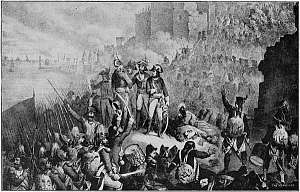
From an old Drawing, artist unknown
Bonaparte at the Siege of Acre
"Difficult, granted; but is it possible for an army to pass?" Napoleon at last impatiently inquired.
"It might be done," was the answer.
"Then it shall be; let us start," said the First Consul, and preparations for that most herculean task were at once made, the commander intending to penetrate into Italy, as Hannibal had done of old, through all the dangers and difficulties of the great Alps themselves.
For the treble purpose of more easily collecting a sufficient stock of provisions for the march, of making its accomplishment more rapid, and on perplexing the enemy on its termination, Napoleon determined that his army should pass in four divisions, by as many separate routes. The left wing, under Moncey consisting of 15,000 men, detached from the army of Moreau, was ordered to debouch by the way of St. Gothard. The corps of Thureau, 5,000 strong, took the direction of Mount Cenis; that of Chabran, of similar strength, moved by the Little St. Bernard. Of the main body, consisting of 35,000 men, although technically commanded by Berthier, the First Consul himself took charge, including the gigantic task of surmounting, with the artillery, the huge barriers of the Great St. Bernard. Once across he expected to rush down upon Melas, cut off all his communications with Austria, and then force him to a conflict.
The main body of the army marched on the 15th of May from Lausanne to the village of St. Pierre, at the foot of the Great St. Bernard, at which point all traces of a practicable path entirely ceased. Field forges were established at St. Pierre to dismount the guns. The carriages and wheels were slung on poles and the ammunition boxes were to be carried by mules. To convey the pieces themselves a number of trees were felled, hollowed out, or grooved, and the guns being jammed within these rough cases, a hundred soldiers were attached to each whose duty it was to drag them up the steeps. All was now in readiness to commence the great march.
"The First Consul set forth on his stupendous enterprise," says Botta in his description of this campaign, "his forces being already at the foot of the Great St. Bernard. The soldiers gazed on the aerial summits of the lofty mountains with wonder and impatience. On the 17th of May the whole body set out from Martigny for the conquest of Italy. Extraordinary was their order, wonderful their gaiety, and astonishing also, the activity and energy of their operations. Laughter and song lightened their toils. They seemed to be hastening, not to a fearful war, but a festival. The multitude of various and mingled sounds were re-echoed from hill to hill, and the silence of these solitary and desolate regions, which revolving ages had left undisturbed, was for the moment broken by the rejoicing voices of the gay and warlike. Precipitous heights, strong torrents, sloping valleys, succeeded each other with disheartening frequency. Owing to his incredible boldness and order, Lannes was chosen by the First Consul to take the lead in every enterprise of danger. They had now reached an elevation where skill or courage seemed powerless against the domain of Nature. From St. Pierre to the summit of the Great St. Bernard there is no beaten road whatever, until the explorer reaches the monastery of the religious order devoted to the preservation of travelers bewildered in these regions of eternal winter. Every means that could be devised was adopted for transporting the artillery and baggage; the carriages which had been wheeled were now dragged—those which had been drawn were now carried. The largest cannon were placed in troughs and on sledges, and the smallest swung on sure-footed mules. The ascent to be accomplished was immense. In the windings of the tortuous paths the troops were now lost and now revealed to sight. Those who first mounted the steeps, seeing their companions in the depths below, cheered them on with shouts of triumph. The valleys on every side re-echoed to their voices. Amidst the snow, in mists and clouds, the resplendent arms and colored uniforms of the soldiers appeared in bright and dazzling contrast: the sublimity of dead Nature and the energy of living action thus united, formed a spectacle of surpassing wonder.
"The Consul, exulting in the success of his plans, was seen everywhere amongst the soldiers, talking with military familiarity to one and now another, and, skilled in the eloquence of camps, he so excited their courage that, braving every obstacle, they now deemed that easy which they had adjudged impossible. They soon approached the highest summit, and discerned in the distance the pass which leads from the opening between the towering mountains to the loftiest pinnacle. With shouts of transport they hailed this extreme point as the termination of their labors and with new ardor prepared to ascend. When their strength occasionally flagged under excess of fatigues, they beat their drums, and then, reanimated by the spirit-stirring sound, proceeded forward with fresh vigor.
"At last they reached the summit and there felicitated each other as if after a complete and assured victory. Their hilarity was not a little increased by finding a simple repast prepared in front of the monastery, the provident Consul having furnished the monks with money to supply what their own resources could not have afforded for such numbers. Here they were regaled with wine and bread and cheese, enjoyed a brief repose amid dismounted cannon and scattered baggage, amidst ice and conglomerated snow; while the monks passed from troop to troop in turn, the calm of religious cheerfulness depicted on their countenances. Thus did goodness and power meet and hold communion on this extreme summit."
The troops made it a point of honor not to leave their guns in the rear; and one division, rather than abandon its artillery, chose to pass the night upon the summit of a mountain, in the midst of snow and excessive cold.
Thus did this brave army reach the Hospice of St. Bernard, singing amidst the precipices, dreaming of the conquest of that Italy where they had so often tasted the delights of victory, and having a noble presentiment of the immortal glory which they were about to acquire; as they climbed up and along airy ridges of rock and eternal snow, where the goatherd, the hunter of the chamois, and the outlaw smuggler, are alone accustomed to venture; amidst precipices where to slip a foot is death; beneath glaciers from which the percussion of a musket-shot is often sufficient to hurl an avalanche.
The labor was not so great for the infantry, of which there were 35,000 including artillery. As for the 5,000 cavalry, these walked, leading their horses by the bridle. There was no danger in ascending but in the descent, the path being very narrow, obliging them to walk before the horse, they were liable, if the animal made a false step, to be dragged by him into the abyss. Some accidents of this kind, not many, did actually happen, and some horses perished but scarcely any of the men.
After a brief rest at the hospice the army resumed its march and descended to St. Remy without any unpleasant accident. Napoleon rested and took a frugal repast at the convent, after which he visited the chapel, and the three little libraries, lingering a short time to read a few pages of some old book. He performed the descent on a sledge, down a glacier of nearly a hundred yards, almost perpendicular. The whole army effected the passage of the Great St. Bernard in the space of three days.
The transfer of the gun carriages, ammunition wagons and cannon was the most difficult of all, but the genius of Napoleon accomplished even this seemingly impossible feat. The peasants of the environs were offered as high as a thousand francs for every piece of cannon which they succeeded in dragging from St. Pierre to St. Remy. It took a hundred men to drag each; one day to get it up and another to get it down.
It has been said that Napoleon had his fortune to make at this period; but, at the moment of crossing Mount St. Bernard, he had fought twenty pitched battles, conquered Italy, dictated peace to Austria,—only sixty miles distant from Vienna,—negotiated at Rastadt, with Count Cobentzel for the surrender of the strong city of Mentz, raised nearly three hundred millions in contributions,—which had served to supply the army during two years,—created the Cisalpine Army, and paid some of the officers of the government at Paris. He had sent to the museum three hundred chef d'oéuvres, in statuary and painting; added to which he had conquered Egypt, suppressed the factions at home and totally eradicated the war in La Vendée.
Napoleon has been pictured crossing the Alpine heights mounted on a fiery steed. As a matter of fact he ascended the Great St. Bernard in that gray surtout which he usually wore, sometimes upon foot, and again upon a mule, led by a guide belonging to the country, evincing even in the difficult passes the abstraction of mind occupied elsewhere, conversing with the officers scattered on the road, and then, at intervals, questioning the guide who attended him, making him relate the particulars of his life, his pleasures, his pains, like an idle traveler who has nothing better to do. "This guide," says Thiers, "who was quite young, gave him a simple recital of the details of his obscure existence, and especially the vexation he felt because, for want of a little money, he could not marry one of the girls of his valley. The First Consul, sometimes listening, sometimes questioning the passengers with whom the mountain was covered, arrived at the hospice, where the worthy monks gave him a warm reception. No sooner had he alighted from his mule than he wrote a note which he handed to his guide, desiring him to be sure and deliver it to the quartermaster of the army, who had been left on the other side of the St. Bernard. In the evening the young man, on returning to St. Pierre, learned with surprise what powerful traveler it was whom he had guided in the morning, and that General Bonaparte had ordered that a house and a piece of ground should be given to him immediately, and that he should be supplied, in short, with the means requisite for marrying, and for realizing all the dreams of his modest ambition."
This mountaineer lived for a number of years, and when he died was still the owner of the land given him by the First Consul. The only thing remembered by this attendant in after years of the conversation of Napoleon during his trip was, when shaking the rain-water from his hat he exclaimed, "There! See what I have done in your mountains—spoiled my new hat!—Well, I will find another on the other side."
The passage of the Alps had been achieved long before the Austrians knew Napoleon's army was in motion. So utterly unexpected was this sudden apparition of the First Consul and his army, that no precaution whatever had been taken, and no enemy appeared capable of disputing his march towards the valley of Aosta. After a brief engagement at the fortress of St. Bard and other minor battles in which the French were victorious, they now advanced, unopposed down the valley to Ivrea which was without a garrison. Here Napoleon remained four days to recruit the strength of his troops.
Napoleon now took the road for Milan. The Sesia was crossed without opposition; the passage of the Tesino was effected after a sharp conflict with a body of Austrian cavalry, who were put to flight; and, on the 2d of June, the First Consul entered Milan, amidst enthusiastic acclamations of the people, who had all believed that he had died in Egypt and that it was one of his brothers who commanded this army. He was conducted in triumph to the ducal palace, where he took up his residence. He remained six days in Milan during which time he gained the most important information, all the dispatches between the court of Vienna and General Melas falling into his hands. From these he learned the extent of the Austrian reinforcements now on their way to Italy; the position and state of all the Austrian depots, field-equipages, and parks of artillery; and the amount and distribution of the whole Austrian force. Finally, he clearly perceived that Melas still continued in complete ignorance of the strength and destination of the French army. His dispatches spoke with contempt of what he called "the pretended army of reserve," and treated the assertion of Napoleon's presence in Italy as a "mere fabrication." Possessed of all this valuable information Napoleon knew how to proceed with clearness and precision.
The eyes of the Austrian general were at length opened and he was preparing to meet the emergency with all the energy that the orders from Vienna and his great age of eighty years permitted; but his delay had been sufficient to render his situation critical. His army was divided into two portions, one under Ott near Genoa; the other, under his own command at Turin. The greatest risk existed that Napoleon would, according to his old plan, attack and destroy one division before the other could form a junction with it. To prevent such a disaster, Ott received orders to march forward on the Tesino, while Melas, moving towards Alessandria, prepared to resume his communications with the other division of his army.
Napoleon now advanced to Stradella where headquarters were fixed. On the 9th of June, Lannes, who continued to lead the van-guard of the French army was attacked by an Austrian division superior in numbers and commanded by Ott. The battle, though severely contested, ended in the complete defeat of the Austrians, who lost three thousand killed and six thousand prisoners. The battle of Montebello was won by sheer hard fighting, there being little opportunity for skill or manoeuvre, the fields being covered with full-grown crops of rye. The shower of balls from the Austrian musketry was at one time so intense, that Lannes, speaking of it afterwards, described its effect with a horrible graphic homeliness. "Bones were cracking in my division" he said, "like a shower of hail upon a skylight." Lannes was subsequently created Duke of Montebello.
Napoleon remained stationary for three days at Stradella, employing the time in concentrating his army, in hopes that Melas would be compelled to give him battle in this position; he was unwilling to descend into the great plain of Marengo, where the Austrian cavalry and artillery which was greatly superior in numbers, would have a fearful advantage. Meanwhile he dispatched an order to Suchet to march on the river Scrivia, and place himself in the rear of the enemy.
General Desaix now joined the army with his aides-de-camp Rapp and Savary, he having returned from Egypt and landed in France almost on the very day that Napoleon left Paris, and had immediately received a summons from him to repair to the headquarters of the Army of Italy, wherever they might be situated. Desaix and Napoleon were warmly attached to each other and their meeting was a great and mutual pleasure. Desaix was appointed to the command of a division, the death of General Boudet having left one vacant, and was extremely anxious to signalize himself. Under the impression that the Austrians were marching upon Genoa, Napoleon dispatched Desaix's division in form of the van-guard upon his extreme left, while Victor, arriving at Marengo from Montebello, where he had assisted Lannes, routed a rear guard of four or five thousand Austrians and made himself master of the village of Marengo.
The French and Austrian armies finally came together on June 14th on the plains of Marengo, to decide the fate of Italy.
Marengo was a day ever to be remembered by those who participated in the stubborn struggle. Napoleon fought against terrible odds in numbers and position. A furious cannonading opened the engagement at daybreak along the whole front, cannon and musketry spreading devastation everywhere—for the armies were but a short distance apart, their pieces in some cases almost touching. The advance under Gardanne, was obliged to fall back upon Victor,—who had been stationed with the main body of the first line,—for more than two hours and withstood singly the vigorous assaults of a far superior force; Marengo had been taken and retaken several times by Victor ere Lannes, who was in the rear of him, in command of the second line, received orders to reinforce him. The second line was at length ordered by Napoleon to advance, but they found the first in retreat, and the two corps took up a second line of defense, considerably to the rear of Marengo. Here they were again charged furiously, and again after obstinate resistance, gave way. The retreat now became general, although Lannes fell back in perfect order.
The Austrians had fought the battle admirably. Their infantry had opened an attack on every point of the French line, while the cavalry debouched across the bridge which the French had failed to destroy, and assailed the right of their army with such fury and rapidity that it was thrown into complete disorder. The attack of the Austrians was successful everywhere; the centre of the French was penetrated, the left routed, and another desperate charge of the cavalry would have terminated the battle. The order for this, however, was not given; but the retreating French were still in the utmost peril. Napoleon had been collecting reserves between Garafolo and Marengo and now sent orders for his army to retreat towards these reserves, and rally round his guard which he stationed in the rear of the village of Marengo and placed himself at their head.
To secure a position more favorable for resisting the overpowering numbers of the enemy, Bonaparte now seized a defile flanked by the village of Marengo, shut up on one side by a wood and on the other by lofty and bushy vineyards. Here from the astonishing exertions of their commander the French made a firm stand, and fought bayonet to bayonet with Austrian infantry, whilst exposed at the same time to a battery of thirty pieces of cannon, which was playing upon them with deadly effect. Every soldier seemed to consider this the defile of Thermopylae, where they were to fight until all were slain. With a heroism worthy of the Spartan band they withstood the tremendous shock of bayonets and artillery, the latter not only cutting the men in pieces, but likewise the trees, the large branches in falling killing many of the wounded soldiers who had sought a refuge under them. At this awful moment Bonaparte, unmoved, seemed to court death, and be near it, the bullets being observed repeatedly to tear up the ground beneath his horse's feet. Alarmed for his safety the officers exhorted him to retire, exclaiming, "If you should be killed all would be lost." But the hero of Lodi and Arcola would not retire. Undismayed and unmoved amidst this dreadful tempest, he observed every movement and gave orders with the utmost coolness. The soldiers could all see the First Consul with his staff, surrounded by the two hundred grenadiers of the guard and the sight kept their hopes from flagging. The right wing, under Lannes, quickly rallied; the centre, reinforced by the scattered troops of the left, recovered its strength; the left wing no longer existed; its scattered remains fled in disorder, pursued by the Austrians. The contest continued to rage, and was obstinately disputed; but the main body of the French army, which still remained in order of battle, was continually, though very slowly, retreating.
The First Consul now dispatched his aide-de-camp, Bruyere, to Desaix, with an urgent message to hasten to the field of battle. Desaix on his part, had been arrested in his march upon Novi, by the repeated discharges of distant artillery; he had in consequence made a halt, and dispatched Savary, then his aide-de-camp, with a body of fifty horse, to gallop with all possible haste to Novi, ascertain the state of affairs there, according to the orders of Napoleon, while he kept his division fresh and ready for action.
Savary found all quiet at Novi; and returning to Desaix, after the lapse of about two hours, with this intelligence, was next sent to the First Consul. He spurred his horse across the country, in the direction of Marengo, and fortunately met General Bruyere, who was taking the same short cut to find Desaix. Giving him the necessary directions, Savary now hastened towards Napoleon. He found him in the midst of his guard, who stood their ground on the field of battle; forming a solid body in the face of the enemy's fire, the dismounted grenadiers were stationed in front and the place of each man who fell was instantly supplied from the ranks behind.
Maps were spread out before Napoleon; he was planning the movement which was to decide the action. Savary made his report and told him of Desaix's position.
"At what hour did he leave you?" said the First Consul pulling out his watch. Having been informed he continued, "Well he cannot be far off; go, and tell him to form in that direction (pointing with his hand to a particular spot); let him quit the main road, and make way for all those wounded men, who would only embarrass him, and perhaps draw his own soldiers after them."
It was now three o'clock in the afternoon; had Melas pursued the advantage with all his reserve the battle was won to the Austrians; but that aged general (he was eighty years old) doubted not that he had won it already. At this critical moment, being quite worn out with fatigue, he retired to the rear leaving General Zach to continue what he now considered a mere pursuit.
Napoleon's army was still slowly retiring from the field, one corps occupying three hours in retiring three quarters of a league, when Desaix, whose division was now forming on the left of the centre, rode up to the commander, and taking out his watch, said in reply to a question: "Yes, the battle is lost; but it is only three o'clock; there is time enough to gain another!"
Bonaparte was delighted with the opinion of Desaix, whose division had arrived at a full gallop after a force march of thirty miles, and prepared to avail himself of the timely succor brought to him by that far-seeing general, and of the advantage insured to him by the position he had lately taken. Napoleon quickly explained the manoeuvre he was about to effect and gave the orders instantly. He now drew up his army on a third line of battle, and riding along said to the different corps: "Soldiers! We have fallen back far enough. You know it is always my custom to sleep on the field of battle." The whole army now wheeled its front up the left wing of its centre, moving its right wing forward at the same time. By this movement Napoleon effected the double object of turning all the enemy's troops, who had continued the pursuit of the broken left wing and of removing his right at a distance from the bridge, which had been so fatal to him in the morning. The artillery of the guard was reinforced by that which belonged to Desaix's division, and formed an overwhelming battery in the centre.
The Austrians made no effort to prevent this decisive movement; they supposed the First Consul was only occupied in securing his retreat. Their infantry, in deep close columns, was advancing rapidly, when at the distance of a hundred paces they suddenly halted, on perceiving Desaix's division exactly in front of them. The unexpected appearance of six thousand fresh troops, and the new position assumed by the French, arrested the battle: very few shots were heard; the two armies were preparing for a last effort.
The First Consul rode up in person to give the order of attack while he dispatched Savary with commands to Kellerman, who was at the head of about six thousand heavy cavalry, to charge the Austrian column in flank, at the same time Desaix charged it in front. Both generals effected the movement rapidly and so successfully that in less than half an hour the French had put the enemy to rout on nearly all sides. A final charge was now made, when Desaix, whose timely arrival with reinforcements had saved the day, and who was then in the thickest of the engagement, was shot dead, just as he led a fresh column of 5,000 grenadiers to meet and check the advance of Zach. But a few moments before Desaix said to Savary, "Go and tell the First Consul that I am charging, and that I am in want of cavalry to support me." As the brave man fell he said: "Conceal my death, it might dishearten the troops." Napoleon embraced him for an instant, and said, as his eyes filled with tears: "Alas, I must not weep now—" and mounting his horse again plunged into the thickest of the battle.
The whole army fought with renewed vigor on learning of Desaix's death, every soldier being bent on avenging individually the loss of their leader. The combined forces now concentrated themselves and hurled their invincible columns upon the Austrian lines, marching victorious at last over thousands of slain. General Zach, and all his staff, were here made prisoners. The Austrian columns behind, being flushed with victory, were advancing too carelessly, and were unable to resist the general assault of the whole French line, which now pressed onward under the immediate command of Napoleon. Post after post was carried. The terrified cavalry and broken infantry fled in confusion to the banks of the Bormida, into which they were plunged by the French cavalry who swept the field. The Bormida was clogged and crimsoned with corpses, and whole corps, being unable to effect the passage, surrendered. The victory, which had seemed quite secure to the Austrians at 3 o'clock was completely won by the French at six. Napoleon's conduct throughout the day and the bravery of his troops were beyond all praise; and it is no less a fact, that the appearance of victory in one or two parts of the extended field roused the courage of the Austrians to enthusiasm and in some cases fatal recklessness. They pressed forward to complete their triumph when the Consular guard, called the "wall of granite," met and successfully resisted the shock. The eye of Napoleon fixed the fortune of the day: he foresaw that the enemy, in the ardor of success, would extend his line too far; and what he had conjectured happened. Then it was that Desaix's division rushed amidst the all but triumphant foe, divided his ranks, and finally completed his ruin.
In this sanguine engagement the Austrians lost about 8,000 men in killed and wounded, and 4,000 more were taken prisoners—one-third of their army. The life of Desaix was the sacrifice. The French loss amounted to 6,000 killed or wounded and about 1,000 of them were taken prisoners, a loss of about one-fourth out of 28,000 soldiers present at the battle.
In the estimation of the First Consul this loss was great enough to diminish the joy that he felt for the victory. When Bourrienne, his secretary, congratulated him on his triumph saying, "What a glorious day!" he replied: "Yes it would have been glorious indeed, could I but have embraced Desaix this evening on the field of battle. I was going to make him minister of war; I would have made him a prince if I could." The triumph of this decisive victory was poisoned by Desaix's death. It seems that he never loved, nor regretted, any man so much and he never spoke of him without deep feeling. Desaix met his death at the early age of thirty-three, and France lost in him a great general and a man of rare promise. Savary, who was much attached to him, sought for his body amongst the dead, and found him completely stripped of his clothes, lying among many others in the same condition. "France has lost one of her most able defenders and I my best friend," Napoleon said after the battle; "No one has ever known how much goodness there was in Desaix's heart; how much genius in his head." Then after a short silence, with tears starting into his eyes, he added, "My brave Desaix always wished to die thus; but death should not have been so ready to execute his wish."
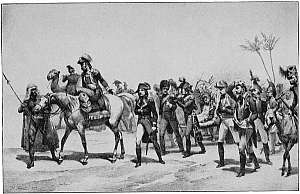
From a Drawing by H. Vernet
Return of the French Army from Syria
Though the vast plain of Marengo was drenched with French blood, joy pervaded the army. Soldiers and generals alike were merited for their gallant conduct and were fully aware of the importance of the victory to France. Thus ended the battle of Marengo, one of the most decisive which had been fought in Europe, and one which opened to Napoleon the gates of all the principal cities of northern Italy. By one battle he regained nearly all that the French had lost in the unhappy Italian campaign of 1799 while he was in Egypt. He had also shown that the French troops were once more what they had been when he was in the field to command them.
In talking with Gohier one day, Napoleon said: "It is always the greater number which defeats the lesser."
"And yet," said Gohier, "with small armies you have frequently defeated large ones." "Even then," replied Napoleon, "it is always the inferior force which was defeated by the superior. When with a small body of men I was in the presence of a large one, collecting my little band, I fell like lightning on one of the wings of the hostile army, and defeated it. Profiting by the disorder which such an event never failed to occasion in their whole line, I repeated the attack, with similar success, in another quarter, still with my whole force. I thus beat it in detail. The general victory which was the result was still an example of the truth of the principle, that the greater force defeats the lesser." One of his favorite maxims is said to have been, "God always favors the heaviest battalions."
The Austrians were completely enveloped, and had no alternative but to submit to the law of the conqueror. Melas sent a flag of truce to Napoleon at daybreak on the following morning, and peace negotiations were at once began. In the meeting which followed Bonaparte required that all the fortresses of Liguria, Piedmont, Lombardy and the Legations should be immediately given up to France, and that the Austrians should evacuate all Italy as far as the Mincio.
The surrender of Genoa was strongly objected to by Melas, but the conqueror would not waive this point. The baron sent his principal negotiator to make some remonstrances against the proposed armistice: "Sir," said the First Consul with some warmth, "my conditions are irrevocable. It was not yesterday that I began my military life; your position is as well known to me as to yourselves. You are in Alessandria, encumbered with dead, wounded, sick, destitute of provisions; you have lost the best troops of your army, and are surrounded on all sides. There is nothing that I might not require, but I respect the gray hair of your general, and the valor of your troops, and I require, nothing more than is imperatively demanded by the present situation of affairs. Return to Alessandria; do what you will, you shall have no other conditions."
The treaty of peace was signed at Alessandria, the same day, June 15th, 1800, as originally proposed by General Bonaparte. He then started for Paris by way of Milan, where preparations had been made for a solemn Te Deum in the ancient cathedral, and at which the First Consul was present. He found the city illuminated, and ringing with the most enthusiastic rejoicings. The streets were lined with people who greeted him with shouts of welcome. Draperies were hung from the windows, which were crowded by women of the first rank and who threw flowers into his carriage as he passed. He set off for Paris on the 24th of June and arrived at the French capital in the night between the 2nd and 3rd of July, having been absent less than two months. Massena remained as Commander-in-chief of the Army of Italy.
To one of his traveling companions with whom he conversed on the journey to Paris about his remarkable victory at Marengo, he said: "Well, a few grand deeds like this campaign and I may be known to posterity." "It seems to me," said his companion, "that you have already done enough to be talked about everywhere for a time." "Done enough," said Bonaparte quickly, "You are very kind! To be sure in less than two years I have conquered Cairo, Paris and Milan; well, my dear fellow, if I were to die to-morrow, after ten centuries I shouldn't fill half a page in a universal history!"
At night the city of Paris was brilliantly illuminated and the inhabitants turned out en masse. Night after night every house was illuminated. The people were so anxious to show their pleasure at Napoleon's miraculous victory that they stood in crowds around the palace contented if they could but catch a glimpse of the preserver of France. These receptions so deeply touched him that twenty years afterwards, in loneliness and in exile, a prisoner at St. Helena, he mentioned it as one of the proudest and happiest moments of his life.
On the day following his return to the capital the president of the Senate—the entire body having waited upon him in state—complimented the conqueror of Marengo in language such as kings were formerly addressed in, and in closing his address said: "We take pleasure in acknowledging that to you the country owes its salvation; that to you the Republic will owe its consolidation, and the people a prosperity, which you have in one day made to succeed ten years of the most stormy of revolutions."
In November following Napoleon's return to the capital he received a letter addressed to him by Count de Lille (afterwards Louis XVIII.) which the exiled prince of the House of Bourbon evidently believed would place him on the throne of France. He said: "You are very tardy about restoring my throne to me; it is to be feared that you may let the favorable moment slip. You cannot establish the happiness of France without me; and I, on the other hand, can do nothing for France without you. Make haste, then, and point out, yourself, the posts and dignities which will satisfy you and your friends."
The First Consul answered thus: "I have received your Royal Highness' letter. I have always taken a lively interest in your misfortunes and those of your family. You must not think of appearing in France—you could not do so without marching over five hundred thousand corpses. For the rest, I shall always be zealous to do whatever lies in my power towards softening your Royal Highness' destinies, and making you forget, if possible, your misfortunes. Bonaparte."
The battle of Marengo was celebrated at Paris by a fête on the 14th of July, which presented a singularly interesting spectacle owing to the appearance of the "wall of granite," the members of which, just as the games were about to begin, marched into the field. The sight of those soldiers, covered with the dust of their march, sun-burned and powder-stained, and bearing marks of heroic deeds on the battlefield, formed a scene so truly affecting that the populace could not be restrained by the guards from violating the limits, in order to take a nearer view of those interesting heroes.