BURIALS AND FUNERAL CEREMONIES. (continued 2)
Reading edition
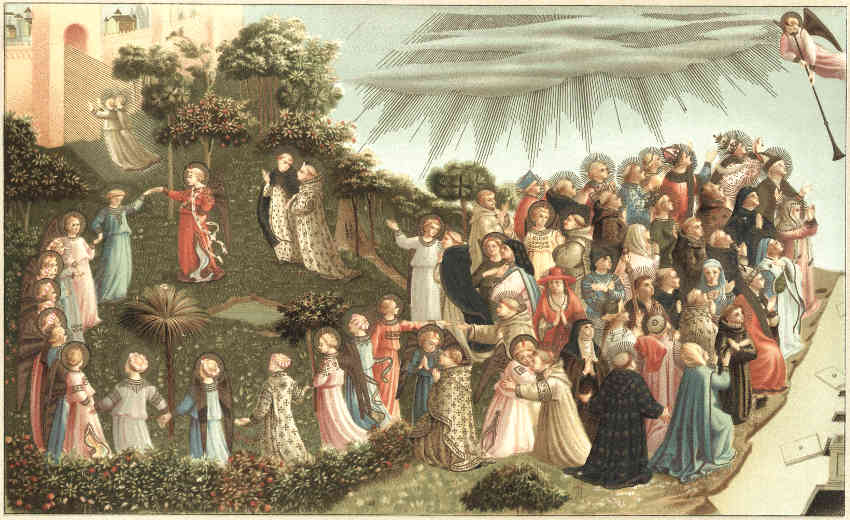
Fragment of Angelico's picture, the Day of Judgement, XVth century. Florence, Academy of Fine-Arts.
Van Eyck has allegorically treated this great subject of the Resurrection (Fig. 408), with as much approach to what the Church believes to be the truth, and perhaps as artistically, as the painter of Fiesole. Amidst a landscape flooded with light, bright with verdure and flowers, the Mystic Lamb, standing upon an altar and shedding his exhaustless blood into the chalice, is being greeted with homage and hymns of praise by the celestial host. Upon the front of the altar is the inscription, “Behold the Lamb of God, which taketh away the sin of the world” (Ecce Agnus Dei, qui tollet peccata mundi). Around the altar, angels form a circle; two of them are scattering incense over the Lamb, while twelve others, six on each side, are bearing the instruments of the passion, and singing the praises of the Divine Victim. In front of the altar, in the foreground, bubbles up a fountain, which, in the language of the Apocalypse, is thus described, “The Lamb shall be their shepherd, He shall lead them to fountains of living water, and God shall wipe away all tears from their eyes.” M. Alfred Michiels, in his “Histoire de la Peinture Flamande,” declares that “no allegory has ever been painted with greater skill.”
Four groups of worshippers are artistically represented amidst verdure and flowers. Above, on the left side, the holy martyrs are plainly recognised by the palms in their hands; and foremost amongst these stand the popes, nearly all of whom, in the early ages, sealed with their blood their testimony to the divinity of the Lamb. Opposite to them are the countless virgins who have claimed to be admitted to the mystic marriage; and below them stand a host of nuns, popes, and bishops adoring the Celestial Victim, and celebrating His praises. Upon the other side of the fountain is the not less numerous phalanx of Old Testament prophets, kings, and illustrious men, whose presence completes the harmonious whole of this admirable composition. The two figures standing out in the midst of this group are supposed by many critics to represent Virgil and Dante. The white robe, the laurel crown, and the bough with the golden apples seem, in fact, to point pretty clearly to Dante’s guide in purgatory; but it is difficult to believe that a painter, who is in other respects the model of pious orthodoxy, should be guilty of so gross a breach of propriety.
In the distant horizon, churches with their graceful towers and spires form a connecting link between heaven and earth. They seem to remind us that it is amidst the notes of sacred music and the splendours of religious worship, and, above all, by partaking of the mystic banquet of the Lamb invisible but yet present, that the soul, as it receives the earnest of the life to come, is enraptured with a prelusive glimpse of the celestial glories.
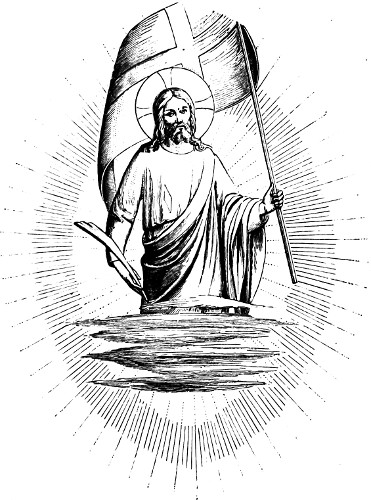
Fig. 409.—Christ, risen from the dead, bearing in one hand the Palm of Martyrdom, and in the other the victorious Standard of the Cross.—From a Fresco painted by Fra Angelico, in the Monastery of St. Mark, Florence (Fifteenth Century).
The dominant idea in this Flemish masterpiece is but the expression of those mysterious words which connect the thought of the grave with the vision of eternal bliss: “Christ is the first-born from the dead.” He is our elder brother in that new life where the bitterness of mourning and the sorrow of separation are unknown. At the archangel’s voice, at the blast of the trumpet, the dead bodies of those whom we have loved shall rise radiant from the earth, within whose bosom they laid in calm repose, awaiting the morning of the resurrection. They shall appear, having put on glory and immortality, conformed to the divine image of Christ their divine brother, their Risen Lord.
PRINTED BY VIRTUE AND CO., LIMITED, CITY ROAD, LONDON.