Chapter VI
Frederick Street translation
THE GENIUS OF MICHELANGELO AND HIS INFLUENCE ON ITALIAN ART
"I have no friend of any kind," said Michelangelo in 1509, "and I do not want any."[127]
Forty years later, in 1548, Michelangelo wrote again, "I am always alone and I speak to no one."[128]
"From his youth," says Condivi, "Michelangelo had consecrated himself not only to sculpture and painting, but to all the other arts with such devouring energy that he had to separate himself almost entirely from the society of men. For that reason many people considered him proud, and others eccentric or mad. In reality it was his love of work alone, his labour without respite, which made him solitary, for he was so filled by the joy and rapture which his work gave him that the society of men did not offer him any pleasure, but rather bored him by distracting him from his own thoughts. Like the great Scipio, he was never less lonely than when he was alone."
That passionate solitude was the very soul of the genius and of the work of Michelangelo. He lived shut up in himself without any real connection with the art of his time. He despised Raphael because he said, "All his talent came from study and not from nature."[129] He himself declared that he derived all his inspiration from within, and if in his pride he underestimated what he was always studying with feverish and persistent ardour, yet it is true that he never sought in the study of the works of others a means of changing or of renewing his own personality, but only of still further emphasising it. In a way he sought from others not examples or lessons, but reasons for being still more himself. It is true that from the beginning to the end he fed on his own soul. Who knows the man, knows his work.
The most striking thing about this extraordinarily unified nature is that it was composed of hostile worlds; a brutal materialism and serene idealism, an infatuation with pagan strength and beauty and a Christian mysticism; a mixture of physical violence and intellectual abstraction; a platonic soul in an athlete's body. That indissoluble union of opposing forces which undoubtedly caused part of his suffering was also the cause of his unique greatness. We feel that the supreme balance of his art is the result of a fierce struggle, and it is the sense of that struggle which gives to the work its heroic character. All is passion even to the abstract idea, so that idealism, which with many artists is a cause of coldness and death, is here a hearth burning with love and hate.[130]
There is undoubtedly a danger in that mystic faith which loses itself in inward visions of such charm that they often leave a feeling of only disgust and contempt for reality.
Non vider gli occhi mei cosa mortale
* * * * *
E se creata a Dio non fusse eguale
Altro che 'l bel di fuor, ch'à gl'occhi piace,
Più non vorria; ma perch'è si fallace,
Tracende nella forma universale.[131]
Varchi was quite right in recognising in Michelangelo the Socratic spirit.[132] Whether he gained these ideas from the teaching of the great Platonists with whom he had talked as a youth in the gardens of San Marco or whether that teaching had merely revealed to him his true nature there is certainly a close relationship between the theories on art of the school of Socrates and those of Michelangelo.
Parrhasius believed in representing only "the perspective, the light and the shadow, the softness, hardness and surface of bodies." Socrates taught him that the object of painting is to represent the soul and the innermost being.[133] "The fields and trees can teach me nothing," he says in the "Phædo"; "I only find what is useful to me among men in the towns." These very men only interested him because there was something eternal in them. The fugitive and changing side of their physiognomy, which for us makes the delicate charm of life and the object of painting, seemed to him an empty and wearisome illusion. Art creates illusions. The objects which it represents are "the dreams of the human imagination offered to people who can see. It is an image which one shows in the distance to little children who can not reason, in order to create illusions for them. These illusions of the senses distract the soul from the only realities, eternal ideas."
Michelangelo reasoned thus in his disdain of all exact reproduction of nature. He had studied it with passion but, in order to discover its laws, he regarded it as an enemy which held the human spirit prisoner. He wanted to free himself from it, he wanted to make of it an instrument for his thought. That is why he sought for and discovered its machinery, and when he could guide it at will he outraged it; he made it produce unprecedented results. He constructed for himself out of his profound knowledge of anatomy a general idea of man, and thereafter, without having recourse to any observation of individuals, he recreated the whole of nature in the image of his ideas and in the likeness of God, source and originator of ideas.
Come dal foco 'l cald' 'esser' diviso
Nom puo 'l bel dall' eterno; e la mia stima
Esalta che ne scende, e chi 'l somiglia.
"As heat can not be separated from fire, so beauty can not be from eternity; and my thought extols what comes from it and what resembles it."
CHARON'S BOAT Detail from The Last Judgment (1536-1541). Sistine Chapel.
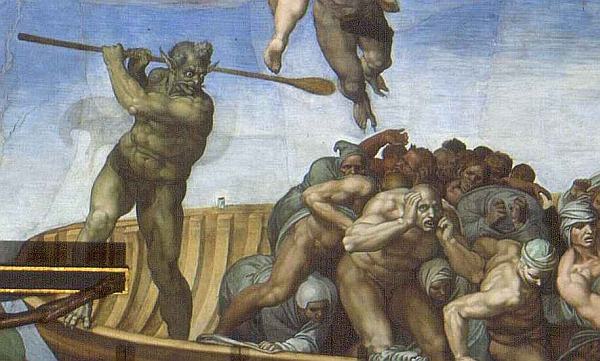
He wanted to express in his work only what was eternal, and he did not believe he could do this with external objects. He tried, therefore, to give to everything he did a character of compelling force. His Platonic idealism was lined with Christian pessimism. Like Vittoria Colonna, he was filled with the sense of the beauty of all human things, and he was obsessed with the idea of death.
He lived in an exhausted epoch which no longer had any happy sense of reality. In God was the only help, in the eternal and immutable perfection. Michelangelo was filled with dislike for all realism. Like Plato, he despised painting in comparison with sculpture.
"Painting seems to me the better the more it resembles sculpture, and the sculpture worse the more it resembles painting. Sculpture is the torch of painting, and between the two there is the same difference as between the sun and the moon."[134]
If he was above all things a sculptor it was because he found in sculpture the most appropriate expression of his abstract and concentrated genius.
Non ha l'ottimo artista alcun concetto,
Ch'un marmo solo in se non circonscriva
Col suo soverchio, et solo à quello arriva
La man, che ubbidisce all'intelleto.[135]
Moreover he reduced sculpture to its most simple form, the isolated statue. Michelangelo had little liking for bas-reliefs and groups, which he hardly ever made, and where he always shows some awkwardness. What we know, through Cellini and Vasari, of his manner of working would incline us to feel to-day that the basis of his sculpture and of all his art was drawing,[136] because that was most immaterial and closest to the form of his thought.
No one has ever drawn as Michelangelo did, and Charles Blanc is right in saying that "if he is unequal in his sculptures and his frescoes, never does his drawing, even when apparently most careless and most summary, betray any feebleness of hand or distraction or hesitancy of spirit." Not only do we penetrate, then, into the mystery of his creativeness, into the dreams and soliloquies of his lonely soul, but we discover there also his most intimate and perfect expression. There he is altogether himself, as Beethoven is in his quartets and in his short pieces for the piano.[137]
I compare these two purposely; for the genius of each of them was solitary, intellectual and passionate, only realising itself completely in the most simple and abstract forms in which the senses had the least part and the spirit the greatest. All the voluptuous charm of art was not only foreign to Michelangelo, but antagonistic to him. The more art was aimed at the senses the more he despised it.
Voglia sfrenata el senso è, non amore,
Che l'alma uccide....[138]
Painting, therefore, seemed to him, as it did to Plato, less virile and less pure than sculpture, because of its seductive quality, its illusive magic which imitates the appearance of things and merely creates illusions. He disdained it inasmuch as it appealed through the attraction of colours at the expense of the idea. He could not endure painting in oils, which he said was only good for women.[139] He rejected landscape, and like Plato only saw in it a vague and deceiving illusion—a sport for children and ignorant people. He had a horror of portraits. They seemed to him a form of flattery for the gratification of vain curiosity and the imperfect illusion of the senses.[140] It is curious to contrast with these principles which were adopted by a part of the Italian school in the sixteenth century, the naïve confession of faith of Dürer at almost the same period. "The art of painting is used in the service of the Church to show the sufferings of Christ and of many other models of virtue, and it also preserves the faces of men after their death." (1513)
That pious and bourgeois realism of Germany and Flanders filled Michelangelo with the same sort of contempt that many artists of to-day feel for subject-painting. "It is," he says, "an anecdotal and sentimental art, which aims only at success and obtains it easily, not by its own value, but by the choice of its subjects. These are pious figures for which tears are always ready, or else rags, ruins, very green fields shaded by trees, rivers and bridges—what they call landscapes—with many figures here and there. That sort of thing is always popular; the least artistic spirit can find something there that appeals to it; it is enough to be inquisitive and to have good eyes." Again—"Flemish painting seems beautiful to women, especially to those who are either old or very young, and to monks and nuns and to a few people of quality who are deaf to true harmony. Although it makes a good effect in the eyes of some people, in truth there is neither reason nor art in it, no proportion, no symmetry, no selection, and no grandeur. In fact, such painting is without body or vigour. The only real paintings are those done in Italy. These are not, like the Flemish pictures, made for the pious.[141] They will never cause anyone to shed a tear."[142]
We can well understand that disdainful confession of faith. What artist is there who has not felt this same irritation at the success of mediocre work exploited by the sentimentality of an uncritical public and who will not understand Michelangelo's haughty refusal to share this too easy success? This pride, ennobling as it is to the character, is unfortunately perilous for art; it cuts it off from all simple souls, it isolates it in the arrogant feeling of inner perfection and of a secret ideal which very few can know or understand. As Michelangelo says:
"Good painting is noble and devout in itself, for among the wise nothing tends more to elevate the soul or to raise it toward devotion than the difficulty of that perfection which approaches God and becomes one with him. Good painting is but a copy of this perfection, a shadow of his pencil, a music, a melody, and only a very keen intelligence can feel the difficulty of it. That is why it is so rare and why so few people can attain to it or know how to produce it. Painting is the music of God, the inner reflection of his luminous perfection."[143]
THE RESURRECTION Drawing (about 1540). Louvre.
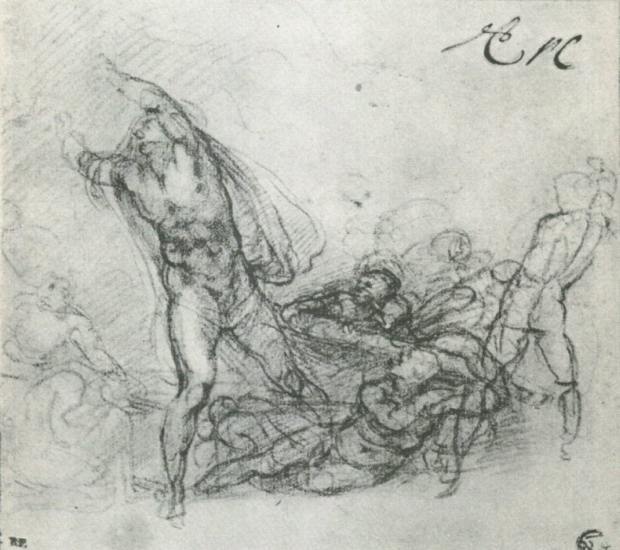
If instead of Michelangelo with his ardent faith and that warmth of enthusiasm which sweeps along his idealism and makes of the Divine Idea as he conceives it a living being to whom he passionately desires to unite himself we should take, I do not say a sceptic or an atheist, but a sincere believer after the manner of the Council of Trent, a Vasari or a Zucchero, then God will be to them not a source of love and ecstasy, but the principle of reason. The reason of the wise—behold the beginning and the end of art. A hundred years after Michelangelo, Poussin was to bind all art in obedience to this principle. He applied all its natural resources to the rendering of one idea. With him the attention is confined to the idea of the work—that is the principal thing. The abstract idea is more important than the form; thought alone is spontaneous; all the rest—life, expression, colour—is determined by the logic of reason. The subject regulates the composition and determines the centre of interest and the groupings of the picture; it indicates the character of the people, their moral aspect and, consequently, their exterior, for the two are bound together. It determines the character of the landscape, which must bear a logical relationship to the scene; it presides even over the execution of the work. The manner of painting is imposed by the subject to be treated; it will be Phrygian or Dorian or Lydian, according to whether the idea is gentle or serious or sad. In this way everything is logical and calculated. Michelangelo's mystical ardour toward divine perfection at least left him his impetuous liberty of feeling. Poussin no longer left anything to chance. His reason commanded and his hand obeyed. If I name him here it is because he was both the end and the climax of artistic intellectualism. At least Poussin left on his work the impress of his great intelligence. His system rests on this idea, and with him the idea was clear and powerful. But what would it be in the hands of men of mediocre talent? The number of artists who either think for themselves, or express with new force the ideas of others, is infinitesimal. Moreover, the ideal is ordinarily to them merely an emphatic rendering of a vague conception of perfection which they have been taught. Under pretext of an intellectual ideal they deform nature; they leave it little by little, turning their backs, their eyes proudly closed, looking only within themselves. "La bellezza," says Tomazzo, "e lontana dala materia" (Beauty is far from matter).[144] The symbol of the period which was to follow is that very Lomazzo,[145] painter, æsthetician—blind.
Blind, more or less, were all who lived around Michelangelo. Their too feeble eyes were dazzled by this sun which shone alone in that twilight of art, the night which was falling on Italy of the Renaissance. A long time after that sun had disappeared below the horizon the radiant glow still remained in the sky. Michelangelo enthralled Italian art.
There is no comparison between the influence which he exerted and that of the other masters of the sixteenth century, Corregio and Raphael. However superior they may have been to their century, Corregio and Raphael only reflected its thoughts with more charm and grandeur. Michelangelo is outside of his time, alone, apart and colossal. He is like a great mountain which inspires in those who dwell at the foot an invincible desire to reach the top; and what men have ever existed who were less capable of climbing those austere and sublime heights? All those effeminate artists of the decadence, intoxicated by his inspiration, attempted to express heroic ideas in their insipid works. They lost the sense of proportion which alone could have saved them. Instead of confining themselves to the little world of their own fancy which, though cold, could have been redeemed by sincerity, they attempted great subjects. A mass of forms, heroic figures and furious gestures that they had learned, were whirled about in their mind, uncontrolled either by greatness of intelligence or of heart.
We must remember that Michelangelo lived through more than fifty years of the Golden Age of Italian art and, as happened in our own day to Victor Hugo, admiration for his works increased in proportion as they deserved it less. Even the factions that had been longest hostile to him—the school of Raphael, for instance—recognised his triumph. Perino del Vaga admits that all the painters worshipped him as their master, their leader and the god of drawing.[146]
The independents, or those who boasted that they were, said as Cellini did in his sonnets:
"Just a leaf from thy crown, O divine Michelangelo, who alone art rich, who alone art immortal. That will suffice me and I shall have no desire for anything else, since for me that only is good and beautiful."
Florence, his own country, more even than the rest of Italy gave him blind admiration. The Academy of Drawing, founded by Vasari, was a college of disciples and apostles. Since Michelangelo's great paintings were at Rome the Florentines copied chiefly his statues, devoting themselves principally, as Lanzi says, to ostentatiously showing "magna ossa lacertosque."[147]
This was in accordance with the doctrine of the master, who declared that sculpture should be the school of the painter and the ideal of painting. Cellini, thinking to define the thought of Michelangelo, absurdly declares and demonstrates that sculpture is seven times greater than painting.
The painter formed himself from this time on by the study of statues, and especially of those of Michelangelo. Colour was therefore regarded as a secondary consideration,[148] and the only aim pursued was drawing over-accentuated, full of unreasonable action, and of excessive virtuosity. If he seemed to Cellini the greatest painter of all time, it was only because all painting from Cellini's point of view was an imitation of sculpture, and the artist who came nearest to him in perfection is Bronzino.[149]
The danger of following a model is less if the model can be understood, but the ideas of Michelangelo absolutely escaped his admirers. How could it be otherwise when all his work is an act of revolt against his century. We can but smile with pity when we see his contemporaries expressing their enthusiasm for the formidable Night in precious and carefully chosen phrases.[150]
THE DOME OF ST. PETER'S From the Original Model in Wood. Preserved in the Vatican (1558).
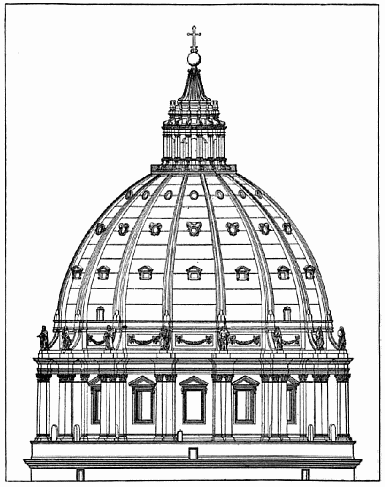
What supreme irony! The world only sees and admires the outer form of those tremendous incarnations of contempt and weariness which are called Moses or the Day, Victory subduing the Prisoner, the Dawn or the Slaves. The world applauds the style of the imprecations launched against it! It even repeats them without knowing the meaning.
Two drawings by Federigo Zucchero, which are in the Louvre, show a number of artists installed in the chapel of S. Lorenzo zealously copying Michelangelo's statues. How many artists of the sixteenth century built their entire work on these notes without ever thinking that such forms are only justified by the passions which animate them, and that it is ridiculous to use them as aids to the learned virtuosity of a cold and forced talent!
Battista Franco of Venice, il Semolei distinguished himself above all others by his zeal in copying Michelangelo. Vasari says that there was not a sketch, not the roughest note, or any sort of fragment of his which he had not devoutly drawn. He knew the whole Sistine by heart. In 1536 he came to Florence and drew once more all the statues of S. Lorenzo. In 1541 he hurried to Rome for the "première" of the Last Judgment, and he made a drawing of the whole thing "con infinita maraviglia il designo tutto." We can understand that he had no time to do any thinking for himself. For a long time he refrained from painting anything of his own. When he decided to begin it was to reproduce in his Battle of Montemurlo some fragments of the war against Pisa or of the Rape of Ganymede.[151]
The independent Cellini writes in his memoirs: "I devoted myself continually to trying to absorb thoroughly the beautiful style of Michelangelo, and since then I have never departed from it."
A hundred years later still Bernini copied the Last Judgment for two successive years before he began to draw from nature. Scivoli watched him doing it and said: "Sei un furbo; no fai quel che vedi: questa è di Michelangelo." ("You are a fool. You are not drawing what you see; this is nothing but Michelangelo").[152]
Bernini, who tells of this, does not see that it is a criticism, for he recommends this same system of education to young artists.
"It is necessary first for a young man to form an idea of the beautiful, for this is of use to him all his life; it ruins young men to begin by drawing from nature, which is almost always weak and mean, and which then fills their imagination, so that they can never produce anything beautiful or great, qualities which are never found in natural things. Those who make use of nature should be already skilful enough to recognise its faults and to correct them. A young man is not capable of this until he has gained full knowledge of beauty."[153]
The essential idea of this teaching was that nature is evil; just what Michelangelo thought. But we now see to what unexpected results his pessimistic idealism led. It produced not only separation from nature, but renunciation of personal feeling for formulas, "since it is not possible for one individual to have light on all subjects nor to grasp without assistance the difficulty of arts so profound and so little understood."
What would Michelangelo have thought of these servile disciples, he who said proudly that "whoever follows others will never go forward, and whoever does not know how to create by his own abilities can gain no profit from the works of other men."
But they had lost even the consciousness of their servility and took more pride in living on Michelangelo's crumbs than he had in creating the work which was to be the nourishment of two centuries. Some drew tranquilly on their memory and their notes, others mimicked the master's grandiose manner, and they were all entirely satisfied with themselves, not one of them realising what their master and model had suffered in giving birth to these works which were so easy for them to imitate.
Michelangelo's idealism had a powerful corrective in "the sense of the beauty of struggle, and the holiness of suffering." "Nothing approaches nearer to God," he wrote, "than the effort to produce a perfect work, because God is perfection."
No one ever struggled more fiercely than this man, who ceaselessly tormented himself and wept at "losing his time uselessly" while he was working at the ceiling of the Sistine Chapel, who wrought with his blood the beings whom he created and was dissatisfied with his sublime creations at the moment of finishing them and left them incomplete, who to his last day in agony and tears
Piangendo, amando, ardendo, e sospirando,—
Ch'affetto alcun mortal non mi è più nuovo,—[154]
"Weeping, loving, burning and sighing—for there was no human emotion which he had not felt."
He was vainly seeking the visioned ideal, and in dying he regretted not the joy of living, but his interrupted labours.[155]
Beside that virile modesty what can we think of the absurd vanity of all those little masters who declared that they derived from the great master and believed themselves to be Michelangelos?
Vasari dares to write:
"To-day art has been brought to such perfection that while our predecessors produced a picture in six years we produce six in one year. I can bear witness since I have seen this done and have done it myself, and nevertheless our works are much more finished and more perfect than those of the renowned painters who preceded us."[156]
Even the weakest ones had the same feeling. Perino del Vaga considered himself very much superior to Masaccio, and in Cellini vanity ended by touching madness. He felt that antiquity was only valuable as a background to his works, and for his Jupiter he used the bronze castings which Primataccio brought from Rome.[157]
When an artist is so sure of success he no longer takes any trouble to deserve it. "Che cartoni o non cartoni," cries Giorlamo da Treviso, "io, io, ho l'arte su la punta dell pennello" ("Have I need of studies, I who have art on the point of my brush!").
The scruples that Michelangelo had felt no longer checked the artists. They were not afraid to finish what they had begun. Pomeranci, Semino, Calvi, painted four square yards a day. Cambiaso painted, at the age of seventeen, the story of Niobe without studies or sketches. He produced as many works as a dozen painters together, and his wife lighted the fire with bundles of drawings which he tossed off every moment. His contemporaries compare him to Michelangelo, and add that the latter does not gain by the comparison. Santi di Tito made a portrait in less than half an hour. He set up a factory in his house and turned them out in enormous quantities. His pupil, Tempesti, did not succeed in finding sufficient occupation for his talents in the great frescoes at Rome and, as a relaxation from painting, made fifteen hundred engravings. In a month Vasari, Tribolo and Andrea del Cosimo built and decorated a palace. In a day Perino del Vaga painted the Passage of the Red Sea.
THE DESCENT FROM THE CROSS Duomo, Florence (1553-1555).
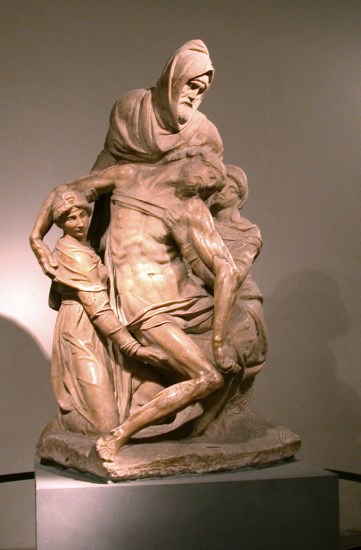
The Venetians, thanks to their distance from Rome and Florence and to their ardent communion with nature, which to the horror of Vasari they dared to copy honestly,[158] were saved for a time, but in the end caught the infection. The Florentine spirit won this last refuge of art, and Tintoretto infused the spirit of Michelangelo into Venetian realism.[159]
The brain of Italy was a prey to fever.[160] Michelangelo had destroyed the balance of mind of a period dried out by intellectualism and weakened by the taste for pleasure. The shock of his dazzling light on their eyes, too feeble to bear it, blinded them and inspired a delirium of imagination without poetry, without thought and without life.
The Carracci were needed at the end of the century, if not to snatch Italian art from inevitable death, at least to lend it, emerging from its follies and delusions, an air of dignity and a cold distinction in which it could veil itself to die.
The greatness of Michelangelo was thus fatal to Italian art. So it is with everything that rises too far above its own time. Decadence can only be averted or retarded by intelligent and moderate talents like the Carracci, who, hardly separated from the average of their times, are easily understood by it. They are the geniuses of common sense, and they are, therefore, useful to the common man. The heroes of art are also its tyrants; their glory kills, and the greater they are the more they are to be feared, for they impose on all men the laws of a personality which can exist but once. They are a devouring force; they illumine, but they burn; they have the right to be unique in their being and in their work. They seem to realise in themselves the whole aim of nature, and there is nothing left for those who follow but to be absorbed and disappear.
It would be absurd to offer Michelangelo as a model to young artists. Should great men ever be taken as models in art? Is not that one of the errors of classical training? They are examples of energy, sources of force and beauty. It is well to look for a moment on their radiance, then tear ourselves from their contemplation and work.
CHRONOLOGICAL TABLE
DATEIMPORTANT EVENTSPRINCIPAL WORKS
1475March 6. Birth of Michelangelo at Caprese.
1488April 1. He enters the school of Domenico and David Ghirlandajo.
1489He enters the school of Bertoldo and becomes the protégé of Lorenzo de' Medici.
1490-1492. . . . . . . . . .Mask of a Faun. Madonna of the Stairs. Combat of the Centaurs.
1492April 8. Death of Lorenzo de' Medici.
1492-1494In the service of Piero de' Medici.Wooden crucifix. Statue of Hercules.
1494October. Flight to Venice and Bologna. He worked at S. Petronio in Bologna.Angel for the Arca of S. Domenico in Bologna.
1495Return to Florence.Giovannino. Sleeping Love.
1496June 25. Arrival in Rome.Bacchus. Cupid.
1498May 23. Savonarola is burned in Florence.
1498-1500. . . . . . . . . .Pietà of St. Peter's.
1501Return to Florence.Statues for the Piccolomini altar in the cathedral of Sienna.
1501-1505. . . . . . . . . .David. Cartoon for the battle of Cascina. Holy Family of Agnolo Doni. Virgin of Bruges. Bas-reliefs of the Madonna for Taddeo Taddei and Bartolommeo Pitti.
1505March. He is summoned to Rome by Julius II.First plan for the tomb of Julius II
1506The Laocöon was discovered at Rome.
1506April 17. Flight to Florence.
1506End of November. Reconciliation with Julius at Bologna.
1506-1508. . . . . . . . . .Bronze statue of Julius II at Bologna.
1508Return to Rome.
1508May 10 to 1512, October. . . Paintings on the ceiling of the Sistine.
1513February 21. Death of Julius II.
1513March 11. Election of Leo X.
1513May 6. Second contract for the tomb of Julius II.
1513-1516Michelangelo at Florence.The Slaves. Moses.
1516July. Third contract for the tomb of Julius II.
1517September. Serious illness of Michelangelo.
1518January 19. Contract in regard to the façade of S. Lorenzo in Florence.
1518-1520Michelangelo at the quarries of Carrara, Seravezza.
1520March 10. Michelangelo is released from the contract for the façade of S. Lorenzo by an order from Leo X.The Christ of the Minerva.
1520April 6. Death of Raphael.
1521Beginning of the work on the chapel of the Medici at S. Lorenzo.The Madonna of the chapel of the Medici.
1521At the end of the year serious illness of Michelangelo.The Victory.
1522November 19. Election of Clement VII.
1524-1526. . . . . . . . . .Work on the tomb of the Medici and the Laurentian library.
1527May 6. Capture of Rome by the Imperialists.
1529April 6. Michelangelo is named Governatore Generale and Procuratore of the fortifications of Florence. Mission to inspect the fortifications at Pisa, Livorno and Ferrara.Leda.
1529September 21. Flight to Venice. Siege of Florence.
1529November 20. Return to Florence. Defense of San Miniato.
1530August 12. Capitulation of Florence. Proscriptions.Apollo.
1531June. Serious illness of Michelangelo.Work on the Medici tombs.
1532April 29. Fourth contract for the monument of Julius II.
1533Beginning of the friendship with Tommaso dei Cavalieri in Rome.First plan for the Last Judgment.
1534Death in Florence of Lodovico, the father of Michelangelo.
1534September 23. Michelangelo returns to Rome, where he remains until his death.
1534September 25. Death of Clement VII.
1534October 13. Election of Paul III.
1535September 1. Michelangelo is named by order of Paul III architect-in-chief, sculptor and painter of the Apostolic Palace.
1536Beginning of the friendship with Vittoria Colonna at Rome.
1536April to November, 1541. . .Last Judgment in the Sistine.
1538The statue of Marcus Aurelius is raised on the Capitoline.Brutus. Drawings of Christ for Vittoria Colonna.
1542-1544. . . . . . . . . .Frescoes of the Pauline Chapel.
1542August 20. Last agreement for the monument of Julius II.
1544June. Serious illness of Michelangelo, who was cared for in the palace of the Strozzi.
1545February. . . . .Completion of the monument of Julius II in S. Pietro in Vinculi.
1545-1546Titian in Rome.
1546January. Serious illness of Michelangelo. He gives the Slaves to the Strozzi.Work on the cornice of the Farnese palace.
1547January 1. Michelangelo named by Paul III architect of St. Peter's.
1547February 25. Death of Vittoria Colonna.Work on the Capitol.
1549November 10. Death of Paul III.
1550February 8. Election of Julius III.Work on the Vigna del Papa Giulio and the reconstruction of the Belvedere stairway.
1551First edition of the "Vite" of Vasari.
1553First edition of the life of Michelangelo by Ascanio Condivi.Work on St. Peter's.
1555March 23. Death of Julius III.
1555May 23. Election of Paul IV.
1555December 3. Death of Urbino, Michelangelo's servant.The group of the Pietà, broken by Michelangelo, is continued and completed by Tiberio Calcagni.
1558. . . . . . . . . .He works at the model of the dome of St. Peter's.
1559-1560Daniele da Volterra, at the command of Paul IV, paints drapery on the figures of the Last Judgment.
1560Catherine de' Medici requested Michelangelo to make the statue of Henri II.Work on the transformation of the Baths of Diocletian into the church of S. Maria degli Angeli.
1561August 29. Michelangelo was taken ill.Work on the Porta Pia.
1563January 31. Michelangelo made President of the Academy of Florence.
1564February.The Rondanini Pietà.
1564February 18. Death of Michelangelo.
1564July 14. Funeral at S. Lorenzo in Florence.
CATALOGUE OF THE PRINCIPAL WORKS OF MICHELANGELO IN PUBLIC COLLECTIONS
I.—PAINTINGS
ITALY
FLORENCE. Uffizi.
Holy Family, painted for Agnolo Doni (between 1501 and 1505).
ROME. Vatican.
Paintings on the ceiling of the Sistine (1508-1512).
The Last Judgment (1536-1541).
The frescoes of the Pauline chapel (1542-1549).
ENGLAND
LONDON. National Gallery.
The Entombment (about 1495).
The Virgin of Manchester (about 1495).
II.—SCULPTURE
ITALY
FLORENCE. Museo Nazionale.
Mask of a Faun (between 1490 and 1492).
Bacchus (1497).
The Dying Adonis (1497).
Virgin and Child, a circular bas-relief made for Taddeo Taddei (between 1501 and 1505).
Victory (1522-1523).
Apollino (1530).
Brutus (1538).
Galleria antica e moderna e Tribuna del David.
David (between 1501 and 1504).
Casa Buonarroti.
The Centaurs and Lapiths, bas-relief in marble (between 1490 and 1492).
Virgin and Child, bas-relief in bronze (between 1490 and 1492).
San Lorenzo.
The Medici tombs (1524-1527 and 1530-1534).
Santa Maria dei Fiore.
The descent from the cross (1553-1555).
ROME. Saint Peter's.
Pietà (1498-1500).
San Pietro in Vinculi.
Tomb of Julius II: (Moses, 1513-1516).
Rachel and Leah (1542-1545).
FRANCE
PARIS. The Louvre.
The Slaves (1513-1516).
ENGLAND
LONDON. South Kensington Museum.
Kneeling Cupid (1497).
Royal Academy.
Holy Family, circular bas-relief made for Bart. Pitti (between 1501 and 1505).
BELGIUM
BRUGES. The Cathedral.
Madonna (between 1501 and 1505).
GERMANY
BERLIN. Koenigliche Museum.
Giovannino (1495).
NOTE ON THE DRAWINGS
The great European Museums—especially the Louvre, the Uffizi, the Albertina in Vienna, the British Museum, Oxford University and Windsor—contain very rich collections of Michelangelo's drawings. The most beautiful of those in the Louvre came from the Jabach and Mariette collections.
"You could not ask for anything more finished or showing a greater knowledge of drawing," says Mariette; ... "they are almost too much finished.... I do not know any other master who finished his studies more completely. When he is looking for a certain pose he dashes off impetuously on the paper what comes from his imagination. He draws with large strokes.... But if he wants to study nature so that he may reproduce it later on in sculpture or in painting he follows an entirely different method.... His drawing is no longer a sketch, but a finished fragment in which no detail is left out, it is the flesh itself; and Michelangelo needed nothing more than this for his modelling. I have a number of drawings where you can see the marks which Michelangelo made on them, and which indicate that these designs were used by him as guides in his modelling...."
Some of the drawings in the Louvre were for the tombs of the Medici and for the bronze David for Florimond Robertet.
Another curious thing about these drawings is that we often find upon them verses by Michelangelo, fragments of poems. Both verses and drawings are often the repetitions or variations of certain ideas which were in his mind for years and occupied his attention with the tenacity of fixed ideas.
Michelangelo used indifferently red chalk, pen and ink, and charcoal or pencil.
BIBLIOGRAPHY
I.—WRITINGS OF MICHELANGELO
Le Lettere di Michel-Angelo Buonarroti, publicate, coi Ricordi ed i Contratti artistici, per cura di Gaetano Milanesi. Florence, 1875, in-fol., IX, 721 pages. Lemonnier (495 letters, from 1497 to 1563).
Rime di Michel-Angelo Buonarroti, raccolte da Michelagnolo suo nipote. Florence, 1623, Giunti (first complete edition, but full of errors).
Rime di Michel-Angelo Buonarroti, cavate dagli autografi e publicate da Cesare Guasti. Florence, 1863 (first really accurate edition).
Die Dichtungen des Michel-Angelo Buonarroti, herausgegeben und mit kritischem Apparat versehen von Carl Frey. Berlin, 1897 (the finest and most complete edition of the poems of Michelangelo which has been made up to the present time).
II.—WORKS ON MICHELANGELO
I. WRITINGS OF HIS CONTEMPORARIES.
Giorgio Vasari.—Vite degli architetti, pittori e scultori (first edition). Florence, 1550, in 4to;—(second edition). Florence, 1568, in 4to.—edition of Milanesi. Florence, 1856, Lemonnier.
Ascanio Condivi.—Vita di Michel-Angelo Buonarroti. Rome, 1553, Antonio Blado;—(second edition). Florence, 1746, with notes by Mariette.
Paolo Giovio.—Michaelis Angeli Vita, published by Tiraboschi in his Storia della letteratura italiana, Vol. IX, Modena, 1781.
Sammlung ausgewaehlter Biographien Vasaris, herausg. von Carl Frey (in the second volume are gathered le Vite de Michel-Angelo Buonnaroti, critical edition of all the biographies written by his contemporaries).
Vittoria Colonna.—Rime (first edition). Parma, 1538;—(second edition), 1539;—(third edition), 1544;—edition Saltini. Florence, 1860, Barbera.—Carteggio, published by Ermanno Ferrero and Giuseppe Müller. Turin, 1892, Loescher(Letters and documents).—Lettere inedite, published by Salza. Florence, 1898.—Codice delle Rime di Vittoria Colonna, appartenente a Margherita, regina di Navarra scoperto ed illustrato. Pistoia, 1900, ed. Tordi.
François de Hollande.—Quatre Entretiens sur la Peinture, held in Rome 1538 to 1539, written in 1548, published by Joachim de Vasconcellos;—French translation in Les Arts en Portugal, by Count Raczynski. Paris, 1846, Renouard.
Donato Giannotti.—De' giorni che Dante consumo nel cercare l'Inferno e'l Purgatorio. Dialoghi. Florence, 1859.
Benvenuto Cellini.—Vita (1559 to 1562), first edition. Naples, 1728.—I Trattati dell'oreficeria e della scultura. Florence, 1893, edition C. Milanesi.
Benedetto Varchi.—Due lezioni di Benedetto Varchi. Florence, 1549.—Orazione funerale recitata nelle esequie di Michel-Angela Buonarroti. Florence, 1564, Giunti.
Francesco Berni.—Opere burlesche. Florence, 1548. Giunti.
Michelangelo's correspondents: I. Sebastiano del Piombo, Ed. Milanesi, French translation by A. le Prieur. Paris, 1890, Librairie de l'Art.
Blaise de Vigenère.—Les Images de Philostrate. Paris, 1629.
II.—MODERN WORKS
Richard Duppa.—The Life and Literary Works of Michel-Angelo Buonarroti. London, 1806, 1816 (translations in verse of the poetry of Michel-Angelo by Southey and Wordsworth).
Quatremere de Quincy.—Histoire de la vie et des ouvrages de Michel-Ange Buonarroti. Paris, 1835.
Giovanni Gaye.—Carteggio inedito d'artisti dei secoli XIV, XV, XVI. Florence, 1839, three volumes.
Fr. Al Rio.—Michel-Ange et Raphael (first edition). Hanover, 1860 (since then there have been seven editions; the last appeared in 1900 with illustrations).
Aurelio Gotti.—Vita di Michel-Angelo. Florence, 1875, two volumes.
C. Heath Wilson.—Life and Works of Michel-Angelo. London, 1876. L'Œuvre et la Vie de Michel-Ange, by Charles Blanc, Eug. Guillaume, Paul Mantz, Charles Garnier, A. Mezières. Anatole de Montaiglon, Georges Duplessis and Louis Gonse. Paris, Gazette des Beaux-Arts, 1876.
Anton Springer.—Raffael und Michelangelo, 1878.
John Addington Symonds.—The Life of Michel-Angelo Buonarroti. London, 1893.
Corrado Ricci.—Michelangelo. Florence, 1901.
Henry Thode.—Michel-Angelo und das Ende der Renaissance, 1e vol. Berlin, 1902.—2e vol. Berlin, 1903.
Alfred von Reumont.—Vittoria Colonna. Fribourg, 1881.
Albert Hauck.—Vittoria Colonna. Heidelberg, 1882.
Giotti.—Catalogo delle opere d'arti e dei disegni di Michel-Angelo Buonarroti, 1875.
F. Reiset.—Notice des dessins du musée du Louvre. Paris, 1866.
Baron H. Geymuller.—Michelangelo als Architekt.
Dr Ernst Steinmann.—Die Sixtinische Kapelle.
Carl Frey.—Studien zu Michelagnolo (Jahrb. der K. preuss. Kunstssamml.) 1895-1896.
Luigi Passerini.—La bibliografia di Michel-Angelo Buonarroti e gli incisori delle sue opere. Florence, 1875.
INDEX
A
Academy of painters, Florence, 139.
Aldovrandi, 10.
Altoviti (Bindo), 122, 134.
Amadio d'Alberto, 66.
Ammanati (Bart.), 110, 139.
Annunciation, 136.
Apollo, 74.
Apollo and Marsyas, 11.
Arca of S. Domenico of Bologna, 10.
Archadelt, 86.
Aretino, 95-98.
Ariosto, 82.
B
Bacchus, 10.
Baccio d'Agnolo, 50, 52.
Baglioni (Malatesta), 68, 71.
Baïf (Lazare de), 69.
Bandinelli, 22, 66.
Bandini, 116, 123, 134.
Bartolommeo (Fra), 24.
Beethoven, 13, 127, 149.
Bembo, 82.
Berni (Francesco), 87, 128.
Bernin, 160.
Bertoldo, 6, 7.
Bettini (Bart.), 134.
Biagio da Cesena, 95.
Boboli (Figures in the grotto), 59.
Boccaccio, 10.
Borghini (Vincenzo), 139, 141.
Borgo (Fortifications of), 110.
Botticelli, 12, 16.
Bramante, 28-31, 35-37, 109, 119.
Bronzino, 22, 128, 139.
Brunelleschi, 77, 119.
Bugiardini (Giuliano), 7, 37, 128.
Buonarroti (Lodovico), 1, 76.
Buonarroti (Lionardo, son of Lodovico), 1, 12.
Buonarroti (Buonarroto), 1, 49, 76.
Buonarroti (Giovan Simone), 1, 130.
Buonarroti (Sigismondo), 1, 130.
Buonarroti (Lionardo, son of Buonarroto), 115, 130, 132, 135, 138, 140.
Buonarroti (Francesca), 130.
Buoninsegni (Domenico), 52, 61.
C
Calcagni (Tiberio), 124, 126.
Capitol, 120-121.
Capponi (Niccolo), 66, 67.
Carducci (Francesco), 67, 68.
Carnesecchi (Pietro), 83.
Carpi (Cardinal), 116.
Carracci, 166.
Carrara, 26, 27, 30, 51, 54, 55.
Caryatid in the Hermitage, 48.
Castiglione (Bald.), 82.
Cavalcanti, 87.
Cavalieri (Tommaso dei), 80, 81, 97, 134, 137, 138.
Cecchino dei Bracci, 128.
Cellini (Benvenuto), 22, 128, 139, 148, 158, 160, 163.
Christ of the Minerva, 49, 58.
Christ, incompleted.
Cino da Pistoia, 87.
Civitale, 107.
Clement VII, 54, 56, 59. 60, 61, 74-76, 128.
Clement VIII, 100.
Colonna (Vittoria), 82-86, 89, 93, 147.
Colossus of Florence, 62-64.
Combat of Centaurs and Lapiths, 8.
Condivi, 129.
Consilium, 86.
Contarini (Cardinal), 83.
Corregio, 155.
Credi (Lorenzo di), 7.
Cronaca, 16.
Crucifix in wood of the convent of S. Spirito, 10.
Crucifixion, 85.
Cupid sleeping, 11.
D
Dante, 10, 57, 87, 106-107.
David, colossal, 16-18, 97.
David in bronze, 17.
Descent from the cross (Duomo, Florence), 126, 127.
Descent from the cross, drawing, 85.
Dolce (Lodovico), 82.
Donatello, 6, 7, 10.
Doni (Agnolo), 24.
Duccio (Agostino di), 16.
Dürer (Albrecht), 25, 150.
Dying Adonis, 11.
E
Entombment, 11.
F
Farnese (Palace), 111.
Fattucci, 62, 63.
Febo di Poggio, 80.
Ferrara (Renée de), 83.
Festa (Constanzo), 86.
Francesca (Piero della), 23.
Franco (Battista), 159.
Francis I, 69.
Frizzi (Federigo), 58.
G
Gaeta (Pier Luigi), 117, 137.
Ghiberti, 4.
Ghirlandajo (Domenico), 2-6.
Ghirlandajo (Ridolfo), 23.
Giannotti (Donato), 65, 87, 115, 128.
Giberti, 83.
Giotto, 4.
Granacci (Francesco), 2, 7, 22, 37.
H
Hercules and Cacus, 66.
Hercules, colossal, 11.
Holland, Francis of, 13, 83.
Holy Family (Agnolo Doni), 24.
Holy Family (Bart. Pitti), 24.
Holy Family (Taddeo Taddei), 24.
I
Indaco, 37.
J
Jacopo di Sandro, 37.
Jove (Paul), 82.
Julius II, 26-36, 43-44.
Julius II (Tomb of), 26-36, 45-47, 48-50, 72, 89-96, 102, 103.
Julius II (Bronze statue of), 33-34.
Julius III, 109.
L
Last Judgment, 91-102.
Leah, 105-107.
Leda, 67, 74.
Le Noyer (Robert), 100.
Leo X, 50-54, 57, 59.
Leone Leoni, 128.
Lippi (Filipino), 23.
Lomazzo, 153, 155.
M
Madonna of Bruges, 25.
Madonna and child (bas-relief in bronze), 9.
Majano (Benedetto da), 4.
Mantegna, 14.
Marcellus II, 114.
Masaccio, 4.
Medici (Lorenzo de'), 6, 7, 13.
Medici (Alessandro de'), 65, 76.
Medici (Duke Cosmo de'), 78, 115-117, 129, 130, 138.
Medici (Don Francesco de'), 129, 134.
Medici (Tombs of the), 59-62, 71-74.
Michi (Giovanni), 38.
Minni (Antonio), 69, 75, 131, 134.
Mino da Fiesole, 4.
Mirandole (Pico della), 7, 10.
Montelupo (Raffaello da), 77, 103, 107.
Montmorency (Constable de), 47, 69.
Montorsoli (Giovanni da), 77.
Moses, 47, 104-106.
Moses (small), 138.
N
Nanni di Baccio Bigio, 112-118.
Navarre (Marguerite de), 83.
Noli me tangere, 134.
O
Ochino (Bernadino), 83.
P
Palla (Battista de la), 68.
Paul III, 89-112, 109, 114.
Paul IV, 99, 114, 118.
Pauline Chapel, Frescoes of, 102.
Perini (Gherado), 80, 97, 134.
Perino del Vaga, 22, 111, 156, 163.
Perugino, 22, 91.
Peruzzi (Baldi), 109.
Petrarch, 10, 87.
Petreo (Antonio), 65.
Pierfrancesco d'Urbino, 66.
Piero di Cosimo, 23.
Pietà of St. Peter's, 14, 15.
Pietà Rondanini, 137.
Pietà, drawing, 137.
Pietà, 13.
Pinturicchio, 23.
Pius IV, 122.
Poems of Michelangelo, 86-89.
Pole (Cardinal), 83.
Poliziano (Angelo), 7, 8, 10, 128.
Pollajuolo, 3.
Pontormo, 22, 134.
Porta (Guglielmo della), 111.
Porta Pia, 120-122.
Poussin, 153, 154.
Pulci, 7.
Q
Quercia (Jacopo della), 4, 10.
R
Rachel, 105-107.
Raffaellino del Garbo, 23.
Raphael, 3, 22, 28, 36, 50, 109, 143, 155, 156.
Resurrection of Christ, 85.
Riccio (Luigi del), 65, 86, 128, 135.
Rossellino (Antonio), 4, 107.
Rosso, 22.
Rustici, 7.
S
Sadolet, 83.
St. Peter's (construction of), 27.
St. Peter (statue), 137.
St. Matthew, 18.
Salviati, 22.
Samaritan woman at the well, 85.
San Gallo (Antonio da), 16, 50, 109-111, 122.
San Gallo (Aristotele da), 22.
San Gallo (Francesco da), 66, 139.
San Gallo (Giuliano da), 31, 43, 50.
San Lorenzo (façade of), 50-57.
San Lorenzo (sacristy of), 59.
San Lorenzo (library of), 60, 78.
San Lorenzo (chapel of the Medici), 76-78.
Santa Maria degli Angeli, 120, 122.
San Miniato (defense of), 66-67, 70.
Sansovino (Jacopo), 22, 50, 112.
Sansovino (Andrea del Monte), 7, 50.
Sarto (Andrea del), 22.
Satyr (laughing), 8.
Savonarola, 8-14.
Schongauer (Martin), 4, 5.
Sebastiano del Piombo, 58, 70, 87, 111, 128, 134, 150.
Serlio (Sebastiano), 66.
Signorelli, 14, 23.
Sistine chapel (ceiling of), 36-42.
Slaves, 47, 49.
Soderini, 16, 19.
Sodoma, 23.
Strozzi (Roberto), 47, 134.
T
Tasso (Bernardo), 82.
Temptation of St. Anthony, 4.
Tintoretto, 151, 165.
Torrigiani, 7.
Tribolo, 78, 165.
Tromboncino, 86.
U
Urbano (Pietro), 58, 131.
Urbino, 103, 132, 133.
V
Valori (Baccio), 71, 75.
Varchi, 68, 86, 128.
Varj (Metello), 49, 58.
Vasari, 20, 78, 101, 111, 128, 139, 140, 153.
Venusti (Marcello), 100.
Veronese, 99.
Verrocchio, 3.
Victory, 138, 140.
Vignole, 128.
Vinci (Lionardo da), 18-22, 24.
Virgin of Manchester, 11.
Vitruvius, 77.
Volterra (Daniele da), 100, 128, 136, 140, 158.
W
War with Pisa (Cartoon), 18-23.
Z
Zucchero, 153, 159.
THE END