Front matter (continued 2)
Reading edition
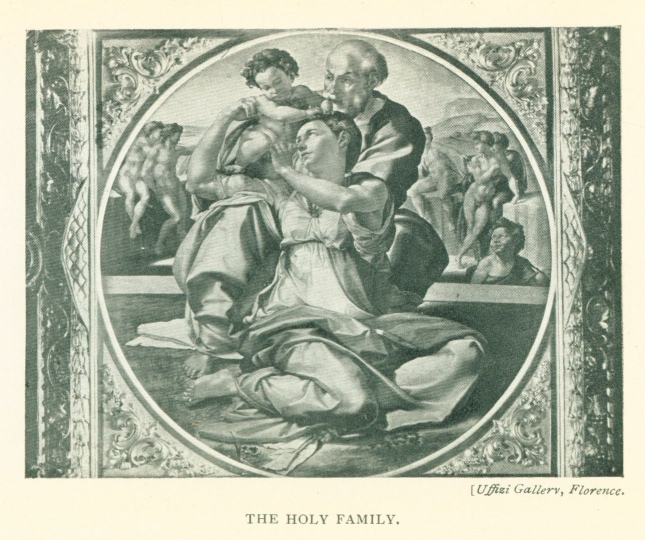
Nevertheless there is not the slightest hint at irreverence; it is merely a Pagan translation, by a master hand, of an oft-repeated Christian theme, a transposition as beautiful and as harmonious in its way as the original score. Indeed, Vasari tells us that Michelangelo painted this strikingly original tondo merely "to show his skill," and the magnificent modelling and foreshortening of the Madonna's arms, the masterful composition, and the wonderfully accurate drawing more than achieve his object. As to the colouring, he entirely disregarded it in his sculptor's pride. He might as well have carved this remarkable work in marble. Before painting the ceiling of the Sistine Chapel, Michelangelo appeared to be wilfully colour-blind, as if afraid that painting would wile him away from the sister art, to which he had plighted his troth.
There is very little doubt that the original design of the Creation of Man was inspired in Michelangelo by one of the antique gems which he admired as a boy in Lorenzo de' Medici's collection. A similar origin may be assigned to the group of Judith and her maid, also in the Sistine Chapel, to several of the Athletes, and to the Leda and the Swan which he painted for the Duke of Ferrara. But this magnificent recumbent figure of Adam far surpasses anything in ancient as well as in modern art, and is indeed a worthy centre round which the remaining stupendous compositions appear to gravitate like planets round the sun. It is here, more than in any other of his works, that we can appreciate Michelangelo's wonderful gift of interpreting the highest and most inaccessible themes in a simple yet imposing manner. Resting heavily on the curved surface of the globe, his powerful limbs and finely modelled flesh clearly outlined against the indigo blue of the sky and the solemn lines of the landscape, Adam gives one the impression of a huge primeval being instinct with strength which he is as yet unable to understand or to use, and just awaking into life, a divine spark of which he receives from the Deity. Michelangelo's conception of God the Father, as an old but powerful and majestic figure, has ever since remained the only possible pictorial symbol of so lofty a subject.
THE HOLY FAMILY.
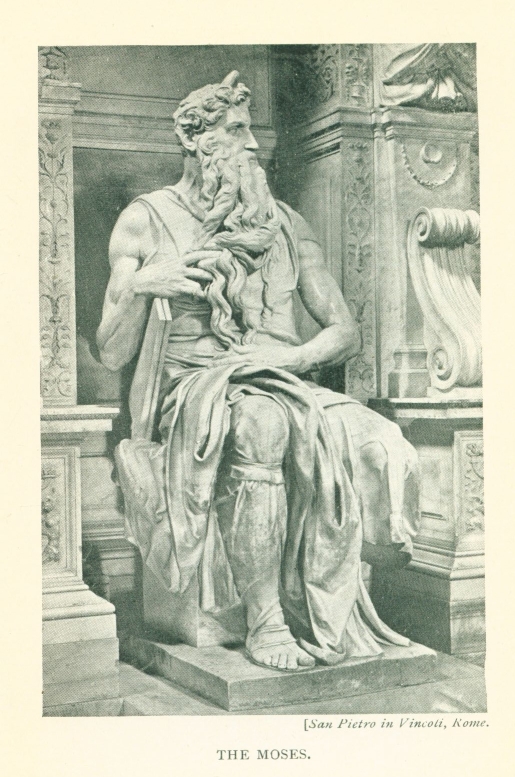
Apart from its great artistic merit, a pathetic interest attaches to the statue of Moses because it represents the last act of that tragedy of the tomb which darkened the greater part of Michelangelo's life, and influenced his art more than any other circumstance of his eventful career.
The leader and law-giver of the Hebrews is seated in an attitude of thought and wisdom, holding under his right arm the tables of the law, and supporting his chin with his left hand, like one tired and full of cares. His beard escapes in long waves between the fingers of his right hand. The hands and strong bare arms of the Moses are magnificent, beyond comparison the finest ever modelled by Michelangelo. The expression of the face is one of commanding power and almost fierce energy, a face capable of inspiring terror rather than love, a veritable embodiment of the cruel, uncompromising Hebrew legislation. The powerful, massive form is clearly apparent beneath the beautiful folds of the draperies, for here, as in all Michelangelo's clothed figures, whether in painting or in sculpture, dress does not hide but almost enhances the shape and beauty of the body. "This statue alone," exclaimed the Cardinal of Mantua, when he saw the finished work, "is enough to honour the memory of Pope Julius."
THE MOSES.
In the Medicean tombs Michelangelo may be said to have equalled if not surpassed the masterpieces of ancient sculpture. We have selected the tomb of Lorenzo de' Medici for our illustration, as the statues which adorn it, symbolizing Evening and Dawn, although conceived in the same spirit of profound melancholy, are, if possible, even more beautiful than the Day and Night of Giuliano's tomb. Evening is represented by an old man, brooding and dejected, but hardly less powerful and muscular than the giant Day. It is evident that he is not suffering from bodily fatigue, but that he is sinking under the weight of some unbearable, irremediable calamity.
The virgin Dawn is perhaps the most beautiful female figure of modern or of ancient art. She is represented as only half awake and almost unable to rise from her couch, while there is a suggestion of ineffable bitterness in the expression of the face with its half-closed eyes wearily greeting another day of sorrow. The powerful yet graceful limbs are magnificently modelled, and the whole figure may be regarded as the perfection of the female form, redeemed from any breath of sensuality by a commanding loftiness of expression, such as the Greeks gave to the statues of their goddesses.
Michelangelo's Last Judgment is a work of so colossal a nature that it would be impossible to give even a remote idea of the whole composition in this unpretentious little book. We have therefore selected for our illustration the central group representing Christ the Judge, a dread figure enthroned on clouds, with hand upraised in an attitude of stern command, surrounded by the Blessed, who press round the Son of God with eager, frightened looks and gestures, as if hardly secure of their final salvation in that terrible day of retribution, "cum vix Justus sit securus." Nestling timorously close to her Son, half sitting, half crouching, with head averted, as if to avoid seeing the coming wrath, and arms crossed on her bosom, is the Mother of God, a wonderfully sweet and pathetic figure, full of pity and sorrow for the condemned souls, and contrasting strangely with the inexorable Judge rising in his stern majesty to pronounce sentence on the frightened, shuddering mass of humanity. The action of the Judge, and indeed every part of the composition, forcibly remind us of the Last Judgment in the Campo Santo of Pisa, but there is not a figure or a detail in the whole of this colossal work which does not bear the imprint of that powerful originality and that wonderful gift to express the most varied emotion and to interpret the loftiest themes, which were the principal characteristics of Michelangelo's genius.
LIST OF CHIEF WORKS
AUSTRIA-HUNGARY
VIENNA, ALBERTINA GALLERY.
Several drawings and sketches.
BELGIUM
BRUGES, CHURCH OF ST. BAVON.
Marble group of Virgin and Child. (Executed at Carrara in 1506 for two Flemish merchants.)
BRITISH ISLES
LONDON, NATIONAL GALLERY.
No. 790, Entombment. Unfinished painting on wood. (Between 1501-1504.)
ROYAL ACADEMY, DIPLOMA GALLERY.
Madonna and Child. Tondo bas-relief (1501-1504).
LONDON, BRITISH MUSEUM.
Several drawings.
OXFORD, TAYLOR COLLECTION.
Drawings.
FRANCE
PARIS, LOUVRE.
Two colossal statues of Captives, originally intended for the tomb of Julius II. (1513).
Numerous drawings, including Head of Faun.
LILLE, MUSÉE WICAR.
Drawings.
GERMANY
BERLIN MUSEUM.
Statue of youthful St. John the Baptist (about 1495).
WEIMAR MUSEUM.
Drawings and studies for the Last Judgment.
HOLLAND
HAARLEM, TEYLER MUSEUM.
Many important drawings.
ITALY
BOLOGNA, CHURCH OF SAN DOMENICO.
Statue of kneeling Angel (1494).
FLORENCE, ACCADEMIA.
Colossal statue of David (1501-1504).
Statue of St. Matthew (unfinished).
BUONARROTI COLLECTION.
Madonna and Child (bas-relief), 1489-1492.
Fight between Centaurs and Lapithae (bas-relief), 1489-1492.
Numerous sketches, studies, architectural drawings and three hundred autograph letters.
DUOMO.
Unfinished group representing "The Deposition from the Cross."
MUSEO NAZIONALE.
Statue of Bacchus (executed in 1497 for Jacopo Galli).
Dying Adonis (1501-1504).
Apollo (unfinished statue, executed in 1530 for Baccio Valori).
Victory (group intended for Julius II.'s Tomb, 1521).
Bust of Brutus (1544?).
CHURCH OF SAN LORENZO.
Medicean Tombs (begun 1521).
New Sacristy and Library of San Lorenzo.
UFFIZI GALLERY.
The Holy Family (tondo in oil-colours, painted for Angelo Doni in 1503).
Numerous drawings, including The Resurrection of Lazarus, Prudence, the Last Judgment.
BOBOLI GARDENS.
Four Slaves (unfinished statues).
ROME, ST. PETER'S.
Group of La Pietà (1499).
CHURCH OF SANTA MARIA SOPRA MINERVA.
Statue of the Saviour (1521).
CHURCH OF SAN PIETRO IN VINCOLI.
Tomb of Julius II. and statue of Moses (completed 1545).
VATICAN, SISTINE CHAPEL.
The Creation and Fall of Man (1508-1512). } } Frescos. The Last Judgment (1535-1541). }
PAULINE CHAPEL.
The Conversion of St. Paul. } Frescoes } (1542-49). The Martyrdom of St. Peter. }
CHISWICK PRESS: PRINTED BY CHARLES WHITTINGHAM AND CO. TOOKS COURT, CHANCERY LANE, LONDON.