INTRODUCTION
Reading edition
I
On ne doit jamais écrire que de ce qu’on aime. It is my happy fortune that I love Michael Fairless; and although, before I began to write of her, I thought the demand anything but happy that compelled me to break the silence she desired, I have come to think even this a part of my good fortune too. I have come indeed to feel that, since her wish to remain unknown must be set aside in face of circumstances she could never have foreseen, this may bring new fulfilment to a desire that lay far nearer to her heart—the desire to give away all she had, to hoard nothing, not even her own self.
4Much that Mrs. Haggard says of her sister’s early childhood is new to me; but all is congruous, as the bud is congruous with the rose. The child with her pet animals I have seen in the woman for whom all animals, even the very fierce, were friends, telling each its own secret and able to receive something of the great human secret offered them in her. They grew, these creatures, grew in spirit, under the magic of her hands and in the stirring warmth of her heart. The wild ones knew her as they knew the little poor man upon the Umbrian hills. Birds would perch about her, rabbits play; even the ‘tramp cats,’ as she calls them in her Christmas Idyll—cats who had taken to the woods and become worse than wild—learnt from her the graces of home life and laid savagery down. ‘She had a way with her,’ as they say in Ireland. And this way stretched 5beyond the kingdom of the beasts and bees and birds. When I first learnt to know her she had a little cottage on a high road, the great Bath road of many tramps. It had been the lodge of an abandoned manor house, and was, of course, close to the gateway. There she tamed her tramp men and made them friends. Every man who came had a table and chair under shelter; the plainest, simplest food; materials for mending his clothes, tea or cocoa to drink, her smile, her wonderful eyes upon his, her open heart and word. Never a thing was stolen from her doors, her wide windows; never a penny did she give; but many a man begged leave to chop wood for her, to dig in her garden—some little thing to show what she had done for him.
It seemed to me illuminating; it pointed me to the one great hope for this world, the hope of the coming of 6the kingdom of God in the power of man’s self-sharing, fearless, love for men.
Mrs. Haggard alludes very briefly to Michael Fairless’s ‘psychic’ gifts. Of these I had said nothing; she herself made nothing of them. But they were strong, too strong to be overlooked by anyone who knew her well. It would lead me outside my province if I were to attempt here an adequate discussion of the matter. I will say only that she was ‘telepathic’ in a high degree, had that sympathetic insight which reveals actual facts hidden from the physical senses. The connexion of this with power over animals is a problem of great interest for which, again, there is no place here. How far her insight—her interior vision—reached I cannot say; that it went beyond animals, tramps, and her best friends I am assured by my experience of her. There is an 7instance given in ‘A Modern Mystic’s Way’ which is true to the letter. The account given there was transcribed in every point from notes taken at the time and signed by her as correct.
She was one whom we who knew her do not try to measure by ordinary standards, the rules of everyday, in any of the relations of life. Need I say that there were people whom she puzzled, bewildered? Or that there were others who not only failed to understand, but wholly misunderstood her? They always do it; they will do it still, no doubt, even when they have read every word Mrs Haggard and I have written here.
W. S. P.
Hartfield, January 1913.
8
II
It has always been a matter of wonder to the writer that the affection of the public for a favourite author should stop short of observing his wishes. Michael Fairless most straitly charged those who would represent her to abstain from the publication of her identity. But demand creates supply, and the interest in her has become so extended that if authorised information about her is not forthcoming, something of an unauthorised and incorrect nature will probably be produced. Only one thing would have made Michael Fairless more vexed than the publication of the truth about her, and that thing would have been the publication of untruth. So many garbled statements, inaccurate assertions and pure fictions have appeared about her that it is time for uncertainty to be dispelled. Death has left absolutely 9authentic knowledge in the hands of two people only—the writers of this volume. Her eldest sister has chronicled such of the very simple happenings of Michael Fairless’s life as have left some record of her character, and save for brief mention, is confidently leaving the treatment of her work and its effect in the competent and devoted hands of Mrs Dowson, her dear friend and literary executor.
A. M. HAGGARD.
Chelsea, January 1913.
HER LIFE
BY
A. M. HAGGARD
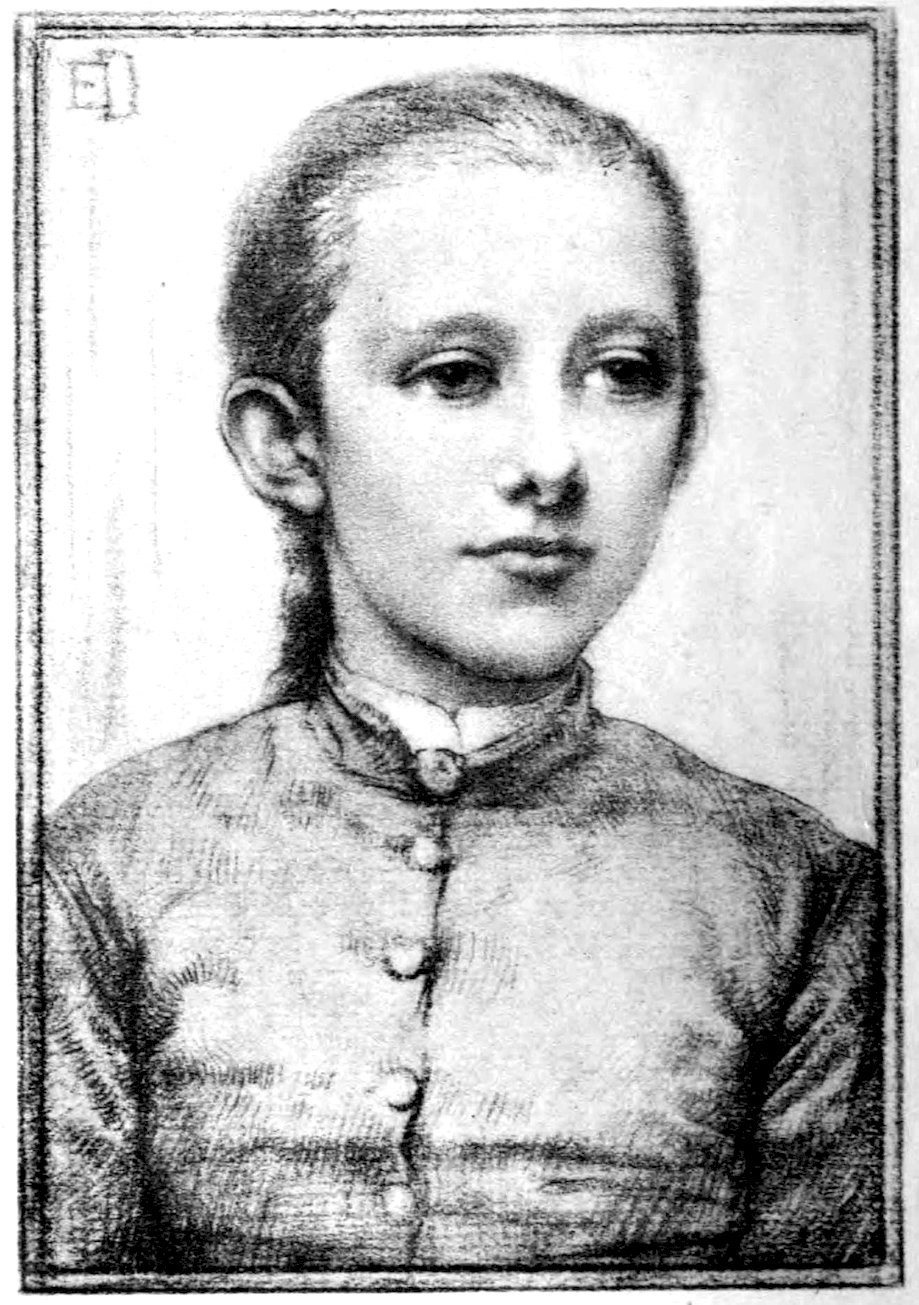
Drawn from a photograph.
13