Front matter (continued 2)
Reading edition
Procyon cancrivorus.—Unfortunately, data for the crab-eating raccoon are not complete enough at high temperatures to include it in this survey.
Summary.—This comparison demonstrates that capacity for evaporative cooling, tolerance of an elevated Tb to enhance passive heat loss, and behavioral avoidance of thermal stress are the primary methods used by procyonids to thermoregulate at high temperatures. Procyon lotor and Bassariscus astutus, whose distributions extend into temperate regions, have developed these abilities to a greater extent than other procyonids. Potos flavus, whose distribution is confined to lowland tropical forests, has the least ability in this regard. Nasua nasua and Nasua narica appear to have thermoregulatory abilities that are intermediate to those of Bassariscus astutus and Potos flavus. This suggests that ancestral procyonids may have had poor to modest ability to thermoregulate at high temperatures, a condition that would have limited their ability to leave the thermal stability afforded by tropical forests. Dispersal into temperate climates, therefore, required not only increased cold tolerance but also selective enhancement of those mechanisms used in thermoregulation at high temperatures.
Table 11.—Distribution by climate of selected procyonid species.
Procyon lotor++++
Bassariscus astutus+++
Nasua nasua++
Nasua narica++
Procyon cancrivorus++
Potos flavus+
Composite Scores of Adaptive Units and Geographic Distribution
In Table 11, procyonid species are arranged in descending order with respect to the number of major climates that are included in their geographic distributions (Hall and Kelson, 1959:878-897; Poglayen-Neuwall, 1975; Kortlucke and Ramirez-Pulido, 1982; Nowak and Paradiso, 1983:977-985). Composite scores ranged from a high of 1.47 for Procyon lotor to a low of 0.39 for Potos flavus, whereas Nasua nasua, Nasua narica, Procyon cancrivorus, and Bassariscus astutus had intermediate values ranging from 0.64 to 0.79 (Table 12). Figure 8 demonstrates that there is a direct relationship between the number of climates these species occupy and their composite scores. Regression analysis (Y = 2.68·X + 0.24; where Y is number of climates, and X is composite score) demonstrates a high degree of correlation between these variables (R = 0.94) and indicates that 89% of the variance in distribution can be explained by composite scores. The various combinations of adaptations expressed by these species do, therefore, play a role in delimiting their climatic (latitudinal) distributions.
Procyon lotor's normalized scores were higher in all categories than those of other procyonids. Procyon lotor, therefore, possesses those traits that have allowed it to become the premier climate generalist of the procyonid family. As an adaptive unit, these traits provide Procyon lotor with the physiological and behavioral flexibility required to take full advantage of a wide range of climates and habitats, and its distribution verifies that it has done so. Even so, it is probably not fair to assume that this species represents a perfect physiological match with climate over its entire distribution. Procyon lotor is, in many respects, still a forest-dwelling species, and its ability to expand its distribution into other habitats such as prairie and desert may well be due, in part, to its use of behavior to take advantage of favorable microclimates in otherwise hostile environments (Bartholomew, 1958, 1987). This feature of Procyon lotor's biology needs to be further examined.
Table 12.—Normalized and composite scores for selected procyonids. (Hbr = ratio of measured to predicted basal metabolism (Table 7), Cmwr = ratio of measured to predicted minimum thermal conductance (Table 7), Ddr = ratio of food categories actually utilized by each species to total food categories eaten by all six species (calculated from Table 9), rmaxr = ratio of calculated to expected rmax (Table 10).)
SpeciesNormalized scoresComposite[a] score
Hbr/CmwrDdrrmaxr
Procyon lotor0.950.952.521.47
Bassariscus astutus0.800.331.240.79
Nasua nasua0.480.33 1.11[b]0.64
Nasua nasua0.480.33 1.11[b]0.64
Nasua narica0.400.531.110.68
Procyon cancrivorus0.550.331.320.73
Potos flavus0.600.110.480.39
All five species with low Ḣb's have composite scores less than 1.0 (Table 12; Figure 8). Four of these five, Nasua nasua, Nasua narica, Procyon cancrivorus, and Potos flavus, have Hbr/Cmwr ratios that are 0.6 or less, which indicates they are the least cold-tolerant procyonids (McNab, 1966). These four species also are confined to either tropic, or tropic and subtropic climates (Table 11). This suggests that these species share a common thermoregulatory adaptation that represents a specialization to these climates. Attendant with this adaptation, however, is a high cost of thermoregulation at temperatures below their Tlc, and this must be an important factor in limiting their distributions to tropic and subtropic climates. Differences in their distributions within these climates, therefore, must hinge more on differences in their Ddr and rmaxr values than on differences in their Hbr/Cmwr ratios. This is supported by the fact that Potos flavus, which has the lowest Ddr and rmaxr values, is confined to a single climate, whereas Nasua nasua, Nasua narica, and Procyon cancrivorus each possess larger Ddr and rmaxr values and are found in two climates. Thus, Potos flavus, with its highly specialized diet and low reproductive potential, is the most ecologically specialized of these procyonids, and its distribution is limited to the single climate that can provide its requirements. Nasua nasua, Nasua narica, and Procyon cancrivorus are less specialized and thus show more ecological flexibility in their distributions.
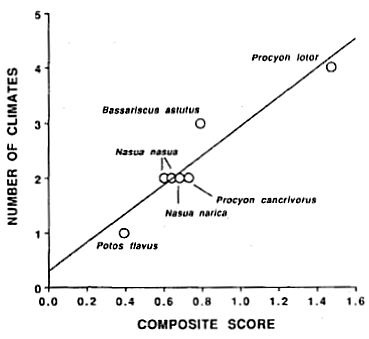
Figure 8.—Relationship between number of climates in which a species is found and its composite score. Symbols for Nasua nasua overlap at coordinates (0.64, 2). Solid line represents linear regression of climates (Y) on composite scores (X): Y = 2.68·X + 0.24; R = 0.94.
Bassariscus astutus, the other species with low Ḣb, is found in three climates, which indicates that it has greater ecological flexibility than Nasua nasua, Nasua narica, or Procyon cancrivorus. Ddr and rmaxr are comparable for these four species (Table 12). This suggests that the greater ecological flexibility of Bassariscus astutus is derived largely from its greater cold tolerance. Bassariscus astutus has a more insulative pelt than these other procyonids (Cmwr = 0.85; Table 7), so its Hbr/Cmwr ratio is higher (0.80; Table 12). This, and its greater capacity for evaporative cooling (Chevalier, 1985), allows Bassariscus astutus to take advantage of a wider range of thermal environments than these other species. However, even with its higher Hbr/Cmwr ratio, the composite score for Bassariscus astutus is not much different than those for Nasua nasua, Nasua narica, and Procyon cancrivorus (Table 12). Consequently, Bassariscus astutus is found in more climates than would be predicted for it on the basis of its composite score (Figure 8). This suggests that either the Hbr/Cmwr ratio carries greater weight in determining distribution than is reflected in this analysis, or as has been described for some other species (Bartholomew, 1958, 1987), Bassariscus astutus may extend its distribution farther than expected via use of its behavior. In either case, for procyonids with low Ḣb, Bassariscus astutus represents the pinnacle of adaptation for climate generalization.
Evolution of Metabolic Adaptations
Evolution of Low Basal Metabolic Rate
A radiation of frugivorous and omnivorous Procyoninae (Table 1) occurred in the middle and late Miocene of North America. It included origins of such terrestrial genera as Cyonasua, Nasua, and Procyon (Webb, 1985b). The earliest procyonid genus to find its way to South America was Cyonasua, an omnivorous carnivore that presumably split, along with its sister genus Arctonasua, from a common North American ancestor (Baskin, 1982; Webb, 1985b). Cyonasua, about the size of present-day raccoons, was adapted to a wide range of habitats and was probably comparable to modern raccoons with respect to the breadth of its feeding habits (Webb, 1985b; Marshall, 1988). Because North American Arctonasua was about the same size as Cyonasua (Webb, 1985b) and shared a number of characters with it (Baskin, 1982), we speculate that it also may have had similar habits and occupied similar climates and habitats. Bassariscus, another member of Procyoninae, had an even earlier origin in tropical North America (Webb, 1985b). The origin of the small arboreal forms Potos and Bassaricyon (subfamily Potosinae) is obscure but is thought to have occurred in the rainforests of Central America (Webb, 1985b). What were the metabolic capabilities of these early procyonids? We do not know, but for several million years, from middle to late Miocene, procyonids lived in tropical and subtropical forests of Central and North America (Webb, 1985b; Marshall, 1988). Then, in the Pleistocene, several modern forms crossed the Panamanian land bridge into similar habitats and climates in South America; but none of them appear to have spread far enough northward to have crossed the Bering land bridge.
Several million years exposure to a tropical environment, with its continuous high temperatures and modest range of thermal extremes, would have favored selection of metabolic and thermoregulatory traits that would minimize energy requirements: a lower than predicted basal metabolic rate, a prolonged or continuous molt resulting in very little annual change in minimum thermal conductance, and a modest capacity for evaporative cooling. In addition, we would expect selection to have favored a diverse diet, good reproductive potential, and behavioral flexibility to utilize a variety of habitats within these climates. Our analysis has shown that such characteristics are the norm for extant members of this family living in tropical and subtropical climates, and we speculate that these traits also were common to early procyonids and served to restrict them to these climates. Our speculation is supported by the fact that their known fossil history from the Miocene is confined to geographic areas that had tropical and subtropical climates.
Later on, during Pleistocene glaciations, tropical and subtropical forests shrank, savannas expanded, and temperate climate was pushed toward equatorial regions. The opposite occurred during interglacial periods (Raven and Axelrod, 1975; Webb, 1977, 1978; Marshall, 1988). Consequently, mid-latitudes experienced alternating periods of temperate and tropical, or at least subtropical, climate change. Selection of characteristics that would have adapted a species with low Ḣb to temperate as well as tropic or subtropic climates could have occurred in mid-latitudes at the temperate edge of these tropical advances and retreats. Our analysis indicates that, for this purpose, selection would have favored lower than predicted thermal conductance, seasonal molt, increased capacity for evaporative cooling, increased tolerance of elevated Tb, increased flexibility of thermoregulatory behavior, food habits that provided for year-round access to a high-quality diet in all three climates, and a higher than predicted rmax.
Bassariscus astutus is the only species with low Ḣb that has all these characteristics, and it is the only one of them that has added temperate climate to its distribution (Table 11). This suggests that Bassariscus astutus is a species that evolved away from the norm for procyonids with low Ḣb, toward characteristics that allowed it to become more of a climate generalist. Potos flavus, with its dietary specialization, low tolerance to high temperatures, and arboreal mode of existence, has become a highly specialized species totally dependent on tropical forests for its survival. As such, it also represents a species that has evolved away from the procyonid norm and portrays the extreme in climate specialization. Olingos, Bassaricyon gabbii (Table 1), may be similar to Potos flavus in this respect (see also Table 10). This suggests that of the extant procyonids, Nasua nasua, Nasua narica, and Procyon cancrivorus have retained metabolic and behavioral characteristics that are closest to those of their Miocene ancestors.
Evolution of High Basal Metabolic Rate
Between the time that Cyonasua appeared and the Panamanian land bridge was established in the upper Pliocene (4 to 5 million years ago), northern climates continued their gradual cooling. This, along with ongoing elevation of the continents and continuous modification of their mountain ranges, served to shrink the tropical forest and create pockets of climatic instability within it and on its edges (Darlington, 1963:578-596; Marshall, 1988). In areas of instability, selection would have favored traits that provided for a broader range of thermal tolerance: higher Ḣb, improved insulative quality of pelt, a more sharply defined molt cycle, improved capacity for evaporative cooling, greater Dd, and higher rmax. Consequently, by the upper Pliocene, two metabolically distinct groups of procyonids could have been established: those species with low Ḣb living in climatically stable forests and those with higher Ḣb living in unstable tropical, subtropical, and perhaps temperate climates.
Procyon lotor is the only extant procyonid with high Ḣb. Procyon cancrivorus is its congeneric counterpart in Central and South America (Table 1), and the two species are sympatric in Panama and Costa Rica. However, in terms of its metabolism, thermal conductance, molt, diversity of diet, rmax, and climatic distribution, Procyon cancrivorus shares more in common with other procyonids than it does with Procyon lotor (Tables 7, 11, 12; Figure 8). This suggests that metabolically Procyon lotor portrays a divergent line of this genus that arose as the result of a series of mutations that gave rise to different metabolic characteristics. This view is in keeping with a recent phylogenetic analysis of this family that shows the genus Procyon to be highly derived (Decker and Wozencraft, 1991). Consequently, it would be instructive and would add to our knowledge of the evolution of climatic adaptation to know more about the genetic relatedness of these two species as well as their historical relationship.
Genus Procyon appears in the fossil record (Hemphillian and Blancan ages; Baskin, 1982) prior to Pleistocene glaciations. During the Pleistocene, there were four different glacial advances and retreats in a relatively short time period (the first appearing little more than a million years ago; Darlington, 1963:578-596; Webb, 1985a; Marshall, 1988). Glacial retreats created pulses of time during which subtropic and temperate climates advanced toward the poles into areas with large seasonal differences in light/dark cycles, whereas glacial advances pushed these climates southward into areas having smaller seasonal differences in light/dark cycles (Raven and Axelrod, 1975; Webb, 1977, 1978; Marshall, 1988). Those members of the genus Procyon caught in these wide latitudinal fluctuations would have experienced conditions favorable to continued selection for characteristics conducive to physiologic adaptation to a wide range of climatic conditions. Procyon lotor is the only member of its genus to have survived this selective process, and as we have seen, it does possess traits that adapt it to a wide range of climatic conditions. Primary among these is its higher Ḣb, which provides it with advantages not shared with other procyonids (see earlier discussion). Three other adaptations also have had a profound influence on Procyon lotor's ability to generalize its use of climate: (1) the increased insulative quality of its pelt coupled with its sharply defined molt cycle, which allows for a large annual change in thermal conductance; (2) its annual cycle of fat storage; and (3) a diverse high-quality diet. The first two of these adaptations required evolution of neuroendocrine pathways capable of responding to time-dependent environmental cues such as changing day length, changing temperature, etc. Such conditions would have been available as selective stimuli in high-latitude forests and savannas of interglacial periods. Procyon lotor's elevated basal metabolic rate would have increased its overall energy requirement, and it makes good intuitive sense, therefore, that evolution during the Pleistocene also would have favored selection of a diverse diet containing many items of high nutritive value.
Summary
Our analysis has illustrated that within Procyonidae there are two distinct modes of metabolic adaptation to climate. One is typified by those species with low Ḣb's (Bassariscus astutus, Nasua nasua, Nasua narica, Procyon cancrivorus, and Potos flavus), and the other by Procyon lotor with its higher Ḣb. Those with low Ḣb's have more restricted geographic distributions, and, with the exception of Bassariscus astutus, they are all confined to tropical and subtropical areas. The fossil history of this family indicates that it had its origins in tropical forests of North and Central America. This indicates that those procyonids whose distributions are still primarily restricted to tropical forests share many of the metabolic adaptations characteristic of their ancestors. We speculate, therefore, that ancestral procyonids had a lower than predicted Ḣb, a pelt with modest to poor insulative quality, good thermogenic ability but poor heat tolerance, modest to poor capacity for evaporative cooling, no well-defined molt cycle, no cyclic period of fattening, nocturnal habits, and a modestly diverse diet of high-enough quality to provide for an average reproductive potential. Although this pedigree contributed to the success of this family in tropical and subtropical forests, it limited the ability of its members to expand their distributions into cooler, less stable climates. Viewed in this perspective, Procyon lotor's high basal metabolic rate, extraordinarily diverse diet, well-defined cyclic changes in fat content and thermal conductance, high level of heat tolerance, high capacity for evaporative cooling, and high reproductive potential all stand out in sharp contrast to the condition described for other procyonids. This suggests that the North American raccoon represents culmination of a divergent evolutionary event that has given this species the ability to break out of the old procyonid mold and carry the family into new habitats and climates.
Appendix: List of Symbols
apotential age of females first producing young
bpotential annual birth rate of female young
Caconductance of air
Cdconductance of den walls
Cmminimum thermal conductance
Cmdminimum dry thermal conductance
Cmw minimum wet thermal conductance
Cmwrratio of measured to predicted minimum wet thermal conductance
Cttotal conductance
Dd diversity of diet
Ddr ratio of food categories actually used by a species to the total number of food categories taken by all species tested
Ėevaporative water loss
Ecratio of evaporative heat lost to metabolic heat produced
Ėeqoxygen equivalent for heat lost by evaporation
Ḣb basal metabolic rate
Ḣr lowest resting metabolic rate at each temperature
Hbr ratio of measured to predicted basal metabolic rate
mmass of animal
mw mass of water
npotential age of females producing their final young
rmax intrinsic rate of natural increase
rmaxe expected intrinsic rate of natural increase
rmaxr ratio of calculated to expected intrinsic rate of natural increase
RQ respiratory quotient
Tachamber air temperature
Tb body temperature
Tlc lower critical temperature
Tn thermoneutral zone
Tuc upper critical temperature
ttime
.Varate of air flow through -tubes

.Verate of air flow into metabolism chamber
αactive phase of the daily cycle
γheat equivalent of oxygen
λheat of vaporization of water
ρrest phase of the daily cycle
Literature Cited
Aschoff, Jürgen
1981. Thermal Conductance in Mammals and Birds: Its Dependence on Body Size and Circadian Phase. Comparative Biochemistry and Physiology, 69A:611-619, 3 figures, 2 tables.
Aschoff, J., and H. Pohl
1970. Rhythmic Variations in Energy Metabolism. Federation Proceedings, 29:1541-1552, 18 figures.
Barghoorn, Elso S.
1953. Evidence of Climatic Change in the Geologic Record of Plant Life. In Harlow Shapley, editor, Climatic Change, Evidence, Causes, and Effects, pages 235-248, 3 figures, 1 table. Cambridge: Harvard University Press.
Bartholomew, George A.
1958. The Role of Physiology in the Distribution of Terrestrial Vertebrates. In Carl L. Hubbs, editor, Zoogeography. American Association for the Advancement of Science, 51:81-95. Washington, D.C.
1987. Interspecific Comparison as a Tool for Ecological Physiologists. In Martin E. Feder, Albert F. Bennett, Warren W. Burggren, and Raymond B. Huey, editors, New Directions in Ecological Physiology, pages 11-37, 1 figure. Cambridge: Cambridge University Press.
Baskin, Jon Alan
1982. Tertiary Procyoninae (Mammalia: Carnivora) of North America. Journal of Vertebrate Paleontology, 2:71-93, 14 figures, 5 tables.
Benedict, Francis G.
1938. Vital Energetics. Carnegie Institution of Washington, 503:viii + 215 pages, 46 figures, 4 tables.
Berggren, William A.
1982. Role of Ocean Gateways in Climatic Change. In Climate in Earth History, Studies in Geophysics, pages 118-125, 4 figures. Washington, D.C.: National Academy Press.
Bisbal, Francisco J.
1986. Food Habits of Some Neotropical Carnivores in Venezuela (Mammalia, Carnivora). Mammalia, 50:329-339, 1 figure, 2 tables, 2 appendices.
Bradley, S. Robert, and Daniel R. Deavers
1980. A Re-examination of the Relationship between Thermal Conductance and Body Weight in Mammals. Comparative Biochemistry and Physiology, 65A:465-476, 6 figures, 6 tables.
Brody, Samuel
1945. Bioenergetics and Growth. xii + 1023 pages, 377 figures, 86 tables, 11 appendices. New York: Reinhold Publishing Corporation.
Calder, William A., III
1987. Scaling Energetics of Homeothermic Vertebrates: An Operational Allometry. Annual Review of Physiology, 49:107-120, 1 figure, 1 table.
Calder, William A., and James R. King
1974. Thermal and Caloric Relations of Birds. In Donald S. Farner and James R. King, editors, Avian Biology, 4:259-413, 34 figures, 17 tables. New York: Academic Press.
Campbell, Gaylon S.
1977. An Introduction to Environmental Biophysics. xv + 159 pages, 55 figures, 14 tables. New York: Springer-Verlag.
Chevalier, C. D.
1985. Thermoregulation in Desert-adapted Ringtail Cats (Bassariscus astutus). [Abstract.] American Zoologist, 25:58A.
Chevillard-Hugot, Marie-Christine, E. F. Müller, and E. Kulzer
1980. Oxygen Consumption, Body Temperature and Heart Rate in the Coati (Nasua nasua). Comparative Biochemistry and Physiology, 65A:305-309, 6 figures, 2 tables.
Colbert, Edwin H.
1953. The Record of Climatic Changes as Revealed by Vertebrate Paleoecology. In Harlow Shapley, editor, Climatic Change, Evidence, Causes, and Effects, pages 249-271. Cambridge: Harvard University Press.
Cole, Lamont C.
1954. The Population Consequences of Life History Phenomena. The Quarterly Review of Biology, 29:103-137, 10 figures.
Crandall, Lee S.
1964. The Management of Wild Mammals in Captivity. xv + 469 pages, 10 tables, 11 plates. Chicago: The University of Chicago Press.
Crockett, Curtis W.
1972. Climatological Summaries for Selected Stations in Virginia. Water Resources Research Center, 53. Virginia Polytechnic Institute and State University, Blacksburg, Virginia.
Darlington, Philip J., Jr.
1963. Zoogeography: The Geographical Distribution of Animals. xiii + 675 pages, 80 figures, 21 tables, frontispiece. New York: John Wiley and Sons, Incorporated.
Davis, D. Dwight
1964. The Giant Panda: A Morphological Study of Evolutionary Mechanisms. Fieldiana: Zoology Memoirs, 3:339 pages, 159 figures, 25 tables.
Decker, Denise M.
1991. Systematics of the Coatis Genus Nasua (Mammalia: Procyonidae). Proceedings of the Biological Society of Washington, 104:370-386, 3 figures, 3 tables, 2 appendices.
Decker, Denise M., and W. Chris Wozencraft
1991. Phylogenetic Analysis of Recent Procyonid Genera. Journal of Mammalogy, 72:42-55, 2 figures, 2 appendices.
Depocas, Florent, and J. Sanford Hart
1957. Use of the Pauling Oxygen Analyzer for Measurement of Oxygen Consumption of Animals in Open-Circuit Systems and in a Short-Lag, Closed-Circuit Apparatus. Journal of Applied Physiology, 10:388-392, 3 figures, 1 table.
Dunn, J. P., and J. A. Chapman
1983. Reproduction, Physiological Responses, Age Structure, and Food Habits of Raccoon in Maryland, USA. Zeitschrift für Säugetierkunde, 48:161-175, 6 figures, 7 tables.
Eisenberg, John F.
1981. The Mammalian Radiations. xx + 610 pages, 157 figures, 61 tables, 6 appendices. Chicago: The University of Chicago Press.
Ewer, R. F.
1973. The Carnivores. xv + 494 pages, 79 figures, 22 tables. Ithaca: Cornell University Press.
Fenchel, Tom
1974. Intrinsic Rate of Natural Increase: The Relationship with Body Size. Oecologia (Berlin), 14:317-326, 3 figures, 1 table.
Ford, Linda S., and Robert S. Hoffmann
1988. Potos flavus. Mammalian Species, 321:1-9, 3 figures.
Ginsburg, Léonard
1982. Sur la position systématique du petit Panda, Ailurus fulgens (Carnivora, Mammalia). Geobios (Lyon), Mémoire Spécial, 6:247-258, 12 figures.
Glazier, Douglas S.
1985a. Relationship between Metabolic Rate and Energy Expenditure for Lactation in Peromyscus. Comparative Biochemistry and Physiology, 80A:587-590, 1 table.
1985b. Energetics of Litter Size in Five Species of Peromyscus with Generalizations for Other Mammals. Journal of Mammalogy, 66:629-642, 1 figure, 6 tables.
Goldman, Edward A.
1950. The Raccoons of North and Middle America. North American Fauna, 60:1-153, 1 figure, 22 plates.
Golightly, Richard T., Jr., and Robert D. Ohmart
1983. Metabolism and Body Temperature of Two Desert Canids: Coyotes and Kit Foxes. Journal of Mammalogy, 64:624-635, 7 figures.
Greenwood, Raymond J.
1981. Foods of Prairie Raccoons during the Waterfowl Nesting Season. Journal of Wildlife Management, 45:754-760, 2 tables.
Hall, E. Raymond, and Keith R. Kelson
1959. The Mammals of North America. xxx + 1083 pages, 553 figures, 500 maps, 1 addendum. New York: Ronald Hall Press Company.
Hallett, James G., Margaret A. O'Connell, Gregory D. Sanders, and John Seidensticker
1991. Comparison of Population Estimators for Medium-sized Mammals. Journal of Wildlife Management, 55:81-93.
Hamilton, W. J., Jr.
1936. The Food and Breeding Habits of the Raccoon. Journal of Science, 36:131-140, 1 chart, 1 plate.
Hart, J. S.
1956. Seasonal Changes in Insulation of the Fur. Canadian Journal of Zoology, 34:53-57, 2 figures, 1 table.
1957. Climatic and Temperature Induced Changes in the Energetics of Homeotherms. Revue Canadienne de Biologie, 16:133-174, 12 figures, 2 tables.
Hart, J. S., and O. Heroux
1963. Seasonal Acclimatization in Wild Rats (Ratus norvegicus). Canadian Journal of Zoology, 41:711-716, 3 figures.
Hayssen, V.
1984. Basal Metabolic Rate and the Intrinsic Rate of Increase: An Empirical and Theoretical Reexamination. Oecologia (Berlin), 64:419-424, 2 figures.
Hemmingsen, Axel M.
1960. Energy Metabolism as Related to Body Size and Respiratory Surfaces, and Its Evolution. Reports of the Steno Memorial Hospital and the Nordisk Insulinlaboratorium, 9:1-110, 12 figures.
Hennemann, Willard W., III
1983. Relationship among Body Mass, Metabolic Rate and the Intrinsic Rate of Natural Increase in Mammals. Oecologia (Berlin), 56:104-108, 1 figure, 1 appendix.
1984. Commentary. Oecologia (Berlin), 64:421-423, 2 figures.
Herreid, Clyde F., II, and Brina Kessel
1967. Thermal Conductance in Birds and Mammals. Comparative Biochemistry and Physiology, 21:405-414, 2 figures, 2 tables.
Hinds, David S.
1973. Acclimatization of Thermoregulation in the Desert Cottontail, Sylvilagus audubonii. Journal of Mammalogy, 54:708-728, 5 figures, 3 tables.
1977. Acclimatization of Thermoregulation in Desert-Inhabiting Jackrabbits (Lepus alleni and Lepus californicus). Ecology, 58:246-264, 10 figures, 4 tables.
Hulbert, A. J., and T. J. Dawson
1974. Standard Metabolism and Body Temperature of Perameloid Marsupials from Different Environments. Comparative Biochemistry and Physiology, 47A:583-590, 2 figures, 2 tables.
Hunt, Robert M., Jr.
1974. The Auditory Bulla in Carnivora: An Anatomical Basis for Reappraisal of Carnivore Evolution. Journal of Morphology, 143:21-76, 42 figures, 13 plates.
Irving, Laurence
1972. Arctic Life of Birds and Mammals Including Man. Zoophysiology and Ecology, 2: xi + 192 pages, 59 figures, 22 tables. New York: Springer-Verlag.
Irving, Laurence, Hildur Krog, and Mildred Monson
1955. The Metabolism of Some Alaskan Animals in Winter and Summer. Physiological Zoology, 28:173-185, 15 figures, 1 table.
Kaufmann, John H.
1962. Ecology and Social Behavior of the Coati, Nasua narica on Barro Colorado Island, Panama. University of California Publications in Zoology, 60:95-222, 20 figures, 13 tables, 16 plates.
1982. Raccoon and Allies. In J. A. Chapman and G. A. Feldhamer, editors, Wild Mammals of North America: Biology, Management, and Economics, pages 567-585, 2 figures. Baltimore: Johns Hopkins University Press.
1987. Ringtail and Coati. In Milan Novak, James A. Baker, Martyn E. Obbard, and Bruce Malloch, editors, Wild Furbearer Management and Conservation in North America, pages 500-508, 9 figures, 1 table. Ontario: Ministry of Natural Resources.
Kendeigh, S. Charles
1961. Animal Ecology. x + 468 pages, 203 figures, 61 tables. Englewood Cliffs, New Jersey: Prentice-Hall, Incorporated
Kincer, J. B.
1941. Climate and Weather Data for the United States. In Gove Hambidge, editor, Climate and Man, Yearbook of Agriculture, pages 685-747, 46 maps. Washington, D.C.: United States Government Printing Office.
King, James R.
1974. Seasonal Allocation of Time and Energy Resources in Birds. In Raymond A. Paynter, Jr., editor, Avian Energetics. Nuttall Ornithological Club, 15:4-85, 4 figures, 9 tables. Cambridge.
Kleiber, Max
1932. Body Size and Metabolism. Hilgardia, 6:315-353, 1 figure, 11 tables.
1961. The Fire of Life. xxii + 454 pages, 65 figures, 78 tables, 28 appendices. New York: John Wiley and Sons, Incorporated.
Kortlucke, S., and J. Ramirez-Pulido
1982. Family Procyonidae. In James H. Honacki, Kenneth E. Kinman, and James W. Koeppl, editors, Mammal Species of the World, pages 252-255. Lawrence, Kansas: Allen Press, Incorporated.
Lasiewski, Robert C, and Roger S. Seymour
1972. Thermoregulatory Responses to Heat Stress in Four Species of Birds Weighing Approximately 40 Grams. Physiological Zoology, 45:106-118, 6 figures, 1 table.
Leone, Charles A., and Alvin L. Wiens
1956. Comparative Serology of Carnivores. Journal of Mammalogy, 37:11-23, 2 figures, 4 tables.
Lillegraven, Jason A., Steven D. Thompson, Brian K. McNab, and James L. Patton
1987. The Origin of Eutherian Mammals. Biological Journal of the Linnean Society (London), 32:281-336, 10 figures.
List, Robert J.
1971. Smithsonian Meteorological Tables, Sixth Edition. Smithsonian Miscellaneous Collections, 114: xi + 527 pages, 174 tables.
Lotze, Joerg-Henner, and Sydney Anderson
1979. Procyon lotor. Mammalian Species, 119:1-8, 4 figures.
Lusk, Graham
1917. The Elements of the Science of Nutrition. 641 pages, 28 figures, 149 tables, 1 appendix. Philadelphia: W. B. Saunders Company.
MacMillen, Richard E., and Anthony K. Lee
1970. Energy Metabolism and Pulmocutaneous Water Loss of Australian Hopping Mice. Comparative Biochemistry and Physiology, 35:355-369, 5 figures, 3 tables.
Marshall, Larry G.
1988. Land Mammals and the Great American Interchange. American Scientist, 76:380-388, 7 figures.
Marshall, Larry G., S. David Webb, J. John Sepkoski, Jr., and David M. Raup
1982. Mammalian Evolution and the Great American Interchange. Science, 215:1351-1357, 3 figures, 1 table.
Martin, Alexander C, Herbert S. Zim, and Arnold L. Nelson
1951. American Wildlife and Plants. x + 500 pages. New York: McGraw-Hill Book Company, Incorporated.
Martin, Larry D.
1989. Fossil History of the Terrestrial Carnivora. In John L. Gittleman, editor, Carnivore Behavior, Ecology, and Evolution, pages 536-568, 10 figures. Ithaca: Cornell University Press.
McNab, Brian K.
1966. The Metabolism of Fossorial Rodents: A Study of Convergence. Ecology, 47:712-733, 19 figures, 5 tables.
1970. Body Weight and the Energetics of Temperature Regulation. Journal of Experimental Biology, 53:329-348, 9 figures, 3 tables, table of symbols.
1978a. The Comparative Energetics of Neotropical Marsupials. Journal of Comparative Physiology, 125:115-128, 14 figures, 3 tables.
1978b. Energetics of Arboreal Folivores: Physiological Problems and Ecological Consequences of Feeding on an Ubiquitous Food Supply. In G. G. Montgomery, editor, The Ecology of Arboreal Folivores, pages 153-162, 10 figures, 3 tables. Washington, D.C.: Smithsonian Institution Press.
1979a. Climatic Adaptation in the Energetics of Heteromyid Rodents. Comparative Biochemistry and Physiology, 62A:813-820, 6 figures.
1979b. The Influence of Body Size on the Energetics and Distribution of Fossorial and Burrowing Mammals. Ecology, 60:1010-1021, 12 figures, 1 table.
1980a. Food Habits, Energetics, and the Population Biology of Mammals. The American Naturalist, 116:106-124, 9 figures, 1 table.
1980b. On Estimating Thermal Conductance in Endotherms. Physiological Zoology, 53:145-156, 5 figures, 1 table.
1983a. Ecological and Behavioral Consequences of Adaptation to Various Food Resources. In J. F. Eisenberg and D. G. Kleiman, editors, Advances in the Study of Mammalian Behavior. American Society of Mammalogists, special publication, 7:664-697, 12 figures, 2 tables.
1983b. Energetics, Body Size, and the Limits to Endothermy. Journal of Zoology, London, 199:1-29, 16 figures.
1984a. Physiological Convergence amongst Ant-Eating and Termite-Eating Mammals. Journal of Zoology, London, 203:485-510, 19 figures, 2 tables.
1984b. Commentary. Oecologia (Berlin), 64:423-424.
1986a. The Influence of Food Habits on the Energetics of Eutherian Mammals. Ecological Monographs, 56:1-19, 6 figures, 2 tables, 1 appendix.
1986b. Food Habits, Energetics, and the Reproduction of Marsupials. Journal of Zoology, London, 208:595-614, 10 figures, 1 table.
1988a. Complications Inherent in Scaling the Basal Rate of Metabolism in Mammals. The Quarterly Review of Biology, 63:25-54, 6 figures, 4 tables.
1988b. Energy Conservation in a Tree-Kangaroo (Dendrolagus matschiei) and the Red Panda (Ailurus fulgens). Physiological Zoology, 61:280-292, 9 figures.
1989. Basal Rate of Metabolism, Body Size, and Food Habits in the Order Carnivora. In John L. Gittleman, editor, Carnivore Behavior Ecology, and Evolution, pages 335-354, 3 figures, 1 table. Ithaca: Cornell University Press.
McNab, Brian K., and Peter Morrison
1963. Body Temperature and Metabolism in Subspecies of Peromyscus from Arid and Mesic Environments. Ecological Monographs, 33:63-82, 26 figures, 7 tables.
Mech, L. David, Donald M. Barnes, and John R. Tester
1968. Seasonal Weight Changes, Mortality, and Population Structure of Raccoons in Minnesota. Journal of Mammalogy, 49:63-73, 2 figures, 3 tables.
Mellen, William J.
1963. Body Size and Metabolic Rate in the Domestic Fowl. Agricultural Science Review, Fall:20-26, and 49, 1 figure.
Mugaas, John N., and James R. King
1981. Annual Variation of Daily Energy Expenditure by the Black-billed Magpie: A Study of Thermal and Behavioral Energetics. Studies in Avian Biology, 5: viii + 78 pages, 14 figures, 18 tables, list of symbols, 1 appendix.
Mugaas, John N., and John Seidensticker
Ms. Geographic Variation of Lean Body Mass, and a Model of Its Effect on the Capacity of the Raccoon to Fatten and Fast.
Mugaas, John N., John Seidensticker, and Paul Cook
In prep. Basal and Thermoregulatory Metabolism of the Coatis Nasua nasua and Nasua narica (Carnivora: Procyonidae).
Müller, E., and E. Kulzer
1977. Body Temperature and Oxygen Uptake in the Kinkajou (Potos flavus, Schreber), a Nocturnal Tropical Carnivore. Archives Internationales de Physiologie et de Biochimie, 86:153-163, 5 figures, 1 table.
Müller, E. F., and H. Rost
1983. Respiratory Frequency, Total Evaporative Water Loss and Heart Rate in the Kinkajou (Potos flavus Schreber). Zeitschrift für Säugetierkunde, 48:217-226, 8 figures, 2 tables.
Nicoll, M. E., and Steven D. Thompson
1987. Basal Metabolic Rates and Energetics of Reproduction in Therian Mammals: Marsupials and Placentals Compared. Symposium of the Zoological Society of London, 57:7-27, 4 figures, 3 tables.
Noll-Banholzer, Ursel
1979. Body Temperature, Oxygen Consumption, Evaporative Water Loss and Heart Rate in the Fennec. Comparative Biochemistry and Physiology, 62A:585-592, 6 figures, 5 tables.
Nowak, Ronald M., and John L. Paradiso
1983. Walker's Mammals of the World. Fourth edition, lxxxvi + 1362 pages. Baltimore: The Johns Hopkins University Press.
O'Brien, Stephen J., William G. Nash, David E. Wildt, Mitchell E. Bush, and Raoul E. Benveniste
1985. A Molecular Solution to the Riddle of the Giant Panda's Phylogeny. Nature, 317:140-144, 4 figures.
Ott, Lyman
1984. An Introduction to Statistical Methods and Data Analysis. Second edition, xi + 775 pages, 118 figures, 169 tables, 1 appendix. Boston: Duxbury Press.
Poglayen-Neuwall, I.
1975. Procyonids and Pandas. In Rudolf Altevogt, Renate Angermann, Heinrich Dathe, Bernhard Grzimek, Konrad Herter, Detlef Müller-Using, Urs Rahm, and Erich Thenius, editors, Mammals III. Grzimek's Animal Life Encyclopedia, 12:90-116, 14 figures, 5 plates. New York: Van Nostrand and Reinhold Company.
1987. Management and Breeding of the Ringtail or Cacomistle Bassariscus astutus in Captivity. International Zoo Yearbook, 26:276-280, 1 table.
Poglayen-Neuwall, I., and Ingeborg Poglayen-Neuwall
1980. Gestation Period and Parturition of the Ringtail Bassariscus astutus (Liechtenstein, 1830). Zeitschrift für Saügetierkunde, 45:73-81, 1 figure.
Poglayen-Neuwall, Ivo, and Dale E. Toweill
1988. Bassariscus astutus. Mammalian Species, 327:1-8, 4 figures.
Prosser, C. Ladd
1986. Adaptational Biology: Molecules to Organisms. vii + 784 pages, 226 figures, 22 tables. New York: John Wiley and Sons, Incorporated.
Prothero, John
1984. Scaling of Standard Energy Metabolism in Mammals, I: Neglect of Circadian Rhythms. Journal of Theoretical Biology, 106:1-8, 2 tables.
Raven, Peter H., and Daniel I. Axelrod
1975. History of the Flora and Fauna of Latin America. American Scientist, 63:420-429, 10 figures.
Robbins, Charles T.
1983. Wildlife Feeding and Nutrition. xvi + 343 pages, 97 figures, 56 tables. New York: Academic Press.
Russell, James K.
1983. Altruism in Coati Bands: Nepotism or Reciprocity? In Samuel K. Wasser, editor, Social Behavior of Female Vertebrates, pages 263-290, 8 figures, 3 tables. New York: Academic Press.
Sanderson, G. C.
1983. Procyon lotor (Mapache, Raccoon). In Daniel H. Janzen, editor, Costa Rican Natural History, pages 485-488, 1 figure. Chicago: The University of Chicago Press.
1987. Raccoon. In Milan Novak, James A. Baker, Martyn E. Obbard, and Bruce Malloch, editors, Wild Furbearer Management and Conservation in North America, pages 486-499, 10 figures, 4 tables. Ontario: Ministry of Natural Resources.
Sarich, V. M.
1976. Transferrin. Transactions of the Zoological Society of London, 33:165-171.
Schmitz, O. J., and D. M. Lavigne
1984. Intrinsic Rate of Increase, Body Size, and Specific Metabolic Rate in Marine Mammals. Oecologia (Berlin), 62:305-309, 2 figures, 2 appendices.
Schneider, Dean G., L. David Mech, and John R. Tester
1971. Movements of Female Raccoons and Their Young as Determined by Radio-Tracking. Animal Behavior Monograph, 4:1-43, 11 figures, 6 tables.
Scholander, P. F., Vladimir Walters, Raymond Hock, and Laurence Irving
1950a. Body Insulation of Some Arctic and Tropical Mammals and Birds. Biological Bulletin, 99:225-236, 6 figures.
Scholander, P. F., Raymond Hock, Vladimir Walters, Fred Johnson, and Laurence Irving
1950b. Heat Regulation in Some Arctic and Tropical Mammals and Birds. Biological Bulletin, 99:237-258, 11 figures, 2 tables.
Scholander, P. F., Raymond Hock, Vladimir Walters, and Laurence Irving
1950c. Adaptation to Cold in Arctic and Tropical Mammals and Birds in Relation to Body Temperature, Insulation, and Basal Metabolic Rate. Biological Bulletin, 99:259-271, 3 figures, 3 tables.
Segall, Walter
1943. The Auditory Region of the Arctoid Carnivores. Zoological Series of Field Museum of Natural History, 29:33-59, 4 figures.
Seidensticker, John, A. J. T. Johnsingh, Rebecca Ross, Greg Sanders, and Maryla B. Webb
1988. Raccoons and Rabies in Appalachian Mountain Hollows. National Geographic Research, 4:359-370, 4 figures, 7 tables.
Sharp, Ward M., and Louise H. Sharp
1956. Nocturnal Movements and Behavior of Wild Raccoons at a Winter Feeding Station. Journal of Mammalogy, 37:170-177, 2 figures.
Shield, John
1972. Acclimation and Energy Metabolism of the Dingo, Canis dingo and the Coyote, Canis latrans. Journal of Zoology, London, 168:483-501, 3 figures, 9 tables.
Shkolnik, Amiram, and Knut Schmidt-Nielsen
1976. Temperature Regulation in Hedgehogs from Temperate and Desert Environments. Physiological Zoology, 49:56-64, 4 figures, 1 table.
Stains, Howard J.
1956. The Raccoon in Kansas, Natural History, Management, and Economic Importance. University of Kansas Museum of Natural History and State Biological Survey of Kansas Miscellaneous Publication, 10: iv + 76 pages, 14 figures, 19 tables, 4 plates.
Statistical Analysis System (SAS)
1982. A User's Guide: Statistics. Raleigh: SAS Institute, Incorporated.
Stuewer, Frederick W.
1942. Studies of Molting and Priming of Fur of the Eastern Raccoon. Journal of Mammalogy, 23:399-404, 3 figures, 1 table.
1943. Raccoons: Their Habits and Management in Michigan. Ecological Monographs, 13:203-257, 55 figures, 16 tables.
Tagle, D. A., M. M. Miyamoto, M. Goodman, O. Hofmann, G. Braunitzer, R. Göltenboth, and H. Jalanka
1986. Hemoglobin of Pandas: Phylogenetic Relationships of Carnivores as Ascertained with Protein Sequence Data. Naturwissenschaften, 73:512-514, 2 figures.
Taylor, Walter P.
1954. Food Habits and Notes on Life History of the Ring-tailed Cat in Texas. Journal of Mammalogy, 35:55-63, 1 table.
Thompson, S. D.
1987. Body Size, Duration of Parental Care, and the Intrinsic Rate of Natural Increase in Eutherian and Metatherian Mammals. Oecologia (Berlin), 71:201-209, 2 figures, 3 tables, 1 appendix.
Thorkelson, Jeffrey
1972. Design and Testing of a Heat Transfer Model of a Raccoon (Procyon lotor) in a Closed Tree Den. xvii + 95 pages, 35 figures, 16 tables, 3 appendices. Doctoral dissertation, Department of Ecology and Behavioral Biology, University of Minnesota, Minneapolis.
Thorkelson, Jeffrey, and Robert K. Maxwell
1974. Design and Testing of a Heat Transfer Model of a Raccoon (Procyon lotor) in a Closed Tree Den. Ecology, 55:29-39, 6 figures, 3 tables.
Todd, Neil B., and Suzanne R. Pressman
1968. The Karyotype of the Lesser Panda (Ailurus fulgens) and General Remarks on the Phylogeny and Affinities of the Panda. Carneige Genetics Newsletter, 5:105-108, 2 figures.
Toweill, Dale E., and James G. Teer
1977. Food Habits of Ringtails in the Edwards Plateau Region of Texas. Journal of Mammalogy, 58:660-663, 1 table.
Toweill, Dale E., and Deyanne B. Toweill
1978. Growth and Development of Captive Ringtails (Bassariscus astutus flavus). Carnivore, 1:46-53, 3 figures, 2 tables.
Trapp, Gene R.
1978. Comparative Behavioral Ecology of the Ringtail and Gray Fox in Southwestern Utah. Carnivore, 1:3-32, 10 figures, 13 tables, 1 appendix.
United States Department of the Interior Geological Survey
1972. Front Royal Quadrangle N3852.5-W7807.5/7.5. AMS 5361 I NW-Series V034.
Vogel, Peter
1980. Metabolic Levels and Biological Strategies in Shrews. In Knut Schmidt-Nielsen, Liana Bolis, and C. Richard Taylor, editors, Comparative Physiology: Primitive Mammals, pages 170-180, 2 figures, 1 table. Cambridge: Cambridge University Press.
Wang, Lawrence C. H., Douglas L. Jones, Robert A. MacArthur, and William A. Fuller
1973. Adaptation to Cold: Energy Metabolism in an Atypical Lagomorph, the Arctic Hare (Lepus arcticus). Canadian Journal of Zoology, 51:841-846, 1 figure, 2 tables.
Wayne, Robert K., Raoul E. Benveniste, Dianne N. Janczewski, and Stephen J. O'Brien
1989. Molecular and Biochemical Evolution of the Carnivora. In John L. Gittleman, editor, Carnivore Behavior, Ecology, and Evolution, pages 465-494, 5 figures, 2 tables. Ithaca: Cornell University Press.
Webb, S. David
1977. A History of Savanna Vertebrates in the New World, Part I: North America. Annual Review of Ecology and Systematics, 8:355-380, 2 figures.
1978. A History of Savanna Vertebrates in the New World, Part II: South America and the Great Interchange. Annual Review of Ecology and Systematics, 9:393-426, 1 table.
1985a. Main Pathways of Mammalian Diversification in North America. In F. G. Stehli and S. D. Webb, editors, The Great American Biotic Interchange, pages 201-217, 1 figure, 1 table. New York: Plenum Publishing.
1985b. Late Cenozoic Mammal Dispersals between the Americas. In F. G. Stehli and S. D. Webb, editors. The Great American Biotic Interchange, pages 357-386, 3 figures, 1 table. New York: Plenum Publishing.
Whitney, Leon F., and Acil B. Underwood
1952. The Raccoon. vi + 177 pages, 2 tables, 8 plates. Orange, Connecticut: Practical Science Publishing Company.
Wood, John E.
1954. Food Habits of Furbearers of the Upland Post Oak Region in Texas. Journal of Mammalogy, 35:406-414, 2 tables.
Wozencraft, W. Chris
1984. A Phylogenetic Reappraisal of the Viverridae and Its Relationship to Other Carnivora. Two volumes, xxviii + 1023 pages, 22 figures, 81 tables, 34 plates, 9 appendices. Doctoral dissertation, Department of Systematics and Ecology, University of Kansas, Lawrence.
1989a. The Phylogeny of the Recent Carnivora. In John L. Gittleman, editor. Carnivore Behavior, Ecology, and Evolution, pages 495-535, 2 figures, 2 tables, 1 appendix. Ithaca: Cornell University Press.
1989b. Appendix: Classification of the Recent Carnivora. In John L. Gittleman, editor, Carnivore Behavior, Ecology, and Evolution, pages 569-593. Ithaca: Cornell University Press.
Wurster, D. H., and K. Benirschke
1968. Comparative Cytogenetic Studies in the Order Carnivora. Chromosoma (Berlin), 24:336-382, 34 figures, 1 table.
Zervanos, Stam M.
1975. Seasonal Effects of Temperature on the Respiratory Metabolism of the Collared Peccary (Tayassu tajacu). Comparative Biochemistry and Physiology, 50A:365-371, 6 figures.
SERIES PUBLICATIONS OF THE SMITHSONIAN INSTITUTION
Emphasis upon publication as a means of "diffusing knowledge" was expressed by the first Secretary of the Smithsonian. In his formal plan for the institution, Joseph Henry outlined a program that included the following statement: "It is proposed to publish a series of reports, giving an account of the new discoveries in science, and of the changes made from year to year in all branches of knowledge." This theme of basic research has been adhered to through the years by thousands of titles issued in series publications under the Smithsonian imprint, commencing with Smithsonian Contributions to Knowledge in 1848 and continuing with the following active series:
Smithsonian Contributions to Anthropology Smithsonian Contributions to Botany Smithsonian Contributions to the Earth Sciences Smithsonian Contributions to the Marine Sciences Smithsonian Contributions to Paleobiology Smithsonian Contributions to Zoology Smithsonian Folklife Studies Smithsonian Studies in Air and Space Smithsonian Studies in History and Technology
In these series, the Institution publishes small papers and full-scale monographs that report the research and collections of its various museums and bureaux or of professional colleagues in the world of science and scholarship. The publications are distributed by mailing lists to libraries, universities, and similar institutions throughout the world.
Papers or monographs submitted for series publication are received by the Smithsonian Institution Press, subject to its own review for format and style, only through departments of the various Smithsonian museums or bureaux, where the manuscripts are given substantive review. Press requirements for manuscript and art preparation are outlined on the inside back cover.
Robert McC. Adams Secretary Smithsonian Institution
Transcriber's Notes
With the exception of the typographical corrections listed below and some minor changes that may have been made in moving tables or illustrations so that they are rejoined, the text presented is that published in the original printed media.
Typographical Corrections
Page ii, LOC Data : Instituion's => Institution's
Page 1, Introduction : linages => lineages
Page 4, The Atypical Procyonid : consumate => consummate
Page 21,Summary : Table 10, footnote f => Table 10, footnote b
Page 26, first paragraph : Nassua => Nasua
Page 31, Literature Cited : Incoporated => Incorporated
Page 34, Literature Cited : Gettleman => Gittleman