INTRODUCTION (continued 2)
Reading edition
The Jewish battle was won, and nothing now remained but to secure the fruits of victory in an inexpugnable form. What followed is, in detail, a matter of conjecture, but the broad lines of the settlement we know from the petition of the Corporation of the City of London, already quoted. Rights of “cohabitation and trade in these dominions” were formally accorded to the Jews in writing.[150] That this happened before the end of 1656 we may gather from a statement of Cromwell’s intimate friend, Samuel Richardson, who, in his “Plain Dealing,” published in that year, says of the Protector, “He hath owned the poor despised people of God, and advanced many of them to a better way and means of living.”[151] The first steps were probably taken on the 26th June, when the longdeferred petition of the Marranos for a license to acquire a burial-ground and for a confirmation in writing of their rights of residence and worship came up for consideration.[152] The Council, still reluctant to engage their responsibility, made no entry of the discussion in their Order Book, and it was probably arranged that Cromwell should personally confirm the Jewish right of residence, subject to an understanding that the spirit of the recommendations presented to the Council after the Whitehall Conferences should be lxviiobserved. The right to acquire a cemetery was certainly granted. Cromwell probably further engaged himself to instruct the London city authorities to place no impediments in the way of the Jews trading on an equality with other citizens.[153] On their side, the Marranos must have agreed not to assist in an indiscriminate immigration of their co-religionists, not to obtrude their worship and ceremonies on the public, not to engage in religious controversy, and not to make converts.[154] The restriction with regard to worshipping in private houses was also probably revised, and the maintenance of a synagogue, subject to the other conditions, sanctioned.[155] In February 1657 Antonio de Carvajal and another leading Marrano, Simon de Caceres, signed the lease for a Jewish cemetery in Mile End.[156] Shortly afterwards another result of the settlement was made public. Solomon Dormido, a son of David Abarbanel Dormido and nephew of Menasseh ben Israel, was admitted to the Royal Exchange as a duly licensed broker of the City of London, the authorities waiving in his favour the Christological oath essential to the induction of all brokers.[157] As wholesale trading in the City was lxviiitransacted exclusively through brokers, the admission of a Jew to that limited fraternity is a substantial proof of the acquisition of untrammelled trading rights by the new community.
The victory, it will be observed, secured to the local Marranos all they required, and in a measure realised the aims of Cromwell’s own policy. To Menasseh ben Israel, however, it was no victory: it was a compromise of a purely selfish nature, which left his idea of a proclamation of a free asylum to the persecuted and scattered remnants of Israel as remote as ever. We may be certain that he did not hide his grief or his indignation. There is indeed abundant reason for believing that he quarrelled over it with the new Jewish community. His hopes of returning to his old position in Amsterdam were shattered, for the Dutch Jews, who had always shared the Stuart sympathies of their Christian compatriots, had formally abandoned him when they found they had nothing to gain from his mission, and had opened negotiations on their own behalf with the exiled king at Bruges.[158] He might, perhaps, have secured his future by becoming Rabbi of the London community had he been content to abide by the terms of the new settlement. This, however, he sturdily refused, and although he was deserted by all his friends, and his monetary resources were exhausted, he continued from his lodging in the Strand to urge on Cromwell the issue of the proclamation on which he had set his heart.
That he must have quarrelled with the London Marranos immediately after the settlement is shown by a letter he addressed to Cromwell towards the end of 1656, in which he asked for pecuniary help, and stated that he (the Protector) was “the alone succourer of my life in this land of strangers.”[159] Cromwell responded with a gift of £25, lxixand in the following March granted him a pension of £100 a year, dating from February, and payable quarterly.[160] Unfortunately this pension was never paid, and Menasseh became overwhelmed with cares.[161] Nevertheless, for six months longer he doggedly pursued his mission. In September 1657 his only surviving son, Samuel ben Israel, who had remained with him in England, died.[162] Then his spirit broke. Begging a few pounds from the Protector[163] he turned his steps homewards, carrying with him the corpse of his son.
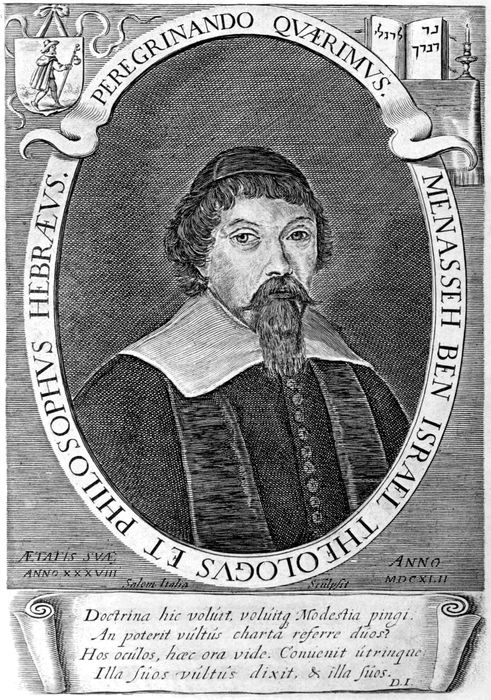
A broken and beggared man he met his family at Middelburg, in Zeeland. He was now bent with premature age. The comely, good-tempered face, with its quizzing eyes and dandyish moustache, so familiar to us in Rembrandt’s etching, had become hollow-cheeked and hollow-eyed. From the crow’s-feet under the temples the whiskers had grown wildly until they formed a white patriarchal beard.[164] It was the wintering touch of the hand of death. Two months later Menasseh died of a broken heart at the house of his brother-in-law, Ephraim Abarbanel, in the fifty-third year of his age.[165]
VI. The Real “Vindiciæ”
One more question remains to be elucidated. How did the seemingly precarious settlement of the London Jews manage to survive the wreck of the Commonwealth?
Both Menasseh and Cromwell had builded more solidly than they knew. If the solution of the Jewish question arrived at towards the end of 1656 was not wholly satisfactory, lxxit was precisely in that fact that its real strength lay. Experimental compromise is the law of English political progress. From the strife of wills represented in its extremer forms by Cromwell’s lofty conception of religious liberty on the one hand, and by the intolerance of the sectaries on the other, had emerged a compromise which conformed to this law, and which consequently made the final solution of the question an integral part of English political evolution. The great merit of the settlement was that while it disturbed little, it gave the Jews a future in the country on the condition that they were fitted to possess it.
The fact that in its initial stage it disturbed so little rendered it easy for Charles II. to connive at it. Had Menasseh ben Israel’s idea been realised in its entirety, the task of the restored Monarchy would have been more difficult. London would have been overrun by destitute Polish and Bohemian Jews driven westward by persecution, some fanaticised by their sufferings, others plying the parasitic trades into which commercial and industrial disabilities had driven the denizens of the Central European Jewries.[166] Many of them would have become identified with the wild Judaical sectaries who were the bitterest enemies of the Stuarts, while the others would have given new life to the tradition of Jewish usury, which for nearly four hundred years had been only an historical reminiscence in the country. Under these circumstances, we can well conceive that a re-expulsion of the Jews might have been one of the first tasks of the Restoration.
From this calamity England and the Jews were saved by the restricted character of the compromise of 1656. When the Commonwealth fell to pieces the Jewish community of London consisted only of some forty or fifty families of wealthy and enterprising merchants, scarcely lxxidistinguishable in their bearing and mode of life from the best kinds of merchant-strangers hailing from Amsterdam, Bordeaux, Lisbon, Cadiz, and Leghorn.
Nevertheless, efforts to procure their expulsion were not wanting. Royalists who recognised in them a relic of the hated Commonwealth, merchants whose restricted economic science resented their activity and success, and informers who imagined that their toleration was a violation of English law, set to work early to denounce them. These manœuvres began, indeed, as soon as the breath was out of Cromwell’s body. Only a few weeks after the Protector’s death a petition was presented to Richard Cromwell demanding the expulsion of the Jews and the confiscation of their property.[167] At the same time, Thomas Violet, the notorious informer and pamphleteer, made a collection of documents bearing on the illegality of the Jewish settlement, which he submitted to Mr. Justice Tyril, together with an application that the law should be set in motion against the intrusive community. The worthy Justice shrewdly suggested to Mr. Violet that in the then confused political situation he would do well to take no action. It would, he opined, be only prudent to await the establishment of a stable Government before moving in so serious a matter.
A few months later Charles II. re-entered London, and the Commonwealth was at an end. Naturally, everybody looked to the new régime to redress the particular grievance or grievances he harboured against “the late execrable Usurper,” and the anti-Jewish party was particularly prompt in its representations under this head. Scarcely had Charles arrived in the Metropolis when the Lord Mayor and Aldermen of the City of London presented to him a humble petition, bitterly complaining of the action of Cromwell in permitting the Jews to re-enter the land, and asking the lxxiiKing “to cause the former laws made against the Jews to be put in execution, and to recommend to your two Houses of Parliament to enact such new ones for the expulsion of all professed Jews out of your Majesty’s dominions, and to bar the door after them with such provisions and penalties, as in your Majesty’s wisdom should be found most agreeable to the benefits of religion, the honour of your Majesty, and the good and welfare of your subjects.”[168] The long pent-up wrath of the City found full expression in this petition, which must be read in its entirety to be appreciated. Thomas Violet followed with another petition, which was equally violent.[169] He declared that by law it was a felony for any Jew to be found in England. He did not, however, propose their expulsion, as he did not think that would be the best way of turning them to profitable account. His suggestion was in the first place that all their estates and properties should be confiscated, and then that they should be cast into prison and kept there until ransomed by their wealthy brethren abroad. A third petition, dated November 30, 1660, is preserved among the Domestic State Papers, but the names of the authors are not given. It runs very much on the lines of the City petition, but it admits the hypothesis of Jews residing in England under license, provided they were heavily taxed.[170]
No direct reply to any of these petitions is recorded. The views of the new Government are, however, no mystery. In the first place, there was no real Jewish question in the country, inasmuch as the Jews were very few, their character was above reproach, and the practice of their religion was conducted with so much tact and prudence that it was impossible in sober truth to be moved by Violet’s impassioned complaint of “a great dishonour of Christianity and public scandal of the true Protestant religion.”[171] Consequently lxxiiithe Government were free to consider the question exclusively from the point of view of secular politics. Once regarded in this light the conclusion could not be long in doubt. Cromwell’s maritime and commercial policy had been adopted by the statesmen of the Restoration, and the success of this policy—represented by the re-enacted Navigation Act—depended to no inconsiderable extent on toleration of the Jews.
Moreover, Charles was under personal obligations to the Jews, and had assured them of his protection even before he came by his own. The Jews of Amsterdam, and some of the wealthier Jews in London, had assisted him during his exile, especially the great family of Mendez da Costa and Augustin Coronel, the agent for Portugal and a personal friend of Monk.[172] Shortly after the mission of Menasseh ben Israel to Cromwell these Jews had approached Charles II. at Bruges and had assured him that they had neither assisted nor approved the Rabbi’s negotiations. Thereupon General Middleton had been instructed to treat with them for their support to the Royalist cause, and Charles had promised that “they shall find when God shall restore his Majesty that he would extend that protection to them which they could reasonably expect, and abate that rigour of the law which was against them in his several dominions.”[173] That these negotiations were not without practical result is beyond question, for the Da Costas and Coronels, as well as several other Jewish families, were exceedingly active on Charles’s behalf during the last few years of the Commonwealth.
It must not be imagined that this Royalist activity represented any double-dealing on the part of the Jews. Those who, like Carvajal and De Caceres, had fled direct from the Inquisition to England, were faithful to Cromwell to the end. The Royalist Jews were men who had acquired their Cavalier sympathies in France and Holland, and shared lxxivthem with their Christian fellow-citizens in those countries. None of them were parties to the negotiations with Cromwell in 1655–56, and none had ever affected Puritan sympathies. They probably had conscientious objections to Republicanism, for they were of the aristocratic Sephardi branch of Israel, with some of the bluest blood of Spain in their veins and immense wealth in their strong-boxes. Their dissent from their Puritan brethren was an early illustration of the falsity of the hypothesis of Jewish political solidarity, which is to this day a cherished delusion of the anti-Semites.
Charles II. did not confine himself to ignoring the anti-Semitic petitions. Having made up his mind that the Jews should be protected, he sought, like Cromwell, to throw the responsibility for his decision on the Constitutional Government. Before the end of 1660 an Order of the Lords in Council was sent to the House of Commons, recommending that measures should be taken for the protection of the Jews.[174] There is no record of any such measures having been adopted. It was probably felt that the most convenient course to pursue was to continue the policy of personal connivance inaugurated by Cromwell, as by that means men’s minds would be least disturbed, and an experiment which was likely to produce good results would not be hampered. Moreover, should the experiment fail, it would be all the easier to deal with it if it had not received any legislative sanction.
Accordingly, the Jews passed from the personal protection of Cromwell to that of Charles. In 1664, when an attempt was made by the Earl of Berkshire and Mr. Ricaut to obtain their expulsion, the King in Council disavowed the scheme, and assured the Jews “that they may promise themselves the effects of the same favour as formerly they have had so long as they demean themselves peaceably and quietly with due obedience to his Majesty’s laws and without scandal to his Government.[175]” A similar course was lxxvtaken by the Privy Council in 1673 and 1685, when attempts were made by informers to prosecute the Jews for the exercise of their religion.[176] Finally the King marked his personal gratitude to the Jews by knighting Coronel soon after the Restoration, and by a generous distribution of patents of denization among the members of the Synagogue.[177]
Thus the Cromwellian settlement was confirmed, and the path was definitely opened by which the Jews might win their way to the citizenship of the United Kingdom.
How that path was successfully trodden is a story which cannot be told in detail here. Its main feature, however, must be briefly referred to, for it supplies the justification for the campaign which Menasseh ben Israel and Oliver Cromwell waged so gallantly on behalf of the Hebrew people in the first half of the seventeenth century.
The Jews won their way to English citizenship not because they remained the servi cameræ, which had been their status under the Norman and Angevin kings, and which they had practically resumed under the Protectorate and the Restoration, but because they literally realised the portraiture of the Hebrew citizen which Menasseh ben Israel vainly placed before the British nation in 1655 in his tract, De Fidelitate et utilitate Judaicæ Gentis. In this way they gradually substituted for the personal protection of the Crown the sympathy and confidence of the nation.
Their old enemies in the City of London were their first converts. The wealth they brought into the country, and their fruitful commercial activity, especially in the colonial trade, soon revealed them as an indispensable element of the prosperity of the City.[178] As early as 1668 Sir Josiah Child, the millionaire governor of the East lxxviIndia Company, pleaded for their naturalisation on the score of their commercial utility.[179] For the same reason the City found itself compelled at first to connive at their illegal representation on ’Change, and then to violate its own rules by permitting them to act as brokers without previously taking up the Freedom.[180] At this period they controlled more of the foreign and colonial trade than all the other alien merchants in London put together. The momentum of their commercial enterprise and stalwart patriotism proved irresistible. From the Exchange to the City Council Chamber, thence to the Aldermanic Court, and eventually to the Mayoralty itself, were inevitable stages of an emancipation to which their large interests in the City and their high character entitled them. Finally the City of London—not only as the converted champion of religious liberty but as the convinced apologist of the Jews—sent Baron Lionel de Rothschild to knock at the doors of the unconverted House of Commons as parliamentary representative of the first city in the world.
Jewish emancipation in England was, in short, the work of the English democracy—almost of the same democracy which in the thirteenth century had spued the Hebrews forth, when their kingly protectors had made their residence in the land conditional on their acting as the usurious instruments of the Royal Exchequer, and which in the seventeenth had resented their readmission under the influence of deeply rooted prejudices, inherited from that dark age. It was no mere homage to the abstract principle of Religious Liberty like the emancipations on the Continent which, in the name of the Rights of Man, suddenly called forth the oppressed Jews from their Ghettos and bade them take up a new life, from which they were sundered by centuries of mediæval seclusion. Religious Liberty in England broadened on more cautious lines. Dissenters, Roman Catholics, and lxxviiJews have each been taken into the bosom of the nation by separate legislative action, and as the result of practical demonstrations of the futility, nay, the disadvantage, of their exclusion. The gradual emancipation of the English Jews, first socially and then in the municipalities, enabled them to show that their civic qualities entitled them to the fullest rights of citizenship; and it was the realisation of this fact—not by statesmen or philosophers, but by their neighbours and fellow-citizens themselves—that eventually gave them the position they now enjoy.
The story of Jewish emancipation in England is the true Vindiciæ Judæorum—the avenging of Menasseh’s broken heart and the vindication of his touching trust in his people. It is something more. It is one of many justifications of that fine conception of statecraft, deeply rooted in infinite sympathy with human freedom, which is the secret of Britain’s greatness, and of which Oliver Cromwell must ever be regarded as the typical exponent in English history.
VII. Documents
The following is a selection of the documents referred to in the foregoing narrative. They have been selected chiefly on account of their personal bearing on Menasseh’s efforts:—
1. Fragment of a letter from Menasseh ben Israel to an unknown correspondent in London (Harl. Miscel., vol. vii. p. 623). The original was probably in French or Latin:—
“Amsterdam, September 5407 [1647].
“Senhor, no pueda enar! that is, sir, I cannot express the joy that I have when I read your letters, full of desires to see your country prosperous, which is heavily afflicted with civil wars, without doubt by the just judgment of God. And it should not be in vain to attribute it to the punishment of your predecessor’s faults, committed against ours; when ours being deprived of their liberty under deceitfulness, lxxviiiso many men were slain only because they kept close under the tenets of Moses, their legislator.”
2. Abstract of a letter relating to the “Hope of Israel” from Menasseh ben Israel to John Dury (Thorowgood, “Jews in America,” 1650, p. xvii). The original seems to have been in French:—
“Amsterdam, November 25, [1649].
“By the occasion of the questions you propose unto me concerning this adjoyned Narrative of Mr. Antonio Montezinos, I, to give you satisfaction, have written instead of a Letter a Treatise, which I shortly will publish & whereof you shall receive so many copies as you desire. In this Treatise I handle of the first inhabitants of America which I believe were of the ten Tribes; moreover that they are scattered also in other Countries, & that they keep their true Religion, as hoping to returne againe into the Holy Land in due time.”
3. Portion of a letter on the same subject from Menasseh ben Israel to John Dury (Thorowgood, ibid.). Like the foregoing, the original was in French:—
“Amsterdam, December 23, 1649.
“[In my Treatise] I declare how that our Israelites were the first finders out of America; not regarding the opinions of other men, which I thought good to refute in few words onely; and I thinke that the ten Tribes live not onely there, but also in other lands scattered every where; these never did come backe to the second Temple, & they keep till this day still the Jewish Religion, seeing all the Prophecies which speake of their bringing backe unto their native soile must be fulfilled: So then at their appointed time, all the Tribes shall meet from all the parts of the world into two provinces, namely Assyria and Egypt, nor shall their kingdome be any more divided, but they shall have one Prince the Messiah the Sonne of David. I do also set forth the Inquisition of Spaine, and rehearse diuers of our Nation, & also of Christians, Martyrs, who in our times have suffered seuerall sorts of torments, & then having shewed with what great honours our Jews have been graced also by severall Princes who professe Christianity. I proue at large, that the day of the promised Messiah unto us doth draw neer, upon which occasion I explaine many Prophecies.”
lxxix4. Letter from Menasseh ben Israel to Paul Felgenhauer (Bonum Nuncium Israeli, pp. 87 et seq.):—
“D. Paulo Felgenhauer,
Salutem & Benedictionem, à
Deo Israelis reprecatur,
Menasseh Ben Israel.
“Bonum istud, in novissimis & afflictissimis hisce temporibus populo Israeli à te, Vir spectatissime, allatum Nuncium, tanto fuit animo meo gratius, quo, post tot seculorum aerumnas & tam diu protractas spes nostras, flagrantius idipsum exoptare non desino; modò præ rei magnitudine verbis tuis fides constare possit. Siccine, Bonarum rerum Nuncie bone, in procinctune jam est, ut adveniat Deus noster, Miserator Nostrum, utque nobis Desiderium tot seculorum, Messiam caput nostrum, tam brevi sit missurus? Siccine tempus illud imminere ais, quo Deus; hactenus offensus & aversus à nobis, iterum Populum suum consolabitur, & redimet non solum â Captivitate hac plusquam Babylonicâ, à servitute plusquam Ægyptiacâ in qua jam elanguit præ morâ, sed & ab iniquitatibus suis, in quibus quasi consumptus est! Vtinam tam Verum esset, quam Bonum Nuncium tuum, tibique, tam Credere possem quàm vellem! Utcunque quæ ad gaudii nostri confirmationem ex scriptis Propheticis Signa adfers Adventus Messiæ (ut fatear quod res est) lubens amplector; & quo plus animo meo volvuntur ea, hoc magis spes mihi inde aliqua affulgere videtur.
“Ad Primum quod attinet, apud nostros Rabbinos id signum in confesso est: quum enim necesse sit Imperia hujus mundi omnia corruere, antequam Regnum & Potestas & Magnitudo Regni detur Populo sanctorum Altissimi, cui omnes Reges servire & obedire oportet, inde non obscure sequitur, immediatè ante adventum illum Messiæ & Instaurationem Regni ipsius, magnas Conturbationes, Tumultus, seditiones, intestina & crudelissima Bella, Regnorum & Populorum hinc inde devastationes præcedere debere; Quæres quod brevi sit effectum sortitura, ex præsenti Imperiorum Mundi facie vero haud dissimile videtur.
“De Elia, secundo Adventus Messiæ nostri signo, quod ais, non diffitemur, quin & gaudemus maxime, quod in eo nos Judæi cum selectissimis Christiani Nominis Viris, in unam eandemque sententiam concurrimus, fore illum ex nostrâ Gente oriundum. Verum enim vero Elias ille cum nondum comparuerit nobis, eo usque saltem suspendatur spes nostra necesse est: adeo ut, donec illum Deus nobis revelaverit, certi & indubitati quicquam de Messiæ Adventu statuere minus tuum videatur.
lxxx“De Tertio isto Adventus Messiæ signo quod ais, nempe de hac Regni Israelis per totum Terrarum orbem prædicatione, id mihi non solum verisimile videtur, sed & tale quid jam in lucem prorumpere & effectum sortiri haud obscurè videmus: quin & Prædicatorem istorum haud contemnendus numerus mihi ipsi per literas innotuit, qui ex diversis mundi partibus ad consolandum Sionem prodierunt; inter alios Viros Nobilitate & Doctrinâ insignes, qui ad manum jam sunt. En ex Silesia habemus Abrahamum à Frankenberg, ex Borussiâ Joh. Mochingerum, ex Galliâ Autorem Libelli Gallico idiomate editi, Du rappel des Juifs. Ex Angliâ quos non? Nuper auctoritate publicâ Nathanael Homerius, SS. Theol. Doctor, librum in folio edidit anglico idiomate, de hac ipsa materiâ; & D. Henricus Jesse, nobis librum Belgico idiomate de Gloriâ Jehudæ & Israelis; publicè dedicavit. Plures allegare possem, qui instar Nubeculæ istius 1 Reg. 18 (quam Elias ascendentem de mari vidit, & subito in tantam molem excrevit ut totum Cœli expansum contegeret) Indies numero & virtute accrescunt, donec tandem totum Terrarum ambitum prædicatione suâ sint completuri: Vt autē aliquod hajus rei specimen, ad testimonium tuum confirmandum tibi, mi Paule prebeam; selegi tibi aliquot Virorum istorum ad me literas, quæ jam præ manibus habebam, quas legere poteris, & mecum gaudere, de ijs qui dicunt nobis, Ibimus in domum Domini, stabunt adhuc pedes nostri in atriis tuis Ierusalem; qui ad cor Ierusalem loquuntur, prædicantes salutem & dicentes Sioni, Deus tuus Regnabit.
“Sed præter hæc mitto quoque ad Te, Vir Doctissime, autographum Panegyrici cujusdam quem meo Nomini inscripsit D. Immanuel Bocarus Frances y Rosales alias Jacobus Rosales Hebræus, Mathematicus & Medicinæ Doctor eximius, quem Imperator Nobilitatis Insignibus & Comitis Palatini dignitate donavit; idque eâ potissimum intentione mitto, ut videat Dominus exstare adhuc & discerni ad hunc usque diem surculos ex stirpe Davidicâ ortum ducentes. Denique ut desiderio tuo faciam satis, en quoque Catalogum librorum, quos vel in lucem edidi jam, vel edendos penes me in parato habeo, sive Latino sive Hispanico idiomate. Hisce te Deo Patrum nostrorum ejusque gratiæ & benignitati animitus commendo, Datum Amsterodami An. 1655, die 1 Febr.”
5. Enclosures in the foregoing, being a letter from Nathaniel Holmes, with a postscript by Henry Jessey (Bonum Nuncium Israeli, pp. 103–106):—
“Nunc sequitur Clarissimi Viri, Nathanaelis Homesii SS. Theol. lxxxiDoctoris Anglici ad me Epistolium, datum 24 Decemb. An. 1649, cum Subscriptione Reverendi D. Henrici Jesse ei annexâ.”
“Decemb. 24, 1649.
“Animus mihi fuit, citius adte scribendi, Vir egregie, otium non fuit, Nec hodie ita mihi vacat, ut menti meæ, tantisque tuis scriptis (quamvis expectatione paucioribus) satisfaciam. Nondum de loco decem Tribuum, ex tuis literis responsum accepi; quod in meis desideratum fuit; non astu, vel curiositate. Veritatem insequor, ne Impostores pro Ebræis nobis obstrudantur. Scripsit quidam nuperime, Innodos Novæ Angliæ decem Tribubus esse prognatos. Alii Tartyros esse contendunt. Alii alios. Discrucior animi, ne fallar, usque dum literas tuæ me fecerint certiorem. Delectari videris D. Nicolai Apologiâ. Spero (ne glorier) te plura (ne dicam majora) visurum, meo de Mille Annis prodeunte tractatu. Quod opus ita me tenet occupatum, ut meæ ad te ituræ morentur literæ. Martyres in tuis literis vox est; quæ, ni fallor, veteri Testamento haud innotuit. Verum sub Novo, viri celebres, Christum, ejusque Evangelium, ad mortem asserentes, primi illud nomen obtinuerunt. Facilè tamen concedo, quoslibet veritatis alicujus testes, Martyres Græce dictos fuisse. Sed (parcatur nostræ libertati Conscientiæ, quam lubentissimè tibi inter scribendum indulsero) nec pontificii jam post Concilium Tridentinum ullatenus habeantur propriè Christiani: nec Martyrium esse mihi videatur, pro hodiernâ Legis Mosaicæ observatione animam deponere. Quippe Lex illa quoad usum, ex plurimis veteris Testamenti suffragiis, ante hoc abolenda esset. Deut. 18, v. 18, 19. Psal. 50. v. 6–15, 23. Iesaiæ 66, v. 1–3. Vt olim multis jam annis transactis, Iudei ubi maxima indulgetur libertas non sacrificantes, vosmetipsos tamen vere Deum colere arbitramini, Libet tamen, non obstanti hâc dicendi libertate nos edoceri, dedocerique, quâ in re â veritate subsidimus, vel hallucinamur. Tractatum itaque quem nominas De debito Christianorum erga Ebræos affectu, mittas; ut quantum in me est, typis mandetur, & in publicum promoveamus. De tempore adventus Messiæ quod incertum pronuncias, idque incertum comprobares experientiâ; in promptu est responsio; Illud Danieli prius ignoranti, tandem revelatum est; idque ex libris illius, nobis. Et quamvis nonnulli (quos nominas) computando hallucinantes, in errorum gyris, & labyrintho sunt involuti; non tamen hâc ratione deponendæ sunt de eâ re (tanquam nullius usus) Prophetiæ. Quippe quod expectamus, Danielis more cap. 9. v. 2 & v. 21. ut jam Vesperi ætatem, quo propius accedunt lxxxiiliberationum periodi, eo clarius elucescant revelationes ad easdem spectantes. Ægyptii Ethnicorum barbariores (te teste Egregie Vir) nascendum Mosen præsentiscebant, nescientibus tunc Israelitis natum Liberatorem. Quidni etiam Christiani Scripturas amplexi, adventum vestræ Messiæ secundum præviderent? In cujus adventu, (pace eruditionis vestræ asserentis, quod stupens mirabar, Vestram salutem in ejus Adventu non esse sitam) fundatur nostra, præsertim vestra æterna salus. Si enim verum foret, eum nondum venisse, & posthæc illum venturum ambigitur, labitur omnis prophetiarum Compages, totumque veteris Testamenti Systema ruit. Et ita de Scripturarum veritate actum est; ut de salute tum nostrâ, tum vestrâ actum est. Quæ si quippiam asserere videantur, Christi Messiæ passionem (Psal. 22. Isa. 53) resurrectionem (Psal. 16) ascensionem (Psal. 68) sessionem ad dextram Patris (Psal. 110) potestatem super omnia regnantem, more Adami novissime creati (Psal. 2. Psal. 8) omnino asserunt. Quæ omnia acurate comparata, Messiæ Filii Davidis adventum, abitumque, reditumque, elenchicè satis demonstrant. Non novum urgeo Testamentum, quod æquis miraculorum portentis nobis commendatum fuit, ut vetus Israeli. Vobis tamen Hebræis libentissimè favemus, utinamque plus multò favere possemus; quamvis nec Meritum, nec pro merito (vox Bibliis ignota) quicquam expectamus. Merces ex gratiâ datur non merito. Malum possumus, qui perfecte peccamus, mereri; bonum in quo omnimodo deficimus. Malum itaque pro nostro, bonum pro Christi merito (si voce utar) nobis compensatur. Hominum (fateor) alter de altero mereri dicatur, ut egomet tibi (vir Candidissime) pro tuis literis me multum debere agnosco. Quin & universa vestræ Nationi, flexis genibus servire molior, ut sive Nos Vobis, Vosvè Nobis facti Proselytæ utrique juxta Isaiam, & Ezechielem, cæterosque Prophetas, in unam coeamus ecclesiam. Nec non (confido) dilectissimus noster Iesseus idem meditatur; cui literas communicavi tuas, ad me missas. Pudet multum me tamdiu siluisse, verum tibi rescribenti, duplâ quoad possim diligentiâ compensabitur.
“A Tui Observantissimo,
“Nathanaele Homesio.
“Tuis hisce ex animo attestatur, assentitur, negociis à scribendo jam detentus, qui Sionis pulverem commiseratur, qui hæc propriâ manu subscripsi
H. Iesse.”
6. Original French text of Menasseh ben Israel’s demands lxxxiiion behalf of the Jews presented to Oliver Cromwell (S. P., Dom. Inter., ci. 115).
“Ce sont icy les graces et les faveurs qu’au nom de ma nation hebreue moy, Menasseh ben Israel, requiers a vostre serenissime altesse que dieu fasse prosperer et donne heureux succez en toutes ses entreprises comme son humble serviteur lui souhaitte et desire.
“I. La premiere chose que je demande a vostre Altesse est que nostre nation hebreue sont reçeue et admise en cestee puissant republique sous la protection et garde de vostre altesse comme les cittoiens mesmes et pour plus grande securité au temps advenir je supplie votre altesse de faire jurer (si elle l’a pour aggréable) à tous ses chefs et generaux d’armes de nous deffendre en toutes occasions.
“II. Quil plaise a vostre altesse nous permettre synagogues publiques non seulement en Angleterre, mais aussi en touts austres lieux de conqueste qui sont sous la puissance de Vostre Altesse et d’observer en tout nostre religion comme nous devons.
“III. Que nous puissions avoir un lieu ou cimetiere hors la ville pour enterrer nos morts sans estre molestes d’aucun.
“IV. Qu’il nos soit permis de trafiquer librement en toute sorte de marchandise comme les autres.
“V. Que (afin que ceux qui vendront soyent pour l’utilité des citoyens et viven san porter prejudice à aucun ni donner scandale) vostre serenissime Altesse elise un personne de qualité pour informer et recevoir passeport de ceux qui entreront, les quels estant arrivez le faira scavoir et les obligera de jurer et garder fidélité a vostre Altesse en ce peix.
“VI. Et pour n’estre point à charge aux juges du peix touchaut les contestations et differents qui peuvent arriver entre ceux de nostre nation que vostre serenissime Altesse donne licence aux chef de la synagogue de prendre avec soy deux ausmoniers de sa nation pour accorder et juger tous les differents de procez conforme à la loy Mosayque avec liberté toutefois d’appeler de leur sentence aux juges civils déposant premierement la somme à laquelle la partye aurait esté condamnée.
“VII. Que si paradventure il y avait quelques loix contraires à nostre nation juifve que premierement et avant toutes choses elles soient revoquées affin que par ce moien la nous puissons demeurer avec plus grande securité sous la sauvegarde et protection de vostre serenissime Altesse.
“Lesquelles choses nous concedant vostre serenissime Altesse nous demeurerons toujours les très affectionnés et obligez à prier Dieu pour lxxxivla prospérité de vostre Altesse et de vostre illustre et très sage conseil. Qu’il luy plaise donner heureux succez à toutes lés enterprises de vostre Serenissime Altesse Amen.”
7. Circular issued by Cromwell’s Council convening the Whitehall Conference (S.P. Dom. Inter., i. 76, 1655, pp. 378–79).
“Sir,—His Highness the Lord Protector and the Council having determined of a certain number of persons (whereof yourself is one) to meet with a Committee of the Council on Tuesday the fourth of December next in ye afternoon neare the Council Chambers in Whitehall to the intent some proposalls made to his Highness in reference to the nation of the Jewes may be considered of you are therefore desired by his Highness & the Council to take notice thereof & so meet at the said time and place for the purpose aforesaid.
Signed in the name &
by order of the Council
He. Lawrence
Presidt
Whitehall,
16 Novem. 1655.”
8. Report of the Sub-Committee of the Council of State after the Conferences at Whitehall (S. P., Dom. Inter., ci. 118).
“That the Jewes deservinge it may be admitted into this nation to trade and trafficke and dwel amongst us as providence shall give occasion.[181]
“That as to poynt of conscience we judge lawfull for the magistrate to admit in case such materiall and weighty considerations as hereafter follow be provided for, about which till we are satisfyed we cannot but in conscience suspend our resolution in this case.
“1. That the motives and grounds upon which Menasseh ben Israel in behalfe of the rest of his nation in his booke lately printed in this English tongue desireth their admission in this commonwealth are such as we conceave to be very sinfull for this or any Christian state to receave them upon.
lxxxv“2. That the danger of seducinge the people of this nation by their admission in matters of religion is very great.
“3. That their havinge of synagogues or any publicke meetings for the exercise of their worship or religion is not only evill in itselfe, but likewise very scandalous to other Christian churches.
“4. That their customes and practices concerninge marriage and divorce are unlawfull and will be of very evill exemple amongst us.
“5. That principles of not makinge concience of oathes made and injuryes done to Christians in life, chastity, goods or good name have bin very notoriously charged upon them by valuable testimony.
“6. That great prejudice is like to arise to the natives of this commonwealth in matter of trade, which besides other dangers here mentioned we find very commonly suggested by the inhabitants of the city of London.
“7. We humbly represent.
“I. That they be not admitted to have any publicke Judicatoryes, whether civill or ecclesiasticall, which were to grant them terms beyond the condition of strangers.
“II. That they be not admitted eyther to speake or doe anythinge to the defamation or dishonour of the name of our Lord Jesus Christ or of the Christian religion.
“III. That they be not permitted to doe any worke or anythinge to the prophanation of the Lord’s Day or Christian sabbath.
“IV. That they be not admitted to have Christians to dwell with them as their servants.
“V. That they bear no publicke office or trust in this commonwealth.
“VI. That they be not allowed to print anything which in the least opposeth the Christian religion in our language.
“VII. That so farre as may be not suffered to discourage any of their owne from usinge or applyinge themselves to any which may tend to convince them of their error and turn them to Christianity. And that some severe penalty be imposed upon them who shall apostatize from Christianity to Judaisme.”
9. Petition of the London Marranos to Oliver Cromwell (S. P., Dom. Inter., cxxv. 58):—
“To His Highnesse Oliver Lord Protector of the Com̄onwelth of England, Scotland & Ireland & the Dominions thereof.
“The Humble Petition of The Hebrews at Present Residing in this citty of London whose names ar vnderwritten
lxxxvi“Humbly sheweth
“That Acknolledging The manyfold favours and Protection yor Highnesse hath bin pleased to graunt vs in order that wee may with security meete priuatley in owr particular houses to our Deuosions, And being desirous to be favoured more by yor Highnesse wee pray with all Humblenesse yr by the best meanes which may be such Protection may be graunted vs in Writting as that wee may therewth meete at owr said priuate deuosions in owr Particular houses without feere of Molestation either to owr persons famillys or estates, owr desires Being to Liue Peacebly under yo Highnes Gouernement, And being wee ar all mortall wee allsoe Humbly pray yor Highnesse to graunt vs License that those which may dey of owr nation may be buryed in such place out of the cittye as wee shall thineke conuenient with the Proprietors Leaue in whose Land this place shall be, and soe wee shall as well in owr Lifetyme, as at owr death be highly fauoured by yor Highnesse for whose Long Lyfe and Prosperity wee shall continually pray To the allmighty God.”
Menasseh Ben Israel.
David Abrabanel.
Abraham Israel Caruajal.
Abraham Coen Gonzales.
Jahacob De Caceres.
Abraham Israel De Brito.
Isak Lopes Chillon.
Oliver P.
Wee doe referr this Peticon
to the Consideracon of yr Councill.
March ye 24th
1655⁄6.
(Endorsement)
Hebrews
ye 25 March 1656
dd by the Lord Presidt
Gentlemen ye 26
June 1656.”
10. Petition of Menasseh ben Israel to Oliver Cromwell, probably written at the end of 1656 (S. P., Dom. Inter., cliii. 122):—
“To his Highness the Lord Protector.
“May it please your Highnesse, what modestie forbidds necessitie (that ingens telum) compells; that having bene long time very lxxxviisickly (an expensive condition) I make my moan to your Highnesse, as the alone succourer of my life, in this land of strangers, to help in this present exigence. I shall not presume to prescribe to your Highnesse but havinge had great experience of your greatnesse in compassions as well as in majestie, I lay myselfe at your feet, that am your infinit obliged supplicant & servant
“Menasseh Ben Israel.”
11. Further petition from Menasseh ben Israel to Oliver Cromwell. It is endorsed “17 Sep. 1657” (S. P., Dom. Inter., clvi. 89):—
“To his Highnesse, the Lord Protector, the humble petition of Menasseh Ben Israel.
“May it please your Highnesse, my only sonne, being now dead in my house, who before his departure, engaged me to accompany his corps to Holland, & I indebted here, I know not which way to turn mee but (under God) to your Highnesse for help in this condition, emploring your bowells of compassion (which I know are great & tender) to supply me with three hundred pounds, & I shall surrender my pension seal & never trouble or charge your Highnesse any more, I am very sensible considering your great past kindnesse (which with all thankfullnesse I acknowledge) how highly-bold this my petition is, but the necessitie of my present exigence & my experience of your admirable graciousnesse to mee have layd mee prostrat at your feet, crying, Help, most noble prince, for God’s sake, your most humble supplicant
Menasseh Ben Israel.”
12. Petition on behalf of the widow of Menasseh ben Israel, addressed to Richard Cromwell by John Sadler (S. P., Dom. Inter., cc. 8):—
“To his Highness the Lord Protector the humble petition of John Sadler.
“Sheweth that although your petitioner being often pressed to present petitions in behalf of the Jewes did rather dissuade their comming hither, yet by some letters of your late royall father & others of note in this nation some of their synagogs were encouraged to send hither one of their cheife rabbines, Menasseh Ben Israel, for admittance & some freedome of trade in some of these ilands. And when he had stayed heere so long, that he was allmost ashamed to lxxxviiireturne to those that sent him or to exact their maintenance heere where they found so little success after so many hopes, it pleased his Highnes & the councell to setle on the said Menasseh a pension of 100£ a yeare which ere long he offered to resigne for 300£ for present satisfaction of debts & other pressures which lay so heavy on him that at length he submitted to resigne his former pension for a new grant of 200£ to be presently paid as the councell ordered.
“But notwithstanding his stay & expense in procuring several seales, he never gott one penny of the said 200£ but at length with his heart ever broken with griefe on losing heer his only sonne and his presious time with all his hopes in this iland he got away with so much breath as lasted, till he came to Midleburg & then he dyed. Leaving a poore desolate widow (with other relations) who solemnly professed she had not money enough to lay him in the sepulchres of his fathers, but for the charity of some that lent or gave them money. It pleased allso your Highess late father to receive one or 2 of the same poore widowes letters to your petitioner (whom they both trusted in that business) & with his owne hands to commit them to the especiall care of Mr. secretary Thurloe who hath also divers times minded the same, but your Highness exchequer is so charged that there is little hope of obteining it there.
“May it please your Highnesse in compassion to the said poore widow & relations of a man so eminent & famous in his owne & meny other nations & for the honour of Christian religion with many other reasons, to order the said 200£ out of the contingencies for the councell or some other treasure where it may be speedily had and without fees allso if it may be according to former orders.
“And your petitioner shall desire to pray.”
1
THE
HOPE OF ISRAEL
Written
By MENASSEH BEN ISRAEL,
An Hebrew Divine, and
Philosopher.
Newly extant, and Printed at Amsterdam,
and Dedicated by the Author, to
the High Court, the Parliament of England,
and to the Councell of State,
The second Edition corrected and amended.
Whereunto are added,
In this second Edition, some Discourses
upon the point of the Conversion of the
JEWES.
By Moses Wall.
LONDON
Printed by R. I. for Livewell Chapman at the Crowne in Popes-Head Alley, 1652.
3
TO THE Parliament, The Supream Court of England, And to the Right Honourable the Councell of State, Menasseh Ben Israel, prayes God to give Health, and all Happinesse:

It is not one cause alone (most renowned Fathers) which useth to move those, who desire by their Meditations to benefit Mankind, and to make them come forth in publique, to dedicate their Books to great Men; for some, and those the most, are incited by Covetousnesse, that they may get money by so doing, or some peece of Plate of gold, or Silver; sometimes also that they may obtaine their Votes, and suffrages to get some place for themselves, or their friends. But some are moved thereto by meere and pure friendship, that so they may publickly testifie that love and affection, which they bear them, whose names they prefixe to their Books; let the one, and the other, please themselves, according as they delight in the reason of the Dedication, whether it be good or bad; for my part, I best like them, who do it upon this ground, that they may not commend themselves, or theirs, but what is for publick good.
As for me (most renowned Fathers) in my dedicating 4this Discourse to you, I can truly affirm, that I am induced to it upon no other ground then this, that I may gain your favour and good will to our Nation, now scattered almost all over the earth; neither think that I do this, as if I were ignorant how much you have hitherto favored our Nation; for it is made known to me, and to others of our Nation, by them who are so happy as near at hand, to observe your apprehensions, that you do vouchsafe to help us, not onely by your prayers; yea, this hath compelled me to speak to you publickly, and to give you thanks for that your charitable affection towards us, and not such thanks which come only from the tongue, but as are conceived by a grateful mind.
Give me leave therefore (most renowned Fathers) to supplicate you, that you would stil favor our good, and farther love us. Truly, we men doe draw so much the nearer to Divine nature, when by how much we increase, by so much we cherish, and defend the small, and weak ones; and with how much diligence doe you performe this, most renowned Fathers? who though you seem to be arrived to the highest top of felicity, yet you do not only not despise inferior men, but you so wish well to them, that you seem sensible of their calamity; you knowing how acceptable to God you are by so doing, who loves to do good to them who doe good. And truly it is from hence, that of late you have done so great things valiantly, and by an unusuall attempt, and things much to be observed among the Nations. The whole world stands amazed at these things, and the eies of all are turned upon you, that they may see whither all these things do tend, which the great Governour of all things seems to bring upon the world by so great changes, so famously remarkable, of so many Nations; and so all those things which God is pleased to 5have fore-told by the Prophets, do, and shall obtain their accomplishment. All which things of necessity must bee fulfilled, that so Israel at last being brought back to his owne place; peace which is promised under the Messiah, may be restored to the world; and concord, which is the only Mother of al good things. These things I handle more largely in this Treatise, which I dedicate to you (most renowned Fathers) you cannot be ignorant, that it is not only not unprofitable, but very useful for States and Statesmen, to fore-see the issue (which yet is ever in Gods hand) of humaine Councells, that so they may observe, and understand from Divine truth, the events of things to come, which God hath determined by his Spirit in his holy Prophets. I know that this my labour will not be unacceptable to you, how mean soever it be, which I trust you will chearfully receive, because that you love our Nation, and as part of it, the Author of this Discourse. But I intreat you be certain, that I pour out continual prayers to God for your happinesse. Farewell, most renowned Fathers, and flourish most prosperously.
Menasseh Ben Israel.
6

Menasseh Ben Israel, To the Courteous Reader.

There are as many minds as men, about the originall of the people of America and of the first Inhabitants of the new World, and of the West Indyes; for how many men soever they were or are, they came of those two, Adam, and Eve; and consequently of Noah, after the Flood, but that new World doth seem wholly separated from the old, therefore it must be that some did passe thither out of one (at least) of the three parts of the world sc. Europe, Asia, and Africa; but the doubt is, what people were those, and out of what place they went. Truly, the truth of that must be gathered, partly out of the ancient Hystories, and partly from conjectures; as their Habit, their Language, their Manners, which yet doe vary according to mens dispositions; so that it is hard to finde out the certainty. Almost all who have viewed those Countryes, with great diligence, have been of different judgements: Some would have the praise of finding out America, to be due to the Carthaginians, others to the Phenicians, or the Canaanites; others to the Indians, or people of China; others to them of Norway, others to the Inhabitants of the Atlantick Islands, others to the Tartarians, others to the ten Tribes. Indeed, every one grounds his opinion not upon probable arguments, but high conjectures, as will appeare farther by this Booke. But I having curiously examined what ever hath hitherto been writ upon this subject doe finde no opinion more probable, nor agreeable to reason, then that of our Montezinus, who saith, that the first inhabitants of America, were the ten Tribes of the Israelites, whom the Tartarians conquered, and drove away; who after that (as God would have it) hid themselves behind the Mountaines Cordilleræ. I also shew, that as they were not driven out at once from their Country, so also they were scattered into divers Provinces, sc. into America, into Tartary, into China, into Media, to the Sabbaticall River, and into Æthiopia. I prove that the ten Tribes never returned to the second Temple, that they yet keepe the Law of Moses, and our sacred 7Rites; and at last shall return into their Land, with the two Tribes, Judah, and Benjamin; and shall be governed by one Prince, who is Messiah the Son of David; and without doubt that time is near, which I make appear by divers things; where, Reader, thou shalt finde divers Histories worthy of memory, and many Prophesies of the old Prophets opened with much study, and care. I willingly leave it to the judgement of the godly, and learned, what happy worth there is in this my Book, and what my own Nation owes me for my paines: It is called, The Hope of Israel; which name is taken from Jerem. 14.8. O the hope of Israel, the Saviour thereof. For the scope of this Discourse is, to show, that the hope in which we live, of the comming of the Messiah is of a future, difficult, but infallible good, because it is grounded upon the absolute Promise of the blessed God.
And because I intend a continuation of Josephus his History of the Jewes, our famous Historian; I intreat, and beseech all Learned men, in what part of the world soever they live (to whom I hope that shortly this Discourse will come) that if they have any thing worthy of posterity, that they would give me notice of it in time; for though I have collected many Acts of the Jewes, and many Hystories out of the Hebrewes, the Arabians, the Grecians, the Latines, and other Authors of other Nations; yet I want many things for this my enterprize, all which I am willing to performe, that I may please my Nation; but rather to the glory of the blessed God, whose Kingdome is everlasting, and his Word infallible.
8

The Translator to the Reader.
This discourse of a Jew comming to my hand, and having perused it, I thought it not inconvenient to make it speake English; for the benefit of my Country-men, who wait for the redemption of Israel; and at the same time of the Gentiles also. That the Author is a Jew, ought to be no scandall to us (though some of us Christian Gentiles are ignorant of, and scandalized at the notion of the conversion of the Jewes, as the Jewes of old were, concerning our being converted, and grafted into the true Stock, as in Acts 11.3.) for though God hath rejected them, yet not for ever: Rom. 11.25, 26. And also the many prophesies both in the Old, and New Testament, which concern their being received againe to grace, gathered from their dispersion, and settled in their own Land; and their flourishing estate under, now our, and then their and our Prince, Jesus Christ the Messiah, who will then triumph gloriously, and all his people with him; these and many more Promises would want a fulfilling (which the God of Truth wil never suffer) if there should not be the revolution of a time, in which they shall be converted, and grace and peace be poured out upon Jewes and Gentiles; though first upon the Jew, then the Gentile. But besides this, the Author expresseth so much learning that he deserveth honour of all; so much ingenuity, and (so far as his light reacheth) so great a measure of the knowledge and fear of God, that he may wel be set for a pattern to us Christians, who profess much better than he, but live much worse. One thing is very remarkable in him, that wheras many of us (like them who canot see Wood for Trees) though inviorned with mercies in these late revolutions, (I speake not to them who measure mercies only, or chiefly, by plentiful tables, ful purses, rich accoutrements, and the like; that wretched Generation is unworthy of the name of Men, much more of Christians) yet will unthankfully cry out, What have we got by all these troubles? and what hath been done? surely 9this Jew shall rise up in judgement against such unchristian Christians; for he in his Epistle Dedicatory says, The whole world stands amazed at what the Parliament hath done; besides he cordially and openly owns the Parliament, who as far as I know never did him nor his Nation any further good then to pray for them; (though we hope, and pray, that their favour may extend to realities, towards that people to whom certainly God hath made many, and great Promises, and shortly will give answerable performances:) but many among us who injoy peace under them, and many other blessings, (too many for an unthankfull Generation) doe refuse to acknowledge them, doe curse them whom God hath blessed, and even in their prayers to that God who cannot be deceived, or imposed upon; doe vent themselves against this present Government, in expressions so wilde and false, that such Language would be accounted most unworthy, in our addresse to any considerable person, much more then to the great God. I shall only adde this, sc. Do not think that I aime by this Translation, to propagate or commend Iudaisme (which its no wonder if the Author doth so much favour, especially in his thirtieth Section) no, through Grace I have better learned the truth, as it is in Jesus, but to give some discovery of what apprehensions, and workings there are at this day in the hearts of the Jewes; and to remove our sinfull hatred from off that people, whose are the Promises, and who are beloved for their Fathers sakes; and who of Jewes, we shall hear to be, ere long, reall Christians.
10
The Authors of other Nations, which are quoted in this Treatise.
A
Abrahamus Ortelius
Agathias
Augustinus
Alexis Vanegas
Alfonsus Cemedro
Alonsus Augustianus
Alonsus de Erzilla
Alonsus Venerus
Arias Montanus.
B
Baronius
Berosus
Boterus
Bozius.
C
Constantinus.
D
Diodorus Siculus
Dion
Duretus.
E
Eselius Geradus
Eusebius Cesariensis.
F
Famianus Strada
Franciscus de Ribera
Franciscus lopez de
Gomara.
G
Garcilassus dela Vega
Genebrardus
Goropius
Guil. Postellus
Guilielmus Blawius
Guil. Schilkardus.
H
Henricus Alangre
Hugo Grotius.
J
Jacobus Verus
Joan. de Castillanos
Joan. de Bairos
Joan. Roman
Joan. de Laet
Joan. Huarte
Josephus d’ Acosta
Joan. Linscboten.
L
Lescarbotus
Lucanus.
M
Manuel Sa.
Marcilius Facinus
Marinus.
N
Nicolaus Trigautius.
O
Origines
Orosius
Osorius Lusitanus.
P
Petrus de Cleza
Plancius
Petrus Simon
Petrus Hernandes de Quiros
Petrus Teixera
Pineda
Plato
Plinius
Pomarius
Proclus
Porphyrius
Possevinus
Plutarchus
Picus Mirandulanus
Ptolomæus.
S
Semuel Bochardus
Solinus
Strabo
Suetonius Tranquillus.
T
Tacitus
Thomas Malvenda.
X
Xenophon.
Z
Zarate.
The Hebrew Bookes, and Authors.
Talmud Hierosolymitanum
Talmud Babylonicum
Paraphrasis Chaldaica
R. Simhon ben Johay
Seder Holam
Rabot
Jalkot
Tanhuma
Joseph ben Gurion
R. Sehadia Gaon
R. Moseh de Egypto
R. Abraham Aben Ezra
R. Selomoh Jarhi
Eldad Danita
R. David Kimhi
R. Benjamin Tudelensis
R. Moseh Gerundensis
R. Abraham bar R. Hiya
Don Shac Abarbanel
R. Joseph Coen
R. Abraham Friscoll
R. Mordechay Japhe
R. Mordechay Reato
R. Hazarya a-Adomi.
11

THE RELATION OF ANTONY MONTEZINUS.

In the 18th. of the Month of Elul: the 5404 year from the Worlds creation, and according to common compute, in 1644. Aaron Levi, otherwise called Antonius Montezinus came into this City Amsterdam, and related to the Sieur Menasseh ben Israel, and other cheifetains of the Portugal Nation, Inhabitants of the same City, these things which follow.
That it was two years and a halfe, since that he going from the Port Honda in the West-Indies, to the Papian jurisdiction, he conducted some Mules of a certaine Indian, whose name was Franciscus Castellanus, into the Province of Quity, and that there was one in company with him and other Indians, whose name was Francis, who was called by all Cazicus. That it happened that as they went over the Mountaines Cordilleræ, a great tempest arose, which threw the loaden Mules to the ground. The Indians being afflicted by the sore tempest, every one began to count his losses; yet confessing that all that and more grievous punishments were but just, in regard of their many sins. But Francis bad them take it patiently, for that they should shortly injoy rest: the others answered, that they were unworthy of it; yea that the notorious cruelty used by the Spaniards towards them, was sent of God, because they had so ill treated his holy people, who wer of al others the most innocent: now then, they determined to stay all night upon the top of the Mountain. And Montezinus tooke out of a Box some Bread, and Cheese, and Jonkets, and gave them to Francis, upbraiding him, that he had spoken disgracefully of the Spaniards; who answered, that he had not told one halfe of the miseries and calamities inflicted by a 12cruell, and inhumane people; but they should not goe unrevenged, looking for helpe from an unknown people.
After this Conference, Montezinus went to Carthagenia, a City of the Indians, where he being examined, was put in Prison; and while he prayed to God, such words fell from him; Blessed be the name of the Lord, that hath not made me an Idolater, a Barbarian, a Black-a-Moore, or an Indian; but as he named Indian, he was angry with himselfe, and said, The Hebrewes are Indians; then he comming to himselfe againe; confessed that he doted, and added, Can the Hebrewes be Indians? which hee also repeated a second, and a third time; and he thought that it was not by chance that he had so much mistaken himselfe.
He thinking farther, of what he had heard from the Indian, and hoping that he should find out the whole truth; therefore as soon as he was let out of Prison, he sought out Franciscus beleeving that hee would repeat to him againe what he had spoken; he therefore being set at liberty, through Gods mercy went to the Port Honda, and according to his desire, found him, who said; He remembred all that he had spoken, when he was upon the Mountaine; whom Montezinus asked, that he would take a journy with him, offering him all courtesies, giving him three peeces of Eight, that he might buy himselfe necessaries.
Now when they were got out of the City, Montezinus confessed himselfe to be an Hebrew, of the Tribe of Levi, and that the Lord was his God; and he told the Indian, that all other gods were but mockeries; the Indian being amazed, asked him the name of his Parents; who answered Abraham, Isaac, and Jacob; but said he, have you no other Father? who answered, yes, his Fathers name was Ludovicus Montezinus; but he not being yet satisfied, I am glad (saith he) to heare you tell this, for I was in doubt to beleeve you, while you seemed ignorant of your Parents: Montezinus swearing, that he spoke the truth, the Indian asked him, if he were not the Son of Israel, and thereupon began a long discourse; who when he knew that he was so, he desired him to prosecute what he had begun, and added, that he should more fully explaine himselfe, for that formerly he had left things so doubtfull, that he did not seem at all assured of any thing. After that both had sate downe together, and refreshed themselves, the Indian thus began: If you have a minde to follow me your Leader, you shall know what ever 13you desire to know, only let me tell you this, whatsoever the journey is, you must foot it, and you must eate nothing but parched Mayz, and you must omit nothing that I tell you; Montezinus answered that he would doe all.
The next day being Munday, Cazicus came againe, and bid him throw away what he had in his Knapsack to put on shooes made of linnen packthred, and to follow him, with his staffe; whereupon Montezinus leaving his Cloake, and his Sword, and other things which he had about him, they began the journey, the Indian carrying upon his back three measures of Mayz, two ropes, one of which was full of knots, to climbe up the Mountaine, with an hooked fork; the other was so loose, for to passe over Marshes, and Rivers, with a little Axe, and shooes made of linnen pack-thred. They being thus accoutred, travelled the whole weeke, unto the Sabbath Day; on which day they resting, the day after they went on, till Tuesday, on which day about eight a clock in the morning, they came to a River as bigge as Duerus; then the Indian said, Here you shall see your Brethren, and making a signe with the fine linnen of Xylus, which they had about them instead of a Girdle; thereupon on the other side of the River they saw a great smoke, and immediately after, such another signe made as they had made before; a little after that, three men, with a woman, in a little Boat came to them, which being come neare, the woman went ashore, the rest staying in the Boat; who talking a good while with the Indian, in a Language which Montezinus understood not; she returned to the Boat, and told to the three men what she had learned of the Indian; who alwayes eying him, came presently out of the Boat, and embraced Montezinus, the woman after their example doing the like; after which, one of them went back to the Boat, and when the Indian bowed downe to the feet of the other two, and of the woman, they embraced him courteously, and talked a good while with him. After that, the Indian bid Montezinus to be of good courage, and not to looke that they should come a second time to him, till he had fully learned the things which were told him at the first time.
Then those two men comming on each side of Montezinus, they spoke in Hebrew, the 4th. ver. of Deut. 6. Semah Israel, adonai Elohenu adonai ehad; that is, Heare O Israel, the Lord our God is one God.
Then the Indian Interpreter being asked, how it was in Spanish, they spoke what followes to Montezinus, making a short pause between every particular.
141 Our Fathers are Abraham, Isaac, Jacob, and Israel, and they signified these foure by the three fingers lifted up; then they joyned Reuben, adding another finger to the former three.
2 We will bestow severall places on them who have a minde to live with us.
3 Joseph dwels in the midst of the Sea, they making a signe by two fingers put together, and then parted them.
4 They said (speaking fast) shortly some of us will goe forth to see, and to tread under foot; at which word they winked, and stamped with their feet.
5 One day we shall all of us talke together, they saying, Ba, ba, ba; and we shall come forth as issuing out of our Mother the earth.
6 A certaine Messenger shall goe forth.
7 Franciscus shall tell you somewhat more of these things, they making a signe with their finger, that much must not be spoken.
8 Suffer us that we may prepare ourselves; and they turning their hands and faces every way, thus prayed to God, DO NOT STAY LONG.
9 Send twelve men, they making a signe, that they would have men that had beards, and who are skilfull in writing.
The Conference being ended, which lasted a whole day, the same men returned on Wednesday, and Thursday, and spake the same things againe, without adding a word; at last Montezinus being weary that they did not answer what he asked them, nor would suffer him to goe over the river, he cast himselfe into their Boat; but he being forced out againe, fell into the River, and was in danger to be drowned, for he could not swim; but being got out of the water, the rest being angry, said to him; attempt not to passe the River, nor to enquire after more then we tel you; which the Indian interpreted to him, the rest declaring the same things both by signs, and words.
You must observe, that all those three dayes the Boat stayed not in the same place, but when those foure who came went away, other foure came, who all as with one mouth, repeated all the fore-mentioned nine particulars, there came and went about three hundred.
Those men are somewhat scorched by the Sun, some of them weare their haire long, downe to their knees, other of them shorter, and others of them much as we commonly cut it. They were comely of body, well accoutred, having ornaments on their feet, and 15leggs, and their heads were compassed about with a linnen cloath.
Montezinus saith, that when he was about to be gone, on Thursday evening, they shewed him very much courtesie, and brought him whatever they thought fit for him in his journey, and they said, that themselves were well provided with all such things, (sc. meats, garments, flocks, and other things) which the Spaniards in India call their owne.
The same day, when they came to the place where they had rested, the night before they came to the River, Montezinus said to the Indian; You remember Francis, that my Brethren told me, that you should tell me something, therefore I entreat you, that you would not thinke much to relate it. The Indian answered, I will tell you what I know, only doe not trouble me, and you shall know the truth, as I have received it from my fore-fathers; but if you presse me too much, as you seeme to doe, you will make me tell you lyes; attend therefore I pray, to what I shall tell you.
Thy Brethren are the Sons of Israel, and brought thither by the providence of God, who for their sake wrought many Miracles, which you will not beleeve, if I should tell you what I have learned from my Fathers; we Indians made war upon them in that place, and used them more hardly then we now are by the Spaniards; then by the instigation of our Magicians (whom we call Mohanes) we went armed to that place where you saw your Brethren, with an intent to destroy them; but not one of all those who went thither, came back againe; whereupon we raised a great Army, and set upon them, but with the same successe, for againe none escaped; which hapned also the third time, so that India was almost bereft of all inhabitants, but old men, and women, the old men therefore: and the rest who survived, beleeving that the Magicians used false dealing, consulted to destroy them all, and many of them being killed those who remained promised to discover somewhat that was not knowne; upon that they desisted from cruelty, and they declared such things as follow:
That the God of those Children of Israel is the true God, that all that which is engraven upon their stones is true; that about the end of the World they shall be Lords of the world; that some shall come who shall bring you much good, and after that they have enriched the earth with all good things, those Children of Israel going forth out of their Country, shall subdue the whole World to 16them, as it was subject to them formerly; you shall be happy if you make a League with them.
Then five of the chiefe Indians (whom they call Cazici) who were my Ancestors, having understood the Prophesie of the Magicians, which they had learned of the Wise men of the Hebrewes, went thither, and after much entreaty, obtained their desire, having first made knowne their minde to that woman, whom you saw to be for an Interpreter, (for your Brethren will have no commerce with our Indians) and whosoever of ours doth enter the Country of your Brethren, they presently kill him; and none of your Brethren doe passe into our Country. Now by the help of that Woman we made this agreement with them.
1 That our five Cazici should come to them, and that alone at every seventy moneths end.
2 That he to whom secrets should be imparted, should be above the age of three hundred Moones, or Months.
3 And that such things should be discovered to none in any place where people are, but only in a Desart, and in the presence of the Cazici; and so (said the Indian) we keep that secret among our selves, because that we promise our selves great favour from them, for the good offices which we have done to our Brethren, it is not lawfull for us to visite them, unlesse at the seventy months end: Or if there happens any thing new, and this fell out but thrice in my time; First, when the Spaniards came into this Land; also, when Ships came into the Southerne Sea; and thirdly, when you came, whom they long wished for, and expected. They did much rejoyce for those three new things, because that they said, the Prophesies were fulfilled.
And Montezinus also said, that three other Cazici were sent to him by Franciscus, to Honda, yet not telling their names, till he had said, you may speake to them freely, they are my fellowes in my Function of whom I have told you, the fifth could not come for age, but those three did heartily embrace him; and Montezinus being asked of what Nation he was, he answered, an Hebrew, of the Tribe of Levi, and that God was his God, &c. which when they had heard, they embraced him againe, and said: Upon a time you shall see us, and shall not know us; We are all your Brethren, by Gods singular favour; and againe, they both of them bidding farewell, departed, every one saying, I goe about my businesse; therefore 17none but Franciscus being left, who saluting Montezinus as a Brother, then bade him farewell, saying, farewell my Brother, I have other things to doe, and I goe to visite thy Brethren, with other Hebrew Cazici. As for the Country, be secure, for we rule all the Indians; after we have finished a businesse which we have with the wicked Spaniards, we will bring you out of your bondage, by Gods help; not doubting, but he who cannot lye, will help us; according to his Word; endeavour you in the meane while that those men may come.
