Front matter (continued 4)
Reading edition
A rocket was to be made ready for firing. Its cargo was brought to it, item by item. Fallon had worked with the others. He was treated with singular forbearance by his shipmates. There came a moment when somebody had to shift his space-rope anchorage. It happened to be Fallon who needed to do this. Soames took hold of Fallon's space rope in the middle and held it firmly while Fallon shifted the end to another anchorage. Fallon was nervous, worried. He finished the task quickly and went on toward the cargo items he was to move.
McCauley, prowling on his perpetual task of inspection, saw the knot Fallon had made. He said sharply:
"Fallon, stop moving and hold on to something solid."
Fallon swung about and stared apprehensively. He clung to an anchor rod sunk in the metal of the asteroid. McCauley made sure he was safe, untied the space-rope knot, and tied it more securely.
"It was a bad knot," said McCauley. "You're safe now."
McCauley went on. This was outside the cargo-netted space and near where the rockets went up. Fallon clung fast to the drill rod. The others went about their business. Stars blazed in the daylight sky. The sun flamed far, far away. Fallon stayed motionless, gripping the rod that was securely set into the metal of Eros.
Presently he stirred stealthily and tugged at the rope with the new knot in the end. It was firm. He tugged more strongly. It held. Then, with the gentlest and most fearful of tuggings, he drew himself to where McCauley had fastened his space rope. He examined McCauley's knot. Fallon was afraid of McCauley, because he had made a bargain he did not believe McCauley would keep. He believed that McCauley meant to be the sole survivor of the Mars Expedition, returning secretly to Earth with tens of millions in stolen atomic fuel.
And Fallon believed that McCauley had planned the near-tragedies of Hathaway and Soames. Therefore he believed that McCauley would be arranging more successful accidents for those two and the rest, and that because Fallon knew of McCauley's plans, he, Fallon, would be the first to be destroyed.
He could see nothing the matter with the knot, but he distrusted it with a despairing terror.
He untied it so he could retie it himself. And McCauley's voice roared in the headphones in his helmet:
"Fallon! What are you doing?"
Fallon started violently. He jumped. His space rope was not anchored, and Eros has no measurable gravity. Fallon went up and away from the asteroid, toward a thousand million light-years of emptiness. His space rope rose with him, not trailing behind but writhing and twisting weightlessly, more like a tendril of smoke than anything else. Horror filled him. He could not cry out.
"Get him!" roared McCauley.
Space-suited figures turned in the stark white sunlight, and inky black shadows followed their movements in strict synchrony. Fallon was twenty feet high.... Forty. A space-suited figure jerked at his space rope for assurance and then leaped up toward Fallon. It was a miss. The glittering metallic space suit swung in a wide arc and then down to ground again. A second man leaped. A third. They swept past the line of his flight. The space rope of one of the men touched Fallon's. Had it struck near the middle, it might have brought his rope down captive. But the end of Fallon's rope flicked free and he went on toward the stars.
Now there were babblings. Space-armored figures moved swiftly toward a single spot, pulling themselves by their ropes.... Fallon was sixty feet high.... Seventy.
Then a man came soaring straight upward. He missed Fallon, but he flailed a rope and it tangled in Fallon's. The bobbing, rope-held figure hauled in, and had Fallon's rope fast. He wrapped it swiftly about his arm. When the jerk came it was not severe.
Then a single figure on the asteroid pulled down and down and down, and Fallon was towed to solidity. He touched before he could utter a sound.
McCauley was the man who'd hauled him back. The others crouched or squatted down, holding fast to the metallic projections from the surface of Eros. They'd given up their ropes to make a rope long enough for his rescue. While one went after him and McCauley stood erect to draw him back, the others held fast by their fingertips to keep from sharing his predicament. They'd risked floating away as helplessly as he himself, in order that their life lines might be used to save him.
McCauley did not reprimand Fallon, but he pointedly thanked the others for the promptness with which they'd acted.
Later, Randy asked vexedly:
"What was the matter with Fallon? He knew he shouldn't have unfastened his rope!"
"His knot wasn't good, and I retied it," said McCauley dryly. "But he thinks I intend to kill everybody, probably him first. So when I meddled with his life rope he thought I was arranging his death. He meant to retie the knot to defeat my evil intention."
"He's a fool!" snapped Randy. "We'd better have it out with him, or there's no telling what he'll do next!"
"I'm afraid I have to," McCauley said distastefully. "He'll be humiliated when he finds out I was humoring him. But get him, anyhow."
There was a clanking sound somewhere in the ship. The inner air-lock door closed. There were noises that told of the sealing dogs being tightened. Then, immediately, the outside lock door opened. Randy went to find Fallon. He came back, disturbed.
"Fallon just went outside. He's supposed to be off-duty, too."
McCauley frowned. Then he flipped the outside-communicator switch. As a matter-of-fact precaution, there was two-way communication with emptiness whenever anybody was outside the ship. Anything that came in was immediately heard from speakers all over the ship, so that the control room did not have to be manned all the time work was proceeding on the planetoid's surface. If an emergency arose, everybody anywhere in the ship would know immediately.
"Fallon," said McCauley curtly into the outside transmitter, "you're wanted. Come back, please."
Silence. No answer. There was only darkness outside the ship now. Stars moved steadily up from the blackness that was one nearby horizon, and down to the blackness that was the other. The red disk of Mars—very near, now—was the brightest object in the heavens.
"Fallon!" snapped McCauley. "You're wanted! Return to the ship immediately!"
A clanking sound came from all the loud-speakers inside the ship. Then Fallon's voice.
"Wait a minute." He panted as if doing some heavy labor where there was no weight. "Ah-h-h! Right! What do you want?"
"I want you back in the ship," said McCauley sternly.
More clankings. They were the type of sound that might be heard inside an air-filled space suit and picked up by its helmet microphone.
"What are you doing?" demanded McCauley.
"I'm fixing ... uh!..." The last was a grunt. "I'm fixing a way to settle something.... I'm set now."
"Fallon!" barked McCauley. "Come to the ship immediately! That's an order!"
"I'm busy," said Fallon's voice, defiantly. "But I'll tell you something! I'm not going back to Earth with the rest of you. I was on the run when I passed myself off as somebody else and got on the ship. I was on the run from Death Row in the pen. They had me ready for the hot seat in two days more, and I got away. Why should I go back to Earth?"
He paused. And then he said, his tone indescribable:
"Everybody is hearing me. I fixed that! I doctored the aerial switch so when it's turned on it can't be turned off again! McCauley can't keep you from hearing me now, because he called me! And McCauley's going to squirm now! I joined up with him to wipe out every one of you, so we could go back to Earth with the atom fuel to sell to contacts he's got! He tried to kill Soames and he tried to kill Hathaway! He tried to kill me today, by getting me lost, but the rest of you jumped to help me and he had to join in so you wouldn't know what he'd tried!"
McCauley winced.
"Poor fool!" Randy said.
"Now listen," said Fallon's voice fiercely. "I've told you the truth. If I'd told you before you wouldn't've believed me. But you're going to believe me now, because I've scrapped my chance of living—it wasn't good anyhow—to tell you! You watch McCauley! Send word back to Earth of what I've told you. He'll not dare to do a thing when a dying man's accused him—and that's what I am!"
"Fallon!" barked McCauley again. "It's a mistake! You thought I planned that stuff, and I was just playing along with you! The others knew all about it! They knew everything you just told them! It's a lie! I'm not planning anything. I just played along with you...."
"Yes?" jeered Fallon. "Tell that to the aviators! The spacemen don't believe you!" Then he said: "So what? I'll be the first man on Mars! I'm Joe Fallon, 4272365, Walla Walla Penitentiary, and I'll go down in the history books. I'm taking off for Mars. Want to race?"
There was a sudden roaring. It was the sound of a rocket blast, conducted by metal to a space suit and picked up by the microphone inside.
"T-taking off," gasped Fallon, outside. "You get this story back to Earth and he won't dare do anything! He won't dare! But I didn't rat on him! Only on what he was going to do."
After that, there was only the roar of the rocket blast.
They poured out of the ship in space suits as fast as the air lock would let them. Perhaps some of them had a faint, faint hope that it was merely a joke. But it wasn't. There were boxes and bales floating heavily, soggily, in the emptiness about Eros. They had been thrust aside when Fallon took the rocket for himself. And he was gone.
McCauley made an irresolute movement back toward the ship, and Randy said quickly, via space phone:
"No use, Ed! We can't make more than six gees acceleration in the ship, and in a loadless rocket he'll make twelve! We can't catch him!"
And there'd be nothing they could do if they did catch him. McCauley ground his teeth, staring at the star-filled sky.
"I did something wrong," he said bitterly. "Something wrong! But what would have been the right thing?"
Hathaway said enviously:
"He'll be the first man on Mars, at that! But his air won't last all the way. He'll coast in and crash and never know it. But he'll be the first man on Mars!"
"Yes," said Randy wryly, "he'll have that.... Let's get these last rockets off and land at a respectful distance behind him."
And they did.
Of course, as everyone knows, the First Martian Expedition was a great success. Of the six men who left on it, five came back. They had maps and photographs and petrological samples, and a complete and surprisingly reasonable explanation of the canals and oases about which astronomers had argued for the best part of a century. They even brought back a sluggish, naked, squirming creature which initiated an entirely new line of biological research.
McCauley began a battle behind closed doors, and Randy helped him, and in time a curious error in the public records appeared. It is officially stated in all the books that one Joe Fallon was the first man to land on Mars, though the first records of the Expedition gave his name as Andrew—at least Fallon the crewman was not named Joe. There is a strange lethargy in official quarters. Nobody bothers to correct the records.
"Of course," said McCauley to Randy, "he stole our watches, but he was a pretty decent character at that, considering. He'd have no part in taking your lives."
"What was he sentenced for?" asked Randy suddenly.
"First-degree murder," said McCauley shortly. "I was curious too. I asked." Then he said, "They're talking about trying to make Jupiter, Randy. It seems to me that if we try, we can get to go on that job. What do you say?"
Randy grinned. He put out his hand and they shook on it.
(When Ed McCauley was a very young officer—in fact a new-made first lieutenant, space travel was only for robots. Nobody'd ever ridden out of the atmosphere in a rocket, and nobody'd ever piloted a ship into orbital flight and landed it again; there wasn't a Space Platform, and the moon bases hadn't been built. There was constant danger from cosmic rays and flare particles, and nobody dreamed of trying to reach either Venus or Mars.
By the time McCauley was a colonel, all those things had been done. But oddly enough, it didn't seem that the job was finished. The more that was done, the more remained to be done. And McCauley found that things never got any more settled down. There was Venus to be explored, right next door, and Mercury just beyond that. And Titan looked promising, and of course there were the asteroids, of which one or two urgently required examination. And even when there were settlements on Saturn and Uranus and Neptune, there were rumors of a planet beyond Pluto.... And after that, the stars.
There'd never be any end to the journeyings of men into space.)
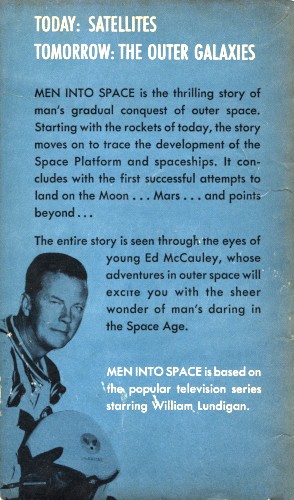
TODAY: SATELLITES
TOMORROW: THE OUTER GALAXIES
MEN INTO SPACE is the thrilling story of man's gradual conquest of outer space. Starting with the rockets of today, the story moves on to trace the development of the Space Platform and spaceships. It concludes with the first successful attempts to land on the Moon ... Mars ... and points beyond....
The entire story is seen through the eyes of young Ed McCauley, whose adventures in outer space will excite you with the sheer wonder of man's daring in the Space Age.
MEN INTO SPACE is based on the popular television series starring William Lundigan.