APPENDIX
Reading edition
Note A The Wolf of Badenoch
From the fact that the lands of Badenoch were so long held by my ancestors, the Comyns of Badenoch, it has often been assumed that the fierce “Wolfe of Badenoch” was a Comyn. This, happily, was not the case, though he held broad lands wrested from the Comyns, and dwelt in their old Castle of Lochindorb.
The ruthless Wolf was Lord Alexander Stewart, fourth son of King Robert the Second, who died A.D. 1390, by whom he was created Earl of Buchan, when that title was forfeited by Comyn in 1374. He was also made Earl of Ross in right of his wife, Eufame, Countess of Ross, in right of whom he held the Thanedom and Castle of Dingwall, the Baronies of Skye and the Lewes, lands in Caithness, Sutherland, Inverness, Nairn, Athol, Banffshire, and Perth, the latter including Forgandenny and Kinfauns, while from his royal father he obtained, besides Badenoch, Abernethy, and other lands of the Comyns, those of Robert de Chisholm in Inverness-shire, and Strathaven in Banffshire, and was created King’s Lieutenant for all the North of Scotland. So he was a most powerful noble, who could brook no contradiction.
When he found that his wife Eufame bore him no children, he sought another love, Mariota, daughter of Athyn, by whom he had five illegitimate sons, Sir Alexander, Sir Andrew, Walter, James, and Duncan. These all grew up as fierce as their father, each drawing to himself a company of wild Highlanders, reckless freebooters who carried fire and sword throughout the country. The eldest 380stormed the Castle of Kildrummy, which belonged to the Countess of Mar, and either compelled or prevailed on her to become his wife, whereupon he assumed the title of Earl of Mar. After this rude wooing, he employed his energies in the service of his country, and was twice ambassador to England.
But the chapter in the Wolf’s history which chiefly affected Morayshire was when, having incurred the censure of the Church for forsaking his wife, he in revenge took possession of the Bishop of Moray’s lands in Badenoch, whereupon he was solemnly excommunicated. To avenge this step, he swooped down from his mountain stronghold at Lochindorb, burnt the town of Forres, with the Church of St. Lawrence and the manor of the Archdeacon, and a month later dealt likewise with Elgin, which, being almost entirely built of wood, was quickly consumed, as were also the Church of St. Giles, “the House of God, ‘Domus Dei,’ near Elgyn, eighteen noble and beautiful manses of the canons and chaplains, and the noble and highly adorned Church of Moray, the delight of the country and ornament of the kingdom, with all the books, charters, and other goods of the country placed therein.”
Eventually the proud Wolf submitted to the Church, and by special commission from the Bishop of Moray to Lord Walter Trail, Bishop of St. Andrews, he was absolved from the sentence of excommunication, in presence of his royal brother and many great nobles at Perth, outside the doors of the Church of the Predicate Brothers, and afterwards before the High Altar, on condition that he should make satisfaction to the Church of Moray, and also that he should send to Rome to obtain the Pope’s special absolution.
He died in 1394, and was buried in the choir of the Cathedral Church of Dunkeld, where a mutilated but still stately monument of a knight recumbent in full armour bears his name as “Senescallus Comes de Buchan et Dominus de Badenoch, bonæ memoriæ.”
381
Note B The Lowlands of Moray
Probably in no part of Scotland has the whole face of Nature been so entirely changed within the last four hundred years, as in “The Laich of Moray,” namely, that low-lying portion of the county of Elgin or Moray traversed by the railway which connects Aberdeen with Inverness.
In comparing Moray of the present day with the ancient province of Morayland, we must first of all remember how very much larger was the tract of country formerly bearing this name, and which included the present counties of Inverness, Nairn, and Elgin, extending eastward to Buchan and Mar, and south along the valley of the Spey as far as Badenoch. Thus, when King Robert Bruce erected his lands in Moray into an earldom, they extended from Fochabers on the east to Glengarry and Glenelg on the western sea-coast. Early overrun by Norsemen, and often invaded by the Danes, Morayland has ever held a prominent position in the history of Scotland, and the blood of the old sea-kings doubtless accounts for much of the turbulence of the Moray men of old, and the vigour on which they pride themselves to this day.
Of their ancient turbulence there is proof enough in the record of kingly murders here perpetrated; for though history goes to prove that Macbeth killed King Duncan in fair open fight near Elgin, there is little doubt that King Malcolm the First and King Duffus were both murdered at the Castle of Forres, and a certain King Donald was slain in the same district.
In short, the men of Moray ever strove so hard for independence that it has been said to puzzle antiquarians to decide whether at length Scotland annexed Morayland, or Moray absorbed all the rest of Scotland! That the former was the true solution must, however, be conceded; inasmuch 382as we find that, A.D. 1160, King Malcolm IV., having conquered the men of Moray, endeavoured to break their power by transplanting large bodies into other counties, extending from Caithness in the north to Galloway in the south, thereby, of course, greatly benefiting these other races!
Having once obtained a footing in the province, these Scottish kings showed themselves so well pleased with it, that they established royal castles at Forres, Elgin, and Banff, and had other hunting-seats besides. The ecclesiastical powers also showed a full appreciation of a climate which has ever been accounted nearer to that of Devonshire than of any other part of Britain—in fact, local tradition gives it credit for forty days of fine weather in the twelvemonth in excess of any other part of Scotland.
Although always noted for this excellent climate, and also for the exceeding fertility of its soil, its agriculture appears to have continued greatly inferior to that of the Southern Lowlands till the beginning of the present century; so that Morayshire farmers may with just pride point to its present high state of cultivation and the perfection of their cattle as among the most notable changes of Moray.
As regards cultivation, Moray now acknowledges no superior in Britain, though she admits Lincoln and Norfolk to be her worthy rivals; while, as regards her herds of polled cattle, the Smithfield prize-list tells its tale year by year, and Morayshire farmers will not soon forget the unprecedented circumstance that the two finest beasts in the Smithfield show for 1881, selected to compete for the Champion Medal[75] (the highest honour that can be attained by a British farmer) were both bred and exhibited by the same man, and that he hailed from the Laich of Moray!
383Altogether, there is a good deal to justify the pride with which the many Moray men scattered all over the earth ever speak of this their special fatherland, and their innate conviction that the world itself could not get on without “the Moray loons.”[76] The feeling was admirably exemplified by the reply of a Morayshire gardener when asked his opinion of the English among whom his lot was cast. “Weel,” said he, “I’ve nae great faut tae find with the Sassenach, but I maun remark that for meenisters or gairdeners, or onything needing head-wark, ye maun come tae us in the North!”
They will not, however, always give full credit even to the said ministers, for I remember the comment of an old man who kept my brother’s lodge, and whose verdict on his minister was that he was of no more account than the figure 9 with the tail cut off!
Craving forgiveness of all southern readers for quoting (of course sympathetically!) this tribute to the dear land which gave me birth, I would now draw attention to some really remarkable changes in the relations of flood and fell, land and water, which have here been effected, partly by drainage and partly by natural causes, and also to various alterations in the fauna of the province.
In the old historical days, vast tracts of the land now under cultivation were all beast-haunted forest, wherein wolves lingered long after they had been exterminated in more accessible regions. There were also great expanses of marsh-land dotted with numerous fresh-water lochs, while the coast was intersected by tidal channels and harbours, some of which have wholly vanished, while others are so altered as to render it difficult to trace their ancient boundaries.
Under the head of vanished waters, we may class the ancient lochs of Cotts, Inchstellie, Inverlochty, Keam, Outlet, Rose-isle, the Laveroch Loch, and the great Loch of 384Spynie, all of which have disappeared within the last two centuries, chiefly under the prosaic influence of drainage.
By far the largest of these, and the most important loch in the province of Moray, was that of Spynie, which has undergone such a singular succession of changes as to make its history one of unique interest. In the records of the thirteenth and fourteenth centuries it figures as an estuary of the sea—a secure harbour of refuge, on whose shores stood the ancient burgh of Spynie—a fisher-town, whose inhabitants were vassals of those mighty lords temporal and spiritual, the Bishops of Moray.
Strange to say, as years rolled on, the ceaseless labour of the waves (aided by the rivers Lossie and Spey, which supplied a multitude of great boulders and masses of gravel) resulted in the formation along the coast of such enormous breakwaters in the form of great terraced banks of huge shingle that, by about the fifteenth century, the sea at last found itself excluded from the harbour by its own work.
Thenceforward the isolated loch gradually changed from salt water to brackish, and then became fresh. No longer tenanted by sea-fish and oysters, fresh-water creatures began to appear and to multiply. As the waters expanded more and more, they overspread the cultivated lands on every side, transforming them to sedgy swamps, which soon were peopled by shy, man-fearing wild creatures, and became the favourite breeding-ground of all manner of water-fowl—a true paradise for naturalists and sportsmen.
Towards the close of the eighteenth century the neighbouring proprietors united in such energetic efforts to recover their lost lands that extensive drainage-works were commenced, and the area of water greatly reduced. But such difficulties were encountered that, for the first half of the last century, the Loch of Spynie held its place as a most attractive feature in the landscape, as its blue waters faithfully mirrored the noble old tower of the Bishop’s Palace, and offered a resting-place to immense flocks of wild swans, 385wild geese, and rare birds innumerable. Many a day of delight have we spent among those reedy inlets, where all my brothers taught themselves the natural history of their own home ere seeking wider fields for sport in distant lands.
But about the year 1860 agricultural interest carried the day, and the prospective value of the reclaimable lands lent new energy to the proprietors. Now only one little corner of blue lake remains to tell of the vanished waters—a little lakelet covering about eighty acres, with reedy shores extending over half as much more. But all the rest is transformed into rich arable land, beautiful only to the eye of the farmer—a dead level, which for some years waved golden in the autumn sunlight with heavy wheat-crops. But Californian competition having taught the Moray farmers to rely rather on their beasts than on their grain, turnips now carry the day, and afford cover for the more commonplace game which has replaced the strange and interesting creatures, now for ever departed.
Both the climate and the soil of “the Laich of Moray” rank exceptionally high. Of the former, as I have already observed, it is locally said to have forty days more sunshine in the year than any other part of Scotland. The old records tell that in the grievous famine which caused so much suffering in the end of the sixteenth century, Moray alone was exempt, and that meal-merchants came all the way from Forfarshire to buy the surplus produce, for which they paid very heavily, and, moreover, had the great cost and toil of transport across the Grampians.
In the end of the seventeenth and beginning of the eighteenth centuries there was a grievous period of famine. For seven years the harvests were so bad that many of the poorest folk literally died of starvation. 1740, 1782, 1799, and 1800 were also famine years, and though in each case Morayshire fared better than the neighbouring counties, the sufferings of the people were very serious.
386Even in normal years there was often grievous scarcity, for up to the middle of the eighteenth century turnips and potatoes were only known as garden vegetables; they were not grown as field-crops, and there was no sown grass. Cattle wandered over the stubble-fields and moors, and picked up a scanty living till the snow drove them to the byres, where they were kept alive on straw, marsh hay, and rushes. Sometimes the poor starving beasts were bled that their starving owners might keep themselves alive.
In Sir Robert Gordon’s accounts of his housekeeping at Dunrobin, when he was guardian to his nephew, the Earl of Sutherland, he enters orders to kill red deer in April and May (when the meat is unfit to eat), because household meal was exhausted. It was not till about 1760 that wheat was extensively grown, and that the clover, ryegrass, and turnips, now so abundant, began to be generally cultivated.
In those days, when our smart forefathers were so gaily apparelled with fine lace at breast and wrist, powdered periwig and cocked hat (terribly inconvenient in windy weather),[77] the peasantry were looked upon simply as slaves, bound to the soil, bought and sold with it. They were ill-housed, ill-fed, ill-clothed. To them a bad harvest surely brought famine, and famine brought pestilence, and marshfever and ague annually claimed many victims.
Sheriff Cosmo Innes told me that his own father had told him how the Highlanders who came in bands to shear his harvests at Leuchars and Dunkirty used generally to take home with them a shaking ague from working in the marshy land. Now, thanks to the farmer and his drainage, ague and intermittent fever have been banished from bonnie Moray.
While Spynie’s triple change from sea-harbour to fresh-water 387lake and from lake to corn-land was gradually taking place in the neighbourhood of Elgin, an equally remarkable transformation occurred along the coast between Forres and Nairn, whereby a broad tract of about four thousand acres of rich alluvial soil was overwhelmed by drifting sands forming a strange belt of desert. Prior to the winter of 1694 and the spring of 1695, this estate was so fertile as to be commonly called “the granary of Moray,” but is now known only as the Culbin Sandhills—a most lamentable example of what strange freaks Nature can occasionally indulge in! It is now a most desolate region of yellow hillocks, composed only of the very finest pale sea-sand, always in movement, and for the most part drifting eastward, stirred by every breath of wind, and carried along in clouds, or running down the hillsides from their summits in trickles, like rills of running water.
A walk on the pale, phantom hills is like a scene in some strange dream, where the very ground beneath one’s feet is all unstable, and runs away from one’s tread. Some of these great mounds are occasionally upwards of a hundred feet in height, and from such a summit we obtain a strange and most eerie view—nothing on every side but a most desolate, dreary waste of barren sand; but even as we mount our steps are loosening the sand beneath us, and inviting the play of the wind which, perchance, ere the morrow has swept the hillock and sportively scattered its atoms over the country miles away.
On the lesser hills there is a sprinkling of dry, tufted bent—that harshest of grasses—but the larger hills are entirely devoid of any vestige of vegetation, and one marvels how even the snails subsist, whose bright-coloured, delicate shells are here so numerous. But though food seems scarce, rabbits and hares contrive to flourish (the latter, however, have of late years greatly diminished in numbers). These in their turn provide an abundant larder for numerous foxes, to whom these lonely solitudes afford 388blissful hunting-grounds, and both the foxes and rabbits of Culbin are noted for their remarkable size.
Speaking of Morayshire rabbits, the trapping and shooting of which is now so serious a care, it is interesting to note the relation between their increase and the destruction of all the rabbit foes which gamekeepers account “vermin.” In the early part of this century all such wild creatures were allowed to hunt unmolested; consequently, although rabbits were tolerably numerous along the sea-coast, they were so scarce in the woods that their occasional appearance was noted with interest.
This was especially the case on my father’s estate of Altyre, on the Findhorn River; but about the year 1816 he engaged an English keeper for the express purpose of killing down vermin. The first year’s bag showed a return of sixty-five foxes, and almost innumerable wild cats, hunting domestic cats, weasels, and pole-cats. A second, third, and fourth year’s work went far towards clearing the woods of these depredators, greatly to the benefit of the neighbouring poultry yards.
Then it began to be observed that there were a few rabbits on the estate. In the second year there was no mistake about it. In the third, my father bagged twenty couple in a single field. As years wore on they increased so as to become a pest. It was almost like the story of New Zealand. All the young oaks, so carefully planted, were devoured, and soon the damage to the woods was estimated at several thousand pounds.
In the year 1840 William Reader, a Norfolk rabbitcatcher, was engaged, and in the first year, between April and September, he killed nearly seven thousand rabbits in the Altyre woods. The annual return for the two following years was about two thousand, and the number of rabbits was soon so far diminished that the services of the rabbitcatcher were dispensed with. Not for long, however, for soon the increase of the foe, and the destruction of valuable 389young wood, necessitated his recall, and from that day to the end of the century his work was never-ending. Then, handing over his work to his son, he retired on a pension from the laird. He died in 1902, in his eighty-eighth year, after sixty-two years of faithful service. It is worthy of note that during his brief absence the rabbits had contrived to make head again, notwithstanding a corresponding increase of vermin, the return for one year showing twenty foxes and a great multitude of weasels.
In that same year, 1840, the first squirrel was shot in the Altyre woods by my brother John, then a lad of fourteen, and the unknown animal was shown to the English trapper as a great curiosity. It was, however, assumed to have been a tame squirrel escaped from captivity, as these beautiful but mischievous little creatures were never seen north of the Grampians till about the year 1844, when they were introduced by Lady Lovat, and turned loose in Beaufort woods as pretty and ornamental little innocents.
Whether these were the progenitors of all the devouring host which now make havoc in the northern forests, or whether another couple were turned out by Lady Cawdor in the woods round Cawdor Castle, is not certain; but this I know, that when in the autumn of 1855 Sir Alexander Gordon-Cumming caught a glimpse of the first squirrel which appeared on his lawn at Altyre, he could scarcely believe he had seen aright, but with the instinct of a keen forester, he very quickly despatched this poor little precursor of the destructive army which so quickly followed.
The notion that this solitary visitor was only the herald of a rapidly multiplying host of immigrants was not at first realised, and the keepers, ever on the alert to destroy all game-consuming vermin, took small heed of these pretty newcomers, which, of course, were deemed very interesting strangers. Soon, however, it became known that the Beaufort and Cawdor woods were suffering severely from their 390depredations, and that rewards had been offered for every squirrel’s head produced.
All too quickly the nibbling armies made their way through Lord Moray’s forests of Darnaway, and, crossing the Findhorn River, invaded the Altyre woods, and there finding congenial quarters, increased and multiplied so rapidly that soon the forester reported very serious damage, and consequent pecuniary loss. The young shoots and buds of all coniferous trees find especial favour with these busy and most wasteful foragers, who destroy far more than they consume, leaping from bough to bough to secure some bud or cone more attractive than that which they have just tasted and dropped, so that the whole ground is thickly strewn with their rejected fragments.
Not content with this wholesale destruction of young shoots, the squirrels have a fancy for barking trees of a considerable size within eight or ten feet of the summit, which is so enfeebled by loss of sap as to offer small resistance to the next gale, so the snapping of many a good tree is laid to the account of these depredators. Even when the wounds heal over, and the tree appears to have recovered, it carries within it ineffaceable traces of its early sufferings, and when, twenty years later, it is sold as timber, the buyer finds to his cost how serious has been the damage done. Especially do young larch-plantations suffer in the early spring, when the winter store of nuts has run short. Then the ground is thickly strewn with the tender young shoots, and, when weary of these, the foliage is devoured; so, what with squirrels overhead and rabbits below, the poor trees have no lack of foes.
Ere long the increase of the squirrels in the Altyre woods was so marked as to necessitate the employment of an extra man, whose sole work was to destroy the invaders (and it required a good marksman to bring down these agile little creatures, in their never-ending games at hide-and-seek). Though the warfare has thenceforth been incessant, each 391autumn is marked by a special campaign, when the squirrels seek a change of diet, and, forsaking the fir-woods, assemble in force among the oaks, beeches, and other hard woods, to gather their winter store of acorns, nuts, and beech-mast. Then the squirrel-slayer and his assistants find their best opportunity, and wage war unsparingly.
I have no return of the annual squirrel-slaughter on the estate previous to 1870, but from that year till 1880 the average annual destruction was a thousand head. It has now been reduced to about one hundred.
This refers only to the Altyre woods. In those round Cawdor Castle the damage done was so great that a reward of threepence per head was offered, and for upwards of twenty years this price was paid on an annual average of one thousand one hundred squirrels. In the sixteen years between 1862 and 1878, a total of fourteen thousand one hundred and twenty-three squirrels were killed, for which was paid a sum of £213, 13s. And still they abound!
Strange to say, in the adjacent forests round Darnaway Castle these pretty pests were very rare till about 1875, when their numbers rapidly increased. The forester attributes this fact to their preference for fir-trees, “from prop-wood to spar-wood size,” and to the fact that, till recently, there were few trees in the forest of this favoured size. The fastidious creatures show a marked preference for young trees of vigorous growth and full of sap. Having once established themselves, the prolific invaders increased and multiplied so rapidly that it was found necessary to put on an extra keeper for their special destruction, besides offering a reward of one penny per head for every squirrel slain, notwithstanding which Darnaway still adds from four hundred to one thousand four hundred to the annual return of little victims. The total in 1901 was one thousand three hundred and fifty-eight. And the war of extermination has to be kept up steadily, in order to prevent a truly alarming increase.
392At Beaufort Castle the annual return is almost always upwards of a thousand. In 1898 and 1899 it rose to one thousand seven hundred and eighty one, and one thousand six hundred and fifty-one.
The destructive little beauties have now invaded Ross-shire in such numbers, and have done such grievous damage to young plantations, that the owners of thirty-eight thousand acres of wood in that county have formed themselves into an Anti-Squirrel Club, allowing their gamekeepers fourpence for every tail (? brush) produced. The return for the first year, 1903, was four thousand six hundred and forty!
Changes in the natural history of a country creep in so silently and so unmarked, that it is only by looking back a few years that we become conscious that old friends have disappeared, and that new ones have taken their place. Members of the Society for the Destruction of Rooks and Pigeons in the North of Scotland, which pays a penny per bird on so many thousands annually, find it hard to realise that at the end of the eighteenth century, the arrival of one pair of wood-pigeons in certain fir-woods not far from the Lake of Spynie, furnished an interesting topic for the naturalists of Moray.
My uncle, Sir Alexander Dunbar, used to start on a long walk from the Duffus Woods to the loch, and would mention on his return that he had seen the two pigeons, or, as he preferred to call them, “the cushats.” By the time his eldest son was a bird-nesting lad, the descendants of the gentle pair were so numerous as to afford the boys good sport, and they noted with special interest that these new colonists bred all the year round, and there was not a single month in the year in which they did not find nests with newly-laid eggs. It was some time ere their quest was successful in the month of January, but at length a mild winter enabled them to complete the score of the twelve months.
Of course, the increase of “the cushie do’es” is largely 393due to the fact that proprietors began to protect their game by killing down the numerous hawks, kites, and buzzards which had hitherto preyed on all wild creatures. Hence the increase of hedgehogs, whose very existence in the country had scarcely been suspected.
Starlings too, now so abundant, were actually unknown, as was well proven by the absence of their eggs from the very perfect collection made by my bird-nesting brothers (at least from the eggs of their own finding in Morayshire). As the starlings increased, the larks (which had given their name to the Laveroch Loch) became fewer and fewer. They almost seem to have vanished with the waters. The hares, formerly so abundant in the cultivated lands of Gordonstoun and Duffus, have also greatly diminished since the extensive drainage of the neighbourhood; while, on the other hand, the increased area devoted to turnips, and the incessant war waged on the “hoodie craws” and other vermin, have been favourable to a corresponding increase of partridges.
Pheasants were in those days quite unknown in this part of Scotland, as also in the adjoining county of Banff, where now some five thousand are annually killed on the banks of the Deveron alone—an increase, however, which of course is in a great measure due to careful rearing on at least one large estate.
Here, too, starlings only made their appearance forty years ago, and the first squirrel was observed about sixty years ago. Except along the sea-board, rabbits were so scarce that when, in 1830, Lord Kintore introduced fox-hunting on the borders of Aberdeen and Banff, his keepers used to go all over the country carrying rabbits, which they dropped in couples, in order to provide tempting diet for the foxes! Indeed in these days of “Ground Game Acts” it seems difficult to realise that less than a century has elapsed since the British Parliament deemed it necessary to pass a special Act (A.D. 1792) for the “Protection of Rabbits” throughout the kingdom.
394The said “conies” have tempted me to a long digression. To return from the woods to the sandhills.
To lovers of strange wild birds (naturalists, not bird-butchers) this Moravian desert has long been a paradise, for its unbroken solitude has attracted many a shy, rare visitor. Not only are migratory birds tempted to alight on such a feeding-ground as this sea-shore (shielded from man’s territory by this desert belt, with its outer barrier of low fir-woods), but there are also at the further extremity certain marshy lochs, and a tract of peat-moss and rank heather, which afford inviting shelter to a very varied game-list, from roe-deer to wild swans.
The latter have in recent years been greatly scared by over-zealous pursuit, and the disturbance of frequent trains rushing through the fir-woods; but from forty to fifty years ago, my brothers occasionally had the luck to see flocks of fifty or sixty of these noble birds quietly feeding in the sheltered little lochs aforesaid, their presence being, moreover, a sure guarantee for that of numerous wild-duck, ever on the watch to profit by the exertions of the swans in pulling up weeds from the deeper water, of which they could snatch their share.
Besides the commoner varieties of wild-duck, such as widgeon and mallard, the rarer scoter and velvet duck, the morillon and the golden-eye were prizes occasionally secured; as also the brent goose, the bean goose, and the gossander, a fish-eating bird of beautiful plumage, with cream-coloured breast and glossy green back, which found a breeding-ground just suited to its tastes among the rank herbage beside the fresh-water lochs, yet within easy distance of the sea.
The shore is still frequented by an astonishing variety of birds, teal and snipe, curlews, peewits, golden plovers, sandpipers, and red-shanks, and great flocks of oyster-catchers, with an occasional tall grey heron, though these last are fewer since the persistent attacks of the jackdaws succeeded in driving them from their heronry on the River Findhorn. 395Neither have we heard in recent years of such immense flocks of beautiful white wild swans as occasionally assembled in the Bay of Findhorn, where as many as three hundred birds have been seen to alight, at the time of their October migrations, there remaining for some hours, to feed and talk, ere dispersing to their several destinations; for after these great swan-parliaments they started in every direction, in parties of from four to twenty, uttering far-sounding musical calls.
Another shy creature which now rarely, if ever, approaches this shore, is the seal, which in the early part of the century haunted the bay, attracted thither by the salmon. The fishers consequently waged a war of extinction, with such results that it is recorded that in the year 1790 one man actually killed a hundred and thirty!
Many conflicting theories have been started to account for the existence of this strange desert. The work of destruction appears to have been due to divers agencies, for in some parts of this region of wind-blown sand we come on tracts of hard sand, sea-shells, and high ridges of water-worn shingle, which appear to have been deposited by an influx of the ocean at some much earlier period. Here and in the neighbouring peat-moss have been found various relics of a remote past. Numerous flint arrow-heads and strange ornaments of bronze—one of which, a ponderous serpentine bracelet, supposed to have belonged to some old Viking, was treasured by my mother, and to her children was ever a talisman to awaken wondering dreams concerning the pale mysterious sandhills which had given birth to such eerie legends of diabolic agency.
For, of course, the supernatural must needs claim a place in the popular tradition which accounts for their existence; and many a time have we listened, with ever-renewed interest, to the thrilling tale of the wicked laird of Culbin, whose iniquities were crowned by refusing to leave his cards on the Sabbath morning, vowing that he would play 396all day, if the devil himself were his partner—a challenge which was straightway followed by a thunder-clap and the appearance of so skilful a card-player that the wicked laird sat engrossed, hour after hour, and knew nothing of the awful sandstorm which had overwhelmed his dwelling; and there to this day he sits in his buried hall, playing a never-ending game!
Some of the old folks told us how once, as they crossed the sandhills for the first time after a great gale, they had suddenly come on the old mansion, the upper part of which had been laid bare, but a few days later it had again entirely disappeared, and there remained no landmark on the ever-moving desert to show even its whereabouts. From time to time, at long intervals, some of its chimneys have been laid bare by the wind, and once, about a hundred years ago, an old apple-tree came to light, and proved its vitality by blossoming and bearing fruit ere it again disappeared.
Rash is the man who counts on ever finding any one spot unchanged on the morrow! A case very much to the point was that of a whole cargo of smuggled goods having been landed on the shore, and there deposited till they could conveniently be removed. A few days elapsed ere the owners returned, and vainly sought for the spot where their stuff lay concealed. The whole shore seemed to have moved—hills were level, and the valleys were hills. So from that day to this nothing has been seen of the lost goods.
At another time a dispute arose as to the boundary between the estate of Culbin and one of its neighbours, and the disputants had the incredible folly to waste labour in transporting a number of stones, eight feet in height, which were placed on the principal hills to mark the line of march. It is needless to say that after a very short time had elapsed there remained no trace of the boundary-stones!
Before examining such records as we possess concerning the origin of this strange desert tract, it may be well to look back to some earlier chronicles concerning similar disasters 397that have from time to time befallen our shores. Thus in the Red Book or Records of the Priory of Pluscarden, preserved in the Advocates’ Library in Edinburgh, it is stated that in the year A.D. 1010 the whole low country of Moray was deluged by the sea.
Less than a century elapsed ere the coast of Britain was swept by that awful wave which submerged the lands of Earl Goodwin, and left in their place the dreaded sands which still bear his name. That this same “devastation by sand” wrought desolation on the coast of Moray is affirmed by three ancient chroniclers, Fordun, Buchanan, and Bœthius. The latter tells how “villages, castles, towns, and extensive woods, both in England and Scotland, were overwhelmed by an inundation of the German Ocean, by the weight of which tempest the lands of Godowine, near the mouth of the Thames, were overwhelmed by sand; and likewise the land of Moray in Scotland was at that time desolated by the sea, castles subverted from their foundation, some towns destroyed, and the labours of men laid waste by the discharge of sand from the sea; monstrous thunders also roaring, horrible and vast!”
Of the destruction of “extensive woods” all along the coast of Moray and Nairn there is ample proof, as not only are the broad expanses of peat-moss full of remains of fine old trees, both oak and pine, furnishing the best of firewood at the present day, but the same peat is known to extend far under the sea, and occasionally, after very rough weather, large masses of peat are washed up from the ocean bed. The same old forest is known to have extended right along the coast, and peat-moss crops out from beneath the great sandhills, which have existed for the last two centuries. On the other hand, the incursion of the sea has left its mark in various beaches of water-worn stones, and beds of sea-sand, with quantities of cockle and other marine shells, lying at distances of fully a mile from the present sea-board.
Probably this great volcanic or tidal wave deposited sand 398all over the country; but it would seem to have been gradually absorbed, as the ruined forest eventually became a great marshy peat-moss, and the once cultivated lands again gradually became overspread with vegetation and restored to fertility. As regards this low-lying estate of Culbin, we find no allusion to anything amiss when, in 1240, it was held by Richard de Moravia, or when, early in the fifteenth century, it passed to the Lady Egidia Moray. The heiress of Culbin bestowed her hand and fortune on Sir Thomas Kinnaird of that Ilk, and her descendants held the estates till the end of the seventeenth century, when they were as effectually destroyed as were those of Earl Goodwin.
There is a tradition to the effect that twenty years before the final catastrophe there had been several serious alarms, owing to the vast accumulations of sand which were cast up by the sea, and which, being carried inland by every gale from the west, gradually deteriorated the value of the farms nearest to the sea-board, destroying the pastures. The first grave alarm seems to have arisen in the autumn of 1676, when the harvest was fully ripe, and the farmers rejoiced in their good-fortune in holding the richest corn-lands of the north. On the westernmost farm the reapers had assembled with their sickles (there were no steam-reapers in those days), and great was their praise of the heavy crop of barley which was to be cut on the morrow. Its richness was noted with wonder, because the summer and autumn had been so exceptionally dry.
The same dry, warm weather still continued, and there was a brooding stillness in the air which excited the misgivings of some, who said it surely presaged storm. Well were their fears verified. Soon a terrific gale sprang up from the north-west, carrying blinding clouds of driving sand; and when the morning dawned, it revealed a level plain of sand, covering the corn-fields to a depth of fully two feet, so that only the tops of the barley were visible. Then the wind fell, and the reapers set about their heavy task of rescuing 399what they could of the grain, while compelled to sacrifice the straw.
No very serious damage seems to have occurred in the next few years, for up to 1693 the rental of the estates showed no diminution, the sixteen principal farmers each paying on an average two hundred pounds Scots in money, with forty bolls wheat, forty bolls bear (rye), forty bolls oats, and forty bolls oatmeal in kind. (Proprietors in those days needed ample storehouses, and were in fact compelled to be grain-merchants.) This rental represents a sum which may have been equal to about £6000 sterling.
But in the terrible winter of 1694–95 the awful calamity occurred, and in the following summer we find the poor ruined laird, Alexander Kinnaird, petitioning the Scottish Parliament for relief of cess and taxes, on the ground that “the two best parts of his estate of Culbin were quite ruined and destroyed by great and vast heaps of sand which had overblown the same, so that there was not a vestige to be seen of his manor-place of Culbin, yards, orchards, and mains thereof, and which within these twenty years were as considerable as many in the county of Moray; and the small remainder of his estate which yet remained uncovered was exposed to the like hazard, and the sand daily gained ground thereon, where-through he was like to run the hazard of losing the whole ... as a certificate produced under the hands of thirty of the most worthy gentlemen of the shire of Moray, Nairn, and Inverness, thereto can testify.”
Not only were the fruits of the land thus destroyed, but also part of the fishing, for in 1733 we find mention of the salmon-fishings on Findhorn being now quite lost by the alteration of the course of the river, and “having yielded no rent these several years bye past.”
Very different is the rent-roll in the barony of Culbin in this year from that which I have already quoted before the sandstorm. Now we find only thirteen tenants, no longer 400holding equally-divided portions of land, and of these only six make any payment in money, amounting to an average of five pounds. Very quaint are the terms of rental. Thus:—
1. William Falconer, Laich of Culbin, pays nine bolls, two firlots bear (i.e. rye), six hears of yarn, four capons and a half, two hens, and thirteen loads of peats.
2. Robert Duncan pays two bolls, one firlot, two pecks bear, two capons and a half, two hens, and three loads of peats.
3. Margaret Innes pays two firlots bear, half a capon,[78] and two loads of peats.
4. John Nicoll pays five pounds ten shillings money, two hens, and six poultry.
And so on. From the total of this singular rental, considerable deduction was made for payment of the minister of Dyke’s stipend, and altogether we can scarcely wonder that the poor laird found himself compelled to dispose of his estates for what they would fetch, and so in 1698 we find a lengthy legal deed of sale, by which he makes them over to Duff of Drummuir, accompanying the deed “with my goodwill and blessing”—a remarkable entry to appear in a legal document, and one which illustrates the existence of a curious old superstition, to the effect that it was exceedingly unlucky to enter into possession of any house or land which the last occupant had been obliged to leave unwillingly. The cause which had led to his being compelled to abandon his home was one which might well excuse the awakening of dormant superstition, and therefore was Kinnaird the more careful to avert any possible source of offence.
It would appear that the shock must have preyed on his 401mind, for he did not long survive the sale of his estates: within three months he was numbered with the dead.
Nor did the Duffs long retain possession of Culbin, notwithstanding poor Kinnaird’s goodwill and blessing. Only thirty-five years went by ere it was sold by public roup for the benefit of John Duff’s creditors, the sum thus realised being £11,366 Scots, which is somewhat less than £1000 sterling.
Within the last forty years much has been done to prevent the further extension of the sand, and to commence the reclamation of at least the borders of this great Sahara. The means adopted have been the planting of thick belts of young fir-trees, which seem as capable of deriving sustenance from these dry sands as their kindred in mountain districts are of existing on barren rocks.
Further efforts were also made to bind the light, shifting sands by transplanting to them large quantities of the hardy bent, which resembles a very dry rush. Its long fibrous roots throw out innumerable filaments, forming a fine net-work. To secure for it a fair start, quantities of broom and whins were laid on the sandhills and pegged down, so as in some measure to diminish their exposure to the wind. How these labours would be facilitated, if only it were possible to introduce a great family of Californian lupines, which have wrought such wonders in transforming the arid sands around San Francisco into fertile soil!
The formation of this strange desert has by no means been Nature’s only recent freak on these shores. Just beyond the sandhills lies the pleasant bay of Findhorn, at the mouth of the beautiful river of that name (not beautiful as seen at the dead level where it is crossed by the railway, but most romantic in its loveliness as it cuts its deep rock-channel through the great fir-forests). Prior to the year 1701 the fishing and seaport town of Findhorn stood upon a pleasant plain, a mile north-west from the present situation. That plain is now the bottom of the sea!
402This great change occurred suddenly, when an unusually high tide burst through the natural sand-bar at the mouth of the river, and surging shoreward, overwhelmed the town. Fortunately, however, this danger had long been foreseen, so the majority of the inhabitants had already forsaken their homes; consequently few lives were endangered.
The old town of Findhorn was situated near a level peat-moss, wherein lay embedded roots and trunks of the great trees which had once nourished in the great forest whose very existence had been forgotten. In the middle of this moorland rose a conical artificial mound about forty fathoms high, called the Douff-hillock. It now lies deep beneath the waves, for that peat-moss is now the ocean bed, and the sea has encroached so far into the land, that instead of the fisher-folk, when bound for the town of Burghead, having a five-mile walk direct to that headland, they have to make a circuit of ten miles round the bay.
The last noteworthy effort of the great waters to pass their accustomed limits on these pleasant shores of Moray occurred in the year 1755, when the fearful earthquake at Lisbon spread terror far and near. Its effects were felt even here, in the form of a volcanic wave, which swept this coast; and it is especially recorded that in the parish of Dyke, near Forres, a flock of sheep, folded in apparent security far beyond the reach of any ordinary tide, were all drowned by the overwhelming wave.
On the other hand, the sea now appears to be steadily receding from these parts of the coast. Old men tell us how, in their youth, they were wont to gather shells and dig for bait on the wet sands between Campbelton and Nairn, where now sheep graze on the brine-sprinkled grass. Moreover, in cutting turf from the older pasture further inland, they were amazed to discover, beneath the thick turf, a paved way, leading to a rude pier, which still retained the iron ring to which boats had been moored at some forgotten time, ere the waters had retreated.
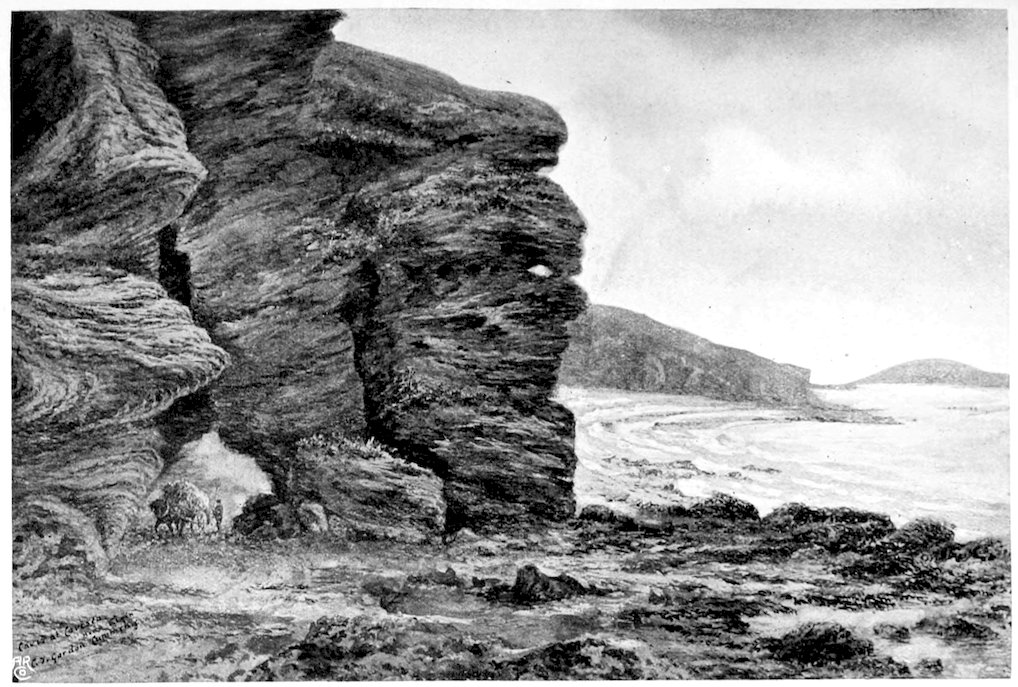
C. F. Gordon Cumming. A CAVE AT COVESEA.
403A far more remarkable instance of such recession is to be found a little further along the coast, beyond the fine Covesea Cliffs, whose fantastic caves and strangely water-quarried rocks tell of a time when they, too, must have lain for countless ages deep beneath the ocean.
But of the changes which have occurred in historic times, undoubtedly the most remarkable is that to which I have already alluded, whereby the ocean deliberately built up the mighty sea-wall which so effectually shut it out from the once beautiful harbour of Spynie.
Such are a few of the many singular changes which would doubtless amaze our ancestors considerably could they return in this nineteenth century to visit their favourite hunting-grounds in the Lowlands of Moray.
Note C A Legend of Vanished Waters
Although in speaking of the Lowlands of Moray I have briefly referred to the very remarkable changes which within the last five hundred years have befallen the beautiful Loch of Spynie, I think it well to record these in fuller detail.
The loch, which was about three miles from Gordonstoun, was till recently the fairest sheet of blue water in all the once great and important province of Moray. Now only a tiny lake, covering an area of about eighty acres, remains in that little corner, which alone of all the ancient province, still bears the name of Moray—a small lakelet in a small county.
Not fifty years have elapsed (I write in 1904) since this great fresh-water lake was one of the most important features in the scenery of the east coast. But the circumstance of chief interest connected with it is that within comparatively recent years, when our ancestors and their contemporaries built their castles on the shores of the lake, 404it was an estuary of the sea, a secure harbour, where fishing-smacks and sometimes trading-ships from far countries found secure refuge. And now, so complete is the transformation, and so utterly have the waters vanished, that the whole district is one wide expanse of rich arable land.
The two prominent objects in the midst of those level corn-fields, are the little hill on which stand the ruins of old Duffus Castle, and those of the Palace of Spynie. The former was once the fortified stronghold of Freskinus de Moravia, one of a race of barons of renown in the days of King David I. In later ages it passed to the possession of the Lords Duffus, who held it till the beginning of the eighteenth century.
One of their servants, who only died in 1760, used to tell of the time when Bonnie Dundee, the celebrated Claverhouse, was a guest in the castle, about the year 1689, and how she brought the claret from the cask in a timber stoup, and served it to the guests in a silver cup. She described Claverhouse as “a swarthy little man, with keen lively eyes, and black hair, tinged with grey, which he wore in locks which covered each ear, and were rolled upon slips of lead twisted together at the ends.”
The old castle was a square tower, with walls about five feet thick, and defended by parapet, ditch, and drawbridge; and round about it was an orchard and garden, noted for its excellent and abundant produce. The moss-grown fruit-trees remain to this day.
Speaking of this castle, my dear old friend Cosmo Innes, historian and antiquarian, and for many years Sheriff of Moray, said: “Of domestic comfort these great lords had not dreamt. This castle of Duffus had no chimneys nor any window glass. When the winter winds blew fiercely across the fen, they shut their stout window-boards—outside window-shutters—and crowded round a fire of peats in the middle of the hall, while the smoke found its way out as it could, and was welcome as communicating some feeling 405of heat to the upper chambers.” What a suggestive description of a cheerful home!
At a distance of about five miles, on another slightly raised site, stand the stately ruins of the Palace of Spynie, which, six hundred years ago, was the summer home of the Bishops of Moray, at a time ere their magnificent Cathedral of Elgin (still so beautiful in its decay) had been ruthlessly pillaged and destroyed. Notwithstanding its ecclesiastical character, this too was a stronghold, with loopholed walls of enormous thickness, watch-towers, and portcullis; and here baronial warrior-bishops, backed by a goodly company of armed retainers, held their supremacy over turbulent neighbours, not only by Divine right, but by very emphatic temporal force, for, as has been well said, “while holding the crosier in one hand, they could ever wield the sword with the other, and act the part of commanders of their stronghold at Spynie, whenever danger threatened.”
Various kings and great nobles had bestowed on the diocese of Moray grants of land, forests, and fishing, and the revenues and temporal power of its Bishops as “Lords of Regality of Spynie,” were so great, that they could well afford to live as princes, and accordingly they did so—their households including as many officials, with high-sounding titles, as those of the greatest nobles.
The title of “Lord of Regality” was no empty name. It was a grant from the Crown, conferring the right of legal jurisdiction in a specified district, both in matters civil and criminal. The Lord of Regality held the power of life and death, and was the arbitrary sovereign within its territory. These extraordinary and most dangerous powers were bestowed on various subjects, and in 1452 were granted by King James II. to the Bishop of Moray and his successors. The jurisdiction extended over the lands of the Church in the shires of Elgin, Nairn, Inverness, Ross, Banff, and Aberdeen, and included no fewer than nine baronies, besides other lands.
406These magnificent Prelates were certainly “lords over God’s heritage” in a most literal sense. Their daily lives practically exemplified how “when a strong man armed keepeth his palace, his goods are in peace,” for dire experience had taught them the need of supplementing their spiritual armour with every efficient temporal defence. For though their tenants and vassals were so far privileged that they were not liable to be called upon to serve the king in time of war, they were not infrequently compelled to act on the defensive.
Thus it was that when David Stewart of Lorn was made Bishop in 1461, and was so sorely troubled by the Earl of Huntly as to be compelled to pass sentence of excommunication against him, the wrathful Clan Gordon threatened to pull the Prelate from his pigeon-holes (in allusion to the small rooms of the old palace). The Bishop replied that he would soon build a house out of which the Earl and all his clan should not be able to pull him. Thereupon he built the great tower which has ever since borne his name—“Davie’s Tower,” four stories high, with walls of solid masonry nine feet in thickness.
Even the large windows of the upper rooms were defended by strong iron bars, while the casement was occupied by vaulted rooms, doubtless for the use of the men-at-arms. The roof is also vaulted and surrounded with battlements. But neither devotion nor recreation were forgotten in the building of this lordly palace, for within its great quadrangle stood the Bishop’s Chapel, and also a spacious tennis-court, while round about the precincts were gardens well supplied with fruit-trees. Here the poor of the parish daily assembled at a given hour, when a bell was rung, and from the postern gate an abundant supply of bread and soup and other food was freely dispensed to all comers.
Many a strange change have these grey walls witnessed—ecclesiastical pomp and martial display—pious and benevolent lives contrasting with scenes of cruel warfare 407and outrage—but no such changes have been half so startling as those physical transformations which have altered the whole aspect of the land. In place of rich harvest-fields extending far as the eye can reach, much of the country round and all the distant high ground, was covered with dense natural forest, haunted by wolves, which were the terror of the peasants, and afforded worthier sport for the barons than their descendants can create for themselves in the slaughter of home-reared pheasants.
Even the older members of the present generation found true sport in abundance round the reedy shores of the great fresh-water Loch of Spynie—the largest loch in the land of Moray—a beautiful sheet of water which, after long resisting successive efforts at drainage, has within the last forty years yielded to a determined attack, to the joy of the farmers and the bitter regret of naturalists and sportsmen.
The latter might (but do not) find a corner of consolation in being saved from the temptation to lay up for themselves after years of agonising rheumatism, brought on by long hours spent in creeping among marshy shallows on bitter winter mornings—such expeditions as were deemed joy by my brothers, whose well-filled bag often included some rare bird—a chance visitor of these shores. For until the middle of this century the rushes and water-grasses and rank herbage of the swamps offered such favourable breeding-grounds as to attract wild-fowl in incalculable numbers; widgeon and mallard, pochard and pintail ducks, teal, moorhens, and great flocks of coot. The loch was also the resort of numerous wild swans, though these had already become rarer visitants than of yore.
Many were the grey-brindled wild cats which haunted the neighbouring fir-woods, and many the badgers, which burrowed like rabbits in the dry banks, thence emerging to dig up the soil after the fashion of pigs. So numerous must these creatures have been in bygone times, that they have bequeathed their name to the lands of Inch-brock, “The 408Isle of Badgers,” a name worthy of note in that it tells not only of the presence of an animal now well-nigh extinct, but also of the time when the sea covered these lowlands, and this now inland farm was a wave-washed isle.
The capercailzie, too (which, being interpreted from the Gaelic, means “the cock of the woods,” and which had entirely died out of Scotland till it was recently re-imported from Norway to Perthshire, where now twenty to twenty-five brace sometimes figure in a single day’s battue), was a regular winter guest in the pinewoods of Moray,[79] until the latter part of the eighteenth century, when it ceased to make its annual appearance, a loss not much regretted by the proprietors of the forests, in which this “cock of the woods” leaves his mark in the destruction of many a promising shoot.
But when we speak of the blue, fresh-water loch (familiar to many travellers from the fact that some fifty years ago the railroad from Elgin to Lossiemouth was constructed right across its shallow, half-drained bed, so that the passengers looked to right and left across its glassy waters),[80] we are speaking of a comparatively modern feature in the landscape. At the time when these two grey ruins, the Palace of Spynie, and the Castle of Duffus, were built, both stood on the brink of a broad estuary of the sea—indeed, there is little doubt that prior to A.D. 1200, the Castle of Duffus, on its green hill, was actually an island. Up to the year 1380, Spynie was a secure harbour, whence “the fishers of sea-fish” were in the habit of sailing with their wives and children to the sea, thence bringing back fish in boats.
Thither came trading-vessels from France, Flanders, and Holland, for until the fifteenth century this loch, known as 409the Bishop’s Port, was the seaport for Elgin, involving only two miles of land transport. After the closing up of the lake, Findhorn became the chief port. But in its earlier days the sea-lake extended about five miles eastward of the Palace of Spynie to a spot called Kintrae, a Gaelic name signifying “the top of the tide.”
Strange to say, there are actually four places bearing this name, each but a little distance from the other, and evidently marking the gradual recession of the tide, as the coast-line changed. Finally we come to a spot which still bears the name of Salterhill, and here, about fifty years ago, the remains of a salt factory were discovered, in the course of digging deep drains. There were also salt-works on the banks of Loch Spynie itself, for they are mentioned in a deed by Bishop Bricius, bearing date A.D. 1203.
Nearly two centuries later, in A.D. 1383, a protest was made by the Lord Bishop Alexander Bar, against Lord John Dunbar, Earl of Moray, and the burgesses of Elgin, respecting the right of the fishing and of the harbour of Spynie, which he maintained to be within the ecclesiastical marches, and to have ever been held by the Bishops of Moray, who, each in his time, had “fishers, with cobles and boats, for catching salmon, grilses, and finnacs, and other kinds of fish, with nets and hooks, without impediment or opposition, the present dispute excepted.”
Later documents, bearing date 1451, still speak of the fishermen and harbour of the town or burgh of Spynie.
All manner of shell-fish abounded in this ancient sea-loch, more especially cockles and oysters. The latter, alas! have long since disappeared from our shores, together with the alluvial mud in which they formerly flourished, the sea-coast being now essentially sandy; but their presence in older days is proven by the numerous shellmounds, marking where clusters of fishers’ huts once stood. These “kitchen-middens” have in recent years been discovered all along the banks of this great basin. One of 410these (at Briggsies), which covers a space nearly an acre, and is in many places about a foot in depth, consists of masses of periwinkles, mussels, limpets, razor-shell, cockles, and oysters, but especially oysters of very large growth, such as may well increase our regret that they should have ceased to exist on these shores. A good deal of charred wood mingled with the shells, tells of the kitchen fires of the consumers, and one bronze pin has been found, as if just to prove that these villagers were possessed of such treasures.
A very remarkable confirmation of the old records regarding the ancient bounds of the sea was obtained when the loch was drained, and large beds of oysters and mussels were found buried beneath the deposit of fresh-water shells and mud. Several anchors of vessels were found, and sundry skeletons. In the same connection we may notice the name of Scart-hill, i.e., the Cormorant’s hill, which now lies at some distance inland, but which assuredly was originally on the sea-shore.
When the recession of the ocean deprived the bishops of their natural harbour, and the fish-supply could no longer be landed at their very door, they still retained their right to the coast fishing; and so, in the year 1561, we find the Bishop and Chapter of Moray granting a charter for “the fishing called the Coifsea” (which we now call Covesea), to Thomas Innes, in consideration of certain payment in kind, the Bishop reserving the right of purchasing the fish caught at the rate of twenty haddocks or whitings for one penny, a skate or ling, twopence, a turbot, fourpence, and a seleich, or seal, for four shillings.
The harvest of the sea included cod, skate, halibut, haddocks, whitings, saiths, crabs, and lobsters. The latter continued abundant until the close of the eighteenth century, when an English company established a lobster-fishery in the bay of Stotfield, for the London market, and in the first season forwarded sixty thousand lobsters alive to town, in wells formed in the hold of the ship, the 411prisoners simply having their claws tied to their sides. They were captured in iron traps, which seem to have had the effect of frightening the lobsters away from the coast, for, like the oysters, their presence here is now a tale of the past.
The lobsters, when captured, were stored in a marine prison, till an opportunity presented itself for sending them to the southern market; and the lobster-catchers were apparently not very discriminating in their selection of a suitable spot where these cases should be sunk. Hence, in April 1677, we find an appeal from the Captain of a trading-ship, The Margaret of Inverness, who, having occasion to call at the port of Crail, summoned a pilot to take in his vessel. He says: “Ane Inglish man being heir had two Lapister-kists[81] in the harbour-muth, and the boatmen towed close to them, and they aleadge that they did losse two hundred Lapisters, for which the Bailies heir has fyned me in thretie punds Scots, and arested and lodged me in prison till I will pay the same, which I doe think ought not to be payed by me, since that I had a Poileot, and the chists lay right in the midle of the harbour-muth.”
No historical record tells how or when the sea threw up the wide barrier of shingle and sand which in later ages separated it from the loch, transforming the broad estuary into a brackish lake with wide-spreading marshy shores, extending as far as Gordonstoun.
That the change was gradual seems proven by the formation of a series of raised beaches, distant about a mile inland from the present coast-line, and forming a succession of plateaus covered with large rounded stones, extending for about three miles along the shore. This curious ridge averages a height of twenty feet above the sea-level, and is from fifty to a hundred yards in width. It is known that in these remote times, the River Spey, which now enters the sea at Fochabers, flowed far more to the west, and probably brought down from the mountains 412those vast supplies of gravel and water-worn boulders. But though the Spey may have brought the material, the process by which the separation of the sea and lake was effected is all a mystery.
Whether, as some suppose, by sudden storms, or else by gradual recession of the ocean, certain it is that when Boece wrote his History of Scotland (which, though not published till 1526, was probably written earlier, since we learn that the author was born in Forfarshire in 1465), the sea was shut out from the lake; and though he mentions that in his time old persons remembered the lake being stocked with sea-fish, and although the river Lossie continued to flow right through the loch, certainly as recently as 1586 even salmon had all forsaken the loch, and were replaced by pike and trout, and multitudes of eels.
The cockles and oysters, too (the possession of which the Bishops maintained as their right), had disappeared with all other denizens of the salt sea, and in place of the brown, tangled seaweeds, fresh-water plants had sprung up. The old historian specially noted the abundant growth of swangirs, whatever they may be, on the seeds of which the wild swans love to feed, and large flocks of these beautiful birds floated in stately pride in the calm blue loch, while multitudes of wild-duck and all manner of water-fowl found refuge among the tall bullrushes and sedges.
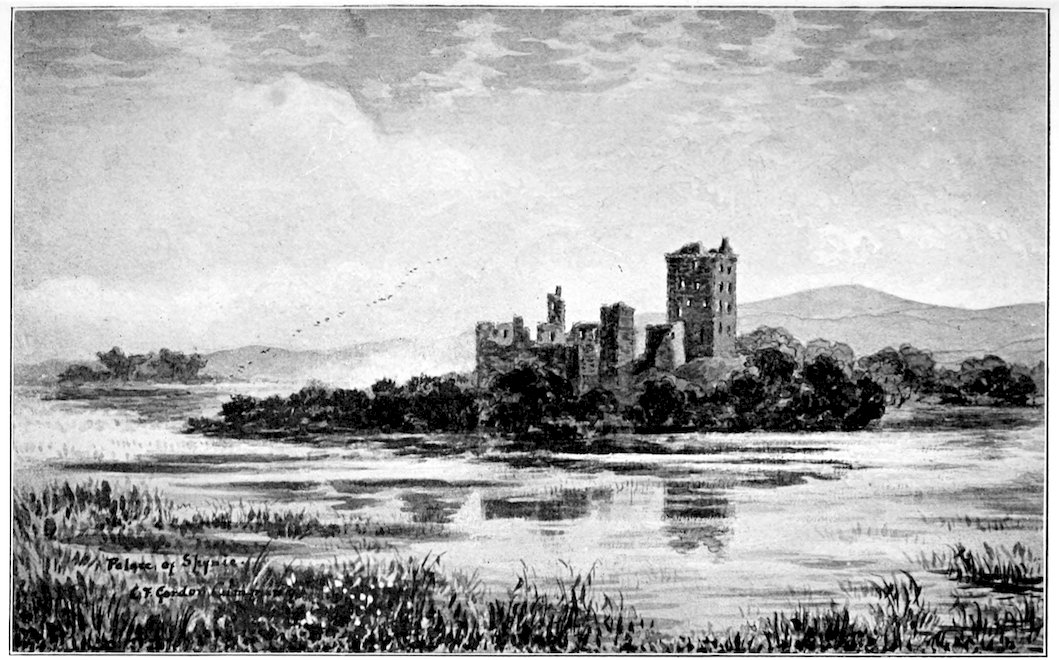
C. F. Gordon Cumming. THE PALACE AT SPYNIE, 1860.
“In this region,” says he, “is a lake named Spiney, wherein is exceedingly plentie of swans. The cause of their increase in this place is ascribed to a certeine herbe, which groweth there in great abundance, and whose seed is verie pleasant unto the said fowle in the eating, wherefore they call it swangirs; and hereunto such is the nature of the same, that where it is once sowne or planted it will never be destroyed, as may be proved by experience. For albeit that this lake be five miles in length, and was some time within the rememberance of man verie well-stocked 413with salmon and other fish, yet after that this herbe began to multiplie upon the same, it became so shallow that one may now wade through the greatest part thereof, by means whereof all the great fishes there be utterlie consumed.”
Very lovely in those days must have been the view from “Bishop Davie’s Great Tower,” overlooking the wide expanse of quiet lake, fringed with willows and rustling reeds and dark green alders (precious to the fishers as yielding a valuable dye for their nets), while beyond the recently created ridge of shingle lay the great stormy ocean, and the watchers on the tower might mark the incoming of the fleet of brown-sailed fishing-smacks, or catch the first glimpse on the horizon of the approach of some gallant merchantman (or perchance a smuggler’s craft) bringing stores of claret and brandy, and other foreign goods. The lake extended from Aikenhead in the east, far to the west of the ancient salt-works at Salterhill, etc., close to Gordonstoun, and ferry-boats took passengers across from point to point.
About the centre of the loch rose the island of Fowl Inch, where multitudes of water-fowl found a quiet breeding-place, while the west end of the loch was dotted with green islets called holmes, which were covered with coarse, rank pasture, called star grass. In days when no foreign grasses had yet been imported, this natural growth was precious, so in the summer-time the cattle were carried by boat and turned loose on the isles to graze. Of these isles, the principal were those known as Wester Holme, Easter Holme, Tappie’s Holme, Skene’s Holme, Picture Holme, Long Holme, Little Holme, and Lint Holme. This precious star grass also grew luxuriantly on some parts of the shore at the west end of the loch, and gave its name to those favoured spots—such were the Star Bush of Balornie, the Star Bush of Salterhill, and the Star Bush of Spynie.
Now, he who has a steady head and sufficient nerve to 414venture on climbing the ruined and broken spiral stairs (through the gaps of which he looks down into the empty space left by the total disappearance of the rafters and flooring which once divided the great tower into four stories) may still stand on Bishop Davie’s battlement, but in place of the broad lake, he will see only one little corner of blue water, sparkling like a sapphire in a setting of yellow gold—the withered reeds of autumn.
This small lakelet, covering about a hundred and ten acres, of which eighty are open water, lies on the edge of the dark fir-woods of Pitgaveny, and is carefully preserved by means of strong embankments separating it from the broad main ditch, which has so effectually carried off most of the water. Small as it is, it suffices to attract a considerable number of wild-duck, and a number of black-headed gulls breed on its margin, notwithstanding that their nests are freely pillaged, as their beautiful green, russet, or brown eggs are in great request for the table. About eighty dozen are thus taken each week during the breeding-season.
A neighbouring tract of rush-land still shows that art has not yet wholly triumphed over nature, but to all intents and purposes Loch Spynie has vanished “like as a dream when one awaketh.” Gone are the quiet pools, well sheltered by tall reeds, where wild geese and ducks, herons and coots, were wont to rear their young; no longer does the otter haunt the shore, or the booming note of the bittern echo from the swamp whence the white mists rose so eerily, and where the fowlers devised cunning snares for the capture of wild-fowl.
The thick mud, once tenanted by multitudinous eels, and which afforded such excellent sport to the spearers, was turned to good account by large tile-works, and the waters are everywhere replaced by rich green pasture, dotted over with sheep and cattle or comfortable homesteads with well-filled stack-yards; while straight, dull roads take the place 415of the old ferries; the boatmen have vanished, the wayfarer trudges on mile after mile across a monotonous expanse of ploughed land or harvest-fields, and the wild cries of the water-fowl are replaced by the shrill steam-whistles that tell of railway-trains, steam-ploughs, or reaping-machines. In short, the days of romance and of ague are a dream of the past, and unpoetic wealth and health reign in their place.
The means by which in the course of many generations this transformation has been effected, form a curious chain of incidents in the history of reclaimed lands. For many years after the separation of the sea from the loch, the River Lossie continued to flow in its ancient channel, passing right through the loch, draining the surrounding land, and carrying superfluous water to the sea. There is reason to believe that the Bishops, who were then almost sole proprietors, assisted this natural drainage by the cutting of deep lateral ditches, by which means some land was reclaimed, and the loch became so shallow that a road of stepping-stones was constructed right across it, so that the Bishop’s Vicar, after preaching to his congregation at Kinnedar (or “The head of the water”) might thereon cross to hold another preaching in Oguestown (the ancient name for the parish church at Gordonstoun).
This road across the water was carefully constructed, and was known as “The Bishop’s Stepping-Stones.” These were three feet apart, and on them was laid a causeway of broad, flat stones, along which the great Church dignitaries might walk in safety. There was also an artificial island near the Palace of Spynie—measuring about sixty paces by sixteen. For what purpose it had been constructed no one can guess, but it was built of stone, bound together by crooked branches of oak—a strange survival of those oak-forests which flourished in this district at the time when the Danes occupied Burghead, and came to repair old galleys and build new ones at Rose Isle, compelling the inhabitants to cut timber for this purpose in the oak-forests.
416Now only bleak, bent-clothed sandhills stretch along the shore, and from time to time an old root or log is upturned as if to prove that the tradition was not wholly a delusion.
Not only have the oak-forests disappeared, but the inlet of the sea where the galleys were constructed has been so wholly blocked up with sand, that not a trace of it is to be found, nor is there any mark to suggest at what period this portion of the coast can have been an island, as its name indicates.
Strange to say, however, the fisher-folk in the neighbouring village of Hopeman tell us that about forty years ago a foreign vessel (“we call them all foreigners unless they’re British,” say the fishers), bound for Burghead, being caught in a storm, ran right ashore near Lossiemouth, as the captain understood by his very old chart that he could run into Spynie harbour, and thence sail round under shelter by the back of Rose Isle.
A similar change, though in a smaller matter, is suggested by the name of Brae-mou, which was formerly Burn-mouth, at Hopeman, and also by the neighbouring farm of Burnside, which lies on rising ground near the sea-board of crags, but where now not the tiniest trickling brooklet is to be found, nor the faintest indication of any fresh-water stream having ever flowed.
There is, however, a tradition that two hundred years ago this and several other burns flowed westward into the lochs of Rose Isle and Outlet, both of which were filled up, and their very sites obliterated in the awful sand-storms which, in the autumn of 1694 and spring of 1695, overwhelmed so many miles of the most fertile land along the shores of Moray.
These streams, thus diverted from their natural channel, turned eastward, and thenceforward flowed into the Loch of Spynie, thus adding to its water-supply at the same time as the drifting sand had partly filled up its basin. Consequently the loch overflowed its bounds, and did vast 417damage to the surrounding lands. The Bishop’s causeway and other artificial roads, the Spynie islet and various homesteads, were lost to sight, and well-nigh to tradition.
After the Reformation, when Church and lands were divorced, the Protestant Bishops, shorn of all temporal power, might indeed inhabit the Palace of Spynie, but were compelled to be passive witnesses of the decay of the ancient drain-works, and the enlargement of the lake. The newly-created Lord Spynie never lived in the country, and suffered everything to go to ruin, so the accumulating waters encroached on the arable land to such an extent as to necessitate some very energetic measures—nothing less than turning the course of the river Lossie and providing it with a new seaward channel.
So in the year 1599 two of the proprietors, Sutherland of Duffus and Archibald Douglas of Pittendreich, whose lands chiefly suffered, agreed on this action.
How these “twa lairds” set about their work does not appear, but they evidently failed, for early in the seventeenth century most of the neighbouring proprietors combined, and having taken counsel with Anderson of Finzeach of Aberdeen, a skilful engineer, they succeeded in turning the Lossie into a new channel, separating it from the loch by a great embankment. A map of the province of Moray, published in 1640 by Sir Robert Gordon of Straloch, shows that this great work had been successfully accomplished.
After this the waters were fairly kept within bounds for half a century, during which men were too much occupied with stormy politics to give much heed to the care of their lands. But in 1694 their attention was rudely reawakened by the terrible calamity to which I have already referred. The drifting sands which desolated so wide a belt of the most fertile lands of Moray did similar damage, though in a less degree, in this district, and so effectually filled the channels of all streams and a great part of the bed of Loch 418Spynie, that its waters, now greatly enlarged, again overflowed their bounds, covering the cultivated lands, and presenting a wide but very shallow surface.
There was danger, too, lest the river Lossie should break its artificial banks, and return to its original channel. So in 1706 the neighbouring lairds bound themselves “to maintain and support the banks of the said river with earth, feal (i.e. turf), stone, creels, etc., ... in order to keep her in the channel where she now runs, and where she had been put by art and force.”
Dunbar of Duffus next attempted to reclaim his own swamped lands, which bore the appropriate name of Waterymains. He made great dykes and embankments, set up a windmill with pumping machinery, and all went well till a great tempest overthrew the mill and destroyed the machinery, whereupon the waters once more overswept the arable lands, of which they retained possession for many years, during which the neighbouring proprietors endeavoured to decide on some system of concerted action.
This, however, was effectually prevented by the counter interests of the family of Gordonstoun. It appears that when, in A.D. 1636, Sir Robert Gordon purchased these estates, he had obtained a charter from John Guthrie, Bishop of Moray, bestowing on him various lands, including those of Salterhill, otherwise called Little Drainie, “with all singular parts, pendicles, and pertinents, together with the passage or ferry-boat in the Loch of Spynie, with the privileges, liberties, profits, and duties of the same.”
In consequence of this charter, the family of Gordonstoun claimed the sole right, not only to the possession of boats on the loch, but also to the fishing and fowling and the use of the natural pastures on the shores, and the determination to preserve these rights was a fruitful source of litigation. It was therefore evident that whatever means were adopted to diminish the lake would infringe on the “profits and privileges” of the Gordons.
419Thus matters were left until the year 1778, when we find local chroniclers bewailing the neglect which had suffered “the ancient ditch” to be so filled up that the loch was daily increasing westward, forming a level sheet of water upwards of four miles in length, and covering a space of 2500 acres, besides the broad margin of marshy land which, owing to occasional overflows, was rendered worthless.
In the following year Mr. Brander of Pitgaveny (whose low-lying lands near the loch suffered more severely than those of his neighbours), resolutely set to work at his own expense, aided by his brother, to restore the old drain, and enlarge it so as to form a canal of some importance. He succeeded in lowering the surface of the lake upwards of three feet, and recovered 1162 acres of land, of which eight hundred fell to his own share, and the remainder to Gordonstoun and other adjacent estates, which touched the shores of the loch.
Then it was that the stone causeway (which was dimly remembered in local tradition) reappeared, as did also the artificial islet aforesaid, and an isle at the west end of the loch, on which were the ruins of a turf cottage. On excavating these, there were found a quantity of peat-ashes and a number of coins, which had apparently been here buried on some sudden alarm. Little did their possessor dream what changes would pass over his humble home ere his hidden treasure was again brought to light!
For a while Sir William Gordon (the last of the strong-minded, energetic race of the Gordonstoun family) looked on with comparative indifference, supposing that this effort to drain the loch would prove as unsuccessful as those of the past. But when he found that the waters had actually fallen so low as to stop his ferry-boat, he deemed it necessary to take active steps for the protection of his rights; and by application to the Crown he obtained a new charter, bearing date 22nd July 1780, giving him a right to “the whole lake or loch of Spynie, and fishings of the same, 420with all the privileges and pertinents thereof, together with the ferry-boat upon the said loch, with the privileges, liberties, profits, and duties of the same.” The granting of this charter was vehemently opposed by the neighbours, and the Messrs. Brander raised a counter-action and counter-claims, which kept all the lawyers busy for many years.
Meanwhile, nature and art continued in conflict. Three years after Mr. Brander’s canal was finished, a great flood occurred which did it considerable damage; the loch regained much of its lost ground, and the ferry-boat continued to ply even to Salterhill until the beginning of the nineteenth century.
By this time Sir William Gordon was dead, and the neighbouring proprietors awoke to a conviction that it would prove remunerative to unite their efforts in making a great new canal so as to reclaim more land. Telford, the most eminent engineer of his day, was consulted. (He was then engaged in the construction of the great Caledonian Canal.) His suggestion was that a canal should be cut through the high ramparts of shingle so as to give the loch a direct outlet to the sea, with mighty sluices at the mouth to keep back the tide.
It was determined to carry out this scheme, but a considerable time elapsed ere the neighbouring proprietors could come to an agreement respecting their several shares in the expenditure, and in the division of land to be reclaimed. This matter involved so much discussion, so many surveys and reports, such examination of witnesses, and other legal forms, that it dragged on, at an enormous expense, from 1807 to 1822! when the dispute was finally submitted to arbitration by the Dean of Faculty.
The work was, however, not allowed to suffer by these long legal proceedings, and by 1812 it was completed, at a cost of £12,740, a sum in which law-expenses formed a heavy item. The lowering of the waters put a stop to ferry-boats, so it became necessary to construct a turnpike 421road right across the loch. The workmen stood in some places breast-deep in the water: thus the Bishop’s stepping-stones, ere many years passed, were succeeded by a substantial turnpike road; and the eels and pike, which still found a home in the shallow water, were further disturbed by the construction of a pathway for “the iron horse.”
For about seventeen years all went well, and although the sluices at Lossiemouth were of wood and not self-acting, involving constant watchfulness on the part of the men in charge, the surface of the loch was maintained at an almost permanent level. Some expensive alterations were made in 1827 to avert a threatened danger of inundation in the fishing town of Lossiemouth; but all such minor fears were swallowed up in the reality of the great calamity which befell the whole land of Moray in the memorable floods of 1829, when very heavy rains on the high lands caused all the rivers to overflow their natural bounds and ravage the land. Even the little Lossie, usually so peaceful, was transformed into a raging torrent, and, bursting the barriers which had grown up between her and the loch, overflowed the canal, leaving it choked with great stones and earth; and rushing seaward, carried away the sluices. Thus in a few brief hours did the mocking waters destroy the labour of years.
In that widespread desolation, men had neither money nor inclination to return at once to the battle; but ere long the canal was partially cleared, the Lossie turned back into her accustomed channel, and high banks were raised to keep her therein. The sluices, however, had vanished, consequently the canal was simply a great tidal ditch, so that the loch itself rose and fell about three feet with every tide. The said ditch was, however, so far effectual that although the loch did overflow a considerable amount of cultivated ground, its limits were well defined, and the raised turnpike road continued perfectly dry.
As years passed by, however, the bottom of the canal 422gradually filled up, and the loch thereupon commenced to spread further and further, so that the neighbouring farms suffered severely, as field after field was inundated. Finally, in 1860 all the tenant-farmers united in a petition to the proprietors to set about a thorough drainage of the loch. This was agreed upon, and after many consultations, the landowners resolved to send a deputation to the fen-country of England, there to study the various methods successfully adopted for marsh drainage. Three reliable men were accordingly selected to represent the proprietors, the factors, the tenants, while a fourth was added to the number as professional adviser. These made a careful examination of the principal waterworks in England, and of all the various kinds of sluices in use, together with the methods of working them.
On their return they drew up a report, recommending, in the first instance, a partial drainage by means of self-acting sluices, which they calculated would, at a cost of £2430, so reduce the waters as to leave only a pool covering about a hundred acres near the old Palace of Spynie. Steam power, they considered, might, if requisite, be applied later to a final drainage.
As there were at that time two thousand acres of land either under water or so moist as to be worthless, there appeared a fair prospect of a good return for the outlay. The works were accordingly commenced. Sluices were put on at the sea, but months of toil and grievous expense were incurred ere they were in working order. In the first instance, a foundation of solid masonry had to be raised on what proved to be a quicksand, and an artificial foundation of heavy piles had to be prepared. Then the water poured into the cutting made through the shingly beach on the one hand, and through the sand on the other—so that the works were inundated both by sea and loch. The unhappy contractor, who had never calculated on such a contingency, pumped and pumped with might and 423main for months, till at length in despair, “out of heart and out of pocket,” he quietly disappeared from the country.
It was necessary, however, that the work, once begun, should be finished. It was accordingly undertaken by two local tradesmen, who in due time accomplished it satisfactorily, but at a very heavy loss on their contract. Four sluices of cast iron, each weighing eighteen hundredweight, were so finely poised as to be opened or closed by the rise or fall of a quarter of an inch in the surface of the water; and when shut not one drop of water could ooze through from the sea into the canal. Then followed the great labour of again digging and deepening the canal, and ere the works were finally accomplished, the expenditure was found to have been about £8000—rather an increase on the estimate! Nevertheless, the work is considered to have been remunerative, as the greater part of the two thousand acres thus reclaimed has proved first-class soil, and even the poorer portions are capable of considerable improvement.
Of course there is a necessity for some annual expenditure, as repairs are needed to keep the whole in working order; but so far the drainage of what was once the beautiful Loch of Spynie may be deemed a complete success from an agricultural point of view, though to the naturalist and the sportsman the farmer’s gain is an irreparable loss.
Much of the low-lying land thus reclaimed proved to be heavy clay, which produced rich wheat-crops, and till about thirty years ago a large proportion of this, and indeed of all the lowlands of Moray, was devoted to this grain. Now, however, since Russia and California furnish such abundant supplies, home-grown wheat is no longer a remunerative crop, so the wheat-fields have vanished, and are replaced by barley and oats, and especially by turnips, for Moray is now emphatically a stock-rearing 424district, and the farmer’s energies are concentrated on care of his beasts.
As concerns the fine old palace with “regality,” its glory rapidly waned after the date of the Reformation. The last Roman Catholic Bishop, Patrick Hepburn, was a man who fully understood the art of making friends with the unrighteous mammon, and, foreseeing the storm of 1560, he made provision in due season, and sought to secure a powerful ally against the day of need. He therefore presented a large part of the most valuable land of the diocese to the Earl of Moray, Regent of Scotland, with fishing and other privileges. He also handsomely endowed many of his own kinsfolks and friends, including his own sons, which was indeed adding injury to insult, so far as his relation to the church was concerned! Having thus disposed of her property for his own benefit, forestalling other robbers of church lands, he settled down to a less harassing life in the old palace, and there died at an advanced age.
At his death the remaining lands of the diocese were confiscated by the Crown, and in 1590 were granted to Sir Alexander Lindsay, son of the Earl of Crawford, who had found favour with King James VI. by advancing ten thousand gold crowns to help to defray his majesty’s travelling expenses when journeying to Denmark to wed the Princess Anne. Sir Alexander accompanied his sovereign as far as Germany, when he was attacked by severe illness, and had to remain behind. King James wrote from the castle of Croneburg, in Denmark, promising to bestow on him the lordship of Spynie, with all lands and honours pertaining thereto. “Let this,” said he, “serve for cure to your present disease.” Sir Alexander was accordingly created Lord Spynie, but not caring to live in the north, he appointed a neighbouring laird to act as constable of the Fortalice and Castle of Spynie. He himself afterwards lost favour with the king, and in 4251607 had the misfortune to get mixed up in a family fight in the streets of Edinburgh, which resulted in his death.
This method of settling a family difficulty was curiously illustrative of the times. The Earl of Crawford had assassinated his kinsman, Sir Walter Lindsay, whereupon Sir David Lindsay of Edzell, nephew of the murdered man, assembled his armed retainers to avenge the death of his uncle. The two armed forces met at Edinburgh, whereupon Lord Spynie interposed and strove to bring about a reconciliation. Hot words soon resulted in a fray, and the mediator was accidentally slain, and fell pierced with eleven wounds. Altogether this is a very pretty picture of the mediæval method of settling such questions.
The title died out in the third generation, when the lands reverted to the Crown, and have since passed from one family to another, till both lands and ruined palace reached the hands of the present owner—Captain Brander Dunbar.
Three centuries have passed by since the death of Bishop Hepburn, for the first hundred of which the old palace was the seat of the Protestant Bishops, to whom it was transferred after the Reformation. One of these, John Guthrie of that Ilk (which means that he was the proprietor of Guthrie in Angus), held it in the year 1640, when the Covenanters took arms, whereupon he garrisoned the palace and prepared for a siege. But when General Munro arrived with a force of three hundred men, the Bishop was persuaded to surrender, so only his arms and riding-horses were carried off.
Again, in 1645, when Montrose laid waste the lands of Moray with fire and sword, the inhabitants of the neighbouring town of Elgin (the cathedral town of the diocese) fled at his approach, to seek shelter for themselves, their wives, and their treasure, in the Palace of Spynie, which continued to be the episcopal residence till the time of Bishop Colin Falconer, who died there in 1686.
426Two years later, in the Revolution of 1688, the palace was annexed to the Crown, as the lands had already been, and since that date it has remained uninhabited. As a natural consequence, its timber and iron-work have gradually been removed by the neighbouring farmers—the doors and flooring, the oaken rafters, the iron gate, the iron chain of the portcullis, have all disappeared, and only a portion of the massive stone walls now remains to tell of the glory of this ancient palace. Even the best of the hewn stones, and the steps of the old stairs, have been thus appropriated. Never was transformation more complete than that which has changed this once mighty ecclesiastical fortress and palace of the sea-board into a peaceful inland ruin, whose grey walls, now tottering to their fall, re-echo only the scream of the night-owl, or the bleating of the sheep which crop the sweet grass within its courts.
Nevertheless, the position of those who occupy the reclaimed lands is by no means one of absolute security. Not only might another year of unwonted rainfall on the hills repeat the story of the floods of 1829, and restore the Lossie to its self-chosen channel through Loch Spynie, to the total destruction of all sea-sluices—but there exists the ever present and far more serious danger on the west, where only a narrow belt of low sandhills protects the cultivated lands from the sea, which in the eighteenth century made such serious encroachments on the neighbouring bay of Burghead.
When we note its ceaseless activity all along this coast (one year building up huge barriers of great boulders to a height of perhaps thirty feet or more, and in the following year carrying them all away, to leave only a gravelly shore), we cannot ignore the possibility that a day may very possibly come when, after a night of unwonted storm, the morning light may reveal a gap in the sandhills, and the fertile lands, which at eventide appeared so safe and 427so peaceful, may lie deep beneath the salt sea, which, reclaiming its rights, has once more resumed its original channel, passing round the back of Rose-isle, to restore to the ancient harbour of Spynie its long-lost character.
Note D Elgin Cathedral and the Church of St. Giles.
There are some points of special interest connected with these ancient buildings, apart from the ruthless destruction by “the Wolf of Badenoch” of all that was beautiful in the town of Forres and the cathedral city of Elgin. (It is a moot-point whether the possession of a picturesque ruin still entitles the burgh of Elgin to this honorary title—a doubt carefully expressed by a conscientious young revivalist in his prayer for a special blessing on “this city of Elgin, if it be a city!” By the way, it is interesting to note that in the Chartulary of Moray, about A.D. 1190, the name Elgin was spelt as at present, although in various later writings it is called Elgyn, Helgun, and Aigin.)