IV CONCORD AND CAMBRIDGE VISITORS (continued 2)
Reading edition
He said a merchant told him one day that he didn’t like Story’s portrait statues, but his ideal work he was delighted with. “You lie!” I said to him. “The beautiful Shepherd-Boy which I helped to buy and bring to Boston you know nothing of—you can’t tell me now in which corner of the Public Library it is hidden away. I tell you, you lie!”
He spoke of the Saturday Club, and said that, although he sometimes smiled at Holmes’s enthusiasm over it, he believed in the main he was quite right, and it would be remembered in future as Johnson’s Club has been, and recorded and talked of in the same way.
Unfortunately I don’t see their Boswell. I wish I could believe there was a single chiel amang them takin’ notes.[20]
On December 14, 1870, the diary recorded a dinner at which Longfellow, Osgood, Aldrich, Holmes, Dana, Howells, Lowell, and Bayard Taylor were the guests. It celebrated the completion of Taylor’s translation of “Faust.” Of the talk of Lowell and Longfellow, Mrs. Fields wrote:—
Before dinner I found opportunity for a short talk with Lowell upon literature. He thinks the chief value of Bret Harte is his local color and it would be a fatal mistake for him to come East, in spite of Taylor’s representation of the aridity of intellectual life now in California. Taylor finds the same reason for leaving his native place. He regrets his large house, and frankly says he is tired of living there, tired of living alone, there being really no one in the vicinity with whom he can associate as on equal grounds. There is no culture, not even a love for it, in the neighborhood.
But I have not said half enough of Longfellow. He scintillated all the evening, was filled with the spirit of the time and the scene, sweetly reprimanded Taylor for not having time to give him a visit also, darted his jeux d’esprit rapidly right and left, often setting the table in a roar, a most unusual thing with him. Holmes at the other end was talking about the natural philosophers who “invented facts.” Lowell took exception, said it was an impossible juxtaposition of ideas and words. Holmes defended himself by quoting (I think the name was Carius; whoever it was, Lowell said at once and rather warningly, he is a very distinguished name) a series of created facts by which he said a woman was not articulated or not as a man is (perhaps I have not his exact ideas); whereat Longfellow at once held up the inarticulate woman to the amusement of the table. Then they began to talk of the singular persons this world contains, “quite as strange as Dickens,” as they always say; and Taylor, who introduced the subject, proceeded to relate an incident which happened to him in a cheap coffee house in New York. It was near a railway station, so he dropped in, finding it convenient so to do, at an hour not usually popular with the frequenters of such establishments. It was empty save for an extraordinary figure with long arms, short legs and misshapen body, who, hearing a glass of ale ordered, came forward and said if he pleased he would like to have his ale at the same table for the sake of company. There was nothing to do but to comply, which Taylor of course did, whereupon the strange creature, never asking who Taylor was, went on to relate that he was the great man-monkey of the world who could hang from a tree and eat nuts and make the true noise in the throat better than any other; he had no competitor except one of the Ravel brothers, but he (Ravel) was not the real thing; he himself alone could make the noise perfectly....
They all drank the exquisite Ehrbacher Rhine wine from tall green German glasses of antique form, which delighted them greatly. Jamie was much entertained by Holmes’s finding them “good conversational aperient, but ugly. I should always have them on the table, but they are not handsome.” Longfellow was delighted with my Venetian lace bodice; it seemed to have a flavor of Venice about it in his eyes. It was a real pleasure to me to see his appreciation of a thing Jamie and I really enjoy so much.
I have not reported all, by any means, but time fails me now. A thought of Dickens was continually present, as it must be forever at a company dinner-table. How many beautiful feasts have I enjoyed by his side! There is none like him, none.
Taylor wrote a friendly German inscription in his book and presented me after dinner.
There were amusing traits of Elizabeth Peabody given. Longfellow remembered that the first time he met her was in a carriage. She was taken up in the dark. Hearing his name mentioned, she leaned forward and said, “Mr. Longfellow, can you tell me which is the best Chinese Grammar?”
A midsummer entry of the same year suggests the part that an editor’s wife may play in the successful conduct of a magazine, if only through sharing the enthusiasm that attends the first reading of a manuscript of distinguished merit.
Saturday, July 16, 1870.—A perfect summer day. Jamie did not go to town, but with a bag full of letters and MSS. concluded to remain here. He fell first upon a MS. by Henry James, Jr., a short story called “Compagnons de Voyage,” and after tasting of it in our room and finding the quality good (though the handwriting was execrable), I invited my dear boy to a favorite nook in the pasture where we could hear the sea and catch a distant gleam of its blue face while we were still in shadow and fanned by oak leaves. It was one of those delicious seasons which summer can bring to the dullest heart, I believe and hope. We lay down with our feet plunged into the cool delicious grass, while I read the pleasant tale of Italy to the close. I do not know why success in work should affect us so powerfully, but I could have wept as I finished reading, not from the sweet low pathos of the tale, which was not tearful, but from the knowledge of the writer’s success. It is so difficult to do anything well in this mysterious world.
On the very next day Lowell wrote Fields a letter which must have been read with delight by such friends of Dickens as the Fieldses. The decorated sonnet which filled its third sheet is reproduced herewith in facsimile: the plainness of Lowell’s script renders type superfluous. The mere fact that the death of Dickens could have called forth clerical expressions provoking Lowell to such scorn is in itself a measure of the distance we have travelled since 1870. The verses are not included in Lowell’s “Poetical Works,” nor are they listed in the “Bibliography of James Russell Lowell,” compiled by George Willis Cooke. With two slight changes they may be found, however, over Lowell’s signature, in “Every Saturday,” for August 6, 1870.
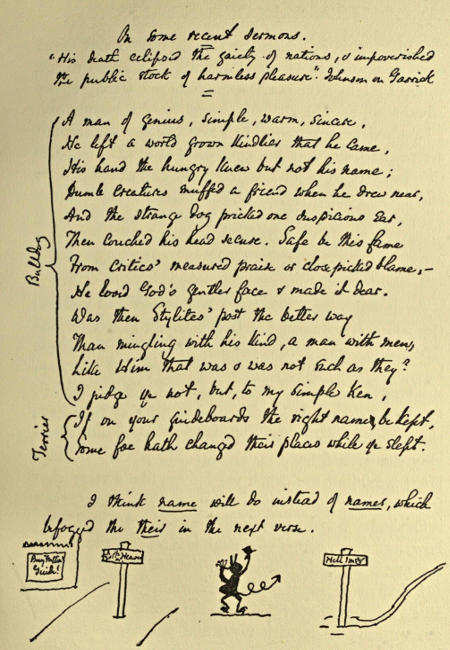
Facsimile of Lowell’s “Bulldog and Terrier” sonnet
Elmwood, 17th July, 1870
My dear Fields:—
I can stand it no longer! If Dickens is to be banned, the rest of us might as well fling up our hands. This hot weather, too, gives a foretaste that raises well-founded apprehension. It is a good primary school for the Institution of which the Rev’ds Fulton and Dunn seem to be ushers. Instead of going to Church today, where I might have heard something not wholly to my advantage, as the advertisements for lost people say, I have written a sermon. It is not a proper sonnet, but a cross between that and epigram—a kind of bull-terrier, in short, with the size of the one and the prick-ears and docked tail of the other, nor without his special talent for rats. Is there any grip in his jaw or no? He is good-natured and scarce shows his teeth.
The thing is an improvisation and the weather awfully hot!
Sweltered your servant sits and sweats and swears: (for alliteration only) but if you would like it for the “Atlantic,” why here it is on the next leaf. Or, if too late, why not “Every Saturday”? I could not even think of it sooner, for I have been wrestling with a bad head and an article on Chaucer, and I fear they have thrown me. I want rest, and a bath of poetry, but where may the wicked hope for either? My sonnet (if Leigh Hunt would let me call it so) hit me like a stray shot from nowhere that I could divine, and five minutes saw it finished. So why may it not be good? It came, anyhow, as a poem comes—though it isn’t just that. But my dog isn’t bad? He is from the life at any rate.
I shall make use of my first leisure to get into Boston. But I have got bedevilled with the text of Chaucer and am working on it with my usual phrenzy—thirteen hours, for example, yesterday, collating texts and writing into margins. I comfort myself that my Chaucer will bring a handsome price at my vandoo! I shall be easier in my coffin if it run up handsomely for Fanny and Mabel.
Do you want an essay for your “Almanac” if one should come, which is doubtful? I need one or two more to make a little volume, and I need a little volume for nameless reasons. O, if I could sell my land! I would transmute that gold into poetry. Or if only poems would come when you whistle for ’em!
Give my kindest regards to Mrs Fields.
Yours always,
J. R. L.
From my study, this first day for three weeks without a drowsy pain in my knowledge box, I really feel a little lively, and wonder at myself. But don’t be alarmed—it won’t last, any more than money does, or principle in a politician, or hair, or popular favor—or paper.
Lowell and Longfellow continue to make their appearances in Mrs. Fields’s diary.
December 7, 1871.—Last Sunday Charlotte Cushman dined here. Our guests asked to meet her were Mr. and Mrs. Lowell and Mr. Longfellow; Miss Stebbins and Miss Chapman, her guests, also came. We had a lovely social time, Lowell making himself especially interesting, as he always does when he can once work himself up to the pitch of going out at all. He talked a while with me about poetry and his own topics after dinner. He said he was one of the few people who believed in absolute truth; that he always looked for certain qualities in writers, which if he could not discover, they no longer interested him and he did not care to read them. He discovered, for instance, in the writers who had survived the centuries the same kindred points, those points he studied until he discovered what the adamant was and where it was founded; then he would look into the writers of our own age to see if he could find the same stuff; there was little enough of it unfortunately. He does not like Reynolds’s portrait of Johnson, thought it untrue, far too handsome, yet highly characteristic in the management of the hands, which portray the man as he was when talking better probably than anything ever did. Mrs. Lowell appeared to enjoy herself. J. says L. is always more himself if Mrs. L. is happy and talkative. They are thinking of Europe. Mabel is to be married in April, and afterward they probably go at once to Europe.
A small party of friends assembled in the evening. Longfellow was the beloved and observed and worshipped among all.
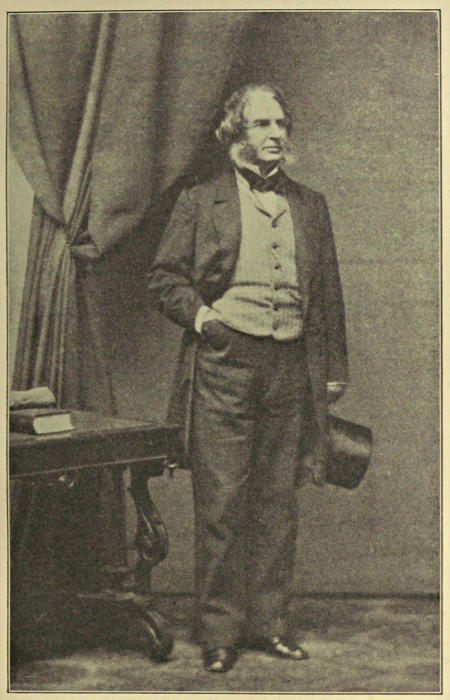
HENRY WADSWORTH LONGFELLOW
From a photograph taken in middle life
April 11, 1872.—Last night Jamie dined with Longfellow. John Field of Pennsylvania and Lowell were the two other guests. J. was there twenty minutes before the rest arrived, and Longfellow gave him an account of the wedding of a school-mate of mine, —— ——, an excellent generous-hearted, generously built woman, with a little limping old clergyman who has already had three wives and whose first name is ——. Longfellow said, in memory of what had gone before, the organist, as if driven by some evil spirit, played “Auld Lang Syne,” as the wedding procession came in, consisting of the bride and her brother, two very well-made large persons and the elderly bridegroom limping on behind all alone. The organist suddenly stopped at this point, breaking off with a queer little quirk and shiver as if he only then discovered what he was doing. Indeed the whole wedding appeared to have points to affect the risibles of the poet. He could hardly speak of it without laughter. He said, moreover, that it was, he thought, disgusting and outrageous for old men to get married.
Tuesday, September 23, 1872.—Longfellow came to town to see Jamie, in one of his loveliest moods. The day was so warm and fine, such a day of dreams, that he proposed to him every kind of excursion. “Come,” he said, “let us go to the tea stores and smell the tea; the warm atmosphere will bring out all the odors and we can get samples!” And again, “Come, let us go to the wharves and see the vessels just in from Italy or Spain. It will be a lovely sight in this soft sky, and we can hear the men speak in their native tongues.” Unhappily all these seductions were in vain, for Jamie was busy and was to lecture in Grantville in the evening. L. said: “At half-past eight I shall think of you doing thus and thus” (sawing the air with his arms). L. continued: “You know I have very strange people come to me—a man came a day or two ago by the name of Hyers, who has just published a book describing his own career. He believes that he is fed by the Lord! ‘How do you mean?’ asked I, with the knowledge that we were all fed in the same way. ‘Why,’ said H., ‘He leaves pies and peanuts on the sidewalks for me.’” Longfellow could hardly contain himself—but “after all,” he said, “that is very like Greene: when Greene comes to me, he always takes his money to come and go, just like my own sons and without so much as a thank you. But I like to have Greene come because he enjoys it so much and it is so strange. He amuses me. Then Appleton too, with his odd fancies, it would be hard to find a stranger man than he. He amused me immensely the other day by fancying an Indian, ‘Great Fire,’ or ‘Hole in the Wall,’ or some such fellow, coming to Boston for the first time. Passing a perruquier’s, he sees the window filled with masses of false hair; taking them to be scalps and the window to be an exhibition of these tokens of prowess, he rushes in, embraces the little perruquier behind the counter, treats him like a brother, and almost frightens the small hairdresser out of his senses!!”
L. likes Joaquin [Miller] much. Of course, he said, there are some things about him not altogether agreeable, such as flinging a quid of tobacco out of his mouth under the table; “but I don’t mind those things; perhaps,” he added, “perhaps I might have done the same as a youth of 20!!!”
Thursday, June 12, 1873.—Dined last night with the Aldriches and Mr. Bugbee at Mr. Lowell’s beautiful old Elmwood.[21] It was a perfect night, cool, fresh, moon-lighted, after a muggy day of heat. After dinner I went into the fine old study with Aldrich, where he showed me two or three little poems he has lately written. He was all ready to talk on literary topics and much in earnest about his own satisfaction over “Miss Mehitable’s Son” (which is indeed a very good story), and was full of disgust over the “Nation’s” cool dismissal of it. It was too bad; but that Dennet of the “Nation” is beneath contempt because of the slights he throws upon good literary work. Aldrich says he found “Asphodel” all worn to pieces, read and reread in the upstairs study. He finds Mr. Lowell’s library in curious disorder with respect to modern books. He is an easy lender and an easy borrower. The result is, everything is at loose ends. Only two volumes of Hawthorne can be found, for instance....
Such wonderful colors overspread our bay this evening, the wide heavens, and all that lay between, it seemed an unreal and magic glory, and I recall dimly Hawthorne’s disgust when he endeavored to describe a landscape. The Lord, he says, expressed himself in this glory; how shall we therefore interpret into language when he himself has taken this form of speech as the only adequate expression to convey his meaning to us? Who does not feel this in looking at the glories of Nature in this perfect season?
And here is a final glimpse of Longfellow, at Manchester-by-the-Sea, shortly after Don Pedro of Brazil had visited him in Cambridge:—
Thursday, July 6, 1876.—A fine rushing wind—no rain, but a wind that seemed to tear everything up by the roots. I dared not venture out in the morning. To our surprise and delight Mr. Longfellow came to dine. He was pleased to find Anna here, and fell to talking of Heidelberg in German with her and quoting the poets most delightfully. We sat in the front hall and rejoiced over his presence as he talked, for he was in a fine talking mood. He told us of the Emperor’s visit and of his soldierly though most simple bearing; how he came to call upon him after his dinner, and when, as he rose to go, Longfellow said, “Your Majesty, I thank you for the honor you have done me.” He said, “Ah! no, Longfellow, none of your nonsense, let us be friends together. I hope you will write to me. I will write you first and you must promise to answer.” As they walked down the garden path together, Longfellow raised his hat and stepped one side as he was about to get into his carriage. “No, no,” he said laughingly, “there you are at it again.” In short, he has left a pleasant memory behind.
Longfellow told us his maids broke everything he possessed; at last they had broken a very beautiful Japanese vase or bowl which Charley brought home—so he had made a Latin epitaph for the maid. Unhappily I recall only the last line:—
Nihil tetigit quod non fregit.
He described Blumenbach very amusingly, whose lectures on Natural History he attended as a youth in Heidelberg. He descended from his desk one day and came and rested his hand on the rail just before which L. was seated. He had been speaking of Platonic love. “Und die Platonische Liebe ist nach Amerika gegangen,” he said, looking at Longfellow. The whole student audience roared and applauded.
He was in the loveliest spirits and manners. His friendly ways to my three friendless girls were not only such as to excite them profoundly, but there was sincere feeling in his invitation to them to call upon him and in his questions in their behalf.
The wind subsided as we sat together; the two young Bigelows sang “Maid of Athens” and one or two other songs, and then he departed. How sorry we were as we watched his retreating figure, as he and dear J. wound down the hill in the little phaeton.
Mrs. Fields’s gallery of friends would be incomplete without a single sketch of Whittier’s familiar outline. Out of many which the diaries contain, one may best be taken, for it shows him in company with that other friend, Celia Thaxter, whom also Mrs. Fields counted among the few to whose memory she devoted special chapters in her “Authors and Friends”; and it brings the three together at Mrs. Thaxter’s native Isles of Shoals, so long a mecca of the “like-minded.”
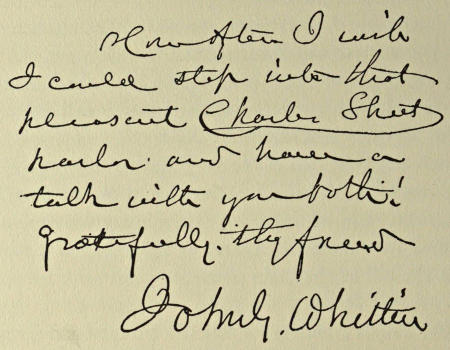
From a note of “Dear Whittier” to Mrs. Fields
July 12, 1873.—I shall not soon forget our talk one afternoon in the parlor at “The Shoals.” Whittier, as if inspired by that spirit residing in us which is the very ground-work of the Quaker belief, began to speak of Emerson’s faith and of the pain it gave him to see the name of Jesus placed in his writings as but one among many. When he discoursed with Emerson of these things, he could have no satisfaction. Celia, on the other hand, said she did not understand these things; she never prayed. “I am sure thee does without knowing it,” said W.; “else what do thy poems mean? Thee has not set prayer perhaps, but some kind of a prayer thee must have. No human being can exist without it. But what troubles me also in Emerson is that I can find no real faith in immortality.” Here I took up the question. I had heard Mr. Emerson at Thoreau’s grave, afterward speaking expressly on immortality, and in both discourses I felt deeply his faith in our future progress and enduring life. Whittier was inclined to think me mistaken. I think too that his use of Jesus’ name is to prevent the worship of him instead of the One God. Whittier asked Celia to read a discourse of Emerson’s, which she did aloud; and again he spoke of the beauty of childlike worship, the necessity for it in our natures, and quoted some lovely hymns. His whole heart was alive and poured out toward us as if he longed tenderly like the prophet of old to breathe a new life into us. I could seem to see that he reproached himself that so many days had passed without his trying to speak more seriously. He was not perfectly well after this—a headache overtook him before our talk was over and did not leave him until he found himself in Amesbury again. I trust it did so there....
Whittier said one day, when we were talking of the “Life of Charlotte Brontë” by Mrs. Gaskell, and I was saying how sad it was she should have made the old man, her father, suffer unto death, as she did, by telling the tale of his bad son’s life, and “still worse,” I said, “she came out in the Athenæum and declared that her story was false, when she knew it was true, hoping to comfort the old man,”—“I don’t know,” said Whittier; “I am inclined to think that was the best part of it, if her lie would have done the old man any good!”
After we had our long afternoon session of talk over Emerson and future existence and the unknowable, Celia stood up and stretched herself and said, “How good it has been with the little song-sparrow putting in his oar above it all!”
And what of Mrs. Fields herself, a woman of nearly forty when this last passage was written? For the most part the diary reveals her but indirectly. Yet in the midst of all her pictures of her friends, a fragment of self-portraiture is occasionally found; and to one of them the reader of these pages is entitled.
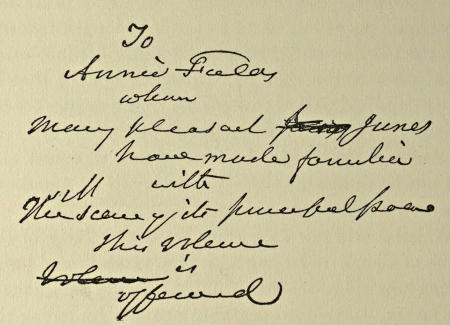
Proposed Dedication of Whittier’s “Among the Hills” to Mrs. Fields. In a letter to Mrs. Fields, Whittier wrote: “I would like thy judgment about it. Would this do?” In altered form it appears in the book.
December 18, 1873.—Have been looking over “Wilhelm Meister”! I struck upon that marvellous passage, “I reverence the individual who understands distinctly what he wishes; who unweariedly advances; who knows the means conducive to his object, and can seize and use them. How far his object may be great or little is the next consideration with me”; and much more quite as good to the same end. It prompts me to say what I wish to do in life.
Aristotle writes: “Virtue is concerned with action, art with production.” The problem of life is how to harmonize the two—either career must become prominent according to the nature of the individual. I discern in myself: 1st, the desire to serve others unselfishly according to the example of our dear Lord; 2nd, the desire to cultivate my powers in order to achieve the highest life possible to me as an individual existence by stimulating thought to its finest issues through reflection, observation, and by profound and ceaseless study of the written thoughts of the wisest in every age and every clime.
To fulfil these aims we must be able to answer the simple question promptly to ourselves: “What then shall I do tomorrow and today?” Then, the decision being made, the thing alone must have all the earnestness put into it of a creature who knows that the next moment he may be called to his account.
As a woman and a wife my first duty lies at home; to make that beautiful,—to stimulate the lives of others by exchange of ideas, and the repose of domestic life; to educate children and servants.
2nd, To be conversant with the very poor; to visit their homes; to be keenly alive to their sufferings; never allowing the thought of their necessities to sleep in our hearts.
3rd, By day and night, morning and evening, in all times and seasons when strength is left to us, to study, study, study.
Because I have put this last, it does not stand last in importance; but to put it first and write out the plan for study which my mind naturally selects would be to ignore that example of perfect life in which I humbly believe, and to return to the lives of the ancients, so fine in their results to the few, so costly to the many. But in the removed periods of existence, when solitude may be our blessed portion, what a joy to fly to communion with the sages and live and love with them!
I have written this out for the pleasure of seeing if “I distinctly understand what I wish.” It is a wide plan, too wide, I fear, for much performance, but therefore perhaps more conducive to a constant faith.