SOME CHESHIRE CUSTOMS, PROVERBS, AND FOLK-LORE
Reading edition
By Joseph C. Bridge, M.A., Mus. Doc. Oxon. et Dunelm., F.S.A.
CHESHIRE, although it borders on Wales, has caught but little of the Celtic imagination; and it is remarkable that the only Celtic legend current is found on the northern side of the county. The folk-lore of this County Palatine cannot compare with the quantity and quality of the Shropshire folk-lore; but legends are to a great extent born of valley and hill and stream, and Cheshire, with its vast plain, is, with the exception of the river Dee, deficient in those material phenomena which are present in such profusion in the neighbouring border county.
But Michael Drayton says of Cheshire men that “they of all England most to antient customs cleave”; and an attempt will be made in this chapter to give a general and compressed account of the customs which still exist and of folk-lore which has been, and still is, of great interest. The legends connected with the river Dee, and the many fine old customs connected with Chester itself are omitted, as they can easily be read in every history of the city. For other omissions the want of space must plead excuse.
SOULING
The most curious Cheshire custom still existent, and one which has not attracted the attention it deserves, is called “souling.” The day after All Saints’ Day (now November 1st) is All Souls’ Day. This was established as a festival of the Church about the tenth century, and in the Middle Ages it was customary for persons dressed in black to traverse the streets, ringing a bell at every corner and calling on all to join in prayer for the souls in Purgatory, and to contribute towards the paying of masses for them. After the Reformation the demand for money was transformed into demands for liquid and solid refreshment by the “soulers.”
But at Salerno, we are told that a custom prevailed previous to the fifteenth century of providing in every home on the eve of All Souls’ Day, a sumptuous entertainment for souls in Purgatory, who are supposed to revisit temporarily the scene of their earthly labours. Every one left their house and remained in church all night, while the feast was consumed by thieves who made a harvest out of this pious custom. Such is the origin of our “souling,” and it seems probable, therefore, that “soul-cakes” were not, at first, meant for consumption by the “soulers” themselves. The custom is still observed, and on the eve of All Souls’ (i.e. on the night of All Saints’ Day) bodies of children still parade Chester and Cheshire villages singing a portion of the old souling song, but tacked on to debased and incorrect versions of the old words, and in many cases amounting to mere doggerel.[52]
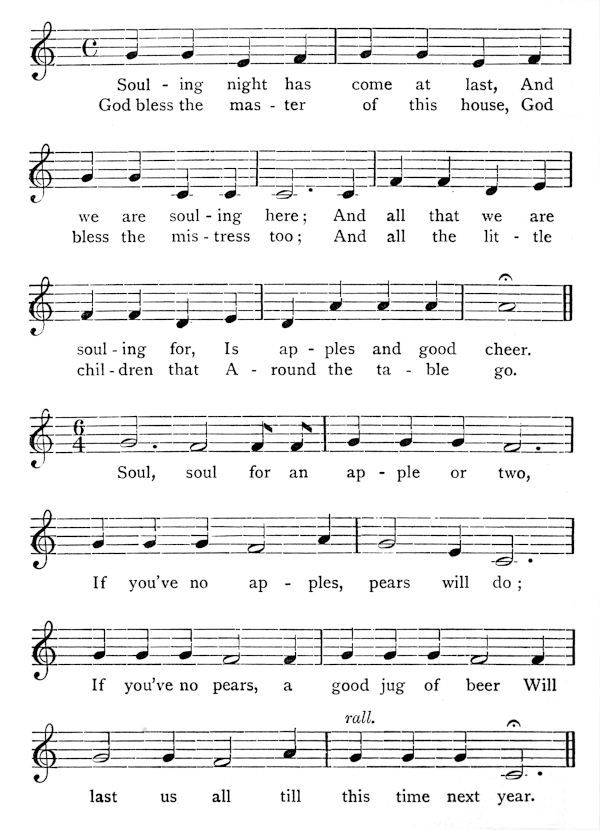
Now, the melody sung is most interesting, for it is undoubtedly pre-Reformation and is cast in the style of the Church music of the period, for there was no sharp dividing line between secular and sacred music when “souling” first began.[53] The “punctum” or drop of a fifth is very characteristic, and will be found in Merbecke and Church writers of the period.
The following is the tune as taken down by me many times in the past thirty years, though it is now getting greatly corrupted and altered, and will probably soon die out. No accompaniment is used:—
[Audio content is not currently supported on your device. [MusicXML]
Souling night has come at last, And we are souling here; And all that we are souling for, Is apples and good cheer. Soul, soul for an apple or two, If you’ve no apples, pears will do; If you’ve no pears, a good jug of beer Will last us all till this time next year. God bless the master of this house, God bless the mistress too; And all the little children that Around the table go.
Other verses are:—
Likewise you men and maidens, Your cattle and your store, And all that dwells within your gates, We wish you ten times more. The lanes are very dirty, My shoes are very thin; I have a little pocket, To put a penny in.
It will be noticed that the “refrain”[54] practically consists of only two notes, so that it could easily be lengthened at the will of the singer and new lines inserted. Here are some of the oldest rimes to which it is sung:—
Soul! Soul! for a soul-cake, Pray, good missis! a soul-cake, An apple, a pear, a plum or a cherry, Or any good thing to make us merry— One for Peter, two for Paul, And three for Him who made us all. Up with the kettle and down with the pan Give us { an answer } and we’ll be gone.[55] { our souling }
The following Staffordshire version is valuable for the statement that they “have all been praying for the soul departed.”
“Soul day, soul day, We be come a-souling; Pray, good people, remember the poor, And give us all a soul-cake. Soul day, soul day, soul, One for Peter, two for Paul, Three for Him who made us all. An apple, a pear, a plum, or a cherry, Or any good thing to make us merry. Soul day, soul day, We have all been praying For the soul departed: So pray, good people, give us a cake, For we are all poor people, Well known to you before; So give us a cake, for charity’s sake, And our blessing we’ll leave at your door. Soul! soul! for an apple or two, If you have no apples, pears will do; If pears are scarce, then cakes from your pan, Give us our souling, and we’ll be gone.”[56]
The following is a Lancashire reference:—
“There is a singular custom still kept up at Great Marton in the Fylde district on this day. In some places it is called ‘soul-caking,’ but there it is named ‘psalm-caking’—from their reciting psalms for which they receive cakes. The custom is changing its character also—for in place of collecting cakes from house to house, as in the old time, they now beg for money. The term ‘psalm’ is evidently a corruption of the old word ‘Sal,’ for soul; the mass or requiem for the dead was called ‘Sal-mass,’ as late as the reign of Henry VI.”[57]
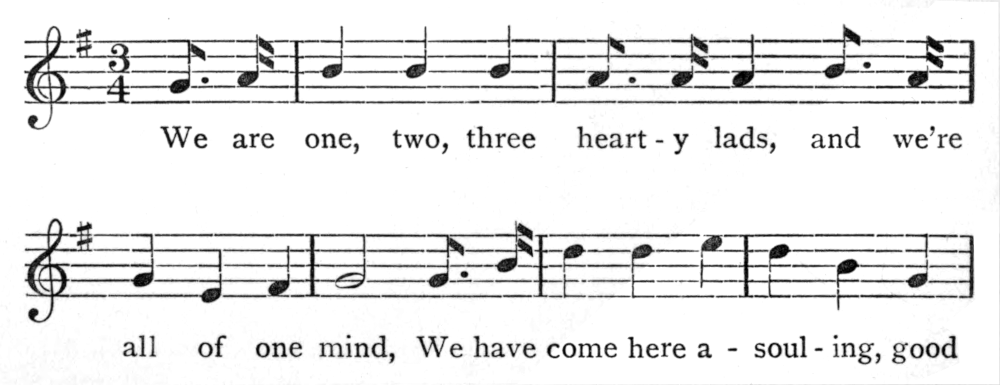
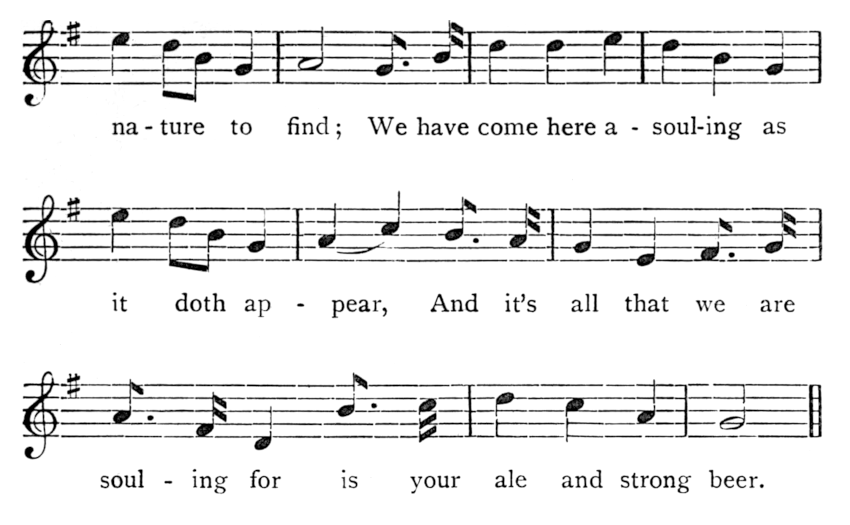
As time went on this tune was probably considered dull and old-fashioned, and the following has, to a limited extent, supplanted it. It is evidently an adaptation of a “pace-egging” song (see post):—
[Audio content is not currently supported on your device. [MusicXML]
We are one, two, three hearty lads, and we’re all of one mind, We have come here a-souling, good nature to find; We have come here a-souling as it doth appear, And it’s all that we are souling for is your ale and strong beer.
There are two other Verses.
At Northwich, Tarporley, and other places the soulers are accompanied by one bearing an imitation head of a horse, which snaps its jaws in an alarming manner. Thus “souling” has got grafted on to the pagan custom of “hodening.” At Over the soulers blacken their faces. This is a survival of the wearing of black already mentioned.
The “Soulers’ Song,” as given by Egerton Leigh, is a poor modern version, evidently adapted from a Maying song:—
“Ye gentlemen of England I could have ye draw near To these few lines which we have wrote, And all ye soon shall hear Sweet melody of music all on this evening clear, For we are gone a-souling for apples and strong beer.”
This is the fourth series of rimes on the subject, and the constant demand for apples and ale was to make a “wassail” bowl of “lambswool,” or hot spiced ale, with toast and roasted apples in it.
Souling seems to have been confined to, or at all events to have only survived, in the counties of Cheshire and Shropshire, though why this should be so it is difficult to say. It is also met with in the adjacent counties of Staffordshire and Lancashire, but only because it seems to have drifted over the borders. One curious reference to it occurs in Tales and Traditions of Tenby:[58]—
“What was called ‘souling,’ or ‘sowling,’ was practised by the female portion of the poor, who visited their wealthier neighbours, demanding ‘soul’ (possibly from the French soûl, signifying ‘one’s fill,’ or from saouler, ‘to satisfy with food.’ See Wright’s Provincial Dictionary), which signified, in its provincial acceptation, any condiment eaten with bread, such as meat, fish, etc., but especially cheese. As the usage was very generally recognised, souling-day proved, and still proves, one of the most profitable days in the calendar.”
The fanciful derivation of “souling” may be passed by, but it is hard to account for this reference to it in “little England beyond Wales.”
At Oswestry, on the Welsh border, it is customary to begin with:—
“Wissal, wassal, bread and possel, Cwrw da, plas yma,[59] Apple or a pear, plum or a cherry, Any good thing that will make us merry.” —Bye-gones, December 11, 1872.
Aubrey wrote regarding Shropshire thus:—
“In Salop the die õnium Animarum (All Soules-day, Novemb. 2d) there is sett on the Board a high heap of soule-cakes lyeing one upon another like the picture of the Sew-bread in the old Bibles. They are about the bignesse of 2d cakes, and n’ly all the visitors that day takes one; and there is an old Rhythm or saying—
‘A soule-cake, a soule-cake, Have mercy on all Christian soules for a soule-cake.’”
“The late Mrs. Gill, of Hopton, near Hodnet, had soul-cakes made in her house to give away to souling children every year up to her death in 1884. They were flat round, (or sometimes oval) cakes, made of very light dough, spiced and sweetened.”[60]
We find some of the words of the “Souling Song” in nearly every itinerant begging custom. In Montgomeryshire a New Year’s rhyme is:—
“The road is very dirty, My shoes are very thin; Please give me a penny To put some nails in.”
Several of the verses are found in a “Wessel-cup Hymn”—a carol popular in Shropshire thirty years ago—and in customs in Worcestershire and Yorkshire.
MARLING
The traveller cannot fail to notice the large number of square pits in the green fields of Cheshire, which are very different from the round drinking ponds of the southern shires.
These “pits” are excavations from which marl has been dug to place on the surface of the surrounding land as manure, and some curious old customs and words are connected with “marling.” After breakfast on the pit bank, the “head man,” who was termed the “Lord of the soil,” called out in a loud voice three times:
“‘O! Yez! O! Yez! O! Yez! This is to give notice that Mr. —— has given to us Marlers part of a thousand pounds, and to whomsoever will do the same we will return thanks and shout.’ The men then joined hands, and, putting their heads together, shouted ‘Largesse! Largesse!’”
Should any one pass through the field, the “Lord” walked up, having a marl clod on his shoulder. This was so well understood that sixpence or a shilling was usually given. If the former, it was proclaimed as “part of one hundred pounds”; if the latter, “part of one thousand pounds.” At the close of the season they assembled in front of the village inn, and repeated the oration.
“Ladling and slutching” is the clearing out the water and mud from a pit. “Fea” is the soil covering the marl. “Setting” is spreading the marl over the land; “Mid-feather,” the space between the pits.
The Cheshire rhyme says:
“He that marls sand may buy the land, He that marls moss shall have no loss, He that marls clay flings all away.”
RUSH-BEARING
The strewing of the floors with rushes is an old custom, and has died hard. The farmhouses in Cheshire were strewn on the first of May with green rushes, over which lavender and rosemary were scattered. Rushes are no longer used, but a pattern is frequently worked on the flagged floor by the juice of dock leaves.[61]
Formerly all churches were strewn with rushes, and these were generally renewed on great festivals:
“1551 Rysshes at Wytsontyd vid
” ”” Mydsomer viijd
” ”against All Hallowtyde xd
1584 To Edward Griffith for boughs, rishes, and other things what time the Earl of Leicester came hither xviijs ijd” [62]
“1630 Paid to Robert Raborne for getting out the old rushes of the church viijd” [63]
The custom of carrying rushes to church gradually developed into a festival, and the rushes were then decorated and carried in procession. In some parishes, where the time of year was suitable, this was done on the “Wake” day of the village. Flowers and garlands were added, which “were hung up in the church; we saw these garlands remaining in several places.”[64] Finally, the graves were strewn with them. This custom is still observed at Farndon with much ceremony on July 16th or the first Sunday afterwards.
Many rush-bearings, or “rush-buryings,” as they are sometimes called, became riotous festivities, and the Chester Courant for August 6, 1810, says:
“Christleton Rush-Bearing.—We were sorry to learn that the festivities of this annual fête should have been disgraced by that almost universally reprobated amusement, a Bull-bait. After this savage practice has fallen into disrepute and disgrace amongst the most uncultivated parts of the island, it is mortifying for us to record a transaction so disgraceful in the immediate vicinity of the polished city of Chester.”
In Cheshire also rushes are used as a charm for warts. The charmer has a long straight rush, ties three knots in it, makes it into a circle, draws it over the wart downwards nine times, at the same time muttering a spell which he refuses to disclose on the ground that if he did so the charm would not work. In three months the wart will disappear.
The old rush-lights of Cheshire were sold at twenty for sixpence. “They were as thick as the present ‘twelve’ candles (twelve to the pound), but half as long again, and gave a steady but dim light. There were some curious bits of folk-lore connected with them. For instance, if a rush-light in ‘sweating’ curled over, it denoted death; if a bright star appeared in the flame, it portended a letter.”[65]
PACE-EGGING
This is still practised in the Wirral peninsula, and the rime sung by the children was as follows:—
“Please, Mr. Whiteleg, Please give us an Easter egg; If you do not give us one, Your hen shall lay an addled one, Your cock shall lay a stone.”
Sometimes with the addition from “Souling” of:
“One for Peter, two for Paul, And three for the One who made us all.”
“In Birkenhead, for some years after the Park was laid out, there were several grassy mounds inside the railings ... which went by the name of ‘The Bouks’ (Banks).... Every Easter Monday the children would bring baskets of coloured eggs. Then a game was played. First, wickets were fixed at intervals at the foot of the ‘Bouks,’ the children took their eggs to the top of the hills and rolled them down, aiming to pass them unbroken through the wickets.”[66]
By degrees “Pace-Egging” became grafted on to the old mumming play which is found in nearly every county of England, and the following was sung at Thurstaston some thirty years ago. Two verses are omitted:—
I. Here come four or five hearty lads all of one mind; We have come a’paste-egging if you will prove kind; If you will prove kind, and never will fail, We’ll treat our young lasses to the best of X ale. Fol di-diddle dol-di-day. II. The next that steps in is Lord Nelson, you see With a bunch of blue ribands tied on to his knee, With a star on his breast like silver do shew, And he comes a’paste-egging with his jolly crew. Fol di-diddle dol-di-day. IV. The next that steps in is a lady so gay, Who from her own country has run far away, With the red cap and feathers that look very fine, And all her delight is in drinking red wine. Fol di-diddle dol-di-day. VI. The Master and Mistress that sit by the fire, Put your hand in your pocket, that’s all we desire; Put your hand in your pocket, and pull out your purse, And give us a trifle—you’ll ne’er be any worse. Fol di-diddle dol-di-day. VII. Some eggs and strong bacon we’ll never deny, For the eggs we can suck while the bacon doth fry. Now all ye young lasses, just mind what ye are about, If you give nought, we’ll take nought, so we’ll bid you good night. Fol di-diddle dol-di-day.
MAYING
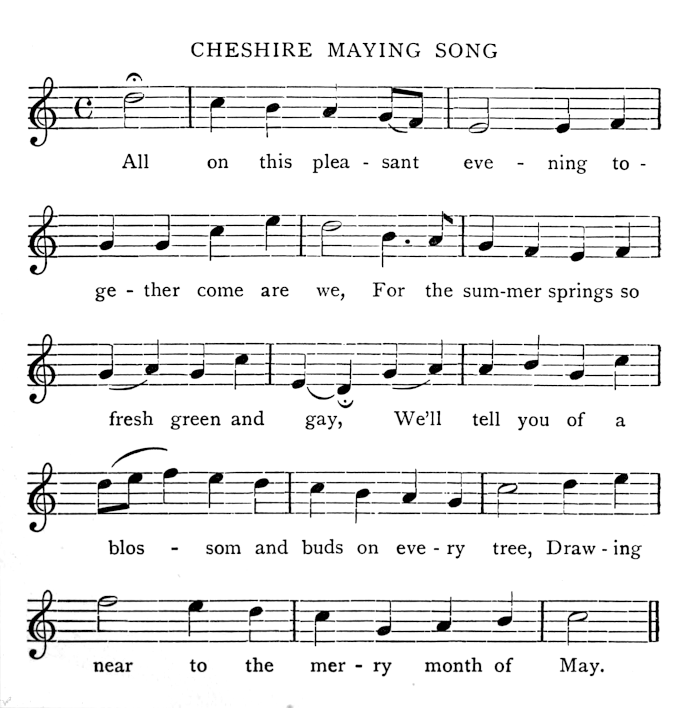
The “Mayers” went about singing and soliciting alms for some weeks before the first of May. The following is a portion of one of their songs, and a variant may be found in Halliwell’s Palatine Anthology, which was given to him by Ormerod, the Cheshire historian. The tune taken down by Egerton Leigh, and given in his book of poems, is terribly mutilated, but I have reconstructed it by the aid of a very similar Lancashire tune. It is undoubtedly old, and the commencement on the supertonic is very quaint. The words are distinctly above the average of old ballads:
[Audio content is not currently supported on your device. [MusicXML]
CHESHIRE MAY SONG
I All on this pleasant evening together come are we, For the summer springs so fresh, green, and gay, To tell you of a blossom that buds on every tree, Drawing near to the merry month of May. II Rise up, the master of this house, all in your chain of gold, For the summer springs so fresh, green, and gay; We hope you’re not offended, this night we make so bold, Drawing near the pleasant month of May. III Oh! rise, the mistress of this house, with gold upon your breast, For the summer springs so fresh, green, and gay; And if your body be asleep, we hope your soul’s at rest, Drawing near to the merry month of May. &c. &c.
In the Halliwell-Phillipps’ version each verse ends with
“Oh this is pleasant singing, Sweet May flower is springing, And summer comes so fresh, green, and gay.”
In Chester and surrounding villages the children still carry round May garlands, and generally a small child bedecked with ribbons, but the old May songs are no longer used.
At Knutsford a May Queen is annually chosen and crowned in public. This village has many curious and pretty customs. On the occasion of a marriage there, brown sand was strewn in the streets, and on this, fanciful figures of white sand and sometimes the flowers of the season were added.
LIFTING
Hone says that the custom of Lifting was prevalent in Chester, but that instead of being tossed in the air, the victims were swung about in a chair.
However, a correspondent in Adams’ Weekly Courant (printed in Chester, 26th March 1771) complains strongly of the custom of “Lifting, or rather the assembling in a riotous manner of a considerable number (I am sorry to say) of females at all the gates and other thoroughfares of this city to extort money from every man whose business may oblige him to pass that way. This is justly complained of by travellers, who, unacquainted with such customs (it not being suffered in any city but this) have given a considerable sum for leave to pursue their journey, and have scarce rode to the other end of the city but must again purchase the liberty of passing on.” It was practised at Chester up to about the year 1860.
The custom is supposed to have reference to the Ascension of our Lord.
HARVEST HOME
When the last field of corn was cut, then the farmer had what was called a “shutting.” The reapers would stand in a ring on some high ground, and one, acting as spokesman, gave out the “nominy”:—
“Oh, yes! oh, yes! oh, yes! this is to give notice That Mester ’Olland has gen th’ seck a turn And sent th’ owd hare into Mester Sincop’s standin’ curn.”
Then, taking hands, they all bent down and uttered an unearthly “Wow! wow-w! wow-w!” Other “nominies” followed, and then a liberal allowance of beer went round. This was supplemented by another ceremony. The last stalks of grain were plaited and formed into a threefold strand, at which the reapers threw their sickles. The one whose aim cut it down was the winner. This was called “cutting the Neck.”
CORNAGE
Cheshire has the great distinction of possessing two Forest Charter Horns held by cornage tenure, and these are still in existence.
The Wirral Horn.—The Hundred of Wirral was mainly divided between the Church and the Palatinate barons. The latter not being resident, the natives were lawless and turbulent; added to which the district was specially liable to incursions from sea-rovers. To reduce the natives to obedience, and as a matter of precaution, Ranulph de Meschines, the third Earl of Chester, about 1121, destroyed such boundaries of property as existed and planted the whole as a forest, so that “From Blacon Point to Hilbre a squirrel might jump from tree to tree”; as the old Cheshire rhyme has it.
The office of chief forester he bestowed upon Alan Sylvester, together with the manors of Storeton and Puddington, to be held by the tenure of blowing a horn, or causing it to be blown, at the “Gloverstone,” Chester, on the morning of every fair-day, to indicate that the tolls payable on all goods bought or sold in the city, or within sound of that horn, during the fair, belonged to the Earl and his tenants there.
After 250 years the citizens of Chester found the forest and its freebooters such a nuisance (for, so far from checking marauders, the forest, as a hiding-place, encouraged them), that they complained to the Black Prince, and begged that he would get his father to abolish it.
In 1376-7, the last year of Edward III.’s reign, the district was disafforested. The horn and its rights had passed, by marriages of female heirs, to the Bamvilles, and then to the Stanleys of Hooton Hall. They continued as titular foresters as late as of 7 Henry VI.
The horn is thus described:—16¾ in. convex, 13¾ in. concave, 9½ in. wide at the mouth, 7 in. in the middle, tapering to 2½ in. at the mouthpiece. The colour is yellow to light brown, with blue or black spots or flakes. It was in the possession of Sir John Stanley-Errington until his death in 1896.
The Delamere Horn.—What we now call the Forest of Delamere was originally the two forests of Mara and Mondrem, extending, roughly speaking, over all the lands between the rivers Weaver and Gowy. Mara was on the Mersey side, and Mondrem on the Nantwich side.
The land was afforested immediately after the Conquest, though the Saxon owner was, for a time, allowed to keep his estate in it. About 1123 Ranulph de Meschines, third Earl of Chester, added to the forest some waste lands and the villa or township of Kingsley, and conferred on Ranulph de Kingsley the forestry rights to be held in grand serjeantry, and gave him a horn in token of his rights as master forester. It is worth noting that the horns of Wirral and Delamere were both given, and at the same period, by this third Earl of Chester. But it is important to note that the office of master forester was not altogether paramount. Certain other rights belonged to the families of Grosvenors, Weavers, and Mertons; and the rights in the two forests were often kept separate and distinct. Finally, however, the whole of the forest rights were vested in the family of Done of Utkinton, and in 1617 James I. came “a-hunting” in the forest of Delamere and knighted John Done, who attended him as chief forester and bow bearer. Sir John died in 1629, and the male line of Dones came to an end. Through the female line the horn and forest rights descended to the Crewes and Ardernes, and then to the present Earl of Haddington, who married Miss Arderne in 1854.
The horn is a beautiful black colour and strongly curved. It is 14 in. on outside curve, but it is only 5 in. across from mouthpiece to mouth. Its greatest width is 1¾ in. at the mouth, and ¾ in. at the other end. The mouthpiece seems of silver gilt, but there is no sign of the other two “golden” bands with which pictures and old documents show it was embellished.
Forest of Macclesfield.—The third great forest of Cheshire was that of Macclesfield, which was in existence before Domesday survey.
The office of hereditary master forester of the forests of Leek and Macclesfield was held by the Davenports of Davenport by a grant from Hugh Cyvelioc, Earl of Chester (1160).
Now the original grant, as in the case of Mara and Mondrem, did not prevent subordinate rights being granted, and there were no less than eight sub-foresters who exercised rights down to the sixteenth century.
One of these foresterships belonged to the manor of Taxal, which was held by the Downes of Sutton Downes and Taxal. According to depositions about the year 1720, it is said of Reginald Downes, the then owner:—
“That hee when ye King came a hunting allways rowsed ye stagg, and when ye King came to ye forest Mr. D. held ye King’s stirrup and ye L’d Darby held his stirrup; and that the L’d Darby, instead of actually holding ye stirrup, put his strop or whip and held it towards ye stirrup while Mr. Downes mounted.
“That the said Mr. Downes had informed this deponent that he held his land by the blast of a horn on Midsummer Day, and paying a pepper-corn yearly; and that once, about 63 or 64 years agoe, this deponent was with the said Mr. Downes when he blowed his horn at Windcather (a range of high hills above Taxal) on that occasion.”
Another deposition states that the horn required “three blasts.” No special horn seems to have existed.
PROVERBS AND SAYINGS
The hard-headed Cheshireman may be deficient in legend, but he has invented a number of wise sayings and proverbs which can hold their own in quality and quantity with any other county. Some of the oldest, however, given by Ray, are wrapped in obscurity. The following is a selection:—
“—— by a proverbe certan Good manners and conynge maken a man.”
Bradshaw (Life of St. Werburgh).
[He was a contemporary of William of Wykeham.]
“Cheshire, Chief of men.”
“Stout, bold, and hardy withal, impatient of wrong, and ready to resist the enemy or stranger that shall invade their country.”—Webb.
Fuller says: “Its gentry is remarkable on a fourfold account—their numerousness ... their antiquity, their loyalty, and their hospitality.”
“Cheshire for men, Berkshire for dogs, Bedfordshire for naked flesh, And Lincolnshire for bogs.” “By waif, soc and theam, You may know Cheshire men.”
[Powerful in their legal rights and tenacious of them.]
“As many Leighs as fleas, Massies as asses, Crewes as crows, and Davenports as dogs’ tails.”
Some of the great Cheshire families.
“There is more than one yew bow in Chester.”
As many a Welshman had found out.
“Cheshire born and Cheshire bred, Strong i’ th’ arm and weak i’ th’ yed.”
Perhaps invented by neighbours “over the border” who had felt the strong arm.
“To grin like a Cheshire cat.”
No satisfactory explanation of this has ever been given. It has formed the subject for inquiries innumerable in “Notes and Queries.”
There is another version: “To grin like a Cheshire cat chewing gravel.”
“It is better to marry over the mixen than over the moor.”
It is better to marry an honest farmer from next door whom you know, than a fine gentleman from a distance who may turn out a fraud.
“Enough and no more, like Mrs. Milton’s feast.”
Milton married as his third wife Elizabeth Minshull of Wistanstow, near Nantwich, who survived him. She was poor and proud, and her enforced economy was not to the taste of her neighbours.
“When the daughter is stolen, shut the Pepper-gate.”
Equivalent to “shutting the stable door when the steed is stolen.” This originated in a former Mayor of Chester fastening up the Pepper-gate after his daughter had eloped through it with her lover.
“If thou hadst the rent of Dee Mills—thou wouldst spend it.”
These Chester mills yielded annually a large rent.
“As fair as Lady Done.”
The wife of Sir John Done, hereditary bow-bearer of Delamere Forest. Pennant, in his “Tour from Chester to London,” says that “when a Cheshireman would express supereminent excellency in one of the fair sex, he will say, ‘There is a Lady Done for you.’”
“Higgledy Piggledy—Malpas shot.”
All share alike.
The well-known anecdote need not be quoted.
“All on one side, like Parkgate.”
A single street with one side only, the river being on the other side.
“Every man was not born to be Vicar of Bowdon.”
One of the most valuable livings in Cheshire.
“To pull Lymm from Warburton.”
Complete and absolute separation.
“Hanged hay never does cattle.”
Bought hay, hung and weighed in the scales, is not economical. It will not do (pronounced “doe”) cattle.
“To scold like a wych-waller.”
I.e., a “salt-boiler” at one of the wyches of Cheshire.
“To catch a person napping, as Moss caught his mare.”
“I’ll tell thee, quoth Wood, If I can’t rule my daughter, I’ll rule my good.”
“But when? quoth Kettle to his mare.”
Of these three worthies history is silent.
“Like Goodyer’s pig, never well but when he is doing mischief.”
“He stands like Mumphazard, who was hanged for saying nothing.”
“Like the parson of Saddleworth who could read no book but his own.”
“Roint you witch! as Bessy Locket said to her mother.”
“No more sib (akin) than sieve and riddle that grew in a wood together.”
“If he were as long as a lither, he might thatch a house without a ladder.”
“It would make a dog doff his doublet.”
“She hath broken her elbow at the Church door.”
A woman grown idle after marriage.
“Score twice before you cut once.”
Used by curriers. Holmes’ “Academie of Armourie.”
Don’t cut your leather until you feel sure you have selected the right place.
“Stoppord law, no stake no draw.”
Stockport or Stopport—only those who contribute to an undertaking may reap benefit from it.
“You may know a Mobberley man by his breeches.”
An allusion to poachers in the neighbouring Tatton Park. They made their breeches of buckskin.
“The Mayor of Altrincham lies in bed while his breeches are mending.”
“The Mayor of Altrincham, and the Mayor of Over, The one is a thatcher, the other a dauber.”
These places were small and unimportant, and the mayors were therefore sometimes chosen from men in humble ranks of life.
“A Stopport (Stockport) chaise.”
Two women riding sideways on one horse.
“As thrunk as three in a bed.”
Thrunk = crowded.
“It is time to yoke when the cart comes to the caples.”
“In some part of England they call a horse a caple.”—Chaucer. Latin = Caballus.
“Good to fetch a rich man sorrow and a dead man woe.”
“As much wit as three folks—two fools and a madman.”
“She hath been to London to call a strea a straw, and a waw a wall.”
Adopting the London pronunciation and forgetting, or being ashamed of, the county dialect.
“To come home like the parson’s cow, with a calf at her foot.”
“To look a strained hair in a can.”
“To shed riners with a whaver.”
“To surpass anything skilful or adroit by something still more so.”—Wilbraham. Riner = a toucher used at quoits.
“Too-Too will in two.”
Strain a thing too much and it will not hold.
“Well, well, is a word of malice.”
“You been like Smithwick, either clemed or bossten.”
Too little or too much.
“Afraid of far enough.”
“Afraid of him that died last year.”
Of that which is never likely to happen.
LOCAL RHYMES
Holt liars, Farndon bears, Churton greyhounds, Aldford hares. In Stoak there are but few good folk, In Stanney—hardly any. Gobbinshire, Gobbinshire from Gobbinshire Green, The ronkest oud beggar as ever was seen.
Gobbinshire was a name of the lower portion of the Wirral peninsula.
Sir Randle Crewe, the Lord of this manor, Was born in Nantwich, the son of a Tanner. Middlewych is a pretty toun Seated in a valley, With a Church and Market Cross And eke a bouling alley; All the men are loyal there, Pretty girls are plenty, Church and King, and doun with the Rump There’s not such a toun in twenty.
—Cavalier Ballad.
“Congleton rare, where they sold the Bible to buy a bear.”
The inhabitants once laid by money for a new Bible, but the town bear having died, they devoted their savings to buying a new bear for baiting.
When the Chester and Birkenhead railway was made, the name of Ledsham was given to a station which was nearest to Sutton, and this gave rise to the following:—
“I want to go to Sutton please.” “There aren’t no Sutton now.” “It’s taken t’name o’ Ledsham, sir.” “For an estate? or how?”
SUNDRY SAWS
Farm servants dissatisfied say:—
Maily bread an maily pies, Skim Dick full o’ eyes, Buttermilk astid o’ beer, I’m sartin I shanna stop here.
(South Cheshire.)
Come aw ye buttermilk sellers that have buttermilk to sell, Ah’d have ye give good mizzer, and scrub yo’r vessels well; For there’s a day o’ reckoning, an hell will have its share, An’ the devil will have you nappers as Mossy ketched his mare.
“Go fiddle for shives (slices of food) Amongst old wives.”
Said in contempt.
“Laus-a-dees What times be these.” “Stare-agog, stare agog Tumbled o’er the tatoe-hog.”
Children irritate bulls by shouting:—
“Billy Billy Belder Sucked the cai’s elder” (udder).
PHENOMENA
Dee’s valley mild till close of year Means three months cold in store, I fear.
The Moon.
When hoo fulls at ye midnight, or soone after that, In ye sommer, great heat, In ye winter, hard frost. When hoo fulls at ye midday, or soone after that, Winter cries, “O ye rain,” Summer says, “Cheshire’s lost.” —Old Cheshire Household Book, 1675-85.
(Hoo is the old English “she.”)
A winde from Sandbach in the Easte Blows good to neither man nor beast. Malpas ales and Malpas gales Cheer the farmer, fill his pails.
Whenever Chester chimes at Congleton do sound A flood, like Noah’s, will wash away ye ground.
The towns are thirty miles apart.
It rains, it pains, it patters i’ the docks, Mobberley wenches are weshin’ their smocks. As long as Helsby (hill) wears a hood, The weather’s never very good.
If Wednesday, Thursday, or if Friday Happen this year to be May day, Then begin some harmless thing And it will thee much credit bring. —Randle Holme, Harleian MSS.
LEGENDS
The Celtic legend already alluded to comes from Alderley Edge. It is a version of Arthur and the Knights of the Round Table.
A farmer going through Alderley Edge, on his way to the fair to sell a beautiful white mare, was accosted by a venerable old man dressed as a monk, who said:
“Sell as thou wilt that steed of thine ’Tis fated that the steed be mine.”
The farmer found no purchaser, and, returning at night, met the monk by two enormous iron gates, through which they entered into a huge cavern where numbers of milk-white steeds were stalled, and by each lay an armed warrior asleep. The wizard paid the farmer, who asked the meaning of the mysterious troopers, and was told that they would, when England
“Was thrice lost and thrice won ’Twixt dawn of day and setting sun,”
come to her aid.
When the wizard ceased, the farmer found himself alone on the hill, and the gates closed behind him.
A dragon legend is connected with Thomas Venables, son of Sir Gilbert Venables, cousin-german to William the Conqueror:—
“It chaunced a terrible dragon to remayne and make his abode in the lordeshippe of Moston in the Countye of Chester, wheare he devoured all such persons as he laid hold on, which ye said Thomas Venables herringe tell of ... dyd in his awne person valiantly set on the saide dragon, where first he shotte hym throwe with an arrowe, and afterward with other weapons manfullie slew him, at which instant the dragon was devouringe of a childe.”
A greater fund of legendary lore is found with regard to the lakes or meres of Cheshire:—
Brereton—Bag or Black Mere.
“Here is one exceeding strange, but attested in my hearing by many persons, and commonly believed. Before any heir of this (Brereton) family dies, there are seen in a lake adjoining, the bodies of trees swimming upon the water for several days together.”—Camden.
Sir Philip Sidney, in Seven Wonders of England, says:—
“The Breretons have a lake, which, when the sun Approaching warms (not else) dead logs up sends From hideous depth, which tribute when it ends Sure sign it is the Lord’s last thread is spun.”
Capesthorn—Rudesmere, or Reedsmere.
In the grounds of Capesthorne is a fine sheet of water called Reedsmere, containing a floating island about 1½ acres in size, which in strong winds is blown here and there. A country legend accounts for this floating island by a story that a certain knight was jealous of his lady-love, and vowed not to look upon her face until the island moved on the face of the mere. But he fell sick, and was nigh to death, when he was nursed back to health by the lady, to reward whose constancy a tremendous hurricane tore the island up by the roots.
Rostherne Mere.
“All kinds of legends are current about Rostherne, as is the case with most lakes which are reported to be deep. One is, that a mermaid comes up on Easter Day and rings a bell; another, that it communicates with the Irish Channel by a subterranean passage; another, that it once formed with Tabley, Tatton, Mere, and other lakes, a vast sheet of water that covered the country between Alderley Edge and High Leigh.”—Hope, Holy Wells and Traditions.
Combermere
Has also a bell legend.
BELLS
The Curfew is still tolled at nine o’clock at Chester Cathedral, and the big bell used to be tolled whenever the Dean or Bishop was going to preach, but this has been discontinued. “Curfew” is tolled at many of the country churches, sometimes throughout the year, and sometimes only at harvest-time.
At Frodsham Church a small bell, which stood over the chancel arch, was called the “Dag-tale” bell, or “day-telling” bell—probably from being used to denote the hours of the day to those working in the fields. At Holmes Chapel, in the parish of Sandbach, there is an entry in 1723 for “bell ropes to Dag-tail 12s.”
The “Pancake” bell is still rung at Congleton on Shrove Tuesday at 11 A.M., and at Tarvin; and at Barthomley and other places it was called by the expressive name of the “Guttit” bell.
Ray says:—
“At Nantwich they have a custom like that in Scotland; when anyone is dead a Bellman goeth about the streets in the morning that the dead person is to be buried, tinkling a bell he has in his hand, and now and then makes a stand and invites the people to come to the funeral at such an hour.”
Prebendary Garencieres of Chester Cathedral, in his will of 1703, says:—
“I would have no other invitation to my funeral than by notice given by the Clerk to the parishioners of Handley and Waverton, and by the Belman to the people of Chester, of the time when, and the place where my corps is to be buried.”
Congleton still preserves three ancient leather belts, on which are strung a number of metal bells with rolling clappers. Two belts have seven, and one has five, and each bell has a different tone. They are said to have been worn by three church officials on the Congleton “Wake” day, the Feast of St. Peter ad vincula, or “St. Peter in Chains.” At midnight of that day three acolytes ran round the town summoning the people to church, thereby representing the clanking of chains. About one hundred years ago the bells fell into the hands of a family of chimney-sweeps, but were ultimately seized and preserved by the town authorities. They are unique.
The following is a Cheshire distich on bells:—
Higher Peover kettles, Lower Peover pans, Knutsford sweet music, and Rostherne great drones.
BIRDS
Two cocks answer one another:—
1. “Cocky Keeko! The women been master here.” 2. “Cocky Keeko! It’s the same everywhere.”
(South Cheshire.)
The “Golden Plover” is called “The Sheep’s Guide” by the Longdendale shepherds, who say the bird’s note warns the sheep of danger.
It is considered bad luck to take the eggs of, or to kill the Robin, Wren, Spotted Fly-catcher, and Swallow, hence the following:—
The Martin and the Swallow Are God’s Mate and Marrow,
or,
“Are God Almighty’s birds to hollow” (= to hallow or keep holy).
Eggs of game-fowl are placed in Magpies’ nests to be hatched, in order to make the game-cocks fight better.
The calling of a green Woodpecker indicates rain.
The name of “Boggarts muck” is given to Owl pellets, the idea being that the small bones therein are those of fairies eaten by boggarts.
The Cuckoo was called “The Welsh ambassador” in Cheshire, because this herald of spring was generally heard first on the Welsh border.
GAMES
Randle Holme gives an entertaining list of children’s games in the Stuart period, nearly all of which are now obsolete. He does not mention one which is more popular in Cheshire than the Southern Counties. This is the game in which a horse chestnut is threaded on a string and struck at with chestnuts similarly threaded. The chestnut is called a “coppity-co”:—
“Coppity-co, My first blow”
is the rhyme used. The word is now softened into cobbity-co (so in Shropshire) and even into comity-co (Chester, 1909).
“Cobbity-cuts Put daïn your nuts.”
(South Cheshire.)
Cop is old English for top or head.[67] Somnolent church-goers in olden times had reason to remember this fact.
Paid Richard Pennington for whiping dogs and cobing sleeping folke £0 10 0
(Bunbury Church Accounts.)
A similar official at Tarvin was familiarly known as “The Cobber,” and at Tarporley as “The Awakener.”[68]
Another curious game is “Dot.” Children move in a ring round one representing “Dot,” and sing:—
“Dun yo’ wot, ’oo were Dot? He were not a bad lot; Whereabouts was his cot, Oi’n furgotten to jot.”
(North Cheshire and Malpas.)
At this point “Dot” puts his hand out, and the one touched has to take his place. This is practically a “counting-out rhyme,” and there seems every probability that it is a very ancient one.
The Manor of Edge, in the Hundred of Broxton, was held, according to Domesday Survey, by Edwin, a Saxon thane, who, although he was compelled to become tenant to Norman Robert FitzHugh, managed to retain for himself the two Edges. Contemporary with him was Dot, the Saxon lord of sixteen manors, some of them conjointly with Edwin; but, more unlucky than he, Dot lost all his manors and fled to Wales. His grandson, Cadwgan Dot, was father of Hova Dot or Dod, from whom the Edge and Broxton Dods claim lineal descent.
The following are additional “counting-out” specimens:—
Orcum, Borcum, Boni, Corkum, Ericum, Bericum, bo-ni-bus. O.U.T. spells out.
(Chester.)
One, two, Sky-blue; All in But you.
(Chester, 1904.)
MUSIC
Although Cheshire cannot be described as a musical county, yet it has no reason to be ashamed of its past musical history.
“Cheshire Rounds” was a celebrated tune and dance—sometimes danced by a couple (whose gyrations resembled the movements of the sun and moon) and sometimes by a single person. The only known portrait of Doggett (who founded the celebrated waterman’s badge) shows him dancing the “Cheshire Round.”
Miss Stanley writes from Alderley Park—
Sep. 8, 1798.
We had yesterday what is generally called a harvest home supper, but here a “shutting.” Old Peter danced the Cheshire Round on the table after supper with Charlotte Alcock, one of the women.
A play-bill of the time of William III. shows how popular the dance was then—
In Bartholomew Fair, at the Coach-house, on the pav’d stones at Hosier Lane end, you will see a Black that dances the Cheshire Rounds to perfection.
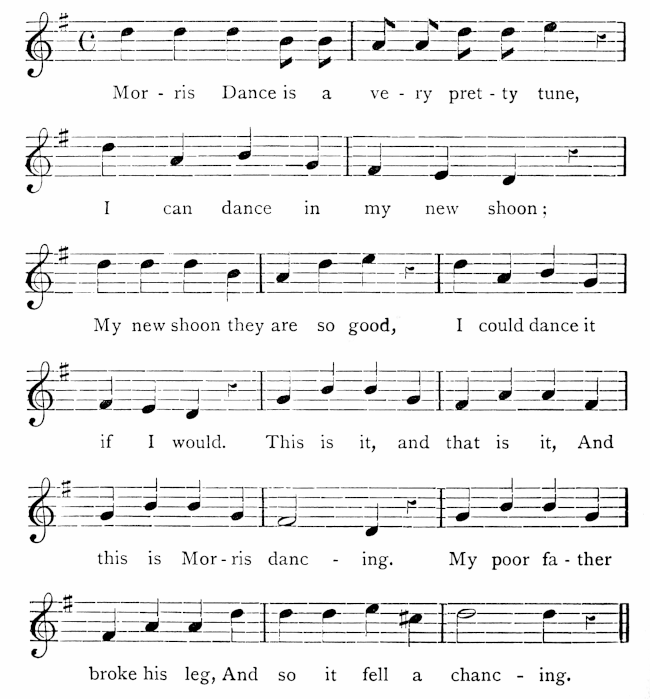
The Morris Dance has always been a favourite, especially in the Knutsford district, where it was danced to the following:—
[Audio content is not currently supported on your device. [MusicXML]
Morris Dance is a very pretty tune, I can dance in my new shoon; My new shoon they are so good, I could dance it if I would. This is it, and that is it, And this is Morris dancing. My poor father broke his leg, And so it fell a chancing.
Just over the border, in Lancashire, the version runs—
My new shoon, they are so good, I could dance Morris if I would; And if hat and sark be drest I will dance Morris with the rest.
Three ballads were very popular, viz. “The Miller of the Dee,” “The Spanish Lady” (who is supposed to have fallen in love with the Cheshire knight Sir Uryan Leigh), and “The Cheshire Cheese.”
CHURCHES
The old parish account-books show that much more was spent on music in old times than in the present day, e.g. Bunbury:—
1762. For a bassoon £5 5 0
1787. John Richardson, for instructing the singers 8 17 0
1801. For a hautboy 0 14 0
1811. For a base violin 6 16 7
1820. Paid Mr. Cotgreave, for leading the singers, 62 nights at 5s. 15 10 0
1821. Do.do.77 nights at 5s. 19 5 0
In 1785, at Farndon, we find—
To a vestry meeting about a bassoon £0 2 6
To a bassoon 6 0 8
Two new “cleronets” and reeds cost £5 12s. 9d., and a new hautboy £1. 8s.
At the same vestry the churchwarden was empowered to pay £1. 1s. yearly to the singers “so long as they continue to sing such tunes as the inhabitants of the parish shall approve of”; and William Snelson was paid two guineas per annum “to teach the children to sing psalms in church.”...
The abolition of the old church band has not been of benefit to many churches and villages.
Passing mention must be made of Handel’s visit to Chester, in 1741, when he tried over the music of the “Messiah” before its first performance in Dublin, and of the great Chester Musical Festivals held at various intervals from 1772 to 1829, and of the celebrated political song called the “Glorious Sixth of May,” which stirred Chester like a second “Lillibulero,” just one hundred years ago.
WELLS
A wishing well, called “Billy Hobby’s Well,” was in the field which is now the Grosvenor Park, Chester, and a local poet sang thus in 1823—
I lov’d the tales that idle maids would tell, Of wonders wrought at Billy Hobby’s well; Where love-sick girls with leg immured would stand, The right leg ’twas—the other on dry land, With face so simple—stocking in the hand— Wishing for husbands half a winter’s day, With ninety times the zeal they used to pray.
Other wells round Chester were “St. Giles’ Well” at Spital Boughton, “Jacob’s Well” near St. John’s Church, “Aganippe’s Well” at Newton, and the “Abbot’s Well” at Christleton, which supplied the monastery at Chester with water. It still exists, but the others are extinct.
Another wishing well was at Gayton, and a holy well at Alderley Edge. St. Plegmund’s Well is in the parish of Plemstall (three miles from Chester). It has been customary for many years to take the water used for christenings in the church from this well.
A chalybeate spring existed in Delamere Forest, and was resorted to by invalids in the eighteenth century.
The largest well now existing is the “Synagogue Well” at Frodsham, which is close to the site of the ancient castle there, and may have been connected with it. It still has a copious supply of water, and has been cleansed and repaired, much to the detriment of its former picturesque appearance.
There is no history attached to it nor any explanation of the curious name. Major Egerton Leigh gives a fancy history of it in his Ballads and Legends of Cheshire.
No traces of well-worship exist; but up to a late period the inhabitants of Nantwich used to sing a hymn of thanksgiving at the “Blessing of the Brine.” An ancient pit, called the “Old Brine” or “Biat,” was decked on Ascension Day with flowers, and a jovial band of young people celebrated the day with song and dance. Aubrey says: “In Cheshire, where they went in perambulation, they did blesse the springs—i.e. did read the Gospel at them, and did believe the water was better.”
A remnant of fire-worship existed at Alvanley, where, on the Toot Hill, fires were made in the spring and autumn, through which the villagers jumped.
ROBERT NIXON
Mention must be made of Robert Nixon, the great Cheshire prophet, whose fame not only rivalled that of Mother Shipton, but may be said (seeing that he is mentioned in Pickwick) to have lasted longer. The earliest history is Oldmixon’s, published in 1714, which says that “in the reign of James I. there lived a fool whose name was Nixon,” and that Thomas Cholmondley of Vale Royal (d. 1652) “took him into his house, where he lived when he composed this prophecy.” But other writers place him at a much earlier period. His prophecies really fall into the two periods of civil war, viz. the Wars of the Roses, and the Great Rebellion. If, therefore, Nixon was a real personage, it is obvious that if he lived in the reign of James I. he cannot have uttered some of the prophecies attributed to him. The discovery of an “Irish Analogue of Nixon’s Prophecy” (Notes and Queries, October 21, 1865) throws great doubt on the whole matter. The subject still requires much investigation.
The following are a few of Nixon’s prophecies:—
When an eagle shall sit on the top of Vale-Royal House, Then an heir shall be born, who shall live to see great troubles in England.
It is said that the Cholmondley family was at this time nearly extinct, but in due course an heir was born, during which time an eagle perched on the house-top.
Between a rick and two trees A famous battle shall be.
The “rick and two trees” may be Warwick, Coventry, and Daventry, and the battle, Edgehill, 1642; or Rickmansworth, Elstree, and Edwinstree, and the battle the second fought at St. Alban’s, 1461.
The following is unintelligible:—
There will be three gates to London of imprisoned men for Cowsters. Then, if you have three cows, at the first gate sell one, and keep thee at home. At the second gate sell the other two, and keep thee at home. At the last gate all shall be done.
Old Mab’s Curse is directed against any one of the Minshull family who shall sell the family acres—
Mabel’s dole, of pious fame From royal blood they say she came; Poor and needy folks do tell That Mynshull’s land no one dare sell, For Old Mab’s curse on him would light That ere should sell land, stone, or bight.
The belief that bees must be told of their master’s death is widely spread, also that a winter crop of primroses betokens a death in the house. Powdered alabaster is considered a good remedy for the ailments of sheep, and the beautiful tomb of Sir Hugh Calveley in Bunbury Church has, in consequence, it is said, suffered much mutilation.
We find Trowle, the shepherd boy in the Chester play, making much of his tar-box as a specific, for the diseases of sheep and cattle were serious matters for an agricultural people, as the following show:—
Paid for a book concerning ye disorders of cattle £0 1 0[69]
and in the accounts of St. John’s Church, Chester, the following occurs five times in 1747:—
Paid for a book about the horned cattle £0 0 8
One other point remains to be noticed. There is a widely-spread belief that the indentures of apprentices in Chester contained a clause stipulating that they should not be compelled to eat salmon more than three days in each week. No such indenture has ever been seen, and the late Mr. Frank Buckland offered, in vain, a reward of five pounds for the sight of such a document. The tradition exists wherever there is a salmon river, but investigation shows that it is without foundation.
Such is some of the folk-lore of Cheshire, and there may still be a great deal which has never yet been recorded. It behoves every one to use his utmost endeavours to put into print every song, legend, saying, or custom that he may meet with. Such relics of the past can only now be obtained from aged people, and in a few years this source will fail, and the rising “school-board” generation will neither know nor care for such things. It is well to remember also (to quote another Cheshire proverb) that “the unlikeliest places are often likelier than those which are likeliest.”
It has been impossible to give all references, but especial mention must be made of Hazlitt’s and Ray’s Proverbs, Mr. Robert Holland’s various papers, The Cheshire Sheaf, and some Bird Notes of Mr. T. A. Coward.